




Abstract
This paper focuses upon the famous sculpture of the Dying Gaul, situated in the Capitoline Museum in Rome, in order to read and to rethink discourses of resilience in the Anthropocene. The Anthropocene poses fundamental questions to understandings of ‘bouncing back’ or imaginaries of ‘sustainable futures’. There can be no affirmative futural imaginaries if saving the world requires the destruction and sacrifice of innumerable others. Thinking with Byron’s reflections upon the Dying Gaul enables us to approach resilience from a radically different perspective, one that (read in conjunction with the work of Claire Colebrook, Karen Barad, Christina Sharpe, Dionne Brand and Saidiya Hartman amongst other contemporary theorists) we call a ‘posthumous’ approach. ‘Posthumous resilience’ refuses the lure of affirmation, of imaginaries of salvage and salvation, and instead seeks to generate an ethic of ‘active withdrawal’ that points beyond the temporal and spatial constraints of the colonial, imperial, imagination. We conclude with a reflection on how posthumous discourses of ‘active withdrawal’ can be the basis of generative politics of refusal which hold open conceptions of justice and seek to break from cycles of violence.
Keywords
Attempting to become more than Man We become less – Blake, The Four Zoas (1797; 9:135:21) Sorrow is knowledge; they who know the most Must mourn the deepest o’er the fatal truth, The Tree of Knowledge is not that of life. – Byron, Manfred (1817; 1.1.10-12)
Introduction
The Anthropocene is the current geological epoch in which excessive humanism, anthropocentricism, and Eurocentrism are implicated through different forms of violent actions that caused an environmental climate crisis that threatens the existence of both human and nonhuman beings alike (Crutzen and Stoermer 2000, 17-18). Embedded within this narrative are the multiple violences that birthed and sustain the modern condition, including those of Indigenous dispossession, of chattel slavery, of colonialism and racial capitalism. Discourses grounded upon the modernist human/nature binary divide and imaginaries of human exceptionalism are held not just to have resulted in the genocidal policies of racial slavery, dispossession, and forced exploitation but also in ecocidal policies of resource extraction and environmental degradation (see, for example, Yusoff 2019). At the centre of this conceptual problematic is the modernist construction of the human, as the autonomous subject cut apart from the world. This subject is one that, in modernist discourses, is expected to be capable of securing itself against global environmental catastrophe on the basis of its proven resilience, its powers of ‘bouncing back’, restoring trajectories of modernist progress and development.
If the Anthropocene closes off modernist imaginaries reliant on the human as the securing and controlling actor, as the subject able to act instrumentally in the world as object, then, as Donna Haraway argues, it is necessary to “push radically to rethink the ‘anthropos’” (Haraway et al., 2016, 536) through a “new kind of politics” (536). With this ‘new kind of politics’, new conceptions of the human and its alleged capacities for resilience are necessary. Within this contextualization, our project is a novel political approach to resilience that inhabits the boundaries between life and death, and the human, nonhuman, and more-than-human. It seeks to highlight modes of ‘becoming’ that do not entail imaginaries of human exceptionalism and the spatial and temporal cuts that these depend upon.
As Claire Colebrook powerfully reminds us (2023), there can be no affirmative futural imaginaries if saving the world requires the destruction and sacrifice of innumerable others. Thinking with Byron’s reflections upon the Dying Gaul enables us to approach resilience from a radically different perspective, one that (read in conjunction with the work of Colebrook, Christina Sharpe, Dionne Brand and Saidiya Hartman amongst other contemporary theorists) we call a ‘posthumous’ approach. ‘Posthumous resilience’ refuses the lure of affirmation, of imaginaries of salvage and salvation, and instead seeks to generate an ethic of ‘active withdrawal’ that points beyond the temporal and spatial constraints of the colonial, imperial, imagination. This project spoke to us, at the time of writing, during Israel’s catastrophic military campaign in Gaza (Wilde 2023, 1), actions that recall past violences and forced expulsions described then by Gilles Deleuze as “a genocide… in which physical extermination remains subordinated to geographical evacuation: being only Arabs in general, the surviving Palestinians must go and merge with the other Arabs” (Deleuze, 1998/1983, 31). We draw out in the final section how the politics of ‘active withdrawal’ might shape our response to the barbarism of this conflict.
In their approach to resilience, critics generally focus upon notions such as (in)vulnerability, ‘invincibility’, ‘protective factors’, ‘successful adaptation’, and ‘positive adaptation’ to understand what qualities would help individuals to “bounce back” (Bourbeau 2018, 24) and why some people have the capacity to bounce back in the face of crises while others lack this capacity (24). Our proposed politics of posthumous resilience and active withdrawal importantly allow us to refuse “divisive moral binaries which can easily become highly racializing and dangerously militaristic” (Chandler 2022, 1). Thus, posthumous resilience and active withdrawal, as an ethical and political project, leads us to aesthetically interpret the statue of the Dying Gaul in non-modernist and non-heroic terms. In that we think it is possible to see in the ongoing and unjust violences of this world a basis for a generative politics of refusal that challenges the erasure practiced by colonial powers and a call for the radical dissolution of modernist violent hierarchical structures of power. In doing this, our proposed posthumous approach holds open conceptions of justice that seek to go beyond modernist cycles of violence.
This paper offers to go beyond existing modernist imaginaries of resilience through approaching resilience from a radically different perspective, the posthumous. The Anthropocene reveals the material world, of which we are part, as marked by violence and open-ended negative becoming. An outcome that negates modernity’s epistemological approach to progress. We argue that, in the Anthropocene, the collapse of the modern understanding of the ‘human’, which for a long-time structured world politics and frames of ethics, and knowledge, renders us living posthumously – an afterlife marked by the death of the modern construct of the ‘human’ as subject and the world as settled object. In recognizing this contemporary condition, the question of the relation to the ‘human’ comes to the fore. Butler (1993) maintains that “the construction of the human is a differential operation that produces the more and the less ‘human’, the inhuman, the humanly unthinkable” (8). Braidotti (2013) argues that the ideal modern ‘human’ assumes an “unshakable certainty … [of their] boundless capacity … to pursue their individual and collective perfectibility” (13). Accordingly, Braidotti (2013) defines humanism as “a doctrine that combines the biological, discursive and moral expansion of human capabilities into an idea of teleologically ordained, rational progress” (13) whereby “[o]therness is defined as its negative and specular counterpart” (15). In order to resist this hubristic understanding of humanity, Haraway (2004) argues that we need to engage with “the figure of a broken and suffering humanity, signifying – in ambiguity, contradiction, stolen symbolism, and unending chains of non-innocent translation – a possible hope” (48).
In this study, we seek neither to return to the ‘human’ of the modernist episteme nor do we wish to re-imagine the human as somehow vulnerable or as a victim. This imaginary of a human suborned to the world, broken, and lacking in capabilities, and therefore given a second sight from a now traumatised positionality, we believe is just as hubristic and problematic. We seek to rethink the problematic of resilience in the Anthropocene and the understanding of the key category of the human through a focus on the sculpture of the Dying Gaul
1
(Figure 1) situated in the Capitoline Museum in Rome. The Dying Galatian (Gaul or Gladiator) Statue in the Capitoline Museum (Rome). Picture copied from Musei Capitolini: https://www.museicapitolini.org/en/percorso/sala-del-gladiatore.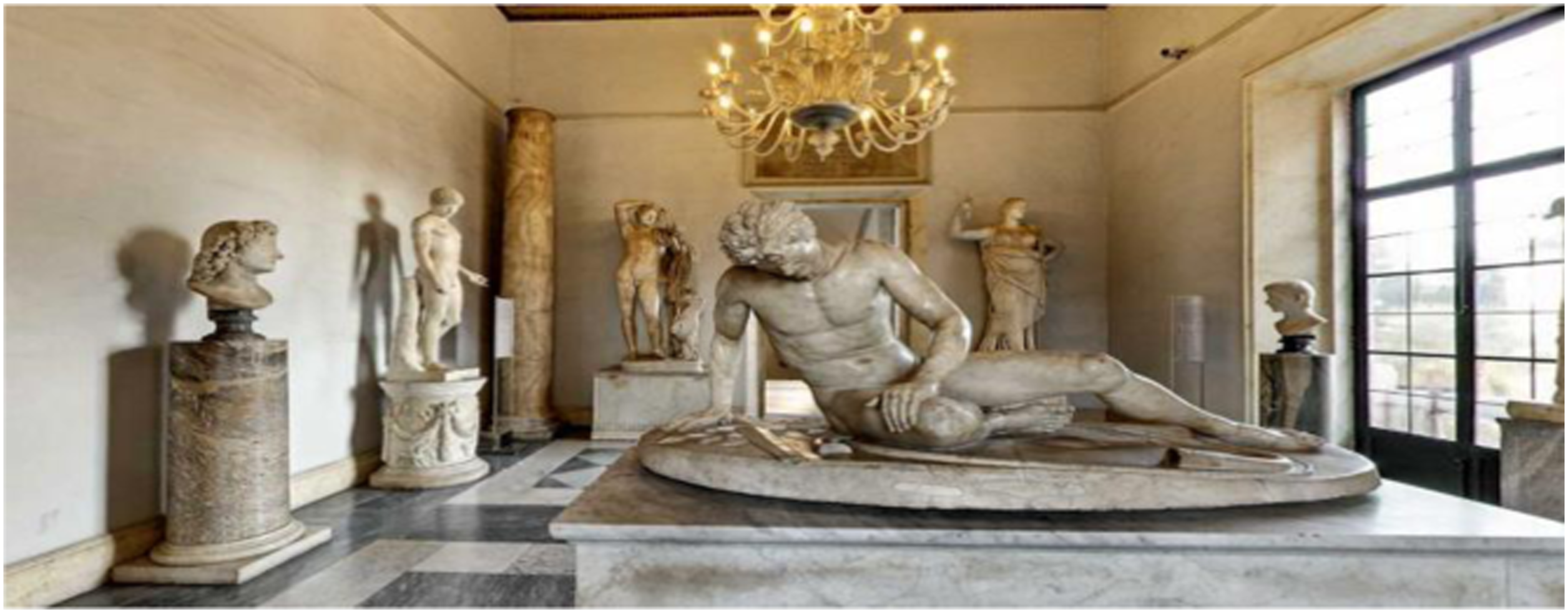
For us, the sculpture can be aesthetically grasped as embodying the values of posthumous resilience; it is a site of entangled practices of humanist violence and vulnerability. Violence here is a way by which the Romans, as an ideal model of civilization and ‘humans’, ascertained their superiority and power. Vulnerability, in this study, does not just constitute defeat, but the possibility of refusal when confronted by the violence of modern arrogance. The sculpture captures the gladiator frozen in a moment of perpetual indeterminacy and contingencies; he is forever suspended between the harsh reality of the present moment of violence, a possible glorious past amongst his people and family, and a future overshadowed by the prospect of death and extinction – not only his own extinction but of his people. Our paper closely examines this instance, recasting it within the context of the Anthropocene in a world within close proximity to extinction and an earth that can no longer be perceived as home.
The paper is in four key sections. The next section provides analytical background to the key concept of posthumous resilience, particularly drawing upon the work of Claire Colebrook in theorising beyond the posthuman. The second section examines the Dying Gaul more closely. Here we engage with previous examinations of the significance of this sculpture by reading insights from art historians and philosophers like Johann Winckelmann (1765) and Gotthold Ephraim Lessing (1880). The third section addresses the concept of what we are calling ‘active withdrawal’ via reading Byron’s depiction of the dying gladiator in Childe Harold’s Pilgrimage, Canto IV (1817) along with Dionne Brand’s poem “Prologue for Now – Gaza” (2023) where she speculatively gives voice to the “corpses” of innocent Palestinian civilians who lost their lives to Israel’s “intentional targeting of civilians, or indiscriminate attacks that risk harming civilians” (Wilde 2023, n.p.) in Gaza. The final section discusses the power of posthumous resilience in a consideration of how ‘active withdrawal’ keeps open claims to justice and enables refusal, breaking from cycles of violence.
Posthumous resilience
Our posthumous approach seeks to problematize discourses of violence and vulnerability that constitute resilience. Instead of thinking in terms of imaginaries that evade extinction and death, posthumous resilience embraces the possibility of death and extinction, underscoring values of refusal embedded in practices of vulnerabilities that refuse enslavement, domination, and erasure. Therefore, we contemplate, if resilience is a survival mechanism where it becomes possible for a certain category of beings to bounce back and recover from a crisis, how can resilience figure for those whose vulnerabilities emerge from entangled material and discursive practices marked by the violence of dehumanization, racialization, enslavement, and death? We argue that it is only through the ethical process of active withdrawal that this violent foundation can be faced, opening up a space for the emergence of new possibilities. This active withdrawal can be articulated and shaped through practices of refusal to affirm the world as it exists in the present modernist understanding.
What would it mean to become resilient in the face of extinction while fully recognizing the violence, genocide and exclusions that have brought humanity to the end of its world. In other words, what would it mean to be resilient in the face of extinction without seeking to salvage or redeem the ‘human’. A ‘posthumous’ reading of the Dying Gaul perhaps enables such an approach, based upon a perspective understood to be ‘of’ but not ‘in’ the world as constituted through the Roman gaze. By ‘of’ but not ‘in’ the world we mean the consideration of the crisis of the Anthropocene from a positionality of nonrelation, from exclusion from full membership of the ‘human’. From the speculative perspective of the less-than-human, the dehumanized barbarian Gaul, the Roman mode of being is one of violent exclusion. It is a world of excess and destruction which imagines itself to be civilized through the process of dehumanizing the other. This process is nowhere better illustrated than in the amphitheatre where the ‘barbarians’ and those denied full membership of society were sacrificed to Rome’s power and honour.
However, it is important to recognise the difference between the gladiatorial death and the mass slaughtering for entertainment of criminals, slaves, captured enemies and wild and exotic animals. The ‘posthumous resilience’ of the dying gladiator is precisely the role demanded of the Gaul as the dispensable life standing-in for the life of the Roman citizen. The role of the gladiator was, in dying, to demonstrate how death could be faced. The gladiator in defeat was expected to accept his death without flinching and without protest and so to refuse to be suborned to life in fear of its ending. In fact, Christian unease with the games was not so much over their cruelty but due to the fact that the gladiator was to face death without seeking meaning in this life or in an afterlife (University of Chicago nd). It is this ‘refusal of what has been refused’ (Moten and Hartman 2018), that is central to the powerful ethical refusal expressed in the Dying Gaul’s active withdrawal: the refusal to affirm the world that has been denied to you. The ‘posthumous’ resilience of the gladiator was not only a refusal of the lure of this world, of life and of glory, but also a refusal of transcendental faith.
The contrast could not be stronger or more performatively enacted than that distinguishing the Roman citizen and the Dying Gaul. The packed amphitheatres of often many thousands of spectators enthralled by the lavish bloodletting and the expectation that, while the audience could ‘holiday’, could escape or disavow their precarity and vulnerability in the arena’s vast displays of wealth, strength and power, the gladiator was to symbolize what it was to confront death, staring it in the face without fear. It was in the moments of dying, of death itself, that the ‘posthumous resilience’ of the gladiator is performed. It is the resilience of refusal at an ontological level, not the refusal of death but the refusal of the refusal of death. In this double refusal there is act of resilience and vulnerability but as stated above, this act of resilience is not an affirmation of the world understood as violent and degraded, nor an affirmation of life as a vital force. The Dying Gaul’s resilience is posthumous: it lacks both subject and object.
This approach is particularly relevant today, when in the epoch of the Anthropocene it appears that there is no modernist promise of futurity. There is the tension between absence and presence that constitutes the Anthropocene, which foretells the disappearance of the ‘human’ and all life on earth while leaving behind traces that affirm their past existence “legible (written after life)” (Weinstein and Colebrook 2017, 6). In terms of disappearance, we can imagine neither a future human nor a human future, enabling death to be conquered through transcendental faith in human transformability or perfectibility. This double negation performed by the Dying Gaul is captured well in Jami Weinstein and Claire Colebrook’s conceptual shift from the posthuman to the posthumous, as a refusal to affirm the human or vitalist or transcendental forces beyond the human and ‘does not boast any form of redemptive humanistic telos’ (2017, xxiii).
The gladiator’s death is an act of resilience but one that does not invest life with meaning and thereby seek to redeem or salvage anything from this life. Colebrook suggests that this approach of indifference to death and to life enables an ethical mode of being that imagines the world without the modernist social construction of binary impositions of subject/object or human/nature; without the transcendental imaginary through which the Romans ‘worlded’ a world of humans and barbarians, civilizers, and those to be civilized. In terms of the legibility associated with the Anthropocene, we read this in the aesthetic of ‘active withdrawal’ that the sculpture of the Dying Gaul captures through expressions of suffering and visible wounds on his body. This aesthetic of active withdrawal that we propose is one which removes differentiation as a practice of subjectivization and objectivization. As Colebrook writes: ‘The aesthetic is inscriptive, textual and sublime because the materiality it presents has not been humanized, nor rendered living, nor imagined as a wholeness or a connectedness’ (Colebrook 2016, 123, italics in original).
In this context, our approach enables us to provide a ‘posthumous’ reading of Byron’s appreciation of the sculpture of the Dying Gaul in the context of his work and life that moves beyond narrowly constructed romantic interpretations of dying the “good death” (Mole 2022, 233). The Romantic ideology of the good death involved “not only a certain way of facing death but also a certain way of representing one’s death” (Mole 2022, 237). Byron strongly believed in this romantic notion of facing death courageously and reflected this belief in his representation of the dying gladiator in Childe Harold, Canto IV: “Consents to death, but conquers agony” (l. 1254). However, Byron struggled to overcome the difficulty of “representing [some]one’s death” (Mole 2022, 237). For example, Byron made use of rhetorical breaks, punctuation, and dashes to convey this difficulty (Cochrane 2015, 123; Shears 2008, 184). This technique can be seen in Byron’s depiction of the moment of the gladiator’s death (ll. 1254-1269), which will be discussed later in the article within the framework of our posthumous resilience and active withdrawal.
When Byron left England for good in 1816, his goal was to break away from the English social and literary conventions, which, he felt, were oppressive and delimiting (Marchand 1968, 13). In a letter to his friend Douglas Kinnaird, Byron asked him to “arrange [his] pecuniary concerns in England” and informed him: “you might consider me as posthumous for I would never willingly dwell in the ‘tight little Island’” (Lord Byron’s Correspondence, II, 24 qtd. in Marchand 1968, 13). Later, Byron departed to Venice, and it is from this posthumous perspective that he wrote Canto IV to be published 1818. Byron’s provocative declaration resonates with our posthumous approach; his deep suspicion of (social, political, literary, etc) systems renders systematic thinking “hopeless” for him (Marchand 1968, 2) and motivates his move of active withdrawal to a self-imposed exile. By declaring himself posthumous, Byron associates himself with the earth or ‘humus’ as home. This notion is significant in our posthumous approach to resilience and active withdrawal since, as Weinstein and Colebrook (2017) point out, ‘humus’ is a notion that “carries a unifying gesture, the sense of being after the earth, after conceptions of humans as emerging from the earth, and after all the notions of the earth as home or ours” (6). In this form of (post)‘humus’ existence, active withdrawal is a refusal of the ‘human’ as a modern construct and an affirmation of the possibility to dissolve the humanism that besets the Anthropocene.
Byron’s posthumous positionality has been described as that of “self-annihilation” (Bennett 1999, 180). This annihilation is demonstrated in Byron’s wish to dissolve in nature: I love not Man the less, but Nature more, From these our interviews, in which I steal From all I may be, or have been before, To mingle with the Universe … (ll. 1598-1601)
Before his final departure from England in 1816, Byron has chosen to mark his death as a British subject by performing the symbolic gesture of visiting the grave of Charles Churchill. According to a letter by John Hobhouse, before leaving England for good Byron rehearsed his death when he lay down on Churchill’s grave then gave the sexton money to mind the grave (Bennett 1999, 181). An act that made an impression with the sexton because in doing that Byron ensures that the sexton will always remember him and associate him with death. Later, in 1823, Byron repeated this act when he visited empty sarcophagi in Kefalonia (Greece) and lay at the bottom reciting lines from Horatio and Hamlet’s gravedigger Act 5 scene 1 from Hamlet, one of Shakespeare’s plays that is mostly concerned with death and dying (ibid, 180). This act is significant since this specific scene represents an instance of Momento mori or reminder of the inevitability of death as it shows Hamlet’s transformed attitude from mockery as he performs danse macabre with an anonymous skull contemplating death’s leveling effect and invoking politicians and figures like Alexander the Great and Julius Caesar to mourning when the skull is identified as that of his friend Yorick, the court jester (Cottegnies 2022, 13–16; Morris 1970, 1035–36). In doing that, we argue that Byron situates himself as a spectre that actively withdraws, refuses the choices offered and thereby haunts the boundaries between life and death as he contemplates, with Hamlet, suffering and the futility of human life.
Byron’s posthumous positionality is one that we wish to adopt here as it exposes the senseless violence of dehumanization associated with colonial practices: “Man marks the earth with ruin” (l. 1605), and at the same time gives consequence to the act of refusal performed by those vulnerable, othered, and dehumanized; a consequence that makes this act of refusal legible posthumously and thus renders the senseless loss of life as a trace that remains to haunt the present (Derrida 2006). This sense of witnessing associated with Byron’s posthumous positionality resists forgetfulness and resonates with the description of Dionne Brand’s positionality in A Map to the Door of No Return (2001) as a “declaration of doorways, corners, and pursuit and those lines that follow, I am held, and held and I think, too, of beholding (“to see or observe a thing or person, especially a remarkable or impressive one; to hold by, keep, observe, regard, look,” OED Online)” (Brand qtd. by Sharpe 2016, 99, italics in original).
So far, in this section, we have defined posthumous resilience as emerging from a process that we call ‘active withdrawal’ leaving in its wake legible traces that (re)tell the story of colonial violence. This process is shaped by different practices that refuse the modernist meaning of death and of leaving the ‘human’ world. The Dying Gaul sculpture in the Capitoline Museum in Rome, we argue, captures these traces of interplaying practices of refusal, placing him in neither the realm of the human nor the posthuman but within that of the posthumous. This is an attitude analogous to Byron’s posthumous approach. The scenes of dead bodies of innocent Palestinian civilians as a result of the senseless Western colonial violence are captured in social media, pictures, graffiti, and different forms of art. Brand describes the materiality of this kind of action by relating it to the function of the eyes watching the unfolding violence and witnessing posthumousness being (en)acted. Relating to the centrality of slavery, Brand places embodied violence “on her retina” (Brand, 2001 qtd. by Sharpe 2016, 99), through which one can witness and read “history …. written on … [the] flesh, as an optic that guides her way of seeing, understanding, and accounting for her place in the world” (99). Sharpe explains that in this sense Brand supplies us with a frame that sees vulnerable bodies “as signifiers of enslavement and its excesses, and it is the ground that positions her/us [the witnesser] to bear the burden of that signification” (99).
Guided by insights from art history, the next section will closely analyze the sculpture of the Dying Gaul by examining its cultural and historical significance. For us, the sculpture captures an instance of refusal where the interplay of material practices of the fight and discursive practices of othering articulate the gladiator’s/Gaul’s ‘active withdrawal’ from the violence of enslavement, racism, and dehumanization and instead opens a space where his posthumous resilience can assert itself.
The Dying Gaul
Focusing on the Dying Gaul, we read insights from art historians and philosophers like Johann Winckelmann (1765) and Gotthold Ephraim Lessing (1880), and Byron’s depiction of the dying gladiator in Childe Harold’s Pilgrimage, canto IV (1817). For us, the sculpture embodies entangled practices of humanist violence and vulnerability. Vulnerability, here, does not constitute defeat, but the possibility of refusal in the face of the violence of modern arrogance embedded in Rome’s claim to civility. The Gaul is situated outside the modern ideal of the ‘human’ and human civilization; he is dehumanized and deemed savage and barbarian. Posthumous resilience underscores the Dying Gaul’s active withdrawal by highlighting aspects of refusal and indifference to death and extinction. We argue that active withdrawal can open up a space where ethics and politics can be conceived otherwise.
At the center of the Hall of the Galatian in the Capitoline Museum in Rome lies the sculpture of the Dying Galatian/Gaul. The sculpture depicts a Celtic warrior, forced to fight to the death in the Roman colosseum, and dying of fatal wounds inflicted on him in a Roman fighting arena. 2 In Rome, the gladiator fight was a way by which the emperor and rich nobility displayed their wealth and commemorated their military victories; it was also a way to distract the people from the economic and political issues of their time (Cartwright 2018, n. p.). The sculpture, found in 1622 in Rome, is a marble replica of one of the bronze group of statues dedicated to Athena and situated on the Acropolis of Pergamon, to celebrate the victory of King Attalos I (241-197 BCE) over the Galatians (Cassibry 2017, 10). Later, Julius Caesar commissioned this sculpture for propaganda reasons as part of his military campaign against the Celtic tribes (seen as barbarians or savages) to show the strength of the Roman empire and its ability to defeat such strong and worthy opponents (28-30).
Rome’s unquenchable desire for colonialization, exploitation, and self-glorification feeds upon these vulnerabilities which are deemed nonhuman. The sculpture shows a warrior fallen on the shield, his head and posture bent in a last moment of resistance. Winckelmann (1717-1768), describes the warrior as follows: It represents a man of toil, who has lived a laborious life, as we may see from the countenance, from one of the hands, which is genuine, and from the soles of the feet. He has a cord round his neck, which is knotted under the chin; he is lying on an oval buckler, on which we see a kind of broken horn. (Winckelmann qtd. by Knight 1833, 10)
Based on Winckelmann’s description, the sculpture emphasizes two important aspects: first, the defeat of a strong and worthy warrior. Second, the victory of Rome over its enemies (Gauls) who are strong and worthy. The glory of the empire is linked to glorifying the death of their captured warriors or barbarians, as the Romans chose to describe them (De Souza 2011, 35). The expressions captured by the sculpture of the Dying Gaul show the inner struggle between his stoic vulnerability and dignified resistance that defies surrender and, therefore, actively withdraw and thereby annul any Roman conception of disgrace or defeat. The posture of the fallen warrior (Figure 2(a)) as well as the muscles in his arms and hands are tense, which suggests that he is pushing against the ground and trying to get up and resume the fight despite the fatal bleeding wound on the right side of his chest. This perseverance appears to be in line with what Gotthold Ephraim Lessing (1880) explains when describing the gladiator: The condemned …. gladiator was bound to do and bear with grace. No sound of lamentation must be heard, no painful contortion seen. His wounds and death were to amuse the spectators, and art must therefore teach the suppression of all feeling. The least manifestation of it might have aroused compassion, and compassion often excited would soon have put an end to the cruel shows. (28-29) A zoomed view of the Gladiator’s body and head (by the authors). The picture is from the Capitoline Museum website: https://www.museicapitolini.org/en/opera/statua-del-galata-capitolino.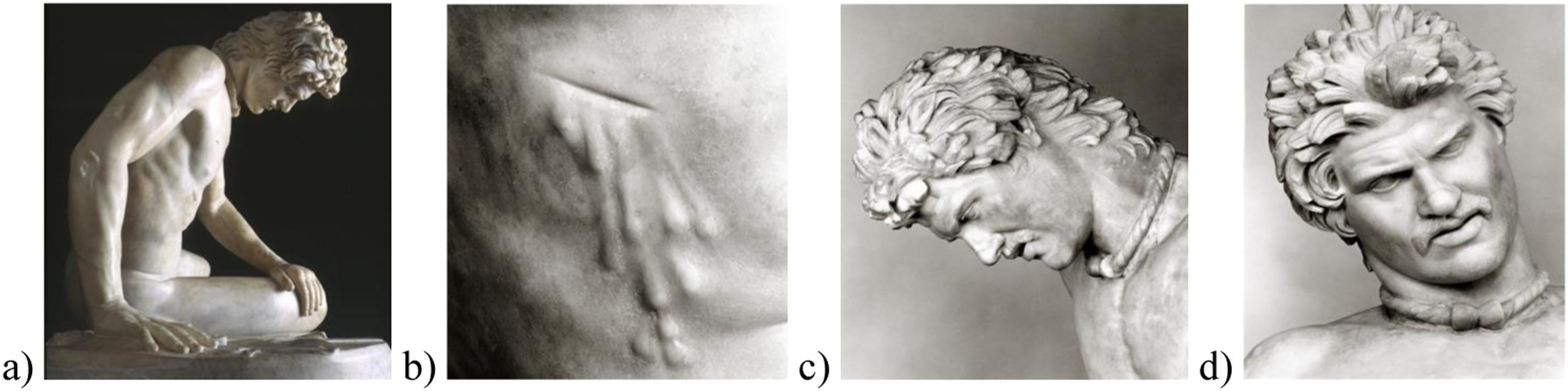
According to Lessing’s statement, if the sculpture expresses exaggerated pain, then compassion would be the goal; by receiving compassion and sympathy from the audience, the purpose of the sculpture would be satisfied and forgotten. However, according to Lessing, by suppressing agony in the sculptural depiction, the Gaul highlighted the dynamism of the struggle, in which he appears to resist and refuse injustice, violence, and extinction. In Enemies of Rome: Barbarians through Roman Eyes (2002), Iain Ferris explains that the sculpture captures the “isolation and dignity” (86-88) of the warrior who is fighting for his life in the arena, as a simulated battlefield, challenging imprisonment and enslavement and voluntarily choosing to actively withdraw and achieve death on his own terms rather than those set for him. Indeed, in his silent agony, the warrior refuses to express pain; his nakedness, according to Ferris (2002), shows him to be vulnerable, wounded and dying, yet is “still strong through the expression and celebration of his” muscular physique (88). Instead, the angle of his neck (Figure 2(c)) and expressions of his face (Figure 2(d)) suggest inner suppressed suffering while trying to recollect his strength and resume the fight. Cassibry (2017) describes the moment of the warrior’s expiration as follows: The tension of the subjects torqued pose - with torso and legs twisting in opposite directions - helps communicate the figures struggle, but it was not entirely new at the time. The sculptures innovation lies instead in communicating how a mind loses control of an injured body. The taut muscles of the right shoulder strain to hold upright a torso tilting forward. The downturned head with its tensed brow, withdrawn gaze, and slack lips conveys life's waning. (29)
In his refusal, the warrior disrupts and puts in question the hierarchies of power and ethical superiority. The Gaul’s death, we argue, spares him the humiliation of imprisonment and enslavement, and the manner of his death, captured in the sculpture, becomes an instant of posthumous resilience that defies time, space, and the violence of the modern humanism.
In this section, we demonstrated how the Dying Gaul embodies the practices of violence and vulnerability where confronting death can be articulated as a process of active withdrawal that defines his resilience as posthumous in its refusal of the world as constructed by the Roman society. We argued that the Gaul’s posthumous resilience reinforces the agency of the Gaul’s refusal and allows us to contemplate the violent past of othering, enslavement, and dehumanization in the present moment. In the next section, we examine Byron’s poetic portrayal of the Dying Gaul in Canto IV of Childe Harold’s Pilgrimage (1817). We demonstrate how the excess avoided in the Gaul’s sculptural depiction is pronounced in Byron’s poetic hyperbole. We argue that the Gaul represents the possibility of imagining life differently as opposed to just (re)producing life and invokes an ethics of active withdrawal that refuses the lure of the world and resilience as a salvific act.
Active withdrawal
The Dying Gaul was depicted poetically by Lord Byron. As part of the grand tour,
3
Romantic poets, like Byron, visited the Capitoline Museum and the Colosseum, and wrote about the sculpture. Lessing (1880) argues that poetic or dramatized depictions should be different from the sculptural depictions: [W]hat is to be avoided in the arena is the very object of the tragic stage, and here, therefore, demeanor of exactly the opposite kind is required. The heroes on the stage must show feeling, must express their sufferings, and give free course to nature. (Lessing 28-9)
Thus, the exaggerations avoided in sculptural depictions, according to Lessing, are actually advised in poetic and dramatized depictions. This licence for emotional engagement is compatible with the Romantic sensibility as well as the affective nature of the Anthropocene. Byron’s Childe Harold’s Pilgrimage, Canto IV animates the fight and shows us the Gaul’s refusal as a process:
After briefly complementing the Gaul’s ability to “conquer agony,” Byron underscores the Gaul’s defeat using words like “lie,” “droop’d,” “sinks,” “low,” “fall,” and “gone.” The ‘inhuman’ character of the cheering crowd, we argue, describes the nature of the fight and introduces the element of time. According to Deleuze and Guattari (1983), “codes continue to exist—even as an archaism—but they assume a function that is perfectly contemporary and adapted to the situation within personified capital (the capitalist, the worker, the merchant, the banker)” (232). As explained earlier, gladiator fights are also occasions for the rich classes to display their wealth and power. This implicates greed and profit-seeking as an assemblage in this barbarous tradition that constitutes the spectators, the fighters, and the crowds. Despite the fact that Roman society did not have an advanced economic system, Runciman (1983) argues that Roman practices, like buying, selling, borrowing, lending, taxing, inheriting, auctioning, extortion and trade were as capitalist as the current social structure that is organized around “conflicting classes standing in different relations to the means of production” (157-58).
Runciman (1983) explains that, in Rome, elite classes owned “means of production” (166) in the form of cultivatable land and slaves, and controlled access to them as well as any “disposable surplus extracted” from them (166). Deleuze and Guattari (1983) confirm the agency of Roman practices in the emergence of contemporary understandings of capitalism, arguing that Roman and other ancient civilizations (like Egypt) are “latent” (218) origins for the emergence of class distinctions, and relations between creditors and debtors, “wealth and poverty” (218), as well as “commodity and labour” (218). Those relations evolved from “primitive communism” (219) to “ancient city-states” (219), to “feudalism” (219), until forming the present understanding of capitalism (219).
In this sense, the arena becomes a code for production and re-production of wealth and a place where the vulnerable other is being murdered. The ‘inhuman’ shout does not only illuminate the savage and barbarian nature of the fight but also shows the audience as complicit in the killing. McGann (2021) argues that “what Byron ‘adds’ to the language is an across-the-board allegiance to the borderless condition of vox populi” (191- italics in original). Furthermore, the archaic nature of “inhuman [ity]” entangles time and space and shows material-discursive practices of violence as not enclosed in the moment of the fight but as a process extending through the past, unfolding in the present, and in continuous flux.
Byron’s emotional reaction to the injustice and hypocrisy gives voice to the Gaul’s thoughts:
Byron’s lines resonate with Dionne Brand’s poem “Prologue for Now – Gaza” (2203). Brand links the trauma of slavery to the current genocide unfolding through Israeli aggression against civilians in Gaza.
Byron exposes the Roman act of dehumanizing the Other when he shows how the Gaul’s children are deemed “Barbarians” by the supposedly civilized Romans. Similarly, Brand exposed the colonial dehumanizing violence in her poem when she shows how Palestinians are deemed “human animals” (ll. 3-4) by the supposedly civilized Western powers that support Israel’s violent campaign in Gaza. The parallel between Byron’s and Brand’s poetic depiction is striking, marking how violent acts of othering and dehumanization performed by colonial powers extend from the distant past and entangle with the violent hands of the colonial aggressor in the present moment. Karen Barad describes this using Albert Einstein’s words as “Spooky action at a distance” (Barad 2010, 251), which “work [s] even beyond the grave, with its effects felt after the link between objects is broken...memories of entanglements can survive its destruction” (Choi 2009, 24 qtd. by Barad 2010, 252).
Commenting on Brand’s poem, Claire Schwartz asserts that “while liberal equivocations are laundering the current genocide through civic procedures of legislation and polite conversation … Brand names the complicity between these supposedly opposed schemes” (Schwartz 2023, 2). Similar to Byron’s grief for the dying Gaul who physically faces his impending death with his heart and thoughts with his loved ones, Brand “opens a space for a grief that hold dear what empire would render disposable, including the more than 7300 Gazans Israel has killed” (Schwartz, Jewish Currents (2023), 2). This notion of entanglement underscores the significance of thinking with posthumous resilience and the ethics of active withdrawal as it exposes the afterlife of catastrophic violence that “require [s]/inspire [s] a new sense of a-count-ability, a new arithmetic, a new calculus of response-ability” (Barad 2010, 251).
The persistence of memory in time and space is articulated in Byron’s poem as a way that defies forgetfulness and erasure and echoes the posthumous approach to resilience. Byron writes about posterity:
As a river, the “Danube” can also symbolize time, and suggest the persistence of violence against the vulnerable Other in time and space. Thus, the Gaul as racialized being embodies space and time, where his past, present and future are entangled at the moment of his death in the form of memory. Identifying with the gladiator, Byron speaks of the Gaul’s as well as his own suffering; he asserts that “remorse,” produced by encountering hard and “rocky” hearts that are closed to love, is a sentiment that will endure “torture” and persist through time.
In this sense, Byron’s hyperbolic condemnation of the Roman civilization and his earlier recognition of the lure of revenge invoke the ethics of active withdrawal as a refusal of the lure of the world; as a refusal of resilience as salvific or affirmative of potentiality ‘in’ the world; there is nothing that revenge can achieve or restore. This prompts us to carefully think through what active withdrawal entails within our posthumous approach to resilience.
Standing in the colosseum, Byron juxtaposes the past with the present. Immersed in the past, Byron’s thoughts depict the loud action of the “buzzing nations,” “Dashing or winding,” as they recklessly “choked the ways” by muting and dehumanizing differences and perceiving of “death or life” as “playthings.” Suddenly, Byron is back in the present moment, the Colosseum appears to be silent since the action, conjured up by Byron’s thoughts of the past, halts: The place is now empty and echoes his voice back to him. Byron’s words choice: “fall,” “faint rays,” “crushed” seats, “void” arena, and “bow’d” walls suggests a solemn moment of sadness and mourning where even the walls, as witnesses to the slaughter are now bowing their heads in respect.
In this section, we analyzed Byron’s animating depiction of the Gaul’s predicament. The degrading and muting violence of Rome is juxtaposed with the dignified active withdrawal of the Gaul. In his emotional rebuttal of injustice, we see Byron contemplating forgiveness and revenge as potential responses to the injustice in the world. In the next section, drawing on Saidiya Hartman’s refusal of material compensation for violence and Christina Sharpe’s suspended refusal, we argue that Byron’s appeal to a posthumous form of justice through his invocation of Nemesis, the goddess of the gladiators, defines our active withdrawal. The framework of active withdrawal and posthumous resilience is generative for a refusal to accept and to affirm the given modes of being in the world.
The power of posthumous resilience
In canto IV, Byron invokes ‘Nemesis’, the goddess of the gladiators, who is worshipped at Rome as the “avenger of crime” (Shears 2017, 198) and particularly renown as personifying retribution for the sin of hubris (of arrogance before the gods). Byron writes:
Indeed, Byron’s turn to Nemesis and contemplation of justice in terms of “unbalanced scales” and “unnatural retribution” alerts us to the complexities underlying the notion of justice and what entails responsiveness and accountability to violence against vulnerable beings. As mentioned earlier, the Gaul embodies the violence of colonialism, slavery, racism, and othering in general, but also of refusal, the rejection of having experiences of violence and suffering defined in terms of victimhood and demands for material compensation. Nemesis, therefore, is a figure of neutrality or active withdrawal, a refusal to take sides or to find a higher meaning; this is a justice of dispassionate distribution rather than of ethics or rights.
In Lose Your Mother: A Journey Along the Atlantic Slave Route (2008), Saidiya Hartman refuses “to believe that the slave’s most capacious political claims or wildest imaginings are for back wages or debt relief” (170), arguing that this would only achieve “limited emancipation against which we now struggle” (170). Hartman (2008) argues that violence would not be undone by further victimization and/or material compensations but in fact would only enact an “afterlife of slavery” (6) in which the vulnerable continues to suffer from “skewed life chances, limited access to health and education, premature death, incarceration, and impoverishment” (6).
Whereas Hartman warns against material compensation and victimization, Nietzsche calls attention to the danger of revenge. In Beyond Good and Evil (1911/1969; Fraser 1976), Nietzsche warns that “he who fights with monsters should be careful lest he thereby become a monster” (97), comparing this to “gazing long into an abyss” (97); he explains that the danger of fixating on the abyss is that it “also gaze into thee” (97). Nietzsche’s assertion draws attention to the way violence gets to be (re)produced as the behaviour of the aggressor gets to be perpetuated in a never-ending cycle of revenge. Thus, we argue that Byron’s concern situates Hartman’s stance that refuses settling scores through material compensation in conversation with Nietzsche’s stance that warns against the pursuit of revenge.
The key point for us about Byron’s use of Nemesis is the powerful analogy in the link between the gladiator (as less-than- or other-than- human) and the punishment for (all-too-human hubris). This punishment cannot be one of revenge as the Dying Gaul has no stake in the world of the arena, the Gaul is not a member of Roman ‘civil society’. In the words of Christina Sharpe (2016) the Gaul is not ‘on the deck’ in the auditorium as a spectator but ‘in the hold’ in the holding pens underneath the arena. Sharpe’s work, In the Wake (2016), has been particularly important for us in thinking through ‘posthumous resilience’ as active withdrawal, as a refusal which is necessarily suspended, refusing an understanding of the human as either a controlling hubristic modern subject or the human as victim, broken and defeated but nevertheless articulating a coherent positionality of critique and redemption.
Active withdrawal, as an ethical imperative, emerges as practices of the present and the past overlap and the refusal to affirm modes of being in the world as it exists and informs the course of action in the future. For us, this is exactly analogous to the reading of the posthumous resilience of the Dying Gaul. In facing death without flinching, without prostrating himself before the baying crowds of the arena, the Gaul refused and becomes indifferent to, what Weinstein and Colebrook (2017) call, the “inhuman rites” (5), the sacrifices demanded into to sustain and to safeguard currently existing ways of producing and consuming.
Active withdrawal as a concept is generative of less hubristic understandings of resilience, enabling the move away from calls to defend borders, boundaries, rights, and territories to the death. Calls to ‘bounce back’, to return to the status quo are exactly those that reinforce and reify the world as it exists. Attempts to secure and to defend this world to the death, as we can see on our TV and computer screens daily, imply the deaths of others as well as our own. Human and non-human worlds have long been and continue to be sacrificed, to maintain modernist imaginaries of progress and discourses of resilience which underpin them. As the bodies of innocent men, women and children continue to pile up in Gaza while the world looks on, the costs of the gratuitous violence necessary to enforce colonial and racial hierarchies ethically and politically can no longer be disavowed.
Conclusion
The Anthropocene is a concept that evokes the violence of human actions against human and nonhuman Others. The interdisciplinary aspect of the Anthropocene allows us to read insights from art, literature, and resilience discourses through one another to think of resilience in ways which do not disavow the violences and exclusions of the Anthropocene. We have sought to think of resilience in ways which do not affirm the ‘human’ world as it exists but at the same time refuse the imaginary of the posthuman as a critical positionality of vulnerability and victimhood. In doing so we have drawn upon the Dying Gaul as a liminal figure of posthumous resilience – a resilience that does not seek to reinstaur a world of subjects and objects; that does not seek to legitimise existing modes of power and regulation or to engage in the politics of revenge and new forms of closure and control. This concept feels particularly relevant in our contemporary times as the practices of Israel’s colonial violence in Gaza become “a legible scar that will endure” (Weinstein and Colebrook 2017, 6), as excessive gratuitous colonial violence can only ever encourage and incite further cycles of violence and repression.
As further generations look like being condemned to conflict, unspeakable violence and permanent injustice in the Middle East, we have truly come to the limits of traditional modes of political contestation and conflict. Claims of resilience or of victimhood can only expand and deepen the conflict. With the help of Byronic constructions of what we are calling ‘active withdrawal’ we have heuristically imagined posthumous resilience as the ‘refusal of what has been refused’; a refusal of the choices apparently available and thus keeping understandings of justice open. Drawing on a number of contemporary theorists and poets, including Claire Colebrook, Saidiya Hartman, Christina Sharpe, Karen Barad, and Dionne Brand, we have presented posthumous resilience as potentially opening up other ways of thinking and being that do not have to affirm the world as it currently exists. Thus, posthumous resilience keeps open as yet unimagined possibilities through a stance of refusal as active withdrawal.
Footnotes
Declaration of conflicting interests
The author(s) declared no potential conflicts of interest with respect to the research, authorship, and/or publication of this article.
Funding
The author(s) received no financial support for the research, authorship, and/or publication of this article.
Notes
Author biographies