




Abstract
This paper analyses how a state produces new internal borders. It selected 1668 newspaper articles on the COVID-19 internal bordering case in Slovakia to answer this question. These articles were then analysed using the thematic trajectory analysis (TTA) through the conceptual prism of structurationism. The results suggest states apply methods during the production of internal borders similar to those used during the (re-)production of an international border. In particular, it shows the application of a military-testing nexus and economic tools to ensure compliance with the new border. Results also revealed that such a border is heavily dependent on popular support for the government and open to re-negotiations by relevant societal groups. From the border production perspective, this study offers a preliminary step into the area of internal borders imposed on a generally homogenous population, especially regarding the borders produced under COVID-19 conditions.
Introduction
With the outset of the worldwide COVID-19 pandemic in late 2019/early 2020, the world has witnessed possibly the most potent case of the return of national borders since the end of the Cold War. Even European Union (EU) countries, which enjoyed border-control-free travel for several decades, closed their borders with the military and the police checking required documentation and measuring temperature. At the same time, new measures were implemented inside the countries. Nationwide lockdowns confined their citizens to their homes and restricted movement through the internal borders. The confinements were sometimes enforced even through mobile phone tracking data (Pollina and Busvine, 2020). Moreover, movement across all sets of internal borders was tied to specific requirements such as essential travel (What counts as essential travel during the Covid-19 lockdown?, 2020), compulsory mouth and nose covering (Min and Phua, 2020), or temperature checks (Standard Business, 2020).
Most of these newly implemented measures were intended to reduce the spread of COVID-19, more or less in line with the previous research on the spread of infectious diseases and viruses. For illustration, Wood et al. (2007) simulated the closure of internal borders in Australia during an influenza outbreak. Their conclusions suggest that the imposition of internal border controls can limit the spread of the epidemic. Priest et al. (2015) studied the efficacy of the border screening methods (self-reported symptoms and temperature measuring) in preventing influenza spread in New Zealand during the South-hemisphere’s influenza season of 2008. Their conclusions suggest that these two methods of border screening achieve only limited success in preventing the entry of infected people. Based on lessons learned from strategies used during the West African 2014-2016 Ebola outbreak, Merrill et al. (2017) concluded that maximum efficiency is achieved by adequately integrating points of entry, border regions and management of internationally mobile populations into a comprehensive health security agenda. Similarly, Zlojutro et al. (2019) used the 2009 pandemic data to identify the airports' most effective border control strategy.
While it is likely that most of the imposed restrictions were in line with available research, the issues associated with setting new bordering practices were not necessarily considered to the same degree. The rapid re-emergence of new and old borders in everyday lives, at least in the West, led to several academic commentaries and articles on the subject. Casaglia (2021), for example, highlighted the use of COVID-19 screening as a new bordering practice aimed at reducing migration through formal points of entry and also restrictions on access to health services for non-citizens. Similarly, Garrett (2020) studied how the implementation of anti-COVID-19 policies by the US Administration was intended to dissuade potential immigrants from Latin American countries. Similarly, several other works looked at the legal perspective of the border closure, arguing against the legality of such decisions and highlighting the impacts on human rights and individual freedoms (Chetail, 2020; Ramji-Nogales and Goldner Lang, 2020; Korkea-Aho and Scheinin, 2021). Pahor (2020), on the other hand, analysed the multiple functions of the reinforced border between Italy and Slovenia that was produced and re-produced during the first wave of the pandemic.
Nevertheless, as Radil et al. (2020) noted, whereas the reinforcement of the international borders was the most noticeable method of state response to the outbreak, there was a significant uptick in the activation – and even creation of – internal state borders. Borders were erected between regions, cities and even neighbourhoods. In most cases in Europe, these internal borders were activated even before restrictions on external mobility were put in place (Rausis and Hoffmeyer-Zlotnik, 2021). Consequently, the new boundaries and bordering practices enabled the creation of the Other even within the formerly unified nations. Finn and Jakobson (2020) reported the situation in Chile where citizens of smaller municipalities treated the denizens of the capital Santiago as an ‘infected population’ and attempted to prohibit interregional movement by makeshift barriers.
Similarly, Liu and Bennett (2020) describe the emergence of rural gated communities using rudimentary fortifications in China, where visitors from the region could enter only upon being subjected to a temperature check, while visitors from other regions were barred from entering altogether. As the infection rate subsided, the formal introduction of colour-based QR coding for possible infection indication replaced the makeshift bordering practice used before. Tedeschi (2020) offers an autoethnographic account of how the early internal bordering procedures based around particular performativity (i.e. wearing a mask, keeping the distance) were put in place – some even before being formalised into law.
In this regard, described internal borders, often established by previously de-bordered communities, provide a clear-cut case of how a new boundary is created. Furthermore, COVID-19 internal boundaries provide a unique insight into bordering practices that were very tightly associated with accordance of rights – even those that were often considered fundamental. They also show how new identities are created along the new borders, even inside a previously unified state, sometimes even beyond its intentions. It is these new internal borders that the presented article intends to describe in further detail, especially in terms of their establishment. In particular, the main aim is to uncover the methods the state used in creating the borders and how they established the process of othering and affected the population. Based on the cited scholarly work, the article expects to find a relationship between the strength of the COVID-prevention practices as the new official bordering techniques, the structural factors stemming from the state and the economy and the reflexive factors arising from the individuals affected by the border. Additionally, it aims to uncover any other connections between and constellations in the official (i.e. state) and unofficial (i.e. private, non-governmental) border production from the vantage point of the state-imposed procedures.
In order to achieve its main aims, the article used an adjusted theoretical prism of border structurationism to study a single case. This approach can provide essential insights into how the processes of border production were put in place and executed. The theoretical prism is applied through the thematic trajectory analysis method borrowed from organisational psychology. While the COVID-19 world abounded with cases of such borders, the presented paper studies the case of Slovakia. The Slovak Republic was virtually the only country in the world whose government decided to test the entire population for COVID-19 positives and then associate the negative result with a more significant degree of freedom. Therefore, every individual living in the country had to participate and experience the new bordering practices first-hand. However, before delving into the specificities of the case selection, it is necessary to clarify the basic conceptual framework for the analysis of border and bordering. Afterwards, the case selection is further justified along with the description of the method. The final two sections deal with the actual case study and its conclusions.
Borders and bordering
The necessary start for the discussion of border production is the definition of what a border is. Newman (Newman, 2003: p. 14) conceptualises borders as institutions that manage the extent of inclusion and exclusion, separating the identification of the ‘self’ from the ‘other’. The process that leads to the establishment of the ‘self’ and the ‘other’ is termed bordering (Newman, 2003: p. 15). However, borders and associated processes appear not only at the limits of larger societal groups but also within them. Examples include administrative borders within a country, cultural or class borders between city quarters, or even activities such as immigration documents check by a police officer far away from the given state’s border (2013: p. 6).
Consequently, borders should be taken as differentiation labels established through bordering processes continually created in society’s daily life (Kolossov and Scott, 2013: p. 3). They are inherently linked to the symbols, behaviours, and stories a given society uses for these purposes (Kolossov and Scott, 2013: p. 9). And are therefore created through performances that demonstrate belonging and sameness (Barth, 1998).
Regarding the creation of new borders, there were those concerned with the impact of globalisation on national borders. The fledgling globalisation at the outset of the 1990s arguably led to the creation of new borders. Globalisation has been thought to bring about new boundaries and identities overlain on still relevant national borders. Phenomena such as cyberspace, regional integration, or transnational corporation arguably contributed to the construction of new and genuinely global communities with their associated performative practices creating a new set of borders that coexist with the old national ones (Sassen, 2006: p. 406; Laine, 2016). Other case studies focused on the production of borders in specific contexts. Claire Beaugrand (2018) analysed the role of many actors ranging from state institutions through elites to people’s everyday lives in the production of national identity in Kuwait.
Similarly, Cathrine Brun (2019), on the other hand, examined Georgia and Sri Lankan boundaries and the impact their changes and subsequent productions have on the experiences and identities of people living in the borderlands. Galen Murton (2017, 2019), studied the interaction of ethnic identity with fenced borders and hardened border regimes in the case of the Mustang-Tibet portion of the China-Nepal border. The author analyses how the Chinese hardened border regime policy toward the Mustang population due to its ethnic closeness to the people of Tibet. These two types of studies show, as Newman (Newman, 2006: p. 183) noted, that borders are not inherently territorial, despite the importance of territory in establishing societal order and organisation. Therefore, the territory concerning borders is relevant for analysing symbolic identity and socio-political power relations (Newman, 2010: p. 773) but is not necessary for analysing any borders that are put in place. What matters is the exclusivity-producing performances that are tied to the production of borders across a large number of bordering actors.
However, the performances cannot be tied only to the daily actions of those who (de-)border (Rumford, 2006: p. 164), nor can they be treated only through their relation to a broader set of historical and ongoing state and institutional performances (O'Dowd, 2010, pp. 1147–1148). As Ferdoush (Ferdoush, 2018: p. 184) suggested in his structurationist theory of borders, both are necessary for the actual production of a border. In summary, this means that the new border production is conducted through the combination of procedures created by state institutions and agents and their adoption and conduct by the population in day-to-day life, who also act upon the established structure. These procedures need not be tied to a particular territorial setting by default. Still, they can be used by the state and non-state institutions, as well as individual citizens, in identification and associated inclusive and exclusive practices intended for ascertaining belonging or sameness in one way or another.
While Ferdoush specifically focuses on borders as edges of state structures, he notes that the theory can be applied to internal bordering outside of the actual borderlands (e.g., during airport border checks). In this regard, as structurationist border theory aims to offer a general understanding of how new borders are created and those existing are sustained, it is appropriate for the article’s aims. Nevertheless, due to its state-border-focused nature, some revision of its fundamental concepts is required.
In particular, the usual structural factors Ferdoush understands as vital in understanding the existence of the state border are most likely not necessarily relevant. Border relationship to other state regions, relationship with neighbouring states and its domestic central institutions, the level of local governance and economic performance (Ferdoush, 2018: p. 189) do not seem relevant to the issue at hand. All these structural factors deal primarily with the relationship of a particular bordering region to the state level, both domestic and foreign. In this regard, the diffused nature of the internal COVID-19 era bordering lies outside of their purview. This leaves market forces, the state’s economy, and political strength as relevant structural factors.
Furthermore, the COVID-19 status needs to be added. Naturally, the nature of the factor has little to do with the actual health of the individual but concerns the state institutions’ use of health as a bordering factor. The new structural elements required to study this particular type of border, therefore, are market forces, the state’s economic performance and the strength of political institutions.
On the other hand, the factors stemming from the population that is to adopt and act upon the new bordering (i.e. reflexive factors) appear fitting for the study at hand. For example, it is possible to expect that new bordering was more easily applied to cultural or ethnic minorities. Similarly, one can assume that individuals’ socio-economic conditions played a role in the decision to uphold or protest the imposed bordering as they were connected to the ability of people to maintain their livelihood. It also applies to the political background of the people at hand – people supporting the opposition parties would likely try to find ways to circumvent the bordering processes.
Finally, the state of the border is the outcome of the structural and reflexive factors. While Ferdoush does not explicitly discuss the border status as a dependent variable in his paper, it is implicitly discussed when he talks about the willingness to accept the bordering from the individuals and the border strength when it comes to globalisation (Ferdoush, 2018: pp. 190, 192). Essentially, it means that the way the border is negotiated between the reflexive borderlanders and the structure and its agents should be the outcome of the daily interaction between the aforementioned factors. A border can therefore be strong, weak or ignored based on this interaction. With COVID-19 borders, it means the interaction between the market, the national economic performance, the state’s ability to enforce new rules, and the spread of the infection on the one hand and the individuals’ backgrounds on the other should lead to a varying state of the new border at hand.
Overall, the structurationist theoretical prism allows for the identification of critical factors to be tracked on the side of the national institutions and population subjected to new bordering. The next step is to locate the listed structural and agent-level elements in the empirical terrain and connect them to the applied method and the selected case.
Analytical approach: tracking bordering and method used
Before defining the method, it is necessary to explain how the proposed theoretical concepts are tracked in the case. Since the presented paper attempts to describe the bordering process in its temporality, the tracked variables need to change over time and provide a within-case variation that would impact the status of the border.
Starting with the individual structural factors, the market forces are understood as the population’s and businesses' particular supply and demand. In particular, it should mean the standing of the business environment and the customers’ desire to acquire products or services. The temporal variation in this factor would focus on the overall need to buy or sell products to maintain the market’s existence. The expected relationship to the new border is that the higher the need to purchase or sell a specific product or service, the lower the willingness to respect the new border. In empirical terrain, it is tracked by the overall economic well-being of businesses and calls, complaints or protests of business owners or potential customers against the new border.
The state economy should describe the overall well-being of the economic life in the state, including the provisions and measures taken at the national level to adjust the market forces described above. In particular, it should detail the state apparatus’s focus on alleviating the country’s monetary situation through specific policies aimed at incentivising the implementation of the new border. The factor entails national policies of financial transfers or tax breaks for business owners or social support to people left out of work due to new bordering provisions (e.g., those that worked in face-to-face services). It is assumed that the better the state of the national economy and the more support for the striving population, the more robust the new bordering practice becomes.
Regarding the country’s political strength, the factor focuses on the ability of the state to enforce its decisions on bordering. In developing countries, it generally denotes central institutions’ power projection towards the border. In particular, it is the capability to successfully demand the performance of those institutions that are required by the law to create and maintain the structure’s edge (e.g. pay the tariffs on imported goods, present a passport at the checkpoint or even have a checkpoint booth operational). However, with internal borders, the power projection is inside the territory. Therefore, political strength denotes the ability to punish those ignoring the bordering practices, ensuring the appropriate documentation is carried by the relevant individuals, and employing the military and the police force to support the decisions on bordering. Furthermore, in the case of democratic states, it should also include popular support for the government, as discontent with the governmental measures can lead to fear when it comes to enforcement of the accepted rules. The hypothesised relation to the border is that the higher the political strength, the stronger the newly established border.
Finally, the specific structural factor related to the COVID-19 spread is understood as the viral spread in the bordered population and state policies related to tracking the health status using bordering-relevant categories. From the first perspective, this is followed simply by the number of infections within the studied country and worldwide. The second perspective is applied through particular tools used by the state to establish health as a bordering relevant category. In particular, it focuses on the testing requirements, the special software applications, the paper and virtual identifications, the temperature checks and other similar tools used for allowing or denying entry to an establishment or exit from a domicile. The expected relationship between the viral spread and the border status is that the higher the number of infections, the stronger the border. For the state COVID-19 policies, it is expected that the larger the number and more significant the rigidity of the guidelines, the weaker the border. The justification for this relationship is the assumption that any new rigid and strong border is more difficult to be accepted by the population.
Outside of the structural and reflexive factors, it is also necessary to define the other fundamental concept applied here – the border. In this case, the term ‘border’, ‘border practices’, or ‘bordering’ is understood as any practice imposed formally by the state or informally by non-state actors that requires identification of a given individual that pertains to the prevention of the viral spread. In practice, this means state decrees on compulsory masks, state-imposed limitation of movements associated with mask-wearing, negative COVID-19 test results, and measures undertaken by social groups, private businesses, or Churches that require similar practices for their members.
Defining the cultural, socio-economic and political reflexive factors is more straightforward. The cultural factor is understood as the cultural background of a given population – i.e. language and ethnicity. The socio-economic factor is understood as the income or type of employment of a given individual or population. Finally, in this case, the political background is understood as the population’s political affiliation regarding the given party system of the studied case. However, applying the categories en bloc could be impossible because the bordered population might not be territorially limited but can appear within the entire studied state structure. Therefore, if the bordering concerns the whole state population, the spotlight is put on the groups that demonstrated any negative or positive attitudes towards the new border – be it demonstrations or zealousness in bordering. In this way, it is possible to understand the opposing groups created by the border. Consequently, it is assumed that a particular category in one factor of a demonstrating population (e.g. low socio-economic background) implies the opposite category in the population supporting the border (e.g. high socio-economic background).
In order to achieve the article’s proposed aim – tracking state’s border development practices and their impact on the population – the applied method must allow for within-case analysis and temporal changes in the tracked concepts. For this reason, the study employs the thematic trajectory analysis (TTA) proposed by Spencer et al. (2021). While the method originated in occupational and organisational psychology, its primary purpose is to deal with temporal developments in studied individuals across several thematic lines. As its authors argue, ‘it is most suited to topics where capturing change and fluctuation on a (case)-level is important in furthering (…) understanding’ (Spencer et al., 2021: p. 553).
The method consists of establishing a micro-level template for each temporal record in the study. The template is a table with temporal units on the x-axis and tracked concepts on the y-axis. Individual cells are filled during the first analysis of the qualitative data. During this phase, the emerging constellations are identified and described in the meso-template. The meso-template allows for categorising different levels of the tracked variables and drawing preliminary conclusions about the case at hand. The third step – preparation of macro-template – is used with larger samples, and due to the case study nature of this article, it is left out. Finally, the categories discovered in the meso-template or inherited from the theory (border strength in this case) are visualised using thematic trajectory line charts, translating the meso-template themes into categorical variables and visualising them against the temporal units. Finally, these charts are evaluated.
In this case, the TTA is employed first by establishing the micro-template for each month and for established theoretical themes. These are then grouped into logical temporal super-units, commented on, and emergent themes are selected based on them. Finally, the individual thematic categories are established and discussed. In this way, the temporal interplay between the structural factors (i.e., the state’s methods used to implement the border) and reflexive factors is laid bare, allowing for concluding on internal bordering procedures.
Case selection
With the method selected and conceptual framework set, it is now necessary to move on to the issue of case selection. As has been suggested before, many new bordering practices were put in place during the pandemic. However, a case should include several conditions for a comprehensive and consequential bordering procedure analysis.
Firstly, as the aim of the article suggests, the case has to include an instance of COVID-19 bordering that the government officially sanctioned. This approach rules out all locally and socially made borders that the governmental institutions had not established. While it means some interesting cases of local and regional borders will be left out, it also ensures the participation of all structural elements of border production – governmental institutions, state agents, individuals, businesses and others.
Secondly, the case should be associated with a particular performance, such as establishing a new identification card, face-covering enforcement, or required mobile application installation. Similar to the previous condition, this might lead to losing track of some new and unusual cases of bordering. On the other hand, it allows for a precise analysis even of those situations for which the officially established performance was not intended – i.e., appropriation of the border by the reflexive actors themselves.
Thirdly, the case should include the production of some tension within the society and the creation of new political identities corresponding to the newly established border. All these three issues are related in one way or another. Still, they are intended to produce a politically significant case that can be tracked nationwide and therefore demonstrate how the production of a new, controversial border takes place in society.
Nevertheless, these three conditions seem to produce a substantial number of results. At the very least, mandatory face covering has been applied worldwide to stop the virus’s spread. However, the issue with analysing the face covering as a border is that it was at one time omnipresent, making a comprehensive case analysis of the phenomenon difficult. Since (almost) everybody and (almost) everywhere was at some point required by the state policy to wear a mask, it would be hard to differentiate the bordering practice enforced by the state from any other societal type of bordering, therefore blurring the two phenomena.
The COVID-19 testing comes to mind as another potential candidate for analysis. The requirement to have a negative test result was in many countries tied to many activities – some even as basic as going to work. In this regard, the case of Slovakia becomes possibly the most relevant one, as the small central European country used antigen tests to examine its entire population for COVID-19. The test was followed by issuing a special card documenting each individual’s participation and results. Possession of such a card enabled the holder to travel across the regions and even enter some establishments. Further, the decision to employ the testing was met with relatively widespread opposition, resulting in significant protests in the capital. The combination of these factors enables a comprehensive analysis population’s reaction to the governmental establishment of a new bordering practice with an expected variation in all the theoretically relevant categories outlined above.
As for applying the described method, the Slovak case study follows the TTA and observes the situation in the country in two distinct parts. Starting with establishing the context of the COVID-19 reaction during the first wave, it then describes the second wave, the subsequent testing, and its results.
The basis for the analysis was a dataset of 1668 articles found through the Factiva database and using the following keywords in Slovak: 1 COVID-19 and (borders or controls or certificate or state quarantine) and (ministry or government or police or measurement). These articles were then searched manually for any mention of the state introducing new bordering practices as defined above. Once articles describing these practices were identified, they were ordered into a timeline showing when they were applied in the country. As mentioned above, the timeline was divided into temporal units (months) within temporal super-units (waves). Once the articles on the COVID-19-related new bordering were selected from the base dataset and ordered accordingly, the TTA (micro-templates, meso-templates) was applied to track the developments in the vital conceptual factors identified above.
Bordering in Slovakia: ‘The Blue Freedom Card’
The first wave (March–June 2020)
Micro-template
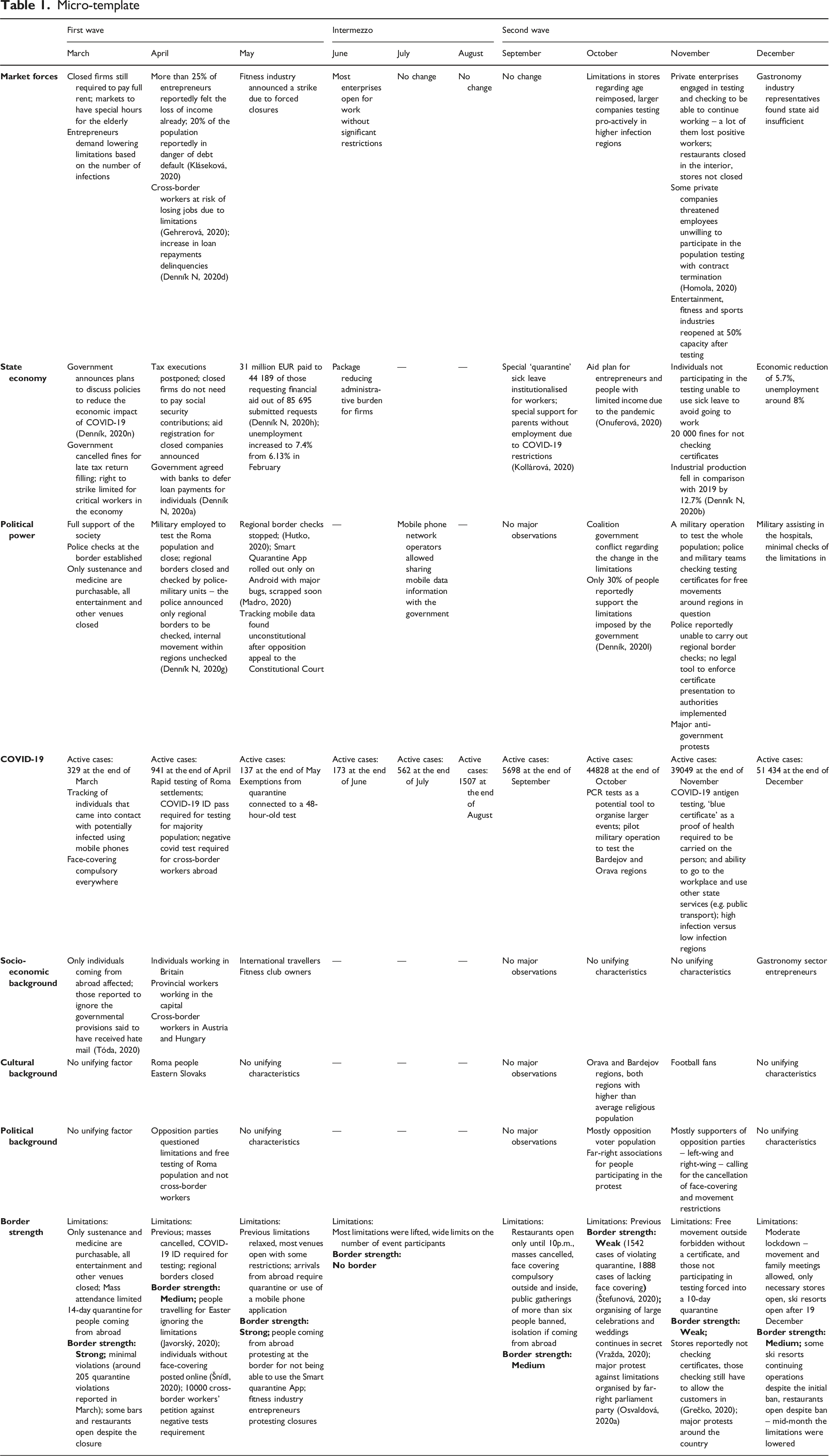
From the state economy structural factor perspective, the government did announce plans to discuss policies to reduce the economic impact of COVID-19 (Denník, 2020r) and cancelled fines for late tax return filing already in March. Nevertheless, the first practical response to the demands for support came in April, when the government agreed with banks to defer loan payments for individuals, postponed tax-related executions, cancelled the compulsory social security contributions for closed firms and announced aid registration (Denník N, 2020a). In May, 31 million EUR of aid was paid to 44 189 out of 85 695 submitted requests for financial assistance (Denník, 2020j). By the end of May, unemployment increased to 7.4% from 6.13% in February.
With the epidemic onset in March, the government was enjoying the full support of the population as it closed down all business activity and allowed only sustenance and medicine stores open. At the same time, the government also decided to cut all international personal rail and bus transport (Denník, 2020r). The police began conducting border checks preventing entry of any individual without Slovak citizenship, residence permit or a new confirmation of employment from the employer.
As the Easter holidays approached, the government strictly prohibited any movement outside one’s domicile – enforced by newly combined police-military units (Denník, 2020p). The teams were to take a specific form from any individual they stopped, containing the reason behind the movement. The Ministry of the Interior would have then confirmed the form’s validity. Additionally, activity beyond one’s region was forbidden. The police had to stop every vehicle on the regional borders and inquire about the reasons for the journey (Javorský, 2020). At times, however, the police requested only proof of payment from the neighbouring town’s grocery store, albeit in the adjacent region (Javorský, 2020). Those without a valid reason for leaving their domicile were returned home by the officers (Denník N, 2020g). The operation predominantly affected individuals working in the more economically developed areas in the country’s western part, travelling home to the east for the holidays. Following kilometres-long traffic congestions around the country, the regional border checks stopped after the involvement of the Prime Minister.
Also in April, the government became concerned about the potential COVID-19 spread within the Roma population. In particular, the concern was caused by the arrival of Roma minority members from abroad (especially Britain) and apprehension about spreading the virus. Consequently, it ordered the military to close off entire Roma settlements to test their inhabitants. The government did not produce any official testing results until some days later, when the reported total number of infected was 31 persons (Denník, 2020o).
As the Roma villages' close-offs and regional border checks subsided in May, the government focused on developing the Smart Quarantine Application. While the application was eventually rolled out only on Android, it contained significant bugs and limited individuals’ ability to enter the quarantine. The application was scrapped soon after (Madro, 2020).
Regarding the COVID-19 structural factor developments, the two early COVID-19-connected activities were tracking individuals that came into contact with potentially infected using their mobile phone data and compulsory face-covering. These two limitations were implemented as the number of active cases reached 329 by the end of March. In April, the aforementioned Roma-related testing was implemented. The testing would establish the epidemic situation in the settlement. If the number of positive cases had been high, the military would have closed the settlement (Denník, 2020p). At the end of April, a new approach was implemented on the international borders. Every cross-border worker had to show a negative COVID-19 test result no older than 30 days. At the same time, the government started with compulsory state quarantine – this meant that all arrivals (except for cross-border workers) from abroad were required to go into a state-provided area for quarantine (Denník N, 2020f). Exemptions from the quarantine required a 48-hour-old negative test (Nový Čas, 2020b). At the end of April, there were 941 active cases, a relatively minor increase from the previous month. At the beginning of May, the cross-border workers were required to have a 48-h-old COVID-19 test result to avoid state quarantine. Outside of the exemption, no significant development occurred during the month. At the end of May, the active cases dropped to 137.
Starting with the socio-economic background as the first of the reflexivity factors, in March, the only specific socio-economic group affected by the border were those arriving in the country from abroad. Interestingly, some of those reported by the media to avoid governmental provisions reportedly received hate mail (Tóda, 2020). In April, with the regional border checks and Roma settlements’ closures, the socio-economic grouping was connected to individuals working in Britain (of Roma origins) and workers from the eastern part of the country working in the capital. In May, the bordering was returned to the state in March and targeted international travellers. At the same time, with the continued closure of fitness centres, the COVID-19-related bordering also resulted specifically strong on the fitness club owners.
Regarding cultural background, the first wave did not see many relevant cultural groupings acting upon the border. The only exceptions were arguably the Roma people, whom the government specifically targeted to conduct testing due to the perceived potential for viral spread. Similarly, the expected movement of Eastern Slovaks home from western Slovakia back to the country’s eastern parts shows a particular cultural tint.
The same can be said about the political background. The groups affected by bordering did not showcase any particular political grouping. At the same time, opposition groups conducted no significant activity except for April, when opposition parties questioned limitations and free testing of the Roma population and not the cross-border workers.
Finally, the outcoming border strength factor shows variance during the first wave. As mentioned before, in March, the implemented restrictions included closing all entertainment and other venues, limiting mass attendance, and 14-day quarantine for people from abroad. While there were some cases in which people did not respect the new limitations – open pubs, a riot in one of the state quarantine facilities – there were almost no signs of widespread disagreement with the imposition of new restrictions. Therefore, the border strength in March can be considered strong. In April, the previous limits were maintained and, in some cases, hardened (e.g. masses were cancelled).
Furthermore, COVID-19 ID became required for gaining access to testing. By Easter, regional borders closed, as discussed above. Nevertheless, border strength was medium as people travelling for Easter ignored the limitations (Javorský, 2020). At the same time, about 10 000 cross-border workers signed a petition against the negative test requirement. Additionally, some without clear socio-economic, cultural or political individuals caught without face-covering posted online by private activists (Šnídl, 2020).
In May, most of the previous limitations were relaxed, and most venues were opened with some restrictions. Nevertheless, arrivals from abroad required quarantine or the use of a mobile phone application. After April, the border strength arguably returned to strong, as there were no major reported issues with the limitations. Nevertheless, people coming from abroad protested at the border for being unable to use the Smart Quarantine App, and the Fitness Industry entrepreneurs stroke against the closures of their businesses.
Intermezzo (June–August 2020)
During the summer months, all the original restrictions were lifted. From the structural factors perspective, most enterprises were open for work. The state economy saw the only significant development in the form of reduced administrative and tax burden for private companies dedicated to improving the entrepreneurial environment in the country. In terms of political power, no significant support demonstrations were recorded. The only change was the law approval allowing mobile phone network operators to share mobile data information with the government for COVID-19 contact tracking. As for COVID-19, the active cases numbers in June and July were more or less equal to cases in March and April, respectively. However, at the end of August, the active case numbers reached new record highs at around 1500. Despite similar reported numbers, most limitations were lifted, and vacation-related international travel restarted at high intensity. The only functional limitations were considerably wide limits on the number of event participants. Accordingly, the level of the observed border was ‘no border’.
The second wave and the ‘Nuclear Bomb’ (September–December 2020 onwards)
The second wave of COVID-19 infections in Slovakia arguably began around the end of August or the beginning of September. Nevertheless, during most of the month, there were no or minimal limitations on the economic life in the country, except for the reintroduction of stricter regulations on public gatherings, withstanding those where a negative COVID-19 test is provided by the participants (Denník, 2020k). The approach fundamentally changed in October when most restrictions were reintroduced – restaurants' interiors were closed, face covering became once again compulsory outside, and public gatherings of more than six people were banned altogether (Mikušovič, 2020b). Additionally, stores remained open, but age restrictions for shopping were reintroduced. Interestingly, some private companies started proactively testing their workers to ensure continued production. In November, with the commencement of nationwide testing, large private enterprises were also involved in the operation and were responsible for testing their employees. The companies were also required to ensure their employees present at the workplace had a certificate ready. Some private companies threatened employees unwilling to participate in the population testing with contract termination (Homola, 2020). After the first two rounds of testing, the entertainment, fitness and sports industries reopened at 50% capacity requiring negative tests (Denník N, 2020c). In December, the significant market-connected event was the complaints of the gastronomy industry representatives, who found state aid insufficient.
In terms of the state economy factor, in September, the government institutionalised a special ‘quarantine’ sick leave for workers in the national economy. Similarly, a new form of support for parents without employment due to COVID-19 restrictions was introduced (Kollárová, 2020). In October, a similar trend continued. The government prepared an aid plan for entrepreneurs and people with limited income due to the pandemic (Onuferová, 2020). In November, however, sick leave was denied to those who did not participate in the testing and had to stay home in forced quarantine.
Furthermore, the private business not checking the certificates of their workers were threatened with being fined up to 20 000 EUR. By November, the country’s industrial production reportedly fell by 12.7% compared to 2019 (Denník N, 2020c). Additionally, the national bank expected the economy to be reduced by 5.7%, with unemployment reaching 8% (Denník, 2020q).
From the political power factor perspective, no significant observations were made in September. However, in October, there were conflicts within the coalition government regarding the limitations change. Additionally, only 30% of people reportedly support the restrictions imposed by the government (Denník, 2020k). Most importantly, a military operation to test the whole population was launched. The two most affected regions – Orava and Bardejov – were tested in a pilot testing already in October.
Along with the testing, a lockdown was reintroduced, and people could only leave their domiciles in life-or-death situations. In general, the testing was introduced as voluntary. Still, those who did not participate – and could not present a valid certificate given out during the operation – were required to remain in a 10-day home quarantine, with unpaid leave, as discussed above (Nový Čas, 2020b).
The testing had two rounds, with the second on 14th November in all regions, with more than 0.7% positivity rate in the last round. In consequence, only 45 out of 70 regions ran the second round. The new restrictions became more complex as moving from an area without the second round to a region with a second round required a new certificate. Therefore, anyone travelling outside their region – even without a high positivity rate – had to get tested again (Folentová, 2020). Regions without the second round had more relaxed regimes, and movement around them no longer required a certificate. 2 The police announced it was unable to carry out regional border checks.
Additionally, no legal tool has been implemented to enforce certificate presentation to authorities. Major anti-government protests occurred in November, calling for the government’s resignation due to handling the COVID-19 crisis and the imposed restrictions. In particular, on 17 November 2020, a public holiday commemorating the protests against the Communist regime, a rally was called to Bratislava, uniting several diverse groups of political opposition – from the far left through the populist centre to the far right – to demonstrate against the compulsory testing and the anti-COVID regulations. One of the chief groups participating was football fans, reportedly disgruntled by their inability to participate in live games (Denník N, 2020b). The attendance was relatively high – with a reported 1000 participants – considering the state of emergency was in effect. Participants called for the end of compulsory facial covering and global testing, arguing that the regulations are unconstitutional and go against human rights. Similar protests, albeit with more negligible participation, took place nationwide (SLEDOVALI, 2020 SME: Protesty na Slovensku).
As the limitations were lowered, December was relatively calm compared to previous months. The only relevant occurrence was arguably the continued support of the military to the hospitals. Only minimal checks of the regulations were carried out in the country.
As for COVID-19 as a structural factor during the second wave, the active cases increased exponentially compared to the first wave. Almost 5700 cases were reported at the end of September. In October, the initial response was the decision mentioned above to limit the number of people at events. Here, a PCR test was required to avoid the limitation altogether. At the end of October, the country had 44 828 positive cases. In November, the military-ran testing used antigen tests to establish COVID-19 positivity or negative of each individual. The proof of the test was a blue certificate. Nevertheless, the testing method allowed for potential false positives and negatives. Those that did not participate were automatically treated as positives and had to remain in home quarantine. Once a blue certificate was acquired, it could have been used to go to the workplace and use other state services (e.g. public transport). In addition, the country’s regions were labelled as high or low infection based on the outcome of the testing. At the end of November, there were reported 39 049 active cases. As the results of the newly implemented restrictions seemed to reduce the number of infections in the population, the Prime Minister declared that the government discovered a ‘nuclear bomb’ against the disease (Objavili sme atómovú bombu, tvrdí premiér. Krajčí zostáva opatrný, 2020). In December, the negative test results were no longer used as a critical tool for rights assignment (Mikušovič, 2020a). Instead, more general rules were applied again, resulting in 51 434 active cases at the end of the year.
There were relatively few, albeit comparatively relevant, observations from the reflexivity perspective. Regarding socio-economic grouping, the group that stood out against the limitations was the entrepreneurs in the gastronomy sector in December. During the second wave, the gastronomy sector was essentially closed – it could only operate in the exterior. Consequently, some owners decided to open their restaurants despite governmental regulations (Denník N, 2020i). Concerning cultural background, Orava and Bardejov regions stood out in terms of reported active cases, especially in late September and early October. Both regions’ populations circumvented the restrictions regarding organising events – especially weddings. In terms of cultural background, according to the statistical data of the Slovak Republic, the regions have a higher than the national average religious population. During the November protests, the only applicable cultural background grouping was football fans, who protested against the inability to participate in live matches. Politically speaking, one major protest occurred in October with participation from the far-right party (Osvaldová, 2020a). Then, the participation in the November protests was generally relatively broad – from left-wing to far-right. Nevertheless, it was organised by the opposition parties, which implies opposition-voting participants. No other socio-economic, cultural, or political groupings were observed in the second wave.
From the border strength perspective, the limitations at the beginning of September were still relatively lenient. However, at the end of the month, restrictions from the first wave were fully reintroduced: restaurants were open only until 10 p.m., masses were cancelled, face covering became compulsory outside and inside, and public gatherings of more than six people were banned. Nevertheless, the aforementioned event rules were ignored, especially in Bardejov and Orava. Within the two regions, large celebrations and weddings were organised in secret (Vražda, 2020). The major protest against limitations prepared by the far-right parliament party in October also ignored existing regulations. While the new borders were respected in September, at least in the first half, the October rules were flaunted more often and more widely, with reported 1542 cases of violating quarantine and 1888 cases of lacking face covering (Štefunová, 2020). Consequently, the border strength can be understood as medium and weak, respectively.
In November, the testing employed an entirely new set of restrictions as described above. Nevertheless, the testing rollout was accompanied by several misunderstandings concerning implementing the new bordering mechanism. While everybody was required to carry the certificate, it was uncertain who could ask for its display nor what sanctions would be imposed on the individuals without it. There were no checks on the regional borders (Denník, 2020m) and people with a negative test were allowed to travel outside of basic sustenance needs (Osvaldová, 2020b).
The response to entering varied in the retail stores – legally opened to those with the certificate. Some store workers did not check the certificates; others asked only for verbal confirmation. There were cases reported where a shopper refused to show their certificate, which resulted in no response from the workers as they technically had no or limited sanctioning options (Grečko, 2020). Other reports described aggressive visitors who refused to present their certificates or wear face covering. These often resulted in the police being called. Certificates were reportedly most regularly demanded by medical service providers (Nový Čas, 2020a). Nevertheless, while it was clarified that stores were required to check the certificates, they argued that they had no legal mechanism to ensure the validity of the presented documents (Kučera, 2020). Therefore, the data shows that the actual border created in November with the blue certificate and testing was considerably weak.
In December, a moderate lockdown was implemented, with movement and family meetings allowed and only necessary stores open. Many of these regulations were not tied to possessing a negative testing certificate, except for entering ski resorts, where such a test was required (Mikušovič, 2020a). Ski resorts were opened after 19 December. Nevertheless, as was reported before, some restaurants opened despite the restrictions until the mid-month, when limitations were lowered. Similarly, some ski resorts continued operations despite the initial ban. The December border strength can therefore be estimated as medium.
Meso-template and discussion
Meso-template analysis.
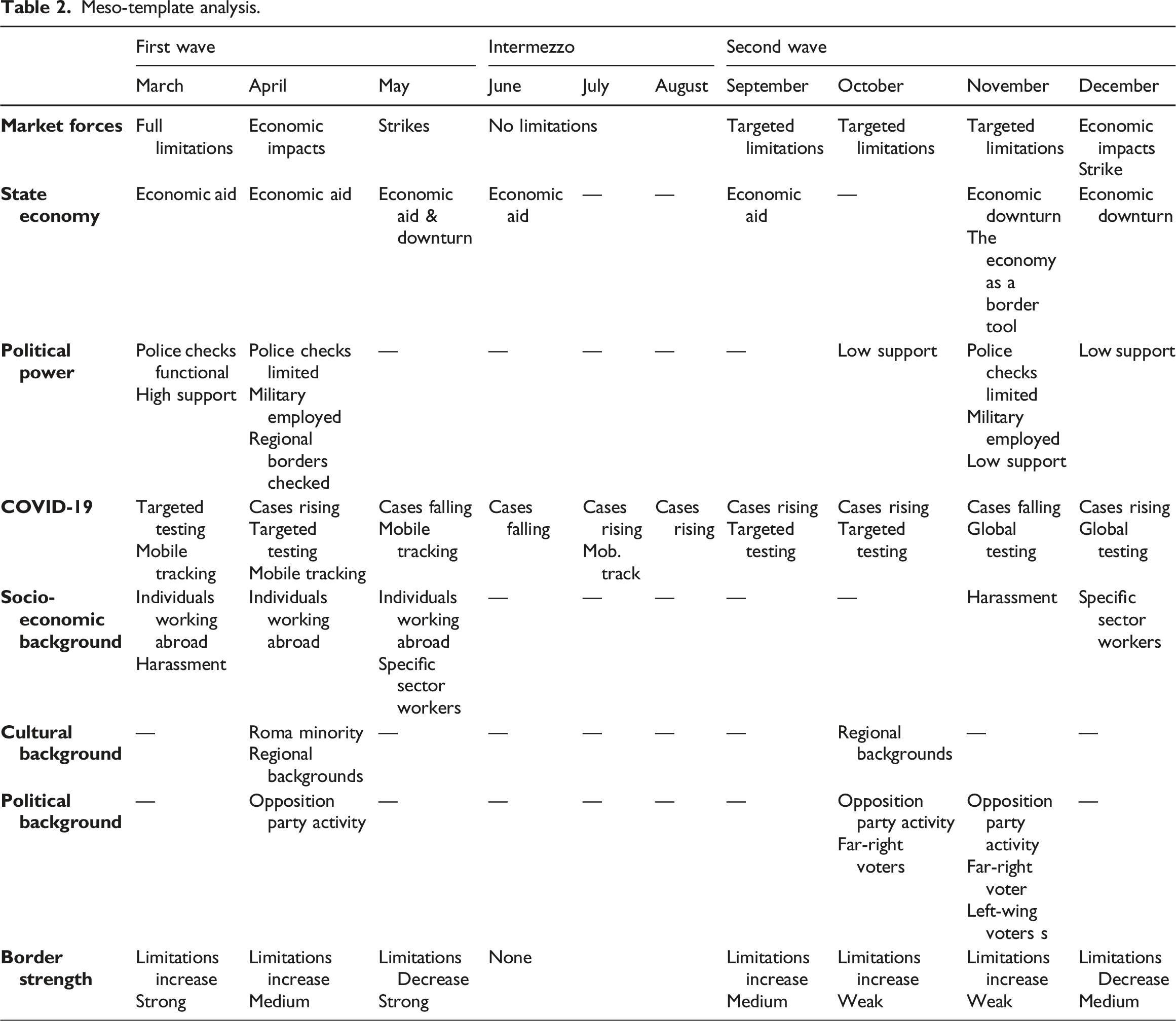
From the structural factors perspective, it does not seem to be connected to the variation in the market forces or state economy as in April, there was an economic aid announced, while in November, the economy was used as a tool in border production. Nevertheless, considering the intensive protests against the government in November, it is likely that the economy as a tool could have impacted the level of border disregard. Employers and store-owners with an economic interest in reopening the economy as soon as possible were used by the state in creating and enforcing the testing certification – at least superficially.
However, the use of the police or the military to enforce particular cases of bordering seems to be constant from the structural perspective. The military deployment arguably offers an interesting case, as a testing-military nexus can be observed during the two waves. As the section on the first wave shows, a very similar approach was used with testing the Roma population, which was argued to be ‘hard to track’. In this case, there was a specific use of a previously established ethnic bordering to determine the subject of the new set of border-producing methods.
While it might have been justified by the actual facts on the ground, it shows a particular selection of the population. The selection used the combination of military force to restrict the population’s movement and bordering agents, in the form of the healthcare workers, to test and therefore assign border-relevant values – positive/negative – to each individual. This variation can be observed in the selected months regarding the COVID-19 structural factor – a testing approach was employed in all 3 months. While the global testing did not carry the amount of restrictiveness enforced by the military during Roma settlements lockdowns, it was still a military operation in combination with the toolset used by the medical professionals. The output – the blue antigen testing certificate – was widely used for (re-)according rights to eligible citizens. More generally, it is possible to argue that the final testing was the output of the combination of previous methods established during the first wave – the testing as a tool of separation, the quarantine, the police-military cooperation, and the regional approach.
In terms of the political structural factor, there is also a clear correlation between the collapsing public support for the government’s approach and the strength of the border. However, while political support was reduced, there was an increase in support – forced or not – from the more prominent economic actors, as discussed above. This development was tied to the COVID fatigue and other relevant factors, such as the massive spread of disinformation. Nonetheless, it shows that establishing a border seems connected to a particular set of interests for its support.
Outside of the testing, the COVID-19 structural factor perspective shows increased limitations in all 3 months. More importantly, the new restrictions that were enforced were all relatively harsh, as they effectively blocked the free movement around the country and had negative socio-economic impacts on a particular segment of the workforce. Firstly, the decision to stop people working in the capital from travelling home during holidays seems to have been highly contentious. The political support at the time was still relatively high, which implies that the stronger the newly imposed border, the less relevant the political support for the government became in the outcome. This reading is also proven true when the bordering practices formalisation is observed. While a face cover was required already in Spring, the Autumn requirement for a specific administrative-style performance seems to have garnered much wider discontent among the population.
Interestingly, there was an increase in the activity of the opposition parties coinciding with any discontent with the bordering. Based on the established timeline, it was arguably acting upon the population’s demand rather than independent activity. It is, therefore, possible to argue that the opposition parties’ behaviour was generally opportunistic rather than principled in their opposition to COVID-19 restrictions.
As for the reflexivity factors, the border was arguably negotiated in the three selected months and in May and December by various groups based chiefly on socio-economic and cultural backgrounds. While the cultural – regional, and Roma – backgrounds were already discussed, there are some crucial observations from the socio-economic factors.
Firstly, the bordering affected the cross-border workers that travelled daily to work across the state’s border. While this touches more upon international bordering, it was interesting to observe some form of harassment from within the society during the early stages of the first wave. This first form of harassment was arguably purely societal and was tied to one of the goals of this article – the formation of identities. Interestingly, this type of harassment on the individual level was no longer present in Autumn, despite the arguable increase in society’s division. It is possible that the original harassment for disregarding governmental restrictions was tied to the issue of formalisation. As a new administrative-styled performance was being introduced to the public for the bordering purposes – of the healthy/unhealthy variant – the specification of who can enforce the border appeared problematic. Contrary to the previous face-covering requirement, which was visible to everyone, a piece of paper containing private information was not something that one could be forced to show to just anyone. It resulted in issues with ensuring that only those who were supposed to have more extensive rights associated with the border had them, reducing the ability to report.
However, another form of harassment occurred in Autumn, when employees were threatened with termination if they did not participate in the testing. It is likely tied to the previously discussed border establishment and particular interests.
Secondly, it was clear that bordering was ignored the most by the specific sector workers that tried to renegotiate the bordering to improve their economic situation. Both the fitness industry in Spring and the gastronomy industry in Autumn demonstratively ignored the regulations and even went on strike. It might have led to changes in the limitations, as they were reduced in the months following the activity.
In summary, the structurationist approach appears to favour the structural factors in the given case. While this might have been caused by the combination with the data collection method, it nonetheless suggests that it might be generally hard to track the reflexive factors internal to the studied population. In spite of this limitation, those reflexive factors uncovered in the micro and meso templates arguably provided insight into establishing internal borders and their subsequent re-negotiation. The internal bordering in the Slovak case showed the application of all the tools typically associated with othering at the international borders – formalisation of (health) status, movement restriction, employment of the military, legal uncertainty, and exclusion from participation in the economic life of the state. The only foremost difference was the fact that the application of these regulations was directed towards the general population.
Similarly to international borders, only the groups standing to lose the most from the existence of the border tended to ignore and weaken it, at least when the political support for the government was high. And some tried to maintain the new borders independently, outside the government’s requests. Once the overall support for the restrictions collapsed, the opposition towards the imposed borderwork became more widespread and arguably not tied only to the particular grouping points of the individual groups. With this summary in mind, it is now possible to address the overall aims of the article.
Conclusion
The article set out to investigate the production and re-production of internal borders. In particular, it intended to uncover states' methods in creating the inner borders and how they establish the process of othering and affecting the population. Using the TTA method with the conceptual prism of the border theory of structurationism, it expected to find a relationship between the strength of the COVID-prevention practices as the new official bordering techniques, the structural factors stemming from the state and the economy and the reflexive factors arising from the individuals affected by the border.
In this regard, there were several tools uncovered by the investigated data. Firstly, the military-testing nexus in the case showed how the original bordering was applied first to a minority before being transposed to the entire population. Secondly, while the government initially tried to use economic aid to lower the economic impacts and arguably also increase the tolerance of the bordering, it later switched to a more repressive economic method to ensure compliance. Third, economic actors interested in conducting business within the economy assisted in border production. And finally, the strength of the border was still dependent chiefly on the government’s political support and the ability of particular societal groups to renegotiate its terms.
With all these arguments in mind, the case also shows the issues of a moving bordering target and the uncertainty of borders. For example, while one could have been a willing participant in the first round of testing – which would have produced a favourable certificate – just 2 weeks later, the lack of participation would have led to the same person losing all ‘privileges’ associated with the certificate. It provides an interesting instance of a situation where the bordering performativeness exists even within a simple participation in a social event. As such, the entire bordering process started earlier than simply upon the presentation of the certification to a spot-checking police-military officer. It began at the moment of participation in the testing, of which the certificate was merely proof.
Interestingly, while the usual administrative type performances are supposed to testify to a state of an individual (e.g., a passport demonstrating belonging to a country), the blue certificate showed instead the willingness to participate in the testing since the actual health state of the individual could have been negative. In this regard, it would appear that this border was more about one’s willingness to share health state information with the government rather than about the state itself. This knowledge and subsequent control over bodies is not new to border studies and comes with close ties to Foucauldian notions of biopolitics and biopower. Yet, in this case, the relation becomes much more transparent with health-related bordering practices.
At the same time, as the new administrative-styled performance was being introduced to the public for the bordering purposes – of the healthy/unhealthy variant – the specification of who can enforce the border appeared problematic. It might be connected with the lack of political power of a given state and the lack of institutionalisation when compared to, for example, the international travel regime. However, it also shows the issue of creating internal bordering within a generally homogenous society based on purely administrative means.
As a secondary goal, the article aimed to uncover any other connections between and constellations in the official (i.e. state) and unofficial (i.e. private, non-governmental) border production from the vantage point of the state-imposed procedures. While the data was arguably limited on the unofficial bordering issue, some clear cases were identified. Firstly, the various forms of online vigilantism show how a combination of population mobilisation through fear and the imposition of new bordering can create inside and outside groups. The fact that some online activists took and posted pictures of their fellow citizens online or sent hate mail to those caught not performing the required activities in the early stages of the pandemic demonstrates this very well.
Outside of these reports, there is also the question of creating new group cohesion. For example, while the data provided here are limited, the fitness industry entrepreneurs' strike to protest the imposed restrictions was the first-ever strike by that industry in Slovakia. Similarly, the participation of football fans – usually a group connected mainly through a sporting event – in a protest against the government showcases the same line of thought.
In summary, the presented article offered a case study of the Slovak border practices vis-á-vis the COVID-19 pandemic. It provided an overview of the current state of knowledge in border studies concerning COVID-19 and, subsequently, a conceptual framework for understanding borders. This framework was applied to the case of Slovakia during the first two waves of the pandemic in 2020. A dataset of 1688 articles was analysed and used to reconstruct the timeline of how the bordering processes were implemented. The article examined the case to identify specificities in establishing a new border and associated bordering practices. As such, several important structural factors were identified based on applying the structurationist theory on the empirical data on how the new border was implemented. In conclusion, the structural factors were similar to those used at international borders, with similar pathologies connected to the moving bordering target, its relations with biopolitics and the necessity of many resources to implement a border without sufficient political support.
Footnotes
Declaration of conflicting interests
The author(s) disclosed receipt of the following financial support for the research, authorship, and/or publication of this article: This work was supported by The Univerzita Karlova v Praze (SVV-260 595).
Funding
The author(s) received no financial support for the research, authorship, and/or publication of this article.
Notes
Author biography