



Abstract
We conducted a qualitative study from 2018 to 2019 to update the reasons why US parents’ refuse or delay vaccines. Four focus groups and 4 semi-structured interviews involving 33 primary care pediatric providers were conducted in Washington and Colorado. A thematic analysis was conducted to identify themes related to reasons for parental refusal or delay. Five predominant themes were identified: (1) vaccine safety, (2) relative influence of information sources, decision-makers, and timing, (3) low perceived risk of contracting vaccine-preventable disease, (4) lack of trust, and (5) religious objection. Vaccine safety was the theme mentioned most frequently by providers (N = 45 times by 26 providers) and religious objection to vaccination was referred to the least (N = 6 times by 6 providers). Provider-reported reasons for parental refusal or delay of childhood vaccines in 2018 to 2019 remain similar to those reported in previous studies.
Introduction
Although vaccines represent one of science’s greatest achievements, parental refusal or delay of childhood vaccines continues to diminish their impact on individual and public health. Vaccine hesitancy, “an expression of concern or doubt about the value, need for, or safety of vaccines or vaccination,” 1 has recently been declared a top 10 threat to global health by the World Health Organization. 2 The prevalence of vaccine hesitancy in the US was recently estimated to be 6.1%. 3 At its extreme, parental vaccine hesitancy can lead to the refusal of all vaccines; more commonly, it manifests as the refusal or delay of some but not all vaccines.4,5
Vaccine safety concerns, low perceived risk of contracting a vaccine-preventable disease (VPD), and lack of trust in vaccination information have been consistent reasons for parental refusal or delay of childhood vaccines reported by both parents and providers.1,5-10 However, most of this research is over 5 years old and national outbreaks of VPD, frequently spurred by the intentionally unvaccinated, 11 continue to occur.12,13 To ensure that interventions designed to mitigate vaccine hesitancy remain responsive to reasons for vaccine hesitancy, it is critical to periodically assess reasons for vaccine refusal or delay to identify new or developing reasons. The primary objective of this study was to update the reasons why parents refuse or delay vaccines.
Methods
We conducted 4 focus groups and 4 individual semi-structured interviews (SSI) in 2 US states (Washington and Colorado) between November 2018 and July 2019 as part of a larger study to design and evaluate a provider vaccine communication strategy to increase childhood vaccine uptake. 14 We utilized both a focus group and SSI format to leverage the primary benefits of each: focus groups, though logistically challenging to coordinate, enabled interactive dialog between all participants that could facilitate identification of a more complete range of reasons for parental refusal and delay, while SSIs, though not able to foster this interaction, were easier to organize. These 2 states were chosen because each ranked in the highest quintile among US states in 2015 to 16 with respect to the proportion of parents claiming non-medical exemptions for their child from required school-entry vaccines. 15 We used convenience sampling to invite practicing pediatric providers (MD, DO, NP, and PA) within each state to participate. Participating providers were restricted to those who were actively practicing in pediatric primary care.
The focus groups and SSIs were conducted iteratively. Two focus groups occurred initially (1 in each state), followed by 4 SSIs in Washington, as well as 2 final focus groups (1 in each state). Focus groups were conducted in person with 5 to 11 pediatric providers present at each meeting, while SSIs were completed in-person or over the phone with an individual pediatric provider. The first in-person focus groups took place in November 2018, SSIs occurred between April and May 2019, and the final in-person focus groups occurred in July 2019.
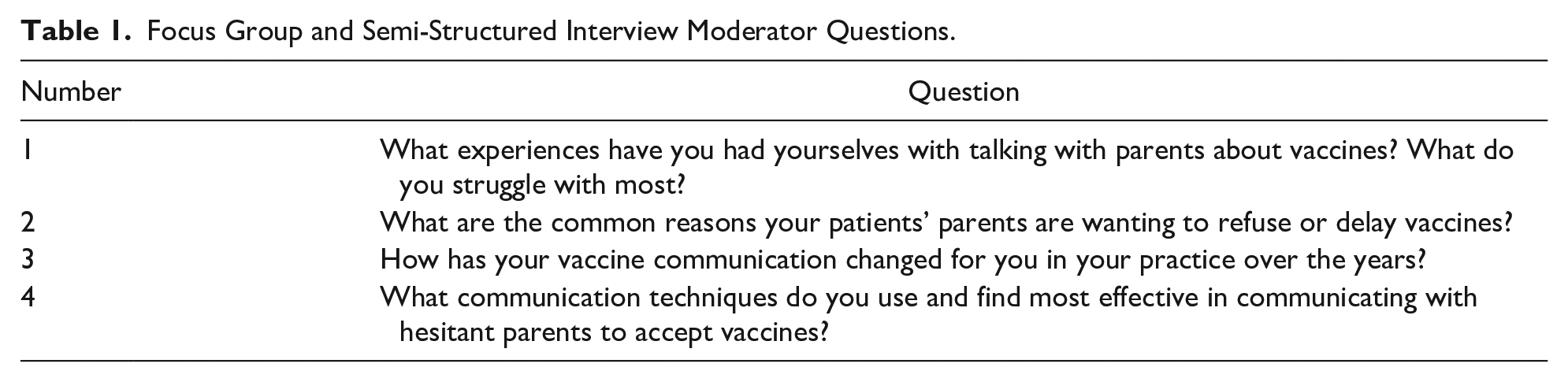
We used a standardized moderator guide developed by study personnel for both the focus groups and SSIs. Both guides included questions pertaining to participants’ experiences in communicating with parents about childhood vaccines and, specifically, the common reasons parents were currently citing when refusing or delaying childhood vaccines (Table 1). Focus groups and interviews were conducted by study investigators (D.J.O, S.T.O, and K.G.). Each participant received a $100 gift card at completion as a thank you for participation. All focus groups and interviews were audiotaped and transcribed.
Focus Group and Semi-Structured Interview Moderator Questions.
We conducted a thematic analysis of the transcripts with inductive coding to identify themes related to reasons for parental refusal or delay of childhood vaccines. 16 To develop the coding scheme, 2 investigators (J.L.U. and B.K.) independently reviewed 2 focus group transcripts and met to discuss identified themes. Disagreements in identified themes were reconciled in consultation with a third investigator (D.J.O.). A revised coding scheme was then developed by 2 investigators (J.L.U. and D.J.O.). One investigator (J.L.U.) subsequently applied the revised coding scheme to all transcripts. Identified themes were then discussed and finalized with the senior investigator (D.J.O.). We assessed the frequency of identified themes using descriptive statistics.
Ethics Approval and Informed Consent
Study activities were approved by the Colorado Multiple Institutional Review Board (COMIRB Protocol 17-1274). Verbal consent was obtained from participants prior to the start of the focus group or interview.
Results
There were 33 total participants in the focus groups and SSIs. In Washington, there were 15 participants from 8 practices, and in Colorado, 18 participants from 2 practices. Most (N = 29) participated in the focus groups.
We identified 5 predominant themes relating to parental refusal or delay of childhood vaccines: (1) vaccine safety (defined as parental concerns regarding the potential physical harm that the composition and the frequency of administration of vaccines may impose on their child); (2) relative influence of information sources, decision-makers, and timing (defined as reasons pertaining to parent decision-making roles, information sources used, and timing of vaccination); (3) low perceived risk of contracting a VPD (defined as reasons regarding parental perception around the low probability their child will contract disease); (4) lack of trust (defined as parent’s lack of trust in their provider and/or the government); and (5) religious objection to vaccination (defined as parental religious concerns regarding vaccines) (see Appendix A). Each theme had several subthemes (Table 2).
Illustrative Quotes for Themes and Subthemes.

Parental concerns about vaccine safety was the theme mentioned most frequently by providers (N = 45 times by 26 providers). The relative influence of information sources, decision-makers, and timing was the second most mentioned theme (N = 14 times by 11 providers). Low parental perception of their child contracting a VPD, as well as lack of trust in the government or their child’s provider were each mentioned 9 times, each by 6 providers. Parents having a religious objection to vaccination was referred to least (N = 6 times by 6 providers).
Vaccine Safety
Vaccine safety concerns manifested in several different ways (Table 2). For instance, providers reported that mercury was one of the “. . .more generalized things that [parents] really fear. . .” and that they often receive questions such as “. . .well what about the formaldehyde. . .?.” Providers mentioned that purported links between vaccines and rheumatologic conditions, chronic fatigue syndrome, developmental issues, and autoimmune diseases were also of concern among some parents (Table 2—Quotes 4-6). Some providers noted that they had parents who “. . .referenced an article they read off Facebook,” related to vaccine safety or say, “. . .I was reading on Facebook that these are dangerous and they can cause autism.” Several other providers expressed that the purported link between vaccination and autism was still a concern among parents, stating, for instance, “it’s still really autism,” that leads to vaccine refusal or delay, and that parents have “. . .old school worries about MMR and autism. It’s like 1998 again.” Aside from specific ingredients and health-related consequences, it was noted that parents often believed that there are “too many vaccines” and “it’s just too much for their immune systems.” Some providers also expressed that some parents believed data on vaccine safety are incomplete or inadequate (Table 2—Quotes 12-14).
Relative Influence of Information Sources, Decision-Makers, and Timing
Reasons pertaining to decision-making roles, information sources used, and timing of vaccination were also suggested by participating providers to be important factors associated with refusal or delay. For instance, providers noted that parents who claimed to “. . .know a lot. . .read a lot,” or who say “I’ve done my research. . .” often refuse counseling from them and refuse or delay one or more vaccines. The need to consult their partner was also an important factor, with providers citing “. . .I can’t make this decision without my husband,” and “I need to talk to my husband. . .” as parental reasons for vaccine refusal or delay. Additionally, lack of agreement about a specific vaccine or vaccination in general among partners was a common reason for refusal or delay (Table 2—Quotes 24, 25). Providers mentioned that keeping a promise to their child of no shots was important to parents, as was avoiding potential side effects for upcoming activities or travel (Table 2—Quotes 21-23).
Low Perceived Risk of Contracting Vaccine-Preventable Diseases
Participating providers suggested that low perceived risk of contracting a VPD was often due to perceptions that their child was not susceptible to contracting a VPD. For instance, providers noted that parents often refused or delayed the human papillomavirus (HPV) vaccine because their child did not currently engage in any sexual contact (Table 2—Quote 33-35). It was mentioned that vaccines like hepatitis B were also refused as a parent believed that their “. . .kid’s not having sex or doing any drugs.” (Table 2—Quote 35). A provider also reported that refusal or delay has stemmed from the parental belief that “. . .based on where they live. . .it was unlikely their child would be exposed” to a VPD (Table 2—Quote 36). Parental beliefs that some VPDs are more severe or likely to be contracted, such as measles over pertussis, were reported to lead to alternative schedules or complete refusal (Table 2—Quotes 37, 38).
Lack of Trust
Providers noted that parental lack of trust due to an undeveloped relationship with the child’s parent led to refusal or delay. At 2-month well visits, providers mentioned that they “don’t have the rapport with them” or the “street cred that you might have later.” (Table 2—Quotes 32, 33). Providers reported that government mistrust led to refusal too and was most common among their “African families” and eastern European families (Table 2—Quotes 34, 35).
Religious Objection
Providers noted that the usage of porcine products and “the fear. . .that fetal cells may have been used” in the development of vaccines led to refusal as some parents’ religious beliefs lead them to consider vaccines as contaminated (Table 2—Quotes 36-39).
Discussion
In this qualitative study conducted in high vaccine hesitancy geographic locations, we sought to update the reasons for parental refusal or delay of childhood vaccines. We found that concerns about vaccine safety continue to serve as the predominant reason for parental refusal or delay of childhood vaccines. The process in which a parent identifies and solidifies decisions around vaccination was also frequently mentioned by providers as common reasons related to refusal or delay. Religious reasons against vaccination were not as frequently mentioned by providers.
The purported link between vaccination and autism was frequently cited as a common safety concern among parents. Although information and educational resources are available to parents 17 that highlight rigorous population-based studies that have found no association between autism and vaccination, 18 this purported link between vaccination and autism persists. Alternative interventions that focus on vaccine safety should be developed to address hesitancy and debunking myths as well as training providers on different communication skills to effectively discuss parental safety concerns during visits.
Low perceived risk of contracting VPD was also mentioned as a common reason for parental refusal or delay. It should be noted that this study was conducted prior to the COVID-19 pandemic. Given that infectious disease outbreaks can influence health-related attitudes and behaviors,19,20 the prevalence of this reason for refusal or delay, in particular, may change as a result of COVID-19 and deserves further study. Regardless, our study still offers a snapshot of common reasons parents refused or delayed childhood vaccines that can serve as a pre-COVID-19 comparison for future studies.
The strength of this study lies in the inclusion of pediatric providers from multiple clinics in 2 states, enhancing the representativeness of our findings. However, it is limited by its qualitative design, which precluded a true quantitative assessment of reasons for vaccine hesitancy. It also is limited by the use of provider-report for reasons of parental refusal or delay rather than report from parents themselves.
Conclusions
Vaccine safety continues to be a common reason reported by providers for why parents refuse or delay childhood vaccines. Interventions designed to reduce parental vaccine safety concerns are needed.
Footnotes
Appendix
Definitions of Themes and Subthemes.

| Themes and definitions | Subthemes and definitions |
|---|---|
Author Contributions
Drs. Opel, O’Leary, Dempsey, Pahud and Robinson made a substantial contribution to the concept or design of this study. All authors were involved in the acquisition, analysis, or interpretation of the data; drafted or revised the article for important intellectual content; approved the version of the article to be published; and agree to be acountable for all aspects of this work.
Declaration of Conflicting Interests
The author(s) declared the following potential conflicts of interest with respect to the research, authorship, and/or publication of this article: At the time this study was conducted, Children’s Mercy received grant funding from GlaxoSmithKline (GSK), Pfizer, and Merck for which Dr. Pahud is an investigator. Dr. Pahud received honoraria from Pfizer, GSK, Seqirus, and Sanofi Pasteur for service on advisory boards and non-branded presentations related to vaccines. Dr. Dempsey served on Advisory Boards for Merck, Pfizer, and Sanofi Pasteur. Dr. Dempsey did not receive research funding from these companies. All other authors declare that they have no conflict of interest.
Funding
This work was supported by the Eunice Kennedy Shriver National Institute of Child Health & Human Development of the National Institutes of Health [R01HD093628; Opel and O’Leary (MPI)].
