



Abstract
CommunityWorks Canada® is a 12-week (30-hour) program that provides social, communication, and job skill–building activities as well as peer mentorship to youth with autism spectrum disorder. Administration of a pre- and postprogram employment readiness measure (n = 76 participants) demonstrated positive changes as reflected by the participants’ decreased concerns about their responsibility, flexibility, job skills, communication, self-view, and health and safety. Postprogram qualitative interviews and survey data collected from a range of program stakeholders (participants, parents, peer mentors, and community partners/employers) corroborated identified gains in personal development, employment exposure, work proficiency, and comfort in work settings. For community partners/employers and peer mentors, greater understanding about autism spectrum disorder and commitment to inclusive hiring reportedly resulted from program engagement. Implications and recommendations are offered.
Introduction
Employment experiences in adolescence typically increase individual work skills and may inform career pathways. Such vocational experiences can be especially valuable for young people with disabilities, 1 given that vocational education, school-sponsored work experiences, and after-school jobs are linked to favorable employment outcomes in early adulthood.2-5
Regrettably, many students with autism spectrum disorder (ASD) leave high school without the skills, experiences, and supports necessary for transition into postsecondary education and career environments. 6 Based on the National Longitudinal Transition Study-2 from the United States, approximately 50% of high school students with ASD had no work experience while in high school and had limited access to vocational training. 7
The vast majority of high school students with ASD (~85%) reported never having held an after-school or summer job during the previous year. 8 After leaving high school, only about half of young adults with ASD were employed outside of the family home. 9 Transition-age youth (ages 16-18 years) who exited vocational rehabilitation services were found to be at greatest risk for being unemployed in comparison to adults (19 to 26+ years). 10 A possible explanation is that, relative to neurotypical peers, youth with ASD require more time to acclimate to employment and to develop job competencies such as the unwritten social rules in an employment setting.11,12
Little attention has been focused on interventions for adolescents with ASD in comparison to children,13,14 with few studies focused on vocational preparation and support during high school.15-17 Bennett and Dukes 18 conducted a systematic review of the literature from 1995 through 2010 regarding employment instruction that included job-specific and social skills for adolescents with ASD, and they found only 12 studies that met inclusion criteria. The majority of the studies addressed specific job skill instruction and none focused on social-communication skills. More recently, Seaman and Cannella-Malone 19 addressed vocational interventions for adolescents and adults with ASD, using Bennett and Dukes’ criteria, 18 and they found 20 articles published between 2010 and 2015. Over half of these studies examined job tasks, with only a limited number focusing on job retention and even fewer addressing preemployment skills. Studies generally highlighted the need for research that addresses both preemployment skills and job retention including “soft skills” (eg, social-communication interactions with customers and coworkers).
Social-communication challenges often manifest in this population, and they have been found to be a barrier to employment for individuals with ASD.15,20,21 Employers reportedly value social communication skills as well as basic job skills among potential employees.22-24 Chiang et al 25 found that social communication skills contribute to greater engagement in postsecondary employment, while Carter et al 26 determined that social competence nurtures employment after high school. Cumulatively, these studies reveal that preemployment training needs to address multiple dimensions (eg, work skills, social communication skills, and adaptive behavior). 27
This literature invites advancement in soft skill development for transition age youth with ASD in relation to vocation. Accordingly, there is a need for multicomponent interventions in vocational development.10,14 As an example of a low-cost and multicomponent intervention, Hillier and colleagues28,29 conducted support groups consisting of 8 one-hour weekly meetings with 5 to 7 individuals with ASD between 21 and 28 years of age. Titled “Aspirations,” the group was described to foster social and vocational skills. Positive changes were noted regarding mental health, which were attributed to social connections and improved insights about employment. To further advance vocational support for secondary school–aged students with ASD, we conducted a secondary review of anonymized program evaluation outcomes, based on a prevocational program titled CommunityWorks Canada® (CWC).
A Description of CommunityWorks Canada®
CommunityWorks Canada® is a federally funded, peer-supported preemployment program for 15- to 21-year-old youth with ASD. CWC was modeled on Autism CommunityWorks, a program that was developed by the Southwest Autism Research and Resource Center in Phoenix, Arizona. It emerged from an identified need for employment support programming, with the aim of improving employment prospects through preemployment training and exposure to volunteer work experiences.
CommunityWorks Canada® is a 30-hour program consisting of 12 sessions, delivered once a week for 2.5 hours per session. Offered after school, it focuses on the development of work skills and related positive behaviors, and provides opportunities to build socially appropriate interaction with others via a semistructured and supportive community environment that cultivates potential areas of interest for future employment. Program cohorts typically consist of 6 participants with ASD, with an additional 6 peer mentors to support and reinforce emerging skills. In community partner/employer settings, vocational tasks are completed each week by participants and mentors. Examples of work done by CWC participants in this application of the program included sorting clothing in a retail setting and food preparation at a nonprofit agency. Exclusionary criteria for the program were the following: (1) participant risk of elopement or abruptly abandoning a session, (2) an unstable medical condition, and (3) anticipated lack of transportation to and from (or regularity in attending) the program.
Evaluation Methods
Reported findings reflect a secondary review of anonymized data that were elicited by program evaluators overseeing program delivery. Program evaluation consisted of pre- and postprogram standardized questionnaires, satisfaction surveys, and qualitative interviews that explored stakeholders’ perceptions of the program and its impact. The program was administered in 7 program sites across 5 Canadian provinces. The sites delivering the program across Canada initially responded to a request to participate in the federally funded program. All of the sites were not-for-profit organizations that specialized in the delivery of services to individuals with autism. At each site, multiple perspectives were sought through the inclusion of program stakeholders, consisting of participants with ASD, parents, peer mentors, and employers (termed “community partners”) who hosted volunteer experiences at employment/community sites for CWC participants.
As part of the program evaluation that had been conducted, measures were administered to program participants with ASD (or parents, as recommended by questionnaire administration protocol). Comparative analysis of pre- and postprogram scores was conducted via quantitative data management software (SPSS). One employment measure, the Work Readiness Inventory (WRI), was administered both to participants with ASD and peer mentors. Specific measures are outlined below.
Baseline Measures
Peabody Picture Vocabulary Test–4 (PPVT-4)
The PPVT-4 scale is a norm-referenced, wide-range instrument for measuring the understanding of single-word vocabulary for individuals between 2½ and 90+ years of age. A standard score ranging from 85 through 115 is considered an average score. Krasileva et al 31 assessed the utility of the PPVT-4 as a proxy for verbal IQ in a sample of 2420 individuals with ASD. Results strongly supported the utility of the PPVT-4 for this purpose.
Waisman Activities of Daily Living (W-ADL)
The W-ADL is a brief informant questionnaire, consisting of 17 items, that elicits functioning (independent, does with help, and does not do at all) in areas such as meal-related, personal care, and housekeeping domains. A maximum score of 34 would indicate that a participant is independent on all of the tasks sampled. In a study of participants with ASD (n = 255), W-ADL scores were strongly correlated with the Vineland Screener Composite (r = 0.78), and the Daily Living Domain (r = 0.82). In general, W-ADL scores were positively associated with IQ, employment, and education, and inversely associated with caregiver burden and the need for respite services. 30
Social Responsiveness Scale–2 (SRS-2)
The SRS-2 measures the severity of autistic symptoms, including social impairments, social awareness, social information processing, capacity for reciprocal social responses, social anxiety/avoidance, and preoccupations and traits. It generates an overall score that reflects severity of social deficits. A total T score >76 is considered severe and strongly associated with autistic disorder; T scores of 66 to 75 are moderate, clinically significant, and negatively influence daily social interactions; T scores of 60 to 65 are mild and indicate milder social interaction challenges; and T scores <59 are within typical limits and are not generally associated with clinically significant ASD.
Pre-Post Assessment Measures
Work Readiness Inventory
The WRI is a 36-item self-report questionnaire designed to identify concerns or areas of weakness in 6 areas of work readiness: responsibility, flexibility, skills, communication, self-view, and health and safety. Higher scores are indicative of increased concerns or areas of weakness.
Social Skills Improvement System (SSIS)
Administered to parents, the SSIS examines youth behaviors that may interfere with performance or acquisition of social skills. Social Skills and Problem Behaviors are reported using Scaled Scores. Scaled Scores above 115 are considered above average, those from 85 through 115 are considered average, and those below 85 are below average. The SSIS has demonstrated internal reliability among its subscales (estimated to be in the range of 0.84-0.95), test-retest reliability for the Parent form (estimated to be in the range of 0.65-0.80), and construct and convergent validity.
Survey Measures
Post Survey
Post surveys were distributed to participants, parents, peer mentors, and community partners/employers at the conclusion of the program to determine overall satisfaction with the program. All of the respondents utilized 5-point Likert-type scales (Strongly Agree, Agree, Neutral, Disagree, Strongly Disagree), with additional options of unsure or not applicable, to respond to closed-ended questions. There were also a number of open-text questions. The community partner/employer surveys were anonymous, and the others were collected in sealed envelops to ensure confidentiality.
Qualitative Analysis
To elicit experiential perspectives and perceived impacts, qualitative interview data had been additionally collected by program evaluators. This process was informed by an interpretive description orientation, 36 which is described as a “smaller scale qualitative investigation of a clinical phenomenon of interest to the discipline for the purpose of capturing themes and patterns within subjective perceptions and generating an interpretive description capable of informing clinical understanding.”37(p5) All participants interviewed had participated in the program; however, the interview guides were slightly altered according to individual roles in the program. Interviews were based on a semistructured interview guide that was developed by program leaders who were steeped in issues related to program delivery as well as the ASD-based employment literature. Main themes reflected participant experiences and perceived impacts of the program.
Using NVivo data management and analysis software 38 and after any identifying data had been removed from interview transcripts, the data were secondarily reviewed via “long interview” processes of coding, categorization, and theme generation. 39 Analysis specifically comprised the following: (1) line-by-line coding, (2) review of codes for textual linkages both within and across transcripts, and (3) examination of the emerging categorization of codes in yielding themes. Verification of themes was further sought through interrater review of data and peer debriefing with key leaders in the employment and ASD field.
The Sample
Participants with ASD were recruited locally by the organizations using recruitment advertisements, social media, and word of mouth. Two hundred thirty-seven youth participated in CWC over 3 years. Participants with ASD ranged from 15 to 22 years of age (mean = 17 years); the majority were male (85%), typically still enrolled in high school (81%), and their primary language was English (95%). Two thirds of participants (67%) had no previous work experience, although 80% indicated a desire to obtain employment. Except for the SSIS, questionnaires and surveys were completed by participants, and a purposive subsample of 8 participants with ASD and 9 parents of participants were interviewed. The interviewed participants, as a group, had proportionately similar profiles to the entire sample in relation to age, sex, and understanding of single words as measured by the PPVT-4. 30
Eighty-five community partners/employers participated in CWC from April 2015 through March 2018. The community partners were largely nonprofit organizations although public and private businesses also participated in the program. Of those, 12 employers/community partners were interviewed. Like the total sample, 75% of the community partners/employers interviewed worked in nonprofit organizations that extensively utilize volunteers to support community initiatives.
Peer mentors were recruited from local high schools through advertisements placed on volunteer websites, word of mouth, and social media. A total of 156 peer mentors participated in the CWC program, the vast majority being female (75%) and attending high school (57%). Each program site was expected to have 6 participants and 6 mentors; however, there were fewer total peer mentors as many peer mentors cycled through the program more than once, and on occasion, a program recruited fewer than 6 peer mentors. Seven peer mentors were interviewed; all were female, 4 were in high school, and 3 had graduated from high school. Those interviewed were representative of the larger peer mentor sample (n = 156), relative to sex and school enrollment.
Ethical Approval and Informed Consent
The review was approved by the University of Calgary’s Conjoint Faculties Research Ethics Board (CFREB #15-0019). Participants provided informed consent, and all data had been de-identified and anonymized prior to this review.
Results
Depending on measures and surveys used, the sample size varied as not all participants completed all measures or all questions on a given measure. The results of the baseline measures (Table 1) provide descriptive information about the program participants with ASD. The range of scores on the PPVT-4 reflect the variability of participants’ understanding of single-word vocabulary. The average mean score for the participants was 85.5, which is a low average score. The W-ADL indicated that the majority of participants with ASD (n = 201) were independent in basic daily living tasks. Partial or lack of independence was most frequently noted on more complex tasks such as banking/managing finances, preparing a complete meal, doing home repairs, and doing errands. The mean score on the SRS-2 fell within the moderate range, indicative of difficulty with reciprocal social behaviors, which likely substantially interfered with everyday social interaction. It is important to note that low performance on one measure (eg, PPVT-4) did not necessarily indicate low performance on the other measures (SRS and WRI). The range of scores on all the measures reflected the diversity of the sample, and future consideration needs to be given to the lower scores of all of the baseline measures to determine the appropriateness of the program and the need for potential modifications to better support these individuals’ future volunteer/employment endeavors.
Baseline Measures.
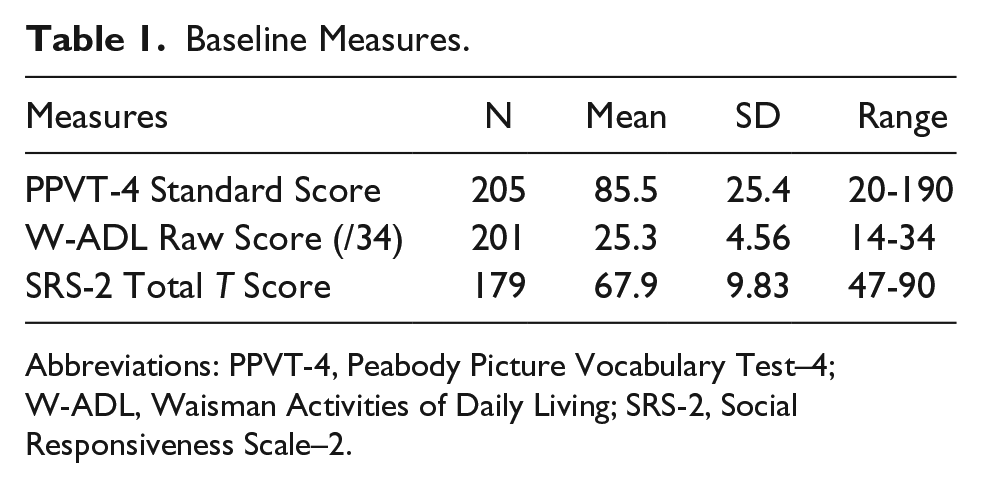
Abbreviations: PPVT-4, Peabody Picture Vocabulary Test–4; W-ADL, Waisman Activities of Daily Living; SRS-2, Social Responsiveness Scale–2.
The WRI was administered to participants with ASD whose understanding of single-word vocabulary was at or above an age equivalency of 13 years (AE ≥13) as this self-perception measure was only deemed suitable for individuals who grasped core concepts. Over half (57%, n = 114) of the program participants with ASD had an age equivalency score at or above 13 years, of which 76 participants completed the WRI at the beginning and end of the intervention. Paired samples t tests were conducted for each domain to evaluate the impact of the intervention on participants with ASD (Table 2). There was a significant decrease in all WRI domain scores, indicating fewer work readiness concerns, from pretest to posttest with the exception of the Flexibility and Health/Safety domains. Cohen’s d ranged from 0.35 to 0.46, suggestive of a small effect. 40
Participants With ASD (PPVT AE ≥13): WRI (n = 76).

Abbreviations: ASD, autism spectrum disorder; PPVT, Peabody Picture Vocabulary Test; AE, age equivalency; WRI, Work Readiness Inventory.
Survey results from participants with ASD (irrespective of receptive vocabulary scores) and parents indicated growth in work readiness skills. Over 70% (86/118) of participants with ASD indicated that they were more prepared to find a job at the conclusion of the program, and 71% (39/55) of the participants with ASD agreed or strongly agreed that they developed job-related skills and abilities. On the open-ended survey, participants with ASD indicated that they had gained “work-related experience,” learned “the importance of teamwork in the workplace,” and learned how to “interact at work” and “be trustworthy and reliable in the workplace.”
Parents also reported positive changes in their youth’s employment readiness. Over 80% of the parents (106/118) agreed or strongly agreed that their youth with ASD had gained an understanding of necessary job skills, with almost half (53/110) indicating improved understanding of career fit.
Outcomes elicited from peer mentors were contrasted to participants with ASD (Tables 3-5). Only peer mentors who completed the WRI and were enrolled in high school were included in the sample (n = 46). As noted in Table 3, the mean age in groups (participants with ASD and peers) differed (t[120] = 5.48, P < .001), such that participants with ASD tended to be older (mean [M] = 17.1 years, SD = 1.53) than peer mentors (M = 15.7, SD = 0.93). This age difference was not regarded as a confounding factor because young people with ASD tend to achieve milestones (eg, employment, independence, and academic competence) later than peers. 41
Demographics ASD Participants (PPVT AE ≥13) and Peer Mentors.
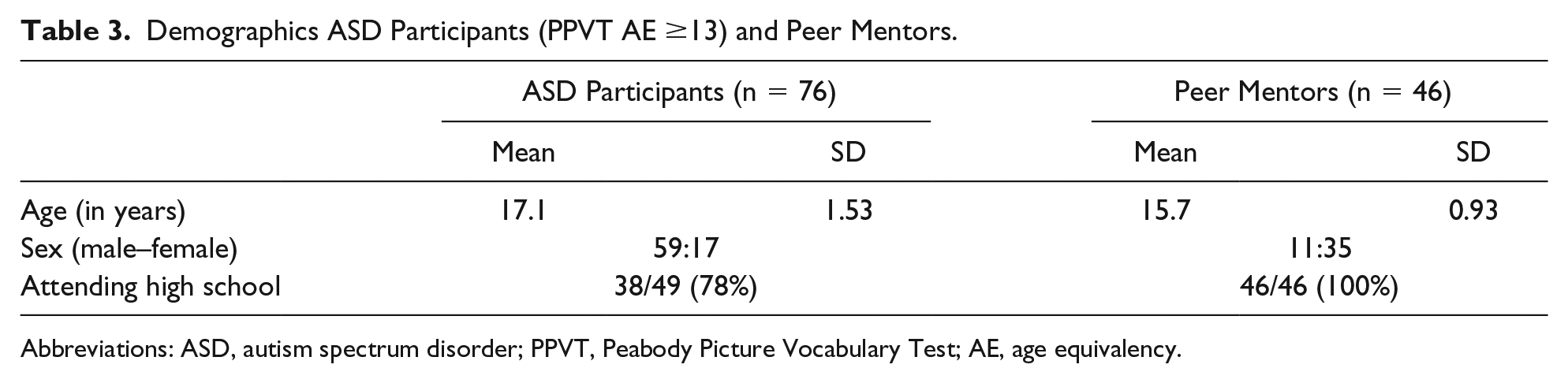
Abbreviations: ASD, autism spectrum disorder; PPVT, Peabody Picture Vocabulary Test; AE, age equivalency.
Pretest on the WRI.
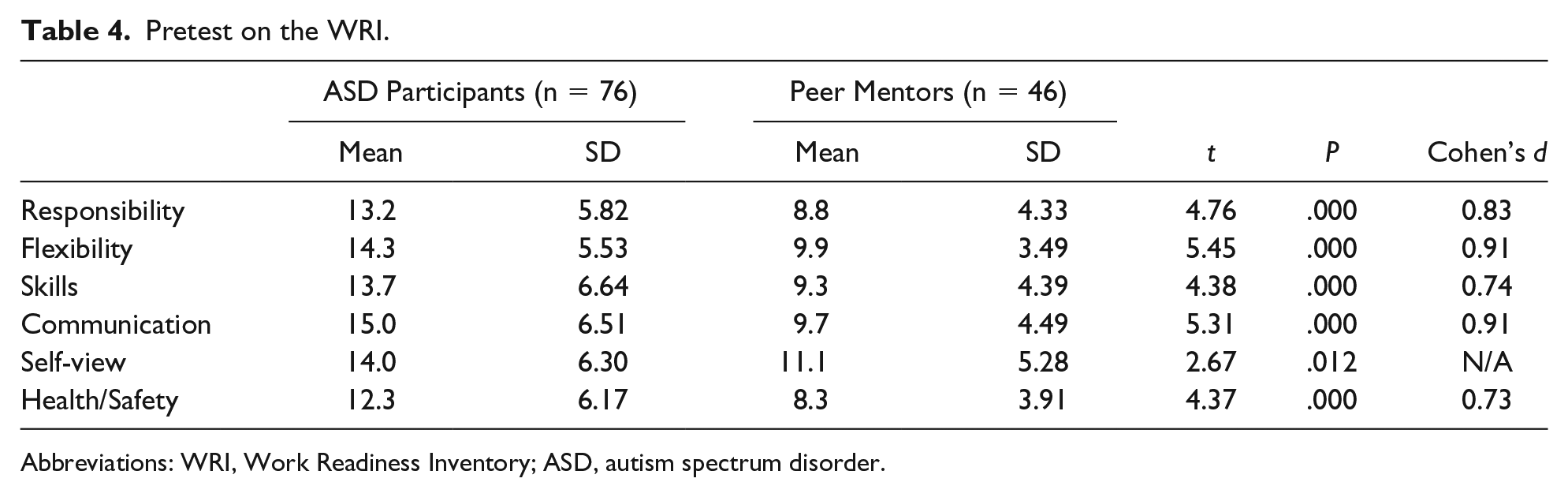
Abbreviations: WRI, Work Readiness Inventory; ASD, autism spectrum disorder.
Posttest on the WRI.

Abbreviations: WRI, Work Readiness Inventory; ASD, autism spectrum disorder.
Fisher’s exact test revealed significant differences (P < .001) in educational attainment of participants with ASD and peer mentors. The subsample of peer mentors was restricted to those attending high school, whereas only 78% of the participants with ASD were still in high school. Like age, the completion of high school for the ASD group was not seen as a confounding factor again, given that adolescents and young adults with ASD often achieve milestones later than typically developing adolescents. 41
Paired samples t tests were conducted, and the results indicated that participants with ASD had significantly more concerns or areas of challenge, represented by higher scores in every domain with the exception of the Self-view domain, when compared with peer mentors at the beginning of the program (Table 4). According to Cohen, 40 the effect sizes for the Responsibility, Flexibility, and Communication domains are large (d > 0.8), and the effect sizes for the Skills and Health/Safety domains are moderate (0.5-0.8).
Paired samples t tests were conducted on posttest WRI scores. Although positive changes were reported for individuals with ASD related to their work readiness skills, their scores continued to be significantly higher on the Flexibility, Communication, and Health/Safety domains, which suggests more concerns or areas of challenge than peer mentors (Table 5). According to Cohen, 40 these domains represent a moderate effect (0.5-0.8).
Social Skills
Parents (n = 155) of the participants with ASD completed the SSIS, 35 a social skills and behaviors questionnaire, before and after the program. Scores were not separated based on those who completed the WRI, as both the pre- and postprogram mean standard scores for the Social Scale and Problem Behavior Scale were not significantly different from one another (P > .05). As a group, no significant changes in overall social skills were found among participants with ASD. The mean pretest scores were just below 85 that, according to Gresham and Elliott, 35 suggests a need for social skills training. At the conclusion of the program, the mean social skills standard score remained virtually the same. For the Problem Behavior Scale, the pre- and postprogram mean scores were just above average, suggesting that participants with ASD had more behavior issues compared with a normative sample (Table 6).
Pre- and Posttest Scores on the SSIS.

Abbreviation: SSIS, Social Skills Improvement System.
Although no changes in social skills were reported on the SSIS, participant and parent survey results indicated positive changes. Seventy-one percent (39/55) of the participants with ASD agreed or strongly agreed that their communication and social skills had improved as a result of the program. Comments from open-ended survey questions indicated that participants enjoyed “socializing” and that they learned “how to (better) communicate with others.” Over 50% of family caregivers (30/57) indicated that there was noticeable gain in their adolescent’s communication and social skills. Survey comments from parents included, “I see him as more sociable,” and “He had more conversations with people his own age that were appropriate.”
Qualitative Experiences
Each group of participants (participants with ASD, parents, peer mentors, and employers/community partners) qualitatively identified impacts and experiences of program engagement. Overall, participants reported positive impacts from the program in the areas of work preparedness and the advancement of social skills. Community partners/employers and peer mentors identified gains in personal knowledge and attitudes. Perceived program impacts are outlined below.
Job Readiness/Career Development Skills
Involvement in the program reportedly enabled participants with ASD to explore employment particularly by learning about different types of jobs, considering their likes and dislikes of job tasks, and differentiating between work and leisure activities. Career exploration through program-related tasks was viewed as helpful, as reflected by a parent: Just getting to try a bunch of different things and you know getting an idea of things he might like to do in the future you know because otherwise it’s just. . . . “What do you want to do when you’re done with high school, and it’s like, huh?” Because what do they know? They don’t have any experience.
Gaining work experience reportedly provided affirmation to individuals with ASD about their ability to complete job tasks and roles as well as work with others. This was described to result in increased self-confidence associated with getting a job. As an example, a participant with ASD stated, I enjoyed the fact that I was able to get . . . work experience because I was always . . . worried about transitioning into the job world.
Other skill advancements identified by participants included coping with employment (eg, working in difficult environmental circumstances), self-advocacy (eg, communicating needs), and professionalism (eg, understanding and managing emotions). Such early preparatory opportunities were perceived to be integral to ultimately finding a job: It provided the entry way into the experience that (the individual) hadn’t had before. If you don’t have the opportunity to begin . . . you’re not moving forward at all.
Social Communication Skills
Participants with ASD stated that meeting with a diverse group of individuals was positive and growth-provoking. Reported by all stakeholder groups, social skills gained by youth with ASD included increased interaction (eg, how to approach people), communication skills (eg, listening and turn taking), and heightened understanding of social cues (eg, recognizing the need for personal space).
For several parents, their adolescent’s involvement in the program was perceived to provide vicarious benefits, including increased parental awareness of the skills of their youth with ASD, relief that the youth was affirmed and experienced gains, and assurance of the potential for the youth to achieve greater independence than previously had been envisioned. In some instances, parents noted improvement in their youth’s level of independence and engagement in the community.
Participant Follow-up Data
Follow-up phone calls with the participants with ASD and/or their parents were attempted at 3, 6, and 12 months postprogram to inquire about postsecondary education and volunteering or paid employment. Fifty-nine percent (139/237) of participants with ASD were reached at 3 months, 68% (135/198) at 6 months, and 85% (132/156) at 12 months. The denominator decreases over time as the programs were administered over 3 years, and not all participants had progressed through all follow-up time points at the time of this review. Fisher’s exact tests were used to determine if the percentage of participants who were attending school, volunteering, or employed differed over time (program end, 3, 6, and 12 months). A significant difference was found only for employment rate (P = .006; Figure 1). At program end, excluding those younger than 16 years of age who were not considered eligible for employment, the employment rate for participants with ASD was 7% and increased to approximately 20% at 3, 6, and 12 months. Most of the participants (83%) worked less than 20 hours per week, and all were in entry-level positions (eg, food delivery, dishwasher, and yard maintenance), with the vast majority (89%) earning minimum wage.

Percentage of participants in employment, volunteer work or school after program exit.
Impact on Community Partners/Employers
Community partners reportedly appreciated what they generally described to be a frequent strong work ethic (eg, dedication and enthusiasm) among individuals with ASD, as illustrated by a community partner who stated, (Participants with ASD) bring a kind of a different view, a different perspective to things that is helpful. . . . If things have to be altered or changed, it doesn’t mean that it’s a negative, it adds to an environment. . . . They’re there to do the job like everybody else, and they want to be successful at it. They actually put in more effort than most people.
Inclusion was described to fulfill organizational goals of increasing diversity in the workforce. For one community partner, involvement in the program helped reflect on the organization’s hiring strategies: It’s just wonderful to have this kind of program to kind of take a step back and think about, “Oh, actually are we engaging people who are on the autism spectrum, and if not, how do we?”
Employers/community partners reported that their involvement in the program enhanced their knowledge about ASD, and subsequently decreased worries and negative stereotypes associated with working with individuals with ASD. Specific areas of knowledge gain were indicated to include strengths and challenges faced by individuals with ASD, the range of ASD expression, ASD terminology, and awareness of ASD programs/supports.
For some community partners, their existing work infrastructure was reported to effectively support individuals with ASD and thus did not require further adjustments. A few reported challenges in determining an optimal fit between work requirements and the capacities of a given individual with ASD, particularly in relation to job tasks or the work environment. Overall, community partners reported gains in working with individuals with ASD and gratification in witnessing work-related and developmental gains.
Program Influence on Peer Mentors
All peer mentors (38/38) agreed or strongly agreed that the program had positively affected them. Many peer mentors indicated that they had deepened their understanding of ASD, with over half (60%) participating in more than one CWC program offering. Several peer mentors identified an increase in social connections, with subsequent improvement in social efficacy and mastery. In turn, these benefits reportedly increased personal confidence as well as perceived connections with individuals with ASD.
Discussion
In its provision of preemployment skill building and work experience, this review of program data collected in CWC suggests that the program was valued by stakeholders. Gains were identified in specific areas of program focus, and participants with ASD and peer mentors expressed enjoyment and gratification related to increased exposure and access to the workplace. Both qualitative and quantitative data identified gains related to preemployment skills for youth with ASD. Outcomes included skill acquisition and experiential gain in dependability, teamwork, and collaboration—skills that are valued relative to employability and revered by employers.42,43
Despite gains, participants with ASD continued to exhibit challenges compared with peers. Given these concerns and continued underemployment of youth and adults with ASD, employment readiness and support—including preemployment developmental assistance—appear to be needed, and align with literature recommending preemployment activities in high school.44-46
Qualitative and survey data gathered from participants and parents generally identified some social communication skill gain as a result of program participation. While these changes were not noted on the SSIS, Anagnostou et al 47 similarly found mixed results when using this instrument in intervention studies that focused on youth social skills. These findings appear to amplify the need for sensitivity in evaluative instrumentation and more support for youth with ASD in the aim of building employment-oriented social skills. 10
Notwithstanding this need for programmatic and evaluative development, it is important to note that these data identified job skill and social communication advancement for participants with ASD. For 67% of autistic participants, the CWC program reportedly provided initial exposure to work experience. Advancing this experience seems important in supporting work skills and aptitudes 3 and is noted to be “one of the most consistent predictors of post-school employment outcomes for youth with disabilities.” 13 Follow-up data at 3, 6, and 12 months postintervention indicated that 20% of the participants became employed, representing a 13% increase. According to the US Department of Labor, Bureau of Labor Statistics (1994-2018), 48 youth enrolled in high school had an employment rate of 20%. Sixteen- to 19-year-old youth with disabilities had an employment rate of 16% versus 30% for youth without disabilities. 49 For participants with ASD, the opportunity to participate in CWC may have offered them impetus toward employment and overcoming the odds of otherwise remaining unemployed.
These data suggest that peer mentors and community partners also benefited from the program. These stakeholders reported greater understanding about ASD and confidence about working with individuals with ASD. The literature suggests that if employers have had positive experiences employing workers with disabilities, they tend to have more favorable views about inclusive hiring.50-52 The positive experiences of these peer mentors and community partners/employers ultimately may be helpful in creating more acceptance, including diverse workplaces and communities.
Parents similarly indicated positive impacts related to expectations for their youth’s vocational future, including increased independence and integration within the community. Parents play an integral role as youth transition to adulthood and from school to work.45,53 While parents identify community employment as important, they reportedly are less optimistic regarding this possibility and opportunities for their youth. 54 Programs like CWC may support parental shifts of expectation and hope in nurturing a vision of their adolescent with ASD within the labor force. Parent expectations seem integral to creating opportunities, based on the importance of parental support and encouragement of youth relative to employment. 55 Furthermore, support and encouragement to parents may offer an additionally important element of family centeredness and guidance relative to employment pathways.
Finally, vocational training, including internships and additional school-based activities focused on career development, tend to be offered to students in high school, but participation by individuals with disabilities may be limited. 56 Findings from this review support greater opportunity for career-related engagement that nurtures work exposure and skill development. Findings concur with research suggesting that vocational opportunities for adolescents with ASD are integral to future employment 45 and corroborate studies that convey benefits of inclusive employment access.14,57
Study Limitations and Recommendations for Further Research
As noted earlier, these findings emerged from a secondary review of nationally collected program data. Future study using experimental design, including randomized group assignment, would enhance precision of variables and measurement of their impacts on employment outcomes. This study did not focus on specific program mechanisms that potentially mediated identified outcomes. A more granular analysis in future study would be useful in discerning how particular interventional processes determine outcomes. Longitudinal research is warranted that elicits program impacts over time. Closer links with outcomes that are integral to individuals and families such as quality of life and community integration are recommended, as is further examination of confounding variables such as youth and family socioeconomic status.
Conclusion
This review amplifies elements of employment readiness and support programming for youth with ASD. It identifies the feasibility of engaging varied stakeholders in building more inclusive employment capacity in the community. In this initiative, peers and community partners/employers contributed programmatically and demonstrated engagement and gain for the youth with ASD and themselves. Overall, these findings amplify the potentially generative role of integrated early (high school) employment preparedness in advancing the vocational readiness of youth with ASD.
Footnotes
Author Contributions
DBN and WM implemented the review and contributed to manuscript development; RZ and ES analyzed the data and contriubted to manuscript writing; SQ analyzed data.
Declaration of Conflicting Interests
The author(s) declared the following potential conflicts of interest with respect to the research, authorship, and/or publication of this article: Drs Nicholas and Mitchell, and Siwei Qi have received financial remuneration from the Sinneave Family Foundation.
Funding
The author(s) disclosed receipt of the following financial support for the research, authorship, and/or publication of this article: This work was supported by the Sinneave Family Foundation. CommunityWorks Canada® was sponsored by The Sinneave Family Foundation and Autism Speaks Canada, and funded in part by the Government of Canada’s Opportunities Fund for Persons with Disabilities Program.
