




Abstract
What this Paper Adds?
This study elucidates the performance of older bilinguals on alternating verbal fluency tasks, which places a greater cognitive load than the other conventional tasks used for assessing executive functions.
The executive functions in the bilinguals of 50 to 60 years is explored in this study.
This is one of the first Indian studies to conduct an error analysis on the performance of younger and older bilinguals in alternative verbal fluency tasks in their first and second language.
Applications of Study Findings to Gerontological Practice
The negative effect of age on executive functions can be observed even in an individual’s 50’s.
The cross-category alternating verbal fluency task can be used to tap slight changes in executive functions in an older bilingual.
The findings of the study could also be used to design an intervention procedure for older bilinguals with language disorders that uses alternate verbal fluency tasks to work on improving executive functions.
Introduction
Bilingualism is an individual’s usage and proficiency in at least two languages. This can be influenced by factors such as opportunities to use a particular language and exposure to other speakers of the language. Grosjean (2010) described bilinguals as individuals who require and utilize more than one language or dialect in their daily lives. There are a couple of advantages that bilinguals would experience compared to monolinguals. Young bilinguals have been reported to be faster in executing attentional network tasks and more adept in alerting and executive functions than monolingual individuals (Costa et al., 2008). The literature provides evidence of a bilingual advantage in cognitive control in older adults too. In the study by Gold et al. (2013), it was found that older adult bilinguals exhibit better performance in the perceptual task-switching paradigm than their monolingual peers.
Bilinguals avoid wrong language intrusions by using language control mechanisms that help in regulating both languages and aid in inhibiting the incorrect language (Green, 1998). Aspects such as inhibitory control, working memory, problem-solving, and decision-making are important for these functions. Domain-general executive control mechanisms that include concentration on a single task, refraining from extraneous actions through inhibition, and recognizing conflicting inputs or situations are particularly crucial for bilingual language control (Ivanova et al., 2016).
Executive functions aid in alternating between two languages in bilinguals (Abutalebi & Green, 2007). Bilinguals exhibited faster and better performance in cognitive flexibility and inhibitory control tasks (Bialystok & Viswanathan, 2009). It has been found that controlled processing is done more efficiently by bilinguals. Bilingual advantage has also been reported on tasks that demand control of attention over competing cues, that is, interference suppression (Martin-Rhee & Bialystok, 2008). Also, few studies conclude that bilingualism helps offset the loss due to aging in certain executive functions (Bialystok et al., 2004).
The alternating fluency task is considered as one of the most sensitive tasks in evaluating executive functions (Deepak et al., 2021). It is cognitively more complex compared to the other fluency tasks. In contrast to the other non-verbal tests like the Simon task, the Flanker task used to study executive functions, the alternating fluency task is linguistic in nature and hence a good estimate of language abilities. The task provides insight into different search strategies that will be used to probe lexicons. It requires intact functioning of cognitive flexibility and divergent thinking for alternating and abundant exposure to various lexical items. The studies that have utilized alternating verbal fluency tasks for probing into the executive functions in Indian scenarios are limited. Deepak et al. (2021) compared the alternate semantic verbal fluency task and alternate phonemic verbal fluency tasks across adolescents, young adults, and older adults. Performance between young adults and older adults showed a significant difference. Also, the older adults exhibited poorer performance in the task of semantic verbal fluency in comparison to phonemic verbal fluency.
As one ages there is a gradual deterioration in cognitive abilities (Grady, 2012; Hedden & Gabrieli, 2004). Executive functions are one such domain that exhibits deficits with age (Bopp & Verhaeghen, 2009). Studies that employed various tasks such as Stroop, Flanker, Digit Span, and Trail-Making Task to tap executive functions have shown significant differences in the performance of older age groups, that is, a decline in performance when compared to the younger age groups. Age-related changes found in executive control are linked to alterations seen in the prefrontal cortex due to aging (Raz, 2000; West, 2008).
There is a dearth of literature on the impact of age on various linguistic and executive functions drawing evidence from their performance on alternating verbal fluency tasks. Dean et al. (2001) investigated how younger and older adults performed in the tasks of semantic fluency, phonemic fluency and cross-category alternating fluency task. On comparing these tasks, it was found that older adults showed lowered performance in the cross-category alternating fluency task.
Need for the study: According to studies looking into the influence of bilingualism on executive control in young adults, bilingualism has a dynamic role in the development and fostering of executive functions. However, the effect of age on bilingual advantage is not explored in specific. Hence it cannot be inferred if bilingual advantage recedes in people who are in their 50’s. From the literature review, it is observed that there are few studies that looked into how age affects executive functions, most of which have indicated that executive functions deteriorate with age. Majority of the previous studies that explored executive functions have employed non-verbal tasks (Calvo & Bialystok, 2014; Struys et al., 2018). Studies employing linguistic tasks have mainly utilized verbal fluency tasks such as semantic or phonemic verbal fluency tasks. Bilinguals’ performance on alternating verbal fluency tasks, which places a greater cognitive load, is less explored. The methodology of alternating verbal fluency used in the present study is unique from the previous studies in that the participants will be asked to alternate between categories in L1 and L2 individually. Also, most of the studies that have explored the effect of age on executive functions are done on populations of age greater than 60. The executive functions in the age range selected for this study, 50 to 60 years, are less explored. In other words, the current research investigated the bilingual advantage in younger and older individuals to assess if bilingual advantage remains the same regardless of age.
Aim of the study: The study aims to inspect the effect of age on executive functions in a bilingual’s 50’s by utilizing alternating verbal fluency task.
Objectives:
To compare the performance of younger and older bilinguals in cross-category alternating verbal fluency task in L1.
To compare the performance of younger and older bilinguals in cross-category alternating verbal fluency task in L2.
Hypothesis:
H1:0-There is no significant difference between the performance of younger and older bilinguals in cross-category alternating verbal fluency task in L1.
H2:0-There is no significant difference between the performance of younger and older bilinguals in cross-category alternating verbal fluency task in L2.
Method
Study Design
The research design followed in this study is a standard group comparison with a cross-sectional study design. To understand whether there was any significant deterioration in executive functions in the early 50’s, the performance of the age group 50 to 60 years was required to be compared with a younger age group. Hence this study design was chosen where bilinguals of 50 to 60 years were compared with bilinguals of the age range 18 to 30 years in terms of their performance in alternating verbal fluency task.
Participants
Participants in two age-groups that is, between 18 to 30 years and 50 to 60 years were considered for the study. Thirty participants in each age group were recruited based on convenience sampling. The sample size was calculated based on the availability of participants in the time frame of 2 months during which the recruitment of participants was carried out. Age was the grouping variable in the study. In order to ensure generality, a mixed, heterogeneous population in terms of occupation was opted for the study. Hence individuals from different professions were recruited. The study followed the World Medical Assosciation Declaration of Helsinki for the recruitment of participants. The Ethics Committee of the institute in India waived the need for ethics approval for the collection, analysis and publication of the data obtained and anonymized data for this non-interventional study since this was done as a part of the student dissertation. Informed consent for their participation and publication of the study was taken from all the participants in written form before recruitment for the study. The participants were informed about their right to refrain from the study if needed. They were given two verbal fluency tasks the responses of which were transcribed and the number of correct responses was taken as the outcome measure.
Participant selection criteria were as follows:
Inclusion Criteria
All the participants were successive bilinguals with Malayalam as their L1 and English as their L2.
They had a minimum of 10 years of exposure to L2.
None of them had any history of physical, sensory, linguistic, or cognitive deficits.
Procedure
The participants were seated in a quiet, closed room and tested individually. Demographic details from each of the participants were elicited and profiled. These included age, gender, educational qualification, and occupation, number of years of formal education and number of years of L2 exposure. Languages known to the participants were also profiled. The details of the participants in two groups—younger and older bilinguals are documented in Tables 1 and 2 respectively.
Details of Participants in Younger Bilinguals Group.
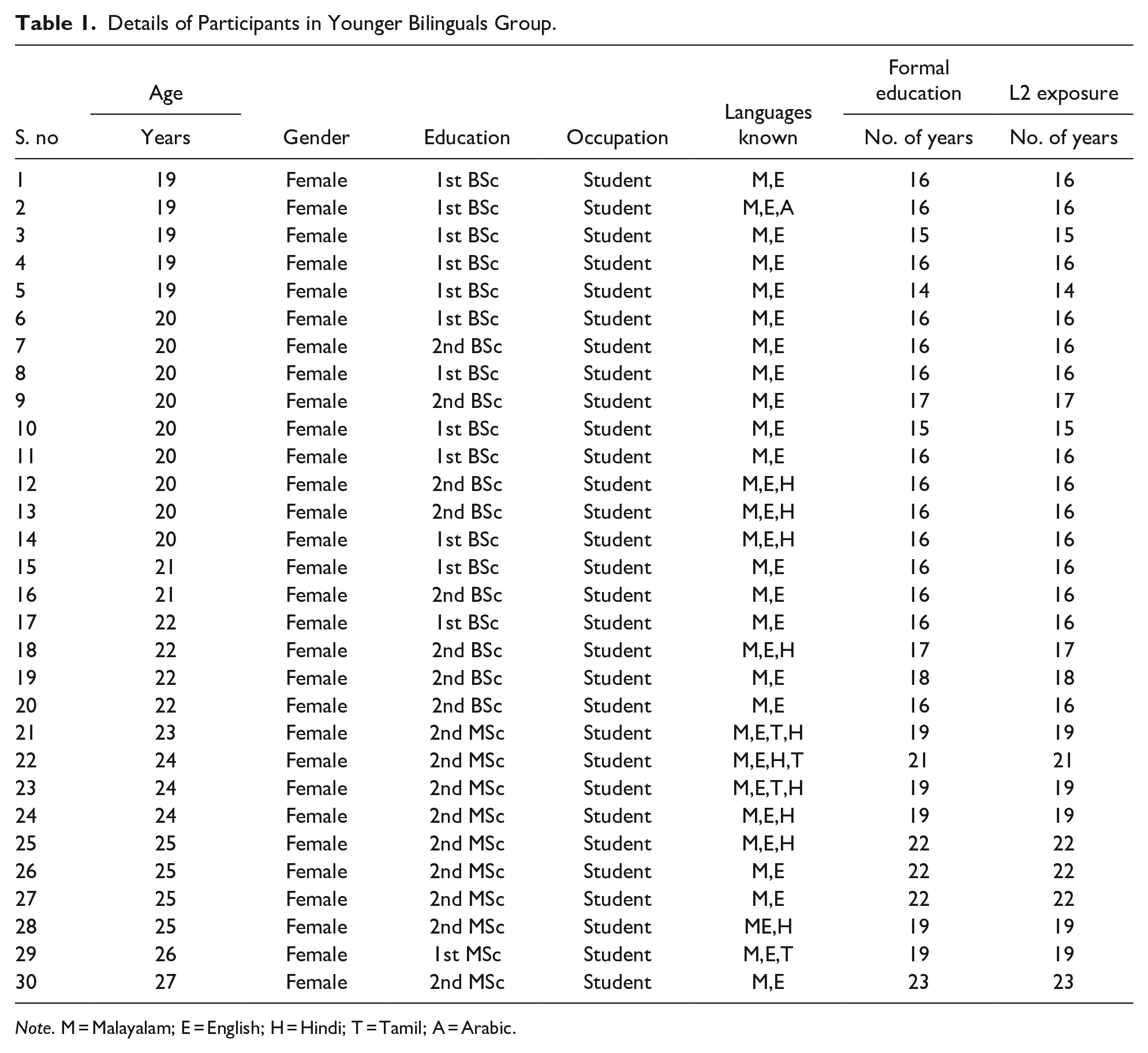
Note. M = Malayalam; E = English; H = Hindi; T = Tamil; A = Arabic.
Details of Participants in Older Bilinguals Group.

Note. M = Malayalam; E = English; H = Hindi; T = Tamil; K = Kannada; F = French; UG = undergraduates; PG = post graduates.
Prior to the tasks, the participants were provided with a self-rating questionnaire, Language Experience and Proficiency Questionnaire (LEAP Q). Language Experience and Proficiency Questionnaire-LEAP Q is an assessment tool developed by Marian et al. (2007). It assesses bilingual proficiency based on language acquisition and usage. The Indian version of LEAP-Q was adapted by Ramya and Goswami (2009). The translation and adaptation of the same in Malayalam language were done by Haripriya et al. (2023). This is the only tool currently available to rate bilingual proficiency in Malayalam-speaking bilinguals. Hence this tool was used in the present study to ensure that the proportion of high proficient and low proficient bilinguals in both age groups selected for the study was not highly variant enough to affect the results. In other words, this was done to minimize the effect of bilingual proficiency which has the potential to be an extraneous variable in the study. The participants were required to rate their proficiency for question 10 in the questionnaire, on a four-point rating scale where 1 indicates zero proficiency, 2-low, 3-good, and 4 indicates perfect proficiency in the domains of comprehension, speaking, reading and writing. Based on LEAP-Q findings, the participants were classified as high-proficient and low-proficient bilinguals. As per the criteria quoted in Vincent and Abhishek (2017), a bilingual should receive a score of 4 in the understanding domain and a minimum score of 3 in all other domains of speaking, reading and writing to be classified as high proficient bilingual. Based on Hickey’s criteria participants were identified as high proficient or low proficient bilinguals.
Among the younger bilinguals recruited, 23 of them were high proficient bilinguals and 7 were low proficient bilinguals. There were 21 high proficient bilinguals and 9 low-proficient bilinguals in the group of older bilinguals.
Each participant was required to perform two tasks. The instruction for each task was clearly provided before each task. Each participant was provided with one test trial prior to the actual testing.
Tasks
The participants were required to perform two alternating verbal fluency tasks. In conventional verbal fluency task used to assess executive functions in bilinguals, the participant is required to name as many items as possible from the single lexical category given. In alternating verbal fluency task, the participant is not only instructed to generate as many items as possible, but also to alternate between two lexical categories in the process. This places higher cognitive load than the other tasks used to assess executive functions and requires the simultaneous action of attention, inhibition, cognitive flexibility, thereby having the potential to tap even the slight deterioration in higher cognitive processes. Hence the alternating verbal fluency task was selected for the current study. The tasks were done separately in L1 and L2 to examine if similar performance could be replicated in the second language as well, however, this was not the primary objective of the study. Also, to rule out the effect of frequency of lexical exposure, commonly seen lexical categories were selected for the alternation in both the tasks.
Task 1: Cross-Category Alternating Verbal Fluency in L1
Two lexical categories, that is, common objects and vegetables, were considered. A time of 2 min was provided to the participants, within which they had to name as many items as possible, alternating between the two categories in L1. The participant was provided examples for alternating from lexical categories not considered in the given task. They were instructed to avoid repeating the items which were already named or using words in L2.
Task 2: Cross-Category Alternating Verbal Fluency in L2
Two lexical categories, that is, fruits and vehicles, were considered. Similar to task 1, a time of 2 min was provided to the participants, within which they had to retrieve as many items as possible, alternating between the two categories. Unlike task 1, the participant had to alternate between the categories in L2. The participant was provided examples from lexical categories not considered in the given task. They were instructed to perform the task without reiterating previously named words or naming them in L1. The order of tasks was counterbalanced across the participants. The responses were audio recorded and transcribed for analysis.
Scoring and Analysis
Quantitative and qualitative analysis were carried out. The number of correct responses were calculated in terms of number of pairs correctly alternated. A score of one was assigned to each of the correctly alternated pairs.
Error analysis was performed to analyse the number and types of errors. Total number of pairs produced incorrectly in this task was calculated. Error responses were classified into single incorrect responses and double incorrect responses. A response was considered as a single incorrect response if only one item in the pair was incorrect whereas it was considered as a double incorrect response when both the items in a pair was incorrect. Each of the single incorrect responses and double incorrect responses were scored as 0. Qualitative analysis was done to identify the type of errors found in the performance of two tasks. Tables 3 and 4 shows the classification of errors observed in Tasks 1 and 2 respectively.
Types of Error Observed in Task 1.

Types of Error Observed in Task 2.

Results
All the recruited participants completed the two tasks and the data from the recruited sixty participants were analysed. The results of the study are explained below in accordance with the objectives.
Objective 1
To Compare the Performance of Younger and Older Bilinguals in Cross-Category Alternating Verbal Fluency Task in L1
The descriptive values for the number of correct and error responses for younger and older bilinguals on Task 1 are shown in Table 5. In order to verify any significant difference in the performance between the two groups—younger and older bilinguals (between-group comparisons), statistical analysis was carried out. The data were subjected to the test of normality using the Shapiro-Wilk test and it was found that the data was not normally distributed (p < .05) for both younger and older bilinguals.
Descriptive Values for the Number of Correct Responses (Correctly Alternated Pairs) and Number of Error Responses (Incorrectly Alternated Pairs) for Younger and Older Bilinguals on Task 1.

Indicates the variable which showed significant difference.
Since the data was not normally distributed, a non-parametric test, the Mann-Whitney-U test was performed for the comparison of younger and older adults. It was found that in Task 1—cross-category alternating verbal fluency task in L1 the |Z| score obtained was 2.063 and the corresponding p-value showed a significant difference (p < .05) between the age groups in terms of the number of correct responses. With respect to the error analysis in this task, the |Z| score obtained was 0.208 and the corresponding p-value indicated no significant difference (p > .05) between the age groups in the number of error responses.
To summate, older bilinguals exhibited poorer performance with respect to the number of correct responses whereas the number of error responses was found to be similar in both the groups in cross-category alternating verbal fluency in L1.
Objective 2
To Compare the Performance of Younger and Older Bilinguals in Cross-Category Alternating Verbal Fluency Task in L2
Descriptive values for the number of correct and error responses for younger and older bilinguals on Task 2 are shown in Table 6. Statistical analysis was done to determine if there was any significant difference in the performance between the ages of the two groups (between-group comparisons). On performing Shapiro-Wilk test it was found that the data was not normally distributed (p < .05) for both younger and older bilinguals for this task. The Mann-Whitney-U test revealed a |Z| of 2.619 and the corresponding p-value showed a significant difference (p < .05) between the age groups for the number of correct responses. On considering the error analysis in this task, the |Z| score obtained was 0.865 and the corresponding p-value indicated no significant difference (p > .05) between the age groups in the number of error responses.
Descriptive Values for the Number of Correct Responses (Correctly Alternated Pairs) and Number of Error Responses (Incorrectly Alternated Pairs) for Younger and Older Bilinguals on Task 2.
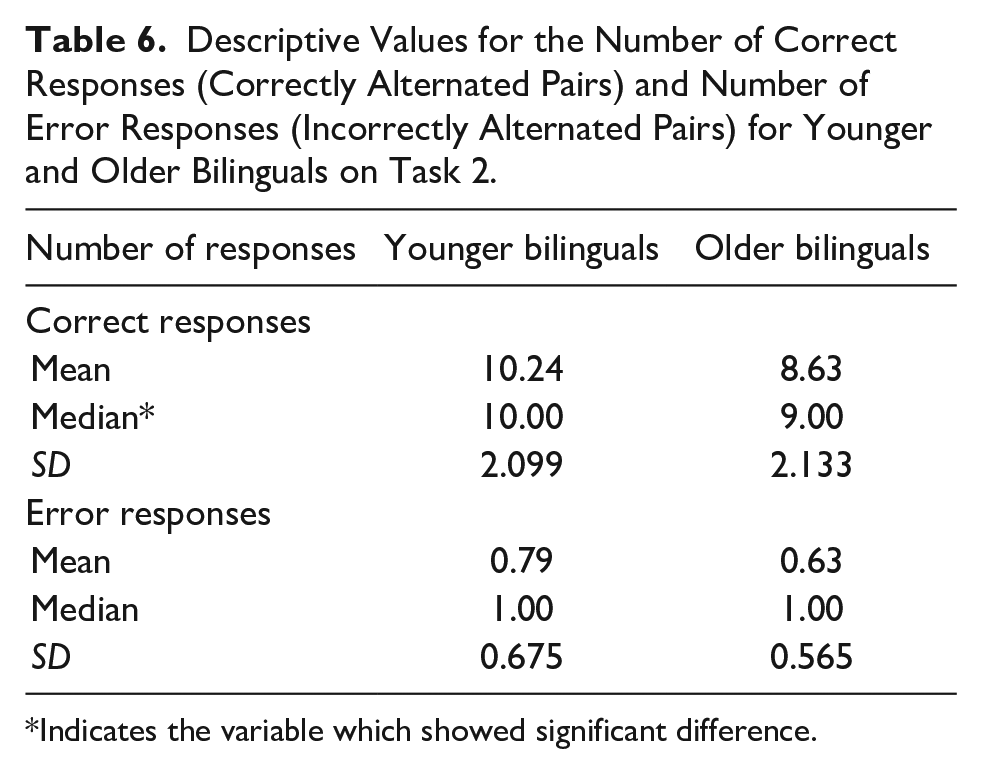
Indicates the variable which showed significant difference.
To summarize, in Task 2, the cross-category alternating verbal fluency task in L2, older bilingual’s performance was inferior compared to younger bilinguals on the number of correct responses. However, there was no significant difference with respect to the error responses between the age groups.
Qualitative Error Analysis
Both younger and older participants exhibited a very small rate of errors. As mentioned above, it was found from the Mann-Whitney U test that there was no significant difference (p > .05) between the number of error responses of younger and older bilinguals in any of the tasks provided. Similar types of errors were found in both younger and older adults. Following are the observations made by the researcher with respect to the errors found in each task in both age groups. Both younger and older bilinguals exhibited a relatively higher number of single incorrect responses when compared to the double incorrect responses in alternating verbal fluency task in L1 and alternating verbal fluency task in L2. On qualitative analysis it was found that, repetitions, substitution from another category, and omissions were the errors in both the tasks. In addition, substitution from other language was exhibited by both older and younger participants in Task 1. Omissions were the most frequently error observed in both the tasks by the participants.
Discussion
The results of the study that age has an adverse impact on executive functions as observed from the cross-category alternating verbal fluency task is in line with the findings from the study by Deepak et al. (2021). They conducted a study among adolescents, young adults, and older adults where the participants were required to perform an alternate semantic fluency task and an alternate phonemic fluency task in Malayalam. Results revealed that older adults performed poorer compared to younger adults.
The findings of the current study with respect to the cross-category alternating verbal fluency task are in consonance with the previous studies that have employed other neuropsychological tests tapping several executive functions, including attention and inhibition. Studies which utilized tests such as the Stroop Test (Van der Elst et al., 2006; West & Alain, 2000), the Simon task (Bialystok et al., 2004; Van der Lubbe & Verleger, 2002) shown that performance declines with age. The negative impact of age on executive functions is further supported by studies that tested working memory spans (Park et al., 2002) and tests measuring the potential to shift attention, such as the Trail Making Test (Salthouse & Fristoe, 1995). The study conducted by Goral et al. (2015) on Spanish-English bilinguals employed the Simon task, the Trail Making test, and the month ordering test age. The results of this study, which indicated a negative correlation between performance in the three domains and age, are consistent with those of the present study.
There are also a couple of studies that contradict the negative impact of age on executive functions. In the study by Luo et al. (2010), bilinguals of four age groups that is, 7, 10 years, young adults, and older adults with respective mean ages of 20 and 70 were given category and letter fluency tests. Results demonstrated that verbal fluency performance improved as people aged from young children to younger adults but remained largely stable in older adults.
The error analysis in the current study revealed that younger and older adults exhibited similar types of errors. In cross-category alternating verbal fluency in L1, the errors observed were repetitions, substitution from another category, substitution by L2, and omissions. Similar errors were observed in cross-category alternating verbal fluency in L2 too except that substitutions from the other language were not observed in this task.
The earlier studies which employed error analysis on generative naming have been done on clinical population such as dementia. According to Rosen and Engle (1997), most repetitions also called perseverations arise due to constrictions in working memory capacity and self-monitoring. As a result, perseverations are observed to be more common among older persons (Ramage et al., 1999) and in persons with memory and executive impairments, such as Alzheimer’s disease (Azuma, 2004). The substitutions from other categories otherwise known as intrusions arise due to deficiency in selection and judgment abilities (Itaguchi et al., 2022). The current study is one of the first Indian studies to conduct an error analysis on the performance of younger and older bilinguals in alternative verbal fluency tasks in their first and second language.
There was a double dissociation in the results as the number of responses produced on alternating verbal fluency task were lower in older bilinguals compared to younger bilinguals, however the error analysis revealed that the responses of the older bilinguals did not differ significantly with the errors produced by younger bilinguals. This could indicate that the cognitive linguistic processes could show a subtle difference, especially in terms of the speed of processing, the retrieval speed as the age increases.
According to the review of the literature, the effect of age on verbal fluency was uneven. Additionally, there were contradictory results regarding the claim that as people age, their responses to executive function will decline. Only a few studies have reported significant age effects on alternating verbal fluency task. The results of the current study indicate that the bilinguals in their early 50’s show a decline in the cross-category alternate verbal fluency task.
The present study enables researchers to compare the performance of bilinguals in each language as well as their ability to alternate between the languages. The study provides an understanding of how language and executive functions interact with each other. The current study could be used to design an assessment tool for assessing cognitive flexibility in typical and atypical bilingual populations. The findings of the study could also be used to design an intervention procedure for bilinguals with language disorders that uses alternate verbal fluency tasks to work on improving executive functions. Also, this study helps to understand the cognitive performance in adults aged 50 to 60. It gives an insight into the effect of age on alternating verbal fluency performance between categories in their L1 and L2, and this knowledge can be applied in clinical settings while assessing bilinguals across different age groups.
There are a few limitations of the current study as well. The groups were not balanced on the basis of bilingual proficiency in the present study. Also, in the current study, the alternating verbal fluency task was not compared with the traditional verbal fluency task. In future studies, this comparison can be incorporated to explore the rate of decline in executive functions with age. In this study, the categories provided for tasks were not of the same complexity levels. For the task in L1, the categories given were common objects (where one can generate items by looking around them) and vegetables. Whereas one of the categories given for task in L2 were vehicles where the number of items in the category may be limited and will also depend on the person’s knowledge of them.
In future studies, the categories considered while performing alternate verbal fluency tasks need to be of equal complexity. Also, future research could investigate the effect of age on processing speed in bilinguals using the same task.Older age groups greater than 60 years can be included in the upcoming studies to compare the performance of younger, middle-aged, and older bilinguals in alternate verbal fluency tasks. The study can also be extended to pathological populations like Mild Cognitive Impairment and Dementia. The comparison of bilinguals with monolinguals on alternating verbal fluency task is another area which can be explored in future.
Conclusion
The current study aimed to examine the influence of bilingualism and age on executive functions by employing alternating verbal fluency tasks. It was observed that the older bilinguals exhibited poorer performance in cross-category alternating verbal fluency tasks in L1 and cross-category alternating verbal fluency task in L2 when compared to younger bilinguals with respect to the number of correct responses. Hence it can be concluded that the negative effect of age on executive functions can be observed even in an individual’s 50’s. However more studies are required to be done on similar lines for better understanding of the extend of decline in executive functions in a bilingual’s 50’s.
Footnotes
Acknowledgements
1. Director, All India Institute of Speech and Hearing, Mysore.
2. Participants of the study
Author Contributions
Declaration of Conflicting Interests
The author(s) declared no potential conflicts of interest with respect to the research, authorship, and/or publication of this article.
Funding
The author(s) received no financial support for the research, authorship, and/or publication of this article.
Ethical Considerations
The Ethics Committee of the All India Institute of Speech and Hearing waived the need for ethics approval for the collection, analysis and publication of the data obtained and anonymized data for this non-interventional study since this was done as a part of the student dissertation. The study followed the World Medical Association Declaration of Helsinki for the recruitment of participants. All the partcipants provided written consent form for the participation and publication of their anonymised information.
