



Abstract
This study aimed to determine the time elapsed since the last dental care visit and its associated factors among older adults in Peru from 2019 to 2021. This was an analytical cross-sectional study utilizing secondary data analysis. The population comprised 210,862 records of older adults from 2019 to 2021, with a final sample of 11,215 records. The dependent variable was the time elapsed since the last dental care visit, while the independent variable was the year, with population characteristics included as covariates. Both bivariate and multivariate analyses were employed. The mean time elapsed since the last dental care visit was 7.93 years (SD = 8.03) in 2019, 7.93 years (SD = 7.28) in 2020, and 7.76 years (SD = 8.01) in 2021, with non-statistically significant difference between medians (p = .050). Hierarchical multiple linear regression analysis indicated that a model incorporating year, health, geographic, and socio-demographic characteristics demonstrated a greater determination coefficient (R2% = .90) and validity (p < .001). The mean time elapsed since the last dental care visit among older adults in Peru was 7.93 years in both 2019 and 2020, and 7.76 years in 2021; geographic characteristics, wealth index, and age were identified as associated factors.
Keywords
Introduction
It has been demonstrated that the proportion of older adults within the global population is on the rise, and this life course is associated with an increased incidence of various oral conditions (Fukai et al., 2017). Recent years have witnessed significant changes in the global prevalence and incidence of oral diseases, with studies indicating that approximately 30% of individuals aged 60 experience periodontal disease, and edentulism prevalence among those aged 60 to 95 reaches 40% (Bernabe et al., 2020). The high prevalence of oral health problems in older adults has historically received insufficient attention (Chróinín et al., 2016), prompting the World Health Organization (WHO) to advocate for the development of health programs tailored to address the needs and investigate the dental care challenges faced by this population (Petersen & Yamamoto, 2005).
Peru has not been exempt from these changes and has witnessed a considerable increase in the aging of its population. The proportion of elderly individuals rose from 5.7% in 1950 to 10.1% in 2017 (Ministerio de Salud del Perú, 2019). Epidemiological studies of the Peruvian population’s oral health have documented a notable prevalence of periodontal disease, recorded at 52.5% in 2014, along with a high prevalence of dental caries, amounting to 90.4% in 2002 and 85.6% in 2014 (Ministerio de Salud del Perú, 2019). These conditions are influenced various factors, including the high costs of dental care and the underestimated impact of oral health on nutritional processes, due to compromised masticatory function. Additionally, these conditions affect social interactions through impairments in phonetic capacity and self-esteem, all of which are essential for maintaining an adequate quality of life in the later stages of life (Miranda-Medina & Alcocer-Nuñez, 2021).
The maintenance of oral health transcends public health concerns and encompasses human rights issues, as accessibility to dental care profoundly impacts the quality of life of older adults. These individuals require comprehensive and timely care to mitigate potential adverse effects on their overall health, nutrition, and social well-being (Fukai et al., 2017; Patel et al., 2021). Research has suggested that oral diseases, coupled with poor oral hygiene, are linked to prevalent conditions in the elderly such as dementia, cardiovascular diseases, and mental health disorders, including depression. These associations significantly contribute to cognitive impairments, which, when combined with factors like immobility, physical inactivity, or a sedentary lifestyle, exacerbate the deterioration of oral, mental, and physical health in this vulnerable age group (Herbert, 2023). The capacity of individuals to access oral health services in a timely manner for early diagnosis, prevention, treatment, or rehabilitation of oral conditions is influenced by a confluence of factors, including healthcare system characteristics, socio-demographic profiles, and geographic locations. These factors collectively determine the promptness with which care is sought (Uguru et al., 2020). Consequently, at an international level, the elapsed time since the last dental care visit serves as a crucial indicator of access to dental healthcare services, particularly among vulnerable populations such as older adults.
It is now recognized that several factors, including age, significantly influence accessibility to dental care (Steele et al., 2015). Numerous studies conducted worldwide on older adults have suggested that various determinants increase the likelihood of accessing dental health services (Almutlaqah et al., 2018; Azañedo et al., 2019; Carbajal-Rodríguez et al., 2019; Lee et al., 2014; Silva et al., 2013). Notably, factors such as being female, possessing a higher socioeconomic status, achieving a greater level of education, and having private dental insurance are prominent among these determinants. However, these studies are limited by their design, which precludes establishing causal relationships. Moreover, the analyses primarily focused on whether older adults accessed dental care without considering the time taken to seek such care or the factors that could either expedite or delay access.
Despite the recognized importance of regular dental care, many older adults, particularly in low- and middle-income countries such as Peru, encounter significant barriers to accessing dental services. These barriers may include financial constraints, limited availability of services, and geographic obstacles (Almutlaqah et al., 2018; Azañedo et al., 2019; Carbajal-Rodríguez et al., 2019; Lee et al., 2014; Miranda-Medina & Alcocer-Nuñez, 2021; Patel et al., 2021; Petersen & Yamamoto, 2005; Silva et al., 2013). Understanding the time elapsed since the last dental care visit and its associated factors among Peruvian older adults is crucial for several reasons. This knowledge provides insights into the gaps and inequities in access to dental care within this vulnerable population and helps identify specific factors that can be targeted by public health interventions to enhance access and utilization of dental services. Furthermore, it contributes to the global discourse on aging and dental health, offering valuable data that can inform policymakers, healthcare providers, and researchers in developing strategies aimed at improving dental care delivery and ultimately enhancing oral health outcomes of older adults both in Peru and worldwide. The Peruvian Demographic and Family Health Survey (ENDES) provides valuable data on dental service utilization among older adults; however, there is a notable lack of representative and updated information necessary to assess dental care accessibility, particularly in the context before and during the COVID-19 health emergency. Consequently, this study aims to address this gap by determining the time elapsed since the last dental care visit and its associated factors among Peruvian older adults during the years 2019, 2020, and 2021.
Methods
Subjects. The study utilized the ENDES database, developed by the National Institute of Statistics and Informatics (INEI) of Peru, for the years 2019, 2020, and 2021. Only national records of adults aged 60 years and older were considered, resulting in totals of 68,135 records for 2019, 73,248 for 2020, and 69,479 for 2021. However, not all subjects had complete data for each of the study variables; thus, the final sample sizes for adults aged 60 and older who provided information on the time elapsed since the last dental care visit were 4,045 records for 2019, 3,943 for 2020, and 3,227 for 2021.
A two-stage, probabilistic, balanced, stratified, and independent sampling was conducted at the departmental level, distinguishing between rural and urban areas. Only records of adults aged 60 years and older who provided information regarding the time elapsed since their last dental care visit in the ENDES database of Peru for the years 2019, 2020, and 2021, and who had complete data on the study variables, were selected for inclusion.
Procedure. The study employed an analytical cross-sectional design utilizing secondary data analysis. The independent variable was the year (2019, 2020, or 2021), while the dependent variable was the time since the last dental care visit, measured in years based on the question: “How long ago were you treated in a dental service or by a dentist?” Additionally, several covariates were incorporated into the analysis.
The covariates included the place of dental care, which referred to the public or private entity providing the dental care services, categorized as follows: Ministry of Health, Social Security (EsSalud), Armed Forces/National Police, or Private Sector. The natural region of residence was defined by territorial units determined by factors such as relief, climate, and vegetation, including the following categories: Lima Metropolitan Area, Rest of the Coast, Highlands, and Rainforest. The area of residence was classified according to the environment in which individuals interact with their surroundings, designated as Urban or Rural. The place of residence referred to the physical space where a person lives, categorized as Capital, City, Town, or Countryside. Altitude was defined as the vertical distance between a specific point on Earth and sea level, measured in meters above sea level (masl), and categorized as Below 2,500 masl or 2,500 masl and above. The wealth index was determined based on data regarding household asset ownership, housing construction materials, and access to water and sanitation services, with levels classified as Very poor, Poor, Medium, Rich, or Very rich. Health insurance coverage was categorized as With Insurance or Without Insurance. Sex was considered with the categories Male and Female, while age was classified for adults aged 60 years and older, divided into two groups: 60 to 74 years and 75 to 98 years.
The covariates were organized under three dimensions: Health Characteristics, Geographic Characteristics, and Socio-demographic Characteristics, following the frameworks established by Carbajal-Rodríguez et al. (2019) and Garcés-Elías et al. (2022), and utilizing a manual variable selection method grounded in theoretical considerations.
After approval of the study protocol by a university Institutional Research Ethics Committee, the first step in conducting the research involved accessing the INEI website (www.inei.gob.pe). Upon entering the site, users were directed to click on “Database,” then “Microdata,” and subsequently “Survey Query.” In the search field, “Demographic and Family Health Survey” was entered, with selections made for the years 2019, 2020, and 2021, specifying a single period for each year. Following the download of each database, the files were merged using STATA 15.1 statistical software. Incomplete records were then filtered from the new database, after which data analysis was performed utilizing the svy command to obtain representative estimates.
The subsequent step involved conducting an analysis of each variable to obtain absolute and relative frequencies. The mean and standard deviation of the variable representing the time elapsed since the last dental care visit were calculated for the years 2019, 2020, and 2021. The Kolmogorov-Smirnov test was utilized to assess whether the dependent variable exhibited a normal distribution in conjunction with the covariates. The results yielded a p-value of less than .05 in all cases, leading to the decision to employ non-parametric tests.
The Mann–Whitney U test was employed to identify differences between the summary measures (medians) of dichotomous covariate categories (health insurance coverage, area of residence, altitude, sex, and age), as these categories divided the sample into two groups with independent measures. The Kruskal Wallis test was used to detect differences between the summary measures (medians) of polytomous covariate categories (place of dental care, natural region, place of residence, and wealth index), which divided the sample into more than two groups with independent measures (Grech & Calleja, 2018).
Additionally, a hierarchical multiple linear regression was developed; this statistical method analyzes data with a hierarchical structure, allowing for the inclusion of predictor variables at multiple levels of analysis while considering variance at each level. This method examines a continuous dependent variable to elucidate relationships between predictors and the dependent variable (Vauclair, 2013). Given these characteristics, a variance inflation factor test was performed to assess multicollinearity among the covariates. The results indicated values of less than 5, confirming that it was unnecessary to eliminate any variables. Consequently, the hierarchical multiple linear regression was deemed suitable for this study, facilitating the construction of models relating the independent variables to the time elapsed since the last dental care visit, as analyzed across the entire dataset.
Prior to this analysis, a logarithmic transformation was applied to the dependent variable due to its lack of normal distribution, which constrained the use of multiple linear regression as part of the proposed analytical statistics for this study. It is important to note that the application of logarithmic transformation is supported in various investigations, including those by Feng et al. (2013) and Habibzadeh (2024), which indicate that transforming a dataset with a non-normal distribution into one approximating normality is preferable, as statistical tests assuming normality typically yield more efficient inferences. The confidence level for this study was set at 95%, with a p-value of less than .05 considered indicative of statistical significance in all tests.
Results
The mean time elapsed since the last dental care visit among Peruvian older adults remained relatively stable across the studied years, with 7.93 years (SD = 8.03) in 2019, 7.93 years (SD = 7.28) in 2020, and 7.76 years (SD = 8.01) in 2021. Differences between medians were not statistically significant (p = .050), indicating stability in dental care intervals over time.
In 2019, significant differences between the medians of time elapsed since the last dental care visit were observed based on health insurance coverage, natural region of residence, altitude, and age (p < .05). Conversely, in 2020, none of the covariates exhibited statistically significant differences between their medians (p > .05). However, in 2021, significant differences between the medians re-emerged, particularly influenced by the area of residence, place of residence, and age (p < .05; Table 1).
Time Elapsed Since the Last Dental Care Visit in Peruvian Older Adults by Health, Geographic and Socio-Demographic Characteristics, 2019 to 2021.
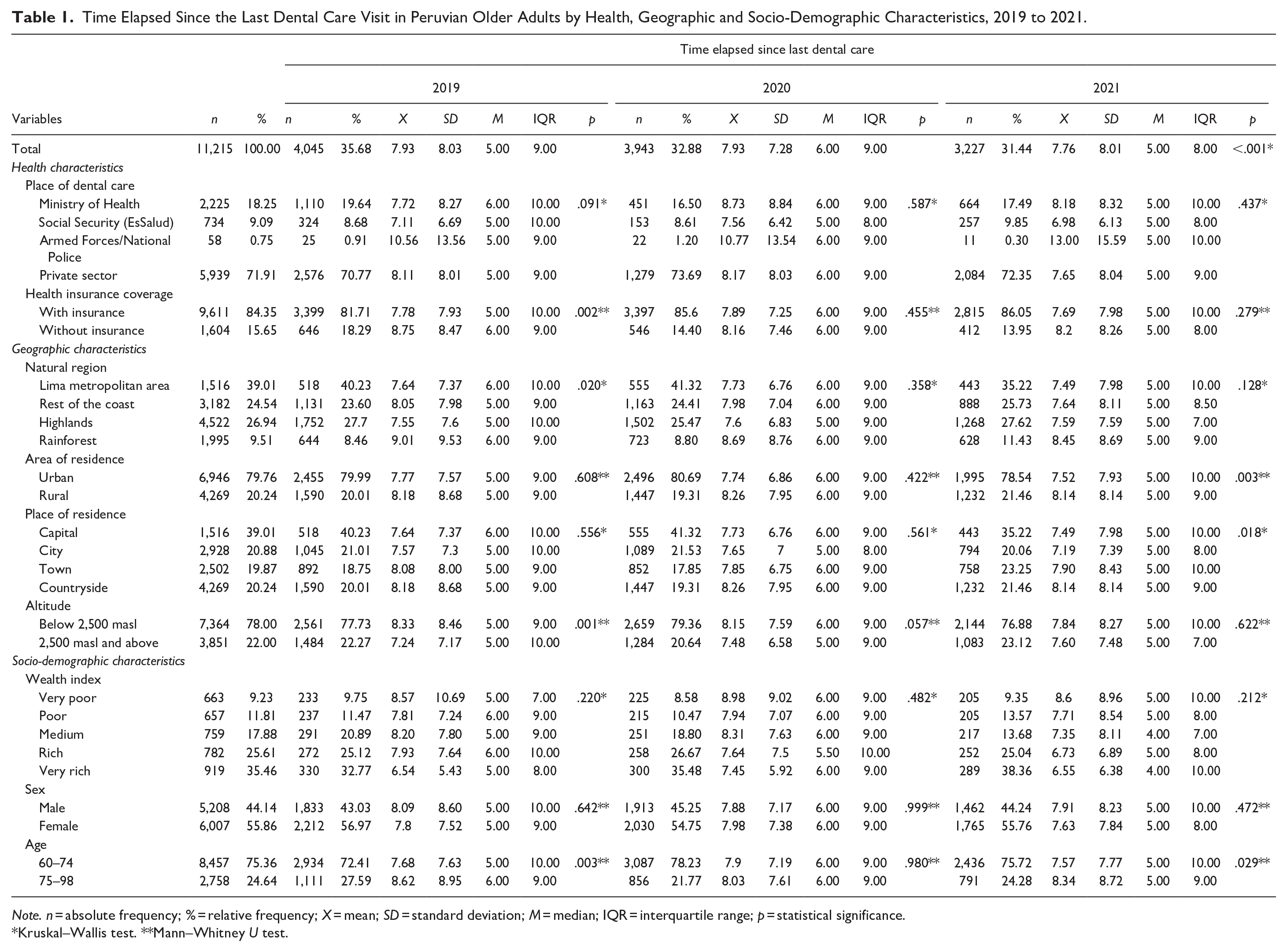
Note. n = absolute frequency; % = relative frequency; X = mean; SD = standard deviation; M = median; IQR = interquartile range; p = statistical significance.
Kruskal–Wallis test. **Mann–Whitney U test.
A hierarchical multiple linear regression analysis indicated that Model 4, which incorporated year, health characteristics, geographic characteristics, and socio-demographic characteristics, yielded the most valid predictions (p < .001). This model demonstrated a high determination coefficient (R2 = .90) and a constant of 13.139, indicating that the independent variables significantly contribute to predicting the dependent variable (Table 2).
Hierarchical Multiple Regression Models for Year, Health, Geographic, and Socio-Demographic Characteristics of Peruvian Older Adults, 2019 to 2021.

Within Model 4, several significant covariates were identified. Geographic characteristics notably influenced the results. The natural region exhibited a non-standardized regression coefficient (b) of −0.436 (95% CI: [−0.781, −0.092], p = .013), indicating a decrease of 0.436 years in the time since the last dental care visit when transitioning between natural regions. Similarly, the area of residence had a coefficient of b = −1.286 (95% CI: [−2.442, −0.131], p = .029), suggesting a reduction of 1.286 years in the time elapsed since the last dental care visit when comparing different areas of residence. The place of residence showed a coefficient of b = 0.550 (95% CI: [0.069, 1.031], p = .025), indicating an increase of 0.550 years in the time elapsed since the last dental care visit when moving between different places of residence. Additionally, altitude had a coefficient of b = −0.806 (95% CI: [−1.556, −0.056], p = .035), suggesting a decrease of 0.806 years associated with changes in altitude.
Socio-demographic characteristics also proved significant. The wealth index had a coefficient of b = −0.552 (95% CI: [−0.827, −0.278], p < .001), indicating a decrease of 0.552 years in the time since the last dental care visit across wealth quintiles. Age showed a coefficient of b = 0.705 (95% CI: [0.039, 1.370], p = .038), suggesting an increase of 0.705 years in the time since the last dental care visit when comparing the age ranges of 60 to 74 years to 75 to 97 years.
These findings underscore the complex interplay of geographic and socio-demographic factors in determining the time elapsed since the last dental care visit among Peruvian older adults (Table 2).
Discussion
In the older adult population, oral health is often overlooked as a significant health issue, despite the prevalence of various comorbidities, particularly non-communicable diseases, which severely impact quality of life (Cosola et al., 2018; Sischo & Broder, 2011). The utilization of health services results from a complex interplay between users and the availability and accessibility of these services, influenced by individual characteristics, contextual factors, and the organization of health services (Garcia-Subirats et al., 2014; Pavão et al., 2012).
This study indicates a non-significant difference in the mean time elapsed since the last dental care visit among Peruvian older adults from 2019 to 2021, with a slight decrease of 0.17 years. The stability in the mean time elapsed suggests a consistent pattern in dental care access among older adults. This finding aligns with previous research by Azañedo et al. (2019) and Carbajal-Rodríguez et al. (2019), which reported a decreased utilization of dental services by older adults, linked to various geographic and socio-demographic characteristics in 2018 and 2019. Garcés-Elías et al. (2022) similarly found no difference in the time since the last dental care visit between 2019 and 2020.
In 2019, significant differences in the time since the last dental care visit were observed based on the natural region of residence and altitude. Older adults residing in the rainforest or at altitudes below 2,500 masl experienced longer intervals before receiving care compared to those in the highlands or at altitudes above 2,500 masl. In 2020, geographic characteristics continued to show similar patterns. By 2021, shorter intervals were noted among older adults in urban areas and cities, while longer intervals persisted in rural and countryside areas. This indicates a consistent influence of geographic characteristics on dental care access from 2019 to 2021. Azañedo et al. (2019) reported that only a quarter of older adults received dental care, primarily from urban areas and private health establishments, particularly in the coastal region of Peru. Garcés-Elías et al. (2022) highlighted significant differences in the time since the last dental care visit related to area of residence and altitude between 2019 and 2020, emphasizing the role of geographic disparities.
Age and wealth index also emerged as significant factors. The study found that older adults aged 60 to 74 received dental care more promptly than those aged 75 to 98 in both 2019 and 2021, reflecting patterns observed in previous studies (Azañedo et al., 2019; Carbajal-Rodríguez et al., 2019). Similarly, Garcés-Elías et al. (2022) reported that individuals with higher economic capacity experienced delays in obtaining dental care less often than their poorer counterparts. These findings underscore the persistent influence of socio-demographic factors on dental care access.
Several studies suggest that specific geographic and socio-demographic characteristics increase the vulnerability of older adults (Azañedo et al., 2024; Zardak et al., 2023). Older adults in rural areas, those in the lowest wealth quintile, and individuals over 80 years old or who are dependent are less likely to utilize dental health services, resulting in longer intervals between dental appointments. This highlights the inadequate facilities within the healthcare system for dependent individuals, exacerbating their already poor oral health status. Language barriers and lower economic incomes further limit access to dental services in rural and remote areas.
When comparing the time elapsed since the last dental care visit with general health care access, limited information is available. Studies such as Barrenechea-Pulache et al. (2022) and Guerrero-Díaz et al. (2021) reveal similar patterns in the use of health services, underscoring the influence of health insurance, education, previous diagnoses, wealth index, and geographic location on healthcare utilization. These findings suggest that socioeconomic disparities and the unequal distribution of health resources significantly impact health service access among older adults.
To address the oral health needs of elderly Peruvians, the Ministerio de Salud del Perú (2019) introduced the Documento Técnico: Plan Nacional de Atención Integral para la Rehabilitación Oral en Personas Adultas Mayores “Perú Sonríe” 2019–2022. This plan aimed to enhance the oral health of elderly individuals through targeted interventions. However, its implementation coincided with the COVID-19 pandemic, hindering a comprehensive assessment and likely falling short of initial expectations. To date, this plan represents the most recent governmental policy concerning oral health for the elderly and is no longer in effect.
Consequently, the findings of this study have important implications for public health policy and practice. The persistent disparities in dental care access based on geographic characteristics, wealth index, and age warrant targeted interventions to ensure equitable healthcare. Policymakers should consider these factors when designing public health programs aimed at improving access to dental care for older adults and maximizing the anticipated outcomes of their implementation.
The limitations of this study include its cross-sectional design, reliance on secondary data analysis, and the use of logarithmic transformation. Secondary data may be subject to biases introduced by the original collection methods, over which the researchers had no control. Furthermore, logarithmic transformation modifies the linear relationships between variables, potentially resulting in the underestimation or overestimation of regression coefficients and confidence intervals, complicating the direct interpretation of the data (Rittmann et al., 2023). While these conditions are inherent to the study’s context, the evaluation of the time taken for older adults to access dental care and its probable associated factors provides valuable insights to address the existing research gap. The results indicate that older adults delay dental care, not due to the COVID-19 pandemic (Garcés-Elías et al., 2022) but as a consequence of the interaction among biological, sociocultural, familial, community factors, and health system characteristics. Public health policies should aim to reduce barriers to oral health care for older adults through coordinated efforts across government sectors and the implementation of health promotion and disease prevention programs tailored to their needs. This approach will ultimately improve the quality of life for this vulnerable population.
Future research should focus on longitudinal studies to monitor the long-term impacts of the COVID-19 pandemic on dental care access. Additionally, studies exploring the effectiveness of targeted public health interventions in reducing geographic and socio-demographic disparities in dental care access would be valuable. Further research could also explore the role of emerging technologies and telehealth in improving dental care access for underserved populations.
Conclusion
The mean time elapsed since the last dental care visit in Peruvian older adults was 7.93 years in both 2019 and 2020, decreasing to 7.76 years in 2021, which reflects a reduction of 0.17 years between 2019 and 2021. Geographic characteristics, wealth index, and age were identified as factors associated with the time since the last dental care visit among Peruvian older adults during this period.
Footnotes
Acknowledgements
The authors would like to thank the Facultad de Estomatología of the Universidad Peruana Cayetano Heredia (UPCH).
Declaration of Conflicting Interests
The author(s) declared no potential conflicts of interest with respect to the research, authorship, and/or publication of this article.
Funding
The author(s) received no financial support for the research, authorship, and/or publication of this article.
Ethics Statement
The study protocol was approved by the Universidad Peruana Cayetano Heredia Institutional Research Ethics Committee (ethics file CONSTANCIA-CIEI-342-30-22, approved on 5 August 2022).
