




Abstract
Serum albumin, known for its multifaceted role in health, is hypothesized to serve as a prognostic marker for older adults, both in hospital and community settings. Nine studies were included in the review, revealing consistent associations between low serum albumin levels and increased mortality risk in hospitalized older individuals. In community settings, low serum albumin levels were linked to higher mortality rates compared to those with normal levels. The synthesis of evidence underscores the potential of serum albumin as a prognostic marker for older adults, offering valuable insights for risk stratification and targeted interventions. While robust evidence supports its utility in hospital settings, further research is warranted in community settings to address current limitations and enhance the applicability of serum albumin as a prognostic tool. This review merges existing knowledge of the prognostic significance of serum albumin in older adults across hospital and community settings. The findings emphasize the importance of serum albumin as a potential prognostic marker, urging continued research efforts to refine its application in diverse healthcare contexts and improve outcomes for the aging population.
Introduction
The aging population presents significant challenges for healthcare systems worldwide. The increasing healthcare needs of older adults, coupled with disparities in access to care and variations in healthcare needs across different age groups and regions, highlight the importance of developing targeted and comprehensive healthcare solutions for this population (C. Li et al., 2022). Various prognostic factors place older adults, both in the community and hospital settings, at a heightened risk of increased mortality, encompassing a broad spectrum of health and lifestyle-related variables. Sarcopenia and frailty have been linked to mortality among older adults (Brown et al., 2015; Iwai-Saito et al., 2021). Weight changes, including loss, gain, or fluctuation, have been associated with an elevated risk of all-cause mortality in community-dwelling older adults (Alharbi et al., 2021), emphasizing the impact of body weight dynamics on longevity. Intraoral conditions, such as the number of functional teeth, emerge as noteworthy risk factors for mortality in community-dwelling older individuals (Maekawa et al., 2020), shedding light on oral health's contribution to overall well-being. Homebound older adults, characterized by multi-morbidity, disability, and limited access to care, face a heightened risk of mortality (Soones et al., 2016), emphasizing the importance of addressing healthcare disparities. Serum γ-glutamyltranspeptidase serves as an independent predictor of all-cause, cardiovascular, and liver mortality in community-dwelling older adults (Loomba et al., 2013), providing insight into the significance of this biochemical marker. Anticoagulation treatment has been linked to lower all-cause mortality in community-dwelling older adults with atrial fibrillation, regardless of their health and functional condition (Pilotto et al., 2016), showcasing the potential impact of therapeutic interventions on life expectancy. Malnutrition, evaluated by the Global Leadership Initiative on Malnutrition criteria, strongly correlates with mortality in both hospitalized and community-dwelling older individuals (Sánchez-Rodríguez et al., 2023), underscoring the critical role of nutritional status. A decline in physical performance, as shown by finger tap reaction time, has been established as a risk factor for mortality and disability in older adults (Shim et al., 2017), emphasizing the significance of assessing motor function in prognostic evaluations. Apart from that, social factors such as social isolation and loneliness are also risk factors for mortality in older adults (Tragantzopoulou & Giannouli, 2021). Prognostic markers play a crucial role in tailoring healthcare interventions to the specific needs and risks of older adults. Identifying high-risk individuals can help healthcare providers prevent adverse outcomes by providing necessary interventions. Addressing the limitations and gaps in current research on prognostic factors in older adults is paramount to advancing healthcare strategies tailored to this population's needs. While significant strides have been made in understanding various prognostic factors, including mortality, cognitive outcomes, and postoperative complications, a fragmented approach often hampers a comprehensive understanding of their interrelatedness(Roheger et al., 2021; Watt et al., 2018). The temporal aspect of prognostic factors remains under-explored, highlighting the need for investigations into how these factors evolve to inform tailored interventions and care planning (Roheger et al., 2020). Prognostic markers inform discussions about prognosis and end-of-life care planning. Finding markers associated with high mortality or poor outcomes helps healthcare providers discuss goals and potential treatments with older adults and their families.
Serum albumin plays a vital role in overall health and well-being. Age-related changes in serum albumin levels have been observed in various studies. Chronic low-grade inflammation, commonly observed in aging, can also lead to decreased albumin synthesis and increased albumin catabolism (Yeh et al., 2018). Several health conditions have also been linked to age-related changes in serum albumin levels. For example, metabolic syndrome has been associated with lower serum albumin levels, particularly with abdominal obesity, hypertriglyceridemia, and hyperglycemia (Cho et al., 2012). In patients with sickle cell disease, lower serum albumin levels have been associated with higher mortality rates (Nouraie et al., 2020). Overall, age-related changes in serum albumin levels may be influenced by altered metabolism, inflammation, nutritional status, and various health conditions. While the exact mechanisms underlying these changes are still being investigated, it is clear that serum albumin levels can be influenced by factors beyond nutrition alone. A study by (Elliott et al., 2016; X. Li et al., 2014) found that low serum albumin levels were associated with an increased risk of frailty in older adults. This highlights the importance of serum albumin as a marker for assessing the overall health and functional status of older adults. Lastly, serum albumin has been recognized as an important nutritional marker. A study by Hwang et al. (2017) emphasized the role of serum albumin as a marker of malnutrition and poor nutritional status in breast cancer patients. Low serum albumin levels have been associated with an increased risk of malnutrition and adverse health outcomes. Furthermore, serum albumin has been identified as a potential prognostic marker in liver diseases. A study by Gardner et al. (2018) demonstrated that low serum albumin levels were associated with increased mortality and poor outcomes in patients with liver cirrhosis (Gardner et al., 2018). In the context of urological malignancies, a review highlights the role of systemic inflammatory response markers, including serum albumin, in these conditions (Ohno, 2018). Low serum albumin levels have been associated with poor prognosis and increased mortality in urologic neoplasms. In conclusion, recent research has highlighted the multifaceted role of serum albumin in the body. It can indicate disease severity, predict prognosis, regulate fluids, and show overall health, and nutritional status. These findings emphasize the importance of monitoring serum albumin levels in various clinical conditions to guide diagnosis, prognosis, and management decisions.
Addressing the limitations associated with identifying and interpreting prognostic factors in older adults is crucial for advancing knowledge and improving patient care in geriatric medicine. By overcoming these challenges, researchers can enhance the validity of prognostic assessments and contribute to more personalized and effective healthcare interventions for older adult populations. Elucidating the nuances of prognostic factors and their impact on mortality, researchers can develop targeted interventions tailored to individual needs and risk profiles. The significance of this review lies in its contribution to addressing these challenges and advancing knowledge in the field of geriatric medicine. By evaluating the prognostic value of serum albumin in older adults across hospital and community settings, our study aims to fill existing gaps in the literature and provide valuable insights into the role of this biomarker in predicting health outcomes in older adult populations.
Methods
A comprehensive literature search was conducted from the inception of available databases up to December 2023, including PubMed, ScienceDirect, Scopus, Web of Science, CINAHL, and Cochrane Library following the Scale for The Quality Assessment of Narrative Review Articles (SANRA) guidelines (Baethge et al., 2019). The search strategy incorporated a combination of keywords and controlled vocabulary related to serum albumin, older adults (age ≥60 years), health outcomes, and cohort studies. The inclusion criteria were limited to cohort studies that investigated the association between serum albumin levels and health outcomes in older adult populations aged 60 years and above (older adult definition based on Indonesian Minister of Health Regulation No. 67 of 2015) (Kementrian Kesehatan Republik Indonesia, 2016). Articles published in English were considered. Two independent reviewers screened the identified articles based on titles and abstracts to determine their relevance. Full-text assessments were then performed for potentially eligible cohort studies. Any disagreements between reviewers were resolved through discussion to achieve consensus.
Relevant data were extracted from the selected studies, focusing on key information such as participant characteristics, serum albumin measurements, health outcomes assessed, and main findings. The synthesis process involved organizing and interpreting the findings from the selected cohort studies, constructing a narrative that delves into the temporal aspects of the relationship between serum albumin levels and health outcomes in older adults. The focus on cohort studies from the inception to December 2023 allows for a comprehensive exploration of the enduring prognostic value of serum albumin.
Results
Study Selection and Characteristics
After the initial search, a considerable number of articles were discovered. Specifically, in the PubMed database, a total of 1,566 articles were retrieved during this phase. To narrow the focus of the review to cohort studies, a filter for observational study types was applied, as indicated by the inclusion of the term “Observational Study” [Publication Type]. This filtering process resulted in a total of 98 articles categorized as observational studies. Subsequently, these 98 observational studies underwent a thorough assessment against the predefined inclusion and exclusion criteria to establish the final set of studies for inclusion in the systematic review. Among the electronic database findings, 14 articles aligned with the eligibility criteria based on their titles. Following the removal of duplicate articles and a comprehensive review of the full texts, nine articles met the criteria and were ultimately incorporated into this review. The study selection process is visually depicted in Figure 1. The selected studies encompassed diverse geographical regions, including Japan (two studies), Israel (two studies), the United States (two studies), and one study each in China, Taiwan, and Finland. The collective subjects across these studies amounted to 143,191 individuals.

Literature search flowchart.
Low Serum Albumin and Increased Mortality Risk in Hospitalized Older Adults
Table 1 shows studies about serum albumin's prognostic value in hospital settings. Nine studies were included in this narrative review, with a focus on the prognostic value of serum albumin levels in older adults. Out of these, six studies were conducted in hospital settings, encompassing 52,318 patients. A consistent and noteworthy finding emerged from these hospital-based studies: low serum albumin levels were consistently associated with an increased risk of mortality among hospitalized older adult individuals.
Summary of Studies About Serum Albumin Prognostic Value for Older Adults in Hospital Setting.

Table 1 provides a comprehensive overview of studies investigating the prognostic value of serum albumin specifically in the hospital setting for older adults. These studies offer valuable insights into the association between serum albumin levels and various health outcomes, shedding light on the clinical relevance of serum albumin as a prognostic marker in hospitalized older adults. For instance, Hu et al. (2023) conducted a retrospective cohort study at Shaanxi Provincial People’s Hospital in China, focusing on older adults diagnosed with diffuse large B-cell lymphoma (DLBCL). Their findings demonstrated that patients with higher serum albumin levels had a longer survival rate compared to those with lower levels (Hu et al., 2023). Aronen et al. (2022) investigated the association between serum albumin levels and mortality rates among older adults admitted to Turku City Hospital in Finland due to respiratory symptoms. Their study revealed a significant correlation between low serum albumin levels and higher mortality rates, as well as increased risk of pneumonia, dyspnea, and death during hospitalization (Aronen et al., 2022). Similarly, a retrospective cohort study at Boston’s Beth Israel Deaconess Medical Centre in Israel, focusing on patients admitted to the intensive care unit found that patients with lower serum albumin levels had significantly higher ICU and hospital mortalities compared to those with higher levels, highlighting the prognostic value of serum albumin in predicting adverse outcomes in critically ill older adults (Jin et al., 2022). Additionally, Kinoshita et al. (2021) investigated the prognostic significance of serum albumin levels in Japanese patients with stage IA non-small cell lung cancer (NSCLC) undergoing surgical resection at Kyushu University Hospital in Japan. Their findings indicated that changes in serum albumin levels were independently associated with disease-free survival and overall survival, underscoring the importance of serum albumin as a prognostic marker in cancer patients (Kinoshita et al., 2021). Moreover, Akirov et al. (2017) conducted a cohort study across multiple medical wards in Israel, examining the impact of serum albumin levels on in-hospital mortality and long-term survival. Their study revealed a dose-response relationship between serum albumin levels and mortality rates, with hypoalbuminemia on admission associated with higher mortality risks, whereas hyperalbuminemia conferred protective effects (Akirov et al., 2017). Lastly, Iwata et al. (2006) investigated the association between hypoalbuminemia and in-hospital death among older adults admitted for acute medical problems to a hospital in Japan. Their findings indicated that hypoalbuminemia was significantly associated with an increased risk of in-hospital death, emphasizing the prognostic value of serum albumin in predicting short-term outcomes in hospitalized older adults (Iwata et al., 2006). Overall, the collective evidence from these studies underscores the critical role of serum albumin as a prognostic marker in predicting mortality and adverse outcomes in older adults admitted to hospitals, thereby informing clinical decision-making and patient management strategies in hospital settings.
The consistent association between low serum albumin levels and increased mortality risk underscores the potential clinical significance of serum albumin as an indicator of prognosis in the hospital environment. These findings imply that monitoring serum albumin levels in older adults upon admission or during hospitalization could serve as a valuable tool for identifying those at a higher risk of adverse outcomes. This could facilitate more targeted and timely interventions to improve their care and potentially enhance survival rates in various hospital settings.
Low Serum Albumin and Mortality Rates in Community Older Adults
In the community setting, three studies were included, involving 90,873 older adults. All three studies consistently reported that lower serum albumin levels were associated with higher mortality risk, anemia, and limitations in activities of daily living (ADL). Table 2 provides key insights into the prognostic value of serum albumin for older adults in community settings, drawing from diverse cohort studies. The findings reveal compelling associations between serum albumin levels and mortality risk among community-dwelling older adults. For instance, the study by Wu et al. (2018) conducted in Taipei City involving a large cohort of older adults demonstrated that even mildly low albumin levels were associated with increased mortality risk across various causes, including all-cause, cancer, cardiovascular, and respiratory mortalities. Conversely, higher albumin levels were linked to better survival outcomes (Wu et al., 2018). Similarly, Salive et al. (1992) conducted a cohort study in the United States, highlighting the significance of hypoalbuminemia as a marker of adverse health outcomes, particularly in the presence of comorbidities such as anemia and limitations in activities of daily living (ADL). Notably, the odds of hypoalbuminemia were substantially elevated in individuals with anemia and multiple ADL limitations (Salive et al., 1992). Furthermore, Klonoff-Cohen et al. (1992) observed in a cohort study conducted in California that lower albumin levels were independently associated with increased odds of mortality, even after adjusting for age, sex, and lifestyle factors (Klonoff-Cohen et al., 1992).
Summary of Studies About Serum Albumin Prognostic Value for Older Adults in Community Setting.
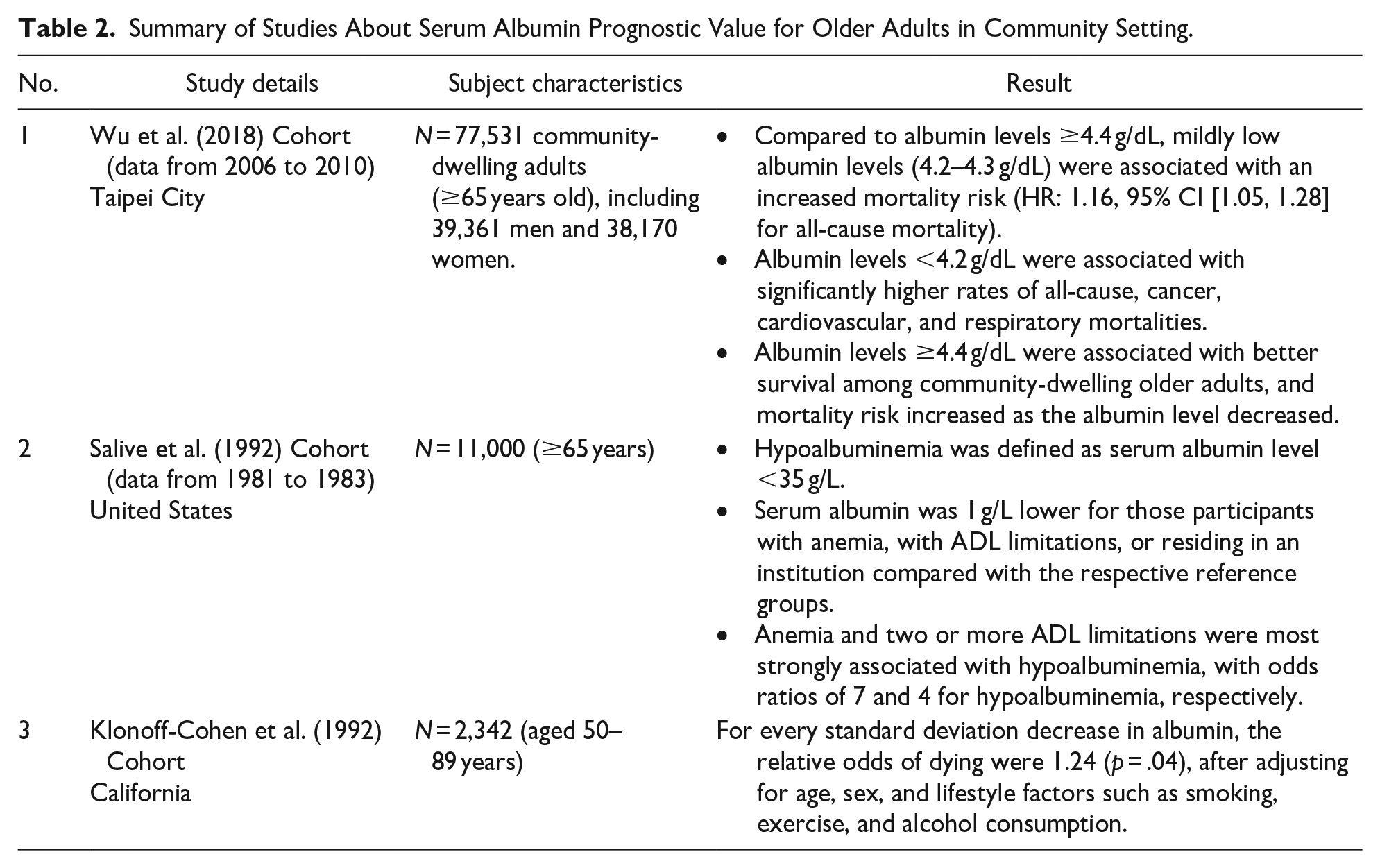
These findings underscore the potential relevance of serum albumin as a prognostic marker for adverse outcomes among community-dwelling older adults. However, it is crucial to acknowledge the limitations within the current body of literature in the community setting. The studies were deemed outdated, emphasizing the necessity for updated research in this domain. Despite the consistent associations found in the existing studies, the outdated nature of the literature underscores the need for more recent investigations to corroborate and refine our understanding of serum albumin’s prognostic role in this specific population. Table 2 summarizes the study-related albumin’s prognostic value for older adults in community settings.
While these initial findings indicate a potential link between low serum albumin and adverse outcomes among community-dwelling older adults, additional and more recent investigations are deemed essential. Such research endeavors could contribute significantly to our understanding of the nuanced relationship between serum albumin levels and health outcomes in the community setting. Furthermore, the implications of these findings extend to community-based healthcare interventions aimed at improving the health and longevity of older adults living independently. Refining our understanding of serum albumin's prognostic role in this context could guide targeted interventions to enhance the overall well-being of community-dwelling older populations.
Potential Mechanisms of Hypoalbuminemia Linked to Poor Prognosis
The multifaceted mechanisms underlying the association between low serum albumin and increased mortality are integral to understanding the clinical implications. Low serum albumin is not only indicative of poor nutritional status and inflammation but also serves as a comprehensive marker of an individual’s overall health vulnerability (Levitt & Levitt, 2017; G. Li et al., 2022; Singh et al., 2019). Its correlation with cardiovascular diseases, acute respiratory distress syndrome, acute stroke, and chronic kidney disease contributes to the observed elevated mortality rates (Bar-Or et al., 2019; G. Li et al., 2022). In patients with end-stage renal failure, the association with increased inflammation and decreased nutritional status further heightens mortality risk (Ndlovu et al., 2019; Singh et al., 2019).
Inflammation plays a significant role in the pathophysiology of hypoalbuminemia by influencing capillary permeability and the distribution of serum albumin (Soeters et al., 2018). Studies have demonstrated that inflammation can increase capillary permeability, allowing serum albumin to escape into the interstitial space, thereby expanding the interstitial volume and increasing the distribution volume of albumin (Dekker et al., 2018). This heightened capillary permeability serves as a key mechanism through which inflammation leads to the escape of serum albumin, ultimately resulting in hypoalbuminemia (Lambadiari et al., 2022). Additionally, inflammation can induce hypoalbuminemia by promoting the catabolism of albumin in response to infection-related inflammation (Arnau-Barrés et al., 2021). Inflammatory cytokines associated with inflammation can lead to decreased synthesis and increased catabolism of albumin, contributing to hypoalbuminemia in various acute and chronic conditions (Larsen & Leonard, 2019). Inflammation-driven escape of serum albumin into the interstitial space downstream of increased vascular permeability is proposed as a mechanism for hypoalbuminemia in inflammatory states (Galbraith et al., 2021).
Malnutrition can lead to hypoalbuminemia through various mechanisms that impact albumin synthesis and metabolism. Malnutrition, characterized by a deficiency in calorie and protein intake, can directly affect albumin synthesis by reducing the availability of essential nutrients required for protein production (Don & Kaysen, 2004). Additionally, malnutrition can impair the liver’s ability to synthesize albumin, further contributing to low serum albumin levels (Dekker et al., 2018). Malnutrition can exacerbate the impact of inflammation on albumin levels. Inflammatory processes associated with malnutrition can increase the fractional catabolic rate of albumin, leading to accelerated breakdown and reduced circulating levels of albumin (Kose et al., 2021). In conditions of chronic malnutrition, the body may enter a catabolic state where muscle breakdown releases amino acids that are preferentially used for energy production rather than protein synthesis, including albumin (Giallauria et al., 2021). This imbalance in protein metabolism can further contribute to hypoalbuminemia in malnourished individuals. Malnutrition-related factors such as reduced protein reserves, impaired vascular permeability, and changes in heart function can also play a role in the pathophysiology of hypoalbuminemia (Gatta et al., 2012). In patients with chronic kidney disease, malnutrition is associated with hypoalbuminemia, highlighting the impact of nutritional status on albumin levels (Kim et al., 2017). Additionally, malnutrition can induce hepatic dysfunction, systemic inflammation, and impaired synthesis of albumin can all contribute to the development of hypoalbuminemia (Loftus et al., 2019).
Hypoalbuminemia, stemming from the intricate interplay of inflammation and malnutrition, serves as a crucial indicator of underlying physiological disturbances in the body. As serum albumin levels decline due to inflammation-induced capillary permeability changes, heightened catabolism, and malnutrition-associated impairments in synthesis, the body’s capacity for maintaining homeostasis becomes compromised. Consequently, hypoalbuminemia not only reflects the severity of these underlying pathophysiological processes but also signifies a state of heightened vulnerability to adverse health outcomes.
Discussion
The extensive body of literature consistently shows a compelling link between low serum albumin levels and elevated mortality rates across a diverse array of medical conditions (Chen et al., 2016; Doucette et al., 2021; Huang et al., 2022; Kendall et al., 2019; G. Li et al., 2022; Ma et al., 2023; Ndlovu et al., 2019). This association is evident in populations undergoing cardiac surgery, peritoneal dialysis, experiencing heart failure, sepsis, acute myeloid leukemia, chronic obstructive pulmonary disease, and those with end-stage renal disease (Doucette et al., 2021; Kendall et al., 2019; Liu et al., 2012; Ma et al., 2023; Mehrotra et al., 2011; Ndlovu et al., 2019). Low serum albumin is correlated with heightened cardiovascular mortality, infection-related mortality, and all-cause mortality, irrespective of the specific medical condition (Chen et al., 2016; G. Li et al., 2022). This robust evidence emphasizes serum albumin's role as a universal and powerful prognostic indicator in diverse healthcare contexts.
The findings of this review hold crucial clinical implications for healthcare providers working with older adults. The consistent association between low serum albumin levels and increased mortality risk, particularly in the hospital setting, underscores the importance of routine serum albumin assessments as part of comprehensive geriatric evaluations. Identifying older adults with low serum albumin levels upon admission or during hospitalization can serve as an early warning sign, allowing healthcare providers to tailor interventions promptly. These interventions could include targeted nutritional support, multidisciplinary care involving geriatricians and nutritionists, and personalized care plans addressing both medical and social determinants. In community settings, the observed link between low serum albumin and adverse outcomes necessitates a heightened awareness among primary care providers. Routine monitoring of serum albumin levels during regular check-ups can aid in identifying older adults at risk for mortality, anemia, and limitations in activities of daily living. Health education campaigns can further empower older adults and their families to recognize the significance of serum albumin levels and encourage proactive measures to improve nutritional status.
Implementing public health interventions based on the findings of this review can significantly improve outcomes for older adults. One key strategy involves integrating routine serum albumin level assessments into regular health check-ups for older adults, both in hospital and community settings. This proactive approach can aid in early identification of individuals at risk and prompt intervention. Additionally, community-based nutrition programs tailored for older adults, with a focus on increasing protein intake and addressing specific nutritional deficiencies, can be instrumental. Collaborative efforts between healthcare providers, community organizations, and public health agencies can strengthen these initiatives, ensuring a holistic approach to older adult health.
The present review offers several strengths and justifications that distinguish it from existing works, particularly the referenced publication. Despite the availability of reviews in the field, this review stands out for its focus on elucidating the specific role of serum albumin as a prognostic marker in both hospital and community settings, a topic that remains of paramount importance in geriatric medicine. By synthesizing recent studies and providing a comprehensive overview of the association between serum albumin levels and mortality risk in older adults, this review offers timely insights into the clinical significance of serum albumin as a prognostic indicator. Overall, while building on existing knowledge, this review makes a valuable contribution to the field by providing a nuanced and up-to-date analysis of the prognostic significance of serum albumin in older adults, thereby advancing our understanding of this important clinical parameter.
While this review provides valuable insights, it is not without limitations. The scarcity of community-setting studies, especially recent ones, highlights a significant gap in the literature. To address this, future reviews could explore additional databases or consider a broader search strategy. The variability in study designs and populations introduces heterogeneity, impacting the ability to draw uniform conclusions. Additionally, the lack of consensus on serum albumin thresholds for intervention poses challenges for implementing standardized public health guidelines. Meta-analysis was not conducted because heterogeneity was observed across the selected studies. Notably, variations in age cut-offs for older adults, diverse serum albumin cut-off values, and differences in underlying diseases among study subjects posed significant challenges to achieving a homogenous dataset suitable for meta-analysis. Future research should aim to establish universal thresholds and explore the influence of confounding factors comprehensively. Lastly, the predominantly observational nature of the included studies emphasizes the need for well-designed intervention trials to establish causation and inform evidence-based practices in public health.
Future research should delve deeper into the mechanisms underlying the association between serum albumin levels and adverse outcomes. Exploring the impact of genetic factors, lifestyle choices, and social determinants on serum albumin could provide a more comprehensive understanding. Longitudinal studies tracking serum albumin changes over time in diverse populations are essential to establish causal relationships. Furthermore, intervention trials assessing the effectiveness of targeted nutritional strategies in improving serum albumin levels and subsequent health outcomes should be a priority. Research should also address the potential disparities in healthcare access and outcomes among older adults, ensuring that interventions are equitable and accessible to all.
Conclusion
The prognostic value of serum albumin in older adults underscores its significance in both hospital and community settings. The consistent association between low serum albumin levels and increased mortality risk in hospitalized older adults highlights the potential clinical utility of serum albumin as an early indicator of adverse outcomes. Recognizing serum albumin as a valuable prognostic indicator opens avenues for targeted interventions, potentially improving overall health outcomes and quality of life in this vulnerable population. The multifaceted nature of serum albumin's predictive power prompts further exploration into its applications across diverse clinical scenarios, warranting ongoing attention in geriatric research and healthcare practices.
Footnotes
Acknowledgements
We would like to express our gratitude to the researchers, clinicians, and participants involved in the studies cited in this review. Their valuable contributions have been instrumental in advancing our understanding of the prognostic significance of serum albumin in older adult populations.
Author Contributions
Conceptualization: NR, LL, BI. Design and methodology: NR, IS, BI. Data collection: NR, BI. Data analysis and interpretation: NR, LL, IS, BI. Writing and drafting: NR, LL, BI. Critical revisions: TI, ZA, II, PP. Supervision: TI, ZA, II, PP. Final approval: all authors have reviewed and approved the final version of the manuscript before submission.
Declaration of Conflicting Interests
The author(s) declared no potential conflicts of interest with respect to the research, authorship, and/or publication of this article.
Funding
The author(s) received no financial support for the research, authorship, and/or publication of this article.
