



Abstract
The behavioral and psychological symptoms of dementia (BPSD) can be challenging for family caregivers to cope with, leading to distress and fatigue. It is therefore important to offer effective strategies to reduce the impact of BPSD. The HOMESIDE randomized controlled trial (RCT) was testing purposefully developed interventions to improve the quality of life and wellbeing of dyads of people with dementia and family caregivers as a result of reduction of BPSD. HOMESIDE RCT was conducted in Australia, Germany, Norway, Poland and the United Kingdom between 2019 and 2022. The study design was a three-arm parallel-group single-blinded, pragmatic RCT with a sample size of 432 dyads. Dyads were randomly allocated to one of three treatment conditions: Music Intervention plus Standard Care; or Reading Intervention plus Standard Care; or Standard Care only. The Reading Intervention (RI) within the HOMESIDE RCT aimed to evoke shared discussion, reminiscence, meaningful shared experiences and consequently enrich everyday life, interaction and the emotional connection between the caregiver (CG) and carereceiver (CR); as well as to enhance activities of daily living and to promote relaxation or stimulation as appropriate. This paper describes the underlying conceptual framework, the content, and delivery of the Reading Intervention within the HOMESIDE RCT.
Keywords
Introduction
The term dementia is used to describe a variety of neurological, neuropsychiatric and medical conditions that cause progressive degeneration leading to changes in cognitive function, communication, and physical function, which in turn impact social skills, mood, and behavior (Arvanitakis & Bennett, 2019). Dementia is best characterized as a syndrome rather than as one particular disease, as it is common for multiple diseases to contribute to any one person’s dementia syndrome (Gale et al., 2018). Dementia is overwhelming not only for those living with it, but also for their families, particularly the person who takes the primary role in providing care and support (World Health Organization [WHO], 2015). Pharmacotherapy is considered essential in the treatment of dementia. However, as the effects of pharmacotherapy are inconsistent across people, non-pharmacological methods have become widely used (Livingston et al., 2020). Non-pharmacological methods of supporting people living with dementia are aimed at both improving physical fitness and improving higher nervous functions, such as memory, thinking, understanding, and assessment of reality. Therapeutic strategies used with people living with dementia include kinesiotherapy, music therapy, occupational therapy, relaxation methods, reminiscence therapy, and other methods to improve quality of life (Maki et al., 2018; Rodríguez-González et al., 2021).
The behavioral and psychological symptoms of dementia (BPSD) can be challenging for family caregivers to cope with, leading to distress, fatigue and increased use and cost of health services (Livingston et al., 2020). Therefore, effective strategies are necessary to mitigate the impact of BPSD on individuals with dementia and their family caregivers. Non-pharmacological interventions, such as music therapy and tailored activities, have shown promise in this regard. Caregiver education and training interventions are also crucial in equipping caregivers to provide better support to their loved ones (Livingston et al., 2020).
The HOMESIDE (HOME-based caregiver-delivered music intervention for people living with dementia) randomized controlled trial (RCT) aimed to evaluate the effectiveness of a purposefully developed music intervention (MI) and reading intervention (RI) in reducing BPSD and improving the quality of life and well-being of individuals with dementia and their family caregivers (Baker et al., 2019).
The study was conducted in Australia, Germany, Norway, Poland, and the United Kingdom between 2019 and 2022, with a target sample size of 495 dyads. A dyad comprised the care recipient [CR]: a person with a diagnosis of dementia, recruited together with the cohabiting caregiver [CG]: for example, a spouse, adult child, sibling, or close friend. The study design followed a three-arm parallel-group single-blinded pragmatic RCT approach, with dyads randomly assigned to one of three treatment conditions: Music Intervention (MI) plus Standard Care (SC), Reading Intervention (RI) plus SC, or SC only. Outcome data were collected at baseline, 13 weeks, and 26 weeks post-randomization, focusing on measures such as BPSD, mood, quality of life, cognition, and resource utilization (Baker et al., 2019).
This paper specifically focuses on the Reading Intervention (RI) within the HOMESIDE RCT, providing an overview of the underlying theoretical framework, delivery process, and preliminary results. The Music Intervention (MI) is discussed in a separate publication (Odell-Miller et al., 2022). The main paper on HOMESIDE RCT presenting aggregate results appeared online in eClinicalMedicine on 2.10.2023 (Baker et al., 2023).
Method
HOMESIDE Reading Intervention (RI): Theoretical Framework
The HOMESIDE RI involved training caregivers (CGs) to engage individuals with dementia in reading activities as part of their everyday care, aiming to create meaningful, shared and rewarding experiences. The RI presupposes that as people are constantly surrounded by words and texts, carefully selected narratives, involving reading, listening, recall, and wordgames, can be used to meet the psychosocial needs of individuals with dementia. By promoting shared activities, the RI aims to improve the relationship and quality of life of the dyad. As long-term memory remains intact until later in the dementia trajectory, the RI supports the continuation of deeply rooted rituals, helping individuals with dementia to stay connected with their surroundings and maintain their functional activities. Additionally, certain RI activities can stimulate short-term memory, enhance orientation to reality, improve communication, and potentially reduce BPSD.
The majority of reading interventionists were occupational therapists, as occupational therapy emphasizes promoting health and wellbeing through occupation (World Federation of Occupational Therapists [WFOT], 2021). Occupation gives meaning and purpose to human life (Carlson et al., 2014). Occupational therapists work with diverse clients, considering their condition and needs, and employing client-centered approach (Sumsion, 2000). Throughout the occupational therapy process, the therapist respects the clients’ values, and enables them to make informed decisions.
In the context of dementia, occupational therapists focus on maintaining or improving daily activity performance, social participation, and quality of life for individuals with dementia and their family caregivers (Bennett et al., 2019; Steultjens et al., 2004).
As the RI is based on the occupation of reading, an occupational therapy model was used as the basis for the RI framework, content and delivery. For measuring quality of life, Quality of Life-AD Measure (QOL-AD) was used. QOL-AD is a 13-item measure developed for individuals with dementia and designed specifically to obtain a rating of the patient’s Quality of Life from both the patient and the caregiver (Logsdon et al., 1999).
Canadian Model of Occupational Performance and Engagement (CMOP-E) and the Reading Intervention (RI)
The Canadian Model of Occupational Performance and Engagement (CMOP-E) (Polatajko et al., 2013) was selected as the theoretical framework for the RI. The CMOP-E claims:
1) All humans are occupational beings
2) Occupation has therapeutic potential
3) Occupation affects health and well-being
4) Occupation organizes time and gives structure to everyday life
5) Occupation gives meaning to life and shapes identity
6) Occupation is idiosyncratic as everyone engages in occupation in a unique way (Polatajko et al., 2013).
These principles align with the goals of the RI, recognizing that individuals, regardless of age, health status, or ability, are occupational beings, including people with dementia. However, it can be challenging to provide accessible and meaningful occupation in dementia, especially in the later stages. Some of the BPSD experienced by individuals with dementia may be caused, at least in part, by lack of meaningful activity. The RI addresses the psychosocial needs of individuals with dementia by providing tailored occupations.
The RI also incorporates the three key components of the CMOP-E model:
The CMOP-E emphasizes the interaction between the person, occupation and the environment as the foundation for occupational performance and occupational engagement. The RI’s specific objectives align with these three components of the CMOP-E model (Table 1).
Comparison of the CMOP-E Model Elements With The RI Objectives.

Note. BPSD = Behavioral and Psychological Symptoms of Dementia; CG = care giver; CR = care recipient; dyad = CG and CR.
The HOMESIDE Reading Intervention (RI): Delivery Schedule and Reading Activities Structure
The RI was implemented over a 12-week period, as outlined in Table 2. In week 0, the interventionist telephoned the CG to inform them of their allocation to the RI, explain the RI schedule, obtain some initial information about the dyad’s reading history, and confirm contact details for sending the Training Manual, Diary, and data collection materials. A comprehensive assessment of the dyad’s reading history, habits, interests and preferences was completed in Week 1. The interventionist delivered three 2-hr training sessions via Zoom, spaced out in weeks 1, 3, and 6, to provide guidance on implementing the RI and engaging the care recipient (CR), with the Training Manual serving as a reference. The CR had the option to attend these sessions. The interventionist also contacted the CG in weeks 2, 5, 7, 9, and 11 to check progress and address any queries related to the RI.
HOMESIDE Reading Intervention Schedule.

Based on the training sessions, the CG was instructed to deliver five 30-min sessions per week using the RI activities with the CR. After each session, the CG completed the Diary, documenting the activity, duration, and its impact on the CR during the session and for the remainder of the day. The Diary also provided space for the CG to provide more detailed descriptions of the session.
Additionally, the CG completed a brief questionnaire after each training session (weeks 1, 3, and 6), rating their response to the session on a five-point Likert scale. The questionnaire included an overall rating of the session and allowed the CG to provide feedback on what they found most and least helpful about the training. Interventionists used the questionnaire responses to address concerns or difficulties during subsequent meetings.
After 12 weeks, the interventionist conducted a semi-structured interview with the dyad and arranged for the Diary to be returned. The interview explored the dyad’s motivation and experiences in participating in the research activities. The interview was audio-recorded for transcription and thematic analysis.
Throughout the study, intervention adherence and fidelity were ensured through supervisory meetings, recordings of intervention segments, and fidelity checklists and questionnaires.
The RI encompassed three categories of Reading Activities, detailed in the Manual provided to CGs before the Training sessions. These categories included:
- CG reading favorite material aloud to the CR,
- CR reading aloud or reading together with the CG,
- and the use of audiobooks.
Below we present the structure of RI activities within HOMESIDE RCT:
i. CG Reading Favourite Material Aloud to CR
The CG was encouraged to sit close to the CR, ideally sitting in front of them with eye contact. Chosen reading material should be well known to CR and read aloud at a pace and volume that helped them to comprehend the text. The CG could probe for memory recall by asking the CR prompting questions or statements such as:
- “Do you remember when. . . (e.g., we read this poem to our children)?”
- “Do you remember when we heard this text. . . (e.g., at school)?”
- “Does this story remind you of the time we. . .?”
- “Do you remember a story about. . .?”
Sometimes repetition of the text was useful especially when short-term memory and attention fluctuated. Sometimes the text was shortened or simplified, and in such cases, this should be noted in case the text is repeated. There might be a brief discussion of reading material and any shared memories evoked. The CG was encouraged to stay focused on the reading activity while it was happening, talking after the reading had finished, unless the CR initiated conversation stimulated by the reading.
If the CR was unwilling to perform self-care tasks (e.g., eating, bathing, going to bed or getting dressed), the CG might try to tell a story, recite a poem, etc., to distract or engage the CR while they performed the tasks.
ii. CR Reading Aloud or Reading Together With CG
This activity might stimulate a brief discussion of reading material and shared memories. Reading together created a common space and meaningful activity for the CG and CR. Therefore, it could influence the quality of the relationship in a positive way. If the CR was unable to read, they might be able to recite verses or other kinds of texts they remembered (e.g., prayers). They could also tell stories (e.g., fairy tales). Again, the CG could probe for memory recall and encourage CR by asking the CR prompting questions or by statements such as:
- “Does this story remind you of the time we. . .?”
- “Do you remember a story about. . .?”
- “You learned this poem by heart at school and you still remember it, well done!”
- “I love hearing you recite these verses. . .”
- “I have never heard this poem before, thank you for sharing it with me. . .”
If the CR was non-responsive, the CG could change the reading material to see if there was a change in response. Sometimes the CR might become emotional and begin to cry, and in that case CG might choose to continue reading if it seemed appropriate, as sometimes the CR might cry because it brought back joyful memories or because they found the text touching and beautiful. If, however, the reading brought back painful memories and the crying seemed awkward or uncomfortable, then CG should stop the activity and moved on to another text or activity. It might be helpful to have some photographs available to support memory recall and reminiscence.
Again, if the CR was passive and unwilling to undertake any activity, the CG might read texts that were related to the activity (e.g., cook books, instruction books on knitting, gardening, dressing, etc.).
iii. The Use of Audio Books
In some cases, it might be preferable to use an audio book instead of reading aloud. While listening to an audiobook together, the CG might find it easier to connect with the CR, because they could focus more on the CR (maintaining eye contact, reacting together, smiling at each other, holding hands, etc.). It was important to listen to the audiobook beforehand, so the CG knew the content of the text before introducing it to the CR.
If the CR was too agitated, the CG might suggest moving from the audio book to reading aloud or stopping the audio book. If, on the contrary, the CG or CR or both were really enjoying the imagery and talking about, for example, a vacation, they could engage in discussion while the audio book continued to play or it could be paused to allow the discussion to unfold.
Preliminary Results
Sociodemographic Data and Statistical Analysis
Statistical analysis was conducted on the socio-demographic data collected during the RI. 144 dyads were randomly allocated to the RI. The study revealed that the United Kingdom had the highest proportion of CGs who were also partners of individuals with dementia (81.6%), while Poland had the lowest recorded percentage of such relationships (13.3%). Additionally, Poland observed that children of care recipients (CRs) served as the predominant family caregivers (CGs) compared to other countries. The largest group of participants with dementia were married (70.1%), with the smallest group being divorced or single (4.9%). Among the CGs, the largest number were in relationships (86.1%). Among the CRs, the greatest number had Alzheimer’s disease (57.7%). Other forms of dementia were less common. Detailed socio-demographic data can be found in Table 3.
Socio-Demographic Characteristics of People Participating in the Reading Intervention.

Note. PCS = Pearson Chi-Square. KW = Kruskal Wallis Equality of Populations rank test. In “Child,” we included “child-in-law” and “grandchild.” In “Other,” we included other relatives or friends.
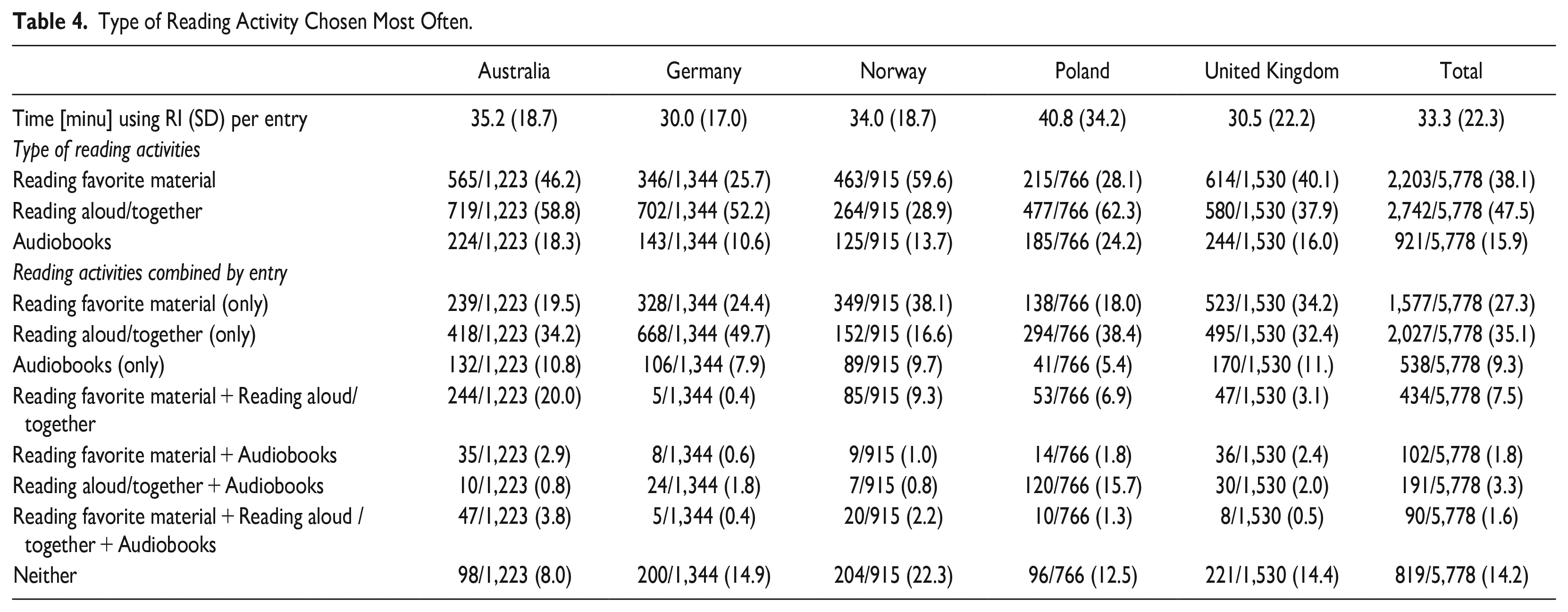
Regarding the type of reading activity selected, the study found that reading aloud or reading together ranked first (47.5%), followed by CG reading favorite material (38.1%) and the use of audiobooks (15.9%). When considering combined activities or individually selected activities, reading aloud or reading together was the most frequent choice, accounting for a total of 35.1%. For a comprehensive breakdown, refer to Table 4.
Type of Reading Activity Chosen Most Often.
The chi-square test (Pearson chi2 test) was used to statistically assess the impact of individual reading activities and their combinations on the mood and engagement of a person with dementia. Correlations were examined between individual single activities versus a combination of activities and their respective evaluations, showing statistical significance when more than one activity was used. The most frequently chosen form of activity was RAT and for this activity the most responses regarding the positive impact on the mood of people with dementia were provided, which constituted 75.03% of all responses provided for RAT activity. However, the relatively highest number of positive answers (83.25%) were given for usage of more than one reading activity. Refer to Table 5 for detailed data.
Assessment of Reading Activity (Mood Responses to Particular Reading Activities).

Note. Pearson chi2(12) = 89.1331 Pr = 0.000. RFM = reading favorite material; RAT = reading aloud together; AB = audiobooks.
The study also explored the correlation between mood and the type of reading activity, considering both single and combined activities. Significant correlations were found between positive mood and the following combinations:
- reading favorite material + reading aloud or reading together,
- reading aloud or reading together + audiobooks,
- reading favorite material + reading aloud or reading together + audiobooks
Among the combined reading activities, the highest percentage of positive responses was found for the RAT + AB combination (93.16%). Refer to Table 6 for specific data.
Assessment of Combined Reading Activities and Mood Responses.

Note. Pearson chi2(21) = 115.5179 Pr = 0.000. RFM = reading favorite material; RAT = reading aloud together; AB = audiobooks.
Sample Vignettes
Sample vignettes were provided to illustrate the use of the HOMESIDE RI with dyads at different stages of dementia. These vignettes highlighted the customization of reading activities based on individual needs, overcoming obstacles such as hearing impairment and dyslexia, and the role of occupational engagement in facilitating positive experiences for both the CR and CG.
Spousal Dyad, CG = 73-Year-Old Husband and CR = 70-Year-Old Wife
The CR had Alzheimer’s Disease, was physically able and mobile, and had longstanding bilateral hearing impairment that affected her communication. She had worked for many years as a nurse. The CG was a retired public transport manager, was still physically able and mobile, and wore a hearing aid in one ear. The couple had two sons who were both married with their own families and supportive of their parents.
The CR traditionally read more than the CG, although she had lost interest. She always had a pile of books by her bed and described “getting lost” in whatever she was reading. She enjoyed fiction and non-fiction, including current affairs. She had a particular interest in forensic science, possibly due to her nursing background. She regularly swapped books with a close friend and the dyad had a large stock of books. The CG usually read for a short while when he went to bed—until he fell asleep. He preferred factual books and was particularly interested in history and reading about war.
Over the years the dyad enjoyed traveling and had many photo albums and scrapbooks they could use to reminisce. For many years the CG provided technical support to a local amateur drama group, for example building the set. This required him to have a detailed knowledge of the script.
The reading interventionist explored the different types of reading activities with the dyad and they concluded that Reading Together suited them best. The CR was still able to read by herself and so wanted to be more actively involved than just listening to the CG reading her favorite material aloud to her. Her hearing impairment obviously affected this view, and also explained why she didn’t enjoy listening to audio books. The dyad enjoyed trying out a variety of shared reading activities together. Initially they selected a non-fiction book about a period of history they were both interested in and took turns reading a chapter aloud to each other. The CR’s confidence improved such that she was then able to read it by herself and really enjoyed doing this again. She then began to read the news online each day and the local weekly paper and would tell the CG about items of interest. They reviewed their vacation photos and memorabilia together which provoked much reminiscence and laughter about where they had been, what they had done and who they had met. As a result, the dyad started to plan some trips in preparation for when they could start traveling again. They also read scripts from plays the CG had previously been involved with, taking on a number of roles each and adopting the relevant accent for each part. The CG stated that he was surprised and impressed by how well the CR had managed this activity, and how much they had both enjoyed it.
Spousal Dyad, CG = 76-Year-Old Husband CR = 75-Year-Old Wife. Married for Many Years
The CR had been diagnosed with Alzheimer’s disease 10 years prior. This had caused the dyad’s communication to become progressively more challenging. The CR’s language capabilities had reduced and they had little to talk about. She also had mild dyslexia.
The CR was a retired office worker, previously employed by the government, in the private sector, and in the school sector. The CG was a retired manager. The couple two children and six grandchildren. They had traveled a lot in their own country and abroad, and both enjoyed outdoor activities. The CR had taken lots of photos during their life together and made many albums and scrapbooks.
The CR and CG had different relationships with reading, with the CG an avid reader and the CR choosing not to read so much. The CG thought this was because of her mild dyslexia. Even so, the couple had earlier taken part in reading circles and had been used to discussing literature. The CG had experience with reading aloud, as one of their grandchildren with dyslexia preferred to learn by listening. The CR had also taken part in this, but not as much as the CG. Over the years the couple had enjoyed listening to audiobooks while driving, but ceased this because of the CR’s dementia.
Through the weeks of the RI, the CG reported that they really enjoyed the reading activity. He was reading aloud to the CR, and had focused on “the good moments,” not on the CR remembering what was read. He said the CR responded by calming down while listening to his voice, and that it was no problem finding suitable literature. They tried out novels, but these were difficult for the CR to relate to. The CG then turned to books written in the period they grew up in and related to the places they had lived. The CR responded well to this as she could partly remember and recognize places and stories. This gave the CG the idea to start using the old photo albums. They sat together and he told her stories about their lives as they were going through the pictures. The CR listened to what he said and expressed pleasure during these moments. An important point here was that this activity gave the CG something to talk about with his wife. The dyad also tried out listening to audiobooks, but this was not successful, as the CG observed that the CR responded better to hearing his voice, not an unfamiliar recorded voice.
During the project period the CR was moved to a residential aged care facility and the CG expressed that he will continue using the photo albums when visiting his wife.
Discussion
Broadly understood narratives are used in the therapy of people living with dementia. One example is bibliotherapy. Bibliotherapy can a.o. provide support for people living with dementia in their community (Brewster & McNicol, 2021). There is also evidence that bibliotherapy can be used specifically with informal carers of people with dementia as a tool to help them cope and contribute to a more positive assessment of care and a more positive attitude toward dementia itself. (Wang et al., 2021). Other reports indicate that in people with mild dementia, bibliotherapy contributes to the improvement of cognitive functions and social behavior, and at the same time reduces depression (Hwang & Park, 2010). There are also studies in which bibliotherapy, especially in its poetic version, was effectively used in reminiscence therapy to trigger autobiographical experiences (Clark et al., 2019).
Texts are also an important part of the Monterssori Based Dementia Programming method. An example of group activities within the MBDP for seniors with mild to moderate dementia is the Reading Roundtable. During these activities, specially prepared stories in large-print are used. They constitute the basis for communication in a group, contributing, among other things, to reducing anxiety in seniors (Camp, 2006). Montessori-based activities, including group reading in late dementia Montessori-based activities, including group reading, are used even with seniors with late dementia (Wilks et al., 2019). Other group activities that bring positive results include Question Asking Reading (QAR; Judge et al., 2000).
Unlike many studies that use narratives, Reading Intervention activities are aimed at home caregivers, not professionals working in residential care, and involve individual rather than group activities. RI also does not require specially manufactured reading materials. The delivery of the RI demonstrated that reading can serve as a self-help aid for family caregivers, alleviating the burden of home care (Schulz & Martire, 2004), especially since reading activities were regarded as easy to implement in daily caregiving routine (Baker et al., 2023). It was very important for Reading Intervention to create meaningful and shared, rewarding experiences that allow loved ones to find a common ground for contact and communication, despite dementia. This put a strategy within the reach of non-professional caregivers that could be effectively applied in a one-to-one relationship and thus contribute to improving the dyad’s quality of life.
The main findings of HOMESIDE RCT did not show a statistically significant or clinically important reduction in BPSD. However, long-term effects were found for Reading Intervention. Additionally, engaging both in Music and Reading Intervention resulted in greater responsiveness of the dyads (Baker et al., 2023). The study revealed that despite dementia, individuals often maintain their engagement in reading activities instilled since childhood, however with the support of their CGs. The preference for reading aloud or reading together may be influenced by the sense of shared activity and community, which can be undermined by dementia (Steultjens et al., 2004). The higher frequency of combined activities may be attributed to the short attention span typically observed in individuals with dementia, with greater satisfaction derived from switching between different activities more frequently. These findings align with studies that emphasize the effectiveness of combining various therapeutic strategies in dementia care (Nakamae et al., 2014).
The presented vignettes exemplify the implementation of the HOMESIDE RI with dyads at varying dementia stages. The vignettes reflect the heterogeneity of the HOMESIDE cohort and highlight the successful adaptation of the RI to overcome specific challenges such as hearing impairment and dyslexia. The vignettes also underscore the importance of occupational engagement in facilitating positive experiences and outcomes for the dyads.
What seems innovative in HOMESIDE RCT is also the use of reading on such a large scale and in conjunction with CMOP-E. As already mentioned, reading has been used in residential aged care, but the sample size was low compared to the HOMESIDE RCT. It is worth noting, however, that even in a small group of study participants reading contributed to the reduction of BPSD (DeVries et al., 2019).
Canadian Model of Occupational Performance and Engagement is one of the top three occupation-focused and environment-emphasizing models, alongside with Model of Human Occupation and Person-Environment-Occupation-Performance (Ashby & Chandler, 2010; Wong & Fisher, 2015). CMOP-E has been used in other studies, for example, concerning reablement of community-dwelling older adults (Tuntland et al., 2015) or occupational performance problems in people with depression and anxiety (Gunnarsson et al., 2023).
The use of CMOP-E as the theoretical framework for the RI provides a solid foundation, as it not only considers the interaction between individuals, occupation, and the environment, but also highlights the importance of engagement component, which is compatible with the reality of dementia, especially in later stages. By aligning with the principles of client-centered practice, occupational performance, and occupational engagement, the RI ensures individualized and empowering interventions.
Limitations
The HOMESIDE RCT was a large-scale study conducted across multiple countries over 3 years, resulting in extensive data that cannot be fully covered in a single article. The preliminary report presented here provides an overview, but further publications are needed to explore specific topics such as types of dementia among CRs, cultural characteristics, educational backgrounds of CRs and CGs, and the dynamics of the CR-CG relationship. Additionally, a more detailed discussion of the specific reading activities and their effectiveness could be included in future publication.
Conclusion
The HOMESIDE Reading Intervention (RI) demonstrates the potential of reading as an occupation to support individuals with dementia and their family caregivers. By incorporating the principles of the Canadian Model of Occupational Performance and Engagement (CMOP-E), the RI offers a person-centered approach that considers the unique needs and abilities of each dyad. The preliminary results indicate the positive impact of the RI on mood and engagement for both the care recipients and caregivers.
The use of reading activities within the HOMESIDE study on such a large scale provides valuable insights into the effectiveness of this intervention for individuals with dementia and their families. By referencing a specific model of Occupational Therapy, the RI contributes to the growing body of literature in this area.
However, it is important to acknowledge the limitations of this preliminary report, and further research and publications are necessary to address specific aspects of the study.
In summary, the HOMESIDE Reading Intervention shows promise as a non-pharmacological approach to support individuals with dementia and their family caregivers. By promoting shared meaningful reading activities, the RI aims to improve the quality of life and well-being of both care recipients and caregivers.
Footnotes
Acknowledgements
We would like to thank Jane Davis, Assistant Professor, Teaching Stream, Department of Occupational Science and Occupational Therapy, University of Toronto, Canada for editing this paper.
Declaration of Conflicting Interests
The author(s) declared no potential conflicts of interest with respect to the research, authorship, and/or publication of this article.
Funding
The author(s) disclosed receipt of the following financial support for the research, authorship, and/or publication of this article: The trial titled “Homebased family caregiver-delivered music and reading interventions for people living with dementia: A randomized controlled trial” (HOMESIDE) is supported by the Joint Programs for Neurodegenerative Diseases (JPND). It is funded jointly by the National Health and Medical Research Council (grant no. APP1169867), Norwegian Research Council (project number 298995), Federal Ministry of Education and Research, Germany (01ED1901), The National Centre for Research and Development and Alzheimer’s Society, UK (grant no. 462), and The National Centre for Research and Development, Poland (grant no. JPND/04/2019).
Ethics Approval
Australian Human Ethics Sub-Committee approval no. 1852845
The United Kingdom approval no. 19/EE/0177
Poland approval no. 186/KBL/OIL/2019
German approval no. DGP 19-013
Norwegian Centre for Research Data (Ref 502736) and Norwegian REK Medical and Research Ethics (Ref 2019/941)
