




Abstract
This study explored the daily challenges and emotional reactions experienced by older adults living with various disabilities, employing both traditional and text mining approaches to ensure rigorous interpretation of qualitative data. In addition to employing a traditional qualitative data analysis method, such as thematic analysis, this paper also leveraged a text mining approach. By utilizing topic modeling and sentiment analysis, the study attempted to mitigate potential researcher bias and diminishes subjectivity in interpreting qualitative data. The findings indicated that older adults with visual impairments predominantly encountered challenges related to navigation, technology utilization, and online shopping. Individuals with hearing impairments chiefly struggled with communicating with healthcare providers, while those with mobility impairments face significant barriers in public participation and managing personal hygiene, such as showering. A prevailing sentiment of negative emotional states was identifiable among all participant groups, with those having visual impairments exhibiting more pronounced negative language patterns. The challenges perceived by participants varied depending on the types of disabilities they have. This study can serve as a valuable reference for researchers interested in a mixed-method strategy that combines conventional qualitative analysis with machine-assisted text analysis, illuminating the varied daily experiences and needs of the older adult population with disabilities.
Introduction
Older individuals face a variety of daily challenges that significantly impact their quality of life and overall well-being, such as issues related to physical health, emotional well-being, social engagement, and everyday activities (Boakye et al., 2023). These challenges include impaired physical functioning, which manifests as difficulties in mobility, executing household tasks, and enduring chronic pain. Additionally, cognitive impairment often necessitates family caregiving support for managing and maintaining daily life (Sakakibara et al., 2022). All individuals can have a permanent disability in at least one area such as hearing, vision, cognition, mobility, self-care, or independent living (Okoro et al., 2018). Disability prevalence escalates with age, with two out of every five older adults being affected (Bourne et al., 2021).
The influence of disability can vary extensively, contingent on the type and severity of the disability, alongside the individual’s personal circumstances and the existing support systems (Liu et al., 2021). For instance, the adverse impact of visual impairment manifests in daily activities such as reading, shopping, cooking, cleaning, and engaging in social activities (Fingerman et al., 2021). Hearing impairment impedes audio-related tasks, including engaging in conversations and identifying verbal cues in everyday life (Ye et al., 2020). Mobility impairment, on the other hand, diminishes physical capabilities, posing challenges in performing tasks requiring standing, walking, climbing, balancing, and coordination (Fingerman et al., 2021). Aligned with unique challenges and needs, supportive contexts–including accessible physical environments, assistive technologies, rehabilitation services, and informal caregiving– are paramount in mitigating the effects of disability. This plays a crucial role in enhancing the quality of life and well-being of older adults (Forster et al., 2023).
To date, research in gerontology and geriatrics has largely focused on the impact of chronic diseases and age-related physical and cognitive decline on individuals’ daily lives (Martinson & Berridge, 2015). The primary goal has been to understand how to support independent and healthy living in these later years (Shen et al., 2019). However, there still exists a significant gap in our understanding of how irreversible forms of disability impact the daily routines of older individuals. This includes their perceptions and accommodations of disability and aging, as well as the specific stressors they encounter within daily routines. To fill in this gap, this study investigated the challenges perceived and emotional responses experienced daily by older adults with three different types of disabilities by utilizing a text mining approach.
In the original study (Koon et al., 2020), a group of older adults with three types of permanent disabilities—visual, hearing, and mobility impairments—were interviewed. The original research team conducted a thematic analysis of these interview transcripts to explore the impact of these disabilities on the daily activities of the older individuals. However, due to its large size of interview data, they extracted the sub-data to manually conduct a thematic analysis. Recognizing the challenges in manual qualitative analysis, this study aimed to introduce a viable approach for analyzing qualitative data in large-scale research projects, while also uncovering latent themes within the chosen interview transcripts. To achieve this objective, the researcher selected five older adults from each disability type and applied topic modeling and sentiment analysis. Should these preliminary results correspond with those of the original study and the outcomes of the thematic analysis of this study, the newlywed proposed approach could then be applied to all interview transcripts to validate previous findings.
In this study, a text mining approach that combines topic modeling and sentiment analysis was employed. Topic modeling is a technique for uncovering themes or topics in a group of documents by identifying the prevailing themes in the text, revealing patterns and insights (Roberts et al., 2016). Sentiment analysis, on the other hand, involves assessing the sentiment or opinion in a text, by detecting and extracting subjective information like positive, negative, or neutral emotions, to grasp the author’s attitudes and emotions (Taboada, 2016). Recent research trends in topic modeling and sentiment analysis in qualitative research have seen a surge in interest in interest and application, particularly in the context of social science. For instance, Ranganathan et al. (2020) analyzed the tweets about the COVID-19 pandemic by combining topic modeling and sentiment analysis to observe trends in sentiments for various themes and topics over time. The increasing focus on topic modeling and sentiment analysis is anticipated to yield more profound insights into public sentiments, dominant interest, and notable events in society. However, a search for studies analyzing interview scripts in health-relaetd qualitative research yielded no results.
This study demonstrated the utilization of text mining methods as a tool for text analysis in qualitative research. By employing these techniques, it seeks to reduce researcher bias and the intrinsic subjectivity that frequently accompanies human interpretations in qualitative studies. Thematic analysis was utilized to validate the results obtained from the topic modeling and sentiment analysis. The discussed approach expected to enable a more rigorous uncovering of latent meanings within the qualitative data. The research was guided by the following questions:
RQ1. What descriptive characteristics are evident in the narratives provided by older adults living with disabilities?
RQ2. What underlying themes about the daily experiences of older adults with three types of disabilities can be identified across all interview scripts using thematic analysis and topic modeling?
RQ3. How do emotional states vary among older adults based on their specific disabilities?
Methods
Original Study
The original study aimed to establish a need-based scientific framework essential for guiding the development of integrated assistive technology. Participants in the study were required to meet the following criteria: (1) be aged 60 to 79; (2) self-identify as having vision, hearing, or mobility impairments; (3) be fluent in English; and (4) reside in the United States. The original research team developed an interview protocol and coding scheme to achieve the study’s objectives. Eligible participants scheduled interviews, during which they completed a self-reported demographic questionnaire. Each interview conducted either in person, via phone call, or through video chat, lasted approximately 1 to 1.5 hr. Three experienced researchers analyzed the interview data using both content and thematic analysis, with each analysis independently focusing on a specific type of disability.
Characteristics of the Participants of This Study
The study focused on analyzing interviews from 14 elderly adults aged 65 and above, all of whom have disabilities. The group consisted of eight women, with an average age of 68. The participants included five individuals with visual impairments, five with hearing impairments, and four with mobility impairments. Approximately half had an education level below high school. On average, participants had three diagnosed chronic illnesses.
Selected Interview Data for This Study
The current analysis specifically concentrated on the participants’ perceived daily challenges and emotional states or responses. To comprehensively grasp the effects of different types of disabilities on daily life and emotional states, interview scripts from individuals with three different types of disabilities (i.e., visual impairment, hearing impairment, mobility impairment) were randomly selected for the text analysis of this study. As a result, 15 unstructured, transcribed interview documents in DOCX format were utilized. Each interview document contained the interviewers’ questions and the participants’ responses. The interview questions of the original study were summarized in Table 1. The first phase of text mining was preparing the textual data to be analyzed. The author transformed the interview documents into the tibble format (i.e., the tidy data structure used in R; Wickham, 2014). A large data frame was created with a structure of one row per turn, focusing on the participants’ responses to each interview question. For text mining purposes, only these responses were utilized.
The Interview Questions Used for Interview Data Collection.

Topic Modeling: Biterm Topic Modeling (BTM)
In the realm of Data Science, text mining is understood as the methodology of extracting information from a vast array of textual documents, accomplished by identifying patterns (Yu et al., 2014). With its roots in content analysis, text mining pinpoints thematic structures by conducting word counts. The principal distinction between content analysis utilized in qualitative research and text mining lies in the tools employed; human researchers mainly use computer software to assist their content analysis, or they might opt for manual coding. In contrast, text mining employs computational algorithms and machine learning to analyze textual data automatically (Yu et al., 2014). It is generally accepted that text mining, offering higher consistency and scalability, is more efficient than manual coding alone (Roberts et al., 2016).
Topic modeling is one technique within the text mining spectrum. It presumes that each textual document within a corpus—in the context of linguistics and natural language processing (NLP), a corpus refers to a large and structured set of textual data—is shaped by a collection of hidden topics (Barde & Bainwad, 2017). Building on this concept, topic modeling algorithms evaluate the co-occurrence of words within a text document, extending this analysis across a substantial corpus to uncover hidden topics (Nelson et al., 2021). The output of a topic modeling typically consists of lists of weighted words, each list aligning with a specific topic. Given the non-technical nature of this paper, the author has chosen not to include every detail from the topic modeling procedures. Instead, the author has selectively reported significant findings to facilitate a comprehensive discussion of the underlying meanings within the interview transcripts.
While multiple topic modeling algorithms exist, including Latent Dirichlet Allocation (Blei et al., 2003), Correlated Topic Model (Blei & Lafferty, 2007), and Structural Topic Model (Roberts et al., 2013), the author selected the Biterm Topic Model (BTM) (Yan et al., 2013) for this study. The BTM is a specialized technique for topic modeling in brief texts (Yan et al., 2013). Differing from other topic modeling algorithms, it focuses on capturing the co-occurrence of words, referred to as biterms, to improve the process of topic identification. This method addresses the challenge of limited data, a common issue in short text topic modeling (Cheng et al., 2014). Additionally, BTM incorporates the concept of biterm burstiness as foundational knowledge, enabling the effective and systematic identification of dynamic, high-quality topics within short text (Yan et al., 2013).
Sentiment Analysis
Emerging as a dynamic subfield of text mining research, sentiment analysis strives to discern the underlying opinions, emotions, attitudes, and appraisals encapsulated within texts (Taboada, 2016). It constitutes the comprehensive procedure of eliciting the inherent emotional intent within specified texts. The resultant sentiments can be categorized as positive, negative, or neutral, or they might be assigned a numeric score reflecting the sentiment intensity. Within industrial societies, sentiment analysis finds applications in business, particularly in product reviews (Rambocas & Pacheco, 2018). Similarly, it aids in understanding politically charged debates as expressed by individuals within the realms of political science and media informatics (Feldman, 2013). Of the diverse approaches available for sentiment analysis, the lexicon-based approach is particularly deductive, estimating the emotional intent of a document through the semantic orientation of its constituent words or phrases (Taboada et al., 2011). Adhering to this approach necessitates the use of dictionaries, which serve as reference compendiums housing words annotated with their respective semantic orientations. Put it simply, lexicon-based sentiment analysis employs adjectives (e.g., good, bad, sad, seriously, painful, stressful) as markers for the semantic orientation of texts. This study incorporates the lexicon-based sentiment analysis methodology.
Text Mining Tools
Text mining—topic modeling and sentiment analysis—was undertaken using the statistical computing language and environment R (Version 4.2.3) (R Core Team, 2023), complemented by the requisite packages. The developed codes and outputs were attached as Supplemental Material.
Thematic Analysis
To corroborate the results from the topic modeling and sentiment analysis, the author conducted a thematic analysis following the completion of BTM and sentiment analysis. However, the outputs generated by BTM and sentiment analysis were not used for conducting the thematic analysis of this study. In general, thematic analysis is a prevalent qualitative research methods utilized for interpreting and assimilating qualitative data (Nowell et al., 2017). It focuses on discerning and examining trends or themes within data, thereby providing insights into the subject matter (Nowell et al., 2017). To conduct thematic analysis, researchers start by acclimating themselves to the data and formulating preliminary codes that encapsulate the essence of the data (Nowell et al., 2017). These codes are subsequently categorized into overarching ideas or trends perceived in the data (Attride-Stirling, 2001). Researchers must ensure the transparency of their analytical procedures to maintain rigor and validity in thematic analysis, meaning that the interpretation and decision-making processes should be both traceable and replicable (Forbes, 2022).
Results
Ordinarily, a research paper’s primary findings are presented in the Results section. Nevertheless, this paper adopts a slightly different approach to reporting. The author, acknowledging the possibility that some readers might lack familiarity with text mining techniques, has embedded necessary methodological context within this section to elucidate the results. Consequently, this adapted approach is intended to ensure that even those without a background in text mining can grasp the findings readily.
RQ1. What Descriptive Characteristics are Evident in the Narratives Provided by Older Adults Living With Disabilities?
All single words in the interview data were filtered by removing meaningless words (e.g., a, an, the, yeah, bye, sir, alright), numbers, brackets, punctuation marks, and symbols. Next, the author used a process called the lemmatization. Lemmatization aims to reduce words to a root form, but does so without considering the context, often leading to results that are not actual words (Plisson et al., 2004). For example, “running” has “run” as its lemma. In summary, out of a total of 20,598 lemmatized words, there were 3,497 unique lemmatized words. The most frequently used of these include: “difficult (n = 386, 1.9%),” “time (n = 282, 1.4%),” “change (n = 153, 0.7%),” “challenge (n = 135, 0.7%),” “friend (n = 134, 0.7%),” “call (n = 132, 0.6%),” “chair (n = 128, 0.6%),” “walk (n = 120, 0.6%),” “home (n = 114, 0.6%),” “feel (n = 110, 0.5%).” The discovery that the adjective “difficult” was the most frequently used word is of considerable significance. The interviews predominantly revolved around the daily experiences of older adults with disabilities, allowing us to infer that these individuals often find many aspects of their daily life challenging. While we must carefully interpret textual data not to over-interpret based solely on word frequency, the usage patterns and frequency of words chosen by the older adults living with disabilities serve as insightful descriptive statistics, shedding light on their collective thoughts.
To make sure the word frequency counts do not overemphasize commonly used words, the author used the tf-idf index (Ramos, 2003). This index combines two measurements: the “term frequency (tf)” and “inverse document frequency (idf).” The tf simply means how often a word appears in the textual data. On the other hand, the idf reduces the importance of words that are used frequently and increases the importance of words that are not used often across a range of textual documents. As a rule of thumb, high tf-idf words are important to one textual document within a collection of documents. In this particular case, high tf-idf bigrams (i.e., pairs of adjacent words) reflect the importance of bigrams in distinguishing between different groups of older adults with varying types of disabilities. Figure 1 illustrates the distribution of the bigrams with the highest tf-idf values across the different types of disabilities. By analyzing the most frequently used weighted pairs of words, we can gain insights into the main areas of interest within the various disability groups.
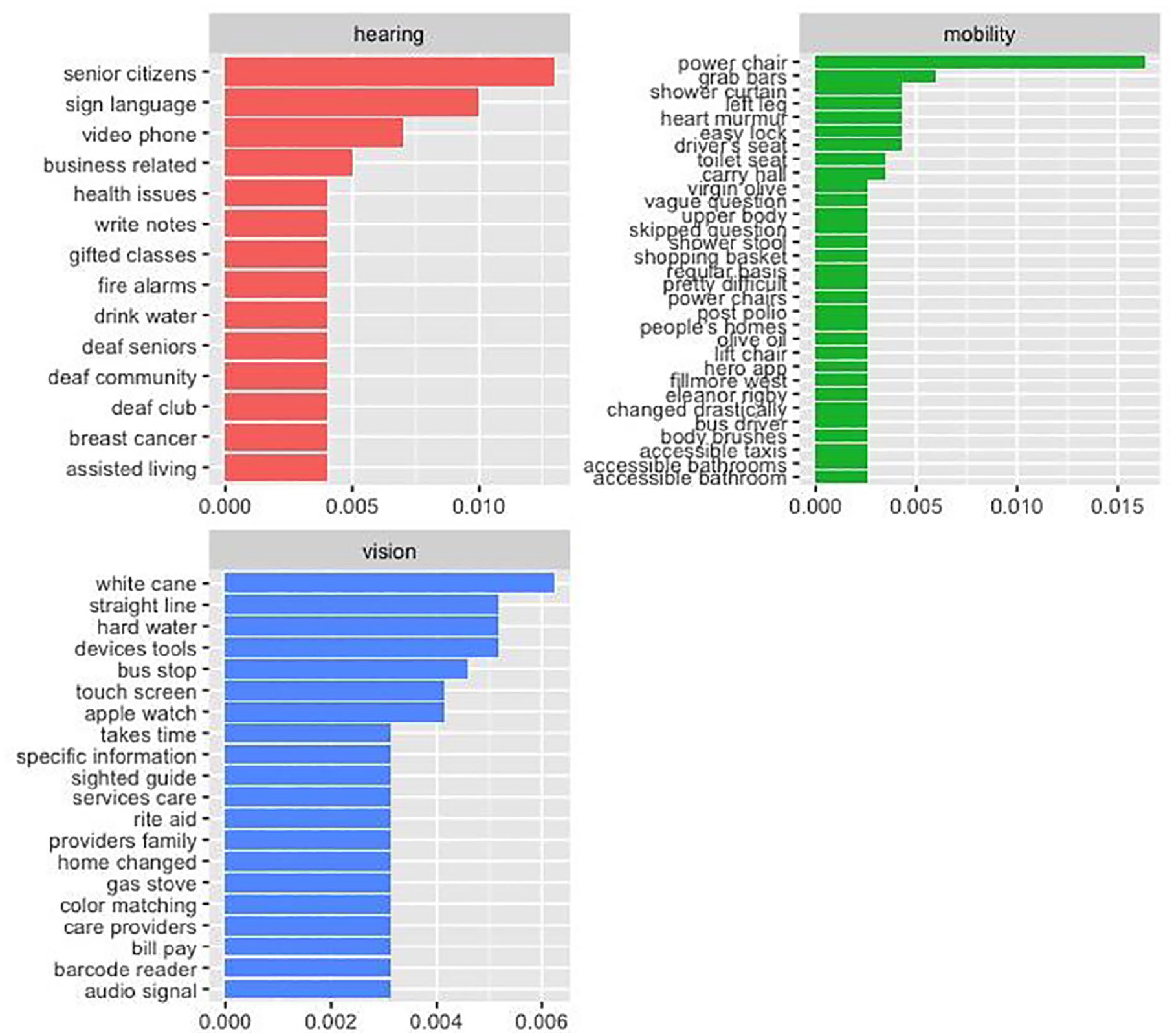
Most frequent weighted bigrams in the collection of interview scripts.
Figure 2 visually represents the bigram relationships, where nodes represent individual bigrams, and edges represent the connections between them (Yan et al., 2013). The positioning of the nodes were determined by their connections and other parameters. Three clusters were observed, and some bigrams were closely connected with edges, indicating a high co-occurrence. To ensure clarity and avoid visual clutter, only the first word is depicted and described for each node, while the second word of the bigram is omitted in Figure 2. Particularly, independent words such as “blood” and “grocery” were found to be associated with all three clusters, suggesting a frequent mention of blood pressure management and grocery shopping issues in the interview scripts.

Correlations among the most frequently used bigrams.
RQ2. What Underlying Themes About the Daily Experiences of Older Adults With Three Types of Disabilities can be Identified Across all Interview Scripts Using Thematic Analysis and Topic Modeling?
A total of five topics were generated, each characterized by the top keywords representing the most salient terms calculated by the BTM algorithms. To reveal the underlying topics within the BTM outputs, the author examined the list of words defining each topic (Figure 3), in conjunction with the original interview scripts. This mixed methods study enabled the author to contextualize the discerned words, thereby enhancing the overall interpretation of the BTM outputs. The identified topics are as follows (For readers in search of comprehensive statistical information pertaining to the BTM outputs, an extensive analysis can be found in the Supplemental Materials).
(1) Topic 1: This topic is characterized by terms such as “difficult,” “shopping,” “online,” “time,” and “technology.” These terms suggest that this topic may revolve around challenges related to online shopping and the impact of technology on older consumers’ behaviors.
(2) Topic 2: The prominent terms in this topic include “deaf,” “time,” “feel,” “doctor,” and “health.” This indicates a focus on healthcare experiences, particularly those related to deafness, doctor visits, and personal well-being.
(3) Topic 3: The terms “chair,” “difficult,” “body,” “shower,” and “seat” represent this topic. It suggests a focus on difficulties related to seating arrangements, including issues related to chairs, body comfort, showering, and seating in general.
(4) Topic 4: Terms like “difficult,” “time,” “bus,” “car,” and “walk” define this topic. It suggests discussions around transportation difficulties, including commuting by bus or car and challenges related to mobility.
(5) Topic 5: This topic is characterized by terms like “home,” “care,” “clean,” “difficult,” and “house.” It suggests a focus on challenges related to home care, housekeeping, and maintaining a clean-living environment.
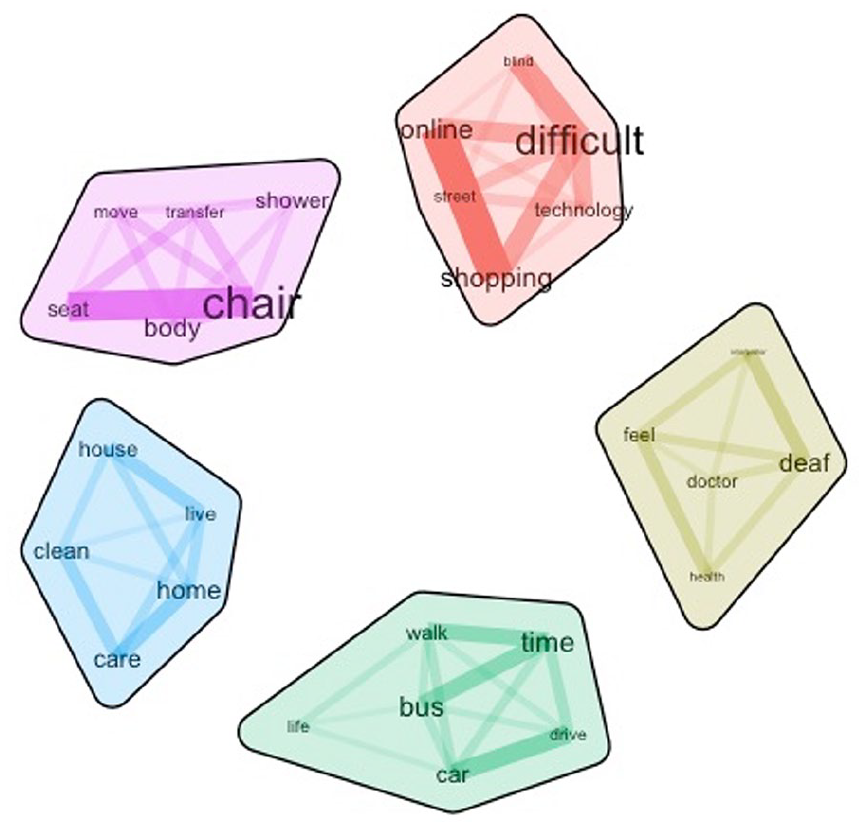
Identified five topics from BTM.
To validate the interpretation of the results from topic modeling, the author additionally performed a thematic analysis and utilized quotes as corroborative evidence. The findings from the topic modeling were consistent with the themes identified in the thematic analysis and aligned with the reports from the original study. Based on the themes identified through topic modeling, the primary concerns of older adults with visual impairments included online shopping, street navigation, and the utilization of new technology (Topic 1). This issue was also noted in the original study. A unanimous preference for in-person shopping with sighted companions was observed among all participants with visual impairments. Notably, three of them used a braille labeling system to help organize their purchased items.
“When I get home, I have little braille labels that I put. I don’t buy very many cans cause I buy almost all frozen or fresh vegetables and fruits and all that. So I mean those are quite obvious, the cans that I do buy I have some braille magnetic labels that I slap on the top of the can (ID 2).”
The participants with visual impairments found it challenging to visit unfamiliar areas. They expressed dissatisfaction with the existing bus, subway, and taxi services. Typically, they were accompanied by sighted family members or friends. The following excerpts from the interview scripts support the Topic 1 by highlighting the issues of accessibility and privacy concerns associated with the use of technology in public spaces: “I would say, um, paying and shopping because there’s so much technology out there that can make life easier so that we can actually complete the transaction ourselves. And now, from what I understand, all the stores are supposed to have the checkout computers talking but I’ve never heard one of them. Oh yes I have, Rite Aid, Rite Aid has one but I’ve never heard anything anywhere else that talks and guides me through it. So I would say shopping and paying for things because the technology is not available to us, can be a little difficult so you have to trust people you don’t know to be honest people. Especially with giving cash. I don’t want to stand there in front of the checkout checking everything on my iPhone cause I have an app on my iPhone that reads money that takes time and I don’t want to hold up a line. So, that can be very difficult (ID 5).”
Older adults with hearing impairments primarily grapple with communication barriers during medical appointments with healthcare providers due to a lack of interpreter services (Topic 2). The lack of interpretation services in clinical settings was also discussed in the original study. Hearing impairment is highly correlated to poor patient-healthcare provider communication. Frequently, healthcare providers become frustrated when conversing with patients with hearing impairments (Mick et al., 2014). To enhance the delivery of medical instructions, promote shared decision-making, and uphold patient autonomy, it is essential to institutionalize commercial interpreter services within healthcare environments (Mick et al., 2014). Additionally, the provision of accessible communication resources, including Braille materials, audio-based medical guidance, and tactile patient educational materials, is imperative to accommodate patients with visual impairments (Beverley et al., 2004).
“ I still resisted the hospital we sued so I went to the other hospital for surgery and radiation but the treatments were at a clinic associated with that hospital and they provided interpreters. I’d seek to find a doctor that will provide interpreting services. That was an advocacy work. The National Association of the Deaf has a card for us to share and distribute to doctors and hospitals (ID 11).”
Those with mobility impairments often find tasks such as showering and securing a seat in public spaces to be significant challenges (Topic 3). Mobility impairment, often associated with symptoms such as pain, imbalance muscle weakness, and unsteady gait patterns in older populations, significantly increases the risk of fall accidents, making it 15 times higher compared to other disabilities (Musich et al., 2018). Specifically, individuals with mobility impairments tend to experience heightened anxiety when navigating stairs or surfaces with reduced friction. One participant (ID 8) demonstrated a profound understanding of the need for safe and accessible residential design to mitigate the risk of accidents.
“The bathroom, the shower, whatever, needs to be designed so that you can do these things without knocking your soap over without knocking your shampoo and your body wash off, with being able to retain your, your, towels and your washcloths, and, you know, body brushes and things like that and it really takes some thought sometimes. And that’s only the process of getting in (ID 8).”
Across the broad, all older adults with disabilities reported managing their living environments (Topic 4) and utilizing transportation (Topic 5) as burdensome tasks. The quote presented below illustrates the challenges faced by an older adult with visual impairments when he needs to make repairs around the house.
“In particular, for a repair or something, but that’s not always very possible, so I find that sort of vulnerability to be a sort of a downer for me (ID 1).”
RQ3. How do Emotional States Vary Among Older Adults Based on Their Specific Disabilities?
In order to detect the dominant emotional status of the older adults living with disabilities, the author computed an overall sentiment score for different types of disability groups (Figure 4). To filter and count the semantically oriented words in the interview scripts, the author used a sentiment lexicon (Lennox et al., 2020). This lexicon provides a list of positive and negative sentiment words. For the “visual impairment” interview scripts (Participant ID 1–5), the sentiment scores display a mixed sentiment. One participant (ID 4) has a positive sentiment score of 22. The other interview scripts show negative sentiment scores running from −181 to −12. The negative sentiment counts range from 18 to 270, while the positive sentiment counts range from 22 to 111. The “mobility impairment” interview scripts (Participant ID 6–9) exhibit a mixed sentiment. The sentiment scores vary, with two documents (ID 6 & 9) having positive sentiment scores of 45 and 19, while the remaining documents have negative sentiment scores ranging from −76 to −12. The negative sentiment counts range from 63 to 267, while the positive sentiment counts range from 48 to 218. For the “hearing impairment” interview scripts (Participant ID 10–14), the sentiment scores indicated a predominantly negative sentiment. The negative sentiment counts range from 68 to 175, while the positive sentiment counts range from 28 to 117. The overall sentiment scores (positive minus negative) range from −90 to −40. The results from the sentiment analysis provide insights into the sentiment or emotional states within each interview script. By calculating the sentiment scores and counts, the variations in sentiment patterns can be observed – predominantly negative sentiments for older adults with hearing impairment, and mixed sentiments for older adults with visual and mobility impairments.

Distributions of sentiment scores.
Discussion
It is important to utilize our limited social and medical resources effectively to improve the quality of life for older adults with multiple disabilities. This demands a comprehensive understanding of their primary disability, its imposed limitations on daily living, and the necessity to align rehabilitation and community services with their prioritized needs (Mitzner et al., 2018). Previous studies commonly used a set of questions that assess functional independence by exploring activities of daily living (ADLs), such as bathing and dressing, and instrumental activities of daily living (IADLs), like shopping or managing personal finances (Chatterji et al., 2015). These ADLs and IADLs counts serve as validated tools to quantify health states and monitor functional changes over time. However, the scope of the interview data for mixed methods study encompassed not only these daily functions but also other domains of daily life activities. This broadened context within the interview data allowed us a deeper understanding of the health states and their impacts on everyday life among older adults with various disabilities.
Quantitatively determining which disability presents the most substantial challenges to daily life for older adults has its limitations. Individual acceptance of and adaptation to their disability, as well as the ability to cope with daily inconveniences, can vary widely. However, when considering how to improve quality of life for older individuals at a population level, rather than individually, it is essential to strive for a generalized understanding of the perceived difficulties experienced by older adults with various types of disabilities. Liu et al. (2022) reviewed 15 past studies to explain the correlation between sensory impairment, cognitive impairment, and ADL in older populations. Similar to the findings of this study, either sensory or mobility impairment independently leads to a decline in daily tasks. Notably, ADL is affected by hearing impairment only when it is significantly severe. In relation to mobility, older adults often express that diminished mobility is an anticipated yet challenging consequence of aging which results in the fear of losing their independence (Goins et al., 2015; Tang et al., 2022).
The majority of studies investigating the relationship between disability, depression, and loneliness tend to define disability as a binary concept (Li & Luo, 2023; Xiang et al., 2021). The sentiment analysis of this study revealed a broad range of emotions exhibited during the interviews with each participant. Firstly, all older adults with hearing impairments showed negative emotional states during the interviews. It is through hearing that an individual connects with their social and physical environments, thereby making hearing impairment not just a personal issue but also one with social implications (West, 2021). This is primarily due to its impact on an individual’s ability to communicate effectively with others. The sentiment analysis of older adults with visual impairments revealed that with one exception (ID 4), they predominantly used more negatively oriented words. Upon revisiting the interview scripts of ID 4, it is evident that this participant is distinct from other participants—the participants showed a proactive approach to learning and the utilization of various assistive technologies to mitigate daily life challenges.
In terms of the influence of technology on depression among older adults with disabilities and chronic illnesses, the effective use of assistive devices can enhance IADL and ameliorate symptoms of depression (Horowitz et al., 2006). These previous findings were also represented in the outputs of the BTM of this study. Information and Communication Technology (ICT) is poised to be a transformative force in enhancing the daily lives of older individuals, particularly in performing a variety of activities (Nimrod, 2020). It is vital, however, to prioritize universal design principles and high accessibility standards to cater to those with disabilities (King, 2020). It should be acknowledged that for older adults living with disabilities, embracing innovative technologies might pose increased challenges in the upcoming years.
This study’s findings from the BTM and sentiment analysis aligned with those of the original study and its thematic analysis. The extracted words accurately reflected the predominant daily challenges faced by the participants. Moreover, the estimated emotional states and responses of the participants resonated with previous research on this topic. These results suggest that combining text mining techniques with traditional text analysis methods is a reliable and effective approach for qualitative researchers dealing with large volumes of data. However, since topic modeling outputs are essentially clusters of frequently used terms, a thorough understanding of the existing research and qualitative data is crucial. Therefore, instead of relying solely on text mining techniques, integrating them with conventional text analysis methods is advisable. This combined approach can enhance data interpretation quality by minimizing researcher bias. Depending on the research design and the amount and quality of text data, the outcomes from text mining may not be able to be interpreted in meaningful ways (Lucas et al., 2015). Nevertheless, the results of the study’s use of text mining suggest the potential for overcoming the limitations of large amounts of qualitative data and traditional qualitative data analysis. Identifying the most frequently used words, visualizing word co-occurrences, and calculating the words and documents that most contribute to each of the topics yielded satisfactory results for surface-level analysis. Based on these findings, the results from text mining could be utilized to develop the coding scheme in the initial round of qualitative analysis.
While the text mining techniques did not markedly enhance the analysis beyond traditional methods, the author observed that text mining could provide advantages. Specifically, it assists researchers in uncovering potential textual meanings by exploring the interactions of word-level meanings within sentences and illustrates the distinct linguistic features present in participants’ narratives. These advantages enable researchers to achieve a balanced data interpretation, characterized by controlled subjectivity. Lewis et al. (2013) advocate for qualitative researchers to adopt a hybrid approach to data analysis, integrating text mining with hand coding. This approach can allow researchers to combine the syntactic and contextual insights gained from thematic analysis with the efficiencies of text mining. Future methodological research should focus on developing and validating hybrid methodologies to enhance data interpretation quality. To identify the most effective analytical strategy, various text mining methods can be considered to be combined with traditional qualitative data analysis.
Limitations
A limitation of the study lies in the findings derived from the topic modeling and sentiment analysis. Firstly, the BTM does not consider the sequential order of words during the process, assuming that words are exchangeable. However, the order of words and phrases can often be crucial for capturing the precise meaning of texts. By disregarding word order, the BTM may overlook important contextual information and potentially impact the accuracy of topic modeling outputs. Secondly, another limitation is that the sentiment analysis relied on a pre-existing sentiment lexicon. While the lexicon provides a comprehensive list of positive and negative sentiment words, it may not capture the full complexity and nuances of sentiment expressed in the specific context of the older adults who participated in the original study. Therefore, the accuracy and relevance of the sentiment analysis results could be influenced by the lexicon’s limitations in adequately capturing the unique sentiment expressions within the disability-related content. In addition, the author only compared three disability groups’ sentiment scores in the current study and could not compare the calculated sentiment scores with other older populations, owing to the lack of similar studies. Thirdly, it should be noted that the results obtained from text mining techniques did not fully capture the contexts of the research participants and the small sample size limits the potential for generalization. To reconcile this limitation, the author employed conventional thematic analysis to enhance the interpretation of qualitative data. Lastly, it was not possible to completely eliminate the subjectivity inherent in qualitative data analysis from the text mining procedures. Interpreting the outputs from the BTM and sentiment analysis required the author’s insights and text interpretations.
Conclusion
In conclusion, this mixed methods study utilized text mining techniques as well as thematic analysis to analyze interview scripts from older adults living with three distinct types of disabilities. Five main topics were identified, and the emotional language used was quantified to infer their emotional response. The perceived challenges of living with each form of disability varied significantly. For instance, older adults with visual impairments found navigation, technology usage, and online shopping particularly challenging. Individuals with hearing impairments primarily struggled with communicating with healthcare providers, whereas those with mobility impairments encountered significant barriers in public engagement and personal tasks such as showering. Generally, these groups reported difficulties in managing their homes and using transportation. The distinct challenges highlighted by older individuals with various disabilities can inform the development of more impactful public health policies in an aging society. Regarding to the emotional status, older individuals with visual impairments demonstrated a higher frequency of negative term usage. The daily life experiences of these individuals, whether positive or negative, were notably influenced by their individual coping strategies for their disabilities. Given the limitations inherent in the exclusive use of either conventional qualitative data analysis or text mining strategies, integrating multiple methods can be deemed advantageous for enhancing the interpretation of qualitative data in research.
Supplemental Material
sj-docx-1-ggm-10.1177_23337214241237097 – Supplemental material for Perceived Challenges and Emotional Responses in the Daily Lives of Older Adults With Disabilities: A Text Mining Study
Supplemental material, sj-docx-1-ggm-10.1177_23337214241237097 for Perceived Challenges and Emotional Responses in the Daily Lives of Older Adults With Disabilities: A Text Mining Study by Soyoung Choi in Gerontology and Geriatric Medicine
Footnotes
Declaration of Conflicting Interests
The author(s) declared no potential conflicts of interest with respect to the research, authorship, and/or publication of this article.
Funding
The author(s) disclosed receipt of the following financial support for the research, authorship, and/or publication of this article: This research was funded by a grant from the National Institute on Disability, Independent Living, and Rehabilitation Research (NIDILRR grant number 90REGE0006-01-00) under the auspices of the Rehabilitation and Engineering Research Center on Technologies to Support Aging-in-Place for People with Long-Term Disabilities (TechSAge; www.  )
)
IRB Approval
N/A.
Supplemental Material
Supplemental material for this article is available online.
References
Supplementary Material
Please find the following supplemental material available below.
For Open Access articles published under a Creative Commons License, all supplemental material carries the same license as the article it is associated with.
For non-Open Access articles published, all supplemental material carries a non-exclusive license, and permission requests for re-use of supplemental material or any part of supplemental material shall be sent directly to the copyright owner as specified in the copyright notice associated with the article.
