




Abstract
Older adults are often overlooked in decision making processes despite the detrimental effects on their well-being. The representation of older adults in investigations and initiatives is needed so that the issues they face, today and in the future, can be resolved through partnership and their active involvement. The aim of this article is to describe a participatory process for conducting a needs assessment (NA) and the contributions and opportunities of partnering with older adults to shape community services and support for older adults. Data were collected from 1,863 participants in a midwestern county via focus groups, interviews, and surveys. We describe how participatory principles were enacted, the involvement of older adults influenced the design and contributed to making sure hard-to-reach residents’ voices were included. Finally, we discuss the ways in which a community inclusive multi-method strategy can optimize resource allocation, identify pathways to more effective policymaking that is matched to the needs and interests of its oldest residents, and lead to unanticipated benefits. Single method, non-inclusive approaches can obscure the critical context and exclude perspectives of the most burdened and vulnerable, who are most in need of support from their community.
Keywords
As the proportion of older adults increases across the globe, the need for quality data to inform decisions about healthy aging will become more urgent, including decisions about community-based services and support delivery, provision, and policy (American Association of Retired Persons [AARP], 2017; Shevelkova et al., 2023). However, older adults are often overlooked in decision making processes and underrepresented in and excluded from research that may inform decisions that affect their lives, which contributes to inadequate support and unaddressed needs (AARP, 2017). Enlisting participation and centering the voices of affected populations in research that impacts their lives is a key tenet of health equity (Snyder & Iton, 2020) and though scholars agree efforts are needed to improve age-inclusivity, little is reported about how to go about increasing older adults’ involvement in studies (Anderson et al., 2021; Lockett et al., 2019; Petrovsky et al., 2022; Singh et al., 2017). Without community involvement, study findings remain in academic institutions and rarely used to impact communities outside it (Brownell & Roberto, 2015). Whether in a clinical or community setting, research is rarely conducted in partnership with older adults, and even less has been written about engagement experiences to inform investigations that can be linked to decisions for healthier aging and communities (Dutta & Kreps, 2013; Williams, 2021).
The meaningful engagement of older people in research holds promise for addressing their lag behind other groups in research participation and can ensure effective and efficient provision of and policy related to community services, programs, and support so they are needs driven (Leach, 2019; Leach et al., 2023; Mitchell et al., 2020). Undertaking a needs assessment (NA) is ideal for understanding the circumstances and challenges faced by individuals, their families, and communities, and to inform plans for effectively addressing their concerns (Reviere et al., 1996) particularly when the population of study is involved (Dutta & Kreps, 2013). Participatory research approaches are a possible antidote in that they center the voices of otherwise marginalized individuals who have a stake in the outcomes; mounting evidence suggests that findings are more relevant, valid, and actionable than traditional research and assessments that do not engage community members (Wiggins et al., 2018). Although participatory approaches are increasingly utilized in studies, the inclusion of older people is uncommon (Blair & Minkler, 2009). Thus, we are compelled to contribute to the discussion about community inclusive projects so that the issues facing older adults, today and in the future, can be resolved through partnership and their active involvement (AARP, 2017). We have successfully executed an older adult community-engaged NA that revealed multi-level challenges and produced findings that were translated into recommendations used to inform funding priorities and practice and policy changes. Needs assessments are often conducted to understand issues related to health, whereas we aimed to take into consideration the social, environmental, physical, mental, and financial circumstances of residents. The aim of this article is twofold. The first is to describe our engaged NA process and the ways in which participatory principles can be enacted in a community-wide assessment. The second is to shed light on the contributions and opportunities of partnering with older adults in a Community Advisory Board (CAB), one mechanism for conducting community-engaged assessments, to shape community services and support for older adults.
Method
This article is based upon an older adult NA conducted in Monroe County, Michigan, located in the southeastern corner of the state with a total population of 150,000, 16.3% of whom are age 65 or older (U.S. Census Bureau, 2016). To lend depth and breadth to our findings, we employed multiple modes of data collection at multiple levels which included 1,863 service recipients, community leaders, service providers, caregivers, and older adults.
Community-Based Participatory Research Principles & Process
Research has an increasing focus on community and need for localized understanding which calls for conceptual tools, such as those of engaged and participatory research, to help illuminate local customs, values, dynamics, and processes. Participatory approaches benefit from working with stakeholders to identify participants, recruit those afflicted by the issues, and share in the decision making that aims to increase quality and novelty of the research (Hacker, 2013).
Engaged research projects endeavor to improve circumstances through change; a project that begins with “the community’s felt needs is more likely to be successful in the change process and in fostering true community ownership of programs and actions” (Viswanath, 2008, p. 288). Community engaged projects appreciate the implications of being an outsider, distribution of power, importance of collaboration at all stages, and mutually beneficial knowledge and capacity building, interactions and outcomes, and that “there is no substitute for knowing the audience” (Glanz & Rimer, 2008, p. 511). Unlike traditional research where the researcher defines the problem, develops a research strategy, and designs the research methods, this inquiry was initiated by the community and conducted with a CAB through an iterative process so that we could listen and respond to concerns, determine priorities, exchange wisdom and resources, and develop a locally based, culturally appropriate approach and tools (Hacker, 2013; Israel et al., 2001; Simpson & Seibold, 2008). To that end, we drew on community-based participatory research (CBPR) principles to guide our collaborative NA (Hacker, 2013; Israel et al., 2005), which attuned our inquiry to the multiple levels of influence that impacted Monroe County older adults. As CBPR principles highlight, our project attended to the ecological realities that older adults were faced with. In addition to talking with and surveying older adults so that we could adequately depict their intra- and inter-personal perspectives via focus groups, interviews, and surveys (including with their caregivers), we gathered organizational level insight via surveying key stakeholders and through working with a CAB made up of experts on aging (more than half were older adults) and local services (current and retired organizational members).
The project began with several meetings with the CAB to open lines of communication and build rapport, discuss local concerns about aging, set priorities, and to begin developing a strategy and plan for the process. Our goal early in the project was to build a foundation of mutual interest and trust and to show that our concern and commitment were not transient. We established a communal appreciation for the project and held discussions about the forthcoming research, setting priorities and timelines. The needs of two groups were of particular concern to the CAB: hard to reach older adults who may be most vulnerable and informal caregivers. Our IRB notified us that we did not need review for the overall project, however, the interviews were approved as an individual research component (IRB # 046315B3). To ensure that our results were robust, and that quantitative analysis were contextualized with qualitative components, we worked with the CAB to design a research strategy that involved gathering data from multiple sources (Billings & Cowley, 1995; Finifter et al., 2005).
CBPR principles were adhered to throughout the study and contact with stakeholders was maintained through in-person meetings, email, and phone conversations to garner input and feedback regarding instruments, sampling, recruiting, and study materials. Qualitative guides and scripts and quantitative instruments were co-created and piloted with and through CAB members using an iterative procedure that included member checking our interpretations of the data we collected.
To achieve rigor and reliability, we devised a sampling plan that employed a variety of approaches to engage a variety of participants (see Table 1). Given the wide range of methods used in our study, they will be briefly described in temporal sequence, with details presented in Table 1 by group.
Data Collection Method Per Group.

Focus Groups of Older Adults
By design, the focus groups were conducted first to provide context for the NA through discussions that helped us to understand the viewpoints, concerns, and perceptions of Monroe County older residents in their own words. This, in turn, helped to reveal the issues we needed to explore and the questions we needed to ask in subsequent data collection components. Questions inquired about challenges older adults faced in their daily lives, resources and services they used to mitigate those challenges, barriers accessing support or resources, improvements to existing services, services that could help alleviate their challenges, and how service providers could improve their reach.
Focus Group of Caregivers
This group was targeted to explore the circumstances of caregivers, a subgroup identified by the CAB with unmet needs. Questions inquired about challenges they faced in their daily lives, resources and services they used to mitigate those challenges, barriers accessing support or resources, improvements to existing services, services that could help alleviate their challenges, and how service providers could improve their reach.
Survey of Caregivers
The CAB requested an ad hoc survey for attendees of a local caregiver summit that was developed during the study. Questions focused on understanding the experiences of caregivers including who they care for, the amount of time spent during a typical week of care provision, and caregivers’ health, challenges, and need for and use of support for themselves.
Survey of Older Adult Service Recipients
This component was developed in response to CAB interest to characterize users and garner insight on patterns of service use, satisfaction, and impact. We were able to compare the demographic features of service recipients with those of the older population at large.
In-Depth, Semi-Structured Face-to-Face Interviews With Older Adults
Interviews were an ad-hoc addition to our research plan, initiated by a gerontology doctoral student who worked closely with the CAB to more deeply explore the lived experience of the oldest county residents, particularly those who lived alone in their homes, who were most at risk of being geographically isolated. The guiding question was: What are the challenges experienced and the strategies devised by older adults to be successful in their efforts to live independently? Questions inquired about the challenges the interviewees faced, strategies employed to deal with those challenges, and the formal and informal social support network available to them.
Survey of Monroe County Older Adults
The population survey characterized the older population, identified their needs and garnered insight representative of the community at large. By design, this survey was conducted last in the project sequence because it was the most expensive part of the NA and was informed by the earlier data collection findings. The survey focused on the health, social, environmental, and economic circumstances of community-dwelling older residents as well as activity levels, community and service engagement, and care provision and reception. Additionally, the CAB requested that we include questions to gauge support for aging services overall, and also, for a proposed increase of the existing municipal property tax millage that would help pay for their provision.
The inclusion of older adults as co-learners, was a quality measure and allowed us to capitalize on a typically overlooked and underused community resource, the oldest residents in a community, who have a plethora of wisdom to offer that has accumulated over their life course (Bailey, 2009; Blair & Minkler, 2009). In order to minimize threats to validity in our multi-method community-engaged design, we were able to draw on strategies identified by Creswell and Plano Clark (2018) including (1) articulating the overall objective and the involvement of the CAB in determining the steps involved in our evaluation decisions; (2) articulating how the sequenced steps relate to or build on each other and lend themselves to action; and (3) involving the CAB in decision making in all stages of the project and implementation of the core design and identifying connections among the steps during our work together. Quality and rigor was further marked by use of multivocality, the time we spent in the field establishing and building trust, member checking and shared reflections, as well as our due diligence in collecting sufficient data to support our claims (Tracy, 2013).
After each qualitative component, researchers debriefed, had the audio recordings transcribed verbatim, which were reviewed to confirm general themes and to extract key comments in the words of community members. While we were able to achieve theoretical saturation—meaning that the opinions and stories gathered in successive interviews tended to converge and reinforce each other and new information was no longer being accumulated—after conducting interviews, this was not the goal of our focus groups. Rather, those were conducted to contextualize the study and identify areas that needed more in-depth exploration in other components. The themes from the focus groups served as guideposts for subsequent data collection instruments to ensure major topics were explored fully. Likewise, while we aimed to achieve a representative sample of the county’s entire older adult population for the population survey (Table 3), we did not seek a representativeness in other components when we used other sampling strategies that were described earlier. Univariate descriptive statistics and cross tabulations (significant at the <.05 level) were included in the final project report via SPSS statistical software. 1 The analysis and interpretation stage of the population survey and synthesizing the various findings was the lengthiest part of the project as researchers grappled how to manage and present the abundance of information to the CAB in a way that would be meaningful and actionable. The findings were incrementally shared with the CAB over several months as data analysis of key components were completed. A final report was generated that included recommendations for program and policy improvements.
Results
This section reports on the process, insights from the approach, as well as applied findings from our study. Older adult participation was vital to the success of this research at all stages including playing a key role in recruiting, acquiring resources, planning and logistics of focus groups and interviews, communication with members of the aging network, and providing guidance, contribution, and feedback about methods, instruments, and study reporting and dissemination.
A key component of this project was to organize the community side of the partnership early on in a way that encouraged involvement, enabled the work to move forward, and positioned the organization to act on results. Our conclusion is that without some institutional structure and guidance in advance for receiving and digesting the recommendations, study findings are less likely to translate into policy changes. Drawing from those of Israel et al. (2013) Table 2 illustrates the ways in which the principles of the approach were enacted, and how it impacted everyone involved in the process.
Community-Based Participatory Research Principles and Enactment.
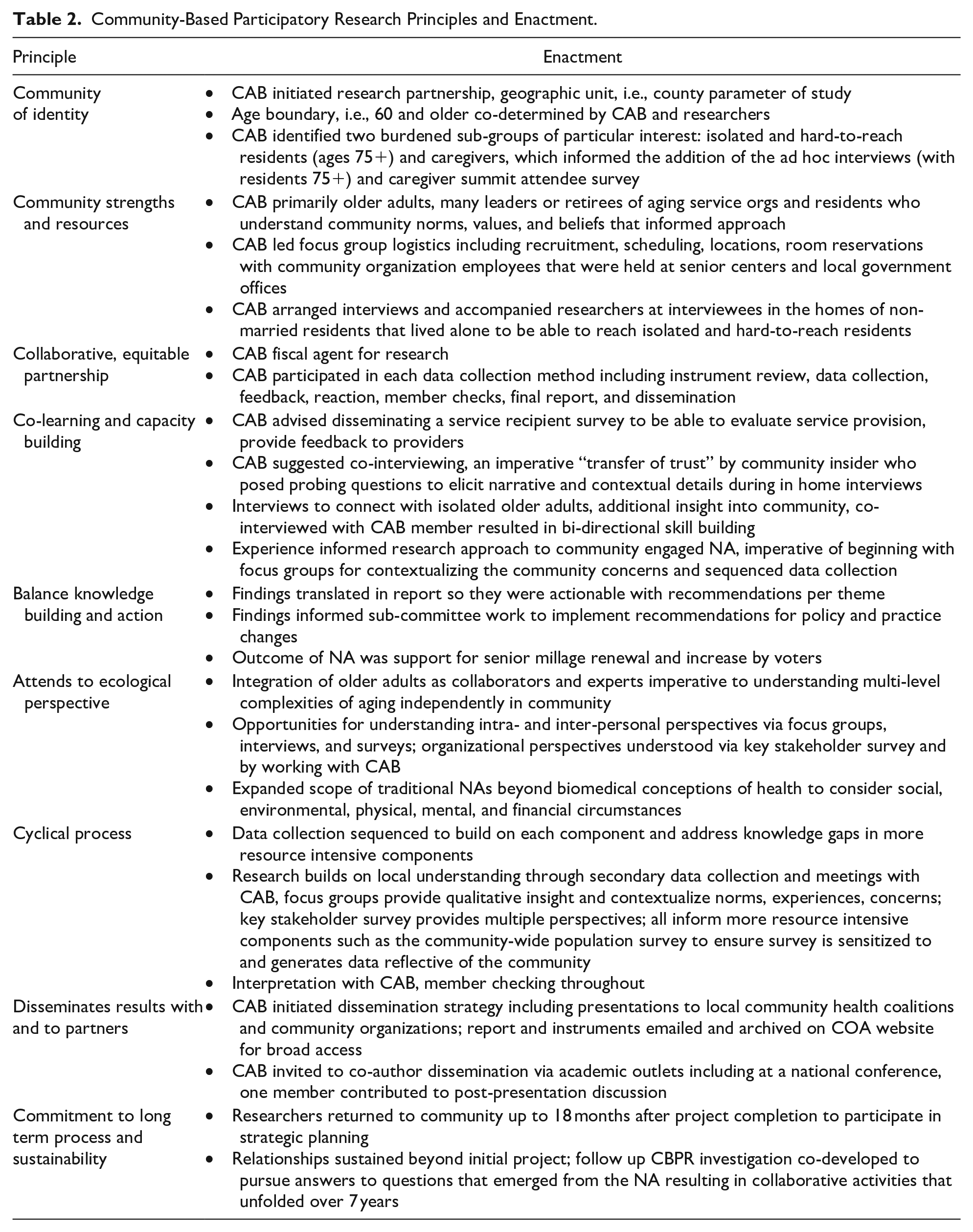
The Community Advisory Board improved the overall approach so that the study was sensitized to, inclusive of, and co-led by aging experts. As depicted in Table 1, the CAB played a crucial role in getting the word out about our study and engaging a variety of participants including recruiting hard-to-reach participants (as determined by the CAB) who lived alone and were ages 75 and over. The involvement of the CAB in our collaboratively designed multi-method strategy yielded a diverse group of study participants, especially among county residents as Table 3 illustrates. Respondents’ demographics sufficiently matched census data on the same population to suggest the sample was representative of older county residents (see Table 3).
Demographic Differences Per Method for Data Collected From Older Adults.

Source: 2015 5-year ACS PUMS data from IPUMS (Ruggles et al., 2015).
To illustrate, through our CAB, we gained access to a wide array of interview and focus group participants, allowing us access to Monroe County’s oldest residents, and the unique and less often captured perspectives of more difficult to reach people, including live-alone older adults who may be at greatest risk for social isolation. The population survey had the highest level of participation by male residents but also included our youngest and most educated respondents. The service recipient survey allowed us to gain insight into the lives of low-income residents, which may not have been as easily done without the anonymity afforded by this method.
We found that the County’s most vulnerable residents, which we estimated to be less than 15% of older adults, were in poor health or disabled and lacked the social and economic resources to help themselves. They were older, female, and single, more likely to be renters, and subsisted almost entirely on Social Security benefits. We also learned from this study that service use changed with age and that service recipients were more likely to be women in every age category. Service users were also more likely to be older, with those age 80 and older over-represented compared to the older adult population at large. As one might expect, service recipients tended to have lower incomes than those who did not receive any services, and rural residents (38% of the county is classified as rural) also used more services than their urban dwelling counterparts. Specific types of services also varied with age: users aged 80 and older were more likely to rely on emergency needs assistance, Meals on Wheels, and in-home care and chore help than those in their 60s and 70s. The oldest segment of the population, those age 80 and above, were the largest consumers of aging services. These services, which include home delivered meals, home care, chore and repair services, and home injury control, are critical to supporting frail elders in their homes. In all, the final 262-page report included conclusions and recommendations for 10 actionable themes: (1) awareness and outreach, (2) caregiver support, (3) community partnerships, (4) geographical issues, (5) home-based services, (6) housing, (7) senior centers, (8) social capital, (9) systems navigation, and (10) transportation.
Discussion
The complex and heterogeneous circumstances of older adults and the difficulty of understanding how best to provide aging services requires diverse tactics appropriate to the task. Though we do not introduce new research methods, we combine and apply them in a community-driven approach that draws on the wisdom of the community’s oldest residents.
We advocate for the inclusion of older adults in investigations, so the voices of the most vulnerable community members are represented, especially in aging studies. Minimally they should be undertaken in consultation with older people; they remain an underutilized and underappreciated resource for conducting aging research (Black et al., 2015; Corrado et al., 2020). Not only did our CAB operate as community historians and advisors, in our case they worked alongside us and assisted in all phases from access through interpretation, dissemination and action. Collaborating with older residents had a major advantage in closing the gap between researchers who were outsiders and the oldest community insiders. Their inclusion not only improves research outcomes, it also positively impacts older adults themselves (Bailey, 2009; Blair & Minkler, 2009).
There were also unintended opportunities that came out of the partnership including the opportunity for a follow up project to pursue answers to questions that emerged from the NA related to low awareness among the counties most vulnerable. That study was a unique opportunity to conduct a CBPR investigation which focused on understanding the communication dynamics of the most vulnerable and hardest to reach, residents ages 75 and older. By drawing on insights from this NA and established partnerships, that qualitative study took place in the homes of residents with a mean age of 83 (range 75–96). One major finding of that project was for the community to bridge the stark gap between aging service agencies and healthcare clinics, sites, and providers especially because individuals ages 75 and over are the largest consumers of healthcare (Leach et al., 2023). Ultimately, the results offered a theoretically grounded approach to outreach and practical tools to improve communication and connections with hard-to-reach residents (Leach et al., 2023; Leach & Novak, 2019 ). For this reason, we recommend that community stakeholders’ partner with academic researchers whose skills may be leveraged to their benefit beyond the scope of an initial collaboration and in ways that are unforeseen. This experience supports the claim by Jagosh et al. (2012) that successful participatory processes transform the context and in doing so pave a path for success in subsequent collaborations.
We added to the NA in ways that were not originally planned, which advanced our data collection to the saturation point and perhaps beyond. For example, community contacts requested an ad hoc survey be disseminated at a local caregiver summit. This survey did validate findings from focus groups, but similar questions were answered via the population survey. The interviews were also ad hoc to the original research plan though a doctoral student wanted to explore the everyday lives of older residents, which uncovered strengths and assets of the community that informed our recommendations. The service recipient survey was crafted in response to the CAB’s desire to evaluate services yet provided surprising information about service users and yielded important insights about the County’s oldest residents. Those who undertake NAs should remain flexible and open to change and encourage team members and advisory boards to embrace modifications and changes as needed. Flexibility helped us to address program and service priorities beyond assessing needs by helping to evaluate the quality of services received as well as discovering services and support residents received or needed without being aware of it.
While we recommend collecting data through multiple methods, we have learned that there are limitations to what can and should be undertaken. This NA attempted to be responsive to all community stakeholders’ ideas, not only to what services were needed and how they could best be provided, but also how well they were being delivered and to what effect. One of the challenges throughout was managing community expectations while considering our research group’s own capacity. Our study realized all the benefits of a wide participation of aging services agencies and the community, but at the cost of more time and resources than originally planned. Planning a more finely focused NA of limited scope may be essential when time and resources are limited. We regularly adjusted project timelines while managing expectations for project completion. Another challenge was grappling with the large amount of data compiled and synthesizing it in a way that would be manageable and prompt action. Based on our experience, we encourage future NAs to tap the wisdom embedded within the community and encourage communities that wish to undertake a NA to join forces with interested groups in neighboring communities to reduce costs and strengthen regional service delivery.
Finally, this project led to policy improvements and change. Researchers helped to transform findings into tangible solutions at the local level by participating in the task forces and strategic planning. Our final report led the CAB to establish several task forces focused on the most significant issues which led to a detailed plan for policy changes and actions for implementation. In our experience, this denotes an important distinction compared with other communities we have worked with to conduct NAs. Although the authors of this paper attended and contributed to post-NA meetings and strategic planning, the development of task forces was a wholly community-driven effort led by local champions committed to making sure that the findings were put into action. Based on this experience, we suggest: 1) NAs should go beyond reporting findings so that the results are paired with actionable recommendations; 2) communities that engage in a NA take into account efforts that lead to change beyond the project including post-assessment planning, and 3) identify champions who can lead subsequent efforts for implementation and change. More research is needed to discern the impact of community engaged NAs in achieving sustainable development goals including whether they promote the well-being of communities, partners, or residents. Moreover, insight is needed, based on the degree to which stakeholders are actively engaged in the process, to understand whether and to what degree the approach led to more to inclusive practices and institutions (Shevelkova et al., 2023). One of the challenges and many limitations of this work is the lack of insight to draw on to inform how to meaningfully engage older adults in NAs, and we advocate for others who engage in this work to devote time to reporting about their experiences. Not only do we wish to see more reports about the experiences, but we also went through a process of reflecting on our collective experience (Leach, 2023). During that evaluation process, our partners shared their reflections about the challenges and benefits of engaging in research, those findings are currently under review for publication so that their perspectives are depicted in their own words. That paper will also include the lessons we learned from engaging in research with that community over the course of 7 years.
Conclusion
Though resource intensive, NAs informed by participatory principles can benefit the community by ensuring that the most vulnerable residents’ voices are represented in the research, optimizing resource allocation, and identifying pathways to more effective policymaking. This approach yields reliable community wisdom to guide planning that attends to the cultural milieu and the population it aims to support and produces results that can reliably inform local aging initiatives (Lehning et al., 2012) and age-friendly communities (Buffel, 2018). Single method, non-inclusive approaches can obscure the critical context and exclude perspectives of the most burdened and vulnerable, who are most in need of support from their community.
Footnotes
Acknowledgements
We are grateful to everyone who participated in this study, the dozens of community members who partnered with us to design and conduct this research and recruit participants, and the Monroe County (Michigan) Board of Commissioners and Commission on Aging. Pam LaPan, Joe Grifka, Sandie Pierce, Cynthia McIlvain, Jim McGuire, Robert Peven, and Jeff McBee were close collaborators who offered guidance, support, advice, and assistance throughout. Special thanks to Dr. Cathy Lysack who provided invaluable feedback and support throughout the manuscript writing process.
Declaration of Conflicting Interests
The author(s) declared no potential conflicts of interest with respect to the research, authorship, and/or publication of this article.
Funding
The author(s) received no financial support for the research, authorship, and/or publication of this article.
