



Abstract
COVID-19 has affected the daily activities of people worldwide. Recommendations introduced to reduce the spread of the virus led to increased use of Information and Communication Technologies (ICT) to meet everyday needs. Such rapid digitalization had not been seen previously and not been possible to study before. Hence, this study aimed to identify and describe self-reported changes in usage of and attitudes toward ICT among three generations in Sweden during the early phase of the COVID-19 pandemic. Additionally, it aimed to identify whether and how belonging to a specific generation was related to these changes. A national cross-sectional survey was conducted in June 2020 with a final sample of N = 3,000, stratified into three generations (30–39, 50–59, and 70–79-year-old persons). A majority reported using digital technology more often than before the pandemic. Compared to the youngest generation, the oldest and middle-aged generations reported that they used digital technology more often than before the pandemic. Our results show which technologies were considered essential for different generations during the early phase of the pandemic. This information can be used to guide policy makers based on knowledge concerning the needs and demands for digital technologies in everyday life among people of different ages.
Keywords
Introduction
From early 2020, the Coronavirus Disease of 2019 (COVID-19) rapidly spread causing great concern all over the world and affecting more than 220 countries and regions (Cucinotta & Vanelli, 2020; Priyadarshini et al., 2020; Radwan et al., 2020). Older adults were especially impacted because it is widely recognized that the severity of COVID-19 increases considerably with age, particularly in cases of fatality. COVID-19 led to social distancing, lockdowns, and curfews being introduced worldwide (Khalili-Mahani et al., 2021; Priyadarshini et al., 2020; Radwan et al., 2020).
In Sweden, for example, people of all ages were recommended to stay at home when sick, avoid public places, keep social distance, wash their hands, and if possible, work from home (Public Health Agency of Sweden, 2020). People aged 70 years and older were defined as a risk group in need of extra precautions and recommended to stay at home and keep social distance at all times. While these recommendations broadly changed people’s everyday activities (Zingmark et al., 2022), one particular change was increased use of information and communication technology (ICT) to keep social contact with others as well as to acquire goods and services (De et al., 2020).
In the context of a pandemic in which people aged 70 years and older had to stay at home and in which the demand for ICT to meet their everyday necessities was heightened, it is relevant to explore whether older people (70+) were affected more or differently than younger people in the society during the early phase of the pandemic. Previous studies showed that both older and younger people (Fristedt et al., 2021; Olsson et al., 2019) are challenged by ICT necessary for everyday life activities. Even before the pandemic, a Swedish report (SPF, 2019) showed that little was done to consider or support the needs and prerequisites of people who lacked or had restricted digital skills, which left them and other citizens behind. Therefore, it is likely that the changed use of ICT as a consequence of the pandemic affected attitudes, adoption, and usage. For instance, it could potentiate negative attitudes toward and reduce the use of ICT by people who do not have the means to use ICT effectively, which, in turn, can lead to a higher risk of digital inequalities and being left behind (Aissaoui & Barcenilla, 2020; Beaunoyer et al., 2020; Horst et al., 2021). Nevertheless, in light of the pandemic, the use of ICT for everyday necessities could potentiate positive attitudes toward and increase both skills and usage of ICT. For example, many older adults embraced technology that facilitated connections with family and friends (Hunsaker et al., 2020; Liddle et al., 2020). It shows that older adults are more likely to use technology if they perceive it valuable to them and if it will positively impact their lives (Berkowsky et al., 2018; Sharit et al., 2021). Hence, ICT has become an important ally for older adults (Llorente-Barroso et al., 2021) during the pandemic.
Through the present study, we contribute to the growing body of literature about older adults’ attitudes toward and usage of technology in relation to COVID-19. Unlike most previous studies we add a generational perspective to this growing body of literature. Little is known about if and how adverse events change perceptions, attitudes, usage, and adoption of ICT from a generational perspective. According to the domestication theory, adoption of technology takes time and is an ongoing process (Haddon, 2011). However, it is unknown if this theory is applicable during periods of rapid digitalization, such as a pandemic, when people are forced to use technologies to meet their everyday needs. Accordingly, there was a unique opportunity to explore changes in use of and attitudes toward ICT among different generations during the pandemic’s early phase.
The present study aimed to identify and describe self-reported changes in use of and attitudes toward ICT in three generations in Sweden during the early phase of the COVID-19 pandemic. In addition, the purpose was to identify and describe whether and how belonging to a specific generation was related to these changes.
Methods
Design
This cross-sectional survey study was implemented as part of the GenerationTech project and was approved by the Swedish Ethical Review Authority (Dnr: 2020-02236). Kantar Sifo (KS), a national consulting company with extensive experience of survey administration, performed the sampling and data collection commissioned by the research team.
Respondents, Sampling, and Recruitment
To make resource-efficient data collection during the limited project period possible and counteract threats to representativeness experienced when targeting a general population sample, an established online panel provided by KS was used. This online panel consists of 100,000 randomly sampled individuals aged 16 years and older and representative of Internet users in Sweden. These individuals have committed themselves to respond to surveys provided by KS during a limited period. They are successively replaced, and the panel is filled with new people to prevent familiarity bias from excessive participation in studies, which could influence the results. The online panel has documented high response rates.
Similar to the original GenerationTech survey data collection (Offerman et al., 2023), participants in the present study were stratified into three age cohorts (30–39, 50–59, and 70–79 years) representing three generations. We applied a pragmatic, scientific strategy involving resource considerations to identify these three different and distinct age cohorts without overlap in age, rather than popular notions of generations (Baby Boomers, Generation X, Millennials, etc.). People in the same age cohort are affected by the societal events/changes that have occurred during their lifetime, and they and their actions in turn have an impact on society and societal values. We also considered the divergence between different age cohorts, as each age cohort might draw upon and seek different kinds of experiences that suit their unique needs and preferences. Based on 2019 Swedish population statistics, the 30 to 39-year-old cohort was approximately 1.37 million, the 50 to 59-year-old cohort was 1.3 million, and the 70 to 79-year-old cohort was 990,000 (Statistics Sweden, 2019). With a confidence level of 95% and a sample of 1,000 per cohort, our margin of error was estimated to 3.1 (Cochran, 1977).
A sampling frame of 20,000 individuals was initially drawn by KS from their online panel, and it included 10,000 men and women respectively with approximately 6,700 individuals from each age cohort (30–39, 50–59, and 70–79 years). In the next step, a sub-selection of 9,146 individuals was randomly drawn by KS considering common variations in response rates within the respective age cohorts. Thereafter, 5,108 individuals aged 30 to 39, 2,331 aged 50 to 59, and 1,707 aged 70 to 79 were invited to the survey.
The data collection proceeded from June 9th to June 24th, 2020 (hereafter referred to as the early phase of the pandemic) until 1,000 persons in each age cohort had responded, yielding a sample of 1,459 women and 1,541 men. That is, in total 3,000 people (i.e., N = 1,000 in each cohort) responded to the survey. A description of the sample is presented in Table 1. All respondents gave digital informed consent before starting the survey.
Characteristics of the Survey Sample, N = 3,000.
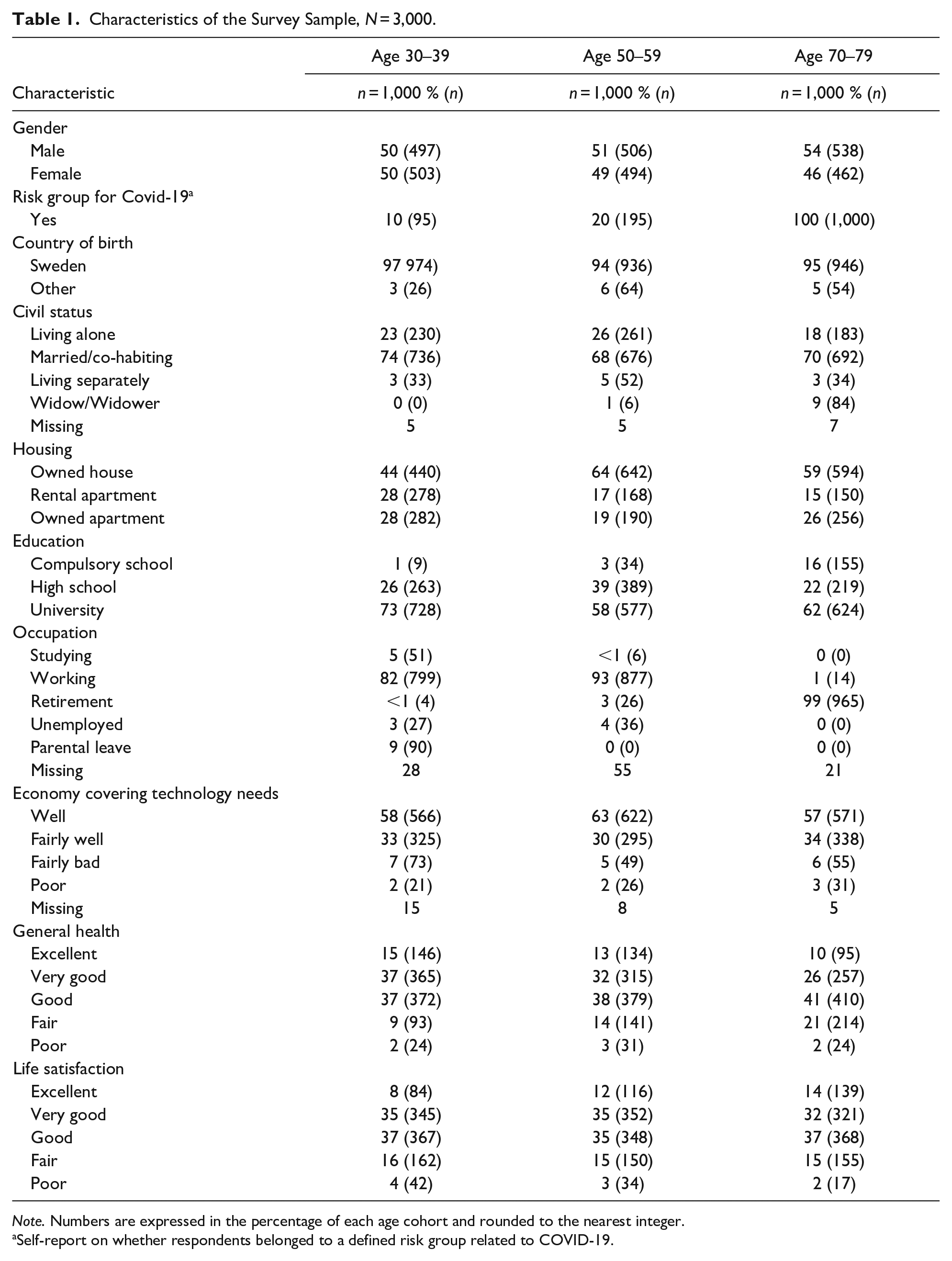
Note. Numbers are expressed in the percentage of each age cohort and rounded to the nearest integer.
Self-report on whether respondents belonged to a defined risk group related to COVID-19.
Survey Questionnaire
Based on the literature, GenerationTech focus groups (Fristedt et al., 2021), and a subsequent survey (Offerman et al., 2023), we developed a study-specific survey focusing on the situation during the pandemic. In addition, the online panel provided background information, such as gender, age, education, region, household size, self-rated health, life satisfaction, etc. Representatives of Sweden’s two largest senior organizations (SPF; and PRO) reviewed a draft version of the survey and provided input on the design and relevance of questions, leading to modifications for the final version. The survey took about 10 min to complete.
Respondents answered questions on a 4-point scale (totally agree, largely agree, partly agree, do not agree) about how they accessed goods and services, if they had used digital technology more often during the early phase of the pandemic, and what kind of digital technology they had used more often. The survey included questions related to changes due to the pandemic and experiences of using digital technology for such purposes. The respondents were also asked about their attitude toward digital technology and if it had changed due to the pandemic and recommendations following the spread of coronavirus. Furthermore, respondents reported if they believed they had sufficient knowledge to use digital technology for their everyday needs. Which digital products or services the respondents used and how they solved potential problems during the pandemic were asked as well.
Data Analyses
Descriptive statistics were used to describe the three-generation sample regarding basic demographics. Due to the non-normal distribution and skewness of the ordinal data, the response alternatives, largely agree, totally agree, and partly agree were merged to facilitate analysis. Logistic regression analyses were performed with the dependent variables, if you have used digital technology more often due to the spread of COVID-19 and what kind of digital technology you had used more during the pandemic’s early phase than before, respectively. The dependent variables were dichotomized into agreeing versus not agreeing to have used certain digital technology more often than before the early phase of the pandemic. The independent variable used in all regressions was belonging to a generation. To control for sociodemographic characteristics, gender, self-rated health, life satisfaction, and education, self-rated economy, housing, civil status, and occupation were entered as covariates. Logistic regression models were first computed unadjusted, followed by an adjusted model controlling for the aforementioned covariates. For all analyses, the alpha level was set to p < .05. IBM SPSS Statistics 27 was used for the data analyses.
Results
Most of the respondents reported that they used ICT more often during the pandemic’s early phase than before the pandemic (Table 2), and they especially used it more to remain in contact with friends and family. Almost a third (30%) of them felt encouraged to use ICT more often during the pandemic’s early phase than before. Lower proportions (17% of the youngest and middle-aged, 12% of the oldest generation) felt their attitude toward ICT had changed to a more positive view. Only a few respondents (3% of the youngest and middle-aged and 2% of the oldest generation) felt their attitudes toward ICT had changed to more negative attitudes. On the other hand, a majority (80% of the youngest and middle-aged, and 86% of the oldest generation) felt that their attitude toward ICT had not changed during the early phase of the pandemic. Most of the respondents (92% of the youngest, 85% of the middle-aged, and 75% of the oldest generation) felt that they had the knowledge needed to use ICT for their everyday necessities during the early phase of the pandemic. However, 1% of the youngest and middle-aged and 2% of the oldest generation felt that they did not have sufficient knowledge for such use.
Relationships Between the Use of ICT and Belonging to a Specific Generation Based on Binary Logistic Regression, Presenting Unadjusted and Adjusted Models Controlling for Covariates (N = 3,000).

Note. Dependent variables are the usage of the ICT, independent variable are the generation one belong to and covariates. Numbers are rounded to the nearest integer.
Associations Between the Use of ICT and Belonging to Specific Generations
In the unadjusted model, compared to the youngest generation, the odds of using ICT more often during the pandemic were 11% higher among the middle-aged and 45% higher among the oldest generation.
In the adjusted model, compared to the youngest generation, the odds of using ICT more often during the early phase of the pandemic were 24% higher among the middle-aged and 57% higher among the oldest generation, see Table 2. In the adjusted model, we observed an upward trend presenting higher OR for all types of ICT use. For instance, compared to the youngest generation, the oldest generation had higher odds ratios for using ICT for e-mails (OR 8.41 [6.61, 10.70]) and SMS (OR 2.43 [1.97, 2.98]) to friends and family more often during the pandemic’s early phase than before. Compared to the youngest generation, the middle-aged generation had lower odds ratios for using ICT to acquire goods (OR 0.79 [0.66, 0.96]) and use video calls (OR 0.70, [0.58, 0.85]) more often during the pandemic’s early phase than before. In contrast, compared to the youngest generation the middle-aged generation demonstrated higher odds ratios for using ICT for e-mails (OR 2.39 [1.88, 3.03]), SMS (OR 1.29 [1.07, 1.56]), and video calls (OR 1.27 [1.04, 1.54]) to friends and family more often during the pandemic’s early phase than before (Table 2).
Discussion
The present study illuminates the readiness and capacity to adapt to an adverse situation such as a pandemic among people from three different generations. For instance, 6 out of 10 respondents had increased their use of ICT. This increase was present across generations and more prominent in the oldest and middle-aged generations. Generational differences and similarities were found regarding which kind of ICT products were used more often during the early phase of the pandemic.
One possibility for the increased use of ICT described across generations is that people are using it more often to find meaningful and social activities. It could also be interpreted as a measure of people’s readiness to adapt to an adverse situation by increasing their use of ICT. This applied above all to the oldest and middle-aged generation. A recent study (Viklund et al., 2022) showed a positive association between internet use and perceiving life as meaningful. Hence, ICT can be seen as a tool, which facilitates engagement in meaningful and social activities (Nimrod, 2020). As a matter of fact, many older adults embrace the function of ICT products if they perceive value in the technology, especially during times of distress, to facilitate social connections with friends and family (Liddle et al., 2020; Sharit et al., 2021). This is supported by our findings that showed the oldest generation preferred to use technologies that facilitate social connections (e.g., social media, email, and SMS) more often than before, while the middle-aged generation used video calls more often. However, as their use prior to the COVID-19 pandemic is unknown to us, actual use is not known among our sample.
Another possible explanation for the increased use of ICT is the impact of the recommendations introduced by the Public Health Agency of Sweden (2020), which defined older aged 70 years and older as a risk group, and all people were recommended to stay at home when sick, avoid public places, and work from home if possible. This in turn created new needs for digital technology and services, (e.g., video calls and food delivery) to stay connected with friends and family or be able to get their everyday necessities. Frequent Internet use during the pandemic, particularly for communication purposes, has been shown to be associated with enhanced quality of life among older and middle-aged adults (Wallinheimo & Evans, 2021). In fact, many of our respondents used ICT more often than before the pandemic to stay connected and for their everyday necessities. This was likely done without, at least face-to-face, support due to recommendations and quarantines. While most of the respondents used ICT more often, many did not, but it is hard to say if this is due to lack of support, if they already used it before the pandemic and did not increase use, or some other reason. Still, it highlights the capacity of most respondents to react to an adverse event such as the pandemic.
Now that the initial urgency to get online caused by the pandemic has passed, further research is needed to understand how to sustain this increased use of ICT, which likely took place without support. Hence, it is important to investigate how to support and sustain meaningful social connections for current and future generations of older people.
According to the domestication theory (Haddon, 2011), adaptation to technology is an ongoing process. First, it is integrated into everyday life, then it leads to individual adjustments, and later on to adaptation to the technology. In our results, most respondents described an increased use of ICT during the pandemic’s early phase, indicating technology was being integrated into their lives. However, their attitude toward ICT remained unchanged for many respondents. It is possible that they neither made adoptions nor changed their attitude later either. They could also have been at the beginning of the adaptation process at the time of the survey without any individual adjustments so far. Though it should be stated that we did not know what their attitude toward ICT was before the COVID-19 pandemic. Meaning, that they could have had a positive or negative attitude toward technology before the pandemic and it did not change. However, the youngest generation changed their attitude to a larger extent compared to the oldest, and the oldest generation had used ICT more often than before the pandemic. A reason for this may be that the younger generations had already before the pandemic embraced technology (Pew Research Center, 2019; Swedish Internet Foundation, 2019). Lee et al. (2019) predicted that age disparities will likely diminish over time. The Swedish Internet Foundation (2021) stated in a recent report that most new users of the internet over the last 3 years are older than 66. This indicates that it is mostly older people who have not been connected before and are therefore most likely to embrace ICT to a larger extent now. Internet use is at an all-time high in many Western countries. This increase has been going on for years but has accelerated over the last couple of years as a result of the pandemic (Pew Research Center, 2021; World Bank Organisation, 2021). It may be that the age disparities are starting to diminish, at least when it comes to starting to use ICT.
In line with our previous study (Offerman et al., 2023) across generations, respondents thought they had the knowledge required to use ICT for their everyday needs during the pandemic’s early phase, but this was more prominent in the youngest and middle-aged generations. This could be a result of the rapid digitalization that has been around for some time now. Sweden is one of the most digitalized countries in the world (Digital Economy and Society Index, 2021), and according to a recent report, nine out of 10 persons in Sweden use the Internet daily. Therefore, it is not that surprising that respondents had the knowledge needed to use ICT for their everyday necessities. However, in the same report, it is stated that every fifth retired person does not use the internet daily. This is reflected in our results as 75% of the oldest generation thought they had the knowledge needed, whereas, in the youngest generation and middle-aged generation, 92% and 85% respectively stated they had the knowledge needed to use ICT for everyday necessities during the pandemic’s early phase. Only 1% to 2% of the respondents said they did not have the knowledge to use digital technologies for daily needs during the pandemic’s early phase, so it is feasible to say that they most likely did not use it for this purpose. The fact that not all countries are as digitalized as Sweden makes it hard to compare and generalize the results to other countries. However, similar to our results, a study conducted in England on middle-aged and older adults (55–75 years old) found that nearly half of the participants confirmed using the internet more than before the pandemic (Wallinheimo & Evans, 2021). Internet use is at an all-time high in many Western countries (World Bank Organisation, 2021), so there may be similarities between Sweden and other digitalized countries in the Western world. In the context of a global pandemic where the transition to a more digital technology-based interaction emerges, it is important to investigate how access and support can be provided for using digital technologies for those who do not have the knowledge or confidence in using them.
Strengths and Limitations
The strength of the study lies in the national sample, randomly drawn from the Swedish population. The respondents represented different socio-economic classes and nationalities, which has a resemblance to the Swedish population. It is worth noting that Kantar Sifo’s online panel mostly consists of internet users, which may limit the variety of perspectives presented and bring people who are more tech-savvy. However, 98% of Swedish households had access to the Internet at the time of the data collection and 9 out of 10 citizens used it daily (Swedish Internet Foundation, 2020). While the perspectives of non-users are important, this study’s main focus was to describe changes in digital technology use during the early phase of the pandemic. Hence, whether you are a long-time or first-time user, your experiences and changes made are still valuable and relevant. Another notable limitation is that questions about the actual use and attitude of respondents and previous experiences with technology could have been included. In retrospect, including such questions would have made it easier to draw conclusions about the actual use and the knowledge of the respondents about the questions they answered. Despite these limitations, the current findings complement the growing body of literature on attitudes and use of technology related to COVID-19, and unlike most previous studies, we add a generational perspective.
Implications
The readiness and capacity among people in different generations to adapt to an adverse situation such as a pandemic should be considered by policymakers. Especially as our results show which types of ICT were perceived as essential and how respondents reacted to the recommendations of the pandemic, in terms of attitudes and use of ICT. It shows there is a need to address how support can be given to people. Digitalization policies should be based on knowledge concerning people’s actual needs and demands from everyday life circumstances. Hence, information regarding changes in use and attitudes toward technology is essential. Otherwise, there is a risk that digitization will lead to a lower quality of life for citizens who do not have sufficient digital literacy to use ICT and thus risk being left behind in the rapid digitalization.
Conclusion
This study shows that collecting data from several generations during the early phase of the COVID-19 pandemic rather than focusing solely on older adults sheds new light on how different generations perceive and utilize ICT. Our study captured generational perspectives regarding reported changes in use of and attitudes toward ICT, which provided valuable insights into this ever-evolving landscape. Through the design with three different generations, we were able to identify differences and similarities that deserve attention for future research and adverse events with potentially unforeseen consequences for individuals, groups and society at large. In the context of a global pandemic where digital interaction is required, it is highly relevant to continue to investigate how technology can support active and healthy aging as well as sustain meaningful social connections for all people—for new as well as experienced users.
Footnotes
Acknowledgements
The authors would like to acknowledge colleagues at the Centre for Aging and Supportive Environments (CASE) as well as CASE User Board and members of the Thematic Collaboration Initiative on Social Rights and Housing for the Aging Population for their feedback and support.
Declaration of Conflicting Interests
The author(s) declared no potential conflicts of interest with respect to the research, authorship, and/or publication of this article.
Funding
The author(s) disclosed receipt of the following financial support for the research, authorship, and/or publication of this article: This work was supported by the Swedish Research Council for Health, Working Life and Welfare (FORTE) [2017-01614 to S.I], and the Ribbingska Foundation in Lund, Sweden.

Data Availability
The data used in this study contains sensitive information about the study participants and they did not provide consent for public data sharing. The current approval by the Swedish Ethical Review Authority (Dnr: 2020-02236) does not include data sharing. A minimal data set could be shared by Al Review Authority, Box 2110, 75 002 Uppsala, Sweden. Phone: +46 10 475 08 00.
Ethical Approval
Has been reviewed and approved by the Swedish Ethical Review Authority (Dnr: 2020-02236).