




Abstract
Limited research has been conducted on the views of senior citizens in Nepal with regards to contemporary challenges and aging issues. To better understand their existing problems, it is important to talk to and survey senior citizens and reflect on their experiences and insights. The Senior Citizens Acts, 2063 in Nepal defines senior citizens as individuals who have reached the age of 60 years or above. With an increase in life expectancy rates, the senior citizen population in Nepal is on the rise. However, despite the guarantees of rights outlined in the policy, little attention has been paid to the needs of the elderly population. This knowledge can help inform policies and programs that improve their quality of life and well-being. Therefore, this study aims to collect the lived experiences of older generations across Nepal, including information about the society, culture, and hardships they faced. The research aims to contribute to existing literature on the experiences of the elderly and inform policies related to senior citizens. A mixed-methods approach was used for this study, incorporating both primary and secondary sources. The primary data was collected through an informal survey posted on Facebook targeting senior citizens in Nepal which generated 100 responses from senior citizens aged 65 years or older within a 2-week period.
Keywords
Introduction
In previous studies, researchers have shed light on the challenges faced by senior citizens in Nepal and the lack of adequate support systems. Khanal (2015) and Khadka (2020) have pointed out that many elderly individuals in Nepal are often left without caretakers as their designated caregiver, typically their son, is frequently either working abroad or living separately. This indicates a significant gap in the provision of care and support for the aging population. Furthermore, Tausig and Subedi (2022) have highlighted the various physical, mental, and psychological issues faced by seniors, including diabetes, high or low blood pressure, amnesia, depression, and physical limitations despite some support from NGOs and INGOs. These challenges are exacerbated by the absence of a caregiver, making life in old age particularly difficult for senior citizens and negatively impacting their overall quality of life. The inadequate response from the government in providing nursing homes or programs for the elderly further emphasizes the urgent need for addressing the needs and concerns of senior citizens in Nepal (Khadka, 2020; Khanal, 2015). This issue becomes more pressing as Nepal’s population is transitioning into an aging population, necessitating immediate action to ensure the well-being of the elderly (Feeney et al., 2001; HAI & UNFPA, 2017; Speck & Booker, 2020).
Moreover, the preference for sons over daughters in Nepali society adds an additional layer of complexity to the support system for the elderly (Acharya, 2019). The changing dynamics of the globalized world, with younger generations seeking economic opportunities abroad, result in aging parents being left behind without adequate care (Khadka, 2020; Tausig & Subedi, 2022). This further emphasizes the need for comprehensive support structures for the elderly. By examining the existing literature, it is evident that the challenges faced by senior citizens in Nepal are multi-faceted, encompassing social, cultural, economic, and healthcare aspects.
The insights of older generations are vital in understanding the society and culture of the past and present, as well as improving their quality of life and preserving their cultural heritage (Denborough, 2008). It is imperative to document their experiences and wisdom before they disappear and to learn from their knowledge through communication and conversation. Senior citizens are important in preserving a country’s collective memories, and their absence would result in cultural and historical amnesia. Learning about their past times, culture, traditions, and societies is crucial, as they provide a rich source of information that helps us reflect on our own quality of life (Ageing Nepal, 2022; Census Report, 2021). As the past plays a significant role in shaping the present and influencing probable futures, it is essential to address the needs and concerns of senior citizens, especially as the proportion of elderly people in Nepal’s population is increasing while traditional family norms of supporting them are declining (Chalise & Brightman, 2006).
Due to economic hardships and various other factors, aging people are often considered a burden even by their own children. As a result, many seniors are left without support and forced to live on the streets or by temples in major cities like Kathmandu, begging for alms (Khanal, 2015). This highlights the dire conditions that many elderly people in Nepal are facing, and their health and quality of life is significantly impacted (Ageing Nepal, 2022; United Nations, 2011). The sight of these individuals living in such conditions is heart-wrenching and raises many questions, such as who will provide them with food, take care of them when they are sick, buy and give them medications, or bring them to the doctor? Who will provide them with better living arrangements when the weather is unfavorable? Who will learn from them and their experiences?
The research aims to reflect on the senior citizens’ experiences, as well as to assess the quality of life of the elderly in Nepal and highlight the (health) issues they face. Risal et al. (2020) notes that improving the quality of life of the elderly in Nepal requires care directed toward their physical and psychological health, strengthening family relations, and achieving financial independence. Addressing the needs and concerns of senior citizens requires understanding their experiences and the culture and society they lived in. This knowledge can help us find the existing reality and reflect on and inform policies and programs that improve their quality of life, health, and well-being.
Overview
According to UNICEF’s (2017) report, an “ageing society” is characterized by a population where the percentage of individuals aged 65 years and above, known as “old-age dependents,” is 7% or more of the total population. When this percentage doubles, to 14% or more, it is classified as an “aged society.” The National Planning Commission, UNICEF and the Population Council (2017) have calculated for this study that Nepal will become an aging society around 2028, in approximately 5 years from 2023. Additionally, it is predicted that Nepal will become an aged society around 2054, which is roughly 31 years from 2023.
According to miscellaneous reports from WHO (2021), “this speed of ageing is rapid” and is similar to that of Japan, which is among the fastest aging societies in the member countries of the Organization for Economic Co-operation and Development (OECD). Japan experienced the same transition process in 24 years between 1970 and 1994. This rate is much faster than what industrialized countries have historically experienced, such as 115 years for France, 85 years for Sweden, 47 years for the UK, and 40 years for Germany. The rapid change has many socio-economic implications, including a significant increase in the responsibility of working-age people (conventionally defined as those who are between the ages of 15 and 64 years) to support old-age dependents in Nepali society in the coming decades. However, the working-age population is leaving the country for employment or other purposes, leaving their parents behind.
In developing countries such as Nepal, poverty, lack of education, healthcare, and transportation pose significant challenges for the elderly population. Poverty has long been an issue in Nepal, particularly in rural areas, where there is a lack of access to quality education and healthcare services. According to Shrestha’s (2014) report, people in rural areas often have to travel long distances on foot to reach health posts as there is no easy access to hospitals. Additionally, poverty has led to the mass migration of youth from rural areas to gulf countries for labor, leaving behind a population consisting mainly of children and the elderly. The government’s programs and allowances for the elderly are insufficient to support their needs, particularly for those from “lower castes” and lower economic backgrounds who are doubly affected by poverty and social marginalization.
Shrestha (2014) suggests that contrary to popular belief, elderly people in urban areas are not necessarily better off than their rural counterparts. One of the major challenges faced by the elderly in urban areas is the issue of abandonment by their children. There have been numerous cases where elderly parents are left behind by their children, with some extreme cases involving leaving them on the street or in temples. In other cases, children in urban areas keep their parents with them until they transfer their property to their children’s name. After the property has been transferred, some children have been found to abandon their parents. Some children even go to the extent of falsely claiming that their parents are deceased, just to acquire their property.
Urbanization and modernization pose significant challenges for senior citizens. First, they lack immediate help when they need it the most. Second, the culture they grew up in is gradually disappearing. Third, their children are often absent due to work, leaving them alone at home without companionship or anything meaningful to do (Chalise, 2006; Khanal, 2015). The isolation experienced by elderly people living in urban areas can be devastating as they have no one to talk to or share their emotions with, leading to psychological and mental health problems such as depression, trauma, and stress (Khanal, 2015).
Moreover, the substitution of traditional Nepali culture, which places emphasis on the responsibility of children to care for their elderly parents, with popular and Western culture that emphasizes individual autonomy, can exacerbate the conditions of older individuals. According to Guyer (1999), culture serves as the foundation of a society, encompassing values, customs, and language. Failure to recognize the merits of one’s culture can lead to a cultural crisis (Lustig et al., 2018). Each culture possesses its unique perspective on life and the treatment and perception of elderly individuals, influencing the provisions for the welfare of senior citizens or/and formulation of policies related to the well-being of senior citizens.
The table below looks at the provisions (Table 1) for the welfare of senior citizens in various countries, including Nepal. By examining the provisions for senior citizens in different countries, one can gain valuable insights into the existing policies in Nepal. This comparative analysis allows us to identify any gaps, deficiencies, or issues in Nepal’s approach toward elderly care. Furthermore, it helps us to understand the local context within the global framework, particularly when considering countries that are considered advanced and affluent in their resources and capabilities.
Different Countries’ Provisions on Behalf of Senior Citizens.
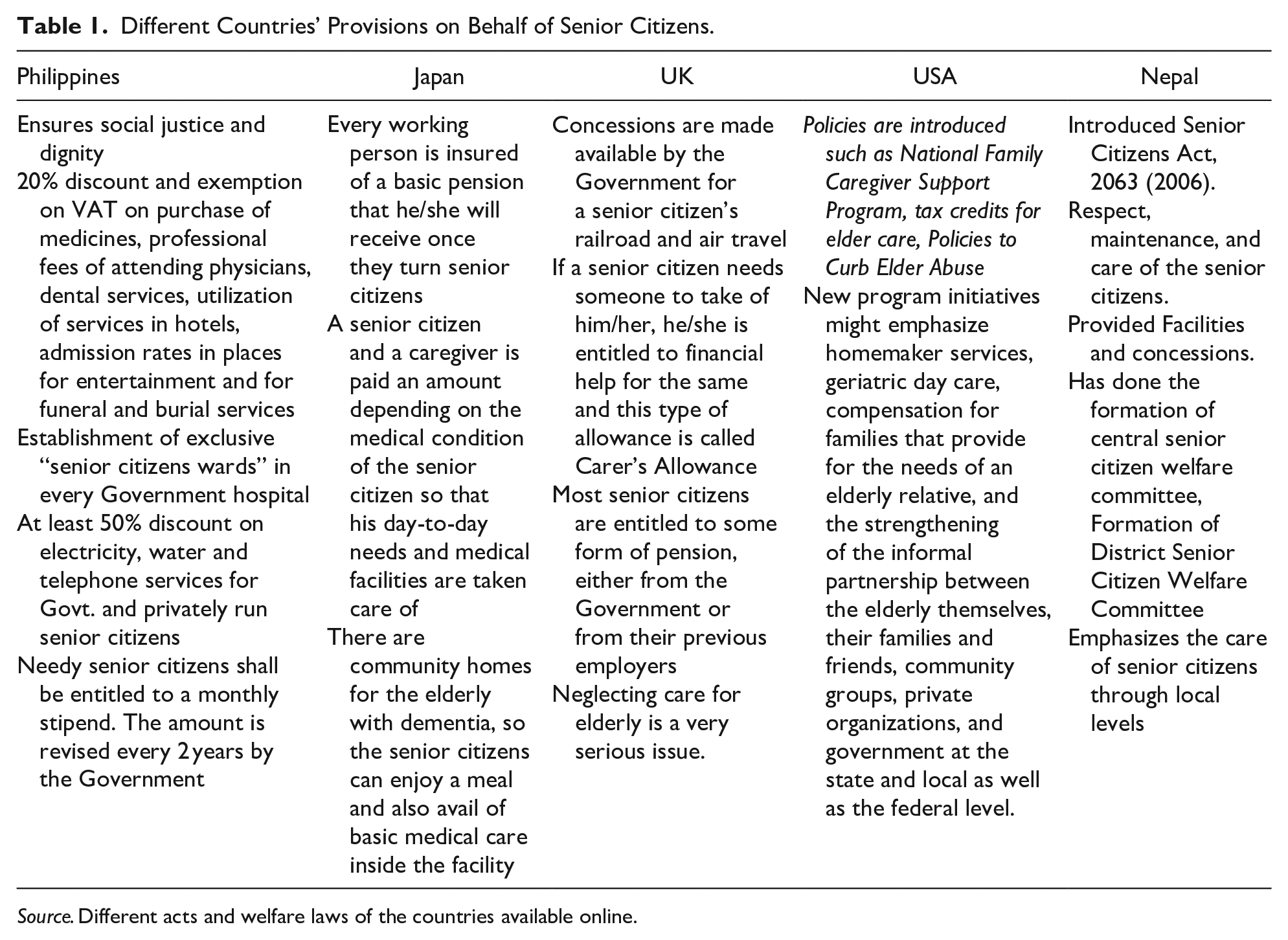
Source. Different acts and welfare laws of the countries available online.
Table 1 shows that there is not much variation between the different acts and welfare laws for senior citizens in various countries. They share many common welfare ideas, such as providing discounts and concessions, compensation, monthly stipends, allowances, financial aid, and prioritizing the elderly. Despite this, the condition of senior citizens in Nepal appears to be worse than in other countries. The experiences shared by senior citizens in research articles or books and on social media reflect the gap between welfare policies and their effective implementation. The policies do not seem to effectively address the conditions of senior citizens, which in turn affects the nation’s development. There is still a gap between what the policies emphasize and what senior citizens need. The policies fail to directly intervene or improve the conditions of the elderly, and do not consider the lack of caregivers in families.
Data Collection Methods
In this study, the researchers used a mixed-methods approach, incorporating both primary and secondary sources (Creswell, 2007). The primary data was collected through an informal survey posted on Facebook, accompanied by a link to a Google Survey form, targeting senior citizens in Nepal. The survey questions were in the form of options or open-ended questions, and respondents were invited to participate voluntarily without disclosing their names or identity. Some respondents could also freely drop their comments on the comment box based on the questions publicly asked. The survey generated 100 responses from senior citizens aged 65 years or older within a 2-week period. The secondary data was collected through a review of existing literature on aging issues in Nepal, including policy documents and research articles. Overall, this mixed-methods approach allowed for a comprehensive understanding of the challenges faced by senior citizens in Nepal and provided valuable insights into how policymakers can improve their quality of life and well-being.
Limitations
The use of social media as a data collection tool has some limitations, such as reaching remote areas and those without access to social media. However, this study exhibits several strengths in its data collection approach. Firstly, it incorporates a diverse range of secondary sources, enabling a comprehensive understanding of aging issues in Nepal. The inclusion of peer-reviewed journal articles ensures a reliance on high-quality research to inform the study’s findings. Additionally, the utilization of government documents and policies provides valuable insights into existing policies pertaining to aging in Nepal. The study is likely to generate valuable information through informal means, such as an online survey posted on Facebook, which allow for the inclusion of diverse perspectives from senior citizens in Nepal. The data may provide valuable insights into the challenges faced by senior citizens in Nepal and highlight the need for policies and programs that prioritize their unique needs. However, it is important to acknowledge the limitations of the study as weaknesses. One weakness lies in the reliance on secondary sources, which may restrict the depth and accuracy of the findings when compared to primary data collection methods. Primary data collection methods the researchers used for this paper allow for voluntary responses from individuals who are specifically targeted for their input. The data rely on individuals’ willingness to engage and their accessibility to platforms like Facebook, thus potentially excluding certain segments of the population or those with limited media literacy. Similarly, the sample size for the primary data collection method (100 responses) may not be representative of all senior citizens in Nepal. These limitations should be considered when interpreting the study’s results.
Data Analysis
The collected data has been analyzed using Narrative method and categorizing and coding the data under emerging themes, and the data was analyzed interpretatively (Creswell, 2007; Czarniawska, 2004). The narrative method is important in qualitative research. Narrative analysis helps find the implicit in the narrative voices that helps expose alternative narratives that are useful in policymaking. This creates a situation in which the meaning is made through binary opposition (Feldman et al., 2004; Miller, 2012). For example, in narratives of senior citizens, one can create an alternative meaning of what it feels like to be a senior citizen from not being a senior citizen. It is a tool through which meaning is made through the practice of binary opposition. In this context, Abel and Sementelli (2005) explained, “All definitions are socially constructed, and reconstructed on a continuing basis, and variation in the meaning or the extension of a concept is a function of alternative evaluative perspectives. . .” (p. 16).
Examining cultural and social biases and oppressive power relationships, for example between senior citizens and non- senior citizen adults, makes it possible to see underlying problems that policies for senior citizen may fail to show. Thus, narrative analysis is crucial to better understand the senior citizens, their problems and guide policymaking. Narrative analysis helps to identify alternatives by discovering any gaps or mismatches between policy and lived experience (Acharya, 2019). Narrative method values personal stories and enables marginalized voices to be considered in policymaking. It is the reason why this study used narrative method to explore senior citizens’ narratives, entering their personal shared autobiographical and other lived experiences.
Narrative accounts of the senior citizen’s life events feature emotions and authenticity that cannot be understood until they are shared. The richness of these emotions and the depth of authenticity are achieved through the acknowledgment of the narratives of the senior citizens by reaching out to the essence of their truthful lives. The story the senior citizens share serve a purpose that a quantitative analysis fails to fulfill, especially in understanding the experience of them and its stereotypes (Carbado et al., 2003). Narratives stress the specificity of experience of a story to convey its verisimilitude (Bruner, 1991).
Data Analysis: Policy Fails to Understand and Know Senior Citizens
The majority (90%) of the participants fell within the age range of 65 to 79, with a higher proportion of female respondents compared to males. These findings indicate that individuals above the age of 79 were relatively scarce in the sample, possibly due to factors such as mortality, illness, or their inability to participate in the survey. By thoroughly examining the responses provided by the participants, it becomes possible to classify and analyze the data based on various themes and categories below (Table 2).
Themes and Explanation.

Based on the survey responses, it is evident that senior citizens who migrated from hilly to Terai regions have experienced changes in their living conditions and family dynamics. The traditional notion of a big family with the presence of a son to look after their parents is declining due to socio-economic, digital, and modernization factors. This change in family structure has led to altered living arrangements, role and status redefinition, a redistribution of work among family and household members, changes in younger generations’ behavior and attitude toward older people, and a decrease in intergenerational care and support (Speck, 2017). These changes have negatively impacted older people, who are experiencing a phase of transition where state provisions remain limited, and family support is decreasing and no longer reliable.
Many respondents cited geographical and financial constraints as factors that limited their educational opportunities. One respondent noted that “house chores were more important than going to school. On top of that, we had to walk many hours to get to the schools. We didn’t have easy access to schools and other facilities like you have these days.” As a result, many of the surveyed senior citizens ended up working as housewives (if female) or farmers (if male). This shift in priorities has had a lasting impact on their career and life opportunities.
Due to the lack of medical and transportation facilities in the past, the senior citizens had limited opportunities to explore places beyond religious sites. Their childhood memories are filled with playing games such as Danidibiyos and other leisure activities. The absence of educational and career opportunities meant they had little to no focus on their own future prospects. Currently, their only source of income is from a handful of respondents who receive retirement payments from their previous jobs. The majority of the seniors are financially dependent on others since they lack retirement funding and savings in their accounts. They hesitate to frequently seek financial assistance from others, leading to a decline in their quality of life (Risal et al., 2020).
In our times, we didn’t have movies, nor were the facilities of transportation, nor were we allowed to those activities outside house chores. Now even if I am old, I would like to go see, visit those places, but I cannot see properly, nor do I know how to make there. Who will take me there? My son is abroad for employment. I don’t have anyone here even to take me to the hospital if something happens to me. Sometimes, I feel very bored and lonely when I have to spend time at home on my own.
These challenges can make it difficult for seniors to maintain their quality of life and well-being. Therefore, it is important to provide support and care for the elderly, not just financially but also emotionally and socially.
Overall, senior citizens have mixed feelings about their current situation. While they value their children’s presence and companionship, they also face challenges such as loneliness, health problems, and financial difficulties. The society’s preference for sons as the primary caregivers for aging parents has also had an impact on the elderly’s well-being, with daughters often feeling excluded from the family’s caregiving responsibilities. Nonetheless, the senior citizens urge younger generations to prioritize family values and respect for cultural traditions while embracing modernity and pursuing personal success.
Concluding the Themes: Key Findings
The research reveals several significant discoveries concerning the obstacles confronted by older adults in Nepal, encompassing social isolation, limited healthcare accessibility, and financial insecurity. These findings, to a certain degree, align with previous evidence from other countries, which have also underscored analogous challenges experienced by elderly populations. Nevertheless, it is crucial to acknowledge that these findings are contextualized within the cultural milieu of Nepal. Inconsistent studies on aging issues in Nepal exist due to the limited extent of research conducted on this subject. Consequently, the study underscores the necessity for further qualitative research to attain a more profound comprehension of the experiences of senior citizens in Nepal and to guide the formulation of policies addressing aging concerns.
From the insights provided in the previous explanation, it can be deduced that certain aspects need to be taken into account while reflecting on senior citizens and their quality of life. One such factor is the existence of gaps between the welfare policies implemented for senior citizens and their actual needs as highlighted by their experiences and narratives.
Furthermore, it is important to acknowledge the significance of family support, especially from children, in promoting the happiness and satisfaction of senior citizens. This support may not always come from the traditional notion of sons being the sole caregivers, as evidenced by the respondents’ preference for daughters’ company. This preference may stem from various reasons such as sons living abroad, considering their parents as a burden, or daughters being more compassionate and closer to their parents.
Finally, it is essential to recognize the significance of culture, socialization, and community involvement in the well-being of senior citizens. The loss of these aspects, due to the adoption of foreign cultures and changing societal norms, can negatively impact their happiness and satisfaction. It is, therefore, important to encourage the younger generation to respect and preserve their culture, be compassionate toward elders, and contribute to society’s development for the betterment of everyone. Overall, while there may be some inconsistent studies related to aging issues in Nepal due to limited research on this topic, this study provides valuable insights into how policymakers can improve the quality of life and well-being of senior citizens in Nepal by addressing their unique needs through targeted policies and programs.
Policy Gaps and Policy Recommendations
After analyzing the data and narratives provided by senior citizens and revisiting the themes and categories mentioned earlier, it is evident that a policy gap exists between what the Senior Citizens Acts, 2063 (2006) states and what the senior citizens actually require. Although the act is designed to address the needs of senior citizens, it is crucial to understand and learn from them to bridge this gap effectively. The following table provides an overview of the gap and offers policy recommendations and takeaways.
Table 3 reveals a gap between what the Senior Citizen Act, 2063 emphasizes and recommends, and what senior citizens are looking for. While the act addresses some of the concerns related to senior citizens, it fails to address the underlying problems and concerns they face. Therefore, the responses and narratives of senior citizens require additional policy recommendations to improve their quality of life, in addition to those already in place:
Ensure the presence of a trained caretaker, adult helper, or paid parent sitter in the family, at least part-time, to ensure that senior citizens consume a balanced diet, spend time with people, go out, and take their medication on time.
Ensure that senior citizens are not left behind and do not have to fend for themselves. This could be achieved by establishing senior citizen centers where they can socialize for an hour or two each week or daily. The government should prioritize the safety and well-being of senior citizens over money, as money alone cannot buy their quality of life.
Ensure that no senior citizen ends up on the street or feels depressed and lonely in their own home. A new program should be introduced to visit the homes of senior citizens, supervise their care, and establish enough care and nursing homes where they can find a home.
Communicate with senior citizens, study the culture they lived in, learn and unlearn from them, and help them be mentors to younger generations. Teach how the culture they lived in can help be a better citizen.
Introduce a policy that both sons and daughters feel equally responsible for looking after their elderly parents. Raising awareness can help cultivate a sense of caring and responsibility in all young people to respect and care for senior citizens.
Senior Citizens Act Versus Narratives of Senior Citizens.

Recommendations for Future Research
Based on the existing research on senior citizens and the myriad of social, cultural, psychological, and physical issues they encounter, there is a compelling need for extensive future research to gain a deeper understanding of their conditions and effectively address their situations. The following are potential areas for future research:
Conduct more research on the views of senior citizens in Nepal with regards to contemporary challenges and aging issues.
Explore the experiences of senior citizens in remote areas of Nepal, as well as those who do not have access to social media.
Investigate the effectiveness of existing policies related to senior citizens in Nepal, and identify areas where improvements can be made.
Conduct more qualitative research to gain a deeper understanding of the experiences and perspectives of senior citizens in Nepal.
Continue to research on the healthcare, quality of life, well-being, and social support of senior citizens.
Clinical Implications for Health Managers and Policymakers
Based on the research findings on the healthcare, quality of life, well-being, and social support of senior citizens have important clinical implications for health managers and policymakers. Some potential implications include:
Develop policies that prioritize the needs of senior citizens in Nepal, including their physical and psychological health, family relations, and financial independence.
Increase access to healthcare services for senior citizens, particularly those living in remote areas.
Provide training programs for healthcare providers on how to effectively care for elderly patients.
Increase public awareness about the challenges faced by senior citizens in Nepal, and promote intergenerational dialog to foster greater understanding between different age groups.
Conclusion
With increasing life expectancy and younger populations abroad for education and employment, the senior citizen population in Nepal is on the rise. However, this demographic shift has also brought to light several challenges faced by senior citizens in Nepal, including social isolation, lack of access to healthcare services, and financial insecurity. The introduction of Citizen Act 2006 aimed to address the needs of senior citizens; however, a policy gap remains between government action and senior citizens’ narratives. It is clear from the study that, it is the need of the hour to understand and acknowledge the experiences and perspectives of senior citizens in Nepal to inform policies related to aging issues. The findings suggest that there is a significant need for policies and programs that prioritize the needs of senior citizens in Nepal, including their physical and psychological health, family relations, and financial independence. Health managers and policymakers can use these findings to develop policies that increase access to healthcare services for senior citizens living in remote areas, provide training programs for healthcare providers on how to effectively care for elderly patients, and increase public awareness about aging issues. Overall, this study provides valuable insights into how policymakers can improve the quality of life and well-being of senior citizens in Nepal by addressing their unique needs through targeted policies and programs. In a nutshell, emphasizing the importance of understanding the experiences and perspectives of senior citizens in Nepal to inform policies related to aging issues, the findings have explored a significant policy gap between government action and senior citizens’ narratives. Health managers and policymakers can use these findings to develop policies that increase access to healthcare services for senior citizens living in remote areas, provide training programs for healthcare providers on how to effectively care for elderly patients, and increase public awareness about aging issues.
Footnotes
Declaration of Conflicting Interests
The author(s) declared no potential conflicts of interest with respect to the research, authorship, and/or publication of this article.
Funding
The author(s) received no financial support for the research, authorship, and/or publication of this article.
