




Abstract
Aging in place with a suitable living environment is essential for the health and well-being of older adults. However, the willingness of older people to modify their housing to meet their needs is not strong. Using the Analytic Network Process (ANP) method, the study first explores the weights of factors, such as perceived behavioral control, policies, and market conditions that influence older adults’ behavioral intention. Then, a structural equation modeling (SEM) approach was used to dissect the psychological factors which account for the largest proportion. Using data from 560 people aged 70 or older from Beijing, results suggest that effectiveness perception, cost perception, and subjective norms can influence older people’s behavioral intention directly or indirectly through emotional attitudes. Risk perception can moderate the level of behavioral intention triggered by cost perceptions. This study provides new evidence for the impact of factors and interaction mechanism on older adults’ behavioral intentions toward age-friendly home modifications.
Keywords
Introduction
The world is entering a hyper-aging society at an unprecedented rate. Relatedly, the current global age-friendly movement supports older adults by promoting different policies and services (Bhattacharyya et al., 2022). Aging in place is a commonly desired lifestyle for older adults (Morton-Chang et al., 2021). Good living environments with functional designs that are safe and accessible help older adults live independently (J. A. Park & Choi, 2021), improve their well-being (S. Park & Lee, 2017), and reduce their levels of depression (S. Park et al., 2018).
The fourth sample survey on the living conditions of urban and rural older adults in China showed that 58.7% of them had unsuitable housing conditions (National Health and Family Planning Commission, 2015). Researches also revealed that more than 40 million older Chinese people have at least one fall every year (Wang, 2020), 56.41% of which occur at home (Lu et al., 2021). The age-friendly housing modification means changing the objective environment of houses that are unsuitable for older people and equipped with assistive devices (Braubach & Power, 2011). In practice, however, socioeconomic factors, older adults’ characteristics, psychological perceptions, and emotions may have different effects on behavioral intentions for home modification. Meanwhile, government funding has a direct impact on the implementation of retrofitting measures (Lim & Lee, 2010). Older adults’ physical functions may weaken with age and fall when moving around in bathrooms and toilets (Bjornsdottir, 2018), so they often want to improve lighting conditions, install grab bars, etc. (Jacobs et al., 2014). Moreover, older people who live alone have a stronger desire to improve their living environment than those with children (Löfqvist et al., 2016). However, older adults are often unable to afford the cost of modifications (Szander et al., 2017).
Existing research has explored the benefits of home modifications and the factors that influence older adults’ behavioral intentions. However, the extent to which social, policy, market, and technological environmental factors influence behavioral intentions remains a research gap. In addition, few studies have comprehensively assessed the impact of psychological factors of older adults, focusing not only on attitudes but also on broader perceptual factors (perceived effectiveness, perceived cost, and perceived risk) and subjective norms. This paper discusses the impact of these factors and explores the interaction mechanisms.
Theoretical Perspective
This study was based on the Theory of Planned Behavior (TPB; Ajzen, 1991), which lays the general conceptual foundation for individual intention and health-related behaviors (Tyson et al., 2014). The components of the theory are behavioral intention, affective attitude, subjective norms, and perceived behavioral control (Ajzen & Fishbein, 1980, p. 278). The theory has been widely used to explain the factors that influence people’s willingness to adopt a behavior (Mancha & Yoder, 2015; Morren & Grinstein, 2016). However, few studies have employed the theory in examining the relationship between older adults’ motivation and modification behaviors in China despite the issue of aging-friendly housing retrofit. Using the positive psychology perspective (Seligman, 2019) and the person-environment fit perspective (Edwards & Shipp, 2007), this study emphasizes not only the psychological factors of older adults but also the sociocultural environment, such as politics, economics, and technology, empirically explores the weight of these factors in older adults’ willingness to modify their homes.
Evidence supports the notion that effectiveness and cost perception (Hoof et al., 2017) directly influence older people’s behavioral intention to modify houses. In addition, fall prevention is a common concern among older adults as a psychological response to potential risks (J. E. Lee & Lemyre, 2009). Subjective norms are the most important factors in behavioral intention (Ajzen, 1988, p. 118). The bulk of the empirical evidence supports the notion that the affordability of housing is an important factor that influences older people’s behavioral intentions (Kim & Lee, 2020; Pynoos & Nishita, 2006). Meanwhile, the subjective norms are the perceived support and approval of the family, relatives, and friends for the adoption of a particular behavior (Eastin et al., 2015), which also plays a pivotal role in the intention of the individual’s behavior (Padilla-Bautista et al., 2022). Based on previous work, the following research hypotheses are proposed.
Hypothesis 1-1: Effectiveness perception positively influences the behavioral intention of aging-friendly housing modifications for older people.
Hypothesis 1-2: Cost perception negatively influences the behavioral intention of age-friendly housing modifications for older people.
Hypothesis 1-3: Subjective norms positively influence the behavioral intention of age-friendly housing modifications for older people.
Emotional attitudes are the result of an overall evaluation of behavior (Ajzen & Fishbein, 1980). Research has shown that attitudes influence the behavioral intentions of older adults (Gamel et al., 2016). Effectiveness perception, cost perception, and subjective norms play a key role in the attitude of older people. Typically, when the perception and subjective norms are stronger, the attitude of older people toward home modifications is stronger. Studies have also found that older adults who are knowledgeable about the effects and costs of modifications have more positive attitudes and stronger behavioral intentions for modifications (Narushima & Kawabata, 2020). The evidence leads us to propose the following hypotheses.
Hypothesis 2-1: Emotional attitude positively influences behavioral intention.
Hypothesis 2-2: Emotional attitude mediates the relationship between effectiveness perception and behavioral intention.
Hypothesis 2-3: Emotional attitude mediates the relationship between cost perception and behavioral intention.
Hypothesis 2-4: Emotional attitude mediates the relationship between subjective norms and behavioral intention.
Studies have shown that older adults generally ignore or underestimate their risk of falls (Kruse et al., 2010). Typically, the poorer the health status of older adults, the more pronounced their perception of fall risk (Han, 2020). Older adults who have experienced falls are more sensitive to the perceived risk of experiencing falls (Chen et al., 2021). Thus, older individuals with high-risk perceptions are more likely to associate their safety with behavioral intentions for home modification. Therefore, we propose the following hypothesis.
Hypothesis 3-1: The relationship between effectiveness perception and emotional attitude is moderated by risk perception such that the relationship is stronger when risk perception is higher but is weakened when risk perception is lower.
Hypothesis 3-2: The relationship between cost perception and emotional attitude is moderated by the risk perception such that the relationship is stronger when the risk perception is higher but is weakened when the risk perception is lower.
Hypothesis 3-3: The relationship between subjective norms and emotional attitude is moderated by the risk perception such that the relationship is stronger when the risk perception is higher but is weakened when the risk perception is lower.
The framework of the study is shown in Figure 1.

Conceptual model.
Methods
Sample and Data Collection
To analyze the factors influencing the age-friendly modifications of older people’s housing and its proportion, we interviewed scholars from five Chinese universities and geriatric research institutes. 1 Through discussions at the Tencent conferences, we finally established a system of indicators that influence the willingness of older people to modify their houses.
To grasp a more extended explanation of the psychological factors such as perceptions, subjective norms, and attitudes that influence the behavioral intentions of older adults in home modifications, a convenience sampling method was used to select questionnaires from older adults over 70 years of age with normal communication skills and autonomous behaviors
Measures
The Influencing Factors and Their Weights
The study was based on a study by Lord et al. (2001, p. 146) and examined 16 modifications such as non-slip shoes/mats, fall alarms, changing electrical wiring, lowering or eliminating step thresholds, replacing pit toilets with bidets, and installing grab bars. In addition, an evaluation system is constructed from four levels: perceived behavioral control, social norms and pressure, policy, market, and technological environment of older adults, which are decomposed into specific indicators one by one to quantify the weights of each factor.
The Psychological Factors and Their Interaction Mechanisms
The measure of behavioral intention consists of three items. The risk perception measure is based on Shiloh and Ilan (2005) and Kahlor et al. (2003) and also consists of three items. Drawing on Eastin’s et al. (2015) approach, subjective norms measure consists of four items. Emotional attitude is mainly from the study of Stevens et al. (2017), which consists of three items. Cost perception and effectiveness perception were drawn from Ryu and Kim’s (2015) study and were based on actual interviews, each consisting of three question items. All items were scored on a 5-point or 7-point Likert scale. The internal consistency of all six latent variables was acceptable, and the Cronbach’s α was .976, .859, .898, .906, .932, and .955, respectively.
Meanwhile, we treated age (70–94 years old), gender (1 = male and 0 = female), marriage (1 = unmarried, 2 = married, 3 = divorced/cohabiting, and 4 = widowed), education (1–6 respectively represents illiteracy to master’s degree and above), dysfunction (0 = none and 2 = yes), and floors (1st to 28th floors) as control variables.
Statistical Analysis
We used the Analytic Network Process (ANP) method to analyze the influencing factors and their weights for age-friendly home modifications. It is a decision-making method based on an analytic hierarchy process that considers the elements within a system interacting with each other and aims to deal with nonlinear problems in complex systems (Saaty, 2008). And the weights of these factors were calculated using Super Decision (SD) software.
Meanwhile, we used Structural Equation Modeling (SEM) to analyze the psychological factors that influence old adults’ behavioral intention. SEM is a multivariate statistical technique that incorporates factor analysis and path analysis, its strength lies in the quantitative study of the interaction between multiple variables (Cheung & Chow, 2011). The method is particularly suitable for dealing with latent variables in the psychological sciences, and thus is widely used in the social and behavioral sciences (Xiong et al., 2015). The SPSS 24.0 and AMOS 24.0 software were used to examine the relationships between the six latent variables (Kline, 2011). Additionally, a confirmatory factor analysis with a maximum likelihood estimation was used to test the measurement model and the construct validity.
After the missing values were treated in a fill-in method, an independent samples t-test was performed. In addition, Harman’s one-way test showed that the largest factor accounted for 16.25% of the total variance, which was below the critical criterion of 40%, indicating that there was no common method variance problem in the study. A validation factor analysis found χ2/df = 2.232, RMSEA = 0.047, RFI = 0.962, CFI = 0.983, IFI = 0.983, TLI = 0.979, and NFI = 0.970, which suggest a good match between the model and the scale data (Kline, 2011).
Results
As can be seen from Table 1, the coefficient weight of the perceived behavioral control factor is the largest, indicating that psychological factors play the most significant role in the behavioral intentions of older adults. The variable with the second highest coefficient weight is subjective norms. The third most important factor is the market and technical environment, in which older adults are particularly interested in the quality and effectiveness of the modifications. The fourth-ranked important factor is the policy environment, in which financial subsidies and support are of greater concern to older adults.
Factors and Weights Influencing Older Aadults’ Behavioral Intention.

Table 2 presents the reliabilities, validities, and correlations of the six latent variables. Composite reliability (CR) indicated that the reliability of the six constructs was good (>.7), the average variance extracted (AVE) of all the variables was acceptable (>.5), the square root of the AVE for each construct was greater than the correlation coefficient between the constructs. This indicates that the scale has good reliability and validity.
Reliabilities, Validities, and Intercorrelations.
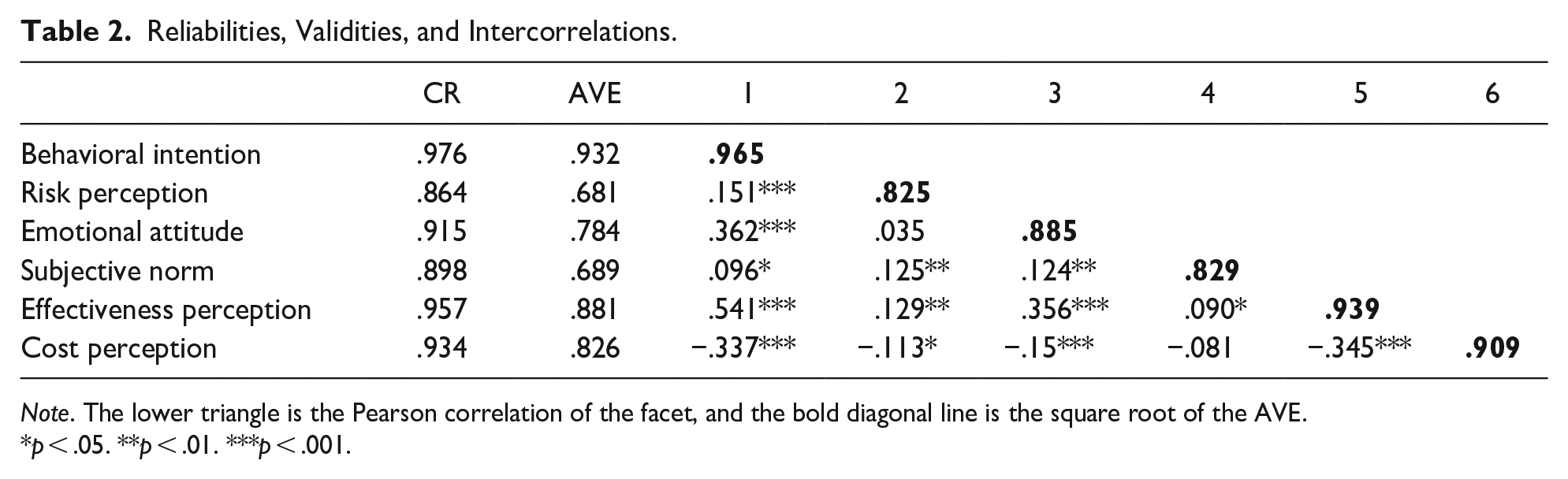
Note. The lower triangle is the Pearson correlation of the facet, and the bold diagonal line is the square root of the AVE.
p < .05. **p < .01. ***p < .001.
With the inclusion of control variables, we adopted the study by Hayes and Andrew (2018, p. 141) and used SPSS macros (PROCESS macro program, model 4) for the analysis, using the 95% confidence interval and a bootstrap sample of 5,000 to test for mediating effects of attitudes. The results are shown in Table 3.
Mediating Effect of Emotional Attitude.

p < .05. **p < .01. ***p < .001.
The effectiveness perception and cost perception was a significant predictor of behavioral intention (p < .001), and when the mediating variable was included, the direct predictive effect on behavioral intention remained significant (p < .001), indicating that emotional attitude played a partially mediating role. The predictive effect of subjective norm on the behavioral intention was significant (p < .05), and when the mediating variable was included, the direct predictive effect on behavioral intention was no longer significant (p > .01), indicating that emotional attitude played a fully mediating role. Table 4 shows the proportion of the mediation effect. Therefore, Hypotheses H1-1, H1-2, H1-3, H2-1, H2-2, and H2-3 are verified.
Decomposition Table of Mediation Effect.

Note. BI = behavioral intention; EP = effectiveness perception; CP = cost perception; SN = subjective norm; EA = emotional attitude.
In the analysis of moderating effects, PROCESS (model 7) was used to test the moderating effect of risk perception based on the inclusion of control variables. To avoid confusion about the sign of the product term of the moderating effect by the negative sign in the cost-effective, the three question items of the cost perception dimension were reverse scored and put into the model for validation. According to Wen and Ye (2014), when the first half of the mediated path is moderated by a moderating variable, this mediating effect can also be moderated. The results showed that risk perception moderated the predictive effect of cost perception on behavioral intention (p < .05; see Table 5).
The Moderated Mediation Effect of Behavioral Intention and Emotional Attitude.
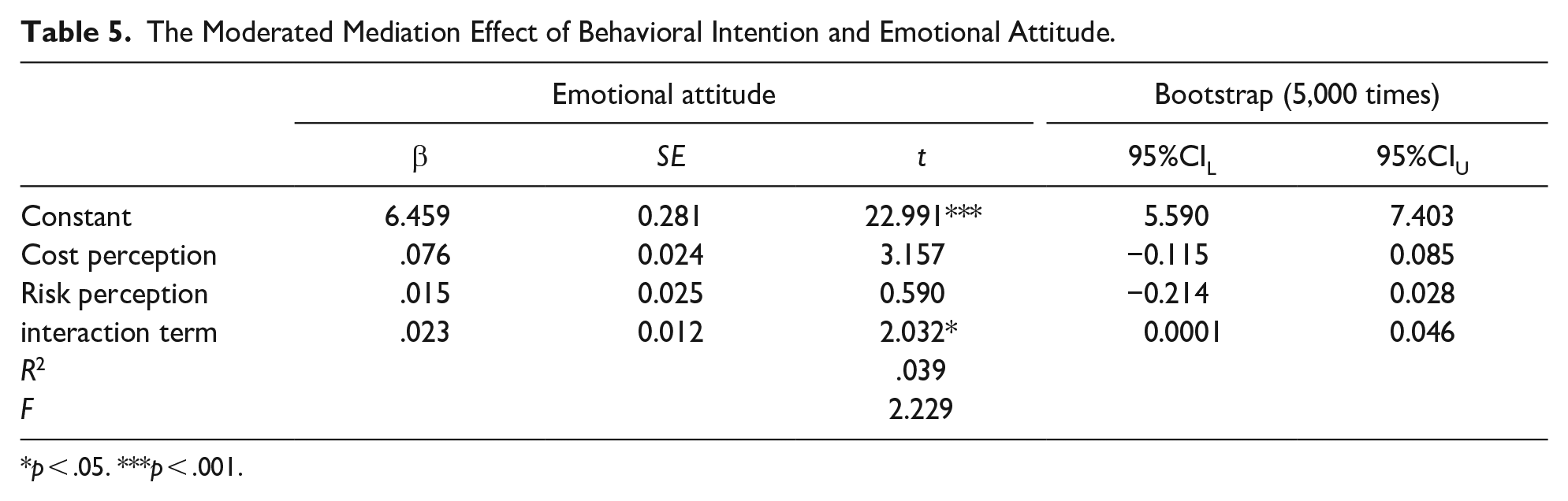
p < .05. ***p < .001.
A simple slope analysis shows that for older people with a low-risk perception level (M−1SD), the effect of the cost perception on emotional attitude is not significant. For older people with a high-risk perception level (M+1SD), the cost effect has a predictive effect on behavioral intention, implying a moderating effect between cost perception and behavioral intention. The slope of the high grouping became larger, which suggests its reinforcing effect. Moreover, the Johnson-Neyman plot shows that the effect of the cost perception on emotional attitude is significant when the threshold value of the moderating variable risk perception is greater than 2.929. Namely, when 2.929 < the risk perception < 7, it can moderate the relationship between the cost perception and emotional attitude toward age-friendly home modifications for older adults (see Figure 2). Finally, using effectiveness perception and subjective norm as independent variables, the moderating effect of the risk perception was found to be insignificant. Therefore, only Hypothesis H3-2 was verified in the moderating effect.

The moderating role of risk perception in cost perception and emotional attitude.
Discussion
In China, against the background of accelerated population aging and rapid economic and social transformation, many old houses in urban and rural areas have not yet installed elevators or set up barrier-free ramps, which brings great difficulties to older people in their daily lives. To promote aging-friendly retrofitting, it is very important to understand the will of old adults first. Understanding the predictors of old adults’ intention to modify their houses is an imperative scientific pursuit. Through expert interview methods as well as empirical analysis based on questionnaires, the study explores the factors that influence older adults to engage in home modifications and provides statistical evidence for these relationships. The findings corroborate the idea that older adults’ psychological perceptions influence their choice of housing modifications (Sakellariou, 2015). More precisely, results illustrate that effectiveness perception, cost perception, and subjective norm may influence older people’s behavioral intention either directly or indirectly through emotional attitude, while risk perception may effectively moderate the level of the behavioral intention triggered by cost perception, thus promoting older people’s housing modification intention. Admittedly, socioeconomic factors and individual characteristics also influence older adults’ behavioral intention by affecting psychological factors. As research has shown, the type of city, services, and infrastructure, as well as the neighborhood and surrounding environment, may influence older adults’ perceived behavioral control of housing conditions (Joint Center for Housing Studies of Harvard University, 2018).
Moreover, the study finds that older people’s attitude has a greater impact on home modification intention, both as a mediating variable and a variable moderated by risk perception. Therefore, attention should be paid to the attitudes of older adults and their intrinsic needs. A more interesting finding is that emotional attitudes fully mediated the effect of subjective norms on behavioral intentions, suggesting that the impact of home modification by older adults in this pathway works exclusively through the mediating variable of emotional attitudes. Namely, older adults with strong attitudes toward their home modifications will mask the impact of perceived social pressures. Economic status also affects older adults’ emotional attitudes toward home modifications, with those who can afford it willing to pay more for home modifications. A study from South Korea found that older respondents were willing to pay a higher price for accessible housing (S. Y. Lee & Yoo, 2020). Another survey of households in Barcelona and Madrid found that older individuals were willing to pay an additional 12.5% for accessible housing on average (Fernando, 2002). Research has also shown that there are significant racial and ethnic differences in the affordability of home modification cost burdens for older adults (Prunhuber & Vivian, 2021).
It is important to note that the attitudes of older adults’ housing modifications are influenced by multiple factors. For example, emotional attachment and spatial identity resulting from long-term residence may make older adults reluctant to modify their homes (Ottoni et al., 2016). The characteristics of the original home environment can evoke memories of the emotions of the past life of older people. Therefore, in the process of promoting age-friendly modification, we should pay particular attention to the role of the attitudes of old adults. In other words, designing a home environment suitable for older adults based on a deep understanding and respect for their original living space and object layout (Talamo et al., 2017), and taking into account the intricacies of physical, mental, social, and economic aspects (Druta et al., 2021).
The current analysis further informs that the attitude of old adults, particularly upper-aged, living alone, and weakened toward housing modification must be considered a high priority. Research has shown that older adults over 80 are generally less willing to modify their homes because they have less control over their lives and lower life expectations (Wu et al., 2017). Older adults may demonstrate a collective silence that will discourage housing modification behaviors from occurring. A study from Canada found that although older women have become less mobile with time and physical aging, they will largely maintain collective silence of their needs in terms of coping strategies and resources to change their living environment (Narushima & Kawabata, 2020). On this occasion, they often overcome the environmental obstacles they face through their psychological adjustment (van Kessel, 2013), and even very frail older adults are mentally resilient (Peace et al., 2011).
Results find that older people who live independently and are in poor health tend to accept age-friendly modifications, which corroborated with the study showing that people with a higher risk perception tend to have higher demands for home modifications (Matthew-Maich et al., 2016), and their cost perception has a greater impact on emotional attitude. This is because older adults in poorer health are usually also those of lower financial resources and therefore less willing to waste money by modifying their homes. In the future, there is a need to educate older adults with lower levels of risk perception about safety and increase their awareness of self-protection and risk prevention.
This study has some implications for understanding the psychological aspirations of older adults in the context of age-friendly housing modifications. It draws on the TPB to illustrate the issue of willingness to implement age-friendly modifications from the positive psychology and person-environment fit perspectives, as well as to explain the mechanisms of influence. Research shows that the inner demands of older adults are a critical point in age-friendly housing modification behaviors. Cost-utility pressures and subjective norms can lead to changes in older adults’ attitudes, which can influence their behavioral intentions. In the context of smart aging and technology for old age in China, the findings of this paper may stimulate relevant government departments to pay more attention to the individual micro-psychological characteristics of older people when promoting age-friendly services. Meanwhile, it is necessary to communicate effectively with older people and consider their preferences and requirements before undertaking aging modifications (Leith, 2016). Furthermore, it is essential to recognize that the technical aspects of housing cannot replace care services and that humanistic care and attention should not be neglected in the process of age-friendly housing modifications.
The current study also possesses a few limitations. First, the subjective nature of model construction may lead to cases of omitted variables. Second, we use cross-sectional data and may ignore the effects of time factors and changes in physical status on the behavioral intentions of older adults. Third, our sample consisted exclusively of older adults in urban China, and the current findings may not be generalizable to rural older adults due to differences in economic conditions and literacy levels. In the future, the sample data should also be tracked and observed to systematically compare the differences in older adults’ decision-making intentions before and after housing modifications. Meanwhile, panel data from different cultural backgrounds should be collected for comparative studies. Improve the measurement methods, refine the model design, and explore the multiple mechanisms that influence older adults’ behavioral intentions.
Conclusion
The paper explores the weights of factors influencing the willingness of older adults to modify their age-friendly homes in terms of policy, market, technical environment, and individual psychological aspects of older adults. The influence effects and interaction mechanisms were explored using structural equations for the micro-psychological factors such as perceptions and emotional attitudes of the elderly, which accounted for the largest proportion. Research shows that cost-utility perceptions, as well as subjective norms, have a significant direct effect on behavioral intentions, while also being able to indirectly predict behavioral intentions through the affective attitudes of older adults. In addition, risk perception moderates the relationship between cost perception and the attitudes. These findings inspire researchers and the social care system to pay more attention to the influence of psychological state and the inner aspirations of older people in promoting age-friendly modification.
Footnotes
Acknowledgements
We appreciate help from members of the Zhang laboratory for comments during preparation the manuscript.
Author Contributions
All authors contributed to the conception and design of this work, the acquisition, analysis and interpretation of the data, and the drafting and revising of the article critically for intellectual content. All the authors approved the version to be published.
Declaration of Conflicting Interests
The author(s) declared no potential conflicts of interest with respect to the research, authorship, and/or publication of this article.
Funding
The author(s) disclosed receipt of the following financial support for the research, authorship, and/or publication of this article: This research was funded by The Decision-making consulting project of the Beijing Social Science Foundation (Project No. 21JCC101), The 70th batch of general programs of the China Postdoctoral Science Foundation (Project No. 2021M700461) and National Social Science Foundation of China: Research on the Distributional Effects of New Rural Collective Economy and its Regulation in the Context of Solidly Promoting Common Wealth (Project No. 22BJY231)
Ethical Approval
Ethical approval was obtained for this research from the Research Ethics Committee, School of Social Development and Public Policy, Beijing Normal University (reference number SSDPP-HSC2017003).

Data Availability Statement
The data that support the findings of this study are available from the corresponding author, Huan Zhang (
Materials Availability Statement
Materials utilized this study may be available upon reasonable request.