




Abstract
Currently, measures of quality of life used with older people with dementia (PWD) are mainly health related. Health is not an actual attribute of but a means to attain quality of life. The Investigating Choice Experiments for the Preferences of Older People - CAPability index (ICECAP-O) measures attributes of quality of life. While its construct validity has been tested with PWD, no study has yet published data on the reliability of this scale used directly with PWD. In this study, we tested the external (test-retest) reliability of the ICECAP-O with 54 community-dwelling older PWD from the south of England. The ICECAP-O had acceptable test-retest reliability (r = .68, p < .01 and r = .56, p < .01 for raw and tariff scores, respectively). This suggests that the ICECAP-O is both a reliable and valid measure of quality of life for use directly with community-dwelling PWD.
Introduction
There is general agreement that quality of life (QoL) is a multidimensional construct that includes psychological, emotional, physical and social components of wellbeing (Allen et al., 2013). However, QoL scales specifically for people with dementia (PWD) are either designed for health-related QoL (e.g. Dementia Quality of Life (DEMQOL)) or for specific sub-types of dementia (e.g. Quality of Life in Alzheimer’s Disease (QOL-AD)) (Yang et al., 2018). Health is a means to attain QoL, and so cannot be attributed as QoL itself (Grewal et al., 2006). Likewise, scales for specific types of dementia may not address the general aspects of QoL and are not comparable with the general older adult population. Although proxy measures of QoL for PWD are available (Mulhern et al., 2013), they can be misleading due to carer bias or discrepancies in ratings with PWD. Therefore, there is requirement of a more encompassing, general self-rated QoL scale for PWD. There is one existing scale, the ICEpop (Investigating choice experiment for preference of older people) CAPability measure for Older people (ICECAP-O) (Coast, Peters et al., 2008) for general QoL of cognitively intact older adults. It is based on capabilities of older adults to sustain wellbeing. Instead of viewing QoL of older adults in the context of factors affecting it, this scale has a novel approach to measure the capabilities attributable to QoL of older adults. It is a valid and reliable measure of QoL of cognitively intact older adults. Moreover, it has already been validated for community-dwelling PWD (Nyman et al., 2021). However, its reliability for community-dwelling PWD has yet to be determined. A test must be reliable to be a consistent measure of a construct. An unreliable test also limits its validity, for example, if a test measures what it purports to measure but the individual’s score on it varies drastically during different administrations, such inconsistency of scores may challenge the validity of the test as well. The researchers may not be able to rely on such tests that are valid but not consistent or reliable. Therefore, in the present study, we sought to determine whether the ICECAP-O is a reliable measure of QoL for community-dwelling PWD. Reliability of ICECAP-O for community-dwelling PWD has never been studied before; therefore, the findings of the present study will be a valuable addition to existing knowledge.
Method
Design
We conducted a cross-sectional survey at two time-points for test-retest reliability with community-dwelling PWD from the south of England. The study was approved by Bournemouth University, UK research ethics committee and all participants provided written informed consent. PWD completed the ICECAP-O on two occasions in a structured interview format with an interval of 2 weeks on average (M (SD) = 12.48 (1.12); min–max = 11–14 days). The interval of 2 weeks between administrations was used as previously recommended (Streiner et al., 2015).
Participants
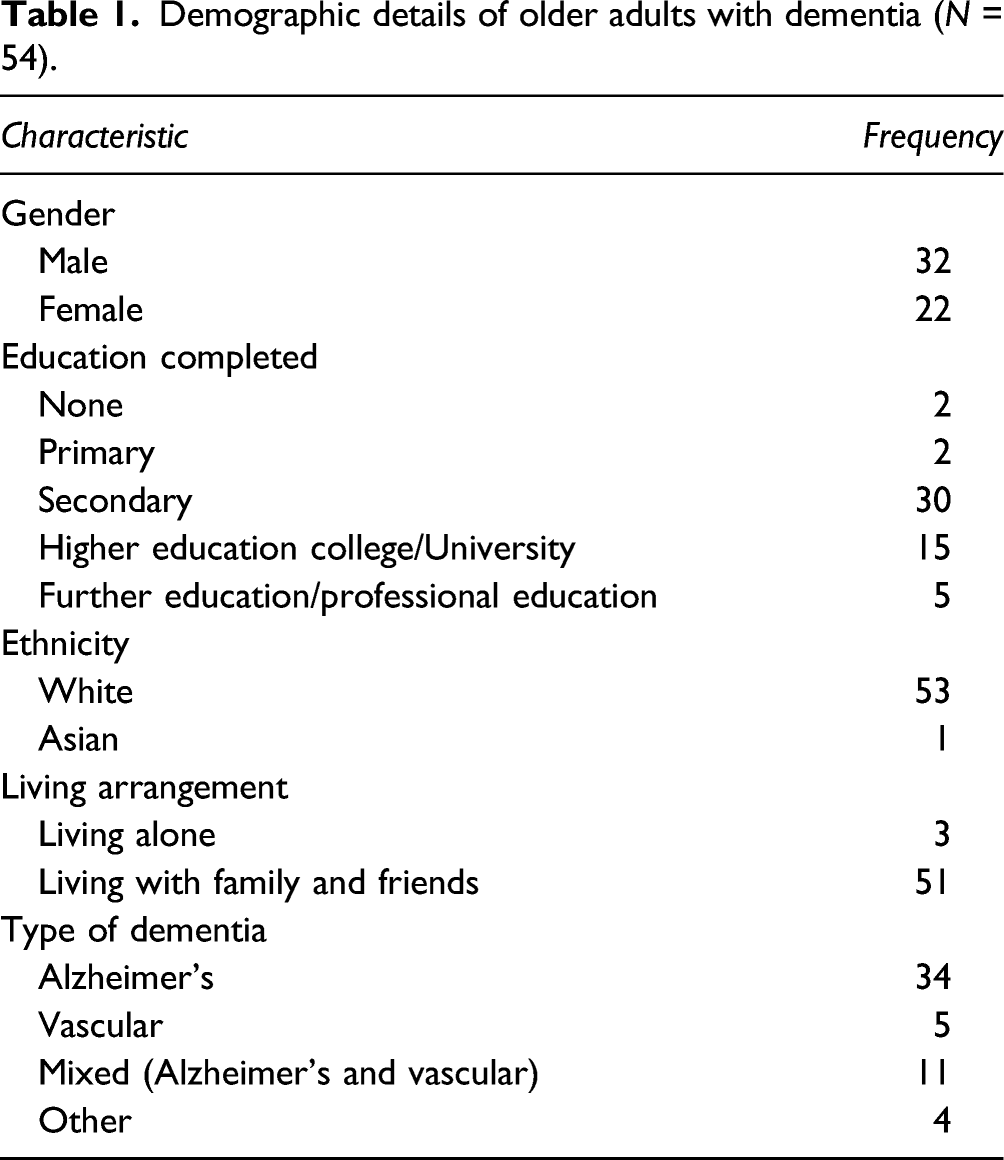
Demographic details of older adults with dementia (N = 54).
Measures
Mini-Addenbrooke’s Cognitive Examination (M-ACE)
M-ACE has been used in the present study for general assessment of cognitive function of PWD to recruit them in the study. It is a brief tool for cognitive screening of individuals with dementia, consisting of five items with a maximum score of 30. It has four cognitive domains: orientation, memory, language and visuospatial functioning. Higher scores indicated better cognitive function. It took approximately 5 minutes to complete. It is a brief and valid measure of cognitive assessment of PWD (Hsieh et al., 2015).
ICECAP-O
ICECAP-O is a tool for general QoL. It has five items which measure five attributes: attachment (love and friendship), security (thinking about the future without concern), role (doing things that make you feel valued), enjoyment (enjoyment and pleasure) and control (independence). All the five attributes being measured through ICECAP-O have four levels of options. For example, first capability in the scale, that is, attachment (love and friendship in layman term) can be rated on one of the four levels, that is, ‘I can have all of the love and friendship that I want’, ‘I can have a lot of the love and friendship that I want’, ‘I can have a little of the love and friendship that I want’ and ‘I cannot have any of the love and friendship that I want’. All the remaining items are rated on similar four levels. The highest level of any capability is scored as 4 and the lowest of any capability is regarded as 1. These are called raw scores which are subsequently converted into tariff scores based on the worst-best scaling of 0–1. The worst-best scores indicate absence/presence of an attribute. However, anyone scoring 1 on each question would indicate zero score or absence of the capabilities. Although, choosing 1 as an option on all the capabilities will still not be considered as absolute zero because zero or complete absence of capabilities is regarded as death. Therefore, 5x1 will have a value closest to zero due to tariffs assigned to level 1 of each capability. The score of 5x4 would be considered 1 indicating maximum of all the capabilities. Raw scores in between these levels will be converted into tariff scores as per pre-determined tariff values for each level of all capabilities (Coast, Flynn et al., 2008).
Demographic Information
Demographic information sheet included questions pertaining to participants’ gender, education, ethnicity, living arrangements, and types of dementia (see Table 1 for details).
Procedure
Data for the present study was collected in two separate sessions with an interval of approximately 2 weeks. The first session of data collection took around 30 minutes on average. The participants were required to complete four forms, that is, consent form, demographic information sheet, M-ACE and the ICECAP-O. All the forms were completed in a structured interview format. The second session took 5 minutes to complete on average as participants had to complete only the ICECAP-O in this session. Time and place of convenience for the participants for data collection was coordinated with them. All conditions of data collection for both the sessions were kept same. The participants who were recruited at day care centres were happy to provide data at their day care centres on both occasions. However, data from the participants, who were recruited from general community outside the day care centres, was collected at their own homes on both occasions. The same researcher collected the data in both sessions from all participants.
Data Analysis
Data collected through test-retest sessions (i.e. raw and tariff scores of PWD on ICECAP-O) were correlated to establish test-retest reliability (the consistency of scores of the same participants for the same measure on two different occasions, a stable measure reflects reliability of the scale) of ICECAP-O. The Pearson product moment correlation coefficient of ICECAP-O scores between two administrations was calculated to determine test-retest reliability of the scale.
Result
There was a strong correlation between the first and second administration of the ICECAP-O based on its raw scores (r = .68; n = 54; p < .01) and tariff scores (r = .56; n = 54; p < .01). The findings suggest that ICECAP-O is a reliable measure of QoL for community-dwelling older adults with dementia.
Discussion
The present study is the first to determine test-retest reliability of ICECAP-O for community-dwelling PWD. Its reliability was never determined before for community-dwelling PWD. Overall, reliability of ICECAP-O is the subject that has not been studied extensively even for cognitively intact older adults. Similarly, ICECAP-O validity for community-dwelling PWD has been investigated earlier. It was found to be a valid self-reported measure of general QoL for people with mild and moderate dementia (Nyman et al., 2021). Evaluation of its reliability for community-dwelling PWD is a novel contribution. The results of the present study have shown it to also be a reliable measure of QoL for community-dwelling people with mild and moderate dementia.
Although .75 and above is considered excellent strength of association (Cicchetti, 1994), our scores were short of that level. In addition, the reliability was stronger for the raw scores (.68) compared to the tariff scores (.56) as .40–.59 is considered fair and .60–.74 good association (Cicchetti, 1994). The .75 level is based on studies with individuals without cognitive impairment. The nature of dementia is more likely to result in participants providing different answers over time. The 14-day period for test-retest assessment as suggested in the literature (Streiner et al., 2015) might be too long for PWD. It would be important for future studies to explore optimal time periods for test-retest reliability for PWD. Two limitations of the present study were identified. First, the findings cannot be generalized to residents of care homes, those with compromised movement (e.g. wheelchair bound) or having any severe sensory impairment (e.g. visual or hearing impairment) because it was restricted to community-dwelling PWD without sensory and mobility impairments. Second, the sample recruited was not culturally diverse, as it included 53 participants with white and one participant with Asian ethnicity. Future studies should be conducted with more diverse samples in different settings for further psychometric testing of the ICECAP-O with PWD.
The present study has advanced the knowledge and evidence regarding reliability of the ICECAP-O among community-dwelling PWD. There was no scale available to measure QoL of community-dwelling PWD at the basis of their capabilities. ICECAP-O which is a capability-based QoL scale for cognitively intact older adults has been validated earlier for community-dwelling PWD (Nyman et al., 2021). However, establishment of its reliability for community-dwelling PWD has complimented its validity, which means it is a psychometrically sound tool for use with community-dwelling PWD. With the establishment of its reliability, ICECAP-O has become a comparable measure of QoL of community-dwelling PWD with their cognitively intact counterparts. Therefore, it may be used in future research to assess QoL among community-dwelling PWD. It may be used to investigate factors and predictors responsible for sustaining or enhancing QoL among PWD. Similarly, it may be used in formulation of appropriate policies regarding QoL among community-dwelling PWD.
Footnotes
Declaration of Conflicting Interests
The author(s) declared no potential conflicts of interest with respect to the research, authorship, and/or publication of this article.
Funding
The author(s) received no financial support for the research, authorship, and/or publication of this article.
