



Abstract
Physical activity benefits the health of older adults (e.g., lowering risk of cardiovascular disease, depression, dementia, and falls). However, less than one in four Americans meets guidelines for physical activity and inactivity increases with age. Masters athletes are exemplary because of their remarkable physical functioning. Swimming is a global, fast-growing sport in Masters athletics. This qualitative study explored motivations and barriers of 18 older adult members of a Masters swim club in Southern California. Guided by a primary research question: Why do Masters swimmers choose swim late in life, when most of their age cohort are becoming less physically active, semi-structured interviews delved into the lived experiences of the participants, and solicited peer feedback. Four main themes emerged: (1) I Just Love the Sensation of Being in the Water, (2) Tell Your Body What to Do Instead of the Other Way Around, (3) Make a Commitment to Your Friends That You’re Going to be There, and (4) I’ve Never Gone This Long in My Life Without Swimming. Participants expressed longing and regret that they could not swim due to COVID risk and safety guidelines. These findings can be used to design community programs to promote lifelong physical activity participation.
Introduction
Physical activity benefits the health and well-being of older adults. Physical activity lowers the risk of cardiovascular disease, which is the number one cause of death, other non-communicable diseases, depression, dementia, and anxiety (Hillman et al., 2008; Lee et al., 2012; Nelson et al., 2007; Pahor et al., 2014). Regular physical activity can produce long-term health benefits. For example, engaging in exercise improves cardiorespiratory endurance, flexibility, and strength, reduces obesity, and builds bone density (Health.gov, 2018; Ohkawara et al., 2007). The physically active are less likely to fall or sustain injuries if they do fall and are more inclined to sleep better, maintain mobility, and stay independent (Pahor et al., 2014; Centers for Disease Control and Prevention [CDC], 2020; U.S. Department of Health and Human Services [DHHS], 2018). Despite these benefits, not enough older adults are physically active (Keadle et al., 2016). The World Health Organization (WHO, 2010) and U.S. DHHS (2018) recommend that adults should engage in at least 150 min per week of moderate-intensity aerobic activity and a muscle strengthening activity at least 2 days per week. Less than one in four American adults fully meet these guidelines, however. The proportion of older adults aged 65 and over who meet the guidelines is even lower, at roughly 14% (HealthyPeople.gov, 2020). Nearly US$117 billion in annual direct health care expenditures (Carlson, 2015) are associated with a failure to meet the recommended levels of aerobic activity and these costs will grow.
Masters athletes are one segment of the older adult population that some promote as exemplary (Geard et al., 2017). Hodge et al.’s (2008) study of New Zealand national Masters Games participants found that these athletes felt enjoyment, were committed, had high perceptions of ability and belonging, and were intrinsically motivated. Researchers from sport psychology, leisure studies, and geriatric rehabilitation have begun to explore experiences of older athletes (Dionigi et al., 2013; Heo et al., 2013; Larson et al., 2019; Pike, 2011; Rathwell et al., 2015; Wigglesworth et al., 2012; Young, 2011). Masters swimming is growing in popularity as a means to increase aerobic activity and muscle-building, is less stressful on conditions such as knee and hip osteoarthritis than some other activities (Cooper et al., 2007), and is largely accessible to the older adult population, with Masters clubs in many cities and towns. Studies of Masters swimmers have mostly focused on elite competitors while excluding the large number of leisure Masters swimmers who do not compete at that level (Lyons & Dionigi, 2007; Medic et al., 2013; Petracovschi, 2011; Santi et al., 2014; Young & Medic, 2011; Young et al., 2011). Masters swimmers’ dedication and tenacity to their sport is not well understood. Many factors influence older adults’ physical activity participation and adherence. Further, older adults may have drivers that are different from those of younger adults. Although the condition of the physical body matters, the interplay of individual perceptions and life circumstances, as well as social and physical environments, impacts physical activity behavior (Grant, 2008; Rivera-Torres et al., 2019; Van Dyck et al., 2017).
The purpose of this study was to explore the motivations of older adult Masters swimmers to engage in this particular type of physical activity and to understand barriers to their sport commitment. Research questions included: Why do Master swimmers choose to swim late in life, when most of their age cohort are becoming less physically active? How do the motivations of Masters swimmers who swam competitively in their younger years compare to the motivations of Masters swimmers who started swimming as adults? Which experiences help motivate Masters swimmers to continue participation in regular sport activity (i.e., recreational and/or competitive)?
Methods
Design
This qualitative study characterized Masters swimmers’ personal experiences in everyday terms. A phenomenological approach illuminated the social, environmental, historical, and cultural influences in addition to the intrapersonal concerns.
Participants
After written consent was obtained, interviews with 18 older adult (aged 60 years and older) members of a Los Angeles area swim program were conducted online with videoconferencing and guided by a semi-structured interview guide. A demographic questionnaire included gender, year of birth, work status, where they practice, how they found their particular club, level of swimming experience, prior physical activity, and reason for joining a club.
Data Analysis
The researcher used interpretive phenomenological analysis (IPA), which involves an exploration of an experience with personal significance, complex decision making and social processes. The aim of IPA is to reveal what a lived experience means to an individual by searching for essences or structures underlying a phenomenon, through in-depth reflective inquiry (Smith et al., 2009). The interviews were transcribed and reviewed, case by case, and coded by the researcher to identify emerging themes. Beyond simple description, the researcher developed an interpretation of the narratives in relation to intrapersonal, social, and environmental contexts. The IPA approach is iterative, ultimately revealing patterns on a group level across cases (Callary et al., 2015; Smith et al., 2009). The study analysis was guided by Sallis et al.’s (2008) ecological model of health behavior (Figure 1). Further review, using metaphors and temporal references as suggested by Peat et al. (2019), moved the interpretation to a deeper level. Ecological model.
Results
Descriptive statistics of study participants (n = 18).

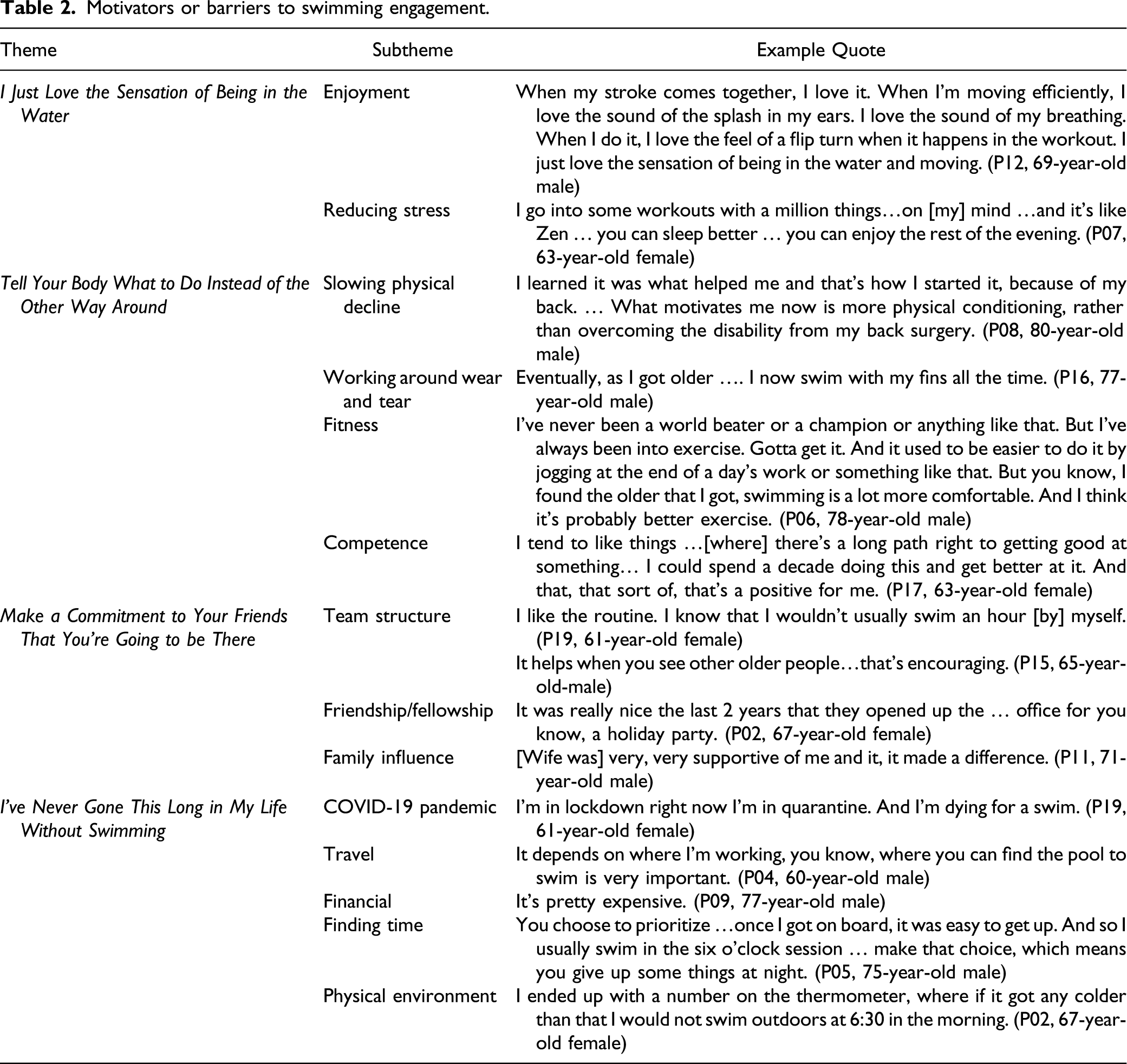
The researcher identified four main themes and several subthemes reflecting motivators or barriers to swimming engagement. Participants’ own words were used to title the themes: (1) I Just Love the Sensation of Being in the Water, (2) Tell Your Body What to Do Instead of the Other Way Around, (3) Make a Commitment to Your Friends That You’re Going to be There, and (4) I’ve Never Gone This Long in My Life Without Swimming.
“I Just Love the Sensation of Being in the Water”
Enjoyment
Participants used words like “joy,” “fun,” and “uplifting” to describe their Masters swimming practices, choosing to swim as older adults because they enjoyed the activity. Some participants described lifelong positive swimming experiences, where others discovered the water’s pleasures later in life. One 71-year-old participant had swum competitively in high school and then returned to the sport at the suggestion of an acquaintance—and 41 years later is still going strong. “I can’t wait to get to the pool. For me, it’s, … an absolute joy. And so as a result, it’s not, you know, it’s not work. It’s not difficult. It’s, …always playing.” A 61-year-old played basketball until he wore out his knees and was advised to consider a different sport. “I remember the first time I went in a 50-m pool … I had to stop halfway across, I was so tired … though today, I can do 100 m butterfly in a 50-m pool.”
Reducing stress
Focusing on swim practice made it easy for participants forget their worries and they described mood elevation at the end of the workout. “The best thing about swimming is how relaxed you feel… that’s the main thing I like about it” (78-year-old male). A 65-year-old female was a caregiver for a loved one with a terminal illness. “I needed a stress reliever and I needed a place to go every single day to sort of get away from the whole thing.” Some participants described improved focus when they swam. A 62-year-old female used guided visualization (of swimming) to get herself through challenging times. “It also is kind of very mindful… dolphining and just feeling your whole body in the water and you really in tune to it. So, you really … focus in the moment.”
“Tell Your Body What to Do Instead of the Other Way Around”
Getting older often coincides with physiological changes such as muscle and bone weakening, slowing metabolism, and sensory loss. As these shifts happen, older adults may feel the control they have over their bodies diminish. However, the participants appreciated a greater sense of control gained by swimming regularly. Slowing physical decline, represented by Tell Your Body What to Do Instead of the Other Way Around, was another superordinate theme, with four subthemes: slowing physical decline, working around wear and tear, fitness, and competence. One 60-year-old male characterized swimming as “a discipline that you can impose on yourself …you can… tell your body what to do instead of the other way around…you have control over at least this part of your physicality, and it doesn’t control you.”
“Make a Commitment to Your Friends That You’re Going to be There”
On an interpersonal level, Make a Commitment to Your Friends That You’re Going to be There emerged as a third main theme, with three important psycho-social subthemes.
Team structure
While team coaches may control the workout by presenting instructions, feedback, and encouragement, swimmers can have positive and negative impacts on each other during the workout. Some of this study’s participants were more driven by the competitive aspect of Masters-level workouts than others, but they all seemed to find a lane to suit their taste. I discovered … several outstanding former college swimmers … guys who… actually won rankings and among the world's best swimmers for their age group. So they have inspired me to continue to swim. I also like having someone to challenge me like the person in the lane next to me, that … makes me go faster. (75-year-old male)
Friendship/fellowship
Many participants explained that they discovered friendly and welcoming lane mates who encouraged them to return to practice. One man, who joined Masters after the age of 70, explained “They were supportive and encouraging and kept reminding you that you’d get there 1 day.” “You make a commitment to your friends that you’re going to be there,” said 75-year-old male, “… nurturing is … important.” Most of the study participants expressed appreciation for the camaraderie of the club. “I’ve been swimming with the same two women for … over 20 years. We’re friends, we’ve … gotten old together… I love the fact that it’s really multi age group and multi ability group” (67-year-old female).
Family influence
An oft-mentioned topic was parental or sibling behavior that motivated participants to swim. Parents often sponsored lessons and/or youth team participation, and siblings sometimes provided impetus as rivals.
“I’ve Never Gone This Long in My Life Without Swimming”
External barriers
It is important to note that the COVID-19 pandemic served as unique context for this study. The risk of contagion and related effect of lockdowns was a theme that overshadowed the interviews and emerged as a barrier to activity participation. “I am so high risk; I cannot swim in a public pool at all.” The pandemic’s disruption was acutely felt by a 67-year-old female, who said, “I’ve never gone this long in my life without swimming … since we closed down for COVID.”
Motivators or barriers to swimming engagement.
Discussion
Implications
The study participants’ narratives painted a vivid and multifaceted picture of today’s older adult Masters swimmers’ motivations and barriers. As expected, the themes aligned with social-ecological models that portray health behavior as a result of intrapersonal, interpersonal, environmental, and policy influences that often intersect. When asked the question, “Could you share a few ideas on why you swim?” a major theme that emerged was enjoyment. This finding was consistent with other studies showing increased enjoyment as a predictor of a desire to continue practicing the activity, such as Young and Medic’s (2011) survey of Masters swimmers at the 2008 World Championships. The present study’s results had much in common with prior studies of older adults’ physical activity participation and commitment (Berlin et al., 2018; Larson et al., 2019). A few participants highlighted enjoyment when swimming outdoors. For example, participants who were ocean swimmers often encountered schools of friendly dolphins and connected with “the elements.” Twohig-Bennett and Jones (2018) found greenspace exposure to be associated with numerous health benefits. The present study expands upon their findings by describing pleasurable aspects of swimming outdoors, which was a motivating factor for many. These findings were consistent with the literature, which includes sound empirical evidence that positive affect, or enjoyment, can increase physical activity levels (Rhodes et al., 2009). Jekauc (2015) found that judgments about pleasure/displeasure mediated the effect of interventions on exercise adherence. Program planners need to consider the “fun factor” of programs to improve older adults’ physical activity adherence.
The relaxing effect of swimming to reduce stress emerged as an important subordinate theme. Strong evidence demonstrates that acute bouts of physical activity can be calming and that regular participation in moderate-to-vigorous physical activity can reduce trait anxiety and risk of depression in older adults (Health.gov, 2018). Shapton (2012) described “the metaphysical state of swimming: The body immersed, feels amplified, heavier and lighter at the same time. Weightless yet stronger” (p. 188). This study’s participants’ experiences evoked that feeling; they enjoyed floating on the surface of the water to defy the tug of gravity and the sag of old age. Several participants noted mood improvement as a motivating factor (e.g., they mentioned “keeping your mind in shape,” “comforting and calming,” “Zen quality,” and “meditative effect”), which was in line with other studies (Bethancourt et al., 2014; Kwaśna & Jaworski, 2018; Yamashita et al., 2019) and that a swim session “wipes away” anxiety. Swimming offered a sense of detachment from day-to-day demands of work. More than three-quarters of this study’s participants were working full-time or were self-employed. This characteristic stood out from prior older adult cohort studies reviewed for this paper, and contrasted with stereotypes of retired older adults.
Tell Your Body What to Do Instead of the Other Way Around, was another major theme in participants’ lived experiences of swimming. Participants were motivated to maintain and improve physical functioning (e.g., strength, endurance, mobility) and youthful appearance. Participants expressed confidence in retaining control over their aging bodies. Like the older athletes in Dionigi et al.’s (2013) sports participation study, they seemed to view their aging as a combination of “acceptance, adaptation and resolve.”
Sarcopenia, or age-related decline in muscle mass, has caught the attention of clinicians and researchers in recent years. Beckwée et al. (2019) recommended resistance training of the large muscle groups in a total body approach to improve muscle function. The act of pushing water out of the way creates resistance and strengthens muscles. Swim gear, such as kickboards, fins, pull buoys and paddles may intensify this resistance.
In Bethancourt et al.’s (2014) study of older adults’ exercise program use, physical limitations “due to health conditions or aging” were frequently noted as barriers to physical activity. Conversely, some of the present study’s participants kept active to deal with their health conditions. Brooke Kirby and Ann Kluge (2013) and Kosteli et al. (2016) reported pain or fear of injury or falling were negative influences. A few of this study’s participants expressed a lingering fear of injury because that would keep them out of the pool. The subtheme working around wear and tear captured the participants’ efforts to find ways to exercise despite limitations, such as joint or low back pain. The third subtheme, fitness, was a common goal and all of the study participants exhibited an awareness, explicitly or implicitly, of the importance of physical activity for good health.
Baker et al. (2010) described how competitors (aged 55–94) used sports participation to negotiate the aging process. They used their physical activity commitment to set themselves apart from other inactive older adults. Similarly, the present study’s swimmers felt quiet pride in their athletic pursuits. Masters swimming helped them construct positive aging identities. A 63-year-old woman said, “you know, I plan to keep swimming till I kick it.”
The third major theme Make a Commitment to Your Friends That You’re Going to be There was part of almost every participant’s swimming narrative. This theme emerged at an intersection of intra- and interpersonal levels of influence. Social motivations described by this study’s participants aligned Franco et al. (2015) who found social interactions to be important in group activities, Brooke Kirby and Ann Kluge (2013) who highlighted the meaning of commitment to a team, and Steltenpohl et al. (2019) who found older adults prefer to exercise with others instead of working out alone. Many of this study’s participants appreciated the social aspects of belonging to a Masters club. First, friendship and fellowship were important. An 80-year-old male said affectionately “I really enjoy swimming with [friend]. Mainly because I like to draft off of her.” As with Steltenpohl et al.’s (2019) research, many of the older adults in this study saw their exercise as “we time,” when they could bond and maintain relationships. The importance they placed on their “buddies” aligned with socioemotional selectivity theory (Reed & Carstensen, 2012), where older adults’ personal goals shift more to the present moment and are laden with emotional meaning. Ocean swimmers also described the pleasure of joining a group adventure in the open water. This camaraderie served to reinforce their commitment to swim regularly.
With regards to swimming on a team versus exercising independently, most, if not all, of this study’s participants enjoyed the variety of a coached, structured, interval-based workout (if they did not, they would likely opt for swimming laps on their own). Lakicevic et al. (2020) highlighted new or varying exercises as a potential key determinant to physical activity adherence. Interval training, which involves intermittent variation of the intensity of movement, is a common feature of Masters swimming workouts. Some of the present study participants were more interested in competing in sanctioned swim meets or open water races than others who swam for recreation or fitness. Larson et al. (2019) profiled Canadian Masters swimmers as: “low-competitive specializers,” “high-competitive specializers” and “samplers.” That study encouraged efforts to make Masters programs appeal to a diverse range of interests and called for further research into the psycho-social experiences of Masters swimmers. Results of the present study enhance our understanding of recreational and fitness Masters swimmers whose experiences reflect the importance of interpersonal relationships to their physical activity commitment.
Third, family influence was a recurrent interpersonal factor. Guell et al. (2015) suggested those involved in interventions pay closer attention to the complex social contexts rather than solely on individuals’ discrete behaviors. This might be accomplished by providing meaningful social opportunities that include family members.
The fourth overarching theme of this study, I’ve Never Gone This Long in My Life Without Swimming, related to external barriers that impeded the participants’ physical activity. The COVID-19 pandemic was the most formidable barrier mentioned in this study and for some the most significant in their entire lives. Many participants expressed frustration about exercise program disruptions, but very few hinted at resignation, instead demonstrating resilience. Several improvised by swimming in their backyard pools temporarily, driving great distances to find an open pool, or by joining ocean swimming groups. These efforts demonstrated evidence of adaptive coping skills, which have been highlighted recently (Fuller & Huseth-Zosel, 2021).
Three additional external barriers were faced by this study’s participants. A few participants experienced difficulty finding the time and place to swim regularly, echoing other studies of older adults (Franco et al., 2015; Kosteli et al., 2016). These individuals demonstrated remarkable resourcefulness, even with demanding jobs, caregiving, and family responsibilities, to commit to their swim routines. A few of the participants mentioned financial barriers. Aside from pool closures during the pandemic, only cold weather/water at the outdoor pools and darkness were mentioned as physical environment barriers. This finding was not surprising, given the mild Southern California climate and also the large number of aquatic facilities in the region.
Limitations
This study had a few limitations. A more diverse study would include individuals from a wider variety of ethnic and socioeconomic backgrounds. The participants were Caucasian with high levels of educational attainment. This was typical of other studies of Masters swimmers worldwide. The reason for lack of diversity in Masters swimming is not well understood and would be worth addressing for public health/recreation program planners who want to support a more diverse population.
The large number of individuals interviewed for this study yielded rich results, but no follow-up fact-checking interviews were conducted. Multiple interviews with the same participant give researchers a second chance to ensure that understanding has occurred (Beck, 2021). The researcher felt confident using the playback feature of Zoom video to be able to capture the essence of the interviews. In addition, peer critiques during the research process were used to establish trust and credibility in the analysis. Other Masters swimmers with similar experiences were invited to comment on interpretations of the data and whether initial findings resonated with them.
Conclusion
This study makes important contributions to the literature on the motivations and barriers of older adults to engage in physical activity. It provides a deeper understanding of the psycho-social experiences of Masters swimmers, from recreational to competitive. This study’s swimmers chose to participate in their sport late in life when most people in their age cohort are becoming less physically active. Learning about the reasons as to why older adults engage in regular physical activity will help the progress of gerontological studies, specifically in the design and promotion of successful health behavior interventions. A more physically active older adult population will improve the viability of social welfare systems in the future.
This study’s overarching themes about participants’ motivation to swim were related to enjoyment, slowing decline of their aging bodies, increasing competence, team structure, and affinity. These influences were often specific to swimming and intersectional. For example, participants were more likely to enjoy a swim when they could share the experience with teammates, either for socialization or friendly competition. State and local policy makers and planners need to provide more opportunities for Masters swimming groups to flourish.
In addition to COVID-19 posing a significant barrier to physical activity engagement, other obstacles were noted such as competing priorities of a busy life and travel interruptions. To address these factors, program planners could provide flexible and automated workout schedules and links to opportunities outside the community. Since cold temperatures were mentioned, facility operators could be attentive to locker room and pool water heat to reduce that barrier. Lastly, a few participants considered club fee expenses to be a potential barrier. This might be more significant for older adults in less advantaged socioeconomic groups. To increase older adult participation, program subsidies to defray user expense could open doors and provide opportunities for more older adults to get in the swim.
Supplemental Material
sj-pdf-1-ggm-10.1177_23337214211044658 – Supplemental Material for What Makes a Military Professional? Evaluating Norm Socialization in West Point Cadets
Supplemental Material, sj-pdf-1-ggm-10.1177_23337214211044658 for Physical Activity and Aging: Exploring Motivations of Masters Swimmers by Susan L. Brilliant, Maria Claver, Patti LaPlace and Schlesinger Cynthia in Gerontology and Geriatric Medicine
Footnotes
Declaration of Conflicting Interests
The author(s) declared no potential conflicts of interest with respect to the research, authorship, and/or publication of this article.
Funding
The author(s) received no financial support for the research, authorship, and/or publication of this article.
Ethical Approval
Approval for the proposed study was obtained from the Institutional Review Board for the Protection of Human Rights at California State University, Long Beach (1637733–3).

Supplemental Material
Supplemental material for this article is available online.
References
Supplementary Material
Please find the following supplemental material available below.
For Open Access articles published under a Creative Commons License, all supplemental material carries the same license as the article it is associated with.
For non-Open Access articles published, all supplemental material carries a non-exclusive license, and permission requests for re-use of supplemental material or any part of supplemental material shall be sent directly to the copyright owner as specified in the copyright notice associated with the article.
