



Abstract
Daycare services serve to prolong aging at home. This decreases both families’ care burden and the government’s financial burden. We identified key factors in the person-centered approach of South Korean daycare center workers to develop and validate a Korean person-centered care questionnaire. Twenty-one items were developed, and 10 expert interviews were conducted. The items were applied to 271 daycare center staff (19.2% male vs. 80.0% female, mean age = 50.68 ± 11.37 years) to evaluate their reliability and validity. Twenty items concerning intimate relationships and the environment, consumers’ self-determination, and home-likeness domains were derived, explaining 40.28%, 10.44%, and 6.97% of the total variance, respectively. The overall tool’s Cronbach’s alpha was 0.905, demonstrating internal consistency. Inter-rater agreement ranged from 0.221 (fair) to 0.765 (good). This tool will be useful for individual staff members as well as for the National Health Insurance Service’s evaluations of service quality at daycare centers.
Introduction
South Korea has achieved economic growth at a faster rate than any other country and is now aging at the fastest rate worldwide (Organization for Economic Cooperation and Development, 2019). The National Health Insurance (NHI) is a core axis in public health management, and in 2008, another type of national social insurance—long-term care insurance (LTCI)—was introduced to respond to rapid aging. Based on the Act on LTCI for Older Persons (no. 14321), LTCI is provided separately for residential facility care and community care. Daycare is a type of community care provided to home-dwelling older adults (Ministry of Government Legislation, 2017) and may be some older adults’ choice for independent living (Gustafson, 1974). For this, LTCI recipients attend daycare centers for a predetermined amount of time per day to receive support for physical activities and education and training for maintenance and improvement of body functions. Although daycare for older people is classified as a community service, considering that recipients stay at these centers for eight hours or longer and receive meals, exercise, and services like bathing, physical and occupational therapy, and cognitive stimulation programs such as recreation, they can be considered in between residential facilities and homecare services.
According to 2018 LTCI statistics, 14.5% of those using long-term care services in South Korea use daycare services, and 11.6% of all long-term care benefits awarded to daycares by the NHI (NHI Cooperation, 2019). In the South Korean Confucian culture, which heavily values filial piety, daycare services are more feasible than residential facilities or hospitals (Park & Jung, 2018). Family members’ burden of caring for older adults is reduced, and they may continue engaging in financial activities. Further, they feel less guilty than those with older relatives living at residential care facilities. This arrangement enables older adults to live with their family but still benefit from systematic care programs, which can delay health deterioration and help maintain their quality of life (Choi, 2015). From the government perspective, daycare services are more cost-effective than residential facility services that provide comprehensive care, and older adults who use daycare services spend less time in long-term care, residential facilities, and hospital beds (Korean Statistical Information Service, 2019). Therefore, daycare improves insurance and national fiscal soundness and sustainability. Consequently, the South Korean government implemented policies to expand daycare use, and daycare centers of various sizes are available in residential districts across the country (NHI Cooperation, 2019).
Daycare is an important service for older adults in Japan, where community-based integrated care systems are utilized (Echizenya et al., 2020). In a prospective cohort study of Japanese older adults, daycare service utilization for 21 days was effective in decreasing mortality and was particularly effective for women, those aged 65–74 years, and those who used visiting nurse services (Kuzuya et al., 2006). A Korean study of daycare services reported significantly improved patient outcomes; however, the cost of health services did not decrease significantly (Chang et al., 2015). Daycare services for older adults in South Korea provide pickup and drop-off services for those who live far away and are entirely responsible for care during the day (Choi, 2010). Among users of daycare centers, 90.4% reported satisfaction with the care, and 95.4% reported decreased care burden (Chang et al., 2015). This satisfaction rate is higher than the rates associated with other types of care: 79.2% for visiting care, 85.1% for home visit bathing, and 44.6% for short-term care (Ministry of Health and Welfare, 2020). Daycare services for older people are associated with lower mortality rate among frail older people (Kuzuya et al., 2006). Thus, these services improve and maintain physical and mental health outcomes or delay the onset or worsening of new conditions, as these services include assistance with bathing and eating, basic nursing, dementia management, and emergency services during certain hours of the day. Despite such high satisfaction rates, older adults using daycare services still report difficulties in daily life: 8.8% concerning meals, 29.2% concerning daily life, and 13.8% concerning boredom (Korean Statistical Information Service, 2019).
Person-centered care is one concept that appears to improve the quality of long-term services for older adults (Flesner, 2009; Yoon et al., 2012). Person-centered care involves the provision of individualized services based on respect for and awareness of each recipient’s needs and protection of their abilities, autonomy, and self-esteem (Flesner, 2009). Globally, long-term care services mainly focus on improving older adults’ quality of life at home in a comfortable, family-like environment, rather than in a residential care or treatment setting (Flesner, 2009). Person-centered care should be personal and holistic (Edvardsson, 2015). Moreover, it should prioritize providing individualized services to the recipient; consider psychological needs; respect the abilities and values of residents; and preserve their independence, autonomy, and self-esteem (Yoon et al., 2018). The NHI Service, which manages LTCI in South Korea, evaluates facilities providing long-term care. Evaluation of daycare services, but only includes a limited assessment of person-centered care, such as services to reflect individual demands, protection of human rights, and potential abuse (NHI Service, 2020).
Objectives
Edvardsson et al. (2008) developed the person-centered Climate Questionnaire-Resident version (PCQ-R) to assess the degree of person-centeredness of acute hospital environments. This tool is appropriate for older adult care centers and is in use in Europe, the US, and Australia (Edvardsson et al., 2009; Yoon et al., 2015). In South Korea, the Korean PCQ-R was developed for care facilities for older adults. It is a valid and reliable tool with high internal consistency (Cronbach’s ⍺=.90; Yoon et al., 2018). However, to our knowledge, there is no tool to evaluate the person-centeredness characteristic of daycare services for older people in South Korea. We, thus, identified key factors of person-centered care at older adult daycare centers and developed a tool to evaluate person-centered care at older adult daycare centers, as provided by daycare staff, which will be useful in improving care quality. Then, we assessed the reliability and validity of the developed tool.
Methods
Study Design and Participants
This methodological study involved tool development and evaluation. In the tool development stage, to measure person-centeredness among staff, key factors of person-centered care at daycare centers were identified through focus group interviews with 10 experts with PhDs, such as professors researching long-term care and researchers at the NHI Service. They discussed the concept of person-centered care and its application in daycare for approximately 3 hours. Notes were taken during the discussion, which were audiotaped for further analysis.
In the evaluation stage, participants included daycare center chairs or managers who worked as nurse aides or personal care workers. A survey was conducted during a quarterly meeting of the daycare centers after explaining the study purpose. A self-report questionnaire (Person-Centered Care Assessment; PCA) was distributed to consenting daycare employees. Those who could not attend this meeting were emailed the questionnaires, and completed questionnaires were mailed back. Of the 334 completed questionnaires, 271 with no missing data (except if participants had not entered a domain entirely) were coded for analysis.
Questionnaire Development and Evaluation
The purpose of the development stage was to construct the content framework related to person-centered care and to derive the relevant questions for preliminary research. In the evaluation stage, the PCA questionnaire was assessed for reliability and validity through participants’ responses.
To construct preliminary questions, a wide literature review on the definition, purpose, and domains of person-centered care and on the tools being used for person-centered care was conducted. A person-centered care climate study by Yoon et al. (2018) at Seoul National University used 17 questions concerning everydayness, which refers to giving older adults the feeling of home by providing a familiar environment and allowing them to engage in their daily activities and safety domains. Yoon et al.’s (2012) definition of person-centered care encompasses the following four concepts: intimate relationships, self-determination, home-like environment, and working environment. In this study, questions were developed based on these four domains and other literature. A home-like environment can promote and sustain older adults’ health and well-being (Wada et al., 2020). Twenty-one questions were derived through interviews with four professors researching long-term care and 10 experts with PhDs, who are active in the subject area.
Data Analysis
Regarding the characteristics of the facilities at which the participants worked and participants’ general characteristics, frequency, percentage, mean, and standard deviation were calculated. To test the tool’s content validity, the connection between the measured and theoretical concepts was confirmed, and a factor analysis was performed to reduce the superfluous questions. Responses were made on a six-point scale, with options ranging from “strongly disagree” to “strongly agree.” For the collected data, to assess whether the 21 questions were adequate for factor analysis, Bartlett’s test of sphericity and the Kaiser–Meyer–Olkin (KMO) test were performed. The two tests showed that the selection of variables for factor analysis was adequate. One question with a communality < 0.8 (the derived factor explained only a low correlation between questions) was excluded. A principal component analysis (with varimax rotation) was performed for factor analysis. The number of factors was chosen based on the eigenvalue and accumulated percentage of dispersion, and all factors with significance ≥ .5 in all 271 participants, where multiple staff members at each daycare center completed the questionnaire, were selected. To test the tool’s reliability, Cronbach’s alpha and correlations were calculated for internal consistency. To investigate internal consistency between staff members working at the same facility, Cohen’s kappa or Fleiss’ kappa was used. Data were analyzed using SPSS 23 software (IBM Corp., Armonk, NY, USA).
Ethical Considerations
Prior to the study, we obtained approval from the concerned institutional review board (1041493-A-2019-012). All participants provided verbal consent after being informed about the study purpose and rationale and that their data would only be used for research purposes. Participants were informed that they could withdraw from the study at any time. The questionnaire asked for minimal information on each daycare center or respondent, and anonymity and confidentiality were ensured.
Results
Participants’ General Characteristics
Characteristics of Survey Participants and Daycare Centers for Long-Term Care Services.

Note. SD: standard deviation.
Verification of Construct Validity of the PCA Questionnaire
The main component factors were analyzed using varimax rotation to verify the construct validity of the PCA questionnaire. The results of Bartlett’s sphericity test were significant (χ2 = 2905.447, p < .01), and the KMO value of 0.920 was very suitable for the selection of variables for the factor analysis. Communality was ≤ 0.4 (low value described by an extracted factor) for the “replacement of caregivers” question, which was excluded. The factor analysis revealed that the main components were reclassified into three domains; considering the percentage of total dispersion, the first domain explained 40.28%, the second domain 10.44%, and the third domain 6.97%.
Factor Analysis of the Person-Centered Care Assessment Questionnaire for Daycare Center Staff (Korean version; N = 271).

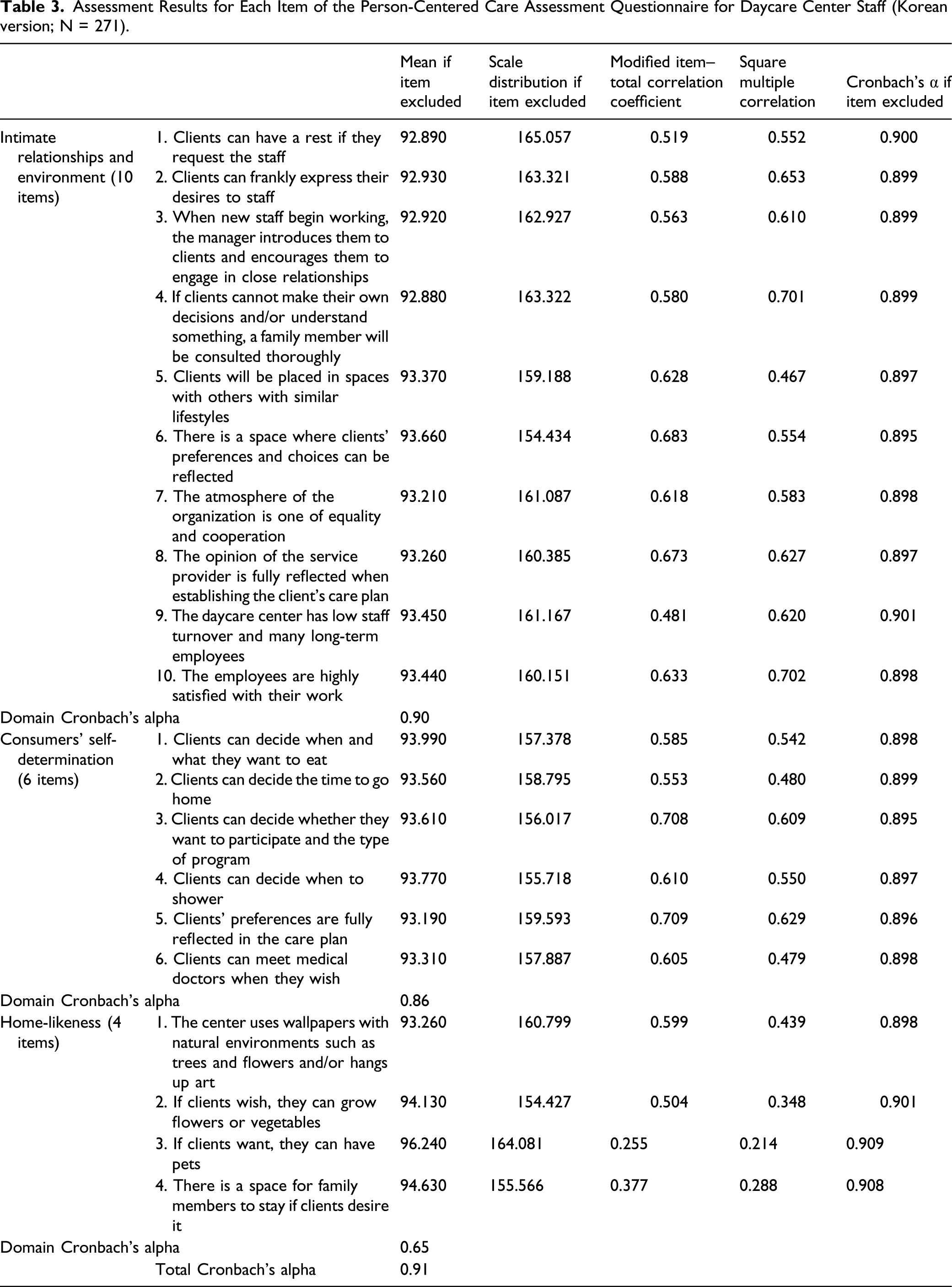
Assessment Results for Each Item of the Person-Centered Care Assessment Questionnaire for Daycare Center Staff (Korean version; N = 271).
Inter-Domain Correlations and Reliability Coefficients of Each Domain of Person-Centered Care.

Inter-Rater Reliability Among Staff at the Same Center
Inter-Rater Reliability Among Workers Employed in the Same Center with Fleiss’ Kappa or Cohen’s Kappa (n = 171).

Note. CI: confidence interval.
Discussion
This study assessed person-centeredness at daycare centers, an important type of long-term care service in South Korea, to generate data to improve older adults’ satisfaction with daycare services. To this end, we developed and validated a tool that can measure the person-centered environment in daycare centers.
In 2019, 34.5% of older adults using daycare services used the services 20–24 days per month, and 45.6% used the services 25 days or more per month, suggesting that many used daycare services almost every day (Ministry of Health and Welfare, 2019). Using daycare services decreases negative changes in physical, social, and family relationships; financial burden; and total care burden (Korean Statistical Information Service, 2019). Moreover, the fact that longer use of daycare services delays entry into care facilities or residential care hospitals (Lee, 2006) also suggests that there is a need to improve older adults’ satisfaction with daycare services. For the care of older adults with dementia, cognitive function declined less in the daycare group than in the homecare group; however, conversely, behavioral symptoms showed a similar decrease between the two groups (Lee et al., 2019).
The present tool was developed to measure the level of person-centered care at daycare centers, and an exploratory factor analysis was performed to test the construct validity of sub-factors of person-centered care at daycare centers: intimate relationships and environment, consumers’ self-determination, and home-likeness. The first domain explained person-centered care most, followed by the second and third domains, respectively. In other words, the staff members thought that intimate relationships and environment—close relationships, communication, and cooperation between family and staff—were most important for person-centered care. For this, participants thought that staff members should be satisfied with their work and that a comfortable environment that allows for adequate rest to encourage continued employment is necessary. Second, participants responded that consumers’ self-determination was important and that they should be able to decide when to eat, when to return home, whether to participate in programs or take a shower, and whether to meet a doctor. The third domain was home-likeness, and participants responded that the emotional environment, such as the presence of flowers or pets and having space available for family members, is important. The difficulties reported by older adults using daycare services seem to be reflected in consumers’ self-determination and home-likeness domains (Chang et al., 2015), and the findings obtained using the present tool will be useful in supplementing these aspects.
Comparing the three concepts derived in this study with the everydayness and safety domains in Yoon et al.’s (2015) study, everydayness—a characteristic of care facilities for older adults—was reflected across intimate relationships and environment, consumers’ self-determination, and home-likeness. When compared to safety, generosity, and everydayness—derived from the initial Swedish version of the PCQ-R in 2008 (Lee et al., 2015)—generosity is reflected in consumers’ self-determination, and everydayness is reflected in intimate relationships and environment and home-likeness. Although the relationship between questions and factors found in a study conducted with residents of older adult care facilities was slightly different, the sub-factors and questions were also similar for staff members at daycare centers (Lee et al., 2015). However, questions on safety were not derived in this study, likely because daycare service users stay for relatively shorter periods and have less severe conditions compared to residential care users (Jeong, 2020).
When the main characteristics of “good care” were explored among direct care workers at South Korean older adult care facilities, they indicated that family-like care, respect for individuals, promotion of independence, and symptomatic improvement were important (Kwon et al., 2018). Intimate relationships, environment, and home-likeness are similar to family-like care, and consumers’ self-determination is close to respect for individuals. Promotion of independence and symptomatic improvement, which are more proactive care processes, were not found in this study. This is likely because person-centered care recognized in daycare centers values respect for individuals and comfort more than active care to improve conditions. Of the initially selected items, “it is difficult to select caregivers” was removed through factor analysis. This is likely because, in reality, it is difficult to change caregivers when requested by clients or their families, given that only 23.5% of all licensed caregivers are employed (Kwon et al., 2018).
This study has a few limitations. First, agreement between staff members at 27 daycare centers where two or more members participated was typically fair or moderate. Large-scale or follow-up studies in the future should explore whether the agreement can be further improved. Second, since the reliability of the tool was validated only at the participating daycare centers, the sample was not selected randomly. Nevertheless, most participants worked at private daycare centers and were females, which coincide with the national trend (Lee et al., 2015). Future studies should validate the tool through a more systematic sampling. Third, considering that the person-centered care measurement tool for daycare centers was developed based on staff members’ responses, it is questionable whether it accurately reflects the demands of older adults or their family members, who are the actual users. However, since most daycare service users in South Korea have dementia, it is difficult to validate the tool through users. Moreover, many caregivers are also older adults (Lee, 2006; Organization for Economic Cooperation and Development, 2019); therefore, caregivers can evaluate long-term care services from the perspective of users and are thus suitable for validating the tool. Future studies should develop and validate tools by observing the behaviors of older adults with dementia who have communication difficulties.
Conclusion
This study identified key factors in the person-centeredness of daycare centers in South Korea. We developed a 20-item tool that measures three domains of person-centered care in this setting: intimate relationships and environment, consumers’ self-determination, and home-likeness. The tool had reliability, validity, and inter-rater agreement, making it suitable for measuring person-centeredness in daycare centers in South Korea. This tool will be useful in regular self-monitoring by daycare centers to assess how person-centered their services are, and in ensuring continued quality assurance. Moreover, the tool may be considered a criterion for person-centered care in the NHI Service’s evaluation of quality of services at daycare centers.
Footnotes
Declaration of Conflicting Interests
The author(s) declared no potential conflicts of interest with respect to the research, authorship, and/or publication of this article.
Funding
The authors disclosed receipt of the following financial support for the research, authorship, and/or publication of this article: This work was supported by the National Research Foundation of Korea Grant funded by the Korean Government (NRF-2017S1A2A2031261).
Ethics Approval
This study was approved by the Institutional Review Board of Dongseo University, its approval number is 1041493-A-2019-012.
