




Abstract
Adjusting to life in a long term care facility (LTCF) can be challenging for older adults. Improvisation (shortened to improv) is a unique activity that encourages creativity and adaptive cognitive stimulation, through performing short scenes with content suggestions. We sought to assess whether improv training, in the form of a course entitled Humor Doesn’t Retire (HDR), could impact patient-centered outcomes in a LTCF. About 15 adults (mean age 83.6 years) living in a LTCF participated in the 8-week HDR course with pre and 1-month post mixed method surveys assessing validated Patient Reported Outcomes Measurement Information System (PROMIS) measures and qualitative open-ended responses. Participants experienced significant improvements in social isolation and perceived stress (p < .05), and trend improvements in positive affect, self-efficacy, and anxiety. Participants described themes of increased attentiveness, becoming more relaxed, increased cognitive stimulation, and improved communication skills. In conclusion, LTCFs may want to consider offering improv training to positively improve the lives of older adult residents.
Introduction
Adjusting to life in a continuing care residential community (CCRC) or long term care facility (LTCF) can be challenging for older adults (Kasper et al., 2019). Residents need to adapt to new situations and social interactions, while dealing with the anxiety and depression that can occur with leaving one’s home (Chao et al., 2019). Prior research has postulated that the same skills used in improvisation (improv) could be applied to any situation that requires people to navigate challenges, such as providing care to another or developing resilience in a new environment (Leonard et al., 2020).
Improv is a unique activity that encourages creativity and adaptive cognitive stimulation, in a social environment (Bermant, 2013). Modern improv typically involves a group of players performing short scenes based on games, with content suggestions from the audience (Bermant, 2013). Improv training has previously been shown successful in several populations, including medical and nursing education (Fu, 2019; Kukora et al., 2020; Sawyer et al., 2017). It has been examined with caregivers and shown to be effective in improving burden, which is the extent to which caregivers perceive the adverse effect that caregiving has on their emotional, social, financial, and physical functioning, (Foley et al., 2021) and depressed mood (Brunet et al., 2021; Krueger et al., 2019). Improv has also been utilized to improve social connectivity among at-risk youths (Tang et al., 2020). With regard to specific diseases, improv has been examined with patients who have Parkinson’s disease and found to positively impact physical function and activities of daily living (Bega et al., 2017). However, even with this research showing the potential benefit of improv, there is a gap in the literature on how improv affects older adults in LTCFs.
Through this study, we sought to examine how learning improv would affect older adults living in a LTCF setting. We aimed to identify whether there were improvements in validated patient-centered outcome measures such as anxiety, stress, social support, confidence, and isolation. We also aimed to assess how improv affects socialization and how improv participants handle stress outside of the classroom. We hypothesized that participation by older adults in an 8 week, in-person improv course would lead to improvements in measurable outcomes, including overall well-being, self-efficacy, socialization, isolation, emotional distress, anxiety, and perceived stress.
Methods
This research was approved by the Northwestern University Institutional Review Board (STU00209883) and the participating LTCF Resident Research Council. Written Informed Consent was obtained.
Study Population
Subjects were deemed eligible to participate if they were: Age 50 and older; current residents of the independent living area of the continuing care retirement community (CCRC); able to attend all the in-person 8 week classes; English-speaking, and if they had no prior participation in improv courses. Subjects were also screened for adequate cognition using the Montreal Cognitive Assessment—blind version, since it was administered over the phone. Potential participants had to score ≥18 (of 22), which is considered normal, in order to be enrolled in the study. The course was held at a 53 story high-rise CCRC located in downtown Chicago, Illinois. We sought to recruit a minimum of eight and a maximum of 20 subjects to participate based on the recommendation of the improv class instructors. Participants were recruited via mailbox flyers, newsletter highlights, and in-person introduction of research opportunities to residents. Subjects were not compensated for participating, however, they took part in the course free of charge.
Intervention
The Humor Doesn’t Retire (HDR) 8-week course took place in-person from September through November 2019 (pre-COVID-19 pandemic). One improv instructor from The Second City taught the 8-week course, with each class lasting 2 hours weekly. The Second City is a world-renowned training center of improv that has tailored several improv courses to focus on improving health and personal wellbeing of students. At least one member of the academic research staff also attended each session. Content included building ensemble, giving and taking focus, object work, and the concept of “yes, and.” While typically there are a variety of exercises and games, this class was tailored to place less emphasis on movement and physicality (e.g., falling to the floor, lifting other actors) so it could accommodate participants who may have physical limitations.
Data Sources and Measures
Surveys were administered in-person and over the phone, by research staff. Participants completed surveys at baseline, immediately after the 8-week course, and 1-month after completing the HDR course. Initial and immediate post-course surveys were conducted in person. The 1-month follow-up survey was completed either in-person or via telephone, depending on the participant preference.
The baseline survey included questions pertaining to participant demographic and attitudes toward participating in an improv course. Additionally, participants completed questions for a series of validated Patient Reported Outcomes Measurement Information System (PROMIS) measures including questions pertaining to positive affect and well-being, self-efficacy for managing emotions, self-efficacy for managing social interactions, ability to participate in social roles and activities, social isolation, global physical health, global mental health, emotional distress, anxiety, and perceived stress (Cella et al., 2007). The 1-month follow-up survey repeated the attitudes questions and the validated PROMIS measures.
Analysis
Standard frequencies and means were utilized for describing participant characteristics. Wilcoxon rank sum test, a non-parametric version of paired t-test, was utilized to assess the significance of the difference between PROMIS measures at baseline and 1-month post HDR intervention. Statistical analysis was performed using R (R Core Team, 2014).
Qualitative analysis was utilized to evaluate responses from the open-ended questions in the 1-month post-HDR completion surveys. Responses were analyzed using constant comparative techniques (Ritchie et al., 2003). Coders independently assessed subject responses for focal themes, then convened to compare and compile findings. The coders then organized the content into themes relevant to participants’ discussions of the effectiveness of the HDR training (Creswell et al., 2011). Previous research has shown that eight to 12 interviews are sufficient to reach thematic saturation in qualitative studies (Small, 2009).
Results
Sixteen participants consented to participate in the HDR course. After the first class, one participant dropped out due to a competing golf schedule (Table 1). With a mean age of 83.6 years, the majority of participants were female (73.3%), living alone (93.8%), and were highly educated with post-college graduate degrees (73.3%).
Participant Characteristics (n = 15).

In comparing PROMIS measures from baseline to 1-month after the HDR course completion, social isolation, and perceived stress significantly improved (p < .05). Trends in improvement were seen with positive affect and well-being (37.6–38.9), self-efficacy for managing emotion (31.8–34.1), self-efficacy for managing social interactions (16.1–18.23) and emotional distress—anxiety (6.0–5.57). There were minimal changes detected in Global Physical Health nor Global Mental Health (Table 2).
Changes in PROMIS Measures After 1 month Post-HDR Improv.
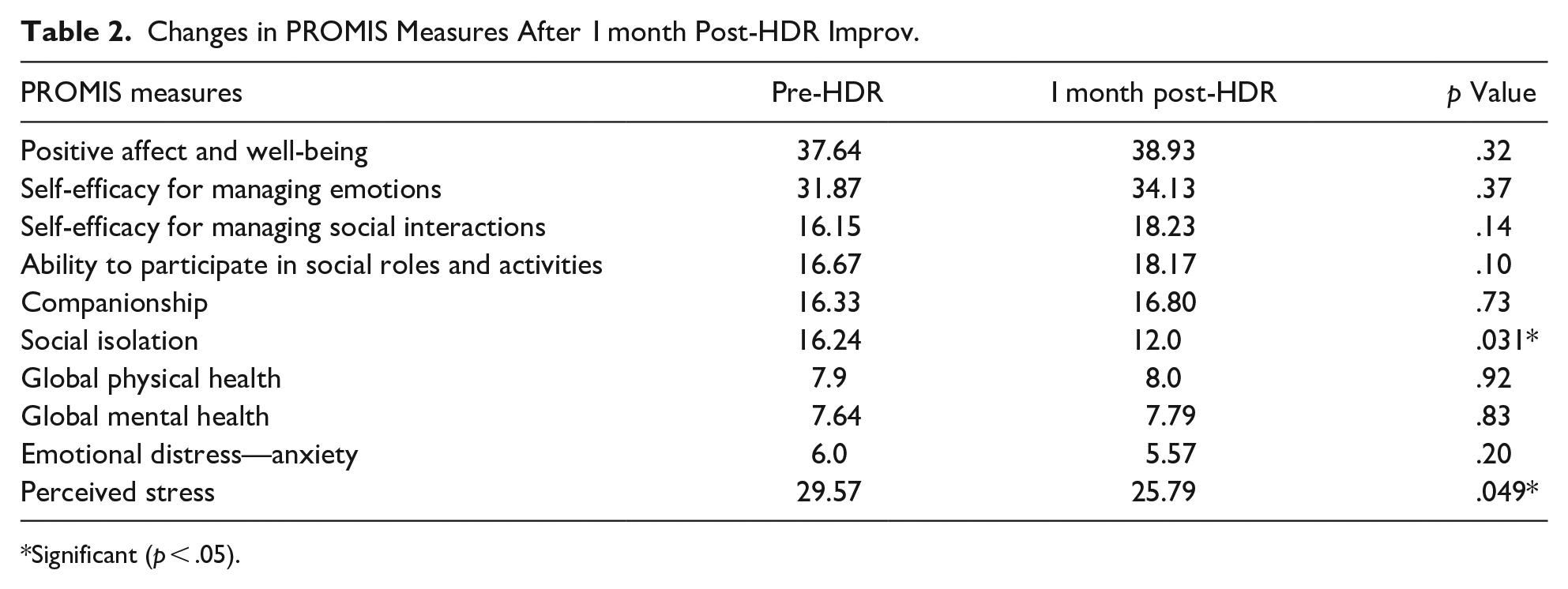
Significant (p < .05).
In the 1-month follow-up survey, subjects were asked: Has taking the Humor Doesn’t Retire improv course impacted how you respond to situations or people outside of the The Second City course? Qualitative analysis of responses revealed several themes:
Positivity
A major theme that subjects reported was becoming more positive as a result of taking the HDR workshop.
I have grandchildren and I used to be more negative, yes BUT instead of yes AND. We give options to one another.
It increased my optimism and positivity and we need that.
Improved Listening
Subjects felt that HDR had taught them to listen better and be more attentive which impacted how they responded to people, including their offspring.
I know that it has. I was telling my daughter about it and I explained to her how the teacher held out her arm and explained that people usually only listen to the elbow and then they don’t listen to what you’re trying to tell them. My daughter said that I do that and that I interrupt her. That was a real eye opener to me. I think I’ve gotten a little better.
It taught me to keep my mouth shut more often. It taught me to listen.
Improved Socialization
Through HDR, subjects met new people and in turn, they felt better prepared to interact and talk with new residents in the LTCF.
I was able to meet new people and I used the information that I got from the class and was able to interact with new people.
It gets me together with people and gives us something to talk about that we’ve done together. I’m an only child and have no living relatives.
Loved the classes! Loved them! Because it gets you together with the other residents. You form friendships you wouldn’t normally have.
Improved Spontaneity
With HDR, subjects received and reacted to new information which brought forth the theme of improved spontaneity. Subjects felt that there were better able to be spontaneous and trust that they would be able to handle situations or changes in conversations.
I think maybe a little more freer to spontaneously say something in a social situation, offer my opinion or my sense of humor.
It’s a change of pace from what’s going on and it forces you to react fast which sometimes you don’t. You have to think on your feet, so to speak.
Because it engages people’s spontaneity, which may be hard for people to use as they get older.
Improved Communication
Subjects responded that aspects of the HDR training had helped them in general communication with others.
It made me think about what I say first before responding.
It has helped me to ask open ended questions to people and not leading conversations with a question.
When asked if they would recommend this type of class to others, all subjects responded positively and on further questioning about why, themes emerged as follows:
General Fun
Absolutely. It just was so much fun and really helpful. I just looked forward to it and when I got there it fulfilled my expectations. It was interesting and I learned stuff.
The class was a lot of fun and there were a lot of laughs. It allowed people to be themselves.
Increased Socialization
It gets me together with people and gives us something to talk about that we’ve done together. I’m an only child and have no living relatives.
Loved the classes! Loved them! Because it gets you together with the other residents. You form friendships you wouldn’t normally have.
Thinking and Cognitive Stimulation
The class has certainly made me think about things I haven’t improvised in a long time. When you think about “I gotta go next, what am I going to say?”
Well, I think it stimulates the way of thinking for you to encourage conversation. It’s an enabler of humor. It’s an enabler of conversation. It’s an enabler of thinking more.
Discussion
This mixed methodology research is the first to show objective scientific evidence that an improv course (The Second City’s Humor Doesn’t Retire) significantly impacts older adults (mean age 83.6 years) in the LTCF setting. Specifically, there were improvements in validated PROMIS measures of isolation and stress. Trends of improvement were seen in PROMIS measures of positivity, self-efficacy, and anxiety. Overwhelmingly, in open-ended responses, older adult participants enjoyed the HDR course and felt that it improved their listening skills, socialization, spontaneity, and conversational skills. From participant responses, the HDR course provided a means for fun, socialization, and cognitive stimulation.
The tenets of improv revolve around listening, spontaneity, responsiveness (“Yes. . . and”) and social interactions with humor and evolving laughter. It is not surprising that participants noted these in their open-ended responses and themes. Notable is that that HDR could significantly improve isolation and perceived stress. With older adults enduring various stressors, it is exciting that by taking an improv course, participants may be able to perceive less stress and feel better able to handle stressors.
These results parallel and corroborated results found in prior improv-focused research. Similar to our results, past research has shown that at-risk youths experienced improvements in social connectivity with improv training (Tang et al., 2020). With the addition of our research findings, improv has the potential to increase socialization skills across age ranges (Gao et al., 2019). Our validated PROMIS measure findings substantiated earlier exploratory analyzes that suggested improv could be a mechanism by which to combat geriatric syndromes, including isolation and stress (Morse et al., 2018).
Considering that this research was conducted in the autumn of 2019, prior to the COVID-19 pandemic, there is great promise that HDR may benefit those who are isolated in LTCFs. In response to the COVID-19 pandemic, The Second City has moved HDR to an online format. We anticipate conducting further research using similar methodology comparing the online with the in-person HDR improv coursework.
As with all studies, limitations exist and most prominent is that this study is single-site with a small sample size. Even with a small sample size, there was significance in the PROMIS measures—isolation and stress. With a larger power, the trends in PROMIS measures that were seen but did not reach significance may be impacted. While we chose a 1 month follow-up, it would be useful to examine longer-term effects on older adults. While we examined validated patient measures, future research could examine measures that would detect direct differences over time in health outcomes, such as cognition, pain, or depression.
Conclusion
Participation in an older adult-focused improv course significantly improved the lives of older residents living in a LTCF. Considering the mean age of participants was 83.6 years, the title of the course “Humor Doesn’t Retire” holds true as older adults learned new improv skills that positively impacted their lives.
Footnotes
Authors’ Note
All authors provided substantial contributions to conception and design, or acquisition of data, or analysis and interpretation of data for the article; drafting of the article or reviewing it and revising it critically for important intellectual content.
Declaration of Conflicting Interests
The author(s) declared no potential conflicts of interest with respect to the research, authorship, and/or publication of this article.
Ethical Approval
The Northwestern University Institutional Review Board and Ethics Board approved this study (STU00209883).
Funding
The author(s) disclosed receipt of the following financial support for the research, authorship, and/or publication of this article: We wish to thank The Cozzi Family Geriatrics Research Fund, who provided funding to support this research. Dr. Lindquist is supported by grants R01 AG058777, R01 AG068421, and P30 AG059988 from the National Institute on Aging.
Informed Consent
Written informed consent was obtained.
Sponsor Role
The sponsor had no role in the design, methods, subject recruitment, data collections, analysis nor preparation of paper.
