




Abstract
Introduction
Older adults in Hong Kong suffer from multiple mental health problems, such as loneliness (Lam et al., 2016), anxiety disorders (Fung & Lam, 2016) and depression (Lai, 2009; Wong et al., 2014). These mental health issues may arise from adverse factors such as loss of socioeconomic status after retirement, bereavement or multiple medical conditions (Hildon et al., 2009). When older adults face adversity, it is sometimes difficult for them to bounce back (Hildon et al., 2008). Under these circumstances, resilience is a particularly important resource for the elderly in Hong Kong. There is no uniform definition of resilience. It was initially considered as an ability to bounce back or cope successfully despite substantial adversity (Rutter, 1985). Other researchers have defined resilience as the outcome of successful adaptation in spite of threatening or challenging environment (Masten et al., 1990). A third definition is that resilience is the process of adapting well in the face of adversity, trauma, tragedy, threats or significant sources of stress (Tugade & Fredrickson, 2004).
To promote resilience among older adults, it is important to explore the characteristics of resilience in terms of how resilience can help older adults adapt to various functional limitations, disabilities, stressors and losses. Findings of previous studies indicated that both intrinsic and extrinsic factors would promote resilience, such as a focus on the present and social support (Hrostowski & Rehner, 2012; Lopez-Fuentes & Calvete, 2015). In other words, older adults’ ability to focus on the present indicates he or she knows how to live and to enjoy life day by day, while social support, especially from friendships and family, help older adults develop optimistic views of life. Religion and spirituality can also be a source of resilience in old age (Resnick et al., 2011) that older people use spiritual and/or religious beliefs and behaviors as a means of coping in the face of adversity. As such, a bottom-up understanding of the characteristics of resilience among older adults from multiple levels by taking the individual, interpersonal, social, and cultural factors into consideration is required.
Currently, the knowledge of resilience in older adults in a Chinese cultural context such as Hong Kong is insufficient even there is substantial evidence that resilience is a synthesis of a variety of resources. In addition, Hong Kong has a uniqueness culture, which is a blend of Chinese traditional mores and Western influences (Cheung & Kam, 2012). Therefore, it is essential to learn about the characteristics of resilience in Chinese older people in Hong Kong whose resilience related life experiences that might be deeply shaped by their national identity and culture.
To guide the current qualitative investigation, we proposed a hypothetical model of resilience (see Figure 1). This model was informed by previous studies that explored the factors of resilience (Bennett, 2010; Lopez-Fuentes & Calvete, 2015; Monden et al., 2014; Takahashi et al., 2016) as well as studies that focused on the measurements of resilience (Connor & Davidson, 2003; Cosco et al., 2016; van Abbema et al., 2015; Wagnild & Young, 1993) . Specifically, resilience was hypothesized to be characterized by internal, external and existential factors. Internal factors consisted of equanimity, positive attitudes towards life, meaningfulness and self-reliance. External factors constituted social support and environmental support. Existential factor referred to spiritual faith. Overall, we aimed to reveal the key characteristics that contribute to resilience in the older population in Hong Kong in this qualitative investigation.
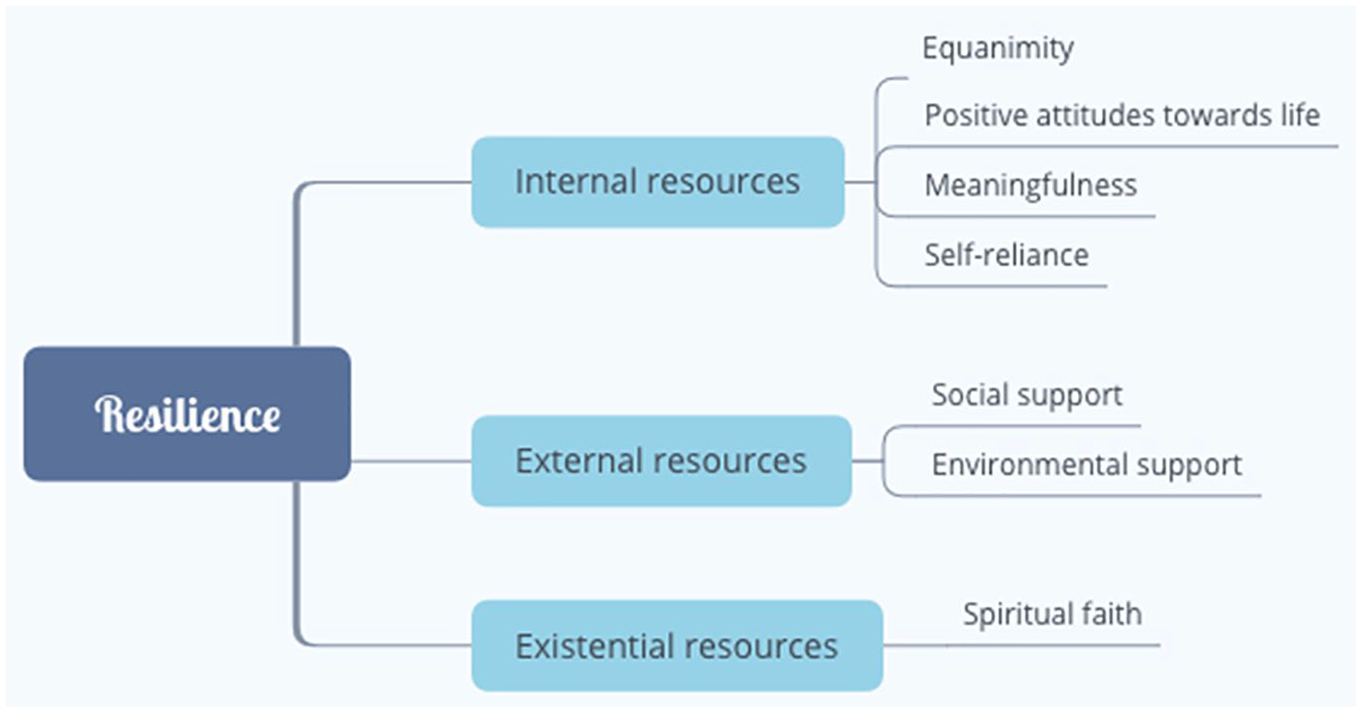
Resilience conceptual model.
Methods
Participants
Convenience sampling was used to recruit older adults in Hong Kong (Palinkas et al., 2015). Individuals who met the following criteria were recruited from community senior centers: (a) Hong Kong Chinese older adults who were at least 65 years old; (b) able to speak Cantonese; and (c) had good visual or auditory acuity or fundamental literacy. Their exposure to adversity was identified and recorded. The demographic characteristics of participants (age, gender, religion, occupations before retirement and income) were also collected.
Procedure
We firstly contacted the directors of the senior centers to request their collaboration. Members were then informed of the investigators’ backgrounds and the study at the monthly regular meetings and their basic information were collected from those who were interested in. Participants were recruited according to the principle of voluntariness and their data were kept confidential. Informed consent letters were signed before the interviews. The semi-structured individual interviews and focus groups were subsequently conducted in the centers.
Data collection was carried out according to the principle of data saturation (Saunders et al., 2018). Based on this principle, decisions about when the data collection phase is completely hinge on the researchers’ evaluation of whether they are hearing new information in the interviews. In this study, 16 face-to-face semi-structured interviews and two focus groups (with another nine older adults) were conducted. Both focus group discussions were moderated by a research assistant with extensive experience administrating focus group discussions and understood well the purpose of this study.
Based on the hypothetical model (see Figure 1), an interview protocol was developed, consisting of eight sets of open-ended questions that encouraged the participants to talk about their experiences (see Table 1). The focus groups and most of the interviews were conducted in Cantonese (two individual interviews were in Mandarin) and audiotaped. The interviews and focus groups were audiotaped and ranged in duration from approximately 21 to 65 min. Following the completion of the interviews, participants were given a supermarket coupon worth HK$50 as a reward.
Interview Questions.

Data Analysis
The current study adopted descriptive phenomenological approach, in which a general of typical essential structure was described based on descriptions of experiences from others (Giorgi, 1997). The descriptive phenomenological approach allows researchers being able to describe the subjective experience of resilience from the perspectives of the participants. Interpretive and critical epistemology informed data collection and analysis (Giacomini, 2010). In the current study, the recordings were transcribed verbatim and the transcripts of the interviews and focus groups were analyzed using qualitative content analysis. We used the analytic induction to describe the perceptions of participants’ perspectives (Elo & Kyngäs, 2008). Data was analyzed independently by two coders with psychology background and expertise in resilience. Consensus were reached after discussion between the two coders. Remained discrepancies were resolved by consulting a third coder who is a psychology professor with expertise in resilience.
Trustworthiness
Efforts were made to ensure the sensitivity, commitment, rigor, transparency and coherence, impact and importance of the study so that it would be trustworthy (Yardley, 2017). Sensitivity to the data was shown by not simply imposing preconceived categories on the data but carefully considering the meanings generated by the participants. Commitment and rigor were demonstrated by in-depth engagement with the topic, including thorough data collection, displaying expertise and skills in the methods employed, and undertaking a detailed, in-depth analysis. Peer examination enabled the establishment of transparency and coherence, which is investigator triangulation providing both confirmation of findings and different perspectives. Throughout the entire coding process, extensive discussions with researchers in the field of resilience were conducted. Critical friends were also invited to add tags and further refine the categories and themes. The requirement of impact and importance is fulfilled as our study could help to understand the resilience of older adults.
Result
Sample Characteristics
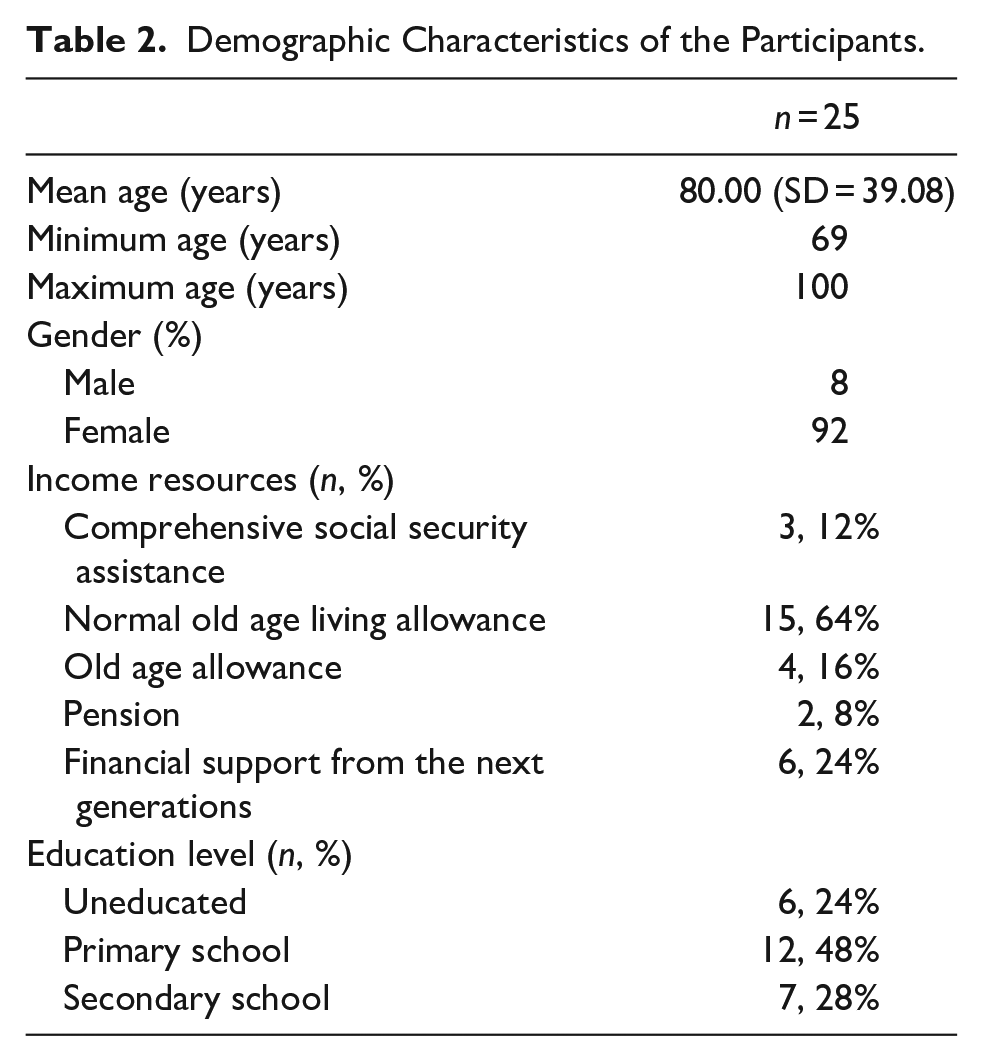
Table 2 summarized the characteristics of the participants, the mean age of them was 80 years (SD = 39.08), ranging in age from 69 to 100 years. The majority of participants were females (92%, 23; 8%, two males).
Demographic Characteristics of the Participants.
Resilience Factors
As reflected by the interviewees, resilience was a dynamic process that occurs over time and that involved different factors of resilience that could be internal, external or existential ones. Accordingly, seven themes were identified, including equanimity, positive attitudes towards life, meaningfulness, self-reliance, social support, environmental support, spirituality and faith. Figure 1 illustrated the conceptual model of all the themes.
Internal factors that pertained to resilience
Equanimity
This factor refers to the acceptance that life has both joys and sorrows. Equanimity encourages a person to bear the belief of letting the unhappy past go without losing gratitude for the past.
Contentment is a type of happiness. This word was mentioned 18 times in the interviews, implying that these seniors had a peaceful state of mind and fewer requirements for a cherished life. To live in the moment, and to accept and face tragedies is the best way to live. One participant recalled her response to a leg injury: There would be plenty of challenges in the life, which taught me how to enjoy the present. I can be persistent until a good solution is found. (S4, 82 years old, female)
Positive attitudes towards life
Not dwelling on problems that have already occurred and having a positive attitude both appear to be essential contributors of resilience.
Most of the participants said that being positive and optimistic helped them to face adversity. Interviewee 6 said that her past experiences had caused her to believe that nothing can bring her down. The most important thing was to be happy, which prolonged one’s lifespan (S6, 84 years old, female).
Meaningfulness
Older adults define meaningfulness as the realization that life has a purpose and is full of hope.
Many participants talked about their abundant lives, doing volunteer work (S2, 85 years old, female), singing pop songs (S13, 70 years old, female) or participating in drama performances (S10, 83 years old, female). They said that no matter how old you were, learning new skills and knowledge deserved your full devotion. The belief that helping others makes one realize the value of life was common among the participants. Many interviewees clarified that a particularly important motivation for them to overcome hardships was their responsibility for their families and children, and the expectations that the next generations would grow up healthy and make a difference.
Self-reliance
Self-reliance is the belief in one’s capabilities and the realization that each person’s life path is unique. The following words of a 78-year-old woman exemplified self-reliance: I dealt with everything by myself. One day a finance company called me to sign my name on my friend’s receipt for a loan, which turned out to be a fraud. I knew that the law case would fail if I signed my name. These skills were what I acquired in the ‘University of Life’. I went to the finance company and told the staff that I had called the police. I’m self-reliant. It was society that taught me to be independent. (S11, 78 years old, female)
Her story illustrated that her self-reliance was a kind of internal ability that was forged by the environment. Many female interviewees reported that their husbands passed away decades ago. They had to become independent, take care of their children and earn money to support the families. They had to rely on themselves and overcome the difficulties on their own.
External factors that pertained to resilience
Social support
All of the participants had high levels of social support. Throughout the interviews and focus groups, the older adults emphasized the value of social support, not just from family and friends, but also from health care professionals, staff in the elderly centers and others’ appraisal.
This study used four categories of social support defined by House (House, 1981). Specifically, emotional support is offering trust, love, empathy and caring; instrumental support includes spending time with someone else or providing them with money or fulfill their material requirements; informational support is furnishing someone with advice or useful information; appraisal support is supplying others with evaluative feedback. Different types of support may co-occur.
When I encountered some problems, I would turn to my children for help. I had limited knowledge and experience when facing difficulties in society. My children would help me to deal with the problems in an appropriate way. They could always give me some advice on those things. (S10, 83 years old, female) (Informational social support) I felt very depressed when my husband passed away. My daughter comforted me, ‘Mom, don’t feel depressed. It was inevitable that we would experience the death. We all had to come to this day.’ She believes in Christianity, and she also suggested me to pray if I couldn’t go to sleep. (S2, 85 years old, female) (Emotional and informational social support) When I had gallstone surgery, my friends and children came to take care of me and help me to get through it. After I had my surgery, my friends helped me with the grocery shopping and then my children would prepare the food for me after they came back from work. (S4, 82 years old, female) (Instrumental social support) I seldom said I was unhappy. When people in the senior centre saw me, they all said they wanted to hug me because I was like a pistachio. I was always delighted that people smiled when they met me. (S10, 83 years old, female) (Appraisal social support)
These four types of social support interacted and supplemented each other. Emotional support facilitated of psychological well-being, and older adults experiencing health-related challenges may benefited from emotional, informational and instrumental support to understand their illness and losses.
Environmental support
The interviewees described environmental support as a factor that helped them to live abundant and carefree lives. Environmental support includes support from neighbors, community senior centers and government agencies. Having access to suitable infrastructure and health care and taking part in physical activity are also important factors.
Neighbors featured prominently in the discussions, with a number of participants referring to long-established micro-communities and reciprocity networks within neighborhoods as a dimension for resilience. These interactions with neighbors contributed to resilience both through practical exchanges of resources and by creating a sense of meaning and warmth.
The interviewees described physical activity as something that benefited them to become acquainted with their bodies and brought them into contact with their friends, contributing to the increase of confidence and well-being. Some of the activities mentioned by the older adults were aerobic exercises, such as Tai Chi, walking, yoga, jogging and dancing.
The most frequently mentioned source of support was from Hong Kong government. Hong Kong is well-known for its high level of consumption and limited living space. But for older adults, the government provides a series of welfare policies, ranging from transportation to medical care. Almost all of the interviewees said that the government was very concerned about older adults. When asked what sustained him every day, a 69-year-old man said without hesitation that it was the government (S1).
Existential factors that pertained to resilience
Spirituality and faith
In this study, a belief in destiny, gratitude and religious faith were identified as sub-themes of spirituality and faith.
Some participants expressed their feelings of gratitude. Senior 10 (83 years old, female) told us, “I’ve been lucky all my life. I grew up in a honeypot environment and I also got married with a very caring husband who treated me as his princess. I was very grateful for that.”
Spirituality and faith can also be associated with a specific religion. In 16 cases, the participants reported that their religious faith gave them resilience. The religions of the older adults were Buddhism, Christianity and Catholicism, all of which contributed to the resilience of the interviewees. Interestingly, nearly half of the participants stated that they became interested in religion after an extreme situation, which was usually a turning point in their lives. Their trust in God helped them to cope with the challenges of illness and the fear of death. It gave them hope that their family members would all be taken care of after they left.
Discussion
Findings of the current study contributes to a growing field of study on the resilience of older adults. The findings provide some constructive perspectives on current conceptualizations of resilience. Older adults possess a variety of sources of resilience that help them to adapt well to stress and losses, although they had experienced adverse life events. These sources of strength are not only found internally, but also in the external and existential environment. Our qualitative study has developed more systematic descriptions of these factors from the perspective of older adults in Hong Kong. For example, “contentment is happiness” and “live in the moment” could be considered specific instances of the source described in the literature as “focus on the present” (Lopez-Fuentes & Calvete, 2015). In addition, we found that spirituality and faith are an existential source of resilience, which has been discussed in the literature as a helpful factor in coping with diseases (Pentz, 2005). Another contributor to resilience identified was “taking part in physical activity,” which has also been found in a previous study (Takahashi et al., 2016), although it has sometimes been classified as an individual resource (Lopez-Fuentes & Calvete, 2015). Lastly, it should be emphasized that our study is the first to identify government support as an important factor in environmental support, which contributes to positive adaptation to the stressful life of the elderly in Hong Kong.
Internal factors that help individuals respond to adversity include adaptive thinking styles and expectations of positive outcomes. Although the majority of the interviewees experienced painful and difficult lives, most of them described their current situation as satisfying and meaningful. This may indicate their desire to live in the present, and to let go of their negative past. For older adults, a positive attitude towards life is a pragmatic coping strategy for dealing with adversity, and is strongly associated with a realistic acceptance of one’s situation while keeping motivated and striving (Wiles et al., 2012). This emphasizes that an optimistic attitude is not merely an internal state, but is intertwined with relationships with other people, with the resources available in a specific community surrounding and other factors such as government services.
Perceived social support is described as beliefs and perceptions about support availability (Holt-Lunstad & Uchino, 2015). The importance of perceived social support to the health of older adults has been extensively documented (Barth et al., 2010; Holt-Lunstad et al., 2010). Supportive relationships have been found to help seniors to live their lives freely and in a less stressful manner. Older adults from the current study indicated that they received both emotional and instrumental support from their relatives and friends, and were also involved in enjoyable activities with them, like going out for day trips or enjoying Cantonese morning tea together. These positive social relationships definitely contributed to their abundant experiences in later life, as they felt they were part of a greater whole and valued by others.
An interesting finding of the current study is that more than half of the participants indicated they were hesitant to ask for support from others, especially from their children. This is because they did not want to become their children’s burden, although they sacrificed a lot for their families despite adversities encountered by themselves. With older adults acknowledged that, they would be gratified when their children living better lives than they do, it seems that harmonious family relations are essential for a satisfying life and well-being for older people with traditional Chinese values. Older adults in this study often exercised together in the morning showing that their relationships involving co-engagement and were more likely to convey social influence, companionship and social support (Ashida et al., 2019).
The distinct approaches illustrated by older adults indicating that spirituality and faith generated support and comfort, helped them find a meaningful community and partners, and supplied motivation and inspiration in the face of challenges. Spirituality and faith are often cited in the literature as important factors in the improvement of general health and well-being (Unantenne et al., 2011), reducing the harmful influences of stress after trauma (Brewer-Smyth & Koenig, 2014), and increased support for those with mental health issues (Koenig, 2012). Gratitude has not been identified as a component of resilience in any previous studies. This is consistent with previous finding that gratitude may be unique to the resilience of older adults (Pentz, 2005). Participation in religious activities may promote feelings of psychological well-being by providing opportunities for social interaction with people who have similar values, offering membership in informal social networks that may give support during hard times (Daaleman & Frey, 2004).
Limitations
Findings of the current study must be interpreted with an awareness of its limitations. First, participants of the current study were all members of community senior centers, in which older adults who were not members of the elderly centers cannot be included. Future studies could consider invite a more representative sample of participants by approaching participants from the street and invite participants with different social economic status. In addition, the majority participants were female (N = 23) in our study with only two male older adults, which may weaken the representativeness of the sample. Future studies might consider invite more male participants on purpose and try to examine whether the themes identified in this study are applicable to a more diverse group of older adults. Third, our participants aged over 69, with most of them can be considered as old elderly people. Older adults from different age ranges might from different times and different understanding on resilience. Therefore, future studies should also consider seek viewpoints from younger elderly people for example those aged from 60 to 69.
Conclusion
In this qualitative study, we identified equanimity, positive attitudes towards life, meaningfulness, self-reliance, social support, environmental support, and spirituality and faith as the key characteristics of resilience among older adults in Hong Kong. Findings of the current study contribute to the understanding of resilience in older adults, which could help clarify why some older adults in Hong Kong remain resilient despite traumatic experiences and multiple losses. Based on the findings of the current study, future research could consider developing comprehensive interventions on promoting resilience among older adults by targeting all the different characteristics.
Footnotes
Authors’ Note
Ethical approval for the study was obtained from the Hong Kong Baptist University Research Ethics Committee prior to the study. In addition, national regulations were followed in conducting the study and the participants were provided informed consent and assurance of anonymity and confidentiality of private information. We declare that all authors have contributed significantly as well as in agreement with the content of the manuscript.
Declaration of Conflicting Interests
The author(s) declared no potential conflicts of interest with respect to the research, authorship, and/or publication of this article.
Funding
The author(s) received no financial support for the research, authorship, and/or publication of this article.
