




Abstract
This study aims to characterize factors related to productive activity participation among community-dwelling older adults. Cross-sectional analyses using data from the National Health and Aging Trends Study were used to calculate weighted frequencies representative of the U.S. population of older adults. Multivariate logistic regression was used to explore factors related to participation outcomes (paid work, volunteering, caregiving). We found that 21% of community-dwelling older adults in the United States reported currently working. Older adults reported working in a wide range of occupations. Driving emerged as one of the most important factors related to increased odds of productive activity participation. Age, gender, and health factors were also significantly associated with increased odds of productive activity participation. By understanding the current profile of participation in activities including employment, caregiving, and volunteering among a national sample of community-dwelling older adults, we can effectively inform intervention programs and resource allocation to support productive aging.
Introduction
By 2030, one out of every five U.S. residents will be more than 65, with older adults being projected to represent a larger proportion of the population than children by 2035 (U.S. Census Bureau, 2018). This shift in the demography of the United States has resulted in a need for transformations in health, economic, and community systems (schools, health systems, labor markets, etc.) that were not designed to address the needs of the current aging population (Rowe & Kahn, 2015). Globally, there are efforts to explore ways to promote an active, inclusive society that embraces the contributions of older adults as productive members of their community; productive activity engagement among older adults contributes to increased psychological and physical well-being at both societal and individual levels (Hao, 2008). Supporting programs, policies, and interventions aimed at promoting increased contributions to society among older adults represent one way to maintain older adults’ sense of purposefulness and well-being as they age (Gonzales et al., 2015). Older adult work participation is complex, with research highlighting that health and socioeconomic status alone do not fully explain trends in older adult work participation (Coe et al., 2012; Fernandez et al., 1998; Kachan et al., 2015). Additional research is needed to examine ways in which older adults can either stay in the workforce or engage in similarly meaningful productive activities.
Productive Activity Participation
Rowe and Kahn (1998) define productive activity in a way that is not limited to employment, including “all activities, paid or unpaid, that create goods or services of value” (p. 47). Productive activities such as formal volunteering and caregiving as well as employment can be protective factors to older adults’ well-being and quality of life (McNamara & Gonzales, 2011). Activity engagement which is mentally stimulating such as employment or other complex productive activities have been associated with improved cognitive function later in life; however, the extent to which other individual characteristics, contextual factors, or occupational complexity are associated with overall mental health and physical function is less known (Hinterlong et al., 2007; Lee et al., 2019). Previous work has identified potential positive health effects of older adult productive activity engagement in multiple roles as opposed to role strain when older adults occupy multiple roles (Rozario et al., 2004). Many of the activities in which older adults participate are largely unpaid. The extent to which participation in these traditionally unpaid productive activities such as caregiving or volunteering differs from participating in paid work has yet to be fully described in the literature. This distinction between paid employment and productive activity as measured more inclusively (to include unpaid roles such as caregiving and volunteering) can have important implications for developing future programs and interventions to promote older adult community engagement as they age.
This Study
The primary goal of this study is to build upon the existing literature to describe key health and environmental factors related to older adult productive activity participation among a national sample of community-dwelling older adults. Specifically, participation outcomes include older adults’ working for pay, volunteering, and caregiving. This study is important in its examination of potential health, sociodemographic, and environmental determinants at the population level related to older adults’ productive activity participation among a nationally representative sample of community-dwelling older adults in the United States. This information can be used by rehabilitation public health professionals to inform and develop effective services to promote increased participation among older adults.
Research Design
Data and Sample
Data were obtained from the 2016 wave of the National Health and Aging Trends Study (NHATS). The NHATS uses a complex panel survey design that oversamples for African Americans and individuals at the oldest ages to yield a representative sample of Medicare beneficiaries in the United States ages 65 and older. Data and are collected annually via in-person interviews (Kasper & Freedman, 2017). The survey aims to characterize late-life function using a biopsychosocial approach. This approach to collecting data on older adults’ health and disability allows this study to explore a range of important health, environmental, and personal factors related to productive activity participation. This study’s primary outcomes include work, caregiving, and volunteering; therefore, subjects residing in nursing home or other residential settings were excluded from the analytic sample.
Measures
Productive activity participation
Productive activity was operationalized based on the construct proposed by Rowe and Kahn (1998) as “activities, paid or unpaid, that create goods or services of value” (p. 47). The NHATS survey includes three primary questions in their participation module that allowed us to identify (a) working older adults who are currently working in the labor force and (b) more broadly those who are engaging in productive activities. We used the following questions as our primary outcomes of interest: (a) Working was defined as those who positively endorsed the following item: “In the last month, did you ever work for pay or in a business you own?” and (b) General productive activity included those who positively endorsed any of the following items: “In the last month, did you ever work for pay or in a business you own?”; “In the last month, did you ever do volunteer work?”; or “In the last month, besides as a job/volunteer work, did you ever provide care for or look after an adult or child who cannot care for themselves?” The categories are not mutually exclusive to allow representation of a range of older adult productive activity participation categories.
Job type description
For respondents who reported participation in this work, descriptive occupational data were collected based on the self-reported type of work. The NHATS provides categorization of occupational titles in 23 categories; for descriptive visual presentation of the occupational profile of older workers, these categories were further aggregated into four domains of industry.
Demographic, health, and environmental variables
Covariates were classified into three primary groups: personal/sociodemographic, health, and environmental. Sociodemographic factors included age (categorical 1 65–70, 71–84, 85+), race, ethnicity (Hispanic vs. non-Hispanic), gender, and marital status. Health factors included self-rated health (excellent to poor), physical function as measured by the Short Physical Performance Battery (Guralnik et al., 2000), mental health as measured by the Patient Health Questionnaire for Depression and Anxiety (PHQ-4; Kroenke et al., 2009), any hospitalization in the past year, and reporting of having any chronic condition. Environmental factors included the individual’s living arrangement (alone vs. with others), accessible transportation (driving status), and community density (metropolitan vs. nonmetro area).
Analytic Strategy
Weighted frequency distributions were calculated to describe sample characteristics using analytic weights provided by the NHATS publicly available data (DeMatteis et al., 2017). A profile of job types was calculated across industry occupations with percentages and descriptions of each provided. Stratified multiple logistic regression analysis was used to examine key factors associated with older adults’ working and productive activity participation. Potential multicollinearity was examined using bivariate correlations with a model inclusion cutoff of 0.80 (Vatcheva et al., 2016). Observations with complete data for the identified variables of interest were included in the regression models. Accordingly, complete data were available for 85% of participant observations, and the analytical sample consisted of 5,057 participants. All analyses were performed using SAS 9.3 statistical software including proc SURVEYFREQ to calculate population estimates of frequency distributions of key demographic, health, and environmental characteristics (SAS Institute, 2012).
Results
Sample Characteristics
Weighted proportions representative of the U.S. community-dwelling older adults are provided in Table 1. Overall, the older adults were White, non-Hispanic (78%), reported good to very good health (65%), female (54%), married or living with a partner (57%), and in the younger (65–74) age group (55%). Approximately 21% of the population reported currently working, 22% reported caregiving of others, and 27% reported volunteering. Among the workers, 37.7% reported also volunteering and 62.3% reported additional caregiving roles. Among the sample of older adults who reported working for pay in the past year (n = 946), a broad array of industries represented the types of jobs in which older adults participate. Figure 1 shows the proportion of working older adults reporting for each general industry classification. The most commonly held jobs included those that fall in the administrative/sales category (35%) including work such as management, business/financial operations, and office and administrative support occupations. In total, 24% of older adults engaging in paid employment reported jobs in the labor and operations sector (e.g., food-preparation- and serving-related occupations, construction and extraction occupations, transportation and material moving occupations). And 18% reported working in the service/helping industry, having jobs such as community and social service occupations, health care practitioners and technical occupations, and protective service occupations. Finally, 13% reported working in the professional services sector, which includes computer and mathematical occupations, architecture and engineering, and life/physical and social science occupations.
Community-Dwelling Older Adult Characteristics (N = 5,930).
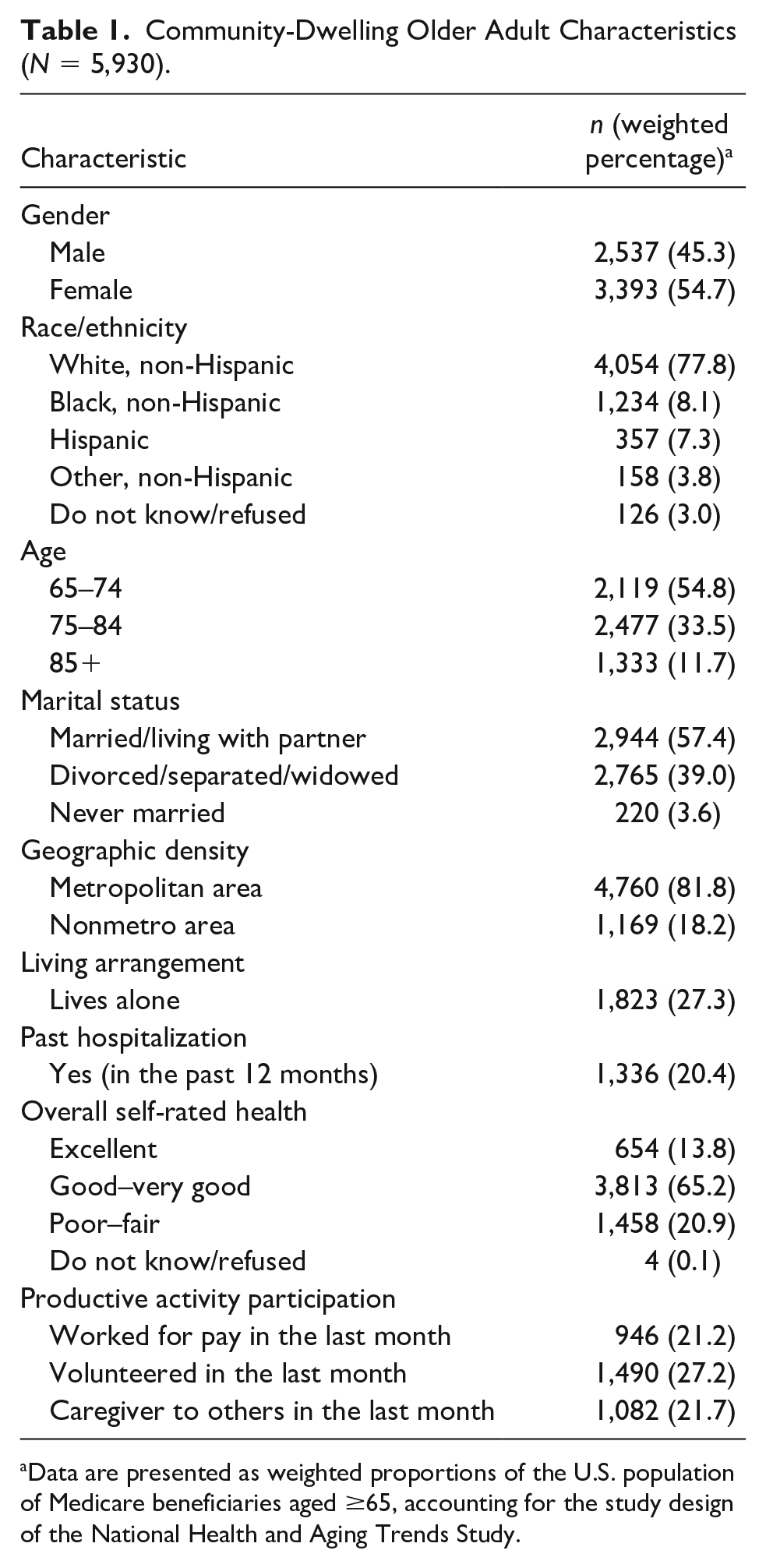
Data are presented as weighted proportions of the U.S. population of Medicare beneficiaries aged ≥65, accounting for the study design of the National Health and Aging Trends Study.

Occupational profile among older workers in the United States (n = 946).
Factors Associated With Productive Activity Participation
Table 2 presents the results of the multiple logistic regression analysis examining (a) factors related to older adults’ participation in paid work and (b) participation in any productive activity. Sociodemographic factors associated with participating in paid work include gender (females less likely to work) (odds ratio [OR] = 0.72; p < .0001), age (decreased odds of working among the 70–84 [OR = 0.64; p < .0001] and 85+ [OR = 0.22; p < .0001] age groups compared with the 65–69 age group), and marital status (those who are married are less likely to work [OR = 0.71; p = .0055]). Race and geographic density were not significantly associated with the likelihood of working within this sample of older adults. In terms of health factors, excellent/very good self-rated health (OR = 1.3; p < .0001), better physical function (OR = 1.2; p < .0001), and better mental health (OR = 0.93; p = .0023) were significantly associated with an increased likelihood of working. Having a chronic condition was not a significant predictor of work participation. A previous hospitalization in the past year indicated a reduced likelihood of working at a marginal statistical significance level (OR = 0.98; p = .492). Environmental factors that were associated with working included driving (increased odds of working [OR = 2.5; p < .0001]) and living alone (decreased odds of working [OR = 0.68; p = .0042]), whereas living in a metropolitan area was not a statistically significant factor with older adults’ likelihood of working.
Multivariate Regression of Productive Activity Participation (n = 5,057).

Note. p values are unadjusted and calculated using design-adjusted Pearson chi-square test for categorical variables and t test for continuous and ordinal variables. CI = confidence interval; PHQ-4 = Patient Health Questionnaire for Depression and Anxiety; SPPB = Short Physical Performance Battery.
PHQ-4 scores such that higher scores indicate increased depression/anxiety risk. The total score is determined by adding together the scores of each of the four items. Scores are rated as normal (0–2), mild (3–5), moderate (6–8), and severe (9–12). Total score ≥ 3 for the first two questions suggests anxiety. Total score ≥ 3 for the last two questions suggests depression. b SPPB scores such that higher scores indicate better physical function. The SPPB score is the sum of three individual scores: the Total Balance Score (BalScore), the Chair Stand Score (ChrStScore), and the Gait Speed Score (GaitScore), and yields a continuous score ranging from 0 to 12.
When examining the results for factors related to participating in a more inclusive definition of productive activity, age (decreased odds of participation with increased age 70–84 [OR = 0.74; p < .0001] and 85+ [OR = 0.49; p < .0001] categories compared with the 65–69 age group), physical function (better physical function increased odds of participation [OR = 1.2; p < .0001]), gender (females more likely to participate [OR = 1.3; p < .0001]), driving (increased likelihood of participation [OR = 2.0; p < .0001]), excellent/very good self-rated health (increased odds [OR = 1.5; p < .0001]), hospitalizations (decreased likelihood of participation [OR = 0.75; p = .0004]), and living alone (decreased odds of participation [OR = 0.80; p = .0161]) were significant factors related to participation in general productive activities.
Discussion
Older adults in the United States participate in a wide range of productive activities, engaging in work, caregiving, and volunteer roles. Approximately 20% of the older adult population currently works across a wide range of industry sectors and occupations. Many older adult workers report participation in multiple roles, such as working and caregiving (62.3%) or working and volunteering (37.7%). Sociodemographic, health, and environmental factors all play a significant role in their association with older adult participation in productive activities. However, some factors vary in the direction and magnitude of their relationship to the participation outcomes as operationalized as paid work versus a more inclusive definition that includes other roles such as volunteering and caregiving. These findings support previous research highlighting the complexities in factors related to older adults’ underlying desire to work, ability to work, and interrelationships between health, personal, and social factors (Nilsson, 2016).
Of note, driving significantly increased odds of participation in both models. Older adults were at least twice as likely to participate in productive activities as older adults who did not report driving. This finding is consistent with previous literature citing the importance of driving as a factor to increase activity and participation outcomes among older adults. Driving increases access to activities outside the home, especially within more driving-dependent environments and communities (Viljanen et al., 2016). Given the relationship between driving cessation and sex, gender, and other social determinants of health, future work should target driving and community mobility support for this vulnerable group of older adults (Choi et al., 2013). These programs should not only include access to public transportation services, but also include support for managing the transition from independent driving to using alternate means of transportation (White et al., 2016).
In terms of differences in the specified model outcomes, findings such as the effect of gender warrant future investigation. This study indicated that females had decreased odds of participating in paid work compared with males, but had increased odds of participating in productive activity when the outcome included caregiving and volunteerism. This finding is consistent with previous research documenting that females are more likely to exit the labor force as their caregiving roles become more demanding (Lee & Tang, 2015). Based upon the findings here as well as existing literature, future research should incorporate an explicit gender-based approach to investigating factors associated with participation outcomes such as work, volunteering, and caregiving to adequately address and promote productive aging among older adults (Paz et al., 2018).
Although this research provides additional insight into factors related to productive activity participation among a national sample of older adults, some limitations should be noted. An important factor to consider when investigating participation outcomes is the role of motive in terms of a person’s values or needs related to engaging in any given activity, especially activities such as employment, caregiving, or volunteering. This study had limited data to explore these underpinnings for rationale of older adult participation in productive activities, including capturing transition phases in and out of various productive roles (i.e., job changes, full time vs. part time, etc.). The current literature suggests a wide range of motivating factors for older adults’ engaging in employment, caregiving, or volunteering roles. Examples include health, financial, social support, and work-demand reasons (Carr et al., 2018; Nilsson et al., 2011). Future qualitative work using a mixed-methods approach will allow clarification of the conceptual link between the person, health, and environmental facilitators to productive activity participation.
Conclusion
In conclusion, this study is consistent with previous work in highlighting that many older adults are currently engaging in productive activities including paid work, volunteering, and caregiving. A sustainable proportion of older adults engage in not only one type of activity but participation in multiple productive roles. In addition, older adults who are currently working represent a diverse range of occupational industries. These findings indicate that facilitators and barriers to older adult participation in productive activities such as work, caregiving, and volunteering are complex. Additional work should be done to further investigate motivating factors delineating older adult ability versus desire to engage in various types of productive roles including employment, volunteering, caregiving, or a combination of the three (Nilsson, 2016). Developing ways to promote older adult productive activity engagement requires innovative approaches ranging from individual interventions to protecting and enhancing work, educational, and community policies and programs (Gonzales et al., 2015). Given the diversity in the older adult population, such productive aging interventions and initiatives should accommodate variation in sociodemographic, health, and environmental factors to be inclusive of all groups of older adults.
Footnotes
Author Contributions
E.E.M. planned the study, conducted the data analysis, and wrote the paper. C.W. contributed to revising and editing the paper.
Declaration of Conflicting Interests
The authors declared no potential conflicts of interest with respect to the research, authorship, and/or publication of this article.
Funding
The authors disclosed receipt of the following financial support for the research, authorship, and/or publication of this article: E.E.M. received support in part through grant R24 HD065702 from the National Institutes of Health—National Center for Medical Rehabilitation Research and the National Institute of Neurological Disorders and Stroke through the Center for Large Data Research and Data Sharing in Rehabilitation pilot studies program.
