




Abstract
Background
Frailty—a dynamic and multidimensional state of increased vulnerability—often remains undetected in primary care until its late presentation when a seemingly minor event results in significant health crisis (Moody, Lyndon, & Grant, 2017) affecting an individual’s level of function and independence (Di Pollina et al., 2017; Landi et al., 2004). Frailty is associated with an aging population, with prevalence rates in Canada of 25% in those 65 years of age up to 50% in those above 80 years (Muscedere et al., 2016), and results in higher usage of emergency departments, hospital admissions, social dependency, and caregiver burden (Xue, 2011). Although the prevalence of frailty increases with age, it is not an inevitable part of aging; and, with early recognition and targeted intervention, it can be mitigated (Harrison, Clegg, Conroy, & Young, 2015).
Major international agencies recommend case finding for frailty in older adults as part of routine clinical practice (British Geriatrics Society [BGS], 2014; Dent et al., 2017; National Institute for Health and Care Excellence, 2016). Case finding implies a systematic search for those at risk of frailty (e.g., those who require additional health and social services; British Columbia Ministry of Health, 2017). Ideally, frailty case finding tools should be valid, short (Morley et al., 2013), simple to use, and easy to interpret by nonspecialist staff (Clegg, Rogers, & Young, 2015). However, despite the abundance of existing tools, as summarized by Abbasi et al. (2018), they typically require additional time, training, use of specialized equipment, and clinical resources, thus potentially hindering efficiency and consistency in busy primary care settings. Moreover, most of these tools were developed for research purposes, therefore, questioning their acceptability and feasibility in clinical practice. These factors pose a significant challenge to the widespread implementation of frailty case finding in primary care.
Among existing validated tools, the BGS recommends the Program of Research to Integrate Services for the Maintenance of Autonomy-7 (PRISMA-7) and 4-m walk test to identify older adults in need of further assessment (BGS, 2014). Clegg et al. (2015) examined the diagnostic test accuracy of these simple tests in primary care: PRISMA-7 and 4-m walk test had high sensitivity (83% and 99%, respectively), but low specificity (83% and 64%, respectively). Low specificity of these tests can yield many false-positive results. To potentially improve the diagnostic accuracy, a two-step approach, where a simple frailty instrument is followed by another simple instrument (Clegg et al., 2015), has been proposed by the BGS. An example of a two-step approach could be administering the PRISMA-7 questionnaire followed by the 4-m walk test.
Another frailty identification tool that has been developed, implemented, and validated by Clegg et al. (2016) in a cohort of 931,541 seniors in 2015 is the electronic frailty index (eFI). In the United Kingdom, the eFI score is derived automatically from structured data contained in primary care electronic medical records (EMRs). Broad implementation of this tool has facilitated the introduction of routine identification and management of frailty within the National Health Service (NHS) primary care system (NHS Employers, 2017).
Despite the availability of research studies on diagnostic test accuracy of frailty identification tools, there is a significant dearth of knowledge about their feasibility and acceptability in clinical settings (Ambagtsheer et al., 2017; Lacas & Rockwood, 2012). Cognizant of this gap in knowledge, we aimed to test feasibility of PRISMA-7, the 4-m walk test, and eFI case finding tools as part of an integrated seniors’ program within the Canadian primary care setting, and the relative acceptability of these tools by health care providers (i.e., nurses/pharmacist vs. physicians).
Brief Description of the Integrated Seniors’ Program—Seniors’ Community Hub
The Seniors’ Community Hub (SCH) model was developed to build capacity in primary care to address the needs of community-dwelling seniors aged 65 years and older living with frailty. The model mobilizes available interprofessional health care providers (e.g., primary health care nurse, family physician, geriatric assessment nurse, pharmacist) within primary care clinics and provides a structured process of care. The process of care has the following key components: (a) case finding for frailty in clinic patients ≥65 years old, (b) team-based modified comprehensive geriatric assessment (mCGA) led by the geriatric assessment nurse on identified at-risk seniors (the mCGA was created based on the principles of the comprehensive geriatric assessment but modified to be done in the primary care setting over a series of visits), and (c) personalized care and support planning informed by the identified components of frailty and patients/families’ goals and priorities. Tailored evidence-informed interventions include exercise programming, nutritional support, medication review, self-management strategies, fall prevention, and connections to community services and resources (Abbasi et al., 2018).
Method
We assessed the feasibility and relative acceptability of PRISMA-7, 4-m walk test, and eFI by groups of health care providers within the SCH using a mixed-methods approach, as defined by Johnson, Onwuegbuzie, and Turner (2007) as a type of research that combines both qualitative and quantitative methods. This study was approved by the Research and Ethics Board of the University of Alberta, Canada.
Quantitative Method
Feasibility was assessed by percent completion rates and requirements for training, special equipment, physical space, and time.
Qualitative Method
Acceptability to health care providers was assessed using two separate focus group interviews intentionally divided to support candid and open feedback. Focus Group 1 included 11 clinical staff and Focus Group 2 included five physicians. Focus group discussions took approximately 1 hr; they were recorded and transcribed verbatim. Two researchers external to the clinic conducted the focus group interviews. The researchers’ background involved collaborative practice for health sciences and health care.
Setting and Participants
The study was conducted within one academic clinic in Edmonton, Alberta, where the SCH program was implemented. The clinic is composed of six primary care practices each with an attending physician and a defined panel of patients. The physicians are supported by a diverse team of health care workers (e.g., nurses, medical office assistants, receptionist).
We used purposive sampling to recruit 85 patients from this clinic who satisfied the following criteria: being 65 years of age and older, community dwelling, and consenting to participation in the study. Those who were below 65 years of age did not provide consent to participate in the SCH or were living in a long-term care facility at the time of enrollment were excluded from the study.
All 16 health care providers who worked full time in the clinic were eligible for the study and invited via email to participate in the focus group. In Focus Group 1, there were three primary care nurses, one geriatric assessment nurse, two medical office assistants, two receptionists, one pharmacist, and two administrative staff; age ranged between 30 and 65 years; years in practice ranged between 5 and 30 years. Focus Group 2 included five physicians (three women, two men; ages between 40 and 65 years; years in practice = 6-30 years). The sixth physician was on the research team and, thus, was excluded from the focus group interviews.
Frailty Case Finding Tools
Selection of tools was based on literature review and recommendations by the BGS (PRISMA-7 and 4-m walk test), in addition to novel primary care approaches for frailty identification (eFI).
PRISMA-7 is an easy-to-use tool comprising seven self-reported yes/no questions regarding age, gender, health problems, social supports, and mobility. This questionnaire can be used in a variety of settings and is also suitable for postal completion (Raîche, Hebert, & Dubois, 2005). It has a sensitivity of 0.83 and specificity of 0.83 (positive predictive value [PPV] = 0.40, negative predictive value [NPV] = 0.97; Clegg et al., 2015).
The 4-m walk test assesses an individual’s gait speed. A gait speed of 0.8 m/s or less (equivalent to taking longer than 5 s to walk 4 m) has high sensitivity and moderate specificity for identifying frailty (Sn = 0.99, Sp = 0.64, PPV = 0.26, NPV = 0.99; Clegg et al., 2015). Slow gait speed is associated with disability, institutionalization, injurious falls, and mortality (Rothman, Leo-Summers, & Gill, 2008; Studenski et al., 2011).
The eFI uses readily available structured data in primary care EMRs for frailty case finding. There are 36 deficits, equally weighted (Moody, 2016), that include comorbidities (two-thirds of all deficits), physical impairments, clinical signs, abnormal test values, and social circumstances (Satake & Arai, 2017). The eFI is used to identify people at high risk of adverse health outcomes and stratify people into categories of frailty (fit eFI score = 0-0.12, mild frailty eFI score = 0.13-0.24, moderate frailty = 0.25-0.36, and severe frailty > 0.36). The eFI has shown robust predictive validity for outcomes of nursing home admission, hospitalization, and mortality (Clegg et al., 2016). The eFI is not automated in Canada but the presence or absence of the 36 deficits can be retrieved manually from Canadian primary care EMRs. To facilitate this in our study, we trained a research assistant to review the EMR (structured and unstructured data) and calculate the eFI score for every patient in the senior’s program. The eFI score was then recorded in the EMR for the health care providers to review.
Data Analysis
Quantitative analysis
Descriptive statistics (frequencies) were used to describe feasibility of the case finding tools. Statistical analyses were carried out using SPSS for Windows (SPSS Statistics Subscription, SPSS Inc., Chicago, IL).
Qualitative analysis
Thematic analysis of focus group transcripts were conducted using the Braun and Clarke (2012) framework. This inductive approach to cluster similar data was supported by NVivo 12 software. The data were organized into preliminary codes, with two researchers reviewing and refining the codes, to describe the acceptability of the case finding tools and process by the groups of health care providers.
Results
Feasibility
Tool completion rates (%)
Case finding tools were administered to the 85 seniors aged 65 years and older who were part of the SCH program and received mCGA. The sample (n = 85) consisted of 51 (60%) females and the mean age was 81.1 years (Md = 82 years, SD = 7.6 years), with 60% being 80 years and older. Table 1 shows the main characteristics of the sample. Eighty-three of the 85 patients had a PRISMA-7 completed (97.6% completion rate, with two refusals), but despite being a self-administered questionnaire, in some cases, patients required help from caregivers or staff to answer the questions. The 4-m walk test had 93% completion rate (79/85) because six individuals were not able to physically do the test (e.g., wheelchair bound). The eFI was done on all the patients (100% completion rate) as the research assistant reviewed each patient EMR and generated the eFI score.
Sample Characteristics (n = 85).

Note. SCH = Seniors’ Community Hub.
Training, equipment, space, and time
No training or special equipment was required to administer PRISMA-7; however, staff did need to hand it out to eligible patients while in the waiting room. The gait speed test required brief training to ensure standardization, equipment (i.e., stopwatch), and space (i.e., measured 4-m walking distance). Both, the PRISMA-7 and the 4-m walk test, took less than 5 min to complete. The eFI required no special equipment, but the research assistant required training and it took 10 to 20 min/patient EMR to determine the eFI.
Acceptability
Perceived utility
Table 2 summarizes the themes (and quotes) that emerged from the focus group discussions. Although there were differences between clinical staff and the physicians in how tools were perceived, all participants agreed that these tools might serve an educational purpose: “. . . we’ve all gained that knowledge [about frailty] through the tools that we have, and that’s been invaluable.” As participants mentioned, “using a variety of tools [helped] to look at frailty in different ways . . . [ensuring] holistic approach to assessment [which] is useful.” Tools also enable shared language and understanding of frailty within and beyond this primary care clinic:
Themes and Quotes Related to Perceived Utility of Case Finding Tools That Emerged From Focus Group Interviews 1 and 2.

Note. PRISMA-7 = Program of Research to Integrate Services for the Maintenance of Autonomy-7; eFI = electronic frailty index.
“. . . we use some of these standardized tools to give a score and come up with a frailty level, so that we can try to speak the same language with others in, say, hospital, who are speaking frailty.”
Perception of burden
Initially, these primary health care providers expressed uncertainty about the process and case finding tools. For instance, the 4-m walk test was perceived to be disruptive to clinic flow as it required adequate space and time: “. . . it did not work with the nurse incorporating [it] into regular visits as you have to use the hallway—[and it is] crowded”; the acceptance improved when the test was incorporated into the assessment by the geriatric nurse. Even though the eFI required 10 to 20 min/patient EMR by the research assistant, physicians found it less intrusive and more helpful in stratifying patients. Reported burden of PRISMA-7 and eFI was low for both Focus Groups 1 and 2 (Table 3). However, additional charting, time spent explaining a new process to patients and caregivers, and expectations of clinic staff to review new information added to perceived burden. Despite this, there was consensus that all clinic staff and health care providers can benefit from understanding more about frailty and the tools. An identified need for updates, ongoing training, and intentional interactions between health care providers, staff, and physicians was acknowledged to support administration of case finding tools (i.e., effective and efficient booking process, identifying patients for case finding/assessment) and shared understanding of frailty. “I think we could probably benefit from having, regular—even if it’s, like, annual or something, just education around frailty and maybe how to use a couple of the tools for the rest of the staff.” The perception of burden was mitigated by willingness of all staff, providers, and physicians to support patient-centered care with “. . . a willingness of the staff as a whole to . . . make this work.”
Comparison of Perception of Burden of Case Finding Tools and Process Between Groups 1 and 2 (High Burden = Tool Not Being Used, Low Burden = Easy-to-Use Tool).
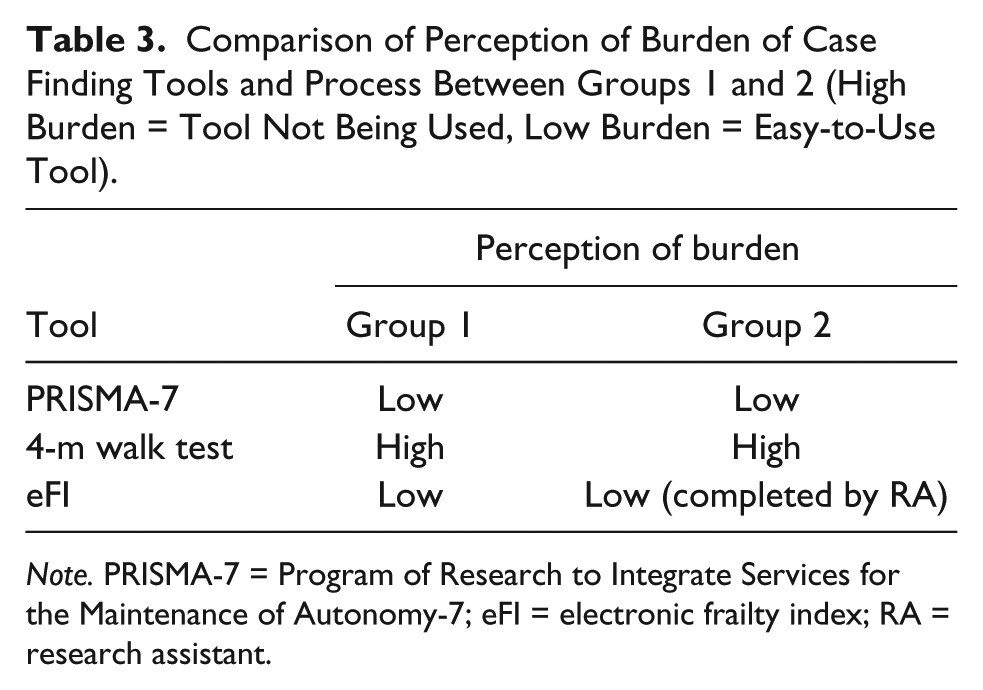
Note. PRISMA-7 = Program of Research to Integrate Services for the Maintenance of Autonomy-7; eFI = electronic frailty index; RA = research assistant.
All clinic staff believed the case finding tools and subsequent assessment of patients living with frailty streamlined access to resources and services. The overall approach to addressing frailty shifted from reactive to proactive, “Wasn’t it more reactive before, though? You know, the patient had something, you would react to it, this [approach] is more proactive.”
Discussion
This pragmatic study evaluated the feasibility and relative acceptability of recommended frailty case finding tools from the primary health care providers’ perspective. BGS guidelines recommend case finding in primary care by administering a two-step approach to improve diagnostic accuracy, where a simple frailty instrument is followed by another simple instrument (e.g., administering the PRISMA-7 questionnaire followed by the 4-m walk test). However, our study showed that despite each individual tool being feasible, there was varying acceptability by providers to implement the recommendations. Staff responsible for managing patient flow commented that any disruption to clinic efficiency or requirements of added space or equipment was not favorable. In contrast, the nursing team who were directly involved in patient assessments found the tools valuable in measuring frailty and identifying those at risk.
Interestingly, the physician group commented that they relied more on their clinical impression and relational continuity with their patients to determine risk of frailty rather than case finding tools. In a cross-sectional study examining general practitioners’ (GP) clinical impression in case finding for frailty in primary care, there is acknowledgment that although GPs’ clinical impressions of frailty are a valuable approach to identify frailty in primary care, this clinical impression is not sufficient and combining it with the use of a complementary objective measure/test is required to help GPs identify frailty more accurately (Fougère et al., 2017), and perhaps even earlier. It was interesting to also note that despite a reliance on their clinical impression, physicians were still open to the use of a frailty tool as long as it was not disruptive to their practice or efficiency. This was apparent in their comments about the eFI, because the research assistant generated the eFI score without introducing any disruptions for patients or physician work flow. When these physicians reviewed the eFI score, they also found it most helpful in stratifying the patient’s risk of frailty.
Although the eFI offers a novel approach to identifying frailty in the real practical setting, the current state of Canadian EMRs still requires additional work to generate this frailty score. The eFI is neither automated (i.e., requires a trained person to manually generate the score) nor embedded into point of care processes (i.e., physicians have to be reminded to review the score). There are a number of barriers for the transposition of the U.K. eFI to the Canadian system such as (a) differences in international coding classifications; (b) development of Canadian EMRs for transactional patient management rather than reporting, thus much of the data are in narrative/open text form (i.e., unstructured data); (c) the need for investment in standardizing and sharing electronic health data; and (d) lack of remuneration strategies/policies. Future studies with deployment of computer science techniques such as natural language processing and machine learning may facilitate the automation of an eFI from Canadian primary care EMR data and overcome these barriers and facilitate point of care frailty case finding.
However, one should be cognizant that frailty case finding could come with significant ethical and legal issues (Reid, Lahey, Livingstone, McNally, & Network, 2018) including medicalization of frailty, risking personal autonomy through stereotyping, and legitimizing denial of care. In our study, physicians voiced concerns over the negative consequences of labeling frailty in their patients, and this initially affected their acceptability of the tools. A key finding from a qualitative study (Shaw et al., 2018) was that to gain acceptance by providers and patients; case finding for frailty must not be implemented in isolation, but rather have a clear outcome/purpose such as being accompanied by a transparent pathway to care (e.g., linking to appropriate intervention and support services, building social and human connections, designing personalized care plans). This was apparent in our study as well; the acceptability of case finding tools improved as health care providers recognized the purpose of the SCH, and how the case finding process enabled proactive identification of individuals who could benefit from effective interventions and prevent these at-risk patients from becoming frailer and high users of the health care system by (a) designing appropriate care to meet patients’ needs based on an objective level of frailty, addressing common problems of frailty (e.g., mobility, cognitive impairment, social isolation), and preventing costly adverse health outcomes, such as unnecessary hospitalizations, avoidable disabilities, and early nursing home admissions; (b) addressing polypharmacy that is often associated with frailty and initiating the use of evidence-based checklists for targeted medication review; (c) identifying seniors with advanced frailty for conversations on end-of-life and advance care planning; and (d) identifying required resources and services for seniors based on frailty index (FI) results for a local population.
Addressing the multidimensionality of frailty in primary care requires a team-based approach and this study revealed differing acceptability of frailty tools and case finding process by health care providers. We recommend improving acceptability by building a shared mental model on the conceptualization of frailty, ensuring that case finding has a clear purpose of improving care with associated care pathways, discussing role clarity and collaborative responsibilities with the team, and utilizing effective strategies for practice change management. Moreover, gathering patient and caregiver perspectives on frailty identification and management may also advance acceptability of processes. Two relevant studies are currently underway in Australia to explore acceptability and feasibility of a number of frailty identification tools from the patient perspective (Ambagtsheer et al., 2017; Archibald et al., 2017). The patient and caregiver viewpoint may be key to uncovering beliefs and biases that may exist about features, stigma, and malleability of frailty and thus have an impact on the acceptance by patients to be screened or their motivation to adhere to recommended management strategies. The notion that frailty is malleable (i.e., can be mitigated, particularly in its early manifestations) requires a mental shift from the commonly held belief that frailty is an end state. Thus, it is essential to take into account the views, attitudes, and perceptions of older adults and their caregivers alongside health care professionals to assist with uptake of case finding and inspiring healthy aging.
Study Limitations
This study included six practices from one academic site supported by an interprofessional team. This clinic was chosen because this is where the SCH program was implemented. This allowed us to solicit the viewpoints of clinic members who were trained on the tools and whose patients received a comprehensive assessment as a consequence of early detection of frailty. That being said, the feasibility and acceptability of these case finding tools should be more broadly assessed in diverse clinic environments, both rural and urban, where resources and staffing issues are different.
Conclusion
Case finding for frailty in the primary care setting is complicated by time constraints, diverse care providers, and abundance of tools available. Despite feasibility of the recommended case finding tools, acceptance varied by provider role and was higher for tools with minimal clinic interruption, low requirements for resources, and those with added benefit (e.g., stratify risk, enhance understanding of frailty).
Footnotes
Declaration of Conflicting Interests
The authors declared no potential conflicts of interest with respect to the research, authorship, and/or publication of this article.
Funding
The authors disclosed receipt of the following financial support for the research, authorship, and/or publication of this article: This study was funded with a grant provided by the Covenant Health, Network of Excellence in Seniors’ Health and Wellness.
