




Abstract
To support the development of internationally comparable common data elements (CDEs) that can be used to measure essential aspects of long-term care (LTC) across low-, middle-, and high-income countries, a group of researchers in medicine, nursing, behavioral, and social sciences from 21 different countries have joined forces and launched the Worldwide Elements to Harmonize Research in LTC Living Environments (WE-THRIVE) initiative. This initiative aims to develop a common data infrastructure for international use across the domains of organizational context, workforce and staffing, person-centered care, and care outcomes, as these are critical to LTC quality, experiences, and outcomes. This article reports measurement recommendations for the care outcomes domain, focusing on previously prioritized care outcomes concepts of well-being, quality of life (QoL), and personhood for residents in LTC. Through literature review and expert ranking, we recommend nine measures of well-being, QoL, and personhood, as a basis for developing CDEs for long-term care outcomes across countries. Data in LTC have often included deficit-oriented measures; while important, reductions do not necessarily mean that residents are concurrently experiencing well-being. Enhancing measurement efforts with the inclusion of these positive LTC outcomes across countries would facilitate international LTC research and align with global shifts toward healthy aging and person-centered LTC models.
Introduction
Long-term care (LTC) homes comprise a care sector that is either established or of growing importance, in most health and social care economies internationally (Beard & Bloom, 2015). This growth is a response to population aging, migration, erosion of family care systems, and changing lifestyles, with families finding themselves less able to care for older relatives who have complex needs, commonly due to geographical removal or the need to work (Schols & Gordon, 2017). Across countries, different approaches have been taken to the funding, provision, and oversight of care in LTC homes (Damiani et al., 2011). This difference extends to how care outcomes are measured; while some countries have implemented few, if any measurement processes and minimal research that incorporates measurement, others have extensive processes connected to a similarly extensive research infrastructure (Tolson et al., 2013).
Research, quality, and performance data in LTC have often included deficit-oriented measures, for example, focusing on functional decline, neuropsychiatric symptoms, malnutrition, anxiety, and/or depression and consumption of pharmacological agents. However, a reduction in such negative conditions does not necessarily mean that residents are concurrently experiencing well-being. A paradigm shift in LTC practice and research is slowly moving the focus from functional decline and deficits toward a more positive and healthy view of aging and the care of older people and/or a better balance between negative and positive outcomes. Models of care based on such salutogenic views of aging and care have been developed that are more explicitly looking at how LTC can be organized, practiced, and evaluated in terms of impacting resident lives in positive ways. For example, studies show that LTC settings with a health-promoting model of care as well as a purposeful inclusion of meaningful everyday activities can facilitate health, quality of life (QoL), and well-being and support positive experiences of residents, family members, and staff (Bergland & Kirkevold, 2006; Cooney, Murphy, & O’Shea, 2009; Krajic, Cichocki, & Quehenberger, 2015; Zingmark, Sandman, & Norberg, 2002), suggesting that LTC settings can actually be places where residents thrive, not just survive (Bergland & Kirkevold, 2006; Björk et al., 2017).
A consistent challenge in international research is identifying a core set of measures for describing salutogenic attributes of LTC. Thriving is one positively focused concept related to LTC outcomes, emerging out of an increasing demand for aged care services to support personhood and place-related well-being. Well-being and QoL are more established concepts that have been a fundamental part of the LTC literature and practice for a long time, with associated challenges including a variety of measures available to use, and difficulties to aggregate and/or compare data across studies. Numerous studies have explored positive and negative care outcomes for residents in LTC, yet no consensus has been reached regarding a fixed set of measures to use in developing common data elements (CDEs) for international comparisons.
This heterogeneity of LTC sectors, and how outcomes are described and measured within them, has limited comparative LTC research, particularly research that is inclusive of less resourced countries lacking extensive data infrastructures. A recent international study of nursing home care across 30 countries found that only one third used a common data collection measure, which does not include well-being, QoL, or personhood (Tolson et al., 2013). Moreover, international differences in what is considered important to measure and in the meanings of measurement constructs, like health and well-being, add additional challenges to establishing internationally comparable data on outcomes in LTC. The Worldwide Elements to Harmonize Research in LTC Living Environments (WE-THRIVE) initiative is a group of LTC researchers who have convened to establish CDEs for consistent approaches to measuring and describing life in LTC homes as a basis for empirical learning within, between, and across settings and countries. It includes 59 researchers from 21 lower middle, upper middle, and high-income countries actively doing research within LTC settings (Corazzini et al., 2019). Here we describe work undertaken as part of the care outcomes domain to identify measures of well-being, QoL, and personhood in LTC settings for use and prioritized for further LTC CDE development as part of the WE-THRIVE initiative.
Aim
This article proposes a set of measures that can be used to measure well-being, QoL, and personhood for residents in LTC, and form the basis for developing CDEs for LTC outcomes across countries.
Method
The work of the WE-THRIVE initiative is guided by best practices in CDEs as constructed and described by the U.S. National Institute of Nursing Research–funded symptom science research centers (Redeker et al., 2015) and is aligned with the International Organization for Standardization (ISO; 2016) Action Plan for Developing Countries and the United Nations General Assembly (2015). Formed in November 2016, the WE-THRIVE initiative has conducted a multistep group process to identify core measurement domains of international interest within LTC (phase 1) and to identify and select concepts and measures of high priority to generate CDEs for inclusion in data collection and management protocols (phase 2). Most WE-THRIVE participants are from the nursing discipline (n = 43), with participants also from medicine (n = 5) as well as social and behavioral sciences (n = 11).
For phase 1, WE-THRIVE established four measurement domains, including (a) organizational context (external and internal to the LTC setting), (b) workforce and staffing, (c) person-centered care, and (d) care outcomes. To commence phase 2, WE-THRIVE convened in 2017 to generate domain concepts. The care outcomes subgroup was comprised of participants (n = 11) from Hong Kong, Jamaica, Japan, Sweden, Switzerland, the United Kingdom, and the United States, and generated 122 candidate concepts as being of high priority in terms of care outcomes in LTC in their contexts, culture, and countries. Once the complete pool of 122 candidate concepts were generated and clarified, concepts were discussed, conceptual overlap and redundancies were identified, and the 11 participants ranked and voted the top 5 priority concepts. The five final concepts were endorsed by the full plenary. These five concepts include symptom management, especially pain management; functional level; harm-free care, which was discussed as the absence of several avoidable, adverse outcomes, such as falls; well-being, which was discussed as comprised of two interrelated concepts of well-being and QoL; and personhood, described as, “letting people be people”; methodological details have been described elsewhere (Corazzini et al., 2019). This article focuses on the well-being, QoL, and personhood concepts as they are conceptually different from symptom management, functional level, and harm-free care in being positively focused and showing less agreement about measurement conventions. The remaining concepts will be explored in a forthcoming manuscript.
The next step in the process was to review the literature on available and commonly used measures for well-being, QoL, and personhood concepts. First, a lexical search was conducted to compare the common dictionary definitions for the concepts of well-being, QoL, and personhood (Table 1).
Dictionary Definitions of Search Terms.

These definitions were used to inform the key search terms used in the literature review. Measures available in the literature for assessing these concepts were identified by searches of PubMed and CINAHL in December 2018. The search terms used were “well-being + instrument,” “well-being + scale,” “wellbeing + survey,” “well-being + questionnaire,” and “well-being + measurement” (Table 2).
Summary of Search Terms and Database Results.
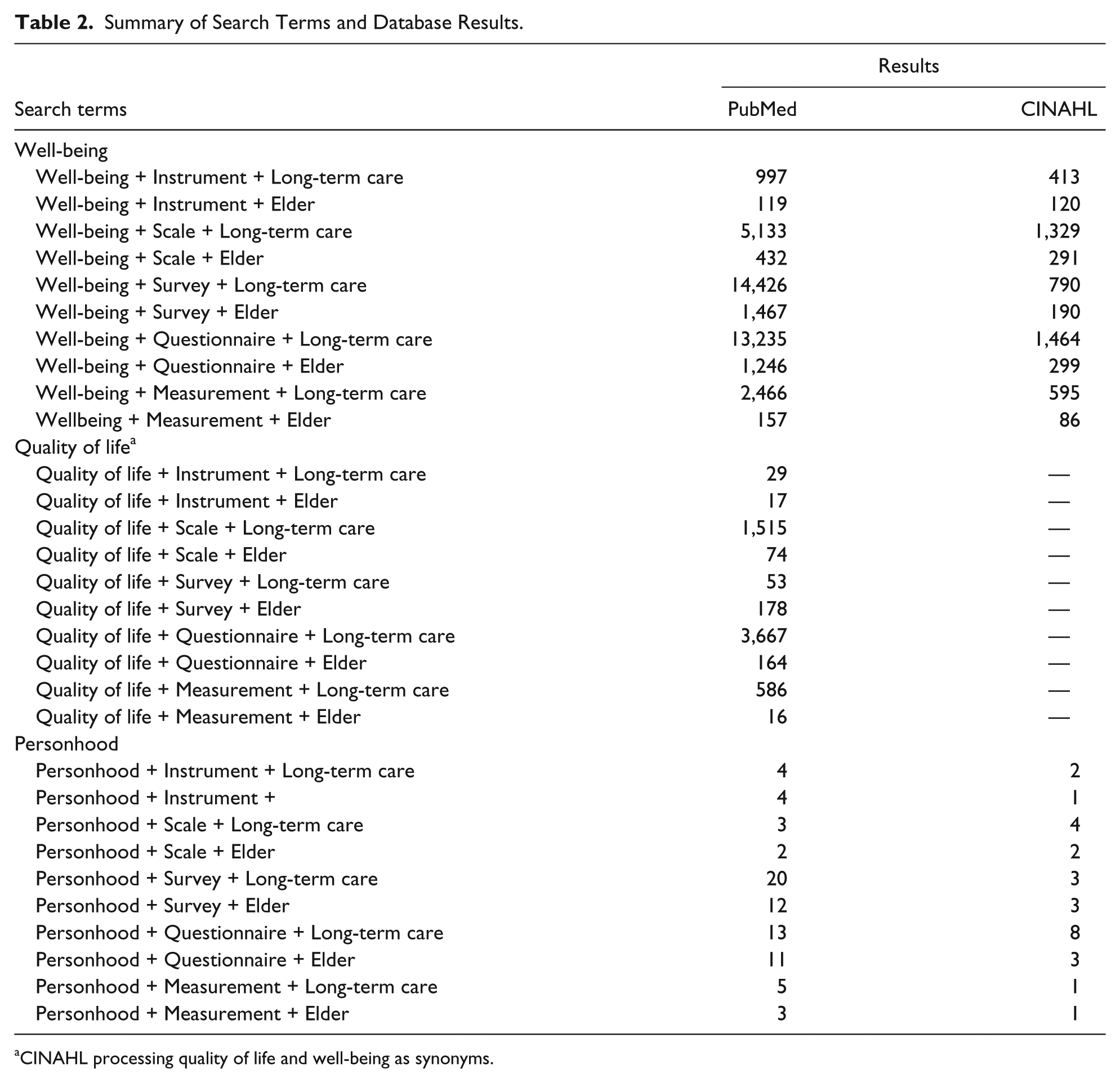
CINAHL processing quality of life and well-being as synonyms.
These paired search terms were also paired with “long-term care,” “nursing home,” and “elder.” The same paired search terms were used to identify instruments for QoL and personhood. The alternate spellings of “wellbeing” and “person hood” were also included in the search. The CINAHL database processed “well-being” and “quality of life” as synonyms, resulting in identical results for these searches. Inclusion criteria for articles/measures were publication in English, potential for use in LTC, possibility for analysis and comparison (i.e., not open-ended, free-text measures/questions), and possibility for use among older people. The measures (see the appendix) were then organized in descending order according to number of publications and frequency of use for review and ranking of importance by the WE-THRIVE working group and steering committee members.
As a first step, a table containing 15 measures identified through the literature review described above were sent out to 21 care outcomes working group members, and to 12 WE-THRIVE steering committee members (n = 12 measures for well-being/QoL, and n = 7 measures for personhood; Table 3). Working group and steering committee members were asked to review the identified measures and respond by reply email if there were any particular measures that they felt were missing for the concepts of well-being, QoL, and personhood. This first consultation resulted in adding measures around social care–related QoL, measures for assessing QoL in residents with cognitive impairment, as well as clarifying whether proxy ratings were possible with the suggested measures.
Ranking of Measures to Consider for CDEs.

Note. CDEs = common data elements.
As a second step, a revised list of 23 candidate measures was sent to the 21 care outcomes subgroup members and 12 WE-THRIVE steering committee members, and they were asked to rank the measures for each concept (i.e., well-being, QoL, and personhood) in terms of being the “best” measure for use across LTC studies internationally. Steering committee and working group members drew upon their scholarly knowledge about and/or experience in using the measures, as well as their analysis of how well the measures operationalize the concepts selected, in making their individual determinations of what were the “best” measures. The measures sent out for ranking included measures for well-being and general QoL (n = 9), measures for dementia-specific QoL (n = 6), and measures for personhood (n = 7). The panel members were asked to rank the best measure as 1, the second best as 2, and so forth; thus, measures with the lowest scores were ranked as preferred by the committee members. After committee members ranked the measures, scores were aggregated.
Results
Based on committee member rankings, three measures emerged as the most highly ranked for each concepts (Table 3).
The recommended measures for selecting well-being CDEs are ICEpop CAPability Measure for Older people (ICECAP-O), Short Form 36 Health Survey (SF-36), and Patient-Reported Outcomes Measurement Information System (PROMIS), ranked in that order. The recommended measures for general QoL CDEs (non-dementia specific) are World Health Organization Quality of Life (WHOQOL), EQ5D, and Adult Social Care Outcomes Toolkit (ASCOT), ranked in that order. The recommended measures for dementia-specific QoL CDEs are Health-Related Quality of Life for People With Dementia (DEMQOL), Quality of Life in Dementia (QUALIDEM), and Dementia Quality of Life Instrument (DQOL), ranked in that order. The recommended measures for personhood CDEs are the Thriving of Older People Assessment Scale (TOPAS), the Experience of Home Scale (EOH), and Personhood in Dementia Questionnaire (PDQ), ranked in that order. We propose these measures to be the first port of call for researchers and service-leaders doing work in LTC homes and wanting to generate internationally comparable data. The recommended measures are further presented below.
Well-Being
ICECAP-O
The ICECAP-O measures overall well-being of older people by exploring the capabilities of an individual through five questions related to five different attributes associated with well-being (Coast, Peters, Natarajan, Sproston, & Flynn, 2008). The ICECAP-O consists of five dimensions of well-being, with four response levels for each question (Coast et al., 2008). These five dimensions are attachment (love and friendship), role (doing something that makes you feel valued), enjoyment (enjoyment and pleasure), security (thinking about the future without concern), and control (being independent; Coast et al., 2008). The total score of the ICECAP-O is obtained by transforming scores into a utility value, which varies between 0 (no capability) and 1 (full capability; Coast et al., 2008). The ICECAP-O has shown satisfactory validity in measuring capability-wellbeing among older people post-hospitalization, as well as among use with older people with cognitive impairments living in nursing homes (Makai, Beckebans, van Exel, & Brouwer, 2014; Makai, Koopmanschap, Brouwer, & Nieboer, 2013), even if further research has been suggested into content validity aspects of the ICECAP-O (Proud, McLoughlin, & Kinghorn, 2019).
SF-36
The SF-36 is a standardized, self-report survey that measures patient health-related QoL (RAND Health Care, 2019; Ware & Sherbourne, 1992). The survey measures eight dimensions of health: physical functioning, role physical, bodily pain, general health, vitality, social functioning, role emotional, and mental health (Lins & Carvalho, 2016). The SF-36 consists of 36 questions that have dichotomous and 6-point Likert-type responses, and the SF-36 is scored by computing scale scores and then transforming the raw scale scores into a 0 to 100 scale (Ware, Snoww, Kosinski, & Gandek, 1993). Higher values indicate higher health status. Some psychometric issues such as face validity and floor effects among older people with cognitive and physical impairments in LTC settings have been raised for the SF-36 (Andresen, Gravitt, Aydelotte, & Podgorski, 1999).
PROMIS
The PROMIS outcome measures are person-centered instruments developed to measure physical, mental, and social health (Health Measures, 2019). Over 300 versions of the PROMIS currently exist to measure different dimensions and cater to different target groups, including cognitive function, positive affect, pain intensity, and ability to participate in social roles and activities. PROMIS measures also include ready profile questionnaires for adults and children (Health Measures, 2019). The PROMIS scales are scored by converting raw scores into standardized t scores (Health Measures 2019). PROMIS scales have been used in over 20 countries (Health Measures 2019).
QoL
WHOQOL-BREF/WHOQOL-OLD
The WHOQOL-BREF Instrument is a 26-item QoL life assessment measure, consisting of four domains: physical health, psychological health, social relationships, and environment (World Health Organization, 2019). The WHOQOL-BREF is a holistic measure, designed to be used cross-culturally (WHOQOL Group, 1998). The WHOQOL-BREF is scored by transforming the raw scores into domain scores, resulting in a range of 0 to 100 for each domain, with higher scores denoting higher QoL (WHO, 1996). The WHOQOL-BREF and WHOQOL-OLD have shown acceptable psychometric performance among use with older people in LTC settings and in the community (Lucas-Carrasco, Laidlaw, & Power, 2011).
EuroQoL—EQ-5D (5L/3L)
The EQ-5D, is a standardized, non-disease specific instrument which measures health status using a Visual Analog Scale (VAS) and health-related QoL using a descriptive system (Carr-Hill, 1992; EuroQol Research Foundation, 2017). The VAS measures self-rated health on a thermometer-like scale, with a total range of 0 to 100, with higher values representing better health (EuroQol Research Foundation, 2017). The descriptive system consists of five questions related to mobility, self-care, usual activities, pain/discomfort, and anxiety/depression, with three to five response levels (EuroQol Research Foundation, 2017). The responses to the descriptive system may be converted into a single five-digit value representing the individual’s self-reported health, weighted according to country-specific value sets, or presented as a health profile based on the five different dimensions (EuroQol Research Foundation, 2017).
ASCOT
The ASCOT is an instrument developed to measure social care–related QoL (Personal Social Services Research Unit, 2018). The ASCOT is available as versions for self-completion, interviews, mixed methods, easy read, and a proxy version for family/friend completion (Personal Social Services Research Unit, 2018). The self-completion ASCOT consists of eight dimensions: personal cleanliness and comfort, food and drink, safety, clean and comfortable accommodation, social participation and involvement, control over daily living, occupation, and dignity, with four response levels to each item (Personal Social Services Research Unit, 2018.). The ASCOT is scored by calculating an index score based on weighted values, resulting in an index value ranging from 0 (being dead) to 1 (ideal state) (Quality and Outcomes of Person-Centered Care Policy Research Unit, 2019). The ASCOT has shown satisfactory validity for in relation to LTC settings (Forder & Caiels, 2011).
Dementia-Specific QoL
DEMQOL
The DEMQOL is an assessment tool developed to measure health-related QoL in all stages of dementia, and is available as both a self-report and proxy-report version (Smith et al., 2007). DEMQOL self-report consists of 31 items, and DEMQOL proxy consists of 28-items, with four response levels to each item, and all items referring to the last week (Brighton and Sussex Medical School, n.d.). The DEMQOL measures five different domains: health and well-being, cognitive functioning, social relationships, daily activities, and self-concept (Mulhern et al., 2013). The items are scored between 1 and 4, resulting in a total range of 28 to 112 for the self-report version and 31 to 124 for the proxy version, with higher values indicating better health-related QoL (Mulhern et al., 2013). A health-state classification system for DEMQOL and DEMQOL proxy is also in development (Mulhern et al., 2013). The DEMQOL has shown satisfactory intraclass correlation coefficient (ICC) and moderate validity in people with mild, moderate, or severe dementia, although further studies have been suggested regarding psychometric performance in people with severe dementia (Smith et al., 2007).
QUALIDEM
The QUALIDEM is a proxy-based dementia-specific QoL instrument which is available in two different versions: a 37-item version for use among people with mild to severe dementia and an 18-item version for use among those with very severe dementia (Dichter et al., 2016). The QUALIDEM 37-item version consists of nine domains: care relationship, positive affect, negative affect, restless tense behavior, positive self-image, social relations, social isolation, feeling at home, and having something to do (Dichter et al., 2016). The 18-item version excludes the domains positive self-image, feeling at home, and having something to do (Dichter et al., 2016). QUALIDEM is scored by adding up the item scores for each subscale, with ranges varying from 0 to 21, with higher scores denoting better QoL in the domain (Dichter et al., 2016). The QUALIDEM has been validated for use in care evaluations and research in LTC settings (Ettema, Dröes, de Lange, Mellenbergh, & Ribbe, 2007).
DQOL
The DQOL is a QoL assessment tool for people with dementia, consisting of 30 items, with five response levels (Brod, Stewart, Sands, &Walton, 1999). The DQOL consists of five subscales: positive affect, negative affect, feelings of belonging, self-esteem, and sense of aesthetics (Brod et al., 1999). The DQOL is scored by calculating the non-weighted average for each item of the subscale, with higher scores indicating better QoL (Brod et al., 1999).
Personhood
TOPAS
The TOPAS is a self- and proxy-rated scale that measures resident thriving in LTC. The scale contains 32-item statements comprising five dimensions: the resident’s attitude (toward living in a nursing home), quality of care and caregivers, resident engagement and peer relationships, keeping in touch with people and places, and qualities in the physical environment (Bergland, Kirkevold, Sandman, Hofoss, & Edvardsson, 2015; Bergland et al., 2014). Each statement is scored on a scale ranging 1 (no, I disagree completely) to 6 (yes, I agree completely) to achieve a possible sum score of 32 (lowest level of thriving) to 192 (highest level of thriving; Bergland et al., 2015; Bergland et al., 2014). The TOPAS has been validated for self- and proxy-rated use in Scandinavian LTC settings (Bergland et al., 2015; Bergland et al., 2014).
EOH
The EOH is a 25-item self-rated scale that was designed to measure the strength of meaningful experiences of living in the LTC home (Molony, McDonald, Palmisano-Mills, 2007). The EOH is comprised of three factors: home, not home, and boundary. Items are rated using a Likert-type scale ranging from 1 (strongly disagree) to 5 (strongly agree). The mean score for all items is the final scale score, where higher scores indicate a stronger experience of home in the environment where the respondent resides (Molony et al., 2007). The EOH has shown satisfactory reliability and validity in LTC environments (Molony et al., 2007).
PDQ
The PDQ measures staff attitudes toward personhood (Hunter et al., 2013). The instrument consists of 20-item statements that are scored using a Likert-type scale ranging from 0 (disagree strongly) to 7 (agree strongly) for a possible sum score of 0 to 140, where higher scores indicate a more positive attitude (Gridley, Brooks, Birks, Baxter, & Parker, 2016; Hunter et al., 2013). Dimensionality and factor structure are yet to be established.
Discussion
This article proposes a set of measures that can be used to establish CDEs for measuring positive care outcomes in terms of well-being, QoL, and personhood for residents in LTC. We described results from a systematic approach involving the establishment of an international multidisciplinary interest group into LTC research, a structured selection and prioritizing process, a literature review and an expert-judge consensus process which resulted in prioritizing nine measures from which CDEs can be sourced to measure outcomes of well-being, QoL, and personhood in LTC homes. Measurement of these positive, desirable outcomes would complement historic approaches that have focused on important, but negative outcomes, such as pressure ulcers and falls. Coordinated use of such measures internationally would contribute to positive care outcomes being measured more widely and more similarly across countries and studies, strengthening capacity for international LTC research and offering efficiencies of scale in research design.
In the literature, well-being and QoL are often described as similar concepts, with definitions that vary slightly depending on philosophical standpoints or theoretical frameworks (Dodge, Daly, Huyton, & Sanders, 2012). Although well-being is commonly defined as a state of happiness or content, definitions of well-being in the literature range from well-being as a holistic phenomenon comprising of various predefined dimensions of human life, to a subjective phenomenon comprised of differing personal preferences (Dodge et al., 2012). The definition of personhood in aged care is just as diverse, and personhood could also be considered as a component or dimension of well-being or QoL, or vice versa. Therefore, it is important to identify measures that cover a range of dimensions, to account for variation in personal preferences of older people and increase validity for application in LTC research across different contexts, cultures, and countries. In conducting this work, we noted that the measures contained numerous dimensions or factors related to the concepts of well-being, QoL, and personhood. This finding is important as these measures could improve the potential to evaluate the quality of care in LTC in developed and developing countries, based on positive or meaningful experiences of care, in contrast to historic approaches that have focused on reducing harms and risks for poor outcomes. For example, the highest ranked well-being measures included dimensions such as physical functioning; vitality; general health perceptions; physical, emotional, and social roles; mental health; attachment; security; enjoyment; control; life satisfaction; and meaning and purpose (Coast et al., 2008; Health Measures, 2019; RAND Health Care, 2019; Ware & Sherbourne, 1992).
The highest ranked for QoL measures included dimensions such as mobility, self-care, usual activities, pain/discomfort, anxiety/depression, physical health, psychological health, social relationships, environment, personal cleanliness and comfort, nutrition, clean and comfortable accommodation, control over daily living, occupation, and dignity (Carr-Hill, 1992; EuroQol Research Foundation 2017; Personal Social Services Research Unit, 2018; World Health Organization, 2019). The dementia-specific QoL measures also included many of the aforementioned dimensions, but also encompassed aspects such as care relationships; positive affect; negative affect; restless/tense behavior; self-image, self-concept, and self-esteem; having something to do; feeling at home; feelings of belonging; and sense of aesthetics (Brod et al., 1999; Dichter et al., 2016; Smith et al., 2007). The personhood measures that received the highest rankings comprised of dimensions such as residents’ attitude, quality of care and caregivers, resident engagement and peer relationships, keeping in touch with people and places, qualities in the physical environment, and experiences of being at home or not at home (Molony et al., 2007). The highest ranked measures for well-being, QoL, and personhood contained dimensions related to physical, psychological, social, and environmental features. Thus, the recommended measures to form the basis for CDEs provide an initial understanding of the current breadth and variation concerning measurements related to well-being, QoL, and personhood in LTC.
This consensus process will hopefully contribute to create an agreement among an international body of experts, thereby helping us to achieve our goals of measuring meaningful experiences of life in international samples of LTC residents. By examining the dimensions of the most highly ranked concepts and measures, we note some conceptual overlap of these three concepts, and how these concepts may often intertwine. Further investigation into common dimensions related to each concept will potentially clarify and illuminate the core features of these concepts together as well as their interrelationships, and inform the selection of final CDEs for international research in LTC.
One strength of this work is in the systematic approach taken to expert consultation and literature searching to develop a list of candidate measures from which CDEs can be selected. An additional strength is that the WE-THRIVE initiative consists of a diverse group of researchers internationally who considered their various contexts and cultures to reach consensus on candidate measures. One limitation is the potential that the expert-panel convened may not represent the full breadth of expert opinion on outcome measurement in LTC homes internationally (i.e., many countries were not represented). LTC researchers from Africa have not yet joined the WE-THRIVE initiative, but engaging collaborators from that region will be a priority of the initiative going forward; continuing efforts will be made to be as inclusive as possible. A second limitation is that the process for identifying candidate measures was based on a limited number of search terms and were restricted to papers published in English only. In many low- and middle-income countries, measures may be published in the national language only, which would have been missed in our searchers. There is a risk, therefore, that our literature searches may not have encompassed all possible measures to be considered for CDEs; multilingual searches are recommended. Finally, we are yet unable to confirm the extent to which all of the measures have sufficient published data to support all aspects of psychometric properties and performance, or the extent to which the recommended measures are available in translated, cross-culturally validated versions, particularly in low- and middle-income countries. This can be seen as a limitation, while it can also be seen as a call for this important work to be initiated for measures where psychometric testing is limited or in countries where translated versions are yet to be developed.
Implications for Practice, Policy, and/or Research
The implications of this work include a proposition that the selected measures would be the first port of call for researchers and service-leaders doing work in LTC homes and wanting to generate internationally comparable data on positive care outcomes in LTC. The generation of comparable data will enable a better understanding of the ways in which LTC homes are similar, and different, internationally. This can help us move beyond the often very superficial comparisons of service models which commonly prevail in the international literature to facilitate a deeper understanding where shared learning opportunities as well as data aggregation and comparison can be better exploited.
This is the first step toward establishing CDEs for positive care outcomes in LTC settings, which means that the next steps in this domain will involve work to further examine these measures to (a) identify their constituent data elements, (b) compare/contrast data elements across measures (e.g., evaluate the face validity of data elements for measuring the concepts internationally), (c) identify any gaps in the availability of valid data elements to measure prioritized concepts internationally, and (d) seek to fill them with data elements from other instruments/literature (or if needed from data elements that we develop); and then ultimately arrive at recommending a set of CDEs, that might come from several instruments, that are prioritized for international use and revised over time as new evidence indicates necessary.
In addition, the next steps for the WE-THRIVE initiative also involve taking similar approaches to short-listing candidate CDEs for the other three outcome concepts (functional level, symptom management, and harm-free care) and for the other three WE-THRIVE domains (organizational context, workforce and staffing, and person-centered care). Once candidate measures for each of these domains are proposed, final consensus processes will be initiated to propose a finalized set of CDEs. Finalizing such recommendations can be done once candidate measures for all domains have been collated, reviewed, and ranked to maximize parsimony and avoid duplication. In the meantime, the candidate CDEs outlined in this article represent the distillation of a combined process of expert consultation, consensus-building, and literature review, and we believe they now comprise the best recommended measures for researchers/service leaders undertaking work in personhood, well-being, and QoL in LTC. We would like to strongly encourage researchers and service-leaders in LTC to engage with the WE-THRIVE initiative to ensure their voices inform the further work toward identification of LTC CDEs.
Footnotes
Appendix
Full List of Measures Reviewed by the Steering and Working Groups.
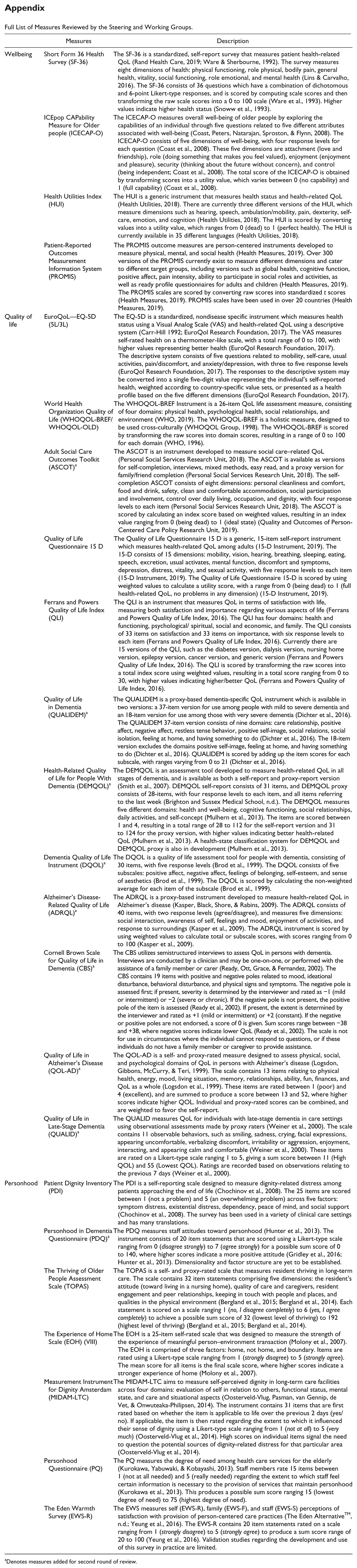
| Measures | Description | |
|---|---|---|
| Wellbeing | Short Form 36 Health Survey (SF-36) | The SF-36 is a standardized, self-report survey that measures patient health-related QoL (Rand Health Care, 2019; Ware & Sherbourne, 1992). The survey measures eight dimensions of health: physical functioning, role physical, bodily pain, general health, vitality, social functioning, role emotional, and mental health (Lins & Carvalho, 2016). The SF-36 consists of 36 questions which have a combination of dichotomous and 6-point Likert-type responses, and is scored by computing scale scores and then transforming the raw scale scores into a 0 to 100 scale (Ware et al., 1993). Higher values indicate higher health status (Snoww et al., 1993). |
| ICEpop CAPability Measure for Older people (ICECAP-O) | The ICECAP-O measures overall well-being of older people by exploring the capabilities of an individual through five questions related to five different attributes associated with well-being (Coast, Peters, Natarajan, Sproston, & Flynn, 2008). The ICECAP-O consists of five dimensions of well-being, with four response levels for each question (Coast et al., 2008). These five dimensions are attachment (love and friendship), role (doing something that makes you feel valued), enjoyment (enjoyment and pleasure), security (thinking about the future without concern), and control (being independent; Coast et al., 2008). The total score of the ICECAP-O is obtained by transforming scores into a utility value, which varies between 0 (no capability) and 1 (full capability) (Coast et al., 2008). | |
| Health Utilities Index (HUI) | The HUI is a generic instrument that measures health status and health-related QoL (Health Utilities, 2018). There are currently three different versions of the HUI, which measure dimensions such as hearing, speech, ambulation/mobility, pain, dexterity, self-care, emotion, and cognition (Health Utilities, 2018). The HUI is scored by converting values into a utility value, which ranges from 0 (dead) to 1 (perfect health). The HUI is currently available in 35 different languages (Health Utilities, 2018). | |
| Patient-Reported Outcomes Measurement Information System (PROMIS) | The PROMIS outcome measures are person-centered instruments developed to measure physical, mental, and social health (Health Measures, 2019). Over 300 versions of the PROMIS currently exist to measure different dimensions and cater to different target groups, including versions such as global health, cognitive function, positive affect, pain intensity, ability to participate in social roles and activities, as well as ready profile questionnaires for adults and children (Health Measures, 2019). The PROMIS scales are scored by converting raw scores into standardized t scores (Health Measures, 2019). PROMIS scales have been used in over 20 countries (Health Measures, 2019). | |
| Quality of life | EuroQoL—EQ-5D (5L/3L) | The EQ-5D is a standardized, nondisease specific instrument which measures health status using a Visual Analog Scale (VAS) and health-related QoL using a descriptive system (Carr-Hill 1992; EuroQol Research Foundation, 2017). The VAS measures self-rated health on a thermometer-like scale, with a total range of 0 to 100, with higher values representing better health (EuroQol Research Foundation, 2017). The descriptive system consists of five questions related to mobility, self-care, usual activities, pain/discomfort, and anxiety/depression, with three to five response levels (EuroQol Research Foundation, 2017). The responses to the descriptive system may be converted into a single five-digit value representing the individual’s self-reported health, weighted according to country-specific value sets, or presented as a health profile based on the five different dimensions (EuroQol Research Foundation, 2017). |
| World Health Organization Quality of Life (WHOQOL-BREF/WHOQOL-OLD) | The WHOQOL-BREF Instrument is a 26-item QoL life assessment measure, consisting of four domains: physical health, psychological health, social relationships, and environment (WHO, 2019). The WHOQOL-BREF is a holistic measure, designed to be used cross-culturally (WHOQOL Group, 1998). The WHOQOL-BREF is scored by transforming the raw scores into domain scores, resulting in a range of 0 to 100 for each domain (WHO, 1996). | |
| Adult Social Care Outcomes Toolkit (ASCOT) a | The ASCOT is an instrument developed to measure social care–related QoL (Personal Social Services Research Unit, 2018). The ASCOT is available as versions for self-completion, interviews, mixed methods, easy read, and a proxy version for family/friend completion (Personal Social Services Research Unit, 2018). The self-completion ASCOT consists of eight dimensions: personal cleanliness and comfort, food and drink, safety, clean and comfortable accommodation, social participation and involvement, control over daily living, occupation, and dignity, with four response levels to each item (Personal Social Services Research Unit, 2018). The ASCOT is scored by calculating an index score based on weighted values, resulting in an index value ranging from 0 (being dead) to 1 (ideal state) (Quality and Outcomes of Person-Centered Care Policy Research Unit, 2019). | |
| Quality of Life Questionnaire 15 D | The Quality of Life Questionnaire 15 D is a generic, 15-item self-report instrument which measures health-related QoL among adults (15-D Instrument, 2019). The 15-D consists of 15 dimensions: mobility, vision, hearing, breathing, sleeping, eating, speech, excretion, usual activates, mental function, discomfort and symptoms, depression, distress, vitality, and sexual activity, with five response levels to each item (15-D Instrument, 2019). The Quality of Life Questionnaire 15-D is scored by using weighted values to calculate a utility score, with a range from 0 (being dead) to 1 (full health-related QoL, no problems in any dimension) (15-D Instrument, 2019). | |
| Ferrans and Powers Quality of Life Index (QLI) | The QLI is an instrument that measures QoL in terms of satisfaction with life, measuring both satisfaction and importance regarding various aspects of life (Ferrans and Powers Quality of Life Index, 2016). The QLI has four domains: health and functioning, psychological/ spiritual, social and economic, and family. The QLI consists of 33 items on satisfaction and 33 items on importance, with six response levels to each item (Ferrans and Powers Quality of Life Index, 2016). Currently there are 15 versions of the QLI, such as the diabetes version, dialysis version, nursing home version, epilepsy version, cancer version, and generic version (Ferrans and Powers Quality of Life Index, 2016). The QLI is scored by transforming the raw scores into a total index score using weighted values, resulting in a total score ranging from 0 to 30, with higher values indicating higher/better QoL (Ferrans and Powers Quality of Life Index, 2016). | |
| Quality of Life in Dementia (QUALIDEM) a | The QUALIDEM is a proxy-based dementia-specific QoL instrument which is available in two versions: a 37-item version for use among people with mild to severe dementia and an 18-item version for use among those with very severe dementia (Dichter et al., 2016). The QUALIDEM 37-item version consists of nine domains: care relationship, positive affect, negative affect, restless tense behavior, positive self-image, social relations, social isolation, feeling at home, and having something to do (Dichter et al., 2016). The 18-item version excludes the domains positive self-image, feeling at home, and having something to do (Dichter et al., 2016). QUALIDEM is scored by adding up the item scores for each subscale, with ranges varying from 0 to 21 (Dichter et al., 2016). | |
| Health-Related Quality of Life for People With Dementia (DEMQOL) a | The DEMQOL is an assessment tool developed to measure health-related QoL in all stages of dementia, and is available as both a self-report and proxy-report version (Smith et al., 2007). DEMQOL self-report consists of 31 items, and DEMQOL proxy consists of 28-items, with four response levels to each item, and all items referring to the last week (Brighton and Sussex Medical School, n.d.). The DEMQOL measures five different domains: health and well-being, cognitive functioning, social relationships, daily activities, and self-concept (Mulhern et al., 2013). The items are scored between 1 and 4, resulting in a total range of 28 to 112 for the self-report version and 31 to 124 for the proxy version, with higher values indicating better health-related QoL (Mulhern et al., 2013). A health-state classification system for DEMQOL and DEMQOL proxy is also in development (Mulhern et al., 2013). | |
| Dementia Quality of Life Instrument (DQOL) a | The DQOL is a quality of life assessment tool for people with dementia, consisting of 30 items, with five response levels (Brod et al., 1999). The DQOL consists of five subscales: positive affect, negative affect, feelings of belonging, self-esteem, and sense of aesthetics (Brod et al., 1999). The DQOL is scored by calculating the non-weighted average for each item of the subscale (Brod et al., 1999). | |
| Alzheimer’s Disease-Related Quality of Life (ADRQL) a | The ADRQL is a proxy-based instrument developed to measure health-related QoL in Alzheimer’s disease (Kasper, Black, Shore, & Rabins, 2009). The ADRQL consists of 40 items, with two response levels (agree/disagree), and measures five dimensions: social interaction, awareness of self, feelings and mood, enjoyment of activities, and response to surroundings (Kasper et al., 2009). The ADRQL instrument is scored by using weighted values to calculate total or subscale scores, with scores ranging from 0 to 100 (Kasper et al., 2009). | |
| Cornell Brown Scale for Quality of Life in Dementia (CBS) a | The CBS utilizes semistructured interviews to assess QoL in persons with dementia. Interviews are conducted by a clinician and may be one-on-one, or performed with the assistance of a family member or carer (Ready, Ott, Grace, & Fernandez, 2002). The CBS contains 19 items with positive and negative poles related to mood, ideational disturbance, behavioral disturbance, and physical signs and symptoms. The negative pole is assessed first; if present, severity is determined by the interviewer and rated as −1 (mild or intermittent) or −2 (severe or chronic). If the negative pole is not present, the positive pole of the item is assessed (Ready et al., 2002). If present, the extent is determined by the interviewer and rated as +1 (mild or intermittent) or +2 (constant). If the negative or positive poles are not endorsed, a score of 0 is given. Sum scores range between −38 and +38, where negative scores indicate lower QoL (Ready et al., 2002). The scale is not for use in circumstances where the individual cannot respond to questions, or if these individuals do not have a family member or caregiver to provide assistance. | |
| Quality of Life in Alzheimer’s Disease (QOL-AD) a | The QOL-AD is a self- and proxy-rated measure designed to assess physical, social, and psychological domains of QoL in persons with Alzheimer’s disease (Logsdon, Gibbons, McCurry, & Teri, 1999). The scale contains 13 items relating to physical health, energy, mood, living situation, memory, relationships, ability, fun, finances, and QoL as a whole (Logsdon et al., 1999). These items are rated between 1 (poor) and 4 (excellent), and are summed to produce a score between 13 and 52, where higher scores indicate higher QOL. Individual and proxy-rated scores can be combined, and are weighted to favor the self-report. | |
| Quality of Life in Late-Stage Dementia (QUALID) a | The QUALID measures QoL for individuals with late-stage dementia in care settings using observational assessments made by proxy raters (Weiner et al., 2000). The scale contains 11 observable behaviors, such as smiling, sadness, crying, facial expressions, appearing uncomfortable, verbalizing discomfort, irritability or aggression, enjoyment, interacting, and appearing calm and comfortable (Weiner et al., 2000). These items are rated on a Likert-type scale ranging 1 to 5, giving a sum score between 11 (High QOL) and 55 (Lowest QOL). Ratings are recorded based on observations relating to the previous 7 days (Weiner et al., 2000). | |
| Personhood | Patient Dignity Inventory (PDI) | The PDI is a self-reporting scale designed to measure dignity-related distress among patients approaching the end of life (Chochinov et al., 2008). The 25 items are scored between 1 (not a problem) and 5 (an overwhelming problem) across five factors: symptom distress, existential distress, dependency, peace of mind, and social support (Chochinov et al., 2008). The survey has been used in a variety of clinical care settings and has many translations. |
| Personhood in Dementia Questionnaire (PDQ) a | The PDQ measures staff attitudes toward personhood (Hunter et al., 2013). The instrument consists of 20 item statements that are scored using a Likert-type scale ranging from 0 (disagree strongly) to 7 (agree strongly) for a possible sum score of 0 to 140, where higher scores indicate a more positive attitude (Gridley et al., 2016; Hunter et al., 2013). Dimensionality and factor structure are yet to be established. | |
| The Thriving of Older People Assessment Scale (TOPAS) | The TOPAS is a self- and proxy-rated scale that measures resident thriving in long-term care. The scale contains 32 item statements comprising five dimensions: the resident’s attitude (toward living in a nursing home), quality of care and caregivers, resident engagement and peer relationships, keeping in touch with people and places, and qualities in the physical environment (Bergland et al., 2015; Bergland et al., 2014). Each statement is scored on a scale ranging 1 (no, I disagree completely) to 6 (yes, I agree completely) to achieve a possible sum score of 32 (lowest level of thriving) to 192 (highest level of thriving) (Bergland et al., 2015; Bergland et al., 2014). | |
| The Experience of Home Scale (EOH) (VIII) | The EOH is a 25-item self-rated scale that was designed to measure the strength of the experience of meaningful person–environment transaction (Molony et al., 2007). The EOH is comprised of three factors: home, not home, and boundary. Items are rated using a Likert-type scale ranging from 1 (strongly disagree) to 5 (strongly agree). The mean score for all items is the final scale score, where higher scores indicate a stronger experience of home (Molony et al., 2007). | |
| Measurement Instrument for Dignity Amsterdam (MIDAM-LTC) | The MIDAM-LTC aims to measure self-perceived dignity in long-term care facilities across four domains: evaluation of self in relation to others, functional status, mental state, and care and situational aspects (Oosterveld-Vlug, Pasman, van Gennip, de Vet, & Onwuteaka-Philipsen, 2014). The instrument contains 31 items that are first rated based on whether the item is applicable to life over the previous 2 days (yes/no). If applicable, the item is then rated regarding the extent to which it influenced their sense of dignity using a Likert-type scale ranging from 1 (not at all) to 5 (very much) (Oosterveld-Vlug et al., 2014). High scores on individual items signal the need to question the potential sources of dignity-related distress for that particular area (Oosterveld-Vlug et al., 2014). | |
| Personhood Questionnaire (PQ) | The PQ measures the degree of need among health care services for the elderly (Kurokawa, Yabuwaki, & Kobayashi, 2013). Staff members rate 15 items between 1 (not at all needed) and 5 (really needed) regarding the extent to which staff feel certain information is necessary to the provision of services that maintain personhood (Kurokawa et al., 2013). This produces a possible sum score ranging 15 (lowest degree of need) to 75 (highest degree of need). | |
| The Eden Warmth Survey (EWS-R) | The EWS measures self (EWS-R), family (EWS-F), and staff (EWS-S) perceptions of satisfaction with provision of person-centered care practices (The Eden AlternativeTM, n.d.; Yeung et al., 2016). The EWS-R contains 20 item statements rated on a scale ranging from 1 (strongly disagree) to 5 (strongly agree) to produce a sum score range of 20 to 100 (Yeung et al., 2016). Validation studies regarding the development and use of this survey in practice are limited. |
Denotes measures added for second round of review.
Acknowledgements
We are very grateful for the valuable work provided by the Worldwide Elements to Harmonize Research in LTC Living Environments (WE-THRIVE) steering group members not participating here as co-authors, including Barbara Bowers, Elena O Siegel, and Anette Fagertun. We are also highly thankful for the very important work provided by the care outcomes working group members not participating here as co-authors, including, but not limited to, Cathleen Colón-Emeric.
Declaration of Conflicting Interests
The authors declared no potential conflicts of interest with respect to the research, authorship, and/or publication of this article.
Funding
The authors received no financial support for the research, authorship, and/or publication of this article.
