




Abstract
Introduction
Steps are a relevant physical activity outcome measure for older adults because walking is a common form of physical activity and is often the target of physical activity interventions (Tudor-Locke et al., 2011). Objective activity monitors offer a range of wear locations and monitoring capabilities from basic step counting to the measurement of physical activity intensity and energy expenditure (Yang & Hsu, 2010). If an objective activity monitor is used to assess walking behavior, it is critical that the monitor is accurate in measuring steps in the targeted population. While activity monitors have been studied in healthier, older populations (Grant, Dall, Mitchell, & Granat, 2008; Storti et al., 2008), there is limited research on the accuracy of activity monitors for counting steps in older adults who walk slow (<0.6 m/s), utilize an assistive device for walking (Van Remoortel et al., 2012), and reside in long-term care environments (Chan, Slaughter, Jones, Ickert, & Wagg, 2017).
In the current study, we sought to determine the accuracy of three research activity monitors in measuring steps in older adults with a range of walking speeds and assistive device usage who reside in independent living communities.
Method
Overview
This cross-sectional validation study assessed the accuracy of three research activity monitors in measuring steps in older adults during walking at their usual gait speed.
Subjects and Setting
Participants were recruited from independent living communities in the greater Pittsburgh area. To be eligible, individuals had to be ⩾65 years of age and able to walk at least 100 feet with or without an assistive device. Study visits were conducted at the independent living community and were administered by the principal investigator and members of the investigative team. The University of Pittsburgh Institutional Review Board approved the study and all participants provided written informed consent before participation.
Self-Report Measures
Participants were asked about demographics, comorbid health conditions (Rigler, Studenski, Wallace, Reker, & Duncan, 2002), and use of an assistive device for walking.
Gait Speed
Participants completed an initial assessment of gait speed determined by recording the time it took for each participant to walk the central 4 m of an 8-m course at their usual pace. Gait speed (m/s) was calculated as distance divided by the time to complete the 4-m walk in seconds.
Activity Monitors
Each participant wore three objective physical activity monitors: the Actigraph GT3X accelerometer (ActiGraph Corp, Pensacola, Florida), the ActivPAL (Pal Technologies, Glasgow, Scotland), and the StepWatch Activity Monitor (Modus Health, Washington, DC). These three models were selected because they are commonly used in research and feature varied wear locations and monitoring capabilities (Table 1). Prior to the walking tests, activity monitors were placed in a standardized manner across participants. The Actigraph was positioned at waist level on the anterior aspect of the thigh using an adjustable belt. The ActivPAL was positioned midway on the anterior aspect of the right thigh and secured with medical tape. The StepWatch activity monitor was attached above the lateral malleolus at the ankle of the right leg using an adjustable Velcro strap provided by the manufacturer.
Characteristics of the Activity Monitors.

100-Step Walking Test
Each participant completed two 100-step walking tests while simultaneously wearing all activity monitors. For each test, participants were asked to walk 100 steps on a level surface at their usual walking pace while two investigators manually counted steps. After the first test, the participant sat for 2 min to allow for an activity monitor washout period. The procedure was repeated a second time. Monitor accuracy, per trial and combined, was computed as the percentage of investigator-counted steps identified by the physical activity monitor (accuracy = 100 × monitor steps/observed steps). If a monitor identified more steps than the investigator, the accuracy was penalized by subtracting the extra percentage of steps from 100%.
Data Analyses
Participant characteristics were summarized to describe the sample. Accuracy was summarized both overall, and stratified by assistive device use (wheeled walker/rollator, cane, and no assistive device) and by clinically meaningful gait speed categories (<0.6 m/s, 0.6-0.79 m/s, 0.8-1.0 m/s, and >1.0 m/s) (Cesari et al., 2005). Comparisons across assistive device groups and gait speed categories were made using the nonparametric Kruskal–Wallis test.
Results
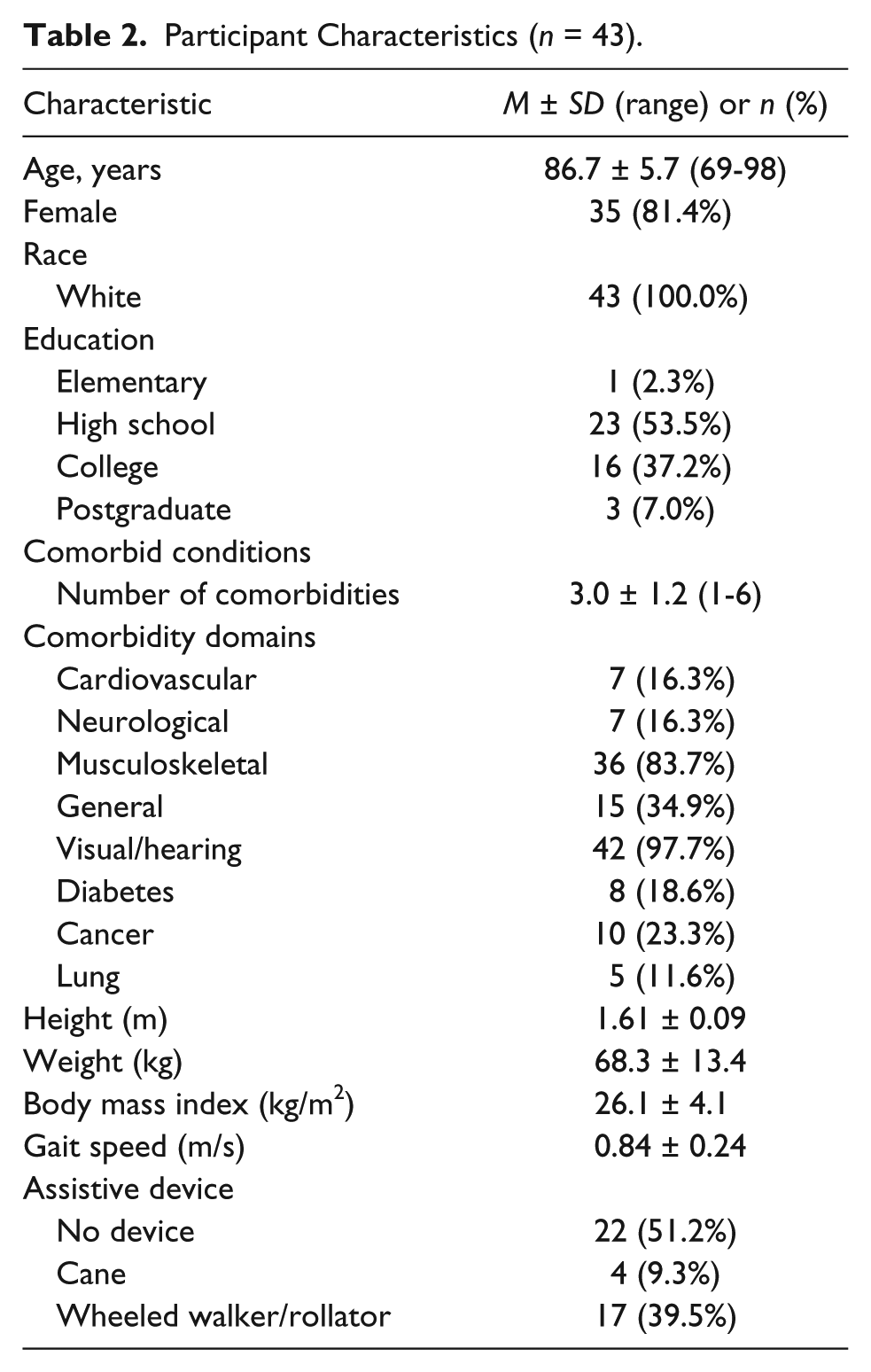
Characteristics of the participants are listed in Table 2. Participants (n = 43, age 87 ± 5.7 years) were predominantly female (81%) and White (100%) with a mean body mass index of 26.1 ± 4.1 kg/m2. Average gait speed was 0.84 ± 0.24 m/s and 21 participants (49%) used an assistive device for walking. Participants had an average of three comorbid health conditions with the most common domains being visual/hearing (98%), followed by musculoskeletal (84%) and other general health conditions (i.e., sleep, pain; 35%).
Participant Characteristics (n = 43).
Overall Accuracy of the Activity Monitors
Figure 1 summarizes overall accuracy of the monitors. Overall, the StepWatch had the highest accuracy for measuring steps (99.0% ± 1.5%), followed by the ActivPAL (93.7% ± 11.1%) and the Actigraph (51.4% ± 35.7%).
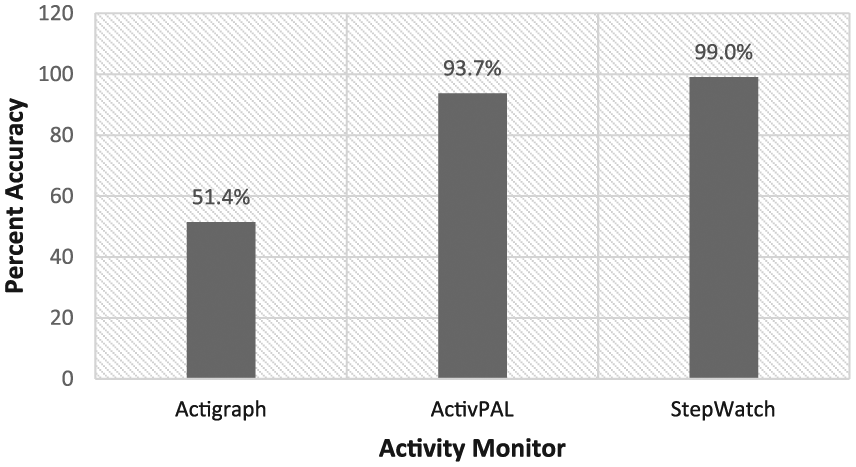
Overall percentage accuracy of activity monitors.
Accuracy of Activity Monitor by Assistive Device Use
Table 3 summarizes the accuracy of the activity monitors stratified by assistive device use. The accuracy of the Actigraph and ActivPAL differed by assistive device use (Actigraph 32.9% ± 28.8% to 67.3% ± 35.6%, p = .0071, and ActivPAL 80.6% ± 27.3% to 96.3% ± 7.0%, p = .0392) and were less accurate in those who used any device. The percentage accuracy of the StepWatch activity monitor did not significantly differ across conditions (p = .7312) and this monitor was ⩾97.7% accurate in those who walked with no device, a wheeled walker/rollator, or a cane.
Percentage Accuracy of Activity Monitors Stratified by Assistive Device Use.

Note. Accuracy defined as monitor steps/observed steps × 100 with 100% indicating perfect accuracy.
Accuracy of Activity Monitor by Gait Speed Category
Table 4 summarizes the accuracy of the activity monitors based on gait speed category. The accuracy of all three activity monitors differed by gait speed category (Actigraph 14.1% ± 18.6% to 85.1% ± 20.5%, ActivPAL 86.8% ± 14.0% to 95.1% ± 9.2%, StepWatch 98.2% ± 2.5% to 99.7% ± 0.3%, all p < .05) with Actigraph and ActivPAL being less accurate at slower gait speeds. The StepWatch was consistently accurate (⩾98.2%) across all gait speed categories.
Percentage Accuracy of Activity Monitors Stratified by Gait Speed Category.

Note. Accuracy defined as monitor steps/observed steps × 100 with 100% indicating perfect accuracy.
Discussion
In this study of older adults, the overall accuracy of the activity monitors for counting steps ranged from 51.4% to 99.0%. The Actigraph, a waist-worn, triaxial accelerometer, was the least accurate while the StepWatch, an ankle-worn, two-dimensional accelerometer, was the most accurate. The ActivPAL, a thigh-worn uni-axial accelerometer and inclinometer, had acceptable overall accuracy of 93.7%.
Our study found that both the ActivPAL and StepWatch had reasonable accuracy in those who used a wheeled walker or a rollator while the Actigraph grossly undercounted steps in this group. The finding that leg-worn activity monitors have similar accuracy for walker and nonwalker users is supported in a previous study of patients in inpatient rehabilitation. In this study, researchers found that leg-worn activity monitors were superior in accuracy compared with wrist-worn monitors for walker users (Treacy et al., 2017). The current study extends these findings to older adults residing in long-term care and reinforces the use of leg-worn monitors, such as ActivPAL and StepWatch, for those who use an assistive device such as a wheeled walker.
The accuracy of all the activity monitors was impacted by gait speed; however, the StepWatch activity monitor still had consistently high accuracy and the ActivPAL had reasonable accuracy across all gait speed categories. The Actigraph was found to be least accurate in measuring steps across all gait speed categories, and the number of steps were considerably underestimated in those who walked <1.0 m/s. The finding that the Actigraph monitor significantly undercounts steps in individuals who walk slowly is similar to findings in a prior study of community-dwelling older adults (Storti et al., 2008) and in hospitalized patients (Treacy et al., 2017) and reinforces that this monitor may not be suitable for measuring steps in individuals who walk <1.0 m/s.
Our study found that both the StepWatch and the ActivPAL activity monitors have reasonable accuracy for measuring steps in older adults with varying walking abilities. The choice between these monitors should be determined based on wear location preference (mid-thigh vs. ankle) and the physical activity outcome(s) of interest. For example, if walking behavior is the primary physical activity outcome, the StepWatch monitor would be a suitable choice. However, if additional physical activity parameters are of interest in addition to walking, such as energy expenditure or time spent in sedentary behavior, the ActivPAL monitor would be a more appropriate choice because the StepWatch only measures steps.
Study Limitations
This study has several limitations including a small number of participants in certain assistive device and walking speed groups, which may result in decreased precision for these groups. All participants were White and participants were predominantly female; therefore, our findings may not be generalizable to other populations. Despite these limitations, our study had several strengths. We used three commonly used research activity monitors that vary in wear location and features. In addition, our study sample included individuals with varying levels of walking abilities in the long-term care setting.
Conclusion
The StepWatch and the ActivPAL displayed reasonable accuracy in older adults with a range of walking abilities while the Actigraph had suboptimal accuracy in counting steps in older adults who walk slowly and those who use an assistive device. Researchers should select an activity monitor based on the specific characteristics of the population and the parameters to be measured, which may include additional physical activity outcomes in addition to step counting.
Footnotes
Declaration of Conflicting Interests
The author(s) declared the following potential conflicts of interest with respect to the research, authorship, and/or publication of this article: Bethany Barone Gibbs has received grant funding to her institution from the Humanscale Company.
Funding
The author(s) disclosed receipt of the following financial support for the research, authorship, and/or publication of this article: This work was supported by the Central Research Development Fund at the University of Pittsburgh, 5P30 AG024827 University of Pittsburgh Claude E. Pepper Older Americans Independence Center, NIH/NIA T32 AGO21885, and NIA K24 AG057728 Midcareer Investigator Award in Translational Patient-Oriented Research in Aging.
