




Abstract
International migration creates important consequences both for migrants and the family members they leave behind. Prior research has noted not only the adverse effects of children’s migration on parents’ mental health but also the fact that family ties and closeness can persist because of supportive exchange despite geographical distances. This study examined the associations between economic and emotional support from migrant children living abroad and depressive symptoms among Chinese elders in transnational families and whether such associations were moderated by the elders’ physical health status and the presence of children remaining in China. The data were collected from a cross-sectional survey of 293 older Chinese in transnational families in Beijing, China. The results of linear regression show that more emotional support from migrant children was associated with lower depressive symptoms among these elders. The association between emotional support and depressive symptoms was stronger among the elders who did not have children remaining in China and who had functional limitations. The findings suggest that maintaining emotionally supportive relationships with their migrant children abroad may help to prevent depressive symptoms among these elders, especially among the older adults who have functional limitations and who have no children remaining in the home country.
Introduction
International migration is one of the most noteworthy features of a globalized economy, creating important consequences both for migrants and the family members they leave behind. Along with these patterns in transnational movement and the separation of families, some scholars have spawned research on the emotional and psychological effects of children’s out-migration on their parents who remain in the country of origin (Marchetti-Mercer, 2012; Miltiades, 2002; Vullnetari & King, 2008), because family is the most immediate component of an elder’s environment and is consequently the most important source of support influencing his or her well-being (Grundy & Sloggett, 2003). Scholars have noted not only the adverse effects of migration on parents’ mental health but also the fact that family ties and closeness can persist despite geographical distances (Baldassar, 2007; Baldassar, Wilding, & Baldock, 2007; Baldock, 2003; Dhar, 2011a; 2011b; Zechner, 2008). Those benefits in persistent closeness are typically associated with emotional and monetary support, the most prevalent and convenient forms of transfer from migrant children to older parents in home countries. Still understudied, however, is the extent to which emotional and monetary support provided by migrant children affects the well-being of older adults in transnational families. The influence of support from migrant children on psychological well-being of older adults may also interact with situational factors such as physical health status of older adult and the availability of support from other family members. This study addresses these questions by investigating the effects of emotional closeness and monetary support from migrant children on depressive symptoms among their older parents left behind in Beijing, China.
The growing flow of emigration from China to other countries in recent decades and the value of children’s support in Chinese culture make this population a particularly interesting sample for such inquires. The number of migrants from China to other countries has doubled from 1996 (4.2 million) to 2015 (9.5 million), and since 2005, China has been the fourth-largest migrant sending country in the world (United Nations, 2017). The growing trend of emigration of young people has raised concerns about the support and well-being of their parents who are left behind in China. Filial culture emphasizing children’s respect for and devotion to their older parents (Cheng & Chan, 2006; Yue & Ng, 1999) also makes China a suitable context in which to study support from migrant children and the well-being of older adults in transnational families. The geographic distance across countries creates a great barrier against the traditional ideal of children providing filial support to their parents. Investigating children’s support delivered across international borders can thus broaden our understanding of evolving family relationships and of the needs of older adults in a context of globalization and changes in traditional culture.
Support From Migrant Children for Older Adults in Transnational Families
Transnationalism, which refers to the sustained ties of persons, networks, and organizations across national borders (Faist, 2000), highlights the importance of networks rather than place and distance. Based on this concept, studies of transnational families aim to explore strategies for maintaining ties and responsibilities in the bi-national context (Glick, 2010). Findings from these studies indicate the perseverance of emotional bonds and practical support between family members across international borders, which challenges the notion of weakening ties in transnational families (Baldassar, 2007; Baldassar et al., 2007; Baldock, 2003; Dhar, 2011; Zechner, 2008). In general, remittances and emotional support are the most feasible forms of support provided by migrant children to maintain strong family ties with their older parents across international borders.
Economic support (remittances) has been treated as a common form of support from migrants to their family members, including their older parents, remaining in the home country (Baldassar, 2007; Dhar, 2011). However, the importance of remittances is not homogeneous within transnational families across the world. Studies focusing on transnational families in the Netherlands and Taiwan, for example, have found that recent migrants tend to have younger, healthier, and wealthier older parents (Baldassar, 2007; Sun, 2012). In this context, rather than remittances going from migrant children to their parents, economic support provided by parents to help their migrant children settle in the host countries is more likely to occur. Furthermore, the importance of remittances from migrant children to older parents in transnational families depends not only on the resources of parents at the individual and family level but also on services and supports for older adults at the community and policy levels in the home country (Horn, Schweppe, & Um, 2013).
Emotional support from migrant children consistently plays an important role in maintaining connections with their family members in the home country (Baldassar, 2007; Baldock, 2003; Lee, Chaudhuri, & Yoo, 2015; Sun, 2012). Advanced communication technology makes frequent contact feasible and affordable for migrant children and their parents across countries, and the information of communication technologies could create a sense of co-presence, which may facilitate reciprocities and obligations across distance (Baldassar, 2016). As Baldassar (2007) argued, “staying in touch” not only maintains open channels of communication but also generates some level of emotional connection and care between migrants and their family members in the origin countries (Baldassar, 2007; Baldock, 2003; Sun, 2012).
However, there is lack of evidence based on quantitative data to identify to what extent the economic and emotional support from migrant children is associated with non-economic aspects of well-being among their family members in the home country. A few studies on internal migrant families in rural China report that remittances from migrant adult children are related to lower levels of depressive symptoms among their older parents living in home communities (Cong & Silverstein, 2008; Silverstein, Cong, & Li, 2006). Emotional support from migrant children could help maintain the ties with their older parents in home countries and make the elders feel cared about and cared for (Sun, 2012). Research on internal rural-to-urban migration of children and the psychological well-being of older Chinese has found that emotional cohesion with children is significantly associated with lower levels of depressive symptoms and higher levels of life satisfaction (Guo, Aranda, & Silverstein, 2009). A recent study on Chinese immigrant families in the United States also reported the significant association between higher levels of children’s support and better psychological well-being of Chinese older adults (Liu, Dong, Nguyen, & Lai, 2017).
Potential Situational Factors
Despite positive descriptions of support from migrant children for their older parents in home countries, the well-being of these older adults in transnational families remains critically understudied. Most existing studies of older adults in transnational families relied on qualitative methods and reported descriptive findings about the interaction between migrants and their older parents. To the best of our knowledge, no study to this point has examined how support from migrant children is associated with the psychological well-being of older adults in transnational families, given the important situational factors of these elders, such as their physical health status and the sources of support that exist in the home country.
Having no children left in the home country could be one of the situational factors that influence the associations between support from migrant children and psychological well-being of older adults in transnational families. Children’s international migration could result in ambiguous loss among older adults, which refers to the unclear, incomplete, or partial loss that results from a migrant child being physically absent but psychologically present (Boss, 1991; Falicov, 2002). A few studies reported that Mexican older adults who had child(ren) migrated to the United States are more likely to suffer from anxiety, sadness, loneliness, and depressive symptoms compared with their peers whose children did not migrate to other countries (Antman, 2010; Arenas & Yahirun, 2011). The elders whose children all migrate to other countries may have the strongest feelings of ambiguous loss, and thus may be more psychologically responsive to either monetary or emotional support from their migrant children.
Physical health problems could be a major source of vulnerability for older adults in transnational families (Gorfinkiel & Escrivá, 2012). The older population, in general, faces a higher prevalence of chronic diseases and functional limitations, resulting in greater need of assistance for daily activities. For the older adults in transnational families, those physical health problems may trigger their worries and anxiety about their future and consequently increase their depressive symptoms (Baldock, 2003). Economic support from migrant children could help the elders pay for health care services, which may alleviate the stress of physical problems. Emotional support from migrant children may also help elders to cope with the emotional stress that comes with poor health. Thus, it is reasonable to hypothesize that older adults in poorer physical health would be more psychologically responsive to both emotional and monetary support from migrant children.
Research Questions and Hypotheses
To extend the existing research on transnational families, in this study, we ask two research questions:
To address these two research questions, this study proposes three hypotheses:
Method
Survey and Sample
The data of this study were drawn from a project titled Chinese Older Adults in International Migrant Families, a study conducted by researchers at the University of Southern California and the University of Iowa in 2012. A purposive sampling method was used to recruit older adults in transnational families in Beijing. The eligible participants (a) were aged 60 and older and (b) had at least one child who moved to and settled in another country. They were recruited from senior centers, public areas in residential communities where older adults gather for morning exercise, and referrals from neighborhood committees, which are the grassroots organizations that serve various needs of local residents in urban China.
Eligible older adults completed either written or verbal informed consent before participating in the survey. A sample of 292 participants completed a survey questionnaire administered by qualified interviewers through face-to-face interviews in Mandarin, and the surveys lasted an average of approximately 50 min. The respondents were asked to assess their physical, psychological, and social well-being and their parent–child relationships. Each child of a respondent was discussed at length, beginning with the eldest, moving on to the same set of questions about their second child, and so on. After completing the questionnaire, the respondents received compensation that was not related to the quality of their answers. This study was approved by the institutional review board of the University of Southern California.
Measures
The dependent variable in the analysis is the depressive symptoms of the older adults, measured by a shorter version of the Center for Epidemiologic Studies–Depression (CES-D) scale that has been widely used in cross-cultural populations including older Chinese adults (Boey, 1999; Cheung, Liu, & Yip, 2007; Radloff, 1977; Zhang & Norvilitis, 2002). Respondents rated the frequency of nine symptoms (i.e., happiness, enjoyment, pleasantness, loneliness, being upset, feeling useless, having nothing to do, poor appetite, and trouble sleeping) that they experienced during the past week (0 = never or rarely, 1 = some of the time, and 2 = most of the time). We coded the items in the same direction and summed the scores to produce a measure ranging from 0 to 18, with higher scores indicating higher levels of depressive symptoms (Cronbach’s α = .833).
The independent variables are emotional closeness with migrant children and monetary support from migrant children. Each participant was asked the quality of his or her relationship with each migrant child and whether he or she received monetary support from the child. In this study, emotional closeness was measured by three questions adapted from the Intergenerational Solidarity Inventory (Mangen, Bengtson, & Landry, 1988), which assessed the quality of parent–child relationships from the parental perspective: (a) “Taking everything into consideration, how close do you feel to (this child)?” (b) “How much do you feel that (this child) would be willing to listen when you need to talk about your worries and problems?” and (c) “Overall, how well do you and (this child) get along together?” Response options ranged from 0 to 2 (0 = not at all, 1 = somewhat, and 2 = very), and the additive score for each child ranged from 0 to 6 (Cronbach’s α = .757). Given that most respondents reported fairly close relationships with their children, we further recoded the sum scores to three categories (1 = not close, if the sum score was 3 or lower; 2 = close, if the sum score ranged between 4 and 5; and 3 = very close, if the sum score was 6). The highest value across multiple children was used when a respondent had more than one migrant child. Monetary support was measured by asking respondents whether they had received money or gifts from each migrant child in the past 12 months (1 = receiving monetary support from any migrant children).
There are three moderators in this study. Having no child in China was indicated by a dichotomous variable (1 = no child in China, that is, all the children had permanently moved to other countries). Physical health status was indicated by functional limitations and the number of chronic diseases. Respondents reported their level of difficulty (0 = none, 1 = some, and 2 = cannot do it without help) in performing six activities of daily living (ADL) and five instrumental activities of daily living (IADL). Given the skewed distribution, we coded functional limitation into a dummy variable with 1 = having any difficulties with any ADL or IADL, and 0 = having no difficulties. The number of chronic diseases was based on the count of diagnosed chronic diseases that a respondent reported.
Control variables included demographic characteristics and socioeconomic status of the respondents. Demographic characteristics included age in years, gender (1 = female, 0 = male), and marital status (1 = married or partnered, 0 = divorced, widowed, or separated). Education and annual household income were used to indicate socioeconomic status. Level of education was coded as a dichotomous variable (1 = having a college degree or higher) because of the highly skewed distribution. Respondents reported their (and their spouse’s, if married) monthly earnings from pension and employment during the previous 12 months. We used natural log plus one of the Renminbi (RMB) value (in ¥1,000) of the total income for this variable, given its skewed distribution.
Analysis
Multivariate linear regression and interaction tests were conducted using STATA 14.0 to examine the three hypotheses. To examine the first hypothesis, we used economic and emotional support from migrant children to predict the depressive symptoms of older Chinese in transnational families (Model 1). To examine the second and third hypotheses, we first added the three moderators (i.e., having no child in China, functional limitations, and the number of chronic diseases) in the regression analysis (Model 2), then created interaction terms between these three moderators and the two forms of support from migrant children, and entered them separately (Models 3-5) and simultaneously (Model 6) in the analysis. It is worth noting that among the six possible interaction terms, monetary support by functional limitations was not tested because of the very small cross-tabulation cell of those who had functional limitations and who also received monetary support from migrant children (n = 6). In all of the regression models, the demographic characteristics and socioeconomic status of older adults were controlled for. Listwise deletion was used to address the small percentage of missing data (less than 5%).
Results
Table 1 reports the descriptive statistics of the Chinese older adults in our study. Over one fourth of the respondents received monetary support from migrant children. More than half of the elders considered their relationship with a migrant child very close, 28.47% perceived those relationships to be close and 15.69% reported that they were not close. Over one third of the elders had no child left in China. Almost one fourth of the elders had functional limitations, and on average, each elder had more than two chronic diseases. The mean score of depressive symptoms was 2.76 out of the range from 0 to 18.
Descriptive Statistics of Chinese Older Adults in Transnational Families (N = 292).

Table 2 shows results of the regression models controlling for sociodemographic characteristics of the older adults. In Model 1, having a close or very close relationship was significantly related to lower levels of depressive symptoms. Monetary support from migrant children was not related to depressive symptoms of older Chinese in transnational families. We added the three moderators in Model 2. Having no child in China, functional limitations, and number of chronic diseases were positively related to depressive symptoms, and such a relationship approached statistical significance.
Stepwise Linear Regression Analysis on Depressive Symptoms of Chinese Older Adults in Transnational Families.

Note. Coefficients (B) are reported.
The reference group is having a not close relationship with migrant children.
p < .10. *p < .05. **p < .01. ***p < .001.
Testing the moderating effects of the three moderators, it was found that none of the interaction terms between monetary support and the moderators were significant. Models 3 to 5 in Table 2 reported the results of regressions with significant interaction terms only. In Model 3, the interaction between having no child in China and having a close relationship with migrant children was related to lower levels of depressive symptoms and the interaction between having a very close relationship with migrant children and having no child in China was approached significant. As shown in Figure 1, on average, among adults who are not close to their migrant children, those who had at least one child somewhere in China have fewer depressive symptoms than those who have no remaining children in China. This difference does not persist among those adults who report closeness to their migrant children. The association between having a very close relationship with migrant children and lower levels of depressive symptoms was stronger in the older adults who had children in China than in those with no child remaining in China.
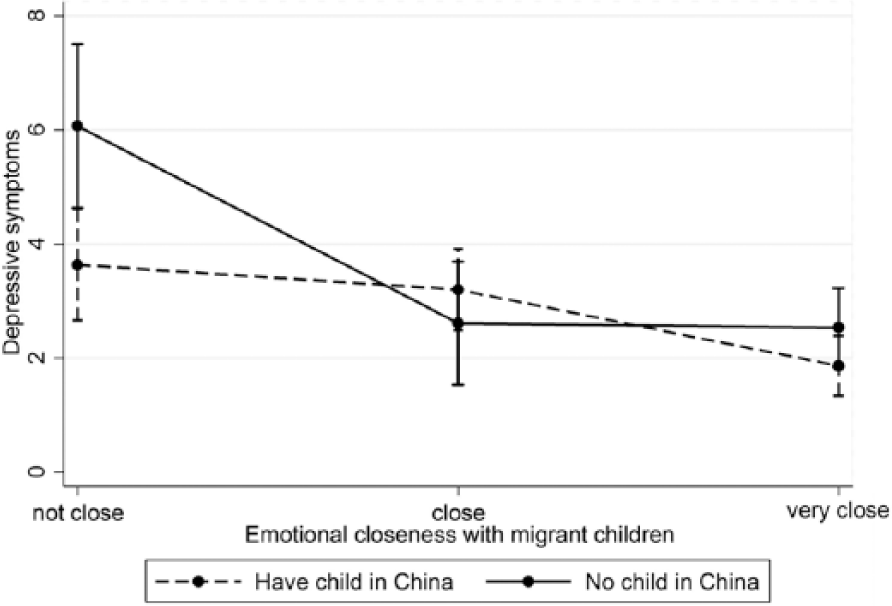
Interaction effect of emotional closeness by no child in China on depressive symptoms.
The results of Models 4 and 5 indicate that the influence of emotional support on depressive symptoms was stronger among those with functional limitations and those with more chronic diseases. Figure 2 shows that having a close or very close relationship with migrant children was associated with significantly lower levels of depressive symptoms of the older adults with functional limitations, while such emotional closeness was not associated with lower depressive symptoms of the elders who did not have functional limitation. As illustrated in Figure 3, the association between having a close or very close relationship and lower levels of depressive symptoms was stronger in the older adults with three or more chronic diseases than those who had less than three chronic diseases.

Interaction effect of emotional closeness by functional limitation on depressive symptoms.

Interaction effect of emotional closeness by chronic diseases on depressive symptoms.
Model 6 showed that, although the three interactions were all statistically significant in their independent models, when entering into the same model, chronic diseases no longer moderated the relationship between closeness with migrant children and depressive symptoms of older adults in transnational families. A t test shows that the older adults with functional limitations had more chronic diseases (M = 3.74) than that (M = 2.25) of those with no functional limitation (t = −6.76,p < .001). The interaction term, emotional closeness by functional limitations, may attenuate significance of the term, emotional closeness by the number of chronic diseases, on depressive symptoms because of the relatively strong association between functional limitations and the number of chronic diseases.
Discussion
This study explored the association between migrant children’s emotional and economic support and depressive symptoms of older Chinese in transnational families. The findings indicate that feeling emotionally close or very close to migrant children plays a protective role against depressive symptoms among these older adults. In addition, this protective function of emotional closeness with a migrant child appears to be particularly strong for older adults with no child in China and for those with functional limitations.
Partly supporting the first hypothesis, our findings demonstrate the importance of maintaining close emotional ties with migrant children to protect the mental health of older parents in transnational families. This finding is consistent with studies of rural elderly Chinese in internal migrant families (Guo et al., 2009). Emotional closeness may create a sense of family unity and continuity despite the geographic dispersion of the family, buffering the possible negative feelings of loss, abandonment, and loneliness that older adults may have. From a practical perspective, close relationships with migrant children may also be transferred to future instrumental support when needed, increasing older adults’ sense of security and mastery, thereby boosting their psychological well-being.
Particularly interesting is the finding that monetary support from migrant children was not related to depressive symptoms of older Chinese in transnational families. It is difficult to compare this result with previous literature, as very few studies have explored the potential psychological consequences of receiving monetary support from international migrant children for older adults. Yet, the finding is inconsistent with those studies on internal migrant families in rural China, which report that remittances from migrant adult children help to reduce the depressive symptoms of the rural elderly in China (Cong & Silverstein, 2008; Silverstein et al., 2006). The different nature and self-selection processes of internal versus international migration may explain this discrepancy. Unlike their rural counterparts with children who migrated internally, older parents in transnational families generally have better economic resources, which may have enabled them to send their children abroad to study or to work in the first place. It is thus more likely that these older adults can support themselves financially rather than depending on economic remittances from migrant children. As most older adults in our study had relatively higher education and income levels, receiving monetary support would not necessarily have benefited their psychological well-being.
Our findings support the second and third hypothesis, but only for emotional support. As expected, having a close relationship with migrant children had a stronger association with lower level of depressive symptoms among those who had no child in China than those who still had some children in China. Having a close relationship with migrant children was associated with similar level of depressive symptoms as having a very close relationship with migrant children among the older adults who did not have any child in China. However, for the older adults who still had children in China, only a very close relationship with migrant children could lower their depressive symptoms. Comparing with those who had children in China, the older adults with no child in the home country were more responsive to emotional closeness with migrant children, which partially supports the second hypothesis of this study.
We also found that having emotionally close relationships with migrant children is more mentally beneficial to older adults who have some functional limitations. Although one might expect that practical support in the form of financial remittances would be more needed and beneficial to address the increasing care needs of aging parents, it is still the emotional closeness that matters for these more vulnerable older adults. Understandably, such close ties may be particularly comforting, reassuring, and psychologically beneficial to older adults when they face more functional limitations.
The limitations of this study should be noted. The elders in the study were selected through a convenience sampling method and were characterized by high socioeconomic status, so the findings may not be generalizable to older adults in transnational families with lower socioeconomic status. Furthermore, because the study relies on cross-sectional data, we cannot rule out the possibility of a reversed relationship between support from migrant children and depressive symptoms among older adults in transnational families. In addition, this study did not differentiate the destination countries of children’s migration. Thus, the findings could not capture the nuanced experience of older adults who had children living in more geographically distant and culturally different areas (e.g., North America and Europe) versus those who had children living in another Asian country.
This study sheds light on the importance of support from migrant children for the mental well-being of older adults in transnational families. The findings contribute new knowledge about family dynamics and the well-being of older adults in the context of international migration. Future research may further explore the protective function of emotional support from migrant children on more domains of subjective well-being, such as better quality of life, less stress, and less loneliness among these elders. To fully explain the mechanisms linking intergenerational relationships to the well-being of older adults in the context of international migration, researchers also need to investigate negative interactions between aging parents and migrant children, such as conflict, disagreement and disappointment, and how those possible outcomes might impact the mental well-being of older adults in transnational families. It might be also interesting to explore whether emotional closeness with non-migrant children influences intergenerational relationship with migrant children and psychological well-being of older adults in transnational families.
The findings from this study may be useful for policy makers and practitioners in developing supportive programs and policies for older adults in transnational families. Overall, our findings point to the need for developing programs both in China and in the destination countries of international migration to enhance intergenerational relationships between older parents and their migrant children. Intergenerational programs in both the migration source and destination place could be designed to enhance communications between the generations and to resolve potential conflict and misunderstanding in the family. Clinical professionals in health care settings in China, such as physicians and nurses, should incorporate the proximity of patients’ children and the nature of their patients’ intergenerational relationships into the assessments they do when providing services for older adults in transnational families. Psychological therapists should also assess family support mechanisms in counseling services for older adults in China, and should help clients and their family members to develop supportive and healthy relationships across countries. Social workers both in China and the destination country (e.g., in a neighborhood with a dense population of Chinese immigrants) may develop educational programs in the communities to help older adults and migrant children understand the importance of intergenerational relationships on the mental health of elders in transnational families. The above services might focus primarily on older adults who have no children staying in China and those with functional limitations. Government-supported programs in China, such as frequent physical check-ups and in-home nurse or doctor visits, could be developed to help alleviate the burdens of these older adults. It is also important for community professionals in China to help the more vulnerable elders to remain connected with their existing networks (e.g., friends, religious communities, and neighbors) and to cultivate resources embedded in those networks to alleviate feelings of loneliness, helplessness, and hopelessness that can result from their children’s migration.
Footnotes
Declaration of Conflicting Interests
The author(s) declared no potential conflicts of interest with respect to the research, authorship, and/or publication of this article.
Funding
The author(s) received no financial support for the research, authorship, and/or publication of this article.