




Abstract
Introduction
The MacArthur model of successful aging (Rowe & Kahn, 1987, 1997) has been widely applied and cited in gerontology over the past 30 years. Different from the previous perspective that focuses on “normal” pathological aging, this model advances our understanding of the aging process by emphasizing factors that promote “successful” aging, which is defined as low probability of disease and disability, high cognitive and physical functioning, as well as productive activity and activity involving relations with others. Despite its enduring popularity, however, this model is not without its critics. As reviewed by Martinson and Berridge (2015), the number one critique to this framework is the missing voices critique, which accounted for close to 50% published critiques. In other words, the subjective components of successful aging perceived as important among older adults themselves who actually went through the aging process are often neglected in this definition.
As a result, increasing studies have documented the mismatch between researcher-defined successful aging and lay-reported successful aging among older adults (Gu et al., 2017; Montross et al., 2006; Strawbridge, Wallhagen, & Cohen, 2002). In fact, many older adults with chronic conditions and disabilities, who were disqualified by the Rowe and Kahn’s criteria, were self-identified as successful agers (Romo et al., 2013). These findings suggest that subjective perceptions of successful aging are likely to be more encompassing than the professional definition. The former tends to go beyond biomedical criteria to include more psychosocial factors such as life satisfaction (Havighurst, 1961), social functioning and participation, psychological resources such as acceptance, adjustment, attitude, spirituality, and emotional well-being (Bowling & Dieppe, 2005; Cosco, Prina, Perales, Stephan, & Brayne, 2013; Laditka et al., 2009; Lewis, 2011; Romo et al., 2013). These psychosocial factors, in turn, will offer effective coping and adaptive strategies in face of inevitable adversities such as decline in physical and cognitive functioning associated with advancing age.
In addition to missing the subjective components, the Rowe and Kahn’s (2015) model was also criticized for its “Western cultural bias” and lacking legitimacy in other cultures and diverse populations. As Pruchno (2014) pointed out, “For many years, our understanding about the aging process focused on the experiences of White Americans” (p. 3), and thus neglected the role of culture in the aging process. We need to “bring culture into the foreground . . . as one of the active principles or forces in a psycho-cultural process (of adaptation to aging)” (Clark & Anderson, 1967, p. 393) because the aging process is “a situated phenomenon—an iterative, socially embedded process that requires adaptation to specific sociocultural contexts” (Perkinson & Solimeo, 2013, p. 102). There is empirical evidence, suggesting the importance of culture in understanding “successful aging.” Using the Survey of Health, Aging, and Retirement in Europe (SHARE), Hank (2011) revealed significant cross-national differences in rates of “successful aging.” Comparing perceptions of aging across 26 cultures from six continents, another study (Lockenhoff et al., 2009) disclosed that basic patterns of aging perceptions are largely shared across cultures, but the effect of culture is the strongest for aspects of aging perceptions such as socio-emotional functioning and perceived societal views on aging. For instance, in East Asia, financial security, social support from family and friends, and happiness are greatly valued among older adults as additional essential components of successful aging (Chong, Ng, Woo, & Kwan, 2006; Feng & Straughan, 2017; Hsu, 2007). In the United States, some studies also found culture related racial and ethnic differences in the perceptions of aging well (Laditka et al., 2009; Lewis, 2011), but data and findings on Chinese Americans are limited.
This study aims to address the abovementioned literature gaps by exploring the perceptions of successful aging among older Chinese adults living in Honolulu, Hawai‘i, the state that has the highest life expectancy of 81.3 in the nation. In the United States, the Chinese community constitutes the largest percentage (around 23%) of Asian Americans (Pew Research Center, 2016). Hawai‘i has the long history of Chinese communities dating back to 1830s when the sugar mills were established in the islands (Nordyke & Lee, 1989). Currently, Chinese Americans make up around 4.7% of the total population of Hawai‘i and approximately 44% of them over the age of 18 years are immigrants (Tong & Sentell, 2017). Tong and Sentell (2017) summarized that Chinese Americans are often facing unique health challenges. It is estimated that 60% or more of Chinese are considered to have Limited English Proficiency (LEP). Many of them do not have health insurance. All these factors make it difficult for members of this community to navigate through the health care system, contributing to their low-utilization of health services. On the contrary, Wu and colleagues (2017) reported that Chinese living in Hawai‘i enjoy the nation’s longest life expectancy, women in particular whose life expectancy is as high as 90 years old. A close examination is warranted to identify the protective factors that are unique to this ethnic group and make them age particularly well despite immigration-related challenges and system-related barriers.
Method
Data
The inclusion criteria for the survey participants consist of O’ahu residents, 60 years of age or older, English speaking, and self-identified Chinese. Snowball sampling was the primary approach used to identify and recruit key informants from local Chinese groups, social organizations, local businesses, and faith-based agencies. The key informants were identified based on their willingness to help recruit Chinese elders in the community. Selected key informants met with research team members to attend a briefing and explain their responsibilities, as well as the parameters of the research project. The key informants then distributed and collected survey forms and helped explain survey questions for the participants. Through the connections of key informants, the research team was able to make presentations and announcements during community meetings and worship services. This research project was reviewed and approved by the Institutional Review Board (IRB) at the institution to which the leading author belongs. A total of 136 English-speaking respondents filled out the survey in winter, 2015.
Measures
Dependent variables
Respondents were asked to rate how important (ranging from 1 = not at all important to 5 = very important) they think of the 12 successful aging items developed in a study conducted in Singapore (Feng & Straughan, 2017) and applied among the elderly population in Shanghai, China (Gu et al., 2017). Before implementing these items, we have consulted experts that are familiar with Chinese older adults and Chinese immigrant populations in the United States, China, and Singapore, and modified the response categories accordingly. Specifically, we merged the original five responses into three categories to highlight the distribution pattern. We combined “not at all important,” “not that important” and “so-so” into “not important” category. We merged “very important” into “important” and also included the percentages for those who offered “don’t know” answer to these questions. To test the reliability of the items, as well as to identify dimensions of the successful aging scale, the 12 items were examined by a principal component factor analysis using varimax rotation.
Independent variables
Socio-demographic variables include age (in years), gender (female = 1), marital status (married = 1), educational attainment (high school or lower, college graduate, and master or higher, with high school or lower being the reference category), and living arrangements (living with spouse and/or child = 1). Respondents’ health status is indicated by three dichotomous variables—self-rated health (good/excellent = 1), disability in activities of daily living (no help needed = 1), and chronic conditions (no any chronic conditions = 1).
Analysis
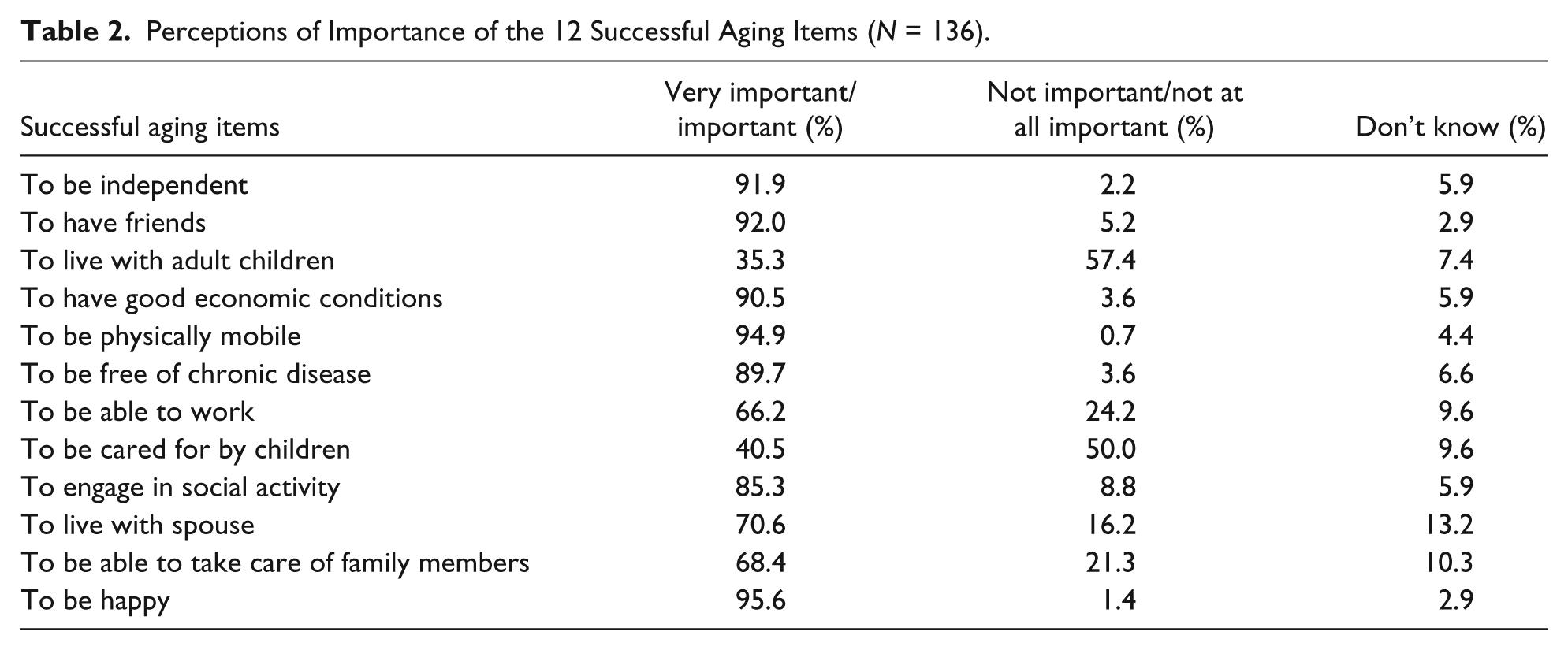
Descriptive statistics of the sample were summarized in Table 1. How the survey respondents rated the importance of each item of successful aging was presented in Table 2. Table 3 displays results from the principal components factor analysis, in which the 12 items of successful aging were clustered into three factors, representing three distinct dimensions of successful aging. Results from unadjusted logistic regressions that examine dimensions of successful aging in relation to socio-demographics and health indicators were presented in Table 4.
Summary of Sample Characteristics (N = 136).

Note. For continuous variables such as age, mean and standard deviation (in parenthesis) were provided.
Perceptions of Importance of the 12 Successful Aging Items (N = 136).
Principal Components Analysis of the 12 Successful Aging Items (N = 136).
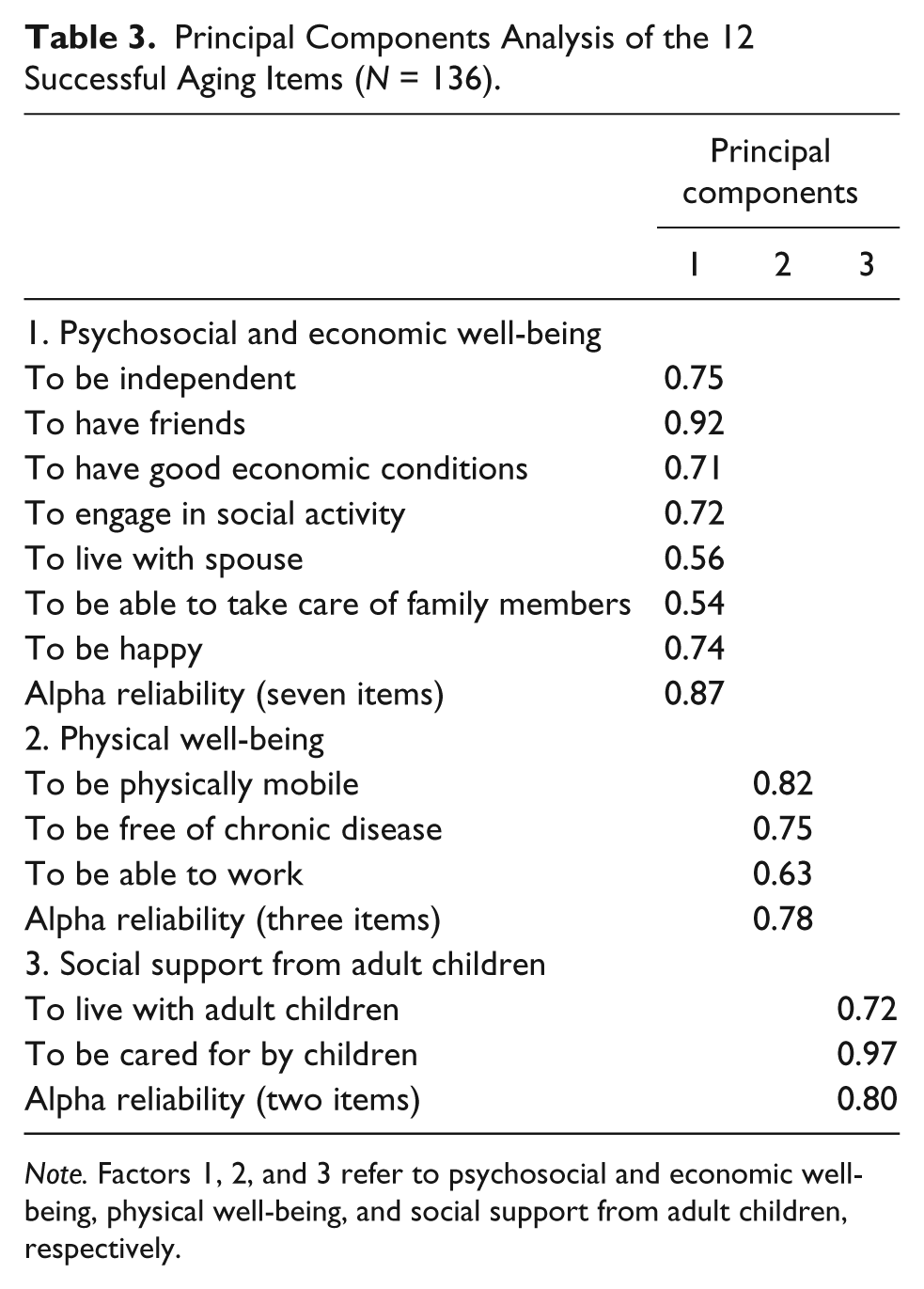
Note. Factors 1, 2, and 3 refer to psychosocial and economic well-being, physical well-being, and social support from adult children, respectively.
Unadjusted Odds Ratios of Correlates for Seven Mostly Endorsed Items of Successful Aging (N = 136).

Note. Results are based on logistic regression models with not important/not at all important/don’t know (0) as the reference group to very important/important (1); unadjusted odds ratios are provided due to small sample size. ADL = activities of daily living.
p < .1. *p < .05. **p < .01. ***p < .001.
Results
Table 1 summarizes the characteristics of all variables. Our sample contains a total of 136 respondents with a mean age being 75 years and standard deviation being 10.6. Approximately, 65% of the respondents were currently married, more than 88% of the respondents were female, and close to 87% of the respondents have a college or above levels of education. In terms of living arrangements, approximately 70% of the respondents reported living with their spouse and/or their children. More than 85% of the respondents rated their health as excellent or good, and more than 91% of the respondents did not need any help in doing activities of daily living. Approximately, 41% of the respondents reported no chronic conditions.
Table 2 reports distribution of the 12 components of successful aging presented to the respondents. As shown in Table 2, items received the rating of “important” by more than 85% of respondents are the following: “to be independent (91.9%),” “to have friends (92%),” “to have good economic conditions (90.5%),” “to be physically mobile (94.9%),” “to be free of chronic disease (around 90%),” “to engage in social activity (85.3%),” and “to be happy (95.6%).” Three items that received moderate levels of acknowledgment are the following: “to be able to work (66.2%),” “to live with spouse (70.6%),” and “to be able to take care of family members (68.4%).” The remaining two items that held higher rates of “not important” than “important” include “to live with adult children” and “to be cared for by children.”
To reduce data dimensions, the 12 successful aging items were then examined by a principal components factor analysis using varimax rotation. Results were summarized in Table 3. The result patterns show three distinct factors. The first factor comprised “to be independent,” “to have friends,” “to have good economic conditions,” “to engage in social activity,” “to live with spouse,” “to be able to take care of family members,” and “to be happy.” These seven items have high internal consistency (α = .87) and were labeled as psychosocial and economic well-being. The second factor is made up of “to be physically mobile,” “to be free of chronic disease,” and “to be able to work.” These three items are closely related as a group (α = .78) and were labeled as physical well-being as they were closely related to physical functioning. The third factor consists of “to live with adult children” and “to be cared for by children.” These two items share high consistency (α = .80) and were labeled as social support from adult children. Both Factors 1 and 2 were perceived as either important or moderately important dimensions of successful aging by most of the survey respondents. Approximately, 35%-41% respondents viewed items composing Factor 3 as important.
Table 4 presents unadjusted odds ratios of logistic regression models for correlates of the seven most acknowledged items (≥85% respondents rated as “important”) of successful aging, in which “not important/don’t know” was the reference group to “important.” Results show that individuals who were better educated had better self-rated health and reported no chronic conditions are more likely to endorse the ideas: “to be independent,” “to have friends,” and “to engage in social activity.” The idea “to be free of chronic disease” seems to be approved as an important item of successful aging regardless of socio-demographic and health differences.
Discussion
Hawai‘i is the state that has the highest life expectancy in the nation and it is also the state that has the high percentages of senior citizens and Asian Americans. These characteristics make Hawai‘i one of the ideal places to examine population aging. This study aims to examine the lay perceptions of successful aging among elderly Chinese, the Asian ethnic group enjoys the longest life expectancy in Hawai‘i. Findings reveal that positive emotions, an engaged life, good health, supportive social networks, and economic independence are among the most important components of successful aging from the perspective of elderly Chinese. Some of the identified components (i.e., good health and social engagement) are consistent with the biomedical model, some (i.e., happiness and economic security) are consistent with findings in other Asian societies (Chong et al., 2006; Feng & Straughan, 2017; Hsu, 2007), and others (i.e., mutual support with family members) are distinctive characteristics that are unique to the context of Hawai‘i. In line with findings from previous studies (Hung, Kempen, & De Vries, 2010), our results indicate the importance of the psychosocial model (Ouwehand, de Ridder, & Bensing, 2007) in understanding successful aging among elderly Chinese in Hawai‘i.
To elderly Chinese in Hawai‘i, the successful aging item that received the most acknowledgment is to hold a positive emotion—“to be happy (95.6%).” This is consistent with findings in Asian societies including Singapore (99.1%) (Feng & Straughan, 2017), Shanghai (98.1%), and China (see Appendix). According to the broaden-and-build theory (Fredrickson, 1998, 2001), daily exposure to positive emotions is likely to compound over time to help individuals build important cognitive, psychological, and social resources that are critical for them to take advantage of opportunities and to meet challenges. These personal resources are found to predict life satisfaction and reduce depressive symptoms (Fredrickson, Cohn, Coffey, Pek, & Finkel, 2008). Similarly, Bonanno (2004) also argued that positive emotions and laughter are important pathways to psychological resilience, which in turn, is essential to support individuals bounce back after aversive events such as loss and trauma. Our findings along with findings in Asian societies suggest that different from researchers’ perspective, older adults tend to hold a more realistic view of successful aging that emphasizes the experience of difficulties using positive emotions rather than the avoidance of vulnerability stressed in the Rowe and Kahn’s model.
Findings on positive emotions and resilient psychological trait among elderly Chinese also suggest that the concept of resilient aging might be more appropriate to use for future research and we will conduct further research along this line. An increasing number of scholars have started to adopt the concept of resilience (Wild, Wiles, & Allen, 2011), which is defined as “the ability to bounce back and recover physical and psychological health in the face of adversity” (Kessel, 2013, p. 127). This definition identifies two key elements of resilience—ability and adversity, which make the concept reflects “more holistic, integrated, inclusive, and globally relevant understandings of aging” (Martinson & Berridge, 2015, p. 65). This concept considers adversity an essential component of aging, thus is applicable to older adults with long-term illnesses and disabilities. Including element of ability also allows individual differences in personal resources that are, to some extent, context or structure dependent. So this seemly individual level concept of resilience has the potential to develop into an overarching framework that is well integrated with the life course perspective (Elder, Johnson, & Crosnoe, 2003) and stress process model (Pearlin, 1989). In our study, although we intended to collect data on the essential components of successful aging, evidence on psychological resilience emerged as the theme that matters the most to the elderly Chinese.
While positive emotions are universally valued among elderly Chinese, results on expectation with regard to the interdependent relationship with adult children show cultural variations. Elderly Chinese in China greatly value reciprocal relationship with adult children. They tend to offer substantial economic, housework, and caring support to their children and grandchildren (Zhang, Feng, Liu, & Zhen, 2015). In return, they expect to live with and/or receive care from adult children when needed. As suggested by results summarized in the Appendix, significant proportions of respondents in Shanghai (SH) and Singapore (SG) acknowledged that “to live with adult children (73.5% in SH and 74.5% in SG),” “to be able to take care of family members (87.2% in SH and 91.8% in SG),” and “to be cared for by children (84% in SH and 62.3% in SG)” are important components of successful aging (see Appendix). By contrast, the corresponding percentages on these items (35.3%, 68.4%, and 40.5%, respectively) among elderly Chinese in Hawai‘i are significantly lower due to reasons such as acculturation and level of socioeconomic development. Taking Shanghai as an example, although it has made a significant progress in economic development, it still has tremendous amount of shortages in social services for older adults, and the overall living standard is still lower compared to Hawai‘i. On the contrary, however, although most of our respondents were native born or have been in the United States for a long period of time, many of them still endorsed children’s support. Supplementary findings from our focus groups with some of the survey participants in Hawai‘i also show that although our respondents expect their parents and adult children to be independent, they expressed willingness to offer help when needs arise. These findings suggest that elderly Chinese in Hawai‘i show interesting Americanized familisim: Their mutual support with adult children remains but in a less obligatory way compared with their counterparts in China and in Singapore.
A couple of major limitations need to be addressed. First, due to limited resources, our sample size is quite small. We are unable to recruit many Chinese males, those with LEP, and recent immigrants. Their perceptions might be different from the ones recruited in this study. Second, survey respondents were not selected at random. Therefore, readers need to be cautious when generalizing findings to other segments of the Chinese population in Hawai‘i. Despite these limitations, however, this study offers preliminary efforts in revealing cultural variation in the lay perceptions of successful aging in the context of Hawai‘i where Chinese culture is mixed with local and American cultures. Our findings reveal important psychosocial dimensions of successful aging.
Footnotes
Appendix
Perceptions of Importance of the 12 Successful Aging Items Across Study Sites.

| Successful aging items | % very important/important |
% not important/not at all important |
% don’t know |
||||||
|---|---|---|---|---|---|---|---|---|---|
| HI | SH | SG | HI | SH | SG | HI | SH | SG | |
| To be independent | 91.9 | 95.6 | 95.4 | 2.2 | 4.0 | 3.2 | 5.9 | 0.4 | 1.4 |
| To have friends | 92.0 | 91.8 | 91.7 | 5.2 | 7.2 | 7.2 | 2.9 | 0.5 | 1.0 |
| To live with adult children | 35.3 | 73.5 | 74.5 | 57.4 | 25.5 | 17.8 | 7.4 | 1.0 | 7.7 |
| To have good economic conditions | 90.5 | 97.6 | 97.9 | 3.6 | 2.0 | 1.5 | 5.9 | 0.5 | 0.6 |
| To be physically mobile | 94.9 | 98.7 | 99.0 | 0.7 | 0.8 | 0.8 | 4.4 | 0.4 | 0.2 |
| To be free of chronic disease | 89.7 | 98.5 | 98.3 | 3.6 | 1.0 | 1.3 | 6.6 | 0.4 | 0.5 |
| To be able to works | 66.2 | 41.7 | 83.1 | 24.2 | 57.4 | 14.8 | 9.6 | 0.8 | 2.1 |
| To be cared for by children | 40.5 | 84.0 | 62.3 | 50.0 | 35.0 | 28.0 | 9.6 | 0.6 | 9.7 |
| To engage in social activity | 85.3 | 64.5 | 76.3 | 8.8 | 35.0 | 20.8 | 5.9 | 0.6 | 2.9 |
| To live with spouse | 70.6 | 89.0 | 81.7 | 16.2 | 10.1 | 9.6 | 13.2 | 0.9 | 8.8 |
| To be able to take care of family members | 68.4 | 87.2 | 91.8 | 21.3 | 12.2 | 5.8 | 10.3 | 0.5 | 2.4 |
| To be happy | 95.6 | 98.1 | 99.1 | 1.4 | 1.4 | 0.5 | 2.9 | 0.5 | 0.4 |
Note. HI (N = 136) stands for Honolulu, Hawai‘i; SH (N = 3,418) stands for Shanghai, China; and SG (N = 1,540) stands for Singapore. Data from Singapore are from Feng and Straughan (2017) and data from Shanghai are from the 2013 Shanghai Elderly Life and Opinion Survey, which was administered by the Shanghai Research Center on Aging.
Declaration of Conflicting Interests
The author(s) declared no potential conflicts of interest with respect to the research, authorship, and/or publication of this article.
Funding
The author(s) disclosed receipt of the following financial support for the research, authorship, and/or publication of this article: This study is supported by a public health grant from Hawai’i chamber of commerce.