




Abstract
Introduction
Populations are aging constantly worldwide, with the proportion of the population who are 60 years or older predicted to almost double from 12% in 2015 to 22% in 2050 (World Health Organization, 2015). Japan has already become a so-called “super-aged society,” and has the highest aging rate of all populations (United Nations, 2015). From a public health perspective, it is important to maintain and improve quality of life of the elderly population, and to assist in their successful aging.
Watching sports—a leisure engagement wherein people watch the effort or performance of athletes—may enhance affect and subjective happiness among elders. The support for this comes from a meta-analysis of 27 studies showing that leisure engagement is positively associated with subjective well-being, and that this association is stronger among retirees than among workers (Kuykendall, Tay, & Ng, 2015). Furthermore, Foroughi, Nikbin, Hyun, and Iranmanesh (2016) showed that the performance of professional athletes, including their demonstration of superior skills and an attitude to do their best, increased spectator excitement and happiness.
However, to the best of our knowledge, there are no studies that have examined the influence of watching sports at a stadium on subjective happiness among elderly people who do not habitually watch sports games in stadiums. Subjective happiness refers to individuals’ evaluations of their lives on both affective (positive and negative) and cognitive (life satisfaction) dimensions (Diener, 2000). Most previous studies that have examined changes in spectators’ affect while watching sports examined individuals who closely identified with a specific sports team—they found that the results of a game influenced these spectators’ affect (Hirt, Zillmann, Erickson, & Kennedy, 1992; Kerr, Wilson, Nakamura, & Sudo, 2005) and subjective well-being (Stieger, Götz, & Gehrig, 2015). By contrast, few studies have focused on individuals who do not root for a specific team—namely, individuals with lower team identification. Currently, the psychological changes in elderly spectators with low team identification are unknown.
Sports marketing research has shown that the emotion of joy has a direct influence on spectators’ satisfaction (Biscaia, Correia, Rosado, Maroco, & Ross, 2012; Kuenzel & Yassim, 2007). Factors contributing to that joy included social facilitation (i.e., the opportunity to interact with other spectators), the quality of the game (team performance), and auditory factors (i.e., a cheering atmosphere) (Kuenzel & Yassim, 2007). It is possible that elders who do not habitually watch sports games in stadiums are more interested in the freshness and extraordinary nature of their experience, rather than which team will win—they might view watching the game as a pleasurable activity based in pure entertainment. This, along with the sense of unity with other supporters and their being able to appreciate the live, excellent performance of professional athletes, may have a favorable influence on their overall affect. Therefore, we examined how watching a professional baseball game in a ballpark influences the affect and subjective happiness of elderly Japanese people without a specific team to support.
Method
Study Participants
Participants were elderly Japanese individuals (eight males, eight females), aged 65 or older, who lived in Saitama Prefecture, Japan. The participants were recruited from a temporary employment agency and did not know each other. The inclusion criteria were as follows: (a) the participant has not received a certification of long-term care needs, (b) has never been diagnosed with dementia or depression, (c) has not watched sports in a stadium three or more times over the past 3 years, and (d) is not a member of a fan club of any professional baseball team.
All participants received a full explanation of the study purpose, significance, and associated risks in advance. This study was conducted with the approval of the research ethics review committee of Waseda University, and has been registered in the UMIN Clinical Trials Registry (registration number: UMIN000020869).
Procedure
All participants were asked to attend a measurement session 10 to 15 days before the day that they would watch the professional baseball game at a ballpark. At this time, we administered a questionnaire survey assessing their life situations, which included items on smoking, drinking, and exercise habits, as well as their degree of interest in professional baseball. Furthermore, we obtained baseline measurements of their affect and subjective happiness. Then, they were instructed to pick and watch any one of the pre-season professional baseball games beginning at 1:00 p.m. held within a 3-day period designated for this study at the Seibu Prince Dome in Tokorozawa City. The baseball ticket was provided free of charge. The participants were allocated infield, nonreserved seats on the home team side (the Saitama Seibu Lions). On the day of the game, they completed a questionnaire containing the measures of affect and subjective happiness, both immediately before and immediately after (i.e., within 30 min) the game. They completed the questionnaire in a room adjacent to the ballpark.
Lifestyle Survey
The lifestyle survey included items on smoking habits (currently smoking, used to smoke in the past, never smoked), drinking habits (3 times a week or more, twice a week or less, do not drink), exercise habits, and degree of interest in professional baseball. All items were self-reported. For exercise habit, people who answered “I have exercised to a degree that made me sweat slightly for more than 30 min a day at least twice a week for over a year” were defined as individuals who have an exercise habit. The degree of interest in professional baseball was surveyed using a 7-point Likert-type scale (1 = not at all interested, 7 = very interested). In addition, we asked them to indicate whether they had any specific baseball teams they supported.
Assessment of Affect
The General Affect Scale was used to assess participants’ affect (Ogawa, Monchi, Kikuya, & Suzuki, 2000). The General Affect Scale is a self-administered questionnaire comprising 24 affective adjectives evenly divided between three subscales: positive affect (active, joyful, satisfied, lively, cheerful, peppy, pleased, and energetic), negative affect (upset, jittery, dismayed, fearful, restless, tense, surprised, and frightened), and calmness (calm, comfortable, serene, peaceful, relaxed, at ease, at rest, and quiet). Each item is rated on a 4-point scale ranging from 1 (not felt at all) to 4 (strongly felt). The total scores of each subscale were calculated as the sum of the scores of the eight items (range: 8-32 points). This questionnaire was developed to assess overall affect, and is based on the Positive and Negative Affect Schedule developed by Watson et al. (Watson, Clark, & Tellegen, 1988) as well as other existing scales. Its reproducibility and validity are both reported to be high (Ogawa et al., 2000).
Assessment of Subjective Happiness
We applied the Subjective Happiness Scale to assess subjective happiness (Lyubomirsky & Lepper, 1999; Mattei & Schaefer, 2004). This is a self-administered questionnaire comprising four items, each of which is rated on a 7-point scale (with responses ranging from 1 to 7). Higher scores indicate greater subjective happiness. The total score of this scale is the arithmetic mean of the four item scores. The items are as follows: Item 1: “In general (on the whole), I consider myself not a very happy person or a very happy person (1 = not a very happy person, 7 = very happy person)”; Item 2: “Compared to most of my peers, I consider myself less happy or happier (1 = less happy, 7 = more happy)”; Item 3: “Some people are generally very happy. They enjoy life regardless of what is going on, getting the most out of everything. To what extent does this characterization describe you? (1 = not at all, 7 = a great deal)”; and Item 4: “Some people are generally not very happy. Although they are not depressed, they never seem as happy as they might be. To what extent does this characterization describe you? (1 = not at all, 7 = a great deal).” Item 4 was reverse scored when calculating the total. In a previous study, the Japanese translated version of this scale was found to have high reliability and validity (Shimai, Otake, Utsuki, Ikemi, & Lyubomirsky, 2004).
Statistical Analysis
We reported descriptive statistics for all variables, represented as the mean ± standard deviation for continuous variables or percentage for categorical variables. The normality of the variable distribution was confirmed using the Shapiro–Wilk test. We used a repeated-measures analysis of variance (ANOVA) to compare the values between the baseline measurement and before/after the professional baseball game. Bonferroni corrections were used for post hoc analysis.
All participants watched the games from the home team side—thus, where the majority of spectators would be home team fans. Thus, we performed a two-way repeated-measures ANOVA to analyze differences in affect and subjective happiness according to subgroups based on the victory or defeat of the home team in the game they watched to investigate the influence of the surrounding atmosphere. The statistical significance was set to p < .05, and IBM SPSS Statistics 23 (IBM Corp., Armonk, New York) was used for the analyses.
Results
Characteristics of Participants
The characteristics of the participants are shown in Table 1. Their average age was 72 ± 6 years (74 ± 7 for male, 71 ± 5 for female). The average degree of interest in professional baseball was 3.8, with 88% of the participants answering four or less. None of the participants had a specific baseball team to support.
Characteristics of the Participants.
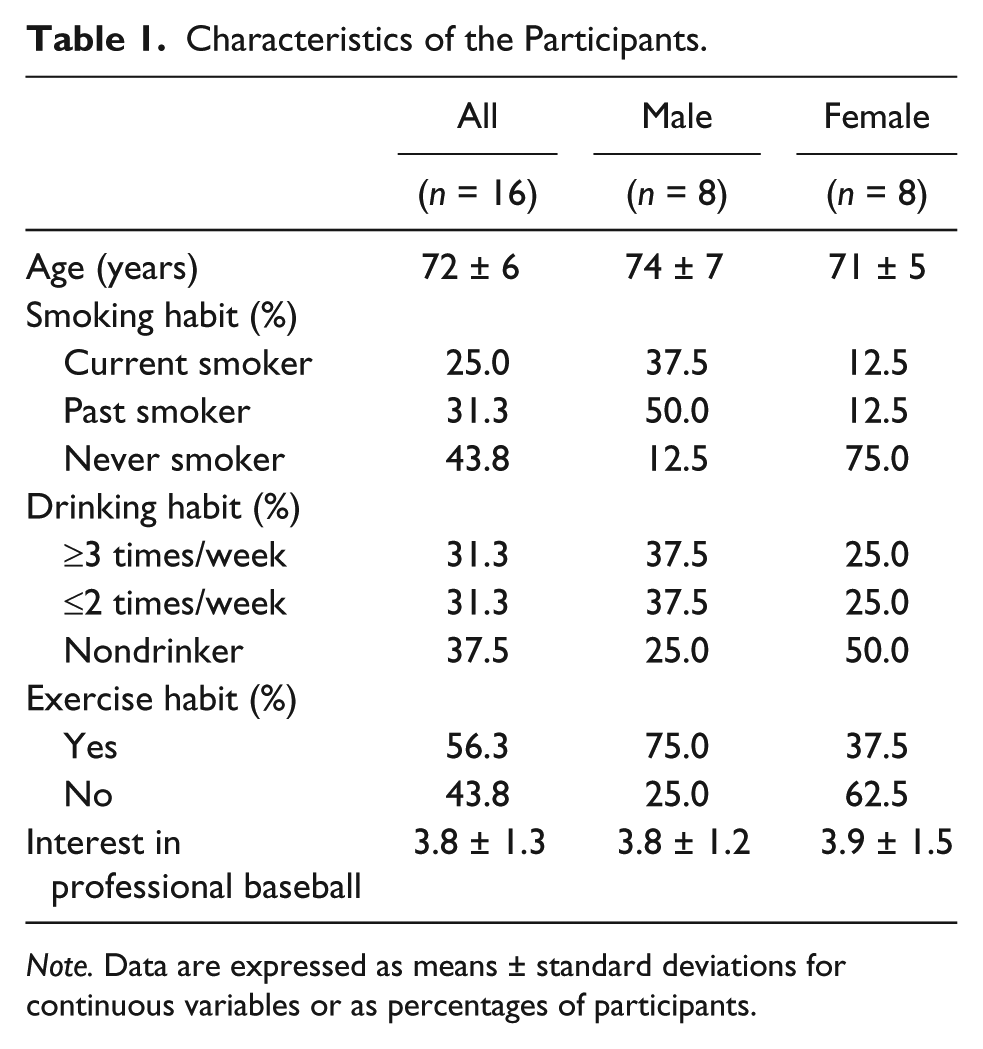
Note. Data are expressed as means ± standard deviations for continuous variables or as percentages of participants.
Baseball Game Results
The games that participants watched over the 3-day viewing period designated for this study resulted in two wins and one loss for the Saitama Seibu Lions (the home team). In the first game, Saitama Seibu Lions faced the Orix Buffaloes, winning by a score of 12 to 1. In the second game, they faced the Tohoku Rakuten Golden Eagles and were defeated with a score of 3 to 8. In the third game, they faced the Fukuoka Softbank Hawks and won by a score of 2 to 1. The number of participants who watched the baseball games were six (one male, five females) on the first day, five (five males, zero female) on the second day, and five (two males, three females) on the third day.
Effects on the Affect and Subjective Happiness
The changes in the three subscales (positive affect, negative affect, and calmness) of the General Affect Scale between baseline, before the game, and after the game are shown in Table 2. The mean score for calmness had a tendency to increase from 19.38 at baseline to 22.37 before watching the game (p = .052, post hoc Bonferroni), and remained high even after the game, at 21.56. Although positive affect did not show a significant change (p = .072, repeated-measures ANOVA), it did increase from 21.19 at baseline to 22.50 before watching the game, and then up to 24.06 after watching the game, and the elevation trend from at baseline to after watching the game was shown (p = .069, post hoc Bonferroni). No clear change was found in negative affect (p = .435, repeated-measures ANOVA).
Changes in the General Affect Scale and Subjective Happiness Scale After Watching a Professional Baseball Game.
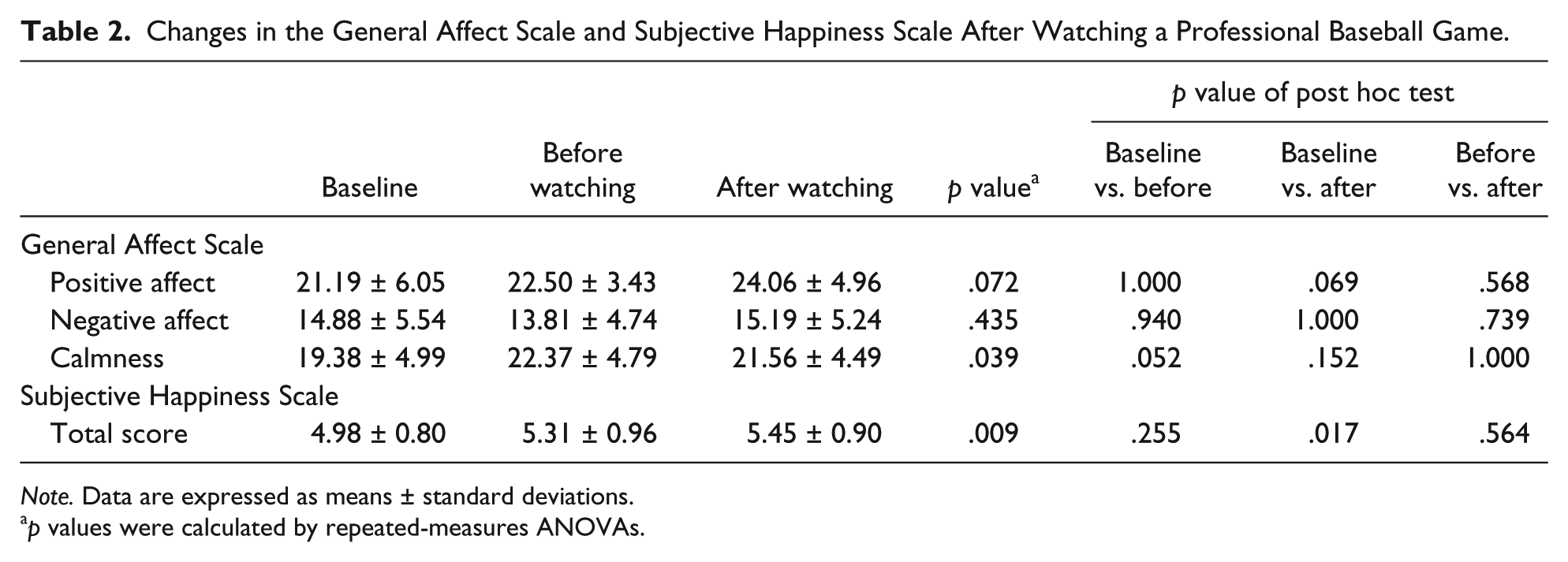
Note. Data are expressed as means ± standard deviations.
p values were calculated by repeated-measures ANOVAs.
The changes in the Subjective Happiness Scale scores due to watching the professional baseball game are shown in Table 2. We observed a significant change in the total score (p = .009, repeated-measures ANOVA)—after watching the professional baseball game, the total score was significantly higher than at baseline (p = .017, post hoc Bonferroni).
Affect or Subjective Happiness According to Game Results
To examine whether the victory or defeat of the home team, which the spectators in the vicinity of the participants during the game would have supported, influenced participants’ affect or subjective happiness, we examined whether the changes in the scores of the three subscales (positive affect, negative affect, and calmness) of the General Affect Scale and the total Subjective Happiness Scale score differed between when the home team achieved a victory or a loss (Table 3). For all variables, we observed no interactions between the game result and changes in affect and subjective happiness (all p > .50, two-way repeated-measures ANOVA).
Changes in the General Affect Scale and Subjective Happiness Scale According to the Victory or Defeat of the Home Team.
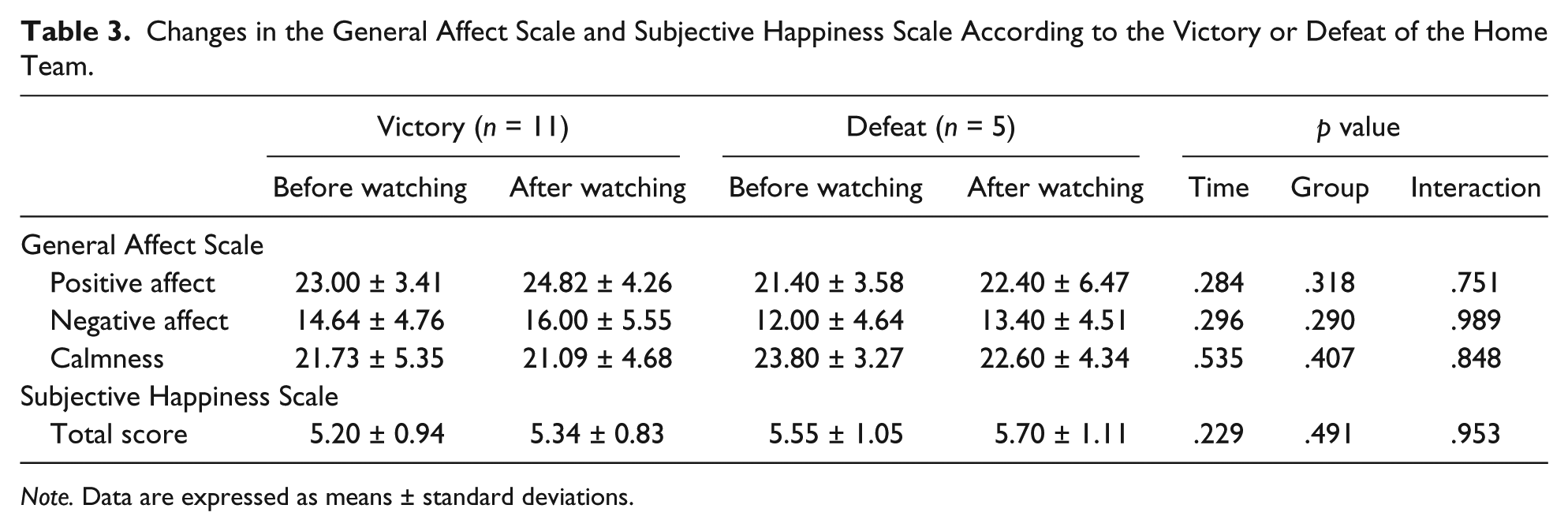
Note. Data are expressed as means ± standard deviations.
Discussion
This study examined how watching a professional baseball game may influence the affect and subjective happiness of Japanese elders who do not habitually watch professional baseball games at a ballpark and who do not have a specific team to support. The results suggest that elders showed an increasing tendency in their sense of calmness before watching the game compared with baseline, whereas subjective happiness increased after watching the game. In addition, this study examined the influence of differences in game results on the changes in affect and subjective happiness; however, no significant association was found between game results and changes in affect and subjective happiness.
Several previous studies have examined the influence of watching sports games on spectators’ affect, although the sports and participants involved have varied (David, Horton, & German, 2008; Hirt et al., 1992; Kerr et al., 2005; Oshimi & Harada, 2012; Sloan, 1989). A study on Japanese soccer fans showed that unpleasant emotions (e.g., anger, sullenness, humiliation, resentment) increased in fans who saw their team lose in a professional soccer game compared with fans who saw their team win (Kerr et al., 2005). Moreover, in a study of university students in the United States who had strong fanship for basketball teams, the victory and defeat of the team they support were associated with positive and negative affect (Hirt et al., 1992). In addition, according to a previous study conducted in Germany examining the influence of the results of the FIFA World Cup 2014 on subjective well-being, spectators’ subjective well-being increased after watching the national team that they supported win, but remained unchanged in matches that ended in a draw (Stieger et al., 2015). As such, these previous studies suggest that the result of a game may influence the affect and subjective happiness of spectators. In the present study, however, there was no influence of game result on these factors. This is partly due to our participants’ lower team identification. According to Wann, Dolan, McGeorge, and Allison (1994) who studied the spectators of university basketball games, the change in emotions corresponding to the result of a game (positive affect with winning and negative affect with losing) was more pronounced in spectators with strong team identification compared with spectators with low team identification. Indeed, the latter group showed no substantial changes in emotions, regardless of the game result. The participants of the present study were elders who do not habitually watch sports in stadiums, and none of them were fans of the home team (the Saitama Seibu Lions). Furthermore, their degree of interest in professional baseball was, overall, not high. We expect that the participants of the present study had low team identification, which perhaps led to the observed lack of the effect of game result. Thus, the present study enabled us to evaluate purely how the act of watching a professional baseball in a ballpark leads to psychological changes in spectators, without the possible confound of game result.
Our findings indicated that calmness was high right before watching the professional baseball game at the ballpark, whereas subjective happiness increased after watching the game. Watching a sports game can produce feelings of anxiety and a sense of tension when individuals watch a team or players that they support and care about the possible result. These feelings are presumed to lead to a decrease in calmness. However, compared with the baseline, participants showed higher levels of calmness right before watching the game. Knobloch-Westerwick, David, Eastin, Tamborini, and Greenwood (2009) discussed the chronological changes in spectators’ feelings of suspense while they were watching a college football game, and reported that spectators who were indifferent to the team showed less suspense throughout the course of the whole game than did spectators with a preferred team. In the present study, because participants’ interest in professional baseball was not high and they were not rooting for the home team, they did not experience the same sense of tension or anxiety in relation to their team or the prospect of victory. As a result, they were able to retain calmness, which characteristically emerges when individuals are engaging in leisure activities that involve an escape or distraction from their daily reality (in this case, having gone all the way to the ballpark).
The present study is the first, to the best of our knowledge, to examine how watching a professional baseball game in a ballpark may influence the affect and subjective happiness of elders with low team identification. Our findings suggest that watching a sports game can itself enhance the subjective happiness of elderly persons without their having a specific team to root for. Providing elders with the opportunity to watch sports at a stadium is expected to increase their happiness and may assist in their successful aging.
This study has some limitations. First, we adopted a single-group, pre–post design. The lack of a control group for comparison indicates that the outcomes of the present study may in part be due to factors other than watching a professional baseball game. Second, the participants in this study were not a group randomly selected out of the population, which may limit the generalizability of our results. However, our analysis showed that the sample characteristics did not largely differ compared with average Japanese elders (see Table 1). Third, the sample comprised only healthy elders who had never been diagnosed with dementia or depression; the affect or subjective happiness of individuals is likely to vary with their morbidity. Finally, there were only 16 participants in this study, which likely led to a high β error due to the lack of statistical power. To further explore how watching a sports game affects the subjective happiness of elderly spectators, we suggest conducting studies targeting a larger, more diverse sample.
In conclusion, among Japanese elders who did not habitually watch sports games at a ballpark, visiting a ballpark to watch a professional baseball game increased their subjective happiness after they had finished watching it.
Footnotes
Acknowledgements
We would like to express our sincere gratitude to the members of Dr. Mitsuru Higuchi’s laboratory at Waseda University, Dr. Mohammad Javad Koohsari, and Mr. Benjamin Howe for their assistance and helpful comments in conducting this study. We would like to acknowledge Dr. Kyoko Yamamoto and Dr. Naoto Suzuki for their advice on assessment of affect using the General Affect Scale.
Declaration of Conflicting Interests
The authors declared no potential conflicts of interest with respect to the research, authorship, and/or publication of this article.
Funding
The authors disclosed receipt of the following financial support for the research, authorship, and/or publication of this article: This work was funded by Saitama Seibu Lions Co., Ltd, Japan.