




Abstract
The COVID-19 pandemic profoundly impacted nurses and other healthcare professionals, underscoring a need to capture and share their experiences, especially amid persistent negative perceptions of nursing. This research aimed to understand the experiences of those who worked during the pandemic, translate them into audio artworks, and understand how their resulting exhibition was experienced. Utilizing arts-based inquiry, nurses (n = 4) and other healthcare specialists (n = 4) were involved in an arts-based workshop fostering a deep exploration of their experiences, and revealing themes such as uncertainty, the complexities of navigating professional identity within widespread “hero narratives”, human connection and the powerful sense of catharsis and community found in sharing their experiences. Inspired by these insights, an artist created the audio artwork “Boats on an ocean”. Six other audio artworks were subsequently created in the same way. A survey (n = 18) and in two hybrid workshops (n = 6) were then undertaken to understand how audiences experienced the exhibited artwork. Audiences consistently described the exhibition as “profoundly moving”. This research marks the first instance of using arts-based methods to both qualitatively capture and artistically disseminate healthcare professionals’ COVID-19 experiences. It serves as a historic record, preserving accounts for future generations.
Keywords
Introduction and Background
The COVID-19 pandemic represented a monumental period in our shared human history, described as the biggest challenge faced in living memory (Charles & Ewbank, 2021). Nurses, the largest group of healthcare professionals’ (HCPs) were called upon to support the pandemic, along with other HCPs. Their experiences of the pandemic were profound, and have had lasting physical and psychological effects (Hernández-Bojorge et al., 2024; Koontalay et al., 2021). The capturing, sharing and study of historical events is central to our ongoing informed and critical understandings of the present (Tosh, 2019). Moreover, the public sharing of memories of historical events can influence the lives of those who reflect on them (Pillemer, 2009). Considering the above, it is important to do justice to the understanding, capturing and sharing of the experiences of the nurses and other HCPs who worked during this time. This is also particularly important in a context where although the COVID-19 pandemic has had a positive impact upon the global public image of nursing by making the reality of it more visible, some negative perceptions remain such as stereotyped portrayals of nurses as selfless, hardworking and compassionate women helpers (Konstantopoulou, 2024). Stereotypes like these can have negative effects such as the exacerbation of gender biases and discrimination, undermining of professional identity along with the professional status and autonomy of nurses (Stokes-Parish et al., 2020), all of which may also negatively affect the recruitment of nurses and midwives, along with patient care.
The capturing and sharing of narratives and experience through arts-based inquiry enables a depth of understanding and insight not commonly achieved through other methods (Barone & Eisner, 2012). This is perhaps because time is taken to reflect on and learn from experiences to create a meaningful narrative (Williamson et al., 2020), providing respite from uncertainty (Lavender, 2024). The use of arts as a tool for exploration is often combined with other more traditional approaches to develop a nuanced, shared understanding of sensitive topics (Okoko, 2023). As such, using the arts as a tool to explore the experiences of nurses and other HCPs in this context may provide richer insights for public sharing.
Whilst changes in the mental and physical health of HCPs were observed throughout the pandemic (Shirkhoda et al., 2024; Umbetkulova et al., 2024), the capturing and understanding of their lived experiences has largely been limited to qualitative analyses of interviews, reflections, observations and surveys (Billings et al., 2021; Chemali et al., 2022; Fumagalli et al., 2023; Marinaci et al., 2023; Phillips et al., 2023; Pilbeam et al., 2022; Rourke et al., 2024; Torrance et al., 2024). Equally, the sharing of these experiences via arts-based approaches have been broadly visual (e.g., via photovoice; Badanta et al., 2021; Ekwonye et al., 2022; Mathura et al., 2022), or through physical artifacts (Casey & Webb, 2021), rather than being audio based. Here we take a combined approach blending arts-based inquiry and the production of audio artworks with qualitative data collection.
Audio artworks in particular offer alternate experiences which can be physically explored as the listener is able to move within the soundscape created (Rumsey, 2011). Artworks of this nature can also be more accessible in public spaces, particularly in a post-pandemic context, where the interaction with and consuming of art has been adapted, and increasingly digitalised (Bradbury et al., 2021). Equally, whilst the sharing of nursing and other healthcare workers experiences of working during the COVID-19 pandemic via the arts has been limited, so has the documentation and evaluation of the public and professional engagement with such arts-based outputs. This research therefore presents a unique opportunity to not only capture and disseminate nurses’ experiences of COVID-19 via audio-artwork, but also to consider public and healthcare professional engagement with such artwork.
It is important to involve HCPs in any public instantiation of their own experiences, particularly where previous perceptions of them as “wounded healers” have been widely romanticised and uncritically accepted (Conchar & Repper, 2014). Moreover, art-making for HCPs in itself can ignite critical reflection (Viscardis et al., 2019). Thus, through understanding and sharing the experiences of HCPs during the pandemic using arts-based approaches, both HCPs and public audiences may be drawn closer to the event and experiences of it, leading to both individual and community meaning making (Plummer, 2019). Considering the above, the aim of this research was to (1) understand the experiences of nurses and other HCPs who worked during the COVID-19 pandemic, (2) develop audio artwork to represent those experiences and (3) understand how the artworks are experienced.
Methods
The project was conducted in partnership with scholars from Coventry University and China Plate Theatre who came together as the city of Coventry was named the United Kingdom (UK)’s City of Culture 2021. Ethical approval was granted by Coventry University’s ethics department (CU Ethics) (P151175 and P122664).
Phenomenology was adopted as the underpinning methodology to this work, as it enabled us to explore themes of “being” in the world and the meaning-making processes involved in both creating and experiencing art (Brough et al., 2010). Phenomenology emphasises individual lived experiences and the process of “becoming”. Though we use workshops as group-based activities, we actively encouraged individual expression throughout, for example, by using prompts that asked participants to first write or reflect on their own and then share with other workshops participants. Indeed, we use multiple qualitative data collection methods to bring complementarity to the research, leveraging each of their respective strengths to achieve more comprehensive and insightful understandings and depth to the topic (Creswell & Poth, 2016). The research occurred and is reported in three phases as outlined in Figure 1 with each phase addressing one of our research aims.
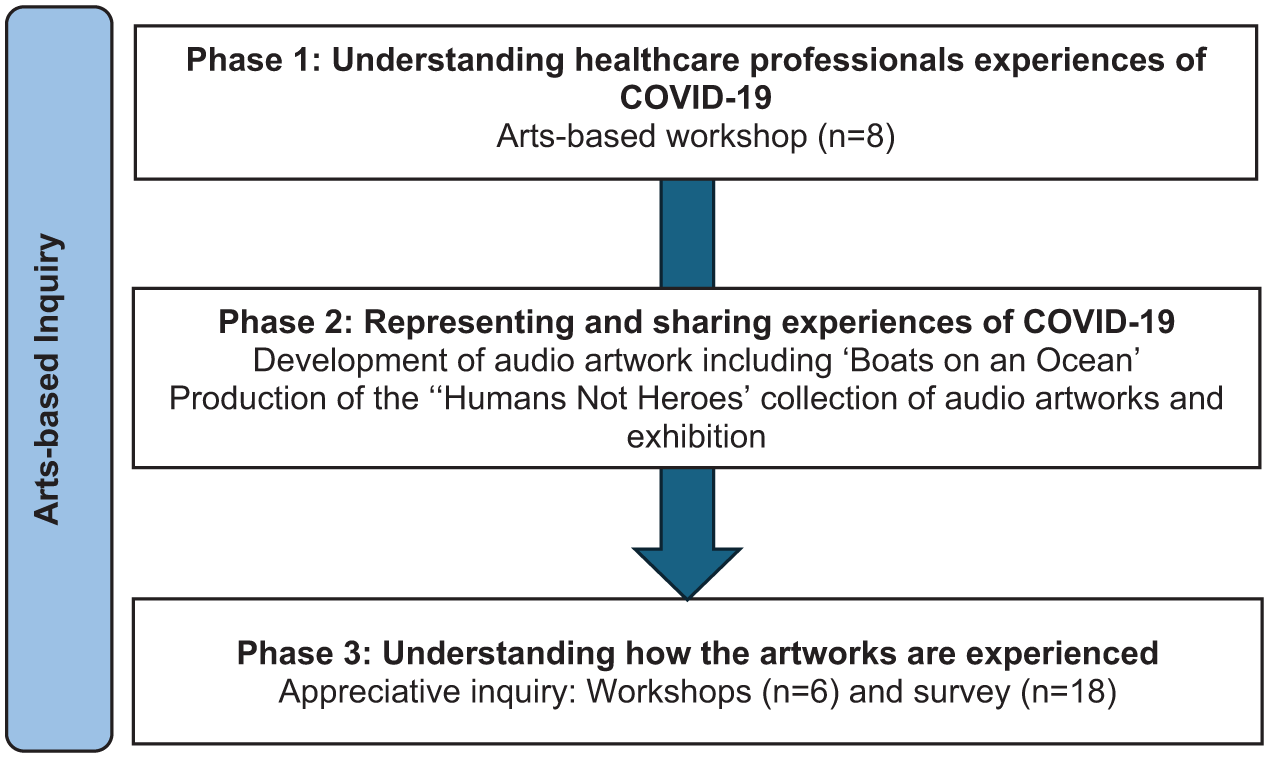
Three phase study design.
Arts-based inquiry offers a powerful way to explore complex and often unspoken experiences (such as those acquired during the COVID-19 pandemic) by providing non-verbal avenues for emotional expression, along with deeper reflection, and connection (Leavy, 2020). We considered that this approach may generate rich, nuanced data and facilitate impactful knowledge sharing, ultimately fostering empathy and driving support for this vital workforce. Arts-based inquiry is situated within the narrative research paradigm and uses art as means of exploring and representing human experiences (Leavy, 2017; McNiff, 2008). Here, the creation of art draws on personal experiences along with personal histories and the art created tells complex stories about these beyond which any spoken or textual language can (Llewellyn-Beardsley et al., 2020).
As illustrated in Figure 1, the arts-based approach was combined with qualitative data capture through the following phases:
Phase 1. An arts-based workshop with nurses and other healthcare professionals to capture in-depth understanding of their experiences of working during the COVID-19 pandemic.
Phase 2. The interpretation and representation of those experiences through the production of audio artworks.
Phase 3. An appreciative inquiry guided survey and workshops to understand how audiences experienced the audio artworks.
Phase 1: Understanding the Experiences of Nurses and Other HCPs Who Worked During the COVID-19 Pandemic
A workshop was undertaken to understand HCPs experiences and provide the artists’ immediate creative inspiration while also seeking to systematically extract and formalise learnings through qualitative data for subsequent endeavours. This approach acknowledges that different methods can illuminate different facets of the data and emphasises the importance of presenting complementary insights and their inherent multiplicity without them necessarily being merged (Flick, 2018).
Sampling
Participant recruitment began in April/May 2020 (early in the pandemic in the UK). A recruitment advert was disseminated online via the China Plate Theatre website, X (formally Twitter) and Facebook. It targeted HCPs willing to share their experiences of working during the pandemic. Potential participants were informed that their contributions would be used to inspire the creation of audio artwork that would be displayed publicly as well as informing research findings. To be eligible, participants were required to be over 18 years old and currently employed as an HCP.
Snowball sampling was subsequently used, whereby participants recruited additional participants from their networks (Johnson, 2014). Participants who met the inclusion criteria were invited to read a participant information sheet online and give their written/digital informed consent to take part in a facilitated workshop lasting 90 min and a subsequent art-work script readthrough to be hosted online (part of Phase 2). Participants were offered a £15 voucher to compensate for their time.
Data Collection
Participants attended an online workshop in June 2020 designed by the authors in conjunction with a writer/director and theatre producer to allow stories to emerge organically (Ali et al., 2020). It was co-facilitated by a writer/director and a theatre producer, a midwife and a nurse from the research team and a psychologist with expertise in mindfulness.
Following introductions, participants were encouraged to set ground rules for a supportive environment. Participants were then encouraged to use metaphor (Landau, 2018), which can often better enable people to access complex or ineffable emotions (such as those which may have surfaced in anticipation of the workshop) to describe how they were feeling and how they saw themselves in the world at that time (e.g., using weather). Next, participants were asked to think of three locations that resonated with them during the pandemic, memories associated with them and then any sights/smells/sounds linked to them. Participants were simultaneously encouraged to write down and share their experiences verbally based on memory.
Subsequently, a “role on the wall” activity was facilitated (Neelands & Goode, 1990). The “role on the wall” has previously been adopted as a data-collection tool as well as being used as a tool for shaping stories (Anderson & Baskerville, 2023). In this instance, participants were invited to consider different HCPs as character profiles, and how they demonstrated compassion (or not) during the pandemic. They were also invited to reflect on both themselves and their characters as “Humans and/or Heroes”, as this was a particular narrative repeatedly brought up by participants for discussion. These reflections were then shared and used as a stimulus for further discussion. Subsequently, the stream of consciousness technique was used to encourage unfiltered expression and exploration of the inner world under construction for both creative discovery and personal insight (Dimililer & Kurt, 2019; Humphrey, 1954). Again, writings were shared and used as a stimulus for further discussion. Everyone had the opportunity to share what they had written. Participants were encouraged to think about which stories resonated with them most strongly, and how they felt audio artworks could reflect their experiences most effectively to the listening public. Our aim was not to achieve data saturation, but rather to achieve “information power” (e.g., having enough data to convincingly support the interpretations and answer our aims; Braun, Clarke, & Hayfield, 2021).
At the end of the workshop, participants were provided with a debrief detailing additional psychological support and a guided meditation. The workshop was audio and video recorded and subsequently transcribed verbatim. Participants were also invited to attend a collective read through of the initial script once drafted by the writer/director in attendance at a later date.
Data Analysis
Initially, all transcripts, video recordings, creative outputs and notes were checked and read through by the research team. As participants were telling stories and providing narratives to be translated into stories, an approach rooted in narrative analysis was considered first. However, our aim was to highlight overarching insights and common experiences which transcended individual stories in this context, rather than to focus on the narrative exclusively (e.g., how stories are told and the narrative arc, etc.) (McAllum et al., 2019). In contrast, thematic analysis enabled the team to effectively identify shared experiences. Thus, taking an inductive approach, the data, which comprised written artifacts from the workshop and transcripts were combined, and then examined and compared according to six phases of thematic analysis (Braun & Clarke, 2006, 2012); (1) Familiarisation of data; (2) Generation of codes (e.g., the following quote “These are stories worth telling” was assigned the following code “The power of storytelling”); (3) Combining codes into themes (e.g., the theme of Human Connection included codes such as “communication”, “compassion” and “kindness”); (4) Reviewing themes; (5) Determine significance of themes; (6) Reporting of findings. Final themes were identified through a succession of iterative refinements. The two researchers (1 midwife and 1 nurse) present within the workshop liaised on identifying themes. Concurrent with thematic analysis and to establish the trustworthiness of findings (Denzin, 2017), investigator triangulation was used as both the research and creative teams agreed final themes together. Sense checking of themes with workshop participants was avoided to circumvent their revisitation to sensitive topics, along with the influence of participants’ subsequent reflections and/or retrospectively altered accounts (Birt et al., 2016). Nevertheless, attendees were invited to a readthrough of the developing audio artwork script (in Phase 2) providing an alternate avenue for member checking.
Phase 2: Representing and Sharing Experiences Through Audio Artworks
A total of seven audio artworks were developed in response to the experiences shared through a series of workshops.
“Boats On An Ocean”
Following the first workshop described in phase 1, the writer/director in attendance used the creative outputs and reflections along with the themes identified to inspire an initial audio artwork piece entitled “Boats on an Ocean”.
Other members of the creative team viewed the workshop recording and collectively explored the narratives – what stood out in terms of stories, themes, but also emotions and tone of voice. The writer/director then used these conversations to further inspire a draft script, to represent the experiences shared. Two workshop participants joined in a collective readthrough as the writer/director read the draft script with the theatre producer to interrogate the story, character and tone.
The writing process itself was mercurial by nature, as NW, co-designer of the process and writer of “Boats On An” Ocean describes below: The process for me was to absorb what was being said in the workshops and note down anything that could be distilled into narrative moments which could stand in for many moments. It was to identify stories which shared maybe an image, or an object, or maybe a colour or particular weather conditions, so that the text could be spoken by one, but be resonant for all. And of course, there were hundreds of these narratives so it was then a question of selecting, knowing that dozens would also communicate the same thing but with different nuances. And then there was just the human element. . .where there was a commitment, and a desire, to reflect back with as much humanity as possible, the experiences of those generous enough to share them with us.
“Humans Not Heroes”
Following the production of “Boats On An Ocean”, NW, EC and the teams’ Engagement and Participation Producer led the training and onboarding of two subsequent writers for the development of six further audio artworks, each created by replicating the workshop format and conversations described above with different participants. One of these writers described their process as follows: Returning to notes I made during the workshop helps, and constantly looking for opportunities to blend in new images or moments that have been described, that tie in with the developing draft of story. . .Writing something quickly (responding urgently) and then ‘stepping away’ for as much time as the project length allows, to return with some objectivity is very helpful. It is a powerful way to look afresh and be able to say to yourself “no, they [the participants] didn’t explain it like that”, or “yes, that’s just the essence of what they seemed to be trying to communicate.
The writers then took an active role in casting actors, which further ensured continuity between participant discussions and the final pieces. Whilst the sound designer did not take part in the workshop, their source material was the script, and their input shaped by the writer and producer who had been present. Alongside this, the teams’ Co-Artistic Director supported the writers dramaturgically, offering an outside perspective on the structure and impact on audiences that the work might have as it was being shaped.
Together the seven works were curated as an online and physical exhibition. Five artworks were launched as part of the UNMASKED: Real Stories of Nursing in COVID-19 exhibition at the Royal College of Nursing (RCN) Library in London; with a two further pieces subsequently being added. This was supported by a digital exhibition hosted online at China Plate Theatre’s website (www.chinaplatetheatre.com). The exhibition then moved to Royal College of Nursing Scotland Learning Hub in Edinburgh. Those accessing the exhibition via RCN libraries were given headsets and a quiet listening space.
Phase 3: Understanding How Audiences Experienced the Audio Artworks
Through Phase 3 we sought to understand how the resulting audio artworks were experienced and evaluate responses to the “Humans Not Heroes” exhibition. Appreciative Inquiry was considered a valuable approach for evaluating the exhibition, because it emphasises strengths (rather than weaknesses; Cooperrider et al., 2008), fostering rich insights on how people might connect with and experience the exhibition. Appreciative Inquiry enables people to connect emotionally with their situation and consider other perspectives as they (1) Discover (Appreciate); (2) Dream (Envision); (3) Design (Construct); and (4) Deliver/Destiny (Innovate) in considering what might be in future (Cooperrider et al., 2008).
Sampling
Exhibition visitors were invited to participate if they were aged 18+ and had listened to one or more of the audio artworks exhibited. A recruitment advert was shared via the RCN’s and China Plate Theatre’s websites and social media accounts weekly throughout the data collection period. Postcards hosting recruitment information were offered to those accessing the exhibition via RCN libraries. Interested participants were invited to read participant information via an online webpage and then provide written/digital informed consent prior to enrolment in the study.
Data Collection
The UNMASKED: Real Stories of Nursing in COVID-19 exhibition at the Royal College of Nursing (RCN) Library in London ran from the 12th of May to 21st October 2023. The exhibition then ran at the Royal College of Nursing Scotland Learning Hub in Edinburgh from 4th December until 16th May 2024. Phase 3 data collection ran alongside this from May 2023 to March 2024. Two 2-hour workshops were conducted in London. Each workshop was hybrid in that participants could either join online or in person. They were both audio and visually recorded. For those unable to attend workshops a longer online survey tool was offered. Whilst the use of Appreciative Inquiry based surveys is not typical, Appreciative Inquiry has previously been used successfully in qualitative survey research published elsewhere (Pezaro, Zarbiv, Jones, Feika, et al., 2024). Moreover, the online survey is established as an exciting and flexible qualitative research tool with numerous applications (Braun, Clarke, Boulton, et al., 2021).
Workshop Activities
Following introductions, participants were encouraged to use metaphor (Landau, 2018) to describe how they were feeling (e.g., using weather). In line with the phases of Appreciative Inquiry, they were then asked to reflect on what they discovered about the audio artworks (e.g., how did they make you feel? What resonated with you?). These reflections were then shared among the group to explore experiential commonalities and/or differences. To envision what might come next, participants were invited to write a response to one of the characters introduced in the exhibition, drawing from the cornerstone of theatre improve – the concept of “Yes, and. . .” to form a monologue – adding to the characters story from where they left off (Aylesworth, 2008). Dreams for the future of the exhibition were also shared to imagine where these stories may go next. The “role on the wall” activity was used to consider how an HCP may experience the exhibition (Anderson & Baskerville, 2023). Participants were then asked to deliberate upon who needs to hear their story and why? In the final phase, participants were invited to discuss the destiny of the exhibition (e.g., How might arts-based processes/outputs like this be used/improved? What can the art and artists do in this context?).
Online Survey
The survey consisted of several demographic questions regarding age, gender, ethnicity and role to capture the diversity of the sample. Participants were also asked where they had engaged with the exhibition. All participants (both survey and workshop) completed these demographic questions.
Further free text and multiple-choice items were only open to those who did not attend a workshop. These were framed around the four steps of Appreciative Inquiry; Discover (Appreciate) (e.g., Please explain the impact of your experience); Dream (Envision) (e.g., what (if anything) would you like to change?); Design (Construct) (e.g., How might you apply what you have gained?) and Deliver/Destiny (Innovate) (e.g., What does the end goal for projects like “Humans not Heroes” look like?). Survey respondents were also asked who they planned to share the audio artworks with (if any) (e.g., with colleagues, training providers, friends, family, or other) and what they had gained most from them (if anything).
Upon completion of the survey and workshops, participants were signposted to debrief material including those related to self-care and psychological support.
Data Analysis
Demographic data were analysed using descriptive statistics. Workshop data were transcribed verbatim and analysed alongside notes, written outputs from participants and qualitative survey data combined. The six phases of thematic analysis (Braun & Clarke, 2006, 2012) were again used as described in phase 1. To bring the diversity of data together from both the survey and workshops, these were all analysed through the lens of AI, as per the study’s framework. Final themes were reviewed and agreed across all authors to establish the trustworthiness of findings (Denzin, 2017).
Reflexivity
Reflexivity is crucial in qualitative research, especially when researchers share insider status with participants (Palaganas et al., 2017). The research team combined qualitative health and arts-based researchers, healthcare professionals, a writer/director and theatre producer. The healthcare professionals offered an inherent understanding of the healthcare environment, its complexities, and the nuances of clinical work, fostering rapid rapport and trust with participants who may feel more comfortable sharing their experiences with someone who “gets it”. This also enabled them to ask more pertinent questions and interpret responses with a deeper, more resonant understanding. However, this insider perspective also presented challenges. Accordingly, the team remained acutely reflexive about potential assumptions based on their own COVID-19 experiences, ensuring they did not inadvertently normalise or overlook distress. We also recognised the risk of over-identification with participants, which could diminish critical distance during analysis along with the need to manage the emotional resonance of stories. Moreover, we recognised how professional values and beliefs might subtly influence data interpretation, potentially leading to a lack of focus. To mitigate these biases, we committed to rigorous reflexive discussions, regular peer debriefing, and maintaining transparency about positionality throughout the research process, thereby enhancing the trustworthiness and depth of this study.
Our research also critically acknowledges the distinct reflexivity of the non-healthcare professionals (e.g., artists and writers, workshop facilitators) involved as “outsiders” (Türkmen, 2023). While lacking direct clinical experience, their outsider perspective offered invaluable advantages, enabling fresh interpretations of healthcare experiences and facilitating the translation of complex narratives for a broader public audience. This allowed for innovative artistic expressions unconstrained by professional norms. However, we were mindful of potential challenges, including the risk of misinterpretation or oversimplification of nuanced clinical realities, and the crucial ethical considerations surrounding the representation of vulnerable narratives. To ensure fidelity to the participants’ experiences while embracing artistic license, we implemented structured engagement, iterative feedback loops, and robust ethical oversight throughout the creative process.
Results
Below we present the findings of our three phased approach.
Phase 1: Understanding the Experiences of Nurses and Other HCPs Who Worked During the COVID-19 Pandemic
The workshop participants (n = 8) predominantly represented nursing (n = 4) along with emergency medicine (n = 1), paramedic science (n = 1), anaesthetics (n = 1) and healthcare support (n = 1). Participants practised within five different sites across the UK.
Four themes were identified: (1) A shifting sand of uncertainty, (2) Challenges in navigating personal and professional identity, (3) Human Connection and (4) These stories should be shared. The following section presents these, accompanied by illustrative quotes from both the transcribed data and the participants’ written outputs that exemplify their essence.
Theme 1: A Shifting Sand of Uncertainty
Participants identified the unexpectedness and uncertainty of the pandemic, particularly at the onset, describing this as a “shifting sand”. The nursing workplace at this time was often described as somewhat chaotic and stressful, as the following participant quote illustrates.
it was a kind of stressful time for everybody with the Command/Control situation that was happening around us. We didn’t know where we stood from day to day. . . (P8)
In the midst of such chaos, some participants described feeling distressed and out of their depth working in unfamiliar situations for which they were underprepared. This meant that they were often finding themselves in unexpected circumstances and having to act quickly in response to challenges. For example, one participant described how they were “taking care of this man who had COVID and was taking his last breaths” and how they had “never heard anything like it before. . .” As such, “the only thing [they] could do that was compassionate for this man. . .was just to wrap him in a blanket. And be there with him”. (P5)
Theme 2: Challenges in Navigating Personal and Professional Identity
Here, participants expressed their work as being integral to their whole identity, as well as their professional identity. However, the need to navigate and maintain separation between both their personal and professional identity was required in this context and yet proved to be challenging for some. This was particularly true where participants felt called upon to act in a certain way during the pandemic. For example, one participant describes how “I have to transform myself into something that everybody probably expects me to ‘be’. . .Able to tell them what to do etc. . .I obviously feel that as I walk, I change from being the ‘real me’ to this sort of ‘pretend me’ at work if that makes sense”. (P3)
Clapping for Carers and the associated hero narrative apparent during the COVID-19 pandemic also caused an identity conflict for some. It often came unexpectedly, and was sometimes interpreted as being somewhat unwelcome, or for the public’s benefit rather than the healthcare workers.
I thought. . . ‘why are they clapping for me?’ I’m just a person doing my job, and I don’t have my uniform right now, I’m not a nurse right now, and I was thinking they’re clapping for people that are perhaps are heroes, and, in that moment, I didn’t feel at all like a hero. (P5)
Most participants agreed that the “hero” narrative was unhelpful.
I hope. . . when [the audio artwork] will be released. . .that kind of word, that “hero”, comes out of the equation, just. . . we’re like, just like everybody else. You know, we have ups and downs. And grateful for the job we do. (P8)
Theme 3: Human Connection
The importance of human connection was a pervading theme throughout participant narratives. Small acts of kindness and compassionate leadership were noted as particularly important. In many cases, this was something that kept the participants’ needs met, as one participant describes below.
. . .even if I’m just in the room and we don’t connect, I don’t connect with this leader, I’ll still feel that she’s aware of me and aware of my needs. (P6)
Humour was also described as being an important form of human connection, both within challenging work situations and when describing painful moments. For example, one participant described whispering to a patient at the end of their life; “There was I holding this man’s hand and would occasionally go down to his ear, whisper something and look up and [his nurse] just stopped what she was doing, because of course I hadn’t explained what I was doing, so it was quite a funny moment at the same time, as well as being very emotional. . .” (P7)
As the group shared stories, there was a growing a sense of human connection building. As one participant describes in relation to the whole group of participants, “Our feelings are interlaced no matter where in the care-setting we are”. (P8). In this sense, participants acknowledged the generalisability of their experiences across the spectrum.
Theme 4: These Stories Should Be Shared
Participants frequently noted that the opportunity to be listened to, share their stories and make sense of their experiences with others was “cathartic” and helped them to release emotions around difficult experiences. In some circumstances this was therapeutic, as participants were able to reflect and subsequently release their negative feelings (e.g., guilt or inadequacy) in a safe space. The following quote provides an exemplar of this.
I felt that. . .there was nothing I could do to help this man, and I felt we had failed him. . . . . .and this topic of “we’re humans not heroes” really struck deep to me then, that perhaps. . .it doesn’t matter that we’re not heroes. The fact is that I was doing my job. And I was playing my part. Despite the disaster of this pandemic. That doesn’t mean that I’m less of a hero because I fulfilled my duty. So, I’m really grateful. . .because it’s really helped me reflect. On that very simple moment. . . (P5)
Many participants also reflected that sharing stories in this way allowed them to feel “refreshed and energised” (P8). Further, there was a recognition expressed of the need to capture these profound experiences and represent them through the arts.
. . .It’s been really nice to be a part of a process where you feel like your voice is heard . . .These are stories worth telling. These are experiences, feelings, emotions that are worth being portrayed through arts. (P5)
Phase 2: Audio Artwork and Exhibition Humans Not Heroes
The first audio artwork inspired by attending the workshop and the resulting data was entitled “Boats On An Ocean” and was produced and hosted via www.chinaplatetheatre.com/whats-on/past/boats-on-an-ocean. The landing page for this piece is presented in Figure 2.

“Boats On An Ocean” landing page.
Following the completion of “Boats On An Ocean”, a further six audio artworks were developed: “After A Run”, “Miles Of Corridors”, “Rescue Mission”, “Shadows”, “Stopped” and “Thresholds”. These can be listened to online at www.chinaplatetheatre.com/whats-on/current/humans-not-heroes. The focus of these artworks consistently map to the identified themes presented in phase 1, often interweaving them to create a rich tapestry of experience. For example, in “Miles of Corridors”, the repeated refrain “It doesn’t have an ending It ebbs and flows. Comes and goes. Peaks and troughs” maps to a shifting sand of uncertainty, as does the anxiety and indecision portrayed in “Rescue Mission” through Binnie’s internal conflict and anxiety (e.g., “What if I turned around and just went home instead?”). The “Work Me” Transformation in “Boats on an Ocean” also explicitly captures the challenges in navigating personal and professional identity. “After a Run” offers the most direct example related to the second theme presented in phase 1, as the narrator candidly discusses her “breakdown” and the irreversible decision to stop working clinically. Her running becomes a literal attempt to “re-enter my body”, signifying a quest to reconnect with a lost or fragmented self. Regarding the theme of human connection presented in phase 1, “Thresholds” portrays this connection in the staff canteen as, “we sit in silence. . . But we smile beneath our masks too. And we well up for one another, and, and we wrap our arms around ourselves, bringing ourselves in close, together, all of us”. The moment in “Stopped” where Mo the porter gently guides the protagonist away during her breakdown and “held me” is also a pivotal act of profound empathy in human connection portrayed. Lastly, with regards to the final theme presented in phase 1 (these stories should be shared), in “After a Run”, the narrator explicitly states her motivation for recording as “I feel like people just don’t know, and I really want my family to know”. “Shadows” is also a powerful testament to the need to share the anger and disillusionment felt towards systemic failures (e.g., “those idiots in Westminster with their parties. . . they’ve done nothing”). This aggregate of examples across all transcripts confirms the salience and interconnectedness of the themes identified in phase 1, and thus further validates the exhibition’s core imperative to bear witness to the lived realities of frontline workers.
The audio artworks were exhibited as part of the UNMASKED: Real Stories of Nursing in COVID-19 exhibition at the Royal College of Nursing (RCN) Library in London, running from the 12th of May to 21st October 2023. This was supported by a digital exhibition “Humans Not Heroes” hosted online at www.chinaplatetheatre.com/whats-on/current/humans-not-heroes. The landing page for this digital exhibition is presented in Figure 3. The collection then went on to be exhibited at the Royal College of Nursing Scotland Learning Hub in Edinburgh from 4th December until 16th May 2024.

“Humans Not Heroes” digital exhibition landing page.
Phase 3: Understanding How the “Unmasked” Exhibition of the “Humans Not Heroes” Collection of Audio Artworks Were Experienced
Having listened to the exhibited audio art works, attendees’ responses (n = 18) to the exhibition were captured via two workshops and a survey. All participants completed the demographic survey questions, with those participants unable to attend the workshops completing additional survey questions. Table 1 exhibits demographic data for all survey (n = 12) and workshop (n = 6) participants and demonstrates the difference in make-up between the workshop and survey participants. Overall, the majority of participants were women (n = 15), and HCPs (n = 7). Other participants included members of the general public (n = 6), retired HCPs (n = 2), healthcare students (n = 2) and 1 arts worker.
Sociodemographic Characteristics of Participants.

Note. *Percentages rounded to the nearest number.
The workshops were attended by six participants (three per workshop) including three healthcare professionals, one member of the public and two healthcare students.
The survey was completed in full by 12 participants; six were healthcare professionals (current or retired), five members of the public and one arts worker. Some participants completing the full survey (n = 2) had shared the audio-artworks with colleagues, friends and family, or just friends and family (n = 1), or friends alone (n = 2), whilst others shared them with training providers (n = 2), colleagues (n = 2) or family (n = 2). When asked what they had gained most from engaging with the “Humans not Heroes” exhibition (if anything), survey respondents indicated they had gained new understandings of the experiences of healthcare staff during COVID19 (n = 5), new ways to use arts in health (n = 5), a new perspective in relation to healthcare work (n = 4), and new perspectives in relation to COVID-19 patients (n = 3). Participants were able to select all that applied, and some indicated in addition that they had gained all of the above (n = 5).
Our analysis of qualitative data (combined from the survey and workshops) resulted in three themes. These are presented below with salient quotes used to highlight key meanings identified. We have added participant types where possible, yet some did not disclose their role when contributing to the workshop.
Theme 1: Profoundly Moving
Overall, the “Humans Not Heroes” exhibition was described as being “profoundly moving” (Public participant – Survey). However, the exhibition did not always bring about positive emotions. For some HCPs, the exhibition evoked “feelings of anger, sadness” (HCP participant – Workshop), particularly toward the government and politicians and toward society and the injustices exposed during the pandemic. Indeed, “[covid] brought out all of the inequalities I think within society which were already there” (HCP participant – Workshop).
Many did not feel valued as they reflected upon how poorly they had been treated both during the pandemic and following it. For example, one participant reflects, “How quickly we forget . . . Now I think particularly as well in the case of the Lucy Letby case as well that you know, it feels like we are worthless, we are not worth anything. You know, frontline staff get a lot of flak from the public now in terms of verbal abuse and even assault as well” – (HCP participant – Workshop). This again was related back to the “clapping for carers” initiative, which was seen to be even more of a hollow gesture given the lack of respect afforded to HCPs in a post pandemic context.
Members of the public described their experience of listening as being “very visceral” and feeling like they were “inside the head of the character” (Public participant – Survey) or feeling it in “very in my body” and described the exhibition as being “Insightful” and “immersive, humanising, enlightening” (Public participant – Survey). They also described feelings of “empathy”, along with gaining knowledge and understanding from hearing the audio-artworks. Such comments demonstrate the power of these artworks in providing insights to the public who would not have otherwise had knowledge of how HCPs endured the COVID19 pandemic. The following quote exemplifies this.
The children talking to their mother down the phone, the impact this had on the storyteller. I have young children and understood the empathy the storyteller had in that moment. – (Public participant – Survey)
For some, insights from the audio artworks not only gave them new understandings, but ongoing opportunities for reflection in their ongoing interactions, as one participant describes, “[I will] think about these stories in my next interactions”. – (Public Participant – Survey)
Theme 2: Catharsis in Community
Those who shared their stories to inspire the artworks expressed how this process had been “cathartic”. All contributions to this theme have come from HCPs who participated in workshops. They largely reflected on how “we can learn so much from each other’s experiences”, and that “bonds between people help to foster that sense of community”. There was also a desire communicated “to give everyone the opportunity to share their story” in this way.
Comments made here broadly reflect those in the earlier theme relating to human connection. As the participant comments highlight below, reflections were often based upon having a unique opportunity to share difficult experiences with both one another, and the public at large. For some, such sharing was seen to “validate their experiences and boosts morale”.
With regards to sharing stories among other HCPs, “it’s really nice to hear that this is cathartic because a lot of what I heard you describe before it’s just like unprocessed trauma basically and not having the time to actually understand what happened. . . that’s why it’s still feels like it’s under the surface . . .. I don’t think is appreciated enough”
In terms of public sharing, “It does bridge those gaps between people and shows that healthcare workers are ordinary people doing exceptional things that you can identify with when you listen in those little moments, like little moments mean a lot”.
Theme 3: A Historic Capture for Generations to Come
As an overarching reflection, participants recognised the importance of “looking at all the evidence and collating an historic event which can be shared for generations to come” (Workshop participant). Indeed, public participants acknowledged how they and the wider public really lacked understanding about the experiences of HCPs and who they were during the pandemic. In this sense they felt that the audio artworks may be useful in “education and training . . . Potentially also part of an archive”. – (Public participant – Survey)
It was seen as “important to capture the real voices” (workshop participant) of those who were on the frontline. The accessibility of the stories was also important as the exhibition had “excellent BSL interpretations” (Arts worker participant – Survey). One participant considered that “having it scattered around in public spaces would be really cool”. – (Workshop participant). There was also a sense that the process of creating the exhibition was “a very powerful tool but also for people who have maybe left the profession, so the [Royal College of Midwives] RCM can maybe use that as a tool to bring back people who have left and maybe to share their own experiences as a way to get people back to work” (Workshop participant). Indeed, there was a sense that “It’s important for Trusts and organisations to hear where their staff are at now” (Workshop participant).
Participants felt strongly that these stories should continue to be created and shared in order to “raise awareness [and] challenge attitudes” (HCP participant – Survey). Participants also expressed how it was important “for the same creative opportunity of stories being told and heard to extend to other groups of people” (Public participant – Survey). Moreover, there were sentiments shared that this historic capture should be shared more widely via “TikTok” (Workshop participant), “radio broadcast” (survey participant) and that “Humans Not Heroes has the potential to be turned into a theatre play, or TV Series for greater awareness and legacy” – (Workshop participant) so that “the real story, ways and all, [is] immortalised in history” (workshop participant).
Final reflections concluded on the importance of “The legacy of emotion not being forgotten. . .If we don’t tell our stories somebody else will” (Workshop participant). With regards to strengthening professional identity, “Many of us realise the difficulties we face, but the public still view as ‘angels’. We are human and the emotional impact was/is immense” (Workshop participant).
Discussion
This research has uniquely captured in-depth knowledge concerning the experiences of nurses and other HCPs who worked during the COVID-19 pandemic via arts-based inquiry, inspired the development of audio artworks, and evaluated their subsequent exhibition using appreciative inquiry. Such knowledge mobilisation activities are essential for sharing knowledge in pursuit of solving workplace challenges (Rowland et al., 2025). Our approach has also provided an opportunity for nurses and other HCPs to come together to share and reflect both through the workshops and exhibition attendance, a compassionate activity considered crucial for them in recovering from traumatic events (Greenberg et al., 2021; Hamilton et al., 2023; Walton et al., 2020; Williamson et al., 2020). Arguably, there is transformative potential in creative, qualitative investigations such as this becoming a vehicle for catharsis (Conolly et al., 2023), reducing psychological distress in these professional populations (Tjasink et al., 2023; Torres et al., 2023) and promoting self-knowledge and healing (Bourgault & Rosamond, 2024). This is reflected in evidence presented here as nurses and other HCPs experienced “catharsis in community” and “Human Connection” that could usefully be explored on a larger scale in future.
Nurses and other HCPs experiences of a “shifting sand of uncertainty” during the pandemic build on previous understandings that it was indeed the healthcare workforce who faced increased psychological, physical and workload pressure during COVID-19 (Abrams et al., 2023; Conolly et al., 2022, 2024; Greenberg et al., 2021; Maben et al., 2022, 2023; Ntontis et al., 2024; Pilbeam et al., 2022; Vizheh et al., 2020). Globally, both nurses and midwives face significant challenges to their professional identity (Pezaro, Zarbiv, Jones, Lilei Feika, et al., 2024). The findings presented here highlight how they also experienced challenges in navigating both their personal and professional identity at this time. This was largely shaped by the national “clapping for carers” initiative and hero narratives deemed unhelpful by some participants. This is congruent with national findings where “clapping for carers” and hero narratives were judged to have benefitted the public more than the workforce (Manthorpe et al., 2022). Indeed, the unintended consequences of the “Hero Narrative” in nursing have been well established (Stokes-Parish et al., 2020). Yet this work and its outputs provide opportunity both for societal reflection and a public reimagining of both nurses and other HCPs going forward.
The workplace compassion noted throughout this arts-based inquiry, particularly via leadership is significant for the wellbeing and flourishing of staff (Pezaro, Zarbiv, Jones, Feika, et al., 2024; West & Bailey, 2023). HCPs have previously expressed how being heard and having the emotional and physical impact of healthcare work recognised, constitutes a demonstration of compassion toward them (Clyne et al., 2018). Yet as evidenced here, such compassion first requires the cultivation of shared and meaningful understandings about how challenges and pain have been experienced (Abrams et al., 2024; Ahmed et al., 2024). Public participants responding to the exhibition appreciated this, and some also expressed how they had gained new knowledge and insights which they would take forward in their everyday lives. This resonates with previous findings where the public sharing of memories of historical events had similarly influenced lives (Pillemer, 2009). It will be important to measure future impacts and consider how to maximise any positive effects identified from the sharing of such stories.
It has been argued that the public instantiation of HCPs, particularly in nursing and midwifery populations needs to draw from an accurate and usable past (Pezaro et al., 2022). Audiences articulated how “Humans not Heroes” had indeed been an important historical capture, and digital stories using arts-based approaches can serve as a way for healthcare students to learn about the emotional experiences of patients and their families (Petty, 2023). “Boats on An Ocean” has already been embedded into undergraduate nursing curriculums in this way, and a book chapter designed to support midwives and nurses navigate and understand burnout and compassion fatigue (Pezaro, 2022). Future research could usefully capture the long-term impact of this collection, and indeed the use of such arts-based approaches in qualitative healthcare research more broadly.
A key strength of this research is that it has brought together multiple qualitative data collection methods and the arts to unearth rich insights about how HCPs experienced the COVID-19 pandemic. Nevertheless, small numbers in workshops whilst allowing for depth, may not allow for the cross fertilisation of ideas as much as a larger workshop might. Yet whilst our datasets were small, thematic analysis remained a valuable tool of analysis, as it holds flexibility regarding smaller dataset sizes and actually enabled more detailed and nuanced engagement with the data, aiding us to uncover subtle patterns and meanings that may have been missed in larger datasets (Braun & Clarke, 2006).
Encompassing reflexivity, we considered that the multidisciplinary approach was at times challenging due to competing priorities and practices (e.g., the need to produce art rapidly and the need to uphold rigorous research processes). Though such contrasting perspectives also gave a richness to interpretations. For example, HCPs within the team were keen to illuminate the clinical tasks described, perhaps shaped by their own professional background and experiences, whilst workshop facilitators were better able to look beyond the mundane to bring emotional representations to the fore. Including additional script writers in the process to develop an additional six audio artworks enabled us to draw in “fresh eyes” to the process. Yet as their interpretations came only from audio recordings of the workshops, they may have been limited. Overall, the contrasting perspectives were used to mitigate potential biases.
Conclusion
This is the first research of its kind to use arts-based methods with nurses and other HCPs to both capture and disseminate their experiences of working during the COVID-19 pandemic through audio artworks. From this founding arts-based inquiry we conclude that nurses, along with other HCPs find catharsis, community, meaning and value in sharing their stories via qualitative arts-based approaches. Public audiences similarly found the resultant audio-artworks to be “moving” with the potential for real-world impact upon understanding of the HCPs lived experiences of the pandemic. Given the findings presented, arts-based approaches may be a useful tool to enhance public perceptions of the health professions in future. Ultimately, this work represents a historic capture of events for generations to come.
Footnotes
Acknowledgements
This work was undertaken as a rapid response to the COVID-19 pandemic and Coventry becoming the United Kingdom’s city of culture 2021. It was conducted as a partnership between scholars at Coventry University and China Plate Theatre. We acknowledge Kerry Wykes as the founder of this project. We also offer thanks to the Churchill Foundation and the Royal College of Nursing for their support during the project.

Ethical Considerations
Phase One and Two: Participant recruitment began in April 2020 after ethical approval was granted by the lead authors institution (Coventry University – CU Ethics department): Approval Number: P106401. Phase Three: Recruitment commenced after ethical approval was granted by the lead authors institution: (Coventry University – CU Ethics department): Approval Number: P151175.
Consent to Participate
We confirm that all participants gave informed consent prior to enrolment to the study.
Author Contributions
Sally Pezaro was responsible for conceptualisation; methodology; validation; formal analysis; investigation; funding acquisition and writing – original draft. Louise Moody was responsible for conceptualisation; methodology; funding acquisition; validation; investigation and writing – review & editing. Edmund Collier was responsible for conceptualisation; investigation; funding acquisition and writing – review & editing. Isabelle Taylor was responsible for methodology; data collection; investigation and writing – review & editing. Andrea Pieri Gonzalez was responsible for methodology; data collection; investigation and writing – review & editing. Susan Wareham was responsible for funding acquisition; methodology; investigation and writing – review & editing. Nick Walker was responsible for methodology; investigation and writing – review & editing.
Funding
The authors disclosed receipt of the following financial support for the research, authorship, and/or publication of this article: Funding was received from “Coventry Creates” via the University of Warwick, the Rayne Foundation and the Covid Culture Recovery Fund. Rayne Foundation grant number: TRF M17805.
Declaration of Conflicting Interests
The authors declared no potential conflicts of interest with respect to the research, authorship, and/or publication of this article.
Data Availability Statement
The data that support the findings of this study are available on request from the corresponding author. The data are not publicly available due to privacy or ethical restrictions.