



Abstract
Black women remain markedly underrepresented in academic nursing—particularly in tenure-track and leadership roles—and their contributions are often overshadowed by persistent inequities in advancement, recognition, and compensation, compounded by the emotional and cultural labor required to navigate predominantly White institutions. Guided by Critical Race Theory and intersectionality, this narrative inquiry explored how 32 Black women faculty and academic leaders experience systemic underrepresentation and construct professional identity. Data were subjected to reflexive thematic analysis, yielding six interlocking themes: the burdens of representation; navigating undervaluation in academia; confronting stereotypes, exclusion, and racialized labor; institutional isolation and structural neglect; emotional exhaustion and the cost of survival; and identity negotiation and resilience as survival work. Participants described countering structural inequities through internal resistance, mentoring, and advocacy. These findings reveal that professional identity construction among Black women in academic nursing is inseparable from entrenched racism and sexism and underscore the urgent need for equity-centered leadership and mentorship to disrupt exclusion and support Black faculty.
Keywords
Introduction
The term burden refers to a weight—both literal and figurative—that one must carry. For Black women in the workplace, this burden is compounded by emotional, psychological, and social challenges stemming from systemic inequities and persistent underrepresentation. These burdens are not confined to healthcare settings but are rooted in broader labor force dynamics that reflect and reproduce structural racism and gendered exclusion. Despite holding comparable or higher degrees, Black professionals consistently earn less than their white peers and experience higher rates of workplace discrimination (Schaeffer, 2023; U.S. Bureau of Labor Statistics, 2022).
Similar pay and discrimination gaps are documented globally—migrant care workers from Africa, Asia, and Latin America in Sweden occupy lower-status jobs and earn less than native-born staff (Behtoui et al., 2020); occupational segregation suppresses rural migrants’ wages in urban China (Zhang & Wu, 2017); large-scale cross-national data show persistent gender- and race-based earnings discrimination (Forth & Theodoropoulos, 2022); and in the United Kingdom a class ceiling leaves professionals from working-class origins earning markedly less than those from privileged backgrounds (Laurison & Friedman, 2016).
Underrepresentation is defined as the inadequate or disproportionate representation of a group relative to its prevalence in the general population or labor force (Turner et al., 1999). Black women in nursing academia often occupy a precarious space of simultaneous invisibility and hypervisibility—a paradox that positions them as both overlooked and over-scrutinized (Iheduru-Anderson et al., 2024). Recent U.S. data illustrate this disparity clearly: non-Hispanic White nurse educators comprise about 77% of full-time faculty, whereas Black/African American educators account for only 10%. Other racial/ethnic groups are likewise scarce—Asian 6.3%, Hispanic/Latino 3.2%, and multiracial 2.1% (Mazinga, 2024). By contrast, 2024 U.S. Census estimates show that non-Hispanic Whites make up 58.9% of the national population, Blacks 12.8%, Hispanics/Latinos 19.1%, and Asians 6.1% (USAFacts, 2025). These disparities underscore how markedly the academic nursing workforce fails to mirror the country it serves. These figures reflect longstanding racial inequities in academic nursing and help contextualize the structural exclusion explored in this study. Black Americans with bachelor’s degrees earn approximately 20% less than their white counterparts with the same degree, and Black and Latino individuals with master’s degrees accumulate less lifetime income than whites with bachelor’s degrees (Carnevale et al., 2020, p. 2), further exacerbating the racial wealth gap.
Disparities in career advancement compound these inequities. As shown in Figure 1, the “broken rung”—the gap in early-career promotion opportunities—disproportionately hinders Black women from advancing from entry-level to managerial positions. In 2023, only 54 Black women were promoted for every 100 men, a steep decline from previous years (McKinsey & Company and LeanIn.Org, 2023). This phenomenon has cascading effects that severely limit representation in leadership roles across sectors, including academia (Field et al., 2023; McKinsey & Company and LeanIn.Org, 2023).

The broken rung: disparities in career advancement for black women the workplace.
Within nursing education, these workplace dynamics are salient. Structural racism, historical exclusion, and bias in hiring, promotion, and mentoring practices contribute to the persistent underrepresentation of Black women in academic nursing and leadership (Iheduru-Anderson, 2020; Jones et al., 2023; Turner et al., 1999). The burdens Black women navigate in these roles reflect broader workplace inequities, but they also carry distinct cultural and identity-related dimensions relevant to nursing as both a profession and academic discipline.
While many underrepresented groups face systemic inequities in nursing and academia, the experiences of Black faculty—and particularly Black women—are uniquely shaped by the enduring legacies of anti-Black racism, gendered bias, and structural exclusion. These intersecting oppressions produce distinct forms of marginalization that cannot be fully understood through generalized diversity frameworks. Acknowledging the challenges faced by other historically excluded populations, this study centers the voices of Black women faculty to explore how racialized and gendered inequities manifest in academic nursing and how these women navigate, resist, and endure them.
Background
To understand how underrepresentation shapes the lived experiences of Black women in academic nursing, it is important to examine the intersecting burdens they carry in the workplace. These burdens are not isolated but overlapping, reinforcing one another and creating cumulative disadvantage. Table 1 summarizes the major types of burden described in the literature and identified by participants in this study. These include emotional and psychological strain, hypervisibility paired with marginalization, racialized and gendered stigma, cultural taxation, scapegoating, and historical exclusion.
Dimensions of Burden Experienced by Black Women in the Workplace.

Table 1 illustrates how these burdens affect Black women’s well-being, professional advancement, and identity formation. Emotional and psychological burdens stem from chronic exposure to daily racialized assaults and isolation in predominantly white spaces (Iheduru-Anderson et al., 2024). Stigma burdens reflect damaging stereotypes that question Black women’s competence and leadership capacity (Gamsakhurdia & Kurdiani, 2021; hooks, 1981; Iheduru-Anderson, 2021; Melson-Silimon et al., 2024). The inclusion tax refers to the additional, uncompensated labor of navigating cultural identity, managing perceptions, and mentoring others without institutional support (McCluney et al., 2019, 2021; Melaku, 2022). Historical burdens trace back to slavery, Jim Crow, and occupational segregation, with lasting effects on income, mobility, and representation (Banks, 2019; Childers, 2023; hooks, 1981).
While prior literature has examined workplace inequities and the psychological toll of racism, little research has explored how these burdens intersect with the development of professional identity among Black women in academic nursing. This study addresses this gap by investigating how Black women faculty and leaders in nursing construct their professional identity while navigating the burdens of underrepresentation.
Conceptual Framework
This study is guided by Critical Race Theory (CRT), with a specific focus on the tenet—intersectionality. Legal scholar Crenshaw (1991) introduced intersectionality in the early 1990s to explain how systems of power interact to marginalize individuals at multiple social locations—particularly Black women. Intersectionality examines how social categories such as race, gender, class, sexuality, and ability do not operate in isolation but intersect to shape unique and compounded experiences of privilege and oppression (Carbado et al., 2013). Within this framework, the paradox of simultaneous invisibility and hypervisibility experienced by Black women in academic nursing functions as a structural mechanism: their contributions are often overlooked even as they are intensely scrutinized as racial exemplars (Iheduru-Anderson et al., 2024). Intersectionality therefore provides the lens through which this study interprets how overlapping identities of race and gender shape the burdens Black women face in academic nursing (Figure 2).

Intersectionality framework guiding the study.
Methods
Research Design
This study employed a qualitative narrative inquiry design grounded in a constructivist epistemology. Narrative inquiry is a powerful method for exploring individual experiences and the meanings ascribed to them, particularly among historically marginalized groups (Dwyer et al., 2017). It is well-suited for examining themes related to identity, culture, and social structures, allowing participants to construct and interpret their realities through storytelling (Iheduru-Anderson et al., 2022). This approach aligns with the study’s focus on how Black women in academic nursing navigate underrepresentation and construct professional identity from CRT perspective.
Sampling and Participant Selection
Participants were recruited using purposive sampling to ensure rich, relevant narratives. Recruitment occurred via online platforms and professional networks targeting Black women in academic nursing. Inclusion criteria required participants to (a) self-identify as Black and female, (b) be 18 years or older, and (c) have at least 2 years of experience as a nursing faculty member or academic leader. The goal was to capture a range of experiences related to the burdens of underrepresentation and professional identity development. Recruitment was national. Although individual states were not collected to safeguard confidentiality, participants collectively represented all four U.S. Census regions (Northeast, Midwest, South, and West).
Data Collection
Data were collected through virtual, unstructured, audio-recorded interviews lasting 70 to 90 min. The primary investigator (KI) conducted all interviews and ensured accuracy by reviewing audio files and corresponding transcripts. This open-ended format allowed participants to narrate their experiences in their own words and at their own pace.
Ethical Considerations
The study received approval from the Central Michigan University Institutional Review Board [IRB#: 2023-1111]. Prior to participation, a consent document outlining the study’s purpose, procedures, risks, and benefits was emailed to each participant. Verbal consent was audio-recorded at the start of each interview in lieu of written consent. Confidentiality was maintained through the use of pseudonyms, and participants were reminded of their right to withdraw at any time without penalty.
Data Analysis
Interview transcripts were analyzed using reflexive thematic analysis, a flexible and recursive method for identifying patterns of meaning within qualitative data (Braun & Clarke, 2012, 2019). This approach recognizes the active role of the researcher in interpreting the data and constructing themes, rather than assuming that themes naturally “emerge” from the text. Analysis was conducted inductively and iteratively, informed by the study’s conceptual grounding in intersectionality.
The six phases of the analysis included familiarization with the data, generating initial codes, constructing and refining themes, and producing the final analytic narrative. Each phase involved close engagement with the data, guided by critical reflection and theoretical sensitivity. Table 2 summarizes the six-phase process and the specific actions taken by the researcher during each stage. A core feature of reflexive thematic analysis is the embrace of researcher subjectivity as a valuable analytic resource (Braun & Clarke, 2019; Byrne, 2022) requiring reflexivity and sound researcher judgment to produce a rigorous and compelling interpretation (Braun & Clarke, 2021; Campbell et al., 2021). Themes were developed not as surface-level summaries, but as shared patterns of meaning underpinned by central organizing concepts. This allowed for a nuanced understanding of how systemic inequities and intersecting identities shape the professional experiences of Black women in academic nursing.
Reflexive Thematic Analysis Process and Researcher Actions.
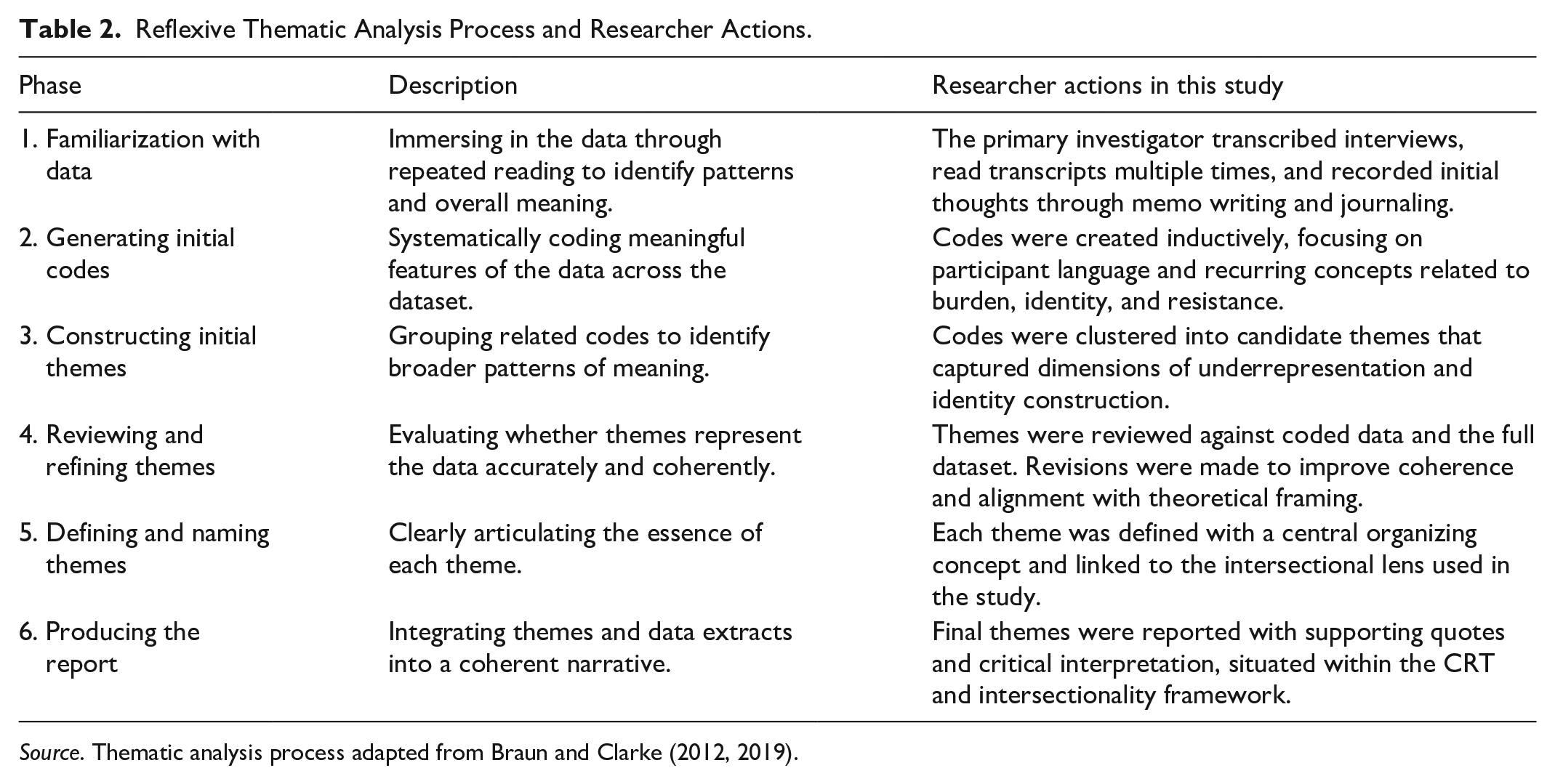
Source. Thematic analysis process adapted from Braun and Clarke (2012, 2019).
Reflexivity and Positionality
This study embraced reflexivity throughout the research process. Reflexivity involves continuous self-awareness of how the researcher’s background, identity, and assumptions may shape interactions and interpretations (Braun & Clarke, 2019; Finlay, 2002; Olmos-Vega et al., 2023). Guided by a constructionist perspective, meaning was understood as socially constructed within broader institutional and cultural contexts.
As a Black woman nursing faculty member in a predominantly white U.S. academic setting, the primary investigator shared key aspects of identity with participants. This insider status facilitated rapport and encouraged participants to speak candidly and without self-censorship. Many used colloquialisms without the need for elaboration, trusting the researcher to understand and accurately represent their narratives. Through reflective journaling and analytic memoing, the investigator focused on the participants’ interpretations while being mindful of her own influence.
Rigor and Trustworthiness
Credibility and trustworthiness were established through transparent documentation of the research process, including methodological decisions, theoretical grounding, and analytic strategies. Reflexivity and positionality were explicitly acknowledged to allow readers to assess how subjectivity informed, rather than biased, the study. The analytic process was thoroughly described to ensure dependability, and thick description of findings supported transferability to similar contexts (Table 3).
Strategies to Ensure Rigor and Trustworthiness.

Source. Adapted from Lincoln and Guba (1985).
Findings
Demographic Information of the Participants
All participants in this study identified as Black women, with the majority being women. The sample reflected a wide range of roles across academic nursing, including faculty, directors, deans, associate deans, and a CEO. Most held doctoral degrees and brought substantial nursing and academic experience. Participants varied in tenure status, academic rank, and leadership positions, offering rich and multi-layered insights into how intersecting identities shape professional identity in predominantly white academic spaces. Table 4 provides an overview of participant demographics, illustrating the professional diversity and positional variation that informed the study’s analysis.
Participant Demographic Summary (N = 32).

Note. Percentages may not total exactly 100% within some categories due to rounding to two decimal places.
The study’s findings are presented through a reflective interpretative thematic analysis, an approach that engages deeply with participants’ narratives to uncover explicit and implicit meanings. Moving beyond surface description, the analysis weaves the researcher’s reflexivity into the interpretation, situating participants’ perspectives within broader social, cultural, and institutional contexts. By acknowledging the nuances of participants’ realities, it offers a holistic view of their challenges and triumphs. Themes and subthemes are used to structure the analysis, highlighting the complexities of participants’ realities. Direct quotes are included to center participants’ voices, while the researcher’s reflexivity informs the interpretation of how identity, power, and underrepresentation intersect in academic nursing.
Theme 1: The Burdens of Underrepresentation
This theme captures the racialized and gendered pressures Black women in academic nursing endure as a result of their underrepresentation—particularly in leadership roles. Participants described how success is often perceived as collective rather than individual, creating an unspoken expectation to represent and uplift their entire community. The tension between personal authenticity and communal responsibility reflects the intersectional burden of visibility (Crenshaw, 1991), where being one of the few Black faculty amplifies both scrutiny and symbolic significance. Dube reflected: Whether we like it or not, our success is our community’s success. Even when you do not feel that you are representing or speaking for the Black community, so many people. . . feel like that about you. . . I felt the pressure to be a good representation of my community and those who look like me.
Dube’s account reveals the emotional labor of navigating this dual role—both excelling as an individual and performing as a cultural representative. For many, this burden was internalized, driving a need to overperform in institutions that already marginalize them. These narratives underscore how systemic inequities not only restrict access to leadership but also impose added psychological demands on those who break through, reinforcing CRT’s view of racism as embedded in institutional expectations and unspoken norms.
Several participants described how these pressures influenced their professional decisions, particularly around academic credentialing. They pursued doctoral degrees not only for advancement, but as a preemptive strategy to avoid being questioned or dismissed. Uche shared, “I felt like I needed a PhD so that no one could question my right to be here.” For others, earning the most recognizable or rigorous credential, such as a PhD over a DNP—was a deliberate attempt to command respect in predominantly white academic spaces. This pattern of defensive credentialing underscores how symbolic representation also shapes material choices. It illustrates how underrepresentation imposes not just emotional labor, but also structural pressure to exceed institutional norms in order to be perceived as legitimate.
This theme highlights how institutional underrepresentation produces racialized expectations of symbolic leadership, compelling Black women to carry both personal and communal responsibility. Through the lens of CRT and intersectionality, these experiences expose how whiteness remains the default in academic spaces, while Black women are burdened with representing and uplifting their communities in environments that offer little structural support. The emotional labor of this dual role reflects a system that individualizes diversity work while absolving institutions of accountability. While Theme 1 explores the symbolic and structural burdens of underrepresentation, the following themes further demonstrate how this underrepresentation manifests in undervaluation, exclusion, and emotional toll.
Theme 2: Navigating Undervaluation in Academia
This theme captures the intersecting racial and gender dynamics that shape how Black women faculty experience and respond to systemic undervaluation in academic nursing. Participants described how professional gratitude, institutional silence, and representational labor intersect to suppress self-advocacy and reinforce inequitable norms.
Gratitude Overshadowing Self-Advocacy
Many participants shared that the excitement of being offered a faculty role often silenced their instincts to advocate for fair compensation or better terms—particularly in predominantly white institutions where such opportunities felt rare. As Jumola recalled: “I was so excited to be invited that I accepted the first salary offer made to me. It never occurred to me to negotiate.”
Her use of invited reflects the power asymmetry and scarcity mindset that permeates the experiences of underrepresented faculty. Within the CRT framework, this illustrates how institutional gatekeeping is internalized, producing compliance in lieu of equity.
Muna echoed this sentiment but expanded on the systemic economic pressures within nursing education that further discourage negotiation, especially for Black faculty. She noted that many remain in academia not for the compensation, but out of commitment to the profession: I’m in academic because of the passion I have, it’s not because of salary. . . 90% of people you’ll have as nurse faculty, they have jobs somewhere. . . because it will take you years to be able to pay your bill with just faculty salary.
Her reflection reveals how structural undervaluation is normalized in academic nursing. Passion becomes a substitute for adequate compensation, and gratitude for the opportunity often outweighs calls for fairness. These dynamics converge to create a culture where Black women faculty—already underrepresented and overextended—accept inequities as a condition of participation. CRT’s lens helps us see this not as individual failing, but as the product of institutional norms that expect silent endurance in exchange for visibility.
Constrained Agency: Silence, Sacrifice, and Survival
Although many participants were acutely aware of disparities in pay, workload, and institutional recognition, few felt empowered to act. Instead, they described a state of constrained agency, shaped by fear of being labeled “difficult,” the absence of mentorship, and a strong sense of responsibility to students. Pelumi captured this tension: “I know I can make more in other institutions. . . but I stayed. . . because I convinced myself that the students need me.” Her decision reflects the emotional burden of representation—remaining not because conditions are equitable, but because her presence matters to those coming behind her. This self-sacrifice, while empowering to students, often came at great personal and financial cost.
Others expressed hesitation to advocate for themselves due to the institutional silence surrounding inequities, or the sense that pushing back could jeopardize their standing: “You just have to do what you have to do to survive.” Within predominantly white institutions, Black women often navigate environments where professional advocacy is framed as oppositional, and silence becomes a mechanism of survival. CRT highlights how this internalized restraint is produced through racialized structures of discipline and exclusion. Intersectionality reveals how gendered expectations of docility, combined with racial stereotypes, leave Black women vulnerable to institutional neglect while bearing the emotional labor of persistence.
Theme 3: Navigating Stereotypes, Exclusion, and Racialized Labor
Black women faculty in academic nursing described persistent encounters with racial stereotypes, exclusionary behaviors, and racialized questioning that shaped their professional identities. These experiences reflect not only interpersonal bias but also systemic undervaluation and the mental gymnastics required to navigate and succeed in predominantly white institutions. Three intersecting dynamics emerged: challenging preconceptions, managing the burden of exceptionalism, and performing invisible labor to maintain legitimacy and belonging.
Challenging Preconceptions and Presumed Incompetence
Participants frequently encountered racialized assumptions that cast them as outliers within academic spaces. Often disguised as compliments, these statements reinforced their racial “otherness” and reflected the presumption of incompetence that many Black professionals confront. For example, Sannia remarked, “This white colleague said to me, ‘I have never met a Black person like you before.” Jumola’s colleague expressed the same sentiment “You are different. You are not what I expected.”
Even after meeting or exceeding institutional benchmarks, participants described the emotional toll of repeatedly having to prove their legitimacy. As Dannie noted: “We pretty much all have to have the same requirements to teach. But yet, people question my expertise until I have proven myself.” These encounters reveal how everyday racialized harm, though often normalized within academic cultures, undermine professional credibility and compound isolation.
The Burden of Exceptionalism and Racial Representation
Many participants described feeling they had no margin for error. Their actions were viewed not only as reflections of themselves but as representations of all Black professionals. This burden to “represent well” created a high-stakes environment in which the cost of failure felt amplified by racial identity. “You cannot afford to mess up because it will reflect badly on other Black people they meet,” Sannia explained. Kyara added, “Why do I have to always find the bright side? Why can’t the system change so I don’t have to?” This relentless demand for composure and overperformance underscores how structural whiteness locates the responsibility for inclusion on marginalized individuals rather than institutions. The expectation that Black women reframe harm as growth reinforces emotional suppression as a professional norm, contributing to burnout and psychological distress.
Invisible Labor and Institutional Neglect
Participants reported that in addition to their official duties, they were often expected to explain racialized harms, educate colleagues, and navigate exclusion with minimal support. This unrecognized labor—emotionally, intellectually, and interpersonally—represents what CRT scholars call a form of racialized institutional taxation. “I spent time educating a colleague about their assumptions while simultaneously solving a professional problem,” Jumola noted, while Holli admitted, “I was begging people for help.”
Some forms of racialized harm escalated into overt exclusion. As the first Black faculty member in her institution’s 110-year history, Holli recalled: “One of the faculty actually approached me within one month of my hire, telling me that she doesn’t see me lasting here.” Such comments reflect more than individual hostility—they reveal institutional cultures that question the legitimacy of Black women’s presence and leadership. In this context, Black faculty must continuously justify their inclusion in spaces that offer little affirmation or structural support.
This theme reveals how everyday racialized harms—ranging from stereotype-driven assumptions to exclusion and hyper-surveillance—are normalized in academic environments. Through CRT, these experiences are understood not as isolated incidents but as manifestations of structural racism embedded in academic norms, expectations, and hierarchies. Intersectionality highlights how these harms are compounded by gender and role expectations, forcing Black women to labor invisibly, self-monitor, and reframe racism as resilience while navigating spaces not built for their success.
Theme 4: Institutional Isolation and Structural Neglect
Participants’ experiences revealed a persistent pattern of institutional isolation and systemic disregard for the well-being and advancement of Black women faculty. These experiences—rooted in historical exclusion and sustained by contemporary organizational cultures—manifested in racial solitude, lack of mentorship, and uncompensated cultural labor. Together, they reinforced underrepresentation and racialized burden.
Racial Isolation and Structural Exclusion in Academic Spaces
Many participants described being the only Black faculty member in their department—a condition that extended beyond numbers to a deeper sense of exclusion from both social and institutional structures. Social and professional disconnection, even from other faculty of color, left them without meaningful networks or shared spaces for support. “We’re just so disjointed. We don’t really talk with one another; we don’t share the same space,” said Sadi. Holli, the first Black faculty member in her school’s 110-year history, was met with silence and doubt: “People struggle to figure out how to work with me. . . One of the faculty actually approached me within one month of my hire, telling me that she doesn’t see me lasting here.”
Others described how racial isolation extended into exclusion from critical institutional processes, such as student conduct and academic progression decisions. Khari reflected on how joining a student affairs committee revealed inequitable presentation of student cases and disparities in accountability: “How do we make decisions about people’s futures when we don’t understand the whole picture?. . . For one of our academic integrity issues, it was watered down. . . They were clearly cheating, but that’s not what was presented.” This account illustrates how institutional exclusion is not limited to interpersonal dynamics, it is embedded in decision-making systems that affect both faculty and students. Black faculty may be structurally sidelined from the very processes where bias could be challenged, perpetuating inequities under the guise of policy neutrality.
These experiences reflect institutions ill-equipped to support or retain Black women faculty, where exclusion is not merely social but structural, reinforcing what CRT identifies as racism embedded in everyday policies and procedures.
Seeking Guidance in the Void
Mentorship for Black women in academic nursing was often absent, inadequate, or
Khari, working at a predominantly white institution, described how the absence of structured support left her navigating faculty life alone. Despite lacking formal advising responsibilities for some students, she was regularly sought out by students of color due to shared lived experience: “I’m still grappling with that cultural tax where students of color seek you out. . . because of just shared life experiences or. . . struggling and not feeling comfortable with approaching other faculty.”
Khari’s account highlights how racialized labor and institutional neglect intersect, leaving Black women unsupported in their own development while expecting them to provide informal mentorship to others. This dynamic aligns with CRT’s framing of structural inequality and reveals how academic systems privilege whiteness while extracting uncompensated labor from marginalized faculty.
In contrast, Saran, a dean, described using her leadership position to actively counter these patterns. Aware that minoritized faculty are often excluded from informal networks where key advancement knowledge is shared, she deliberately created mentoring structures to support their success. While her outreach extended to all faculty, she prioritized outreach to those most likely to be overlooked: “[I help them] develop advancement plans, navigate promotion processes, and determine whether academia is the right long-term fit.”
Saran’s account illustrates how culturally responsive leadership can interrupt cycles of exclusion by anticipating structural neglect and addressing it proactively. Her efforts serve as a counterexample to the prevailing void in mentorship described by most participants, demonstrating what equity-oriented mentorship could look like if institutionalized.
Cultural Taxation and Unacknowledged Advocacy
In addition to official duties, participants were frequently positioned as cultural interpreters and racial equity educators—roles that, while critical, were unpaid, unrecognized, and emotionally taxing. Participants pushed back against these imposed roles: “I am not the spokesperson for the Black community” Khari asserted. Yet many, including Khari, found themselves deeply embedded in student support work, often serving as an anchor for students of color navigating predominantly white programs. She described how informal mentoring became a lifeline for students and a meaningful, if unacknowledged, aspect of her faculty identity: I have notes on my office whiteboard from students who’ve graduated, thanking me for supporting them and being there for those conversations. Some told me those talks helped them get through situations where they didn’t feel comfortable going to other faculty. They said it made a difference — even in just staying in the program.
Despite the profound student impact, this labor was not always institutionally supported or recognized, some are accused of “giving more attention to students of color.” Khari noted that while some faculty and leaders recognized the importance of equity work, others disregarded it entirely. Her account illustrates how cultural taxation operates not just as a burden of responsibility, but as a space of connection, emotional investment, and systemic tension.
While this advocacy supports student persistence, the uneven support from peers and leaders reflects an institutional culture that benefits from equity work without structurally supporting it. CRT helps frame this not as an oversight, but as an expected feature of academic spaces that normalize whiteness while depending on the unpaid labor of faculty of color to promote inclusion.
Theme 5: Emotional Exhaustion and the Cost of Survival Instead of Thriving
The emotional exhaustion described here reflects the compounded weight of systemic underrepresentation, institutional neglect, and racialized expectations. The cumulative effect of institutional neglect, cultural taxation, and racialized expectations produced profound emotional exhaustion among participants. Black women faculty described the constant effort to remain composed, competent, and credible in environments where their legitimacy was routinely questioned and their contributions undervalued. For many, this ongoing labor led to sustained fatigue and brought them to the edge of burnout. This sentiment is exemplified by Ilori’s statement: “You are always exhausted not from the physical work but from mental and emotional gymnastics. It got to a point where it is no longer sustainable.” Often invisible to others, this exhaustion was not episodic but cumulative, produced by long-term exposure to systemic inequities and the relentless demand to navigate them alone.
Isolation deepened this exhaustion. Participants described being left out of both professional and social networks. They often had to initiate their own inclusion, navigating professional spaces where invitations were not extended. This quiet exclusion heightened participants’ sense of marginalization and self-questioning. Exclusion was compounded by hypervigilance: the ongoing need to self-monitor and suppress emotional responses to avoid confirming stereotypes or appearing unqualified. As Hillary noted, “You cannot afford to mess up because it will reflect badly on other Black people they meet.” This state of hyper-awareness forced participants to suppress valid emotional responses while consistently self-monitoring—a survival strategy that drained emotional reserves.
In addition to navigating this isolation, some participants felt a personal responsibility to act as racial representatives and institutional advocates—mentoring underrepresented students, challenging racialized language, and addressing inequities—all while managing the demands of their formal academic roles. “Language has consequences. It’s not my job, but I couldn’t let it slide” Pelumi noted. Although participants took pride in such advocacy, they also voiced frustration with how institutions normalized these burdens as part of their unofficial duties. As Akia explained, “I kept saying to myself, ‘I must do what I have to do to succeed and prove them wrong.’” This expectation to remain resilient in the face of harm underscores how institutions rely on Black women’s emotional and mental labor to sustain themselves, rather than addressing the structures that create harm.
For some participants, the psychological toll of this unreciprocated labor became untenable, prompting serious consideration of leaving academia altogether. “I just could not do it anymore. I don’t know how much longer I can continue in academia. I am not sure it is worth it. All the sacrifice. . .,” Emelda said. Others described a quiet resignation—learning to survive systems unlikely to change by drawing on internal reserves rather than expecting institutional accountability.
These experiences reveal that emotional exhaustion and burnout are not the result of personal fragility or overwork. They are symptoms of an academic system that extracts labor, demands excellence, and withholds care. Through a CRT lens, these conditions are not incidental—they are the product of structures that normalize whiteness while marginalizing Black women. Intersectionality further illuminates how race, gender, and professional expectations converge to make emotional endurance a requirement for survival in academic nursing.
Yet one participant, Hassani, offered a markedly different experience—illustrating how institutional care and trust can foster psychological safety and mitigate emotional fatigue. She did not experience pressure to overperform or fear of surveillance. Instead, she described feeling valued, supported, and free to focus on her work and students without hypervigilance: I didn’t feel like I was under the microscope, and I didn’t feel pressure. . . what I did feel was an enormous sense of gratitude. . . when you feel loved and cared for by your superior and colleagues. . . you have a level of productivity that’s unparalleled.
Rather than operating in survival mode, Hassani described a thriving environment—driven not by fear or scrutiny, but by relational trust and a sense of belonging. An environment where she felt free to focus on students, take intellectual risks, and grow professionally. Her narrative underscores that emotional exhaustion is not inevitable; but context dependent, shaped by leadership culture and institutional climate. Hassani’s account reinforces the idea that when care and affirmation are embedded in academic structures, Black women faculty can thrive rather than endure.
Theme 6: Identity Negotiation and Resilience as Survival Work
Black women faculty in academic nursing described the emotional and psychological work of navigating institutions where their presence, appearance, and communication were persistently marked as “other.” To remain in these spaces, participants engaged in ongoing identity negotiation, modulating how they spoke, dressed, and presented themselves to be perceived as professional, credible, and nonthreatening. These adaptations were often accompanied by efforts to reframe adversity as fuel for resilience, reflecting both the burden and brilliance of survival.
For many, the need to conform began early in their nursing trajectories. Ella reflected on how whiteness was naturalized in nursing education, shaping her early sense of self: It just didn’t start when I got into a leadership role. . . My introduction into nursing with it being a predominantly white field. . . even as a student and earlier in my career, there wasn’t that explicit discussion about how you are perceived and the racism that is just flagrant. . . So, I saw myself as just trying to fit in to what was projected as the norm.
Ella’s experience illustrates how institutional whiteness is embedded in nursing’s foundations. In the absence of critical discourse about race, many participants internalized the need to adapt—laying the groundwork for later codeswitching and identity regulation as forms of professional survival.
Codeswitching and Cultural Adjustment
Participants shared that codeswitching, whether conscious or unconscious, was often necessary for navigating predominantly white environments. They described adjusting their language, behavior, and engagement in faculty spaces to avoid scrutiny. “Unconsciously, I was codeswitching because I was trying to fit in to keep my job. . . Some things I did, I hated doing them. . . but I had to do what I had to do,” Holli recalled. These adaptations, though often subtle, had deep emotional and psychological effects. As Knox observed, “You don’t even recognize that you’re doing that. . . but it affects your well-being—psychologically, physically, mentally, and spiritually.” The constant need to recalibrate to “fit in” exemplified the daily costs of navigating whiteness in academic nursing, often under the guise of professionalism.
Appearance and the Politics of Presentation
Participants also described how hair, dress, and physical presentation became sites of surveillance and tension. Their appearance was often met with fascination, exoticization, or subtle critique. “I always have to weigh how I dress, how I wear my hair. . . because you are judged on the standards set by people who do not look like you,” Muna noted. “There is an unnatural fascination about my hair,” Sannia added. Ella spotlighted the politics of this scrutiny, connecting it to broader systems of control: “Who else is policed for their natural hair that you have to have a policy to be able to show up?. . . That’s an assault on someone’s humanity. For literally just being.” Citing the CROWN Act, she argued that Black embodiment remains pathologized in professional spaces, reinforcing Eurocentric norms and extending Du Bois’s notion of double consciousness to the body, hair, and self-presentation.
Resilience as Internal Resistance
In response to these racialized pressures, participants developed forms of resilience that enabled survival. This was not rooted in optimism, but in necessity. “I had to succeed—not just for myself, but to defy the low expectations placed on me and prove I belonged in spaces that doubted me. The students don’t expect me to quit” Gozie explained. This resilience hinged on reframing exclusion as motivation and maintaining mental discipline under duress. “I kept saying to myself, ‘I refuse to be a failure,’” Vanisa recalled.
For some, survival meant outperforming institutional expectations through “defensive credentialing.” Safiya reflected: I had to get the hardest one. I had to get the one that everybody, every White person would know what it was. I don’t have to explain it. . . I intentionally got a PhD. . . so no one could question my ability.
Her story reflects the anticipation of racial doubt and the extraordinary labor required to be perceived as legitimate.
Other participants expressed resistance by embracing authenticity rather than assimilation. Akia described modeling self-acceptance in her pedagogy.
I wanted students to know that you could be yourself and be in nursing and be in this space, and that was important for me. . . It organically happened. Students felt a comfort level in speaking with me. . . regardless of where they were from. —Akia
Akia’s classroom approach became a form of resistance, affirming her identity and the humanity of her students, even within rigid institutional norms.
Yet participants were clear: resilience came at a cost. It masked psychological strain, required constant self-regulation, and did little to dismantle structural inequity. Some, like Ella, described how efforts to conduct race-conscious or justice-oriented scholarship were discouraged as unfundable or irrelevant. “I was trying to focus on. . . not the pharmaceutical or biological implications. . . but more of the social construct. . . And I remember being told. . . ‘Oh no, that would never fly. You’re not going to get funding.’”
For Ella, it was not the institution but professional organizations that ultimately supported her racial consciousness and critical identity development: “What helped to form my professional identity. . . came through the professional socialization in my professional organizations.” Her narrative highlights how formal academic structures often suppress racial literacy, while counterspaces—affinity groups, external organizations, and communities—nurture it.
Through the lens of Critical Race Theory and intersectionality, these strategies—codeswitching, presentation management, defensive credentialing, and reimagined pedagogy—are not freely chosen, but forged under structural constraint. Black women in academic nursing are compelled to navigate institutions that demand excellence while denying belonging, requiring them to adapt constantly while being denied the freedom to exist as they are.
Summary of Findings
This study reveals how the burden of underrepresentation shapes the intersecting challenges experienced by Black women faculty in academic nursing. Participants navigated persistent racialized exclusion, professional undervaluation, cultural taxation, and institutional neglect—conditions that were intensified by their visibility as “the only one” or “one of few.” The pressure to codeswitch, overperform, and represent their entire communities compounded the emotional and psychological toll of navigating spaces not built for their success.
While participants demonstrated extraordinary resilience, reframing adversity, engaging in self-advocacy, and sustaining student support, the cost of survival was profound. Their narratives reveal that what often appears as personal strength is in fact a response to systemic failure. Through a Critical Race Theory and intersectional lens, these findings demonstrate how racism and sexism are embedded in the expectations, norms, and omissions of academic nursing. The burden of underrepresentation is not incidental; it is structurally produced and institutionally sustained.
Discussion
Identity negotiation emerged as core dimensions of navigating academic nursing. Drawing on Critical Race Theory (CRT) and intersectionality, the findings illuminate how Black faculty—particularly women—contend with systemic exclusion, performative diversity expectations, and the emotional labor of survival in predominantly white institutions. The six themes—The Burdens of Underrepresentation; Navigating Undervaluation in Academia; Navigating Stereotypes, Exclusion, and Racialized Labor; Institutional Isolation and Structural Neglect; Emotional Exhaustion and the Cost of Survival; and Identity Negotiation and Resilience as Survival Work—offer a critical lens into how structural racism and gendered expectations intersect to shape faculty experience and professional identity in academic nursing.
This study affirms the deep structural inequities that underlie the persistent underrepresentation of Black women in academic nursing. As Field et al. (2023) note, disparities in early promotions for Black women contribute to their declining representation at each successive leadership level. Participants in this study articulated the immense pressure to succeed not just for personal advancement, but to symbolize opportunity for others. This aligns with Wallace et al. (2014), who described the historical burden placed on Black educators to lead social transformation while being scrutinized. The expectation to represent one’s race—and to do so without institutional support—echoes Crenshaw’s (1991) framing of intersectionality, wherein Black women must navigate overlapping systems of race and gender oppression. While many embraced roles as mentors or trailblazers, the emotional and professional toll of symbolic leadership without structural backing is profound.
Undervaluation manifested through unequal compensation, constrained advancement, and internalized expectations to accept poor treatment in exchange for opportunity. Participants recounted how gratitude for being “invited” into academia often muted their instinct to negotiate or self-advocate, reinforcing institutional norms that reward compliance (Dickens & Chavez, 2018; Hernandez et al., 2019). Muna’s reflection on the economic instability of nursing faculty roles further highlights the structural normalization of devaluation. This mirrors DeWitty and McCamey’s (2022) findings that faculty of color are concentrated in less supported, under-resourced institutions. Through a CRT lens, these outcomes are not personal shortcomings but reflections of structural power imbalances that treat Black women’s presence as conditional and undervalued.
Participants detailed encounters with racialized aggressions and expectations, including heightened scrutiny of their appearance and expertise. The burden to outperform, avoid mistakes, and “disprove” stereotypes of incompetence or aggression parallels the “angry Black woman” trope described in Dickens and Chavez (2018). These experiences evoke Du Bois’ concept of double consciousness and align with Iheduru-Anderson (2020), who emphasized how Black women must constantly prove their legitimacy in academic nursing. The compulsion to overperform due to anticipated scrutiny was compounded by the racialization of ordinary behaviors—such as hair presentation—echoing the embodied cost of hypervisibility. These findings align with McGee et al. (2023), who found that stereotype management requires continuous emotional labor, often at the expense of authenticity.
Institutional support systems were notably absent from participants’ narratives. Many described being “the only one” in their department, lacking both peer networks and structured mentorship. Khari’s account of piecemealing her professional identity underscores the organizational neglect of Black faculty development. This reflects Hirshfield and Joseph’s (Hirshfield & Joseph, 2012) concept of identity taxation—where marginalized faculty perform unpaid labor as cultural brokers without adequate institutional recognition. Pelumi’s efforts to challenge deficit-based language among faculty, despite receiving no formal authority to do so, underscore the structural expectation for Black women to advocate without institutional backing. As CRT asserts, neutrality in policy often masks deeply racialized practices that perpetuate inequity.
The compounded pressures of undervaluation, exclusion, and hypervisibility produced profound emotional fatigue among participants. The emotional toll of having to “be excellent at all times” while feeling surveilled and unsupported echoes findings from Holley (2021) and McGee (2024) who found that Black women principals felt their decisions had implications for all Black women in leadership positions. They believed they could not afford to make mistakes, as it would reflect poorly on Black women leaders as a whole. Participants’ sense of having “no margin for error” and of serving as racial exemplars echoes the invisibility/hypervisibility paradox described by Iheduru-Anderson et al. (2024). Several participants reported psychological distress related to impostor syndrome, performance anxiety, and self-surveillance. This aligns with research showing that Black women in leadership experience chronic stress due to intersectional expectations (Iheduru-Anderson & Shingles, 2023).
The internal conflict between professional identity and authenticity, coupled with systemic resistance to their presence, created a cycle of overwork, self-silencing, and burnout. Consistent with the paradox framework, our data show that underrepresentation and racialized taxation coexist with hypervisibility in evaluative moments, magnifying stress and burnout (Iheduru-Anderson et al., 2024). These patterns reveal that resilience is often mistaken for wellness and used to excuse institutional failure to support Black faculty.
Participants employed strategies such as codeswitching, strategic silence, and credential overcompensation as tools for survival. These practices, while adaptive, were rarely fulfilling and often diminished their sense of authenticity. Holli’s account of reluctantly codeswitching to “keep her job” exemplifies how Black women are compelled to conform to white normative standards at the expense of self. This reflects Hall et al.’s (2012) notion of “shifting,” and connects to broader research on stereotype management among Black professionals (McGee, 2016). While participants demonstrated remarkable agency and resilience, CRT and intersectionality frameworks remind us that such resilience emerges not from institutional empowerment, but from necessity. These strategies underscore the reality that survival in white-dominated academic institutions requires ongoing identity negotiation, mental discipline, and emotional fortitude.
Together, these themes reveal that Black women in academic nursing are not only navigating systems that devalue and isolate them—they are simultaneously building pathways for others while carrying invisible labor. Despite their leadership and contributions, they remain underrecognized, overburdened, and emotionally taxed. Their testimonies demand structural transformation—not simply personal adaptation—to ensure that diversity in nursing education is not achieved at the cost of Black women’s well-being.
Implications for Nursing Education, Leadership and Practice
The underrepresentation of Black faculty—particularly Black women—in academic nursing reflects entrenched structural inequities that limit access to mentorship, advancement, and institutional influence. This underrepresentation is not simply a numerical imbalance; it undermines the profession’s stated commitment to equity and weakens its ability to educate a workforce equipped to meet the needs of an increasingly diverse population. Without structural investment in inclusion, nursing education risks perpetuating the very inequities it seeks to address in practice (DeWitty & Murray, 2020; Wallace et al., 2014). Nowhere is this more evident than in the failure of academic nursing to provide meaningful, structured, and culturally responsive mentorship. Despite nursing’s emphasis on care, collaboration, and professional development, mentorship within nursing academia often reflects exclusionary norms, passive neglect, or a “figure-it-out” ethos that abandons marginalized faculty at critical career stages.
Participants in this study revealed how underrepresentation is sustained through systems that normalize exclusion, reward assimilation, and devalue culturally informed contributions. Black faculty often assume the role of mentors, cultural brokers, and advocates for underrepresented students—despite receiving little or no institutional support. These roles demand emotional labor and institutional knowledge yet are rarely acknowledged or compensated. Meanwhile, these same faculty are routinely denied access to meaningful mentorship themselves, navigating career progression in isolation. This contradiction exposes the limits of performative inclusion and the deep misalignment between nursing’s professional values and its academic practices.
Addressing these conditions requires sustained structural transformation. Nursing education must move beyond symbolic diversity efforts and implement equity-centered hiring, promotion, and retention practices. Institutions should develop formalized, culturally responsive mentorship infrastructures that are embedded in policy, resourced appropriately, and evaluated for impact. Mentorship should not depend on individual goodwill or informal access to insider knowledge but must be recognized as essential to professional development and faculty success.
Leadership development must also be democratized and equitably resourced, particularly within underfunded Minority-Serving Institutions (MSIs) where leadership opportunities are often limited by financial constraints. Federal and philanthropic investments in faculty pipelines, mentorship programs, and race-conscious policies are critical to reversing patterns of exclusion. Academic leaders must be trained to identify informal exclusion and actively counteract the cultural patterns that marginalize Black faculty (Wallace et al., 2014).
One participant’s approach as a dean illustrates what inclusive leadership can look like in practice. By intentionally mentoring minoritized faculty, facilitating advancement planning, and creating access to otherwise gatekept knowledge, she modeled a proactive and relational form of leadership. Her example highlights how intentional action—not just inclusive rhetoric—can interrupt structural exclusion and support long-term equity in faculty development.
Finally, institutions must reframe success to include collective well-being, cultural accountability, and community-rooted excellence. Centering the voices and experiences of Black faculty—particularly Black women—offers a path forward for academic nursing to live up to its stated values and to build a workforce capable of addressing the health needs of a diverse and changing society.
Strength and Limitations
This study offers several notable strengths. By using a narrative inquiry design, it centers the lived experiences of Black faculty in academic nursing providing in-depth insight into the structural, cultural, and emotional complexities they navigate. Gathering stories from multiple participants allowed for the identification of shared themes while honoring the distinctiveness of individual trajectories.
However, as with all narrative studies, limitations exist. Participant narratives depend on memory and self-reported reflections, which may be shaped by time or selective recall. Some participants offered vivid and detailed accounts, while others provided more generalized responses. To enhance depth and accuracy, the researcher used probing questions and conducted member-checking by sharing a thematic summary with three participants to validate interpretations.
The interpretive nature of narrative inquiry introduces the potential for researcher bias. The researcher’s positionality may have influenced both data collection and analysis. To mitigate this, the researcher engaged in ongoing reflexivity, acknowledged their standpoint, and documented analytic decisions to ensure transparency.
Although these findings are not intended to be statistically generalizable, they offer transferability to readers in similar academic or institutional contexts. The study’s detailed methodological approach provides a foundation for replication or adaptation in future research involving other marginalized faculty groups. Ultimately, this study amplifies voices often excluded from leadership discourse in nursing education and underscores the urgent need for systemic change.
Conclusion
This study illuminated the persistent and intersecting burdens faced by Black women faculty in academic nursing, revealing how systemic underrepresentation, racialized labor, and institutional neglect shape their professional identities and trajectories. Participants navigated these challenges by engaging in strategic adaptation, cultivating resilience, and fostering community, even as these efforts exacted significant emotional and psychological costs.
The findings affirm that these burdens are not individual deficiencies but institutional failures rooted in entrenched structures of racism and sexism. Participants were clear that real change requires more than inclusion rhetoric—it demands structural accountability. They called for leadership that prioritizes equity, transparent advancement pathways, and institutional cultures that recognize and redistribute the labor of mentorship, advocacy, and representation.
To cultivate a truly inclusive and just academic nursing environment, nursing education must center the voices and experiences of those historically marginalized, not as a diversity checkbox but as essential to the profession’s growth, integrity, and social mission. Without such transformation, Black women will continue to bear the weight of a system not built for their success.
Footnotes

Funding
The author disclosed receipt of the following financial support for the research, authorship, and/or publication of this article: The author received partial financial support for the research from the Central Michigan University Faculty Research and Creative Endeavor Fund and the College of Health Professions Faculty Research Grant. No funding was received for the authorship or publication of this article.
Declaration of Conflicting Interests
The author declared no potential conflicts of interest with respect to the research, authorship, and/or publication of this article.