




Abstract
We examine the lived experiences of foreign domestic helpers (FDH) working with community-dwelling older people in Hong Kong. Unstructured interviews were conducted with 11 female FDHs, and thematically analyzed. The theme inescapable functioning commodity represented the embodied commodification of FDHs to be functional for older people in home care. Another theme, destined reciprocity of companionship, highlighted the FDHs’ capacity to commit to home care and be concerned about older people. The waxing and waning of the possibilities of commodified companionship indicated the intermittent capacity of FDHs to find meaning in their care, in which performative nature for functional purposes and emotional engagement took turns to be the foci in migrant home care. This study addresses the transition of FDHs from task-oriented relation to companions of older people through care work. Discussion draws on the development of a kin-like relationship between FDHs and older people with emotional reciprocity grounded in moral values.
Keywords
Introduction
In response to a shortage of family caregivers, importing migrant care workers is becoming a global phenomenon in developed countries or cities (Bourgeault, Atanackovic, Rashid, & Parpia, 2010; Cohen-Mansfield, Garms-Homolová, & Bentwich, 2013; Constable, 1997; Gavanas, 2013; León, 2010; Palenga-Möllenbeck, 2013). According to the Organisation for Economic Co-Operation and Development (OECD; 2012, 2013), migrant workers employed in the health and social care sector comprised 3% to 24.3% of all migrant workers in Western developed countries in 2011, and the trend has been increasing. Employing a foreign domestic helper (FDH), as a major group of migrant care workers, to fulfill caregiving needs has become common in Hong Kong homes. Among the 2,431,500 households in Hong Kong, one out of three has hired an FDH (Census and Statistics Department, 2015; HelperChoice, 2016). The proportion of retired couple households with FDHs has increased from 2.5% in 1995 to 7.8% in 2016 (Legislative Council Commission, 2017). The proportion of singleton elderly households with FDHs has also increased from 2.5% in 1995 to 9.7% in 2016 (Legislative Council Commission, 2017).
Current understandings about informal care largely focus on the caregiving provided by family members and on the associated caregiver burdens. In particular, managing the distress of providing care for older persons is a primary stressor that can lead to a great deal of family conflict (Pearlin, Mullan, Semple, & Skaff, 1990). Studies reveal that factors that contribute to the highest amounts of caregiving distress for families also apply to FDHs, including the fact that the majority of such caregivers are female, have a low level of educational attainment, reside with the care recipient, are consigned to spending a large number of hours on caregiving, and lack the choice about being a caregiver (Adelman, Tmanova, Delgado, Dion, & Lachs, 2014; Zarit, Todd, & Zarit, 1986).
However, unlike family relationships, FDHs are not assumed to have the bond of filial responsibility toward the elderly care recipient as they are not family members of older people (Phillips, Ajrouch, & Hillcoat-Nallétamby, 2010). Generally, the tasks performed by FDHs at home can be reduced to the three “C’s”: cleaning, cooking, and caring (Anderson, 2000; Bauer & Österle, 2013). The latter, in particular, does require emotional engagement, which cannot be realized without interaction, affection, and fondness (Bauer & Österle, 2013). It was argued that the affective dimension of the work of FDHs problematizes traditional understanding of employer-employee relationships in which emotional exchange is not the major concern (Baldassar, Ferrero, & Portis, 2017). The debate about whether FDHs are emotionally engaged lies in whether they are regarded as quasi-family members or have “insider” status, experience emotional reciprocity, and can negotiate power with their employers (Bauer & Österle, 2013; Chowdhury & Gutman, 2012).
For the majority of FDHs, the boundary between care work and domestic service is usually blurred (de la Cuesta-Benjumea & Roe, 2014; Gavanas, 2013; Razavi & Staab, 2010). This places FDHs in a position of being potentially vulnerable to abuse, whether physical, emotional, or verbal (Akalin, 2007; de la Cuesta-Benjumea & Roe, 2014). The phenomenon of “care exploitation” was popularly reported in studies of migrant home care. For example, the concept of “social family” explicated the abuse of familial-like relationships of FDHs by extended kin of older people (Lin & Bélanger, 2012). At the micro-level of interpersonal interactions in the care work, FDHs also experienced discrimination, insufficient language proficiency, and lack of cultural competency (Bourgeault et al., 2010; Gavanas, 2013; Walsh & Shutes, 2013).
Despite the distresses mentioned above, the affective dimension in the care work of FDHs may enable their kinning with older people and allows FDHs to experience enhanced relationships with older people (Baldassar et al., 2017). Kinning is the process of the development of kin-like relationships between caregivers and care recipients (Baldassar et al., 2017). This kinning may be viewed as a positive aspect in the caregiving of FDHs, which may further contribute to the well-being of both FDHs and older people. Because of this possibility, questions arise about how FDHs negotiate their caregiving distress with employers, and find positive meanings in their work.
Significance of This Study
We argue that understanding the caregiving experience of FDHs is crucial because they are a marginalized group in that their care work is “invisible” from the public sphere. It was suggested that live-in arrangements effectively concealed the interactions between older people and FDHs, which contributed to reduced public accountability on long-term care within an uncertain social care environment (Christensen & Manthorpe, 2016). In addition, the lack of formal occupational regulation of the home care provided by FDHs is a disempowering characteristic not present in other types of intimate and informal caregiving roles undertaken by people who are not family. Thus, the possibilities and vulnerabilities inherent in relationships between FDHs and older people need further exploration. These insights may lead to a much better understanding of the potential dangers and possibilities faced by FDHs in their caregiving work.
Aim of the Study
To examine the lived experiences of FDHs working with older people living in the community of Hong Kong.
Design and Method
This study uses Heideggerian (1927/2008) hermeneutic phenomenology and the methods of van Manen (2014). Heideggerian hermeneutic phenomenology is employed in this study because of its emphasis on the ontological stance of “being in the world” (Dasein). The notion of “being in the world” is about understanding lived experiences as socially and historically conditioned in ways that are not questioned, or without consciously being aware of one’s own taken-for-granted situation (Heidegger, 1927/2008). In addition, assumptions of this methodology include an understanding of a reality that is in constant transformation. Such transformation occurs through changing social norms, such as personal goals or interests. Moreover, dynamic interpretations often occur through a cyclical (hermeneutic) process in which reality evolves (Heidegger, 1927/2008).
Recruitment of Participants
Eleven female FDHs, aged 27 to 57, with 2 to 15 years of experience in caring for older people, were voluntarily recruited from two local nongovernmental organizations (NGO) and through personal networks. Briefing sessions were provided to FDHs to explain the projects and their rights to withdrawal. Informed consent from FDHs was sought before they were interviewed. (See Table 1 for the demographic characteristics of the participants.) The study was granted ethical clearance by the Human Subjects Ethics Sub-Committee of the related university. This report uses pseudonyms to maintain the confidentiality of the participants.
Demographic Characteristics of the Foreign Domestic Helpers.

Note: NGO = nongovernmental organization.
Data Collection and Analysis
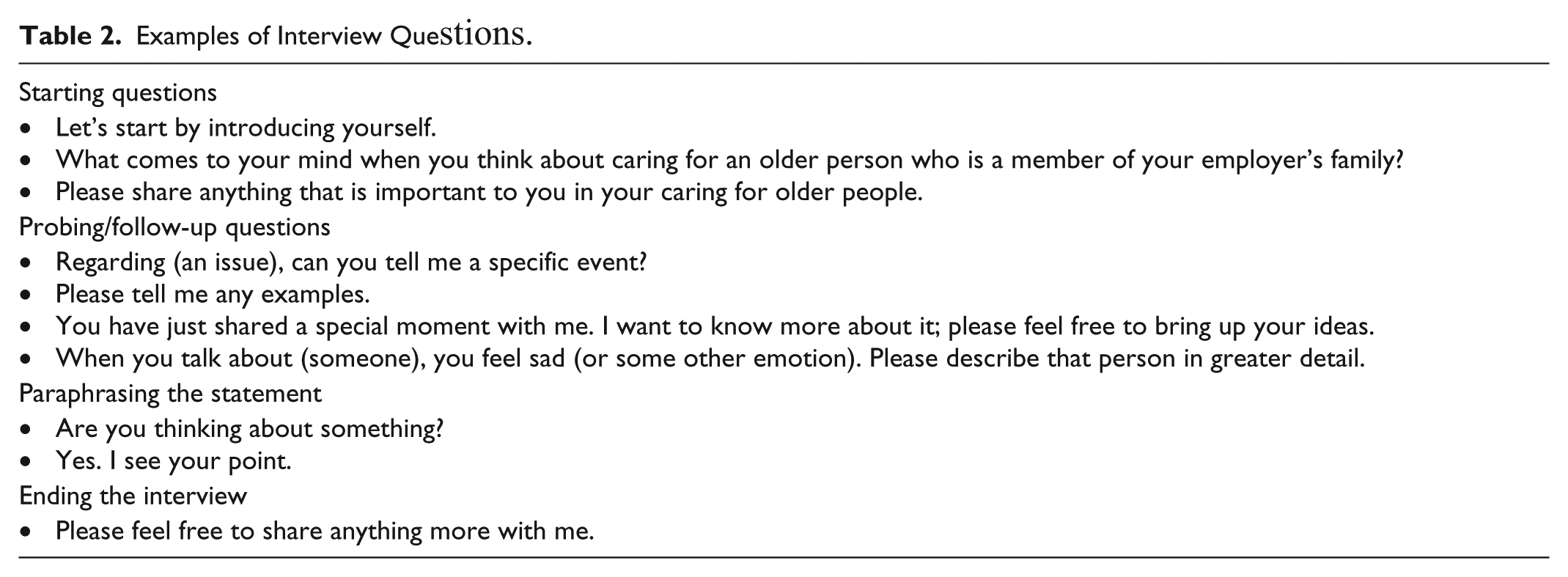
Data collection and analysis occurred simultaneously. The first author conducted interviews from December 2013 to February 2016. Each interview lasted from 60 to 120 minutes, which was the length of time needed to collect vivid stories of the FDHs’ work (see Table 2 for some of the open and unstructured interview questions). None of the FDHs demonstrated emotional distress during the process. Interviews were transcribed verbatim.
Examples of Interview Questions.
The data were analyzed by identifying and questioning connections with Heidegger’s philosophy (de Witt, Ploeg, & Black, 2010) by employing van Manen’s (2014) systematic process of collecting and analyzing these data: (a) gathering descriptions of lived experiences; (b) converting data into anecdotes; (c) subjecting the anecdotes to holistic, selective, and line-by-line thematizations; and (d) engaging in phenomenological reflective writing (van Manen, 2014). These four processes are iterative, which allow the authors to reflect back-and-forth between the part and the whole of these data. This reflection facilitated the research team to question about any taken-for-granted assumptions (e.g., contractual obligations of FDHs) in the analysis, contributing to hermeneutic interpretation. The research team subsequently disclosed the various patterns of relationship between older people and FDHs, contributing to understandings about migrant home care with multiple realities.
The research team generated thematic expressions, phrases, and/or narrative paragraphs. These were transformed into sub-themes and themes at higher levels of interpretation. After the 11th participant, the analysis revealed recurrent meanings and patterns; hence, an end was put to the recruitment and data analysis.
Trustworthiness
To ensure trustworthiness, the authors employed the framework of de Witt and Ploeg (2006), which emphasizes five characteristics: (a) balanced integration, (b) openness, (c) concreteness, (d) resonance, and (e) actualization. Balanced integration was achieved by connecting Heidegger’s philosophy with van Manen’s method and with quotes from the participants, to elicit the meaning of experiences. Openness was demonstrated by accounting for decisions that were made throughout the study, such as on eligibility criteria and the cessation of data collection and analysis. Concreteness was achieved by linking the meanings of experience with a discussion on the nature of caregiving and the well-being of FDHs for future practice and research. Resonance was facilitated by reading this manuscript individually and showing intellectual sympathy for the caregiving provided by FDHs (de Witt et al., 2010). In addition, each FDH was presented with a transcript of her own anecdotes and was invited to elaborate on them. For those who could not attend face-to-face follow-up interviews, the first author related his interpretations of their stories through mobile phone texts or online communication tools. As for actualization, no measures can actualize the future felt effect and utilization of readers (de Witt et al., 2010); however, in this article, readers are supported in doing so with the inclusion of excerpts of the raw data that provide contextual factors of the participants’ situation.
Findings
The theme inescapable functioning commodity represented the embodied commoditized care work of FDHs that the self of FDHs was entrapped as a commodity in home care. Another theme, destined reciprocity of companionship, highlighted the FDHs’ capacity to commit to home care and to be concerned about older people with mutual regard. Together, the essence was interpreted as a waxing and waning of the possibilities of commodified companionship. This process disclosed the intermittent capacity of FDHs to find meaning in their care, in which the performative nature for functional purposes and emotional engagement took turns to be the foci in migrant home care.
Inescapable Functioning Commodity
This theme highlights the embodiment of FDHs with instrumental purposes to serve older people and the family of older people, which ultimately satisfies FDHs’ own desires. On one hand, the functional dependency of older people compels individuals to employ FDHs to carry out burdensome and “dirty” task when caring for older people (Cohen & Sirkeci, 2011): Grandfather was hospitalized for 3 days. When he was discharged back home, he was weak. He could not walk. I assisted him in walking. (Ella) I transferred grandfather from his bed to the wheelchair and to the bedroom every day. . . . Grandfather suffered from constipation. I needed to use my finger to open his bowels as taught by the doctor. (Ida)
On the other hand, the desire to earn money and to meet career aspirations prompted FDHs to supply themselves as instruments to fulfill those needs: The salary in Hong Kong is better. I have to save money. I can learn more and I want to be a nurse in Indonesia. (Audrey)
Within the employer-employee relationship, the older people and the employers of FDHs provided considerable responsibility to FDHs. For the older people or the family members of the older people, FDHs were instrumentally functional. For example, Jessica was a housekeeper for the older people, while Ida was an extension of the children of older people. Meanwhile, the assigned tasks could be overwhelming for FDHs, and the functional nature in the relationship can be a source of stress in the caregiving: Md’m (grandmother), I can’t finish all the tasks in one day. Please instruct me slowly. (Jessica) My employers left all the responsibilities to me. Whenever grandfather was sick, I called the ambulance and sent him to the hospital. Whatever grandfather needed, I just told his children. They would give me money and they left other responsibilities to me. (Ida)
However, emphasizing the functional nature of FDHs in the caregiving eventually forced the FDHs to resign their autonomy and self-worth to satisfy the instrumental needs of older people: I must stay beside her when she watches TV. I have to put the phone in front of the TV and take the phone to her if someone calls her. I still need to sit beside her even [when] she finishes watching TV. She instructs me like a robot. I would tell her, “I am your hands and I am the one to do it.” I am so tired of her. (Jessica)
Paradoxically, FDHs also valued themselves for their utility, which had allowed them to come to Hong Kong. The scope of services might even extend beyond instrumental functioning, that the entirety of FDHs could replace the children to take care of older people with quality time. The self of FDHs was embodied in an exchange relationship between services and money, in which FDHs showed up as commodities to be “kept” in a relationship to perform functions: I was the only one for the couple. I could give them everything they needed, except for financial needs. I could help them. I could take care of them. Their children did not have a good time with them. In fact, it may be the only reason why the older people kept me. (Felicia)
Notably, this way of being “commodified” by putting oneself into a relationship to serve for functions according to the needs of employers for exchanges of material reward was not self-evident to FDHs. They were usually unaware of how they were embodied within the “commodification” of who they were and what they did, as they simply perceived this state of affairs as “the way things are,” thus, being inescapable: I don’t think I am a commodity. I work to improve the life of my family and to satisfy my own desires. (Audrey) It depends. While I am unhappy with my family and need money, I can see that I am exchanging money with my own body. I think it’s normal. (Jessica)
Destined Reciprocity of Companionship
This theme highlights the development of enhanced relationship between older people and FDHs, in which FDHs experience emotional reciprocity from older people. The FDHs spoke about another aspect of their work in those moments when they acknowledged their commitment and emotional concern for the older people whom they cared about: I called grandmother also because I had been staying in the hospital for a whole day [with grandfather]. I worried about the safety of grandmother when she was home alone. Ultimately, I worried that grandmother would be unable to care for herself. (Catherine)
This meant that they connected emotionally to the older people. In moments of reciprocity between the FDHs and the older people, the FDHs’ being was characterized by an authenticity based on mutual trust. While the FDHs concerned about the well-being of older people by committing to the care works, FDHs subsequently experienced trust from older people as an emotional reciprocity. For example, both Audrey and Bonita gained the trust from their older care recipients: I noted everything down. I did everything. When the new helper came, I told her that the heart is important. Now, when grandmother has any problem, she asks me . . . Even if the other helper answered her questions, grandmother would ask me again to confirm. It seems that grandmother did not want her to answer. (Audrey) She was already bedridden in the hospital in later years. Her daughter returned from New Zealand to care for her, so I stayed outside the ward. However, grandmother told her daughter that, “I want Bonita. I want Bonita to sit beside me, to take care of me.” Honestly, it’s a good thing for me. (Bonita)
Experiencing emotional reciprocity from older people further enabled FDHs to put the welfare of older people at the forefront of their experiences. Subsequently, FDHs assigned less meaning to monetary rewards and put the sole pursuit of financial gains into the background: The children said that they did not have money. So I offered half salary to them to allow me to continue to care for the couple. I even said, “If you really cannot afford to hire me, I am fine with any amount that you give me. . . . Of course, I am also here for money. If you are good to me, money is secondary.” (Felicia)
Positive interactions characterized by respect and appreciation enabled FDHs to commit into the caregiving totally, as explicated by “give my whole heart to this job, to grandmother.” This affirmed that who they were and what they did went beyond that of performing functions as a commodity to being engaged in companionship with affection. FDHs acted as trustworthy companions to the older people whom they cared about. As a result, the FDHs experienced a destined reciprocity with older people, characterized by the generating of mutual regard in their relationships: On the first day, I accompanied grandmother to have exercise. Grandmother said I was smart. . . . There were also moments when grandmother would shake for a few minutes after waking up in the morning. She seemed to have lost a lot of energy, so that she was even unable to pick up a cup. . . . That was the time that I needed to give my whole heart to this job, to grandmother. Therefore, I hugged her or kissed her when grandmother cried. I even slept with her on the same bed so that she would not be alone. Grandmother is a nice person. I like her. Therefore, I am nice to her. (Katy)
The Essence: The Waxing and Waning of the Possibilities of Commodified Companionship
The development of enhanced relationship between FDHs and older people was not always obvious. Even though the FDHs were able to develop emotional bonding with older people, the affective dimension of their care work was occasionally given less concern when the FDHs rationalized their care work by attending to imperatives of everyday survival: I could not leave grandfather without consideration. I knew that he would leave [die] immediately if I left him. . . . Being a helper, I had to be patient because I needed the job. (Ida)
Hence, making sense of their work was in a process that “waxed and waned” between two ways of being: as a commodity, or maid, while at the same time, as a crucial part of their work as a companion or friend: They [her employer’s family] told me that I am already a part of their family. . . . But I am a maid, or a friend. (Bonita)
The particular possibilities of being a commodity (maid) and/or being a companion (friend) at any moment depended on the mutual trust and respect granted to FDHs in their caregiving, in which FDHs would return in the relationship. This showed the reciprocity between older people and FDHs: I did not calculate with them [older people]. Money is nothing for me. If you treat me well, money is secondary. If you respect me, I respect you. . . . The friendship is important. Friendship and respect. (Felicia)
Experiencing respect from older people preserved the FDHs’ capacity to commit themselves in their relationships with older people. In one excerpt, the language used by one FDH demonstrated a fundamental need to preserve or restore a sense of meaning in their work, that is, as “caring has to come from the heart”: Caring about older people has to come from the heart. Older people occasionally show temper and are naughty. If the helper does not care from his/her heart, he/she will scold and beat the older people. If the helper cares from his/her heart, he/she will talk with the older people patiently. (Dora)
The “heart” personified the FDHs’ commitment to care through a deeper and fuller engagement with older people. This commitment eventually allowed FDHs to provide care out of a sense of moral obligation: It [caring for older people] was difficult. . . . Maybe if you love your children, you will do anything for them. I learned to take care of grandfather just like loving my child. Therefore, I accepted everything. I still carried on, although it was such a difficult obligation, such a difficult responsibility. (Ida)
In other words, FDHs were not simply concerned about the welfare of older people, but were open to the possibilities arising from an authentic presence in moments of caregiving: I just try to permit something to develop. . . . All of our experiences turned into love. In caring for grandmother, I just let her feel assured. No matter what happens, I help her. (Bonita) It seems that I am connected with grandmother. I cannot understand it, but it is really uncomfortable to leave her [to start another career in another city]. (Katy)
Eventually, in reflecting on the struggle between caring for and caring about older people, the FDHs were able to articulate past experiences to develop deeper meaning in their own lives. FDHs recalled how they had started the relationship with older people under the intention to transform care works into remittances for their own sake. While FDHs overcame the difficulties in their care work for older people, their relationship transformed from a performative nature to a relational one characterized by gratitude from older people. While the remittance allowed FDHs to survive by being instrumentally functional to older people, the companionship provided other meanings to FDHs to validate their caring experience, helping them to justify their care works. This process culminated in a kind of suffering that waxed and waned with respect to different ways of being in their work: Until now, if I have time, I will go to take a look at the building where we lived. If they had not hired me as a domestic helper, I would not be there. . . . [T]his couple is still very important to me. Because of them, I can support my children. (Felicia) I gained something and I learned something. . . . For 12 years, I had those hurtful moments. I consider those moments as successful. Grandfather told me that he was happy with me. He cried and said thank you to me. There won’t be any successes if I don’t get through pain, right? (Ida)
Discussion
In Hong Kong, FDHs perform the majority of the household work for local middle-class families (Chan, 2005). As such, due to their social status, the FDHs’ voices and work are vulnerable to marginalization (Chowdhury & Gutman, 2012; Khan, 2009). In this study, the FDHs’ sense of self was inescapably commodified to purposes that were instrumental, as echoed by Anderson (2000) that “that is the worker’s ‘personhood’ rather than her labour power, which the employer is attempting to buy” (Anderson, 2000, p. 128). Yet, this was the reality to their provision of home care, as FDHs are integrated into the global care chain with power inequality between developed countries and developing countries for contrived purposes, including for providing the domestic task of caregiving (Hochschild, 2000). Many studies have been devoted to the phenomenon of marginalization in an attempt to understand and prevent the exploitation of FDHs and to properly advocate for them when they encounter problems in the households in which they work (Akalin, 2007; Constable, 1997; de la Cuesta-Benjumea & Roe, 2014; Yeoh & Huang, 2009). This study advocates for FDHs that they are not passive but are actively engaged in the caregiving. Instead of viewing the care work of FDHs merely as an exchange relationship grounded in service and monetary reward, our findings agree with recent studies on domestic work that there is a transition from performance of tasks to performance of affection in the realm of home care by migrant care workers (Baldassar et al., 2017; Shinan-Altman & Ayalon, 2017). Meanwhile, the transition is conditional on prior mutual reciprocity between older people and FDHs and grounded in the deep moral responsibility that FDHs feel toward the older people whom they care about.
In this study, the “heart” personified the sense of care felt by the FDHs and resonates with previous studies on women’s caregiving being rooted in a sense of moral obligation (Finch, 1989). In particular, we found that the FDHs’ commitment to engaging in companionship allowed them to be authentically present in their relationships. This enabled them to place in the forefront concerns about the quality of their care (Chiang, 2011). This development of FDHs from instrumentally functional to companions of older people somehow echoed with Karner’s (1998) discussion on the development of a kin-like relationship of long-term care workers. The development of a kin-like relationship progresses from task-oriented through friendship to familial adoption (Karner, 1998). Meanwhile, our findings only support the transition from task-oriented to friendship with controversial data to support the transition to familial adoption. In our data, the FDHs named their older care recipients as grandparents. FDHs also provided a metaphor that caring for older people was just like loving the children of FDHs. However, the FDHs also clearly positioned themselves as maids or friends of older people. This may highlight the ambivalence experienced by the FDHs in the relationship that status of “fictive kin” may actually be exploitative (Lin & Bélanger, 2012). For example, the development of a kin-like relationship is often associated with emotional labor that replaces emotional care from families (Ayalon, 2009). In this study, the FDHs even advocated that they could replace the children of older people by providing quality time with older care recipients, to be kept in the caregiving relationship. However, by replacing the family members of older people, FDHs suffered from a considerable amount of responsibilities as well. The ambivalence in the relationship is worthy of further investigation.
Another point is that the kinning process (Karner, 1998) is not a unidirectional process in this study. There was a “waxing and waning” of the FDHs’ ability to focus on either the performance of tasks for one’s own survival or emotionally engaging with older people for the sake of older people’s welfare. Our findings suggest that task-oriented relationship and companionship keep replacing each other in different situations. In this study, some FDHs were able to eventually reflect on their experiences and express a purposeful life of fulfillment, together with earning remittances for their own sake. This finding echoes that of other studies showing that FDHs, as women, were able to perceive care as rewarding in the sense of feeling that they were giving to others and learning from the experience (Chowdhury & Gutman, 2012; Marks, Lamber, & Choi, 2002). Baldassar et al. (2017) suggested that central to the development of a kin-like relationship, the passage from a constrained choice of migrant care provision to a mutually meaningful relationship is more important than any named stages. This study provides a brief insight into Baldassar’s suggestion that the moral obligation shared by FDHs in their care work may be important for them to perceive positive meanings in home care. The moral obligations may serve as a medium for moral imagination or reflection of FDHs so that they are enabled to reinterpret their roles and redefine their situation for other higher meanings (Black, 2004; Guignon, 2006).
While the deep moral responsibility enabled the FDHs to be concerned about the well-being of older people, the FDHs have to experience prior mutual trust and mutual regard from the older people. The work of Huh (2008) suggests that the rewards of providing care are more than material. There is an intrinsic reward for FDHs, which is the psychological reward resulting from gains in caregiving (Foley, Tung & Mutran, 2002; Kramer, 1997). Gains in caregiving, such as mutual regard, enabled the dyad of FDHs/older people to experience enhanced relationships as a result of positive interactions with emotional reciprocity (Baldassar et al., 2017).
Limitations and Strengths
This study involved only female FDHs, and, therefore, might not be applicable to male FDHs, who make up only 2% of caregivers in Hong Kong. Meanwhile, cultural and structural differences need to be taken into account when considering whether the insights obtained from this study might apply to other countries. For example, migrant home caregivers who participate in the underground employment market may demonstrate other ways of working and connecting with older people (de la Cuesta-Benjumea & Roe, 2014; León, 2010; Morales-Moreno, Giménez-Fernández, & Pérez-Echevarría, 2015). Most current studies view the phenomenon of FDHs from a sociological or feminist perspective, focusing on the rights of FDHs working in a constrained environment (Hochschild, 2000; Khan, 2009; Yeoh & Huang, 2009). This study complements such studies by taking a phenomenological approach to providing a voice to FDHs, and by disclosing their active commitment to care. This study may help health and social care professionals to come up with another way of supporting this workforce by appreciating their potential to contribute to the provision of quality care.
Implications
This study revealed the necessity of FDHs to not just care for, but to also authentically care about, older people through their emotional commitment. Moreover, the findings are similar to those of other studies that showed that family care relationships involve more than just the action of serving (de la Cuesta-Benjumea & Roe, 2014; Doane & Varcoe, 2005; Gündüz, 2013). In other words, previous studies have tended to ignore those experiences that are connected to ways in which FDHs express a connection and experience a deep moral responsibility to the older people whom they care about. This study shows that strategies supporting the work of FDHs are needed, which acknowledge that such work goes beyond the exercising of skills to merely fulfill tasks, and also involves the need to cope with emotional demand in care work.
According to Kelly and Bourgeault (2015), the duties of FDHs are ambiguous in terms of scope, especially in the area of caregiving. Currently, the skills training provided by local NGOs to FDHs in Hong Kong is limited in scope. For the most part, it is comprised of instruction in first aid skills, basic care, housekeeping tasks, and cooking (HelperChoice, 2017; Wang, 2017). There is a lack of psychosocial training and support to help FDHs cope with the emotional demand of caregiving arising from the development of companionship. Hence, further research is needed to understand the types of caregiving work performed by FDHs in Hong Kong, as well as their psychosocial burden. As a better understanding of their work is achieved, training programs for FDHs can be developed and standardized (Kelly and Bourgeault, 2015).
Policy makers might also devise standardized occupational strategies to enhance the working conditions of FDHs. As FDHs take on more roles in caring for older people, the creation of a caregiver registry might help to regulate them (de la Cuesta-Benjumea & Roe, 2014; Kelly & Bourgeault, 2015). Moreover, a registry of FDHs may better identify those in need of support, including training and psychosocial support (Kelly & Bourgeault, 2015).
Conclusion
This study highlighted ways in which FDHs are commoditized in providing home care for older people. In particular, their emotional commitment to providing such care eventually made them less completely focused on the financial benefits involved in carrying out the task, but rather led them to incorporate the element of companionship. This highlights the need of social care strategies that address the possibilities and risks arising from the development of companionship in the realm of migrant home care. The authors suggest that there is a need to support FDHs to cope with the emotional demand arising from the affective dimension of home care by providing FDHs with psychosocial support, and to facilitate the setting up of a registry of employers, to support the psychosocial training in caregiving to handle the emotional demands of home care.
Footnotes
Author Contributions
K.H.M.H. planned and conducted the study and data analysis, and wrote the article. V.C.L.C supervised the study and critically reviewed the study and the article. D.L. critically commented on the phenomenological analysis of the study and the article. B.H.B.K. critically commented on the findings in relation to classic studies on foreign domestic helpers in Hong Kong.
Declaration of Conflicting Interests
The authors declared no potential conflicts of interest with respect to the research, authorship, and/or publication of this article.
Funding
The authors received no financial support for the research, authorship, and/or publication of this article.
