




Abstract
Maternal, child, and newborn health is a priority area in Canada and around the world. The work of public health nurses (PHNs) is often invisible and misunderstood. The purpose of this qualitative research project was to explore how universal and targeted home visiting programs for mothers and babies were organized, delivered, and experienced through the everyday practices of PHNs (n = 16) and mothers (n = 16) in Nova Scotia, Canada. Feminist poststructuralism and discourse analysis were used to analyze interviews. Concepts of relations of power enabled an understanding of how health outcomes had been socially and institutionally constructed through binary relations. PHNs and mothers spoke about the importance of “softer” health outcomes, including maternal self-confidence and empowerment that had been constructed as less important than health outcomes that were seen to be more tangible and physical. Findings from this research could be used to guide practice and planning of postpartum home visiting programs.
Keywords
Public health nurses (PHNs) can make a significant difference in the lifelong health of mothers and babies through the care and support they provide in the early postpartum period. Supporting families during this time is a priority in many countries around the world (Blackman, 2002; Engle et al., 2007; World Health Organization [WHO], 2013) where various types of programs are offered to mothers and families. Support programs typically begin in the first few months postpartum, sometimes extending up to 5 years depending on family’s needs. Early home visits provided by PHNs in the first month postpartum are one example of such support.
Most public health care professionals would agree that supporting mothers and babies in early postpartum is the most effective means of ensuring both short- and long-term positive health outcomes for individuals and families are attained. Early home visiting (EHV) programs have, in fact, been shown to positively affect the physical, social, emotional, and mental health outcomes of mothers, babies, and families (Kersten-Alvarez, Hosman, Riksen-Walraven, Van Doesum, & Hoefnagels, 2010; Nieva, Van Egeren, & Pollard, 2010; Olds et al., 2010; Plews, Bryar, & Closs, 2005; Sharps, Campbell, Baty, Walker, & Bair-Merritt, 2008; Sweet & Appelbaum, 2004; Vanderburg, Wright, Boston, & Zimmerman, 2010). However, there are many different models of home visiting programs, and the best way to deliver care continues to be debated.
The majority of public health research tends to focus on health outcomes that are tangible and easily measured such as rates of breastfeeding, hospital admissions, maternal smoking, infant weight, and maternal and infant mortality/morbidity (Public Health Agency of Canada [PHAC], 2013). Some people might refer to these as “hard” measureable health outcomes. In contrast, health outcomes such as confidence and self-esteem are included less often and when they are included, these health outcomes are often represented as less important thereby creating a dichotomy and discourse of “softer” health outcomes. Few studies have examined the impact of these “softer” health outcomes on personal and family health. In this article, we present one of our major findings that emerged from the data and focus on how “softer” health outcomes were constructed through the everyday practices of PHNs and mothers. Our overarching primary research question was as follows:
We begin with a background of the provision of postpartum care through public health.
Background: Postpartum Follow-Up Care and Public Health Nursing
The WHO states that health care must be responsive and accessible to all people who need it (WHO, 2000, 2001, 2013; World Health Organization & Office of the UN High Commissioner for Human Rights, 2007). Postpartum follow-up care through home visiting is one example of health services responsive to the needs of mothers, infants, and their families. The numerous EHV programs that exist in countries around the world, including Canada, are influenced by social, economic, cultural, and institutional factors (Davidson, Smith, Socha, Aston, & Etowa, 2010; Nova Scotia, 2015a, 2015b, 2015c).
In Canada, most EHV programs are carried out by PHNs. Their work has a century-long history rooted in illness prevention and health promotion for mothers and children through both school and home visiting programs that historically focused primarily on poverty and unsanitary living conditions (Aston, 2008; Aston, Meagher-Stewart, Vukic, & Sheppard-Lemoine, 2006; Aston et al., 2014a, 2014b; Jack, DiCenso, & Lohfeld, 2005; Stamler & Yiu, 2011). This strong focus on primary prevention, health promotion, and protection for children and mothers continues to underpin PHN practice today. Yet, despite this long history, the work of PHNs around the world has not been well researched or evaluated and therefore continues to be misunderstood, misconstrued, unrecognized, undervalued, and seen as women’s work (Aston et al., 2014a, 2014b; Davies, 1998; Stamler & Yiu, 2011; Yiu & Horsburgh, 1989).
Western society has also historically represented public health nursing as women’s work, thereby socially constructing the practice as less valuable than medical or health interventions that predominantly incorporate a more quantitative “scientific” approach to interacting with mothers. Despite the fact that PHN work involves complex health assessments that are evidence-based, rigorous, and scientific (Stamler & Yiu, 2011), PHNs have also been referred to as “mothers’ friends” creating a dichotomy between medicine and public health (Davies, 1998) that often perpetuates a non-intentional hierarchy between these two health disciplines.
A medical discourse became dominant during the 1980s when the global approach to public health shifted from a socio-ecological perspective to a more reductionist, biomedical, and clinically driven model. This major shift conflicted with the socio-ecological health promotion and illness prevention practice of PHNs (Stamler & Yiu, 2011). During the 1990s, changing notions of public health led to debates about optimal models of service delivery, prompting PHNs in North America and the United Kingdom to adopt a more targeted approach to home visiting (Aston et al., 2014a, 2014b; Elkan, Robinson, Williams, & Blair, 2001; Hall & White, 2005; Olds, 1999; Stamler & Yiu, 2011). At the same time, emerging research continued to reveal health inequities and the significance of social determinants of health (Ashton & Seymour, 1988; PHAC, 2010) causing PHNs in Canada and around the world to focus increasingly on serving the needs of populations perceived to be more “vulnerable” and “at risk.” New mothers who are identified as meeting certain criteria are sometimes referred to as being in the “targeted” population (PHAC, 2010), which then positions them dichotomously against other mothers who are considered “less vulnerable” and only eligible for more “universal” type programs.
Several studies have explored the efficacy of targeted programs and have found that they often lead to a variety of positive health outcomes such as a reduction in postpartum depression or an increase in maternal–infant secure attachment (Armstrong, Fraser, Dadds, & Morris, 1999); an increase in parents’ infant safety knowledge, a mother’s decision to breastfeed, and infant primary care visits (Hedges, Simmes, Martinez, Linder, & Brown, 2005); an increase in exclusive breastfeeding (Bashour et al., 2008); reduced maltreatment of children (Eckenrode et al., 2000); fewer pregnancies and more time between pregnancies; and less time needing aid and food stamps (Kitzman et al., 2000). Although there was a lot of research associated with targeted programs, we found very few studies that focused on universal programs for new mothers. Our overall critique of this literature found that health outcomes continued to be primarily measured quantitatively with very few qualitative studies.
There were only a few studies that focused on the experiences of PHNs and mothers. These included the development of a positive interpersonal relationship with nurses to effectively address fears of working with health professionals (Jack et al., 2005); feeling empowered about mothering practices (Aston et al., 2014a, 2014b; Aston et al., 2006); and the creation of a supportive climate and trust (Jansson, Petersson, & Udén, 2001). This lack of research evidence can perpetuate an environment that gives more or less credibility to some health outcomes and their long-term health impacts compared with others, and that tends to undervalue the work of PHNs. Findings from our study offer insight into the significance of hidden health outcomes discovered within EHV programs provided by PHNs for new mothers postpartum.
Purpose
The purpose of this research project was to explore how universal and targeted home visiting programs for mothers and babies were organized, delivered, and experienced through the everyday practices of PHNs and mothers.
Home Visiting Program
This study was conducted in Halifax, Nova Scotia, an urban environment. At the time of the study, public health services offered two EHV programs for mothers and babies: one designed specifically to “target” mothers “at risk” for poor health conditions and another to provide “universal” health care for mothers during the early postpartum period. Screening for these programs involved new mothers being contacted in the hospital or later at home by telephone. A standardized screening tool was used to determine whether a mother might potentially benefit from additional supports such as a PHN or community home visitor (CHV). A more thorough standardized assessment would then be conducted to allow for a more objective approach to determine if there was actual “risk” to the family and if they were eligible for the “targeted” or “Enhanced Home Visiting Program.” If the mother was not screened in as “at risk” but still needed a bit of support, a PHN could be available through the “universal” program via a telephone call or a home visit. Mothers in the “universal” program usually only required one to three visits or phone calls by a PHN depending on the needs of the family. In comparison, the “targeted” program offered weekly visits for up to 3 years from both PHNs and CHVs. Other support services offered by public health at the time of the study included prenatal classes, drop-in centers, and telephone support services from a PHN for breastfeeding or general postpartum support.
Method
Feminist poststructuralism informed by discourse analysis (Butler, 1992, 2005; Cheek, 2000; Foucault, 1983; Scott, 1992) guided all phases of the research process. This particular version of feminism as a philosophy, theory, and methodology focuses not only on the social construction of gender but also includes class, race, abilities, and so on. Knowing that most PHNs and mothers were women, we suspected gender would be an important concept to consider. The division between targeted and universal groups also alerted us to the possibility that judgments about class might emerge. Poststructuralism, guided by ideas from Foucault, provided us with a way to understand how personal experiences were connected to social and institutional discourses of health and mothering as well as understand how participants negotiated their world through relations of power. For example, by focusing on the language and meaning provided by each participant when describing their experiences within the home visiting programs, we could begin to understand where their beliefs and values came from and how they chose to interact with nurses, mothers, friends, colleagues, and so on. We were able to answer questions such as “How did PHNs and mothers interact with each other based on their socially constructed positions?” A discourse analysis allowed us to take the beliefs, values, and practices as told through participants’ own personal experiences and make sense of them within the context of social and institutional constructs and other discourses. Interactions through relations of power showed us HOW people were feeling, negotiating, challenging, or accepting different beliefs and practices. We also focused on identifying how binary opposites were socially constructed through relations of power that either continued to perpetuate these binaries or offered possibilities for change. With the use of feminist poststructuralism, we identified these moments as both oppressive and supportive social structures, stereotypes, and ideologies.
Recruitment and Ethics
Letters of invitation were sent to all PHNs who conducted EHVs in the targeted or universal programs. PHNs also gave letters of invitation to all new mothers during home visits. PHNs and mothers contacted the research coordinator if they were interested in participating in the study. We received a very positive response and were able to recruit the majority of PHNs who worked at the health unit. Mothers and managers also contacted us very quickly to participate in the study. The majority of interviews were conducted within a 6-month period. To be included in the study, PHNs had to have 1-year experience working in public health and at the time of the interview, be working in either the targeted or universal home visiting program. Mothers had to be a first-time parent and had a PHN visit them in their home at least once as part of either program. Managers had to have worked in their managerial position for 1 year. We interviewed 16 PHNs, 16 mothers, and four managers. Sixteen mothers and PHNs were determined as suitable as the researchers were focused on in-depth analysis of the interviews, and 16 of each enabled opportunities for in-depth interviewing. Fewer managers were interviewed as the focus of the research was on the direct visits. Of the 16 PHNs, two worked in both the targeted and universal program whereas an additional five PHNs worked exclusively in the targeted program. The remaining nine PHNs worked exclusively in the universal program. Of the 16 mothers who were interviewed, six were enrolled in the targeted program and 10 were enrolled in the universal program. All mothers and PHNs lived in the Halifax Regional Municipality that included both urban and rural areas. All mothers were interviewed in their homes, and PHNs were interviewed at work in a private office. All participants had the study explained to them by the research coordinator who was also the interviewer. Participants signed a consent form and were told they could withdraw from the study at anytime during the interview and up to 2 months after the interview. Participant names and identifying information were removed from research documents and replaced with pseudonyms. All participants were assured that their participation was voluntary, confidential, and they could stop at any time without consequences. The study obtained ethical approval from Dalhousie University and the University of Ottawa Research Ethics Board.
Data Collection and Analysis
Participating PHNs, mothers, and Public Health managers were interviewed about their experiences with the EHV programs. The interviews followed a semi-structured interview guide and were conducted in a conversational, non-hierarchical manner. We asked the PHNs questions such as “Tell me about the home visiting program,” “Tell me about a typical home visit,” “What works well?” and “What are some challenges?” We asked the mothers questions such as “Tell me about the home visit,” “What did you like about the visit?” and “What didn’t you like?” We asked the managers to tell us about the home visiting programs and their experiences as a manager working with PHNs, policies, and programming. The interviews, which lasted approximately 30 to 90 minutes, were audio recorded and transcribed verbatim by a transcriptionist who signed a confidentiality form.
Data collection and analysis were conducted simultaneously, and the research team, led by the principal investigator, analyzed the data using feminist poststructuralism and discourse analysis (Cheek, 2000; Powers, 2001). Briefly, this process followed a guideline developed by the principal investigator. All team members read one transcript and identified what they thought were significant issues. They then highlighted the quotations that supported the issues. The beliefs, values, and practices were then extrapolated from each quotation paying close attention to the exact words used by the participant to ensure we captured the meaning they placed on their own experience. We then wrote about the social and institutional discourses that informed the issue presented in the quotation. For example, we asked questions such as “How do the discourses affect the participant?” “Does the participant easily agree or disagree with the beliefs, values, and practices they spoke about?” “Was it an easy or positive experience?” “How did they feel?” and “Were there questions, conflicts, tensions that they expressed?” These moments were then analyzed as examples of “relations of power” that the participants experienced. We also incorporated the participant’s “subjectivity” (how they were positioned as a nurse, woman, mother, etc.) as well as their “agency” (how they chose to act in each situation by accepting or challenging their experience). We analyzed two more transcripts with the full team using the same process. After that the research coordinator and principal investigator completed analyzing the rest of the transcripts with the same process.
Rigor and trustworthiness were maintained through accurate transcription of in-depth interviews, using memos, and notes. Credibility was attained through regular research team meetings, which confirmed the ongoing analysis, while dependability and auditability were established through an audit trail that recorded research decisions and rationales.
Results
One of the themes that emerged through our data analysis focused on the “different” ways PHNs and mothers spoke about health outcomes. Managers are not included in this analysis as they did not convey the interactions of mothers and nurses in the field. It became evident that dichotomies had been created between health outcomes. Both PHNs and mothers spoke at length about how important it was to focus on being and feeling “normal,” “confident,” and “not judged.” This was a powerful and unique finding because although the words confident, self-esteem, and empowerment are sometimes used in the literature when referring to successful mothering, these words are not always specifically used with health outcome indicators (PHAC) or screening and assessment tools (Parkyn). All PHNs and mothers emphatically spoke about how feeling normal and gaining confidence helped mothers effectively take care of themselves and their babies. Two subthemes within the theme of health outcomes include (a) feeling normal: support and reassurance and (b) building maternal confidence.
Feeling Normal: Support and Reassurance
During home visits, PHNs described the need to reassure and provide support and information to new mothers about many issues. Both mothers and PHNs told us that mothers wanted to know that they were doing all the right things to ensure their babies were healthy and progressing appropriately. One nurse told us, for example, So with new moms, for sure there’s a sense of . . . Well, for some, there’s a sense of panic. That everything has to be according to the book. And so you explain to them, you know, you can spend your time saying, “It’s okay. You know what, I’ve seen a baby that hasn’t had a bowel movement every single day, and is breastfed and still does okay. I’ve seen a baby that has only gained their birth weight back in a full month after discharge, and that’s okay.”
A sense of their situation being “okay” was very important for mothers adjusting to their new role. Another PHN described the importance of reassurance in terms of “feedback”: We offer that feedback that you’re doing a good job, you know, or this is not going the way you want it to but you couldn’t have done anything about that. You know, it’s the propping up that people need sometimes when they’re going through a difficult time. Because there’s nothing more difficult than that role adjustment and that physical adjustment in particular even if things go well.
The statement “there’s nothing more difficult” brings acknowledgment to the intensity and difficulty of the first few months postpartum. PHNs in this study shared their expertise and assessments that the majority of mothers experience considerable pressure to do things right and determine what is “normal.” Many of the PHNs in the study spoke about how their practice included reassuring mothers that their experiences were “normal” and that they were doing a good job. The ability to assist mothers and their partners in this area can help to boost confidence and foster parenting capabilities. One PHN stressed that mothers needed “support with that . . . just what’s normal? Sometimes it’s a big thing to know what normal is.” This PHN also added . . . if a nurse is able to get in there and instill confidence in a mom in those first 3 and 4 and 5 days, it can make all the difference in the world with, you know, her understanding, well, what is normal? It’s normal for a baby to lose weight. Don’t worry about it. Let’s look at the other things. Is your baby pooping, is your baby peeing? Fabulous. You’re doing exactly what you need to do.
Most of the mothers described feeling reassured by their PHN. More specifically, they spoke about how they felt relieved to hear that they were “doing it right.” The dichotomy between “right” and “wrong” baby care created feelings of stress, anxiety, and guilt for all the mothers in the both home visiting programs.
I guess she reassured me that I was doing everything right and, you know, gave sort of that support that I needed . . . (Mother, Universal) Reassured, calmer. That I was doing something right. Because it’s so hard to tell in that first month, month and a half. You’re like, I don’t know what I’m doing. Everything is wrong. All he does is cry. And so it was reassuring to know that I was doing everything properly and that was just normal for babies, and that’s how it was supposed to be. (Mother, Universal) Because you do kind of want to be reassured whether you are doing things right or not. Not that you’re not doing things right because everybody’s different but . . . it’s just to have the sense of feeling that, yes, okay, I am on the right track. (Mother, Universal)
Mothers in this study expressed that they had, at times, minimal knowledge of what was “normal” for themselves and their babies and felt uncertain of their parenting skills and abilities. Having a PHN available to reassure them that what they were seeing and experiencing was normal (compared with other mothers and/or supported by experts) helped to relieve uncertainty and anxiety.
You know, it is, it’s very stressful and so consuming. Like everything they do, you want to make sure that they’re feeding normally and eating . . . You know, those types of things. And then you get that reassurance that yes, it’s okay, it’s good, it’s just you can almost feel your stress level leave. (Mother, Universal)
Mothers believed that PHNs were experts in parenting and caring for babies and, therefore, placed a high degree of confidence in opinions and suggestions offered during home visits.
. . . so it was reassuring to know that I was doing everything properly and that was just normal for babies, and that’s how it was supposed to be. Because even though my mother was telling me, I was like, “Mother, you don’t know.” Like you kind of doubt her because she’s my mother but she’s not somebody who’s like an expert on the subject or anything. So it was nice to hear it kind of from the horse’s mouth that I was doing it properly and that there was nothing to worry about. (Mother, Universal)
Fear and uncertainty play a significant role in the lives of these new mothers and goes hand-in-hand with a mother’s desire to know they’re “doing it right.” Much of the social discourses at play around new mothers are made powerful through fear-based outcomes. A mother is told that if she practices co-bedding she may harm her child, if she feeds her child formula her child will not receive the necessary nutrients to be healthy, and if her child is not able to lift his or her head by a particular age they are not “normal.” Although these types of guidelines are likely meant to be just “a guide” rather than set in stone practices, several mothers described their emphasis and reliance on these resources and guidelines.
I referred to my books and my books are telling me she should be on this kind of schedule, and [my baby] is not on the schedule that they books say. So I’m thinking, okay, now I’m doing something wrong. (Mother, Targeted)
Many PHNs in the study spoke about how they were aware of this perception by mothers, and therefore, they used their subject position as an expert to provide mothers with reassurance and comfort. “I think it’s just being a resource for someone,” stated one of the PHN participants. “[PHNs are] another resource versus their family physician who probably can only give them 6 to 10 minutes. And making it all right. Making sure everything that they are doing is okay.”
Mothers also identified a need to know that they were “normal” and that the issues and problems they were experiencing as a new mother were not unique to them.
I just think it makes you feel better as especially a new mother that there are other people having the same problems, the same questions, and they’re all getting answered through those resources that are available. (Mother, Universal) A lot of mothers don’t like to admit it but you have those moments that you’re just like, “get out of my face before I hurt you” [laughs] And like she’s really good with that. Like she’ll say, “okay, well, just . . . You know, you’re doing things right, you’re putting her down, you’re walking away, you’re going outside, you’re breathing, you’re doing . . .” You know what I mean? Like every mother has it and a lot of mothers don’t like to admit it but most mothers do go through it. (Mother, Universal)
The importance accorded to the PHN’s reassurance for new mothers during the home visits was a vital aspect that was reinforced throughout the data.
Building Maternal Confidence
Many of the mothers highlighted the significant role that PHNs played in building their confidence during a time of transformation and role development. The ability of a new mother to feel confident during such a significant transitional period as the birth of new baby is not an easy task. High expectations are placed on new mothers through a social discourse that suggests mothering should be instinctual and easy. As a result, new Mothers feel pressured to be a perfect parent while having minimal knowledge of parenting and what it entails. This leads to mothers feeling scared, uneasy, and insecure about caring for their child. The experience of confidence was discussed by most of the interviewed mothers with them very clearly identifying the PHNs as a source of confidence building.
He [husband] really likes that they come over because he feels like they are confidence boosters for me. And whenever they come, I’m usually in a good mood afterwards. So he enjoys the fact that they come over more than me going to any other follow-up clinics or anything. (Mother, Targeted) She made me feel very confident in what I was doing. Because every time I made a decision on something, she’d tell me the benefits of it and say, “That’s very good. I’m glad you chose that. You know. You’re making very good decisions here as a mother.” She said, “You’ve been doing the best a mother can do, and I’m really happy for you.” (Mother, Targeted)
Most of the PHNs also spoke about how confidence was an important health outcome for mothers. The PHNs described confidence building in terms of starting mothers “on the right track,” of pulling out “their strengths and really letting them know that, look, these are the things you’re doing well.” The PHNs also talked about fostering “autonomy” and “good self-esteem . . . just to feel strong in their role . . . so that they won’t be dependent on other people or other supports,” so that “they’ll be able to move forward”—important considerations according to one of the PHNs interviewed. “We’re so by ourselves,” she said. “Families are at the other end of the country or they’re working, not able to support moms. So it’s the support that she needs . . . [to] get things into a pattern of confidence.”
According to the PHNs who participated in the study, support to help build a pattern of confidence was essential to not only the mother and baby but also to the whole family system. The mother’s confidence went up if she felt that things were progressing normally and as one PHN pointed out, if the mother knows what to expect. Mothers were then able to cope better and focus on parenting and being “the best mother they can be,” engaging with the baby to reach his or her full potential. One PHN said, [As a confident mother] . . . you’re more engaged with the baby. You’re more engaged with your community . . . your partner, your family. And that again impacts everybody around you. If you don’t feel confident, you feel concern about how you’re mothering, you know. And then that’s passed on.
Confident mothers who are able to cope and focus on parenting are also empowered, as many PHNs revealed when they described the impact that support and information had when provided through home visits and other public health programming. One PHN was very candid. “They’re empowered,” she told us. “They feel like they can do it.” And when they do not feel capable of doing certain things, the empowered mothers are “more inclined to seek out help . . . if they need something” and more likely to be taken seriously by their doctors. Empowered mothers generally “feel successful and feel like a better parent.”
The topic of empowerment also arose with respect to how PHNs supported mothers’ feeding choices for their babies. Breastfeeding in Canada has become a dominant discourse that is perpetuated through medical and social beliefs and values that support breastfeeding as the best source of nutrition for babies. One of the main reasons PHNs visited mothers in their homes was to help with breastfeeding. “Just the challenges of breastfeeding is usually the number one reason why I’m there.” Although the dominant discourse on infant feeding is to promote breastfeeding, PHNs are cautious about how they work with mothers and often try to help mothers not feel guilty when they choose not to breastfeed. PHNs are aware of the competing beliefs and values that are placed on breastfeeding and formula feeding and the ensuing guilt that may be experienced by mothers through relations of power. This awareness then leads them to work with mothers in particular ways that attends to the relations of power. PHNs spoke about the many ways they attempted to focus on a mother’s choice.
One PHN spoke about how she supported a mother’s choice to formula feed because she acknowledged the mother’s beliefs that formula helped the baby sleep longer as well as enabled other people to feed her baby. The PHN was there to support both breastfeeding and bottle feeding. “Because I know she’s not going to exclusively breastfeed,” the PHN pointed out. “And this is how she would like her life to be, and that’s okay . . . if she’s already made her decision then I have to support her for where’s she’s at.” Another PHN added, “She’s [the mother] making a conscious decision not to breastfeed and I’m going to support her during that. And she’s just as important.”
Another PHN revealed that she sometimes felt it was important to grant permission not to breastfeed, knowing the pressure mothers may feel from health care professionals to breastfeed as well as the guilt that many mothers feel when they choose to formula feed. A dominant health care discourse that is seen to predominantly support breastfeeding automatically places PHNs and mothers in particular positions that might be seen to align or be in opposition based on beliefs about breastfeeding. Particularly when there is a mandate to support breastfeeding as an important health outcome (with formula feeding viewed as less desirable). One predominant reason for PHNs to make home visits was to support breastfeeding. This focus is informed by a commitment to increase breastfeeding rates in Canada as breastfeeding has been deemed the best nutrition for babies. We saw evidence in this study of how PHNs carefully and expertly handled relations of power between themselves and mothers knowing that tensions might exist between themselves and mothers when addressing breastfeeding and formula feeding. They recognized the tension that had been created through the dichotomous relation that positioned mothers having to “choose” between breastfeeding and formula feeding. When a mother is put into a position of “choosing” whether to breastfeed or not, it is not that simple. The acceptance and non-judgmental approach demonstrated by the PHNs can help mothers feel confident in their choice not to breastfeed exclusively and more comfortable in the support that a PHN is willing to offer them. Although breastfeeding may be the ideal starting point, choosing not to breastfeed may be in keeping with the realities that mothers encounter.
Feeling empowered and confident is a powerful outcome for new mothers in the beginning few months after the baby is born. The belief that mothers naturally know what to do and should be able to transition into motherhood with no major problems continues to be a dominant stereotype in North American society and other places around the world. The transition to becoming a mother is unfortunately downplayed and not taken seriously. All the PHNs who participated in the study believed that transition is difficult. They identified the tensions between different beliefs/discourses around mothering and suggested that modern society may not realize the complexity. The different discourses provide a good example of how mothering continues to be socially constructed through beliefs of normalization, natural ease, and constant happiness. PHNs from both programs offered many examples of how they challenged these stereotypes everyday in their practice during home visits by providing mothers with their reassurance and positive support which helped build confidence, empowerment, and autonomy.
Many of the mothers identified feeling stressed or overwhelmed when bringing their new baby home.
Definitely overwhelmed. Very stressful but just a feeling of I don’t know what to do now kind of . . . I like to be very prepared and organized and things, and I thought, okay I have everything prepared and everything organized, all the clothes are washed, everything’s good. I’m ready for this. It’s good. But the minute this little person comes home it’s like okay, no, I don’t know what I’m doing. (Mother, Universal)
Calming and reducing a mothers stress level is an important health outcome for both mother and baby. Many Mothers articulated the impact of stress on their baby describing how their babies could feel their stress and therefore also become stressed or fussy as a result.
And once I stopped stressing, I’m sure physically and emotionally, she felt it. Because once I got my confidence or my reassurance, we’d have like a week fabulous or 2 weeks fabulous until the next little stumbling block or the next little hurdle came. (Mother, Targeted)
Discussion
PHNs and mothers in this study provided numerous examples of how feeling confident, normal, reassured, and less stressed were important outcomes during the early days postpartum (Figure 1). In fact, they overwhelmingly spoke about these health outcomes more than others such as breastfeeding, physical issues (mom or baby), smoking, or psychological concerns. PHNs and mothers described the importance of how their interaction with mothers was critical to support them to feel normal and to have confidence. It was not simply providing information, rather it was the way in which PHNs built trusting relationships, communicated, and made the mothers feel comfortable during the home visits. PHNs and mothers in both the targeted and universal programs provided similar stories when talking about feeling normal, having confidence, being reassured, and feeling less stressed. PHNs in this study described the importance of paying attention to these health outcomes that alerted the researchers to both the tensions that existed in their practice, which often focuses also on measurable outcomes (breastfeeding; physical health). Mothers’ overwhelming discussion of the value of how PHN’s facilitated their mothering reinforced the value PHN’s visits and the importance of the softer health outcomes. We describe in other articles (Aston et al., 2014a, 2014b) how the practice of PHNs and the experiences of mothering continue to be socially constructed as misunderstood or hidden. Nursing discourses are often not included in health discussions when medical discourses dominate the language and discussions. We can see how health outcomes within documents such as the PHAC perpetuate measurements of physical and quantitative data. Health outcomes such as confidence may also be “measured” but through a different lens that is qualitative. This study highlights that not all relevant health outcomes can be measured in numbers. On the contrary, PHNs and mothers spoke about the way mothers “felt” and how this enabled them to take care of their babies and themselves.
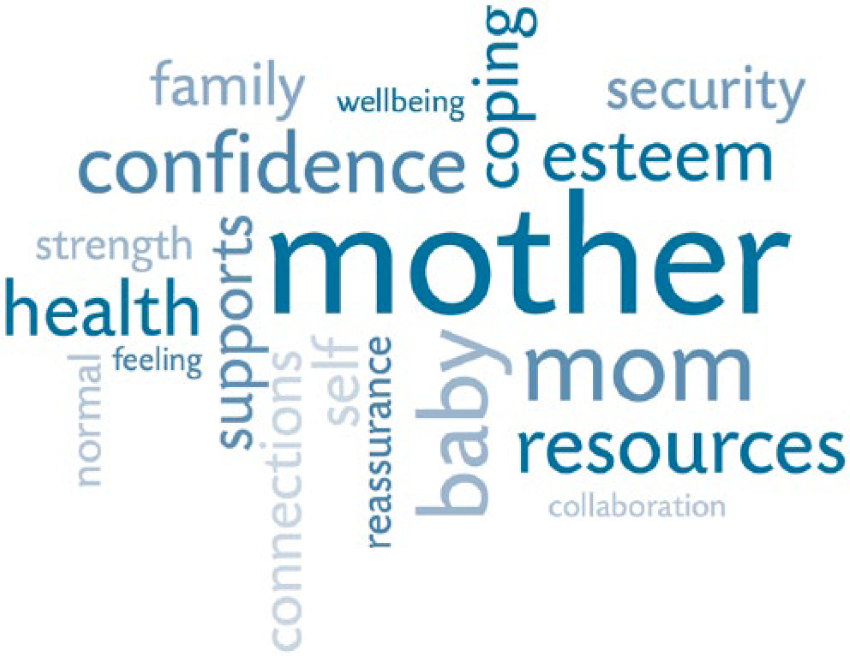
Soft health outcomes described by PHNs and mothers.
Through the use of discourse analysis, we can see how the beliefs, values, and practices of the PHNs and mothers created a discourse that challenged mainstream dominant meanings and discourses of health outcomes. The invisibility and misunderstandings of mothering and PHN practices (Aston et al., 2014a, 2014b) positioned their experiences and practices as “less important” than the dominant discourse that included mother and baby health outcomes that predominantly focused on physical, acute, and illness-oriented health outcomes. In this study, feminist poststructuralism provided a lens to understand how health outcomes for new mothers were socially constructed through personal experiences. The unique findings from this study provide another way to understand health outcomes. With the use of feminist poststructuralism and discourse analysis, we can see how relations of power have positioned different health outcomes in opposition. The intent of our research is not to create a situation having to choose one set of health outcomes over the other. Rather, we challenge health care professionals to look at the benefits of including both in a way that does not create a hierarchy that is exclusionary. Choices always have to be made; however, when choices are limited due to hegemonic discourses, it becomes oppressive to mothers who are seeking the best way possible to take care of their babies and themselves.
Strengths and Limitations
A strength of qualitative research using feminist poststructuralism informed by discourse analysis, and therefore this study, is the in-depth analysis of individual participants’ experiences that ultimately bring to light emerging and often unique themes. These moments in time can then be used as transferable knowledge used in practice or policy. However, caution must also be taken not to generalize findings. As this may be considered a limitation of the study, we suggest that further research that is perhaps quantitative or longitudinal be conducted to further examine the findings of this study.
Conclusion
This research enabled us to carefully examine the experiences of “other” health outcomes that were not always part of the dominant discourse on measurable health outcomes. Most would agree that confidence and feeling empowered are two important health outcomes; however, when positioned through competing discourses, one becomes hegemonic and the other becomes less important or the “other.” PHNs and mothers have stated over and over again the importance of these health outcomes. Once mothers feel confident, empowered, and less stressed, other things seem to fall into place, and mothers can cope better, no matter what their socioeconomic status or risk status might be as evidenced in both the targeted and universal programs examined in this study. It is the trajectory to good health and positive health outcomes that has been identified as extremely important to mothers and PHNs in this study.
Addressing tensions and hidden relations of power is one way that health care professionals can challenge unintentional oppressive beliefs and practices. The full range of potential health outcomes that can develop as a result of a PHN home visit is vast and difficult to adequately describe because of its unique and individual impact. However, the stories and experiences of PHNs and new mothers highlighted in this article provide the basis for creating an equitable comprehensive program that transcends a hegemonic biomedical approach to health care.
Footnotes
Acknowledgements
The authors thank Linda Young for her collaboration and support of this research, and all mothers, PHNs, and managers who participated in the study.
Declaration of Conflicting Interests
The authors declared no potential conflicts of interest with respect to the research, authorship, and/or publication of this article.
Funding
The authors disclosed receipt of the following financial support for the research, authorship, and/or publication of this article: The authors received financial support from the Nova Scotia Health Research Foundation to conduct the research.