




Abstract
The aim of this study was to explore dimensions of relational work in interprofessional health care teams. Practitioners from a variety of disciplines came together to examine teamwork and cocreate knowledge about interprofessionalism using forum theater. Interviews held prior to the workshop to explore teamwork were foundational to structuring the workshop. The forum theater processes offered participants the opportunity to enact and challenge behaviors and attitudes they experienced in health care teams. Throughout the workshop, aspects of professional identity, power, trust, communication, system structures, and motivation were explored. The activities of the workshop were analyzed using Pickering’s theory, identifying three mangle strands found in being a team: organizational influences, accomplishing tasks, and an orientation to care. Performativity was identified as having a bearing on how teams perform and how teamwork is enacted. Practice components were seen as strands within a mangling of human and nonhuman forces that shape team performativity.
Keywords
Background
The World Health Organization (WHO) concluded in 2010 that sufficient evidence supports interprofessionalism through collaborative modes of care. As well, the WHO (2013) document Transforming and Scaling Up Health Professionals’ Education and Training calls for hastening educational and practice reforms including interprofessionalism. Yet, literature introducing the term interprofessional and research elucidating the dimensions of interprofessional practice and interprofessional education (IPE) was scant at the turn of the 21st century (Reeves, Tassone, Parker, Wagner, & Simmons, 2012). A Canadian framework was developed to support interprofessional competency-based care and education (Canadian Interprofessional Health Collaborative, 2010) and serves to inform the interprofessional competency framework of other countries (Interprofessional Education Collaborative Expert Panel, 2011; Schmitt, Blue, Aschenbrener, & Viggiano, 2011).
Relational aspects of practice were identified as a barrier for new graduate nurses to engage in interprofessional practices (Pfaff, Baxter, Jack, & Ploeg, 2014). Interpersonal influences on role construction have a bearing on interprofessional interactions (MacNaughton, Chreim, & Bourgeault, 2013). Interprofessional collaboration-in-practice has been described as “more rhetoric than actuality” in considering ethical practices (Ewashen, McInnis-Perry, & Murphy, 2013). Perspectives of the workings in interprofessional practices are beginning to appear in the literature. This study was shaped by questions such as the following: What can be understood about how professionals actually interact in interprofessional health care teams? What influences the behaviors and processes that become teamwork? This explorative qualitative study aims to answer questions about the relational work of interprofessional health care teams using forum theater. Guided by the qualitative research reporting framework COREQ (Tong, Sainsbury, & Craig, 2007), findings are discussed in relation to Pickering’s (1995) theory, illuminating conceptual strands seen through participant experiences of being in health care teams.
A Reflexive Start
I undertook this inquiry after several years of observing health care teams and working with student teams to broaden the understanding about interprofessional team contexts and their influence in practice. This research is framed within performative methodology using forum theater methods. I looked to performance to investigate health care teams through my experiences of seeing theater open up places of imagination and where exploring such possibilities held the potential for new understandings in ways that traditional inquiry methods did not. Needing further training, I completed courses and training in performance theory, discourse analysis, arts-based research, drama theory, and Theater of the Oppressed. Partnering with an expert in community theater research methods offered me the opportunity to branch into performative inquiry to address questions exploring the condition of being a team.
Framework
Forum theater is a mechanism to generate knowledge with community members through their explorations of power, socially constructed roles, emotions, and tensions by creating spaces to probe practitioner realities and interactions. Rooted in Boal’s (1985) Theater of the Oppressed, where theater was used in communities to generate discussions and “rehearse action toward real social change” (Pendergast & Saxton, 2009, p. 69), forum theater brings nonactors to a stage to cocreate knowledge, insights, and possibilities for change.
Crucial to the methodology in this inquiry is the philosophical underpinning of performativity (Sommerfeldt, Caine, & Molzahn, 2014). This concept, as developed by Butler (1993, 1999), remains closely tied to the original as imagined by Austin (1962) and refined by Derrida (1988) in the context of interprofessional health care teams. Performativity is the coming together of dynamic forces that play out in performances of the individual team members and the team itself. Comprising language, structure, behaviors, and context, performativity can become obscured when investigating team function is limited to examining performance through language alone. Insights into team workings emerge through the performative frame of theater methods. With performativity as a key element, the forum theater process becomes a mechanism to analyze discourse, movement, and representation in exploring relational aspects of teamwork.
Discovering aspects of practice by exploring performativity includes seeking insight into individual and team behaviors. Behaviors that are performed over and over again become a repeated performance and, as such, are expressions of restored behavior that is “symbolic and reflective” 1 (Schechner, 2002, p. 36), reinforcing meta-messages within a health care system. When a health care provider performs an assumed role, it could be explained as Me behaving “‘as I am told to do’ or ‘as I have learned’” (Schechner, 2002, p. 28). The performative aspect of health care teams contributes to cultural rituals comprising language (jargon), masks (nametags, white coats, uniforms), and performances on cue that elicit conditioned responses (hierarchy and reinforced positions often including subservience).
Method
Forum theater was used to involve members of communities in finding collective understandings and avenues to imagine change. The process involved presenting participants with focused and shared concerns, after which meaning was explored through discussion. Prior to meeting for the forum theater workshop day, participants met with me and the theater facilitator for a conversational interview to identify common ideas about teamwork and to gain a sense of how to structure the theater games in the introductory part of the forum theater process.
A forum theater method involves a theater facilitator working with community members to craft scenes into a play about their community concerns. As part of the meaning-making process, participants were invited to offer stories related to the central idea of relational work involved in being a part of an interprofessional team. These participant stories were then developed into image theater vignettes (Boal, 2002). After the shared stories were portrayed in images, participants decided, as a group, which stories to take further. The refined and composite story was explored through animating the image. This was done by the facilitator who asked for words, thoughts, and next steps of each of the characters in the image. From this, short scenes were staged and a play developed.
In forum theater, the play does not end at the resolution of the issues, but instead at the climax where the protagonist is sure to fail without some type of intervention. After the play is performed for others, the audience has the opportunity to intervene and change what happens in the play. Looking for and rehearsing different ways, to which community members respond, holds the possibility of altered outcomes. With the help of the theater facilitator, an audience member, called a spect-actor (Boal, 1985), requests a rerun of a particular scene and takes the place of one of the actors to change something that they believe to have a bearing on the outcome.
The style of forum theater used in this research was influenced by a variation known as Theater for Living (Diamond, 2007) that expands the interpretation of oppression and extends possibilities for transforming conflict. The theater component is facilitated by an expert in the theater method whom, in Boal tradition, is called a Joker. Jokering is a well-developed facilitating role (Pendergast & Saxton, 2009) that combines theater and dialogue, questioning, and guiding exploration of the issues and environments that contribute to a situation. In this study, the theater facilitator, in the role of the Joker, worked closely with me. We met frequently to analyze data, prepare for the theater workshop, and ultimately produce a play with the participants to advance conversations and understandings about aspects of being in a health care team.
The analysis is guided by Pickering’s (1995) performative theory of The Mangle of Practice. Pickering’s theory rejects semiotic representation, arguing that scientific practice is open-ended and reciprocal in “a dance of agency” (Pickering & Guzik, 2008, p. vii). He claims that scientific practice needs to be decentered with respect to human and nonhuman agency in a process that he named mangling. This theoretical foundation is valuable in the analysis of the theater experience data to examine interprofessionalism and health care providers as they negotiate care decisions. Pickering explores symmetrical and constitutive engagement of humans and nonhumans with the world. The emerging intrinsic temporality in that intersection invokes an “ontology of becoming” (Pickering & Guzik, 2008, p. 3). With such a lens, I examined the interplay of people in health care teams and the structures, systems, and culture in which the team exists. 2
Ethical Review
The project was reviewed and approved by the university ethics review board. Participants offered informed consent, were aware that they could withdraw at any time, and could choose their own level of involvement in the activities of the workshop. It was possible that participants might be unfamiliar with theater techniques or feel uncomfortable about aspects of sharing experiences with a group or performing. The researcher and theater facilitator strove to ensure a welcoming and inviting studio theater environment, committed to confidentiality, and did not purposefully embarrass or draw attention to any participant, minimizing potential risks and discomforts.
Participant Selection
Potential participants were informed of the project through handbills and posters, word of mouth, personal emails, and phone calls, and the listserve of a humanities in health interest group. Individuals from varied disciplines and professions practicing in existing health care teams were purposefully invited to participate in this research project. Practice sites in health care with current interprofessional team structures in primary care, rehabilitation, or active treatment were of particular interest.
Purposeful recruitment of diverse health professions was desirable because it held the potential to provide varied and relevant perspectives about authentic health care teams. There was little response from practitioners in primary care, an interesting situation given that the move toward team-based approaches to care is widely visible in primary care settings. Most responses came from clinicians in rehabilitation and acute care. I fielded calls and emails of persons wanting more information about the project with about 40 individuals expressing interest. Ultimately, eight practitioners contributed through interviews, of whom seven participants engaged in the full-day theater workshop. The eight practitioners included nurses, a physical therapist, medical researcher, nurse practitioner, alternative medicine practitioner, physician, and an occupational therapist. Interviews provided a foundation for structuring the theater activities.
Setting
The conversational interviews were held in public spaces such as a coffee shop or in a private office. A full-day workshop was held in an arts-based research theater studio on a university campus situated in a metropolitan area in Canada. This studio has a large instructional space in one half of the room; the other half is a fully functional theatrical stage complete with lighting, sound booth, catwalks, black flooring, acoustical sound, and various configurations of black stage curtains. The intimate theater space provided an atmosphere of stage authenticity. The video cameras were positioned in the stage wings to be as unobtrusive as possible. During the workshop, a research assistant and two videographers were also present in the studio.
Data Collection
Multiple methods of generating data (conversations, workshop activities, forum theater interventions, field notes, recordings) were used. I “trouble” the word data and its use in aesthetic inquiry such as this research. Data connote objectified pieces of information whereas arts-based research aims to experience embodied understandings to inform exchanges and analysis among participants and the researcher(s). 3 To align with convention, I refer to data in this article acknowledging the interplay of data and analysis in research processes.
Intentional reflexivity is acknowledged in field notes, interview prompts, and the iterative analysis during the workshop. The data from these sources were used to elicit close examination of components of teamwork and to explore beginning insights into the relational work of interprofessional teams. In addition, conversations within the workshop and creation of staged scenes provided the opportunity for participants to reflexively make clear a transformative awareness of their own realities.
All of the interviews were transcribed. The workshop activities that led to scene development were structured based on iterative analyses of earlier data from the interviews and review of the audio recordings. Video recordings captured the discussions, rehearsed scenes, and the play that developed over the 1-day workshop. The scene development dialogues and conversations were video recorded and transcribed for reference in further analysis.
Throughout the workshop participant ideas and themes were written on paper posters, with the developing ideas tracked and reworked on a large whiteboard. Emerging topics were verified by the participants and further explored in group discussions with the theater facilitator during the creation of the scenes.
Conversational Interviews
The loosely structured interviews with guiding questions were conversational in nature and open to be led by the participant. Aspects of teamwork that were identified in one interview were introduced to other participants for their reflection and consideration. For example,
I’m wondering—we’ve heard some of the other participants talk about comfortable tensions that exist . . . It’s just part of how they see working in a team; you’re going to have some tensions. What is your view?
Such looped-back triangulation is consistent with theater research methods. Using individual conversations in place of prolonged interaction usually seen in forum theater multiday workshops, including discussing other participants’ notions, is similar to principles of participatory action research where participants are involved in a process of “praxis with phronesis” (Fals-Borda, 2013, p. 165). This engages the participants in a continuous movement of reflection and action with the intention of building shared understanding. In this way, conversations created a type of asynchronous workshop of ideas. The potential points of struggle that surfaced in the interviews were grouped as struggles with administration and structure; struggles of practice, including roles, ethics, attention, communication, team interactions and unity; and struggles of performance, which included the need for patient involvement with the team, assessment, and patterns of team function. These struggles informed the subsequent development of the theater play.
Analysis Methods
The analysis proceeded in three discrete steps: (a) following the interviews (pulling forward themes), (b) iteratively during the theater workshop, and then (c) after the theater experience. The analysis discussed in this manuscript focuses on findings using a performative stance (Pickering, 1995) to explore the mangle of interprofessional team practice.
Forum theater methods require iterative analysis throughout workshop preparation and during the dramatic play by the participants. Such participatory research acknowledges the “inherent capacity for participants to create their own knowledge based on their experience” where “popular knowledge” is “taken in, analyzed and reaffirmed or criticized” (Conrad, 2004, p. 15). Forum theater animation through participant intervention explores the issues raised in the scenes. Each reconsidered scene demonstrates deeper insights and intentions in the portrayal of characters and plot development. Forum theater takes participants to a point of crisis and then works backwards through foreshadowing struggles to examine contributors that lead to the climax, an ongoing and iterative coanalysis by the researcher and participants. For the purposes of this research, the audience was composed of research participants.
Strands of the Mangle
In addition to the iterative analysis that occurred during the workshop and play, aspects of relational work were further explored by reviewing the transcripts and video recordings. This analysis is a nontraditional posthumanist approach based on Pickering’s (1995) description of the mangle in practice. 4 The mangle is a word used by Pickering (1995), a social scientist, as both a noun and a verb. As a verb, it refers to the constant negotiation of agency. As a noun, it names the performative nature of practices, metaphorically similar to the mangle of a wringer-style washing machine that extracts excess water from wet clothes when fed through the tight-fitting rollers. 5
Pickering (1995) rebuffs the semiotic narrowness of scientific inquiry that privileges language, theorizing scientific practice through a performative idiom rather than a semiotic representational one. According to Pickering, human agency in practice seen as “gestures, skills and so on” (p. 17), come together with nonhuman “machines” as mechanical entities or systems that are “set in motion and exploite[d]” (p. 17). Human and nonhuman agency becomes “constitutively intertwined” when they are “tuned,” influenced by social relations and other “cultural” workings, to be interactively stabilized in practice in the “dialectic of resistance and accommodation” (p. 25).
Points of struggle in the scenes leading to the crisis of the play make evident aspects of the health care team practice mangle. I call the components that were identified by participants in creating scenes for the forum theater strands 6 in the mangle of practice. These strands are components that explain parts of the relational work comprising interprofessional team performativity.
Multiple strands appear in the mangle, and those three identified in this analysis are some that were exposed in this particular exploration. Because the strands are intertwined, they cannot be pulled out of the mangle and need to be explored in relation to practice. Metaphorically, the mangled strands can intertwine in ways that build a cord with elements of both accord and discord, or might remain entangled, existing in the complexity of the interprofessional context. 7 Tensions are present and acknowledged.
Findings: Theater Workshop and Scene Development
The initial components that resonated for the participants in the interviews helped to structure the theater workshop in relation to aspects of roles, unity, relationships, language (communication), ethics, competing attentions, and patient contributions.
Images
The development of image theater processes began the workshop. Participants sculpted the images, scenes from their own experiences (some of which were also raised in the interviews) by positioning other participants in meaningful frozen stances and gestures. Creating image tableaux familiarized the participants with exploring health care team experiences in a performance mode. New understandings came by expanding the images through facilitation, including animation, movement, and language in the expressed emotion of characters by making a statement or wish for the character. All images were created along the themes of teamwork and relationships within health care teams. Figure 1 portrays a disconnected team engaged in tasks individually. 8

Separate tasks.
It is interesting to note the physical separation of each person. Tasks are being done independently and backs are turned to colleagues.
The characters in Figure 2 are a physician and a nurse practitioner. The tableau was an early expression of team experiences between the two health care providers. The nurse practitioner was attempting to “hold ground” in an emotion-filled conversation.
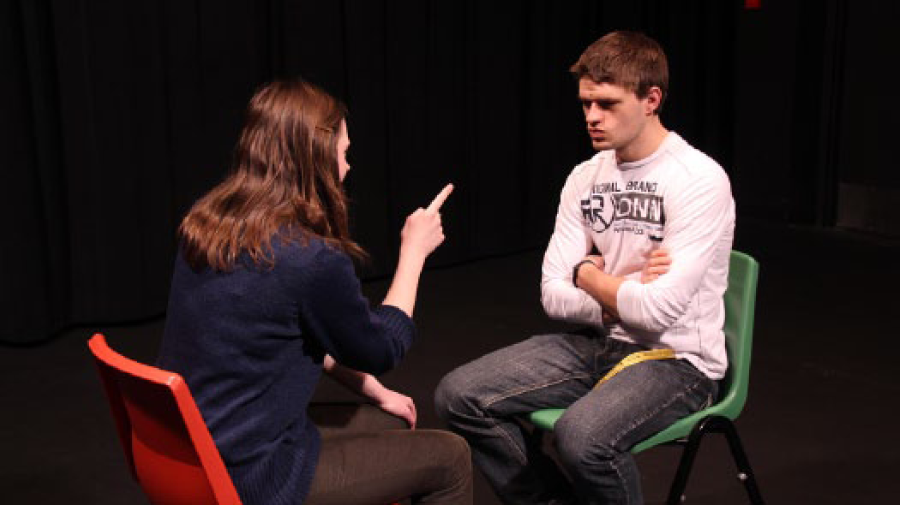
Holding ground.
The aggressive expression of the nurse practitioner and the lecturing gestures of the physician portray increased withdrawal from relational engagement conducive to collaboration. The appearance makes visible the tensions between the two practitioners. Donna 9 commented on the image that “it’s about winning so there’s no team there anymore, there’s nothing, it’s severed, it’s completely severed.”
Participants in Figure 3 are focused on accomplishing tasks over team cohesiveness. There was a clear disconnect between team responsibilities to assist and in accomplishing individual tasks.
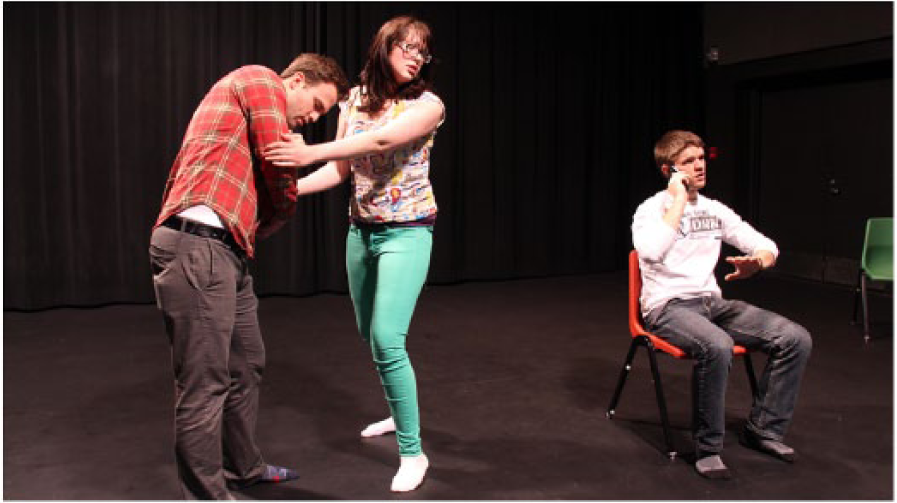
Disconnected.
Distance and disconnects are seen in the presence of a pressing patient need which is at odds with accomplishing tasks by both the person sitting and the practitioner looking to teammates with expectation. The lack of movement was interpreted as a lack of interest in helping, even though tasks were framed as aspects of caring.
The Play
The image theater exercises permitted the participants to explore new ways to discuss and analyze aspects of their team experiences. Participants found that some of the similarities of their narratives revealed in discussions came together in a story about an adverse patient event that occurred on one of the participants’ units. The sequence of events leading to the troubling event included dysfunctional team processes, fractures in team communication, uncertainty about roles, and ambiguity about team function. The composite story was shaped into five components that each carried some degree of struggle and became scenes of the play.
For effective forum theater, participants strive to comprehensively understand the characters that they are playing by reason of actually being part of the community grappling with the issue (Diamond, 2007). The task of the group is to “find the crisis of their play and work backwards, moving their characters out of the crisis” (p. 114).
The characters of the play were a senior nurse, a newly hired staff nurse, a physician, and a unit clerk on an acute care hospital unit. The storyline followed a team meeting that discussed the challenges of being short staffed and having a new staff member being oriented to the unit. At the team meeting, the physician dismissed the concerns as a nursing problem. Later, a crisis brought the physician back to the unit because of an adverse event, the result of administering a questioned medication dosage.
At the height of the crisis, the senior nurse was in a volatile dialogue with the physician, the unit clerk left the area to avoid the confrontation, and the new staff member was frozen in uncertainty. A scene summary is provided in Table 1.
Scene Synopsis.

The first scene involved a team meeting where everyone was present and waiting except the physician. The physician entered, reminded the team of a full schedule, and stated the wish of wanting to get right to the crucial discussions. The new staff nurse had earlier expressed high expectations of teamwork that were quickly met with skepticism (see Figure 4).

Scene 1—Team meeting.
During scene rehearsals, jokering the first scene brought out details: The team meeting was held weekly, there was a culture of dread, the same person always dominated the meeting, there was individualistic problem solving, there was a lack of formal mentoring for new staff, and the suggestion was made that arrogance is actually a lack of confidence related to domination. The image, too, makes visible the hierarchical structure and disconnect between team members.
In the second scene, team members were attending to tasks individually, each in isolation overwhelmed with the volume of work they needed to do. The physician added to team dysfunction through disengagement and insensitivity. During the third scene, some team members demonstrated collaborative behaviors of a team-within-a-team through encouraging the person with the most power to question a drug order. There was a sense of patterned responses and repeated performances of powerlessness in the nurses when attempts at amicable clarification were rebuffed by the physician.
By the fourth scene, the nurse was becoming desperate about being unable to solicit support, fearing for the safety of the patient. Colleagues were understanding yet consumed in their own activities, using distance as a protection. The emotion and tension of the play built as the hope of teamwork vanished in the final scene. After a patient died from a medication dose, the furious physician held no regard for team structures and assigned blame. The other team members were speechless and had no processes to use as strategies or tools in dealing with the crisis as a team. Alone and ashamed, the nurse, with a bowed head softly whispered, “I know.” Everyone on stage was frozen in postures of animated terror. There was palpable silence on the stage. The dysfunction that fed the crisis had exposed the broken team.
Following refinements and rehearsals of the scenes, the play was ready to perform for an audience. After the theater facilitator explained the process of forum theater interventions, the audience was told that the play was about health care teamwork, but not given a synopsis of the scenes or a storyline. It was run without interruption and the performance maintained the tensions and passion seen in the rehearsals.
At the end of the play, an audience participant was invited by the theater facilitator to comment on any observations or ideas about the play. 10 This participant, a health care professional with hospital administration experience, pointed out how “conditioned everyone is. And how, as I see it, . . . disconnected to how you’re feeling, your own conscience about every decision . . . [E]verybody’s overwhelmed and is responding in a different way” (Audience member). It was pointed out by this audience member that perhaps the physician’s response to being overwhelmed was manifested in an authoritarian autocratic style, and that the others came together in a relational way. The conditioned roles of the nurses might have prevented them from stepping out of the imposed hierarchy that restricted them from offering their perspective.
The theater facilitator opened up the discussion for ideas about what “one of these characters could do differently to veer this sinking ship in a different course, in a different way” (Theater facilitator). It was suggested that the senior nurse was
disempowering to the whole team dynamic . . . the new team member, her ideas are sort of shuffled away, put down almost. The dysfunctional dynamic was spoken to right at the start . . . just “there’s absolutely nothing we can do about this and he’s this way” . . . If the [senior nurse] had taken the role . . . and included this new team member and maybe had just a little more skill in being confrontational with the doctor that her teammates could feel supported and they might have more strength as a group as opposed to [individually]. (Audience member)
So what would a different approach be like? The theater facilitator invited anyone to offer an intervention at any point of the play. With the theater facilitator, the participants took the play back to the first scene with the team meeting. An onstage participant suggested, “I think one of us [characters] could have at least maybe asked him [the physician] to sit down. ‘Would you want to join us, maybe?’” (Shannon). The theater facilitator ended the discussion so as to try that suggestion, changing the scene by rerunning it with the new approach, a process that defines forum theater.
Setting up the intervention, an empty chair was incorporated into the scene. The characters decided that the new nurse would invite the physician to sit in it before the meeting got underway. The characters were asked to remain in character and to respond as the characters would in redoing the scene. The empty chair seemed like a small change. The participant playing the character of the physician was caught off-guard by the gesture to the chair and the invitation to sit, while the other team members were unsure about what might happen next (see Figure 5).

Invitation.
This change disrupted the usual team behavior. Providing the invitation to sit changed not only the physical arrangement but also the speed of the dialogue, where the physician character was looking and giving attention, and the emotional tone of the meeting. Participants set the scene, including the physical arrangement of the chairs, according to previous team experiences. The physician was seen as being apart from the rest of the team and carried on conversations with team members in a confrontational and power position. The chair for the physician was placed in a position of leadership as opposed to a space being made for the physician among the team members.
The theater facilitator explored the situation further by discussing what was going on in the team. The acknowledgment of having “clout” with administrators was seen as neither exploitive nor helpful in building team identity. The aspect of power differentials was acknowledged as part of the realities of current practice. Participants to this point had been pessimistic about having the capacity to realize any influence or mount any challenge to power structures. Three of the five scenes in the play involved power differentials and were centered on disengagement or distance within the team.
Discussing the differences between the original team meeting scene and the new scene with the intervention, participants related to a newness and hopefulness in being able to look for ways to have meaningful and authentic dialogue within teams and with others whom they saw as having influence in developing policies and parameters 11 in which their own team operated, illustrated in Table 2.
Transcript.

The discussion extended to caricatured stereotypes and how interactions can reinforce behaviors. A caricature can be considered an inanimate part of interactions manifested in the ineffective patterns of the team. Repeated performances of the team members embracing caricatures of other team members becomes routine, part of the performativity of expecting nonengagement and indifferent responses.
Participants recognized that being part of a team usually meant being assigned to a team. Imagining how the team could be different was a difficult task for them because some of the barriers were seemingly impossible to counter. The scene from the play, the audience intervention, and discussion are provided here as one example from the workshop process where the potential for multiple interventions with other scenes could also occur. The discussion that follows draws on the performative discussion that took place throughout the workshop.
Findings: Across Scenes
The forum theater process demonstrates three identifiable strands in the mangle that were exposed by the participants: organizational influences, accomplishing tasks, and an orientation toward care. These strands appeared in more than one scene, exposing different components of the strands.
Mangle Strand: Organizational Influences
From the first image theater activities to the final discussion of the forum theater play, the detached and cautious ways in which health care team members and administrators interact appeared. The participants talked about administrators and unit managers often being away at meetings rather than being present on the unit and available to them. “[The unit manager] is probably at a meeting. Sorry.” (Shannon). The participants laughed out loud at the remark, knowingly nodding their heads. In discussions, they acknowledged varying influence of power holders, suggesting that physicians have “clout” with hospital management. Some spoke of being called a team yet were a team in name only, lacking effective team structures and processes. Expressed concern about disengagement from team members and administrators was a recurrent strand throughout many of the images and discussions.
Adequate and appropriate staffing was acknowledged as important to being a team and appreciated as an administrative challenge. Associated with being disconnected, participants at times viewed unit management as being “just on a completely different page, no understanding between the manager and the staff member—but she’s all nice and smiley” (Shannon). As seen in the first intervention, a new staff nurse is a catalyst for change in disrupting unhelpful patterns of interacting. New staff, described by Shannon as “new blood” that “would change the dynamics . . . sticking somebody new in—that new energy” (Bonnie), can bring refreshing idealism. This, however, takes time and mentorship for new and novice members of health care teams to realize performance expectations.
Participants also believed that managers and administrators had a genuine interest in teams being effective in their work. Although disappointments and frustrations with organizational influences were apparent in the tableaux as well as in the play, the potential for finding effective ways of being a team became evident in the forum theater interventions. This aspect of being a team is further explored in the strand identified as orientation to care.
Mangle Strand: Accomplishing Tasks
Participants viewed their respective practices of skillfully accomplishing tasks individuallyas being on occassion at odds with teamwork. Donna suggested that understanding the tasks of teamwork involved connection within the team that took intention and time; “Trying to touch base. To connect” (Donna). “It’s part of how I do my job ’cause I need to know what the energy is of my team members” (Pat). Several of the images had themes of fractured communication, power imbalances, and anger. Competitiveness brought struggles; “I’m going to win this, I will win this at all cost!” suggested one interpretation of another’s frozen image.
Behaviors that blocked team cohesiveness came from disregarding or being unaware of each other’s contributions. “[S]he’s off doing whatever that’s got nothing to do with the fact that there’s care, her immediate care, so she’s just doing some whatever role [when her teammate is nonverbally communicating] ‘Really? Can’t you see what’s going on?’” (Bonnie) “Oblivious,” (Donna).
[A]t the end of the day, it was just—he assumed we’ll take care of it, I think, he took us for granted. And we didn’t speak up, we kinda covered for him ’cause we like him . . . so we had a good sense of team in some ways, but in other ways, it was really a struggle. (Donna)
Participants voiced confusion in how to interrupt the environment or culture that has developed in their areas of practice. When individual roles are overemphasized, teamwork becomes hollow, “façade” (Shannon), such as when one participant who tried to elicit a collaborative approach was met with the response, “Don’t ask questions, just do your job” (Donna).
Mangle Strand: Orientation Toward Care
Underlying many of points of conflict was the authentic desire to provide care to patients. Early in the workshop the discussion turned to the idea that being a team meant purposefully being in touch. “As a health care professional, I have to intend to touch base with people” (Donna). Caring not only involves interaction with patients, but team members as well. “Like, we have a lot of care and compassion for our patients or our clients and sometimes I think we forget to extend that to one another, ’cause we get so busy doing what has to be done” (Pat). Having permission to disrupt policies or system traditions was something that was acknowledged but not explicitly done without reservation. “I need to speak up for myself—so having permission and clearly defined permission is really . . . valuable to teams” (Pat). “[I]f she hadn’t [given me permission to withdraw from an activity] at the beginning, I probably wouldn’t have. I would have just stuck it out” (Shannon).
Referring to not having “permission” to refuse an assignment in giving care, Gail suggested:
[Permission] is there often in tacit unspoken terms but sometimes we haven’t heard that as individuals and so it’s important to come back to the managerial or the team group—that those [permissions] are spoken, so that there’s no question about what’s okay and what’s not okay.
This veiled foundation of having or needing permission to voice positions about care decisions was made explicit in the final play when the audience member intervened by questioning the motives of the health care providers for being in the team at all.
Tensions between team members were discussed not only as professional interaction but also in a sense of not wanting patient needs to go unmet. “Could you just come out on the floor, do your job ’cause I’m having to cover for you” (Donna). “‘Do you want me to do your job?’—one of our [physicians] said that all the time” (Shannon). In the finished play the dialogue between a senior nurse and the prescribing physician failed to resolve the issue of dispute, yet at the core was a desire for a positive patient outcome.
The patient, the very reason for the team to exist, was not a character in the play, yet remained the unscripted entity in the five scenes. This “role” parallels practice where the complexities of systems and human interaction become a counterfocus to the person receiving care from the team.
The orientation to care becomes overlooked in attending to more obvious requirements of establishing teamwork. The facilitator asked whether having a new person on the team had an effect on team processes.
[M]ost of us are—we’re in health care ’cause we’re good people, or we want to be on teams . . . But you lose sight of it. So just reminding us of what our [reasons are, through having a new person who is idealistic]. (Shannon)
In constructing a scene for the play, the participants created a dialogue that attempted to engage the physician in using influence or power with the administration in the challenges facing the team. The senior nurse raised the idea of patient safety in response to the physician, drawing attention back to patient care.
Using a performative theory of practices, team members participating in theater methods identified perspectives of teamwork previously underrecognized. Each strand of the mangle is performed in team interactions and practices. These repeated performances of mangling became the performativity of the team.
Discussion
In the Mangle: Resistance and Accommodation
The practice mangle can be further explored by examining movement within the strands described by Pickering (1995) as resistance and accommodation. Where health care providers are the humans, and systems and structures the nonhumans, the dance of agency of the two takes the “form of a dialectic of resistance and accommodation” (Pickering, 1995, p. 22).
Resistance is the “failure to achieve the intended capture of agency in practice” (Pickering, 1995, p. 22), a “practical obstacle” (Pickering, 1993, p. 569) in the path of pursuing a goal. Accommodation is the “active human strategy of response to resistance” (Pickering, 1995, p. 22) where, in the face of obstacles, one devises “some other tentative approach toward [the] goal” (Pickering, 1993, p. 569). Each strand of the mangle has components of resistance and accommodation seen in the participant’s own team practices.
Pickering’s view of resistance is seen as passive, a perspective that changes the discussion of the response to power in a Foucauldian sense. Negativity and passivity were seen as team members continued in behaviors that perpetuated dysfunction and remained as obstacles in realizing the goal of patient care. This appeared as individualistic views of patient care tasks, withholding support of idealistic notions about being a team, expressing powerlessness in having an influence with administration, and remaining silent and nonconfrontational in situations of power differentials and autocratic hierarchy. Dysfunctional behaviors enacted futile attempts to achieve the “intended capture of agency in practice” (Pickering, 1995, p. 22). These dances of agency remained unfinished in the team where “clout” was not universal, meaning that by reinforcing power holders, team members were expected to “dance” with the system in choreographed steps to effect change.
Power relationships and their impact on agency in health care have been discussed by others (Powell, 2012). Considering the complexity in teams and health care structures, the elements of agency and relationships are interconnected and emerge through “recursive interactions” (Fenwick, 2012, p. 144) as a force in team performativity. Team members can actively use strategies to acknowledge their agency as it intersects with systems in practice. Developing team competency is an additional task to personal competency in what Lingard (2012) describes as “collective competence” (p. 67).
In the play we created, nonhuman agency failed to be “captured” (Pickering, 1995, p. 17). The team members were motivated by patient care and safety yet allowed their behavior to be influenced by perceived roles and entrenched behaviors. Mechanisms for clear communication were not fostered. Power was accorded to traditional holders. Processes for feedback, shared tasks, and reflection were absent. Human agency was not decentered in a way that invited balanced agency, but actually the nonhuman health care system machine held the team to a belief of powerlessness in being able to find system alignment with their goals of teamwork and patient care.
During the theater process, to imagine different ways of being a team, participants could address means to identify power structures and recognize how team members understand power. Is power claimed or abdicated? How and by whom? Is this an influence of structured hierarchy or an organizational system that follows reportable areas of responsibility? Individuals might be choosing individualistic practices within a team organizational structure because of lack of training in team processes and functions.
The mangle is “shorthand” for the interaction of resistance and accommodation (Pickering, 1995, p. 23), the emergent “intertwined delineation and reconfiguration of machinic [sic] captures and human intentions, practices and so on” (p. 23). There is a reconfiguration of one aspect of practice in the discoveries made changing the scene of the team meeting. The physical rearrangement of team meeting space required the team members to think differently about their interactions with each other.
Limitations and Future Research
Participation was limited to a small number of health care team members. Although there was diversity in the group, other strands might become visible with different compositions of participants. All of the participants in this study were from acute care with specialized teams. Future inquiry with teams from other settings, such as those practicing in primary care, is important. Including patients or clients and families in being fully present on their health care team brings further complexity that invites exploration.
Performative methodology is an innovative approach to interprofessional health research. Theater opens up improvisation and imagination to consider ways of being in a team. Applied theater methods with a skilled facilitator offer such possibilities. Future research that is embedded in practice might expose other strands of practice. Pickering’s work bears relevance to health care practice and needs further exploration (Jackson, 2013), particularly with regard to the concepts of resistance and accommodation. Intervention research is needed to explore ways to teach (Frenk et al., 2010), strengthen, and support health care practitioners in interprofessionalism as it is intentionally expanded. Tying team effectiveness to other outcome measures requires a clearer view of the factors influencing team performance and performativity.
Performativity develops over time and calls for more longitudinal work. Further inquiry that situates performativity within professional identity discourses, including team identity, is needed. Fenwick (2014) also points to the increasing need to attend to the sociomaterial world of health care teams and their impact.
Conclusion
Performative research using forum theater methods provided insight into aspects of being a team by making space for health care team member participants to enact their experiences of teamwork. In this study, interprofessional practice comprised complex relational elements. Practice components are seen as strands within a mangling of organizational influences that included administrative structures and power differentials, the means of accomplishing tasks individually and as a team, and having an orientation toward care as a common aim of team members. Understanding the agency of both humans and nonhumans, which, in teamwork, can be systems and technology, opens new avenues for conversations about interprofessionality and health care teams. Pickering’s concept of the dialectic of resistance (some block in the pursuit of a team goal) and accommodation (creative and improvised approaches to overcoming the obstacle) provides space for teams to examine sociomaterial forces within and outside of their team.
In achieving teamwork, the democratic principles of power distribution need to be resolved, given the hierarchal nature of health care. Teams that intentionally examine performativity might guard against inflated emphasis on individualism in achieving collective and ethical team practices. As health care team members acknowledge and examine performances, team performativity is shaped. Participants in this study discovered that authentic enactment of being a team meant acting as a team rather than being named a team. Exploring the performativity of interprofessional teams through a performative methodology provides spaces to clarify the contexts of practice at the intersections of humans and systems, engaging with strands from mangles in practice.
Footnotes
Acknowledgements
I acknowledge Dr. Anita Molzahn and Dr. Vera Caine with appreciation for their contributions and feedback in the development of this article. I also thank my participants who are dedicated to their work, the patients for whom they care, and their willingness to enact their experiences of being in a team and practicing interprofessionally.
Declaration of Conflicting Interests
The author declared no potential conflicts of interest with respect to the research, authorship, and/or publication of this article.
Funding
The author received no financial support for the research, authorship, and/or publication of this article.