




Abstract
In the 2020–21 school year, during the COVID-19 pandemic, districts across the United States varied in whether and for how long they offered virtual, in-person, or hybrid learning to their students. Weber and Baker introduced funding adequacy as a determinant of school reopening decisions. While they documented a strong association between funding adequacy and learning modality decisions during the pandemic, their analysis did not control for local partisanship or union strength—well-established predictors of school reopening. I replicated their analysis and found that controlling for partisanship and union strength substantively attenuated but did not eliminate the association between funding adequacy and school reopening in the United States during the pandemic.
Keywords
Introduction
In the 2020–21 school year, during the COVID-19 pandemic, districts across the United States varied in whether and for how long they offered virtual (i.e., remote), in-person, or hybrid learning to their students. A collection of research on school reopening during the pandemic—mostly quantitative studies—has identified correlates of those learning modality decisions, including local partisanship, teachers union strength, district racial and socioeconomic demographics, and urbanicity, with mixed results on COVID-19 rates (Singer, 2025a).
Weber and Baker (2025b) introduced funding adequacy—“how much more or less a school district spends than the predicted cost of providing an education that meets a common educational outcome” (p. 4)—as a determinant of school reopening decisions. The authors noted that measures of spending alone may be misleading because they do not account for differences in the costs of educating different student populations or of operating in different contexts. They assembled a dataset that included the number of months that school districts in the United States spent in remote learning in 2020–21 as well as district demographics, raw per-pupil spending levels, and a measure of funding adequacy. They used regression analysis to estimate the number of months that a district spent in remote learning, comparing the results when predicting based on spending versus their measure of funding adequacy. They found that greater funding inadequacy predicts more time in remote learning (and that the model that relies on raw spending levels misleadingly suggests that more spending is associated with more remote learning).
While Weber and Baker’s findings offer evidence of the importance of funding adequacy for learning modality decisions during the pandemic, their analysis has one notable shortcoming: They did not control for local partisanship or union strength. Prior research on school reopening has consistently shown that school districts with more Democratic voters (typically measured with 2020 presidential election results) and stronger teachers unions (often proxied by the size of the largest district in the county) were more likely to start the year in remote learning and more likely to provide remote-only learning for longer (Singer, 2025a).
Using Weber and Baker’s dataset and adding a measure of district-level partisanship and a proxy for union strength, I replicated their analysis of the relationship between funding adequacy and learning modality during the COVID-19 pandemic. I found that controlling for partisanship and union strength substantively attenuated but did not eliminate the association between funding adequacy and school reopening in the United States during the pandemic. The association between funding adequacy and reopening originally observed by Weber and Baker can be seen as part of the broader political and institutional environment rather than as a cleanly identified fiscal relationship.
Background
Research on school reopening decisions in the United States during the COVID-19 pandemic has identified a set of political, demographic, and contextual factors associated with whether and when schools offered in-person instruction (Singer, 2025a). Local partisanship was perhaps the strongest and most consistent correlate of instructional modality in 2020–21, and union strength also was a notable correlate. For local partisanship, Democratic-leaning school districts spent more time in remote learning (although this association weakened over the course of the school year; e.g., Christian et al., 2025; Houston & Steinberg, 2023; Schueler et al., 2025) due to greater concerns about pandemic health risks and deference to public health guidance among Democratic leaders and constituencies (e.g., Harris & Oliver, 2021; Kitchens & Goldberg, 2024; Singer et al., 2023). For teachers unions, greater union strength (measured several different ways) was associated with later reopening and longer time in remote instruction (e.g., Hartney & Finger, 2020; Houston & Steinberg, 2023), more likely due to long-standing bargaining arrangements than overt political mobilization (Marianno et al., 2022) and also possibly capturing the coincidence of union strength and broader teacher labor market pressure (Singer et al., 2023).
Given the influences of partisanship and union strength on education spending (Chin & Shi, 2025; Cowen & Strunk, 2015), there is reason to expect that accounting for local partisanship and union strength would attenuate the association between funding adequacy and school reopening decisions. Weber and Baker (2025b) noted that districts with funding inadequacies likely faced greater challenges implementing COVID-19 mitigation strategies, such as hiring additional personnel or updating and maintaining facilities to safely accommodate in-person learning. They also noted that district demographics (e.g., poverty level and racial/ethnic composition) were correlated with both funding adequacy and reopening decisions and ultimately controlled for those factors in their analysis (either by incorporating them in the construction of their funding adequacy estimates or including them as covariates in spending-per-pupil models). These factors also are correlated with partisanship and union strength (Harris & Oliver, 2021); however, controlling only for demographics is not sufficient to account for the distinct associations of local partisanship and union strength with school reopening decisions. Funding adequacy, partisanship, and union strength should be understood as jointly determined and partially overlapping features of districts’ political and institutional environments.
In sum, incorporating measures of partisanship and union strength directly is necessary to better estimate, contextualize, and interpret the association between funding adequacy and instructional modality during the pandemic. To the extent that local partisanship, union strength, and funding adequacy are interrelated, controlling for these political factors may absorb part of the association between fiscal conditions and reopening decisions. The goal of this reanalysis was therefore to clarify how sensitive the relationship between funding adequacy and reopening (documented by Weber and Baker) was to additional controls for political context.
Data and Methods
This reanalysis relied on the dataset assembled by Weber and Baker, which was available for download from the OpenICPSR data repository (Weber & Baker, 2025a). The dataset included data for 11,291 school districts. For each district, the dataset included the percentage of the year in 2020–21 that the district spent in remote, hybrid, and in-person learning; a measure of raw spending in the district; a measure of funding adequacy from the National Education Cost Model (Baker et al., 2021); district demographic and enrollment information; district poverty rate estimates; and county-wide COVID-19 case rates for the county in which the district was located. 1
Weber and Baker estimated time in virtual instruction as a function of district spending per pupil and district funding adequacy. In their spending-per-pupil models, they controlled for a number of district characteristics, including enrollment size, grade levels (i.e., share of students in high school), percent of English language learners, percent of students with disabilities, and local poverty rates. They also included state fixed effects and county-level COVID-19 case rates (which they interacted with state fixed effects given the variation in state health policies). In their funding adequacy models, they did not include the district characteristics as controls because those same controls were used to construct the funding adequacy measure, but they still did include state fixed effects and controlled for county-level COVID-19 case rates (again interacted with state fixed effects). Full details of the methodology can be found in their original paper (Weber & Baker, 2025b).
I added a measure of local partisanship. To do so, I used data provided by the Redistricting Data Hub (n.d.). Specifically, I used their dataset of 2020 presidential results by Census block (Redistricting Data Hub, 2023). The dataset included the total number of votes per block as well as the number of votes for each major party candidate. I combined the 2020 presidential voting data with Weber and Baker’s dataset using the Geographic Relationship Files provided by the National Center for Education Statistics’ Education Demographic and Geographic Estimates (EDGE) Program (Geverdt, 2019). The EDGE files included a geographic crosswalk between Census block groups and school districts in the United States. I aggregated the block-level voting data from the Redistricting Data Hub to the block group level and then matched each block group to its corresponding school district and further aggregated the voting data to the district level. With district-level counts of total votes and votes for each major candidate, I created a measure of the percentage of voters in each school district who voted for Donald Trump (i.e., Republican) and Joe Biden (i.e., Democratic). 2
I also added a proxy for union strength. Prior studies have used a variety of different measures to capture union strength: the size (in student enrollment) of the largest school district in the county, the presence of a collective bargaining agreement, the length of a district’s collective bargaining agreement, union revenue total, and even the volume of local teachers union activity on social media (Hartney & Finger, 2020; Marianno et al., 2022). While most of these measures required novel and time-intensive data collection, local largest district enrollment size was a more readily accessible measure, including in Weber and Baker’s original dataset. As Houston and Steinberg (2023) explained, when including state fixed effects, this measure captures the relative strength of unions between counties within a state. Weber and Baker’s original model included a district-level measure of log enrollment. Thus, I used log enrollment of the largest district in the county as the proxy for union strength.
With measures of district-level partisanship and union strength available, I then replicated Weber and Baker’s analysis. I present the main results: a regression analysis to estimate the time spent in remote learning based on either spending levels or funding adequacy. Weber and Baker conducted several robustness checks (e.g., different base funding year data and in-person learning instead of remote learning as the outcome variable). I also replicated these robustness checks—which can be found in the openly available code for the replication study—and (as was the case for Weber and Baker) my findings remained consistent. Data and analysis code can be found on the OpenICPSR data repository (Singer, 2025b).
Findings
Tables 1 and 2 show the results of the analysis that incorporated a measure of local partisanship and union strength. Table 1 shows the results for estimates that used a measure of spending per pupil, and Table 2 shows the results for estimates that used a measure of funding adequacy. In each table, the first two columns show Weber and Baker’s original estimates, whereas the latter two columns show the replication results that incorporate the additional variables.
Spending Model Estimates with Partisanship and Union Strength
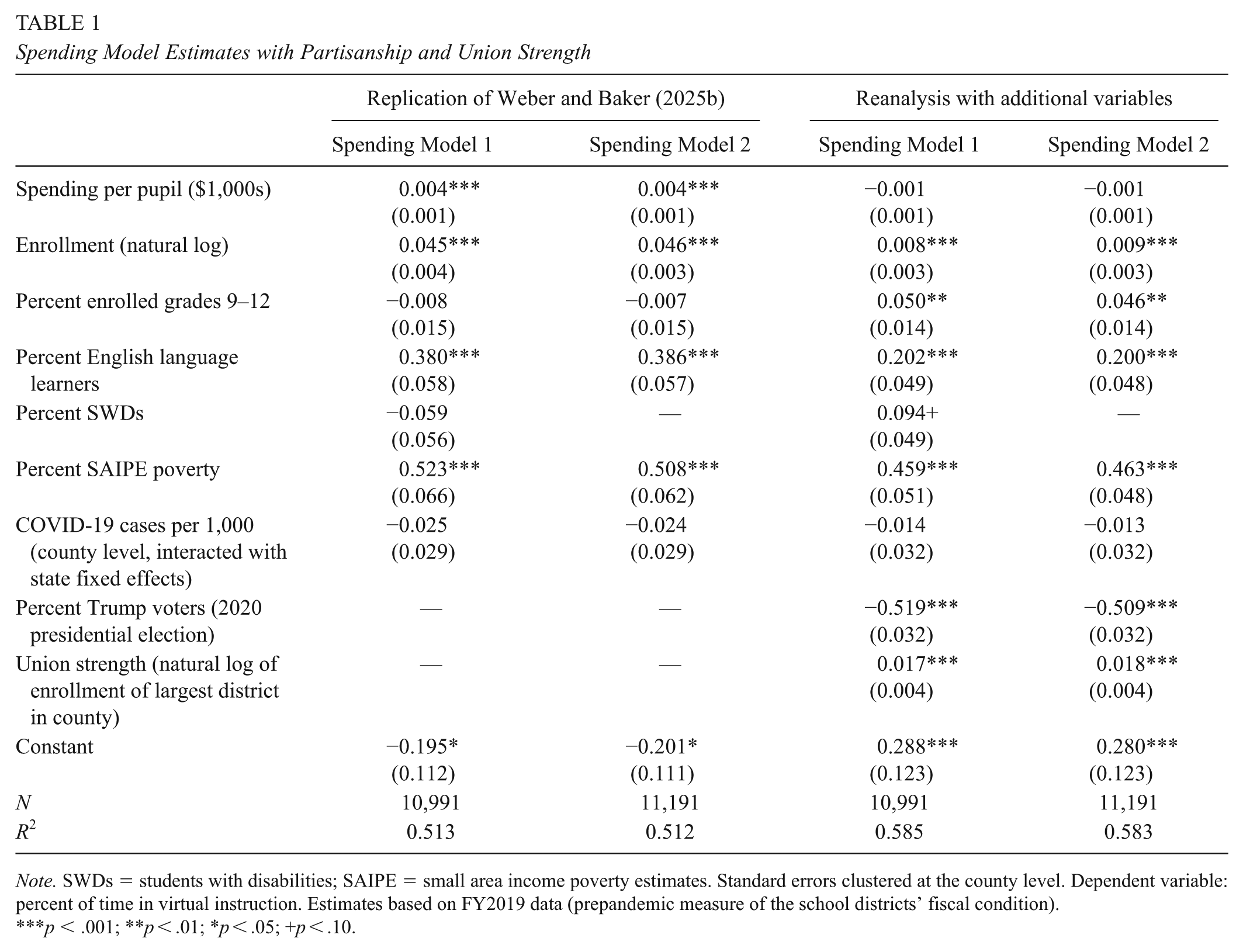
Note. SWDs = students with disabilities; SAIPE = small area income poverty estimates. Standard errors clustered at the county level. Dependent variable: percent of time in virtual instruction. Estimates based on FY2019 data (prepandemic measure of the school districts’ fiscal condition).
p < .001; **p < .01; *p < .05; +p < .10.
Adequacy Model Estimates with Partisanship and Union Strength

Note. NECM = National Education Cost Model. Standard errors clustered at the county level. Dependent variable: percent of time in virtual instruction. Estimates based on FY2019 data (prepandemic measure of the school districts’ fiscal condition).
p < .001; **p < .01; *p < .05; +p < .10.
Including local partisanship and union strength in the model attenuated Weber and Baker’s original estimates of the association between funding adequacy and virtual instruction. First, it is notable that the R2 was higher for each of these estimates (~0.58) compared with Weber and Baker’s original estimates for the spending models (0.51) and the funding adequacy models (0.44–0.46). This difference reinforces the explanatory power of local partisanship and union strength as predictors of school reopening and learning modality in 2020–21. 3
In the spending models (Table 1), when controlling for the percentage of voters who voted for Trump in 2020 and a proxy for union strength, I found no statistically or practically significant relationship between spending per pupil and time in virtual instruction. This differs from Weber and Baker’s estimates, which showed a positive relationship between spending per pupil and time in virtual instruction. In addition, the positive associations between some demographic variables and time in virtual instruction (i.e., percentage of English language learners, poverty level, and enrollment size) were smaller in my estimates than in Weber and Baker’s estimates, likely because local partisanship was correlated with district demographics and size.
In the funding adequacy models (Table 2), I found a negative relationship between adequacy and time in virtual instruction. In other words, as Weber and Baker found, greater funding adequacy gaps are associated with increased time in virtual instruction. Yet, when controlling for local partisanship and union strength, I found a slightly weaker relationship. In the model with the adequacy measure that excluded race as a covariate (see Weber and Baker’s paper for additional details on these measures), I found a 0.5 percentage point (pp) decrease in virtual schooling days for every $1,000 positive change in adequacy (i.e., a $1,000 closing of the adequacy gap and/or adding to the adequacy surplus), whereas Weber and Baker found a 0.6 pp decrease. In the model with the adequacy measure that included race as a covariate, I found a 0.6 pp decrease in virtual schooling days for every $1,000 positive change in funding adequacy, whereas Weber and Baker found a 0.9 pp decrease.
In other words, my estimate suggests that a 1 standard deviation positive change in adequacy (~$7,800–$7,900 more per pupil) was associated with 7.0–8.5 fewer days of virtual instruction, whereas Weber and Baker originally estimated 9.8–12.8 fewer days of virtual instruction associated with such a change (depending on the adequacy measure used). As a point of comparison, a 1 standard deviation increase in the percentage of Trump voters in a district in 2020 (~18 pp) was associated with 18–19 fewer days of virtual instruction, whereas a 1 standard deviation decrease in union strength (proxied by log enrollment of the largest district in the county) was associated with ~5 fewer days of virtual instruction.
Conclusion
This reanalysis clarifies the association between funding adequacy and school districts’ decisions about in-person versus remote instruction during the COVID-19 pandemic. By incorporating measures of local partisanship and union strength—two of the most consistently cited predictors of school reopening decisions—this study addresses a key limitation of Weber and Baker’s (2025b) original analysis. First, my findings confirm prior research showing that partisanship and union strength explained additional variation in districts’ learning modality decisions in 2020–21. Local partisanship in particular was a strong predictor of reopening.
In addition, including local partisanship and union strength in the estimates attenuated Weber and Baker’s prior estimates of the relationship between funding adequacy and time spent in virtual learning. Including district-level measures of partisanship and union strength substantively attenuated the estimated association between funding adequacy and time spent in virtual instruction. This attenuation indicates that political context explains a meaningful share of the relationship originally attributed to funding adequacy, highlighting the extent to which fiscal capacity and political environment are intertwined in shaping pandemic reopening decisions.
Still, funding adequacy remains a statistically significant predictor of reopening even after accounting for the political context in which districts operated. Moreover, the results confirm that estimates based on raw spending amounts are not sufficient to capture the consequences of funding inadequacy. This suggests that funding adequacy does capture dimensions of district capacity (e.g., staffing levels and facility conditions) that are not fully reducible to political context alone. In sum, the fiscal conditions under which districts operated may inform our understanding of school districts’ responses to the COVID-19 pandemic, but they must be considered as part of the broader political context.
Footnotes
Appendix
Variance Explained for Adequacy Model Estimates Based on Stepwise Regression

| NECM adequacy gap/surplus model | NECM adequacy gap/surplus model | NECM adequacy gap/surplus model | NECM adequacy gap/surplus model | |
|---|---|---|---|---|
| R 2 | 0.441 | 0.569 | 0.487 | 0.574 |
| Percent Trump voters (2020 presidential election) | No | Yes | No | Yes |
| Union strength (natural log of enrollment of largest district in county) | No | No | Yes | Yes |
Note. NECM = National Education Cost Model. Standard errors clustered at the county level. Dependent variable: percent of time in virtual instruction. Estimates based on FY2019 data (prepandemic measure of the school districts’ fiscal condition).
Declaration of Conflicting Interests
The author declares no potential conflicts of interest with respect to the research, authorship, and/or publication of this article.
Funding
The author received no financial support for the research, authorship, and/or publication of this article.
