




Abstract
This study considers whether dual enrollment is associated with students’ earnings outcomes over a longer, 10-year time horizon after high school graduation, than previously analyzed in the existing literature. Using longitudinal administrative data that span K–12, higher education, and the workforce, we conducted a propensity score analysis to understand how dual credit participation among five cohorts in the state of Texas—the 2008-2012 high school graduating classes—correlates with annual earnings measured through the 10th year post high school graduation. We find that dual credit participants realize lower earnings than non-participants during the first 4 years after high school graduation, but achieve higher earnings in Years 5 through 10, netting a cumulative 10-year earnings increase of 6%. We find similar results across many student subpopulations, although smaller magnitudes of association for some, suggesting that dual enrollment relates favorably to distal measures of students’ financial wellbeing.
Introduction
Dual enrollment, which allows high school students to earn college credit through concurrent enrollment in college coursework, 1 has broadened considerably across the United States over the past 2 decades. State policymakers and postsecondary institutions have expanded dual enrollment as a strategy to propel students into the college pipeline early and promote college readiness, enrollment and persistence, increase and accelerate degree attainment, reduce college costs, and improve long-term labor market outcomes (Ozmun, 2013; Taylor, 2015; Zinth, 2014). Texas has been at the forefront of this expansion, embedding dual credit into its secondary education system and enacting policies to increase student access (Struhl & Vargas, 2012). Although dual enrollment programs are widely adopted, research related to whether their potential benefits continue after higher education remain limited. Prior research has primarily examined more immediate outcomes such as postsecondary enrollment, persistence, academic performance, and completion (Allen & Dadgar, 2012; An, 2013; J. Lee et al., 2022; Liu et al., 2020; Fink et al., 2017); however, comparatively, little is known about the enduring effects of dual enrollment on earnings—an outcome that directly shapes the perceived value of these programs.
This study contributes to this literature by analyzing the long-term postsecondary and labor market outcomes associated with dual enrollment participation in Texas. Using statewide administrative data encompassing nearly 1 million public high school graduates from the classes of 2008 through 2012, we examine postsecondary enrollment and earnings trajectories over the 10 years following high school completion. Employing propensity score weighting to adjust for observable differences in academic preparation, demographics, and school characteristics, we estimate the associations between dual enrollment and both annual and cumulative earnings, while also investigating heterogeneous effects across subgroups defined by race/ethnicity, gender, socioeconomic status, English proficiency status, academic performance on eighth grade state standardized testing, and cohort year. By extending the time horizon of analysis and disaggregating results by student groups, the study assesses whether dual enrollment fosters sustained positive economic outcomes and whether those outcomes are equitably realized across student populations.
The rationale for creating a path to early college access rests on the assumption that providing high school students with opportunities to engage in college-level coursework can yield long-term benefits across their educational and occupational trajectories. Implicit in this rationale is a belief among educators, policymakers, institutions, and communities that dual enrollment not only facilitates immediate higher education success, but also improves students’ eventual career prospects (An & Taylor, 2019; Buckley et al., 2022; Henneberger et al., 2022; J. Lee et al., 2022; Phelps & Chan, 2016). Empirical validation of this supposition is worthwhile. Although we do not claim causal identification, our inverse probability weighting analysis of the relationship between dual credit participation and earnings yields meaningful inferential insights into this underexplored area of research. Furthermore, with Texas making significant investments in expanding dual credit access (Decker, 2025; Miller et al., 2018), understanding the long-term economic returns of these programs is vital for assessing their efficacy, informing program design and future policy and funding decisions, and, ultimately, improving students’ educational success and economic mobility. General dual enrollment programs introduced in Texas in the early 2000s are analogous to many prevailing models implemented across numerous states today, many of which continue to offer dual credit coursework outside of the intensive early college framework (American Institutes for Research, 2024). Insights from this study may inform policymakers and educators in these states about the long-term economic impacts of dual credit participation, and facilitate decision-making related to access, scaling, and resource allocation.
Motivation for the Study
Despite the expansion of dual enrollment in Texas and in the broader U.S. landscape (Barshay, 2024; Decker, 2025), findings in the literature regarding the outcomes of dual credit students have been mixed. Research on historical, less comprehensive implementations of dual credit versus the Early College High School (ECHS) and Pathways in Technology Early College High School (P-TECH) models has found positive associations between dual credit participation and achievement both in high school and in postsecondary. However, there is a lack of consensus in these studies regarding the benefits of dual enrollment for traditionally underserved populations; some studies suggest dual credit participation favors college matriculation and completion for minoritized and underserved students (Blankenberger et al., 2017; J. Lee et al., 2022; Liu et al., 2020), while others find that these benefits are limited or naught (H. B. Lee & Villarreal, 2023; Moreno et al., 2021).
This mixed evidence raises questions about the equity implications of dual enrollment in states continuing to grow and refine their offerings. Furthermore, there is little research assessing the long-term financial outcomes of some of the earliest cohorts of dual credit participants. Very few studies investigate the relationship between dual credit participation and wages, and those that do have a limited time horizon, assessing only 6 years or less after high school graduation (Buckley et al., 2022; Henneberger et al., 2022; Phelps & Chan, 2016). Studying these relationships is necessary to understand whether the value of taking a dual credit course extends to the labor market and supports students’ financial wellbeing, both overall and by student subgroup. As a broader swath of states continues to develop dual credit policy, Texas’s long history of dual enrollment now offers more than a decade of evidence to help fill these gaps in the literature and inform these policy efforts.
Our study uses five high school graduating cohorts in Texas to examine relationships between dual enrollment and earnings outcomes over a 10-year period; we analyze how relationships between dual credit participation and wages vary across specific student populations, such as economically disadvantaged, limited English proficient (LEP), and academically disadvantaged student groups. Disaggregating results by key demographic and academic groups allows us to gauge whether positive associations between dual enrollment and earnings are equitable. We conclude that participation in dual enrollment is generally associated with positive earnings outcomes, but results vary in magnitude and timing for certain student groups, which suggests that the earnings gains from dual credit are not distributed equally across all students. While our population of focus predates the current dual credit landscape in Texas, which now offers numerous ECHSs and P-TECHs, dual enrollment offerings from the mid 2000s to early 2010s in Texas are comparable to many dual enrollment models operating today in other regions within the United States. Furthermore, with the development of more technical and CTE dual credit programming over the past few years, there has been greater emphasis on the investigation of career- and labor market-focused outcomes. We aim to assess if dual enrollment in its historical and general format led to higher earnings over time as a precursory examination to the long-term outcomes of more contemporary implementations of dual enrollment.
Literature Review
Dual Enrollment in the National Landscape
States vary in their implementation of dual credit programs; while many states, like Texas and Virginia, have standardized dual credit policies and funding streams, dual credit programs in other states, such as Nebraska, are articulated at the local and institutional level (J. Lee et al., 2022; Pretlow & Wathington, 2014). As national efforts to enhance the quality of dual enrollment data begin to materialize, recent IPEDS data indicate that 2.5 million of all high school students participated in college courses in 2022–2023 (Fink, 2024). State-level data suggest that dual enrollment has grown tremendously not only in terms of the rates at which students are participating, but also by the number of courses students are taking (Taylor et al., 2022). For example, the proportion of high school graduates with dual enrollment credits in Indiana increased by 21 percentage points from 2012 to 2018 (39% to 60%; Indiana Commission for Higher Education, 2021). In Oregon, the average number of dual credit courses completed increased from 6.8 to 10.4 from 2011 to 2018 (Cox et al., 2019). In Texas, the transformation of dual credit policy over the past 2 decades has changed dual credit delivery from a limited set of core coursework options prior to 2015 to numerous postsecondary curricula in associate degree and career and technical education (CTE) pathways after the enactment of House Bill 505, 2 with many dual credit courses offered at ECHSs and P-TECHs (Miller et al., 2017).
In the Texas context, the distinction between the ECHS model and the general dual enrollment model, which is the focus of this study, is characterized by the intensity of coursework offered and the student population targeted by the program. The general dual enrollment model allows eligible high school students, typically in 11th and 12th grade, to enroll in college-level courses and receive simultaneous credit toward both their high school diploma and a postsecondary credential. These courses may be academic in nature—such as core course designed to apply towards transferable degrees such as the associate of arts or associate of science—or technical, including CTE courses aligned with workforce certificates and associate of applied science degrees. They are delivered either on high school campuses by approved instructors or on college campuses (Texas Education Agency [TEA], 2019; Texas Higher Education Coordinating Board [THECB], 2018). This model is broadly accessible across many high schools, helping students gain exposure to college-level work without being enrolled in a specific program of study or credential pathway (TEA, 2019; THECB, n.d.). In contrast, the ECHS model represents a more intensive and structured variant of dual enrollment that is intentionally designed to serve historically underserved and at-risk student populations. ECHSs are open-enrollment high schools that are often standalone campuses or embedded “schools-within-schools,” and they enable students to earn a high school diploma and up to 2 years of college credit, often culminating in an associate degree. In addition to coursework, the ECHS model incorporates rigorous instruction, personalized academic advising and social support, and maintains formal partnerships with higher education institutions to guide program design and implementation (TEA, n.d.a, n.d.b; Texas CCRSM, 2022). An extension of ECHS, the P-TECH model is oriented towards work-based education, and focuses on certificate and associate degree pathways aligned with high-demand industries and fields wherein students have opportunities to gain work experience (TEA, n.d.a, n.d.b).
Dual Enrollment Research Overview
Existing studies clearly demonstrate an association between dual credit participation and short-term college-going outcomes, including increased academic momentum in high school, the likelihood of college enrollment and persistence, and degree completion. In relation to high school success, some studies indicate that dual credit participation increases student achievement by way of improved test scores, increased accumulation of dual credit hours, increased likelihood of graduation and improvement in 4-year high school graduation rates, as well as improved college application rates (Haskell, 2016; J. Lee et al., 2022; Villarreal, 2018). Regarding college outcomes, some studies find more robust and positive associations between dual enrollment and college access, persistence, and completion for traditionally underserved populations, such as low-income students, underrepresented racial and ethnic groups, women, first-generation, and academically struggling students (An, 2013; An & Taylor, 2019; Blankenberger et al., 2017; Henneberger et al., 2022; J. Lee et al., 2022; Liu et al., 2020); other studies find less positive or insignificant relationships between dual credit participation and college outcomes for some or all underserved student groups examined (Kremer, 2022; H. B. Lee & Villarreal, 2023; Moreno et al., 2021; Phelps & Chan, 2016; Struhl & Vargas, 2012). These studies employ ordinary least squares (OLS), propensity matching, and other correlational estimation approaches, such as fixed effects, to control for a range of student baseline characteristics.
Studies investigating the causal effects of dual enrollment outside of the ECHS and P-TECH models observe more subdued impacts on student outcomes than the research which utilizes selection on observables and correlational approaches. Two studies uncover modest causal effects of dual credit participation on college choice (selection of a 4-year over a 2-year institution), enrollment, and completion. Hemelt et al. (2020) conducted a randomized controlled trial in Tennessee to examine the impact of dual enrollment math courses on a set of high school and college outcomes. They observe that enrollment in an advanced dual credit algebra course—one that requires students to pass an end-of-course exam to earn college credit—leads to increased enrollment in more rigorous math courses but has no effect on college enrollment. Miller et al. (2018) use instrumental variables in conjunction with differences-in-differences and fixed effects approaches to control for both observable and unobservable variables influencing selection into dual credit courses and college enrollment and completion. The authors find moderate effects of dual credit participation on increased college enrollment and credential completion, particularly in 2-year institutions, and even less positive effects for low-income and minoritized students compared to more high-income and White students, which is attributed to lesser academic preparedness.
The research pertaining to the assessment of ECHS and P-TECH programs employs more robust causal designs to estimate the effects of dual enrollment, yielding positive impacts on student outcomes. Through experimental study designs of ECHSs which use a lottery-based admissions process, Berger et al. (2014), Zeiser et al. (2021), and Edmunds et al. (2017) conclude that dual credit participation has a positive significant impact on college enrollment and degree completion for students who enroll in early college high schools compared to those who do not enroll, with positive effects observed for underserved groups. However, the analysis of subgroups by Edmunds et al. (2017) indicates that the differential impacts of ECHS on postsecondary enrollment are smaller for underrepresented students (Black, Hispanic, and Native American) than non-underrepresented students; similarly, differential effects of ECHS on postsecondary credential attainment are smaller for underrepresented and underprepared 9th grade students compared with their counterparts. In subsequent research, Edmunds et al. (2020) find that the accelerated nature of ECHS does not compromise academic performance in college after high school, as participants observe a higher rate of associate degree attainment compared to nonparticipants 6 years after early college graduation; the rate of baccalaureate degree attainment, however, is equivalent between the two groups.
Although less extensive than the literature on early college high schools, experimental studies on CTE dual enrollment suggest positive effects on high school performance and postsecondary enrollment. A quasi-experimental examination of North Carolina’s dual credit CTE pathway offered to 11th and 12th grade students shows a positive association between CTE participation and postsecondary enrollment in both 2- and 4-year institutions for the overall sample; a positive statistically significant relationship between CTE dual enrollment participation and enrollment in 2-year institutions is observed for subgroups by race and ethnicity and socioeconomic status (Edmunds et al., 2024). Assessing a more intense mode of CTE dual enrollment programming, a randomized controlled trial of New York City’s 6-year P-TECH program from Grade Levels 9 through 14 (sophomore year in postsecondary) finds significant effects on students attempting and earning more college credits and passing Regents exams (required for admission into City College of New York schools); the study’s findings also suggest that the program helps at-risk students achieve high school success and become prepared for college (Dixon & Rosen, 2022).
Our contribution to the scholarship is to describe the long-term outcomes of dual enrollment, not estimate the causal impact of dual credit participation. To date, and to the authors’ knowledge, only three studies examine dual enrollment and post-college earnings through propensity score and/or linear regression methods, evaluating outcomes only 3 to 6 years after high school graduation (Buckley et al., 2022; Henneberger et al., 2022; Phelps & Chan, 2016). Henneberger et al. (2022) estimate earnings at the 6th year after high school graduation for Maryland’s 2010 cohort and observe a significant and positive relationship between dual credit participation and early labor market earnings, with correlations more robust for traditionally underrepresented students, specifically African American, other race, and free/reduced lunch-eligible students. Phelps and Chan (2016) examine the relationship between CTE dual credit course completion at a Wisconsin community college from 2008 to 2010 and their short-term earnings 3 to 5 years after high school graduation; their findings suggest a significant and positive association between CTE dual credit course completion and earnings—particularly for those who completed dual credit courses on a high school campus with high school instructors, had higher Accuplacer math and reading scores, and pursued longer-term credentials in STEM and engineering pathways. Following 11th grade dual enrollment students in five high school graduating cohorts (2010–2011 through 2014–2015) in Colorado, Buckley et al. (2022) conclude that 5 years after students’ expected high school graduation date, the earnings of dual credit participants are significantly higher on average in comparison to nonparticipants; the analysis, however, does not differentiate wage outcomes by specific student backgrounds. While these studies generally show positive earnings outcomes across student populations, they estimate these outcomes over a narrow time horizon and do not examine differences for a wider-ranging set of student groups.
Contribution to the Literature
We contribute to the literature in two primary ways. First, we extend prior research by examining the long-term relationship between dual enrollment and earnings up to 10 years after high school graduation for Texas students in the 2008–2012 cohorts. Second, we investigate whether these relationships differ across student subgroups defined by economic disadvantage, race and ethnicity, gender, English proficiency, prior achievement, cohort, and high school locale. To partially address selection bias, we use inverse probability weighting with linear probability models for postsecondary enrollment and log-linear models for earnings, adjusting for observable student- and school-level characteristics. We find that dual enrollment is associated with higher earnings a decade later, although this relationship is uneven across student groups.
Dual Enrollment in Texas, 2007–2010
Given that the dual enrollment landscape in Texas has evolved markedly over the past 2 decades, examining the demographic characteristics of early participants, the types of courses they undertook, and their college going trends provides context for understanding the population we analyze. During the 2007–2008 through the 2009–2010 academic years, the majority of students who enrolled in dual credit courses in Texas were in Grades 11 and 12 with students in 12th grade enrolling at the greatest proportions (American Institutes for Research, 2011). A total of 88% of dual credit courses were offered to students at community colleges and taught by college instructors (Calahan , 2016). Dual credit participation was not equitably distributed across demographic groups during this period; on average, almost 50% of students were White—a disproportionately higher proportion than the 35% observed in the statewide high school population—approximately 40% were Hispanic, and under 10% were African American. Economically disadvantaged and limited English proficient students were underrepresented in dual enrollment; only 37% of dual credit participants were low-income compared to 50% of the overall high school population statewide, and roughly 2% were LEP during this period. On average, one-third of courses taken for dual credit in Texas were in social studies or history, a quarter of courses were in English, and approximately 10% of courses taken were in CTE. In all, 88% of school district and high school administrators affirmed that dual credit courses were either “effective” or “very effective” in aiding college enrollment (American Institutes for Research, 2011). Possible factors contributing to the efficacy of dual enrollment on college going may have been related to the college campus experience; attending dual credit courses on college campuses may have allowed students to become accustomed to the college environment, and relationships with college instructors may have increased students’ motivation to enroll after high school graduation. With evidence suggesting that dual enrollment during this early period promoted high school academic achievement and college enrollment, whether the program also enabled positive outcomes in the long term is worth examining, as our study aims to accomplish.
Theoretical Framework
We draw on sociological theories to explain how participation in dual enrollment may be associated with greater likelihood of postsecondary enrollment and completion, and thereby with improved labor market outcomes. Human capital theory in education suggests that education is an investment in the human agent driven by intentional decision-making that is most optimal for the individual. The outcomes of education or, in regard to our research, a dual enrollment student’s intentional investment in higher education, bring about socioeconomic mobility through increased earnings, poverty alleviation, individual growth, and social returns or external benefits to others as a result of the individual’s educational attainment (Becker, 1994; Holden & Biddle, 2017). Students’ selection into dual enrollment is based on expectations of immediate returns, including momentum for high school achievement and preparation for college-level academics, as well as distant benefits such as college completion and better financial outcomes. Bourdieu’s (1986) framework adds a cultural lens to the analysis in terms of understanding how dual credit students gain cultural capital to achieve success in college and the workforce. Participation in dual enrollment allows students to earn credentials, develop study habits, discipline, and confidence, enhance their communication skills, and become accustomed to institutional norms—assets that are valuable when students navigate higher education and professional settings. These adopted behaviors and internalized dispositions, which Bourdieu coins as “habitus,” are formed through early exposure to college environments and can translate into increased productivity, adaptability, and professionalism in the workplace.
While these constructs provide a lens for considering the expansion of dual enrollment, they imply that social and economic mobility are exclusively based on individual choice and behavior and not influenced by structural inequities tied to socioeconomic class (Rivera et al., 2019). Research establishes persistent earnings disparities across social classes, racial and ethnic groups, and by other demographic differences (Akee et al., 2019; Bloome, 2014; Manduca, 2018; Smith, 2000), suggesting that there is a systematic underestimation of the human and cultural capital of historically marginalized populations in the employment market (Thomas et al., 1994; Tomaskovic-Devey et al., 2005). We postulate a positive association between dual enrollment participation and earnings in our study, but also anticipate wage outcomes to vary within certain demographic categories.
Methodology
This study examines the relationship between dual enrollment participation and annual postsecondary enrollment and annual earnings for the 2008–2012 high school graduating cohorts in the state of Texas to determine if dual credit is associated with positive earnings for students over a 10-year trajectory post high school completion. The specific research questions addressed in this paper include the following:
What is the relationship between dual credit participation and annual earnings up to ten years after high school graduation?
What is the relationship between dual credit participation and annual college enrollment up to ten years after high school graduation?
To what extent do the relationships between dual credit participation and annual college enrollment and earnings vary for different student populations based on the following categories: race and ethnicity, socioeconomic status (as indicated by free/reduced lunch program participation), gender, English proficiency, eighth grade standardized exam performance brackets, high school graduating cohort, and high school locality (city, suburban, town, rural)?
What is the relationship between dual credit participation and cumulative earnings 10 years after high school graduation?
Data
To answer these questions, we use administrative records from a P20W state longitudinal data system (the Texas Education Research Center at the University of Texas at Dallas) to construct a statewide panel dataset consisting of five cohorts of Texas high school graduates from the classes of 2008 to 2012, tracking their postsecondary enrollment and earnings over time up to 10 years after high school graduation. The Texas Education Research Center coalesces individual-level data from three primary sources: the Texas Education Agency (Pre-K to 12th grade), Texas Higher Education Coordinating Board (postsecondary), and Texas Workforce Commission (employment). Our dataset includes an indicator for enrollment in at least one dual credit class in 11th or 12th grade and a range of variables measured from eighth through 10th grade, including assessment results (eighth grade math and reading scores), demographics (race/ethnicity, gender, free/reduced lunch status, etc.), and high school environmental characteristics (share of students eligible for free/reduced lunch, student-to-teacher ratio, graduation rate, etc.). Our outcome variables, measured after high school graduation, include enrollment at public postsecondary institutions in Texas and quarterly wages earned by working for employers covered by the state unemployment insurance system.
Sample
Statewide data were used to provide as large a sample as possible, and the 2008–2012 high school graduating cohorts were selected to allow for a 10-year measurement window in which to observe earnings. Notably, each of the selected cohorts graduated before the Texas legislature enacted House Bill 505 in 2015, which expanded access to dual credit coursework to include ninth and 10th grade students; therefore, all students in our sample did not participate in a dual credit class until 11th or 12th grade at the earliest (and hence any variables observed in 10th grade or earlier are captured before a student engages in dual credit coursework). To avoid systematic differences in campus types, we exclude students enrolled in charter and early college high schools (ECHS). 3 To avoid missing data caused by interstate migration and grade repetition or acceleration, we also restrict the sample to students enrolled in the appropriate academic years (or in their grade level) at a public school in Texas from eighth grade to 12th grade. We also exclude students who did not have eighth grade math and reading test scores on the Texas Assessment of Knowledge and Skills (TAKS).
Pooling all five cohorts of graduates, our final sample comprised 954,953 students, 249,170 (26.1%) of whom enrolled in at least one dual credit course in 11th or 12th grade, and 705,783 (73.9%) did not take any dual credit courses. The average number of semester credit hours completed by those who enrolled in dual credit courses was 11.23. Appendix 1 (in the online supplemental material) shows summary statistics for our sample. We also divided our full sample into subgroups based on cohort, gender, race/ethnicity, socioeconomic status (disadvantaged and non-disadvantaged according to free/reduced lunch program participation), English proficiency, eighth grade TAKS performance brackets, and high school urbanicity. We analyzed these subsamples to see whether the potential educational and earnings benefits of dual credit participation extended to the most underserved student groups in our overall population.
Variables
Our primary independent variable is a dichotomous indicator measuring whether a student enrolled in at least one dual credit class in 11th or 12th grade. Our primary dependent variables, observed during the 10 years after high school graduation, are a dichotomous indicator of annual postsecondary enrollment and a continuous variable capturing (log) annual earnings, adjusted to 2024 dollars using CPI-U. Annual, year-by-year enrollment reflects whether a student in each of the five high school graduating cohorts enroll in a 2-year, 4-year, health-related, or independent/private higher education institution in Texas over a 10-year period. Wage records in the Education Research Center holdings are reported on a quarterly basis. We measure annual enrollment each academic year and calculate annual earnings by summing quarterly earnings from Q3 of a given calendar year (July–September) to Q2 of the following calendar year (April–June); we aggregate this way to approximately align with the academic year. For each year, we impute zero for quarters with missing wage data if the student has at least one observed quarterly wage during that year; students with no observed wages across all four quarters are excluded from analysis for that year. This approach provides a conservative estimate of in-state economic engagement and avoids overstating annual earnings. However, it may undercount out-of-state, federal, and self-employment, which dual credit and non-dual credit students may participate in at different rates.
Control variables used include high school graduation cohort (with 2008 as the reference category), gender, race/ethnicity (with White as the reference category), socioeconomic status (based on receipt of free/reduced lunch), (limited) English proficiency, eighth grade TAKS academic achievement (three categories: passed both math and reading and commended in at least one, passed both but commended on neither, or failed at least one), gifted and talented status, special education status, at-risk status (of not graduating from high school according to the TEA’s definition; TEA, 2024), prior enrollment in alternative education in ninth or 10th grade, share of underrepresented minorities (Black, Hispanic, and Native American) at the student’s high school, share of free/reduced lunch recipients at their high school, share of limited English proficiency students at their high school, student-to-teacher ratio at their high school, average years of experience for teachers at their high school, graduation rates at their high school, and region/locale (urban, suburban, town, or rural according to National Center for Education Statistics definitions) of their high school. All control variables were known prior to each student’s first opportunity to take a dual credit class. Appendix 9 includes more detailed descriptions of all variables.
Analysis
We model participation in at least one dual credit class as a treatment and use propensity score analysis to statistically adjust for students’ non-random selection into dual credit classes. Specifically, we estimate each student’s likelihood of participating in dual credit using logistic regression, including a comprehensive set of pre-treatment control variables selected according to established guidelines (Newgard et al., 2004; Stone & Tang, 2013); these covariates are described in Appendices 1 and 9. In line with prior literature (H. B. Lee & Villarreal, 2023; Struhl & Vargas, 2012), we use state math and reading assessment performance as proxies for academic preparation and ability. However, despite adjusting for these student and school characteristics, we do not interpret our results as causal, as unobserved factors (like motivation and ability) may still influence both dual credit participation and outcomes. Our findings, therefore, represent adjusted associations under the strong and unlikely assumption of selection on observables. After estimating propensity scores, we calculate and apply inverse probability weights (IPW) in all outcome regressions (enrollment and log earnings). The use of IPW, rather than matching, allows us to retain nearly our full sample, supporting subgroup analysis (Braitman & Rosenbaum, 2002; Guo & Fraser, 2015; Hubert, 2014; Rosenbaum & Rubin, 1983). Inverse probability-weighted regressions estimate the average treatment effect on the treated (ATT) by comparing observed outcomes of dual credit participants to reweighted outcomes of non-participants who serve as a comparison group. We assess covariate balance before and after weighting by examining standardized mean differences between treatment and control groups, summarized in Table 1. Standardized mean differences quantify covariate differences in standard deviation units, with values below .1 conventionally indicating adequate balance. In our analysis, all covariates exhibited standardized mean differences below .05, suggesting excellent post-weighting balance between treatment and control groups. To confirm the common support assumption, we also compare the distributions of propensity scores for the treated and control groups (pre- and post-weighting) in Figure 1. We exclude from analysis any observations outside the region of common support—where no suitable comparison exists. We repeat the logistic regression, IPW, and balancing process for each subgroup we analyze, and the distributions of these propensity scores are shown in Appendix 7. Covariate balance tables for all subgroups are available upon request.
Covariate Balance: Unweighted Versus Weighted Standardized Means for Full Sample

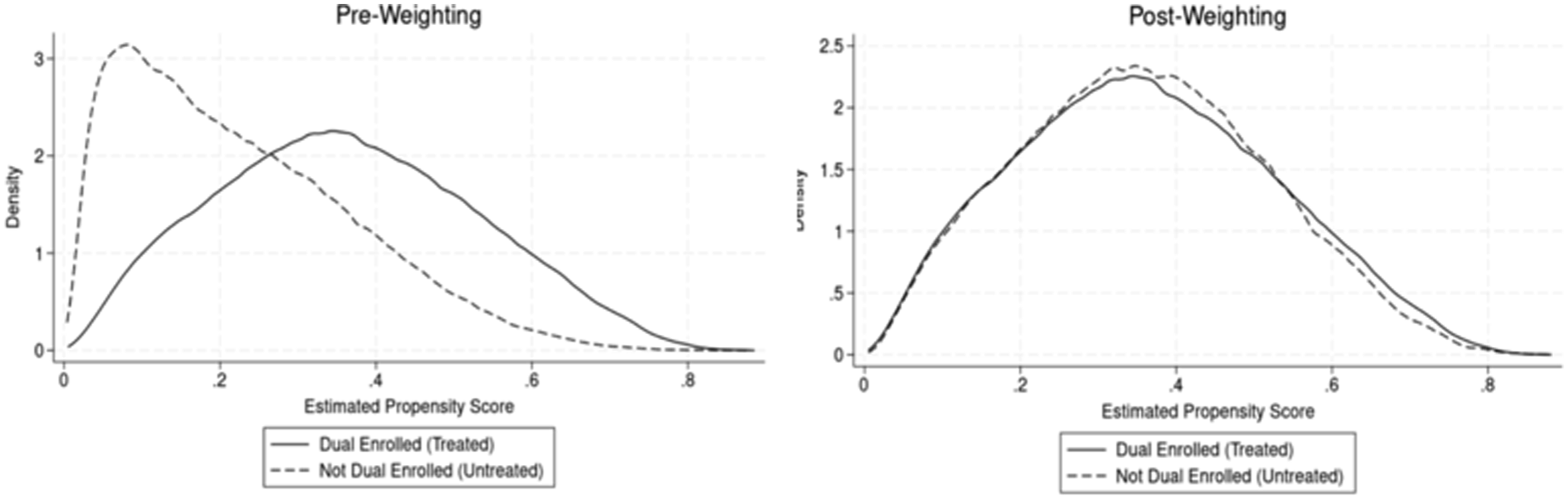
Pre-/Post-weighted estimated propensity scores for full sample.
For our outcome models, we estimate separate inverse probability-weighted regressions for each outcome year and subgroup, regressing on dual credit participation, pre-treatment covariates, and cohort indicators. This approach allows the association between dual credit and the outcome (enrollment or log earnings) to vary freely by year and group. Specifically, for each year


where

where variables are as previously defined.
Findings
Propensity of Dual Enrollment
We begin our analysis with a series of logistic regressions to estimate each student’s propensity to participate in at least one dual credit class in 11th or 12th grade, both for the full sample and for each subgroup. Through this analysis, we identify several individual and school characteristics associated with increased or decreased odds of participating in dual credit, largely consistent with the existing literature. For example, we find that greater odds of dual enrollment are associated with the female gender, gifted and talented status, eighth grade commended TAKS scores in math or reading, and enrollment at high schools with higher graduation rates and average teacher experience. Lower odds of dual credit participation, meanwhile, are associated with being a student of color, receipt of free/reduced lunch, failing eighth grade TAKS scores in math or reading, special education status, at-risk status, prior enrollment at an alternative education high school in ninth or 10th grade, and enrollment at high schools with higher shares of LEP students and higher student-to-teacher ratios. We find similar results by subgroup, noting that for the Native American group, LEP and alternative education covariates were dropped due to sample size. Further details on the association between student and school characteristics and odds of dual credit participation for the full sample are detailed in Appendix 8, and subgroup results are available upon request. For our full sample and every subgroup, we are able to generate inverse probability weights using results from these logistic regressions, achieve balance, and weight our subsequent analyses of postsecondary enrollment and earnings, which are the focus of our study.
Annual Earnings and Postsecondary Enrollment
Figure 2 summarizes weighted earnings results for the overall population, plotting them next to weighted results for postsecondary enrollment. In our figures and discussion, since we model log earnings, we report

Adjusted associations between dual credit and earnings/enrollment, full sample.
Our weighted enrollment results align with this mediation story. We find a positive significant association
Subgroup Analysis
Our subgroup analysis mirrors the trend of the full sample—similar enrollment patterns, with lower initial earnings for dual credit participants and higher earnings later—while differing in magnitude and timing. Figures 3.1 to 3.5 show subgroup-specific estimates with 95% confidence intervals (Black and Hispanic race/ethnicity, economic disadvantage, gender, prior achievement, and school urbanicity). Results for Asian, Native American, LEP, and cohort-year subgroups are presented in Appendices 2 and 5, respectively. We use the lack of overlap between 95% confidence intervals as a visual heuristic for subgroup differences; this rule is conservative because overlapping confidence intervals do not necessarily imply the absence of a true difference.

Adjusted associations between dual credit and earnings by race/ethnicity.

Adjusted associations between dual credit and earnings by socioeconomic status.

Adjusted associations between dual credit and earnings by gender.
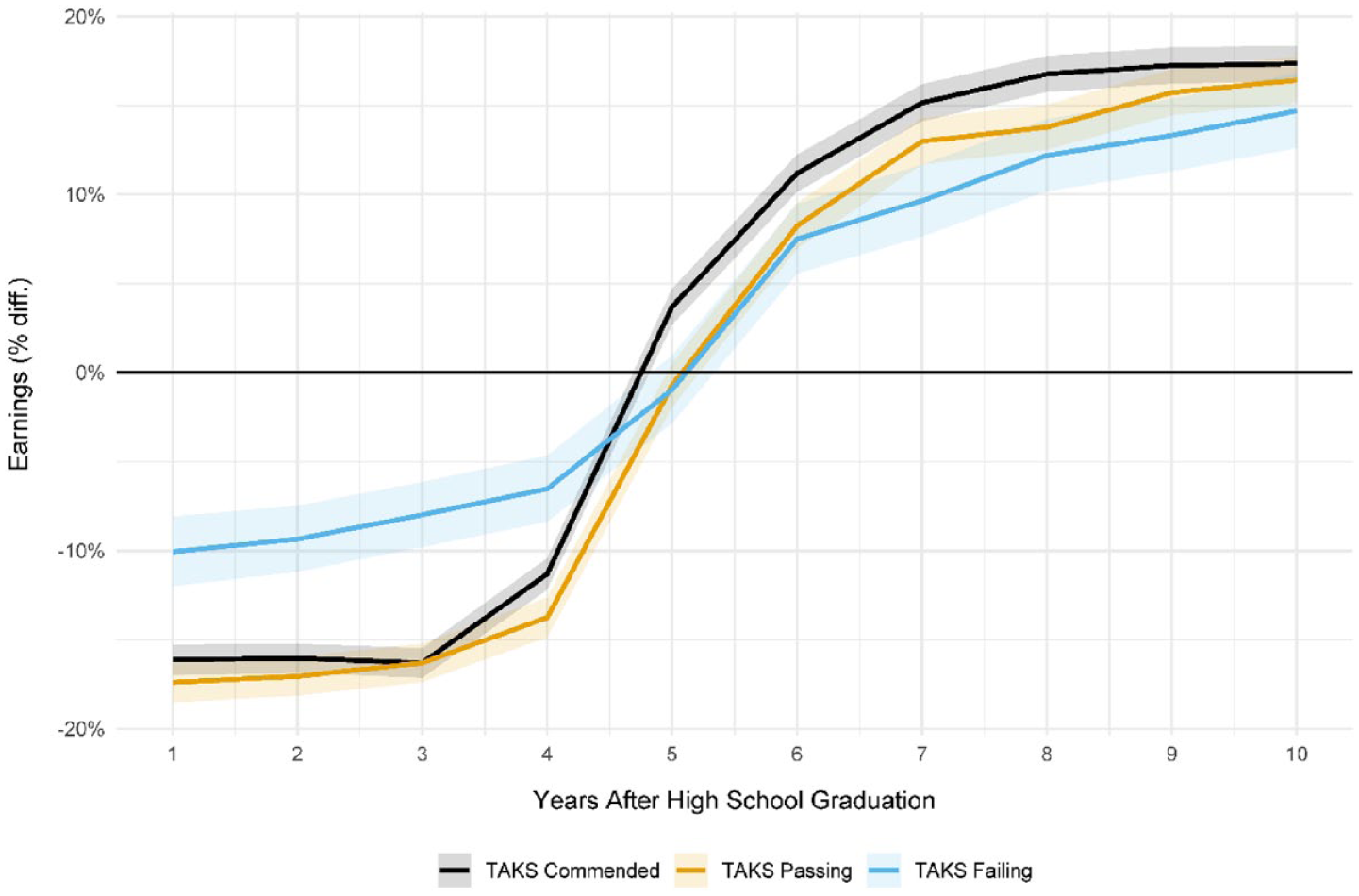
Adjusted associations between dual credit and earnings by prior achievement.

Adjusted associations between dual credit and earnings by school urbanicity.
Race and ethnicity
Black, Hispanic, and White students exhibit significant differences in the relationship between dual credit participation and earnings over time, depicted in Figure 3.1. Black students do not experience as large of an earnings dip associated with dual credit in the initial years after high school graduation as Hispanic and White students do (−7% vs. −15% vs. −17%). Hispanic students take an additional year to switch from a negative to a positive association between dual credit and earnings. Over the long-term, the magnitude of the association between dual credit and earnings is highest for White students and lowest for Hispanic students, with Black students in between; during Years 6 to 10, the gap between White and Hispanic students is 7–10 percentage points, and the gap between White and Black students is 4–8 percentage points. Taken together, these patterns suggest that the relationship between dual credit participation and earnings unfolds differently across groups, potentially reflecting heterogeneity in post-high school time allocation and subsequent credential accumulation, among other factors.
Socioeconomic status
Figure 3.2 shows similar gaps by economic disadvantage (free/reduced lunch status, or FRL). As with Black students, students receiving FRL do not realize as large of a dual-credit earnings dip in the initial years after high school graduation as non-FRL students do (−12%–13% compared to −17%–18%). As with Hispanic students, students receiving FRL also do not see the positive association between dual credit and earnings until Year 6 after high school graduation rather than in the 5th year as observed in other groups. And, finally, during Years 6 to 10, non-FRL students exhibit a larger positive association between dual credit and earnings than FRL students do, with a 3–5 percentage point disparity that appears to narrow toward the end of the observation window.
Gender
Figure 3.3 shows a stronger positive association between dual credit and earnings for female students than for male students throughout the entire 10-year observation window. Female students face less of an early earnings dip from participating in dual credit, observe a positive earnings association 1 year earlier than male students, and continue to realize a larger positive association between dual credit and earnings through Year 10. While male students may earn more on average, the increase in earnings associated with dual credit is greater for female students, which means dual credit may serve as a potential means of closing gender earnings gaps. The evidence is, again, consistent with the idea that college enrollment and attainment serve as plausible mediators between dual enrollment and earnings, particularly given higher mean college enrollment, retention, and graduation rates among women compared to men.
Academic achievement
Prior academic achievement, captured using eighth grade TAKS performance, also seems to moderate the association between dual enrollment and earnings, as Figure 3.4 shows. Students who failed one or both of their eighth grade math and reading TAKS exams see less of an earnings dip during the initial years after high school graduation, similar to Black students and students receiving FRL. These students may allocate more time to employment than education, or use employment to finance their education, but we cannot observe hours worked in our dataset. Students who earned commended scores in either math or reading first realize earnings benefits from dual enrollment in Year 5 after high school graduation, while all others do so in Year 6. The magnitude of the association between dual credit and earnings is also higher for students with commended TAKS performance than for both the passing and failing subgroups.
Urbanicity
Finally, we consider how high school urbanicity moderates the association between dual credit and earnings in Figure 3.5. We again find that the initial earnings dip of dual credit is not as severe for students from urban high schools as it is for students from other locales, just like with Black, FRL, and TAKS-failing students. In this case, we also find that the association between dual credit and postsecondary enrollment is greater in magnitude for students in towns and rural areas compared to students in urban ones (Appendix 6); this may partially explain why urban students experience a smaller initial decline in earnings—if lower shares of urban students enroll in postsecondary education after participating in dual credit, they may have more time to devote to work instead. In Years 6 to 10 after high school graduation, earnings of students in towns and rural areas rise more with dual credit than do earnings of urban and suburban peers.
Cumulative Earnings
Because dual credit is associated with lower initial earnings and higher subsequent earnings in our annual analysis, we also examine dual credit’s relationship with cumulative 10-year earnings to understand whether, on net, dual credit is associated with positive wage outcomes for students. As before, we use log earnings, discuss percent changes, and plot predicted cumulative earnings for interpretability. To construct cumulative earnings, we sum annual earnings over the 10-year observation window and restrict the sample to individuals with non-missing earnings data in every post-high school year. Between 67%–72% of students have non-missing earnings in a given year, and approximately 35% (334,633 students) have complete earnings data across all 10 years. This sample size allows us to maintain substantial statistical power despite the restriction. Moreover, the restricted sample is compositionally similar to the full sample, with dual credit participants comprising 27% of the restricted sample compared to 26% of the full sample. To be included, students must work for at least one quarter in every year, but we note that we do not observe or further restrict employment intensity (in hours or quarters of employment) beyond this condition.
Overall, we find a significant positive association

Predicted 10-year cumulative earnings by dual credit participation and subgroup.
Discussion and Implications
This study contributes to the literature on long-term wage outcomes of dual enrollment in Texas for five cohorts of high school graduates from 2008 to 2012. While it cannot address the causal mechanism of the extent to which dual credit education affects annual earnings 10 years after high school graduation, it establishes key associations through inverse probability weighting, regression techniques, and the inclusion of a comprehensive set of covariates to diminish selection bias. We estimate differences in annual postsecondary enrollment, log annual earnings, and log cumulative earnings between participants of dual credit and non-participants using a longer timeframe and for more student subgroups than are found in the literature. We find that dual credit participation is strongly and positively associated with postsecondary enrollment, with participants significantly more likely to enroll in the years immediately following high school and remain more likely to enroll for up to 10 years. In contrast, earnings are initially lower for dual credit participants during the first 4 years after graduation. This pattern shifts in Year 5 when earnings become higher for dual credit participants and continue to increase over time, reaching nearly 17% higher by Year 10. The shift from negative to positive earnings suggests that increased postsecondary enrollment, and possibly attainment, mediate long-term earnings trends for dual credit participants. Above all, the study assesses whether dual enrollment has a positive relationship with wage outcomes and concludes that while such gains reach all students in our sample, they are less pronounced among certain student populations, particularly Hispanic and male students. With regards to annual earnings, we find strong evidence that dually enrolled students had higher earnings than non-participants in Years 5 to 10 after high school graduation, despite lower earnings in initial years; however, some subgroups observe lower earnings gains over the 10-year period, including Hispanic, male, LEP, and economically disadvantaged students. Although these student subgroups observe lower earnings over time, they are more likely to enroll in postsecondary education over the 10-year period relative to their counterparts. This pattern indicates that while dual enrollment has a strong positive association with increased college participation among these populations, it does not demonstrate a similar consistent association with long-term earnings for these students. Increased cumulative earnings over the 10-year period is also strongly significant for dual enrollment students in the overall sample and in all subsamples, with the exception of the Native American and the LEP student groups. Subgroups that observed the highest cumulative earnings gains include White, Black, and female dual enrollment participants, while economically disadvantaged, low performing, male and Hispanic dual credit students experienced the lowest returns in cumulative earnings. A general comparison of annual and cumulative earnings across all demographic groups signifies that although dual enrollment is positively correlated with earnings for most students, the time in which these gains begin during the 10-year trajectory and their magnitude vary among the populations.
Coined “programs of privilege” or “random acts of dual credit” in Community College Research Center’s study on dual enrollment equity pathways, the conventional dual enrollment model, the authors contend, lacks intentionality and a meaningful advising system to ensure students are completing courses that are aligned to college pathways (Fink & Jenkins, 2023). Alignment with degree programs and credential pathways as well as robust and continuous academic counseling beginning from the onset of dual credit enrollment are two of several factors that can ensure the dual enrollment experience closes equity gaps in postsecondary enrollment, credential attainment, and, ultimately, in earnings and financial outcomes. Dual enrollment can also serve as a mitigator for inequitable outcomes if the impetus and enthusiasm for college-going is established early with underserved students and their families. Although such initiatives are common in many locales across the United States (Velasco et al., 2024), there remains substantial opportunities to expand and improve collaboration among school districts, local colleges, and the families of elementary and middle school students in disadvantaged communities to establish a college-going culture and promote participation in dual credit programs. College and high school administrators can collaborate to ensure talented instructors with strong mentorship skills, trained in culturally responsive teaching, and committed to dual credit students’ success are those teaching dual enrollment courses both in college and high school settings (Duncheon et al., 2023; Mehl et al., 2020; Perry, 2023). Akin to the early college high school model, these characteristics highlight a more robust and holistic dual enrollment infrastructure that allows students to socialize and transition into higher education through the experiences of engaging in college courses, receiving meaningful academic advising and support, and building independence and confidence (Duncheon, 2020). Yet, qualitative investigation shows that a general dual enrollment experience in one or two courses can not only increase students’ academic readiness, but also shift their behavior, thinking, and ways of interacting based on the expectations of college (Karp, 2012).
Limitations
One limitation of the study is our inability to assess the relationship between dual enrollment participation and earnings for high school graduates enrolled in college or employed out-of-state, as the dataset includes college enrollment and wages earned in Texas only. The Texas Workforce Commission data tracks individuals exclusively in the state’s Unemployment Insurance (UI) system, leaving out a significant portion of the workforce, including self-employed individuals, federal workers, independent contractors, and workers paid in cash (Texas Workforce Commission, 2024). Another limitation is our inability to control for ninth and 10th grade standardized test scores, as standardized math and reading testing in Texas was only uniform through eighth grade; as this is not a causal analysis, the selection of covariates is sufficiently comprehensive to support a descriptive study.
Although the set of covariates included in the analysis is fairly comprehensive, additional indicators could further control for selection bias, such as enrollment in advanced coursework, GPA, and attendance. GPA prior to the high school graduation year is not available in the ERC data; however, course grades are factored into the at-risk status indicator, which we include as a covariate. We also could not identify an indicator for absenteeism in the ERC data. While the ERC includes information on AP and IB coursework, honors course enrollment data are not available. For the cohorts in our study who were enrolled in ninth and 10th grades between 2004 and 2009, participation in AP and IB courses during those early high school years was uncommon. Reports from the TEA show AP and IB exam participation by grade level for the 2004–2005, 2007–2008, and 2008–2009 school years and indicate that participation in such courses was primarily concentrated in Grades 11 and 12 (TEA, 2006, 2009, 2010). Even with the inclusion of additional variables for academic ability beyond those we incorporate (e.g., eighth grade standardized test performance, gifted and talented status, at-risk status, special education status, etc.), we are unable to account for unobserved factors such as students’ motivation to pursue postsecondary education, which likely plays a significant role in selection into dual enrollment. Given these limitations, the estimated earnings differences should be interpreted cautiously.
Lastly, with the selection of high school graduating cohorts as opposed to cohorts of students from a lower grade level such as eighth or ninth grade, the non-dual credit participants in our sample may have outcomes which are biased upwards because every student graduated. If our cohorts included students who did not graduate high school, the true gap between the outcomes of dual credit and non-dual credit students in the sample would likely be greater. While our 2008–2012 graduating cohorts antedate the current trend in Texas of scaling stronger dual credit models like ECHSs and P-TECHs, it is still a relevant population to study, as the dual enrollment model in Texas during this timeframe is similar to the dual enrollment programs of many other states today. Accordingly, our analysis can be replicated in other states that have a similar dual enrollment infrastructure.
Conclusion
Taken together, our results affirm that while dual enrollment does have the potential to generate favorable outcomes overall with respect to earnings, additional work is necessary to ensure that these benefits equitably extend to all students. We utilize a statewide sample of approximately 1 million students encompassing five cohorts of high school graduates to improve the study’s external validity and generalizability, and, to address potential selection bias, we apply propensity score weighting. Future quasi-experimental designs focusing on dual credit and economic outcomes would benefit from the inclusion of additional covariates beyond the demographic, school, and environmental characteristics conventionally collected in state longitudinal data systems. Example covariates could be measures of students’ motivation to attend college and parents’ academic characteristics, which may more effectively explain the imbalance in outcomes for certain underserved populations. More experimental and causal designs assessing the impact of dual credit on postsecondary and labor market outcomes are needed in this sphere of research. In the context of recent dual credit programming and policy shifts in Texas, it is critical to understand, through causal and more robust non-experimental research approaches, more recent cohorts who have experienced new forms of dual credit delivery, such as P-TECHs, than were observed in this study. The question of who gains from dual enrollment participation and whether those gains extend forward in time should continue to be revisited as more historical data become available for more recent cohorts. All in all, our research implies that collective work at the national, state, community, and institutional levels is necessary to ensure that the long-term benefits of dual enrollment are equitable across all populations. Such analyses play a critical role in assessing the efficacy of substantial public investments aimed at scaling dual enrollment programs, especially given that their rapid growth has transpired before the availability of robust evidence of successful long-term outcomes.
Supplemental Material
sj-docx-1-ero-10.1177_23328584261422256 – Supplemental material for Do Dual Enrollment Students Realize Better Long-Term Earnings? Variations in Financial Outcomes Among Key Student Groups in Texas
Supplemental material, sj-docx-1-ero-10.1177_23328584261422256 for Do Dual Enrollment Students Realize Better Long-Term Earnings? Variations in Financial Outcomes Among Key Student Groups in Texas by Navi Dhaliwal, McKenna Griffin, Dillon Lu, Sayeeda Jamilah, David Mahan, Trey Miller and Holly Kosiewicz in AERA Open
Footnotes
Acknowledgements
The authors (research team) are full-time employees of a metropolitan community college; this project consumed less than 25% of employee hours over a 2-year period. Two full-time professors from a 4-year public research institution worked on the project without compensation, contributing less than a total of 10 hours over a 2-year period.
Declaration of Conflicting Interests
The authors declared the following potential conflicts of interest with respect to the research, authorship, and/or publication of this article: The authors are employed as full-time staff and administrators at a metropolitan community college. The project was not requested by the community college, nor was it directly influenced by personnel other than the research team.
AI Disclosure
The authors disclose the use of ChatGPT to generate code that was used to produce the figures presented in this paper. ChatGPT was also used to provide coding and methodological feedback.
Open Practices

Notes
Authors
NAVI DHALIWAL is the Director of Economic Research and Data Strategy at the Research Institute at Dallas College; email:
MCKENNA GRIFFIN is the Data Visualization Specialist at the Research Institute at Dallas College; email:
DILLON LU is the Data Science Analyst at the Research Institute at Dallas College; email:
SAYEEDA JAMILAH is Operations Manager and mixed methods researcher at the Research Institute at Dallas College; email:
DAVID MAHAN is the Executive Director of the Research Institute at Dallas College; email:
TREY MILLER is an Associate Professor of Economics in the School of Economics, Political and Policy Sciences at the University of Texas at Dallas; email:
HOLLY KOSIEWICZ is Director of the Education Research Center and Researcher at the Texas Schools Project in the School of Economics, Political and Policy Sciences at the University of Texas at Dallas; email:
References
Supplementary Material
Please find the following supplemental material available below.
For Open Access articles published under a Creative Commons License, all supplemental material carries the same license as the article it is associated with.
For non-Open Access articles published, all supplemental material carries a non-exclusive license, and permission requests for re-use of supplemental material or any part of supplemental material shall be sent directly to the copyright owner as specified in the copyright notice associated with the article.
