




Abstract
Community-based education spaces (CBESs) play an important role in partnering with schools to disrupt systemic inequities that shape the educational experiences of Black youth. However, these collaborations often unfold within unequal power dynamics that limit their potential to achieve transformative outcomes. This study examined how leaders of Voices of Change, a predominantly Black-led CBES located in the rapidly gentrifying neighborhood of Baycrest, partnered with high school administrators to collaborate with and challenge the school system to address systemic inequities impacting Black youth. Specifically, the study examined how the CBES leaders leverage their role within a school partnership and employ community organizing strategies when school and district administrators dismiss the importance of collaboration to advance equity for Black youth. This study used a critical ethnographic approach, drawing on the frameworks of wake work and culturally sustaining leadership to analyze how the CBES and school leaders negotiated power, collaboration, and tension within their partnership. Data were collected through the acquisition of artifacts, documents, interviews, and observations of the collaboration of Voices of Change with a local high school. This study reveals that when the partners engaged in consistent and intentional collaboration, they catalyzed critical changes for Black youth. However, resistance from school and district administrators constrained progress toward addressing systemic inequities. In response, the CBES used community organizing strategies to empower students and staff to address systemic inequities impacting Black students. While prior studies have examined such partnerships, they have not done so through a lens that interrogates the specificity of anti-Blackness. By centering the specificity of anti-Blackness, this study identifies barriers within CBES–school partnerships and illuminates the strategies that Black communities use to navigate and resist the challenges that emerge.
Keywords
Introduction
The balance of power between leaders of community-based education spaces (CBESs) and school administrators significantly influences their ability to foster partnerships that meaningfully address systemic inequities affecting Black youth. Systemic inequities are rooted in policies and practices shaped by historical, economic, and sociopolitical conditions, resulting in disparities in educational opportunities and outcomes (Carter et al., 2017; Ladson-Billings, 2006). CBES refers to a range of after-school programs, churches, and community-based youth organizations that provide youth development activities, including academic tutoring, mentoring, leadership development, and youth activism (Baldridge et al., 2017; Ginwright & Cammarota, 2007; Higginbotham, 1994; Kwon, 2013). While CBESs pursue varied educational and social-emotional outcomes, Baldridge (2014, 2020b) argued that some organizations serving Black youth have been shown to prioritize learning goals similar to pre-K–12 schools, such as improving academic achievement and reducing disciplinary disparities, in ways that reinforce deficit narratives and reduce the agency of these young people. Although some CBESs emphasize school-based outcomes, the learning and pedagogies of youth workers hold significant potential to support Black youth in developing liberatory and agentic philosophies (Baldridge, 2018; Nygreen, 2017). Baldridge (2020b) described this tension within CBESs as the youthwork paradox or the simultaneous potential for these organizations to reproduce and challenge inequities.
This potential for CBESs to reproduce and disrupt systemic inequities extends into their partnerships with schools. While not explicitly focused on Black youth, scholars suggest that CBES–school partnerships are most effective in achieving increased academic or social outcomes when the programs are integrated (Anthony & Morra, 2016; Noam et al., 2002; Yohalem et al., 2012). Despite shared aims, partnerships between CBESs and school leaders can operate within unequal power dynamics, where school administrators limit the collaboration’s ability to effectively address the systemic inequities that youth experience (Anthony, 2019; Fuentes, 2012).
An approach that CBES leaders use to navigate unequal power dynamics with school administrators is the application of community organizing principles, which promote shared responsibility, build stakeholder capacity, and disrupt traditional power structures that privilege the school system (Bertrand & Rodela, 2018; Ishimaru, 2019). However, applying community organizing principles can introduce tensions, particularly when school leaders resist sharing power, which may limit the potential of such collaborations to address systemic inequities experienced by Black youth (Fuentes, 2012; Ishimaru, 2018). Although scholars have examined CBESs working independently of schools (Baldridge, 2014; Ginwright, 2010) and community organizers pushing reform from the outside (Fuentes, 2012; Ishimaru, 2018; Welton & Freelon, 2018), a gap exists in the literature about how CBES leaders simultaneously engage school administrators as collaborators and push reform efforts through community organizing.
This article addresses that gap by examining Voices of Change (VC), a predominantly Black-led CBES situated in the rapidly gentrifying Baycrest neighborhood of Stonewood, which has one of the highest concentrations of Black residents in the city. VC is a CBES that supports Black youth academically and socially within schools while simultaneously using community organizing to challenge systemic inequities. VC illustrates a hybrid approach that is neither fully insider nor outsider, bringing nuance to the literature on CBES–school partnerships that addresses systemic inequity experienced by Black youth. While Although the name CBES generally signals a decentering of school-based authority, this case reveals how CBES leaders may strategically operate within schools to advance developmental goals for Black youth.
Drawing on wake work (Sharpe, 2016) and the framework of culturally sustaining leadership (CSL) (Santamaría & Santamaría, 2016), I examined how power was negotiated in a CBES–school partnership and how these dynamics both advanced and foreclosed opportunities to address systemic inequities affecting Black youth. This study presents a more nuanced portrait of CBES–school collaboration, expanding the field’s understanding of how these collaborators operate as partners and stakeholders in tension as they pursue equity for Black youth. Specifically, I investigated the following question: What strategies do community-based education space leaders employ to partner with high school administrators in disrupting systemic inequities experienced by Black youth?
By answering this research question, this article contributes to the literature by providing examples of the ways anti-Blackness, a specific type of systemic inequity, manifests in school–CBES partnerships and illuminating the strategies Black communities use to navigate and resist these dynamics. While prior studies have examined such partnerships, they have not done so through a lens that interrogates the specificity of anti-Blackness. By centering the specificity of anti-Blackness, I not only identified barriers within CBES–school partnerships but also illuminated the strategies that can be used to navigate and resist the challenges that emerge. The following section is a review of the scholarship on the historical foundation of the CBES field and CBES–school partnerships to ground the analysis.
Literature Review
Historical Foundations and Power Dynamics in CBES Partnerships
CBESs originated in response to youth delinquency and child labor laws in the 1910s. From their early development, community members recognized the potential of these spaces to provide safe environments for low-income children to engage in various activities, including sports, reading rooms, and religious instruction (Halpern, 2000). Black women parishioners in Black churches created community centers offering recreational and summer programs for youth (Higginbotham, 1994). However, segregation played an important role because community organizations and city governments provided limited resources to CBESs in Black communities and they often faced “underfinanced and understaffed” conditions, offered minimal structured programming, and were frequently shut down soon after opening (Halpern, 2002, p. 184).
A genuine commitment to providing Black youth with access to CBESs did not emerge until the 1980s, when a Carnegie Foundation report suggested that such organizations could be a lever in decreasing juvenile crime during after-school hours (Woodland, 2008). At the time, federal, state, and local legislators frequently portrayed Black youth via harmful stereotypes, depicting them as excessively delinquent and sexually promiscuous (Kwon, 2013). During the 1990s, federal, state, and local governments allocated resources to support CBESs. For example, the U.S. government formalized this commitment by establishing the $40 million 21st Century Community Learning Centers initiative, which provided funding for schools to create or partner with CBESs to improve educational outcomes and reduce delinquency (Hollister, 2003).
During the same period, nonprofit and philanthropic organizations emerged as key players in supporting communities to engage in social activism and build the capacity to address local concerns. Youth-organizing nonprofits in particular became critical to CBESs, offering young people opportunities to develop a civic identity and the practical skills needed to confront issues in their schools and communities (Ginwright & Cammarota, 2007; Kirshner, 2009). Black youth participating in organizing-focused CBESs have shown that such learning can cultivate critical consciousness of local issues, sustain cultural identity, and foster action to challenge anti-Blackness (Clay, 2019; Ginwright, 2010; Turner, 2021). Although not all funding was explicitly directed toward youth-organizing CBESs, from 1978 to 1998, nonprofit and philanthropic organizations collectively raised an estimated $166 billion (INCITE! Women of Color Against Violence, 2020). In accepting funding from nonprofit and philanthropic organizations, some CBES leaders chose to adjust their mission in ways that ultimately reinforced existing systemic inequities (INCITE! Women of Color Against Violence, 2020).
While state and nonprofit funding provided crucial resources, these sources introduced power dynamics that prioritized school-centric agendas, prompting some community organization leaders to align their work with narrowly defined educational outcomes. Some CBESs began adapting their programming and framing their educational outcomes to align with school district priorities, including academic achievement, attendance, and reducing disciplinary disparities (Baldridge et al., 2017). Some CBESs portrayed Black youth in deficit-based terms or framed their work as “fixing” Black youth rather than acknowledging how systemic inequities may impact developmental outcomes in an effort to secure resources (Baldridge, 2014). When CBES leaders did not align with deficit narratives about Black youth, they often struggled to obtain the funding and public recognition necessary to sustain their programs (Baldridge, 2014). Baldridge (2020b, p. 619) described this dynamic as a contributor to the “youthwork paradox,” where the funding landscape enables and constrains CBES leaders in their efforts to address racism and deficit narratives. This reliance on contracts to secure funding placed CBESs in a precarious position. The CBESs must meet school district and grant funder expectations to maintain financial support, thereby reinforcing a power imbalance in these partnerships.
Another pertinent dynamic is the privileging of schools as the primary learning environments for young people. CBESs operate within the broader sphere of informal learning, where the emphasis is on engaging participants in meaningful, nonevaluative activities aligned with their interests rather than on formal, didactic instruction in subjects such as math and reading (Rogoff et al., 2016). Baldridge (2018) highlighted a persistent tension that youth workers experience, namely not being recognized as educators, because learning is typically associated with the instruction of school-based teachers. Research demonstrated the salience of CBES educators in supporting Black youth to think critically about the world, engage in identity development, and address community issues (Baldridge, 2018; Ginwright & Cammarota, 2007; Kirshner, 2009). This privileging of schools marginalized the pedagogies of CBES youth workers and other informal learning environments, even though their value lay precisely in offering forms of learning that differ from those in pre-K–12 classrooms (Baldridge, 2018; Halpern, 2000; Nygreen, 2017).
School–Community Partnerships: Navigating Tensions and Power Imbalances
Scholars and policymakers have proposed various strategies to foster school–community partnerships that address systemic inequities. Research literature on CBES–school partnerships has focused on transitioning from discrete programming models to more integrated systems linking school activities with after-school programs (Anthony & Morra, 2016; Noam et al., 2002; Yohalem et al., 2012). For example, Little et al. (2010) identified promising strategies that strengthened CBES–school partnerships, including regular communication, blended staffing models, a shared vision, and relationship building at multiple levels. When CBES and school leaders implement these strategies, research has indicated notable improvement in student academic achievement and social-emotional skills (Durlak & Weissberg, 2007; Finn-Stevenson, 2014). However, Anthony (2019) noted that regular tension in CBES–school partnerships can stem from the principal if they are not willing to communicate regularly and share power. These studies emphasized the importance of creating strong communication and relationships to facilitate student learning. However, prior research has focused on improving collaboration for academic and social outcomes rather than on how CBES and school leaders can navigate tensions to resolve systemic inequities disproportionately affecting Black youth.
Youth, parent, and community leadership scholars have investigated how leaders enact strategies to influence systemic change in pre-K–12 school systems. Warren and Mapp (2011) argued that community organizing principles, such as engaging in political education to understand systemic inequities, fostering relationships within the community, and building a group’s capacity to critique and take collective action, can drive systemic change in pre-K–12 school systems. In addition, researchers have applied community organizing principles to examine topics such as building community capacity to address systemic inequities, fostering authentic collaboration between school and parent leaders to address issues, and developing strategies to integrate cultural practices into schools (Baquedano-López et al., 2013; Mediratta et al., 2009; Shirley, 1997; Warren, 2005; Welton & Freelon, 2018). A common dynamic in school–community collaboration is school leaders limiting the agency and decision making of youth, parents, and community stakeholders, thereby reinforcing a school-centric agenda that perpetuates existing systemic inequities (Bertrand, 2014; Ishimaru, 2019). Ishimaru (2018) suggested that because tensions commonly arise in youth, parent, community, and school partnerships, it might be more important to assess the degree to which systemic transformation has been realized rather than whether it has occurred wholesale.
Insights from these two bodies of literature offer important considerations regarding the opportunities and challenges of navigating power imbalances in CBES–school partnerships. Leaders of CBESs face challenges similar to those encountered by youth, parents, and community leaders because they all must negotiate limited access to decision-making power within school systems. In both cases, school leaders often constrain the agency of these stakeholders, restricting their ability to meaningfully address systemic inequities affecting Black youth. Although community organizing principles can cause tension when engaged in collaboration, these strategies build stakeholder capacity to exercise agency. Critically examining the barriers to effective collaboration is underexplored for CBES leaders. These leaders occupy a particularly complex position, working within school systems while striving to advance community organizing goals to address systemic inequities. This study fills that gap by examining how leaders of a Black-led CBES strategically operated inside and outside a school system to advance equity for Black youth. The following section introduces a theoretical framework for exploring how CBES–school partnerships can negotiate power dynamics and collaborate effectively to challenge systemic inequities that impact Black youth.
Theoretical Framework: CSL and Wake Work
This study combined the concepts of CSL (Santamaría & Santamaría, 2016) and wake work (Sharpe, 2016) to investigate a CBES–school partnership. CSL provided an analytic lens for examining how school–community partnerships collaborate to address systemic inequities. Wake work illuminated the strategies Black communities use to disrupt the ongoing trauma, violence, and historical injustices rooted in the legacy of slavery (Sharpe, 2016). I will employ CSL and wake work lenses to explore how a CBES–school partnership collaborated and confronted the systemic inequities that impact Black youth.
The conceptual foundation of CSL is culturally sustaining pedagogy (Paris, 2012), which emphasizes the importance of educators supporting diverse youth in sustaining their linguistic, literate, and cultural identities. While culturally sustaining pedagogy focuses primarily on educators, CSL extends this framework to include school and community leaders, exploring how they collaborate to address persistent inequities (Santamaría & Santamaría, 2016). For example, Bonanno et al. (2023) investigated how school and community leaders employed culturally sustaining approaches to develop their critical consciousness, supporting their ability to recognize systemic inequities and integrate diverse voices into school decision-making processes.
Central to CSL are the principles of building knowledge about community issues and fostering relationships to engage in collective decision making, which are fundamental to community organizing. Community organizing emphasizes the importance of building awareness about the history of systemic inequities and empowering communities to enact transformative change (Warren & Mapp, 2011). CSL similarly emphasizes empowering communities to build collective knowledge through actions such as community conversations and acting to address persistent inequities (Santamaría & Santamaría, 2016). CSL and community organizing emphasize the importance of trusting relationships among community members and school leaders, which are essential for establishing shared goals and implementing systemic change (Santamaría & Santamaría, 2016; Warren & Mapp, 2011).
Wake work offers an analytic lens to understand how Black communities navigate systemic inequities tied to the enduring legacy of slavery. The concept of the wake is rooted in the work of Black studies and English scholars whose research, often associated with Afropessimism, examines how societal structures and institutions rooted in slavery continue to enact violence against Black bodies. Patterson (2018) argued that enslaved people experience a permanent condition called social death through violent uprooting from their homelands and dehumanization that strips them of their identity and culture, reducing them to nonbeings who exist solely to serve their master’s will. Although slavery has ended, Black bodies are still seen as fungible or can be used and disposed of with no regard to their humanity (Wilderson, 2010). Black American life remains shaped by the legacy of slavery because systemic inequities continue to deny Black people “human agency, desire, and freedom” (Dumas, 2016, p. 13). Hartman (2008, p. 6) described Black Americans as living in the “afterlife of slavery,” where indiscriminate violence against Black bodies has led to “skewed life chances, limited access to health and education, premature death, incarceration, and impoverishment.”
Sharpe (2016) used the metaphor of the wake, or the tracks of water left by the disturbance of a ship, to represent the lingering effects of slavery that continue to impact the lives of Black Americans. The wake describes how gratuitous violence against Black bodies persists from slavery in various spatial, legal, psychic, and material forms (Sharpe, 2016). For example, the murder of unarmed Black Americans by police can be seen as a manifestation of the wake because those systems of law enforcement have their roots in slave patrols (Moore et al., 2018; Robinson, 2017). Similarly, the overreliance on policing by school leaders in pre-K–12 systems serving Black communities disproportionately funnels Black youth into the prison system (Carter et al., 2017), which could be defined as an example of the wake.
Wake work aims to counteract the lingering effects of the wake by envisioning and enacting new relationships with society and institutions that perpetuate systemic inequities against Black communities. For example, Sharpe described Brand (2002) as engaging in a form of wake work by writing a narrative that reflects on her disconnection with her African ancestry due to the transatlantic slave trade and describes her steps to reconnect with her heritage. Brand’s (2002) narrative indicated wake work because she built her consciousness and imagined a response to how Black people in the diaspora might engage with the historical trauma of slavery and reshape their relationship with society. Similarly, Carey (2020) described Samuel, a young Black male who enacted wake work by learning about systemic inequities, such as negative stereotypes, poverty, and violence, and by taking steps to challenge them. Samuel’s actions illustrate how wake work empowers individuals and communities to recognize the afterlife of slavery and build their capacity to disrupt systemic inequities. In the context of CBES–school partnerships, wake work provides a framework for understanding how these collaborations can empower Black communities to recognize and confront systemic inequities, envision new futures, and act to transform their relationships with educational institutions and society.
The combined lens of CSL and wake work offers a robust analytic framework for investigating CBES–school partnerships in multiple ways. This lens highlights how Black youth, community members, and school staff develop critical consciousness and acquire knowledge about the impact of systemic inequities on their community and then act to address those issues. Addressing systemic inequities requires the conscious ability to think critically and take intentional steps to disrupt these persistent issues (Carter et al., 2017; Ladson-Billings, 2006). Santamaría and Santamaría (2016) emphasized that for educational leaders, developing critical consciousness involves a deliberate process of learning about inequities and then acting to dismantle them.
When CSL is combined with wake work, this analytic lens illuminates how Black communities recognize and disrupt systemic inequities. Wake work provides a focused exploration of how Black individuals come to understand the enduring effects of the afterlife of slavery and develop strategies to confront those persistent inequities. Integrating these theoretical lenses is crucial for guiding an analysis of how Black CBES leaders articulate the ways their understanding of systemic inequities informs their leadership practices and efforts to disrupt harm in Black communities. CSL and wake work have been integrated to guide the study’s methodology, including research questions, site selection, coding schemes, and data-analysis categories. The following section outlines how these combined lenses informed my methodologic approach.
Methods
Study Site: Voices of Change and Baycrest High School Partnership
The Baycrest neighborhood has one of the highest percentages of Black residents in Stonewood, a city in the northwestern United States. Systemic inequities have historically shaped Baycrest because racial housing covenants, redlining, and, more recently, gentrification have concentrated the city’s Black population in the neighborhood. In response to systemic inequities, VC was formed to address the needs of Black youth. Established in 2016, VC emerged after the dissolution of a CBES that previously hosted a Children’s Defense Fund (CDF) Freedom School program for Black youth. The CDF Freedom School model drew inspiration from the 1964 Mississippi Freedom Summer Project, which aimed to promote social justice and voting rights. Today, the CDF Freedom School program has six educational foundations, including a culturally infused reading curriculum, intergenerational leadership development, support for student-led activism, community-based solutions to address issues, parent and community engagement, and promotion of nutritional and health wellness. VC raised $50,000 in the lead-up to the summer of 2016 to sustain the Freedom School program with support from former program employees, Black youth, and local organizations.
In the summer of 2016, VC leaders hosted the CDF Freedom School at Baycrest High School (BHS). The partnership between VC and BHS administrators was solidified in 2016 as the CBES leaders developed year-round programs, including restorative justice initiatives, after-school tutoring, critical literacy, and leadership development. VC leaders have been foundational partners in disrupting issues that affect Black youth in Baycrest. Their efforts include stopping the closure of BHS, collaborating with youth and city officials to secure free public mass transit cards for students, partnering with BHS administrators to address overly punitive disciplinary practices, and rallying to advocate for school renovations. BHS administrators and VC leaders have collaborated on multiple aspects of school leadership, including serving on the race and equity team, partnering on community engagement initiatives, and providing professional learning for staff.
The sociopolitical context in which the VC–BHS partnership operated is critical to understanding the tensions within their collaboration. First, the partnership was shaped by a contractual funding relationship in which BHS compensated VC for its services. Although VC has expanded its efforts to secure contracts with other schools and organizations, its financial ties to BHS created a power dynamic that may have constrained its ability to fully challenge school-based practices for fear of jeopardizing its funding.
Second, the study started shortly after the murder of George Floyd by police officer Derek Chauvin. At the time, VC youth were leading a social action campaign to remove police officers from their school. BHS was one of only four schools in the Stonewood School District out of more than 100 that remained staffed by police. This campaign highlighted long-standing concerns about the criminalization of Black youth in schools. It played a critical role for BHS administrators and district officials to confront the implications of embedding police in educational spaces.
Finally, the collaboration unfolded amid frequent turnover in the principal role at BHS, which created instability and inconsistencies in the school’s commitment to the partnership. Each new principal brought different priorities and levels of engagement with VC’s work. This inconsistent engagement made it challenging to sustain a consistent approach to collaboration. These sociopolitical conditions, financial dependencies, social activism, and administrative instability shaped both the possibilities and tensions of the VC–BHS partnership.
Participants
In the context of this study, the term leader is understood through a distributed leadership lens (Diamond, 2013; Spillane, 2005). Spillane (2005) argued that focusing solely on individuals in formal authority positions obscures the multiple actors, complex interactions, and collective actions through which organizational goals are accomplished. Extending this perspective, scholars have noted that the leadership practices of youth, families, and community members are often overlooked in studies of educational change despite their central role in shaping outcomes (Bertrand & Rodela, 2018; Ishimaru, 2018). Accordingly, this study sampled individuals in formal administrative roles and those whose everyday practices contributed to leadership within the partnership between VC and BHS.
This study focused on two groups of participants who played key roles in the collaboration between VC and BHS, including developing professional learning sessions, making decisions, and setting partnership goals. The first group, the VC staff, included Aliyah, Eve, George, Lindsay, Macie, Tim, and Trina. Table 1 provides descriptive details about the study participants, including names, organization, race, ethnicity, and position at the time of the study. VC youth workers led initiatives and played key roles in leadership activities, such as holding meetings with BHS administrators, facilitating professional learning sessions for BHS staff, and organizing youth programs.
Descriptive summary of study participants
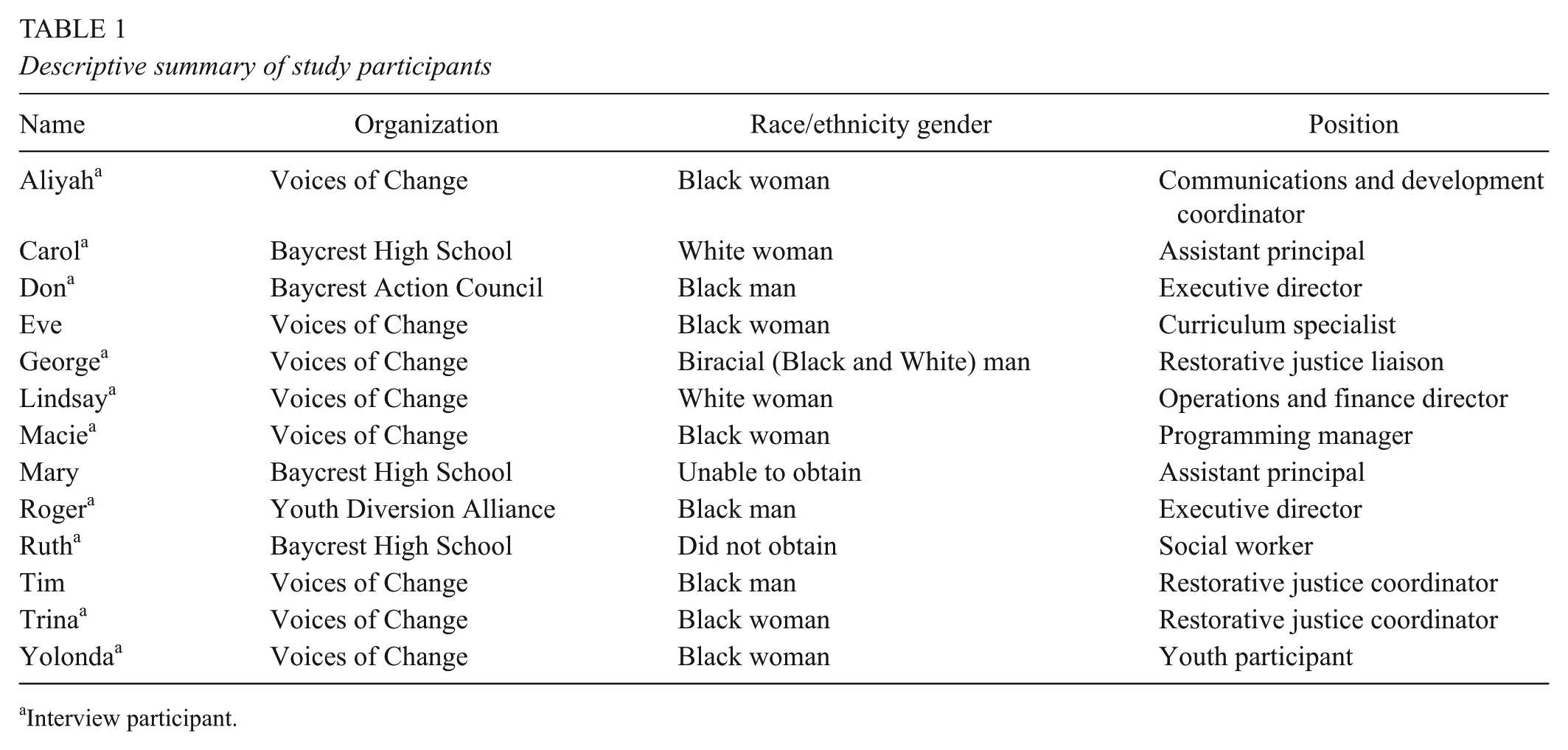
Interview participant.
All staff members, except Lindsay, identify as Black and had deep-rooted connections to the Baycrest community. Many were born in Baycrest, spent significant time there during childhood, or have been actively involved in the neighborhood as adults. For example, Trina grew up in Baycrest, whereas George became involved in Baycrest as an adult, motivated by a commitment to using restorative justice practices to address the disproportionate discipline and youth incarceration. In addition to the VC staff, I interviewed Yolonda, a former youth participant of VC, to provide context on her learning, leadership, and growth because of the partnership.
The second group included BHS staff: Carol, Mary, and Ruth. Carol and Mary were vice principals at BHS. Ruth served as a school social worker and acted as a liaison between VC and BHS. At the time of the study, Ruth was listed as a team member on VC’s website. Ruth actively participated in partnership meetings and helped initiate various restorative justice programs with VC. Finally, I interviewed two community leaders, Don, executive director of the Baycrest Action Council, and Roger, executive director of the Youth Diversion Alliance, to gain a better understanding of the broader impact of the collaboration because their organizations had either partnered with or worked alongside VC and BHS. This diverse group of participants offered valuable insight into the partnership’s collaborative efforts and far-reaching effects.
During the summer of 2020, I emailed Aliyah, VC’s communications and development coordinator, an outline of the scope and aims of this study. After this initial connection, we scheduled a meeting with other VC members to discuss the project further and determine their interest in participating. Once the VC team approved the collaboration, Aliyah connected me with VC youth workers for interviews and to coordinate observations. I met with Aliyah biweekly to share my ongoing interpretations of VC’s leadership work and to reflect on my relationship with the organization. During these meetings, Aliyah recommended activities, documents, and individuals to interview, all of which helped deepen my understanding of VC’s leadership practices and their collaboration with BHS.
Data Collection
The research question guiding this study was: What strategies do community-based education space leaders employ to partner with high school administrators in disrupting systemic inequities experienced by Black youth? I used critical ethnographic methods (Madison, 2011) to collect and analyze data, examining the partnership between VC and BHS. Data collection for this study took place over approximately 9 months, from July 2020 to April 2021. I chose critical ethnography as the method because Sharpe (2016) described the wake and Black people’s resistance through wake work as everyday acts. Goffman and Lofland (1989) suggested that ethnographic participant-observer observation allows the researcher to witness how individuals respond to everyday life situations as they occur. The primary data-collection technique I employed was participant-observer observations, complemented by semistructured interviews, document and artifact analysis, and reflexive memo writing to develop a trustworthy interpretation of the partnership between VC and BHS.
I conducted participant-observer observations, along with writing field notes to track my emerging interpretations of the BHS–VC partnership. The protocol for participant-observer observation encompasses areas such as meeting processes, relational dynamics, and leadership practices. In observing meeting processes, I documented who was present, the types of routines and norms that guided the meetings, and how decisions were made. For relational dynamics, I paid attention to who introduced ideas, how others responded to those ideas, how conflict emerged and was navigated, and how expertise was recognized or disregarded. Lastly, regarding leadership practices, I observed how the group developed a shared vision, identified problems, addressed issues of race and racism, and practiced sustaining the cultural identity and well-being of Black youth. Wake work and CSL guided me as analytic lenses, which illuminated the ways the collaboration may or may not have been co-led and responsive to VC’s focus on addressing systemic inequities experienced by Black youth.
I conducted approximately 80 hours of participant-observer observation from July 2020 to March 2021. I attended VC–BHS leadership team meetings, VC leadership meetings, and community meetings. Observations included five leadership team meetings (1–2 hours each), seven program area meetings (1 hour each), and four community meetings (1–3 hours each). For example, I attended BHS and VC leadership team meetings where the group addressed school discipline issues. BHS administrators actively sought the expertise of VC youth workers to address discipline issues through restorative practices. Additionally, I participated in VC events, including three Black healing circles, one staff recruitment event, and VC’s Baycrest Bites food access program, to better understand their leadership practices and community engagement. For example, I volunteered four times with the VC’s Baycrest Bites food access program, which provided groceries and other essential resources left unmet due to the COVID-19 shutdown of schools.
I conducted 14 interviews lasting between 30 and 60 minutes (the actual length varied depending on the depth of participants’ responses). The interviews followed a semistructured format, balancing focused questions with space for informal exploration of emerging topics (Merriam & Tisdell, 2016). My questions sought to identify participants’ experiences living in Baycrest, the development of their critical consciousness, their motivations for enacting leadership practices, and the nature of the collaboration between VC and BHS leaders. I selected these areas of focus to align with concepts from wake work and CSL. These interviews aimed to understand how participants made sense of being Black in a community marked by a history of systemic disregard, how they navigated enduring inequities, and how they perceived the tensions, strategies, and processes involved in building collaborative efforts to address the multiple inequities affecting Black youth at BHS.
I collected documents and artifacts to help contextualize the partnership between BHS and VC leaders. These included professional-development materials, event calendars, organizational documents, video media, and print media. I selected this material to gain a deeper understanding of the values, goals, and practices that guided the collaboration between VC and BHS. For example, BHS and VC co-created a promotional video highlighting their joint training and implementation of restorative practices to support students. This video illustrated how the partnership facilitated professional learning and emphasized the impact these efforts had on teachers’ practices and students.
Data Analysis
I used thematic analysis strategies, focusing on three critical steps: familiarization, coding, and theme development (Terry et al., 2017). I engaged in familiarization from the beginning and continuously reviewed data to learn the nuances that occurred throughout the project. I developed an audit trail to aid the familiarization process, tracking critical information, including (a) date of data collection, (b) type of data (e.g., interview, fieldnote, document/artifact, or feedback session), (c) location of data retrieval, and (d) notes about the data. I uploaded all relevant data into Dedoose (research software) for organization, coding, and analysis (DeCuir-Gunby et al., 2011). After the data were organized, I employed the codebook-development method outlined by MacQueen et al. (2008) to track the definition of each concept, specify when to use each code and when not to use it, and provide an example for each code. I developed codes deductively based on wake work and CSL through an iterative process. Deductive codes developed from wake work included (a) Blackened knowledge, (b) re/imagining, (c) trauma, and (d) healing. Deductive CSL codes included (a) critical self-consciousness, (b) community conversation, (c) shared expertise, and (d) shared decision making. In the initial coding rounds, I used deductive codes to assess which should be retained, which additional codes were needed, and which redundant codes could be collapsed or eliminated.
During the deductive coding process, I found that multiple data segments did not align with wake work or CSL. To capture these insights, I developed inductive codes to identify additional patterns and themes in the data. Inductive codes included (a) context, (b) tension, and (c) restorative practice. For example, I applied the context code to encompass background information about a person, initiative, or activity. I applied these codes across data sources (e.g., interviews, fieldnotes, and artifacts) to triangulate salient patterns and themes.
I drafted analytic memos during data collection and analysis to develop and identify patterns, test themes, track methodological decisions, and narrow the study’s focus (Miles & Huberman, 1994). For example, developing the inductive code tension illuminated relational dynamics between VC and BHS stakeholders, which may have limited the CBES from engaging in decision making and providing its expertise. The analytic memos highlight multiple cases in which these issues arose.
I took multiple steps to ensure a trustworthy interpretation of the data. First, Madison (2011) argued that critical ethnographers must reflect on their interpretations and how their relational dynamics with research participants impact their study. To engage in this reflexive process, I drafted researcher identity memos (Maxwell, 2012) throughout data collection and analysis to document my values, shifts in how I understood the work of CBES serving Black communities, and changes in the relational dynamics between myself and participants. By tracking these themes, I reflected on my biases and adjusted my approach to foster a more reciprocal relationship with VC and BHS.
Second, I conducted member checks with VC staff to allow them to substantiate claims or suggest alternative interpretations, which were integrated into the collected data (Merriam & Tisdell, 2016). During data collection, I conducted bimonthly meetings with Aliyah to discuss my interpretation of the data, potential observations, and interviewees who would better contextualize the work of the CBES. Additionally, I conducted a formal discussion with VC staff near the end of data collection to discuss initial interpretations of the VC and BHS partnership before the extensive data-analysis process began. Near the end of the data analysis, I provided VC with a slide-deck presentation to ensure that the partnership was effectively represented and to allow the CBES to integrate its feedback into the final analysis. Lastly, the findings were shared with scholars and colleagues at research conferences, who provided substantive revisions that supported further refinement of the themes.
Positionality
As a Black male scholar and educational leader, I drew on wake work and CSL as critical lenses to make sense of the dynamics between VC and BHS. My lived experience has shaped my understanding of how educational systems often demonstrate a disregard for Black youth and communities. I have personally navigated these systems and, at times, been both an agent of resistance and complicit in practices that reproduce harm. These dual roles have helped me see how the logic of slavery, central to wake work, can be both confronted and sustained through everyday leadership practices.
Throughout this study, I engaged in reflective practices to track the evolution of my interpretations and relationships. I regularly wrote researcher identity memos (Maxwell, 2012) to interrogate my values, assumptions, and positionality within the research. When I noticed shifts in my interactions with Aliyah, VC’s communications and development coordinator, such as changes in tone over email or our meeting dynamics, I reached out to discuss these tensions directly. This led to a restructured cadence of meetings and greater clarity when I contacted VC staff, ensuring that I honored their time, knowledge, and leadership.
These reflective practices helped me remain accountable to the core purpose of this work, which was to center how Black communities enact leadership that challenges and redefines how schools respond to systemic inequities affecting Black youth. Additionally, they helped me become more mindful of not engaging with VC in ways that might reinforce the wake.
Limitations
The COVID-19 pandemic introduced unforeseen limitations because BHS and VC had to adjust their standard operating procedures in response to rapidly changing educational and health policies. VC typically offers in-person youth-development programming during the summer and after-school hours at BHS. The pandemic forced VC to transition its summer Freedom School program to a virtual format, creating a video-based curriculum, hosting biweekly virtual check-ins, and making phone calls to youth.
These changes impacted the types of observations and interviews I could conduct because the institutional review board of record mandated social distancing measures to prevent the spread of the virus. I primarily engaged in observations and interviews online, limiting opportunities for informal socializing with BHS and VC staff, which Goffman and Lofland (1989) suggested is crucial for gaining deep familiarity with people as they navigate unexpected events.
This presented two key limitations for the study due to the lack of informal interactions. First, it may have affected my ability to build trust with VC and BHS staff. Without opportunities for casual, unstructured social moments, my presence often reflected a more formal researcher and researched dynamic because I primarily showed up to conduct observations rather than to engage relationally. Second, the online setting may have limited spontaneity between VC and BHS staff. This may have reinforced a business-like tone in the partnership, reducing opportunities to observe moments of conflict, confusion, informal relationship building, or shifts in group dynamics that often emerge more naturally during in-person interactions.
To mitigate these limitations, I volunteered with VC staff at their Baycrest Bites food access program, which provided weekly groceries and hot meals from local Black- and Brown-owned restaurants, offering a chance for more informal interactions. Additionally, I conducted biweekly meetings with Aliyah to discuss my research and engage in informal conversations about our personal lives and ongoing issues in the Baycrest community.
Another limitation due to COVID-19 was the reduced number of VC youth participants available for interaction. VC was unable to run its typical after-school programs at BHS, limiting spontaneous engagement with youth. To address this, I collaborated with Aliyah to contact former VC participants, which resulted in an interview with Yolanda. Despite additional outreach, I was unable to secure interviews with other students. To supplement this, I collected video and newspaper footage that highlight the developmental potential of youth as they reflected on their participation in VC’s learning opportunities.
Lastly, member checks were conducted with VC staff but not with BHS leaders. Member checks were not completed with BHS staff primarily because they did not respond to multiple interview requests. The absence of this process with BHS participants may have limited the opportunity to validate or challenge both the interpretations of VC staff and my analysis. This discrepancy may have influenced the depth and accuracy of the findings.
Findings
The findings highlight key strategies employed by VC and BHS to collaborate in ways that disrupt systemic inequities affecting Black youth in their community. Also, the findings highlight the pivotal role that a CBES can play in partnership with schools to address the needs of Black youth while navigating tensions that arise in these collaborations. Although the partnership between VC and BHS was productive, it was not without tension. VC had to assert its agency and adapt its approach to move forward with its vision of supporting Black youth.
The findings are organized into three central themes: (a) building the capacity of Black youth to drive change on issues that directly affect them, (b) having regular communication and addressing systemic inequities at multiple levels, and (c) engaging in social action when the school fails to adequately respond to youth concerns.
Cultivating Youth Leadership Through Community Organizing
Baycrest’s Black residents have a long history of drawing on community organizing principles, such as building collective capacity, nurturing relationships, and sustaining long-term activism to address systemic inequities (Warren & Mapp, 2011). As early as 1994, Baycrest residents and community organizations presented a community-led action plan to address infrastructure, housing, safety, employment, childcare, and food access. However, it took until 2016 for the Stonewood City Council to approve the plan, demonstrating both the persistence of Baycrest’s Black communities and the glacial pace of institutional change. This enduring community organizing ethos is deeply embedded in the work of Baycrest’s CBES, which uses it as a practical strategy to confront systemic inequities. This section examines how VC’s programming, particularly Freedom School and after-school initiatives, leveraged community organizing principles to empower Black youth to recognize and develop the tools necessary to address systemic inequities in their school when not working directly with BHS administrators.
Building the capacity of Black youth to recognize and address systemic inequities is a cornerstone of many the Baycrest CBES efforts. Don, a long-time Black resident and community leader, affectionately known as the “mayor” of the neighborhood, served as the executive director of Baycrest Action Council. He was a key advocate for the 1994 community action plan, which the Baycrest Action Council continues to steward. A central component explicitly described in the neighborhood plan was empowering youth to understand the issues affecting their community and acting to address them. Don described VC and the Baycrest Action Council as having a “symbiotic relationship,” highlighting their close collaborative efforts, such as a successful campaign to secure mass transit cards for youth, ensuring safe and reliable transportation to school. Don emphasized that VC was “planting seeds and training young people to engage in social action” through initiatives such as Freedom School and other leadership-development programs.
VC’s Freedom School is a prime example of a capacity-building initiative that nurtures Black youth’s ability to build knowledge and act to address systemic inequities. Although VC typically uses curriculum from the Children’s Defense Fund (CDF), COVID-19 prompted the creation of a new virtual curriculum that emphasized academic, community-connected, and creative liberation. The new curriculum adopted CDF tenets, such as reading culturally infused media, developing community-based solutions for issues, and supporting student-led activism.
For example, one week’s curriculum centered around “making a difference in my community.” Youth had access to readings and videos about the 1921 Tulsa race riots. Youth were encouraged to create a written or video project about a Black, Indigenous, and People of Color (BIPOC) business in their neighborhood and advocate for supporting local BIPOC businesses. These activities promoted community solidarity and economic empowerment, ensuring that Black dollars stayed within Baycrest’s Black-owned businesses. VC’s goal in the curriculum guide was “to identify more BIPOC businesses in the neighborhood that community members can learn about and support to strengthen the local economy and keep the Black/Brown dollar within the community for a longer period of time.” Freedom School was a critical opportunity for young people to learn about historical issues impacting Black communities and consider steps that might be taken to support the Baycrest community.
Freedom School was not VC’s only leadership-development initiative. VC leaders offered after-school programs that supported youth in developing an understanding of community organizing principles. Yolanda, a former VC Black youth participant in her first year of college, shared her experience participating in VC’s after-school program at BHS. Yolonda recalled: Overall, we do not have the same resources and were not given the same knowledge on certain issues. I never knew that we dealt with gentrification. I never knew we had a food desert. I never knew our school was being treated differently. I was unaware of these things. I thought this was normal. I guess growing up in Baycrest, everything that goes on seems normal.
Yolonda’s reflections highlight how systemic inequities can go unrecognized by Black youth until they have the knowledge and tools to imagine a world beyond it. Yolonda described reading books by Black authors about the Black experience, discussing issues impacting Baycrest’s Black residents with other young people, and having mentors who supported her learning that fostered a strong Black identity. Through VC, Yolonda learned to recognize the systemic nature of gentrification and food deserts, gaining the critical consciousness needed to disrupt these inequities. She was involved in a 2018 social action campaign against the construction of a $240 million youth jail. As part of this advocacy, Yolonda was prominently featured in a 2018 music video alongside other Black youth scholars, advocating that the city should not build a jail but instead allocate the funds for education programs and basic human needs.
Yolonda’s story illustrates how VC’s programming created opportunities for youth to develop a strong sense of Black identity and a commitment to social action. Reflecting on her experience with VC, Yolonda stated, “Being able to work with VC provides a safer environment to talk about those things [systemic inequities]. Like those things [systemic inequities] are not okay. This is a problem that we need to fix.” VC’s programming has played a crucial role in building the capacity of Black youth to recognize their agency in disrupting systemic inequities. Through initiatives such as Freedom School and their after-school programs, Black youth were able to develop a deep understanding of their community’s history, systemic inequities, and how they can lead efforts to challenge the structures that oppress them.
Implementing Restorative Practices: Collaborating to Address Systemic Inequities
CBES leaders, such as those from VC, are often excluded from meaningful opportunities to share their expertise or participate in decision making with school administrators (Anthony, 2019; Bertrand & Rodela, 2018). The partnership between VC and BHS leaders represents a shift in this traditional power dynamic because school administrators recognize the CBES youth workers as essential partners in addressing systemic inequities affecting Black youth. This section highlights two key strategies that contributed to this shift: (a) maintaining regular communication to address systemic issues collaboratively and (b) confronting inequities at multiple levels of the school system.
The original partnership between VC and BHS began with the continuation of the summer Freedom School beyond the summer of 2016. Following the success of the first Freedom School, the collaboration expanded into a year-round effort, providing vital support, including tutoring services, youth leadership development, and restorative practices. BHS administrators worked closely with VC to integrate the CBES into multiple leadership processes, such as the race and equity team, facilitating professional learning and implementing restorative practices.
A key inequity that VC and BHS have worked to address is the disproportionate discipline of Black students. For many years, BHS suspended and disproportionately disciplined Black students. The partnership sought to shift from punitive sanctioning to a more relational approach by implementing restorative practices. Restorative practices often involve facilitated encounters, where victims and offenders discuss the harm caused and how both parties can heal from an incident (Zehr, 2015). Since 2016, VC leaders have partnered with BHS administrators to redevelop the school’s discipline policies and practices by integrating restorative practices. Lindsay, VC’s operations and finance director, noted that much of VC’s funding for restorative practice efforts came through school contracts when they began working at BHS. A vital strategy in addressing disproportionate discipline has been holding regular meetings to discuss ongoing student discipline issues and develop action plans. To achieve its goals, building strong relationships between CBES and school collaborators requires regular communication and a shared vision (Little et al., 2010).
Collaboration to implement restorative practices between BHS administrators and VC was apparent during a partnership meeting in early March 2021. After approximately a year of virtual learning, BHS prepared to resume in-person instruction in May 2021. The stakeholders discussed strategies for instituting restorative practices to support students during their return. BHS Vice Principals Mary and Carol sought to prepare staff by offering restorative practice training on conflict circles. Conflict circles help restorative justice practitioners address harmful behavior by engaging the community in conversation about what happened and how to repair the harm. Vice Principal Mary expressed confidence that the group had the expertise to develop effective strategies for BHS staff. During the meeting, Trina, VC’s restorative justice coordinator, emphasized the importance of proactive restorative practices and helping staff recognize their tone and body language. The group ultimately decided to conduct simulated conflict circles through virtual role-play as part of the training.
Lastly, the group decided on the timing for the conflict circle training, which Vice Principal Mary suggested could happen in April, May, and June. In conjunction with VC leaders, BHS administrators hosted professional learning sessions on restorative practices during staff meetings, resulting in cohorts of educators and administrators receiving training to implement restorative practices. For example, BHS and VC leaders hosted a 2-day circle training with a cohort of 15 staff members that focused on conducting a circle, facilitating restorative dialogue, and practicing the approach through simulated circles. A BHS educator, Glenda, shared in a promotional video how using conflict circles had positively impacted her relationship with students. She explained: I am a passionate practitioner of circles. VC taught me circle practice in my first year at BHS a couple of years ago. I have been using them in my classes ever since. . . . I think that they are powerful tools, ranging from classroom cultural building circles to when we are dealing with conflict.
Glenda’s comments illustrate how circle practice can foster classroom culture and build stronger relationships among students. There are increased opportunities to share, connect, and learn from one another beyond addressing discipline issues. Glenda described a relational approach that helped cultivate a sense of “connection” and “joy,” which are critical for creating affirming learning environments for Black youth. Rather than positioning circle practice solely as a disciplinary tool, she framed it as a strategy that supports emotional “safety” and belonging.
Beyond their work with students, BHS and VC also have used circle practice in professional learning sessions in ways that have the potential to raise awareness about the nature of systemic inequities affecting Baycrest. VC collaborated with BHS administrators to incorporate circle practice into staff and other standalone meetings, where BHS staff have affinity groups. Affinity groups are spaces where people sharing a common identity discuss a topic of mutual interest related to race and ethnicity. Vice Principal Carol reflected on VC’s role in leading these professional learning groups with circle practices, stating They [VC] initially did a lot of work about words: What does it mean to be racist? What is White supremacy? The Black Lives Matter movement occurred during that time. . . . Reviewing their objectives, how do those align with the work we need to do here [Baycrest High School]? There was a movement away from that initial teaching everybody how to keep circle and community building circles. . . . They [VC] would hold affinity circles so Black affinity, Latinx, White women, White men, [and] Black men.
Carol’s reflection highlights how VC leaders have helped BHS staff deepen their critical consciousness, particularly concerning race, Whiteness, and the Black Lives Matter movement in Baycrest. Building on this learning, staff also participated in affinity groups, which Carol described as “critical work” in addressing the systemic issues facing BHS. This work was made possible through the partnership between VC leaders and BHS administrators, who intentionally created conditions for sustained, reflective, and sometimes uncomfortable conversations about race and equity by maintaining regular communication in meetings where they addressed systemic issues and co-created professional learning opportunities for BHS staff.
Engaging with restorative circles and affinity groups has provided opportunities to address systemic inequities experienced by Black youth. Research on CBES–school partnerships has highlighted the importance of transitioning from discrete programs to unified collaboration, as exemplified by the VC–BHS partnership (Anthony & Morra, 2016; Noam et al., 2002; Yohalem et al., 2012). This collaborative approach demonstrates the power of the CBES–school partnership to foster institutional change through regular communication and impact change at multiple levels.
Navigating Conflict During Collaboration: Unapologetically Centering Black Youth
A key element cited for successful CBES–school collaboration is unification in resource sharing, communication, and goal setting (Anthony & Morra, 2016; Little et al., 2010; Noam et al., 2002). However, tensions often arise from differences in priorities and perspectives between stakeholders that can hinder progress toward shared goals (Ishimaru, 2019). While significant gains were made in instituting restorative practices at BHS, tensions emerged due to principals’ varied approaches toward collaborating with VC. Since 2016, BHS has had three Black male principals, each with a distinct perspective on partnering with VC. This section examines how these leadership transitions impacted the partnership and highlights how VC unapologetically centered Black youth during moments of tension.
When the partnership began, Principal Doug Martin was at the helm of the collaboration. During his tenure, VC and BHS leaders had positive interactions, especially in introducing restorative practices to address disproportionate discipline. However, Principal Martin’s successor, Principal Kevin Watson (2016–20), brought a different approach. Under Principal Watson, the relationship between VC and BHS became increasingly strained as he sought to roll back restorative practices in favor of punitive discipline methods. Ruth, a BHS social worker (listed on the VC website as part of the team at the time of the study), shared an example of Principal Watson’s resistance to implementing the restorative intervention form (the form was a tool developed in partnership between VC and BHS leaders during Principal Martin’s tenure to shift discipline from punitive actions to restorative processes): There is a form called the restorative intervention form that they [BHS staff] are supposed to fill out anytime there is a conflict in class. If a student is asked to leave class for any reason, there is supposed to be a restorative intervention. That form existed for 2 years, and the principal [Principal Watson], who did not like us [VC] very much, would never really approve it or enact it. This year, it [restorative intervention form] did get approved and enacted, but it was in this weird virtual setting where there is not a ton of conflict happening. So it has not fully gotten off the ground.
Ruth’s comments highlight how Principal Watson’s decision making effectively delayed the implementation of restorative practices at BHS despite a prior agreement on their importance. After Principal Watson left, Principal Marcus Hill prioritized implementing the restorative intervention form. Although Principal Hill was more collaborative, his approach introduced different challenges. Lindsay, VC’s operations and finance director, reflected on the broader challenges of partnering with BHS principals: A school principal gets to decide who they want in their school, what type of partnerships they have, and what kind of funding they get. [The principal is] the decision maker, which I understand. Principals are busy; they have a lot on their plate, so they are not necessarily thinking about community partners all the time. It depends on how that individual leader sees their neighborhood, how much they know, what is going on with community organizations, and their perspective around collaboration. At Baycrest, we have had several transitions in the principal position, and we have experienced very different relationships with each of those. That has greatly impacted the type of work that we have been able to do at the school. . . . There is an interesting paternal relationship. I feel like [they] treat us like children.
Lindsay’s comments highlight a principal’s crucial role in shaping the partnership’s effectiveness. A principal’s willingness to build trust, sustain previous initiatives during leadership transitions, and collaborate reciprocally significantly influences the partnership’s success. At BHS, frequent principalship changes deeply impacted VC’s ability to maintain consistent collaboration because each new leader brought a different approach. Lindsay also described a “paternal relationship,” noting that at times, VC leaders were treated more like children than equal partners, reflecting how power dynamics can constrain collaboration.
Macie, VC’s programming manager, described an approach to navigating tense interactions with BHS administrators: There is a lot of power there, and so I feel BHS admin, in the past, we tried to move on our own, be an organization, and do what we said we came there to do. They [BHS administrators] would often come in and be like, Hey, you cannot do this. You cannot do that. You have to tell me that. You understand this is supposed to be a partnership, but then they would turn into them telling us what to do, which is like, no, we are our own organization. We have agency. We do not take orders from them [BHS administrators].
Macie’s statement underscores the recurring struggle for autonomy and respect in VC’s collaboration with BHS. While BHS principals held considerable power to shape the partnership, VC also exerted its agency, especially when collaboration was minimal or school leadership resisted sharing power.
Ruth’s perspective reinforces how BHS administrators may seek to limit VC’s influence, particularly when VC’s approach challenges the status quo. She noted: I think the admin [BHS administrators] have always been a little afraid of VC because they are so bold, unapologetic, and not easily controllable. They [BHS administrators] were appreciative of them [VC leaders], and they do recognize that the work that they do is great. However, because they [BHS administrators] are still invested in their own place in the system, they also know that the people above them are expecting them to keep VC in check.
Ruth’s insight reflects a broader fear among administrators about losing authority or control when partnering with an organization such as VC. In response, VC adopted an unapologetic approach to holding BHS accountable for prioritizing the needs of Black youth by advocating for their interests, even when it meant defying school leadership.
A significant example of VC asserting its agency occurred in the campaign to end police presence in the Stonewood School District. In the aftermath of George Floyd’s murder by Minneapolis police in late spring 2020, VC-supported Black youth organized a virtual walkout, community rallies, and social media campaigns to challenge the presence of law enforcement on school grounds. Their efforts influenced Stonewood School District to end its partnership with the local police department for at least a year. This activism represents a significant trend of VC youth-driven social change as VC-supported students addressed various systemic issues, including funding, school renovations, transportation access, and equitable food policies.
Yolonda explained how VC helped them act when the district or school administration failed to address issues: If Stonewood School District was not doing anything about [an issue], we would go to VC. We [BHS youth] are like, this is an issue. I am not saying they [administrators] do not care, but they do not act. They [administrators] do nothing about it, and we are going to VC leaders, and VC is going to do something about it.
Yolonda’s comments reflect VC’s critical role when the Stonewood School District or BHS administration failed to act.
One example of the district’s inaction led to a nearly 3-year Black youth-led social action campaign that concluded in September 2018. The campaign aimed to replace the long-standing walk-to-school policy with access to mass transit cards. Under the policy, students living within 2.5 miles of their school were required to walk, often across busy streets or in areas without sidewalks. Using community organizing principles gained from VC learning opportunities, the youth successfully obtained access to mass transit cards for low-income students in the district. Ruth, BHS’s social worker at the time of the campaign, reflected on Principal Watson’s reaction to the youth’s social action: The new principal [Watson] was not about that heat. The new principal [Watson] was like, y’all are causing problems. . . . Why are you doing a walkout or why are you [going] down to city hall for these mass transit cards. . . . Two years later when we actually got the mass transit cards for everybody, then they were singing our praises and we were wonderful for doing that work.
Although BHS and district administrators may have believed that their actions served the school’s best interests, their priorities often conflicted with those of the Black youth they serve. VC’s support enabled the youth to envision a response and exercise agency to effect meaningful change within BHS and the Stonewood School District. This example highlights that CBESs must sometimes take unapologetic action in school partnerships, recognizing that advancing equity may require enduring criticism while advocating for those most affected by systemic disregard.
Discussion
For this study, I examined the partnership between leaders of a CBES (VC) and school administrators at BHS to understand how these organizations collaborate to address systemic inequities affecting Black youth. Specifically, I asked: What strategies do community-based education space leaders employ to partner with high school administrators in disrupting systemic inequities experienced by Black youth? The answer illuminates the insider–outsider roles that VC assumed in its partnership with BHS to address systemic inequities affecting Black youth. The findings extend the literature by showing how CBES collaborations with schools draw on Black community strategies that work in tandem and resist relational dynamics that might otherwise reinforce systemic inequities impacting Black youth.
Drawing on the frameworks of wake work and CSL, the findings offer important insights into the promise and complexity of CBES leaders as they navigate the tension of partnering with school administrators and driving change from outside the system. This study builds on prior research highlighting the importance of CBES–school partnerships in fostering regular communication, developing a shared vision, and integrating efforts across multiple levels of the school to achieve desired outcomes (Anthony & Morra, 2016; Little et al., 2010; Noam et al., 2002; Yohalem et al., 2012). The VC–BHS partnership starkly contrasts with typical discussions of CBES–school collaboration, which at times focus on narrow outcomes such as improving academic achievement and social-emotional skills rather than systemic inequities (Durlak & Weissberg, 2007; Finn-Stevenson, 2014; Little et al., 2010).
In this case, VC was viewed as an insider that collaborated closely with BHS administrators to implement restorative practices, strengthen school culture, and facilitate deeply reflective conversations about race and equity during professional learning sessions. The leadership practices demonstrated in this partnership are culturally sustaining because they rely on trust, recognize community leaders as holders of substantive knowledge, and establish shared goals that guide systemic change to address persistent inequities (Santamaría & Santamaría, 2016). I refer to this type of collaboration as an insider role, which demonstrates how bringing a CBES into the school as a trusted partner can catalyze critical changes to systemic inequities impacting Black youth through ongoing communication and joint efforts across multiple levels of school practice. This insider role disrupted the typical relational pattern between schools and community organizations, which often privilege a school-centric agenda (Bertrand, 2014; Ishimaru, 2019), suggesting a more reciprocal model for partnership that addresses systemic inequities experienced by Black youth.
However, complexities arose in this partnership due to a persistent relational tension common in CBES–school collaborations. School leaders were often unwilling to engage in regular communication or share decision-making authority with CBES staff (Anthony, 2019). Specifically, the BHS principal and other administrators were reluctant to address inequities identified by the school’s Black youth. In response, VC staff supported Black youth by teaching community organizing principles, including political education to understand systemic inequities and building their capacity to critique and take collective action that can drive systemic change (Warren & Mapp, 2011).
VC’s efforts to support BHS’s Black youth through community organizing represent meaningful forms of wake work. As Sharpe (2016) argued, the logic of slavery is unresolvable, and Black communities navigate ongoing racial violence through everyday acts of resistance and disruption. In this study, VC, a predominantly Black-led CBES, employed key strategies that exemplify wake work, including (a) building the capacity of Black youth to drive change on issues that directly affect them and (b) engaging in social action when school leaders failed to respond adequately to youth concerns. I describe these strategies as navigating an outsider role, intentionally cultivating Black youth agency, enabling them to understand and act on systemic inequities impacting their community.
A central goal of the VC–BHS partnership was to build Black youth’s capacity to recognize and disrupt systemic inequities through community organizing principles. Through initiatives such as Freedom School and its after-school programming, VC taught community organizing principles in ways that, through the lens of CSL (Santamaría & Santamaría, 2016), fostered the critical consciousness of Black youth. These programs not only educated youth about the systemic inequities affecting their community but also empowered them to take collective action toward addressing those issues. As a result of these practices, VC youth successfully advocated for free access to mass transit cards and played a key role in suspending the school district’s partnership with the city police department. This emphasis on empowering Black youth is particularly significant given that some CBESs operate within funding and sociopolitical contexts that incentivize deficit-based views, framing youth as needing to be “saved” and as lacking the agency to address the issues that shape their lives (Baldridge, 2014, 2020b).
Furthermore, VC leaders’ willingness to unapologetically serve Black youth rather than acquiesce when administrators dismissed or undermined youth demands reflects a necessary form of resistance when working to create change from outside a partnership. While tensions between VC and BHS hindered progress toward shared goals, the partnership nonetheless catalyzed critical shifts in how systemic inequities affecting Black youth are addressed. Given that tensions frequently complicate CBES–school collaborations, these shifts may constitute a more meaningful measure of success than the achievement of systemic transformation alone (Ishimaru, 2018).
Implications
This study highlights promising strategies and raises important questions about how CBES–school partnerships engage in collaborations that catalyze systemic change in the lives of Black youth. Based on the findings, four implications for research and practice include (a) developing leadership programs situated in supporting Black youth to engage in social action, (b) sustaining funding for culturally affirming, civic-oriented CBESs, (c) embedding communication and continuity in CBES–school partnerships, and (d) advancing the use of Black studies theories in research on CBES–school collaborations. These implications offer actionable strategies to strengthen practice and scholarship about CBES–school partnerships.
Create Leadership-Development Programs Situated in Black Youth Social Action
Based on these findings, CBESs and schools could collaborate to create leadership-development programs similar to Freedom School, which would help Black youth recognize and disrupt the systemic inequities impacting their lives. These programs could be rooted in community organizing principles, such as understanding the history and nature of systemic inequities in their communities, fostering strong local relationships, and building the capacity of youth to engage in collective action to address the issues that directly affect them (Clay, 2019; Ginwright, 2010; Turner, 2021; Warren & Mapp, 2011).
For example, if a school sought to partner with a youth-organizing CBES focused on Black boys, it might consider the extent to which the organization applies the Black transformative agency framework (Turner, 2021). This would involve assessing how well the program supports Black boys in asserting their agency to challenge hegemony, fosters peer networks that encourage learning and care, and cultivates motivation for advocacy. School administrators could work with CBES leaders, specializing in community organizing, to integrate the Black transformative agency framework principles into the school environment. One approach could involve civics educators collaborating with the CBES to incorporate the Black transformative agency framework into the curriculum, providing students with hands-on opportunities to engage in projects that create systemic change within the Black community.
Beyond Academic Support: Sustaining Funding for Culturally Affirming, Civic-Oriented CBESs
A second approach is for policymakers at the school board and city levels to allocate sustained funding for after-school programs that center community organizing as a core learning outcome. CBESs serving Black communities have historically faced precarious and inconsistent funding (Baldridge, 2020a), limiting their capacity to provide long-term, transformative programming. Investing in CBESs that offer more than academic and social support signals a broader commitment to youth leadership development that values civic engagement and culturally affirming practices alongside academic achievement.
Community organizing has long been a critical tool in the Baycrest neighborhood for addressing systemic inequities that affect Black communities. By supporting Black youth in community organizing, school leaders can move beyond deficit ideologies that frame them as needing to be “saved” or “fixed” (Baldridge, 2014, 2020b). Instead, Black youth will be empowered with the knowledge and skills to lead change in their communities, fostering a commitment to activism and social justice.
Embedding Communication and Continuity in CBES–School Partnerships
A third implication for practice is to develop strategies that strengthen the partnership between CBESs and schools, particularly by fostering clear and consistent communication. Research has shown that effective communication is critical for the success of school–community partnerships (Anthony, 2019; Bertrand & Rodela, 2018). However, tensions are inevitable due to differing perspectives and practices between school and community leaders (Ishimaru, 2019). To address these complexities, regular meetings between the CBES and school staff could serve as a space to establish shared goals, align strategies, discuss emerging tensions, and plan for leadership transitions. For example, the CBES leaders and school administrators could create a transition report that updates incoming leaders on the partnership’s accomplishments, ongoing strategies, and key action points to ensure continuity during leadership changes.
Given the principal’s central role in these partnerships, creating or designating a liaison role with administrative authority could help focus more on alignment and relationship building between the school and CBES. School district hiring personnel responsible for selecting future principals could consider involving CBES leaders in the hiring process. CBES leaders possess a deep understanding of the community’s history, needs, and existing partnerships, making them valuable contributors to selecting principals who can align with the partnership’s goals. Including voices of CBES leaders on principal hiring committees can help ensure that incoming school leaders are committed to equity, collaboration, and sustaining relationships with community organizations.
A Call to Use Black Studies Theories to Research CBES–School Partnerships
Lastly, the theoretical lenses used in this study offer significant implications for research on school–community partnerships serving Black communities. Although existing literature has explored the actions of Black youth and community organizations advocating systemic transformation on issues of inequity (Ishimaru, 2018; Welton & Freelon, 2018), the application of Black studies theories has been notably underutilized in this area of research. Black studies theories provide a contextualized and specific understanding of the lived experiences of Black people within the diaspora, moving beyond generalized discussions of racism that are often reductive about the agency and knowledge of Black communities (Dumas & ross, 2016).
Sharpe’s (2016) wake work theory centers on investigating Black people’s critical consciousness and their strategies to enact change as necessary to disrupt the afterlife of slavery. Using Black studies theories combined with CSL encourages the development of research that amplifies activism, strategies for knowledge acquisition, and the leadership potential of Black youth and community. Future research could use these theories to examine how CBESs and schools collaborate to resist and overturn policies that perpetuate systemic inequities in Black communities.
Conclusion
With this study, I demonstrate that when schools partner with a CBES, such as the one between BHS and VC, they can foster meaningful transformations in addressing systemic inequities affecting Black communities. As Ishimaru (2018) noted, wholesale systemic change may be unlikely, but critical degrees of transformation can still produce significant impacts. These degrees of transformation are critical in the context of Black communities because the lingering effects of slavery are endemic (Hartman, 2008; Wilderson, 2010). Engaging in forms of wake work is not aimed at overturning the anti-Black system but rather at exploring how Black communities navigate, resist, and disrupt persistent inequities (Sharpe, 2016). My findings underscore how school–CBES partnerships can create tangible opportunities for youth, families, and communities to exercise agency and pursue equity within enduring structures of systemic disregard.
The strength of this partnership lies in its focus on empowering Black youth to engage in social action and fostering strong collaborative relationships. However, the complexities of the VC–BHS partnership were shaped by the role of school principals, whose varying levels of support for restorative practices and shared decision making hindered the collaboration’s trajectory in achieving its collective goals. Despite these challenges, VC’s unapologetic commitment to centering Black youth and asserting its agency enabled the organization to navigate tense moments of resistance. By providing a platform for student-led activism and remaining resolute in its mission, VC influenced school policies and empowered students to advocate for the changes they sought. This study underscores the need for continued investment in CBESs that builds Black youth’s capacity for activism, fosters CBES–school partnerships based on trust and shared decision making, and supports CBESs in adapting and asserting themselves when collaboration becomes contentious with school leadership.
Footnotes
Author Note
All names and locations have been changed using pseudonyms.
Declaration of Conflicting Interests
The author declares no potential conflicts of interest with respect to the research, authorship, and/or publication of this article.
Funding
The author received no financial support for the research, authorship, and/or publication of this article.
Ethics Considerations
The University of Washington Institutional Review of Board approved this study (STUDY00010750) on October 20, 2020.
