




Abstract
There are increasingly more peer-reviewed journal articles that feature research conducted within or studying the phenomenon of education research–practice partnerships (RPPs). Yet, there is little guidance on how to write about RPP-related research. This article describes findings from a document analysis examining what formats authors use when publishing studies taking place in an RPP or examining RPPs. Using a sample of journal articles published in four of the American Educational Research Association’s (AERA) journals with high impact factors (n = 37), the study findings explore the different formats used when writing about RPP-related research. The study findings suggest draft guidelines that may contrast with traditional article formats. Implications for authors, reviewers, and journal editors of RPP-related research are discussed.
Keywords
Introduction
There are increasingly more peer-reviewed academic journal articles that feature research conducted within or studying the phenomenon of a research–practice partnership (RPP) in the field of education. When searching for the term research–practice partnership in search engines, the number of articles using this term continues to grow. For example, as seen in Figure 1, in Google Scholar in 2010–15, this search term brings up a total of 242 results, and in 2016 and the years following through April 2025, this term brings up >4,092 results.
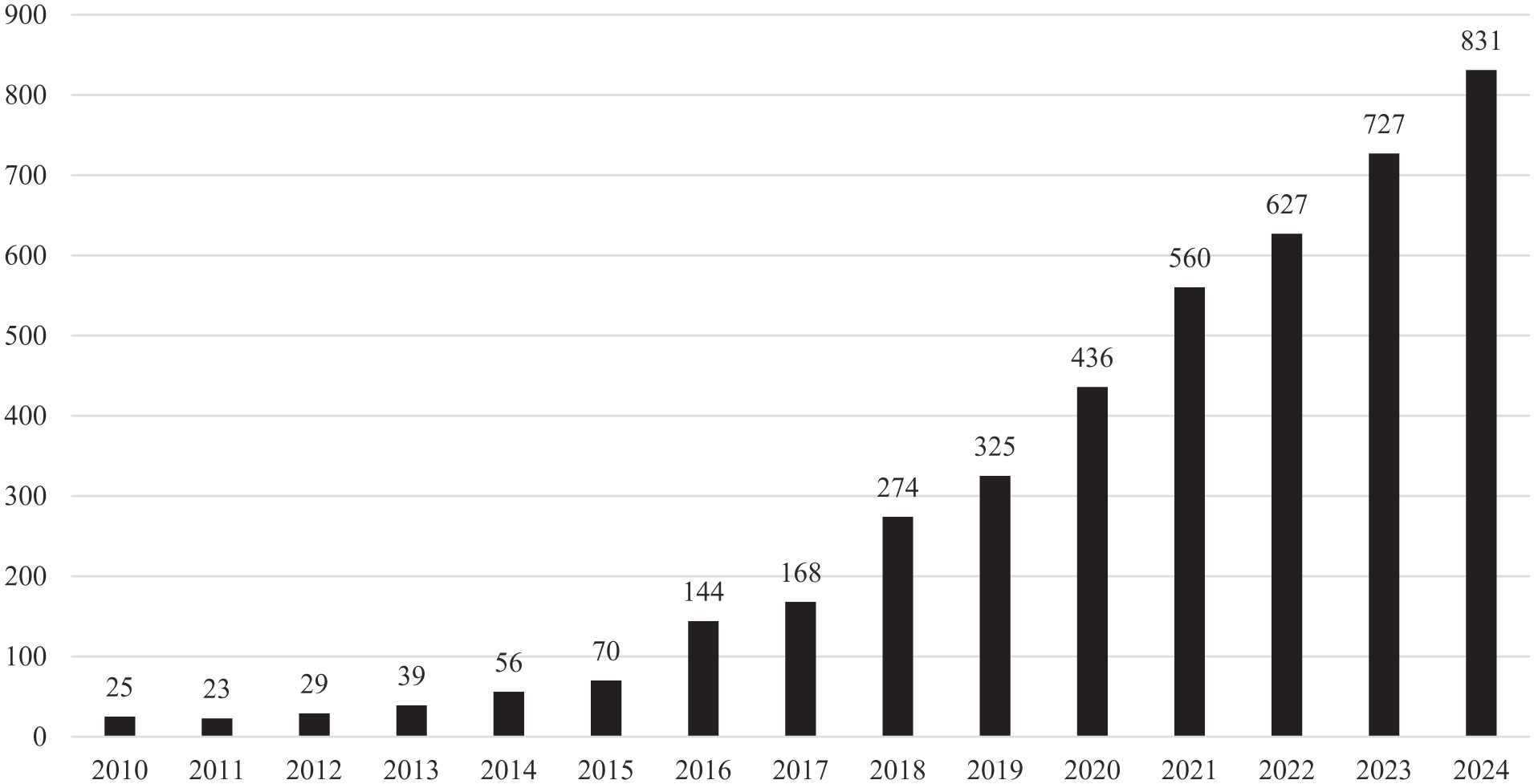
Count of citations in Google Scholar search from April 2025 for search term research–practice partnership.
The growth in educational research journals publishing RPP-related research is likely influenced by several factors. Educational researchers are incentivized to focus on RPPs because of support from funders (e.g., Rivera & Chun, 2023), including the Spencer Foundation, the William T. Grant Foundation, and the National Science Foundation, that have funding programs related to RPPs. There are some instances of university institutional support for research related to RPPs (e.g., Gamoran, 2023; Ozer et al., 2021), which also has incentivized researchers to pursue working on, studying, and ultimately publishing journal articles about RPPs. There have been calls for RPP research by both professional associations and journal editors, such as the National Academies of Sciences, Engineering, and Medicine (2022) report titled, “The future of education research at IES,” that advocated for more support from the Institute of Education Sciences for research conducted in RPPs. Also, several peer-reviewed journals have special issues focused on RPPs, including JESPAR (Yakimowski, 2015), AERA Open (Penuel & Hill, 2019), Educational Policy (Yamashiro et al., 2022), and the Peabody Journal of Education (Arce-Trigatti et al., 2024). The growth in education RPPs is also represented by the increasing membership of the National Network of Education Research–Practice Partnerships (NNERPP), which has grown from 16 RPPs in 2016 to >73 members in 2024 (NNERPP, 2024).
Another element pushing for more publishing about RPP work is the reality of the increasing number of early-career scholars who receive explicit training on how to work in RPPs. These scholars are looking for pathways for publishing their research. Universities such as the University of California Irvine School of Education and the Stanford University Graduate School of Education have programs involving coursework and fellowships preparing doctoral students to work in RPPs (Stanford University Graduate School of Education, 2024; UCI Orange County Educational Advancement Network, 2024). Some doctoral students document their experiences working in RPPs in journal articles (e.g., Tanksley & Estrada, 2022; Wegemer & Renick, 2021).
Despite this motivation to publish RPP-related research, there is a lack of guidance on what information should be included in articles given that RPP research is inherently different from research conducted using more traditional approaches. RPPs are seen as “joint work,” where the research conducted is collaborative in nature and requires the expertise of both the researcher and their partner (e.g., Penuel et al., 2015). The joint work of RPPs contrasts with more traditional research, where research is conducted only by researchers and translated or disseminated to practice or community members. RPP research has indicators for effectiveness that are different from those of traditional educational research methods (Henrick et al., 2017, 2023), including whether the research builds the capacity of those engaged in the work or helps practice or community partners improve their work. While there is guidance on the necessary learning needed to engage in collaborative education research (Collaborative Education Research Collective, 2023) and even guidance on how to start an RPP from the “NNERPP milestones guide for emerging RPPs” (Wright, 2023), there is no formal guidance on what types of information or formats should be used when publishing RPP-related research.
Epistemological norms from these other forms of collaborative education research may model the types of information to include in articles about RPP-related research. Some forms of participatory methods, such as youth participatory action research (e.g., Cammarota & Fine, 2008), and methods from the learning sciences, such as social design experiments (e.g., Gutiérrez & Jurow, 2016), have histories of bringing humanizing approaches to research (Paris & Winn, 2013) and engaging in decolonizing practices (Patel, 2015) that speak to histories and context as well as foreground care in research. These research traditions engage in practices such as Patel’s (2015) concept of “answerability,” or being more responsible and accountable in the research relationships (p. 73); co-writing and co-authorship in peer-reviewed academic journals (e.g., Gardner, 2017; Malone, 2024); and writing, reviewing, and editing for journals that foreground issues of power and politics within the context of the research (e.g., Politics of Learning Writing Collective, 2017). Practicing answerability, co-writing and co-authorship, and attending to political contexts are a few approaches that RPP research could follow when developing guidance for publication.
While there are some approaches created by other epistemological traditions, guidelines for writing and publishing RPP-related research likely will need to address a few assumptions about how knowledge is produced, including assumptions about authorship that are often contested within the academy. These assumptions include whether it is appropriate to have a single- versus multiple-author manuscript, the order of authors listed, and whether authorship is given to the person or people responsible for the written work (Robillard & Fortune, 2016). As RPPs work to shift traditional roles and responsibilities in educational research, this inevitably shifts decisions around authorship in RPP-related manuscripts. Similarly, authors of RPP-related research may need to address naming conventions relying on co-constructed ideas rather than researcher-only or practitioner-only naming conventions (e.g., Parsons, 2021). These tensions about authorship and nomenclature are assumptions that need to be addressed by publishing guidelines for RPP-related research.
Given the lack of guidelines for writing about and publishing research related to RPPs, this analysis examines existing articles for underlying principles that authors use to guide their documentation of RPP-related research. Specifically, I conducted a document analysis examining the following research question: What formats do authors use when publishing studies taking place in an education RPP or examining education-based RPPs? For the purposes of this study, I defined the concept of formats for publishing in four ways: (a) location where RPP content is discussed, (b) acknowledgment of partner contributions, (c) explanation of the nature and purpose of the RPP, and (d) discussion of the authors’ positionality or relationality (Ríos & Patel, 2023). I used a purposeful sample of journal articles published in four of the American Educational Research Association’s (AERA) journals with high impact factors published on or after 2016 when Coburn and Penuel’s (2016) article in Educational Researcher (ER) was published outlining a research agenda for education RPPs.
I begin this article by exploring the reality of why a lack of publishing guidelines may exist for articles about RPP-related research. Then I describe the methods and data sources in the analysis to answer the questions about format when publishing RPP-related research. Then I discuss the findings from the document analysis and interpretation of the findings. I use existing literature on RPPs to interpret these findings, including the concept of RPPs as joint work by Penuel et al. (2015), the definition of effective RPPs by Henrick et al. (2023), and publishing guidelines from other fields related to community-engaged research (Bordeaux et al., 2007; Doberneck, 2021). I use these interpretations to offer up draft guidelines for authors, reviewers, and editors in educational research who seek to write about and publish articles conducted within RPPs or examining RPPs. The intent of these guidelines is to open a conversation about explicit guidance for publishing about RPPs and to invite this community to further vet this opening draft. This study is one step toward exploring whether documenting RPP-related research within academia may require upending some norms of publishing in peer-review journals. This article ends by discussing implications from the findings for scholars, reviewers, and editors engaged with RPP-related research.
Lack of Guidelines for RPP-Related Research
The field is lacking literature examining the formats used to write about RPP-related research. However, some authors have started to describe the realities that they experience when writing about RPP-related research. These realities include the challenges involved in collaborative writing, the pursuit of venues that may publish unconventional writing formats, and the reliance on traditional norms of publishing when pursuing publication of their RPP-related research. Given the absence of an existing literature base, I used this opportunity to explore some of the realities that may influence the development of the articles within this study.
The first reality experienced by authors of RPP-related research is that they are looking for guidance on how to publish research that involves collaborative writing. For example, Harris et al. (2024) discussed the need to have examples of academic writing for collaborators to guide their engagement in the academic writing process, which can be different from other forms of writing. Similarly, as a lecturer at Stanford University Graduate School of Education teaching courses on RPPs, doctoral students asked me for examples of article formats involving RPP-related research. They were looking for model papers that demonstrate where they should write about the context of their work and the approach used in their RPP work. This search for publication guidance is expected given that the RPP norms encourage researchers to consider approaches to documenting their research in different ways, such as publishing in practice- or community-facing settings (e.g., slide decks for school board or community presentations and articles in practitioner-facing magazines) or co-authorship with their practice partner (Henrick et al., 2023).
The second reality is that researchers pursue publication of their RPP-related research in formats and venues that allow for unconventional article formats. For example, authors may only submit their manuscripts where there is a specific call for RPP articles through a special issue. As mentioned in the Introduction, JESPAR, AERA Open, Education Policy, and the Peabody Journal of Education all have had special issues related to RPP-related research. Another alternative is researchers pursuing discipline-specific research in an RPP while at the same time studying the realities of working in an RPP. Then the researchers pursue publication for both the discipline-specific study and the research examining the realities of working in the RPP itself. For example, RPPs funded by the National Science Foundation grant-making program CSforALL are required to work with RPP evaluators to support the improvement of their partnerships (U.S. National Science Foundation, 2025). Consequently, their RPPs produce research about computer science education and the development of the RPP itself. One RPP, Chicago Alliance for Equity in Computer Science, published research examining their discipline-specific findings for computer science (e.g., Blaushild et al., 2024) and then published findings from their evaluation work related to their RPP (Henrick et al., 2024).
In the absence of explicit guidelines, the third reality is that researchers rely on more traditional norms of publishing when pursuing publication. It could be argued that the “Standards for reporting on empirical social science research in AERA publications” (American Education Research Association [AERA], 2006) represent more traditional norms of publishing. Interestingly, these standards for AERA publications do not discuss reporting about the conditions or context for conducting research in partnership or using collaborative methods. And yet these standards guide the publication in AERA journals and therefore may be excluding important formatting considerations for RPP-related research. These traditional standards for publishing may be why RPP-related research tends to fall into traditional behaviors such as framing research as a “one-way benefit to the practitioner” (p. 20) rather than as a reciprocal benefit to the researcher and practitioner (Arce-Trigatti & Resnick, 2023).
To address these realities and potentially advance the approach to publishing RPP-related research, I examined the current formats authors use when publishing research conducted in an RPP or examining an RPP. Next, I will describe the methods used in this analysis.
Methods
This study used document analysis (Merriam & Tisdell, 2016; Morgan, 2022) to examine articles documenting interdisciplinary educational research studies published in peer-reviewed journals conducted within and about RPPs. The study used a purposeful sample of literature and engaged in a thematic analysis of the formats used in these articles. Here I describe the context and motivation for this study, the sample of articles, the approach to the analysis, and the potential limitations of this study.
Context and Motivation for the Study
I develop the concept for this study in the context of >15 years of leading an RPP and completing blind reviews of numerous articles submitted to peer-reviewed journals about RPP-related research. Also, I teach with colleagues at an R1 university in a graduate school of education two courses examining RPPs. Each year, doctoral students in these courses ask me what format they should use when submitting their manuscripts involving RPP-related work to journals for publication. They ask for advice about where in their manuscripts to discuss the approach and processes related to the RPP work such as co-development of research questions (e.g., Meyer et al., 2022), navigating political tensions (e.g., Yamashiro et al., 2022), and documenting their role as participant observers. I give the students informal guidance based on formats I have seen authors use and that I use in my own publications. Similarly, after attending many AERA annual conference presentations where RPP-related research has been discussed, I find myself asking questions related to what information should be included when documenting RPP-related research. I am also a White, middle-aged female with a background as an elementary school teacher and educational policy researcher. I am conducting this analysis to produce more specific ideas for these early-career scholars and other scholars pursuing the publications of RPP-related research. All these realities influence the analysis presented in this article and provide greater context influencing the methods used.
Sample
I used two criteria to identify a sample of articles for this analysis. First, I included articles discussing research conducted in RPPs or research examining RPPs in different disciplines, or what Cronin and George (2023) refer to as “communities of practice” (p. 168). Although these are education-focused journals, studies from a wide range of disciplines are featured, including (for example) economics, sociology, and organizational behavior, among others. Second, the study used a sample of journal articles with the key search term research–practice partnership published in four of AERA’s journals with high impact factors: AERA Open (impact factor of 3.5), American Education Research Journal (AERJ; impact factor of 3.5), Education Evaluation and Policy Analysis (EEPA; impact factor of 2.4), and Educational Researcher (ER; impact factor of 5.4). Arguably, these AERA journals are well recognized by the educational research community given their impact factors and their association with one of the largest professional associations for educational researchers. This sample of journals has some limitations because authors of RPP manuscripts may be more likely to submit to journals interested in RPP-related research or forums such as magazines published by professional associations or community-based news outlets.
I also limited the search to the years after Coburn and Penuel (2016) published an article in ER that arguably inspired the publication of RPP-related research given that it outlines a specific research agenda for RPPs. The Coburn and Penuel article also coincides with the William T. Grant Foundation’s exploration and support for RPPs starting in 2011 (as documented by the Coburn et al. (2013) white paper), the Institute of Education Sciences launching grants to encourage RPPs in 2013, and the Spencer Foundation launching grants focused on RPPs in 2015.
I identified 41 articles (see Appendix A) using the search process just described, 37 of which were included in this analysis. The articles were organized into clusters of 20 studies conducted within an RPP and 17 studies conducted to examine RPPs as a phenomenon. Within these subsets, I organized the articles by the journal in which they were published. Four articles were excluded from the sample, each for different reasons: They were neither a study stemming from RPP work or a study examining an RPP and they merely mention the research–practice partnership search term. 1
Analysis
When conducting this analysis, I read each article and developed codes based on the formats used to talk about RPP-related research. See the coding scheme in Appendix B. I organized the codes according to four ideas and guiding questions related to the writing formats, with slightly different codes for studies taking place in an RPP and studies examining an RPP. For the idea of “location” and the associated research question, “Where in the article do the authors explain this is collaborative research?” codes included methods, context or history, and acknowledgment sections. For the idea of “partner contribution” and the associated research question, “How do the authors explain the nature of the RPP?” which was only explored in studies taking place in an RPP, codes included why an RPP, how were RPP processes used, and what is the value added by the RPP. For the idea of the “nature of the RPP” and the associated research question, “Do the authors acknowledge contributions of the practice and community partners,” codes included whether the RPP was named and co-authorship.
For “positionality” or “relationality” (Ríos & Patel, 2023) and the associated research question, “Do authors examine their positionality or relationality?” codes included whether the author was part of the RPP and did the manuscript discuss issues of power and status. It is important to note that positionality statements may not in and of themselves ameliorate power differences and may in fact reinforce hierarchical and less collaborative beliefs about power (e.g., Boveda & Annamma, 2023; Gani & Khan, 2024; Savolainen et al., 2023). Therefore, I included the concept of relationality, which Ríos and Patel (2023) argue highlights how people are influenced by other people and contexts they are in relation with, which could, in turn, influence their approach to a research study. However, the reality of a positionality statement in and of itself or a discussion related to relationality could signal or explain an important consciousness of the author(s) in relation to the research, whether working in an RPP or examining an RPP through a research study.
Limitations
The sample in this study was limited to a subset of literature in educational research journals. Consequently, the larger body of published educational RPP-related research is likely more diverse in nature rather than constrained by the nature or editorial leadership of these four journals. Also, the search terms used to identify this sample may leave out RPP-related research published in these journals after 2016–24. For example, there are articles in AERA Open published by researchers from the University of Chicago conducted in their RPP with Chicago Public Schools that do not use the term research–practice partnership in the manuscript, so they were not part of the sample in this study (Allensworth et al., 2021, 2022). The authors do thank their “partnership” in the Acknowledgments section of both articles but again do not use the full term research–practice partnership anywhere in the articles. Similarly, an article by Thompson et al. (2017) in ER used the term researcher–practitioner partnerships and consequently was not included in the sample, even though the article was talking about RPPs. Similarly, some authors may conform to the standards for publishing traditional research and intentionally leave out this term in their manuscripts.
In addition to limitations in the sample, there are also limitations to the analytic methods used. For example, I am the only author for this study, so the study did not have the benefit of having multiple perspectives during the analysis. However, I did have two peers review the analysis and manuscript, and I made edits based on their feedback. This study was inductive in nature and attempted to form hypotheses and draft guidelines for writing and publishing RPP-related research that would need further testing by the larger field using an inclusive process.
Findings
I start by presenting the findings about the formats used when publishing studies taking place within an RPP. Then I present the findings about the formats for studies examining RPPs. I end by discussing the patterns seen across the formats used when publishing both types of RPP research.
Formats of Articles Published About Research Conducted Within an RPP
The formats of articles published about research conducted within an RPP have some notable patterns. As seen in Table 1, there were six articles from AERA Open, five articles in AERJ, four articles in EEPA, and five articles in ER. Overall, the content of their discussion of the RPP tended to discuss RPP operations in the methods, biographies, and instructions. Over half the articles named the RPP, and only four of the 20 articles had what appeared to be a practice partner as a co-author, and even fewer articles had a positionality statement. The authors spent less time discussing the purpose and the added value of the RPP. Here I discuss each of these patterns in more detail organized by the key ideas of my analysis—location, partner contribution, the nature of the RPP, and author positionality or relationality.
What formats do researchers use when publishing studies taking place in a research–practice partnership?

Note: Other areas where research–-practice partnerships are discussed include three papers in the Notes section, two in a Context/History section, one in the Implications section, and one in the Findings section. None of the article titles included the term research–practice partnership.
Most Articles Discuss RPP Operations in the Location of Methods, Biographies, Introductions
Most articles conducted within an RPP discussed their RPP in operational terms—who was in their partnership, how they exchanged data for the study, or what the partnership was examining together. For example, over half the articles (n = 13) discussed their RPP in the Methods section. Most of the mentions of RPPs in the Methods sections were best characterized as how the RPP work related to the methods used in the research. In most cases, the article authors mentioned the term research–practice partnership once in the Methods section and generally did not discuss the concept in depth. For example, Stein and Grigg (2019) explained, “Our data come from City Schools’ administrative data held by the Baltimore Education Research Consortium, a research–practice partnership between Johns Hopkins University, Morgan State University, and Baltimore City Public Schools” (p. 1840). Sun et al. (2019) wrote, “We obtained these reports through a research–practice partnership with OSPI [Office of the Superintendent of Public Instruction], then extracted information from these reports, from originals in PDF format into Excel spreadsheets using Python” (p. 515).
The next place the more operational RPP characteristics were discussed was in the authors’ biographical statements (n = 7). The biographies shared that the researcher specialized in research where they were engaged in RPPs or some type of collaborative research. For example, in Kane and Rosenquist (2019), one of the author’s biographies stated, “His research interests center on data-driven school improvement, research–practice partnerships, and policies and structures to improve student engagement and motivation” (p. 1718). One of the biographies in the Thompson et al. (2019) article stated, “Her research focuses on understanding and promoting equitable knowledge building within educational communities, including but not limited to classrooms and research–practice partnerships” (p. 22). This mention of the RPP in the biography may be specific to one journal given that five of six of the AERJ articles had authors that listed the RPP work in their biographies, and only two other articles in AERA Open and EEPA had this characteristic.
Interestingly, five of the articles, at least one across each of the four journals, discussed the RPP in the Introduction to the article by mentioning some operational characteristics of the RPP. In Murphy and Johnson (2023), the Introduction stated, “Through a research partnership with a large, urban school district in California, we employ student-level data across seven cohorts of kindergarten students to examine the relation between EL status and SPED placement” (p. 312). Cerda-Smith et al. (2024) wrote, “This study describes a research–practice partnership between developmental scientists and partner school leaders to explore student outcomes associated with the Stamped Intervention” (p. 2). Sometimes the authors who mentioned the RPP in their Introduction came back to mention it again as a limitation, such as Murphy and Johnson (2023), when they wrote, “The data come from one district with . . . a mature research–practice partnership with a large research university, so the findings may be influenced by this context” (p. 330). Two articles discussed their RPP in the Introduction and discussed it in the Implication sections of the article. For example, Armstrong-Carter et al. (2023) used the Implications section to advocate for other RPPs like theirs by writing, “Of primary importance, we demonstrate the feasibility of forming and maintaining interdisciplinary partnerships between researchers and local and statewide school departments of education” (p. 13).
Most Articles Explained Partner Contributions by Naming the Partner in the RPP
Given that naming the practice or community partner in an article discussing RPP work is usually a negotiated terrain, it is interesting that more than half the articles (11 of 20) named their RPP or their practice partner. Generally, some RPPs have explicit policies for always naming the RPP and the practice partner when publishing, and other RPPs choose to go through a process of internal review to decide on whether to name the RPP and practice partner. For example, the partnership named by Stein and Grigg (2019) had formal processes, what is referred to as a “no surprises” clause that they operationalized with a 30-day period of review before publication (Connolly et al., 2012). Other RPPs name their partners in their academic articles because the nature of their work and their data sets are already in the public eye. For example, Patrick et al. (2021) described their partnership and resulting dataset as “an annual survey of all public-school educators in Tennessee developed in partnership between TDOE [Tennessee Department of Education] and the Tennessee Education Research Alliance (TERA)” (p. 6). It could be that the public nature of this survey, which is explained on TERA’s website as an “annual joint effort” between TERA and TDOE, and the unique characteristics of the dataset provide an avenue for the authors to name the members of the RPP in articles (Vanderbilt University, 2024).
Few RPP Articles Explain Partner Contributions Through Co-Authorship and Acknowledgment
Different from naming the RPP or partner organizations, a minority of the 20 articles taking place in an RPP took steps to acknowledge their practice partner through co-authorship or discussing their practice partner in the Acknowledgments. As seen in Table 1, only four articles appeared to have a co-author that could be a practice partner. Similarly, four articles thanked their practice partner in the Acknowledgments section of the article. Woulfin (2018) wrote, “I am grateful for the coaches and district and school leaders engaging in our research–practice partnership so that educators learn every day so all students learn” (p. 14). Rodriguez and Hunter (2021) wrote, “The authors acknowledge the many individuals at the Tennessee Education Research Alliance and the Tennessee Department of Education for providing data and expert insight” (p. 675) and went on to name specific people in the RPP that were helpful. It is possible that the authors acknowledged the contributions in other areas aside from these publications through co-presentation or other means, but acknowledgment was not foregrounded in these articles.
Few Articles Discuss the Nature of the RPP
Probably most telling are the patterns in articles for how authors explain why they are engaged in an RPP, the approach they use in their RPP work, and the added value of the RPP to the research. Five of the 20 articles explained the “why,” or the purpose for the authors engaging in an RPP, by referencing literature about the importance of RPPs. For example, in Murillo et al. (2021), the authors explained in the Methods section, “the RPP allows the research team to participate in critical reflection across the three studies, noting the design, culture, and response of City School related to immigration issues across time” (p. 4). Then Russell et al. (2020)explained why a method was appropriate to use to achieve the RPP’s goals by writing, “Our work to test and refine a model for mathematics instructional coaching employed a DBIR approach (Penuel et al., 2011). DBIR is an appropriate method for organizing research–practice partnerships aimed at addressing complex problems of practice” (p. 444). These explanations of why they work in an RPP are still typically discussed in the Methods section.
Three of the 20 articles discussed the value RPPs add to the study. For example, Kazemi et al. (2022) explained the purpose of their RPP by writing, “The overarching purpose of the RPP is to understand and support school leaders to transform the learning environments within the schools to make them collaborative, joyful, identity affirming, and meaningful places for adult and student learning” (p. 1062). The authors explained how the RPP developed the “professional learning infrastructure at the school in the first three years of the School Improvement Grant (SIG) through the RPP” (p. 1063). The RPP added practical value by building an infrastructure—“The teacher learning system”—that the principal continued to use after the grant’s completion (p. 1063). This explanation came in a section titled, “Study Context,” that sits within the Methods section.
One RPP Article Involved a Positionality Statement or Discussed the Relationality of the Authors
Across all 20 articles taking place in an RPP, only one article explained in some depth the author’s positionality or relationality in the RPP. As mentioned in the Methods section of this article, these statements were not a fail-safe way of adjusting for privileges and status that come from being a researcher. Although an imperfect practice, RPP-related articles with positionality statements provide an approach for other authors to explain their RPP-related research. The article by Posselt et al. (2023) had a section describing the authors’ positionalities within their Methods section. The authors explained their discipline-specific expertise, their role in the academy (faculty vs. doctoral student), and their gender and racial identities. As we turn to the articles published about research examining RPPs, it is interesting to ponder why only one article of research taking place within an RPP had a positionality statement or some sort of reflexivity about the authors’ positions, identities, and stances as researchers.
Formats of Articles Published About Research Examining RPPs
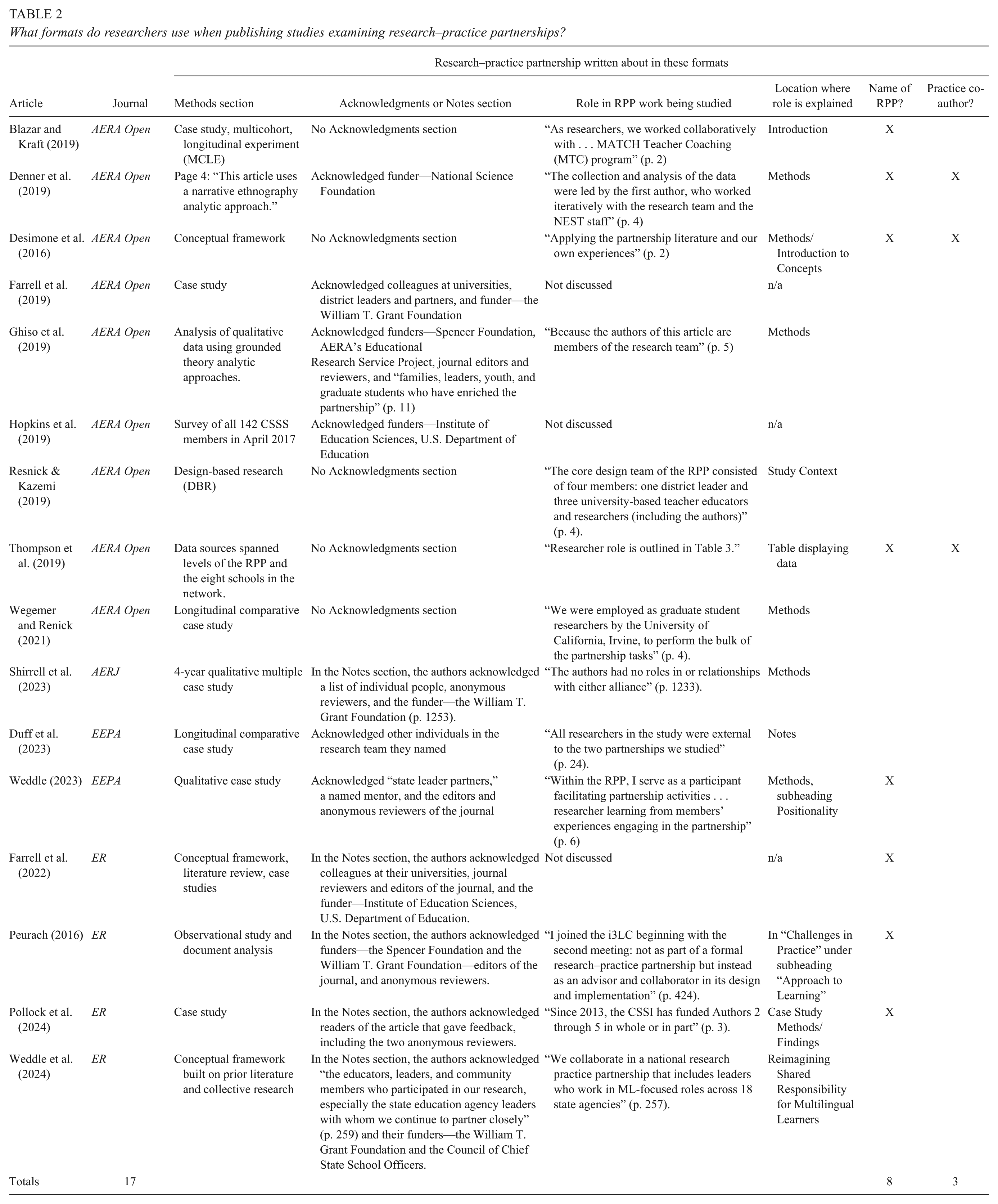
The formats of articles published about research examining an RPP had some similarities but generally were varied in their characteristics. As seen in Table 2, 10 of the 17 articles were published in AERA Open, one article was published in AERJ, two articles were published in EEPA, and four articles were published in ER. Most of the articles used qualitative research methods, with almost half the 17 articles using case study methodologies. Nine of the 17 articles explicitly explained the role of the authors in the RPP being studied. Seven of the 17 articles named the RPP they were examining. Here I discuss each of these patterns in detail. Again, I discuss each of these patterns in more detail organized by the key ideas of my analysis—location, partner contribution, the nature of the RPP, and author positionality or relationality.
What formats do researchers use when publishing studies examining research–practice partnerships?
Not Surprising, Articles Located Their Discussion of Qualitative Approaches in the Methods Section
The methods used across studies examining education RPPs generally were qualitative in nature. Almost half, eight of the 17 articles, appeared to use case study methods. Three of the 17 articles said that they were building a conceptual framework. Other methods used included grounded theory, ethnography, data collection through surveys, a multicohort, longitudinal experiment, design-based research, discourse analysis, and document analysis, among other methods. The methods may have been influenced by the nature of studying a phenomenon such as RPPs; the research needed to capture organizational, team, and individual dynamics and processes that might require more nuanced data collection and analysis. The methods used influenced the types of information the authors shared about their study, including the context of the RPP where the research was taking place, with qualitative methods potentially explaining more about the study contexts when describing a case study, for example.
It’s important to note that the methods and approach to research used in these studies of RPPs influenced which journal authors might submit their research to and which journals would accept those studies. For example, since 2016, there has only been one article published in AERJ about research examining RPPs, an article by Shirrell et al. (2023), and two articles published in EEPA. In contrast, AERA Open hosted a special issue featuring empirical research examining RPPs resulting in 10 articles being published, and ER has published four articles about research examining RPPs. This pattern may discourage researchers examining RPPs to submit their research to AERJ or EEPA and consequently influence the formats used when writing about these studies and the types of articles summarizing studies that make it through peer review.
Most Articles Locate Their Discussion of the Role of the Researcher in the Methods Section
Studies examining RPPs may inspire and require researchers to adopt different, more collaborative roles and research methods given the norms of RPPs. To understand whether authors were engaged in more traditional or collaborative research, I examined how the role of the researcher was explained in these research articles examining RPPs. For example, nine of the 17 articles explicitly explained their role in the RPP being studied, with most of the authors implying that they were engaged in the RPP work itself or the researcher adopted collaborative methods in their research of the RPP. Authors’ discussions of their role mostly took place in the Methods section (n = 7). For example, Ghiso et al. (2019) wrote, “Because the authors of this article are members of the research team, we also wrote memos capturing our own experiences in the RPP in relation to the interview questions” (p. 5). Wegemer and Renick (2021) wrote, “We were employed as graduate student researchers by the University of California, Irvine, to perform the bulk of the partnership tasks” (p. 4). Two other approaches explaining the role of the authors in relation to the RPP included mentioning it in the Introduction (e.g., “As researchers, we worked collaboratively with . . . MATCH Teacher Coaching (MTC) program”; Blazar & Kraft, 2019, p. 2) or mentioning it in a table displaying data (Thompson et al., 2019), where the authors described the roles of researchers and practitioners across different phases of development in their networked improvement community. Five of the 17 articles did not explain the role of the researcher in relation to the RPP. There was only one article, by Shirrell et al. (2023), where the authors explicitly explained that they had no formal role in the RPP by writing, “The authors had no roles in or relationships with either alliance” (p. 1233).
About Half the Articles Explained Partner Contributions by Naming the RPP Being Studied
As with the frequency of explaining the role of the researcher in these studies of RPPs, almost half the studies examining RPPs named the partnership they were studying (eight of 17). For example, Farrell et al. (2022) wrote, “Supported by the National Science Foundation, the MIST project was organized as an RPP between university-based researchers and educational leaders in four large school districts that served a total of 360,000 students” (p. 202). In most cases where the RPP was named in studies examining an RPP, the researchers explained their role within the RPP they were studying. For example, Weddle (2023) wrote, “The RPP was established in June 2020 as a working group within the EL Collaborative of the CCSSO [Council of Chief State School Officers] and expanded over time to include SEA [State Education Agency] leaders who were not Collaborative members” (p. 5). Weddle also went on to write, “Within the RPP, I serve as a participant facilitating partnership activities” and a as “researcher learning from members’ experiences engaging in the partnership” (p. 6). Where the RPP was not named, some authors chose to explain why. For example, in the Notes section, Zala-Mezö and Datnow (2024) explained that they were not naming their “project team members” in the Acknowledgments section “for the purposes of confidentiality” (p. 17).
Fewer Articles Acknowledge Partner Contributions by Sharing Appreciations or Co-authorship
Although more than half the articles examining RPPs named the RPP, it was less clear the authors’ approaches to acknowledging their appreciation for the members of the RPPs being studied. For example, only four of 17 of the article authors provided acknowledgments to the RPPs they were studying. These appreciations came sometimes in the Acknowledgment section of the article and sometimes in the Notes and were for the most part anonymized to more generalizable roles of their practice partners in their community or organization. Ghiso et al. (2019) used the Acknowledgment section to appreciate the “families, leaders, youth, and graduate students who have enriched the partnership” (p. 11). Weddle (2023) used the Notes section to appreciate “the educators, leaders, and community members who participated in our research, especially the state education agency leaders with whom we continue to partner closely” (p. 259). Three of the 17 articles acknowledged their partners by seeming to make their partners co-authors of their research examining their RPP. It is important to note that the practice of acknowledging and naming the RPP being studied could be stymied by the constraints of human subjects’ agreements requiring confidentiality or anonymity. Therefore, it could be that sharing appreciations of the RPP or adding partners as co-authors is limited in these articles examining RPPs given institutional research agreements, among other reasons.
Few Articles Discuss the Authors’ Positionality or Relationality
As with the lagging documentation of appreciation for the RPPs being studied, there was an even smaller number of articles that appear to discuss the authors’ positionality or relationality. Three of the 17 articles appeared to discuss the authors’ positionality or relationality. As seen in Table 3, one article had specific positionality statements in the Methods section that use the subheading “Positionality,” and two articles discussed their positionality in less specific terms without a formal subheading in their Methods section. In her article examining RPPs, Weddle (2023) explained her professional background and her role in the RPP. Weddle said that her role was as “a participant facilitating partnership activities, as well as a researcher learning from members’ experiences engaging in the partnership” (p. 6). Weddle went on to describe how her role as a researcher both studying the RPP and engaging in the RPP allowed the state leaders in the partnership to trust her as an insider.
Positionality-related statements in research related to research–practice partnerships (RPPs)
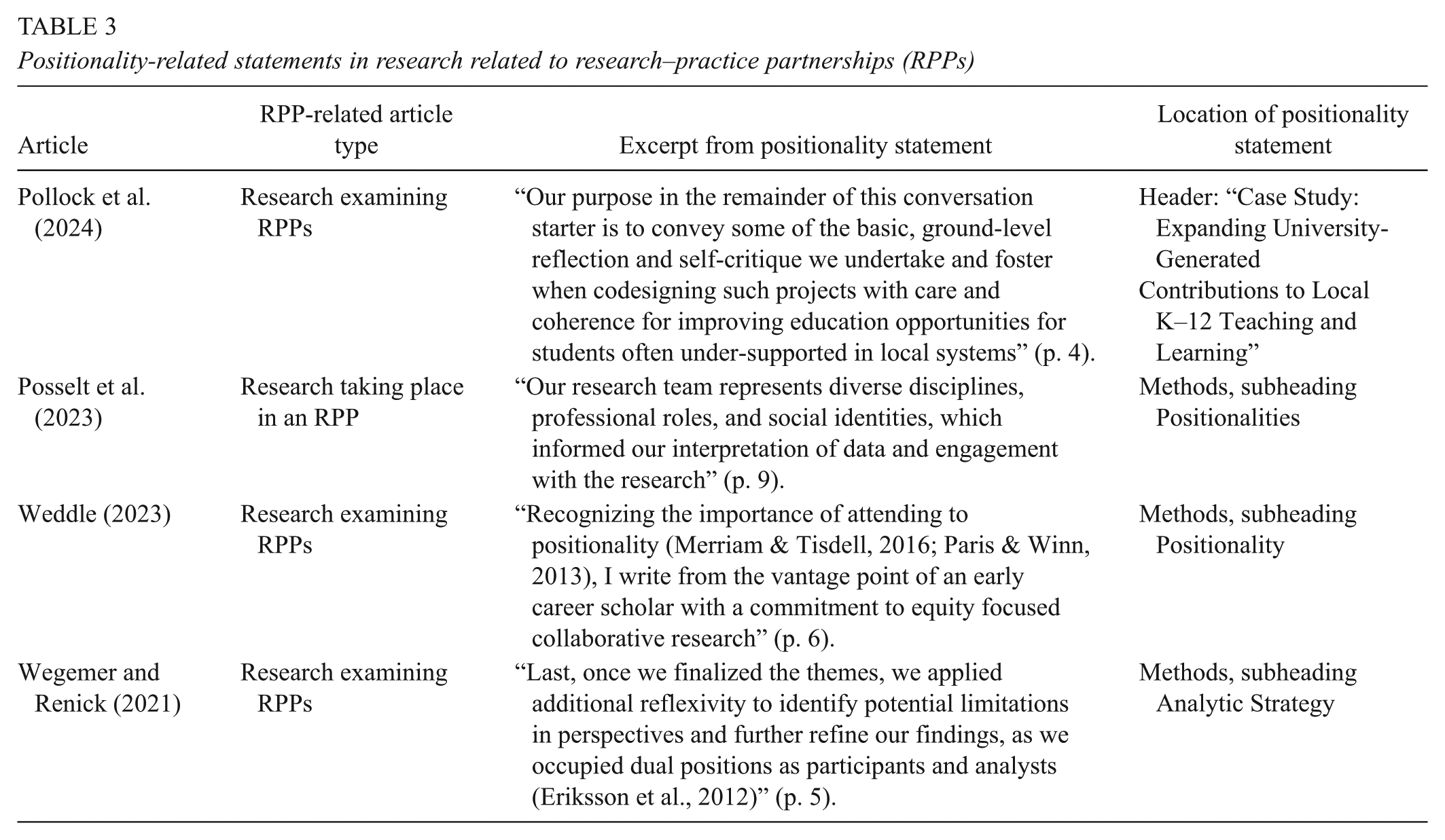
In contrast, two articles did not have subheading titled “Positionality” in the Methods section, but they both explicitly discussed their relationality in different ways. Pollock et al. (2024) described the process of “reflection and self-critique” that they as researchers took when engaging in collaborative research (p. 4). They explained the process they used to attend to their relationships with their community partners and the influence this may have had on their research. Wegemer and Renick (2021) also explained their relationality. Within their Methods section, they used the subheading “Analytic Strategy” to discuss how they applied their “reflexivity” to acknowledge limitations and attend to the “dual position” they occupied as both researchers and practitioners in the RPP.
Discussion and Implications
This study explored formats for writing about and publishing research related to RPPs. For research taking place in an RPP, most articles located the discussion of the RPP operations in the Methods section, the authors’ biographical sketches, or the Introduction. Most of the articles also named the practice or community partner in the RPP. Few articles described partner contributions via co-authorship or acknowledgments of appreciation for their practice partners. Few articles spent time discussing the nature of the RPP work, and consequently, their descriptions of the RPP were very operational in nature, like who was involved rather than explaining the purpose or value of the RPP. For research examining an RPP, not surprisingly, most articles located their discussion of their qualitative research approaches in the Methods section. The qualitative nature of the research may be the reason why few articles of studies examining RPPs were published in two of the four journals in the study sample, given that those journals tend to privilege more quantitative or mixed methods. Most articles located the discussion of whether the study authors were engaged in collaborative research with the RPP in the Methods section. In terms of acknowledging partner contributions, about half the articles named the RPP being studied. However, fewer articles acknowledged partner contributions by sharing appreciation for the RPP being studied, and few articles seemed to have practice partners as co-authors. Overall, few articles about research taking place in an RPP or examining an RPP discussed the positionality or relationality of the authors.
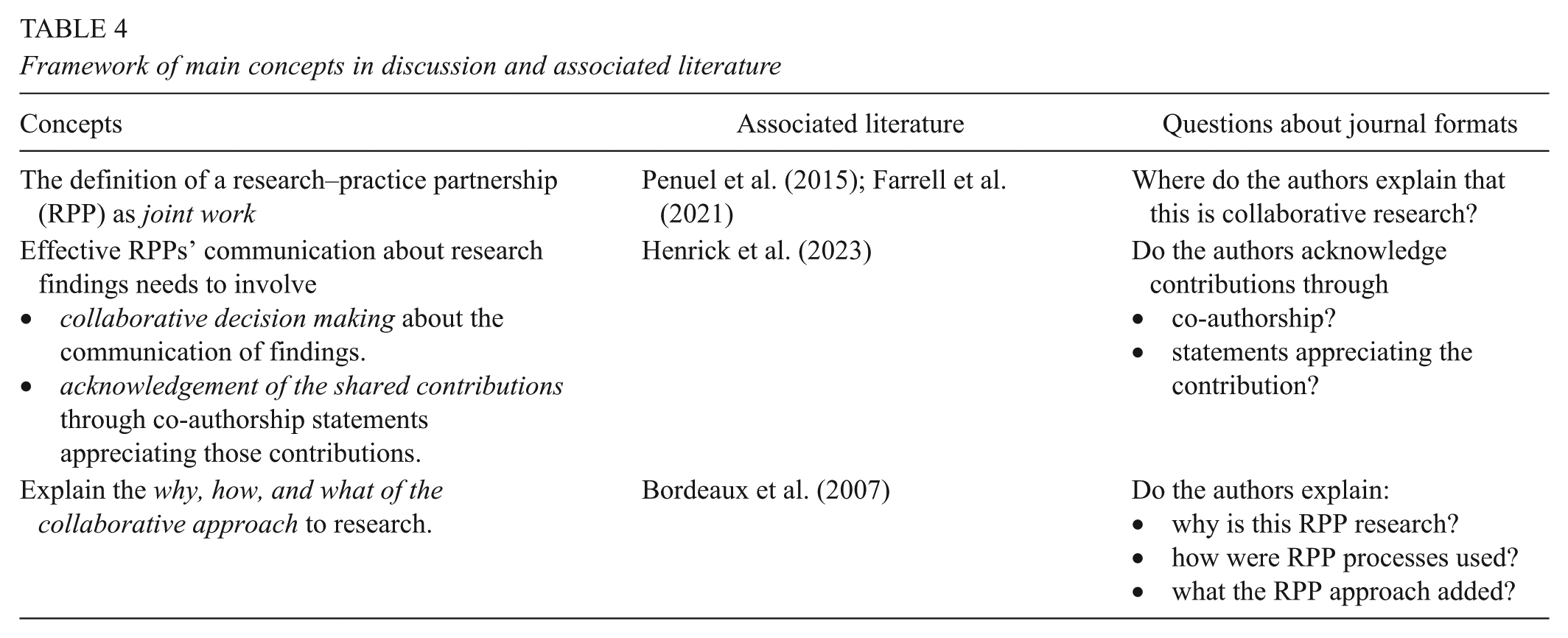
To interpret these findings, I used concepts described in Table 4 that stem from the existing literature. First, RPPs are conceptualized as “joint work,” which moves away from the metaphor as research needing to be translated into practice and instead conceptualizes RPP-related research as shared work (Penuel et al., 2015). Second, I used concepts from documented indicators of effective practices for documenting and communicating RPP findings from the research produced (Henrick et al., 2023). Finally, I referred to other disciplines’ guidelines for publishing community-based research. In Table 4, I define the three concepts, and next, I explain how these concepts influenced my suggested interpretation of the findings.
Framework of main concepts in discussion and associated literature
RPPs as Joint Work
The number of frameworks guiding the definition and function of RPPs has arguably maintained a focus on the conceptualization of Penuel et al. (2015) of RPPs as joint work. Farrell et al. (2021) advanced the concept of joint work by defining RPPs as “Long-term collaboration[s] aimed at educational improvement or equitable transformation through engagement with research. These partnerships are intentionally organized to connect diverse forms of expertise and shift power relations in the research endeavor to ensure that all partners have a say in the joint work” (p. iv). This concept of RPP work as joint work has shown up in other publications examining the form and function of RPPs (Cooper, 2013; Cooper et al., 2021; Davidson & Penuel, 2019; Farrell et al., 2022; Weddle, 2023).
If RPP-related research is truly functioning as joint work or examining the joint work of an RPP, then this has implications for how RPP-related research is represented in an article. I might argue that to represent the concept of joint work of RPPs, authors need to use formats that provide some description of the context and purpose of working in an RPP or the RPP they are studying that influenced the research. Therefore, a singular statement such as, “This research was conducted in a research–practice partnership” or “This study is about a research–practice partnership” is more likely misrepresenting the nature of the joint work. The joint work of RPPs is messy and anything but conventional research. Santo et al. (2017) used the word messy to describe the work in an RPP because of the multiorganizational networks and overlapping cultures needed to enact their RPPs. Consequently, writing a manuscript for publication and not acknowledging the messy context and purpose of the RPP beyond one sentence likely is not capturing the influence the RPP has on the research methods and findings.
RPP-Related Research Could Require Documentation of the RPP Context
Consequently, this might require authors to answer a set of questions to explain the context and condition for the RPP being examined or the RPP in which the research was produced: What is the rationale for working as an RPP (as opposed to conducting research using traditional relationships)? What contexts influence how this RPP operates and the research it produces? What limitations does the RPP add (if any) to the research findings? Arce-Trigatti and Resnick (2023) suggested describing the “underlying components” of an RPP that both add value and also present limitations to the research. It is not clear that this information needs to go into the Methods sections, although it could (p. 24).
Based on the findings from this analysis, it seems that most authors in the sample of both research taking place in an RPP and research examining an RPP named the RPP they were working in or studying, discussed whether the authors were engaged in the RPP, and discussed the RPP in the Introduction, Methods section, and biographies of the authors. Both the naming and the description of the RPP-related research in different parts of the article implied that these authors could add a few more details about the purpose and context of the RPP being studied to honor any joint work while not radically changing their manuscript. For example, Ehrenfeld (2022) wrote in the Introduction to their article, “The overall project was a research–practice partnership with a PD organization, where we used video to support secondary mathematics teachers’ teams in improving their practice” (p. 490). In this case, I would argue that Ehrenfeld is using the pronoun we to explain the joint nature of the work, even though the focus is on improving their or the teachers’ practice. This quote from Ehrenfeld (2022) also models how to explain the purpose of the RPP, that is, to “support secondary mathematics teachers’ teams to improve their practice.” This description of the RPP provides a lot of information about the context and purpose of the RPP, suggesting that it would be possible to explain these aspects of an RPP in a few, thoughtful sentences.
Other articles added this information describing the RPP context and purpose to the Limitations section of the article. Three of the articles discussing research conducted in an RPP discussed the limitations of conducting research in an RPP. For example, Murphy and Johnson (2023) explained these limitations by writing, “The data come from one district with a long history of serving a large, diverse EL student population and a mature research–practice partnership with a large research university, so the findings may be influenced by this context” (p. 330). Somewhere in the article, the authors writing about RPP-related research need to describe the RPP’s context and purpose that influence the research the authors produced.
Standards for Effective RPP Communication
The other resource that explores how RPPs communicate their research using a more dynamic approach than the approach used in the translational research paradigm is the dimensions of RPP effectiveness provided by Henrick et al. (2023). In dimension 4, the authors explain the collaborative aspects of communication and engagement in RPP research, which include five indicators: (a) include relevant perspectives in the decision to share knowledge, (b) identify what is useful to share and with whom, (c) design and facilitate sharing collaboratively, (d) engage diverse audiences to share knowledge, and (e) recognize partnership knowledge as co-created. To summarize across these indicators, in an RPP, the communication and engagement with research need to be collaborative with all partners, decisions about communication and findings are made collaboratively, and communication formats must acknowledge the shared contributions through co-authorship, co-presentation, or collective or unitary statements appreciating those contributions. The last elements, co-authorship and statements appreciating contributions, have implications for how RPP research is documented in journal articles.
Similar to RPP effectiveness indicators of Henrick et al. (2023), RPPs follow some unique processes for deliberating whether to name the RPP or RPP participants in studies. Some RPPs develop formal processes for publishing their research, which lead to the RPP and practice partner being named in a publication. For example, some RPPs have what they call a “no surprises” agreement in their partnership, which provides a window of time for the practice partner to review research before it is published with the name of the practice partner (Tseng et al., 2017). The traditional convention of naming any “participant” or “subject” in a research study according to most institutional review boards requires permission usually in writing. If an RPP or a partner is named in a study, this also may require a process the RPP goes through to get the proper permission to name the RPP. Why? By naming the RPP, it usually exposes the location and the community where data are being collected and could violate requirements for confidentiality named by an organization’s institutional review board.
RPP-Related Research Could Require Documentation via Acknowledgment and Reflexivity
For the members of the RPP engaged in the research or the members of the RPP being studied by researchers, they could explore questions to more explicitly discuss the communication and engagement needed to live up to the criteria for RPP effectiveness. Questions could include, How do members of the RPP want to be acknowledged—naming the RPP, co-authorship, or explicit acknowledgment of the RPP in the Notes or Acknowledgments sections? What are the authors’ roles in relation to this RPP? How do RPP members work together? How do RPP members decide how and who to communicate their findings? To do what Arce-Trigatti and Resnick (2023) suggest where RPP-related research disrupts traditional practices in formatting and publishing research, I argue that these questions need to be discussed among RPP members explicitly ahead of pursuing publication.
In the study findings, fewer RPP-related research articles thoroughly acknowledge practice partners’ contributions. For example, there are different variations for how authors explain their relationship to the RPP and whether they choose to maintain anonymity of the RPP during the acknowledgment of RPP participants. Starting with the example demonstrating more acknowledgment while also anonymizing, Kazemi et al. (2022) wrote in their Acknowledgments section, “We are indebted to the students, teachers, principal, and instructional coaches at Hilltop Elementary (pseudonym) for their partnership in creating a powerful learning environment for all of us” (p. 1084). Zala-Mezö and Datnow (2024) acknowledged their appreciation for their RPP partners and also wrote, “For the purposes of confidentiality, we do not list individual members by name” (p. 17). However, in a study where researchers are studying an RPP, Duff et al. (2023) wrote in their Notes section, “All researchers in the study were external to the two partnerships we studied” (p. 24), but they provided less detail or acknowledgment for the members of the RPPs themselves they were studying.
In addition to acknowledgment of partners, more studies could use reflexivity or even positionality statements to explain the researchers’ role and orientation for engaging with the RPP. Based on the lack of articles where authors examined their own identities and experiences in relation to the RPP work, I would argue that this is an area of the field that needs further exploration. The field could draw on other methods, potentially critical (Young & Diem, 2024), humanizing (Paris & Winn, 2013), or decolonizing (Patel, 2015) research methods, that could support reflexivity or relationality without a positionality statement in the article. These questions need further study within a larger sample of articles given that only four of the articles in the whole sample had something resembling a positionality statement and potentially with a sample of articles outside the field of education.
Guidance from Other Collaborative Research Disciplines
As opposed to educational research, other disciplines provide guidelines for researchers and their partners that outline specific formats when publishing their findings. For example, Doberneck (2021) published a resource titled, “Publishing engagement scholarship” Campus Compact, a national nonprofit association for higher education organizations focused on civic and community engagement. With thousands of members, Campus Compact provides interdisciplinary resources to support collaborative, community engaged research. The Doberneck resource lists many articles and reports to support the communication of research findings from some form of collaborative research through publication. The most detailed resource is an article by Bordeaux et al. (2007) published in a community health journal that makes the case that there are five points to address when publishing community-based participatory research (CBPR): (a) Pay attention to general principles for organizing each part of a paper, which they suggest may be different when discussing collaborative research, and (b) reinforce text with strategically selected and clearly labeled tables and figures. The last three points seem the most important and relevant to RPP documentation: (c) Explain why a CBPR approach was used, (d) specify how a CBPR approach was used, and (e) specify what the CBPR approach added to your project.
RPP-Related Research Could Explain the Purpose and Value of the RPP
These concepts from the CBPR publishing guidelines suggest that authors of RPP-related research who want to explain beyond the simpler operations of their RPP might explore a set of questions suggested by Bordeaux et al. (2007): How does the RPP work? Why does the RPP exist? What value does the RPP add to the research? From the study findings, few articles taking place in RPPs discuss the purpose and value of working in the RPP. As mentioned in the Findings section, one article by Murillo et al. (2021) discussed the value of working in an RPP by writing, “The RPP allows the research team to participate in critical reflection across the three studies, noting the design, culture, and response of City School related to immigration issues across time” (p. 4) or the justification by Russell et al. (2020) for using a certain collaborative research method (e.g., Design Based Implementation Research) to help explain the purpose for working in an RPP. Most of the articles in this study explained some variation of the RPP operations or addressed the question, How does the RPP work? Few of the articles addressed the purpose or “why” of the RPP or what value the RPP brings to the research? As the field of RPPs looks to advance its norms and principles for writing about and publishing their work, this could be an area for further growth.
Yet, how should the field decide what formats would best represent the intent of RPP-related research? If as Arce-Trigatti and Resnick (2023) suggest and RPP-related research and writing should not follow traditional formatting, reporting, and publishing practices, then what principles or guidelines should it follow? These questions merit further discussion in future research or debate within the field. In the long term, it would be my hope that the concepts, questions, and suggested formats outlined in Table 5, which summarizes key points in the discussion and interpretation of this study’s findings, could be a nascent set of guidelines for writing about RPP-related research that could be debated and improved by the field. I invite members of the field of education RPPs to view these questions as a starting place with the vision that they are used, analyzed, picked apart, and recreated into more formal guidelines that could influence the field of RPP-related research. In the short term, the findings from this study and questions in Table 5 suggest some implications for authors, reviewers, and journal editors that could influence writing and publishing of RPP-related research in the short term.
Questions for preparing research related to research–practice partnerships (RPPs) for publication in journals.

Implications for Authors of RPP-Related Research and Their Partners
When writing about RPP-related research, authors may expect to write the manuscript differently than a traditional research article. Given the intent of RPPs, articles need to document the ways the RPP-related research disrupts traditional methods of conducting research. To honor the broader processes and commitments in the RPP, it would be important to explore the questions discussed earlier (in Table 5) among the RPP partners at the beginning of the writing and publication process.
Additionally, RPP partners may want to formally discuss and decide on authorship in the beginning phases of the RPP work not only when publishing in a peer-reviewed journal but also for a brief, slide deck, report, or other document published for a practice, policy, or community audience. The study findings demonstrate how few RPP-related articles included co-authorship when publishing their research in a journal. Given that co-authorship is a practice in some RPPs, partners may want to discuss whether to also include co-authorship for other documentation meant for practice, policy, and community audiences.
Implications for Reviewers of RPP-Related Research
When reviewing an article about RPP-related research, use the questions in Table 5 to understand the relationship between the RPP, the authors of the manuscript, and the research. Look for the location where the RPP is discussed and what the authors say and don’t say about their work in or examination of the RPP. Provide specific suggestions to authors of the articles for how to explain the RPP in the context of their research and where it makes the most sense for the authors to add this detail. Reviewers can provide specific feedback to authors during a blind review. For example, a reviewer might write, “On page X in the Introduction of your article, after the third paragraph, add in a description of why as researchers you are working in this RPP and what value it adds to your research.”
Implications for Journal Editors Receiving RPP-Related Research Manuscripts
There was not one article format that seemed to be common across any of the journals in this study’s sample. Therefore, journal editors could establish publishing guidelines explaining where in the article structure the context and purpose of the RPP may be discussed, where the RPP or partners may be acknowledged, and whether the journal encourages researchers to submit articles with their partners as co-authors. These findings suggest that journal editors could have a lot of influence over standards for publishing RPP-related research given that there were some cases where one journal had articles with a pattern of using a specific format (e.g., authors in AERJ talking about their RPP in their biographies). One idea would be for journal editors to adopt common formats for when research is related to RPPs that could be different from your average research article, such as common approaches for describing the context of the RPP in the Methods section.
Future of Writing About Education Research Related to RPPs
As the field of education RPPs continues to grow, it behooves members of the field to define the practices for writing about RPP-related research as a means to strengthen and develop the field. This study suggests that the formats for publishing peer-reviewed journal articles of RPP-related research are varied. In some cases, the formats for writing about studies taking place in RPPs may be lacking a complete description of the work the RPP contributed to a study. In other cases, the details excluded from the writing about a study examining RPPs may misconstrue or mask whether a researcher examining an RPP is in fact a member of the RPP. The growing field of RPP-related research can improve by developing some additional standard practices for writing about the work, and I would argue that most of those practices could apply to research taking place in an RPP or examining an RPP. If RPPs are meant to disrupt the traditional forms of conducting research, then even in the confines of a peer-reviewed journal article, the RPP-related research will be different from an average article. Some of the articles in this study included these different types of information, with discussions of reflexivity, relationality, co-authorship, and, at minimum, documenting the purpose of the RPP, the roles of the authors in the RPPs, and what value the RPP brings to the research and its methods. I hope that this study is a call to action for the field to strengthen the practices for writing and publishing about RPP-related research that ultimately makes the field unique and disruptive to traditional power structures in the academy and furthers the clarity and usefulness of this type of collaborative educational research.
Footnotes
Appendix A: List of Articles Included in the Document Analysis
Appendix B
Guiding questions, coding scheme for two types of articles, and associated concept and literature used to develop the codes

| Guiding question | Codes for study taking place in a research–practice relationship (RPP) | Codes for study examining |
Associated concept and literature |
|---|---|---|---|
| Location: Where in the article do the authors explain that this is collaborative research? | • Methods • Acknowledgments • Biographies of the authors • Notes |
• What methods are used? • Are the methods collaborative in nature? • What is discussed in the Acknowledgments section (if it exists)? |
• More traditional headings in an academic article where RPP dimensions can be discussed (e.g., concept of RPPs’ dimensions of variation by Farrell et al., 2021) |
| • Context/history of the RPP • Other arts |
• Whether the author is part of the dataset being analyzed? • Where is the role of the author discussed? |
• Less traditional headings in an academic article where RPP dimensions can be discussed (e.g., concept of RPPs’ dimensions of variation by Farrell et al., 2021) • Concept of joint work and researchers working at the boundary of their role by Penuel et al. (2015) |
|
| Partner contributions: Do the authors acknowledge contributions of practice and community partners? | • Is the RPP named? • Co-authorship? • Statements appreciating the contribution of partners? |
• Is the RPP named? • Co-authorship? • Are there acknowledgments of appreciation for RPPs being studied? |
• Pertinent dimensions of variation in RPPs from Farrell et al. (2021)
• Composition (e.g., organizations involved) and approaches to research (e.g., intensity of working together, views of appropriate roles of researchers and practitioners) |
| Nature of RPP: How do the authors explain the nature of the RPP? |
• Why this is RPP research? • How were RPP processes used? • What the RPP approach added? |
— | • Bordeaux et al. (2007) guidelines for publishing community-based participatory research in peer review journals |
| Positionality or relationality: Do authors examine their positionality and/or relationality? |
• If the author is part of the RPP, how is it discussed? • Do authors address issues of power and status? |
• If the author is part of the RPP, how is it discussed? • Do authors address issues of power and status? |
• Farrell et al. (2021) explain that one of the five principles of RPPs is to shift power relations in research endeavors. |
1.
As listed in Appendix A, the Shores et al. (2020) article from AERJ was excluded because the only mention of RPPs is that one of the author’s biography (Ha Eun Kim) reads, “Currently, she is a graduate student researcher in OCEAN [Orange County Educational Advancement Network], a research–practice partnership” (p. 2089). The Desimone et al. (2019) article was excluded because the only mention of an RPP is that the article references a study about an RPP (Desimone et al., 2016) that also uses the same theory being referenced in the Desimone et al. (2019) article to “analyze the implementation effects of a research–practice partnership” (p. 168). The article does refer to the states involved in the study as states with “willingness to partner with us” (p. 168) but does not describe any other connection to an RPPs. The Kim (2019) article does discuss RPPs when interpreting some of the findings and implications from the case studies, but the case studies themselves are not taking place in an RPP or examining RPPs. Similarly, the  case study explores interactions in a “research–practice relationship” (p. 2) and briefly contrasts this concept with RPPs in the opening theoretical framework and in the “Conclusions and Limitations” section. However, the term is only cited twice and is not discussed in detail.
Note: This manuscript was accepted under the editorial team of Kara S. Finnigan, Editor in Chief.
Author
LAURA WENTWORTH, PhD, is the Director of the Research-Practice Partnership Program at California Education Partners, leads the Stanford University-San Francisco Unified School District Partnership, and is a lecturer at the Stanford University Graduate School of Education. She supports the development of practice, knowledge, and research about research–practice partnerships in education.