




Abstract
Following recent discipline reforms, formal suspensions and expulsions have declined nationwide. This qualitative study investigates the kinds, causes, and consequences of informal exclusionary discipline practices that have inadvertently emerged in public preschool and early elementary settings. Drawing on interviews with 63 parents, teachers, administrators, and behavior specialists, we provide evidence of within-classroom, within-school, and out-of-school informal exclusionary discipline practices. We find that these practices occur when mandates to reduce formal discipline are not paired with adequate resources for alternative restorative behavior management approaches. By disproportionately impacting racially/ethnically and economically marginalized students, informal practices reproduce formal school discipline disparities and contribute to further educational inequities. These practices have lasting harms, including disruptions to child learning, parental employment, and child and families’ sense of school belonging. Findings underscore the need to systematically document and address informal exclusionary discipline practices, which remain invisible in administrative records but constitute increasingly common forms of racialized exclusion in contemporary early education.
Keywords
The U.S. public education system suffers from stark, longstanding racial/ethnic disparities in exclusionary school discipline (i.e., suspensions and expulsions). 1 Black students in particular face disproportionate risk; though Black children comprise 15% of total K–12 enrollment, they account for 36% of students expelled and 44% of students receiving multiple suspensions (U.S. Department of Education Office for Civil Rights, 2014). Moreover, experiences of exclusion are disturbingly common in early childhood educational settings. Despite their vulnerability to nondevelopmentally appropriate punitive discipline, in recent decades, preschoolers were expelled more than three times as often as students in grades K–12 (Gilliam, 2005; U.S. Department of Education Office for Civil Rights, 2014).
In the early 2010s, the Obama administration’s Departments of Education, Justice, and Health and Human Services jointly sounded the alarm about the prevalence and racial disproportionality of exclusionary discipline, calling on states and local governments to reduce suspensions and expulsions (U.S. Department of Health and Human Services & U.S. Department of Education, 2014; U.S. Department of Justice & U.S. Department of Education, 2014). A decade later, many school districts have adopted reforms to reduce exclusionary discipline and related racial inequalities among young students, as reflected in declining aggregate rates of formal K–12 suspensions and expulsions (Leung-Gagné et al., 2022; Losen & Martinez, 2020a) and in some cases, the outlawing of suspensions and expulsions in preschool and early elementary grades (Loomis et al., 2022; Zinsser et al., 2022). And yet, young children still experience social-emotional challenges at school (National Center for Education Statistics, 2022), educators often lack adequate resources to respond in non-punitive ways (e.g., Gimbert et al., 2023), and patterns of racial inequality in perceptions of and responses to young students’ behaviors persist (e.g., Boonstra, 2021; Sabol et al., 2022). In this context, what compensatory disciplinary strategies have emerged in preschool and early elementary educational settings, and what are the consequences for young students of minoritized racial/ethnic identities?
Our study identifies informal exclusionary discipline practices in the San Francisco Unified School District (SFUSD), a large, racially/ethnically diverse urban school district in Northern California. In part due to SFUSD’s longstanding history of disproportionately disciplining students of color, and Black students in particular, suspensions and expulsions are now forbidden in preschool and widely discouraged in K–12. As such, SFUSD offers an ideal setting in which to examine the range of informal exclusionary discipline practices that educators may utilize when formal suspensions and expulsions are no longer legally permitted or have become culturally unacceptable. Leveraging interview data from a diverse set of district stakeholders–including parents, teachers, administrators, and behavioral support specialists–we investigate informal exclusionary discipline practices, defined here as within-classroom, within-school, and out-of-school practices that limit students’ opportunities to fully access and engage in classroom learning activities (Williford et al., 2023). We seek to shed light on the types of, rationales for, and repercussions of such practices, which have received scant scholarly attention but may constitute increasingly common forms of racialized exclusion in contemporary early education environments.
Historical Evolution of Racial Exclusion in Schools
Both the prevalence and racial disproportionality of U.S. K–12 exclusionary discipline rose dramatically following court-ordered desegregation efforts in the wake of Brown v. Board of Education (Skiba & White, 2022). As school integration began in earnest in the late 1960s and early 1970s, the removal of students of color via suspensions and expulsions emerged as a novel mechanism of racialized exclusion that remained both separate and unequal (Bickel, 1981; Chin, 2024; Skiba & White, 2022). Exclusionary discipline and related racial disparities continued to rise in the 1980s, 1990s, and 2000s amidst broader societal shifts that favored zero-tolerance policies and the criminalization of juvenile delinquency (Chin, 2024; Leung-Gagné et al., 2022). In 1973, when the Civil Rights Data Collection began tracking suspensions nationally, rates stood at 4% in the aggregate, 6% for Black students, and 3% for White students. By 2010, when rates peaked, overall suspensions had risen to 7%, and the Black-White gap had quadrupled from 3 to 12 percentage points (16% vs. 4%; Leung-Gagné et al., 2022).
Contemporary School Discipline Reform
Though concerns about inequities in exclusionary discipline were first highlighted in congressional testimony in the 1970s (Children’s Defense Fund, 1974), this form of educational injustice did not receive sustained federal attention until some 40 years later. In the early 2010s, a sizable body of research about exclusionary discipline and its disparate impacts began to accumulate. Specifically, the Obama administration and a handful of scholars published landmark studies highlighting both the alarming prevalence and racial disproportionality of suspensions and expulsions in K–12 (U.S. Department of Education Office for Civil Rights, 2014) and early childhood settings (Gilliam, 2005; U.S. Department of Health and Human Services & U.S. Department of Education, 2014). Of particular concern was discipline among preschoolers, who faced expulsion at more than three times the rate of their K–12 counterparts (Gilliam, 2005; U.S. Department of Education Office for Civil Rights, 2014). Research revealed several contributing factors to the uniquely high rates of early childhood exclusion, including early educators’ insufficient preparation in child development and behavior management, elevated levels of stress and burnout, limited access to early childhood mental health consultation, and subjective interpretations of developmentally typical behaviors—particularly among children of color—as defiant or dangerous (Allen et al., 2022; Gilliam, 2005; Zinsser et al., 2022).
Policymakers and academics also recognized that racial discipline disparities intersected with other axes of marginalization, including disability status and gender. For example, students with disabilities faced suspension at more than twice the rate of their nondisabled peers, and Black students with disabilities experienced the highest risk of all (Leung-Gagné et al., 2022). These findings coalesced with emerging evidence of exclusionary discipline’s short- and long-term harms, from reduced school connectedness and academic achievement to increased likelihood of future discipline, high school dropout, and juvenile and adult incarceration (e.g., Lamont et al., 2013; Shollenberger, 2013).
Buffeted by this collective evidence, multiple departments within the Obama administration jointly issued guidance in 2014 calling for shifts away from punitive school discipline approaches. Over the subsequent years, states and districts in both traditionally conservative and liberal regions followed suit, adopting policies that favored nonpunitive alternatives such as positive behavioral interventions and supports (PBIS) and restorative justice (RJ; González et al., 2021; Koon et al., 2024). Recognizing the particular prevalence and developmental inappropriateness of exclusionary discipline for young students, advocates and policymakers often prioritized reforms in preschool and early elementary grades (Loomis et al., 2022; Zinsser et al., 2022). These changes occurred amidst rising public awareness about the school-to-prison pipeline and declining popular support for zero-tolerance policies (Gleit, 2025; Hirschfield, 2018). Momentum for disciplinary reform further accelerated in 2020, when the high-profile murders of Black Americans, including George Floyd, Ahmaud Arbery, and Breonna Taylor, spurred a paradigmatic popular and scholarly shift in Americans’ understandings of structural racism broadly, and of connections among carceral logics, policing, and schools specifically (Skiba et al., 2022). Indeed, as of 2024, at least 17 states and D.C. have passed laws limiting the use of suspensions and expulsions for younger children, typically defined as those in preschool through third or fifth grade (Education Commission of the United States, n.d.).
In the aggregate, these reforms have had considerable success, driving statistically and practically meaningful reductions in national K–12 suspension rates since their peak in 2010 (Koon et al., 2024; Leung-Gagné et al., 2022). But while formal K–12 suspension rates for every major racial/ethnic group–including Black, Native American, Latine, Pacific Islander, Asian, and White–have declined, racial/ethnic disparities persist, with the size of exclusionary discipline gaps remaining relatively unchanged (Koon et al., 2024; Leung-Gagné et al., 2022).
Though trends in formal early childhood suspensions over time remain difficult to assess due to the lack of consistently monitored national data (Zinsser et al., 2022), available evidence indicates that Black students continue to be excluded from school via suspensions at the highest relative rate beginning in preschool (e.g., Giordano et al., 2021). Notably, comprehensive literature reviews have consistently concluded that differences in student behavior do not account for the large racial disparities in suspension rates (Skiba & Williams, 2014; Welsh & Little, 2018). Instead, past work points to a number of systemic and school factors associated with discipline disproportionality, including educators’ implicit racial biases, insufficient teacher preparation, poor educator working conditions, ineffective school leadership, and inequitable resource allocation (Leung-Gagné et al., 2022).
Informal Exclusionary Practices Amidst the Nonpunitive Pivot
In recent years, a handful of studies have surfaced concerns about informal exclusionary discipline practices that may emerge in PreK–12 settings in the wake of the national nonpunitive pivot (Gleit, 2025; Williford et al., 2023; Zinsser et al., 2022, 2024). Broadly, this scholarship defines informal exclusionary discipline practices as instances beyond official suspensions and expulsions in which students lose opportunities to fully engage in learning activities. In her ethnography of a suburban California public high school, Gleit (2025) focuses on informal expulsions, documenting the permanent forcible removal of adolescent students via methods such as coerced transfers. She discusses the invisibility of informal exclusionary discipline practices in official school records and calls for further investigations of such practices, especially in contexts embracing formal disciplinary reforms (Gleit, 2025).
Zinsser et al. (2022) echo this call in their systematic review of the literature on early childhood exclusionary discipline. Citing the disturbing prevalence of formal early childhood discipline, alongside anecdotal evidence of informal or “soft” exclusionary practices, they emphasize the need for rigorous empirical investigations of informal practices (Zinsser et al., 2022). 2 Their arguments dovetail with evidence of young students’ heightened social-emotional and behavioral needs–and early educators’ lack of training and resources to respond in nonpunitive ways–in the post-pandemic era (e.g., National Center for Education Statistics, 2022). With formal discipline no longer viable, in the absence of adequate alternative strategies to meet students’ needs, informal early childhood exclusionary practices may emerge in progressive, reform-oriented settings. Given the persistence of both racial gaps in formal early childhood discipline (e.g., Giordano et al., 2021) and educators’ racialized interpretations of young students’ behaviors (e.g., Boonstra, 2021; Sabol et al., 2022), we might expect young students of minoritized racial/ethnic identities to disproportionately experience informal exclusion.
To date, a small number of recent studies have investigated informal exclusionary practices in early education. Both O’Grady et al. (2024) and Murphy et al. (2024) leverage data from teachers in mixed community early education settings, finding evidence of exclusionary practices such as “soft” expulsions that impact multiply marginalized students (i.e., those with disabilities and from minoritized racial/ethnic backgrounds). Williford et al. (2023) surveyed a predominantly White sample of public kindergarten teachers in Virginia about their use of five informal exclusionary practices (e.g., breaks outside the classroom, lost recess, limited talking privileges). They found that teachers reported greater use of such practices when the racial composition of students they perceived as having the lowest self-regulation and social skills included more Black students. Unable to do so with their own data, the researchers call for future work to understand explanations for and consequences of these practices for affected students, families, and broader school staff (e.g., administrators). Finally, leveraging data from parents in Illinois, Zinsser et al. (2024) found that young children enrolled in a mix of nonprofit and private childcare and preschool programs continued to experience informal or “soft” expulsions following the state’s 2018 legislative ban.
The Present Investigation
We extend this nascent body of scholarship by exploring the views of a broad, racially/ethnically diverse set of district stakeholders–including administrators, behavioral support specialists, parents, and teachers–on informal early childhood exclusionary discipline practices. We apply a transactional model to understand dynamic, reciprocal relationships between teachers and students, who mutually influence one another in the classroom (Sameroff & Mackenzie, 2003). This model originated in the parenting literature, where it has been used to examine how ineffective parental responses to minor child misbehaviors produce bidirectional exchanges that grow increasingly aversive over time (Patterson et al., 1992). A transactional model underscores that neither teachers nor students act in a vacuum; rather, teachers’ perceptions of students’ misbehaviors influence their responses, including the potential use of informal exclusionary discipline practices, which in turn shape students’ behaviors and learning in the classroom (Sutherland & Oswald, 2005). We situate these transactional teacher-student processes within public preschool and early elementary educators’ broader structural and interpersonal constraints and resources, from teachers’ systemic undercompensation to the dearth of available mental health supports to their implicit racial biases (Alamos & Williford, 2023; Allen et al., 2022; Granziera et al., 2021).
Our inductive qualitative approach allows for expansive conceptualizations of informal exclusionary discipline practices, based on participants’ lived experiences and insights into the range of within-classroom, within-school, and out-of-school practices utilized in public school-based early education settings. The inclusion of parent perspectives is especially important; despite parents’ pivotal role in school exclusion processes, especially for young learners, the aforementioned systematic review of early childhood exclusion found that just two of 20 studies incorporated any parent data (Zinsser et al., 2022).
We investigate informal exclusionary discipline practices in the San Francisco Unified School District (SFUSD), a progressive urban school district in Northern California. We focus on these practices because they limit children’s equitable access to academic and social-emotional learning opportunities at a foundational developmental juncture. Specifically, our study is guided by the following research questions:
Following recent prohibitions on formal school discipline, what informal exclusionary discipline practices are students experiencing in public preschool and early elementary settings?
How do various district stakeholders–including parents, teachers, administrators, and behavior support specialists–make sense of why these informal exclusionary practices are occurring?
What consequences do stakeholders describe for young students and families experiencing these informal exclusionary practices?
Amidst shifting disciplinary discourses and increases in state and local legislation restricting formal early childhood suspensions and expulsions (Loomis et al., 2022; Zinsser et al., 2022), we seek to shed light on the informal exclusionary practices that may inadvertently emerge in the absence of adequate alternative, evidence-based strategies to meet young children’s behavioral needs. This work has important equity implications, as the very children excluded for behavioral reasons are often those who stand to benefit most from early childhood education (Murano et al., 2020).
Method
Study Context
This study takes place as part of a research-practice partnership between SFUSD and Stanford University to investigate district efforts to reduce longstanding racial discipline disparities. SFUSD is a large urban school district in Northern California with roughly 50,000 students in 132 schools. In 2023–2024, the school year corresponding with data collection, enrolled students were racially/ethnically diverse: 33% Asian, 32% Latine, 12% White, 9% Multiracial, 6% Black, 3% Filipino, and less than 1% each American Indian or Pacific Islander, with 4% declining to state. Nearly half (47%) of students were socioeconomically disadvantaged, a quarter (25%) were English language learners, and 14% were eligible for special education services (SFUSD, n.d.).
SFUSD is a strategic site to study evolutions in informal exclusionary discipline practices, given state and local conditions that have rendered formal exclusionary discipline illegal and/or culturally frowned upon. As a state, California has operated at the cutting edge of national school discipline reform efforts. In 2013, the state legislature passed AB 420, prohibiting suspensions for willful defiance for students in kindergarten through third grade (Assembly Bill 420, 2013). The legislature additionally passed AB 2806 in 2022, outlawing suspensions and expulsions in all early learning and care programs, including public preschools (AB 2806, 2022).
Similarly, at the district level, SFUSD has been engaged in formal discipline reforms for more than a decade (SFUSD, n.d.). Reforms were initially prompted by cultural and political pressures, as progressive organizations and parent groups in San Francisco called for new policies to address the school-to-prison pipeline (SFUSD, n.d.). Such pressures were compounded in 2019 when the state of California first formally sanctioned SFUSD for “significant disproportionality” in the suspension of Black students–a designation the district has retained into the present day (California Department of Education, Data Evaluation and Analysis Unit, 2023). Until it demonstrates reductions in racial discipline disparities, SFUSD is required to implement a Comprehensive Coordinated Early Intervening Services plan to address discipline disparities. Under the current plan, district guidelines widely discourage the use of formal suspensions and explicitly require that educators contact the assistant superintendent prior to the suspension of a Black student in grades K–12 (The Safe and Supportive Schools Resolution, 2014). Against this backdrop, SFUSD affords unique insights into the range of informal exclusionary discipline practices that early educators may turn to when states and districts pivot away from punitive policies.
Relative to school districts nationwide, SFUSD has a distinct racial/ethnic composition, including a plurality of Asian students (33%) and a large proportion of Latine students (32%). This demographic profile differs from that of districts studied in much of the existing school discipline literature, which has largely focused on Black/White disparities. As such, the previously cited findings may have limited generalizability to our study setting. At the same time, SFUSD offers an opportunity to extend the literature by examining how informal exclusionary discipline practices operate in more racially/ethnically diverse student populations.
Procedures
This is a descriptive qualitative case study using semistructured interviews. We chose a qualitative methodology because it is well-suited for achieving an in-depth and multifaceted understanding of heterogeneous experiences and perspectives, as well as for analyzing experiential information that can be used for hypothesis generation for future quantitative studies. The goal of this qualitative case study is not to generalize findings; rather, as Yin (2014 p. 21) writes, “Case studies, like experiments, are generalizable to theoretical propositions and not to populations or universes. In this sense, the case study, like the experiment, does not represent a ‘sample,’ and in doing case study research, your goal will be to expand and generalize theories (analytic generalizations) and not to extrapolate probabilities (statistical generalizations).”
We utilized purposeful sampling (Miles et al., 2020) to identify interview participants. Specifically, we selected participants based on their roles in the decision-making processes of school behavior management and discipline policies and practices at the district, school, and classroom levels. The interview sample offers diverse, in-depth perspectives on school discipline and behavior management practices from four stakeholder groups: (1) district administrators (e.g., principals, assistant superintendents, policy directors); (2) early childhood general education teachers (grades PreK–1); (3) early childhood Tier-2 and Tier-3 behavior support specialists; and (4) parents of children referred to Tier-2 and Tier-3 behavior support services. We recruited all district employee interview participants (i.e., administrators, teachers, and behavior support specialists) via individual formal recruitment emails. We recruited parent interview participants via follow-up emails and text messages to parents who participated in a related parent survey (described below) and consented to further contact.
We conducted a total of 66 interviews with 63 unique participants between June 2023 and May 2024. We conducted a mix of in-person and Zoom interviews, according to the participants’ preference. Interviews ranged from 50 minutes to 2.25 hours in length, with most averaging 1–1.5 hours. As first author, I conducted the majority of the interviews, with additional interviews conducted by a trained research assistant employed full-time as a research coordinator at the Stanford Graduate School of Education. We offered parents the opportunity to participate in their language of preference. Two parents chose to be interviewed in Spanish, and those interviews were carried out by the first author, who is fluent in Spanish.
This study grew out of a broader mixed-methods study of an early childhood Tier-3 intervention to prevent exclusionary discipline among children of color in a 10+-year research-practice partnership between the research team and SFUSD. 3 In addition to conducting interviews and surveys, the research team–and I, as primary author, in particular–spent more than 50 hours conducting onsite participant observations and workshops with district partners. These sustained interactions generated familiarity and trust between the research team and district employees, including administrators, teachers, and behavior support specialists. Our partnership with the aforementioned early childhood Tier-3 program garnered further familiarity and trust with parents of participating students. Collectively, these connections boded well both for recruiting participants and for facilitating frank conversations about sensitive topics related to race and discipline. Given the politicized nature of the topics, we assured all participants of the confidentiality of their identities and took additional measures to ensure that interviewees felt comfortable participating honestly. Despite potential concerns about social desirability bias, participants across roles and school sites appeared motivated to speak candidly—often expressing relief at having the chance to discuss informal discipline practices they felt were pervasive yet underacknowledged.
Relatedly, given the study’s focus on racialized exclusionary experiences, we took great care to recruit a racially/ethnically diverse interview sample (see Participant section and Table 1 for further details). We employed several strategies to do so, including leveraging the relationships and trust built throughout our more than decade-long research-practice partnership with racially/ethnically diverse administrators, teachers, and staff throughout the SFUSD. We also intentionally built a multiracial/ethnic research team: the first and fourth authors identify as White, and the second and third authors identify as mixed Black and Latine. Collectively, our varied lived experiences supported sample recruitment and helped us remain attentive to power dynamics shaping both research processes and educational systems.
Demographics: All participants (N = 63) and parents (n = 15)

Note. Data in the second and third columns reflect the entire interview sample (N = 63). Data in the fourth and fifth columns reflect the subsample of parent interview participants (n = 15). Household income data was only gathered from parent interview participants.
With input from district partners, we developed a semistructured interview protocol (available in the online appendix) to guide discussions with respondents. We designed questions to foster a rich understanding of (a) respondents’ perceptions of the contributors to the rates of and racial disparities in formal discipline; (b) interactions between administrators, teachers, and families when young students experience emotion regulation challenges and/or engage in perceived misbehavior; (c) educators’ discretion and accountability in discipline-related processes; (d) supports available to educators and families to address child behavior and related discipline challenges; and (e) potential racial and cultural biases and incongruences in interactions among educators, parents, and young students in discipline-related processes. Drawing on transactional frameworks that emphasize reciprocal influences between adults’ and children’s classroom behaviors—and, in particular, how teachers’ racial biases and children’s racialized classroom experiences can intensify coercive interaction cycles for young students of color—(Alamos & Williford, 2023; Sameroff & Mackenzie, 2003), we included probes that explored how educator responses shape student behavior over time and vice versa.
We framed interviews as “guided conversations,” posing a series of open-ended questions and responses as well as follow-up questions that encouraged further explanation (Kvale & Brinkmann, 2005). Upon repeated mention of informal exclusionary practices in initial interviews, we iteratively revised our protocol to directly ask about such practices. When participants expressed knowledge of informal exclusionary practices, as the vast majority did, we probed further for types, explanations, and consequences.
Participants
Full sample
We conducted a total of 66 interviews with 63 unique participants. As shown in Table 1, the interview sample includes a diverse set of district stakeholders, including administrators (e.g., principals, assistant superintendents, policy directors; n = 18), general education teachers (grades PreK-1; n = 17), Tier-2 and Tier-3 behavior support specialists (n = 13), and parents of students in grades PreK–5 that previously received Tier-3 behavior support services (n = 15). Behavior specialists work with students identified as needing additional behavioral supports beyond an individual teacher’s capacity to provide. As a result, they are useful informants, and their perspective differs from that of teachers.
Among all interview participants, 33% identify as Black, 27% as White, 16% as multiracial or other, 13% as Asian or Pacific Islander, and 11% as Latine. Most participants (86%) identify as women, with others identifying as men (13%) or nonbinary (2%). The majority (63%) have a graduate degree, 21% have a bachelor’s degree, 5% have an associate’s degree, and 11% have some college or less. Among participating teachers (n = 17), seven taught pre-k, three taught transitional kindergarten, six taught kindergarten, and one taught first grade.
Parent subsample
Table 1 also presents demographic characteristics separately for parent interview participants (n = 15). Relative to school staff (i.e., administrators, teachers, and behavior support specialists), parents were more likely to be Black or Latine and less likely to have a college or graduate degree. We only collected household income data from parents, of whom 40% reported an annual household income of $0–24,999; 20% of $25–49,999; 13% of $50–74,999; 20% of $75–99,999; 7% of $100–149,999; and 0% of $150,000 or more. Using the midpoint for each income category, the mean annual household income in our sample was $46,666 (SD = $36,738). Thus, all parent participants reported annual household incomes that fall below San Francisco’s threshold for low household income, which was $149,100 for a household of four in 2023. The average annual household income for parents in our sample falls below San Francisco’s “very low income” threshold, which was $55,900 for a household of four in 2023 (California Department of Housing and Community Development, 2023).
All parent participants (n = 15) had a child who had previously participated in the district’s aforementioned Tier-3 behavior support program. Per district policy, this program was for students ages three to five in preschool, transitional kindergarten, or kindergarten who did not have disability designations. All students in the program received a 10-week high-touch intervention that provided them with individualized social, emotional, and sensory supports to prepare them to thrive in their general education classrooms. Among the parent interview participants, 11 had children who were boys, and four had children who were girls. Children of the parent participants had the following racial/ethnic identities: eight were Black; two each were Latine and Multiracial; and one each was Asian, Pacific Islander, and White. At the time of the parents’ interviews, their children were in the following grades: two in preschool, five in kindergarten, four in first grade, two in second grade, and one each in third and fourth grades.
Analytic Strategy
Interviews were transcribed verbatim and coded with Dedoose qualitative software. We completed two passes of coding (Miles et al., 2020). The analysis involved both deductive and inductive techniques to capitalize on the richness of our data and to ensure that we capture themes not reflected in our a priori codes (Miles et al., 2020). Preliminary first-pass codes were gleaned from a literature review and developed on the basis of our research-practice partnership’s priority questions for the project. I reviewed interview transcripts to identify additional inductive codes and, with the fourth author, revised the first-pass codebook (including codes, definitions, and examples) for conceptual precision and clarity. In short, our aim was to explore existing ideas about exclusionary practices while also allowing new concepts to emerge.
We used the same collaborative approach to codebook development for the second pass of coding. Second-pass codes featured inductive analytic codes designed to reveal the interpretive frames that respondents use to understand the kinds of, reasons for, and effects of informal exclusionary discipline practices.
Trustworthiness
I completed the majority of both coding passes with assistance from the second author. We took extensive measures to ensure a high degree of intercoder reliability. Specifically, we held a series of norming sessions to review the codebook. We then independently coded several of the same transcripts and met to ensure consistency, reach consensus, and discuss emergent themes. We assessed all primary first- and second-pass codes for intercoder reliability across the first and second authors using Cohen’s kappa (k > .80; Miles et al., 2020).
Across both coding passes, we wrote memos to identify and explicate salient themes about the types, rationales for, and repercussions of informal exclusionary practices. We also created matrices and leveraged Dedoose’s analysis tools (e.g., code frequency and co-occurrence analyses) to examine the prevalence, rationales for, and consequences of informal exclusionary processes across diverse stakeholder groups. Between coding passes, we conducted member checks with select participants to scrutinize the validity of our interpretations (Lincoln & Guba, 1985). We especially attended to heterogeneity and disconfirming evidence (Small & Calarco, 2022). Collectively, these analytical strategies–including triangulation across diverse stakeholder perspectives, cross-validation between researchers, and member checks–address common threats to the validity of inferences drawn from qualitative data (Miles et al., 2020).
Results
Types of Early Childhood Informal Exclusionary Discipline Practices
Our first research question focused on identifying and defining informal exclusionary discipline practices. Through iterative rounds of coding, the research team developed the taxonomy presented in Table 2, which includes 10 researcher-defined practices with illustrative examples. All names are pseudonyms.
Informal exclusionary discipline practices: Taxonomy, definitions, and examples

Note. Interview respondents’ anonymized identities are presented with a unique combination of their stakeholder group (i.e., teacher, parent, administrator, behavior support specialist) and a letter (e.g., A, B, C) to show the range of perspectives reflected in the quotes. Letters are repeated across stakeholder groups, meaning participants from different stakeholder groups with the same letter (e.g., Parent A and Teacher A) are two different individuals.
Within-classroom practices
Participants described three informal practices that occur in which the focal child remains in their usual classroom (i.e., within-classroom practices). The first and most common within-classroom practice involves instructing a child to participate in a separate space or activity. As an example, a behavior support specialist described a classroom arrangement in which a teacher created an “office” for a kindergartener, Ángel, who “would sit in his ‘office,’ but it was in the far corner of the classroom, and he was playing by himself–doing his own thing while everyone else was doing [academic] work.” The second within-classroom practice entails asking a parent to come into the school or to accompany the class on a field trip to help manage their child’s behaviors. Several teachers and parents described this practice, parent asked to support, as a “requirement” or an ultimatum: either the parent comes in or the child cannot attend school. The third within-classroom practice we labeled peers leave, which occurs when all other students leave the classroom while the focal child remains. This practice most commonly occurs when the teacher “evacuates” the rest of the class for safety concerns or when the rest of the class goes to recess and the excluded child is kept inside.
Within-school practices
Participants described three informal practices that occur in which the focal child leaves their usual classroom but remains at school (i.e., within-school practices). The first and most common within-school practice entails a teacher sending a child out under the supervision of a non-instructional adult. Roughly half of reports of this practice involved sending the child to the principal’s office; other non-instructional adults mentioned include office staff, social workers, librarians, and security guards. The second within-school practice occurs when a teacher sends a child to a different classroom. Both teachers and parents described these as “buddy” classrooms, reflecting a pre-established arrangement between two teachers. The final within-school practice entails a teacher sending a child into the hallway unsupervised by an adult. As one administrator described, “there’s a pattern of, you’d come in [to the school], and there’s a kid out in the hallway. And you’re like, that’s not [right]. We’re not sending them home, but they’re losing a lot of learning time.”
Out-of-school practices
Participants described four informal practices that occur in which the focal child is excluded from the school environment entirely (i.e., out-of-school practices). The first and most common out-of-school practice, sent home, involves a teacher or administrator sending a child home early for behavioral reasons. Parents, teachers, and administrators alike noted the frequency with which certain young students were sent home, including “twice a week” or “every single day” for some students. One parent explained, “I don’t know what their policies are with disciplining at [Jordan’s] school, but [having] parents or caregivers pick [students] up was their go-to.” The second out-of-school practice, told to stay home, entails a teacher or administrator proactively instructing a parent to keep their child home on a given day or set of days. Parents and behavioral support specialists spoke of teachers telling families that a child “can’t come for two days” or to “leave them home tomorrow for a mental health day.”
The third out-of-school practice occurs when a teacher or administrator implements a reduced schedule for a student, such as “[cutting] this child’s school day in half so they leave at 11:00 [AM].” Finally, participants described the fourth informal out-of-school practice as when a teacher or administrator recommends that a child “switch schools” or declines to enroll a child. Noting that this practice of transferring or never enrolling a child is “illegal,” participants likened it to a “quiet” or informal version of early childhood expulsions.
Awareness of Practices Across Parents, Teachers, Administrators, and Behavior Support Specialists
Table 3 reports aggregate awareness as well as mentions of practices across stakeholder groups. Of our 63 unique interview participants, 57 (90%) reported knowledge of at least one informal exclusionary discipline practice, including 100% of teachers, 89% of administrators, 87% of parents, and 85% of behavior support specialists.
Informal exclusionary discipline practices: Awareness across parents, teachers, administrators, and behavior support specialists

Note. The second column reflects total mentions of a given informal exclusionary discipline practice by unique interview participants (N = 63). The third through sixth columns reflect the proportion of each of the four stakeholder groups–parents (n = 15), teachers (n = 17), administrators (n = 18), and behavior support specialists (n = 13)–that mentioned a given practice. In all cases, the researchers asked interview participants a general question about informal discipline practices, and participants organically described the practices listed in each row. Across columns, counts include ambiguous examples–but not inclusionary examples–reported in Table 4.
Of the three categories of practices in our taxonomy, within-school practices were most commonly reported, and the most frequent practice in that category was sending a child with a non-instructional adult. Out-of-school practices were the second-most commonly reported, and the most frequent practice in that category was sending a child home early. The most common within-classroom practice involves instructing the child to participate in a separate space or activity.
Results reveal variability across stakeholder groups in expressed awareness of informal practices. For example, nearly half of teachers (47%) mentioned sending a child to a different classroom, but very few parents (7%) or administrators (6%) spoke of this practice. Similarly, while more than a third (35%) of teachers discussed having all other peers leave the classroom, few parents (7%) and no administrators (0%) cited awareness of this practice. These findings raise questions about the extent to which parents and administrators are aware of informal within-classroom and within-school practices routinely employed by teachers and the contextual factors leading teachers to use them.
Several participants described a cascade of practices, wherein educators initially employ informal within-classroom exclusionary discipline practices before moving on to within-school and out-of-school practices. Acknowledging this progression and its particularly harmful consequences for Black students (discussed at length in subsequent sections), one administrator shared: It’s very common—the “silent” or “minimal” suspensions. The first step is kids in the back of the classroom, separated at their own workstation—the idea being, let’s not let them be part of the classroom community until they get their behavior straightened out. That could happen for the better part of a week, a month, heck, the semester. [. . .] Oftentimes, it was a Black male child, in classroom after classroom after classroom, in the back. A pervasive, neat, quick, easy, accessible tool. As a next step, in elementary school, it might be a desk in the hall, right outside the front door. [Now] you don’t get to be in the classroom. And then referred to the social worker or principal.
Fuzzy Boundaries From Inclusion to Exclusion
Table 4 illustrates how some within-classroom and within-school practices may exist on a continuum from inclusionary to exclusionary. Such practices involve instructing a child to participate in a separate space or activity, asking a parent to support in the classroom, sending a child out with a non-instructional adult, and having the child attend a different classroom. By presenting inclusionary, ambiguous, and exclusionary examples, we seek to: (a) transparently grapple with the challenge of defining certain informal exclusionary practices, which is essential for future efforts to document them; (b) showcase how boundaries between inclusionary and exclusionary practices vary based on differing circumstances, intentions, stakeholder perspectives, and impacts; and (c) highlight the need for educator training to ensure that potentially inclusionary practices do not slip into more exclusionary forms.
Examples of informal behavior management practices that may exist on a continuum from inclusionary to exclusionary
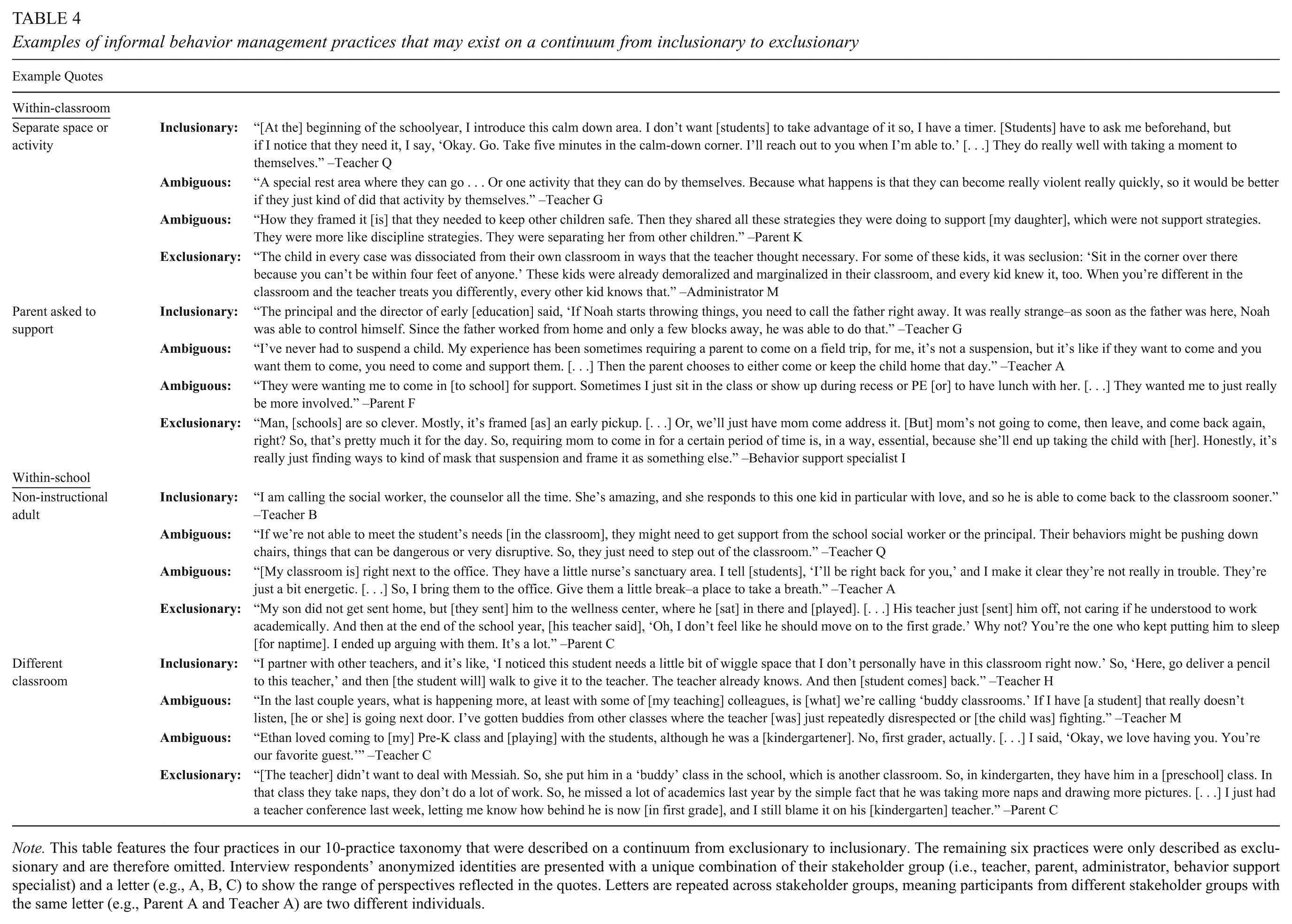
Note. This table features the four practices in our 10-practice taxonomy that were described on a continuum from exclusionary to inclusionary. The remaining six practices were only described as exclusionary and are therefore omitted. Interview respondents’ anonymized identities are presented with a unique combination of their stakeholder group (i.e., teacher, parent, administrator, behavior support specialist) and a letter (e.g., A, B, C) to show the range of perspectives reflected in the quotes. Letters are repeated across stakeholder groups, meaning participants from different stakeholder groups with the same letter (e.g., Parent A and Teacher A) are two different individuals.
For example, instructing a child to participate in a separate space or activity was described on a continuum from a “calm-down corner” where students can “[take] a moment to themselves” to prolonged “seclusion” that “demoralized and marginalized” students. A parent spoke directly to the ambiguity of a separate space or activity, explaining that what her daughter’s teachers perceived as “support strategies” felt to her “more like discipline strategies.” Similarly, whereas teachers described the practice of sending a child out with a non-instructional adult as more ambiguous or inclusionary, one parent recounted her son’s teacher “just [sending] him off” to the wellness center, “not caring if he understood the work academically.”
Finally, participants spoke of the practice of asking parents to support at school as more or less exclusionary as a function of family circumstances. A father working a remote white-collar tech job was described as able to come to his son’s school to support as needed, in some cases multiple times per week, enabling his child to remain in the classroom. By contrast, many participants explained that it was frequently impossible for low-income working parents, and particularly single parents, to miss work to come to their children’s school as requested. We thus include asking parents to support as an exclusionary practice, because even if the intention was inclusionary, for most parents in our sample, the impact was prohibitive and resulted in their child not being permitted to attend school on a given day.
For the purposes of this study, ambiguous examples are included in counts of informal exclusionary discipline practices in Table 3. Given the understudied nature of these practices as well as their potential profound negative effects, we err on the side of including ambiguous examples as exclusionary. We further do so to center the experiences of the young focal child, who is not accessing typical learning opportunities in the classroom alongside peers. However, we acknowledge that these practices occur in the context of transactional dynamics among teachers and students, nested within broader systems. Collectively, these nuanced findings speak to the importance of the underlying contexts and motivations that explain why these informal practices occur–the topic we turn to next.
Why Schools Utilize Informal Exclusionary Discipline Practices
Table 5 presents reasons cited by participants for the use of informal exclusionary discipline practices at the classroom and systems levels. Table 6 reports aggregate awareness of reasons as well as awareness across stakeholder groups.
Reasons why informal exclusionary discipline practices occur: Taxonomy, descriptions, and examples
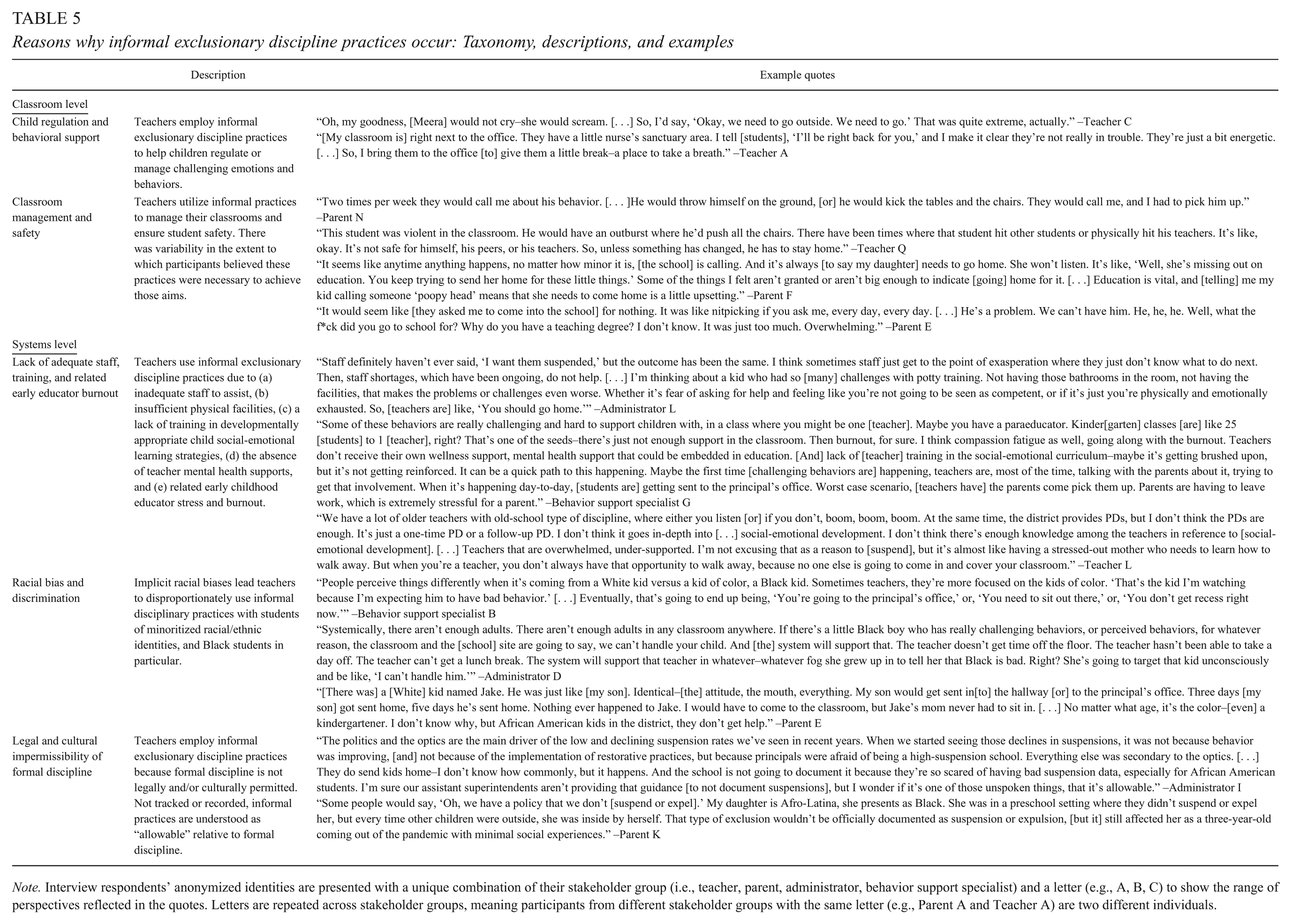
Note. Interview respondents’ anonymized identities are presented with a unique combination of their stakeholder group (i.e., teacher, parent, administrator, behavior support specialist) and a letter (e.g., A, B, C) to show the range of perspectives reflected in the quotes. Letters are repeated across stakeholder groups, meaning participants from different stakeholder groups with the same letter (e.g., Parent A and Teacher A) are two different individuals.
Reasons why informal exclusionary discipline practices occur: Awareness across parents, teachers, administrators, and behavior support specialists

Note. The second column reflects total mentions of a given reason by unique interview participants (N = 63). The third through sixth columns reflect the proportion of each of the four stakeholder groups–parents (n = 15), teachers (n = 17), administrators (n = 18), and behavior support specialists (n = 13)–that mentioned a given reason. In all cases, the researchers asked interview participants a general question about informal discipline practices, and participants organically described the reasons listed.
Classroom-level reasons
Roughly half (47%) of teachers mentioned using informal exclusionary discipline practices to help children regulate or manage challenging emotions and behaviors. As one teacher explained, when her students become dysregulated, she “brings them to the office [to] give them a little break–a place to take a breath.” By contrast, only one administrator (5%) and no parents or behavior specialists cited child regulation and behavioral support as an explanation for these practices.
Classroom management and safety was the most frequently reported reason overall, mentioned by 100% of teachers, 80% of parents, half (54%) of behavior support specialists, and a quarter (28%) of administrators. However, among participants who raised this reason, there was variability in the extent to which they believed these practices were necessary to maintain safe and calm classrooms. On the one hand, several teachers described child behaviors (e.g., hitting, knocking down chairs) that made the classroom “not safe” for their peers or themselves, warranting decisions to have children leave the classroom or go home. On the other hand, parents expressed frustration at being asked to come to school or pick up their child for “minor” or “little things” that they believed teachers should be able to handle.
Articulating the tension between competing classroom-level demands, one teacher reflected, “What do you do if this one student is affecting the whole classroom? Obviously, you want to look out for each and every child.” But as one teacher balancing the needs of many students, “we’re kind of stuck.”
Systems-level reasons
Participants reported several systemic reasons for the use of informal exclusionary discipline practices. The first is a lack of sufficient alternative resources with which to manage children’s behaviors and their broader classroom environments. Specifically, diverse stakeholders spoke of a dearth of staff and inadequate facilities (e.g., accessible preschool bathrooms) in early childhood settings across the district. Among those adults present in school buildings, participants described a lack of pre- and in-service training in developmentally appropriate, restorative social-emotional learning and behavior management practices. This lack of resources and professional development is further compounded by the absence of teacher mental health support, contributing to early childhood educators’ “[physical and emotional exhaustion],” “burnout,” and “compassion fatigue.” Half (47%) of teachers and 20–25% of parents, administrators, and behavior support specialists mentioned this interrelated set of factors, which we report together in light of the frequency with which participants mentioned them concurrently. Conversely, when additional school support staff (e.g., paraeducators) are available, teachers, behavior support specialists, and administrators alike described reduced reliance on informal exclusionary discipline practices.
Racial bias and discrimination was the second most commonly reported reason overall, mentioned by half of parents (53%) and behavior support specialists (47%), as well as a quarter (28%) of administrators. No teachers cited racial bias and discrimination as an explanation for informal exclusionary discipline practices. Participants other than teachers described implicit racial biases as leading educators to disproportionately “[focus] on the kids of color” and “[expect] bad behavior,” resulting in young students of minoritized racial/ethnic identities–and Black students in particular–getting singled out and informally excluded in ways that their White peers engaged in similar behaviors do not.
The final systems-level explanation offered by participants is that formal discipline is no longer legally and/or culturally permitted. This reason was mentioned by roughly a third (31%) of behavior support specialists and a quarter of teachers (24%) and administrators (22%), as well as by two (13%) of parents. In preschool, participants noted that formal suspensions and expulsions are both legally prohibited by state law and culturally forbidden as “not developmentally appropriate.” In transitional kindergarten and early elementary grades, participants described a climate in which schools are “so scared of having bad suspension data, especially for African American students,” that educators engage in “clever” “[types] of exclusion [that] wouldn’t be officially documented as suspension or expulsion.” Whereas suspensions may have previously been understood as reflecting poorly on suspended students, district stakeholders now understood suspensions as reflecting poorly on suspending adults/schools–a shift that has incentivized the use of unreported and thus more “allowable” informal exclusionary discipline practices.
Though we highlight these reasons separately for clarity, reasons co-occur within and across levels. For example, several participants described how inadequate early childhood staff and related educator burnout intersect with implicit racial biases to produce inequities in perceptions of and responses to child behaviors. As one administrator explained: There aren’t enough adults in any classroom anywhere. If there’s a little Black boy who has really challenging behaviors, or perceived behaviors, for whatever reason, the classroom and the [school] site are going to say, “We can’t handle your child.” And [the] system will support that. The teacher doesn’t get time off the floor. The teacher hasn’t been able to take a day off. The teacher can’t get a lunch break. The system will support that teacher in whatever–whatever fog she grew up in to tell her that Black is bad. Right? She’s going to target that kid unconsciously and be like, “I can’t handle him.”
Effects of Informal Exclusionary Discipline Practices
Child- and family-level effects
Participants described several effects of informal exclusionary discipline practices for impacted students, families, and schools. Table 7 presents descriptions and examples of effects that emerged across interviews. Table 8 reports aggregate awareness of effects as well as awareness across stakeholder groups.
Effects of informal exclusionary discipline practices: Taxonomy, descriptions, and examples
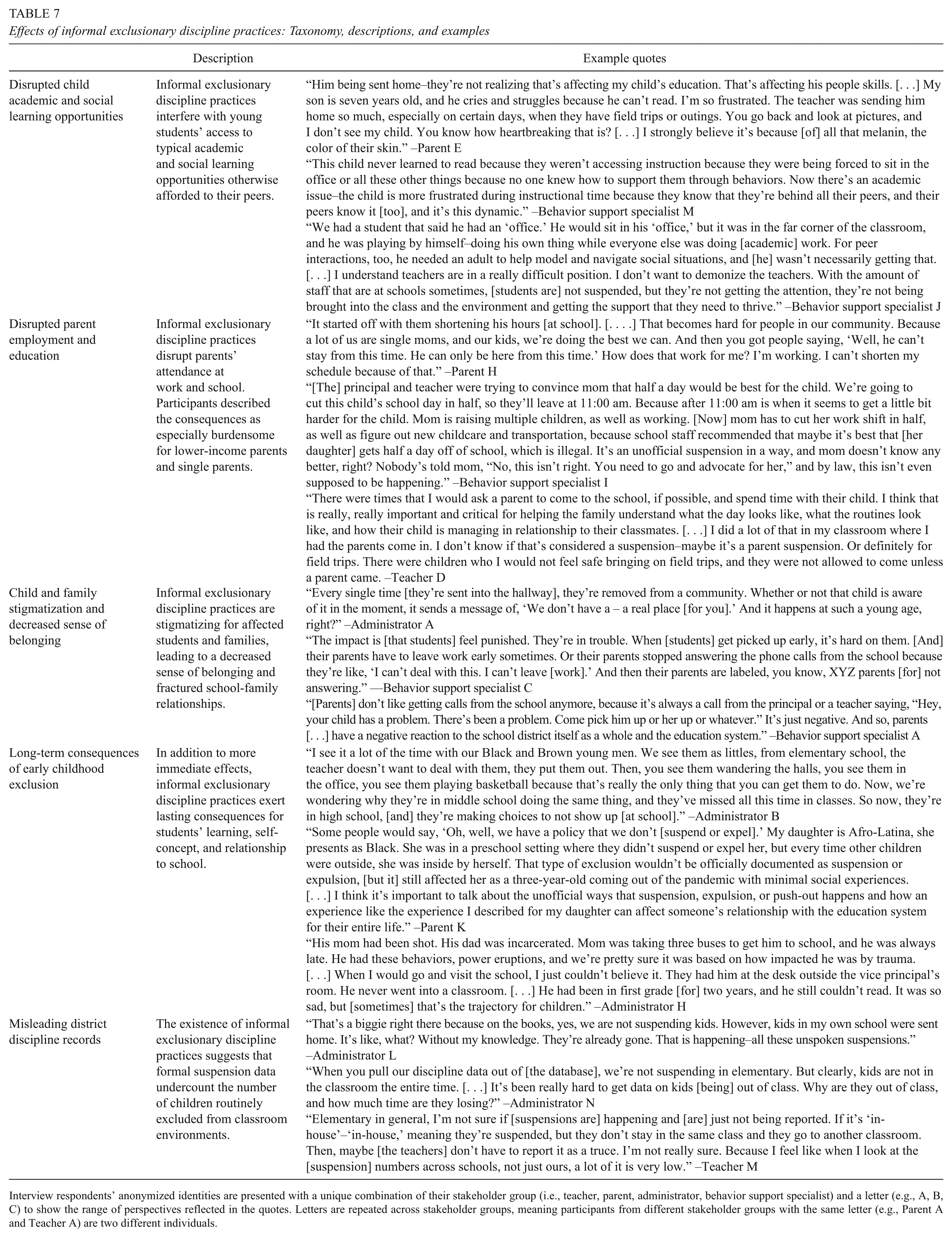
Interview respondents’ anonymized identities are presented with a unique combination of their stakeholder group (i.e., teacher, parent, administrator, behavior support specialist) and a letter (e.g., A, B, C) to show the range of perspectives reflected in the quotes. Letters are repeated across stakeholder groups, meaning participants from different stakeholder groups with the same letter (e.g., Parent A and Teacher A) are two different individuals.
Effects of informal exclusionary discipline practices: Awareness across parents, teachers, administrators, and behavior support specialists

Note. The second column reflects total mentions of a given effect by unique interview participants (N = 63). The third through sixth columns reflect the proportion of each of the four stakeholder groups–parents (n = 15), teachers (n = 17), administrators (n = 18), and behavior support specialists (n = 13)–that mentioned a given effect. In all cases, the researchers asked interview participants a general question about informal discipline practices, and participants organically described the effects listed.
One of the most commonly cited consequences of informal practices was disrupted child learning opportunities, mentioned by 40% of parents, 30% of teachers and behavior support specialists, and 22% of administrators. Multiple participants described negative repercussions for young children’s academic development–in particular, how repeated experiences of informal exclusion interfered with learning to read. In the words of one parent: “My son is seven years old, and he cries and struggles because he can’t read. I’m so frustrated. The teacher was sending him home so much.” Participants reported similarly harmful effects for young students’ social learning opportunities, including their “people skills” and abilities to navigate peer interactions.
A quarter (25%) of participants–including approximately half (47%) of parents–described informal exclusionary discipline practices as disruptive to parents’ employment or education. Parents, behavior support specialists, and administrators recognized informal exclusionary discipline practices as especially stressful and burdensome for low-income parents and single parents, who have less flexible work schedules and fewer resources with which to navigate schools’ requests. Both parents and teachers acknowledged that teachers did not intend to interfere with parents’ schedules by asking parents to pick up their children early or come into school to support, despite that often being the outcome. In the words of one anguished parent, “For a whole month, [the teacher] would be like, ‘Come get him now. Get him out early. I’m sorry, I don’t want to do that to you.’ But I was like, I’m going to lose my job. I’m going to lose my job.”
Children and families’ stigmatization and decreased sense of school belonging were the most frequently mentioned effects of informal exclusionary discipline practices, referenced by the majority (62%) of behavior support specialists and half (47%) of parents. As one behavior support specialist reflected, “Would you have felt a sense of love if every single time you came into this classroom, you were put over there in the corner?” Despite their young ages, students were described as aware of being “singled out,” in some cases even asking their parents if they are “a bad kid.” Participants noted that students’ peers picked up on these dynamics as well. One administrator explained, “When you’re different in the classroom and the teacher treats you differently, every other kid knows that.”
Participants also cited stigmatizing impacts for parents, many of whom received repeated negative communication from their children’s schools. After her daughter was routinely separated from her preschool classmates, one mother explained, “I had a lot of internalized . . . I must be doing something wrong. I’m failing. I’m a bad mom. This is my fault.” Others described parents developing frustration and distrust to the point of no longer answering the school’s phone calls. While some teachers (18%) acknowledged in-the-moment stigmatizing effects of being separated or sent home for children, teachers did not discuss broader negative ramifications of these practices for family-school relationships.
Some participants characterized experiences of informal exclusion as traumatic events with long-term consequences for students’ educational trajectories. As one behavior support specialist explained, in addition to disproportionately affecting students with prior histories of trauma, these informal exclusionary discipline practices “are and can be considered adverse childhood experiences in and of themselves.” This participant expressed disappointment that more district colleagues did not seem to recognize the potential lasting effects of informal exclusion for children’s future wellbeing and access to opportunities–a disappointment substantiated by the 0% of teachers who mentioned longer-term implications. Nevertheless, 22% of administrators, as well as 33% of parents, referenced lasting effects for students’ learning, self-concept, and relationship to school. For example, one administrator described how the same students sent out in preschool–most often Black and Brown boys–were similarly excluded in middle school, leading them to fall behind, internalize that they don’t belong, and skip additional school as adolescents.
Systems-level effects
The final effect surfaced by participants involves schools’ misleading district discipline data. This consequence was cited by 28% of administrators, rendering it the most commonly discussed effect among that stakeholder group. Expressing skepticism in the accuracy of the official discipline records, one administrator reflected, “When I first got the data, I was like, ‘Hey, wait a minute. It’s 0, 0, 0, 0, 1.’ [. . .] You got this particular population of students at this grade level–there’s got to be more than zero [suspensions].” Other participants echoed this theme, explaining that because informal exclusionary practices are “unspoken” and “undocumented,” formal suspension data systematically undercount the number of children routinely excluded from classroom environments.
Discussion
A decade after Obama-era formal school discipline reforms, our study sheds light on a range of informal exclusionary discipline practices that have emerged in public preschool and early elementary settings. Drawing on in-depth interviews with 63 parents, teachers, administrators, and behavior support specialists in the San Francisco Unified School District, we provide evidence of within-classroom, within-school, and out-of-school informal exclusionary discipline practices. These practices occur when mandates to reduce formal discipline are not paired with resources for more restorative and developmentally appropriate behavior management approaches.
By disproportionately affecting racially/ethnically and economically marginalized students and families, informal exclusionary discipline practices reproduce formal school discipline disparities and contribute to further educational inequities. Specifically, these practices have both short- and long-term consequences, including disrupted child learning opportunities, disrupted parent employment and education, and decreased child and family sense of school belonging. Finally, the existence of these undocumented practices suggests that formal school discipline records undercount the number of young children routinely excluded from classroom learning environments.
Young Students Experience Informal Exclusionary Discipline Practices
Our findings demonstrate that informal exclusionary discipline practices exist and, like formal discipline (Gilliam, 2005; U.S. Department of Education Office for Civil Rights, 2014), emerge early in children’s educational trajectories. Participants referred to these practices using a variety of terms, including “unofficial,” “silent,” “soft,” “hidden,” “quiet,” “minimal,” and “clever” discipline. We found evidence of a taxonomy of practices that emerge in the context of bidirectional teacher-student transactions and grow progressively exclusionary, as children move from being isolated in their classrooms, to outside their classrooms but within their schools, to no longer at school entirely. Specifically, within-classroom practices include when teachers instruct a child to participate in a separate space or activity, ask parents to support, or when all other peers leave the classroom. Within schools, practices entail teachers sending a child outside with a non-instructional adult, to a different classroom, or into the hallway unsupervised. Informal out-of-school practices occur when a child is sent home, told to stay home, has their schedule reduced, or is transferred or never enrolled.
The vast majority (90%) of participants reported the existence of one or more informal exclusionary discipline practices, including 100% of teachers, 89% of administrators, 87% of parents, and 85% of behavior support specialists. The two most commonly cited practices involve sending a child out with a non-instructional adult or home early, mentioned by 59% and 47% of participants, respectively. Concerningly, certain within-classroom and within-school practices (e.g., peers leave, different classroom) were described by significant proportions of teachers but were barely known to parents or administrators in our sample. Further, our findings suggest that children may experience these practices over time as a cascade–for example, teachers initially instructing them to engage in a separate space or activity within the classroom before sending them to the principal’s office and, weeks later, reducing their school schedule. Together, these results underscore the importance of elevating awareness about more subtle within-classroom and within-school informal exclusionary practices, which may be precursors to increasingly exclusionary out-of-school experiences.
Despite being known to parents, teachers, administrators, and behavior support staff alike, informal exclusionary discipline practices remain invisible in district administrative records, which only track formal suspensions and expulsions. This finding corroborates an emerging body of evidence on the existence of undocumented informal suspensions and expulsions (Gleit, 2025; Murphy et al., 2024; O’Grady et al., 2024; Williford et al., 2023; Zinsser et al., 2022, 2024). Collectively, this research suggests that current administrative records undercount the number of students forcibly excluded from their schools (Gleit, 2025) and highlights the need for systematic data collection on these informal practices. Simply put, because these practices are not recorded, we do not know how commonly they occur.
To remedy this knowledge gap, federal, state, and district discipline data collection should include questions about informal exclusionary practices and triangulate reports from multiple stakeholders (e.g., administrators, teachers, families). Further, data should be disaggregated by race/ethnicity, income, gender, language, and disability status for transparency and accountability. To start, we specifically recommend incorporating questions about informal out-of-school exclusionary discipline practices (e.g., sending a child home, reducing a child’s schedule) into the biannual federal Civil Rights Data Collection survey (U.S. Department of Education Office for Civil Rights, n.d.). 4 States and districts can additionally revise existing school climate surveys, many of which solicit both parent and teacher reports of formal discipline practices (e.g., the California School Climate, Health, and Learning Survey; California Department of Education, n.d.) to ask about informal within-classroom, within-school, and out-of-school practices. Once quantitative data have been gathered, future scholarship can examine the prevalence, disparities, precursors, and consequences of informal exclusionary discipline practices in representative samples.
As more data is gathered, we can develop increasingly nuanced understandings of informal exclusionary discipline practices and refine our taxonomy and data collection instruments accordingly. Beyond the spatial dimension of exclusion, scholars can attend to important dimensions such as dosage–the frequency and length of a child’s exclusionary experience–as well as differences by developmental period (Steyer et al., 2025). Indeed, some informal practices, such as briefly sending a dysregulated preschooler to another classroom with a developmentally appropriate task (e.g., to sharpen a pencil), may even be adaptive, granting a child agency without prolonged disruptions to their learning. This may be especially true in early childhood education settings, where not all periods involve academic instruction. Future research should examine when and how such practices may function as developmentally supportive rather than exclusionary.
A Long and Racialized History of Early Childhood Exclusion Continues
The Obama administration’s 2014 call to reduce racial/ethnic disparities in suspensions and expulsions was an essential course correction for educational justice. Nevertheless, when legal and cultural mandates to reduce formal discipline are not paired with resources for restorative behavior management alternatives, such mandates may inadvertently prompt the use of informal exclusionary discipline practices that reproduce racial inequities. Specifically, participants reported that informal exclusionary discipline practices disproportionately impact students of minoritized racial/ethnic identities, and Black students in particular. Indeed, half of the parents and behavior support specialists described informal practices as racialized and as resulting in young children being excluded due to the color of their skin. In America’s long history of evolving forms of racial exclusion, our work suggests that informal disciplinary practices constitute an emerging mechanism (Alexander, 2012; Skiba et al., 2022).
Our results further demonstrate that informal exclusionary discipline practices reproduce the harms of formal discipline for students by disrupting children’s access to learning opportunities (e.g., Losen & Martinez, 2020b) and contributing to stigmatizing experiences that decrease students’ sense of school belonging (Fisher et al., 2020). In addition to negative impacts for students, these practices have harmful ramifications for entire families, including interfering with parents’ employment. In line with prior studies on formal discipline (e.g., Losen, 2011), we found that informal practices are especially disruptive for low-income families and single-parent families, given the additional stress that having a child sent home may cause. Alongside aforementioned discriminatory experiences, these disruptions to child learning and parent employment produce fractured school-family relationships for affected families and particularly Black families. These findings speak to the urgency of interventions to repair trust and ensure that families of minoritized racial/ethnic identities feel respected and affirmed (Collins et al., 2024; Wahman et al., 2022).
The Use of Informal Exclusionary Discipline Practices Reflects Systemic Underinvestment in Early Childhood Education
Diverse participants acknowledged the profoundly difficult constraints faced by early childhood educators, noting that informal exclusionary discipline practices stem from structural failings that impede educators’ abilities to simultaneously maintain safe classrooms while meaningfully including all students. Specifically, we found that informal practices result from a lack of early childhood staff and facilities, inadequate pre- and in-service training in restorative behavior management approaches, a dearth of teacher mental health supports, and consequent educator stress and burnout. These findings corroborate scholarship suggesting that informal exclusionary practices emerge when educators lack the capacity and resources with which to holistically manage children’s behaviors (Gleit, 2025; O’Grady et al., 2024; Williford et al., 2023) and underscore the need to distinguish between legitimate safety concerns and lower-level disruptive behaviors. Paired with empirical and journalistic evidence that today’s youngest learners are entering school with unprecedented levels of behavioral concerns (e.g., throwing chairs, biting, hitting; Kuehn et al., 2024; Miller & Mervosh, 2024), this work amplifies calls for greater investments in our early childhood educator workforce and systems.
At the teacher level, such investments should include increased early childhood educator pre-service and in-service training to prevent and respond to students’ behavioral challenges with evidence-based, culturally responsive social-emotional learning (SEL) strategies. We particularly recommend transformative SEL approaches (Jagers et al., 2019) that explicitly emphasize equity and seek to dismantle racism and ableism, as SEL on its own is not sufficient to overcome intersectional forms of discrimination. Relatedly, teacher professional development in restorative classroom management can improve students’ academic, behavioral, and social-emotional outcomes (Cruz et al., 2021; Korpershoek et al., 2016) and reduce the use of and racial disparities in formal exclusionary discipline (e.g., Gregory et al., 2015). Similar teacher training interventions should be tested for efficacy in mitigating the prevalence and disproportionality of informal exclusionary discipline practices.
These efforts must also wrestle with the nuanced ways in which within-classroom and within-school practices intended as inclusionary (e.g., having a child visit a calm-down corner or step outside the classroom with a supportive staff member) may inadvertently become exclusionary if overused or misused. Applying a transactional model can help researchers and educators alike understand how well-intentioned practices may slip as a result of negative reinforcement cycles in which past interactions with students shape teachers’ future responses to student behavior (Sutherland & Oswald, 2005). As Alamos and Williford (2023) emphasize, teachers’ implicit racial biases may make them especially likely to perceive the behaviors of young children of color as challenging, prompting disproportionately punitive responses to future perceived misbehaviors—particularly when teachers are under stress. At the same time, young children who routinely experience racialized classroom dynamics—such as being disciplined more frequently or more harshly than peers—may begin to feel singled out or unwelcome, leading to increased dysregulation and classroom disruption that, in turn, reinforces teachers’ reliance on exclusionary strategies.
To these points, despite the importance of enhanced teacher training in transformative SEL and restorative classroom management approaches, these skills alone are insufficient without adequate on-the-ground resources. A vast body of scholarship attests to early educators’ chronically poor working conditions, including large class sizes, inadequate breaks, low compensation and benefits, and subpar facilities and physical environments (e.g., Allen et al., 2022). Alongside a dearth of teacher mental health supports, these factors contribute to profound early educator stress and burnout. These resource inequities are not randomly distributed but are the product of broader patterns of structural racism, which have historically underfunded early education systems that both serve and employ racially and economically marginalized communities (e.g., Allen et al., 2022). Our findings suggest this systemic underinvestment—and the educator stress and burnout it produces—is a risk factor for the disparate treatment of racially minoritized young students. Accordingly, sustained investments are needed to address the underlying structural conditions that create the context for such disparate treatment.
While many parents (53%) linked educators’ racial biases to their use of informal exclusionary discipline practices, no teachers (0%) in our sample explicitly made this connection. Conversely, nearly half of teachers (47%) cited children’s regulation and behavior-support needs as a reason for these informal practices, but no parents (0%) did. These findings reveal profound disconnects among parents’ and preschool and early elementary teachers’ understandings of the root causes of informal discipline. Collectively, these findings speak to the need for sustained, multifaceted coaching and support for teachers beyond one-off professional development sessions on isolated topics (e.g., teacher wellness, implicit racial biases) to produce more equitable student experiences. Specifically, integrated coaching and supports should attend to the interplay among teachers’ stressors and racial and cultural biases, including how stressors may exacerbate such biases. At the same time, investments in culturally responsive family engagement can foster strong relationships between teachers and parents characterized by mutual empathy. Crucially, prior work suggests that such relationships can serve as protective factors against early childhood exclusionary discipline (Wahman et al., 2022; Zulauf & Zinsser, 2019; Zulauf-McCurdy & Zinsser, 2022).
At the district and state levels, our findings underscore the need for additional funding to sufficiently staff evidence-based tiered behavior management approaches that serve as non-punitive alternatives when classroom challenges arise. Across early childhood and K–12 settings, tiered approaches like positive behavioral interventions and supports (PBIS) and restorative justice (RJ) have been shown to effectively reduce formal discipline and related racial discipline gaps, especially when implemented with fidelity and an equity orientation (e.g., Clayback & Hemmeter, 2021; McIntosh et al., 2021). Nevertheless, uneven investment in and implementation of restorative approaches means they may fall short of their potential to reduce exclusionary discipline (Welsh, 2023). For example, the 2023 California state budget allocated just $7 million for its more than one thousand districts to implement restorative justice practices–a mere fraction of the resources required for large districts like SFUSD to make necessary shifts (Cornwall, 2024). Additional systemic changes should prioritize building trusting relationships with racially/ethnically minoritized families, which prior work suggests can happen through avenues such as the intentional hiring and equitable compensation of Black teachers and staff (e.g., Latunde, 2017).
Limitations and Future Directions
This study benefits from a large, racially/ethnically diverse qualitative sample that encompasses a range of perspectives–including those of parents, teachers, administrators, and behavior support specialists–in the San Francisco Unified School District (SFUSD). Though we corroborate emerging empirical evidence of informal exclusionary practices in other districts and states (Gleit, 2025; Murphy et al., 2024; O’Grady et al., 2024; Williford et al., 2023), our data is drawn from a single urban public school district in California, limiting its generalizability. Future qualitative research should inductively investigate the kinds, causes, and consequences of informal exclusionary discipline practices in diverse educational settings (e.g., districts with different policies and cultural norms around discipline) to surface additional patterns of informal exclusion. In particular, studies should examine how these practices manifest across student populations with varying racial and ethnic compositions, including settings where Asian or Latine students represent a smaller or larger share of enrollment. This work is critical to understanding how racialized discipline operates across demographic and geographic contexts.
This study grew out of a broader research-practice partnership to investigate SFUSD’s efforts to reduce longstanding racial discipline disparities. As a result, all parents had, and all teachers and behavior support specialists had recently worked with, a child identified as having high-level behavioral needs who faced an increased likelihood of future suspension. While this is a strategic sample in which to examine the kinds, causes, and consequences of informal exclusionary practices, these parents and educators are not representative of SFUSD at large. Novel work should explore these practices with more representative samples and supplement findings with quantitative surveys to understand prevalence and disparities. Such scholarship can also attend to the roles of gender, disability, and intersectionality therein–key themes in the broader school discipline literature (e.g., Annamma et al., 2020) that were not the focus of our interviews and thus did not surface in our data. In particular, because our sample was drawn from a general education program that did not serve children with disability designations, future studies should attend to the intersectional experiences of students in special education.
Conclusion
As of 2024, at least 17 states and D.C. have passed laws limiting the use of formal suspensions and expulsions in preschool and early elementary grades (Education Commission of the United States, n.d.). If we seek to end inequitable and developmentally inappropriate experiences of early childhood disciplinary exclusion, such legislation is necessary but not sufficient. In particular, we offer evidence of informal exclusionary discipline practices that inadvertently emerge in the absence of alternative resources and strategies with which to restoratively meet young children’s behavioral needs. This work has important equity implications, as the very children excluded for behavioral reasons are often those who stand to benefit most from early childhood education (Murano et al., 2020). Moreover, these early informal practices disenfranchise young students and families at the start of their educational journeys, with lasting repercussions for student learning, parent employment, and families’ sense of school belonging. In sum, our findings amplify calls to conceptualize exclusionary discipline as an adverse childhood experience (Cribb Fabersunne et al., 2023) and to address both formal and informal discipline with collective urgency.
Supplemental Material
sj-docx-1-ero-10.1177_23328584251375062 – Supplemental material for De Facto Suspensions: Informal Exclusionary Discipline Practices in Public Preschool and Early Elementary Settings
Supplemental material, sj-docx-1-ero-10.1177_23328584251375062 for De Facto Suspensions: Informal Exclusionary Discipline Practices in Public Preschool and Early Elementary Settings by Lily Steyer, Maya Provençal, Francis Pearman and Jelena Obradović in AERA Open
Footnotes
Acknowledgements
The opinions expressed are those of the authors and do not represent the views of the Institute of Education Sciences, the U.S. Department of Education, or the Board of Trustees of the Leland Stanford Junior University. We would like to thank Meenoo Yashar and Christie Herrera (respectively the former and current assistant superintendents of early education in the San Francisco Unified School District) and their staffs, as well as Laura Wentworth (director of the Research-Practice Partnership Program at California Education Partners)
Declaration of Conflicting Interests
The author(s) declared no potential conflicts of interest with respect to the research, authorship, and/or publication of this article.
Funding
The author(s) disclosed receipt of the following financial support for the research, authorship, and/or publication of this article: This research was supported by a grant from the Stanford University Graduate School of Education; the Stanford Data Science Scholars program; the Institute of Education Sciences, U.S. Department of Education, under Grant R305B140009; and the Jacobs Foundation under Advanced Research Fellowship 2017-1261-07 to Jelena Obradović.

Notes
Authors
Dr. LILY STEYER is the director of child policy at the Clinton Foundation and a Society for Research in Child Development State Policy Fellow with the California Department of Education;
MAYA PROVENÇAL is a Ph.D. student at the Stanford Graduate School of Education;
Dr. FRANCIS PEARMAN is an assistant professor of education in the Graduate School of Education at Stanford University;
Dr. JELENA OBRADOVIĆ is a developmental psychologist, a professor at Stanford University in the Graduate School of Education, and the associate director of the Stanford Center on Early Childhood;
References
Supplementary Material
Please find the following supplemental material available below.
For Open Access articles published under a Creative Commons License, all supplemental material carries the same license as the article it is associated with.
For non-Open Access articles published, all supplemental material carries a non-exclusive license, and permission requests for re-use of supplemental material or any part of supplemental material shall be sent directly to the copyright owner as specified in the copyright notice associated with the article.
