




Abstract
Low bachelor’s degree receipt rates by community college students have been attributed to credit loss arising from vertical transfer. However, there has been limited quantitative study of the association of transfer with credits’ degree-requirement applicability. This research used a novel student record archive to track the degree-requirement applicability of a targeted sample of 796 vertical transfer students’ credits prior to and through transfer. The results show that credits can move in and out of degree applicability at multiple points in a student’s career, not just associated with transfer, that transfer sometimes can be associated with vertical transfer students’ credits becoming degree-requirement applicable, and that articulation between associate and bachelor’s programs can be associated with degree-applicable credit and course transfer. These results can help guide policies that will maximize students’ efficient accumulation of degree-applicable credits.
Keywords
Introduction
Much concern has been expressed about the leaks in the vertical transfer student pipeline, the pipeline from enrollment in an associate program (in a community college) to attainment of a bachelor’s degree. In a recent national study, ~80% of community college students reported seeking at least a bachelor’s degree (CCCSE, 2023), but in another study, only ~16% achieved that goal within 6 years, with lower values for students from underrepresented groups (Velasco et al., 2024). The leaks in this pipeline are unfortunate given that the median annual salary of bachelor’s degree holders is about $15,000 higher than that of those with associate degrees (Ma et al., 2019), and that U.S. jobs will increasingly require postsecondary education (Carnevale et al., 2023). Given that 41% of U.S. postsecondary students are enrolled in community colleges (close to 9 million students; Community College Research Center, n.d.), hundreds of thousands of U.S. prospective vertical transfer students are not attaining their educational and employment goals, particularly students from underrepresented groups.
The possible cause of the leaks in the vertical transfer pipeline that has received the most attention is what has been called credit loss. This is a general term that has been used by almost all studies until recently to refer to any credits earned in associate programs that do not transfer to bachelor’s programs (see, e.g., Government Accountability Office [GAO], 2017; Monaghan & Attewell, 2015). Credit loss results in students having to take more total credits than are needed for their bachelor’s degrees, a waste of time and money. Therefore, many states (e.g., California, Florida, North Carolina, and Texas) have passed legislation or enacted policies to try to ensure that associate program credits transfer to bachelor’s programs, including automatic transfer of a core of lower-division general education courses and/or specific major courses (i.e., articulation agreements; Whinnery & Peisach, 2022). This study examined credit loss in detail, including different types of credit loss.
The equity implications of any type of credit loss are substantial. Community (associate) colleges tend to enroll higher percentages of students from underrepresented groups (National Center for Education Statistics, 2023), and students who begin college in community colleges are less likely to attain their bachelor’s degrees than similar students who begin in bachelor’s programs (Schudde & Brown, 2019; Xu et al., 2020). The leaky vertical transfer pipeline therefore differentially harms students from underrepresented groups. Anything, such as credit loss, that makes it more difficult to attain a bachelor’s degree if a student starts at a community college constitutes higher education inequity.
For community college students, the wasted time and money caused by lost credits can have profound implications due to these students’ limited resources. Community college students are more likely to be Pell Grant recipients (Walker, 2024), with fewer funds to cover the cost of excess credits. In addition, community college students may have more demands on their time. In a sample of >31,000 City University of New York (CUNY) undergraduates, Logue et al. (2022) found that almost one third (31%) of vertical transfer students reported caring for someone at home at least 10 hours per week, whereas only 18% of bachelor’s degree students who had never transferred reported such responsibilities. Whether and how vertical transfer students’ credits are lost are critical issues for ensuring higher education success and equity.
Previous Research
For >20 years, studies have quantitatively examined vertical transfer students’ credits. Together these studies appear to show that lack of credit transfer is substantial and that it decreases vertical transfer students’ success. However, due to limitations in these studies’ methodologies, the conclusions that can be drawn from their results are also limited.
How Many Credits Are Lost?
In the earliest of these studies, the Texas Higher Education Coordinating Board (2001) 1 examined thousands of individual student transcripts from five Texas public universities. On average, the number of transfer students’ credits not accepted varied between 4 and 39 depending on the sending institution. Texas has continued to be at the forefront of tracking transfer students’ credits. For example, a 2021 report from the Texas Association of Community Colleges and Philanthropy Advocates estimated that the average Texas bachelor’s graduate who had earned community college credits had lost 9.8 credits due to transfer. In other state-focused research, Giani (2019) found that transfer students to Hawaii and North Carolina universities lost an average of 3.9% and 7.2% of their credits, respectively. The CUNY Office of Policy Research (2022) examined credit loss in 5,700 CUNY vertical transfer students. The study found that 47% of the students had lost degree-applicable credits between their associate and bachelor’s programs and estimated that only 21% of those credits were lost for reasons other than transfer. In 2017, the GAO released startling national findings. The GAO found that, on average, students who transferred lost 43% of their credits, a number large enough to cause substantial delays in students finishing their degrees, if they finished at all. The value of 43%, an outlier in comparison to what all other studies have found, is often referred to in the higher education press (e.g., D’Orio, 2022).
Which Variables Are Associated with More Credit Loss?
A few studies have examined which variables predict credit loss. Simone (2014) found that the higher the student’s grade point average (GPA), the more credits were transferred, and that vertical transfer students at public institutions lost about 20% of their credits. A study by Fink et al. (2018) using transcript data from two state systems examined the critical topic of credit applicability, instead of just looking at credit transferability. This study investigated which student demographic and academic variables were associated with students accruing excess credits, including excess credits resulting from associate-degree credits not transferring to bachelor’s degrees. One of the findings was that Black students were more likely to accumulate excess (inapplicable) credits.
How Is Credit Loss Associated with Student Success?
Doyle (2006) found that only about half of students were able to transfer all their credits and that those who were able to do so received their bachelor’s degrees more quickly. Monaghan and Attewell (2015) found that the more credits vertical transfer students lost when transferring, the less likely they were to complete a bachelor’s degree. Belfield et al. (2017) tracked transfer students’ records for 6 years. The researchers found that both loss of credits on transfer and the fact that some students never transfer decrease the economic efficiency of starting in a less expensive community college with a goal of earning a bachelor’s degree. Zhang (2022a) used vertical transfer students’ transcripts from a public research university, finding that various indicators of early academic momentum, including the number of community college credits accepted for transfer, were associated with obtaining a STEM (science, technology, engineering, mathematics) bachelor’s degree. Zhang (2022b), also examining vertical transfer students’ transcripts, found that students who had initially declared a STEM major on transfer were less likely to receive a STEM bachelor’s degree if they transferred fewer courses. Zhang’s findings were consistent with those of Spencer (2023), who, using a national dataset and student transcripts, concluded that vertical transfer students have a lower probability of completing a bachelor’s degree if they lose credits due to transfer.
Data Limitations
None of these studies had access to data showing how many of the students’ credits were lost at the actual point of transfer. Further, with the exceptions of Fink et al. (2018) and CUNY Office of Policy Research (2022), none considered the degree applicability of credits.
Conceptual Framework
The prior studies, in examining transfer students’ credits, determined whether courses, and thus their credits, transferred from community to bachelor’s colleges—they examined lost credits. They usually did this by means of time-consuming review of individual transcripts to determine whether courses taken at a community college appeared on a vertical transfer student’s transcript. However, simply knowing whether credits transfer from one college to another is insufficient in assessing credit transfer. Transfer credit success involves credits transferring as applying to specific degree requirements and not just as electives (Couturier & Kadlec, 2021). When credits originally taken to satisfy general education or major requirements subsequently transfer only as electives, students may have less flexibility in their academic programs, have to retake courses or take extra courses, accumulate excess credits, run out of financial aid and/or pay extra tuition, take extra time to graduate, or even not graduate (Fink et al., 2018; GAO, 2017). Examination of credit transfer needs to include an examination of whether credits transfer as applying to degree requirements (general education, major, and elective requirements), not just whether credits transfer at all.
Further, the transcripts used by all prior studies were retrieved at various times following transfer. Thus, the information contained in these transcripts could represent the status of a student’s record immediately following transfer, or it could represent the status of a student’s record much later, when a variety of factors may have modified which courses transferred from the community college and how they transferred. For example, following transfer, a student could change their major, resulting in previous credits counting for the student’s major now counting only as electives. With a major change, the previous major credits might even become excess credits if the student had already earned the maximum number of electives for their degree. Only by examining the status of credits immediately before and after transfer is it possible to determine the relationship between transfer and credits.
In our conceptual framework, it is not just an absence of community college credits on a bachelor’s student’s transcript that hinders transfer student success, but also an absence of degree-applicable community college credits specifically in association with transfer. Only such an association can help target transfer practices and transfer credit policies that are hindering degree-applicable credit accumulation and thus can suggest ways to increase transfer student success.
This Research
This research used a novel student records archive to track, at specific points in time, including immediately before and after transfer, changes in the applicability to degree requirements of the credits of a targeted sample of vertical transfer students. Applicability changes related to both transfer and other factors were tracked. The research sought to answer the following two specific questions:
When and to what extent did credits lose and gain applicability, especially in association with transfer?
Were credits and courses of vertical transfer students with particular demographic or academic characteristics more likely to lose degree applicability, and if so, why?
The goal of this research was to illustrate the relationship of transfer with credits’ degree applicability in a targeted sample consisting largely of students from underrepresented groups, the type of vertical transfer students of most concern. In this way, the research can help identify transfer policies or situations whose modification can facilitate the transfer of degree-applicable credits and thus speed and increase degree completion. The results demonstrate that credits can be, and can become, inapplicable to degree requirements at multiple points in time, not just at the time of transfer; that sometimes credits can gain applicability in association with transfer; and that articulation between associate and bachelor’s programs is related to whether credits transfer as degree applicable. The results therefore put facilitation of credit transfer into a broader context of strategies to support transfer students, while at the same time demonstrating that there are numerous nuances to credit transfer that support the need for accurate and detailed data to maximize transfer student success.
Methods
Research Site and Its Transfer Policies
This research was conducted using the academic records of students at three colleges of CUNY, a system of 20 undergraduate colleges all located within the five boroughs of New York City. Bronx Community College and Hostos Community College offer only associate degrees, and Lehman College offers only bachelor’s, master’s, and doctoral degrees. These three colleges are all located in the same New York City borough (the Bronx), and for decades have worked together to facilitate transfer from associate to bachelor’s programs, including by the construction of multiple articulation agreements. Bronx sends 50–60% of its CUNY vertical transfer students to Lehman, and Hostos sends 40–50% (internal “Transfer Report for Sending Colleges, Trends,” Z. Tang, personal communication, February 20, 2024). Since 2017, these three colleges have been meeting regularly to resolve credit-transfer problems among them (Bronx Transfer Affinity Group [BTAG], https://bit.ly/3R74y7C).
CUNY has several systemwide policies that facilitate intrasystem transfer, for both students and credits (Logue, 2017; Pathways, https://bit.ly/49DWYZX). First, CUNY community college students are not required to complete associate degrees (which usually require 60 credits) before transferring to CUNY colleges offering bachelor’s degrees (which usually require 120 credits). Second, all courses transfer among all CUNY colleges with at least elective credit—no credits are totally lost when a student transfers from one to another CUNY college. Third, the credit the receiving college gives to a transferred course (the transfer credit rule for a particular course, formalized in the receiving college’s software) is independent of other courses the student may have taken, the student’s major, the origin of the credit (e.g., online or dual enrollment), whether the student has a degree, or any other student characteristic. Some transfer credit rules do differ depending on the grade the student received in the sending college’s course. Fourth, CUNY has a 30-credit general education (Common Core) requirement for all associate of arts, associate of science, and bachelor’s degree-students. Other types of associate degrees (such as an associate of applied science [AAS] degree) typically require only part of the 30-credit Common Core, in addition to a relatively large number of major credits. Students who transfer from, for example, an AAS program to a bachelor of science (BS) program, must complete any remaining parts of the Common Core, in addition to any bachelor’s degree requirements, to receive the bachelor’s degree. When a student satisfies any category of the Common Core at any CUNY college, that student is deemed to have satisfied that category at all CUNY colleges. Colleges are not permitted to add general education requirements beyond the Common Core, except that bachelor’s programs all require an additional six to 12 credits of college-specific general education courses.
However, transfer of CUNY major credits is often not seamless. Although CUNY lists at least three initial courses that are supposed to be offered by, and transfer to, all colleges for each of 18 majors, the offering and transfer of these courses are not enforced, and many required initial courses for these 18 majors are not on the lists. Further, there are dozens of CUNY majors with no list. For these reasons, a course counting toward a particular major at one college may count for only elective credit at another college—a transfer student in that major may need to take a substantively similar course at the destination college (for examples, see CUNY Transfer Explorer, https://bit.ly/3DdeHYR). If a student in this situation has already earned the maximum number of elective credits allowed for their degree, any additional elective credits become excess credits, a waste of time and money. Some CUNY colleges have instituted articulation agreements to try to address some of these major credit problems, but the agreements cover only the most traversed transfer paths and are extremely time consuming to create and maintain, plus the records and communication concerning these agreements are inadequate (Logue et al., 2023).
Finally, it should be noted that, despite CUNY’s policy that all credits transfer as at least electives, new credits sometimes can appear on, and existing credits sometimes can disappear from, students’ records when they transfer. For example, a student newly matriculated at Bronx or Hostos may have some college credits taken while in high school (dual-enrollment credits), but those credits may not be recognized by the student’s community college and so are not entered into this pre–transfer student’s record. However, Lehman may recognize these credits, entering them into the student’s record following transfer, and then either apply them or not apply them to the student’s degree requirements.
Data Sources and Analytic Strategy
All CUNY colleges use Ellucian’s Degree Works software to record and audit students’ academic records, with all data accessible centrally. This software provides information about the degree-requirement applicability of each student’s courses. For example, credits with “applied to degree (applicable)” status
can be indicated as general education, major, or minor credits, or as credits required for a degree but that satisfy no other requirements (which we refer to as elective credits).
In contrast, credits that have “not-applied-to-degree (inapplicable)” status include
credits for which a student received an insufficient grade (e.g., a W [withdrawal] or an F, which we refer to as insufficient credits);
credits for valid courses with valid grades but which do not satisfy any degree requirements, including not satisfying the required number of elective credits, because a student already has enough elective credits (these are what we refer to as overflow, or excess, credits); and
transfer credits that are for valid courses with valid grades but that are more than the number of credits that an institution permits to be transferred (i.e., credits not permitted by an institution’s residency requirements, which we refer to as over-the-limit credits).
For this research, we combined the numbers of overflow and over-the-limit credits as our total not-applied-to-degree (inapplicable) credit numbers, disregarding the insufficient credits, which cannot, under any circumstances, be applicable to any degree requirements.
However, although Degree Works records this detailed credit information, each time a student’s Degree Works record changes, Degree Works overwrites the student’s previous record (i.e., Degree Works is a transactional database). Therefore, to determine whether transfer was associated with vertical transfer students’ community college credits being applicable or inapplicable to degree requirements, in 2019 we began archiving the Degree Works records for students transferring from Bronx or Hostos to Lehman. We added a student’s record to the archive whenever there was going to be a change in that student’s record. The data analyzed here come from the first 796 such vertical transfer students who, in addition to their archive records, had CUNY central office database records (i.e., records of their demographic and academic characteristics) that were complete enough to conduct the analyses reported here. All 796 students transferred—with or without having completed an associate degree—in the period 2019 through 2021. We identified, separately for each of these students, the last Degree Works record before the student transferred (time point 1) and the first Degree Works record that was at least 2 weeks after the start of the student’s first post-transfer semester (when the student’s Lehman course schedule would have stabilized, time point 2). We also obtained each student’s Degree Works record at the time the archive data were retrieved (October 2021 through March 2022, time point 3, also referred to as current). If a student had graduated or transferred from Lehman to another college as of time point 3, we used the archive record for their last Lehman enrollment. For each time point, we determined the degree applicability for each student’s community college course credits.
The data contained within the Degree Works archive, in combination with CUNY-wide administrative databases, which contain extensive information about every CUNY student, offer a great many opportunities for tracking vertical transfer students’ credits and the variables associated with changes in the degree applicability of the credits. The results presented here focus on the findings that address the specific research questions listed earlier.
Student Sample
The 796 students in the sample were first-time college students who transferred from Bronx (50% of the sample) or Hostos (50% of the sample) to Lehman. 2 The characteristics of the students in the two community colleges were similar. The largest difference between them was that students from Bronx were 57.3% Latino/a and from Hostos 65.1% Latino/a. No significance tests of differences between the students in these two colleges had greater than a small effect size. Therefore, to increase statistical power, students from the two colleges were combined for all analyses. Table 1 summarizes the combined sample’s demographic and academic characteristics.
Student sample characteristics

AAS, associate of applied science; STEM, science, technology, engineering, mathematics
Notes. Percentages of students are shown. Pell Grant recipients (%): status at their receiving college. Family income for 29 students is missing. Family income for 119 students is zero. AAS student and majors: latest major in the sending college.
The percentages of the students who were Black or Latino/a and who were Pell Grant recipients were 94.0 and 77.0, respectively (national values for all transfer students are 39.4% Black or Latino/a and 28.5% in the lower two quintiles of neighborhood income). Most of the sample’s students (74.4%) were female (compared with 59.4% of all transfer students nationally), and most were older than traditional college age (mean age 26.9 years at the point of transfer compared with 58.9% of all transfer students nationally being younger than 25 years of age; National Student Clearinghouse Research Center, 2025). In sum, the CUNY sample consisted of higher percentages of students from underrepresented groups than is the case for typical U.S. transfer students.
In terms of academic characteristics, consistent with national data (National Center for Education Statistics, n.d.), by far the most common single pretransfer major was liberal arts and sciences (43.8% of the sample), a major at both Bronx and Hostos, but not at Lehman. Also consistent with national data, after liberal arts and sciences, the next most popular community college majors were health (including nursing), which was 15.8% of the sample, and business management (9.3% of the sample). Another academic characteristic of this sample was that 23.4% were AAS majors just prior to transfer. Finally, note that, on entry to community college, most of these students (64.6%) had been assessed as having remedial need, most often in mathematics.
Regressions
Analyses included logistic regressions, in addition to extensive descriptive statistics. The regressions investigated the relative strength of the relationships between different student characteristics and the likelihood of courses changing from applicable just before transfer (time point 1) to inapplicable after transfer (separately for right after transfer, time point 2, and when the data were retrieved, time point 3). Changes in course rather than credit applicability were examined because the credit-transfer rules are based on courses and because otherwise courses with more credits would have dominated the regression findings.
Equation (1) shows the specific regression model used:

In this model, pi denotes the probability of course i, applicable prior to transfer (time point 1), being categorized as inapplicable following transfer. DEMOi is a vector of variables indicating the demographic characteristics of the students associated with course i. These variables include dummy variables for gender, race/ethnicity, and Pell Grant recipient status as well as continuous variables for the students’ age (years >18) and family income at the time of transfer. ACADi is a vector of variables indicating the academic characteristics of students associated with course i. These variables are dummy variables for being initially assessed as needing remediation (in reading, writing, or mathematics), and indicators for being an AAS student, nursing/other health major, or business management major just prior to transfer. The largest associate major, liberal arts, was not included in the model because that variable showed significant collinearity with other model variables, and because that major has many different tracks, making any interpretation of results with that major difficult. The nursing/other health and business management majors were included due to their relative popularity and given concerns about nurse shortages (American Association of Colleges of Nursing, n.d.). The numbers of students in other majors were too small to include any of those majors in the model. ACADi also includes the students’ cumulative GPA prior to transfer as a continuous variable, b0 is the intercept, and b1 and b2 are vectors of coefficients. Multivariate imputation by chained equations (mice; van Buuren & Groothuis-Oudshoorn, 2011) was used to impute missing data concerning assessed need for remediation and family income. The variables for age and cumulative GPA were standardized prior to the regression analyses. Finally, the family income variable was logarithmically transformed.
Given that nothing affects CUNY transfer-credit rules except occasionally a grade in a specific course, with these regressions we were not seeking evidence of causal relationships. Instead, we were seeking information concerning the relative strength of associations among variables, information that could provide additional cues regarding why certain types of students seem to have more difficulties with credit transfer than do others.
Results
Applicable and Inapplicable Credits at the Three Time Points
Figure 1 and Table 2 show the degree applicability of all the students’ credits at each of the three time points. Four aspects of these data should be noted. First, there are inapplicable credits even at time point 1. These are due to the students earning more community college credits than were allowed for their associate-degree programs (overflow credits).
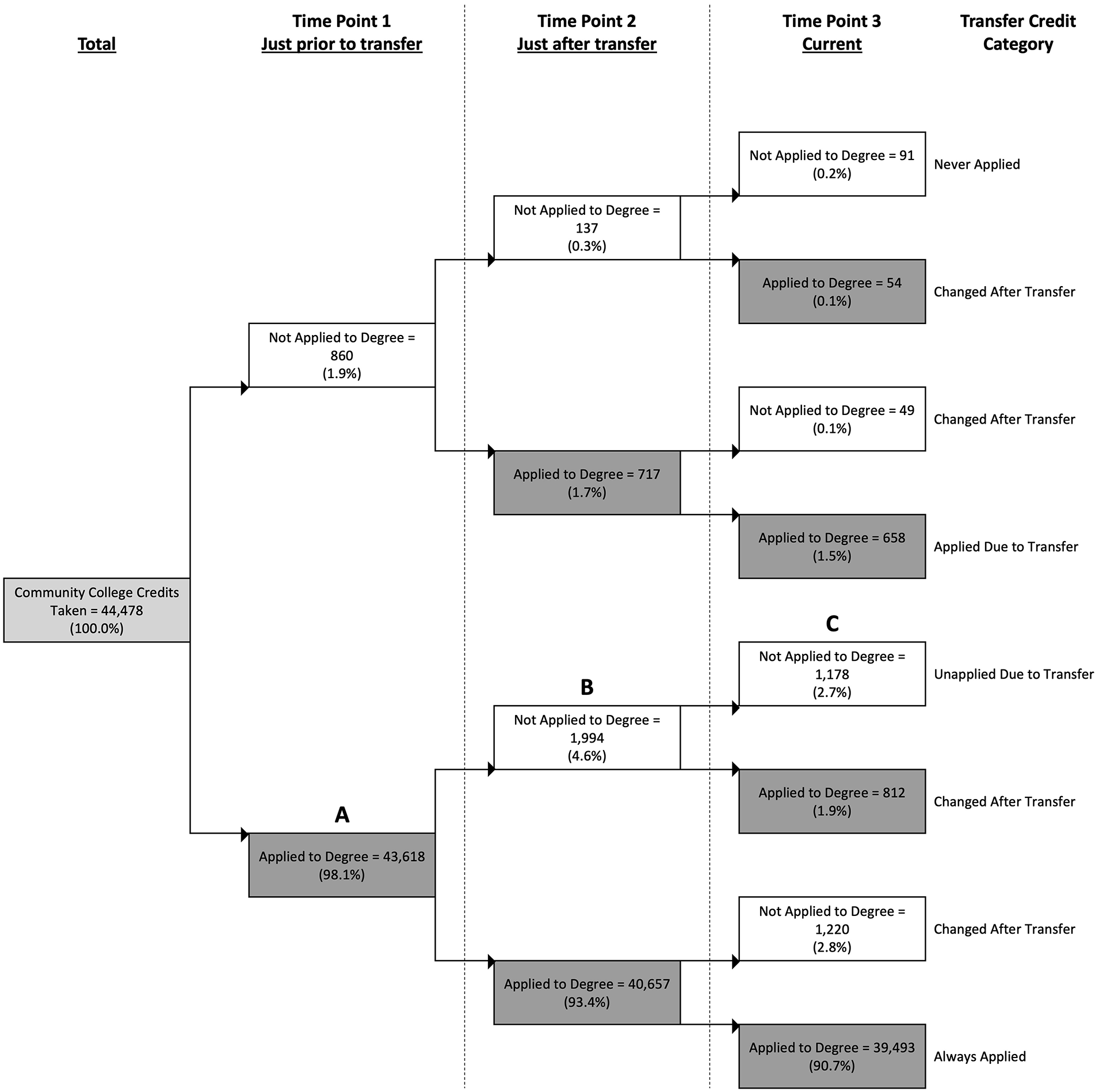
Flowchart of the degree applicability of vertical transfer students’ community college credits.
Percentages and numbers of credits in Figure 1 transfer-credit categories

Note. Percentages of credits are shown.
At the current time, 866 of these credits were applicable to degree requirements and 1,269 were inapplicable.
Second, although the total numbers of credits at the three time points in Figure 1 are not equal, they differed at most by a relatively small percentage. Just prior to transfer (time point 1), the total number of credits was 44,478; just after transfer (time point 2), the total was 43,505 (a 2.2% decrease); and at the current time (time point 3), the total was 43,555, an increase of 0.1% from just after transfer. These differences are not surprising given the fact that, as described previously, enrollment histories can change a student’s total number of recorded credits when the student transfers colleges. In addition, there are sometimes mistakes and corrections in the colleges’ recording of credits.
Third, for both transitions (from time point 1 to time point 2, and from time point 2 to time point 3), credits change from being applicable to being inapplicable and vice versa. For example, 4.6% of applicable community college credits became inapplicable immediately after transfer, but 40.7% of those inapplicable credits later became applicable.
Fourth, without the archive, someone would have calculated credits made inapplicable in association with transfer as the sum of all the credits in the “Not Applied to Degree” boxes in Figure 1 for time point 3 (2,538 total credits; 5.8% of all current community college credits). However, the data in Figure 1 reveal that the value of 5.8% constitutes approximately twice as many credits as actually became inapplicable at the time of transfer (only 46% of the current not-applied-to-degree credits in this study had become not applied to degree at the time of transfer).
Tables 3–5 show the values for the three specific credit categories at the three time points: the electives category (which are applicable credits) and the overflow and over-the-limit categories (which are the two categories of inapplicable credits). Beginning with an examination of the electives category (Table 3), of the 796 students, 417 (52.4%) had electives credits prior to transfer. That about half the students had no electives credits prior to transfer is not surprising. At CUNY, associate majors’ requirements combined with Common Core requirements frequently leave little or no room in the typical 60-credit degree for any elective credits. For example, the business management major at Hostos is 30 credits. That plus the 30-credit CUNY Common Core totals the 60 credits required for the associate degree, with no room for electives. Table 3 also shows that right after they transferred (time point 2), 757 students had electives credits (95.1% of the sample), a mean of 36.9 electives credits per student who had electives credits right after transfer. This increase in electives credits from time point 1 to time point 2 may have occurred for two reasons. First, there is more room for electives in a 120-credit bachelor’s program than in a 60-credit associate program, so credits that were in the overflow category prior to transfer (time point 1) could change to the electives category right after transfer (time point 2). Second, once a CUNY student has satisfied the entire Common Core, as some of these students had done, CUNY Degree Works moves all credits that satisfy only the Common Core into the electives category as a block. 3
Student characteristics at the three time points for students with elective credits

AAS, associate of applied science; STEM, science, technology, engineering, mathematics
Note. Percentages of credits are shown.
A dash (—) in a cell means that the sending or receiving colleges do not offer that major.
Student characteristics at the three time points for students with overflow credits.

AAS, associate of applied science; STEM, science, technology, engineering, mathematics
Note. Percentages of credits are shown.
A dash (—) in a cell means that the sending colleges or receiving college do not offer that major.
Student characteristics at the three time points for students with over-the-limit credits

AAS, associate of applied science; STEM, science, technology, engineering, mathematics
Note. Percentages of credits are shown.
A dash (—) in a cell means that the sending colleges or receiving college do not offer that major.
Table 4 provides detail on the overflow (excess) credits category. Of the 796 students, 121 (15.2%) had overflow credits prior to transfer (time point 1). However, right after they transferred (time point 2), 170 students now had overflow credits (21.4%), a mean of 10.0 overflow credits per student who had overflow credits at this time point. This indicates that some students had courses changed to electives when they transferred and then had too many electives for their Lehman degrees.
Table 5 provides detail on over-the-limit credits (credits exceeding Lehman’s residency requirements). At the time when these data were retrieved, Lehman would allow no more than 70 community college credits to apply to its bachelor’s-degree requirements. Lehman also required that students take at least half their major credits at Lehman. Of the 796 students, only three (<1%) had over-the-limit credits prior to transfer. However, right after they transferred, 59 students had over-the limit credits (7.4% of the total sample). The relatively few over-the-limit credits prior to transfer are not surprising given that the students were all first-time college students.
Credit Transfer and Student Characteristics
Tables 3–5 can be examined for information about what happens at the point of transfer for students with certain characteristics. In terms of race/ethnicity categories, there do not appear to be large differences in the electives data across the three time points. However, although the percentage of students with overflow and over-the-limit credits who are White remained relatively small and had little variation across the three time points, the percentage of Black students with overflow credits decreased by ~25% from right before (time point 1) to right after (time point 2) transfer. In contrast, the percentage of Latino/a students with overflow credits increased by about the same amount. In other words, just after transfer, students with overflow credits were more likely to be Latino/a and less likely to be Black in comparison with before transfer. The findings for over-the-limit credits were the opposite: Just after transfer, students with over-the-limit credits were less likely to be Latino/a and more likely to be Black. These findings indicated that when enrolled in the community colleges, Black students in this sample may have been relatively more likely to have earned excess credits, and Latino/a students in this sample may have been relatively more likely to have had major credits changed to electives when they transferred. Findings discussed below concerning the tendency of Black and Latino/a students to enroll in certain majors may help to explain these findings, given that CUNY’s transfer-credit rules do not differ as a function of race.
Two academic student characteristics were associated with increases in the over-the-limit (inapplicable) credit category following transfer: students having an AAS major in community college and students having been assessed as having remedial need in writing. The total number of inapplicable credits for the 186 AAS students grew from 414.5 to 773 to 872 (a mean of 4.7 per student)—across the three time points. More specifically, although only 33.3% of the AAS students had over-the-limit credits just before transfer (time point 1), this percentage was larger (55.4% and 43.9%) at time points 2 and 3. This is not surprising. As indicated previously, AAS majors take more major courses than are likely to be accepted by a bachelor’s college. In the case of students with a remedial need in writing, in the years when the students in this sample transferred, CUNY was assessing large percentages of community college freshmen as needing remediation and placing most of those students into precollege noncredit courses with low pass rates. Given that addressing any assessed remedial need was prerequisite to taking many college-level courses, these students had difficulties filling out and completing their academic programs with applicable credit-bearing courses (CUNY News, 2023). Thus, it is not surprising that students assessed as having remedial need in writing should have an increased frequency of over-the-limit credits following transfer.
Another way to examine the relationships between transfer and the degree-requirement applicability of credits is to examine the characteristics of students with credits at various stages in Figure 1. Box A shows the total number of applicable credits just before transfer (time point 1); box B shows the total number of those credits that became inapplicable (i.e., overflow or over-the-limit credits) just after transfer; and box C shows the total number of box B’s credits that stayed inapplicable until time point 3 (the time point at which the archive data were retrieved). The characteristics of the students with credits in boxes A and C are not the same (see Table 6). In comparison with students in box A, students with credits in box C were more likely to be female, Black, and AAS majors and to have been assessed as having remedial need in reading and writing. In other words, in the current sample, vertical transfer students with these characteristics were more likely to have their applicable credits become inapplicable in association with transfer and for those credits to remain inapplicable. Again, credit-transfer rules at CUNY do not differ according to student characteristics, so there must be another explanation for these findings.
Percentages of students with specific characteristics prior to and following the earning of transfer-associated inapplicable credits

AAS, associate of applied science
Note. Box A represents all applicable credits just prior to transfer (time point 1), and box C represents all applicable credits that became inapplicable following transfer and remained inapplicable until the archive data were retrieved (time point 3); see Figure 1.
Credit Transfer and Majors
The findings demonstrating that vertical transfer students with certain characteristics were more likely to have applicable credits become inapplicable when they transferred may be related to students with certain characteristics choosing certain majors, majors that are more or less likely to result in applicable credits becoming inapplicable in association with transfer. Consider students who majored in nursing or other health fields at the two community colleges. Of 126 such students in the current sample, 90.5% were female (compared with 74.4% of the total sample) and 50.0% were Black (compared with 32.8% of the total sample). Although 15.0% of the student sample majored in nursing/health prior to transfer, students majoring in nursing/health held >30% of the overflow credits and >50% of the over-the-limit credits at all three time points. In contrast, they held only ~10% of the electives credits prior to transfer (increasing to ~24% after transfer).
Table 7 provides more detail about what happened to the credits of the community college nursing/health students when those students transferred. Before transfer (time point 1), they had taken a total of 268.5 credits that were inapplicable, a mean of 2.1 per student, but just after transfer (time point 2), they had a total of 448.5 credits that were inapplicable, a mean of 3.6 per student. By time point 3, the total number of inapplicable credits had again increased, for these students, to 528.5, a mean of 4.2 per student instead of the 2.1 just before transfer, a doubling of inapplicable credits and enough to require a typical community college nursing/health student to take an extra course, perhaps involving an extra semester in college. Note that these are average values; some of these students had a much greater increase in inapplicable credits following transfer. A total of 52 of the 126 nursing/health students had an increase in their inapplicable credits as of time point 3, and for these students, the mean, minimum, and maximum increases in inapplicable credits were 10.1, 1.0, and 34.0, respectively.
Number of credits at the three time points for community college students in nursing/health and in business administration/management

The findings concerning credit transfer for community college nursing/health students were consistent with the fact that 41% of these students (all 37 nursing students and 13 of the other health students) were AAS majors. Although a student who completes the AAS in nursing at either of the community colleges (and thus also earns an RN) can transfer their credits and enroll in a low-credit BS in nursing completion program at Lehman, only 11 of these students transferred with a completed nursing AAS. The other AAS nursing transfer students, to earn a BS in nursing (with an RN), had to take what is known as the noncompletion program. For this program, students must finish any remaining prerequisite nursing courses; take the entire, extensive nursing curriculum at Lehman; finish the CUNY 30-credit Common Core (recall that AAS programs require only some of these 30 credits); and take some additional general education courses required only for bachelor’s- program students. Adding still another challenge to the path for these students is that fall transfer students must wait until the following fall to learn if they are being accepted to Lehman’s BS in nursing noncompletion program or must switch to another major. Due to student demand exceeding program capacity, the minimum GPA necessary to be admitted to Lehman’s nursing noncompletion program traditionally has exceeded 3.5; many applicants are not accepted. Some prospective nursing vertical transfer students retake some courses to obtain higher grades to gain admission. There are thus multiple ways in which nursing/other health students can earn excess electives and have their courses’ credits classified as insufficient or overflow.
In summary, most community college nursing/health students, who constituted 15.8% of the total sample, were female, half were Black, and due to the natures of their majors, they had difficulties earning only applicable credits. These associated demographic and academic characteristics contributed to the female and Black students of the whole sample being likely to have applicable credits change to inapplicable in association with transfer and to Black transfer students having a greater increase in over-the-limit credits compared with Latino/a students.
The findings for the community college nursing/health majors contrasted with findings for the two community colleges’ business administration/management majors (see Table 7). At both community colleges, a business administration/management major culminated in an associate degree (with graduating students having to have completed the entire 30-credit CUNY Common Core), and since at least 2019, there have been articulation agreements in place for these majors with Lehman’s bachelor of business administration degree. As shown in Table 7, the 74 business administration/management vertical transfer students in the sample (52.7% of whom were female and 32.4% of whom were Black), with the benefits of articulation agreements, fewer constraints on admission to the corresponding bachelor’s-college major, and a lower-credit major, had, at time point 3, ~36% fewer inapplicable credits per student than did the nursing/health students (a mean of 2.7 vs 4.2 inapplicable credits per student).
Regression Results
Table 8 shows that, although Equation (1) does not account for a large proportion of the variance in the outcome variables, consistent with much of the descriptive statistics presented earlier, courses were more likely to become inapplicable in association with transfer when taken by female students, older students, students with initial assessed remedial need in writing, and students enrolled in AAS programs. Courses were less likely to become inapplicable in association with transfer when taken by Asian and Latino/a students (at time point 3), Pell Grant recipients, students with assessed mathematics remedial need, students with higher cumulative GPAs, and students enrolled in business management programs (at time point 3). Note that CUNY associate-degree students are not allowed to transfer to a bachelor’s program without having satisfied their assessed remedial needs, which at the time of this study only a minority of students were able to accomplish in mathematics (Logue et al., 2016). Therefore, it is not surprising that transferred courses becoming inapplicable would be negatively associated with their having been taken by students with initial assessed remedial need in mathematics—students satisfying their remedial need in mathematics were unusually successful students. Also note that when the variable for a course having been taken by a student enrolled in an AAS program is removed from the regression model for time point 3 (fourth data column of Table 8), then a course having been taken by a nursing or other health major becomes a significant predictor of courses becoming inapplicable in association with transfer. This suggests that the effect of the nursing/other health variable is largely related to its association with the AAS variable, itself associated with courses becoming inapplicable. A course having been taken by an AAS major has one of the largest marginal effects of all variables examined.
Probability of courses applicable at time point 1 (prior to transfer) becoming inapplicable right after transfer (time point 2) or at the time of the analysis (time point 3) as a function of student characteristics: Marginal effects at means from logit regressions

GPA, grade point average; AAS, associate of applied science
Note. Robust standard errors are shown in parentheses. Missing values for remedial need and family income were imputed using the method of multiple imputation by chained equations. Multicollinearity tests found only weak correlations among the model’s variables (variance inflation factors ranged from 1.1 to 1.65).
Years older than 18 years (z).
Reference category for race/ethnicity is Black.
Ln(family income in thousands of dollars).
Cumulative GPA (z).
p < .1; **p < .05; ***p < .01.
Discussion
This study tracked changes in the degree applicability of the credits of a targeted sample of 796 vertical transfer students, largely from underrepresented groups. The results are unique for multiple reasons. First, they show not just whether credits transferred at all between two colleges, the measure used by almost all previous empirical studies, but also the degree applicability of the credits right before and right after transfer. The results also show that the degree applicability of credits and courses can change at multiple points in time, not just at the time of transfer, and that tracking the effect of transfer on the degree applicability of credits necessitates taking the alignment between students’ associate and bachelor’s programs into account.
First, we will examine in detail research question (RQ) 1 (when and to what extent did transfer students’ credits lose applicability?). As shown in Figure 1 and Table 2, in this sample involving two community colleges and one bachelor’s-degree college, colleges that have spent many years articulating their programs, only ~2.7% of vertical transfer students’ credits lost degree-requirement applicability in association with transfer and stayed inapplicable. These credits became inapplicable due to their becoming excess electives (overflow credits) or their exceeding the bachelor’s college’s residency requirements (over-the-limit credits). However, at the time at which the records were retrieved (time point 3), an additional 3.1% of credits originally taken at a community college were inapplicable. An assessment of vertical transfer students’ records taken only at that point thus would have overestimated the credits that lost degree applicability in association with transfer. The close articulation of the three colleges within a single university system and the study’s ability to measure credits that were affected specifically by transfer are two factors that can help explain the relatively low value of 2.7% compared with some previous studies, such as the national data reported by the GAO (2017). Our results are consistent with the several studies that have now documented multiple reasons in addition to transfer, such as major change, for excess credits at graduation (Kilgore et al., 2019; Ojha & Hush, 2025; Richardson & Knight, 2024; Rivera et al., 2025).
This study provides some additional information about credits becoming inapplicable for reasons other than transfer. Figure 1 shows that credits can lose degree applicability at time points other than transfer. Approximately 2% of the original total community college credits were inapplicable prior to transfer, and a small proportion of the original total community college credits (0.2%) never applied to degree requirements at any of the study’s three time points, before or after transfer. Further, ~3% of the original total community college credits were applicable right after transfer but became inapplicable by time point 3, when the data were retrieved. One reason for such credit applicability changes is a student changing their major, which can cause a student to have too many elective (overflow) credits. Approximately 83% of the inapplicable credits just prior to transfer became applicable immediately after transfer. That credits can gain applicability in association with transfer has been recognized only recently in the research literature (Richardson & Knight, 2024). When bachelor’s programs allow more electives than do associate programs, as was the case here, more vertical transfer students’ credits can apply to their degrees than before transfer.
The loss of credit and course degree applicability was associated with certain student characteristics (RQ 2; Tables 3–8). Both courses taken by students who had enrolled in AAS programs in their community colleges and by students who had been assessed as having remedial need in writing were more likely to become inapplicable after transfer. In addition, when enrolled in the community colleges, Black students appear to have been relatively more likely to have earned excess credits. Latino/a students appear to have been relatively more likely to have had major credits changed to excess electives when they transferred. Some of these findings appear related. Students majoring in nursing/health in Bronx or Hostos (15.8% of the total student sample) were more likely to be female and Black than the overall community college population; the community college nursing and some health degrees are AAS degrees (whose credits transfer to bachelor’s programs less well than do credits of associate degrees); and not all nursing students who transfer to Lehman are admitted to Lehman’s nursing program.
Such relationships involving major and credit applicability help to illustrate the complex effects of transfer. By its very nature, vertical transfer involves a student changing from one program with one set of requirements to another. This is the case even if the student’s associate major is in the same discipline as the bachelor’s major, and majors can have many variations. Whether or not credits applying to the associate requirements count toward the bachelor’s requirements is simultaneously a function both of individual course equivalencies and of how well aligned are the associate and bachelor’s major requirements. Examining the individual effects of both these factors is a topic ripe for future research, and addressing both these factors is a challenge for practitioners who wish to facilitate successful vertical transfer.
Our findings show that credits can go in and out of degree applicability for multiple reasons. Some of the reasons for credits becoming inapplicable include receiving colleges not giving applicable credit for a course, a receiving college’s residency requirements, and a student’s changing their major. The combination of all these factors can result in wasted time and money. The total number of inapplicable credits at time point 3 in Figure 1 is 2,538 (the equivalent of 846 three-credit courses). Only full-time, New York State resident students (71% of CUNY undergraduates; “Student Data Book, Fall 2023 Enrollment,” Z. Tang, personal communication, March 11, 2025) would not be charged extra for such credits, with other students being charged $305–$620 per credit, and earning these inapplicable credits would have required extra time for all students. Some entity (e.g., the federal government, the state, the city, the student, or a donor) is expending funds to take and/or offer these inapplicable credits. However, we now know that, in this sample, only about half the inapplicable credits became inapplicable in association with transfer.
Using Major-Specific Articulation Agreements to Prevent Inapplicable Credits
The findings were consistent with articulation agreements resulting in smaller amounts of inapplicable credits in association with transfer (see Tables 7 and 8). There is no articulation agreement in nursing between the community and bachelor’s colleges, and courses transferred by students majoring in nursing were relatively more likely to become inapplicable. In contrast, there is an articulation agreement between the business administration/management associate and bachelor’s degrees at the colleges studied here, and courses transferred by these students were relatively less likely to become inapplicable. Consistent with these findings, courses taken by students in AAS degrees, whose general education and major requirements frequently do not articulate well with those of bachelor’s degrees, were among the most likely to become inapplicable following transfer.
This research therefore would seem to suggest that articulation agreements for specific majors, the most frequently proposed strategy for eliminating nontransferred (lost, inapplicable) credits, are useful in limiting inapplicable credits, However, there are multiple reasons why such articulation agreements, and their more prescriptive relatives, dual admission programs, cannot be the sole solution to preventing inapplicable credits (Logue, 2024; Logue et al., 2023).
The first reason is that articulation agreements for specific majors cannot, by themselves, counter the multiple causes of inapplicable credits suggested by this research. Such articulation agreements cannot, for example, prevent the overflow (excess, inapplicable) credits that can occur when a student changes their major. This research found that less than half the students’ inapplicable credits resulted from credits becoming inapplicable at the point of transfer. Any strategy, such as constructing major-specific articulation agreements, that does not address the inapplicable credits that became inapplicable for reasons unrelated to transfer will allow many inapplicable credits to continue to exist.
Yet another reason that major-specific articulation agreements cannot ensure that all credits are applicable, or even that all applicable credits remain applicable when transferred, is rooted in the fact that associate and bachelor’s majors can both have variations or concentrations. These variations or concentrations have different requirements, resulting in different credits becoming applicable or inapplicable when students transfer. Even for a major such as business, the number of possible combinations between different types of associate and bachelor’s degrees can be substantial. For example, not including majors related to accounting, Bronx has three different concentrations in business and Lehman has eight. This results in a total of 24 different combinations of associate and bachelor’s business majors just between these two colleges. The number of combinations of all of CUNY’s associate degrees with all of CUNY’s bachelor’s degrees in the same discipline is in the thousands. Should a student change their major, even more possible transfer paths exist. In 2023, Bronx students transferring to Lehman followed 189 different transfer paths (A. Ott & R. Banks, personal communication, March 18, 2024). Also, consider the fact that, nationally, approximately one fourth of transfer students transfer across state lines (National Student Clearinghouse Research Center, 2025). To construct and maintain traditional articulation agreements for all these transfer paths is not possible. Constructing, maintaining, and communicating even one major-specific articulation agreement can be quite difficult (Bray & Sweatt, 2018; GAO, 2017; Jaggars & Fletcher, 2014; Logue et al., 2023; Schudde et al., 2020). One study has even described major-specific articulation agreements as “inarticulate” (Taylor, 2019). Thus, again, although apparently effective as suggested by our research, major-specific articulation agreements cannot be the sole solution for preventing students from having inapplicable credits.
A final reason that major-specific articulation agreements are limited in their ability to help students transfer their credits is that they are usually designed for students who take credits at one specific college and then transfer to another specific college. However, many students follow a “swirling” pattern, repeatedly transferring among multiple colleges (Anderson & Kadlec, 2021).
Practice and Policy Implications
The longer a college student spends obtaining their degree, the greater is the opportunity for adverse events to occur in the student’s environment that interfere with degree completion, and students from underrepresented groups are more likely to experience such events (Bickerstaff & Melguizo, 2024; Hern & Snell, 2014). Therefore, if a primary goal is helping underrepresented students complete their bachelor’s degrees, this goal will be assisted by giving students and the advisors who support them the information and tools that will assist the students in completing their degrees as efficiently as possible.
Our results showed that, in our sample of largely students from underrepresented groups, even students transferring between closely articulated colleges can accumulate inapplicable credits, which can carry additional cost and can delay completion. State or system or federal policies and practices that would assist students and the advisors who support them in the students accumulating as few inapplicable credits as possible include the following:
Ensuring that all credits transfer as at least elective credits, as currently occurs within the CUNY system (Logue, 2017).
Ensuring that students who transfer prior to earning an associate degree retain credit for any general education, as well as major, requirements they have already fulfilled (Monaghan & Attewell, 2015).
Minimizing (while still accomplishing educational goals) the total number of general education and major credits required, thereby maximizing the number of elective credits a student can take and minimizing the chances a student will accrue excess (overflow) credits if they change their majors, if they have some of their major or general education credits changed to elective credits when they transfer, or if they double major (which can result in greater earnings; Hemelt, 2010; Logue, 2017).
Requiring all students to have similar general education requirements or a similar general education framework so that if a student changes majors or changes colleges, they do not have to take new, additional general education courses (Whinnery & Peisach, 2022).
Enrolling students in AAS programs (programs without significant overlap with bachelor’s programs) only when there is a resulting specific professional opportunity that is desired by the student instead of a bachelor’s degree (D’Amico et al., 2021).
Keeping residency requirements as low as judged feasible by the institution (Ellis, 2020).
Establishing select articulation agreements while remembering that they are just one tool—a limited and nonscalable tool (Logue, 2024).
Ensuring that everyone is aware of how all credits transfer so that students and their advisors can make course and transfer-destination choices that minimize inapplicable credits. A website with this functionality (Transfer Explorer, or T-Rex) was implemented at CUNY in 2020, now has had hundreds of thousands of unique users (Mueller et al., 2024), and has facilitated >4,000 positive transfer-credit rule changes (J. Villalona, personal communication, March 25, 2025). A national version was recently launched by the nonprofit organization Ithaka with significant support from multiple foundations (Buonocore et al., 2025). Note also that many higher education organizations recommend transparency in how credits transfer (e.g., AACRAO, https://bit.ly/4htGJBK), and Title IV institutions are required to make available information concerning how credits transfer (GAO, 2017).
Additional Uses and Limitations of This Research
The data in the student record archive used in this research can have additional uses. For example, these data could be used to identify courses that are likely to be applicable prior to transfer and inapplicable afterwards or to identify particular community and bachelor’s college pairs for which applicable associate program credits are more or less likely to be applicable following transfer. In addition, our methods could be used to identify and quantify community college credits that do not appear on vertical transfer students’ transcripts (something that does not happen at CUNY due to all courses transferring as at least electives). Yet another use is that this study’s student record archive could be employed to assess the effects of changes in credit-transfer policies.
This study’s goal was to show how the degree applicability of credits and courses could be tracked in a targeted sample of largely underrepresented transfer students, investigating how and why that credit applicability can change. The three colleges studied here are in close geographic proximity and have been working to smooth vertical transfer among them for many years. Moreover, these colleges have particular major requirements that may differ at other colleges. Therefore, the percentage of applicable credits that became inapplicable in association with transfer and stayed inapplicable cannot be assumed to generalize to other higher education settings. However, the methodology developed and used in this study certainly can be applied to research involving a wide range of institutions and situations. Further, findings obtained here, such as the data showing that vertical transfer students’ credits can gain applicability in association with transfer, can inform future studies of and policies concerning credit transfer at other institutions, including the effects of additional factors related to credit transfer and persistence not studied here, such as the effects of financial aid policies. Finally, although the students studied here were not representative of the national college student population, they largely came from underrepresented groups and therefore constitute a sample of particular interest in determining how to increase transfer student success and equity. Future research should obtain data from a diverse range of colleges to enable generalization of results.
Conclusion
Although this study indicated that transfer may cause inapplicable credits less than some people think, it also indicated that transfer-related inapplicable credits still can be found in well-articulated transfer partners. In addition, we should keep in mind that even one excess credit can result in a student spending an extra semester obtaining their degree, with a concomitant extra tuition charge and the loss of half a year of the extra salary that a degree can bring. Such financial consequences are particularly meaningful for students who have limited financial resources and substantial personal obligations, as was the case for many of the students in this study. Multiple actions need to be taken to minimize inapplicable credits. The research described here helps indicate what some of those actions should be.
Footnotes
Acknowledgements
For contributions to all stages of the research, including comments on previous drafts, we thank R. Banks, J. Fink, K. Heffernan, M. Kurzweil, D. Linderman, C. Littman, A. Monday, A. Morrison, A. Ott, V. Rabinowitz, R. Rayo, Z. Tang, V. Upadhyay, C. Vickery, J. Villalona, M. Weiss, the presidents of the three colleges studied here (Presidents De Filippis, Delgado, and Santiago), and many members of CUNY’s Office of Applied Research, Evaluation, and Data Analytics; CUNY’s Transfer Opportunity Project; and Ithaka S+R’s and CUNY’s Articulation of Credit Transfer Project.
Authors’ Note
Portions of this research were previously reported in Logue, A. W., Yoo, N., Gentsch, K., & Chellman, C. (2022, July 7). What really happens to transfer students’ credits? Inside Higher Ed.  ; in Logue, A. W., Gentsch, K., Yoo, N., & Chellman, C. (2023, February 1). The true-life story of transfer students’ credits: The bad and the good. Presentation at the 2023 National Institute for the Study of Transfer Students Annual Conference; and in Logue, A. W. (2024, November 23). Tracking vertical transfer students’ credits: Changes in applicability to degree requirements. Presentation at the 2024 APPAM Fall Research Conference.
Declaration of Conflicting Interests
The authors declare no potential conflicts of interest with respect to the research, authorship, and/or publication of this article.
Funding
This research was funded by City University of New York, Heckscher Foundation for Children, and Grant R305A180139–19 from the Institute of Education Sciences of the Department of Education (the contents of this paper do not necessarily represent the policy of the Department of Education, and endorsement by the federal government should not be assumed).
Open Practices
Due to the data containing personally identifiable information, the data are only available on request (from the corresponding author). The Stata and Python scripts for calculating the descriptive statistics, for setting up the data for the regressions, and for calculating the regressions can be found in OPENICPSR at .
Notes
Authors
A. W. LOGUE is professor emerita in the Center for Advanced Study in Education of the Graduate Center of The City University of New York (CUNY). Her research focuses on college student success, especially regarding mathematics remediation and college student transfer.
NAYEON YOO is a research analyst in the Office of Applied Research, Evaluation, and Data Analytics of The City University of New York (CUNY). Her recent research focuses on evaluating dual enrollment programs and their associated student outcomes.
YOSHIKO OKA was a research analyst in the Office of Applied Research, Evaluation, and Data Analytics of The City University of New York (CUNY). Her research has focused on transfer student success.
KERSTIN GENTSCH is a senior policy analyst in the Office of Applied Research, Evaluation, and Data Analytics of The City University of New York (CUNY). Her research focuses on college readiness, admissions, and transfer.
CHRISTOPHER BUONOCORE was director of student success initiatives at Lehman College of The City University of New York (CUNY) and is now product manager of Transfer Explorer at Ithaka. His work focuses on transfer student success and the utilization of actionable data.
MARK CASAZZA is director of business intelligence in the Office of Applied Research, Evaluation, and Data Analytics of The City University of New York (CUNY). His work focuses on college student records and college student success.
COLIN CHELLMAN is senior university dean of the Office of Applied Research, Evaluation, and Data Analytics of The City University of New York (CUNY). His research focuses on college student success.
DAVID WUTCHIETT is data analyst/scientist in the Office of Applied Research, Evaluation, and Data Analytics of The City University of New York (CUNY). His research focuses on college student success.