




Abstract
Prior research on school reform implementation has demonstrated that school leaders may translate policies into practice in ways that either promote or undermine the policy’s goals. To generate a more in-depth understanding about how principal attitudes toward policies relate to how they implement them, we applied insights from the sociological theory of professional control. We drew on interviews with 30 school administrators who were experiencing the rollout of a more rigorous and centralized screening protocol for teacher applicants in the Los Angeles Unified School District. We found that principals’ perceptions of the policy ranged from positive to very negative, and they also varied in how much discretion they exercised in their own subsequent hiring practices. Perhaps counterintuitively, principals with positive perceptions of the district’s protocols enacted the most assertive strategies to recruit teachers. Our findings advance research and theory on how school leaders’ attitudes about policies influence policy implementation.
Introduction
School districts have increasingly adopted systems to increase data use in decision making, including screening systems to capture information about applicant teachers more systematically (Cannata et al., 2017; Engel et al., 2018). The extent to which these reforms improve teacher hiring is not well understood. Indeed, the effects of these reforms are difficult to predict because school leaders may implement these policies in ways that support or undermine the policies’ goals (Donaldson & Woulfin, 2018). For example, district-level hiring reforms leave considerable discretion—that is, freedom to make school-level decisions (Lortie, 2009)—for school principals to conduct their own screening and to make final hiring decisions. Principals may maneuver around district-level reforms (Rutledge et al., 2008) or struggle to use district-provided data even when they want to (Grissom et al., 2017), muting the impacts of reforms.
We investigated these issues qualitatively using interviews with 30 school administrators in the Los Angeles Unified School District (LAUSD). In 2013, the LAUSD adopted a district-level screening protocol—the Multiple Measures Teacher Selection Process (MMTSP)—intended to be more rigorous and to collect more meaningful information on applicant teachers. Applicants must be screened through this system before school principals can hire them. Applicants are scored on a variety of screening assessments and can be disqualified based on their total score or their scores on the individual assessments. Importantly, however, applicants can receive exemptions from minimum score requirements based on the judgments of either district screening specialists or school site principals. This leaves some hiring discretion in the hands of school-level administrators but also substantially reduces their discretion (i.e., autonomy) relative to more decentralized alternatives and the status quo ante. Previous research has shown that applicants’ MMTSP scores are meaningfully predictive of teachers’ outcomes, suggesting that the selection process helps to hire effective teachers (Bruno, 2024; Bruno & Strunk, 2019). However, the lower performance of applicants who received score exemptions may indicate that principal discretion in sidestepping the MMTSP is used poorly. Thus, as noted above, there are many remaining questions about whether this data-oriented hiring reform is implemented with enough consistency to meaningfully improve hiring outcomes.
To study the dynamics between principals and district administrators that influence how the district screening requirements affect site principals’ teacher selection processes, we address three research questions (RQs):
We found that principals vary substantially in how they perceive the district’s screening protocols, with perceptions ranging from positive to very negative. Additionally, we distinguished two groups of principals: those who are relatively assertive in pursuing their preferred candidates (e.g., even using hiring strategies unsanctioned by the district) and those who are relatively passive (e.g., taking the candidate pool as largely fixed). Perhaps counterintuitively, participants who expressed a positive perception of the district’s more rigorous hiring protocols enacted the most assertive strategies to recruit teachers. We did not find evidence that these patterns vary substantially by principals’ characteristics or context.
We contribute to literature that documents, but does not explain, variation in how principals hire teachers (Grissom et al., 2017; Nelson, 2019; Papa & Baxter, 2008; Rutledge et al., 2008). We build on policy-implementation scholarship documenting the agency of principals, such as Donaldson and Woulfin’s (2018) account of how principals implemented state teacher evaluation systems using a variety of discretionary practices and Mavrogordato and White’s (2020) study of principals’ varying levels of involvement in reclassification processes for English language learners. To our knowledge, our research is the first to extend this lens to study teacher hiring decisions, which may have unique attributes compared with instruction-related or teacher evaluation policies. For instance, although instruction or evaluation practices involve principal interactions with people who are already members of the professional community and are often protected by collective bargaining agreements, hiring policies and practices involve principals’ interactions with external parties. The adoption of similarly centralized data-oriented human resources (HR) policies in other districts nationwide and LAUSD’s size and diversity position our study findings to likely translate to other contexts.
In addition to our empirical contributions, our theoretical innovation was to import insights from the sociology of work and occupations, specifically regarding professional control and autonomy (e.g., Barley & Tolbert, 1991; Freidson, 1984; Mintzberg, 1973) to more fully explain why professionals’ resistance matters for education policy implementation. Our findings also have implications for practice, especially for district leaders. For example, interviews with principals revealed which aspects of teacher screening principals believe are important; which they lack sufficient information on, rendering them less useful; and those they find constraining and thus attempt to circumvent. This knowledge can inform efforts to make district processes both more efficient and popular with principals. Our results also point to areas for intervention (by researchers or district officials), such as messaging to address principals’ misconceptions about district office processes.
Principal Discretion Over Hiring as Professional Control
Our objective was to understand how principals perceive and respond to data-oriented district-level teacher hiring reforms. Although it can be difficult to hire sufficient numbers of teachers in some locations (DeArmond et al., 2010) or for some jobs (Cowan et al., 2016), in many contexts, administrators have considerable discretion when hiring because the number of applicant teachers far exceeds the number of open positions (Engel et al., 2014). How principals use their discretion likely matters a great deal. For example, principals able to select more effective teachers thus could facilitate better student outcomes (Chetty et al., 2014; Kraft, 2019), but discretion also can be used by school leaders in ways that introduce gender and racial bias, as seen in the case of teacher evaluation (Drake et al., 2019). We situate our study within research on educational leadership that describes principals’ motivations and behaviors when exercising discretion in policy implementation broadly and in hiring practices specifically.
Principal Discretion in Policy Implementation
Research documents that discretion is both common and a persistent tension in principal implementation of instructional and teacher evaluation policy reforms (Donaldson & Woulfin, 2018; Spillane et al., 2002). With a middling level of positional authority, principals orient themselves to higher-level policies while also attempting to gain control over an unpredictable working environment (Lortie, 2009). This gain in control is achieved by exercising discretion—that is, freedom or “‘apertures’ in the district control system” to make school-level decisions (Lortie, 2009, p. 45). Previous research on principal discretion has found that principals are usually unaware of their leeway over decision making (Mavrogordato & White, 2020). Yet, when working within the constraints of formal policies such as the reclassification of students out of English language programs (Mavrogordato & White, 2020) and teacher evaluation systems (Donaldson & Woulfin, 2018), principals exercise authority by taking advantage of decisions over which they have a say (Sarason, 1977). Even in everyday decisions such as choosing to ignore deadlines and policies from the central office to protect instructional time, principals make “extrabureaucratic maneuvers” to overcome obstacles to school performance (Morris et al., 1982, 692). In other words, principals as middle managers both experience constraint under institutional norms and mandates and mediate policy by autonomously framing, modifying, and enacting policy goals (Donaldson & Woulfin, 2018; Spillane et al., 2002).
Studies at the intersection of education policy and educational leadership emphasize that principal practices around policy are rooted in their perceptions of the policy. For example, in an ethnographic and interview-based study of principals (and other staff) in three elementary schools in Chicago undergoing accountability reforms, Spillane et al. (2002) observed that principals’ practices and ways of talking about their responsibilities and goals with respect to the reforms involved cognitive sense-making processes. Specifically, principals drew on their position in the hierarchy and their past professional experiences to shape the way they enacted policy in their school setting. In another study, scholars focused on principals’ perceptions of and behavioral responses to a state-level teacher evaluation policy (Donaldson & Woulfin, 2018). Based on interviews with 44 Connecticut principals, the authors found that the principals engaged in a variety of discretionary activities—tinkering, reducing, framing, hybridizing, double-dipping, and gaming—in response to policy constraints on their practice (Donaldson & Woulfin, 2018). For instance, principals “tinkered” with the rules of the evaluation tool by extending the time window for conducting a teacher’s midyear conference. The Donaldson and Woulfin study illuminates how principals used their estimations of whether policies are worthy of enhancement or need to be more feasible to narrate their rationale for supporting the policy or “going rogue.” Although the former perception of the policy could be thought of as positive, representing perceived legitimacy of the policy’s goals as something they wanted to support, the latter was more negative, representing external pressure to buffer themselves against.
Not all studies find variation in perception leading to variation in discretionary policy enactment. In an interview study with 20 principals from large, urban school districts about how principals coped with the COVID-19 pandemic, Kaul et al. (2022) observed a uniform cognitive response among principals of dissatisfaction with district guidance. However, they still found diverse behavioral responses to the guidance, ranging from abiding, to challenging, to subverting guidance. To our knowledge, there are no studies of this kind that explicitly focus on principals’ enactment of district-level teacher hiring policies.
Principals’ Roles, Preferences, and Discretion in Hiring
Of the myriad roles and responsibilities of a principal, there is reason to believe, from a professional discretion perspective, that they might care more about discretion in hiring than in other areas of their work. For example, research on educational leadership documents that principals’ influence over classroom instruction is mostly indirect, but they may enjoy “tighter control over teacher hiring and assignment” (Donaldson, 2013, p. 842; Gamoran & Dreeben, 1986). In addition, a study of Iowa principals found that 55% of them considered discretion in teacher hiring the most important area in which to have autonomy, with teacher evaluation a distant second (Lortie, 2009). Principals’ roles in teacher hiring can span the four stages typically distinguished in studies of hiring: recruitment, screening, selection, and job offer (Kogan et al., 1995; Perrone & Meyers, 2023; Rutledge et al., 2008).
We consider teacher hiring as a potential aperture where principals may exercise discretion to select teacher candidates unique to their own preferences, not fully constrained by bureaucracy. Indeed, prior research has demonstrated that principals have preferences in choosing teacher candidates. Some principals value candidates’ interpersonal skills, such as warmth, over their academic skills, believing the former to be essential for connecting with students (Tamir, 2019; Wise et al., 1987). Principals of color and principals in majority-minority schools hire more teachers of color (Bailes & Guthery, 2023; Bartanen & Grissom, 2023). Principals appear to prefer to hire teachers with whom they have prior social ties (Cannata, 2011). Principals are also concerned with selecting candidates who match or complement the existing staff (Rutledge et al., 2008; Simon et al., 2019; Torres, 2019). Importantly, almost all these teacher attributes are not characteristics that a standardized test or assessment-based teacher screener typically would select on. We therefore apply insights from sociological theory on professional control—that is, that professionals in an organization have some “control over the content and terms of [their] work” (Ingersoll, 2003, p. 58)—to the case of teacher hiring.
Theoretical Framework
We view principals’ discretion through the theoretical lens of professional control. Professional control can be thought of as having the expert-based authority to make individual judgments, apart from the dictates of bureaucratic (i.e., organizational) controls (Freidson, 1984; Ingersoll, 2003; Scott & Davis, 2007). In contrast, bureaucratic control is “antithetical to the freedom of activity” of the professional such that managers’ supervisory authority, derived from hierarchical and formal systems, ensures control over professionals’ actions (Freidson, 1984, p. 10). Organizing work according to bureaucratic rules is a form of control over organization members’ professional autonomy (Hodson, 2001). As professions become embedded in organizations, bureaucratic control can diminish professionals’ autonomy (Barley & Tolbert, 1991). Nevertheless, the relationship between professionals and their organizations is not necessarily conflictual; in fact, control can go in the opposite direction, where professionals occupy or control the organization, as in the case of doctors controlling organizational policies concerning patient care. In this case, professionals have “considerable freedom from bureaucratic control” (Barley & Tolbert, 1991, p. 6).
Principals are embedded in school districts, making them likely similar to other bureaucratic professions such as engineers, whose guiding principles and goals as a professional group become enmeshed in their bureaucracy’s principles and goals (Vaughan, 1996). Like the managers Mintzberg (1973) studied, principals face a conundrum of control because they have control over only some aspects of their work and less over others and therefore must exert their will as opportunities arise (Lortie, 2009). And in line with Weber’s (1968) conception of bureaucracy, traditional public schools delineate supervisory relationships among employees using a hierarchical structure, which specifies the limits of authority for professionals in subordinate or middle-management positions. However, district–principal relationships within modern school bureaucracies may deviate from the clear lines of authority predicted by Weber. Institutional theorists such as Weick (1976) argued that schools have inconsistent control relations because they lack authority of office (Gamoran & Dreeben, 1986). Put differently, bureaucratic controls imposed by authorities within school systems are insufficient to ensure compliance. Just as principals have limits of control over teachers’ adherence to instructional policies, district officials may have limits of control over principals’ adherence to hiring policies. For example, a district-level teacher screening policy uses what might be conceptualized as output controls (Ouchi & Maguire, 1975) to measure the quality of teacher applicants but may not be accompanied by behavioral controls or other clear levers for motivating principals to comply, such as normative control through a shared organizational culture (Jones, 2013). In sum, despite the district controls over them, principals likely can find apertures for exercising professional discretion. The wider literature on professional control is informative for predicting conditions under which principals might bypass that aperture by embracing bureaucratic controls or seek out that aperture by resisting bureaucratic controls.
Outside of education, research on clashes or synergies between organizational-bureaucratic and professional control has taught us more about conditions that provoke managers’ desire for control. Managers sometimes embrace policies or tools that could diminish their control when allowed to participate in their design and implementation. For example, this is seen when middle managers create output and process controls they agree on, as in the case of setting a budget number goal among managers of a hotel management company (Mazmanian & Beckman, 2018) and making decisions based on metrics of clicks among newspaper editors (Christin, 2018). And in the public sector, one study of a Transportation Security Administration unit implementing new worker surveillance technology showed that managers used this technology to crack down on workers resisting their control (Anteby & Chan, 2018). Another study showed that when middle managers in youth services organizations had opportunities to be involved in reform implementation, this facilitated the acceptance of the reform across the organization (Higgs et al., 2023).
In other situations, middle managers may be more likely to resist control from higher-level managers. Insights from self-determination theory, which predicts that professionals are more satisfied and perform better when they have more autonomy (Deci & Ryan, 1985; Ryan & Deci, 2002), explain this resistance. Self-determination theory investigates how psychological factors intrinsic to the self—especially autonomy, competence, and relatedness (i.e., a sense of connectedness to others)—can motivate human action (Ryan & Deci, 2002). This provides insight into workers’ desires to retain a sense of internal control over their work (Deci et al., 2017). For example, an interview study of HR professionals found that they were often reluctant to use algorithmic candidate screening because they did not trust its accuracy and felt a loss of control over the process (Li et al., 2021).
In addition, studies of organizational reforms aimed at reducing hiring manager racial and gender bias, initiated by higher-level management to increase workplace diversity, showed that middle-level managers often respond with behavioral resistance (Dobbin et al., 2015). Based on quantitative analyses of >800 U.S. workplaces, Dobbin et al. (2015) found that workplace controls that limit managers’ hiring discretion and displace their authority to promote employees—such as imposing job tests and other objective performance parameters—“generally elicit resistance” and undermine policy goals (p. 1016). In contrast, bureaucratic reforms that induced engagement from middle managers—such as management training programs by nomination—fared more favorably for policy implementation outcomes. These findings are consistent with self-determination theory as well as classic research on tactics workers use to assert control when their autonomy is challenged (Gouldner, 1964).
Turning back to the specific case of how principals perceive and react to a screening policy instituted at the district level, the theoretical perspective on organizational-bureaucratic and professional control has potential to extend prior education policy research. For example, in their study of how principals perceive and make sense of district-level accountability reforms to teachers, Spillane et al. (2002) used a cognitive framework. This framework examines how principals’ interpretation of policy shapes their personal implementation practices, such as how much they used student assessment data to meet policy aims. In their study of how principals viewed and modified a state-level teacher evaluation reform, Donaldson & Woulfin (2018) used a structure–agency framework to explain observed deviation from policy mandates. Like cognitive frameworks, structure–agency frameworks highlight principals’ role as policy mediators. The structure–agency framework also reveals policy as a double-edged sword of constraint and opportunity for principals to express their own professional judgment. Yet, a theoretical approach that directly pertains to professional control could strengthen policy scholars’ understanding of autonomy as an occupational-level, and not just individual-level, concept. With its focus on jobs, self-determination theory (Deci & Ryan, 1985) is attuned to these issues. Thus, our approach more firmly roots the study of principal discretion and policy implementation in the sociology of work. Theorizing professional control offers a more complete understanding of where policy resistance comes from and why it is endemic in education policy implementation.
Context and Setting
Teacher Hiring in the LAUSD
The situation in our research site—the LAUSD—is both typical of the professional struggle for discretion faced by urban school principals (e.g., Engel et al., 2018) and may represent a more extreme case of it. Consequently, the LAUSD may provide valuable insight on the centralization of teacher hiring practices nationwide because little evidence exists about the topic (Perrone & Meyers, 2023).
The LAUSD is the second largest school district in the country by enrollment, with >400,000 students in transitional kindergarten through twelfth grade, and >550,000 students when counting independent charter schools and other programs (e.g., adult or early childhood education). The LAUSD employs ~25,000 teachers. Despite the district’s size, initial teacher applicant screening in the LAUSD is largely centralized, especially after recent efforts to increase the intensity of district-level screening. Applicant teachers do not apply directly to positions in the district’s ~1,000 traditional public schools. Rather, applications are solicited and collected at the district level. HR specialists in the district office then conduct a series of screening exercises to exclude applicants from consideration. School principals may be in contact with applicants at any point in the process (e.g., recruiting from teacher preparation programs or encouraging student teachers to apply). However, candidates are only eligible to be hired once they have been deemed eligible by the district.
For present purposes, we categorize these screening exercises into two categories, although this distinction is somewhat subjective and does not correspond to official district nomenclature. First, district specialists conduct what we consider “basic” screening, or the screening most districts would perform. Roughly speaking, this basic screening ensures that applicants meet legal requirements for holding specific certificated positions, such as background checks and licensure verification. Second, LAUSD’s district specialists conduct what we refer to as “advanced” applicant screening. This advanced screening is aimed at ensuring some degree of applicant quality. For example, in the LAUSD, applicant teachers are interviewed at the district level and can be screened out of the applicant pool based on their interview performance.
Of particular interest to this study is that LAUSD’s advanced screening can be distinguished by its intensity, both relative to what occurs in many other districts and relative to the LAUSD’s own past practice. In the 2013–14 school year, LAUSD began to conduct advanced screening using its internally developed MMTSP, which replaced a process that relied primarily on a district-level candidate interview. This was intended to increase the rigor and consistency of teacher screening and to align screening standards with evaluation standards for hired teachers, revised at approximately the same time. The MMTSP includes eight assessments, each explicitly aligned with specific criteria for teachers (e.g., evaluation standards). Applicants receive a score on each assessment and are excluded from eligibility if their overall score—or their scores on some individual assessments—are too low. Although their relative score weights have been adjusted over time, as has implementation of some assessments during the COVID-19 pandemic, assessments include (a) a structured interview, (b) evaluation of professional references, (c) a sample lesson demonstration, with two district officials performing the role of students in a role play, (d) a writing sample, (e) a grade point average (GPA) evaluation, (f) a subject matter expertise assessment, based on licensure test performance or GPA and a small number of points granted for any of a variety of miscellaneous (g) background experiences (e.g., prior in-district experience) or (h) preparation experiences (e.g., majoring in one’s subject area credential). Previous research has found that taken together, these assessments provide meaningful information about candidates’ success once they are hired. For additional information about the MMTSP, including score distributions and evidence of predictive validity, see Bruno and Strunk (2019) and Bruno (2024). It is typically only after an applicant has passed both the basic screening and the advanced screening at the district level that they are added to an eligibility list allowing them to be hired.
Principals retain broad authority over whether and how they additionally screen and select candidates from the eligibility list, which the district provides to them. Additionally, although all applicants must be screened by the district, principals can request that an applicant who would not normally be eligible due to their MMTSP screening scores 1 be granted an exception and added back onto the eligibility list. Principals receive warnings that such candidates would not meet eligibility standards as normally applied.
Still, the MMTSP potentially reduces school principal autonomy, or their perceived autonomy, in several ways. For example, although principals still may engage in a wide and typical range of recruitment and selection activities, they cannot make hiring decisions without candidates satisfying MMTSP requirements. Moreover, these requirements are nontrivial; a substantial fraction of applicants is excluded from the candidate pool available to principals because they are unwilling or unable to complete the MMTSP’s more advanced screening, and even successfully screened applicants typically lose eligibility after 1 year. And this advanced screening may not align with principals’ own criteria for hiring. Additionally, principals may perceive that district-level screening calls their own authority or professional judgment into question. It is those perceptions and their behavioral consequences that we have endeavored to understand in our study.
Finally, we recognize that principals’ perceptions of the district’s role in the hiring process may depend on the supply of teachers. Teacher shortages may increase the need to hire quickly when candidates apply, heightening the salience of principals’ hiring discretion. Or there may be no choices for principals to make, diminishing the salience of such discretion. However, only 10% of our participants indicated that teacher shortages were a serious problem in their contexts. Most participants reported that their schools enjoyed at least a moderately robust applicant pool. This is consistent with public comments by district officials during the time of our data collection that LAUSD was able to fully staff its teacher positions by the start of the school year (Kurzweil, 2023). Because numerous studies in a variety of contexts have indicated that teacher positions go unfilled at low rates, on average, both in absolute terms and compared with other occupations, this may indicate that the teacher labor markets faced by our participants are not unusual (e.g., Bruno, 2025; Edwards et al., 2024). However, those same studies have shown that teacher shortages vary considerably across states, districts, schools, and positions, and such variation could easily matter for principals’ perceptions of their hiring autonomy. We do not attempt to generalize to all such contexts, and our results should be interpreted accordingly.
Data and Methods
Data Collection
To answer our research questions, we conducted interviews with 30 school principals in LAUSD during the spring and summer of 2023. Our research questions aimed to document principal perceptions of the district’s role in hiring teachers and examine variation by principal and school characteristics in the attitudes they have and hiring strategies they use based on their perceptions. Thus, LAUSD’s size and diversity are ideal as a research setting. LAUSD operates >1,400 schools and other educational centers across six geographic “local district” regions encompassing a total of >700 square miles. In the LAUSD, the regions are each about the same size in terms of number of schools and student enrollment but vary in their student demographics. This makes it possible to identify schools and school leaders that are different from one another along many dimensions despite all operating within the same school district superstructure. Moreover, the LAUSD includes ~230 independent charter schools.
To take advantage of the size and diversity of the LAUSD, we recruited a stratified purposeful sample (Patton, 2010) by district region, school level, and principal gender, 2 followed by a convenience sample to increase response rate. Sampling as evenly as possible across regions, school level, and gender ensures that the range of experiences, perceptions, attitudes, and strategies is reflected in our overall sample. Some prior research suggests that school location can be associated with teacher shortages (DeArmond et al., 2010) and principal gender with assertiveness in leadership practices (e.g., Ispa-Landa & Thomas, 2019), which each might affect how principals perceive or respond to teacher hiring policies. Using demographic data on the full population of schools in the district, we conducted a case-pair matching recruitment strategy adapted to qualitative research. We sampled within 48 groups defined by six regions, four grade spans, and two principal genders and aimed to balance our sample across the groups as much as possible. 3 Within a list of eligible “matches,” we randomly selected participants to recruit and proceeded to the next name if the invitation was refused. Matching procedures enabled researchers to more effectively isolate individual characteristics of interest (such as those we note in RQ 3, e.g., principal years of experience, race, and gender) than convenience sampling to see their unique role in generating attitudes, behaviors, and perceptions. We successfully recruited participants from 20 of those groups, with the last 10 interviews being driven by efforts to increase sample size (so later interviews represented region-gender-grade cells already covered by somebody in the first 20 participants). The descriptives of our sample appear in Table 1. Our sample was 63% female, and n = 8 identified as Asian, n = 7 as Hispanic or Latino/a, n = 4 as Black, and n = 10 as White (one participant identified as two races). The average years of experience as a principal was 6.8 years, ranging from 0 to 20 years.
Sample descriptives

Note. Percentages may not add to 100 due to rounding. Years of experience range from 1 to 20 with a standard deviation of 5 and a median of 5.5. District-wide principal race and gender information reported by the district in their “Fingertip Facts” about the district for the 2022–23 school year. Other school characteristics are taken from school directories from the district and the National Center for Education Statistics. We did not observe districtwide principal experience levels.
To encourage participation and a diverse sample, we offered principals a $50 gift card (Mercer et al., 2015). The goals of our design were to capture the breadth of views of, and responses to, district screening and to be able to make comparisons across organizational and individual characteristics. Moreover, our goal in our qualitative methodology was to reach data saturation rather than achieve representativeness, which is not attainable in interview studies (Small, 2009). Our final sample size was the result of both practical and saturation principles. By the time we reached 30 participants, we both stopped receiving acceptances to participate and we were not hearing new themes in each interview.
Interviews were conducted by one of the authors or a research assistant via Zoom. (For training purposes, the first few interviews were conducted with both present.) Interviews were audio-recorded, autotranscribed, and checked by a team of research assistants for accuracy. The average interview lasted ~70 minutes and included questions about principals’ teacher hiring experiences, their familiarity with and views on the basic and advanced screenings at the district level, and their strategies and perspectives on recruiting and hiring quality teacher applicants. Each interviewer wrote a descriptive memo immediately after interviewing each participant (Lareau, 2021), which summarized how the participant viewed the district hiring process, for example, what the district does well or could do better, how much control principals feel they have over hiring, and instances in which principals used the centralized screening process or circumvented it.
Data Analysis
To analyze interview data, we primarily used a protocol coding approach, which aligned concepts in our research questions and interview guides with our coding scheme (Miles et al., 2014). We created a codebook with definitions (Appendix A). These included two main themes addressed in our research questions: principal perceptions of the district and its hiring process and principal hiring strategies (i.e., specific subcategories of which emerged from interviews). We approached the classification of perceptions and strategies by creating qualitative categories (e.g., of positive, mixed, negative, or very negative) across which we could make comparisons and contrasts (Glaser & Strauss, 1967).
To assign qualitative data segments to code categories, a research team of three coders, including one of the authors, used the basic process for establishing interrater reliability in semistructured interviews described by Campbell et al. (2013). For a training dataset, we created a reliability spreadsheet of 25 sample text segments from our interviews. In the first round of coding across three coders, we achieved 100% agreement on the coding of autonomous principal hiring strategies but only 43% on perception of the MMSTP and 57% on principals’ view of the district’s role in teacher hiring. We then conducted multiple team meetings to reconcile disagreements in coding and applied the resolved meanings to the remainder of transcripts, which were coded by a primary coder. An example of resolved disagreement includes the following: regarding an instance where a principal referenced their view on the eligibility list as not being helpful, one coder called this an example of “perception of MMSTP.” Because the eligibility list is not one of the core components of the MMSTP, instances such as this were henceforth coded by all coders as the “principal’s view of the district’s role in hiring.”
After the primary coder (MJ) had coded remaining transcripts in MAXQDA, she then constructed a data-comparison matrix (Miles et al., 2014) that highlighted patterns by theoretical category/theme (column) and case/participant (row). This table could sort participants by perception, strategies, and demographic backgrounds to uncover patterns related to the research questions. This author then used MAXQDA’s complex coding query function to produce a table that intersected perception codes with strategy codes, which assisted in the write-up of findings.
Findings
In this section, we describe patterns we observed for each of our research questions in sequence. We first describe how principals perceived the district’s advanced screener. Next, we present the strategies that principals used to recruit candidates and examine the relationship between principal perceptions and strategies. Finally, we consider variations in perceptions and strategies by principal and school characteristics. Hereafter, because it is the focus of our research questions, screener refers to the advanced screener unless otherwise noted.
How Principals Perceived the Screener
Principals varied in their perceptions of the district screener, with about half viewing it positively and the other half having a mixed or negative view of the screening process. Principals’ views could be classified into four major groups, including those who had positive, mixed, negative, and very negative views about the district’s screener of teacher applicants. We defined the categories using a combination of whether the principal felt that any of the components of the district screener were useful and whether they were confident about the quality of candidates who passed the advanced screener. 4
Positive View
The principals who had a positive perception of the district screener (n = 14) had previously hired teachers from the eligibility list whom they believed were quality candidates. These experiences led them to feeling confident about the screening process implemented by the district and its thoroughness. For example, Angela, a veteran principal of an elementary school (Elementary, Veteran), 5 explained that she uses many of the same measures in her own hiring practice when she identifies a candidate for a position. She feels that it is useful that the district has the candidates perform a short teaching demonstration, saying, “It’s useful if what they saw was, you know, effective or at least closer to effective than not.” Most of Angela’s appreciation for the screener, though, was for the basic screener, not the advanced one. Nevertheless, she did not see the advanced screener as an obstacle.
Does . . . the District Office’s involvement in the hiring process—is it helpful to you, or at least does it not get in the way of your decision-making process of hiring teachers?
Yeah, you know, it doesn’t get in the way. What the district does is they take care of ensuring that the teachers have what they need, in other words, that, you know, they have their BA, all the exams that they have to take, [and] that they’re credentialed. And if they’re not credentialed, some of them may qualify for a provisional [license] or some of them may qualify for something else. So it’s like vetting. Once they’re able to be hired, then they put them on a list. And that’s when it becomes our turn to pick through the list, request résumés, interview them, and then decide.
Angela sees a clear benefit to the basic screener and some benefit to the advanced screening measures implemented by the district. She still requires candidates to perform a teaching demonstration and a second interview with her but trusts the district’s first cuts.
Some of the participants were not very familiar with the components of the district screener because the district had never provided information or trainings about the screening process. Once we informed them about it, this group tended to feel, like Angela, that the screener would help principals save time by filtering out the least qualified candidates. For example, after the interviewer informed Cindy (Elementary, Veteran) what the screener entailed, she responded that she saw all the steps as useful—especially the interview component and the teaching demonstration—and she also performed these in her own hiring process.
[In addition to collecting the professional references,] you know they also interview the applicants. How useful do you think it is that the district does this?
[It’s] very useful, so that they [the district] can just decide if there’s somebody who just shouldn’t be taking up our time, [if] they just clearly are not going to be a strong candidate. I would rather have a layer take care of that before wasting my time.
For Cindy, the time savings aren’t just about the basic screener. Her positive perception toward the MMTSP extends to interpreting it as an attempt by the district to assist principals. Even with this positive interpretation, Cindy wished that the district provided her with more information on how the candidates performed on the MMTSP: “It would be great, you know, if the district said, you know, here’s a little one-pager. A summary of what we saw as strengths and weaknesses during the lesson demonstration, or here is the writing sample that we got and our thoughts. I mean, wow, that would be great.”
Mixed View
Unlike the principals with a positive perception of the advanced screener, some (n = 7) held more ambivalent views. Ryan’s (Elementary, Novice) perception of the screener is a balanced mixture of positive and negative. On the one hand, he finds it useful that the district collects the teachers’ professional references. Echoing Angela and Cindy, he sees this as a benefit to him insofar as he does not have to do the work.
Let’s say the district said, “Okay, we’re no longer going to screen. You now have to screen, and this is what you have to do”—then that would be the benefit [to me]. It would be so much extra work for me if I had to screen every candidate that deeply with, you know, demo lessons and writing samples. That would really slow me down.
However, Ryan also thinks some of the measures in the screener are not useful. Sometimes his own evaluation of the candidate contradicts the district’s, and the lack of detailed information from the district’s screening renders their work practically useless.
How does the [MMTSP] screening process affect or change any of your school hiring practices?
Honestly, I don’t care for it [pauses] because I’m still gonna hire the people I like, you know. [laughs] They all went through the process, and here’s the thing, too. I don’t get—It’s not like I get results of whatever their process is. I get a list of eligible candidates. But I’m not able to click on someone and go, “Okay, let me see how they did in the process. Oh wow, they did great at instruction.” . . . I don’t get to see any of that, so that doesn’t help me. . . . So if I see, if I interview someone and they seem crummy, I won’t care that they went through the process and passed. I’m seeing crummy. I’m not gonna hire this person, you know. . . . I don’t care for the screening process, because I don’t get any information from it.
Even though Ryan does not have access to candidates’ performance data on the screener, he relies on some components rather than repeating them himself, as Angela and Cindy (who had positive perceptions) did. He does not require his candidates to perform a second teaching demonstration or deliver a writing sample. Instead, he said he may look for other signals of candidate quality, such as typos in their résumés.
Similarly, Ariel (Elementary, Veteran) is an example of a principal who appreciated that the district was “extremely thorough” in their protocols, but sometimes she did not have much faith in the advanced screener. She found fault with two components of the MMTSP, especially the teaching demonstration, based on the experience of a teacher that she had recently hired. Ariel believed the teaching demonstration provided an inaccurate assessment of a candidate’s ability to teach, because the demonstrations did not emulate a true classroom environment. She explained, They’ll give them a scenario and tell them pretend we’re sixth grade students or something like that. Three years ago, the experience of my new hire was that she said it was really uncomfortable to pretend that these adults were like kids. I’m like, yeah, that’s got to be kind of weird.
To Ariel, demonstrations allow neither candidate interaction with the age group of students they would be working with nor a helpful assessment of a teacher’s classroom management. Overall, teachers with a mixed view of the screener see the benefit of some components of the MMTSP, but they also question the capacity of the measures to predict quality classroom instruction.
Negative View
About a third of participants (n = 8) held negative perceptions of the advanced district screener.6,7 Within this group, we classified a few participants (n = 3) as mildly negative because their perceptions were negative, but they expressed seeing one MMTSP component adding value to principals. For example, Ivan (Secondary, Veteran) feels that the advanced district screener takes so long to process that it creates a backlog of teachers to complete onboarding. Ivan explained that this could make quality teachers choose a different district. In addition, as a principal of a higher-achieving school, he does not feel that he benefits as much from the district screening process. Ivan believes that the district teacher eligibility list is greatly depleted by schools with greater needs before it reaches him because the district “usually route[s] them (teachers on the eligibility list) to the other schools, because we’re not a high-need school because of the [students’ overall] achievement levels.”
Most principals in the negative group had a very negative view of the district screener (n = 5). They could list multiple components of the advanced screener that they were unhappy with, often after encountering the low-quality candidates who made it through the MMTSP. For example, Evelyn’s (Secondary, Novice) negative perception of the district screener arose from her experience with a newly hired candidate who struggled to know science standards needed to teach. This led to skepticism about who is conducting the MMSTP screening.
I have teachers who made it through their screening process and can’t explain to me what the Next Generation Science Standards are, for example. I’m not sure who’s doing this screening. Do they know what we’re looking for? How do you really identify, for example, a teacher who has good classroom management? . . . There’s something missing in the process still. That we’re still getting people on our campuses that are ill-prepared to make good decisions, use good judgment, you know, manage thirty 11-year-olds.
Evelyn admits that she does not feel confident that the MMTSP is thorough enough to identify a talented candidate. From her perspective, the interview and lesson plan demonstrations are not enough for district HR employees to recognize whether a candidate is good or not.
Finding Good Teacher Hires: A Spectrum of Assertiveness
Principals engaged in a variety of hiring strategies that were approved and encouraged by the district as well as unsanctioned strategies. We were interested in how many strategies each principal employed and the types of strategies that they enacted. Our data showed that most principals were either active or highly active (n = 19) in anticipation of an open position and would enact various strategies to ensure that they did not have to rely solely on the teacher eligibility list or other formal recruitment options provided by LAUSD. We conceptualized these calculated and sometimes creative activities, meant to circumvent formal district hiring policies for principals, as assertive hiring strategies. Other principals were less assertive, meaning that they would rely solely on the district eligibility list or would try to comply with district policies by using only the sanctioned strategies. We viewed assertiveness through a spectrum of highly assertive to not very assertive strategies, with hybrid hiring strategies in between. Next, we describe the different hiring strategies and how prominent they were among different groups in our sample.
Sanctioned and Unsanctioned Hiring Strategies
The district-sanctioned strategies are those that are in direct affiliation with LAUSD. For example, principals are encouraged to attend LAUSD job fairs hosted by the district. At job fairs, principals attend, have a booth, accept teacher résumés, and can meet directly with candidates. This face-to-face interaction often leads to job offers on the spot or opportunity for future interviews. A second sanctioned strategy involves the district-run system where a principal can submit a request for the district to post a position on the LAUSD website. This system also allows interested candidates to reach out to the school directly and request an interview. Third, use of the district-provided eligibility list to find candidates represents following official district procedures for finding teacher applicants. Lastly, some of the charter schools worked with organizations that would help them find staff for positions, and the principals in those schools consistently felt positively about the support that these organizations brought. Altogether, 21 of our study participants said they used one or more of these sanctioned strategies.
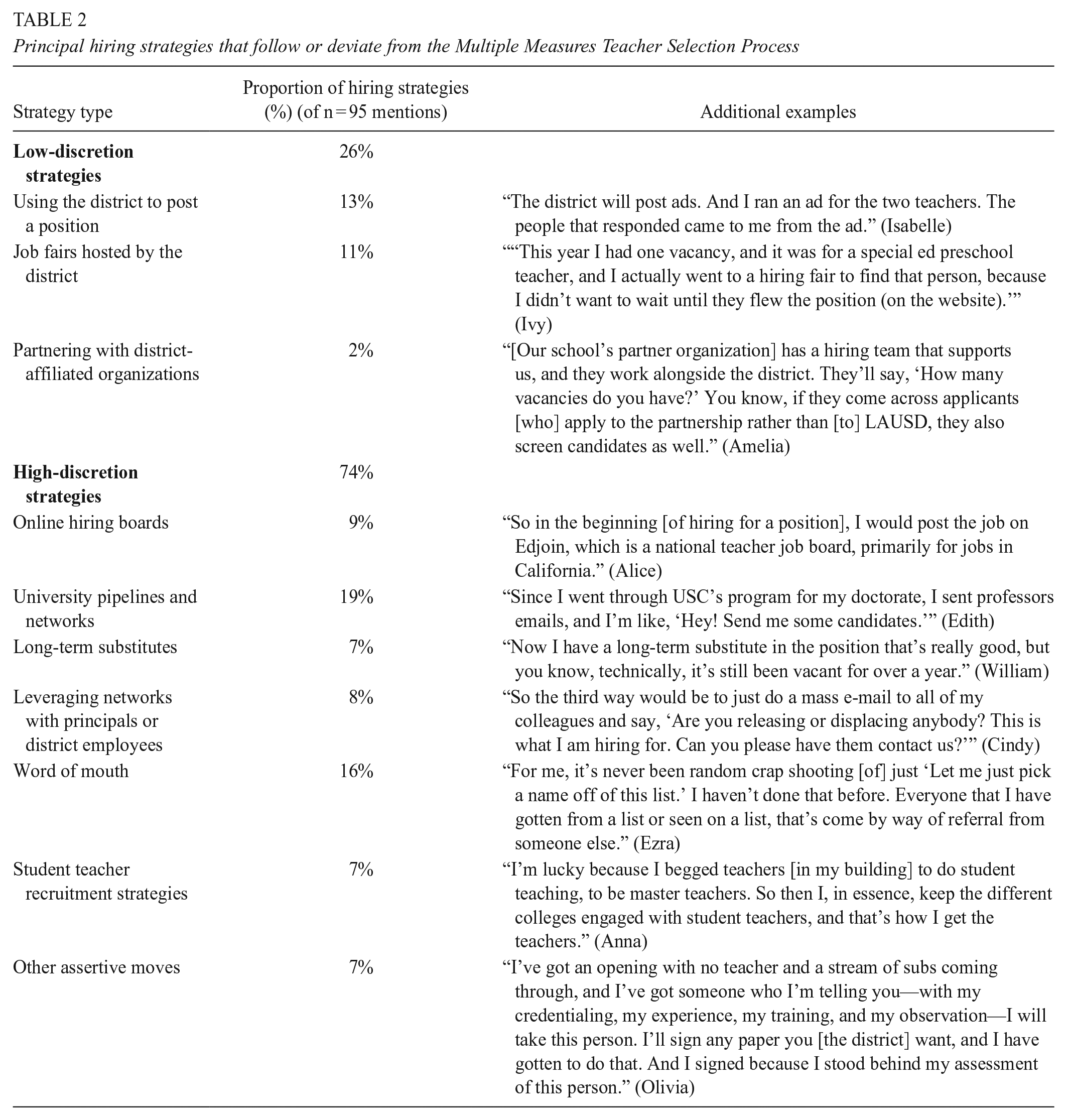
The unsanctioned strategies—by which we mean not prescribed steps in the district hiring process, although not necessarily prohibited by the district—were often precipitated by a principal anticipating an unfilled position, which the principal worked to fill in three major ways: (a) by posting the position on popular hiring boards external to the district, such as Edjoin and LinkedIn, (b) by using networks strategies, including developing and tapping their personal connections with local university-based teacher degree programs, and (c) by using a comparatively long-term strategy of encouraging current teachers to take on student teachers. Altogether, almost all of our study participants said that they used at least one unsanctioned strategy—but some used more strategies and more intensively than others. Table 2 provides a list of both types of strategies and their frequencies that emerged from the interviews.
Principal hiring strategies that follow or deviate from the Multiple Measures Teacher Selection Process
Less Assertive and Hybrid-Strategy Principals
The participants who were categorized as not very assertive (n = 6) relied on district-controlled resources, such as job fairs, job postings on the district’s website, and the teacher eligibility list, to identify candidates that they wanted to hire. For example, Amelia (Elementary, Novice) described job fairs as a meaningful opportunity for candidates and schools to gain exposure and build new connections. She recounted: “When I go to hiring fairs, I’ll talk to the candidates and say, ‘Hey, you know, let me have your résumé. I’ll set up an interview with you.’” She also used the fairs to share information about her school. Because the district organizes hiring fairs, principals in this group see job fairs as a low-effort way to recruit. Similarly, these principals view the district’s job postings and eligibility lists as efficient and effective. For example, Aaron (Secondary, Veteran) liked to post the details of the position that he was looking for on the district website because, in his view, the candidates who search for jobs there have already been vetted, which allows for a quicker hiring process. This group of principals basically stayed within the lines of the district’s prescribed hiring procedures.
Another example of unassertive strategies is Evan (Elementary, Novice), a principal of a school with low teacher turnover. He feels that the district is being helpful in its screening and finds it important to follow the district guidelines, although he describes the MMTSP as often “a bit flustering” because of how long it takes candidates to be processed. In line with this ambivalence, he attempted to comply with district protocols even when he had his own outcomes in mind. He explained, “I have to fly it [the job posting] globally on the district website, just so that applicants have an opportunity to see it there, even though I already know pretty much who I want to hire.”
By comparison, the participants who were categorized as hybrid (n = 5) did engage in unsanctioned forms of recruitment but also would use the district’s teacher eligibility list. These principals would actively call teachers on the list, set up interviews, and also would try concurrently using other nonsanctioned strategies. For example, Yasmin (Elementary, Veteran) recognized that the MMTSP is a long process that in the past had caused candidates to take jobs in other nearby districts, but she still engages with the teacher eligibility list. Yasmin explained how she includes the list in her recruitment strategies: I call the district, and I say, ‘I have a vacancy. Can I have the list of the candidates.’ And then they provide me [with] a list, and then I make phone calls or I send a mass email with BCC. Like ‘I have a fourth grade opening, you know, if you’re interested in coming for an interview, let me know.’
Yasmin tries to follow district-sanctioned recruitment strategies by contacting candidates on the eligibility list. Yasmin also posts the position to the LAUSD website. Yasmin’s strategies are considered hybrid because she also uses her networks and word of mouth among staff and principals to recruit candidates. Yasmin told her teaching staff about position openings to augment her recruitment prospects. She described, “[I] have newer teachers where they’re still finishing their credential, you know, or they may be at the university taking a class or two, so they know people who are going through a credential program” that they could recruit.
Assertive and Highly Assertive Strategies
We categorized principals who enacted the most unsanctioned strategies to identify and recruit candidates as assertive or highly assertive (n = 19). They tended to be dissatisfied with sanctioned strategies for finding quality teacher hires. Instead, principals such as Uma (Secondary, Novice) and Alice (Secondary, Veteran) turn to their relationships with universities and student teachers as alternative recruitment methods. Alice dedicates time and effort to building her connection with UCLA, saying, “I participate in a university program as a guest speaker for their teachers who are getting their credentials. I did a presentation last year on Zoom with the class and from that, two teachers wanted to come visit my school, and one of them I ended up hiring.” Similarly, Uma explained: What we’ve been able to do is we have student teachers on campus. About a quarter of our teachers are mentor teachers [as] part of our partnership with UCLA and sort of our value of being a “teaching school.” A lot of our candidates have come from that pool from the student teachers, and we’ve hired a good number of them.
Principals such as Uma treated the student teacher’s 16-week stint as a trial period to identify if they would acclimate to the students and school culture. If so, the principal would then try to secure the candidate’s availability before anyone else. Either through student teachers or establishing school–university ties, local universities offer access to teacher candidates that allowed principals to attempt to avoid the top-down hiring policies enacted by the district. Because student teachers do not have to be subjected to the screener (although eventually, to get hired, they do), principals attempted to “get a jump” on the candidate.
Ivan (Secondary, Veteran) was one of the most assertive participants. He simultaneously used different networks and recruitment methods, even when only anticipating future vacancies. Ivan explained how the sanctioned strategies were either not available (the district did not invite him to the job fairs) or unhelpful (he only received the eligibility list after schools with higher needs used it). Ivan held a mixed view of the basic screener for this reason as well as of the district’s advanced screener due to delays it caused to job offers. Given these constraints, Ivan felt that he needed his own sources of teachers. He saw credentialing programs as hubs for the highest-quality candidates before other schools recruited them. He cultivated relationships with certification programs so that he would be “aware of potential candidates before the hiring season.” He confidently stated, “[My] networking with the credentialing programs, UCLA, Center X, and USC’s credentialing program has been very, very helpful. And these are outside of our district’s protocols.” As a veteran principal, Ivan also has developed internal networks that have helped him hire the teachers that he wanted through word of mouth, and he strategically leveraged relationships with district HR employees in the credentialing office. “So this is part of my relational piece of networking,” he said. “I call [the HR person in charge of] credentialing and I say, ‘Hey, I have this candidate who’s not on the list. Can we please fast track this, or can we get them processed ASAP, so I can hire them?’ Most of the time, it does work.” For Ivan, district employees offered yet another network he could tap into to hire preferred candidates.
But Ivan’s most creative strategy was opportunistically prefilling anticipated positions. Because he knew of the difficulty of filling science teacher roles in the district, he sought to hire teachers to fill positions likely to be vacant a year or two in the future. He described a recent instance of prefilling: A chemistry teacher came by and said, “Hey, I’m a recent graduate. I’m available within the month.” I did not have a position, but I knew that in a year or two I would have an opening. So I hired the teacher, and I gave them a part-time assignment, knowing that I would have an opening in a year and a half.
Ivan’s assertive move maximizes his discretion to hire part-time employees whom he will eventually recruit into full-time roles instead of relying on the district’s resources to ensure that the position is filled in time. Overall, highly assertive principals demonstrated between one and six different strategies for recruiting and hiring candidates, with the average being four.
The group of charter school principals in our sample demonstrated mostly assertive recruitment and hiring strategies, but with much less variety than principals like Ivan. This was largely because they already had their own organizational connections tailored to their school’s hiring needs or designated hiring personnel who they trusted would identify a qualified candidate. Alice was asked if she found it difficult to find candidates for hard-to-fill positions. What stood out to her were obstacles that principals faced after the pandemic. Teachers now had to be both strong content experts and have customer service skills to navigate parent relationships, which she felt made it difficult to make a teaching position attractive to candidates. “That’s why my partnership with Teach for America Los Angeles is so critical because they’ve already done the prescreening. They’ve already got a pool of people who want definitely to work in an environment, like in the community that we serve.” She trusted Teach for America to effectively screen for high-quality candidates.
Relationship Between Perceptions and Strategies
Principals enacted a variety of hiring strategies, and these were patterned by principals’ perceptions of the screener (i.e., whether they perceived it positively or negatively). The most popular unsanctioned recruitment strategies involved principals tapping into their networks, as shown in Figure 1. These networks included contacts at universities and word of mouth through their current teachers’ networks. Although university networks were used similarly by principals with a positive or negative view of the screener, word of mouth was used much more by principals with a positive view of the screener (eight of 15) than those with negative views (three of 15). For example, Eduardo (Elementary, Novice) sees all components of the MMTSP positively, especially the teaching demo, which he calls “super important,” and the writing sample, which he does not do, as necessary to ensure applicants can “communicate using proper grammar.” Still, Eduardo works to find candidates himself. He is proud to have fostered a “family atmosphere” in the school, where teachers feel comfortable recruiting candidates to join. Recalling how he hired the last several candidates, he reflected, “It’s been word of mouth. The last couple of candidates that we’ve hired are teachers currently employed here that have shared with friends. [They’ll say to them,] ‘There’s an opening, apply!’”

Frequencies of hiring strategies used, by perception of advanced screener
The other five categories of unsanctioned hiring strategies showed a similar pattern. That is—perhaps counterintuitively—participants who expressed a positive or mixed perception of the MMTSP were the ones who most often enacted assertive strategies that lay outside the district’s envisioned role for the principal in the teacher hiring process (see Figure 1). This was the case for 11 of 14 principals in the group with positive perceptions. Principals who had strong networking relationships with other principals often shared information about potential candidates that they considered quality teachers. This included sharing advance information on candidates that would be added to the teacher eligibility list. This sometimes happened when principals had to displace teachers as their schools went through mandated restructuring or downsizing. For example, Lori (Elementary, Novice) talked about principals’ connections as a recruitment tool: A lot of time, it’s also between the principals. It’s like, “Hey, do you know someone? Are you displacing anyone good? I have a position.” So a lot of time, itʼs among the principals that we will talk and then say like, “Hey, I might have to displace someone. Do any of you have a position available for this person?”
In place of the district’s vetting of candidates on the eligibility list, these principals would rather turn to trusted principals in their network who had vetted candidates for them. Principals who had a good working relationship with the teacher also can ensure that they were able to support their teacher in getting hired if the district required the principal to let them go. In sum, leveraging principal networks was an effective, although unsanctioned, way that principals regained professional control over recruitment, screening, and selection parts of the hiring process.
In contrast, there was no clear relationship between negative perceptions of the MMTSP and principals’ hiring strategies. The most popular district-sanctioned hiring strategies, posting to the district website and attending district job fairs, were used somewhat evenly by principals who held a positive, negative, or mixed view of the screener (see Figure 1). Many principals in the negative perceptions group wondered how rigorous the MMTSP was when they struggled to find high-quality candidates from the teacher eligibility list. But despite their negative perceptions of the advanced screening method, some principals in this group still preferred to use district-sanctioned methods to recruit teachers. For example, all participants with very negative perceptions (i.e., n = 5) still engaged in a district-sanctioned strategy of creating a job posting and allowing the district to market the position for them on the district website. As Evelyn (Secondary, Novice) stated, she was skeptical of HR employees who assessed applicants using the MMTSP. Yet she described the sanctioned strategy of posting to the district website as an effective way to request support from the district to fill a position: “Through our district website, we have a fairly robust HR site where you can go to look for certificated openings. You go there and schools can post their flyers for their positions.” Nevertheless, some principals in the negative perceptions group did exhibit assertive hiring strategies that went beyond the district’s procedure for finding teachers to hire. For instance, 33% of principals who used online hiring boards, 33% of principals who used university networks, and 13–29% of principals who used the other five unsanctioned strategies held negative views of the advanced screener. Similarly, the principals we categorized as having a mixed view of the screener reported using both assertive and unassertive strategies.
To visualize the perception/strategy relationship in a more nuanced way, we plotted the range of responses we observed from our respondents along a two-way qualitative spectrum in Figure 2. Although Table 2 and Figure 1 provide a sense of the distribution of strategies and perceptions in the sample, Figure 2 shows different sizes of clusters at various points along these spectra. For instance, the largest cluster we observed was among the positive and highly assertive principals, a cluster of nine principals in the upper-right zone of the figure. Another cluster was the mixed views and highly assertive (n = 4) in the center top. The remaining combinations were more spread out, depicting our finding that respondents with negative views of the screener occupied a range of high, medium, and low assertive strategy positions.

Plot of perception/strategy combinations, by respondent
Variations in Principal Perceptions and Hiring Strategies by Principal Gender and Race and School Context
Although the nature of our sample and interview questions did not allow us to draw conclusions about reasons for any observed differences by gender and race of principals, we did note a few clear patterns. This supplemental analysis further enabled us to address our third research question and to rule out alternative explanations for the patterns we observed in principal attitudes and autonomous hiring strategies, based on prior research that has demonstrated differences in assertive behavior by employee gender or race (Ispa-Landa & Thomas, 2019; Ridgeway, 2001).
Perceptions of the advanced screener did not vary much by principal gender. Nearly half the participants who identified as female and about half the participants who identified as male held positive views of the advanced screener. In terms of strategies, females tended to exhibit only slightly more assertive strategies (n = 13 of 19) than males (n = 6 of 11).
Similarly, perceptions of the advanced screener did not vary noticeably by principal race. However, two patterns are suggestive: Principals who identified as Asian tended to describe mostly assertive hiring strategies (n = 6 of 8), whereas participants who identified as White were most willing to use district-sanctioned strategies. We considered that this pattern might proxy for staffing conditions in the schools these principals led. We acknowledge that even if the district did not face large teacher staffing shortages, some schools experienced more shortages than others. Indeed, we found that Asian principals in our sample more often worked in regions that they perceived to face shortages than did White principals.
We also considered whether any patterns in principals’ attitudes or assertiveness emerged by school contextual factors, such as level of schooling (elementary or secondary) or region in the city. It could be that positive views of the MMTSP reflect relative ease of hiring. Elementary principals stated that it was not difficult to fill positions that required only a nonspecialized, multisubject license. Indeed, elementary school principals held the most positive attitudes about MMTSP, followed by middle school principals, with high school principals expressing higher levels of dissatisfaction. In addition, principals in three regions (one of them a harder-to-staff region) tended to be mostly assertive in their hiring strategies; principals in another region (also harder to staff) demonstrated a split between assertive and nonassertive strategies; and we did not have enough data from the other three regions to discern patterns.
Discussion
In our study of principals’ perceptions of and responses to a district-level hiring policy that placed more restrictions on who principals could hire, we found that principals varied substantially. Nearly half of our sample perceived the policy—which we liken to an advanced teacher screener—positively. But perhaps counterintuitively, these principals tended to demonstrate assertive hiring strategies that went beyond prescribed district procedures for recruiting and hiring teachers. About a third of the sample had negative views of the policy, but they did not show a clear pattern in how much they followed or circumvented district-sanctioned hiring processes. Some of these principals demonstrated assertive hiring strategies, but others of them were relatively passive (e.g., taking the candidate pool as largely fixed). We found little evidence that these patterns varied substantially by principals’ characteristics or context.
Our findings make two contributions. First, we advance research on principal discretion by highlighting the importance of principals’ awareness of and attitudes toward policies in shaping their responses to them. To our knowledge, we are the first to use a framework grounded in theory on professions to explain principals’ interpretation and mediation of policy. Although principals’ level of control over an unpredictable working environment may be tenuous (Lortie, 2009), principals are sometimes also unaware of the control over decision making they have (Mavrogordato & White, 2020). We show that principals exercise professional control—specifically in the form of exercising discretion in hiring decision making—most often when they do not feel threatened by a higher-level hiring policy. Still, about half the principals who perceived that the hiring policy created obstacles to their ability to lead a high-performing school—that is, who perceived diminished autonomy—overcame these by employing professional control—that is, their expert-based authority to make individual judgments, apart from the dictates of bureaucratic (i.e., organizational) controls. As such, we provide novel evidence of a set of extrabureaucratic maneuvers (Morris et al., 1982) principals used to hire teachers.
Second, we contribute to literature that documents variation in principals’ priorities and strategies to hire teachers (Grissom et al., 2017; Papa & Baxter, 2008; Rutledge et al., 2008). Consistent with prior research on principal preferences in teacher hiring, we found principals engaging in recruiting, screening, and selection activities of their own (Perrone & Meyers, 2023) in ways that often privileged candidates’ connections via social ties (Cannata, 2011) or fit with the school (Rutledge et al., 2008). Building on this research, we highlight different strategies principals use in hiring teachers along a spectrum of assertiveness vis-à-vis district policy and explore how variation may be related to principals’ perceptions of that policy.
Our findings about the ways some principals circumvented the district screener also have possible implications for inequity—in both the distribution of teacher talent and principal support from the central office—when principals rely on contacts in central HR office (Honig & Rainey, 2023), as did highly assertive Ivan. This persisted even though LAUSD was, as several principals perceived, trying to use staggered access to the teacher eligibility list among principals to allocate teacher talent to high-needs schools first. Another implication for inequity pertains to the possibility that principals may not be able to exercise as much discretion because of applicant shortages, for example, due to being less attractive schools (DeArmond et al., 2010). We found suggestive evidence of this because our analysis of principal strategies most common across school regions showed that harder-to-staff schools featured fewer principals who enacted assertive hiring strategies. Our data cannot conclude whether this pattern is widespread or whether unsanctioned strategies are a form of privilege for principals with wider potential applicant pools. In sum, our study uncovered some assertive moves principals use to fill teaching positions, some of which may undermine the district’s efforts to standardize the teacher screening process.
Future research could investigate policy consequences of principals’ assertive, professionally autonomous hiring strategies. Previous research has documented that not all instances of principal discretion undermine policy aims. For instance, Donaldson and Woulfin (2018) showed how principal enactment of teacher evaluation policy aided the policy’s development aims but not its accountability aims. In our study, we found possible silver linings of principal professional autonomy to the district’s advanced screening policy. To the extent that the principals are skeptical of the hiring process, it could bolster some of the goals of the reform. Additionally, we found that many of the principals who perceived the screener negatively still followed at least some district-sanctioned hiring processes.
As such, policy designers might not need to be worried that principals are dissatisfied with the policy. Perhaps such a reaction from principals who desire more professional control will motivate them to be more thoughtful with their own hiring or make them realize how they have an important role to play in distinguishing higher-quality from lower-quality candidates. For example, many of our interviewees described conducting additional screening of their own because they needed applicant information (such as a teaching demonstration) situated in their specific school setting. Future research also could consider issues of efficiency versus quality in hiring policy and how they play out in centralized versus decentralized district settings. Some studies have found that teacher hiring is more efficient when it is decentralized to the school level (Naper, 2010). We do not yet know whether models for efficient hiring are compatible with models for quality hiring and whether a screening process such as the one we observed would be viable in a school district with a more decentralized structure (either formally or informally or both).
Future research also could consider implications for equity in how districts apply policies across schools and principals facing different hiring situations. For instance, Asian principals in our sample appeared to enact more assertive hiring strategies than other racial groups. These patterns raise questions about whether observed differences arise from the social factors or school conditions that vary by principal race. As prior research has suggested, Asian educational professionals face essentializing stereotypes that may compel them to take actions to have their performance (and that of other Asian colleagues) be viewed positively (Museus, 2014). Thus, it is possible that Asian principals in our sample experienced more intense feelings of pressure to fill all the positions. It is also possible that these principals were hired to lead schools that required more intensive leadership practices to address preexisting resource and performance pressures, often called a glass cliff. Prior research has documented that females more often lead such schools (Smith, 2015). Although our data did not allow us to further understand these influences, future research should more explicitly grapple with how race and gender shape principal discretion, specifically in their use of hiring strategies.
The patterns uncovered in our study have practical implications for district-level policy implementation. Our findings suggest that engaging middle managers in the public sector—such as principals—is key to avoiding backlash responses rooted in fear of loss of professional autonomy. We do not suggest that the policy be removed because it appears to be at least somewhat effective for identifying teacher candidate quality (Bruno & Strunk, 2019) as well as being aligned with and coherent within district initiatives for improved performance, as described in research on the organizational arrangements of district offices (Honig & Rainey, 2023; Johnson et al., 2014). Rather, if districts can engage principals in new teacher screening practices, principals will be more likely to appreciate the purpose of the change and to bring their perceptions and behaviors into alignment with the policy. This is similar to what studies of corporations and nonschool public-sector organizations have shown in terms of middle managers embracing reforms that otherwise could be construed as undermining their discretion (Dobbin et al., 2015; Higgs et al., 2023). This does not mean that principals ought to control the content or implementation of the screener but rather that they are consulted in its development and modification. One feature of the policy we studied that may have aided principals’ autonomy, even if unintentionally, was the district’s decision to withhold MMTSP scores from principals. Such a feature could be effective for incentivizing principals to use their own judgment among the candidates on the eligibility list.
Principal autonomy over teacher hiring is a valued form of professional discretion among principals (e.g., Donaldson, 2013), yet research has suggested that urban school principals have struggled to secure the amount of discretion in hiring that their peers in other district settings enjoy. Nationwide survey evidence indicates that school principals in urban schools tend to report low levels of influence over teacher hiring relative to other principals (Engel et al., 2018). These patterns, combined with the importance of principals for successful policy implementation, suggest that it is important to take principal autonomy into account when designing and imposing district- and state-level education policy. This autonomy remains an important area for future research.
Footnotes
Appendix A: Focal Codes
Time principal dedicates to teacher recruitment:
Acknowledgements
We thank the Los Angeles Unified School District for their research partnership, the College Research Board for their grant support, Emma Park, Rachel Moy, and Julia Slusher for research assistance; and J. R. Keller and participants at the People and Organizations and the Association for Public Policy Analysis and Management annual meetings for their feedback on earlier versions of this paper.
Declaration of Conflicting Interests
The authors declare no potential conflicts of interest with respect to the research, authorship, and/or publication of this article.
Funding
This work was funded by the Campus Research Board at the University of Illinois, Urbana-Champaign (Grant No. RB22001).

Note: This manuscript was accepted under the editorial team of Kara S. Finnigan, Editor in Chief.
Notes
Authors
JENNIFER L. NELSON is an assistant professor of education policy, organization, and leadership in the College of Education at the University of Illinois at Urbana-Champaign. She studies how organizational demography, arrangements, and leadership practices in schools shape teachers’ social networks and coworker support.
MARISOL JIMENEZ is a PhD candidate of education policy, organization, and leadership in the College of Education at the University of Illinois at Urbana-Champaign. She studies education reforms in urban areas.
PAUL BRUNO is an assistant professor of education policy, organization, and leadership in the College of Education at the University of Illinois at Urbana-Champaign. He studies personnel administration, school finance, and school choice.