




Abstract
This qualitative study traced high school teachers’ collaborative work before, during, and after pandemic-induced remote schooling. Conducted over 3 school years, interviews with teachers and instructional coaches at two urban high schools revealed that although teachers were more physically isolated than ever during remote schooling, collaboration increased substantially. A flexible remote schedule introduced unprecedented common time in teachers’ normally packed workdays. This change shifted norms of isolation among teachers and fostered sustained collaboration on instruction and student outreach. Participants valued the alternative workplaces these changes permitted and hoped that they might outlive remote schooling. However, interviews conducted after schools reopened revealed that collaboration had, with some exceptions, largely returned to pre-pandemic practices at both schools. These findings complicate our understanding of teachers’ work during and after COVID-19, extend limited scholarship on teacher collaboration at the high school level, and offer an empirical investigation of the critical relationship between teacher collaboration and time, an undeveloped area. Implications for school leaders and policymakers are offered.
Keywords
Introduction
Teacher collaboration is essential. It is associated with student learning gains (Goddard et al., 2007; Ronfeldt et al., 2015), it can improve teacher retention (Johnson & Birkeland, 2003; Pogodzinski et al., 2013; Smith & Ingersoll, 2004), and it affords teachers emotional support in a demanding profession (Datnow, 2018). Despite these benefits, teacher collaboration is difficult to achieve. This is especially true for high schools, where subject specialization through departments silos teachers (Siskin, 1994), and school schedules are driven primarily by student preferences, not teachers’ professional learning (Powell et al., 1985). Such conditions tend to isolate high school teachers rather than unite them as colleagues.
When the COVID-19 pandemic shuttered K–12 school buildings and forced teachers to adopt an entirely new mode of instruction, the importance of teacher collaboration intensified (Johnson, 2020; Kraft et al., 2021). But how did this disruptive period in education affect high school teachers’ work specifically? If high school teachers are professionally isolated even when their brick-and-mortar buildings are open, what would remote schooling mean for their professional lives?
Motivated by these questions, I began interviewing teachers at two comprehensive high schools in one urban school district during the 2020–21 school year, which was largely conducted online. I wanted to understand how teachers were coping when pandemic-induced school closures presumably had isolated them even further from colleagues. During interviews, teachers universally shared their struggles teaching students via computer screens. As far as their engagement with colleagues, however, they were coping surprisingly well. Accordingly, I shifted my research design to explore this unexpected finding further.
Interviews with participants at both high schools revealed that teachers’ collaborative work had increased substantially. The district’s master schedule for remote high school instruction reduced teachers’ instructional hours and gave teachers common time on a scale previously unimaginable. That common time enabled sustained teacher-driven collaboration on remote instruction, collaboration around students, and collaboration in new collegial configurations. These changes disrupted established norms of privacy and isolation among many teachers at both schools. Participants hoped that these changes might persist in some form after schools reopened. However, two additional waves of interviews during the 2021–22 and 2022–23 school years revealed that teachers’ work had, with some exceptions, returned to pre-pandemic forms.
These surprising findings complicate the dominant narrative that COVID-19 caused teacher burnout and stress. They extend limited research on teacher collaboration in high school contexts and advance a conceptual framework on high school teachers’ collaboration emphasizing the crucial factors of professional norms, school leadership, and time in supporting teachers’ work together. Finally, by showcasing what high school teachers did with increased common time when they finally had it, this article offers an empirical investigation of the critical relationship between teacher collaboration and time, an underexamined area. The study’s focus on the pandemic may highlight a unique moment in education, but these findings remain relevant to teachers’ day-to-day work in schools at any time.
Literature Review
Teacher Collaboration in Schools
In recent decades, on-site collaboration with colleagues has increasingly become a fixture of teachers’ workplaces. Teacher collaboration occurs when teachers engage in what Little (1990a) called “joint work”—a “shared responsibility for the work of teaching”—with the aim of improving student outcomes. This work can assume several forms, including exchanging best practices and instructional strategies, analyzing student work and data, co-planning lessons, co-creating curricular materials, conducting peer observations, and conferencing around individual students whom teachers have in common (Datnow & Park, 2018; Vangrieken et al., 2015; Weddle, 2022). Importantly, Kelchtermans (2006) reminded us that “collaboration and collegiality do not happen in a vacuum, but—on the contrary—always appear in the particular context of a school, at a particular moment in time” (p. 221). Teachers’ individual workplace contexts help determine whether these practices occur at all and how successful they are when they do.
High-quality teacher collaboration is positively associated with student achievement. Examining three elementary schools in North Carolina where test scores rose dramatically over 5 years, Strahan (2003) observed strong collaborative teacher cultures centered around “data-directed dialogue” (p. 143). Jackson and Bruegmann (2009) demonstrated the powerful influence of “peer-induced learning” in elementary schools (p. 87), highlighting spillover effects in teacher quality when effective colleagues are present in the workplace. Goddard et al. (2007) found a direct link between highly collaborative elementary school contexts and student achievement in reading and math. Examining collaboration in instructional teams—groups of grade-level teachers who share a common cohort of students—Ronfeldt et al. (2015) found an association between teachers’ collaboration around assessments (e.g., analyzing results on state tests) and reading and math gains. The authors also found that teachers’ collaboration on instructional strategies predicted reading gains.
Studies also have highlighted the relationship between collaborative workplaces and teachers’ satisfaction and retention (Johnson et al., 2012). Such workplaces are particularly important for novice teachers who frequently work as “solo practitioners, expected to be prematurely expert and able to work without the support of a school-based professional network” (Kardos & Johnson, 2007, p. 2100). Johnson and Birkeland (2003) found that early career teachers were more likely to remain in school contexts “organized to engage teachers of all experience levels in collegial and collaborative efforts” (p. 605). Analyzing data from the 1999–2000 Schools and Staffing Survey, Smith and Ingersoll (2004) similarly found that new teachers who collaborated in induction programs were more likely to remain at their original schools and in the teaching profession overall beyond their first year.
However, most research on teacher collaboration has focused on elementary and middle schools in part because collaboration happens more frequently there (Patrick, 2022). Elementary and middle schools’ contextual features (e.g., less specialization, smaller school sizes) more readily support formal collaboration structures such as instructional teams or common planning time (Gallimore et al., 2009; Johnson, 2019; Louis et al., 1996; Wei et al., 2010). In contrast, high school contexts are organizationally far more complex. Elementary school teachers are subject generalists, but high school teachers are specialists whose primary allegiance is to their subject departments (Siskin, 1994). Although departmentalization certainly can enable “strong department-based communities of practice,” it also constrains “teachers’ mutual engagement at the school level” (McLaughlin & Talbert, 2001, p. 127) and stifles interdisciplinary exchange. Departmentalization means that shared subjects, not shared students, shape teachers’ collaboration when and if collaboration occurs. And because high schools are so specialized, students’ preferences among or placements within specialties typically dictate the design of schedules, not teachers’ professional development (Powell et al., 1985). Classroom exigencies, such as overwhelming student loads, can further limit teachers’ time and capacity to collaborate. The National Center for Education Statistics estimates that the average class size of high school teachers is 23 students (National Center for Education Statistics [NCES], 2018), meaning that some high school teachers may have as many as 150 students on their caseloads in a given semester.
Altogether, these conditions tend to spur “looser professional linkages” among high school teachers and limit opportunities to collaborate (Louis et al., 1996, p. 762). And yet, this is precisely why more research is needed on teachers’ collaboration at the high school level. By examining what high school teachers can do with common time when they have it, this study contributes to a less developed research area and offers implications for the structuring of high school teachers’ workplaces going forward.
Studying Teachers’ Work During a Pandemic
Research on teachers during the pandemic has focused primarily on issues of burnout and stress (McCarthy et al., 2022; Pressley, 2021). Analyzing data from the American Educator Panels’ (AEP) survey, a series of RAND reports painted a dire picture of the profession and repeatedly raised alarms about teacher attrition (e.g., Diliberti et al., 2021; Steiner & Woo, 2021).
Another, less prominent stream of research has examined teachers’ professional lives during the pandemic and tends to complicate this bleak narrative. Although Schiller et al. (2023) found that pandemic-related closures worsened collegiality overall among New York teachers, not all evidence has been so discouraging. For example, surveys conducted during the school closures in the spring of 2020 cited collaboration as critical for teachers’ transitions to remote instruction (Hamilton et al., 2020; Kraft et al., 2021). In a December 2020 survey, California elementary school teachers credited the remote context with facilitating “deeper collaboration” with colleagues (Santagata et al., 2024, p. 714). In a mixed-methods study of pre-K–12 teachers in the spring and summer of 2021, Blair et al. (2023) similarly found that when teachers confronted pedagogic challenges and diminished contact with students, collegial relationships became a source of emotional support and instructional innovation. Barlett et al. (2024), meanwhile, have emphasized the pandemic’s deeply contextual nature, demonstrating that schools with strong collaborative cultures were best equipped to respond to pedagogic disruptions. And teachers across the country experienced more flexible schedules while remote and taught fewer hours as schools balanced synchronous learning with asynchronous learning and concerns about students’ mental health intensified. This arrangement enabled at least some teachers to more fully engage in activities such as parent conferences and joint planning (Marshall et al., 2023, p. 65).
This study builds on the above-mentioned findings, highlighting remote schooling’s unexpected collegial benefits and delivering a nuanced narrative about teachers’ pandemic work lives. But it also carries the inquiry further. The study’s longitudinal design—comparing teachers’ remote workplaces and in-person, “normal” workplaces—illuminates the contrast between these distinctive work environments. This contrast is enormously revealing, making the structural conditions that impede teachers’ collaboration dramatically visible and demonstrating what teachers can jointly accomplish when those conditions dramatically shift. This design additionally allowed me to investigate whether the positive changes teachers experienced during remote schooling have had any lasting influence on their post-pandemic workplaces, something few studies have done.
Conceptual Framework for High School Teachers’ Collaboration
Drawing on existing research, this article’s conceptual framework identifies three school-level forces that shape high school teachers’ collaboration: (a) professional norms among teachers, (b) the principal’s leadership, and (c) time—both how much time teachers receive and how that time is used and scheduled. Although these are not the only forces that influence high school teachers’ collaboration, they are essential and are particularly pertinent to understanding teachers’ workplaces before, during, and after remote schooling.
Professional Norms Among Teachers
Teaching is intensely social work, but teachers spend nearly all their time working on their own, away from colleagues (Lortie, 1975). This professional isolation is the product of distinctive structural conditions in high school teachers’ workplaces: departments that divide up teachers, create subject-specific identities, and frustrate schoolwide collaboration initiatives (Siskin, 1994); large “egg crate” buildings that conceal rather than expose good teaching (Hargreaves & Fullan, 2012; Murphy, 2020; Sizer, 2004); and demanding teaching schedules with overwhelming student loads and multiple lesson preps (Sizer, 1992). These structural conditions affect teachers differently; in a single school, collaborative departments may exist alongside uncollaborative departments (McLaughlin & Talbert, 2001). Most frequently, however, they promote norms of “privacy and noninterference” among teachers, which, in turn, undermine collaboration efforts (Little, 1990a, p. 530). Together these structures and their associated norms render teaching a solitary assignment rather than a mutual, school-wide endeavor.
Conversely, a different set of professional norms characterizes collaborative teacher workplaces. In these settings, teachers unite around shared goals and assume joint responsibility for students’ learning (Newmann & Wehlage, 1995). They espouse an “orientation toward continuous improvement” on instruction and approach their work with “a sense of agency” (Bryk et al., 2010, p. 55). Moreover, they are guided by an open acknowledgment of teaching’s profound complexities (Rosenholtz, 1989, p. 43). Importantly, such norms “do not spring spontaneously out of teachers’ mutual respect and concern for each other” (Rosenholtz, 1989, p. 44). They, too, are the products of structural conditions, albeit different ones from the typical high school. These may include grade-level interdisciplinary teams that moderate the rigidity of departments; flexible schedules that afford teachers’ regular, sustained common time; peer observation initiatives such as instructional rounds that make teaching visible; and resources such as classroom coverage for teachers when they are engaged in those observations.
The Principal’s Leadership
School principals further influence professional norms among teachers and therefore teacher collaboration (Tichnor-Wagner et al., 2016). Studies have demonstrated that effective principals serve as instructional leaders (Goddard et al., 2015), engage teachers as partners in instructional improvement (Charner-Laird et al., 2017), and set expectations for teachers’ collaborations (Anderson et al., 2010). They cultivate what Bryk and Scheider (2002) called “relational trust” with teachers, a necessary precondition for productive school change. Moreover, they allocate resources to ensure teachers’ authentic engagement with collaboration initiatives. For example, principals can limit teachers’ nonacademic duties, ensure that certain teachers share the same free periods when building schedules, and safeguard teachers’ collaborative time (Grissom et al., 2021; White-Smith, 2012). Johnson (2006) accordingly characterized school principals as “broker[s] of workplace conditions” (p. 15).
Not all forms of leadership, however, cultivate productive norms among teachers. When administrators enforce collaboration initiatives but fail to involve teachers in decision making or to empower them as instructional leaders, collaboration can devolve into a “compliance exercise” (Bill and Melinda Gates Foundation, 2014, p. 10). Hargreaves and Dawe (1990) found that when collaboration initiatives are “bureaucratically determined” and primarily advance administrators’ priorities, they may spur not authentic but “contrived collegiality” among teachers (p. 229). Patrick (2022) similarly demonstrated that teachers find collaborative initiatives with “high levels of administrative oversight” unhelpful (p. 664).
Time
Time exerts an especially important influence on teachers’ collaboration because it provides the core infrastructure for collaboration to occur. And yet, teachers continually report not having enough of it. “There’s no time” remains a nearly universal response when teachers discuss their professional learning (Collinson & Cook, 2001). A nationally representative survey of K–12 teachers found just 38% reporting having enough time to work with colleagues (Johnston & Tsai, 2018, p. 5).
Time in schools is made concrete by the master schedule, a powerful structure that allots resources and personnel throughout the school day. Any form of collaboration must confront this consequential blueprint. The master schedule outlines how long classes meet for and when specific teachers teach. It specifies when teachers have free periods and when they are responsible for fulfilling nonacademic duties (e.g., monitoring hallways, cafeterias). As Little (1990b) has written, teachers’ collaboration is acutely “enhanced or eroded” by the master schedule: The master schedule makes room, or not, for all teachers to be available for a block of time each day. The master schedule gives reason, or not, for teachers to work together on a program for a group of students taught in common. (p. 186)
Schools that formalize and protect collaboration in their master schedules can enhance teachers’ professional lives and improve student outcomes (Bae, 2017; Charner-Laird et al., 2017; Louis et al., 1996). In general, however, the master schedule erodes what teachers can jointly accomplish because it “maximizes the use of teachers’ time so that their students—not their colleagues—get the full benefit of their expertise” (Jonhson, 2019, p. 82). So much time spent with students limits teachers’ time spent with colleagues—time that could, as research has shown, improve teachers’ work with students in classrooms.
Importantly, time influences the other forces identified in this conceptual framework: professional norms and the principal’s leadership. When schedules offer minimal time or no time at all for teachers’ collaboration, norms of privacy and isolation are promoted and reinforced. Minimal time with colleagues limits teachers’ abilities to coalesce as faculties and mutually advance schoolwide efforts to help students succeed. And when teachers are so strapped for time, their engagement in whatever collegial time they do have may be distracted or marked by collective frustration. As “brokers of workplace conditions,” school principals maintain some influence over how time is spent in schools and the design of schedules (Johnson, 2006, p. 15), but time presses on principals, too. Principals, for instance, have limited control over the number of instructional hours their districts mandate. They are also influenced by district priorities for how teachers ought to spend their time, some of which may directly impede the cultivation of strong professional cultures in schools.
These interrelated school-level forces of professional norms, principal leadership, and time shaped teachers’ shifting engagement with colleagues before, during, and after remote schooling. Time, however, laid the groundwork for teachers’ collaboration. Time made collaboration either possible or impossible. Its influence on teachers’ remote-era collaboration—and on teacher collaboration at any time—is significant. Nevertheless, beyond international comparison studies (e.g., Darling-Hammond et al., 2010, 2024), few studies have closely examined this relationship. Addressing this gap, the present study offers a detailed analysis of time and teacher collaboration in context.
Method
Research Questions
The following research questions guided this study:
How, if at all, did increased common time with colleagues during pandemic-induced remote schooling affect high school teachers’ collaboration? What forms of collaboration, if any, did it enable?
What role did teachers’ distinctive workplace contexts (e.g., professional norms, principal leadership) play in this process?
How, if at all, did changes during remote instruction affect teachers’ workplace contexts after schools reopened? Have remote-era changes in teachers’ collaborative work influenced teachers’ workplaces after COVID-19? If so, how?
Research Sites and Participants
To answer these research questions, I conducted semistructured in-depth interviews with 24 teachers and two instructional coaches at two public high schools in a midsize urban district I call the Iron City Public Schools (ICPS). 1 All interviews took place remotely over a secure institutional Zoom account. The ICPS serve roughly 25,000 students. The district’s student body is 75% low income and 70% non-White. The two similarly sized research sites, Arborview High School (AHS) and Lakeland High School (LHS), are both comprehensive high schools organized principally around subject departments. During remote schooling, both schools also experienced the same flexible schedule, allowing for rich comparisons. Table 1 offers further detail on the schools.
The schools.

Although AHS and LHS have key differences, they represent typical comprehensive high schools. My selection of typical cases is purposeful. Studies on teacher collaboration have tended to prioritize exemplary cases over typical ones. Although the resulting research helpfully demonstrates what works in effective teacher workplaces, it also can obscure the challenges and complexities associated with enacting similar practices in schools that are ill-structured to support teachers’ collaboration. As Weddle (2022) noted, further research on typical cases—or even “weak collaborative cultures”—can “support the development of effective collaborative dynamics for teams that stand to benefit the most” (p. 12).
After the study was approved by a university institutional review board in the fall of 2020, I began recruiting participants by sending email messages to all teachers in each school. Instructional coaches also generously encouraged teachers’ participation. To expand the participant sample, I used snowball sampling, inviting teachers to spread word of the study among their close colleagues. The resulting participant sample spans career stages and subject areas. Only two participants in the sample were non-White. This was not intentional in my sampling, but it does parallel a pronounced racial mismatch between teachers and students in ICPS, where nearly 90% of teachers are White. Table 2 provides additional detail about the participant sample.
Participants.

Novice: 1–3 years; Second stage: 4–10 years; Experienced: 10+ years. These career-stage labels are based on prior literature.
Data Collection and Analysis
I conducted multiple in-depth semistructured interviews with participants over 3 school years (2020–21, 2021–22, and 2022–23). This research design is distinctive from those of many studies of teachers conducted during the pandemic, which have relied on survey data. Interviews help us pursue and understand the complexities of teachers’ work at any time, but especially during the pandemic, when teachers had little control over and were seldom consulted about myriad changes in their work. By conducting interviews over time, I approach the pandemic as an “ongoing social process” (Rubin & Rubin, 2012, p. 4). A longitudinal design additionally departs from snapshot studies of COVID-19’s effects on teachers’ work that tend to treat the pandemic as a single event.
The first 2 school years in my timeline of data collection (2020–21 and 2021–22) were most disruptive for teachers’ work. From September 2020 to March 2021, teachers navigated the practical challenges of remote learning, that is, synchronous face-to-face instruction delivered entirely via an online learning platform (i.e., Google Classroom). I chose not to analyze teachers’ collaborative work during emergency remote learning (mostly asynchronous remote instruction during initial spring 2020 closures) or hybrid learning (instruction delivered to remote and in-person students simultaneously from March 2021 to June 2021) because these phases of pandemic schooling were considerably shorter and more volatile than the lengthier, more stable remote learning phase.
Participants hoped that the 2021–22 school year would be a return to normalcy, but health and safety measures, coupled with COVID-19 outbreaks and reacclimating students to in-person learning, made for a tense homecoming. Accordingly, interviewing a sample of participants a third time during a steadier school year (2022–23) allowed me to follow up on earlier findings and determine whether participants’ remote collaboration had any lasting influence on their teaching environments 2 years later. In total, 23 teachers participated in the first wave of interviews (2020–21), 16 in the second wave (2021–22), and 13 in the third wave (2022–23). The average interview lasted 55 minutes.
Data analysis was ongoing. Shortly after the interviews, I listened to recordings and then wrote analytic memos to note key phenomena, prevailing responses across the sample, and emerging themes in the data. This practice of memo writing prepared me for upcoming interviews because I adjusted questions and filled gaps in my understanding of teachers’ workplaces. I repeated this process for each wave of interviews. Over time, I developed more nuanced views of teachers’ workplaces at both research sites and was able to more confidently draw comparisons between and within schools. Although I transcribed some whole interviews myself, I worked primarily with raw transcripts generated by Zoom, which I refined into more precise documents for analysis.
Following each interview wave, I engaged in multistaged coding processes using NVivo coding software. Initial open-coding stages yielded codes that were “provisional, comparative, and grounded in the data” (Charmaz, 2006, p. 48). Axial coding stages established clearer patterns across interviews. Finally, I engaged in a selective coding process wherein core categories crystallized and codes peripheral to the inquiry’s focus were discarded (Corbin & Strauss, 2014). This process uncovered the discrete forms that teachers’ collaborative work assumed during remote learning. It additionally exposed recurrent, cross-cutting themes and tensions in the research sample. (The Appendix offers sample codes, definitions, and examples of coded segments.)
Not all participants interviewed during the 2020–21 school year agreed to be interviewed over the next two rounds of interviews. However, my ongoing engagement with several participants ensured greater validity for the study’s findings. Interviewing some participants as many as three times helped me “rule out spurious associations and premature theories” (Maxwell, 2010, p. 283) and trace changes in teachers’ collaborative work with greater accuracy. This also allowed me to share subsequent analyses with participants and hear their responses to my findings (Maxwell, 2010, p. 283).
Findings
Before Remote Schooling
Pre-pandemic Professional Norms at AHS
Despite its large size, AHS participants viewed their school as a collegial workplace before the pandemic. “We’ve always been collaborative,” said Mackenzie. Kurt, an instructional coach, called the school “excessively collaborative,” particularly compared with the handful of other Iron City schools where he had worked. Teachers “bend over backwards” to support one another, he explained. “If you need a lesson idea or help with something, there always someone—or a bunch of someones—who are more than willing to help.”
These productive professional norms are in part the result of formal collaboration structures. AHS’s ninth grade is organized into clusters, essentially smaller schools within the school. Each cluster has an interdisciplinary team of teachers who share the same cohort of students. Ninth grade teams share the same free periods every day. This gives ninth grade teachers time to systematically collaborate across disciplines and confer about students. Although tenth grade teachers are not organized into teams, they, too, enjoy common time to collaborate. Like ninth grade teachers, they share the same free periods. They also formally convene as a full group once per week to collaborate around students and state tests, which students take their sophomore year.
Although AHS teachers noted exchanges of practice regardless of grade level, eleventh and twelfth grade teachers—in contrast to ninth and tenth grade teachers—receive minimal formal common time with colleagues. These teachers reported having almost no interaction with same-grade teachers outside their subject areas. And even collaborative time within subject areas is limited to monthly department meetings, encounters frequently absorbed by noncollaborative matters. At these grade levels, it is, said Leena, “every teacher for themselves.” Having taught every grade at AHS, Ann noted experiencing “more camaraderie in the ninth grade, on a team. . . . I was not effective at an eleventh and twelfth grade level because I didn’t have time to co-plan with teachers or to discuss student concerns or curriculum.” In higher grade levels, she said, “You really are just reacting. You can’t be proactive.” Thus, although participants broadly described AHS as a collegial workplace, collaboration varied considerably by grade level.
Pre-pandemic Professional Norms at LHS
Overall, LHS participants were less positive about their school’s professional community. When asked to describe it, several notably highlighted “cordiality,” not collaboration. “I do my best to get along with others,” remarked Terry. “People are friendly,” reflected Garrett. “That’s about it. People go to the end-of-year retirement parties.” “It’s very cordial,” added Andre. Although participants could readily cite a close colleague at the school, they did not describe a workplace where teachers regularly exchanged practices and discussed students. Aaron, an instructional coach, said that collaboration was “sporadic.” When it did occur, it “tended to form along the lines of who’s friends with who.”
Importantly, these norms, too, are influenced and reinforced by a set of structural conditions that LHS teachers occupy. There are, for example, few formal occasions at the school to enable collaboration. Unlike AHS, LHS’s schedule is not designed to facilitate collaboration among particular grade levels. It does not organize ninth grade teachers into teams. Monthly department meetings remain the core formal spaces where teachers collaborate, and as at AHS, such meetings at LHS are often consumed by issues unrelated to professional learning. Further, participants often characterized the collaboration that does occur in these settings as top down and “forced.” Joyce, who previously taught in a higher-performing district, was especially critical of LHS’s professional culture, asserting that she and her colleagues rarely engaged in high-quality conversations about data or student learning “unless the state comes in and makes us.” Some participants also pointed to the effects of LHS’s sprawling building segmented by departments, which they said limited collegial visits across subject areas. Rebecca distilled the dominant view on this when she said, “I’m on my own little island.” “Collaboration is a challenge because we’re all isolated,” added Terry. “We’re free agents,” Ed said. “We live in our own little worlds.”
Most important, teachers repeatedly referenced state interventions to clarify why LHS’s professional culture was not of higher quality. The school has consistently ranked in the state’s bottom 10% of schools, prompting its placement in turnaround status in 2019. An increased state presence and heightened focus on raising test scores fostered a somewhat tense, uncertain workplace.
Time and Teacher Collaboration
Despite these differences between AHS’s and LHS’s workplaces before the pandemic, all participants cited time as a scarce resource. Lack of time, they argued, was an obstacle when it came to collaborating with colleagues. Master schedules seldom allotted concrete time to collaborate. Overwhelming teaching schedules consumed teachers’ energies, with participants at both schools teaching five 47-minute classes per day requiring multiple separate preps. “Part of the problem of having kids five periods a day is that we’re really limited,” said Rebecca (LHS). This arrangement, she explained, limited teachers’ ability to “go out and watch other people teach.” “It’s hard to get a group of people together weekly,” said Trisha (LHS). “Trying to meet during the school hours is so hectic,” added Quinn (LHS). “It’s hard to get anything done with everything else that’s going on. My department head’s schedule is crazy. He has so many different responsibilities. Half the time he gets pulled out for whatever reason.”
Zoe (AHS) thought that watching her peers teach would be invaluable for her professional growth. A packed schedule, however, prevented this opportunity: I would love it, and I think a lot of teachers would love it, because they want to better themselves and learn something from somebody else. . . . But there’s no time. . . . I don’t have time to go to the bathroom and make copies much less watch my peers teach.
Even AHS’s ninth grade teachers—recipients of comparatively outsized opportunities to engage with colleagues—cited time as a barrier to authentic collaboration. Overwhelming instructional hours and nonacademic duties (e.g., monitoring hallways, bathrooms, cafeterias) could compromise their ability to authentically engage with their common time, as fortunate as they were to have it. Mackenzie, for instance, admitted that she often tuned out during team meetings. Sometimes she skipped them altogether because of her all-consuming schedule. “I feel bad saying this,” she confessed, “but it feels easier to not take the PLC [professional learning community] as seriously as cafeteria duty, because I get called out if I miss cafeteria duty.”
This evidence sheds light on teachers’ workplaces prior to remote schooling. It was from these respective contexts that AHS and LHS participants would encounter a very different schedule and, as a result, different workplaces.
During Remote Schooling
Remote Schedule and Teacher Collaboration
After the haphazard, asynchronous remote learning program of the spring 2020 school closures, ICPS introduced a uniform high school schedule to facilitate synchronous remote learning for the 2020–21 school year (see Table 3). This schedule represented a marked departure from AHS and LHS teachers’ pre-pandemic work. Teachers taught fewer hours in an arrangement that closely resembled what other advanced nations normally mandate (Darling-Hammond et al., 2024, p. 86). They did not necessarily see the same students every day. On certain days, designated drop-in hours enabled them to meet and work with students one on one. Participants frequently likened this schedule to one that students would experience in college.
Remote learning schedule (Iron City Public Schools).

Block refers to synchronous teaching, where teachers are live in front of students.
In terms of collaboration, the remote schedule afforded all teachers unprecedented blocks of common time. Every morning, from 9:50 to 10:43, all teachers shared the same free period. This luxury—an interval each school day when no teacher was responsible for seeing students—was unheard of before the pandemic given the complexities of the schools’ instructional programs. In addition, for a large portion of the school year, Fridays would remain entirely asynchronous for students, enabling teachers to engage in professional learning communities (PLCs), department meetings, and other configurations during school hours. The time teachers spent in these groups was especially striking because, although mandated, it was often free of extensive administrative oversight.
Participants felt these changes intensely. Although participants at AHS had described their school as collaborative before COVID-19, they found that the remote schedule deepened this school characteristic and extended common time to all teachers regardless of grade level. “It’s a continuation of the collaboration we had already developed,” said Shannon. “Giving teachers this time has continued our collaboration,” said Kurt. “In fact, collaboration has shot through the roof.” In March 2021, Kendra emphatically stated that she had done “more curriculum collaboration, curriculum writing, and actual co-planning” with her department in the past 6 months than she had in her previous 5 years at the school. When asked if she felt isolated from colleagues at a time when teachers were more physically distanced than ever, Shannon quickly replied, “I don’t, and I think that’s because we have worked hard to make sure that that doesn’t happen.” Bruce went as far to say that his “ties to colleagues” had “gotten stronger” during this time.
At LHS, norms around collaboration seemed to be evolving because of time changes. When Susie interviewed for a position at LHS the previous year, she had inquired about teacher collaboration. Having completed her student teaching at a smaller, exceptionally collaborative ICPS school, she wanted to work in a similarly supportive environment. “Sorry,” LHS teachers told her, “Everyone here is on their own.” The 2020-2021 school year was Susie’s first at LHS, and based on conversations with colleagues and her own experiences, school closures were unexpectedly shifting professional norms among teachers. “There’s actually quite a bit of collaboration going on because of the circumstances,” she remarked. Others echoed this. “Collaboration actually, in a sense, has grown,” reflected Paul. “It’s easier to meet remotely. We don’t have to find time.” “There has been more collaboration, because we’ve had time to collaborate,” said Trisha.
The next three sections detail three salient forms of collaboration enabled by common time during remote schooling: (a) collaborating on instruction, (b) collaborating around students, and (c) collaborating in new collegial configurations.
Three Forms of Collaboration
Collaborating on Instruction
A primary purpose for collaboration concerned remote instruction itself. Participants at both AHS and LHS described working closely with colleagues to gain fluency in this new instructional modality. Although teachers varied in their technologic expertise and some were already using Google Classroom in their pre-pandemic teaching, synchronous remote teaching was a novel change that teachers mutually confronted. Participants widely viewed the transition as a shared experience. As Bruce (AHS) put it, “We’re all essentially at square one. We’re all building this together.”
Teaching students remotely was complex work regardless of teachers’ subject areas and experience levels. Successfully adapting one’s discipline to the remote context required tapping new instructional tools and technologies. The school district’s policy that students could not be required to have their cameras on or microphones unmuted during class meant that teachers seldom saw or heard their pupils. Checks for understanding had become exceedingly difficult, and teachers had to devise and adjust to new forms of communicating with students. They could seldom rely on strategies that had defined their instruction in physical classrooms (Murphy, 2024). Amid these conditions, said Rebecca (LHS), collaborating with colleagues had become a necessity. “Teachers in general—we’re not good with change. We like the way we do it. We like being able to do it our own way. And I feel like with this, we’ve all just kind of been like, ‘Okay, well, how are you doing? Because it’s not going well for me.’”
Detailing “high-consensus” teacher workplaces, Rosenholtz (1989) wrote, “When people define work as inherently difficult, helping behavior occurs because it is both necessary and legitimate to seek and offer assistance” (p. 43). By AHS and LHS teachers’ accounts, mutual recognition of remote instruction’s difficulties nurtured such helping behaviors. During their common time, teachers came together to debrief lessons, exchange strategies, present demonstrations of pedagogic tools, and discuss problems of practice endemic to remote classrooms. “It has been really helpful to have time carved out for that,” said Laura (AHS). “I’ve learned a lot of technology from the younger folks especially,” said Shannon (AHS). “You get to see what other teachers are using in the classroom and what works and what doesn’t work,” explained Andre (LHS). “We spend a lot of time sharing what’s working well and what’s not working well,” explained Nate (AHS). At LHS, a group of colleagues even designed a peer observation initiative to improve practice. Although peer observations would become mandatory after schools reopened, some teachers voluntarily opened their Google Classrooms to colleagues. Terry called this process “nerve racking” but emphasized that “asking for help is the bravest thing you can do” as a teacher.
Although many of the collaborative practices detailed here were specific to remote instruction, participants also highlighted using common time with colleagues to discuss and plan instruction beyond the pandemic. For example, Garrett and Trisha, both LHS social studies teachers, described building common rubrics, assessments, and projects; curriculum mapping; and engaging with data and student work to inform decision making. These practices, explained Garrett, “should have been done from the get-go, but we literally could never meet with each other.” Having time to meet, Trisha added, “has allowed us to think big picture. Like, ‘What have we learned from teaching this year? What might we change?’” At AHS, Kendra, the school’s English as a second language department head, similarly described working with her colleagues to develop units and create materials. “We’ve got 90 minutes where we can sit down and really dig in,” she said. “It’s been wonderful to support each other that way. . . . It will go away, so it’s been great to have it while we do.”
Collaborating Around Students
AHS teachers also used their common time to collaborate around students. After identifying struggling, absent, or disengaged students on a shared spreadsheet, teachers would convene to discuss them during their common time. Partnering with school adjustment counselors, teachers developed targeted strategies to best reach individual students. Often this joint work would prompt virtual parent–teacher meetings that all of student’s teachers could attend, a practice unheard of in normal times. The process, said Kendra, was “particularly beneficial in the fall when we were trying to identify the students who were falling through the cracks, who weren’t engaging, who were having connectivity issues.”
“We are loving this time together,” said Nora. “So many problems are solved by piecing things together. Each student is taking seven classes, and they reveal a little about themselves in each.” Leena added that “just being able to get a feel, very quickly, of how a student is doing in someone else’s class or what challenges they’re facing is huge when you don’t have access to that information.” Nora went on to describe the kinds of realizations these meetings spurred: All of a sudden, we were like, “This student’s mom had a baby at the beginning of quarantine, and she lost her job, and he’s taking care of the baby, has to stay up until 2 a.m.” We would never be able to figure all of that out from our students. I have 125 students. I can only pick up bits and pieces. . . . Not every student is comfortable telling me stuff. . . . But it’s so helpful getting to talk to teachers that had had that student before March 2020, and me being like, “What’s going on with this student?”
The collaboration around students detailed here resembled what AHS’s ninth grade instructional teams did with their common time during normal times. Teachers in the upper grades, however, had no formal means to do so before remote schooling. “Even though we have a lot of students in common,” explained Leena, “we could never communicate with other teachers around those kids.” “I love this meeting,” said Zoe, “I finally have an outlet to talk about kids.” “I didn’t even know who the other eleventh grade teachers were!” gasped Nora. “That’s just not how we function.”
These reflections showcase the remote schedule’s influence on deep-rooted school structures. All AHS teachers, regardless of grade level, experienced formal collaborative time. The school’s rigid departmental structure loosened. Professional norms, in turn, evolved because teachers who previously had no outlet to confer with colleagues about shared students assumed joint responsibility for those students. A final theme of teacher collaboration extends this phenomenon, exploring the new collegial configurations that common time spurred.
Collaborating in New Configurations
A final form of teachers’ remote collaboration concerned not what teachers collaborated about but with whom they collaborated. AHS participants, for instance, described smaller groups of colleagues that had sprouted up within departments. Leena described interdisciplinary meetings of chemistry and physics teachers “where we [could] actually show each other lessons we put together and talk about them.” Bruce cited new meetings with other ninth grade social studies teachers where he and his colleagues were “actually able to talk about practice, what we’re doing in our classes, and share lessons.” As she recalled her crowded, unproductive English department meetings of normal times, Mackenzie emphasized more genuine discussions of teaching in her new, more intimate collegial configurations with other grade-level English teachers: “It is easy to be candid in such a small group as opposed to a large one with teachers who I don’t really know, who I wouldn’t really want to broadcast my failures with.” Laura, a teacher with whom Mackenzie collaborated, ventured, “Maybe they’ll keep that when we go back, because I do find it really helpful.”
LHS participants also detailed new collegial configurations. For example, they cited committees convening on Fridays to advance the school’s turnaround plan. Although these groups would have likely taken shape if the schools were physically open, asynchronous Fridays gave teachers sustained, uninterrupted time to engage in them. Susie discussed an equity and diversity group during which teachers across subject departments shared practices on “making classrooms more inclusive” and compiled resources for LHS faculty. Terry discussed an interdisciplinary committee focused on improving collegiality at the school. It was here that the school’s peer observation initiative first took shape. In groups like these, teachers broke out of the silos that subject departments normally created. “I’ve had experiences with teachers that I probably wouldn’t have had if we had been in the building,” remarked Rebecca. By “banding together” with groups of teachers across the school, she had “seen the other side of the struggle.”
Principal’s Leadership and Teachers’ Collaboration
The three forms of collaboration enabled by increased common time represented departures from AHS’s and LHS’s pre-pandemic workplaces. The collaborations also were noteworthy because they were primarily teacher driven. Although administrators often required teachers to meet at specific times in the remote schedule, they took a decidedly hands-off approach. In general, teachers did not use their common time to advance administrative priorities or top-down initiatives. Instead, they worked with colleagues to pursue issues, activities, and projects that mattered to them.
As participants considered their future professional lives, they hoped that their remote collaborative practices might be preserved and protected after schools reopened. They understood that principals were key figures in making this possible. Nevertheless, many doubted the ability of principals to do so effectively. Aaron (LHS) had viewed school closures as “an opportunity to almost rebuild” LHS and rethink its deep-rooted structures. “I don’t think that we have the administrative capacity to take advantage of that opportunity,” he ultimately decided. “Unless they do something with the bell schedule,” he continued, the new PLCs teachers had experienced on Fridays would “probably go away.” “They let things die on the vine,” Garrett added of LHS administrators. “They run out the clock on everything. They’ll never say no; it’s just, ‘We’ll circle back to that.’ And it just never comes back, and it feels deliberate.”
In Nora’s telling, AHS’s principal had explicitly told teachers to “be thankful you have so much time to collaborate with your colleagues. That’s going away next year when we all go back to school.” “Come on!” Nora fumed, as if speaking directly to her principal. “Why aren’t you learning anything from what’s happening? Everyone is telling you [that] this is the most valuable thing we’ve ever done. There’s just no . . ., ” she stopped herself, sighing. “There’s no desire to even try to rethink it and figure out how this could be possible.” Leena recounted a conversation with an administrator at AHS where she raised the possibility of having common time with same-grade teachers to discuss students. “I was like, ‘Oh, I hope we’ll be able to . . .,’” she interrupted herself, imitating the administrator’s perfunctory reply: “‘Oh, those are very hard to schedule.’ Scheduling . . . that’s what they say. Let’s just leave it at. That’s what I was told.” As she considered the schedule’s embeddedness and administrators’ seeming reluctance to modifying it, Zoe (AHS) mused: I think that Arborview, like many places, is like: “Well, we’ve always done it this way, and this is how it runs, because it’s how we’ve always done it.” That’s such a terrible way to run things. “This is what we know, so this is what we do.”
The following sections draw on interview data from the 2021–22 and 2022–23 school years—after remote schooling had formally ended and schools had fully reopened—to understand how, if at all, remote-era changes in teachers’ collaborative work affected their workplaces beyond the pandemic.
After Remote Schooling
Teacher Collaboration After Schools Reopened
When I reconnected with Nora in January 2022, one year after her first interview, schools were open again. She joined our Zoom call not from her bedroom but her AHS classroom. To begin our call, I recapped the collaborative practices she had described during remote schooling. “That’s so depressing to hear,” she replied, her voice muffled beneath an N95 mask. “It was so great, and it’s just so gone. They didn’t even try.”
Teachers interviewed during the 2021–22 school year echoed Nora’s response, reporting that collaboration at both AHS and LHS had returned to pre-pandemic levels after schools reopened. “We took the schedule that we had pre-pandemic and just did it again,” said Kurt (AHS). “It’s a shell of that,” said Garrett (LHS), looking back. “We’re back to not having any time,” said Zoe (AHS). “It’s totally ‘back to normal.’” “We are back to status quo,” remarked Bruce (AHS). Teaching entirely new courses this year had only heightened Bruce’s desire to collaborate with colleagues. “I talk to them in the hallway and stuff,” he said, “but it’s not like I can sit with them and pick their brain about X, Y, Z lesson. . . . It’s a tremendous loss.”
This abrupt return to pre-pandemic workplace conditions could be explained in part by the fact that although remote learning was over, pandemic schooling was not. The 2021–22 school year saw schools buckle under surges of COVID-19 cases, students struggle to reacclimate to in-person learning, and teacher morale plummet. Given these conditions, teacher collaboration was hardly viewed as a priority. When interviewed that year, some participants actually had to be reminded of the collaborations they eagerly reported a year earlier. Accordingly, a third set of interviews conducted during the 2022–23 school year—after the pandemic’s dust had relatively settled—presented a clearer picture of whether the changes participants desired had come to pass. Overall, those changes did not occur on any grand scale, but administrators did introduce new collaboration initiatives. The following section explores these initiatives.
Post-pandemic Collaboration Initiatives
After the pandemic, AHS’s and LHS’s teacher workplaces looked much like they did before the pandemic. The same structural conditions that frustrated teachers’ collaborative work before remote schooling reemerged. Some participants described the isolation that accompanied teaching in large, fragmented buildings. Shannon (AHS) marveled about going “a whole week without seeing people that I saw every day when we were working online.” “Sometimes I feel like I’m on my own little island over here,” reflected Susie from a far-flung corner of LHS. Just as before the pandemic, grade levels and departments often dictated teachers’ collegial interactions, and densely packed teaching schedules once again made meeting with colleagues difficult. That said, both schools launched new collaboration initiatives. Although some of these initiatives represented positive changes, all tended to reinforce structural conditions in both schools that made schoolwide sustained collaboration challenging.
One initiative, for example, favored ninth grade teachers specifically. For the 2022–23 school year, AHS and LHS introduced opportunities for ninth grade teachers to collaborate around students to align practices and policies across subject areas during a crucial transition year. The Ninth Grade Success Team, as the initiative was called at LHS, gave ninth grade teachers—or at least those who were able to attend the weekly meeting—a forum to discuss individual students as AHS teachers did in their instructional teams. These initiatives certainly benefited teachers, particularly given the academic losses students suffered due to schooling disruptions. At AHS, however, by expanding collaborative time among teachers who already received outsized occasions to collaborate, On Track—as the initiative was called there—appeared to magnify the wide variation of teachers’ professional lives at the school. This variation was particularly dramatic because common planning time at AHS qualifies as a duty; while ninth grade teachers spent their duty period developing practices and policies with colleagues, other teachers spent their duty period managing the flow of student traffic in hallways and at bathrooms. “We have no common time—that’s all disappeared,” sighed Leena (AHS), who taught juniors and seniors. These teachers experience “radically different professional lives within the same system” (McLaughlin & Talbert, 2001, p. 2).
AHS and LHS also introduced schoolwide initiatives designed to facilitate and support collaboration among all teachers, regardless of grade and subject. These initiatives were at least partially responsive to teachers’ positive experiences with colleagues during remote schooling. For example, AHS introduced a digital platform called Panorama where teachers could pool information on students to better meet their academic and social-emotional needs. LHS introduced schoolwide peer observations, an initiative that first materialized during teachers’ remote PLCs. These initiatives, though well intentioned, quickly soured among teachers.
Panorama likely appealed to administrators because it did not require them to build common time into teachers’ complex schedules to collaborate around students. Through the platform, teachers could record and share data about students as they had during remote schooling but without having to physically convene during school hours. Teachers, however, saw this as a poor substitute for their previous engaged work. Nora likened it to “filling out forms” rather than building a connection with a colleague around a shared student. Before long, explained Zoe, Panorama had “fallen by the wayside. It still exists, but no one really uses it anymore.” Eventually, administrators stopped mentioning the initiative, even the assistant principal who enthusiastically spearheaded it.
At LHS, peer observations also discouraged teachers. The initiative had been conceived during remote schooling as a promising outlet for exchanging and improving teaching strategies. It also had aimed to promote collegiality between departments by requiring teachers to observe classrooms outside their subject areas. As Terry aspirationally put it, “We’re a faculty under one building, with common goals.” But what had been straightforward during remote schooling had become exceedingly complex once integrated into a post-pandemic “back to normal” schedule. Administrators had reduced observations to 15-minute classroom visits. Although that brevity could be explained by “time and coverage when you have a large school,” Max called the format “ridiculous.” “Why not see the whole class? That makes more sense.” To participate, teachers also frequently had to secure coverage for their own classes, a stressful feat that did not always seem worth it for such short observations.
Time and Teacher Collaboration
As this analysis of post-pandemic collaboration initiatives suggests, time reemerged as a key barrier to teachers’ collaboration at AHS and LHS after COVID-19. A flexible remote schooling schedule had given teachers abundant common time, enabling a range of collaborative activities. Now the return to schools’ pre-pandemic schedules had abruptly narrowed teachers’ engagement with colleagues and crowded out occasions to collaborate for many teachers. The schedule, participants argued, was incompatible with the collaborative work they had done while remote and had hoped to maintain. “It’s impossible,” Kurt (AHS) said of increasing teachers’ common time in a normal school year. “There’s no way you can make it work in the schedule. . . . You can never get everyone together.” “It’s just almost an impossibility with the number of programs we have,” Paul (LHS) similarly reasoned. “Frankly, I don’t know if this can change,” said Kendra (AHS). It was, she concluded, “just the structure of things.” Without a major overhaul of the schedule, reflected Garrett (LHS), “I don’t see how you get back to that same level of collaboration.” Looking back on her time spent collaborating around students during remote schooling, Zoe (AHS) said, “I don’t even know where you would put that in. . . . I can’t imagine a time in a building when you’d all have time together.”
As participants made sense of their present work lives, they remembered the remote year with a kind of tempered fondness. The teachers Paul oversees as LHS’s world language department head talk about “missing that time” on asynchronous Fridays. As harmful as remote learning was for students, Ann (AHS) said, “There were also parts of it that were nice. There were huge chunks of time where you could stop, take a breath, and be reflective. . . . We had built-in time to work together. . . . There was co-planning that we don’t get to do anymore.” As Shannon (AHS) looked back and considered these collegial benefits, she decided, “The school system really missed an opportunity to make a schedule change that would have benefited teachers and students. That’s super unfortunate.” More hopefully, Leena (AHS) argued that reimagining the schedule was not a dead issue. “We are all still talking about it,” she insisted. “It’s still a thing people want. It’s still a thing we’re asking for.”
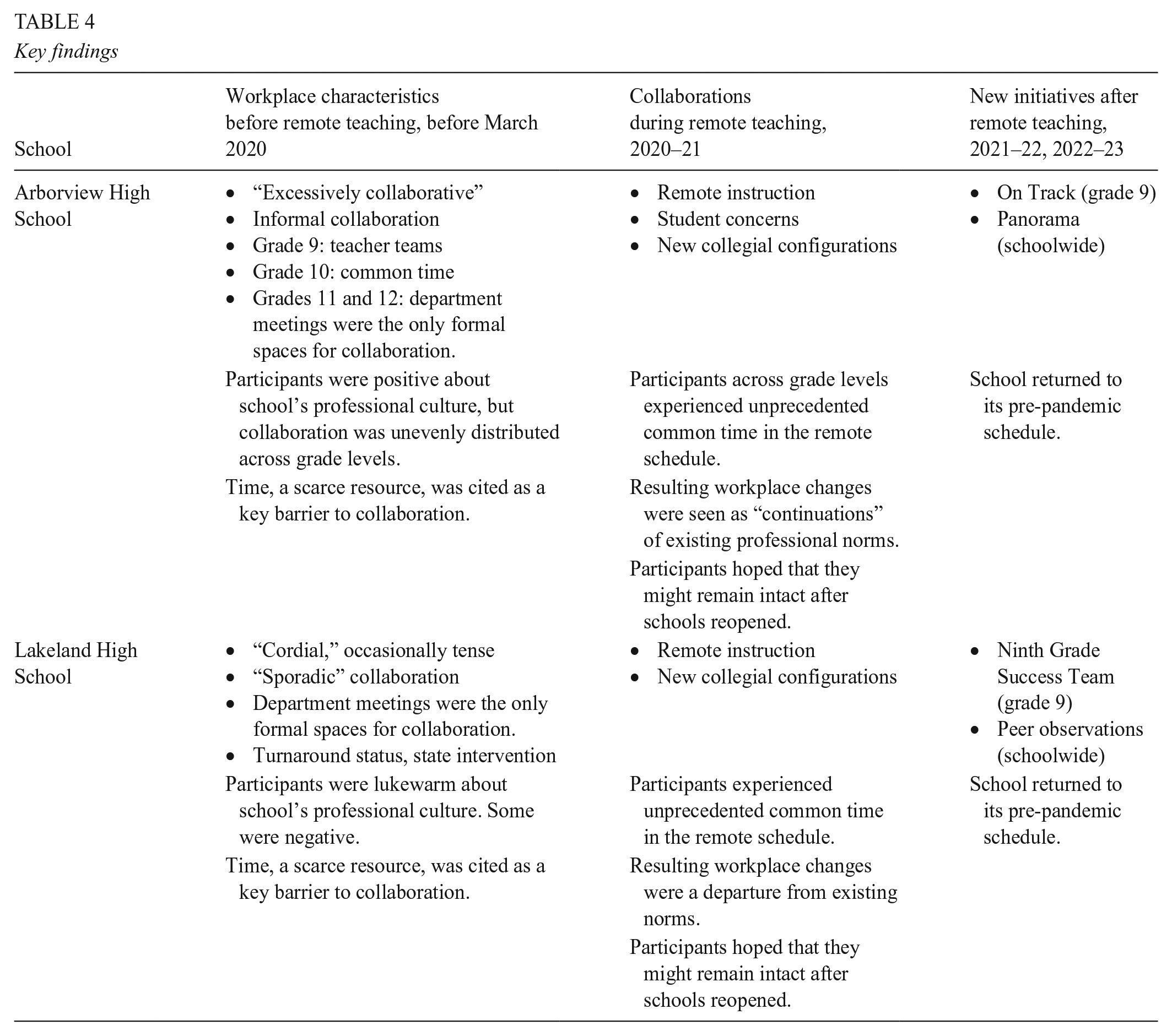
Key findings
Limitations
Conducting qualitative research during a pandemic posed limitations. Although principals play key roles in teachers’ collaboration, AHS and LHS principals’ intensified workloads during the study timeline made it impossible to interview them. I also was unsuccessful gaining approval to observe teachers’ collaborations firsthand, during either remote or school-based meetings. Recruiting participants presented additional challenges and, in some cases, limited aspects of my analysis. “Subject departments,” wrote Siskin and Little (1995), “form the primary organizational unit of the high school, defining in crucial ways who teachers are, what they do, where and with whom they work, and how that work is perceived by others” (p. 1). Although some departmental differences did emerge in the study, I am unable to offer a systematic analysis of how AHS’s and LHS’s departments differentially experienced the remote workplace because departments are not evenly distributed in the sample and, occasionally, some are overrepresented. Recruiting during a period of great instability for schools also raised questions about selection bias. It is possible, for example, that teachers with comparatively positive pandemic experiences are overrepresented given their willingness to sit for interviews at all during this turbulent period. However, after analyzing participants’ responses, I am confident that this is not the case. Participants universally described negative experiences of teaching during the pandemic. 2 Engagement with colleagues proved a rare, conspicuous bright spot in teachers’ overall experiences.
Finally, this article details teachers’ collaborative work at only two high schools in one district. Its findings are not generalizable to other schools or districts. However, given that teachers in many schools and districts experienced more flexible schedules while working remotely (Darling-Hammond & Hyler, 2020), ICPS teachers’ experiences may resonate with teachers and educational leaders across contexts. Moreover, the question of how, if at all, states, districts, and schools continue to engage with pandemic-era changes to teachers’ work has enduring relevance in the field.
Discussion
This article explored teachers’ collaborative work at two comprehensive high schools before, during, and after pandemic-induced remote schooling. Interviews with AHS and LHS teachers and instructional coaches revealed that school closures came with surprising benefits to teachers’ collaborative work. A flexible remote schooling schedule afforded teachers common time on a scale once inconceivable. As a result, collaboration increased substantially across both schools as teachers collaborated on instruction, around students, and in new collegial configurations. These collaborations were often teacher driven and sustained and therefore felt particularly authentic and valuable to teachers.
Some key differences between AHS and LHS emerged during the analysis. For example, the schools had different professional cultures prior to the pandemic. AHS’s participants spoke positively about their school’s professional culture, but LHS participants described a comparatively strained one. These different starting points meant that each school experienced collaboration somewhat differently during remote schooling. At AHS, positive preexisting professional norms among teachers extended the school’s characteristic “helping behaviors” and allowed collaboration to flourish (Rosenholtz, 1989, p. 43). At LHS, meanwhile, teachers’ remote collaborations represented a more significant departure from the school’s characteristic norms of privacy and isolation. Remote collaboration patterns also occasionally looked different at the two schools. For example, collaboration around students was robust at AHS but not at LHS, and some collaboration initiatives at LHS were tied to the school’s turnaround process. Despite these differences, though, remote schooling afforded teachers at both schools—regardless of subject area and grade level—unprecedented blocks of common time in their daily work, creating enormous potential for collaborative work.
During interviews, participants continually wondered what would become of their prized collaborative practices after schools reopened. Certainly they would never again experience common time on this scale, and some of that time had been dedicated to pandemic-specific matters. Nevertheless, participants saw the value of having common time with colleagues at any time. Its importance transcended crisis schooling, and they hoped that administrators might find ways to preserve their remote-era collaboration in some form after schools reopened. Participants were often disappointed by their schools’ leadership in this area. Especially frustrating was principals’ apparent submission to status quo pre-pandemic schedules, which participants viewed as ill-designed to facilitate and support collaboration. As evidenced by the exchange Leena recounted with an AHS administrator, “the schedule” could be a conversation ender—a concise justification for why things were the way they were and why they couldn’t be otherwise. The schedule, however, should have been a conversation starter. It might have been exactly what principals would have to scrutinize to put teachers’ professional desires into practice. After all, time had laid the foundation for teachers’ remote collaborations. Time had enabled teachers to collaborate on instruction, around students, and in new configurations. And time would again become a leading obstacle to collaboration after remote schooling.
In the end, a return to in-person learning largely meant a return to participants’ pre-pandemic workplaces. The familiar structural barriers to collaboration reemerged and, along with them, norms of isolation for many teachers. To be sure, some administrators did introduce new collaborative initiatives. Ninth grade teachers, for instance, received collaboration time to norm around students’ transitions to high school. Other schoolwide initiatives were intended to harness the productive collaborative work that teachers valued and carried out during remote schooling. Both Panorama at AHS and peer observations at LHS sought, in some measure, to extend the collaboration on instruction, around students, and in new configurations that school closures had unexpectedly fostered. Both initiatives, however, had limited impacts on teachers’ professional lives because they were simply absorbed into a schedule incompatible with teachers’ professional learning. By making collaboration around students asynchronous, Panorama sidestepped the schedule’s complexities altogether while stripping the collaborative activity of the collegial interactions that teachers so appreciated. Meanwhile, LHS administrators shoehorned a schoolwide peer observation initiative into a schedule that was incongruous with the professional culture of cross-disciplinary continuous improvement that they were seemingly trying to create. Both initiatives, in sum, had yielded to “the schedule.” Although some participants remained hopeful that their workplaces still could change, the evidence presented here is discouraging.
It may be argued that the collaborations teachers enacted during remote schooling were pandemic specific and are therefore less pertinent to teachers’ everyday practices. For example, although teachers adopted instructional technologies during the pandemic that may inform their future practices, they are unlikely to deliver synchronous remote instruction in their everyday teaching—that is, unless future crises again shutter school facilities. AHS teachers’ collaboration around students also may be understood as pandemic specific given its focus on troubleshooting students’ connectivity issues or absenteeism and disengagement exacerbated by the pandemic. And teachers also may have been more inclined to engage with colleagues as they did because of the pandemic. After all, throughout interviews, participants emphasized how lonely remote teaching could be. The remote platform and district policies, teachers argued, made it exceedingly difficult to forge meaningful connections with students, an aspect of teaching many found especially rewarding (Murphy, 2024). With this reward so hard to access, teachers may have looked elsewhere to fulfill their social and emotional needs and consequently thrown themselves into opportunities with colleagues.
These rival hypotheses are compelling, but participants’ enhanced professional lives during the pandemic hold relevance beyond crisis schooling. For starters, the collaborations that participants detailed are characteristic of high-quality professional cultures in schools. Collaborations on instruction, around students, and in different collegial configurations are practices that effective teacher workplaces regularly engage in to improve student outcomes. Distinctive student behaviors may have accompanied school closures, but student disengagement is a timeless issue, and absenteeism continues to intensify. Working with colleagues to address these problems remains vital at any time. Moreover, not all of teachers’ collaborative work was pandemic related. Some teachers, for example, used their common time to advance instructional changes they hoped to implement after remote schooling.
The pandemic’s isolating effects certainly may have heightened teachers’ drive to interface with colleagues. Collaboration may well have been a refuge and one less urgently needed during normal times, but the fact that participants seized on opportunities to collaborate is noteworthy. Their responses during and after remote schooling reflect a genuine desire to engage with colleagues and as such may not have been as evident during a normal school year, when high schools’ structural conditions frequently foreclosed such opportunities.
Implications
Implications for Research
This article extends research on teachers’ professional lives during the pandemic and complicates prevailing narratives of teacher burnout. Additional studies in this area would be helpful given that school closures marked a profound, unprecedented chapter in the professional lives of teachers everywhere. But ICPS teachers’ experiences have implications for researchers far beyond crisis schooling. Their experiences are as much—if not more—about the normal conditions in high schools affecting teachers’ collaborative work as they are about pandemic schooling. Further study of those conditions is critical. In particular, the persistent problems of time use and school organization in high schools demand further investigation. To this end, there is much to learn from schools that are not the best cases in teacher collaboration (Weddle, 2022). The better we grasp the structural forces shaping teacher collaboration, the better policymakers and school leaders can respond to them. By the same token, researchers might additionally explore typical high schools that have found success adapting their entrenched school structures to support high-quality collaboration.
Implications for Practice
Rethinking Time in Schools
Time was a key driver of study participants’ collaboration during remote schooling. After schools reopened, it once again became a key constraint. Although time in schools remains an understudied phenomenon, any effort to promote collaboration in high schools requires confronting the issue of time directly. It requires better understanding of what teachers mean what they say, “I don’t have enough time.” And it requires grappling with that all-powerful structure that study participants’ principals hesitated to scrutinize: the master schedule. School leaders so often approach the master schedule as a procedural puzzle, a math problem to overcome. This study urges leaders to approach it as an illustration of a school’s priorities. Teacher collaboration should be one of those priorities.
Rethinking time additionally requires policymakers and school leaders to examine and even modify demanding teaching schedules that frequently limit teachers’ ability and capacity to collaborate. American teachers clock a tremendous number of instructional hours. Classroom teaching “consumes about 80% of U.S. teachers’ total working time as compared to about 60% for teachers” in other OECD countries (Darling-Hammond et al., 2010, p. 3). Our teachers spend around 50% more time directly engaged with students than the international average (27 hours versus 19 hours) (Darling-Hammond et al., 2024). In contrast, less demanding teaching loads in higher-performing countries such as Finland and South Korea enable teachers to collaborate more regularly and, in turn, achieve better results in the classroom.
After the academic losses students suffered due to the pandemic, particularly in high-poverty districts such as Iron City (Goldhaber et al., 2022; Halloran et al., 2021), it makes sense that when teachers are in schools, their time is almost exclusively spent teaching. It also makes sense that this would be the case at any time; direct engagement with students makes up the core of teachers’ work, and researchers have demonstrated the positive effects of increased instructional hours, when used effectively, on student achievement (Kraft & Novicoff, 2024). But teaching is also irreducibly complex, uncertain work. Without time to, as Ann said, “stop, take a breath, and be reflective” with colleagues, students may not be getting the most of all their time spent with teachers. And considering the positive effects of teacher collaboration on student achievement, a schedule that prioritizes so many hours of instruction but vanishingly few with colleagues to inform that instruction may ultimately be a schedule in conflict with itself.
What might it look like to modify high school schedules to better support teachers’ collaboration? Profiled in Bae (2017), Hillsdale High School in San Mateo, California, offers policymakers and school leaders a powerful example. Hillsdale shares many qualities with those featured in this study; it is a comprehensive public high school, similar in size, and most of its students are non-White. The school’s teachers, however, teach fewer instructional hours in an arrangement that mirrors the international average (Bae, 2017, p. 11). To prioritize teacher collaboration, the school dismisses students early every Thursday, configures teachers in both content area and interdisciplinary teams, and provides teachers with three common preparation periods per day. This schedule allows teachers to work together to advance the school’s mission, improve practice, and offer students individualized support. “Collaboration drives the schedule,” wrote Bae (2017), not vice versa (p. 9).
Hillsdale High School has reimagined its master schedule to enable sustained, high-quality collaboration, but schools do not necessarily have to overhaul teachers’ instructional hours to protect and promote collaboration. School leaders can limit teachers’ nonacademic duties such that teachers are not compelled to skip a PLC because of cafeteria duty. They can synchronize the free periods of specific teachers to encourage targeted collaboration, negotiate late starts or early dismissals for students to make time for collaboration (Merritt, 2016), or get more strategic with staffing and enrichment classes to free up teachers (Rosenberg et al., 2018, p. 14).
Rethinking School Structures
The master schedule may be an especially powerful school structure, but it is just one among several that frequently impede teachers’ collaboration. To reap collaboration’s rewards, schedule changes alone will not suffice. School leaders also must address the distinct constellation of school structures that teachers occupy. For decades, reformers and scholars have emphasized the adverse effects of high schools’ structural conditions on collaboration. This study’s examination of pandemic-induced remote schooling draws renewed attention to this phenomenon. AHS and LHS teachers’ prolonged departure from “status quo” workplaces made ever visible those workplaces’ structural conditions and the norms of privacy and isolation they naturally produce.
Studies have emphasized the powerful influence of spatial proximity on teachers’ collaboration (Coburn & Russell, 2008; Reagans, 2011; Spillane et al., 2017). Accordingly, when rethinking school structures, school leaders can start by scrutinizing the relationships between the physical structure of their school buildings and teacher collaboration. They can be intentional about where they physically assign teachers, keeping the potential for collaboration in mind. They can take steps to repurpose schools’ existing physical spaces to promote collegial interaction and create common spaces beyond teachers’ individual classrooms for collaboration. Although costly, modifying existing school architectures that reinforce teachers’ professional isolation also should be an ongoing pursuit. By virtualizing school contexts, remote schooling transcended spatial constraints altogether. While digital platforms should not supplant opportunities for colleagues to convene physically (i.e., Panorama at AHS), school leaders can leverage such platforms to further support teachers’ exchange of ideas, resources, and practices. Digital platforms can be strategically tapped to ameliorate the isolating effects of sprawling “egg crate” facilities.
School leaders and policymakers also should consider alternatives to subject departments that so often fragment schools and stifle interdisciplinarity (Siskin, 1994). Instructional teams—groups of teachers who teach a common student cohort—are one such alternative (Charner-Laird et al., 2017, Gallimore et al., 2009; Johnson, 2019; Ronfeldt et al., 2015). The ninth grade team structure at AHS, for example, puts teachers into conversation about common students rather than common subjects, allowing them to coordinate support across disciplines and respond more holistically to students’ needs. In addition, offering teachers a range of collaboration configurations, both inter- and intradepartmental—as Iron City teachers experienced while remote—can further strengthen high schools’ professional norms and minimize their vastness. The reason for high school teachers’ constrained collaboration largely may be, as Kendra said, “the structure of things,” but structures can change. They are not set in stone.
With any of these changes, school leaders must carefully negotiate their own roles. As “broker[s] of workplace conditions” (Johnson, 2006, p. 15), principals are essential to facilitating and supporting teachers’ collaboration. They must be actively engaged in teachers’ work with colleagues. But exerting too much control over that work can erode trust and compromise teachers’ engagement (Hargreaves & Dawe, 1990; Patrick, 2022). Principals must strike a balance between respecting teachers’ expertise and autonomy and providing administrative direction. Moreover, rethinking structures in the interest of teachers’ collaboration requires attending to the individual contexts of schools. As this study’s findings demonstrate, each school context is distinctive. Even across a single school, professional norms can vary widely. Effective collaboration initiatives are responsive to these contextual realities. A peer observation program piled onto teachers’ already-full plates, absent the necessary contextually specific changes to accommodate this new commitment, is bound to fail.
Finally, policymakers and school leaders too often exclude teachers when making pivotal decisions about their work. This study amplifies teachers’ voices. Any collaboration initiative must begin with valuing teacher expertise and experience. Only when teachers become true partners in reimagining their work can schools achieve collaborative cultures that benefit students and teachers alike.
Conclusion
The pandemic’s impacts on education have been extraordinary and devastating. For teachers, the pandemic wrought burnout, fatigue, stress, and diminished commitment to the profession. But a crisis also can be an opportunity. This article illustrates how high school teachers found unexpected opportunities to collaborate amid a crisis. Those opportunities took root at a time when teachers were more physically uprooted than ever. They exposed the structural conditions normally constraining high school teachers’ collaborative work. But it should not take closing schools and uprooting teachers for these critical collaborative practices to occur. Prioritizing them may be logistically challenging, particularly at comprehensive high schools such as AHS and LHS, but they are worth the challenge. As for whether “the structure of things” will change in these teachers’ workplaces, only time will tell.
Footnotes
Appendix
Acknowledgements
Special thanks to Susan Moore Johnson for her valuable feedback on this article.
Declaration of Conflicting Interests
The author declares no potential conflicts of interest with respect to the research, authorship, and/or publication of this article.
Funding
The author received no financial support for the research, authorship, and/or publication of this article.

Note: This manuscript was accepted under the editorship of Dr. Kara Finnigan.
Notes
Author
JEREMY T. MURPHY is an assistant professor of education at College of the Holy Cross. His research uses qualitative and historical methods to explore teachers’ work, professional lives, and their complex relationships with instructional reform and change. He can be reached at