




Abstract
This qualitative study explores how secondary school educators in the United States conceptualized their workplace relationships during the 2021–2022 school year, which was a period marked by a return to in-person instruction amidst ongoing public health crises and heightened politicization of school policy and practice. Drawing on micropolitical theory, we analyze data from 54 educators who participated in 26 online focus groups and interviews. Findings reveal that workplace relationships were shaped by a combination of individual characteristics and school policies. Political homophily emerged as a key factor that influenced educators’ relationships. Educators bonded over shared political beliefs and experienced isolation when misaligned with dominant ideologies at their schools. These interpersonal dynamics shaped educators’ senses of belonging, job satisfaction, and organizational commitment, underscoring the need for inclusive school environments that allow for ideological diversity.
Keywords
The COVID-19 pandemic profoundly altered how American educators worked. In March 2020, educators experienced the largest school closure movement in recent history (Zviedrite et al., 2021). For much of the 2020–2021 school year, educators operated in isolated, virtual environments, disrupting the rhythms of face-to-face collaboration and connection that had been central to school life (Kraft et al., 2021). In 2021–2022, most schools reopened (Parks et al., 2021), charging educators with working in-person even as health guidelines continued to evolve until the COVID-19 pandemic was officially declared over in May 2023 (Sarker et al., 2023). Hence, the 2021–2022 school year marked a pivotal moment for rebuilding in-person relationships as many educators returned from working remotely. Compounding reopening challenges, educators faced a heightened politicization of school policy and practice. Mirroring ideological conflicts across the country, debates over mask mandates, vaccine requirements, and social distancing guidelines permeated schools (James et al., 2022; Stroebe et al., 2021). Pitched battles about how to teach race (López et al., 2021; Vue et al., 2024) and gender (Polikoff et al., 2024) amplified tensions, thrusting educators into politically charged public discourse in an increasingly polarized nation (Abramowitz & Webster, 2016; Iyengar et al., 2018). These intersecting dynamics created an environment of unprecedented complexity, making the 2021–2022 school year a unique context for studying the nature of educators’ workplace relationships and whether these relationships mitigated or exacerbated external pressures.
Workplace relationships are central to an educator’s sense of belonging (Skaalvik & Skaalvik, 2011), self-efficacy (Nias, 2005), organizational commitment (Canrinus et al., 2012), and retention (Hopkins et al., 2019). Supportive and collaborative ties contribute to high-functioning schools and strong student outcomes (Ronfeldt et al., 2015). While much is known about how educators develop these ties, existing research often examines educators’ relationships within the context of specific reform efforts (Penuel et al., 2009). Little is known about how educators’ workplace relationships function during periods of public crises and heightened ideological divides. Research suggests that moments of organizational transition provide fertile ground for the formation and dissolution of educators’ workplace ties (Spillane & Shirrell, 2017). However, 2021–2022 represents a year of unprecedented transition. Against this complex backdrop, our study explores how educators conceptualize their workplace relationships and whether existing theories adequately capture the relational dynamics educators experienced. Specifically, we investigate whether collegial bonds can sustain educators’ organizational commitment in such a fraught context, or whether the magnitude of external crises outweighs possible protective effects of supportive colleagues.
To address these questions, we draw on micropolitical theory, which frames schools as vibrant social organizations marked by cooperation and conflict (e.g., Achinstein, 2002; Ball, 1987; Hoyle, 1982; Marshall & Scribner, 1991). Micropolitical theory positions educators as political actors who engage in everyday behaviors, such as forming social groups or establishing in- and out-group status, with the goal of navigating power dynamics and pursuing their ideal working conditions (Kelchtermans & Ballet, 2002). Despite micropolitical theory’s utility as a conceptual framework across a range of contexts, micropolitical scholarship often focuses on organizational conflict (Achinstein, 2002) and relies on small, ethnographic case studies of singular school sites (Flessa, 2009; Malen et al., 2014). Our study addresses these gaps by employing a nationwide sample and applying micropolitical theory to illuminate relational complexities across diverse organizational environments, including positive school climates.
In this paper, we define educators’ workplace relationships as any type of connection—positive or negative; collegial or conflictive—between two or more people who work at the same school. Drawing on data from 54 educators who participated in 26 focus groups and interviews conducted online in March and April 2022, we analyze antecedents, functions, and outcomes of educators’ workplace relationships. Our conceptual framework uses micropolitical theory to consider how school policy and individual attributes influence relational dynamics, shaping educators’ experiences at work. Our findings suggest that relationships emerge from a predictable interplay of individual characteristics, school policies, and micropolitical dynamics. While some tight-knit social groups foster belonging in negative school climates, supportive relationships are not universally protective. Despite the unprecedented nature of the 2021–2022 school year, many of our findings confirm prior research. However, we identify two notable distinctions that contribute to existing theory: (1) educators form ties based on political homophily, befriending colleagues with similar political beliefs and avoiding those with dissimilar beliefs, and (2) a perceived misalignment between an educator’s beliefs and the dominant political leaning at their school often coincides with isolation and intentions to resign. These findings highlight the role of political polarization in shaping educators’ relationships. Although political homophily has been found to be a salient relational factor and predictor of attrition in other industries (Bermiss & McDonald, 2018; Henderson & Jeong, 2022; Roth et al., 2017, 2022), it remains an understudied dimension in education. We conclude by discussing the implications of these findings.
Literature Review
Schools as Social Organizations
Extant research has suggested that consistent patterns exist across dyadic tie formation and the establishment of informal and formal networks in schools. A robust literature on dyadic ties demonstrates how educators tend to bond with peers who share their pedagogical philosophy (Bidwell & Yasumoto, 1999), identity (Reagans, 2010; Spillane et al., 2012), physical proximity, and role (Bridwell-Mitchell & Cooc, 2016; Spillane et al., 2017). Given that educators often bond with people assigned to their department or teaching team (Spillane et al., 2012; Willower, 1991), research has shown that tie formation is susceptible to administrative intervention. However, research also suggests educators can develop relationships in unexpected ways that are less reflective of formalized collaborative structures and more reflective of elusive power dynamics, such as perceived social status (Bridwell-Mitchell & Fried, 2020). Relatedly, although dyadic ties can influence a school’s relational environment, researchers have called for more studies that make “fewer assumptions about how dyadic interactions translate into community dynamics” (Bridwell-Mitchell & Cooc, 2016, p. 9) because group interactions introduce complexities not found in one-on-one relationships. Hence, our study considers educators’ perceptions of dyadic ties as well as group dynamics.
A common phenomenon in schools is the establishment of coalitions or smaller social groups called “subgroups” (Frank, 1995; Frank & Zhao, 2005; Nee & Ingram, 1998). Similar to dyadic ties, subgroups can form organically or as a result of the organizational structure (Coburn et al., 2013). Subgroups can have subcultures, which may include a different set of norms, values, and expectations than the wider organization. Often referred to colloquially as “cliques,” subgroups can be a place of gossip, which has the potential to influence power in a workplace (Kurland & Hope-Pelled, 2000). Although cliques and gossip sometimes connote negativity, subgroups can act as mediators between individuals and their organizations in ways that can be productive for both individuals and organizations (Nee & Ingram, 1998). Research suggests that a subgroup’s investment in educational change efforts can lead individuals who belong to that subgroup to become more or less invested in reforms (Penuel et al., 2009). Hence, a subgroup can be a boon or an obstacle to reform. The potential impact of subgroups on individuals requires an understanding of the organization in which they are situated. An organizational culture shapes whether employees look to gossip or subgroups as a key source of information (Kurland & Hope-Pelled, 2000). To that end, our study captures educators’ conceptions of their dyadic ties and subgroup membership within the context of their schools’ broader relational climates.
Given that school reform often leverages relationships as a strategy to affect change (e.g., improve literacy instruction by increasing collaboration between teachers; Penuel et al., 2009), researchers who study faculty and staff relations tend to employ social capital theory to elevate how relationships facilitate resource exchange. Social capital theory positions employees’ social networks as a means through which expertise and knowledge are hoarded, accessed, and/or distributed (Coleman, 1988). Although social capital theory depicts educators’ social ties as catalysts for resource exchange, it provides limited tools for considering the more intimate parts of educators’ relationships. Research demonstrates that educators’ workplace bonds are uniquely personal (Jarzabkowski, 2002; Spillane & Shirrell, 2017), suggesting that friendship and compassion (Eldor & Shoshani, 2016) may be as much a goal of tie formation as access to resources. Counter to the rationality implied by social capital theory, educators’ workplace relationships cannot be reduced to mere resource exchange (Gibbons, 2004). Research suggests the quantity of ties is not universally better than relational quality; for new teachers, the number of social ties at work is a lower predictor of retention than the quality of those ties as measured by relational trust (Hopkins et al., 2019). Additionally, social capital theory assumes a “bureaucratic rationality” (Marshall & Scribner, 1991, p. 351) when describing subgroup formation that obscures how ideological and values-driven educators’ relationships can be (Bridwell-Mitchell & Fried, 2020). To address these theoretical complexities, our study incorporates micropolitical theory.
Schools as Polities
Even in the most cohesive schools, collaboration arises from ongoing tensions among colleagues who hold divergent pedagogical beliefs and professional interests (Achinstein, 2002; Jarzabkowski, 2002; Westheimer, 1999). This has prompted scholars to employ micropolitical theory as a framework to explain the political nature of collegial dynamics within schools. Micropolitics is concerned with organizational politics or “who gets what, when, and how” (Marshall & Scribner, 1991, p. 350) in the presence of competing interests and finite resources. Central to a micropolitical perspective is the recognition that a combination of formal authorities and informal influencers shape a school’s social structure (Hoyle, 1982). A blend of individual discretion and organizational pressures impacts educators’ tie formation and instructional decision-making (Coburn & Russell, 2008; Levine & Marcus, 2010). In alignment with the micropolitical tradition, our study foregrounds educators’ workplace relationships as inherently political, reflecting tensions between managerial structures and organic coalitions formed through personal agency in the presence of ever-evolving power dynamics.
Micropolitics provides a framework for studying “how things really work, not how an organizational chart or a principal’s action plan would like them to work” (Flessa, 2009, p. 331). In contrast to theories that depict policymaking as rational processes that lead inevitably to progress or consensus, micropolitics positions teachers as active agents, capable of shaping their working environment through everyday actions (Hoyle, 1982). According to Kelchtermans and Ballet (2002), micropolitical behavior consists of “actions that aim at establishing, safeguarding, or restoring the desired working conditions” (p. 108). Since educators have diverse personal and professional interests (Hoyle, 1982), their definitions of desirable working conditions vary, which leads educators to form coalitions with like-minded peers (Bidwell & Yasumoto, 1999). Since collegial bonds are central to a supportive working environment (Cohen et al., 2009), our study considers any behavior that educators take to establish positive relationships or avoid negative relationships to be a micropolitical action. To that end, micropolitical actions can be convivial or conflictual.
Extant research on micropolitics in schools has been motivated by the idea that micropolitical actions shape an organizational environment in ways that impact student learning (e.g., Ronfeldt et al., 2015), teachers’ understanding of policy (e.g., Coburn, 2001), teacher retention (e.g., Hakanen et al., 2006), and school climate (e.g., Kelchtermans & Ballet, 2002). School reform efforts often emphasize theories of change that require teachers to adapt and embrace new norms (Penuel et al., 2009). Reform is a collective endeavor that requires dismantling professional silos and negotiating power dynamics to foster shared values, cultures, and goals. Conflict is inherent in this type of organizational change (Achinstein, 2002). Embracing school reform as “an eminently political process” (Willower, 1991, p. 451), micropolitics offers a critical lens that challenges the notion of top-down policies as the sole drivers of change. Micropolitics recognizes that formalized routines only scratch the surface and true reform often emerges from informal interactions. However, most qualitative studies have focused on micropolitics within the context of specific reform efforts rather than organic interactions such as those found in “hallways, lunchrooms, or staff workrooms” (Penuel et al., 2009, p. 128). To fill that gap, our study eschews a narrow focus on a specific reform movement, opting instead to examine how educators perceive their relationships in various contexts and, in doing so, illuminates the nuances of micropolitical actions across formal and informal spaces.
Research Questions
Our exploratory cross-sectional study investigates how educators conceptualize their workplace relationships in secondary schools 1 across the United States during the 2021–2022 school year. To answer this question, we ask the following:
How do educators’ workplace relationships develop?
What are the main functions of educators’ workplace relationships?
How, if at all, do educators’ workplace relationships shape their experiences at work?
How, if at all, does school climate shape educators’ relational experiences?
Conceptual Framework
Micropolitical theory provides a logic for the reciprocal ways in which school policy combines with individual interests to shape an educator’s relational experience at work. Figure 1 shows a conceptual framework that draws on micropolitical theory to posit how workplace relationships develop and how those relationships, in turn, might affect educators’ experiences. In this framework, relational antecedents consist of a mixture of formalized collaborative structures and individual attributes, such as identity, interests, and ideology. At an organizational level, a school’s structure (e.g., departments) couples with “border politics” to create a unique social context. According to micropolitical theory, a school’s border politics exist on a continuum from “unified/exclusive” to “diverse/inclusive” (Achinstein, 2002). On one end of the spectrum, unified/exclusive social groups are present in schools where teachers form close ties in homogeneous groups with rigid boundaries. For instance, a unified/exclusive school consists of educators who bond with their teaching team but rarely converse with people outside of their grade or content specialty. On the other end of the spectrum, a diverse/inclusive school enables more heterogeneity to flourish as educators collaborate across traditional boundaries. Additionally, micropolitical theory suggests pedagogical philosophy or a school’s “ideology” exists on a continuum from “critical/counter” to “mainstream/congruent” (Achinstein, 2002) that educators may reify or reject. The degree to which an educator aligns with their school’s ideology can influence their comfort and willingness to work with their colleagues. Hence, we consider a school’s ideology to be an influential factor for tie formation.

Conceptual Framework.
Situated within this complex organizational environment, our conceptual framework positions educators as agentic. Through micropolitical actions of “convergence” or “divergence” (Galey-Horn & Woulfin, 2021), we expect educators to form bonds or isolate themselves as they aim to create their ideal working conditions given their school contexts and individual needs (Kelchtermans & Ballet, 2002). We theorize that educators who “converge” are more likely to experience insider status that might elicit a sense of belonging, well-being, and job satisfaction. Conversely, educators who “diverge” are more likely to experience outsider status that might elicit a sense of isolation, negative well-being, and low job satisfaction.
Methodology and Methods
Data Collection
Given the exploratory nature of this study, qualitative data was considered essential for theory-building and identifying relational mechanisms (Patton, 2002). Study participants were recruited online in March 2022. Recruitment flyers were circulated online through listservs, social media platforms (i.e., Facebook groups), and the authors’ professional networks. Electronic flyers asked prospective participants to complete an interest survey about their availability, demographics, school type, and a brief description of relationships at their current school. Participants were selected to achieve a diverse sample rather than a nationally representative sample. To center historically marginalized voices, we intentionally oversampled educators of color compared to national demographics (i.e., more than 20% educators of color; NCES, 2023).
This study’s main data collection method was 90-minute semi-structured (Patton, 2002) focus groups conducted via Zoom. To ensure confidentiality, focus group participants did not know each other. To facilitate trust and connection, we led separate focus groups for white educators and educators of color. All participants were given an option to have an individualized interview if they preferred it to a focus group. Individual interviews were 60 minutes. See Appendix A for the protocol, which was used in both focus groups and interviews. Each participant received a $150 electronic gift card as compensation. All participants were given pseudonyms using a random name generator that accounted for their self-identified gender, race, and ethnicity. Procedures were approved by a blinded Institutional Review Board (IRB#: 2022/01/28). For more methodological details, see Pezalla et al. (2024).
Seventy-two secondary school educators participated in 19 focus groups and 6 interviews. We defined educators broadly to include teachers, paraprofessionals, interventionists, and counselors. Since this study investigated educators’ conceptions of their workplace relationships during the 2021–2022 school year, it was essential that educators worked in a school at the time of data collection. Therefore, we excluded 18 participants who had resigned, retired, worked at multiple schools with no dominant workplace, and/or were in administrative roles. Tables 1 and 2 provide an overview of the sampled participants’ demographics (N = 54).
Demographic Overview of Study Participants (N = 54)

Detailed Participant Information, Listed In Order of Appearance in the Findings Section of This Paper

Data Analysis
Transcripts were analyzed in three iterative phases of qualitative coding. To elevate educators’ voices for theory-building regarding relational mechanisms, the first phase of analysis was inductive, using descriptive coding (Miles & Huberman, 1994) to capture educators’ perceptions of their relationships. We attended to relational antecedents, functions, and outcomes. We defined antecedents as any individual characteristic, event, or policy that triggered a relational process to occur. A relational process could be any behavior that established connections or boundaries between colleagues. Therefore, antecedents were anything that promoted or inhibited bonds between educators. Since tie formation has implications for policy and practice, we categorized antecedents as static (e.g., race) or susceptible to intervention (e.g., school policy that establishes professional learning communities). Although some participants discussed former workplaces, coding only included relational information that was attributed to participants’ current workplaces so that data could be analyzed within the context of geographic and demographic information collected about participants’ current schools.
The second phase of coding involved emotions coding (Saldaña, 2009) to identify the dominant affective tone educators used to describe their workplace relationships and their school climates. We defined school climate as the quality of educators’ experiences of “school life,” resulting from and reflecting norms, values, relationships, practices, and organizational structures (Cohen et al., 2009). A positive school climate was one in which educators described feeling socially, emotionally, and physically supported; a negative school climate was one in which educators did not feel socially, emotionally, or physically safe. After determining whether educators perceived their relationships and/or school climates as positive and/or negative, each educator was placed on a Cartesian plane in which the x-axis represented their perceived workplace relationship(s) and the y-axis represented their perceived school climate. Figure 2 shows the Cartesian plane on which participants were organized into four quadrants: (1) strong relational environment: positive school climate with positive relationships; (2) mixed relational environment: positive school climate with negative subgroups; (3) weak relational environment: negative school climate with negative relationships; (4) mixed relational environment: negative school climate with positive subgroups. This analysis helped us understand how participants made sense of their workplace ties in relation to their broader school communities.

A Cartesian Plane on Which We Mapped Participants’ Relational Experiences.
The third and final round of coding involved a deductive approach that drew on micropolitical theory to consider whether emergent themes fit within a micropolitical framework. Using values and versus coding (Saldaña, 2009) to capture competing interests and adversarial frames, this analysis considered social groups’ boundaries. We attended to friendships and alliances, including who worked together, how information was shared, who had access to resources, and where educators perceived division, conflict, tension, or competition. This helped us understand schools’ border politics in which educators negotiated insider and outsider status.
Coding took place on Dedoose software. See Appendix B for our codebook.
Findings
To investigate how educators conceptualized their relationships, we examined how educators described workplace ties and the relational context in which ties were formed. The following section details our findings in order of our research questions.
The most frequently mentioned relational antecedent was departmental assignments. For many educators, their school’s structure propelled them to befriend colleagues on their respective teams. Mark summarized the most common theme in our data: “I would say I have the strongest relationships with people whose job is closest to mine.” However, Emily provided a more nuanced take on how school policy can stimulate strong bonds within grade-level teams and, as an unintended consequence, generate division across grade-level teams:
So, we have three parts to our school. It’s one school, but three parts. And the teachers, I notice, tend to think of themselves as units that are pretty separate from the other parts. There’s very few times when we’re all together as a staff . . . They tend to be like, “Oh, well, you know how lower is,” or, “Oh, you know how upper is.” Like definitely grouping each other into units.
At Emily’s school, border politics were unified and exclusive, fostering robust grade teams that socialized and collaborated only amongst themselves.
In addition to formalized collaborative structures, many educators mentioned tie formation that resulted from homophily. For instance, two women-identifying teachers expressed gravitating toward other women socially. Similarly, as a Black male teacher, Andre self-identified as a minority within his school and noted that he was drawn to befriending other people of color, stating that “Minorities have to carve out spaces for themselves just like the kids do.” In addition to static attributes (e.g., race), malleable characteristics, such as values and beliefs, emerged as important relational antecedents.
Notably, several educators described forming ties with colleagues who belonged to the same political party. For example, Ashley recounted exclusive border politics at her school that mirrored the nation’s polarization on masks and Critical Race Theory (CRT):
So, I’m in Ohio . . . and half of the educators are very much anti-mask, anti-CRT . . . and half of them are very much mask, vaccinate . . . It’s like we’re a staff divided because we’re in these two separate political groups who feel very strongly. I want our kids to wear masks. I don’t care if your kids wear masks. I send my kid to your classroom; they all have their masks off. They come to mine; they better wear their mask. And now we’re all off mask, but anyways, it’s become so clear how people align right now that it’s like, there’s cliques. That’s that group and you can’t trust them.
Through her description of the in- and out-group criteria at her school, Ashley illuminated a consequential interplay between political partisanship and workplace relationships. While Ashley overtly referred to national politics, other participants described more subtle or indirect ways in which macro-level ideology permeated relational dynamics. Several participants described their geographic upbringing as a relational antecedent due to implied cultural and political assumptions associated with various geographic regions. In their schools, geography was a proxy for political beliefs, which played a role in whether educators perceived each other as insiders or outsiders. For instance, Sarah felt she did not fit in at her rural school because she grew up in a city and colleagues judged her for an assumed political belief system attached to an urban upbringing. Similar to the duality of formalized collaborative structures, perceived partisanship was described as a connector and distancer, bringing colleagues together to form close bonds and drawing boundaries that maintained distant or weak ties.
Taken together, educators’ relationships developed through a combination of individual characteristics, social policy, and border politics (i.e., inclusivity and exclusivity of social groups; Achinstein, 2002) in ways that mirrored prior research (e.g., Bidwell & Yasumoto, 1999; Bridwell-Mitchell & Cooc, 2016; Reagans, 2010; Spillane et al., 2012, 2017; Willower, 1991). However, while prior research has emphasized pedagogical philosophy as an ideological driver of relationships in schools (Achinstein, 2002; Bidwell & Yasumoto, 1999), we found that macro-level ideology also played a key role in structuring social groups. We found that educators categorized colleagues along party lines, mirroring the nation’s political polarization (Abramowitz & Webster, 2016; Iyengar et al., 2018). Hence, educators’ collegial relationships seemed to be deeply embedded in and affected by ideological divides on a national scale.
When you have good relationships with your co-workers, you feel safe saying, “I have no idea how to teach them.” Or “My lesson plans aren’t working. What are your ideas?” You’re not ashamed to not be perfect at everything.
Laura illuminated the importance of solidarity during the 2021–2022 school year when similarly credentialed professionals were still working remotely due to the COVID-19 pandemic:
Nobody really understands what you do on a day-to-day basis, except those that do it with you. It’s kind of like going into battle together. And so being able to know that you have people that support you . . . I think that leaves you with a peace that you can go home with at night, that you have people there that get you and understand you.
Nicole underscored how relationships elicited comradery, collaboration, and friendship concurrently, describing a teammate as her “school bestie” and noting how they “see each other at our worst . . . and at our best.” For some educators, work doubled as a place to gather with friends. Hannah described intimate personal relationships that extended beyond the workday:
This weekend, my principal and a middle school teacher and myself, we all have birthdays within a month of each other. We’re going out of town. We’re having a ladies’ weekend and going out of town . . . I’d say, it’s like my second home . . . my second family.
To Hannah and many other participants, workplace relationships were about much more than an exchange of resources.
In sum, we found educators viewed relationships as sources of joy, emotional support, and social capital exchange. While workplace relationships facilitated knowledge-sharing and problem-solving, educators reported that their ties extended beyond professional interactions. Many educators formed bonds that were deeply personal, reinforcing prior research on the intimate nature of educators’ workplace relationships (Gibbons, 2004; Jarzabkowski, 2002; Spillane & Shirrell, 2017).
I want to say I love going to work every day because I get to see my best friends and I get to have fun with my best friends. We are always up to shenanigans . . . I don’t like school days off because . . . I want to go see my friends.
Conversely, Andre described exclusive border politics and negative relationships that contributed to isolation, low job satisfaction, and negative well-being. Andre highlighted the challenges of being a racial minority treated as an outsider in a predominantly White institution with homogenous social groups: I’m a Black man historically who didn’t go to the school, not from [the city where the school is located]. So it’s all these things I’m not acquainted with. There’s a certain flow . . . There’s a lot of nepotism. You get picked because you knew [someone at the school] because you went to school together, or you get picked because you played on the same lacrosse team. You can see how kind of inequitable the hiring practices are that I can’t imagine a promotion because the highest person of color on campus is the Deans and they don’t have anywhere to go either . . . This is why I don’t really recommend my friends . . . I’m not going to put my folks in danger of such kind of problematic systems, unless they’re familiar with it . . . I’m not going to put my dear friends in a space where it could be very hostile and very alienating.
By pointing to a culture of exclusion reinforced by discriminatory hiring practices, Andre revealed connections between his perceptions of the broader school context, his workplace relationships, and his feelings about work.
Unsurprisingly, educators’ relational experiences seemed to shape their well-being and job satisfaction. Confirming prior research (Canrinus et al., 2012; Hopkins et al., 2019; Skaalvik & Skaalvik, 2011), positive relationships often contributed to a sense of belonging and professional affirmation, while negative relationships were associated with isolation and professional frustration.
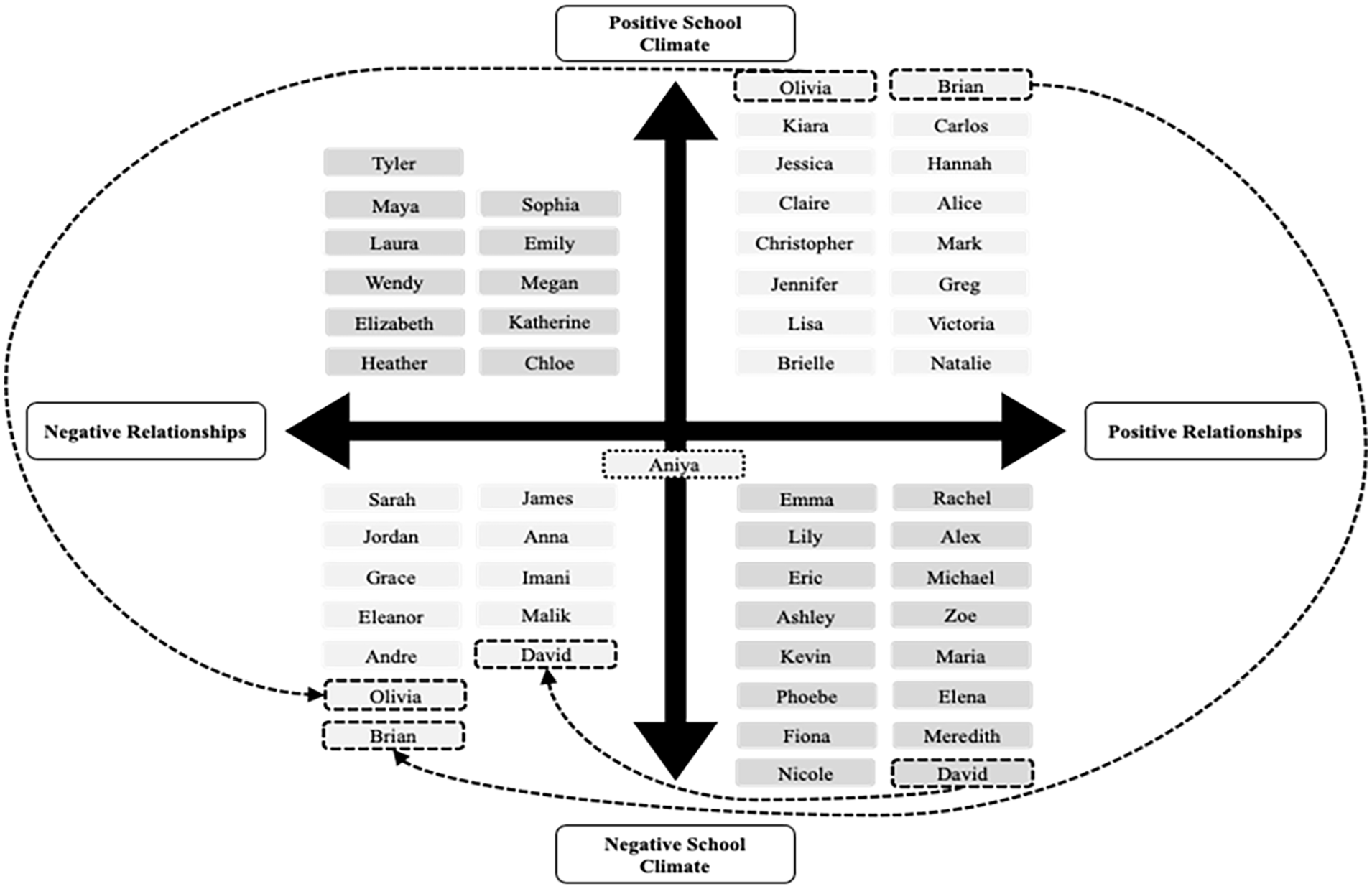
Participants’ Relational Experiences.
46% of our sample (25 out of 54) described positive school climates. Among those who described positive school climates, 14 expressed having only positive relationships. For instance, Carlos depicted a relationally rich environment in which his school hosted community events and teachers were comfortable with colleagues in and outside of their assigned teams: We all know the inside jokes and know everything as we known each other for so long. [If] we didn’t have that, I don’t think the school would work as well as it does . . . We can even like go into another person’s classroom and nobody feels offended, and you just talk to them. You walk right in and talk to students if you want.
Carlos thrived in a positive school climate with heterogeneous social groups and inclusive border politics in which colleagues exhibited shared ownership beyond their classrooms.
In contrast to solely positive relational environments, 44% of educators (11 out of 25) characterized their school climate as positive while also mentioning negative subgroups that they avoided. We considered a negative subgroup to be a distinct coalition that participants perceived as influencing their relational experiences at work. Negative subgroups were deemed influential enough to warrant a code if they impacted how often participants collaborated with others, who participants collaborated with, and/or the extent to which participants felt they belonged at work. General talk of informal coalitions or cliques was not coded as negative subgroups. For example, brief mentions from Natalie of “little cliquish stuff between grade levels . . . that happens at every school” was not coded as a negative subgroup.
Within positive school climates, 11 negative subgroups were coded. Participants often described negative subgroups as educators who held different political beliefs than them, revealing yet again how macro-level ideology affected border politics. Several educators described positive school climates in which they had mostly positive relationships and avoided a subset of teachers who were affiliated with a different political party. For instance, two educators who perceived their school climate as relationally positive avoided colleagues who belonged to a different political party and who they felt were fearful of gender diversity and, consequently, harmful to students. For Elizabeth and Megan, differences in macro-level ideology propelled them to draw boundaries and generate an insider group with teachers who shared their beliefs. Megan said, “We’ve got a large trans population of kids and we’ve got some staff who refuse to call them by their . . . chosen gender names, which pisses me the hell off.” Relatedly, Elizabeth attempted to avoid “Teachers who are bigots.”
44% of our sample (24 out of 54) described negative school climates. Among those with negative school climates, nine were completely isolated with no protective subgroup. For instance, Jordan felt isolated from her colleagues because she held a distinct role without an assigned team and she lived in a different neighborhood, which made her feel “like the outsider coming in.” Andre and Malik illustrated the insidious harm they experienced as Black men in racially intolerant workplaces. Malik elevated his intersectional identity as a salient part of his isolation at work:
Man, being a male in education when it’s majority women, that’s something within itself, especially if you are the kind of male that has a willingness to stand up for things and have a willingness to fight back when you feel like you’re getting punched in the mouth . . . being a male, in particular a Black male because . . . I really feel like if I was a White man, I wouldn’t be going through none of this.
Although they were at different schools, Andre and Malik described strikingly similar experiences of how homogenous, exclusive border politics was racialized and harmful to those from historically marginalized backgrounds.
63% of participants who self-reported negative school environments (15 out of 24) also identified positive subgroups of which they were a member. For instance, Rachel described a negative school environment rampant with distrust and turnover. However, Rachel also expressed fondness towards her grade team that yielded a strong sense of belonging:
I had a colleague recently say that this is one of the most political schools he’s ever worked at . . . And I would agree . . . it just feels like there’s a general distrust. With the team that I love, the 10th grade English team, those three women . . . we are so strong . . . we really value each other . . . value the conversations, the friendship, and the collegiality . . . We recognize some of the toxicity on other teams and we’re like we don’t want to be a part of that . . . we want to stick together.
Rachel’s high job satisfaction was not due to the overall school climate but rather a positive subgroup culture that emerged through formalized collaborative structures. Similarly, Alex discussed a disconnect between their “really positive and very supportive” department and the broader school community:
My school’s school culture is very negative at the moment. Morale is super low. I’ve lost nine colleagues to turnover this year in the middle of the school year, most recently someone in my department who I was very close with. And that’s extremely disruptive. The students are freaking out, asking everyone else if we’re going to still be here next year. That’s been really sad and hard. It’s so strange, and it’s kind of a weird dichotomy because my department is really close, and really positive and very supportive.
Nicole also disclosed that her “relationships with the adults” was the sole reason she continued to work at her “toxic” school. For participants like Alex and Nicole, a protective subgroup was enough to prevent them from resigning despite persistent attrition. However, positive subgroup membership was not always enough to solidify organizational commitment. Lily shared how a negative school culture forced her to consider alternate employment despite her supportive team:
I would be lying if I didn’t say or think about hmm, maybe it’s time for me to move on to something else. Not because of my team but I guess it’s just a collective thing of what’s happening at the school . . . I look at it and I’m like, God is it worth it?
Lily’s experience demonstrates that positive subgroup membership was not always a mediating factor more powerful than school climate.
As shown in Figure 3, there were four outliers who did not fit neatly into one of the quadrants on our Cartesian plane. Two outliers were best captured in two quadrants with arrows to represent change over time. These educators experienced role shifts that impacted their relationships during the 2021–2022 school year. David went from having a protective subgroup within a negative school with persistent attrition to feeling isolated when he switched roles and moved to a different floor:
. . . the middle school wing was chock full of all these happy, positive people . . . I really owe my long-term health and my happiness to some of my coworkers in the middle school because they’re so darn positive and they made me a better person . . . And now I’m back up on the third floor again around the grumpy people . . . And I’m trying not to get sucked into that black hole of negativity because it definitely has an impact.
Brian also changed roles and felt more isolation and weaker job satisfaction since leaving his team and losing his community. These examples illustrated how promotions or role shifts led to tie dissolution and altered how educators experienced their relational environments.
Another outlier demonstrated how a single event could drastically change an educator’s opinion of their relational circumstances, especially if that event was politically charged. Olivia taught in a positive school environment in which there was collaboration and collegiality. However, Olivia became so enraged at how a situation with a trans student was handled that she submitted a letter of resignation effective at the end of the school year: . . . everybody at my school is wonderful and they’re all great teachers and all great coworkers and I know I could go to any single one of them [for] help and they would fall over themselves to help me. But at the same time, there’s like a line that I personally just cannot cross with them because I know that that trust is not there, at least on my end . . . there was a trans student who wanted to use . . . the correct gender bathroom for them. And the community exploded. Students were honestly just confused. It’s a very, very rural area where I teach. And then we were basically told, and this is not an exact quote, but it’s pretty close, “Don’t talk about it. Hopefully it will all blow over.” And I just did not agree with that.
Through this story, Olivia demonstrated how important ideological alignment was for her well-being and organizational commitment.
Lastly, contrary to our central theoretical assumption that relationships were crucial for educators, one participant expressed a neutral feeling towards her workplace relationships. While Aniya described a negative school climate, she shared that her relationships within that climate were neither positive nor negative. Aniya articulated a desire to maintain relational boundaries and not get too close to colleagues because a “job is just a job.” She described a neutrality toward her colleagues that was unique within our sample. Since Aniya oriented to colleagues differently than other participants, her goal of work-life balance and deprioritizing close ties was essential for us to consider as counterevidence.
Overall, we found striking complexity in how educators experienced their schools’ relational environments. Some educators described taking refuge in supportive subgroups and feeling a sense of belonging and organizational commitment while employed in divisive schools with high attrition. Other educators reported feelings of exclusion despite working in schools they perceived as generally collaborative. This suggests that subgroups may have mediated the broader effects of school climate, an insight that extends prior research on the meso-level of schools’ relational networks (Frank, 1995; Frank & Zhao, 2005; Nee & Ingram, 1998). Interestingly, we found that educators who experienced misalignment with school policies, particularly gender-related policies, or with the dominant political party at their school reported heightened feelings of exclusion even if they described their school climates as positive. This suggests that political polarization did indeed permeate educators’ workplace dynamics.
Discussion
This study examines how secondary school educators in the United States conceptualize their workplace relationships during the 2021–2022 school year. Educators describe their workplace relationships as embedded within complex social environments where close bonds and distant ties are shaped by an interplay of individual agency, school policies, and subgroup dynamics. Although this was an unprecedented year, relational antecedents, functions, and outcomes are fairly consistent with existing research. Educators form relationships based on a combination of individual characteristics and formalized collaborative structures, mirroring findings from prior research (e.g., Bridwell-Mitchell & Cooc, 2016; Coburn et al., 2013; Spillane et al., 2012). Relational patterns appear consistent across geographic regions and school types. Departmental assignments are central to relationships, often creating strong intra-departmental ties while reinforcing silos that limit interdepartmental collaboration (Bidwell & Yasumoto, 1999). Consistent with micropolitical theory, a school’s border politics determine whether formalized collaborative structures foster cohesion and/or division (Achinstein, 2002). However, our findings diverge from previous micropolitical scholarship in an important way. While prior research suggests that pedagogical philosophy is the main driver of ideological sorting (Achinstein, 2002; Bidwell & Yasumoto, 1999), our data indicate that macro-level ideology also plays a role in structuring in- and out-group dynamics. A notable subset of participants (20%, 11 out of 54) sort colleagues along ideological lines to create and maintain politically homogeneous social groups. This ideological sorting seems to influence not only tie formation and subgroup membership but also job satisfaction and organizational commitment.
During a time of heightened ideological division across the country (Abramowitz & Webster, 2016; Iyengar et al., 2018), we find that national political discourse plays a key role in shaping local workplace dynamics. For a fifth of our sample, political homophily emerges as a salient factor for subgroup formation. Educators bond with colleagues who share similar political beliefs and avoid colleagues with differing political beliefs. Educators perceive geographic upbringings (i.e., urban versus rural) and views on masks, vaccines, Critical Race Theory, and gender identity as key markers of political beliefs, which they use to bond or distance themselves. For participants who describe political homophily as a relational antecedent, the consequences of alliances and divisions are notable. We find that educators who perceive themselves as ideologically aligned with colleagues describe a stronger sense of belonging and greater job satisfaction. In contrast, those who feel politically misaligned with the dominant political party at their school can experience isolation and, in some cases, frustration that contributes to thoughts of resignation. This finding is consistent with organizational management studies that show that ideological misalignment is a strong predictor of turnover in the private sector (Bermiss & McDonald, 2018). In other industries, perceptions of an organization’s political stance can influence job seekers, employee retention, and workplace satisfaction (Roth et al., 2017, 2022). Employees who perceive themselves as politically dissimilar from their colleagues report lower job satisfaction and commitment, particularly when employees identify as Democrats in Republican-majority organizations (Henderson & Jeong, 2022).
Across our sample, educators describe their relational environments as composed of subgroups, which mediate broader school climate effects. For instance, some educators describe seeking refuge in politically aligned social groups that provide a sense of belonging, emotional security, and professional affirmation amidst a school community in which they feel marginalized ideologically. Rather than experiencing school climate as a monolithic force, educators frequently navigate supportive or exclusionary subgroup cultures that shape their daily interactions. For some, subgroups function as protective. Among the 24 participants who describe working in negative school climates, 63% (n = 15) identify positive subgroups that offer emotional support and mitigate feelings of isolation. Of the 15 educators in positive subgroups within negative school climates, 40% (n = 6) share that their collegial relationships are the primary reason they remain at their current schools. This is consistent with research on the buffering effects of positive workplace relationships (Skaalvik & Skaalvik, 2011). Although our data demonstrates how many educators perceive their workplaces as multidimensional relational environments with subgroups where educators can feel they belong even if they feel isolated from the wider school community, subgroups are not universally protective.
In ideologically or racially exclusive environments, subgroups can reinforce division and isolation. For instance, both Black male participants describe feeling supported by affinity groups but alienated from dominant social groups in predominantly White schools. This highlights the racialized nature of school border politics. Although positive school climates are often assumed to yield stronger workplace ties and feelings of belonging (Cohen et al., 2009), our findings suggest that educators might still feel isolated if excluded from influential subgroups. Likewise, some educators in negative climates find belonging through strategic subgroup affiliation, suggesting that school climate alone does not dictate relational experiences. Hence, the dual nature of subgroups as both protective and divisive complicates traditional assumptions about school climate and its effects on individuals. Given these complexities, our findings necessitate a revision of our conceptual framework.
Revised Conceptual Framework
In our revised conceptual framework (Figure 4), educators engage in a multidimensional relational environment that is both embedded in and shaped by macro-level ideology. At the school level, formalized collaborative structures and border politics influence whether social groups are heterogeneous and inclusive or homogeneous and exclusive. These subgroup dynamics, in turn, shape individuals’ relational experiences. Consistent with our original framework, educators are agentic, forging alliances with and/or maintaining distance from colleagues. However, our findings highlight a shift from the initial conceptual framework. Our original framework theorized a more straightforward link between educators’ environments, micropolitical actions, and relational experiences. However, our results found something more complex. When discussing their relational experiences, educators do not simply ask themselves, “Do I belong at work?” but rather, “Do I belong? With whom? And how does my belonging relate to my school community and wider social context?” Educators navigate these relational layers when constructing their social experiences. Rather than a simple connection between belonging and individual actions or a positive school climate, our findings reveal a more nuanced dynamic. Some educators in negative school climates form protective subgroups, while some educators in positive climates distance themselves from colleagues they perceive as negative. This complexity underscores the need for researchers to move beyond simplistic measures of school climate or individual dyadic relationships and instead account for meso-level relational networks when investigating educators’ relational experiences at work.

Revised Conceptual Framework.
Implications for Policy and Practice
First, our findings underscore the importance of inclusive, relationally rich schools. A focus on belonging is not just a matter of individual well-being but is central to retaining a dedicated and resilient workforce. During a time of heightened stress and turnover (Diliberti & Schwartz, 2023; Muskin, 2024; Robinson et al., 2023; Taie & Lewis, 2023), strengthening workplace relationships may serve as a vital strategy to mitigate emotional exhaustion and reduce educators’ desires to leave the profession. Given the racialized nature of border politics, our study highlights the need for efforts to nurture relationships while also addressing racial equity and inclusion. The experiences of educators from historically marginalized backgrounds emphasizes the need for school leaders to be proactive in fostering racially inclusive workplaces through affinity groups and equity-based hiring practices.
Second, our findings also demonstrate how systems meant to promote collaboration, such as grade teams, often operate paradoxically, both bonding and dividing colleagues. To encourage boundary-spanning across departments or grades, we recommend implementing strategies such as interdepartmental or intergrade professional learning opportunities and structured mentoring that pairs educators with colleagues outside of their grade or content specialty. If existing collaborative structures are exclusive, role shifts can negatively impact ties, well-being, and job satisfaction. Therefore, we recommend that school administrators approach personnel changes, including turnover and promotions, with caution and care.
Third, we find the impact of political partisanship on educators’ work environments to be profound. Schools are unique workplaces because faculty and staff come from across the political spectrum. A 2023 nationwide poll found that 36% of teachers identified as Democrats, 26% as Independents, 20% as Republicans, 14% as something else, and 3% chose not to disclose (Lin et al., 2024). This political diversity suggests that many teachers work with colleagues who hold different political beliefs, emphasizing the importance of equipping educators with the skills to navigate political diversity. Our data reveal that mixed political environments can be challenging for educators, particularly during a time of heightened polarization (Abramowitz & Webster, 2016; Iyengar et al., 2018). We find that educators benefit from having like-minded peers, especially if educators perceive themselves as being in the political minority. In those cases, employee resource groups might help by providing a space for educators with shared views. Across industries, employee resource groups have fostered workplace belonging and engagement (Cenkci et al., 2019) by bringing together individuals with shared identities (e.g., race; Pour-Khorshid, 2018) or interests (e.g., environmental sustainability; Rolf et al., 2016). However, the challenge for educators would be to ensure that these groups remain issue-focused rather than overtly partisan to avoid the perception that educators are endorsing a particular political party. To avoid the perception of political bias, employee resource groups could foreground specific policy issues, such as environmental sustainability (Rolf et al., 2016), which has proven successful in other industries (Cenkci et al., 2019).
Lastly, our findings emphasize the importance of clear and consistent policies to help educators navigate their roles in an ever-changing society. Well-defined policies may reduce ambiguity regarding expectations and mitigate potential conflict that emerges from backlash to educators’ discretion, particularly related to issues that are politically charged, such as public health, race, and gender. However, as more educational issues become politicized, we caution leaders in policymaking positions that some educators may view even the most traditional policies not as neutral guidance but as ideological positions, which might influence workplace dynamics.
Limitations and Future Research
Our study has several limitations that can be addressed by future research. First, our sample consisted of participants in various roles from diverse geographic regions and school types. Although this enabled us to examine workplace relationships across contexts, it complicated parsing out confounding variables since participants were exposed to different administrative pressures and regional norms. Future research can capture more institutional data to account for varying policy contexts.
Second, our study captured a cross-sectional snapshot of educators’ experiences, overlooking longitudinal changes that may have occurred. This temporal limitation prevented us from understanding the stability and evolution of educators’ workplace relationships. Future longitudinal studies can monitor changes over time, providing insight into how social structures may evolve due to personnel shifts and/or politically charged events.
Third, in our recruitment materials, we identified the purpose of this study as learning about educators’ relationships. Our disclosure of the study’s topic may have contributed to a skewed sample in which all but one of our participants expressed that workplace relationships were important to them. This singular outlier begs the question of a possible Hawthorne effect (Adair, 1984) that may have obscured more diversity in opinions if we had been able to randomly sample educators across the country without informing them of the topic we aimed to investigate. To improve the reliability of future studies, researchers can adopt limited disclosure during participant recruitment. This approach minimizes the risk of priming participants with an analytical focus on relationships that might influence their responses. To ensure that ethical standards are upheld, researchers can obtain informed consent by explaining that some study details are withheld to preserve the research’s validity, and participants can be fully debriefed afterward to clarify the study’s purpose and address any questions or concerns.
Fourth, it was unclear whether our sample was representative of the political diversity found across our nation’s educators. We neither asked participants for their political affiliation nor did we attempt to sample for political diversity because the role of politics in shaping educators’ workplace relationships was an emergent theme from the data rather than an intention of our data collection. Future research could capture participants’ political affiliations and determine if schools reflect partisan dynamics found in other industries, such as Democrats experiencing more difficulty in Republican-leaning environments (Henderson & Jeong, 2022).
Lastly, our study was limited by its approach to sampling individual educators from different schools. More research is needed that examines multiple teachers from a single school, which would enable a holistic view of relational dynamics, including subgroup formation, influence, and evolution. Future exploration could elucidate the conditions under which subgroups serve as protective versus divisive forces. Additionally, scholarship is needed that more concretely links relational dynamics to student outcomes and organizational outcomes.
Conclusion
Overall, our study reveals how political ideology and subgroup dynamics fundamentally shape the social fabric of schools, challenging assumptions of ideological neutrality in educators’ workplace relationships and school climate as monolithic. In the 2021–2022 school year, our study illustrates how secondary school educators’ workplace relationships are shaped by an interplay of individual attributes, school policies, and subgroup dynamics. Notably, political homophily emerges as a key factor influencing tie formation. Although educators’ workplace relationships serve crucial functions, such as collaboration and emotional support, they can also perpetuate exclusion, especially when ideological or identity-based differences are seen as barriers. Therefore, social groups serve as both protective networks and sources of division, influencing an educator’s sense of belonging, job satisfaction, and organizational commitment. Our findings emphasize that school climate alone does not dictate relational experiences; rather, meso-level relational networks mediate broader environmental effects. These insights call for a reconsideration of existing theoretical frameworks, including the need to account for a more dominant role of political ideology and subgroup dynamics. In sum, this study underscores the urgent need for supportive school environments that acknowledge ideological diversity and foster inclusivity, which are essential for promoting educator well-being and retention.
Supplemental Material
sj-docx-1-ero-10.1177_23328584251347170 – Supplemental material for Ties in Tumultuous Times: Educators’ Workplace Relationships as the Intersection of People, Policy, and Politics
Supplemental material, sj-docx-1-ero-10.1177_23328584251347170 for Ties in Tumultuous Times: Educators’ Workplace Relationships as the Intersection of People, Policy, and Politics by Melanie Muskin and Ta-yang Hsieh in AERA Open
Footnotes
Acknowledgements
Thank you to Dr. Anne E. Pezella and Alyssa Scott for supporting with data collection, and Dr. Joanna L. Williams and Vera Niederberger for feedback on our manuscript.
Declaration of Conflicting Interests
The author(s) declared no potential conflicts of interest with respect to the research, authorship, and/or publication of this article.
Funding
The author(s) disclosed receipt of the following financial support for the research, authorship, and/or publication of this article: We gratefully acknowledge the financial support from a Chan Zuckerberg Initiative Foundation grant (CZIF2021-005774; “Expanding the Vision for Developmental Relationships in Schools”) awarded to Search Institute. Opinions and conclusions expressed in this article do not necessarily reflect the views of this funding agency.

Note: This manuscript was accepted under the editorship of Dr. Kara Finnigan.
Notes
Authors
MELANIE MUSKIN is a doctoral candidate in Human Development and Social Policy at Northwestern University;
TA-YANG HSIEH, PhD, is a research scientist at Search Institute;
References
Supplementary Material
Please find the following supplemental material available below.
For Open Access articles published under a Creative Commons License, all supplemental material carries the same license as the article it is associated with.
For non-Open Access articles published, all supplemental material carries a non-exclusive license, and permission requests for re-use of supplemental material or any part of supplemental material shall be sent directly to the copyright owner as specified in the copyright notice associated with the article.
