




Abstract
Opportunities in school provide important building blocks for students to develop three essential competencies for academic success: confidence, value for academic tasks, and self-regulatory behaviors. However, students’ varying perceptions of such opportunities have received little attention in extant research. Using data from the Study of Deeper Learning, this study focused on students’ perceptions of opportunities that align with recommendations from robust psychological theory and research: real-world connections, personalized supports, and academic press. After examining the factor structure of student perceptions, latent profile analyses revealed five groups of students differentiated by distinct patterns (profiles) of perceptions. Gender predicted profile membership and profiles showed significant differences on both distal and proximal success indicators. Results underscore the importance of perceived deeper learning opportunities for students’ thriving, suggest directions for developing school supports, and contribute much-needed insights about the structure, common patterns, and correlates of heterogeneous perceptions of opportunities for deeper learning.
Students’ intrapersonal competencies, including motivational beliefs and self-regulatory behaviors, are receiving increasing attention due to their importance for academic success, wellbeing, and healthy societies (National Research Council, 2012; Partnership for 21st Century Skills, 2019; Paunesku & Farrington, 2020). Motivational loss, including loss of confidence and loss of interest in academic pursuits, is a pervasive and persistent problem for high school students (e.g., Gripshover et al., 2022; Watt, 2004). Students also often lack the skills and habits necessary to translate their motivation into academic success (OECD, 2016). Research on interventions, teaching strategies, and school climate factors that support or undermine students’ motivation and self-regulation (Linnenbrink-Garcia et al., 2016; Walton & Yeager, 2020) has had limited success in prompting scalable, replicable insights for widespread school reform (Nichols & Berliner, 2023; Schwartz et al., 2016). This may be due to our incomplete understanding of the role of student perception in mediating contextual influences.
Students’ interpretations of their experiences are presumed to act as the vital explanatory link between classroom characteristics and students’ developing intrapersonal competencies (Eccles & Wigfield, 2020), but few studies have explored the nature and role of perception in mediating motivational support. Evidence suggests that students’ perceptions of the same situation can vary widely (Lam et al., 2015; Schenke et al., 2017) and this is rarely accounted for in conceptualizing, measuring, and analyzing classroom effects (Morin et al., 2014). Indeed, directly observed teaching practices often fail to predict student motivation (Patrick et al., 2019; Schwartz et al., 2016). Certain instructional methods may motivate subgroups, while being demotivating to students already at risk of failure or marginalization (Murphy et al., 2007). Importantly, psychologists and educators also do not yet know why students’ perceptions vary, partially due to unresolved questions about how to appropriately model student perception variables and their correlates.
Accordingly, in this study I used data from the Study of Deeper Learning to investigate (1) comparisons of theorized models for student perceptions, (2) heterogeneous patterns of student perception variables, and (3) antecedents and outcomes associated with students’ divergent perceptions. In addition to adding key evidence about the latent factor structure of student perception measures, this study contributes much-needed knowledge for increasing the effectiveness, feasibility, and scalability of design recommendations for supporting students’ important intrapersonal competencies. The study also contributes key empirical support needed to extend the reach and impact of existing motivation theory and research on how to support students’ diverse pathways to success.
Theoretical Framework and Relevant Research
Deeper Learning and Social Cognitive Views of Psychological Support
It is well-established by decades of research that motivational beliefs and self-regulatory behavior are very important, proximal predictors of students’ academic success and wellbeing in school (Pintrich, 2004; Wigfield et al., 2016). Extant research has focused primarily on students’ beliefs and behaviors and their implications for important academic outcomes (Miele et al., 2023). Importantly, research shows that high school students tend to lose motivation, on average, in that they devalue schoolwork and feel less capable of success over time (see Rozenzweig et al., 2022, for a review), and this can have detrimental consequences for their behavior and success. Thus, there is an urgent need to understand why motivation changes over time. However, compared to the amount of work on outcomes of students’ beliefs and behaviors, much less research has focused on the contextual processes that contribute to students’ motivational trajectories (Eccles & Wigfield, 2020; Paunesku & Farrington, 2020).
Indeed, social-cognitive theories including expectancy-value theory, self-regulated learning theory (Zimmerman, 2013), and achievement goal theory (Urdan & Kaplan, 2020) posit that social environmental processes shape students’ motivational beliefs and self-regulatory behaviors, and that students, in turn, shape their environment. Consistent with social-cognitive theories of motivation and self-regulation, the Study of Deeper Learning relied on and provided evidence for the assumption that schools can provide opportunities that shape students’ beneficial beliefs, knowledge, and behavior (Agger & Koenka, 2020; Ottmar, 2019; Zeiser et al., 2014).
Thus, opportunities for deeper learning, defined broadly as opportunities to apply learning from one situation to another (National Research Council, 2012), show considerable overlap with social-cognitive conceptualizations of opportunities for boosting and maintaining motivation and self-regulation. For example, drawing on decades of motivation research and areas of convergence among major motivation theories, Linnenbrink-Garcia et al. (2016) outlined instructional design principles for supporting students’ motivation. A few processes included in the Study of Deeper Learning (SDL) directly overlap with Linnenbrink-Garcia and colleagues’ (2016) recommendations. Specifically, both highlight real-world connections and opportunities for complex problem solving as helping students see the value of their academic tasks (Gray et al., 2020; Harackiewicz & Priniski, 2018; Schmidt et al., 2019). Further, opportunities to receive feedback (Koenka et al., 2019) and opportunities to learn how to learn (Greene et al., 2020) help students build their confidence—an important source of motivation—alongside their actual subject matter competence. Personalized supports and instruction (Reeve, 2016) along with academic press (i.e., high expectations) and clear expectations (Middleton & Midgley, 2002; Reeve & Cheon, 2021) boost confidence, task value, and self-regulatory behavior as students are given opportunities to build their skills and to see that their instructors care about them, believe in their ability to succeed, and will scaffold clear paths to learning even the most difficult material.
The Important and Elusive Role of Perception
Although extant theory and research provide promising clues about how schools can support students’ intrapersonal competencies, practical and empirical results regarding the effects of classroom opportunities and interventions are inconsistent (Schwartz et al., 2016). As a partial explanation for these inconsistencies, and in alignment with broader situated views (Nolen, 2020), Eccles and Wigfield’s (2020) Situated Expectancy-Value Theory (SEVT) emphasizes the interconnected roles of the environment, socializers, and personal identities in shaping levels and meanings of intrapersonal competencies within students. SEVT propositions suggest that students’ interpretations of their experiences may vary at least in part due to their culture, gender, and prior relevant experiences (Eccles & Wigfield, 2020). For example, English language learners or high-achieving students may perceive teaching practices differently from students who speak English as their first language or from lower-achieving students, due to differences in the types and amounts of support they need or expect from teachers. Similarly, gender socialization may also play a role in shaping differential perceptions for boys and girls in school (e.g., Cheryan et al., 2009). Applying these ideas to deeper learning opportunities, it is likely that students’ perceptions and effects of opportunities for deeper learning may be quite heterogeneous, and that students’ personal characteristics may partially explain variation in perceptions.
In prior research, student perceptions of school experiences have been treated alternately as individual- (e.g., Bardach et al., 2020; Bong et al., 2013) or group-level variables (e.g., Karabenick, 2004; Murayama & Elliot, 2009) to assess the effects of classroom supports on individual student outcomes. Importantly, student perception studies for the most part do not follow a clear conceptual framework outlining the nature and appropriate treatment of such variables (Johnson et al., 2024; Morin et al., 2014). Indeed, although many theories include broad propositions indicating that deeper learning opportunities at school should shape student’s beliefs and behavior via perception, educational psychologists do not have well-developed theories guiding the conceptualization and modeling of perception constructs.
Various treatments of perception data in past research reveal some implicit assumptions, however. Student perceptions modeled as classroom- or school-level variables suggest that perception surveys accurately and reliably capture shared qualities of the classroom or school: school climates. A few studies (e.g., Lam et al., 2015) suggest this is not the case, and that at least some student perception variables should not be aggregated, as students can perceive opportunities within the same environment very differently (Schenke et al., 2017): school microclimates (see also Robinson, 2023). As an alternative to classroom- or school-level aggregation, student perceptions can also be modeled as student-level variables, ignoring clustering at the group level, suggesting that variation in students’ perceptions is attributed only to individual differences. Indeed, small intraclass coefficients for classroom climate variables observed in some prior research seem to support this latter view (e.g., Lam et al., 2015; Miller & Murdock, 2007; Robinson, Lira, et al., 2022; Schweig, 2014). However, rather than considering students’ perceptions as indicators of either group-level or individual-level phenomena, it is perhaps most accurate to conceptualize students’ perceptions of school experiences as having both individual- and group-level components. This conceptualization is suggested in recent research by Morin et al. (2014) and Robinson (2023) and is enacted, for example, in research on teachers’ emotion transmission (Frenzel et al., 2018).
Analyses that simultaneously include both group- and student-level representations of perception variables, and that account for measurement error by using latent rather than observed variables, generate more accurate estimates and allow for disentangling confounded relations between variables at each level (Morin et al., 2014). However, it is unknown whether these “doubly latent” models are appropriate for all student perception measures, or for perceptions of deeper learning opportunities in particular. Comparing different models for student perceptions, and then examining correlates of heterogeneous perceptions, are important and necessary steps in testing theory, such as Motivational Climate Theory (Robinson, 2023), to inform the conceptualization and use of such climate measures. This research is also essential for building accurate understanding of the nature and correlates of students’ experiences in real classrooms.
Profiles of Student Perceptions
Schools and teachers can take a variety of actions to support students’ motivation and self-regulation. As such, there are multiple perceptions of school environments that are important for forming a full picture of deeper learning opportunities. Indeed, classroom and school factors do not operate in isolation: teachers and schools employ multiple strategies that form a complex and interconnected system of contextual processes that together shape students’ beliefs and behaviors. For example, qualitative evidence from prior work indicates that students gained confidence from course support resources such as office hours, tutorials, and lecture guides (Robinson, Lee, et al., 2022). However, those resources seemed to be most beneficial when students heard instructors frame the use of support resources as an indicator of diligence and eagerness to learn rather than low ability (Robinson, Lee, et al., 2022). Perceptions of one opportunity, and subsequent effects of those perceptions, may actually depend on perceptions of other opportunities (Wallace & Sung, 2017).
Thus, a typical variable-oriented approach that examines relations between student perceptions and outcomes when controlling for other student perception variables or using a variety of interaction terms has limited utility and ecological validity. When multiple variables co-occur within individuals and contexts, a person-oriented approach is suitable, as this approach allows for the examination of patterns (i.e., profiles) of multiple variables within groups of students (Wormington & Linnenbrink-Garcia, 2017) as well as the correlates of these intraindividual profiles. Using these methods, patterns of multiple perceptions that are prevalent and that naturalistically occur in a given setting can be identified and examined for their relative benefits to students.
Research using person-oriented methods has indeed yielded promising results, contributing understanding about typical patterns of motivational beliefs (e.g., Fong et al., 2018; Perez et al., 2019) within students, informing theory, research, and practice in education. Thus far, these methods have been applied to student perceptions of school only very rarely. Indeed, to my knowledge, Schenke and colleagues’ (2017) investigation of heterogeneous perceptions of classroom climate among middle school students is the only study within the motivation literature that employed this method using school climate (student-perceived support) variables. Understanding common, heterogeneous profiles of perceived deeper learning opportunities can provide a unique and more holistic depiction of how students experience school supports for their most important competencies.
Present Study
Although robust achievement motivation and self-regulation research has arisen from the ever-present need to develop students’ intrapersonal competencies, there is thus far only limited understanding of how students view and weigh various opportunities for deeper learning in their school environments. A few recent studies (Frenzel et al., 2018; Lüdtke et al., 2009, 2011; Morin et al., 2014) have uncovered innovations in measuring, correctly modeling, and examining the effects of student-perceived qualities in school environments (i.e., motivational climate), but combined examinations of measurement, modeling, and correlates of a comprehensive set of psychological climate variables are thus far largely unexplored. This study directly addressed these needs, with a focus on the following research questions and hypotheses:
Research Question 1: Do latent individual-level or “doubly latent” (both individual- and group-level) factor models better fit students’ perceptions of deeper learning opportunities? Based on prior studies of similar perception variables (Lüdtke et al., 2009; Morin et al., 2014), I expected doubly latent models would best represent student perception data.
Research Question 2: What are the emergent intrapersonal profiles of perceptions of deeper learning opportunities? Based on theoretical expectations and on one prior study examining profiles of student perceptions (Schenke et al., 2017), I expected to find between three and seven profiles including high all, low all, and mixed levels (i.e., shape effects) of perception variables.
Research Question 3: How do student characteristics (e.g., gender, prior achievement, language learner status) predict profile membership? Consistent with theoretical expectations indicating that students’ prior experiences and identities shape their perceptions (Eccles & Wigfield, 2020; Robinson & Lee, 2025; Robinson, Lira, et al., 2022; Zheng et al., 2023), I anticipated that student characteristics would predict profile membership. However, due to the lack of prior research on these processes, these analyses were exploratory rather than confirmatory.
Research Question 4: How do intrapersonal profiles relate to proximal and distal indicators of student success? I expected that profiles with higher student perceptions of beneficial opportunities would have higher self-reported motivation and self-regulation, higher scores on high school achievement, and higher likelihood of postsecondary enrollment. Further, I hypothesized that profiles showing high levels of some perceptions alongside lower levels of other perceptions would be less beneficial for correlates and outcomes compared to profiles with the highest levels of all deeper learning perceptions. However, due to the lack of prior research on school perception profiles, these analyses were also primarily exploratory.
Method
For this investigation, I analyzed existing data from the American Institutes for Research Study of Deeper Learning comparing student experiences and outcomes across schools implementing teaching approaches for fostering deeper learning and matched comparison schools using business-as-usual instruction (Zeiser et al., 2014). Data for this study consisted of three cohorts of ninth grade students (N = 2,294; 54.1% girls; 52.8% Hispanic/Latino/a, 22.8% White, 8.1% Asian, 13.6% Black) from 23 high schools in New York and California. Students included in this study were those who completed surveys during the 2009–2010 (Cohort 1, n = 789), 2010–2011 (Cohort 2, n = 871), and 2011–2012 (Cohort 3, n = 634) academic years. When background data was collected in eighth grade, 5.1% of the student sample had individualized education plans (IEPs), 60.9% were eligible for free or reduced-price lunch, 1 and 26.2% were English language learners. Students were enrolled in schools identified as Deeper Learning (DL) schools (46.8% of the sample; 13 schools) or matched comparison (control group) schools (53.2% of the sample; 10 schools) in New York and California. Deeper Learning schools were part of pre-existing national school networks that promoted innovative teaching practices theorized to foster students’ deeper learning competencies. These competencies included mastery of the content, critical thinking skills, collaboration and communication skills, the ability to learn how to learn (i.e., self-regulation), and academic mindsets (i.e., motivational beliefs) such as confidence, value for learning, and the belief that hard work will lead to success.
Measures
Data for the present study consisted of student survey data, standardized achievement tests as indicators of prior achievement, data from the PISA-based Test for Schools (PBTS) as achievement outcomes, high school graduation data from school records as a behavioral outcome, and postsecondary enrollment data from the National Student Clearinghouse as additional behavioral outcomes. All achievement data were standardized using state-specific means and standard deviations to be comparable across locations and so that results could be interpreted in effect sizes (American Institutes for Research, 2021). All survey items used in this study are provided in the Appendix, and full documentation regarding measure development and sources is provided in the Student Survey Documentation for the larger study (American Institutes for Research, 2016).
Perceptions of deeper learning opportunities
To address RQ1 about the appropriate modeling of perception variables and RQ2 regarding intrapersonal profiles of student perceptions, I considered six Deeper Learning constructs reflecting key instructional features theorized to support intrapersonal competencies. These variables were Opportunities for Real-World Connections (nine items, α = .89), Opportunities to Learn How to Learn (four items, α = .78), Opportunities for Complex Problem Solving (four items, α = .93), Opportunities to Receive Feedback (three items, α = .84), Personalized Supports and Instruction (11 items, α = .92), and Academic Press and Clear Expectations (10 items, α = .92). These measures were selected due to their alignment with instructional principles for supporting students’ task value beliefs, expectancy for success, and self-regulation skills, and also because definitions of the selected constructs reflected the study’s focus on school supports (rather than students’ individual psychological beliefs). In addition, the selected measures are conceptually similar to measures used in prior school climate modeling studies (e.g., Morin et al., 2014) but represent a more comprehensive set of climate indicators. Item prompts asked students to “think about your English, math, science, and social studies classes this school year” and to consider, “For how many of these classes is each statement true?” on a scale from 1 = None of my classes to 4 = Three or more of my classes. It is important to consider that this measurement scale provides no information about the extent of opportunities in each class, so responses to these questions likely mask considerable variability in exposure to deeper learning opportunities.
Predictors of profile membership
Gender (0 = not female, 1 = female), English language learner status (0 = student is not an English language learner, 1 = student is an English language learner), and prior achievement (middle school standardized achievement tests; Zeiser et al., 2014) were examined as predictors of profile membership. 2
Correlates and outcomes of profile membership
Three self-reported intrapersonal competencies theorized to be supported by the focal deeper learning opportunities came from the study survey: these were termed Motivation to Learn, Self-Efficacy, and Perseverance in the Deeper Learning dataset. Motivation to Learn (α = .81; five items; e.g., “I think what I am learning in my classes is interesting”) and Self-Efficacy (α = .91; seven items; e.g., “I know I can complete difficult tasks”) are constructs that roughly align with situated expectancy-value theory’s (SEVT; Eccles & Wigfield, 2020) focal motivational beliefs (value for academic tasks and expectancy for success) that are posited to be the two most important, proximal predictors of achievement and choice (Eccles & Wigfield, 2020). Perseverance (α = .88; five items; e.g., “I finish what I begin”) was selected as an indicator of self-regulated learning behavior, the third factor necessary for students to translate their motivation into academic success.
As a complement to these self-report measures, additional outcomes included indicators of achievement, high school persistence, and higher education pursuit obtained from the Organisation for Economic Co-operation and Development (OECD) Programme for International Student Assessment (PISA)-Based Test for Schools (PBTS), school records, and National Student Clearinghouse data. For achievement, PBTS reading, math, and science tests were administered by the researchers during students’ 11th or 12th grade year (AIR, 2021). On-time high school graduation (1 = graduated on time, 0 = did not graduate on time) was obtained from school records, and enrollment in a 2-year institution or a 4-year institution (both binary variables), which were not mutually exclusive, were obtained in fall 2016 from the National Student Clearinghouse.
Analytic Plan
As a preliminary step, a clustering variable was created to reflect the nested structure of the data (i.e., students nested within 23 schools and three cohorts) and thus enable multilevel modeling. Student data were not linked to specific classrooms, and perceptions of deeper learning opportunities items asked students to consider multiple classes, and thus clusters were created based on a combination of school and cohort (year). Students in the same cluster were in the same school and largely taking the same classes, and thus were likely referring to the same teachers. Thus, Level 2 variance in students’ ratings was theorized to reflect shared experiences among ninth grade students of the same cohort (year) and school (see the online Supplemental Materials for additional rationale).
Next, I screened the selected perceptions of deeper learning opportunities measures (six scales, 41 items total) for inclusion or exclusion in the study based on quantitative and qualitative criteria to ensure that the final selection of variables would capture distinct, theoretically-aligned processes while minimizing redundancy. Reducing the items in pursuit of parsimony was also a goal, as multilevel structural equation modeling functions best when the number of estimated parameters in the models does not exceed the number of clusters present in the data. Quantitative criteria consisted of latent correlations between variables from an initial factor analysis. Qualitative criteria included (1) alignment of individual items with the construct definitions and with the equivalent constructs from achievement motivation theories, along with (2) an analysis of overlapping meanings across the selected constructs.
To address RQ1 about the appropriate modeling of perception variables, I conducted confirmatory factor analyses (CFA) comparing a traditional single-level (student level) model of student perceptions of deeper learning opportunities (Figure 1a), ignoring clustering in the data, to a doubly latent (two-level) model of the same variables (Figure 1b).

Hypothesized One-Level Model of Student Deeper Learning Opportunity Perceptions.

Hypothesized Multilevel Doubly Latent Factor Model of Student Deeper Learning Opportunity Perceptions.
To address RQ2, student-level factor scores from the selected CFA model were used in latent profile analysis (LPA) using Mplus (Version 8; Muthén & Muthén, 1998-2017). LPA is an exploratory method, with model selection relying on a variety of statistical indicators combined with theoretical expectations to identify the profile solution. I tested a series of two- to seven-class models, successively allowing means, variances, and covariances of the profile indicator variables (student perceptions) to vary across latent profiles. Following Collins and Lanza (2010) and Nylund et al. (2007), I relied primarily on Bayesian Information Criterion (BIC), with lower values indicating better fit, and theoretical interpretability (e.g., profiles that are meaningful and distinct) to select the profile solution. Additional indicators (e.g., AIC, SABIC, and likelihood ratio tests [aLMR, BLRT]) were used to refine the profile selection when additional evidence was needed.
To address RQ3 and RQ4 about correlates of profile membership, I added predictors and correlates/outcomes as auxiliary variables to the selected profile model. Automated 3-step procedures in Mplus (e.g., R3STEP, BCH, and DCATEGORICAL) allow for the examination of predictors and outcomes while accounting for the uncertainty in latent profile memberships and without shifting the profile solution (Asparouhov & Muthén, 2014). The multinomial logistic regression results of these methods tested whether predictors and outcomes were associated with probabilistic profile memberships. The conceptual model showing hypothesized relations among the profile variables, profile membership, predictors, and outcomes is shown in Figure 2.

Conceptual Model of Student Perception Profiles and Their Relations to Correlates.
Results
Preliminary Analyses
Combining indicators of school (23 schools) and cohort (three cohorts, not all of which were represented in all schools) resulted in 68 unique clusters containing an average of 33.74 students per cluster, meeting the recommendation of Lüdtke et al. (2011) of approximately 50 Level 2 units for doubly latent multilevel models.
Qualitative and quantitative examination of the selected scales revealed conceptual and statistical redundancy among the scales and items; some items were also poorly aligned with the construct definitions. An initial confirmatory factor analysis of the six selected measures (including all items), conducted to generate latent correlations for preliminary analysis, yielded a non-positive definite covariance matrix due to very high latent correlations. Latent Opportunities to Learn How to Learn correlated with three other variables at > .80 (Opportunities for Complex Problem-Solving, Opportunities to Receive Feedback, and Academic Press and Clear Expectations), including one correlation of r = .98 (Opportunities to Learn How to Learn with Academic Press and Clear Expectations). In addition, the correlation between Opportunities to Receive Feedback and Personalized Supports was r = .93. Indeed, qualitative examinations of the items from these scales revealed considerable conceptual overlap. For example, the item “I learn a lot from feedback on my work” from Academic Press and Clear Expectations is conceptually very similar to items from Opportunities to Receive Feedback. Thus, Opportunities to Learn How to Learn and Opportunities to Receive Feedback were eliminated due to their redundancy. In addition, Opportunities for Complex Problem-Solving consisted of items focused on the student (e.g., “I judge the value and reliability of an idea”), rather than on the opportunities provided by teachers in school, and so this construct was eliminated.
Items from the three remaining constructs (Opportunities for Real-World Connections, Personalized Supports and Instruction, and Academic Press and Clear Expectations) were further examined for alignment with construct definitions and with this study’s focus on classroom opportunities (rather than individual student behavior or features) to identify the most relevant items to be retained in analyses. For example, items such as “I interview or get information from family or community members” from Opportunities for Real-World Connections were removed due to a focus on the student’s behavior rather than on opportunities provided by the teacher. The final selected measures consisted of four items from Opportunities for Real-World Connections (α = .81), four items from Personalized Supports and Instruction (α = .82), and four items from Academic Press (α = .77; see the Appendix). These constructs represent three distinct and important theorized supports for task value (Real-World Connections), autonomy as a necessary condition for intrinsic or high-quality extrinsic motivation (Personalized Supports), and both perceived and actual competence, including self-regulation (Personalized Supports and Academic Press). Table 1 shows correlations and descriptive statistics for the study variables, including the selected profile variables and correlates.
Correlations and Descriptive Statistics for the Study Variables

Note. Correlations and descriptive statistics were computed using observed composite scores in SPSS. ELL = English language learner; RWC = Real-World Connections.
p < .001; **p < .01; *p < .05.
Factor Analyses
Single-level factor analyses, ignoring the clustering in the data, and a doubly latent multilevel factor analysis for the three perceived opportunity variables both showed excellent fit to the data (see Table 2), but with higher comparative fit index (CFI) and Tucker-Lewis index (TLI) values suggesting better fit for the single-level factor analysis. The multilevel CFA assumed factor loadings were equal at the student and cluster level, and so another model relaxing this assumption was conducted, resulting in similar fit compared to the model with equal loadings. Latent correlations at Level 2 were also very high (r = .83 - .97), and SRMR at Level 2 suggested model misfit at that level. Thus, I tested an additional model with one factor at Level 2, but this model also showed similar fit with the exception of SRMR at Level 2, which was higher. Thus, the model assuming three factors with equal factor loadings at the student and cluster level was selected. Although SRMR suggested model misfit at Level 2, subsequent analyses focused on the Level 1 perception variables.
Fit Statistics for Confirmatory Factor Analyses

Note. SRMR for 2-level models is presented as within/between. RMSEA = root mean square error of approximation; CFI = comparative fit index; TLI = Tucker-Lewis index; SRMR = standardized root mean square residual. The selected model is presented in bold.
Further, intraclass correlations for the survey items supported the need to account for clustering at the school level. Intraclass correlations (ICCs) for the survey items ranged from .033 to .085, indicating that 3%–9% of the variance in these variables was explained by cluster membership. In other words, it appeared that the vast majority of variance in perceptions of deeper learning opportunities was explained by individual differences (between students). However, ICCs for composite scores of perceptions of deeper learning opportunities (see Table 1) ranged from .08 to .12. Thus, although the single-level CFA appeared to fit better, the doubly latent multilevel CFA model (see Figure 3) was selected because for the entire range of ICCs among the items, the design effect, deff = 1 + (c −1) × ICC, where c is the average cluster size, exceeded the rule of thumb cutoff of 2 (deff = 2.07 – 3.74) indicating that Level 2 variance should be accounted for in the modeling approach in order to minimize bias in model estimates (Lai & Kwok, 2015; Raudenbush & Bryk, 2002). However, as an ancillary exploratory analysis, I also conducted LPA using scores from the single-level CFA; results are provided in Supplemental Materials.
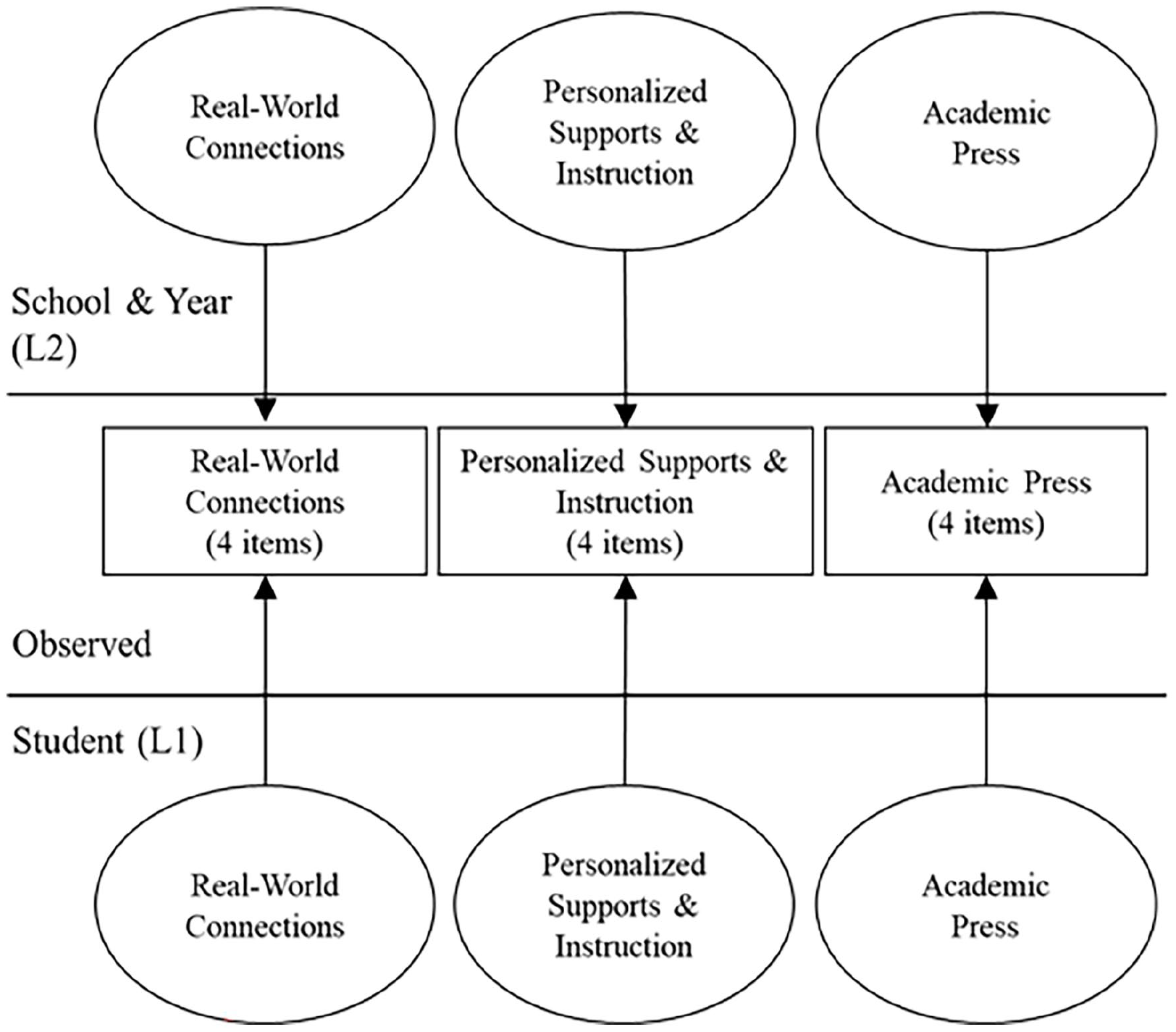
Final Selected Factor Model of Student Perception Variables.
Identification constraints for the MCFA were set so that Level 1 factor means were in the original measurement scale (1–4) and Level 2 factor means were set to 0. Level 1 factor means indicated that in the overall sample, students perceived moderate levels of Real World Connections at school (M = 2.95, SE = .04), and moderate-high levels of Personalization (M = 3.40, SE = .03) and Academic Press (M = 3.69, SE = .02), on average. All variances were significant (σ2 = 0.14 – 0.40, p < .001), indicating variation in latent means that was significantly different from 0. Latent correlations among the three factors ranged from r = .55–.75, with the highest correlation being observed between Personalization and Academic Press and the lowest between Real World Connections and Academic Press.
Latent Profile Analyses
Factor scores at the student level were extracted from the selected doubly latent MCFA model to be used in latent profile analyses. As such, results of LPA can be interpreted as within-school, student-level means and relations among student perceptions, controlling for between-school differences. Fit statistics and model information for the series of 2- to 7-class models, successively allowing parameters to be class-specific, are displayed in Table 3. Although BICs for Model 5 and the 7-class Model 2 were quite low, indicating better fit compared to other models, plots revealed profiles within each solution had the same “shape”—relative levels of the three profiles—and only differed in terms of level (e.g., low all, moderate all, and high all). Some also had low classification quality as indicated by entropy scores and further, the 7-class Model 2 had several profiles that were quite similar to each other in terms of both level and shape. Thus, the 5-profile solution for Model 3 (class-specific means, class-invariant variances and covariances) was considered next, as BIC was quite low compared to other models and appeared to be a leveling-off point for BIC in the series of models, with relatively smaller reductions in BIC for the 6- and 7-profile models in the series. The likelihood ratio test comparing the 5-class model to the 4-class model was significant (p < .001), indicating significantly better fit. Examinations of the profile plots also showed shape effects in the 5-profile solution that did not appear in the 4-class solution. Classification quality was high, with average latent class probabilities for most likely latent class memberships all greater than .83.
Fit Statistics, Proportions, and Entropy for the Profile Model Comparisons

Note. The selected solution is presented in bold.
Means for the profile variables are presented in Table 4 and Figure 4. The profiles were labeled and described using both absolute and relative levels of indicator variables across and within profiles, following recommendations by Wormington and Linnenbrink-Garcia (2017) for labels that maximize objectivity, describe notable features of each profile, and enable cross-study comparisons.
Descriptive Statistics for the Profile Variables

Note. Non-common subscripts (a-d) within a row indicate means were significantly different across profiles due to non-overlapping confidence intervals. RWC = Real World Connections, Pers = Personalization.

Unstandardized and Standardized Means for the Selected Profile Solution.
Class 1 (10.8% of the sample, n = 247) was labeled Moderate-Low All because levels of all three variables were near or below the midpoint of the scale, and were the lowest in the sample with means that fell well below the sample average. The mean of Real-World Connections was particularly low compared to the only moderately low levels of Personalization and moderate levels of Academic Press in this profile. In other words, students best classified in this profile reported all three deeper learning opportunities as occurring in only one or two of their classes, on average, and perceived Academic Press as occurring in significantly more classes than Personalization, which in turn was reported as occurring in more of their classes than Real World Connections.
Class 2 (4.0% of the sample, n = 91) was titled Moderate All due to levels of all three variables falling between 2.5 (the midpoint of the measurement scale) and 3.5. The mean of Real World Connections was lower than the other two variables in the profile, which were not significantly different from each other. In comparison to the first profile, Moderate-Low All, this profile showed significantly higher levels of all three variables, indicating students best classified in this profile viewed Personalization and Academic Press as occurring in two to three or more of their classes, on average, whereas means of Real World Connections indicated students perceived this opportunity as occurring in between one and two of their classes.
Class 3 (4.8% of the sample, n = 109) was labeled Personally Pressed, as this profile exhibited very high levels of Personalization and Academic Press, among the highest in the sample, with much lower Real World Connections that were among the lowest in the sample and below the midpoint of the scale. Similarly to the Moderate-Low All profile, students best classified in this profile reported Real World Connections as occurring in only one or two of their classes, on average, but simultaneously that they experienced Personalization and Academic Press in many more of their classes.
Class 4, containing the majority of the sample (73.2%, n = 1679), was labeled High All, as students best classified in this profile reported the highest mean levels of all three perceptions; means in this profile were significantly higher than all or most other profiles, and means for all three fell between 3 and 4 on the scale. Students best classified in this profile reported means of Academic Press near the top of the measurement scale that were significantly higher than this profile’s mean for Personalization, which was, in turn, significantly higher than this profile’s mean for Real World Connections, resulting in a shape similar to that of the Moderate-Low All profile, but with much higher overall means. Notably, students in this profile reported the highest Real World Connections in the sample, reporting Real World Connections in around two of their classes, on average.
Lastly, Class 5 (7.3% of the sample, n = 168), was labeled High Academic Press, as students best classified in this profile reported Academic Press at the same levels as students in the High All profile, but with moderate Real World Connections and Personalization that was among lowest in the sample. In other words, these students indicated that they felt many of their teachers pushed them to do their best work, but less often felt their teachers personalized their learning experiences or made connections between the course content and the real world. Class-invariant covariances within profiles indicated all three perceptions were positively and significantly related, with standardized rs ranging from .66 to .87 (p < .001).
Predictors of Latent Profile Membership
Next, predictors of profile membership were added to the latent profile model using the automated 3-step method (R3STEP command) in Mplus. Girls were approximately half as likely as boys to be in the Moderate-Low All (b = −0.68, p = .007, OR = 0.51) or Moderate All (b = −0.77, p = .022, OR = 0.46) profiles compared to High Academic Press. In other words, girls were more likely to be in the High Academic Press profile compared to the Moderate-Low All or Moderate All profiles. Conversely, girls were more likely than boys to be in Personally Pressed (b = 1.05, p = .001, OR = 2.84) or High All (b = 0.40, p = .018, OR = 1.49) versus Moderate-Low All. Girls were also more likely than boys to be in Personally Pressed (b = 1.13, p = .004, OR = 3.11) compared to Moderate All or High All (b = 0.65, p = .02, OR = 1.91). In summary, girls tended toward profiles with the highest perceptions of Academic Press, whereas boys tended toward profiles with moderate levels of all perceptions, followed by the High All profile.
Prior achievement predicted a higher likelihood of membership in the High All profile as compared to the Moderate-Low All profile (b = 0.29, p = .032, OR = 1.22), indicating a one-standard deviation difference in prior achievement predicted a 22% difference in the likelihood of being in High All as opposed to Moderate-Low All. Prior achievement was not a significant predictor of any other pairwise comparisons. When controlling for gender and prior achievement, no pairwise profile comparisons were significant for English language learner status, indicating differences in language background were not associated with perceptions of Deeper Learning opportunities.
Correlates and Outcomes Associated With Latent Profile Membership
Finally, correlates and outcomes associated with profile membership were added to the profile models using automated 3-step methods in Mplus, in which analyses were conducted separately for interval/ratio outcomes (three intrapersonal competencies and three PBTS test scores; using the BCH command) and categorical outcomes (on-time graduation and two higher education pursuit variables; DCATEGORICAL command). 3 Results for outcome variables are presented in Table 5.
Results for Correlates and Outcomes Associated With Profile Membership
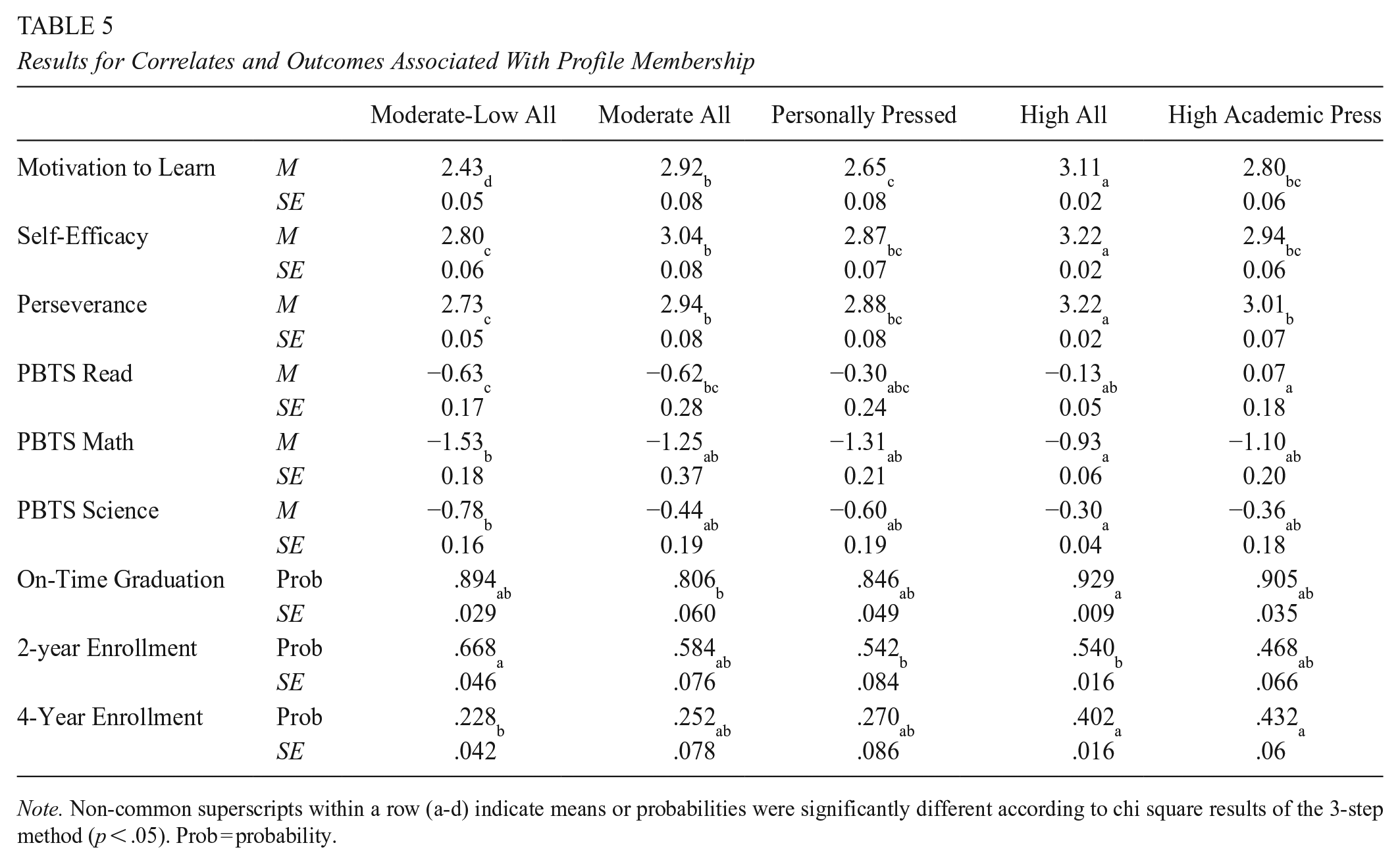
Note. Non-common superscripts within a row (a-d) indicate means or probabilities were significantly different according to chi square results of the 3-step method (p < .05). Prob = probability.
Students best classified in the High All profile showed the highest means of all three intrapersonal competencies and PBTS scores, although their PBTS Math and Science scores were not significantly higher than scores from any other profiles except the Moderate-Low All profile. The Moderate All and High Academic Press profiles appeared to be the next most beneficial profiles. Students in these profiles reported mean levels of intrapersonal competencies that were significantly lower than in the High All profile, but significantly higher than other profiles, with the exception that Motivation to Learn and Self-Efficacy in the High Academic Press profile were not significantly higher than some other profiles’ levels of these variables. Students in these two profiles (Moderate All and High Academic Press) also scored among the highest in the sample on PBTS tests, except for reading being relatively lower among Moderate All students. Students best classified in High Academic Press scored the highest in the sample on the PBTS Reading test, and significantly higher than students in the Moderate All profile. In contrast, the Moderate-Low All profile appeared to be the least beneficial for the selected variables, as students best classified in this profile showed the lowest levels on all, with mean scores that were significantly lower than those in other profiles for most variables. However, the Moderate-Low Real World Connections profile appeared to be nearly as detrimental, as means for outcome variables in this profile were in most cases not significantly different from means in the Moderate-Low All profile.
Fewer significant differences were observed for categorical outcomes of on-time graduation, enrollment in a 2-year higher education institution, and enrollment in a 4-year higher education institution. Students in the High All profile had the highest probability of on-time graduation, on average, and also had among the lowest probabilities of enrollment in a 2-year institution (alongside the Low Real World Connections profile). In contrast, the Moderate All profile had the lowest probability of on-time graduation that was significantly lower than the on-time graduation probability for the High All profile. However, all other profiles were not significantly different from these two profiles in terms of on-time graduation probabilities. Students in the Moderate-Low All profile had the highest probability of enrolling in a 2-year institution, with a significantly higher average probability than students in the High All and Low Real World Connections profiles, but no other pairwise comparisons were significant for 2-year enrollment. Lastly, the High All and High Academic Press profiles showed the highest probabilities of enrollment in a 4-year institution, with probabilities that were significantly higher than the Moderate-Low All profile, but no other pairwise comparisons were significant. Overall, students best classified in the High All and High Academic Press profiles appeared to have the most beneficial outcomes in terms of graduation and enrollment in a 4-year institution; students in the Moderate-Low All profile were most likely to enroll in a 2-year institution and least likely to enroll in a 4-year institution.
Discussion
Schools provide important opportunities for students’ psychological thriving, including their confidence for school, their value for learning, and the development of their self-regulated learning skills. However, even among students in the same school who have presumably very similar opportunities provided to them, students perceive those opportunities quite differently. In this study, I documented evidence of this heterogeneity in student perceptions, which is thus far scant in the literature. Controlling for between-school differences, students showed heterogeneous patterns of deeper learning opportunity perceptions, and this heterogeneity was associated with personal characteristics and key correlates and outcomes. Findings from factor analyses and profile analyses also indicated that students differentiate between various dimensions of supportive teaching. Results have implications for the conceptualization and analysis of students’ perceptions of school supports, for school reform efforts to improve students’ opportunities in school, and for understanding typical student perceptions and their important correlates.
Modeling Students’ Perceptions
First, results of factor analyses indicated that a single-level model appeared to fit the data better than a multilevel model that accurately reflected school-level nesting (i.e., between-school and -year differences in students’ perceptions of in-school opportunities). In other words, even though the survey questions asked students to report on what happened in school (i.e., in how many classes they received each opportunity), students’ reports appeared to reflect much more about the students than about the schools. It may be that the schools in this study somehow provided very similar levels of these opportunities, resulting in little between-school variation to be detected in analyses. However, this balance of within- to between-level variance aligns with findings from previous studies focused on perceptions of motivationally supportive teaching practices (Lam et al., 2015; Miller & Murdock, 2007; Robinson, Lira, et al., 2022) that have found similarly low proportions of variance at the school or classroom level. The finding about within-school differences in perceptions can be interpreted in two ways: it may be that the same opportunities in school are being perceived and interpreted very differently by students, or it may be that students in the same school are actually provided with different opportunities and thus their heterogeneous reports are accurate reflections of what is happening.
These two explanations may also jointly explain the results of this study: some within-school variation could be due to differences in opportunities, and some due to different perceptions of the same opportunities. Certainly, there is evidence that students are not all treated the same (İnan-Kaya & Rubie-Davies, 2022; Myhill & Jones, 2006; Skiba et al., 2011), and that teachers and schools adapt their supports to students’ needs (Deunk et al., 2018; Guay et al., 2017). Indeed, although the characteristics of the schools (Zeiser et al., 2014) suggest it was likely that students were largely reporting on the same classes within each school, the data contain no details to verify this and it should be considered as one explanation for heterogeneity of perceptions within schools. Thus, in the absence of direct observations of students’ opportunities in school, actual differences in supports cannot be ruled out as an explanation for these findings. However, it is very likely that differences in perception are also an important factor. Indeed, recent research has shown similar amounts of heterogeneity in students’ perceptions even within large, lecture-style undergraduate classes, including those delivered online, in which students have very limited, if any, opportunities for differential treatment or opportunities (Robinson & Lee, 2025; Robinson, Lee, et al., 2022).
Beyond considering actual differences in opportunities alongside differential perceptions of the same opportunities as explanations for the results of this study, it is also important to consider the possibility that the measurement items do not provide accurate or valid indicators of deeper learning opportunities, real or perceived. For example, students within the same school might perceive the same conditions, but may respond differently to the measures. Regarding the measures in this study specifically, factor analysis results may to some extent reflect the design of the questionnaires, which asked students to report the number of their classes in which each opportunity was present or not, in general (i.e., not referring to any particular time period). Due to recall biases, halo effects, or simply the large grain size of the measure, number of classes as a unit of measurement may be unlikely to yield specific, accurate ratings when averaged across multiple teachers, situations, and time periods. Further, based on the wording of some questions from the original measures (e.g., “I work on helping solve real-world problems”), the measures may have prompted students to focus on their individual experiences rather than group-level shared experiences. There is very limited research examining what information students consider when answering questions about their school environment, but existing research suggests that such questions may be difficult for students to process and may not prompt specific memories about their school or teacher (Karabenick et al., 2007). Thus, future research is needed to improve the validity of student reports about their school environment. In the meantime, results of such measures must be interpreted carefully, particularly when making recommendations for practice.
Five Profiles of Perceived Opportunities and Their Correlates
Latent profile analyses of students’ deeper learning perceptions, controlling for between-school differences, revealed five groups of students with distinct patterns of the perceived opportunity variables. The vast majority of students (High All, 73.2% of the sample) reported quite high levels of all three opportunities, indicating that most students viewed their schools as providing supports for these important processes in many of their classes. The high incidence of this profile may reflect a combination of the measurement scale and common teaching practices; for example, it may be quite uncommon for students to experience no Academic Press or Personalization within a given course, and thus would rarely have cause to report these practices occurring in only one or two of their courses. However, interestingly, in all five profiles, students reported perceptions of real-world connections that were significantly lower than other perception variables. Only in the High Academic Press profile was any other mean similar to that of Real World Connections: students in this profile also reported relatively low (moderate) levels of Personalization that were not significantly different from this profile’s mean of Real World Connections. This finding of Real World Connections being consistently lower than other perceptions suggests that even for students who felt otherwise highly supported, many appeared to struggle to find connections between what they learned in school and their everyday lives or future goals. Given that this was so common across so many different schools, real-world connections could be an important focus for broader school reform efforts aimed at facilitating students’ socio-emotional thriving and academic success.
Indeed, real world connections appeared to be particularly important in differentiating some student competencies and outcomes. Specifically, the Personally Pressed and High All profiles had very similar levels of Personalization and Academic Press, but differed on Real World Connections, and these two profiles also differed significantly on motivation to learn, self-efficacy, and perseverance. In other words, students who otherwise reported similar support at school, but who did not feel many of their classes made schooling relevant to their lives, reported lower motivation to learn, self-efficacy, and perseverance compared to students who felt more of their classes made schooling relevant to their lives. This key role of connections between course content and real life aligns with theory and research in the achievement motivation literature (Harackiewicz & Priniski, 2018; Schmidt et al., 2019) and beyond (e.g., Ortiz et al., 2018). However, and interestingly, these two groups did not significantly differ on achievement, graduation, or postsecondary pursuit.
After the High All profile, the next most prominent group was the Moderate-Low All profile, representing about 10% of the sample. Due to their relatively low levels of all three perception variables, this group could be labeled the “at risk” group, as they perceived the lowest levels of school support in the sample. Indeed, students best classified in this profile showed the most maladaptive patterns of most outcome variables. These students were also the most likely in the sample to enroll in a 2-year postsecondary institution; however, this latter result should not necessarily be considered as a maladaptive outcome. Further, rates of on-time graduation in this profile (89.4%) were not significantly different from any other profile’s graduation rates. Instead, students best classified in the Moderate All profile actually had the lowest rates of on-time graduation (80.6%), which were significantly lower than graduation rates in the High All and High Academic Press profiles, and had reading and science achievement scores among the lowest in the sample. Thus, even though students in the Moderate All profile reported significantly higher deeper learning opportunity perceptions than those in the Moderate-Low All profile, in retrospect this profile may also be an “at-risk” profile specifically for achievement and graduation rates.
Another relatively small yet notable profile was the High Academic Press profile; students in this profile reported much higher levels of perceived academic press compared to perceived real-world connections or personalization. In other words, this profile was notable because it showed a unique shape relative to the other profiles, most of which appeared in an “ascending” shape from left to right: real-world connections were typically lowest, followed by higher levels of personalization, and finally academic press that was typically highest in each profile. Interestingly, although students best classified in this profile had significantly lower motivation to learn, self-efficacy, and perseverance than students in the High All profile, they did not significantly differ from High All students on the distal outcomes of on-time graduation, achievement, or postsecondary enrollment. Thus, it could be that perceiving high Academic Press with moderate levels of Real World Connections and Personalization was “enough” to support this group’s longer-term achievement and persistence. However, it is important to consider that this is only a snapshot of students’ perceptions in ninth grade, and they could have had very different experiences in subsequent years that then shaped their long-term outcomes. Thus, future research examining variation in actual and perceived opportunities over time in relation to students’ important outcomes is needed to more fully understand how these processes function.
Further, because such a large proportion of students were best classified into the High All profile, it may be tempting to conclude that student perceptions (particularly using these measures) are not meaningfully heterogeneous. On the contrary, mixture modeling revealed four unique groups who reported quite different experiences in school, along with unique (and not always worse) patterns of educational correlates and outcomes, compared to the majority of their peers. Lumping these students together with their peers would not paint an accurate picture of how these students experienced their opportunities in school. Identifying even relatively small subgroups is important for understanding the scope and incidence of various experiences, both for theory development and for considering the scale, type, and targets of future interventions or educational reforms. In other words, just because only a small subgroup reports a less-than-stellar experience in school, this does not mean their experience is not important or worth mitigating.
Following theory and prior research suggesting that students’ personal characteristics can act as lenses through which they view school experiences (Fauth et al., 2020; Matthews, 2018; Poorthuis et al., 2015; Zheng et al., 2023), I examined gender, English language learner status, and prior achievement as predictors of profile membership. Indeed, girls tended to be classified in profiles with the highest Academic Press, whereas boys tended toward profiles with moderate levels of all perceptions, followed by the High All profile. These findings may reflect actual differences (i.e., teachers academically pressing girls in more classes than they did for boys) or measurement limitations. As explained above, however, findings could indicate that girls perceived similar opportunities differently from boys, as underscored by similar findings in higher education (Robinson & Lee, 2025). Surprisingly, and in contrast with prior research (Meyerhöffer & Dreesmann, 2019; Poorthuis et al., 2015; Zheng et al., 2023), English language learner status was not associated with profile membership and prior achievement largely did not predict profile membership, with the exception of unsurprisingly distinguishing High All from Moderate-Low All. This is perhaps a promising indication that students viewed their schools as providing support for students regardless of their English language skills or, with the exception of Low All students, their prior achievement. However, considering that English language learners had lower achievement, along with lower rates of on-time graduation and 4-year postsecondary enrollment (Table 1), and that students with lower prior achievement similarly showed less adaptive outcomes compared to higher achievers, it may perhaps be desirable for English language learners and less prepared students to receive (and thus in theory perceive) more school support than their peers.
It is important to remember that the motivation, self-efficacy, and perseverance variables that are theorized outcomes of deeper learning opportunities were assessed at the same time as the profile indicators. Thus, it is possible that the self-reported outcome variables may reflect students’ habitual or trait-like motivational and self-regulatory tendencies that, rather than being outcomes of perception profiles, may in fact have acted as lenses that informed how students viewed school opportunities. To fully understand the extent to which school environments can “move the needle” on students’ motivational and self-regulatory characteristics, future research using longitudinal approaches is needed to disentangle relations among students’ school perceptions and these important characteristics.
Conclusion
Students’ experiences in school can support or undermine three competencies that are essential for their academic thriving: confidence they can succeed, value for academic tasks, and self-regulatory behaviors. One prominent way to understand opportunities in school is to ask students about their experiences. However, due to thin conceptual guidance in prior literature (Robinson, 2023), how such data should be modeled and analyzed is unclear. Results of this study on students’ perceptions of opportunities for deeper learning at their school, including Real World Connections, Personalization, and Academic Press, indicate that students’ answers to questions about their perceptions of school opportunities for deeper learning appeared to reflect individual differences much more than between-school differences in these opportunities. This is particularly striking when considering these schools were selected due to their varying levels of opportunities for deeper learning. Relations of profile memberships to key correlates, including motivational and self-regulatory characteristics, achievement, on-time graduation, and postsecondary pursuit, underscore the importance of perceived deeper learning opportunities for students’ thriving and success. In particular, whereas students endorsing the highest levels on all three perceived opportunity variables had the most optimal patterns on proximal and distal outcome variables, as expected, students with varying combinations of low and high levels of perceived opportunities had more complex patterns of outcomes. To effectively improve opportunities in schools, it is vital to design such opportunities and evaluations of their effects not only considering typically targeted outcomes of improved motivation, persistence, and achievement, but also considering important mechanisms of those effects: whether or not students perceive their school experiences as providing the intended opportunities.
Supplemental Material
sj-docx-1-ero-10.1177_23328584251338175 – Supplemental material for Understanding the Nature and Correlates of Students’ Heterogeneous Perceptions of Opportunities for Deeper Learning
Supplemental material, sj-docx-1-ero-10.1177_23328584251338175 for Understanding the Nature and Correlates of Students’ Heterogeneous Perceptions of Opportunities for Deeper Learning by Kristy A. Robinson in AERA Open
Footnotes
Appendix
Declaration of Conflicting Interests
The author declared no potential conflicts of interest with respect to the research, authorship, and/or publication of this article.
Funding
The author disclosed receipt of the following financial support for the research, authorship, and/or publication of this article: This research was supported by funding from the AERA Fellowship Program on the Study of Deeper Learning, funded by the William and Flora Hewlett Foundation.

Note. This manuscript was accepted under the editorship of Dr. Kara Finnigan.
Notes
Author
KRISTY A. ROBINSON, PhD, is an assistant professor in the Department of Educational and Counselling Psychology at McGill University. She studies educational conditions that support students’ motivation and thriving.
References
Supplementary Material
Please find the following supplemental material available below.
For Open Access articles published under a Creative Commons License, all supplemental material carries the same license as the article it is associated with.
For non-Open Access articles published, all supplemental material carries a non-exclusive license, and permission requests for re-use of supplemental material or any part of supplemental material shall be sent directly to the copyright owner as specified in the copyright notice associated with the article.
