




Abstract
Humanizing social interactions with Black children help to oppose the harmful impacts of anti-Blackness. Although empathy is found to improve the quality of teachers’ social interactions with Black students, too little research explores the relationship between teachers’ racial beliefs and expression of empathy. This study describes evidence supporting the validity of the teacher beliefs about race (TBAR)—a measure recently added to a previously published scale of teacher empathy with Black boys. The TBAR shows evidence of reliability (α = .86) and is positively associated with how teachers conceptualize and enact empathy across a range of professional teaching tasks. The paper concludes with a discussion of the influence anti-Blackness may have on expression of empathy, the TBAR’s associations with teacher characteristics (e.g., gender), and recommendations for future research.
Keywords
Introduction
Empathy remains an important human capacity with material consequence for improving Black people’s lives. The racial uprisings that followed George Floyd’s public slaying in May 2020 and the unending COVID-9 global health crisis have taken a tremendous toll on Black people’s collective physical, emotional, and psychological well-being (Alcendor, 2020; Anderson et al., 2022). Black Americans’ health and economic status have worsened when compared with other racial/ethnic and minoritized groups in the United States (Laster Pirtle, 2020; Reyes, 2020; Wright et al., 2022). Indeed, the unparalleled loss experienced the world over has only intensified the preexisting failures of American social institutions to meet the needs of Black communities, including pre-K–12 schools.
Scholars insist that contemporary American schools are little more than sites of Black pain and suffering (Dumas, 2016; Dumas & ross, 2016; Ross et al., 2022). The capacity of classroom teachers to negotiate meaningful social interactions with Black youth, which includes the practice of seeing through their eyes and feeling with (rather than for) them (i.e., empathy), is an urgent pedagogic intervention essential to undoing that suffering. Expressing empathy is less about attempting to “understand” the profundity of Black people’s distress as much as it is an “act and process of knowing” (see Warren, 2018) also described as perspective taking (Batson et al., 1997; Boland & Tenkasi, 1995; Gehlbach et al., 2023). This knowing facilitates teachers’ acquisition of culturally specific points of view. These points of view or perspectives enable more dynamic moment-by-moment pedagogic responses from educators during social interactions with Black youth that may over time produce consistently favorable student outcomes.
A foremost goal of the present study was to discern the extent to which teacher beliefs about Black boys and notions of race inform how they conceive of empathy in their everyday teaching practice. Warren’s (2015a) original Scale of Teacher Empathy with African American Males (S-TEAAM) included two subscales: teacher conceptions of empathy (TCE) and teacher application of empathy (TAE). This paper introduces an upgraded version of Warren’s previously published measure of teacher empathy. S-TEAAM 2.0 combines both the TCE and TAE measures of the original S-TEAAM and a new subscale that measures teacher beliefs about race (TBAR). The study is guided by the following questions: (a) What is the validity of the newly authored TBAR? (b) To what extent are teacher beliefs about race associated with their conceptions and application of empathy with the Black boys they teach? and (c) To what extent do teacher beliefs about race and empathy vary across individual teacher characteristics?
Indeed, empathy has been found useful to helping teachers make professional decisions that lead to culturally responsive and sustaining pedagogic outcomes (Eisman & Patterson, 2024; McAllister & Irvine, 2002; Milner, 2010; Murphy et al., 2018; Warren & Lessner, 2014; Whitford & Emerson, 2019). For example, Warren (2014, 2020) insisted that Black boys’ increased participation/engagement in school was improved, in part, because of ongoing interactions with teachers who demonstrated evidence of empathy. He found that teacher empathy precipitated high(er) academic achievement, sense of belonging, and Black boys’ feelings that their teacher cared about them. Nevertheless, in a society that still struggles to publicly acknowledge the long-lasting impacts of chattel slavery, which include the ubiquity of anti-Blackness, there endures a limited understanding of empathy’s utility to remaking American education to be a more humanizing social enterprise for Black youth.
Anti-Blackness as “Total Climate”: Black Education and the Contemporary Study of Teacher Empathy
A growing corpus of research in the field of Black education insists that anti-Blackness, or the racial logics underscoring the impossibility of Black people’s humanity (Jung & Vargas, 2021), is a signature feature of American schooling (Dumas & ross, 2016; Grant et al., 2020; Mustaffa, 2017). Christina Sharpe (2016) described anti-Blackness as atmospheric or “total climate”—encapsulating all of us—weathering our experiences of the world and one another. She concluded that anti-Blackness defines what is and is not possible for those marked as Black in the U.S. sociopolitical context while at the same time perpetually rendering Black death as inevitable “in the wake” of chattel slavery. Anti-Blackness is all around us, transmitting specific messages about race that mediate one’s social interactions with Black people and fundamental understandings of Blackness. It has circulated for more than four centuries as an imperceptible yet active social force (Jung & Vargas, 2021). And while teaching is considered a helping profession, researchers conclude that no matter how well meaning an educator, the far-reaching consequences of anti-Blackness are innumerable and therefore inescapable (Annamma, 2017; Coles, 2016; Gordon, 2023; Jenkins, 2021; Mustaffa, 2017; Warren et al., 2025). Not only does anti-Blackness obscure mainstream perceptions of the Black body (Wilderson, 2010), which implicate social perspective and one’s ability to apply empathy with fidelity (Gehlbach et al., 2023), anti-Black logics are also foundational to the persistence of opportunity gaps for Black Americans (Carter & Welner, 2013; Weiner, 2006). A detailed discussion of opportunity gaps and their relevance to design of the TBAR items appears in the Methods section.
Simply acknowledging that anti-Blackness exists does not ensure a teacher’s readiness to adeptly respond or react to Black youth in ways that effectively reduce or eliminate sustained racialized harm. Campaigns for police-free schools and campuses (Cops Out, 2024; Crenshaw et al., 2015; Na & Gottfredson, 2013), the passing of policy in New York City to make culturally responsive and sustaining pedagogy a requirement in the largest U.S. public school system (New York City Government, 2019), and national calls to reduce disproportionality in Black students’ exclusionary discipline signal greater public recognition of the many ways American education is an anti-Black racially assaultive social enterprise (Baker-Bell et al., 2017; Love, 2016; Lozenski, 2017; Warren et al., 2025). Anti-Blackness knows no boundaries. Regardless of ethnoracial student–teacher match, simply instructing a classroom teacher to exercise use of empathy as a mechanism to undoing Black children’s harm in school brought on by anti-Blackness is shortsighted. As this study will show, assuming that a teacher organically possesses the capacity to adeptly apply empathy in the professional teaching context because they share the race or gender of their students is similarly misguided.
Regardless of the teacher’s social identity, scholars insist that racial literacy, for example, is essential to resisting racialized oppression in education (Sealey-Ruiz, 2013; Sealey-Ruiz & Greene, 2015; Stevenson, 2014). A teacher’s understanding of race and racism undoubtedly shade the points of view/social perspectives they use to express empathy when negotiating interactions with Black youth. Moreover, although education research lauds empathy’s utility in interrupting the conditions that fray Black students’ social, emotional, psychological, and intellectual well-being (Legette et al., 2022; Majors et al., 2020; Warren, 2013, 2014; Warren, Presberry, & Louis, 2022; Whitford & Emerson, 2019), this research fails to clarify the potential pitfalls of attempting to empathize without attending to the status of one’s own critical (racial) consciousness (Bañales et al., 2021; Diemer et al., 2021; Freire, 1974). Critical consciousness requires interrogating one’s beliefs about the enduring significance of anti-Blackness and anti-Black racism in the United States. To do so positions the educator to better understand the particularity of Black suffering that too often defines Black education experience (Coles, 2016; Dumas & ross, 2016). Such admonitions to consider anti-Blackness in Black education research anchor interpretation of this study’s findings.
Black Teachers on Teaching Black (Boy) Students and S-TEAAM 2.0
American schools not only reproduce a social order that insists on economic competition, but for Black children they can serve as sites of ongoing race–gender violence (Dumas, 2014; Nyachae, 2016; Owens, 2022; Pierce, 2017). Cultural connections between Black teachers and their Black students may facilitate empathic interaction, but such connections are not guaranteed. Nonetheless, Black teachers historically have played a key role in subverting multiple forms of symbolic and physical assaults experienced by Black students (Givens, 2021; Siddle-Walker, 2018). They tend to make professional decisions when teaching Black youth that intentionally buffer risk, bolster Black students’ resilience, and counter racialized (institutional) harm (Cunningham & Swanson, 2010; Graham, 2022; McKinney de Royston et al., 2021; Warren, 2020). And while the literature on Black teachers’ empathy with Black boys is incredibly limited, there remains important evidence pointing to the positive impacts of Black student–teacher racial match for nurturing positive interpersonal relationships with Black youth (e.g., Downer et al., 2016; Fergus et al., 2014; Foster, 1990; Grissom, 2017; Milner, 2006; J. D. Nelson, 2016; Redding, 2019; Warren, 2013; Warren, Carter Andrews, & Flennaugh, 2022). Being taught by a Black teacher likely improves the overall quality of a Black child’s pre-K–12 learning experience.
On the contrary, being taught by a Black teacher does not alone guarantee resolution to Black (boy) students’ persistent race–gender harm in American schools. Although Downer et al. (2016) claimed that Black teachers tend to view Black boys’ behavior to be less problematic in comparison with White teachers who observe the same behavior, Owens (2022), like Gregory and Roberts (2017), found that regardless of teacher race, Black boys are more likely to be perceived as blameworthy for behavior identical to misbehavior displayed by their White and Latino peers. Milner (2006) insisted that Black teachers’ cultural similarities with Black students do not alone preclude those teachers from acting in ways that reproduce Black boys’ dehumanization in school. This research suggests that implicit biases and racialized assumptions can indeed undermine cultural connections between Black students and Black teachers.
Put simply, a teacher who racially identifies as Black is not automatically cleared from perpetuating anti-Blackness. National administration of S-TEAAM 2.0 happened to yield a final analytic sample of respondents that did not include White teachers. Beyond defining inclusion–exclusion criteria, the researcher has little control over who will respond once a survey is publicly administered. The absence of White teachers from the sample was not on purpose, nor was it a goal of this study. Considering the critical role Black teachers historically have played in the education lives of Black children across time, this circumstance did, however, provide the research team with a rare opportunity to contemplate the significance of teacher empathy and Black teachers’ teaching of Black youth without reference to the White gaze, in and against the backdrop of an anti-Black American education system. In other words, despite White educators’ overrepresentation in the teacher workforce, there is not a measure that we know of that is intended for use to improve educators’ interactions with Black (boy) students that relies primarily on the experience, expertise, and practice of Black teachers. This is a novel feature of S-TEAAM 2.0.
Furthermore, research measures used in education scholarship, as in other fields such as psychology, tend to center White perspectives in their development, item design, and analysis (Abo-Zena et al., 2022). The consequences of such decisions include advancing Eurocentric knowledge production and standards of rigor that minimize multicultural epistemological orientations and intellectual traditions. Findings from such research too often bear relevance to the lived experiences of ethnically, racially, and linguistically diverse Black people. Moreover, research approaches that insist on, or happen to have, a primarily White respondent pool also may fail to nuance the unique features of Black teachers’ pedagogies and interactions with Black youth. And the entire field benefits from deeper understandings of Black teachers’ work with Black students (Givens, 2021; Ladson-Billings & Anderson, 2021; Stewart et al., 2023). This study helps to unsettle commonly held assumptions and myths about Black teachers who teach Black children while also offering robust interpretations that illuminate the significance of their work with Black families. That said, Black teachers are the reference group for S-TEAAM 2.0. The findings from this study help to establish validity for the TBAR subscale and its association with respondents’ other social identity characteristics such as gender.
Teacher Beliefs, Teacher Empathy, and Social Interaction: A Literature Review
Social interaction between educator and student is the site for expressing empathy in real time (Davis, 1996, 2006; Feshbach & Feshbach, 2009). The literature review to follow briefly describes teacher empathy, teacher beliefs, and their influence on student–teacher interactions. This discussion is followed by the definition of teacher empathy used in this study. The literature review concludes with an overview of existing measures of teacher empathy and teacher cultural or racial beliefs.
Teacher Beliefs + Anti-Blackness in Black (Boy) Students’ Education Outcomes
Teacher beliefs are defined in this study as the thoughts, perceptions, and values about teachers’ roles as educators, the role of education as a practice, and the ways that students learn (Vartuli, 2005). Teacher beliefs are viewed as “a filter of both information experience, framing situations and problems, guiding intention and subsequent action” (Buel, 2011, p. 479). For example, what a teacher believes determines how they cultivate or support students’ cognitive and behavioral development (Blazar & Kraft, 2017; Borghans et al., 2008; Jackson, 2018; Kraft, 2019; Nelson & Guerra, 2013; Rockoff, 2004; Siwatu & Starker, 2010). Scholars also find that teacher beliefs are informed by their individual class-based values and professional development, such as their teacher preparation courses (Lareau & Weininger, 2003). Improving any child’s experience of school implies what a teacher believes about that child, the social contexts where they teach, and the teaching vocation itself.
Considering the ubiquity of anti-Blackness, it is assumed that teachers and administrators with decision-making authority have internalized anti-Black messages about Black boys. And considering that elementary and secondary teacher beliefs have long-lasting impacts on students’ academic and social outcomes (Aaronson et al., 2007; Chait, 2009; R. Gordon et al., 2006; Rivkin et al., 2005; Rockoff, 2004), it is urgent that efforts to improve Black boys’ experience of school include getting beneath a teacher’s actions, including the application of empathy, to discern the logics that guide their behaviors, such as their beliefs about race.
Pervasive messages of Blackness as inferior undoubtedly infiltrate teachers’ beliefs about Black people and Black communities, thereby coating the social and cultural perspectives of Black boys that inform how teachers choose to interact with them. Unchecked or unrecognized anti-Black racist social perspectives make expressing empathy with Black boys nearly impossible, as evidenced, for instance, by persistent trends in Black boys’ education outcomes.
Patterns of racial harm reflecting dominant discourses on Black boys’ school achievement are widely known and too commonly accepted as immutable. Black boys tend to be underrepresented for indicators of high academic achievement at every level of education and overrepresented for indicators of academic underachievement (Moore & Lewis, 2014; Schott Foundation for Public Education, 2015; Toldson, 2008), despite promising new models that better attend to Black boys’ race–gender well-being (e.g., Nasir et al., 2019). For instance, increased numbers of Black boys are suspended and expelled from school in part due to the failure of teachers to comprehend Black boys as children at all (Goff et al., 2008, 2014). Coles and Powell (2020) found that educators tend to rely on racial logics akin to that of White landowners during chattel slavery when making discipline decisions involving Black children in the present day regardless of the educator’s race. Such logics underscore tacit beliefs about Black boys as objects to be negotiated at will. Put differently, educators too often conclude that it is more appropriate to discipline and control Black boys than treat them with the redemption, kindness, and dignity that all human beings deserve.
Although this study focused on Black boys singularly, the issue of harsh treatment during social interactions with adults in school also impacts Black girls and nonbinary Black youth. For example, implicit association tests have been used to show that all Black students are often disproportionately disciplined in comparison with White students (Riddle & Sinclair, 2019). Black boys specifically tend to be viewed as criminals and treated like grown men by the time they are 8 and 9 years old (Carey et al., 2022; Ferguson, 2002; Ladson-Billings, 2011; Wallace, 2018). These findings illuminate the anti-Black racial logics that are ripe for (perhaps unconscious) development of anti-Black racial beliefs. Such values and perceptions of Black boys render their capacity to be or act as children unfathomable or unimaginable (Dumas & Nelson, 2016) and, as a result, likely undermine a teacher’s good intentions to negotiate consistently humanizing social interactions with them. Ongoing interactions with adults who do not have the tools to both notice and challenge anti-Black racial beliefs sustain cycles of Black boys’ pain and suffering in school. S-TEAAM 2.0 helps reveal the association of such beliefs with teachers’ conceptions of empathy and the influence of their racial beliefs on applications of empathy to interactions with the Black boys they teach.
Defining Teacher Empathy
Empathy is a multidimensional construct. That is, empathy is both emotional and intellectual (Davis, 1996, 2006). The affective domain of empathy is commonly, but not exclusively, referred to as empathic concern (e.g., feeling with someone), whereas the cognitive domain of empathy is understood as perspective taking (e.g., adopting someone’s psychological point of view). Perspective taking is core to the expression of empathy in social relationships and indeed is required to express empathic concern (Davis, 2006; Eisenberg & Miller, 1987). Neuroscientists conclude that empathy does not need to be taught (Decety & Ickes, 2009; Decety & Lamm, 2006). Put differently, all humans are thought to be born with the capacity to empathize. The social conditions framing interactions with those different from us (e.g., physical context of the interaction, personal relationship to the subject of empathy’s application, personality of the empathizer, etc.) are salient when determining the efficacy of the empathetic response (B. Cooper, 2010; Feshbach & Feshbach, 2009). With this in mind, the teaching context establishes a particular set of social conditions for the application of empathy that is different from its expression with strangers on the street, family or close friends, for instance.
Teacher Empathy and Cultural Beliefs Measurement Tools
The influence of early empathy questionnaires (Davis, 1983; Dymond, 1949, Hogan, 1969; Kerr, 1960; Mehrabian & Epstein, 1972) is foundational to the development of empathy measurement tools in the late twentieth and early twenty-first century. Such scales tend to be self-report empathy measures (Baron-Cohen & Wheelwright, 2004; Caruso & Mayer, 1998; Dadds, 2008; Garton & Gringart, 2005; Jolliffe & Farrington, 2006; Mehrabian, 1996; Reniers et al., 2011; Spreng et al., 2009). Scales incorporating behavioral measures include comic strip tasks, picture viewing paradigms, kids’ empathic development scales, and picture stories (Nummenmaa et al., 2008; Reid et al., 2012; Völlm et al., 2006; Westbury & Neumann, 2008). These scales center on the capacity of individuals to empathize primarily from a psychological and/or prosocial point of view. They do not necessarily measure the ability of an individual, let alone a teacher, to express empathy in particular professional contexts such as a school or classroom.
Existing empathy measures that are associated with a professional context tend to focus on specific applications of empathy not limited to consultation and relational empathy. Examples include the Jefferson Scale of Physician Empathy (Hojat et al., 2001), the Nursing Empathy Scale (Reynolds, 2000), the Autism Spectrum Quotient (Baron-Cohen et al., 2001), the Japanese Adolescent Empathy Scale (Hashimoto & Shiomi, 2002), the Scale of Ethnocultural Empathy (Wang et al., 2003), and the Emotional Empathy Scale (Mercer et al., 2004). Warren’s (2015a) original S-TEAAM queries a respondents’ beliefs or conceptions of empathy first and then, with this conception in mind, how they might apply it to a range of specific professional tasks. The S-TEAAM, like the empathy measures just mentioned, however, does not sufficiently account for the ways racial beliefs correlate or interact with respondents’ thinking about empathy in the professional teaching context. And none of the empathy measures mentioned here specifically query teacher empathy and teachers’ racial beliefs using the same instrument.
Two other scales of teacher beliefs related to race and culture are worth spotlighting. Kruger and Love’s (2005) scale measures teachers’ culturally relevant beliefs and their correlation with students’ high academic achievement. Milner (2017) referenced an unpublished scale that he coauthored with colleagues at the Center for Urban Education titled, “Teachers Race Talk Survey.” This scale examines general beliefs about race with one question of 12 referencing the circumstance of anti-Black police violence. Like the TBAR subscale of S-TEAAM 2.0 introduced in this paper, both measures are useful for talking with teachers about the ways that race and racism mediate teaching and learning outcomes with Black children. The TBAR subscale, however, is specific to Black boys, with most of the questions asking about a teacher’s philosophies about teaching, their perceptions of Black boys, and the logics that guide how they negotiate social interactions with Black boy students.
Finally, although empathy has been found to improve the quality of student–teacher interactions with young Black men and boys, limited information is known about the positive association of teacher beliefs about race and teacher empathy. Evidence of association between teacher empathy and their beliefs about race can be helpful for the design of learning environments and experiences that disrupt the effects of anti-Blackness in schools. Pohan and Aguilar’s (2001) Personal and Professional Beliefs about Diversity and Stanley’s (1996) Pluralism and Diversity Assessment scales are two prominent scales used to measure teachers’ beliefs about culture and/or difference. Although both scales assess teachers’ beliefs about diversity, they do not specifically implicate teacher empathy or teachers’ beliefs about race and Blackness in particular. The Teacher Cultural Beliefs Scale (Hachfield et al., 2011) also measures diversity through examinations of teacher beliefs about multiculturalism and egalitarianism in the context of prejudiced social interactions. S-TEAAM 2.0 breaks new ground by being far more explicit in soliciting respondents’ perceptions and philosophies of race-based scenarios involving Black boys followed by questions that inquire about the role of empathy in respondents’ professional teaching practice.
Methods
S-TEAAM 2.0 is composed of demographic questions and three subscales. The newest subscale, introduced in this paper, is teacher beliefs about race (TBAR). Our primary research questions are (a) What is the validity of the TBAR scale? (b) To what extent are teacher beliefs about race associated with their conceptions and application of empathy with Black boys? and (c) To what extent do teacher beliefs about race vary across individual teacher characteristics? The first subscale of S-TEAAM 2.0 is teacher conceptions of empathy (TCE). It is a four-item measure designed to evaluate teachers’ general perceptions of the role of empathy in their engagement with Black students as well as their beliefs about empathy as a professional disposition. It is the first of two original S-TEAAM subscales (Warren, 2015a; see appendix). The second, teacher application of empathy (TAE), is a five-item measure designed to assess how teachers think about their own application of empathy to their teaching practice, particularly with Black boys. TCE and TAE are unchanged from their original form. The TBAR is the third and newest scale, hence S-TEAAM 2.0. The remainder of this section describes the research team’s approach to both validating the TBAR subscale of S-TEAAM 2.0 as well as identifying its associations with the TCE and TAE subscales. Note here that analyses for S-TEAAM 2.0 were conducted with an original data set.
Establishing Robust Validity for TBAR
The Standards for Educational and Psychological Testing (2014) outline the importance of establishing robust validity for any measure. Ho (2020) summarized this guidance by outlining five sources of evidence that point toward validity (known as the five C’s aide-mémoire): content, cognition, coherence, correlation, and consequence. Throughout this paper, we provide evidence for the validity of the newly designed TBAR subscale in a diverse sample of educators of color. Validity is the extent to which evidence and prior literature affirm the intended use and interpretation of a given measure. We assess the validity of the TBAR by analyzing the reliability of the measure and examining how it correlates with other measures that are related to or predictive of similar constructs. The following sections discuss our strategy for determining the validity of the TBAR.
Content and Cognition: Item Development
To begin establishing validity, we’ll first describe the theoretical underpinnings of the TBAR’s items (i.e., content). Items for the TBAR were developed across at least three distinct phases. First, research on opportunity gaps stood out as a novel intellectual frame through which to begin ideating the specific concepts about race and teaching that the TBAR would measure. Opportunity gaps are barriers to education opportunity that are external to a young person that impair their capacity to achieve at optimal levels in school (Carter & Welner, 2013; Wiener, 2006). They are the result of ideological, political, and structural forces that insist on preserving White dominance. Carter and Welner (2013) argued that “educational disparities and intergenerational economic inequality are highly correlated with skin color, ethnicity, linguistic, and social class status” (p. 1). In other words, our theory in this study assumes that what teachers know about the political and material impediments to Black people’s well-being, as mediated by racial power and disadvantage, influences how they deploy empathy to guide their professional decision making. The substance of those decisions is evidenced in teachers’ social interactions with students as educators manage everyday professional teaching tasks. The trajectory of such interactions with Black students will either improve these students’ education experience over time or exacerbate their vulnerabilities and racialized harm.
Next, the team used Milner’s (2012) explanatory framework of opportunity gaps to operationalize the specific issues that drive opportunity gaps likely to emerge during teachers’ social interactions with Black students. The framework includes five philosophy-oriented dimensions that illumine core beliefs about racialized others thought to have a significant impact on the trajectory of social interactions with Black youth in the professional teaching context (hereafter referred to as constructs). These constructs are (a) colorblindness, (b) meritocracy, (c) cultural conflicts, (d) deficit mindsets and low expectations, and (e) context-neutral mindsets and practices. The five constructs bound what beliefs about race the TBAR was designed to measure, in large part, for the salience of these constructs to determine Black children’s wellbeing in school and the quality of their learning experiences (Milner, 2012). Having narrowed down the specific beliefs the TBAR would probe, the research team embarked on a comprehensive literature review. The review of literature provided baseline understanding of each construct necessary to begin drafting the items that would appear on the first version of the TBAR. Figure 1 provides a brief definition for each of the five constructs and sample peer-reviewed articles reviewed to derive those definitions.

Five constructs of the original teacher beliefs about race (TBAR) subscale.
The research team further examined this literature for examples of the ways anti-Blackness (Jung & Vargas, 2021) is evidenced in or perpetuated by each construct as well as the implication of that construct on Black boys’ long-term education success (Table 1). This synthesis of the existing research literature provided the building blocks for TBAR item construction.
Anti-Blackness in the Five Constructs and Their Effects on Black Boys’ Education.

The team then employed a Guttman-style approach to constructing specific items (Wilson, 2023). In this approach, items are organized on an ordinal scale with multiple statements placed in hierarchical order. Such an approach captures the respondent’s beliefs and the level of belief within each question, which aligns well with the study’s goal of capturing teacher beliefs about race. Each element or construct of the original TBAR scale included five draft items (i.e., 25 total items on the original TBAR). The team then applied a general level of specificity to each of the five constructs through a general topics guide approach (Wilson, 2023). That is, we drafted and revised the items to ensure that a range of key issues specific to race, place, and ideology could be probed appropriate to the specific construct in question. Doing so improved the likelihood that the TBAR would offer robust representation of the construct across the five drafted items. The ultimate goal for the TBAR was that when understood collectively, the 25 items would reveal rich insights about a teacher’s beliefs about race particular to their imagination of Black life, Black boys, and education. Scores on any specific construct may reveal one’s propensity toward interactions that are more likely to help or harm Black boys. That is, the higher the score, the less likely it is that teachers are interacting in a way that is potentially exacerbating how Black (boy) students experience harm. Results from the TBAR should not be used as definitive evidence of one’s complete beliefs about race. The tool is intended to be generative, not evaluative.
Next, we describe the method of item testing on educator raters (i.e., cognition) to further clarify our approach to validity. After the items for the original TBAR were fully drafted, the measure was pretested (Howard, 2018) using both quantitative (e.g., item rating) and qualitative (e.g., cognitive interviews and focus groups) tasks with a diverse group of practicing classroom teachers. For example, cognitive interviews (Desimone et al., 2004) were used to inquire about respondents’ experience completing S-TEAAM 2.0. Researchers gave special attention to how respondents felt while completing the TBAR and how well respondents comprehended the TBAR’s 25 items. The team also queried whether the drafted items offered useful insights about their associated components/TBAR constructs. The research team also wanted to ensure agreement about the meanings of specific terms and phrases across the pool of respondents.
The pretesting process led to a lively conversation. Teachers shared that they tended to think about their own Black boy students when answering the TBAR questions. Each of the seven educator raters shared reflections on professional scenarios where they felt that empathy was relevant to navigating issues of race when interacting with Black boys. They also discussed the ways they’ve seen Black boys underserved in schools where they worked and the utility of these 25 items to capture information that is useful to nuancing the complexities of teaching Black boys. The teachers were asked if the TBAR items were confusing or if there were questions that they thought should be changed or reworded. The feedback they provided directly informed our revision of the TBAR items, but no items were removed at this stage. Final revisions to the TBAR items to be included on S-TEAAM 2.0 were made in March 2019. The scale was then administered nationally between April and June 2019.
Coherence, Correlation, and Consequence: Data Analytic Approach
To further establish validity, we provide evidence through ordinary least squares regression models that the TBAR measure is positively correlated with the TCE and TAE. The research team deliberated over the consequences of using the TBAR to understand how educators with varying identity characteristics might conceptualize and apply empathy to their practice with Black boys. This process also was informed by what we learned from our pretesting procedure described above. A principal components analysis (PCA) was conducted using Stata Statistical Analysis Software, version 16 (StataCorp, College Station, TX). The PCA was used to further determine the reliability of the TBAR subscale of S-TEAAM 2.0 (i.e., coherence).
We chose PCA because the five original TBAR constructs were expected to have strong correlations with one another. In other words, the TBAR items were designed to query teachers’ orientations to colorblindness, meritocracy, cultural conflicts, deficit mindsets and low expectations, and context-neutral mindsets and practices. Doing so allowed for better understanding of respondents’ beliefs about race, education, and teaching Black boys. The team decided to conduct a PCA instead of a confirmatory factor analysis because doing so allowed for exploration of how the different elements may correlate with each other’s factor loadings within the unique sample of S-TEAAM 2.0 respondents. A PCA also did not require the same strict assumptions of independence. Finally, the TBAR underwent an oblique rotation to allow all items to correlate with one another, and communality estimates were calculated (Abdi, 2003; Hendrickson & White, 1964). An additional correlational analysis was performed to see how the questions on each scale correlated with one another. After determining the internal validity of the scale through factor analysis and inter-item correlation tests, we estimated how each of the three S-TEAAM 2.0 subscales correlated with one another (i.e., TCE, TAE, and TBAR), which when recorded, helped to assess the validity of S-TEAAM 2.0 overall.
Results of the PCA strongly suggest that the TBAR is comprised of three distinct components; therefore, we also assessed the associations between each of these components, the TCE, and the TAE. This is important because the existing research literature suggested that productive beliefs about race, such as refusing an ethos of colorblindness, for instance, would be positively associated with teacher conceptions and applications of empathy. It also was necessary to estimate the associations between the three S-TEAAM 2.0 subscales because they collectively assess characteristics related to empathy that our theory suggests improves the quality of teachers’ social interactions with Black boys. The addition of the TBAR measure to S-TEAAM 2.0 should provide a more robust understanding of how beliefs about race and the utility of empathy work together to strengthen the quality of teachers’ interactions with Black boys in a social world where anti-Blackness is ubiquitous.
Linear regressions to test the associations between the components of the TBAR, TCE, and TAE subscales of S-TEAAM 2.0 were conducted using the following ordinary least squares model:

where
Sample and Procedure
S-TEAAM 2.0 was administered using a snowball sampling technique (Biernacki & Waldorf, 1981). It was forwarded to school administrators, teachers, support services personnel, and other colleagues in the research team’s networks. The survey was then forwarded by these individuals to other people within their respective networks. The goal was to get a large, diverse sample of educators to complete the survey. Respondents completed the survey by clicking a link in their email, which then allowed them to take the online survey anonymously, administered via Qualtrics. After respondents completed and submitted S-TEAAM 2.0, they were asked to submit their email address. Ten email addresses were chosen from the database of completers to receive a $50 gift card. Gift cards were sent within 2 weeks of closing survey submissions.
The final analytic sample included a diverse group of 192 teachers (n = 192). Initially, 244 teachers began the survey. Two teachers, however, failed to indicate consent to use their data, and 52 teachers did not complete the full S-TEAAM 2.0, leaving a 78% completion rate. The sample included a significantly larger portion of males. Sixty-one percent of the sample identified as male (n = 116), 31% as female (n = 65), and roughly 5% indicated a nonbinary gender identity (n = 9). Forty-five percent of the sample identified as Black or African American (n = 86), 23% as Native American or Alaska Native (n = 44), 12% as Latino/a or Hispanic (n = 23), 8% as Native Hawaiian or Pacific Islander (n = 15), and 7% as Asian (n = 12). Two percent of the sample identified with multiple racial categories (n = 4), and 3% declined to report a racial identity (n = 6). Seventy-seven percent of respondents described serving a student body with more than half the students being identified as Black (n = 146). Twenty-three percent of respondents described serving a student body with less than half the students being identified as Black (n = 44). Although White females represent the largest demographic of teachers in the United States, this sample did not include any White teachers. The study allowed for research exploration of racially diverse teachers’ racial beliefs, which is a fresh, innovative contribution of this research, although it was not our original intention. Benefits and potential limitations of this work ate described in the Discussion section. Moreover, the subracial analysis was a bit underpowered due to lower sample numbers. Although the results are certainly interesting, they are not intended to generalize to the broad population of U.S. teachers.
Results
The original TBAR subscale of S-TEAAM 2.0 included 25 items that were initially designed to measure five constructs described in Figure 1. These constructs were the result of our use of opportunity gaps framing (Carter & Welner, 2013). The concept of opportunity gaps is useful to discerning how and why particular inputs sustain the failure of American schools to adequately educate Black children. Milner’s (2012) research named dimensions of teaching and learning that might specifically help to explain the persistence of opportunity gaps. These inputs (or constructs; see Figure 1) became building blocks for how we chose to operationalize beliefs about race in design of the TBAR, in part, because of their relevance and contribution to elucidating stubborn trends in Black (boy) students’ education achievement.
As such, three components from a 25-component solution were found to be the most meaningful and psychometrically sound of the five original TBAR constructs. Kaiser (1960) argued that eigenvalues >1 indicate a significant factor. Although five components had eigenvalues >1, the literature suggested that a parallel analysis is the most consistent way to determine meaningful factors (Horn, 1965). The results of parallel analysis demonstrated that there are three meaningful factors within the TBAR measure. Figure 2 depicts a scree plot of the eigenvalues. A Kaiser–Meyer–Olkin (KMO) measure of sampling adequacy was used to determine the favorability of the data for factor analysis. KMO values between 0.8 and 1.0 indicate that the sample is adequate. The final TBAR subscale of S-TEAAM 2.0 had a KMO value of 0.841, suggesting that a factor analysis was appropriate for this sample.

Scree plot of eigenvalues after factor analysis.
Final TBAR Subscale
Results of the PCA indicated that the final version of the TBAR scale introduced in this paper is comprised of three distinct components that we’ve termed deficit mindsets and colorblindness (DMC), cultural context and meritocracy (CCM), and cultural competency (CC). The TBAR employs a Likert scale from four (“Strongly agree”) to one (“Strongly disagree”). The original TBAR’s Cronbach’s alpha was .88. After running the PCA, five items were removed (i.e., B5, B13, B22, B23, and B25). The component loadings for these items were .45 or less. The final TBAR’s Cronbach’s alpha was only marginally affected by removing those items, leaving it at .86, indicating strong reliability for the final version of the TBAR measure. Table 2 shows each item’s mean and standard deviation, oblique rotated loadings, communality estimates, and definitions of each component color coded to match the particular items they include.
Components, Variance, Means, and Standard Deviations for the Final Teacher Beliefs About Race (TBAR) Subscale (n = 192).
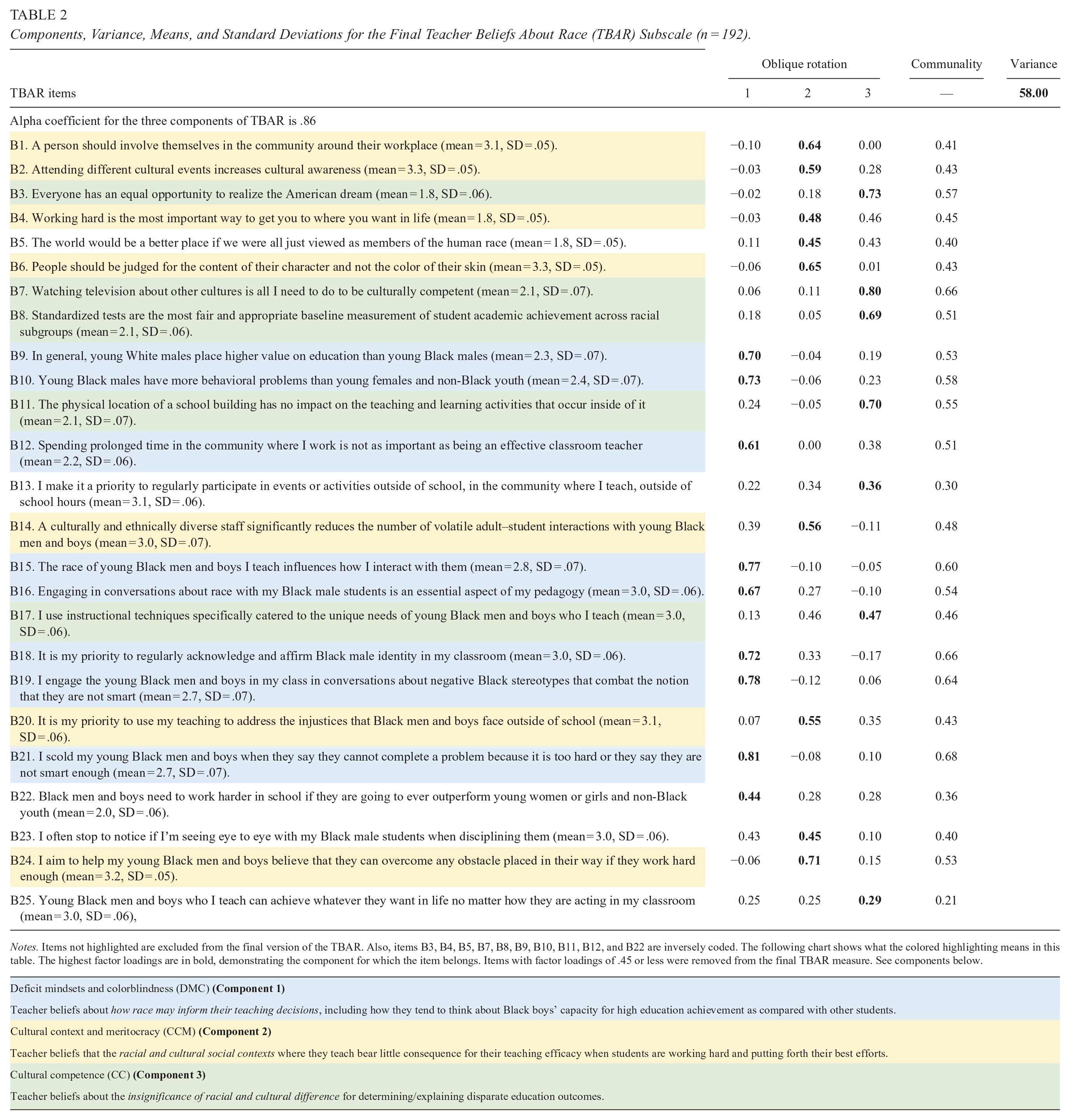

Component 1 (i.e., DMC), has a Cronbach’s alpha of .88. Component 2 (i.e., CCM) has a Cronbach’s alpha of .76. Component 3 (i.e., CC) has a Cronbach’s alpha of .78. What we originally described as the five constructs of the TBAR are now three components of the final TBAR following the PCA.
The composite score of responses to the TBAR assesses a given teacher’s beliefs about race in the professional teaching context with Black boys. The higher the composite score on the TBAR, the more productive are a teacher’s beliefs about race, which, in turn, may contribute to them acting in ways that undo and/or resist the racialized harm characteristic of Black students’ education experience in the United States. The experience of Black folks’ dehumanization in school reflects the ongoing consequence of anti-Blackness. A higher score on the TBAR indicates the likelihood a teacher has the knowledge and understanding to counteract impairments to their capacity to adeptly exercise empathy when negotiating interactions with Black (boy) students. Table 3 reports the correlations between the items on the TBAR subscale.
Item Correlations of the Teacher Beliefs About Race (TBAR) Subscale of S-TEAAM 2.0.

Statistical significance at p < .05.
Although these items were originally written for one of the five constructs, the PCA revealed which items were more closely correlated with one another, leading us to a final version of the TBAR for use moving forward to be included on the revised and upgraded S-TEAAM introduced in this paper (see Appendix A). Tables 4–6 report the correlations between the items on each of the components that comprise the final version of the TBAR made of the highlighted items in Table 2.
Item Correlations of the Deficit Mindsets and Colorblindness (DMC) Component: Teacher Beliefs About Race (TBAR) Subscale of S-TEAAM 2.0.

Statistical significance at p < .05.
Item Correlations of the Cultural Context and Meritocracy (CCM) Component: Teacher Beliefs About Race (TBAR) Subscale of S-TEAAM 2.0.

Statistical significance at p < .05.
Item Correlations of the Cultural Competence (CC) Component: Teacher Beliefs About Race (TBAR) Subscale of S-TEAA2.0.

Statistical significance at p < .05.
Associations Among the Three S-TEAAM 2.0 Subscales
We hypothesized that the TCE and TAE subscales would be positively associated with the components of the TBAR subscale. Negative associations between these scales would suggest that our theory is flawed. Table 7 shows the relationship between teacher beliefs about race, respondents’ conceptions of empathy, and application to their professional teaching practice.
Associations Among Teacher Beliefs About Race (TBAR), Teacher Conceptions of Empathy (TCE), and Teacher Application of Empathy (TAE) Subscales.

Notes. Covariates include binary race indicators, years of teaching, indicator of whether the individual teaches more than 50% Black students, gender, and locale type. Please note that we lost two additional observations due to incomplete TCE and TAE scales in our naive estimates and an additional 13 observations because of missing data among the covariates. Robust standard errors are reported.
p < .001; **p < .01.
These results are consistent with our initial hypothesis. There is a positive relationship between the two original Warren (2015a) S-TEAAM subscales (e.g., TCE and TAE) and the newly created TBAR subscale, all of which were analyzed using an original dataset. Table 7 shows that each one-point change in an individual’s conceptions-of-empathy composite score was associated with a 0.64 increase in their TBAR composite score when we controlled for individual teacher characteristics. This increase was statistically significant at the .01 level. A one-point increase in an individual teacher’s application of empathy was associated with a 0.28 increase in their TBAR composite score with the inclusion of covariates, and this relationship was statistically significant at the .01 level.
Tables 8–10 show the associations among the three components of the TBAR subscale (i.e., DMC, CCM, and CC) and the TCE and TAE subscales. When exploring the associations among the three components, we found that two of the components had no statistically significant associations with either the TCE or the TAE. The CCM component, however, was positively associated with both the TCE and TAE subscales. Table 9 shows that with the inclusion of covariates, each one-point increase in a participant’s conception of empathy was associated with a 0.34 increase in their understanding of cultural context and meritocracy. Similarly, a one-point increase in a participant’s application of empathy (i.e., TAE) was associated with a 0.68 increase in their understanding of cultural contexts and meritocracy. These relationships were significant at the .001 level. They suggested that the TBAR’s associations with the TCE and TAE subscales may be largely informed by teachers’ beliefs about cultural context and meritocracy. That is, a teacher’s belief about the conditions of Black life local to the place of their teaching and the students they were teaching may impact their understanding of the long-term consequences of anti-Blackness to influence Black educational outcomes. Such understanding also may implicate and facilitate improvements in their cultural competence and development of more asset-oriented mindsets and the capacity to see race in their professional work. Finally, it is worth noting again that scores on S-TEAAM 2.0 were primarily for research purposes, generative to broader discussions of race, empathy, and the education of Black (boy) students. The tool also may be used by practitioners to ground meaningful conversations about race and how to establish the conditions for learning akin to more humanizing social engagements with Black youth.
Associations Among Deficit Mindsets and Colorblindness (DMC), Teacher Conceptions of Empathy (TCE), and Teacher Application of Empathy (TAE) Subscales.
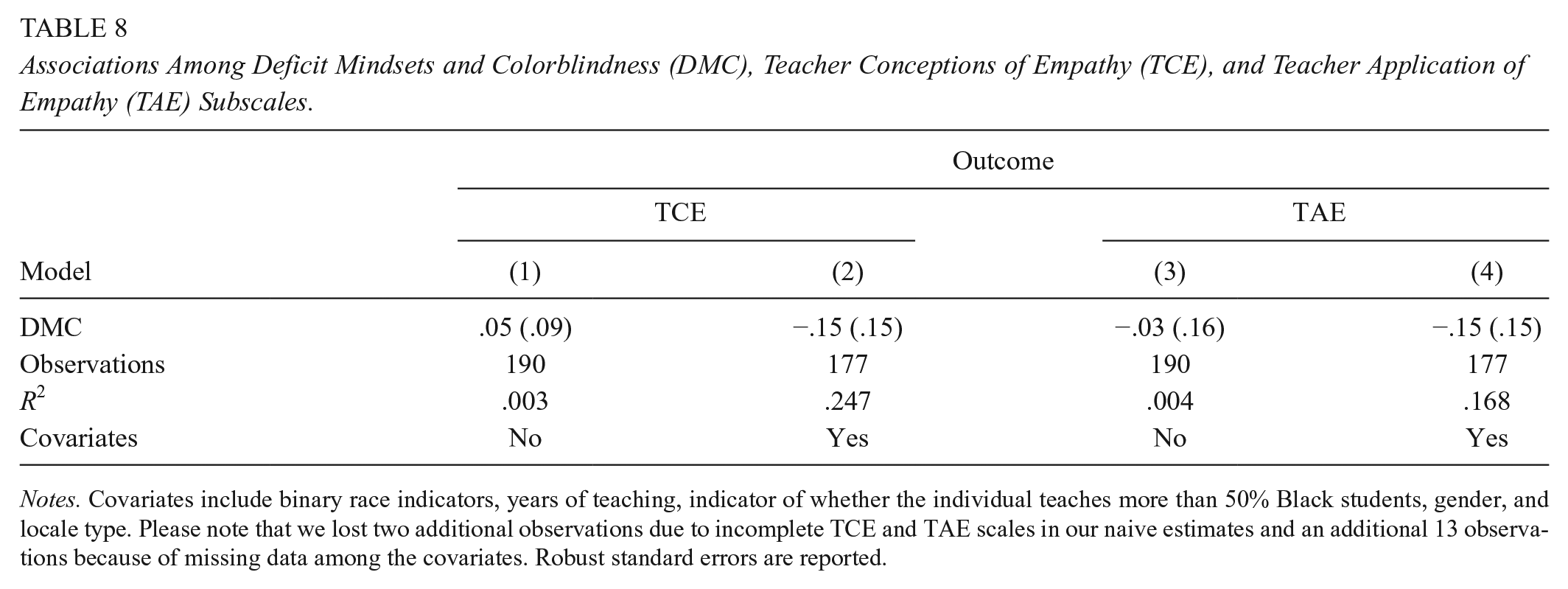
Notes. Covariates include binary race indicators, years of teaching, indicator of whether the individual teaches more than 50% Black students, gender, and locale type. Please note that we lost two additional observations due to incomplete TCE and TAE scales in our naive estimates and an additional 13 observations because of missing data among the covariates. Robust standard errors are reported.
Associations Among Cultural Context and Meritocracy (CCM), Teacher Conceptions of Empathy (TCE), and Teacher Application of Empathy (TAE) Subscales.
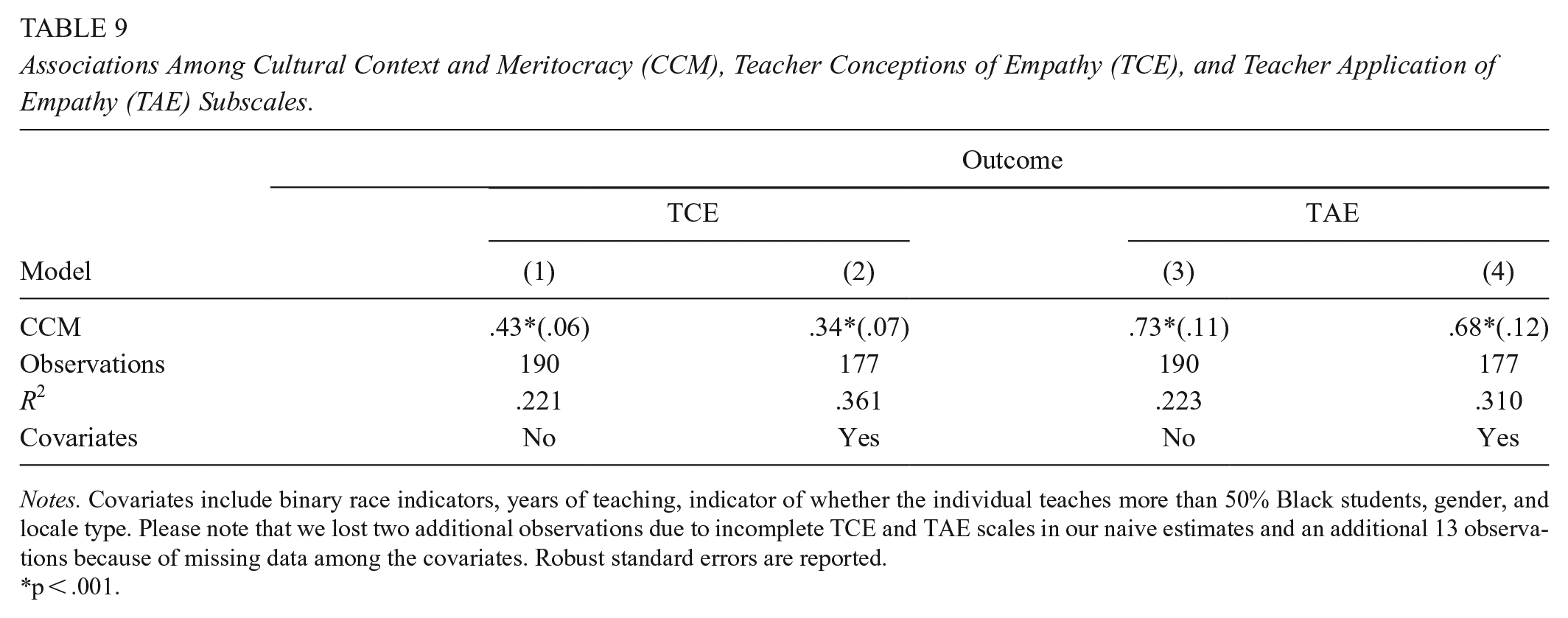
Notes. Covariates include binary race indicators, years of teaching, indicator of whether the individual teaches more than 50% Black students, gender, and locale type. Please note that we lost two additional observations due to incomplete TCE and TAE scales in our naive estimates and an additional 13 observations because of missing data among the covariates. Robust standard errors are reported.
p < .001.
Associations Among Cultural Competence (CC), Teacher Conceptions of Empathy (TCE), and Teacher Application of Empathy (TAE) Subscales.

Notes. Covariates include binary race indicators, years of teaching, indicator of whether the individual teaches more than 50% Black students, gender, and locale type. Please note that we lost two additional observations due to incomplete TCE and TAE scales in our naive estimates and an additional 13 observations because of missing data among the covariates. Robust standard errors are reported.
In addition to exploring how the S-TEAAM 2.0 subscales correlated with one another, we also observed the associations between the demographic characteristics in our sample and their composite scores on each of the three S-TEAAM 2.0 subscales. Table 11 reports these associations.
Associations Among Teacher Characteristics and the Teacher Beliefs About Race (TBAR), Teacher Conceptions of Empathy (TCE), and Teacher Application of Empathy (TAE).

Notes. The models do not include covariates. Each column reports the estimates from two different linear regression models. The table reports the estimates from 33 models overall. Black teachers, teachers who live in cities, and male teachers are the reference groups.
p < .05; **p < .01; ***p < .001.
Teachers identifying as Latino/a were associated with higher conceptions of empathy in comparison with Black teachers in the respondent pool. Asian teachers were associated with significantly lower applications of empathy compared with Black teachers in the sample. Teachers who identified with multiple racial groups were associated with higher conceptions of empathy when compared with Black teachers in the sample, but they represented <3% of the sample. It is interesting to find that teachers who reported having 50% or more Black students scored notably higher on the TBAR, TCE, and TAE. Similarly, female teachers scored higher than male teachers on two of the three subscales of S-TEAAM 2.0. Interestingly, nonbinary teachers scored lower than teachers who identified as male on the TBAR scale but higher than male teachers on the TCE. Roughly 5% of the sample identified as nonbinary.
Discussion
Beyond reinforcing the validity of Warren’s (2015a) S-TEAAM with the new sample of data collected for S-TEAAM 2.0, our results yielded evidence that the final TBAR measure (see Table 2) introduced in this paper demonstrates strong validity with several fascinating correlations with the TCE and TAE. These results answered our first research question about TBAR’s internal validity in the affirmative. To answer our second research question, we found that teachers’ beliefs about race do positively correlate with their conceptions of empathy and its application in their classroom teaching with Black boys. Finally, we observed compelling associations between demographic characteristics in our pool of respondents and composite scores on each of the three S-TEAAM 2.0 subscales (i.e., TCE, TAE, and TBAR).
Much of the discussion in this section will center on our interpretation of a few intriguing associations reported in Table 11. These associations were documented in response to our third research question about the extent to which teacher beliefs about race and empathy vary across individual teacher characteristics. In only a few instances was a teacher’s racial identity significantly associated with their beliefs about race, conceptions of empathy, and application of empathy. Overall, the concentration of Black students a teacher taught and their gender were associated with far more significant differences in their beliefs about race and their orientations toward empathy when teaching Black boys.
Teaching ≥50% Black Students
Our results suggested that if a teacher respondent taught ≥50% Black students, they were likely to score higher on all three subscales of S-TEAAM 2.0. There are several inferences one might make when interpreting the significance of these findings. We offer a few reflections here. It is possible that by teaching a larger concentration of Black students, one is better positioned to acquire, and then employ, more culturally competent/sustaining/responsive frames of reference consistent with the social perspectives of the Black students they are teaching. Like the findings from McAllister & Irvine’s (2002) study of the effects of a cultural immersion experience on educators’ multicultural beliefs and empathy, teachers in Warren, Presberry and Louis (2022), as well as Warren’s (2014) study demonstrated compelling evidence of empathy with the Black boys they taught, in part, because of knowledge acquired in and through deep immersion in/engagement with predominantly Black communities.
There is a decades-long body of scholarship on asset pedagogies (e.g., funds of knowledge, culturally relevant, culturally responsive, and culturally sustaining pedagogy) advocating that teachers embed themselves in communities of diverse youth and families (Gay, 2022; González et al., 2006; Ladson-Billings, 2021; Paris & Alim, 2017; Ramos & Kiyama, 2021). Funds-of-knowledge scholars, for example, argued that spending prolonged time in community spaces from which students emerge supports development of culturally aligned understandings of the world that greatly improve how teachers relate to culturally diverse students. Such understandings sharpen an educator’s cultural sensitivities, which, in turn, translate into overall higher-quality social interactions with youth and families. It is possible that our respondents’ higher scores on the TBAR, TCE, and TAE are attributable to profound personal and/or professional engagements with Black communities and enhanced sensitivities to the needs of Black children and families; each of which facilitates more productive beliefs about race. Such an interpretation is not farfetched considering the concentration of Black teacher respondents in this study.
In the case of Black teachers in particular, scholars found that there is a long tradition of Black teachers who reflect the values, interests, and cultural pride of Black caregivers when teaching Black children (Acosta et al., 2018; Foster, 1997; Gist, 2018; Siddle-Walker, 2018). The continuity between home and school facilitated Black students’ academic achievement and Black educators’ teaching efficacy. Their increased capacity to provide students with humanizing learning experiences despite, in some cases, deplorable material learning conditions is boon to their teaching effectiveness (Givens, 2021). It is also possible that individuals who teach predominantly Black students are drawn to those teaching posts because of a preexisting affinity for Black children. If this is the case, their higher scores on the TBAR, TCE, and TAE in the context of teaching Black boys could be due to prior immutable personal, professional, and/or political commitments. Simply being a Black teacher, however, did not correlate with higher scores on the three S-TEAAM 2.0 measures. Therefore, earnest commitments to the well-being of Black students alone does not evidence one’s readiness to express empathy with fidelity and to do so with advanced knowledge of race and anti-Blackness as guidance.
Black Teachers
We expected that Black teachers would score higher on the three subscales of S-TEAAM 2.0, especially the TBAR. Black teacher respondents were not associated with higher scores on the TBAR (e.g., more culturally competent, less likely to maintain and teach from deficit-based perspectives of Black life, or less likely to exhibit colorblindness than a non-Black respondents). Black teachers also were not found to apply empathy to a greater degree than non-Black teachers. Although empathy is understood in this project to be an intuitive capacity belonging to all human beings (Decety & Lamm, 2006), applying it in the professional teaching context is a skill that needs to be developed and sharpened over time (B. Cooper, 2010; Eisman & Patterson, 2024; Feshbach & Feshbach, 2009; McAllister & Irvine, 2002; Meyers et al., 2019). Similarly, this study’s results indicated that all teachers, regardless of race, need practice thinking and talking about race, especially when it comes to noticing the many ways anti-Blackness impacts our everyday lives.
Anti-Blackness permeates every aspect of our social world. Going back to Sharpe’s (2016) phenomenological argument of anti-Blackness as total climate, no persons—Black or otherwise—can escape the anti-Black sentiments swirling about. Put differently, none of us are immune to having internalized conceptions of Blackness that reinforce its association with deficit, death, and inferiority. Results from our study substantiated the importance that all teachers be invited to probe their racial beliefs if for no other reason than to discern how their thinking might lead them to enact harm or be complicit with school policies that sustain Black children’s pain and suffering. Elevating one’s recognition of race comes through forms of perspective taking that include, for example, professional dialogues about race and racism, about history, and about slavery. Teacher education is a space primed for such dialogues (Eisman & Patterson, 2024; Warren, 2018). Honest discussions about hard topics like race make room for candid reflections about how one’s race-gendered self, beliefs, and worldviews determine their professional decision making with Black youth.
The growing literature on diversifying the teacher workforce (Bristol, 2020; Gist & Bristol, 2022; Woodson & Bristol, 2020) furthermore suggests that race–gender match may improve Black boys’ experience of school by potentially alleviating the racialized assault that is commonplace in American schooling. Recent scholarship insists that encountering more Black teachers can indeed have a positive impact on Black children’s academic, social, and emotional well-being (Dee, 2005; Egalite & Kisida, 2018; Grissom, 2017; Redding, 2019). Still, simply having greater volumes of Black teachers alone is inadequate, in the same ways that insisting that teachers simply express empathy and build relationships does not singularly reverse stubborn trends in Black boys’ academic underachievement. We encourage further exploration of this association in future research with a larger respondent pool.
Women Teachers
Finally, teachers who identify as women are more likely to score higher across all three S-TEAAM 2.0 subscales. Research has found that students tend to view women teachers as more soft and permissive than men teachers (Brophy, 1985) in ways that do too little to disrupt racist and sexist power regimes in schools (Nyachae, 2016). In fact, Black boys in Warren’s (2020) study described profound surprise that their Black men teachers had emotions, that they cried, and that they cared about them as deeply as they did (pp. 377–378). Prior to high school, these boys declared that they’d had mostly female teachers who acted as “other mothers” (Mawhinney, 2011) to them. Such perceptions reflect hegemonic gender roles that suggest that males must be relentlessly tough and emotionless, whereas females must carry the disproportionate burden of nurturing young people. It is important to note that the associations reported in this paper should not be interpreted causally. However, the relationships between conceptions of empathy, applications of empathy, and beliefs about race may highlight areas in need of further study.
In the same ways that anti-Blackness infiltrates our racial logics, effectively undermining one’s ability to reasonably comprehend blackness as full of humanity (Jung & Vargas, 2021; Wilderson, 2010), no person—woman or otherwise—is immune to having internalized patriarchal logics or worldviews (Connell, 2009). Sometimes these logics manifest in how women may perceive themselves as more emotionally responsible for children than their men teacher colleagues. Even more confounding is the fact that there was double the number of male respondents to S-TEAAM 2.0 than female respondents. We are not entirely sure why more men completed the survey than did their women or gender nonbinary counterparts. It is possible that the survey was circulated among a faculty of one or two single-sex schools, for example, with predominantly men teachers, considering the first author’s professional networks who received access to the survey.
Regardless, our conjecturing about the reasons for gender differences in the study’s results speak to the broader global power of patriarchy and heterosexism. Decades of gender research affirm the stronghold hegemonic norms of gender and sexuality have on conceptions of masculinity and femininity, which, in turn, implicates expectations for differences in male and female relational interactions with youth—professional teaching context or not (Connell, 2009; Lindsey, 2020). Dominant gender logics are not undone when specifically querying about race. If anything, race further mediates how gender is understood and expressed (Crenshaw, 2017). And while empathy is both affective and emotional, the emotional aspect of its application is too rarely considered in empirical explorations of its relevance in education.
Limitations and Future Research
Although the estimates described in our results are not causal, they set the stage for more research on the associations among teacher empathy, teacher beliefs about race, and the subsequent impacts on one’s teaching dispositions. Our participant pool also was not representative of the general (teaching) population. Most teachers within the United States are White women (Schaeffer, 2021), so it’s important to note that because our sample was entirely educators of color and disproportionately male, this paper’s findings should not be generalized to the broader teaching force. Our findings, however, do invite meaningful discussion and thought-provoking questions that should guide future scholarship. Although the sample does limit the scope of generalizability, its merits are several, chief among them being the chance to learn from teachers of color in a measure designed to examine their orientations to teaching with Black children wherein Black teachers are the reference group. We count this happening as a serendipitous gift to the study of teacher empathy and Black education that indeed invites further investigation. Our future work does include additional uses of the TBAR with a greater sample of White, female, and multiracial educators. This will broaden the scope of our understanding, and its findings will bolster S-TEAAM 2.0’s generalizability. Such work also will help us to discern similarities and differences in outcomes across respondent subgroups.
Likewise, the results of this study provide robust data from which to continue theorizing the significance of empathy and teacher beliefs in an anti-Black social world. The racially diverse respondent pool had lived experiences navigating anti-Blackness that are specific yet distinct from Black people. These are lived experiences for which White people are not privy. As a Black research team, we are led to believe that our respondents’ experiential knowledge cannot be separated out of, or isolated from, the logics they used to complete S-TEAAM 2.0, in the same ways that our own experiential knowledge is not insulated from rigorous interpretation of study results.
Although the PCA provided an important and meaningful exploration of the TBAR’s factor structure, we also recognize that conducting a confirmatory factor analysis would provide additional clarity on the TBAR’s construct validity. We were not able to conduct a confirmatory factor analysis in this study because of sample size limitations, but we look forward to expanding the TBAR’s validity through future research with additional, more representative samples. We also recognize that examining the external validity of the TBAR through an exploration of its associations with internal subscales that are not widely used is less than ideal. In this future work, we also plan to strengthen the external validity of the TBAR by validating it against other established empathy and racial attitude scales that are in more common use.
Finally, future research also might attempt both mixed-methods investigations of the specific relationship between teachers’ effectiveness with Black boys, their beliefs about race, and conceptions and application of empathy. This investigation should include White participants, considering, for instance, that White women do make up much of the U.S. teacher workforce (Schaeffer, 2021). Warren (2013, 2014, 2015b) began studying teacher empathy qualitatively, which aided in development of the original S-TEAAM (Warren, 2015a). This work, however, did not consider at all how or to what degree White teacher’s racial identity, racial literacy, or racial bias, for example, informed their conception of empathy or the decisions they were making when negotiating interactions with the Black boys they taught. His work did, to a small degree, consider students’ perceptions of teachers, which leads to the last recommendation for future research. That is, future qualitative and quantitative studies of empathy in education should systematically probe Black students’ perceptions of teacher/educator empathy. Such studies would be beneficial for theorizing the utility of empathy in one’s contemporary teaching practice with Black children. This work should be done parallel to research conducted to explore teachers’ own perceptions of empathy’s expression in the professional teaching context.
Conclusion
Educators are better equipped to negotiate high quality social interactions with Black children when they are regularly invited to notice themselves in the context of an anti-Black society engineered to buttress White supremacist hierarchies of power (e.g., ableism, heterosexism, classism, etc.). By learning to see the ideological, political, and structural impediments to opportunity Black folks have long encountered, teachers are better prepared to cultivate versions of empathy that yield culturally responsive/sustaining pedagogic outcomes. Such learning is as important for Black educators and other educators of color as it is for White educators, albeit the process and developmental trajectory for non-Black teachers will look distinctly different than it does for Black teachers.
This study’s results help to establish the relationship between teachers’ beliefs about race with Black boys, conceptions of empathy, and their relevance to the everyday hard work of teaching. Black children are too often subjected to schooling environments mired in anti-Black racial violence. The application of empathy can reasonably interrupt Black students’ experience of school as painful but not without their teacher’s visceral awareness of the ways anti-Black racial logics structure social relations between themselves, Black children, and Black communities. The components of the TBAR demonstrate utility for helping educators notice how their beliefs about race inform their thinking and teaching practice, thereby rendering S-TEAAM 2.0 a worthwhile tool for advancing critical discussions of race in education research, teaching, and teacher education.
Footnotes
Appendix A
Acknowledgements
The authors thank DeLeon Gray and David Cole for helpful feedback on this manuscript.
Declaration of Conflicting Interests
The authors declare no potential conflicts of interest with respect to the research, authorship, and/or publication of this article.
Funding
The authors disclosed receipt of generous funding from the Spencer Foundation.
Open ICPSR Citation

Authors
CHEZARE A. WARREN is an associate professor of equity and inclusion in education policy at Vanderbilt University. His research examines the conditions, nature, and quality of educator–student social interactions necessary to humanize Black children’s experience of school.
CARLA P. WELLBORN-WATTS is a doctoral candidate in the Department of Leadership, Policy, and Organizations at Vanderbilt University. Her research examines the logics of Black families’ schooling decisions and, more specifically, the role of Black homeschooling to reduce and refuse Black children’s racial harm.
TIM J. HERD is a doctoral candidate and Wasserman Fellow in Higher Education and Organizational Change at the University of California, Los Angeles. His research examines university governing boards, student success, and affirmative action.