




Abstract
Elementary teachers often feel underprepared to teach integrated STEM (iSTEM) and describe their preservice teacher preparation as ineffective. The purpose of this study is to investigate the extent to which semester-long STEM methods courses influenced elementary preservice teachers’ (PSTs) iSTEM teaching self-efficacy and identify how the sources of self-efficacy influenced their beliefs and confidence in teaching iSTEM. Participants included 131 PSTs at a large midwestern research-intensive public university in the United States. Quantitative data sources included the Self-Efficacy for Teaching Integrated STEM instrument administered as a pre-and post-test. The qualitative data collection included two semi-structured interviews with 10 selected participants. Findings suggest that PSTs experienced growth in iSTEM teaching self-efficacy through their STEM methods coursework. Sources that emerged as contributors toward enhanced confidence to teach iSTEM were enactive mastery, emotional arousal, vicarious experiences, and verbal persuasions. The implications for preservice teacher preparation programs and future research on iSTEM teaching self-efficacy are discussed.
Keywords
While STEM disciplines have traditionally been taught as distinct subject areas in formal educational settings, K–12 standards are rapidly shifting toward integrated STEM (iSTEM), which seeks to merge the STEM disciplines to prepare students for careers that require interdisciplinary knowledge (National Academy of Engineering & National Research Council [NAE & NRC], 2014). This shift and the relatively recent inclusion of engineering in K–12 education standards (e.g., NGSS Lead States, 2013) pose new demands in already challenging elementary teaching contexts. Elementary teachers are often uncomfortable teaching science, mathematics, and engineering as independent subjects (Buss, 2010; Hammack & Ivey, 2017), and STEM integration poses new challenges. Of considerable concern is that a significant number of elementary teachers describe their preservice teacher (PST) preparation as ineffective, especially in interdisciplinary content knowledge, leaving them unprepared to teach using an iSTEM approach (Banilower et al., 2018; NAE & NRC, 2014; Trygstad et al., 2013). Despite calls for increasing iSTEM instruction, there are limited professional development (PD) opportunities for inservice teachers to engage in learning about iSTEM instruction (Luft et al., 2020), and PST preparation programs have also been slow to adapt to the demands of iSTEM (Bartels et al., 2019; Madden et al., 2016).
Self-efficacy, which refers to one’s perceived ability to plan and act in order to achieve a goal (Bandura, 1986), is a critical component of teachers’ sense of competence and confidence in iSTEM instruction (T. M. Johnson et al., 2021). It is well documented that elementary teachers do not possess a strong sense of science, mathematics, or engineering teaching self-efficacy (e.g., Darling-Hammond et al., 2002; Gunning & Moore Mensah, 2011; Hammack & Ivey, 2017; Knaggs & Sondergeld, 2015; Webb & LoFaro, 2020). Low self-efficacy levels among PSTs may relate to ongoing challenges, as beliefs of elementary PSTs during their teacher preparation years are often carried into their future classrooms (Enochs & Riggs, 1990; Ramey-Gassert & Schroyer, 1992; Ramey-Gassert et al., 1996). These beliefs act as filters that influence how teachers interpret new knowledge of teaching, as well as their motivation and efforts to bring desired changes to their existing practices (Zeldin et al., 2008). Research evidence suggests links between science and mathematics teaching self-efficacy, teacher effectiveness, (e.g., Bray-Clark & Bates, 2003; Muijs & Reynolds, 2002; Sehgal et al., 2017), and commitment to the teaching profession (e.g., Coladarci, 1992).
Self-efficacy is also related to teachers’ job satisfaction (Klassen & Chiu, 2011), willingness to stay in the teaching profession (Kasalak & Dagyar, 2020), and teacher retention (Krieg, 2006). Therefore, it may be beneficial to nurture elementary PSTs’ iSTEM teaching self-efficacy levels during their teacher preparation programs to improve the quality of elementary iSTEM instruction (Menon, Shorman, et al., 2023a). Additionally, higher levels of iSTEM teaching self-efficacy could positively influence PSTs’ desire to teach iSTEM in the future, which can have a profound impact on increasing K–12 student interest, motivation, and intentions of pursuing a STEM career (Blotnicky et al., 2018). Research investigating self-efficacy within traditional elementary science and mathematics methods courses (based on a single discipline rather than merging STEM disciplines) has been quite prolific within the past several decades (e.g., Bates et al., 2011; Menon, 2020; Menon & Sadler, 2016, 2018). However, iSTEM teaching self-efficacy remains under-researched, so little is known about supporting PSTs’ self-efficacy development within iSTEM contexts. This study is purposefully designed to contribute to the field’s knowledge base on supporting iSTEM instruction within teacher preparation programs that aim to prepare effective and confident elementary teachers. The purpose of this study is twofold: (1) to add to the field’s understanding of how PSTs’ iSTEM teaching self-efficacy is shaped, and (2) to explore how and in what ways the range of experiences and interactions within iSTEM contexts contribute to developing iSTEM teaching self-efficacy.
Theoretical Underpinnings and Background Literature
The Construct of Self-Efficacy
The construct of self-efficacy has long been recognized as influential in the field of teacher education (Bandura, 1986; Nespor, 1987; Pajares, 1992). Bandura’s (1981) conceptualization of self-efficacy positioned the construct as a judgment about one’s abilities to “organize and execute courses of action” (p. 587) to achieve a desired goal. Self-efficacy comprises two dimensions: personal efficacy and outcome expectancy (Bandura, 1977). Researchers have posited that the dimensions are related but can act independently. Applied to teacher education, personal teaching efficacy refers to an individual’s belief in their ability to teach the subject effectively and support student learning (Bandura, 1993). Outcome expectancy is related to task outcomes, or estimating whether teacher actions will lead to desired student outcomes (Deehan, 2017). Self-efficacy has been linked to one’s behavior and interests, and the self-efficacy beliefs someone holds can promote effort and perseverance when dealing with taxing situations (Bandura, 1982).
Teacher self-efficacy is a dynamic construct and suggests that beliefs can change with new experiences; in turn, these beliefs can influence motivation, behavior, and actions (Gist & Mitchell, 1992). Specifically, as articulated by social cognitive theory, actions are influenced by cognition as well as an individual’s self-reflection that allows them to alter their own thinking and behavior (Bandura & Wood, 1989; Plourde, 2002) and can promote effort and commitment to try new teaching strategies (Enochs & Riggs, 1990). Bandura (1981) further articulated that self-efficacy is situational and subject matter–specific. Because PSTs may hold negative views about STEM when they enter teacher preparation programs (Menon, Bauer, et al., 2023b), failure to develop iSTEM teaching self-efficacy during teacher preparation coursework may relate to weaker intentions to teach iSTEM in the future. Therefore, in iSTEM contexts, supporting PSTs’ self-efficacy beliefs about iSTEM is particularly important, as they can influence PSTs’ behaviors, such as task persistence, risk-taking, and innovation (Plourde, 2002). We posit that positive iSTEM teaching self-efficacy is central to effective STEM teaching.
Sources of Self-Efficacy
Bandura (1997) proposed four sources of self-efficacy that influence teachers’ personal and outcome efficacy: mastery experiences, vicarious experiences, verbal persuasion, and emotional arousal. Mastery experiences involve first-hand engagement with the task and are considered an important contributor to one’s feeling of success in carrying out that task. Within teacher education, mastery experiences involve teaching in an actual classroom or student practicum (Gunning & Moore Mensah, 2011; McDonnough & Matkins, 2010; Palmer, 2006). Other mastery experiences could include working in collaborative groups to develop lesson plans, engaging in group discussions, and writing teaching reflections (Brand & Wilkins, 2007; Rice & Roychoudhury, 2003). Vicarious experiences are viewed as observing others performing a task successfully, which enhances self-confidence to perform similarly in a given situation (Bandura, 1997). In teacher education, watching experts’ videos, classroom mentor teachers teaching, and methods course instructors modeling evidence-based pedagogy are vicarious experiences that allow preservice teachers to observe others thriving in similar situations, potentially promoting confidence in their own teaching (Bautista, 2011; Gunning & Moore Mensah, 2011).
The third source, verbal persuasion, refers to positive feedback on teaching-related tasks that can enhance PSTs’ motivation and confidence for future teaching. Several individuals may provide feedback to PSTs, including methods course instructors, classroom mentor teachers, supervisors, peers, colleagues, students, and family members, which may influence PSTs’ performance skills and encourage success, leading PSTs to make greater efforts to perform the tasks. The fourth source of self-efficacy, emotional arousal, refers to one’s physiological and affective states due to feelings of stress or tension arising from a particular situation. Emotional states may determine PSTs’ abilities to handle stress and persevere through the unanticipated challenges they may encounter in classrooms (Bautista, 2011; Gunning & Moore Mensah, 2011). Palmer (2006) proposed three additional sources of self-efficacy specific to teaching. First, enactive mastery experiences are those involving the actual act of classroom teaching. Second, cognitive mastery experiences involve success in understanding pedagogical techniques for science teaching (cognitive pedagogical mastery) or science content (cognitive content mastery). Finally, simulated modeling or role-played teaching in an elementary class may serve as another source of self-efficacy (Palmer, 2006).
STEM Integration
STEM disciplines are often taught as distinct subject areas in formal schooling, but modern careers in STEM fields frequently require a blending of content knowledge from different disciplines (NAE & NRC, 2014). STEM integration seeks to merge the disciplines and is promoted to increase the number of students who are interested in and prepared to pursue STEM careers (NAE & NRC, 2014; Stohlmann et al., 2012). For example, Guzey et al. (2016) found that students who were taught using an engineering design-based science curriculum showed improved attitudes toward STEM careers following iSTEM instruction. Teachers also report that students have increased interest and confidence in science and mathematics through iSTEM instruction (Wang et al., 2011).
A variety of approaches to STEM education have been suggested, ranging from STEM disciplines as completely separate and disconnected to full integration of all four disciplines (Bybee, 2013). Some researchers advocate for integration across all four STEM disciplines (e.g., Burrows et al., 2018; Chandan et al., 2019), while others focus on natural integration opportunities, considering any instruction of two or more STEM disciplines to be integrated (e.g., Kelley & Knowles, 2016; Moore et al., 2020). The most common classroom approaches to iSTEM instruction generally take one of three forms: context integration, supporting content integration, and content integration (Bryan et al., 2016). Context integration involves contextualizing learning objectives from one discipline in a context from another discipline, often through a story. In supporting content integration, the primary learning objectives from one discipline are supported by meaningful work in another discipline. In content integration, a single unit or lesson includes learning objectives from multiple STEM disciplines; this form of integration is the most fully integrated. The wide range of approaches to iSTEM education presents PSTs with little clarity about how best to incorporate iSTEM instruction in their classrooms.
STEM Teaching Self-Efficacy
Research on teaching self-efficacy among elementary teachers has largely focused on experiences within single-discipline methods courses, such as science or mathematics methods courses. Within PST programs, empirical studies have consistently shown that experiences in elementary science or mathematics methods courses support an increase in self-efficacy beliefs in these individual disciplines (Bates et al., 2011; Bautista, 2011; Gunning & Moore Mensah, 2011; Menon, 2020). Approaches used in these courses include modeling reform-based approaches like inquiry (Bybee, 1997; Rice & Roychoudhury, 2003; Seung et al., 2019), engaging PSTs in practice-based science (Menon, 2020; Menon, Bauer, et al., 2023b), lesson planning (Cantrell, 2003; Palmer, 2006), critically reflecting on teaching practices (Brand & Wilkins, 2007; Menon & Azam, 2021a; Mulholland & Wallace, 2001), and providing content-focused coursework (Avery & Meyer, 2012; Menon & Sadler, 2016, 2018). Other studies on self-efficacy among PSTs have explored the significance of field experiences and student teaching for developing positive self-efficacy for science or mathematics teaching, yielding mixed results. Some studies have suggested increased elementary PSTs’ self-efficacy after their practicum experiences (McDonnough & Matkins, 2010; Sherman & MacDonald, 2007; Watters & Ginns, 2000). In contrast, others report that field experiences pose challenges to PSTs that may be detrimental to self-efficacy beliefs (Hancock & Gallard, 2004).
There remains a paucity of research on supporting teachers’ iSTEM and engineering teaching self-efficacy in PST preparation programs (Menon et al., 2024), but recent studies (e.g., Fogg-Rogers et al., 2017; Kaya et al., 2019; Rinke et al., 2016; Webb & LoFaro, 2020) suggest preservice iSTEM or engineering experiences can support increases in elementary teachers’ self-efficacy. Several studies found increased self-efficacy beliefs when methods courses emphasized STEM integration (T. M. Johnson et al., 2021; Rinke et al., 2016; Thomson et al., 2017). These studies suggest that although modeling iSTEM instruction and providing opportunities to create STEM lessons positively impacted self-efficacy, lack of prior science or mathematics knowledge interfered with feelings of preparedness to teach STEM. In a study conducted by Menon, Shorman, et al. (2023a), PSTs’ iSTEM teaching self-efficacy and perceptions of teaching STEM changed after the STEM-focused experiences within a semester. Nevertheless, these studies do not provide enough information about the underlying factors that support or hinder iSTEM teaching self-efficacy. Also, much remains unclear about developing and sustaining self-efficacy for iSTEM instruction long-term. Several questions remain unanswered: What kinds of personal and contextual factors support iSTEM teaching self-efficacy, and how? How and under what conditions do various sources of self-efficacy inform iSTEM teaching self-efficacy? How is self-efficacy for iSTEM instruction sustained long-term?
Focus of This Research
Given that the literature base on iSTEM teaching self-efficacy is still minimal, the empirical findings concerning iSTEM teaching self-efficacy are inconsistent and often lack details on how the range of experiences within iSTEM contexts are contributing sources of self-efficacy; the present study seeks to better understand how self-efficacy is shaped within iSTEM contexts. We contend that more information regarding how and in what ways iSTEM teaching self-efficacy is shaped by various sources (mastery experiences, vicarious experiences, verbal persuasion, and affective and psychological states) will allow STEM educators to design experiences that support the development of iSTEM teaching self-efficacy. The following research questions guided this study:
How does preservice elementary teachers’ iSTEM teaching self-efficacy change during their participation in semester-long STEM methods courses?
What prior STEM experiences do elementary PSTs recall positively and negatively, and how do these experiences inform their beliefs and confidence about teaching?
What sources of self-efficacy within the STEM-focused semester influence PSTs’ beliefs and confidence about teaching?
Methods
Research Design
This mixed methods study utilized a triangulation convergent design (Creswell & Plano Clark, 2017) that included quantitative and qualitative methods of data collection, analysis, integration, and data convergence to generate results (see Figure 1). The mixed methods approach allows researchers to consider multiple viewpoints involving common elements from deductive (post-positivism) and inductive (constructivism) approaches to explore the phenomenon and construct knowledge (R. B. Johnson et al., 2007; Plano Clark et al., 2008). Building on the assumptions of the pragmatic approach, the research design allowed for a more in-depth understanding of the underlying phenomenon under investigation—namely iSTEM teaching self-efficacy. The quantitative analysis explored the changes in PSTs’ iSTEM teaching self-efficacy between two time points (the beginning and the end of the semester), and the qualitative analysis provided an understanding of why and how these changes occurred within the iSTEM contexts. Findings from the two datasets were merged for triangulation to understand PSTs’ iSTEM teaching self-efficacy development.

Triangulation convergent design.
Participants
The participants in the study included 131 PSTs from a large Midwest research-intensive public university’s elementary teacher preparation program. All participants who volunteered to participate signed the university-approved informed consent forms electronically. Although a total of 165 survey responses were collected at its first administration and 140 at its second, only 131 respondents were included in the analyses. The remaining responses were excluded based on the following criteria: incomplete surveys at either of the two time points or multiple responses from the same individual (in which case, the complete response was retained; when both responses were equally complete, the first response was retained). Table 1 presents the demographic information of the 131 participants included in the analyses.
Demographics for N = 131 Total Participants in the Survey.

Race/Ethnicity percentages do not add up to 100% because some participants identify as multiracial.
Description of Interview Participants (n = 10)
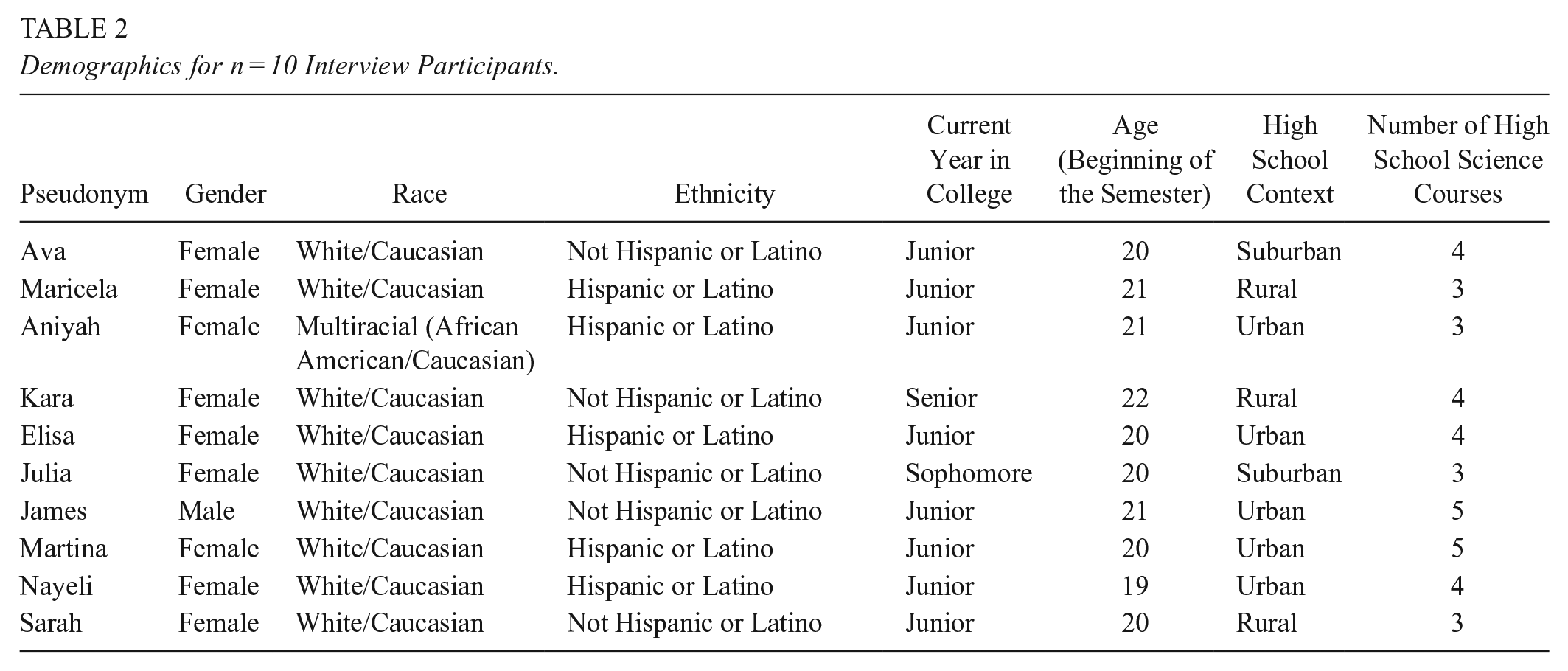
Ten participants who volunteered to participate in the interviews were enrolled in an elementary education program housed in the Midwest research-intensive public university. Table 2 provides demographic and background information for the ten interview participants. These participants had varied science backgrounds, including both in-school and out-of-school learning opportunities. For example, Martina described exploring the forest and going on scavenger hunts with her mother, which shaped her interest in science from an early age. Ava remembered observing blue-tailed skinks in front of her house with other children in her neighborhood. Elisa recalled participating in science fairs as an elementary student, which was pivotal in her decision to major in science during college, eventually developing an interest in becoming a science teacher. Nayeli previously participated in a summer camp equipped with 3D printers and virtual reality, which enhanced her understanding of hands-on STEM learning. Aniyah reported a distinct enthusiasm for geography and hiking, and she found her college experience deepened her passion for science. In addition to the required science coursework, Julia also took two elective engineering courses in high school and enjoyed these courses. James worked for a tree company that focused on factors that played a role in tree growth and worked on conservation efforts to maintain a healthy tree population. Sarah grew up playing with science kits with her nanny but became disinterested in science at the end of high school. Maricela completed her certification as a nurse assistant in her senior year of high school and entered college aspiring to be a midwife, but she later shifted to pursue dual certification in elementary and special education. Similarly, Kara entered college with the intent of becoming a dentist, but her experience with college-level chemistry was not what she expected, so she decided to pursue a degree in education. Participants’ diverse backgrounds and experiences in science allowed us to better understand the range of experiences that informed their initial perceptions of science or STEM teaching and learning.
Demographics for n = 10 Interview Participants.
Research Context
The interview participants belonged to the elementary education program at the large Midwest public university that utilized a recently redesigned STEM semester. Within the STEM semester, participants enroll in three methods courses that run parallel: science and engineering methods, mathematics methods, and innovative learning technologies (ILT) methods. The ILT course is a two-credit course, and the other two methods courses are three-credit courses; each course runs 15–16 weeks a semester. Typically, there are three cohorts per semester, and each cohort enrolls 20–24 PSTs.
The design features of the STEM semester were based on existing models of STEM integration (e.g., Kelley & Knowles, 2016) that emphasize scientific inquiry and engineering design processes situated within a real-world context while integrating technology and mathematical tools to design solutions to solve a problem (Menon, Bauer, et al., 2023b). While the individual methods courses emphasized discipline-specific pedagogies, such as 5E lesson planning (Bybee, 2013) in mathematics and science, engineering design (Lottero-Perdue, 2017), mathematical modeling, robotics, and coding in the ILT course, there were shared assignments based on the same STEM topics across the courses. One of the cross-course themes, for instance, Sustainability, was purposefully designed to allow PSTs to experience cross-course connections and learn how different disciplines are integrated within a sustainability module. During the science and engineering methods course, PSTs conducted activities on the hydrological cycle in a 5E format. At the same time, the mathematics methods course focused on tasks related to water flow rates and interpreting floodplain maps with line graphs. During the technology course, PSTs used a makerspace to scale and 3D-print house models on the EnviroScape floodplain model. PSTs used engineering design processes to design and test the effectiveness of flood mitigation strategies to protect their houses. The methods courses also hosted expert guest speakers (e.g., a civil engineer), allowing PSTs to ask questions and discuss how their designs compare with the real world.
All PSTs worked on the previously described tasks collaboratively within teams; they then designed and team-taught an iSTEM lesson in a microteaching setting (teaching to their peers), as well as through field-based teaching in a local elementary classroom. Throughout their planning, PSTs received extensive feedback from all methods instructors to improve their lessons. Following implementation, PSTs discussed the successes and challenges associated with teaching with their mentor teachers and during debrief sessions in their methods courses.
Data Collection
Data were collected over one year in two semesters (fall 2022 and spring 2023) in two distinct phases: a quantitative phase and a qualitative phase (see Figure 1). Quantitative data sources included the Self-Efficacy for Teaching Integrated STEM (SETIS) instrument (Mobley, 2015) and additional items, including demographic questions. The qualitative data collection included two semistructured interviews with selected participants (n = 10). Following, we describe each of the data sources.
The Self-Efficacy for Teaching Integrated STEM (SETIS) Instrument
The SETIS survey (Mobley, 2015) was administered as a pre- and post-survey to investigate changes in PSTs’ iSTEM teaching self-efficacy over the course of the semester. The pre-survey was administered during the first week of class, and the post-survey was administered during the last week of the semester. Participants were given one week to complete each survey during the respective periods. The survey was made available to participants via a link to an online Qualtrics survey.
The SETIS survey consists of 19 items that are rated on a 4-point Likert scale, with higher scores representing higher self-efficacy: 1 as “cannot do at all”; 2 as “would have difficulty doing this”; 3 as “mostly confident that I can do this”; and 4 as “very confident that I can do this.” In this study, we report individual SETIS scores as the average of the 19 items using the Likert categories. The instrument’s reliability for this sample was calculated using Cronbach’s alpha for the pre- and post-survey data, representing the measurement’s internal consistency at the two time points. The Cronbach’s alpha values of 0.95 (pre-survey) and 0.96 (post-survey) represent strong reliability (Chandrasegaran et al., 2007). Participants also responded to demographic items at the same time as the SETIS pre-survey. The demographic information was collected once at the beginning of the semester.
Interviews
Interviews served as the primary source of qualitative data. We searched the existing literature on teacher self-efficacy to design two interview protocols, which consisted of questions with increasing complexity to understand participants’ perceptions of teaching iSTEM and the factors that influenced their perceptions during the STEM-focused semester. We conducted two semi-structured interviews with each selected participant (n = 10) during the semester. The first interview was conducted within two weeks of the start of the semester, and the second was conducted in the final two weeks of the semester. The first interview was designed to reveal participants’ experiences within K–12 and college science or STEM courses and their perceptions of science teaching originating from their prior experiences. This interview lasted approximately 30–45 minutes. The second interview was designed to gather information on the course-related factors that impacted participants’ iSTEM teaching self-efficacy. The prompts also targeted factors that supported or hindered participants when engaged in various STEM experiences within the course. This interview lasted for approximately 45–60 minutes. Both interviews were conducted individually via Zoom and were recorded and transcribed.
Data Analysis
Quantitative Analysis
The quantitative analyses were performed using the Statistical Package for Social Science (SPSS version 27). To assess the change in iSTEM teaching self-efficacy from the beginning to the end of the semester, we conducted a paired-sample t-test to compare the differences in the means of pre- and post-SETIS scores. We used Cohen’s d to examine the effect size—that is, the magnitude of the change.
Qualitative Analysis
Before the analysis, all interview transcript files were stored in a secured shared folder accessible only to the research team. At this stage, a unique identifier was given to each interview transcript file, and the de-identified files were used for the analysis. The interview data were analyzed in two distinct phases: (1) an inductive phase using thematic coding procedures (Nowell et al., 2017) and (2) a deductive phase using Bandura’s (1997) and Palmer’s (2006) sources of self-efficacy. The thematic analysis procedures provided flexibility to the research team to examine the perspectives of different study participants, identify similarities and differences, and generate patterns in the data (Braun & Clarke, 2006; Nowell et al., 2017). We utilized Nowell et al.’s (2017) step-by-step analytical approach to analyze the data and to establish trustworthiness (Lincoln & Guba, 1985). In the first step, the core research team, consisting of four qualitative researchers in science education, randomly selected one interview set (both pre-and post-interview from the same participant). Each researcher independently read and re-read the raw data (interview transcripts) multiple times to become familiar with the content of each interview. Then, the research team met to discuss their initial thoughts and interpretations of the events described by the participant. Throughout the discussion, we kept detailed notes on relevant facts, the questions we asked, and the decisions and choices agreed upon by the team. These notes further guided our coding process and served as the audit trail to support the trustworthiness of the study (Lincoln & Guba, 1985).
Second, each researcher independently coded the interview set and recorded their initial inductive codes on a shared spreadsheet. When analyzing the interviews, we looked for evidence in words or phrases that captured participants’ descriptions of prior or current course experiences and ways in which these experiences impacted views and perceptions about science or iSTEM teaching. The researchers then met to share and compare the initial codes for similarities and differences and discussed discrepancies until a consensus was reached. For example, one of the discrepancies between researchers was coding the same classroom context that the participant described in contradicting ways (positive and negative). After the discussion, we decided to code these events as both positive and negative experiences while making notes regarding the factors associated with each of these experiences.
Third, we developed a codebook that included detailed descriptions of each code and selected excerpts from the data as examples of that code in context. At this stage, we imported the codebook into MAXQDA 2022 (version 22.7) and used the software to sort, organize, and analyze the data. Each researcher independently revisited the same interview set and coded it using the codebook, then coded another interview set that was randomly selected (i.e., each researcher coded a total of four interviews, two pre- and two post-interview sets). The inter-coder agreement was calculated by the MAXQDA software using kappa (Brennan & Prediger, 1981); for the first round of analysis, the inter-coder agreement was 0.70 (based on the 10% of the data, i.e., two interviews coded out of 20 total interviews), and for the second round of analysis, the inter-coder agreement was 0.88 (based on 20% of the data). The first round of analysis (kappa value 0.70) indicated a low agreement, but the second round value (kappa value 0.88) indicated a strong agreement between researchers (Hallgren, 2012). Throughout the process, the codebook was revisited several times to condense codes and group them into categories and subcategories that led to emergent themes representing how PSTs’ prior and current course experiences impacted their iSTEM teaching self-efficacy and the associated factors leading to these changes. All remaining interviews were coded according to the final codebook (see Table 3).
Sample Codebook.

In the fourth step, the deductive phase, we utilized existing frameworks of sources of self-efficacy: Bandura’s (1997), which includes enactive mastery experiences, vicarious experiences, verbal persuasion, and physiological states/emotional arousal, and Palmer’s (2006), which includes cognitive content mastery and cognitive pedagogical mastery. This analytical framework was used to identify the presence of these sources in participants’ post-interview transcripts, particularly in their descriptions of the course-related factors that served as sources of self-efficacy. Beginning with one post-interview, the research team discussed indicators and codes (see Table 3) for each of the sources of self-efficacy that seemed to contribute to participants’ knowledge, confidence, or views about iSTEM teaching in the interview excerpts. Then each researcher coded 2–3 post-interviews (a total of 10 interviews) in MAXQDA. Using MAXQDA, we also determined the frequency of the occurrence of each source of self-efficacy within all the coded data, which provided a greater understanding of the distribution, relative importance, and contribution of various sources toward participants’ iSTEM teaching self-efficacy. Following these steps, we compiled the emergent findings and triangulated findings, including convergence and corroboration of the findings from the two data sets (quantitative and qualitative), and carried out subsequent writing.
Results
In this section, we first present the findings from the quantitative analysis of the SETIS survey on the changes in STEM teaching self-efficacy for all participants (research question 1). Then, we discuss the categories from the cross-case analysis of ten selected participants about their prior STEM experiences that influenced their teaching beliefs and confidence (research question 2). A discussion of factors from the STEM semester representing sources of self-efficacy that contributed to beliefs and confidence in teaching follows (research question 3). While describing categories, we provide interview excerpts from participants’ pre- and post-interviews, using pseudonyms for participants.
Integrated STEM Teaching Self-Efficacy Beliefs
We employed a paired-sample t-test to examine changes in self-efficacy from the beginning of the semester to the end of the semester (see Table 4). The results were statistically significant (t[130] = −9.01, p < .01), with the mean self-efficacy increasing from 2.88 to 3.36 (on a 4-point Likert scale). This change corresponds to an effect size (Cohen’s d) of 1.00; on average, participants’ self-efficacy increased by just over 1 standard deviation, representing a large effect size.
Descriptive Statistics and Paired Samples t-Test for iSTEM Self-Efficacy.

p < .01.
Prior Science Experiences
We present the findings for the second research question under two categories—(1) prior positive science experiences and (2) prior negative science experiences—and provide rich descriptions of the critical events from prior K–16 classrooms or lived experiences that informed participants’ views and confidence in science and science teaching.
Positive Experiences
During the pre-interview, participants were prompted to share episodes from their prior science experiences, and many recollections indicated positive impressions as a learner of science. Figure 2 presents the factors from the cross-case analysis of participants’ pre-interviews, along with the percentages indicating the relative occurrence of each factor within the analyzed interviews. This further suggests the importance of each factor contributing positively to learning science. In other words, the percentages represent the participant interviews where each code occurred. Since multiple participants indicated more than one factor, the percentages are not aggregated to 100% but rather calculated independently based on the number of participant interviews discussing the factor. Courses that utilized hands-on science experiments (discussed by 80% of participants) seemed to contribute the most toward participants’ excitement and motivation to learn science. Maricela shared, “In middle school, we got to really be hands-on and do a lot of experiments. This is when I really started to enjoy doing science, in the classroom especially.” Three participants specifically mentioned hands-on engineering as fun and exciting and, in some instances, helped them relate to the science involved in engineering activities. The following excerpt from Julia’s interview reflects this tendency: I really like engineering, and just like science was a part of it. So, I think I liked all of the hands-on [activities] that we did in 8th grade, and I could see the science in what we were doing that was hands-on. The experiment we ran was something like we made rockets out of old soda cans and liters of soda bottles. And then we would launch them, and that was really fun. I remember doing that. It was really exciting.

Prior positive experiences.
Other major contributors toward positive dispositions in science were excellent teacher (80%); teacher attributes such as passion, genuine interest in teaching, empathy, and good rapport with students; and courses that enhanced students’ creativity and freedom of expression through science or engineering (60%). For example, Sarah shared, “We created a diorama for our biology class that was about an environment that something lived in. The teacher let us have our own free rein on the project, so it was nice to have our own creativity in order to create the project instead of, like, a rigid set of rules.” Interestingly, many participants (60%) expressed that grades were an important criterion for whether they liked or disliked a science class, consequently influencing their affinity and confidence in the subject matter. For instance, Nayeli expressed: When I was taking chemistry my junior year, it was one of the toughest sciences I’ve ever taken. It felt really rewarding to get the grade back and see my reflection of, like, actually being able to learn the challenging concepts and being able to see my progress in chemistry cause it was a tough subject . . . . It definitely made me realize that I can take on challenging subjects like chemistry, things that involve more math because math is not my strong suit. So, it definitely made me confident in, like, being able to take on challenges and get to where I want to be.
Participants also found participation in field trips (20%), science fairs (20%), and group projects (30%) helpful in building their interest in science. As Nayeli mentioned, “A mini field trip just outside of the classroom was really exciting and a good memory. I really enjoyed that.” Participants’ explanations also suggested that positive experiences increased their awareness of strategies that work well in engaging students and provided ideas for future STEM teaching. Julia mentioned: In our high school science class, everyone was put in groups, and we made a bridge. Then, at the end, we tested them all to see which one could hold the most weight. As a teacher, I want to do a lot of hands-on experiences so students can see what they’re learning can help them actually do things [use engineering to solve problems].
Negative Experiences
Participants also shared prior negative experiences that left them feeling less enthusiastic about science and science teaching (see Figure 3). While narrating these negative episodes, most participants (80%) recalled being frustrated and having a tendency to give up on science. For example, Elisa recalled her experience in her junior year chemistry course: I was not understanding the material, which was kind of a step back. I was really frustrated, I was feeling pretty discouraged, and ever since then, I have kind of really disliked science I don’t feel very confident in it anymore.

Prior negative experiences.
Similarly, another participant shared an experience from her sophomore chemistry class that seemed to have a long-lasting negative impression of science. Kara shared: I remember taking chemistry in my sophomore year; that was not one of my strong suits. That’s when I started not to like them [science subjects] because I just didn’t have the best outlook further on, and I was nervous about taking science classes in college. I did at the time want to be a dentist, but that [sophomore chemistry class] kind of steered me away because I did not like the way chemistry was in that class, so that was probably one of the lowest points.
Participants were further prompted to share the underlying cause of their dislike or discomfort for experiences they described negatively. We found three major contributors: impersonable teacher (negative dispositions) (70%), traditional teaching methods (70%), and bad grades (60%). Elisa recalled that her “chemistry teacher would go around the question and not really answer it, just kind of going in a loop.” These experiences made Elisa question her abilities to succeed in science as she said, “I don’t feel very confident in it [science] anymore. It also just made me question my science ability.” Maricela described traditional teaching approaches and associated these approaches with failure and bad grades. The following excerpt reflects this tendency: In biology class, I really struggled with memorizing when we were doing cells and having to memorize just all the different terminology, and I really struggled. I think I had a lot of negative emotions attached to the class. It kind of frustrated me that I was getting a bad grade in it as well. When it was testing, it made me not really like that aspect of science at all levels.
Prior science teachers’ lack of enthusiasm and seemingly negative attitudes toward teaching stood out as critical factors in participants’ negative science experiences. Ava, for instance, described that “the chemistry teacher in high school was very monotone and didn’t seem to care about the students that were struggling. He just wasn’t very passionate, but he only cared about the kids that understood it [the science topic].” Sarah described her struggles when asked to memorize different parts of the periodic table and that “the teacher wasn’t very forgiving if people weren’t able to memorize, and she wasn’t being very empathetic towards us when we were assigned such a large chunk of memorization in the short time frame.”
Interestingly, participants’ responses suggested that negative experiences seemed to bring more clarity to participants on how a teacher’s negative attitudes and traditional approaches might jeopardize students’ motivation in science, which can have a long-term impact on science interest. For instance, Sarah further elaborated on her negative experience with chemistry assignments and memorizing the periodic table in a short time: [It made me] realize that students have a life outside of your class and that there’s also a lot of things going on in the students’ lives that could be affecting them, and it’s not fair to give them too much work that will be stressing them in other aspects of their lives.
Nayeli shared insights for future teaching from her experience where she felt neglected by her chemistry teacher when she wanted more attention to understand the topics: It definitely makes me want to touch base with every student individually to see if they’re struggling and if they haven’t come forward about their struggles. Just so I can get on a personal level with my students and also have them know, I’m here to help them and not let them just fall behind in the class, whether that is high school or elementary.
Contributing Sources of Self-Efficacy
In this section, we discuss the findings of the third research question on the sources of self-efficacy in the STEM semester that served as contributors toward participants’ iSTEM teaching self-efficacy. Figure 4 provides the percentage distribution of each contributing source of self-efficacy and the number of occurrences of each code (shown parenthetically) corresponding to various sources of self-efficacy evident in participants’ excerpts. These sources seemed to impact participants in two ways: (1) increased practical knowledge of iSTEM teaching (i.e., knowledge of teaching iSTEM gained by first-hand experiences learning through iSTEM pedagogies) and (2) enhanced confidence in iSTEM teaching. Below, using participants’ excerpts from the post-interview as evidence, we describe how different sources of self-efficacy played a role in shaping practical knowledge and confidence in iSTEM teaching.

Sources of self-efficacy.
Increased Practical Knowledge of iSTEM Teaching
During the post-interview, PSTs were asked to share whether and why they felt more knowledgeable about iSTEM teaching. We found that cognitive pedagogical mastery experiences as STEM learners (accounting for 41% of all contributing sources of self-efficacy, n = 132) seemed to contribute the most to PSTs’ increased practical knowledge of STEM teaching. Participants attributed first-hand engagement in activities rich in pedagogies relevant to iSTEM teaching in the three methods courses (science, mathematics, and technology methods) as beneficial for increasing their practical knowledge. These experiences included hands-on STEM investigations, collaborative group work, an iSTEM project with lesson planning, the 5E model, and the engineering design process. Ava mentioned, “Having the different experiments and the hands-on lessons itself” helped her to “see how different lessons can be altered in the classroom.” Aniyah described learning about the engineering design process and the 5E model as pedagogical tools for teaching iSTEM, saying, “I didn’t know anything really about engineering, so that was something I appreciated learning about. I didn’t know about the 5Es, so that was nice to see how it can make the learning process a little easier.”
Participants worked in small groups together on an iSTEM project where they had to design a problem-solving task that utilized the STEM disciplines. Kara shared how designing an iSTEM-focused lesson enhanced her practical knowledge: The most influence on me was when we had to create our own STEM lesson, and it showed me how even to us [novices in STEM], it’s not the most difficult thing to do. It is intimidating at first, but with that lesson [iSTEM lesson planning], it is very interesting to bring all those things together and experience how you can make a lesson out of it.
Maricela also shared how the iSTEM project experience enhanced her understanding of how different STEM disciplines can be integrated: In our technology class, we had an integrated STEM project, where we focused on solving a problem within our ecosystem. So, we had to integrate math, science, and technology into the lesson and also make sure that we were problem-solving in the lesson. Planning for that lesson kind of got a little bit difficult because you have just to make sure every single aspect is being paid attention to, because sometimes, when you have just math and science, technology can be forgotten, or if you have technology and science, math can be forgotten, but I definitely feel more prepared.
The other two contributing sources toward participants’ practical knowledge of iSTEM teaching were vicarious (10% of all contributing sources, n = 31) and cognitive content mastery (9% of all contributing sources, n = 30) experiences. Participants’ responses suggested that vicarious experiences in the form of instructor modeling and observing iSTEM teaching by mentor teachers enhanced their practical knowledge of teaching. Witnessing STEM instructors in the three methods courses use teaching pedagogies provided examples for the future, hence increasing their practical knowledge of elementary teaching. Martina shared her experience from her science methods course: The class activities were the most beneficial for me because I was able to see [emphasis added] the teacher model how to teach science and I was able to see how students [PSTs] became engaged during different topics, and how people [peers] were able to understand things better after they were able to explore it on their own.
Sarah talked about her vicarious experience from the mathematics methods course, describing, “Our math professor was very good about allowing us to work as a group and also to make sure to be available for questions during the class. It was a really great classroom model, and it really helped me see [emphasis added] what works.” Participants felt that engaging in hands-on investigations (cognitive content mastery) improved their understanding of science or mathematics concepts or using a technology tool for teaching. Maricela shared, “In my technology course, we did a Google course where we learned how to use all of the different Google apps, which, there’s a lot, but I have a way better understanding of how to use different teacher technology.”
Sarah mentioned watching classroom mentor teachers (vicarious experience) and guest speakers who engaged them in various STEM lessons (cognitive content mastery) as important contributors toward feeling well-equipped with resources needed for future teaching, as seen in the excerpt that follows: A lot of the resources came from the science methods class because we had outside speakers who came in and gave us resources that we could use in our future classroom that were aligned with the [state] standards. I also think that the teacher mentors that we had in the practicum were definitely a good resource just to see how it looks like in the classroom and how it looks like for that teacher.
Enhanced Confidence in Teaching Integrated STEM
In addition to increased practical knowledge of iSTEM teaching, at the end of the semester, most participants reported increased confidence in actually teaching iSTEM and described various aspects of the STEM semester as contributing sources of self-efficacy. Results indicated physiological and affective states (31% of all contributing sources of self-efficacy, n = 100) as an important source, as participants reported feeling less anxious and thus more confident about iSTEM teaching than they had at the beginning of the semester. For instance, Kara shared, “I was very intimidated coming into the semester, I thought it was going to be very heavy on science and math. But this semester really showed me how you can incorporate all of those together, and it just built my confidence more in understanding it.”
In particular, more exposure to pedagogies and resources for teaching iSTEM, as well as overcoming challenges they faced while learning the new STEM content, pedagogies, technologies, and STEM lesson planning, contributed to enhanced confidence to teach iSTEM in the future. For instance, Ava said, “Having the challenges specifically with the lesson plan and overcoming those challenges really gives me confidence for the future that I can push past those, stick with it and persevere, and find creative lessons that the kids need to learn.” Elisa shared how her fear of science teaching decreased: I was nervous going into it [the STEM semester] because I didn’t have the best relationship with science, so I didn’t want that to rub off or to present that self in front of my students that I didn’t love it as much, and I think with the experience with the methods course, and with practicing all the 5E models, that is not really the case anymore. I could go into a classroom and be confident and enjoy science, and I actually did end up enjoying science throughout the semester.
During the semester, participants had one opportunity to teach an iSTEM lesson that they created in their methods courses to elementary students during their practicum. These enactive mastery experiences (6% of all contributing sources of self-efficacy, n = 19), although mentioned less frequently, also contributed to participants’ confidence in iSTEM teaching. Kara shared: Just having it [iSTEM lesson enactment] in a practicum setting did help, that real-world setting really helps a lot . . . I will strive to be a teacher that does incorporate STEM because our lesson showed how much students really liked being involved with all of that technology and then having that engineering to create everything.
Kara further described her first-hand experience teaching the iSTEM lesson and acknowledged the importance of iSTEM for elementary students. She said, “Succeeding now after this practicum, I can see how beneficial it is to succeed with students, and it is just a boost of confidence when I can succeed, and when they [elementary students] can, through my lessons.” She pointed out how in her practicum (enactive mastery experience), she witnessed (vicarious experience) students learning the topics she taught. This experience reassured Kara (emotional arousal) that she could succeed in teaching iSTEM in the future, as she described, “Once I saw that my students are understanding what I was teaching for them, and they were succeeding, it made me feel like I was succeeding, and that was a much better feeling, and it felt like it had more of a purpose behind it.” Some participants had the opportunity to teach their iSTEM lesson in a science museum. Nayeli’s responses suggested emotional arousal in observing excitement in students she taught at the museum, stating, “We taught at the children’s museum. That definitely gave me more confidence in preparing and then teaching it [iSTEM lesson] too and seeing the kids really enjoy the lesson and be really engaged.”
Verbal persuasion was discussed infrequently (3% of all sources of self-efficacy, n = 9) regarding encouragement from peers, course instructors, and classroom mentor teachers. For instance, Ava mentioned her peer group as a support system, particularly since it was her first time planning an iSTEM lesson. She shared, “The integrated STEM project, we had to create a lesson plan basically from scratch, so having those peers to lean off of, and get more information and ideas from, that really helped kind of build up confidence and knowledge of how to do that.” Nayeli mentioned collaboration among peers and instructor feedback when working on collaborative lesson plans as an important contributor, especially when creating an iSTEM lesson for the first time: What really taught me, too, is that creating STEM lesson plans requires a lot of collaboration. Teacher feedback when I worked with my peers on that project was really helpful because it can be a lot sometimes because it is a lot of subjects in one, and finding the right uses of them and trying to think out of the box, like, “How can I apply technology to this that’s actually useful?” Just kind of a lot of collaboration and feedback this semester that helped.
Discussion
While there is extant literature on PSTs’ self-efficacy, much remains unclear about how self-efficacy is shaped within iSTEM contexts. The present mixed-methods study was purposefully designed to address this gap in the literature by positioning our research over a year, focusing specifically on how iSTEM teaching self-efficacy changes after participating in science or STEM teaching methods courses. Additionally, we sought to better understand how and in what ways prior K–16 experiences and the range of experiences within iSTEM contexts were contributing sources of self-efficacy. Our findings from the SETIS survey suggest significant positive changes (d = 1.04) in PSTs’ iSTEM teaching self-efficacy from the beginning to the end of the semester. Although the literature base on PST iSTEM teaching self-efficacy is limited, our findings of gains in iSTEM teaching self-efficacy resonate with previous studies that have investigated self-efficacy within methods courses where iSTEM was intentionally planned (e.g., T. M. Johnson et al., 2021; Menon, Shorman, et al., 2023a; Ryu et al., 2019). Previous research findings indicate that elementary PSTs’ beliefs from their teacher preparation years are often carried into their future classrooms (Enochs & Riggs, 1990; Ramey-Gassert & Schroyer, 1992), and higher levels of self-efficacy are associated with teacher effectiveness in science and mathematics (e.g., Bray-Clark & Bates, 2003; Muijs & Reynolds, 2002; Sehgal et al., 2017). Thus, improved self-efficacy in iSTEM may also translate to quality teaching practices once PSTs transition to full-time teaching positions.
Our qualitative trends, identified in participants’ interview excerpts, support and provide a deeper understanding of the quantitative findings. Our findings indicate that K–16 and life experiences shape PSTs’ likes or dislikes toward science or mathematics and, thereby, their willingness to teach STEM; however, positive experiences within new iSTEM contexts are essential sources of iSTEM teaching self-efficacy. Our study found that PSTs arrive in methods courses with beliefs and views about science and STEM teaching originating from a mixture of positive and negative experiences. Other studies in the field also suggest that prior experiences do impact PSTs’ initial beliefs and may act as filters when exposed to new information within iSTEM contexts (Menon & Azam, 2021b; Ring et al., 2017; Zeldin et al., 2008). A better understanding of PSTs’ prior experiences and the types of beliefs about different STEM disciplines and teaching iSTEM that they bring when they arrive at methods coursework is critical to designing experiences that develop iSTEM teaching self-efficacy.
Our data suggest that many PSTs did not arrive feeling confident in science or iSTEM at the beginning of their methods coursework. More so, unsurprisingly, many PSTs perceived iSTEM as intimidating because of their lack of prior experience in learning STEM in an integrated way. Empirical evidence exists concerning elementary teachers feeling anxious about STEM due to a lack of exposure to STEM as learners (Nadelson et al., 2013; O’Dwyer et al., 2023; Shernoff et al., 2017). In the case of our study, while negative dispositions were evident in PSTs’ responses, an interesting finding was that negative K–16 experiences (e.g., traditional teaching styles) turned out to be “teachable moments,” providing clarity to PSTs on what needs to be avoided in a classroom. Positive dispositions in science, from factors such as hands-on learning and passionate teachers as role models, also resulted in increased awareness of strategies that work in a classroom setting. Despite the nature of their prior experiences, PSTs arrive in methods courses with some initial ideas on how they would like to approach science teaching in the future and the kind of science teacher they want to be for their students (Menon & Azam, 2021a).
Sources of Self-Efficacy
We found six sources of self-efficacy, as proposed by Bandura (1997) and Palmer (2006)—namely cognitive pedagogical mastery, cognitive content mastery, enactive mastery, vicarious experiences, emotional arousal and physiological states, and verbal persuasion—as contributors toward PSTs’ iSTEM teaching self-efficacy. We present a visual model (see Figure 5) that illustrates the contribution of each of the sources. While the contribution and extent of these sources certainly varied, as evident in PSTs’ responses, together, these sources seemed to positively impact PSTs’ practical knowledge and confidence to teach iSTEM. We found that three sources (cognitive pedagogical mastery, cognitive content mastery, and vicarious experiences) contributed to practical knowledge of iSTEM teaching. Sources that emerged as strong contributors toward enhanced confidence to teach iSTEM were enactive mastery, emotional arousal, vicarious experiences, and verbal persuasion.
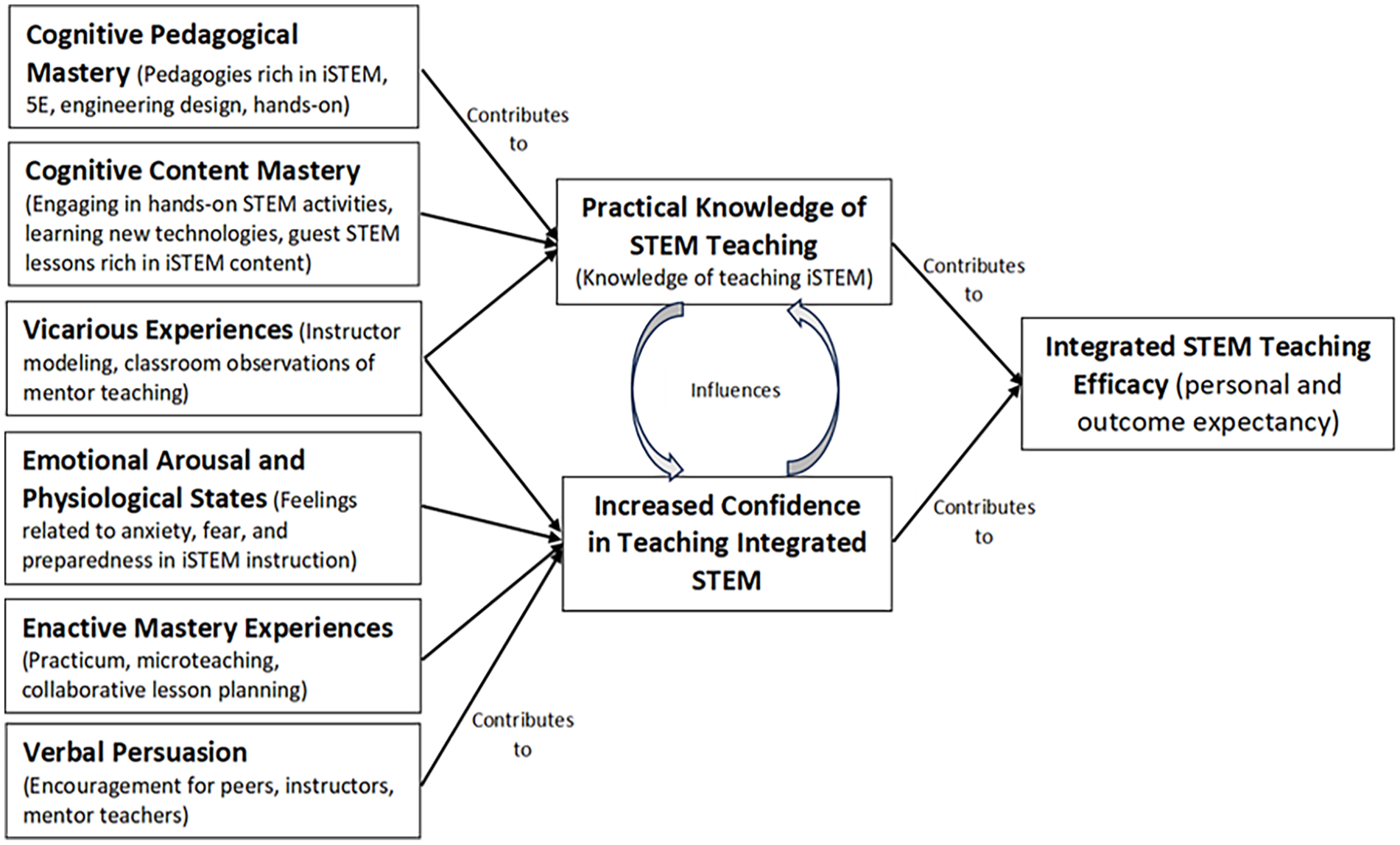
Visual model of the sources of self-efficacy impacting iSTEM teaching self-efficacy.
Our findings further indicate that cognitive pedagogical mastery experiences were most frequently discussed within the methods course contexts. This is unsurprising given the focus on learning pedagogical approaches for iSTEM teaching. Participating as learners in various activities rich in iSTEM pedagogies, such as the 5E model and engineering design, as well as opportunities to apply the new pedagogies in creating iSTEM lessons, supported the development of practical knowledge for teaching iSTEM. The notion that practical knowledge blends “experiential knowledge, formal knowledge, and personal beliefs” (van Driel et al., 2001, p. 137) is well-known in the context of teacher education. In this study, PSTs constructed practical knowledge about iSTEM teaching through firsthand cognitive content mastery experiences such as hands-on STEM investigations that integrated knowledge from different disciplines to solve problems using the engineering design process (Lottero-Perdue, 2017) and applying new technologies learned in methods courses. In addition, as evident in the post-interview responses, PSTs benefitted from experiencing and learning about formal pedagogical models such as the 5E learning cycle approach, engineering design process, and three-dimensional learning advocated by NGSS (NGSS Lead States, 2013). Blending iSTEM content with rich pedagogies relevant to iSTEM learning helped PSTs “see” how the four disciplines merge.
Vicarious experiences such as witnessing iSTEM lessons taught by instructors, classroom mentor teachers, and guest speakers (for example, environmental science and engineering educators) were rich sources of iSTEM teaching self-efficacy. For PSTs, these experts served as role models; seeing how experts “do” STEM seemed to help PSTs position themselves in their future role of teaching iSTEM. This finding is in accord with other studies in science and engineering education that suggest that engaging in and “seeing” successful examples of expert teaching have the potential to impact science teaching self-efficacy (Menon, 2020; Menon & Sadler, 2016; Webb & LoFaro, 2020; Yesilyurt et al., 2021). Although PSTs visited elementary classrooms to observe mentor teaching, the amount of iSTEM instruction was limited and, thus, less evident in PSTs’ responses. It could be that PSTs, as novice teachers, may not be aware of the different ways STEM can be integrated (as STEM could be an integration of two or more disciplines, not necessarily all four disciplines), particularly with classroom visits scheduled early in the semester. Perhaps multiple debriefing sessions within methods courses concerning what PSTs see in elementary classrooms are critical to reveal any false perceptions related to the status of iSTEM education. Nevertheless, the findings related to vicarious experiences seem encouraging; we also found evidence suggesting increased confidence among PSTs to teach iSTEM.
In this study, most PSTs had only one opportunity to practice teaching iSTEM lessons designed within methods courses for elementary students. Although the enactive mastery experience of putting PSTs’ practical knowledge into action was less pronounced than in other studies (Bautista, 2011; Gunning & Moore Mensah, 2011; Menon, 2020), the practicum was powerful in impacting PSTs’ affective and physiological states, leading to an increase in confidence to teach iSTEM. As mentioned earlier, PSTs, as novices, are often uncomfortable with STEM disciplines and certainly less aware of iSTEM pedagogies. Unsurprisingly, a lack of disciplinary background influences PSTs’ anxiety and stress levels (Menon & Sadler, 2016; Rich et al., 2017), which was also the case with this study’s participants. After teaching the iSTEM lessons, PSTs experienced personal success when they saw elementary students excited to learn from them and have fun in the activities they had planned. These experiences helped overcome some of the persistent fears related to iSTEM teaching. With increased levels of iSTEM teaching self-efficacy evident in quantitative results and evidence from PSTs’ interview responses that also suggested increased confidence, PSTs likely have greater abilities to overcome challenges related to iSTEM teaching in the future due to their methods coursework. However, more research is needed to understand how PSTs’ iSTEM teaching self-efficacy translates into practice.
Interestingly, verbal persuasion was the least frequently discussed source of self-efficacy. When discussed, PSTs valued verbal feedback from peers, particularly groupmates who collaborated to design and enact iSTEM lessons, and feedback from their instructors and mentor teachers. However, less evidence on verbal persuasion from this study does not mean it should be discounted. Rather, perhaps a greater emphasis on positive feedback is needed to ensure that PSTs receive clear messages about their growing abilities to teach iSTEM. Given that iSTEM contexts are relatively new environments, verbal persuasion may be a valuable source of inspiration. STEM educators may need to intentionally design more opportunities for PSTs to receive positive encouragement, such as more interaction with their peers, one-on-one meetings with methods course instructors and mentor teachers, and classroom discourse where they can share their successes and challenges about their teaching enactment.
Limitations
First, it is important to note that the current study focuses on a single year of data; a longitudinal investigation on iSTEM self-efficacy spanning multiple years could yield more insights into how PSTs’ iSTEM self-efficacy further develops and translates into practice. The long-term impact of the STEM semester on PSTs’ teaching efficacy may be realized when they independently teach in formal classrooms. It is also important to acknowledge that the data collected solely represents participants’ experiences within one institution’s unique STEM semester. The structure of the STEM programs varies across institutions, so it might be prudent to collect additional qualitative data from participants across multiple institutions. Such an approach could further enhance the generalizability of the findings and provide a more nuanced understanding of the impact and efficacy across STEM programs.
Conclusions and Implications
Given the findings, the study has implications for STEM educators involved in designing iSTEM experiences within the preservice teacher preparation programs and future research on iSTEM teaching self-efficacy. First, considering that the emphasis on STEM integration is growing and that elementary teachers feel underprepared to deliver iSTEM instruction, STEM educators involved in preparing PSTs must restructure their curricula or existing programs to increase focus on iSTEM. Considering that PSTs often report a lack of experience as STEM learners, perhaps designing courses that blend iSTEM content and pedagogy supports the development of interdisciplinary and practical knowledge. Oftentimes, when designing efforts related to STEM reforms, the time devoted to iSTEM interventions within existing methods courses is limited or short-term, which may not always provide the desired changes in iSTEM teaching self-efficacy. Perhaps it would be fruitful for multidisciplinary faculty to come together and brainstorm ideas when leading such reforms.
Second, we recommend that STEM educators consider including a field-based component within methods courses for PSTs to practice iSTEM lessons in formal classroom settings. Multiple opportunities for PSTs to learn, observe, design, and enact iSTEM will help bridge the gap between theory and practice, which could further support the increase in confidence and practical knowledge for iSTEM. Third, it is important that PSTs are engaged in teamwork and discourse to enable the exchange of ideas that allow them to negotiate, share, discuss, and reflect on successes and challenges they face as learners and future teachers within iSTEM contexts that are relatively new to them. Such discourse surrounding PSTs’ observations of classroom teaching is crucial as elementary classroom iSTEM instruction could be limited and may depend on a variety of factors such as the school culture, administrative support, etc. Fourth, we also suggest that STEM educators must be intentional and explicit in developing a range of ways PSTs can receive continuous mentoring and positive feedback and encouragement when trying new things within iSTEM contexts. Individuals’ prior exposure to STEM may vary, so PSTs may arrive with diverse perspectives about STEM; therefore, it is important to provide risk-free environments where PSTs can challenge their preexisting beliefs and develop new and fresh understanding, knowledge, and self-efficacy related to iSTEM.
Shaping PSTs’ iSTEM teaching self-efficacy beliefs within teacher preparation programs is important for achieving the desired goals for future STEM educators. While this study contributes to the existing knowledge base on how various sources of self-efficacy contribute to iSTEM teaching self-efficacy, additional research is needed. For example, a broader sampling of participants from multiple institutions would strengthen the transferability of findings. Further, longitudinal studies would help demonstrate whether iSTEM teaching self-efficacy translates to effective iSTEM instructional practices and student learning. In addition, long-term studies can further explore links between iSTEM teaching self-efficacy, teacher effectiveness, and retention.
Footnotes
Declaration of Conflicting Interests
The author(s) declared no potential conflicts of interest with respect to the research, authorship, and/or publication of this article.
Funding
The author(s) disclosed receipt of the following financial support for the research, authorship, and/or publication of this article: This material is based upon work supported by the National Science Foundation under Grant Nos. 2151056, 2151045, 2151057, 2151012. Any opinions, findings, conclusions, or recommendations expressed in this material are those of the author(s) and do not necessarily reflect the views of the National Science Foundation.
Open Practices
The datasets generated and/or analyzed during the current study are not publicly available. The survey and interview data generated and/or analyzed during the current study are not publicly available due to the identifiable nature of the data. The participants’ confidentiality must be maintained per the Institution Review Board guidelines from the institution where the data was generated. However, any inquiries concerning the materials are welcomed. We have now provided screenshots of the data set, interview data analysis in MAXQDA, and interview protocols, available at 
Authors
DR. DEEPIKA MENON is an assistant professor of science education at the University of Nebraska-Lincoln, 840 N 14th Street 230 Carolyn Pope Edwards Hall Lincoln, NE 68588; email:
DR. JEANNA R. WIESELMANN is an assistant professor of STEM education at Southern Methodist University, PO Box 750455, Dallas, TX, 75275-0455; email:
DR. SARAH HAINES is a professor of biological sciences and science education at Towson University, 8000 York Road, Towson MD 21252; email:
DR. SUMREEN ASIM is a professor of science and technology education at Indiana University Southeast, 4201 Grant Line Rd, New Albany, IN 47150; email:
DR. AMANDA KOCH is a principal scientist at the Human Resources Research Organization (HumRRO), Minneapolis, MN; email:
DEREK COX is a graduate research assistant in science education at the University of Nebraska-Lincoln, 840 N 14th Street 230 Carolyn Pope Edwards Hall Lincoln, NE 68588; email: