




Abstract
To shape professional learning (PL) and curriculum interventions for successfully transforming instruction, we need to better understand how multiple aspects of the system work. Applying structural equation modeling with a sample of 437 teachers in 153 middle and high schools in 11 districts serving 50% or more Black or Latinx students, we found that teachers are significantly more likely to use ambitious and culturally responsive (CR) instruction in the classroom and that student engagement increases when PL and curriculum adoption are (1) targeted toward ambitious and CR instruction, (2) provide clear, specific directions to teachers, (3) are aligned with each other, (4) are supported by teachers, and (5) are accompanied by incentives. PL worked through fostering stronger beliefs in and confidence using CR instruction. The curriculum and PL had both independent and interactive effects on bolstering the use of ambitious and CR instruction.
Keywords
Introduction: Significance of Understanding How Curriculum and Professional Learning Influence Teachers and Students
Understanding how curriculum and professional learning shape instructional change and how that change influences students is fundamental to many educational improvement efforts. Research is clear that the effectiveness of professional learning (PL) increases when it is aligned with the required curriculum (Penuel et al., 2011) but provides less evidence on the extent to which successful implementation of a new curriculum depends on aligned high-quality PL. Relatedly, we do not have a clear sense of the features of the policy environment that need to be in place for curriculum and PL to shape instruction effectively. Additionally, there has been an increased focus on leveraging curriculum and PL to foster more ambitious instruction—which challenges students to analyze, synthesize, and apply knowledge rather than exclusively memorize and perform procedures—and culturally responsive (CR) teaching—which recognizes and draws on students’ backgrounds, knowledge, and experiences to shape instruction. However, we know little about the mechanisms through which PL works to foster shifts in CR teaching, and more research is needed on the relationship between student engagement and ambitious, CR, and traditional instruction.
Scholars suggest that teacher beliefs in the value of CR instruction and their confidence in using CR approaches are likely instrumental in bolstering their use of it in the classroom (eg, Bray-Clark & Bates, 2003; Civitillo et al., 2019; Comstock et al., 2023). And reformers suggest that use of ambitious and CR instruction will foster greater student engagement, a critical precursor to improved learning (Markowitz, 2018) and a fundamental goal of the push to move away from the predominant reliance on procedural instruction (Ginsberg, 2015; Hill, 2009; Nykiel-Herbert, 2010).
Our study provides a unique opportunity to empirically examine this system of relationships, fundamental to current instructional reform yet rarely examined holistically. Using structural equation modeling, we are able to examine multiple components of the instructional system concurrently to answer a series of related research questions to better understand how curriculum and PL relate to instruction and student engagement: (1) How does curriculum and PL with specific high-quality features relate to teachers’ use of ambitious, CR, and traditional instruction? (2) Are instructional change efforts more successful when a new curriculum is coupled with aligned PL? (3) Is the relationship between PL and instruction mediated by teachers’ confidence and beliefs around CR instruction? (4) Is the use of ambitious and CR instruction related to greater student engagement?
In our study, we estimate a comprehensive set of relationships to test the following hypotheses: (1) curriculum and PL with certain desirable policy features relate independently to more use of ambitious and CR and less traditional instruction; when both are in place, they have even stronger relationships; (2) ambitious and CR instructional approaches relate to greater student engagement, whereas reliance on traditional instruction is associated with decreased engagement; (3) PL with desirable policy features is associated with stronger beliefs and confidence around CR instruction; and (4) these stronger beliefs and confidence relate to greater use of CR and ambitious instruction, which increase student engagement.
Our study contributes to the literature by modeling these complex relationships simultaneously using structural equation modeling. Further, ours is the only study that we know of that explicitly measures features of curriculum and PL in multiple districts across the country to model both direct and interactive relationships with ambitious and CR instruction—important because it comes closer to approximating the actual real-world complex system of relationships. Further, we know of no other study that provides larger-scale evidence to document whether PL on CR instruction is related to teachers’ beliefs and confidence in using CR approaches and whether CR instruction relates to student engagement. Our work also provides evidence for the underdocumented hypothesis that CR instruction works better in the context of ambitious instruction. And we ground our analysis in the policy attributes theory (Porter et al., 1986), which allows us to assess the relationship of instruction with PL and curriculum with a set of key policy features of specificity, authority (teacher buy-in), consistency, power (rewards and sanctions), and stability. We examine these questions systematically through a set of structural equation models with a sample of 437 mostly middle school mathematics teachers in 11 districts across the country, each serving 50% or more Black and Latinx students.
Drawing on the Literature: Links Between Policy Features of PL and the Curriculum and Teacher Beliefs, Confidence, Instruction, and Student Engagement
Effects of Curriculum and PL on Instruction
Policymakers and reforms have relied heavily on both curriculum and PL as mechanisms for instructional improvement. Curriculum plays a critical role in shaping what teachers cover in the classroom and the instructional approaches they use (eg, Agodini & Harris, 2010; Polikoff, 2021; Remillard et al., 2014). The design of curricular materials shapes practice by emphasizing specific content, offering ideas for particular instructional practices, and designating the role of teachers in instruction (Agodini & Harris, 2010; Ball & Cohen, 1996; Remillard et al., 2014). Alignment of the curriculum with other elements of the policy system, such as content standards, is essential for providing teachers with a clear path to implementation (Pak et al., 2020; Polikoff, 2015).
Many scholars argue that if curriculum adoption is not accompanied by guidance and support for teachers, it will be insufficient to ensure changes in instruction (eg, Alozie et al., 2010; Polikoff, 2021). Curriculum enactment can vary for a number of reasons. Curricular materials may be misinterpreted, especially if there is little guidance embedded within the curriculum (Alozie et al., 2010). Teachers need support in understanding how the curriculum relates to content standards and how to adapt it to meet the needs of their particular students (eg, Ball & Cohen, 1996; Freeman & Porter, 1989; Penuel et al., 2011; Yang et al., 2020).
PL is instrumental in addressing these needs and providing extra support to help teachers make the changes required by new curricula. Teacher PL has been the subject of hundreds of studies, including rigorous randomized control trials (e.g., Garet et al., 2008; 2016) ; and while results vary, there is substantial evidence that high-quality PL can change what and how teachers teach (Agodini & Harris, 2010; Desimone, 2009; Garet et al., 2001; Kennedy, 2016). These effects have been well documented in elementary, middle, and high school in studies across both science, technology, engineering, and math (Greenleaf et al., 2011; Lynch et al., 2019; Osborne et al., 2019; Penuel et al., 2011; Roschelle et al., 2010) and English language arts (ELA) (Babinski et al., 2018; Masters et al., 2010).
Linking PL directly to curriculum has the potential to make both the PL and curriculum more effective. For example, Taylor et al. (2015) used a clustered randomized, controlled design to show that combining research-based science curricular materials with curricular-aligned PL had a positive impact on improving teacher practice, which, in turn, improved student achievement for high school students. Other scholars used meta-analyses to show that curricular-aligned PL has stronger effects than PL or curriculum used alone (eg, Lynch et al., 2019; Pellegrini et al., 2021). Similarly, a review of randomized, controlled trials of PL interventions concluded that activities closely aligned with curricular lessons were the ones most likely to result in consistent and longer-term implementation (Desimone & Garet, 2015).
Providing PL focused explicitly on the curriculum can offer opportunities for teachers to better understand instructional strategies prioritized in the curriculum as well as curricular goals (eg, Alozie et al., 2010). Additionally, curriculum-aligned PL may enable teachers to better situate their learning of the curriculum within their school or district context (eg, Ball & Cohen, 1996; Davis & Krajcik, 2005). Each of these benefits can be instrumental in addressing misconceptions and in supporting teachers to enact the curriculum as intended.
This literature forms the basis for our first two research questions: How does curriculum and PL with specific high-quality features relate to teachers’ use of ambitious, CR, and traditional instruction? and Are efforts more successful when a new curriculum is coupled with aligned PL?
Which Characteristics of PL and Curriculum Matter? Applying the Policy Attributes Theory
Our work builds on previous studies of curriculum and PL by examining how a set of key features of curriculum and PL matter. We use the policy attributes theory (Porter, 1994) as a framework for identifying the curriculum and PL attributes critical for fostering successful implementation. The framework posits five dimensions through which policies, in this case PL, gain influence over practice—specificity, authority, consistency, power, and stability. We adopt the view that it is the respondents’ perceptions of the attributes—how they individually experience them—that matter for determining behavior rather than the policy as written (see Desimone, 2002).
The specificity, or level of detail of the guidance in the curriculum and the PL, determines how much teacher invention is required (Ball & Cohen, 1996); for example, sample lesson plans can provide a concrete understanding of how to enact the curriculum that reduces unwanted variation (eg, Penuel et al., 2011). Normative (buy-in) and institutional (leadership and resources) authority encourage teachers to take up the practices that are being promoted (eg, Polikoff, 2021; Remillard & Bryans, 2004). Consistency or coherence in the policy environment is also important (Hodge & Stosich, 2022; Spillane & Jennings, 1997; Spillane et al., 2022), and alignment of the curriculum with other initiatives and with PL ensures coherent guidance that facilitates implementation (e.g., Davis & Krajcik, 2005; Polikoff, 2021). Although results are mixed, research has shown that power in the form of incentives or sanctions can play a role in moving teachers to use a curriculum or take up what they learn in PL (eg, Dee & Wyckoff, 2015; L. Desimone, 2002; Yuan et al., 2013). Finally, the stability of the curriculum is crucial in supporting efforts to shift teachers’ practice (eg, Berends et al., 2002). Previous work has shown that these attributes are related to stronger uptake of reform (Desimone et al., 2005, 2019; Edgerton et al., 2020). Thus, we hypothesize that the stronger the policy features, the more likely it is teachers will alter their instruction in ways supported by the curriculum and PL.
Improving Instruction: Fostering More Ambitious and CR and Less Traditional Instruction
Instructional reform across content areas has called for shifts from a predominant emphasis on traditional approaches (ie, an emphasis on direct instruction, memorization, and procedural tasks) to inclusion of instruction that is both ambitious and CR (International Literacy Association [ILA], 2019; National Council of Teachers of Mathematics [NCTM], 2000). Ambitious practices are those that focus on active learning and conceptual tasks—engaging students in discussion, critical thinking, and real-world applications (Choppin et al., 2020; H. C. Hill et al., 2018; Lampert, 1992; National Mathematics Advisory Panel, 2008). Despite research showing that ambitious teaching is associated with greater student engagement (Turner et al., 2014) and achievement (Le et al., 2009), teachers primarily enact mostly traditional approaches (M. Comstock, A. S. Kenneth et al., 2022; Covay et al., 2015; Desimone & Long, 2010; Desimone et al., 2005). Thus, we need more evidence to guide curriculum and PL interventions to foster more use of ambitious practices.
CR teaching is a paradigm for instruction that uses students’ cultural identities as resources for instruction (Delpit, 2006; Gay, 2000, 2010). CR teaching emphasizes teachers’ use of pedagogy that builds on students’ strengths and supports students to construct knowledge and build social consciousness (Gutstein et al., 1997; Ladson-Billings, 1995, 2009). In a comprehensive review of primarily small-scale and descriptive studies, Aronson and Laughter (2016) found that CR is consistently linked to student outcomes such as increased engagement (Copenhaver, 2001; M. L. Hill, 2009; Nykiel-Herbert, 2010) and improved academic achievement (Gutstein, 2003; Langlie, 2008).
While we know of no randomized, controlled trials of CR instruction, Blazar’s (2021) study that randomly assigned White teachers and teachers of color to upper elementary classrooms found substantial and significant effects on student self-efficacy, engagement, attendance, and achievement mediated in part through teachers of color practicing behaviors aligned with CR, such as developing interpersonal relationships with students and individualizing instruction.
The field could benefit from evidence of how to support teachers in using more CR approaches and more empirical evidence from larger samples linking such approaches to student outcomes. Here we focus on student engagement, which has been linked to both achievement and socioemotional outcomes (Markowitz, 2018).
It is from this literature that we derive our research question asking: Does increased use of ambitious and CR instruction relate to greater student engagement, and does traditional instruction relate to less student engagement?
PL’s Effects on CR Beliefs and Confidence
How do we elicit changes in instruction that result in more CR and ambitious teaching? Scholars suggest that high-quality PL is a critical lever for changing instructional practice and that it works through increasing teachers’ knowledge and shifting their beliefs, which, in turn, leads to changes in their instructional practices (eg, Kennedy, 2016). We ground our hypothesis that PL works through changing confidence and beliefs and that PL provides specific, consistent, authoritative, powerful, stable guidance will help foster teacher beliefs consistent with CR teaching and increase their confidence/self-efficacy in doing so. We do not directly measure knowledge but rely on prior research that links knowledge growth with confidence/self-efficacy (Appleton, 1995; Swackhamer et al., 2009) and changes in teacher practice (Roth et al., 2019).
Previous work suggests that CR-related beliefs, such as holding high expectations for all students, valuing cultural diversity, viewing race as a central component of individual identity, and acknowledging the roles that race and culture play in society, are a precursor to teachers’ effective use of these approaches (Gay, 2018; Ladson-Billings, 1995; Seriki & Brown, 2017). Also, teachers’ confidence and self-efficacy about engaging in such pedagogy are associated with their self-reported use of CR teaching (Civitillo et al., 2019; Gay, 2010; Zee & Koomen, 2016).
Research suggests that CR-focused PL can influence teacher beliefs and confidence (Fitchett et al., 2012; Parkhouse et al., 2019; Psalti, 2007; Tucker et al., 2005) and teacher practice and student outcomes (Aronson & Laughter, 2016; Parkhouse et al., 2019; Savage et al., 2011). Notably, much of this research is qualitative in nature (Bottiani et al., 2018), which allows us to build on this work by testing these relationships with structural equation modeling and larger samples.
From this literature we derived our research question that asks: Does PL work through bolstering teachers’ confidence and beliefs to support more use of ambitious and CR instruction in the classroom?
Integrating these findings across areas, we conduct a comprehensive analysis of how policy attributes of curriculum relate to teachers’ CR and ambitious instruction, how PL relates to instruction through teacher beliefs and confidence, and how CR and ambitious instruction relate to student engagement.
Methods
We studied 11 school districts across the country engaged in a PL partnership initiative funded by a prominent education philanthropy organization. The funder required districts to serve 50% or more Black and Latino/a students, English learners, and/or students from low-income families. Districts partnered with external organizations such as PL providers and curriculum developers to enact curriculum-embedded PL in mathematics to promote enhanced student learning, particularly for historically marginalized students. The focus of the curriculum was on ambitious and CR instruction. Thus, this study’s findings are derived from a set of equity-oriented racially and linguistically diverse public school districts.
Sample and Data-Collection Procedures
Our sample was comprised of 437 math teachers (many of whom also taught ELA and science) in 153 schools (62% response rate), mostly in grades 6 through 8, in 11 districts. We administered a survey electronically via Qualtrics between April and June of 2021 to teachers in the 11 partnerships. We compensated participating teachers with $60 for completion of the survey, which took approximately 30 minutes. Eighty-seven percent of teachers taught at the middle school level, followed by 9% in high schools and 5% in elementary schools. The sample was racially/ethnically diverse (41% Black or African American, 36% White, 8% Latino/a, 7% Asian, 3% multiracial, <1% Indigenous/Native American, and <1% Middle Eastern) (see Appendix Table A.1). Teachers were asked to report on their mathematics instruction. Although the findings presented are not generalizable to the broader teacher workforce, the sample is illustrative of public schools serving predominantly marginalized students who are engaging in curriculum adoption and PL around increasing ambitious and CR instruction.
Survey Measures
The validity and reliability of survey items and scales can vary based on the source, development, quality of items, and circumstances of administration (Desimone, 2006; Desimone et al., 2010). We have confidence in our measures for several reasons. We drew on scales from sources that provided reliability and validity data for the scales (eg, Bryk et al., 2010; Cruz et al., 2020; Guyton & Wesche, 2005; Phuntsog, 2001; Siwatu, 2007) and documented concurrent validity through correlations with other key instructional approaches and student outcomes (Comstock et al., 2022; Griner & Stewart, 2013; Zee & Koomen, 2016). We engaged in cycles of expert review and cognitive interviews for any items that we adapted or developed to ensure clear understanding of the questions (Desimone & LeFloch, 2004; Fowler, 1995; Rowan et al., 2002), and we conducted a small-scale pilot study. Further, rather than asking teachers to evaluate their own instruction, we used behaviorally oriented questions, which have been shown to have substantial reliability and validity when not asked in an accountability environment, and we uses composites that are better able to distinguish among behaviors (Mayer, 1999).
Further, the notably similar scores across districts (see Appendix Table A.6) and the psychometric properties of our scales (see Appendix Table A.4) support the validity of the data (Burstein, 1995; Stecher & Borko, 2002). At the same time, we acknowledge that instruction, self-efficacy, engagement, and confidence are complex constructs, and we have necessarily narrowed their definition to allow measurement. Thus, interpretation of our findings should be limited to our conception and measurement of these constructs. Next we describe each of the measures used for analysis. Table 1 provides descriptives for the scales, and Appendix Table A.2 lists the items.
Descriptive statistic, teacher survey scales
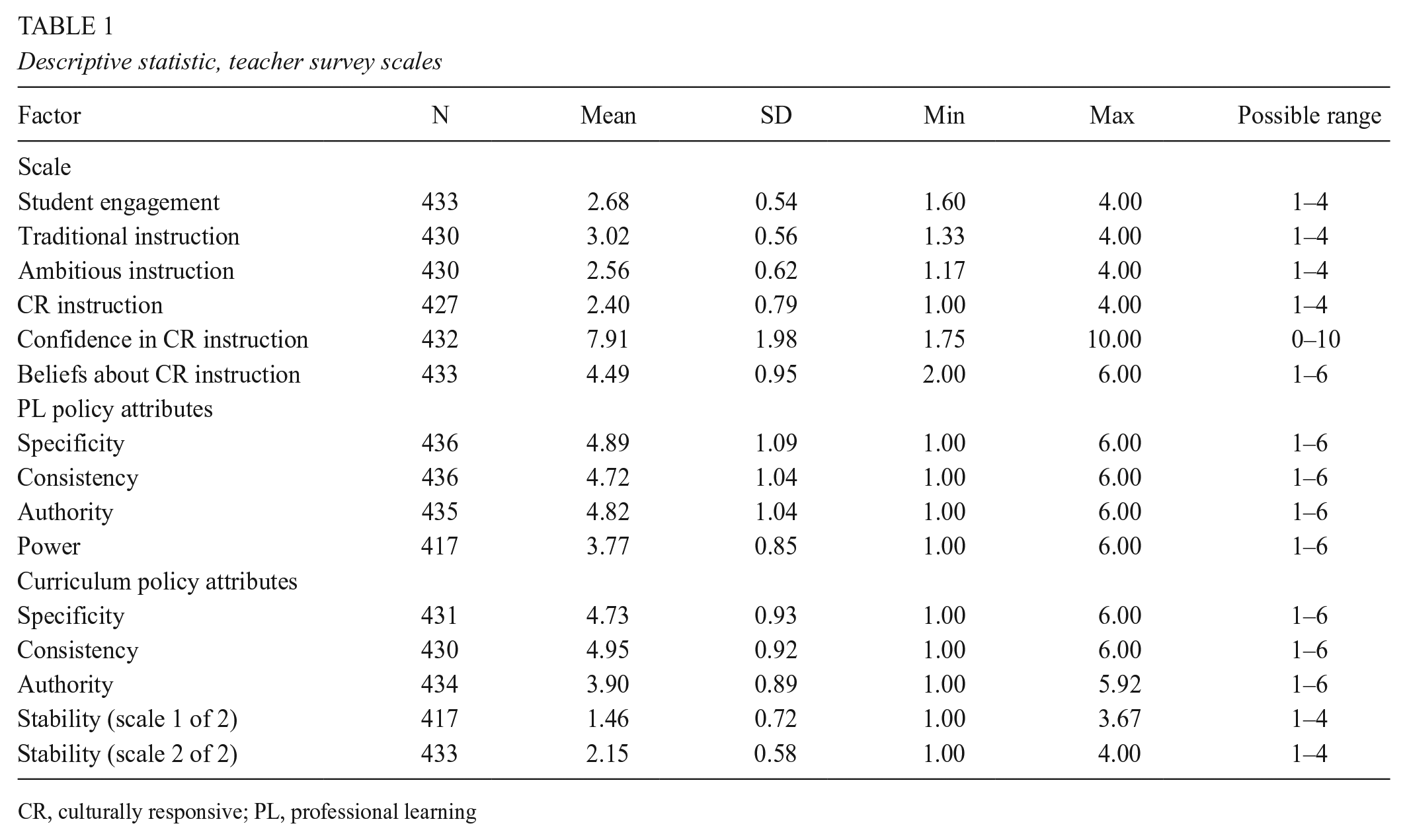
CR, culturally responsive; PL, professional learning
PL Policy Attributes Scale
The PL Policy Attributes Scale measures the specificity, consistency, authority, and power of the PL in a teacher’s school. Because PL policy interventions were all in their first year of funding and persisted for the duration of the study, we did not measure stability. Each set of items asks teachers to rate their agreement with statements on a six-point scale (completely disagree, mostly disagree, slightly disagree, slightly agree, mostly agree, or completely agree). Items for these scales were based on work from the Center for Standards, Alignment, Instruction and Learning (see, eg, Desimone et al., 2019; Edgerton & Desimone, 2018) and a survey developed and tested in partnership with the School District of Philadelphia (Desimone et al., 2016; K. H. Hill et al., 2023). We created an overall PL policy attributes scale by first creating subscales for each of the attributes by averaging all the items within each subscale. Negative items were reverse coded (for this scale and all others). Then, when adding each subscale, we multiplied by the standardized factor loadings for each subscale (see Appendix Table A.3) to reflect each subscale’s contribution to the overarching latent construct PL policy attributes.
Curriculum Policy Attributes Scale
The specificity, consistency, and authority items ask teachers to rate their agreement with statements on a six-point scale (completely disagree, mostly disagree, slightly disagree, slightly agree, mostly agree, or completely agree). Stability items ask teachers to report how long the curriculum has been in their school and district using four timespans (<1 year, about 1–2 years, about 3–5 years, or more than 5 years). Curriculum policy attribute items were based on previously developed and validated surveys (Desimone & Hill, 2017; Desimone et al., 2016; Marsh et al., 2005). We created an overall Curriculum Policy Attributes Scale by averaging items within each subscale and then adding each subscale multiplied by its standardized factor loading to reflect its contribution to the overarching Curriculum Policy Attribute Scale (see Appendix Table A.3).
Beliefs About CR Instruction
The beliefs about CR instruction scale (Cronbach’s α = .715) measures teachers’ beliefs regarding approaches and practices designed to support culturally diverse learners on the same agree/disagree scale as earlier. These items are based on the Culturally Responsive Teaching Outcome Expectancy (CRTOE) Scale and Phuntsog (2001).
Confidence in Culturally Responsive Instruction Scale
The Confidence in Culturally Responsive Instruction Scale (Cronbach’s α = .907) measures teachers’ confidence in adapting instruction and instructional materials to meet the needs of culturally diverse students and to make learning meaningful. Teachers were asked to rate their confidence on statements from a scale from 0 (not confident at all) to 10 (extremely confident). These items are based on the Multicultural Efficacy Scale, the Culturally Responsive Teaching Self-Efficacy (CRTSE) Scale, the CRTOE Scale, the Critical Consciousness Scale, and theory (eg, Freire, 2000; Ladson-Billings, 1995).
Culturally Responsive Instruction Scale
The Culturally Responsive Instruction Scale (Cronbach’s α = .837) measures the frequency with which teachers report implementing culturally responsive practices in their classroom, such as adapting their instruction to meet the needs of learners from diverse cultural backgrounds or using students’ cultural backgrounds to make learning meaningful. Teachers reported how often they engaged in specific activities on a four-point scale (never, a few lessons, about half of all lessons, or most or all lessons). These items are based on the Multicultural Efficacy Scale, the CRTSE Scale, the CRTOE Scale, the Critical Consciousness Scale, and theory (eg, Freire, 2000; Ladson-Billings, 1995).
Ambitious Instruction Scale
The Ambitious Instruction Scale (Cronbach’s α = .828) measures the frequency with which teachers report incorporating conceptual practices such as small-group work, hands-on activities, and student-led discussions into their instruction. Teachers reported how often they engaged in specific activities on the four-point frequency scale. These items were based on a previously developed and validated survey (Desimone et al., 2016) and RAND Corporation’s American Teacher Panel Surveys (Opfer et al., 2021).
Traditional Instruction Scale
The Traditional Instruction Scale (Cronbach’s α = .65) measures the frequency with which teachers incorporate practices such as direct instruction, call and response, and independent work into their instruction (with the same frequency scale as earlier). These items were based on previously developed and validated surveys (K. H. Hill et al., 2023) and RAND Corporation’s American Teacher Panel Surveys (Opfer et al., 2021).
Student Engagement Scale
The Student Engagement Scale (Cronbach’s α = .776) measures the degree of teacher-reported student engagement during instruction, as evidenced by completing work and asking questions. Teachers were asked to reflect on the behaviors of students in their classes during the previous marking period. Teachers reported the number of students exhibiting specific engagement behaviors on a typical day using a four-point scale (none, a few, about half, or most or all). These items are based on previously developed and validated surveys (Desimone et al., 2016).
Psychometric Properties of Scales
We examined the psychometric properties of each scale using confirmatory factor analysis in a structural equation modeling framework. For each confirmatory factor analysis, we examined the fit statistics (eg, Standardized Root Mean Square Residual [SRMR], Comparative Fit Index [CFI], Tucker-Lewis Index [TLI], and Root Mean Square Error of Approximation [RMSEA]). We checked fit statistics to see if they met the cutoffs reported in the literature while remaining flexible (Hu & Bentler, 1999; Kenny & McCoach, 2003; Lai & Green, 2016; McDonald & Ho, 2002). The models demonstrated acceptable fit when considering all the fit statistics (see Appendix Table A.4) .
To check the reliability of scales, we estimated omega coefficients (
Data Analytic Approach
We aggregated teachers across districts, given the nature of our sample. As shown in Appendix Table A.6, the number of teachers within each district does not allow for nesting (Hox, 2010). Further, the means for each of our key latent variables are notably similar across districts, suggesting that no one district’s responses are driving the results (although we do have considerable variability in numbers of respondents across districts).
We used structural equation modeling (SEM) to model the relationships we are testing. In SEM, researchers apply theory to hypothesize relationships between latent variables (measures of a specific construct) by designing and specifying a priori structural equation models (Bollen, 2014; Bollen & Pearl, 2013; Kline, 2016, 2023; Morgan, 2013). Researchers justify the structural paths leading from one latent variable to another with theory, which represents the study’s hypotheses. SEM allows researchers to model simultaneously the direct and moderated paths of multiple relationships, as posited by theoretical notions (Gerbing & Anderson, 1988).
For each of our structural equation models, we examined model fit to evaluate the overall structure using acceptable thresholds reported in the literature: RMSEA < .06, CFI > .90, TLI > .90, and SRMR < .06 (Hu & Bentler, 1999; Kenny & McCoach, 2003; Lai & Green, 2016; McDonald & Ho, 2002). Then we reviewed standardized parameter coefficients and amount of variance explained (eg, R2 statistics) for each model, only in cases when model fit was deemed acceptable. R2 indicates the percent of variability in the variable that the model explains, and its associated P values indicate whether the percent of variation explained is significant. Small, medium, and large effects follow guidelines for SEM and Cohen’s d, where .2 is small, .5 is medium, and .8 is large (Gomer et al., 2018).
Structural Equation Models
We specified two structural equation models. Our first model tests our hypotheses that (1) teachers who experience curriculum and PL with desirable policy features (e.g., specificity, consistency, authority, power, and stability) use more ambitious and CR instruction and less traditional instruction, (2) curriculum and PL have separate and interactive relationships with instruction, and (3) ambitious and CR instruction have a positive relationship with student engagement, whereas traditional instruction has a negative one (see Figure 1).
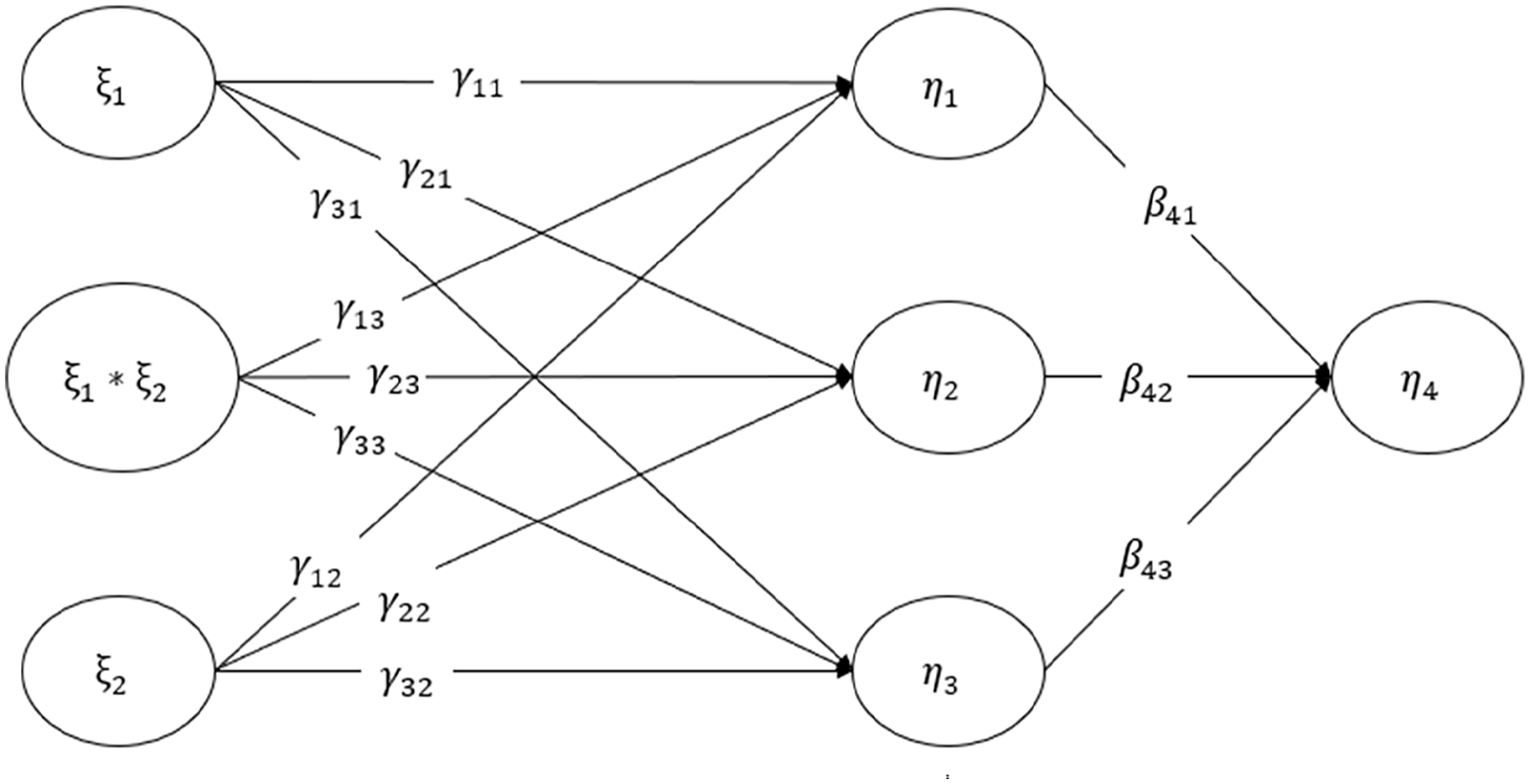
Structural Equation Model 1.
In our second structural equation model, we test the hypothesis that the policy attributes of PL indirectly relate to instruction by working through teachers’ beliefs and confidence (see Figure 2).
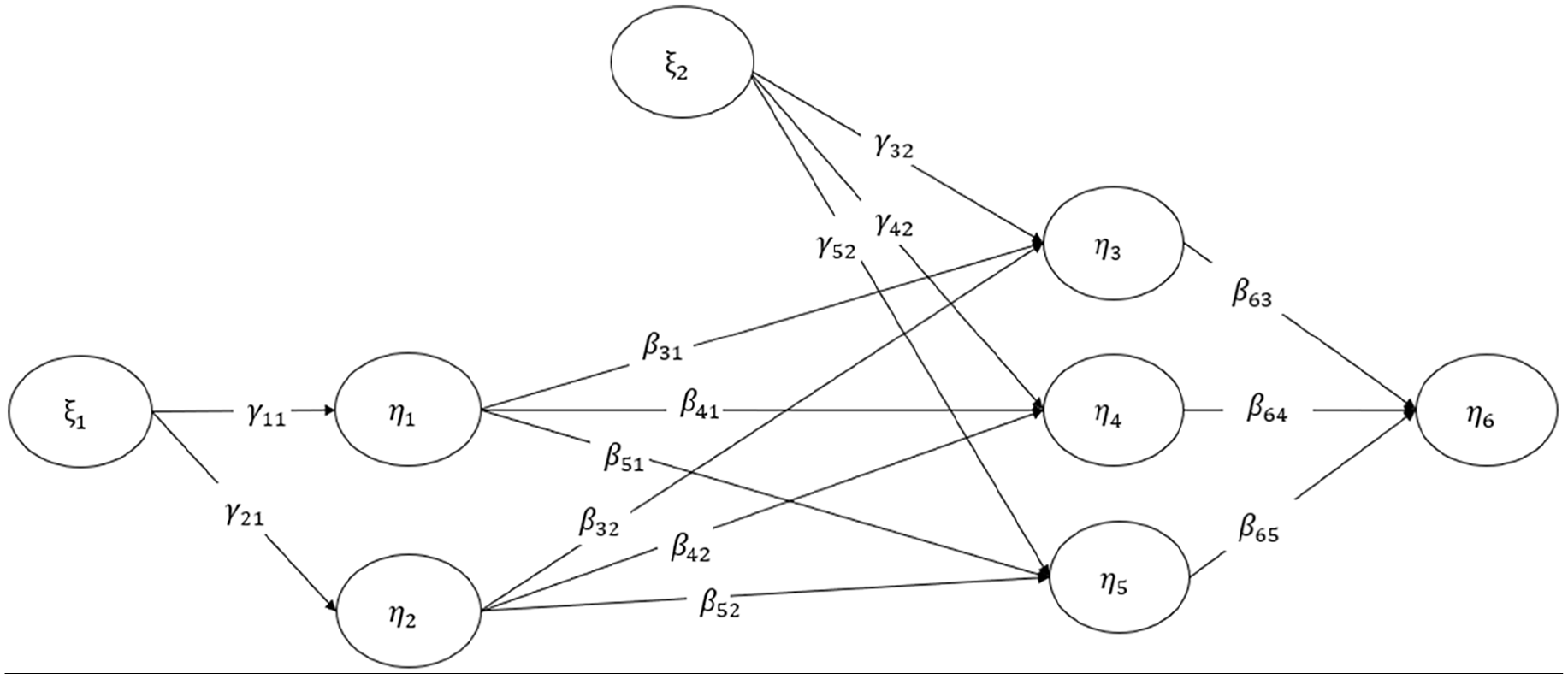
Structural Equation Model 2.
Statistical Software and Missing Data
We used Mplus, version 8.3, to compute statistical analyses. For analyses, we estimated parameters of structural equation models by using full-information maximum likelihood. Although missing data was not a concern, in that we had <5%, full-information maximum likelihood uses all the data for estimation, producing unbiased estimates (Asparouhov & Muthén, 2019; Enders, 2003; Enders & Bandalos, 2001).
Results
Prior to interpreting standardized coefficients, we checked for acceptable model fit. We were unable to assess the fit of the first model because statistics (e.g., SRMR, CFI/TLI, and RMSEA) have not been developed for latent variable interaction models. The second model had an SRMR = .07, CFI/TLI = .90/.89, and RMSEA = .045 (range, .042–.049), which demonstrated acceptable fit based on our a priori thresholds, suggesting that the relationships set forth in our hypothesized model predicted the associations among variables.
Structural Equation Model 1: How the Policy Attributes of PL and Curriculum Relate Separately and Interactively to Ambitious, CR, and Traditional Instruction and, In Turn, Student Engagement
The results, shown in Figure 3, support our first hypothesis that stronger policy features of curriculum and PL are related to teachers’ use of ambitious (β = .104, P = .014; β = .161, P = .003) and CR instruction (β = .158, P = .019; β = .205, P = .013) but not traditional instruction (β = .076, P = .113; β = 0, p = .710). Here the beta coefficient indicates how many standard deviation (SD) units are associated with a 1-unit increase in the independent variable. For example, a 1 SD increase in policy features of PL is related to .161 SD unit increase (P = .003) in ambitious instruction, after controlling for CR and traditional instruction.

Structural Equation Model 1.
Findings also support our hypothesis that PL and curriculum work together to bolster ambitious (β = .085, P = .001) and CR instruction (β = .099, P = .014). The coefficient for traditional instruction (β = .059, P = .049) was marginally statistically significant. The effect sizes for CR (r² = .101, P = .001) and ambitious instruction (r² = .165, P = .001) indicate that curriculum, PL, and their interaction described 10.1% of the variability in CR instruction and 16.5% of the variability in ambitious instruction, a medium and large effect size, respectively (see Table 2).
Effect sizes.

CRP, culturally responsive pedagogy; CR, culturally responsive
We hypothesized that CR instruction and ambitious instruction were related to increased student engagement and that traditional instruction was related to decreased engagement, but in our models, only the use of ambitious instruction was associated with more student engagement (β = .488, P < .000), explaining 14.5% of the variability (r² = .145, P = .006). CR instruction was significantly associated with an increase in student engagement when ambitious instruction was not in the model (β = .22, P < .009). We interpret this to suggest that much CR instruction is done in the context of ambitious teaching, and when it is not, it may not engage students to its fullest potential.
Structural Equation Model 2: Extent to Which PL Works Through Changing Teachers’ Confidence and Beliefs
Next, we wanted to better understand how PL works—specifically, we tested our hypothesis that the attributes of PL work through bolstering teachers’ beliefs and confidence in CR instruction. As with Model 1, we also examined the direct paths from curriculum to instruction and from instruction to student engagement.
Similar to Model 1, curriculum policy attributes were associated with an increase in CR instruction (β = .135, P = .010) and ambitious instruction (β = .293, P < .000) but not traditional instruction (β = .056, P = .397). We also found that the stronger the policy features of the PL, the more likely teachers were to believe in and have confidence in CR approaches. Specifically, the results in Figure 4 show that PL was associated with increased teachers’ beliefs (β = .228, P < .000) and confidence in CR instruction (β = .371, P < .000), that PL explained 13.8% of the variability in teachers’ confidence in CR instruction (r² = .138, P < .000), a medium effect size, and that PL explained 5.2% of the variability in teachers’ belief in CR instruction (r² = .052, P = .045), a small effect size.

Structural Equation Model 2.
This model also showed that CR beliefs were not related to using more ambitious (β = −.073, P = .267) or traditional instruction (β = −.149, P = 0.051) but were related to more frequent CR instruction (β = .130, P = .041). Confidence in CR instruction was associated with an increase in ambitious (β = .215, P < .000) and CR instruction (β = .342, P < .000) but not traditional instruction (β = .158, P = .021, but the effect size (r2) was not significant, indicating that none of the variability in traditional instruction was explained by our model.
Model 2 explained variability in ambitious and CR instruction but was only marginally significant in explaining traditional instruction; this may reflect how entrenched traditional instruction is. Model 2 explained 15.7% of the variance in ambitious instruction (r² = .157, P < .00) and 22.8% of the variance in CR instruction (r² = .228, P < .000), both considered relatively large effect sizes.
Consistent with findings from Model 1, ambitious instruction was associated with increased student engagement (β = .514, P < .000), whereas neither of the relationships of CR instruction (β = −.116, P = .132) and traditional instruction (β = −.190, P = .050) with engagement were statistically significant. Ambitious instruction explained 13.6% of the variance in student engagement (r² = .136, P = .002), a medium effect size.
We also tested a model (not shown) that added to Model 2 the direct relationships of PL with instruction, but those paths were not statistically significant, providing more evidence that PL works through teachers’ confidence and beliefs.
Limitations
Our findings should be interpreted considering both their strengths and limitations. Our sample is comprised primarily of middle school mathematics teachers. Future research might examine whether our results are similar for other grades and subject areas. Also, we relied on survey data, which can be subject to respondent bias and social desirability, especially surveys about cultural competence (Larson & Bradshaw, 2017). To alleviate some of this bias, we used behavior-based measures of teacher instruction, which prior work has shown to be a valid and reliable way of measuring teacher practice (Mayer, 1999). Although we partly addressed this bias by conducting reliability and validity psychometric testing of the scales, we acknowledge that teachers’ self-reports may not fully or accurately reflect their classroom practice (see, eg, Parkhouse et al. [2019] regarding CR teaching specifically). Future studies might build on ours by using complementary measures such as classroom observations. Similarly, our outcomes are instruction and student engagement, not student achievement. We rely on the literature that links use of ambitious and CR instruction and student engagement (eg, Cooper, 2014; Goldin et al., 2019; Marks, 2000) to increased learning (eg, Cherfas et al., 2021; Portes et al., 2018) and student engagement with student learning (Markowitz, 2018; Wang & Holcombe, 2010). Further, while a strength of the study is our measuring a set of key policy features of the curriculum and PL, we are not able to identify the independent contribution of each of the features; designing studies that isolate features would be a future next step that would be helpful in understanding what may be driving effects.
We do not use an experimental design, which would allow causal claims. While SEM is considered by many scholars to be an appropriate method for investigating causal relationships using nonexperimental data (Bollen, 2014; Heckman, 2005; McDonald, 2004; Meehl & Waller, 2002; Morgan, 2013), we adopt a conservative approach with our cross-sectional data and interpret our findings as relational. SEM is especially well suited to model complex interrelated relationships (Bollen & Pearl, 2013; Gerbing & Anderson, 1988; Tarka, 2018) such as the ones we examined in this analysis. Despite the caveats that alternative models also may fit the data (Cliff, 1983), there may be omitted variable bias (Bollen, 1989), and our results rely on the accurateness of a priori theoretical models grounded in previous research (Bollen & Long, 1993). This approach has the potential to provide valuable insights into making sense of complexity (Macallum, 2003). As such, our work offers important insights into understanding how curriculum, PL, beliefs, and confidence operate as a system to influence instruction and student engagement; prior research has rarely modeled these complex relationships simultaneously.
Discussion
How Does Curriculum and PL with Specific High-Quality Features Relate to Teachers’ Use of Ambitious, CR, and Traditional Instruction? Are Efforts More Successful When a New Curriculum Is Coupled with Aligned PL?
Curriculum and PL are arguably the two most common leverage points for school and instructional improvement (eg, Penuel et al., 2007). We explore them in the context of ambitious and CR initiatives and examine whether they work better together and the extent to which a set of strong policy features is associated with instructional change.
Our findings that stronger curriculum and aligned PL attributes (ie, specificity, consistency, authority [buy-in], and power [rewards and sanctions]) were related to teachers’ increased use of ambitious and CR instruction are consistent with previous findings of the importance of specificity (Stornaiuolo et al., 2023), authority (Pak et al., 2021), and power (Nichols et al., 2021) in the uptake of reform. Our finding that these attributes did not relate to teachers’ use of traditional (procedural and transactional) approaches is consistent with the enduring nature of teacher-centered instructional approaches (eg, Lefstein, 2008; Litke, 2020) and research that shows that teachers’ responses to improvement initiatives are typically to add on to their instructional routines without omitting previous practices (eg, Cohen, 1990). Also, as teachers learn new ideas and approaches in PL, we might expect them to increase their use of multiple types of practices including traditional as they build their expertise in using different approaches in diverse ways. This complicates the interpretation of instructional change, when teachers layer on different approaches rather than trade off one for another. Still, it is encouraging that carefully selected high-quality curricula and purposefully crafted PL focused on CR and ambitious instruction are associated with increased use of these approaches in the classroom.
Our finding that combining aligned curriculum and PL bolsters the use of ambitious and CR instruction even more than either alone supports the idea that aligning PL with curricula plays a key role in motivating instructional improvement (Polikoff, 2021) and that found curricular-aligned PL is more effective than either alone (Lynch et al., 2019; Pellegrini et al., 2021). Our results from multiple districts and schools across the country build on earlier work that studied a particular intervention and found that PL was more effective when it is explicitly linked to curricula (Penuel et al., 2007, 2011; Taylor et al., 2015) and a review of randomized, controlled trials in PL that found that PL was more effective when closely linked to teachers’ lessons and curricula (Desimone & Garet, 2015). Our contribution to this literature on single interventions or syntheses of single interventions is that we are able to explicitly measure in the same analysis features of PL and curriculum interventions in multiple districts across the country to model both direct and interactive relationships with instruction.
Our results provide substantial evidence that when PL and curriculum are targeted toward ambitious and CR instruction, provide clear, specific direction to teachers, are aligned with each other, have the support and buy-in of teachers, and operate in a policy system that has incentives for enacting the curriculum and the approaches taught in the PL, teachers are more likely to use ambitious and CR instruction in the classroom. This set of policy features can serve as a roadmap to districts to guide their design of PL and associated policy systems to support instructional improvement.
Does Increased Use of Ambitious and CR Instruction Relate to Greater Student Engagement, and Does Traditional Instruction Decrease Engagement?
Here we build on previous qualitative and case study work (eg, Duke et al., 2021; Irvine, 2020; Turner et al., 2014) to respond to the call for complementary larger-scale evidence on the relationship between ambitious and CR instruction and student outcomes (Sleeter, 2012).
We expected more frequent enactment of ambitious and CR instruction to result in higher levels of reported student engagement (eg, Feger, 2006; Gay, 2002; Ginsberg, 2015; Harbour et al., 2015), but in our analysis, only ambitious instruction increased student engagement. Our findings are similar to those of Byrd’s (2016) national survey of 315 middle and high school students that showed that ambitious instruction (labeled constructivist) was related to student interest and belonging but that practices related to cultural and critical consciousness were not. A careful look at our CR measures might help explain this. Our CR measured included items that ask teachers about examining materials for stereotypes and adapting materials to address bias. These types of practices fall within CR instruction, but they do not imply a particular pedagogy. They may result in students feeling valued and respected (Gay, 2021; Ladson-Billings, 1995), bolstering their perception of themselves as capable students (Souryasack & Lee, 2007) and increasing their confidence in school (Hubert, 2014), but this may take a while to translate into engagement. Furthermore, such changes may not be captured by our measure of engagement, which included items such as completing homework, persevering through challenges, asking questions, and working independently.
Additionally, our results here are consistent with an idea that so far has not been assessed empirically, that CR instruction is most effective when conducted in the context of ambitious instruction. In our original conception, we drew on considerable literature that distinguishes ambitious approaches that focus on cognitive demand, challenging content, and active learning (eg, Kraft & Hill, 2020; Smith et al., 2005, 2007) from CR instruction that individualizes instruction, draws on students’ funds of knowledge, and includes an emphasis on social and political critique (eg, Abdulrahim & Orosco, 2020; Bottiani et al., 2018; Howard & Rodriguez-Minkoff, 2017).
In separate models, each had a positive and significant relationship with student engagement, but when both were in the same model, only ambitious instruction was significantly related to student engagement. We suspect this is due in part to the interactive relationship between CRT and ambitious instruction. Many teachers use ambitious and CRT strategies in concert; our descriptive statistics bear this out. Ambitious and CR instruction were statistically significantly correlated at .56; specifically, 56% of teachers who reported very frequent use of ambitious instruction also reported very frequent use of CR instruction. Taken together, these findings suggest the potential for districts to integrate ambitious and CR strategies for maximum benefit to students. Further research might explore if and how ambitious and CR approaches can and should be combined for maximum student engagement and learning. Understanding how to leverage and interact CR and ambitious strategies is a challenge for the field.
We expected that an emphasis on traditional instruction, which uses teacher-led activities, memorization, and procedural tasks, would reduce student engagement (see Markowitz, 2018), but in fact, in our models there was no statistically significant relationship between traditional instruction and student engagement. One interpretation of these results is that traditional instruction is so entrenched in US public schools that student engagement levels are impervious to it. We are encouraged by the findings that ambitious approaches are related to increased engagement, however.
Does PL Work Through Bolstering Teachers’ Beliefs and Confidence to Support More Use of Ambitious and CR Instruction in the Classroom?
Building on previous work demonstrating a link between PL and more ambitious and CR teaching (Horn & Garner, 2022), we were interested in whether the relationship of PL with the use of ambitious and CR teaching was mediated by teachers’ confidence and beliefs, and we found that it was. PL did not have a direct relationship with instruction. Although our first model shows that teachers who participate in PL that is specific, consistent, authoritative, powerful, and stable use more ambitious and CR instruction, our second model shows that these relationships are explained in part by teacher beliefs and confidence.
Thus, we provide empirical evidence that the relationship between PL and CR instruction is mediated by teachers’ beliefs and confidence related to CR instruction. PL was associated with stronger teachers’ beliefs in the value of CR practice, that it is essential for an inclusive classroom, that incorporating social or political issues and encouraging students to be politically active are appropriate activities, and that different students may learn from various teaching methods. Also, PL was associated with higher teacher confidence in using examples from students’ everyday lives, in integrating social or political issues into class discussions, in supporting students in social or political action, and in uncovering their own bias in their teaching, and this was associated with more CR instruction. Many frameworks conceptualizing how PL works posit that it works through bolstering confidence and beliefs (Borko, 2004; Desimone, 2009; Kennedy, 2016). We add to the literature by formally modeling these mediating relationships between PL and instruction. We also found that CR confidence is related to more traditional teaching, although much less so than for ambitious and CR instruction. This could reflect the phenomenon we discussed earlier, that developing expertise in a specific area enables a teacher to use multiple approaches to good effect.
Another key finding from our study is that confidence matters more than beliefs for fostering change in instruction. Confidence in CR instruction was associated with more use of both ambitious and CR instruction. Belief in CR instruction was associated with more use of CR instruction (β = .130), but by less than half the relationships with confidence (β = .342). This is in line with previous work that while beliefs can be critical precursors to changes in practice (Spillane et al., 2018), beliefs do not always translate directly into practice (Guerra & Wubbena, 2017) and that teachers need to feel self-efficacious to put their beliefs into practice. Our analysis demonstrates that confidence in using strategies consistent with CR beliefs is a precursor to more use of CR strategies in the classroom. An implication of this finding is that districts should attend explicitly to supporting teachers in developing their confidence and beliefs in CR instruction.
Conclusion
Our study advances the field by explicitly measuring features of PL and curriculum in multiple districts across the country to model both direct and interactive relationships with instruction. Our results provide evidence, from a sample of 437 teachers in 153 schools across 11 districts serving predominantly Black and Brown children, that when PL and curriculum are targeted toward ambitious and CR instruction, provide clear, specific direction to teachers, are aligned with each other, have the support and buy-in of teachers, and operate in a policy system that has incentives for enacting the curriculum and the approaches taught in the PL, teachers are significantly more likely to use ambitious and CR instruction in the classroom. Further, we found that these relationships are both direct and interactive. That is, PL and curriculum each have independent direct relationships with more use of ambitious and CR instruction in the classroom, and when provided together, they relate even more strongly to teachers’ use of ambitious and CR instruction.
We showed that the PL worked through changing teacher beliefs and confidence; we provided evidence that specific, authoritative, consistent, and powerful PL can help shift teacher beliefs to consider CR instruction as appropriate and useful and develop teacher confidence in employing CR strategies in the classroom. These changes in beliefs and confidence, in turn, were associated with more use of CR and ambitious instruction in the classroom. Finally, we found that ambitious instruction—where students work on extended activities; apply knowledge to new situations; critique, synthesize, and evaluate; lead discussions and presentations; and self-reflect—significantly and substantially increased student engagement. Our findings apply to our middle school mathematics sample but may hold promise for other grades and subjects.
We are encouraged by these findings. In our quest to provide engaging, challenging, an CR instruction to all students across the country, our study offers evidence across schools and districts that this can be achieved. We hope that this study contributes to other work that is helping to identify ways that schools and districts can shape their learning and curriculum to better serve all our nation’s students.
Footnotes
Appendix
District sample size and latent variable means.

| Sample size by district | PL policy attri-butes | Curriculum policy attributes | Confidence in CR instruction | Beliefs about CR instruction | Ambitious instruc-tion | CR instruc-tion | Traditional instruction | Student engage-ment |
|---|---|---|---|---|---|---|---|---|
| 35 | 3.4 | 2.6 | 5.7 | 3.7 | 1.4 | 1.0 | 1.6 | 1.6 |
| 13 | 3.4 | 2.8 | 8.4 | 4.8 | 1.2 | 1.6 | 1.7 | 1.6 |
| 10 | 3.7 | 3 | 7.7 | 3.9 | 2.2 | 2.2 | 2.4 | 1.9 |
| 29 | 3.1 | 2.8 | 6.7 | 3.7 | 1.6 | 1.4 | 2.1 | 1.5 |
| 30 | 3 | 2.6 | 7.3 | 3.7 | 1.5 | 1.4 | 2.1 | 1.5 |
| 25 | 3.8 | 3.1 | 7.0 | 2.9 | 2.0 | 1.6 | 2.5 | 1.9 |
| 9 | 4.3 | 3.3 | 7.1 | 3.8 | 1.6 | 1.5 | 2.1 | 1.7 |
| 10 | 3.5 | 2.7 | 6.8 | 2.9 | 1.5 | 1.2 | 2.1 | 1.3 |
| 86 | 3.1 | 2.7 | 6.0 | 3.0 | 1.5 | 1.0 | 2.1 | 1.8 |
| 142 | 3.5 | 3 | 7.4 | 3.5 | 1.6 | 1.4 | 2.1 | 1.6 |
| 37 | 3.5 | 3 | 7.3 | 3.7 | 1.3 | 1.1 | 1.6 | 1.9 |
PL, professional learning; CR, culturally responsive
Declaration of Conflicting Interests
The author(s) declare no potential conflicts of interest with respect to the research, authorship, and/or publication of this article.
Funding
This work was supported by the Bill & Melinda Gates Foundation (ID INV-000745).
