




Abstract
Prohibited concept laws have a chilling effect on teaching, resulting in the erasure of social justice topics; however, the extent to which district-level actors support such laws or the role they play in perpetuating the effect is unclear. I offer a framework for understanding how district-level policy messaging contributes to the chilling effect in the context of increased partisanship and nationalized politics at the local level. I use survey data to describe school board members’ and superintendents’ perceptions of Tennessee’s PK–12 Prohibited Concepts Law. Overall, there is support for the law, but there are significant differences between the perspectives of school board members and superintendents, with the latter more likely to express neutrality. There are no differences by location, but there are significant differences based on political affiliation and perspectives about state control of curriculum, supporting the larger trend of increased nationalized partisanship of local politics.
Keywords
Introduction
In the last several years there has been heightened public attention and political controversary around attempts to control curriculums and teaching in schools through so called prohibited or divisive concepts legislation. Recent studies indicate that these laws have created a chilling effect on the work of teachers, which raises concerns about negative impacts for students. This descriptive study advances research on prohibited concepts laws by leveraging data from a statewide survey of Tennessee’s school board members and superintendents in order to better understand the role that district administration may play in producing the chilling effect.
Tennessee’s Prohibited Concepts Law, Tenn. Code Ann. § 49-6-1019, was signed into law on May 25, 2021 (Appendix A). The law utilizes increasing financial sanctions as a policy lever, where districts can be penalized by losing state funding if their teachers or curriculums include listed concepts in lessons. Implementation of the law includes a mechanism for reporting violations via a publicly available, online form. While this study focuses on one state, the Tennessee law mirrors similar legislation backed by conservative-affiliated special interest groups across the nation, which include vague specifications and undefined concepts that leave the laws open to interpretation (Anderson, 2023; Crenshaw, 2021; Kelly, 2023; López et al., 2021). Further, the topics targeted by Tennessee’s law match those in recent analyses of existing and proposed laws across the United States, which identify two specific thematic areas targeted by prohibited concepts legislation: (1) ethno-racial diversity and (2) sex, gender, and LGBTQ diversity (Kelly, 2023; White, 2022). Importantly, while the Prohibited Concepts Law in Tennessee does not explicitly state the words Critical Race Theory (CRT), and there are no examples of CRT being utilized in PK–12 education standards or curricula across the nation, Tennessee’s law broadly mirrors the wording of similar legislation meant to deter the teaching of anti-racism, justice, multiculturalism, criticality, and cultural responsiveness which have been adopted since 2020 (Anderson, 2023; Gallagher et al., 2021; Gross, 2021; Kelly, 2023; Kelly et al., 2023; Ladson-Billings, 2021; López et al., 2021; White, 2022). While these aforementioned concepts have distinctions between them, I use the umbrella term social justice for purposes of brevity.
In the context of Tennessee and other states with similar legislation, many teachers are hesitant to engage in the teaching of social justice topics due to fear of being fired or having their work otherwise negatively impacted. These fears are the results of the threat this policy makes to the work of teachers who may be found in violation of the law, resulting in a chilling effect where teachers engage in self-censorship, avoiding such topics even when they are part of the mandated standards or curriculum (e.g., Anderson, 2023; Gallagher et al., 2021; Kaka & Hollstein, 2023; Kelly et al., 2023; Misco & Patterson, 2007). As the chilling effect of this law has been well established in the studies listed in the previous sentence, this study contributes to the known body of knowledge by examining district-level administrator perspectives of the Prohibited Concepts Law to examine the extent to which their perspectives may contribute to the chilling effect, regardless of whether the threat of teacher job loss is real or perceived.
School board members and superintendents are tasked with making personnel decisions and implementing policy at the district-level. Their perspectives should be considered in order to better understand how the law is actually positioned to impact the work of schools and teachers. While educational governance at the state and classroom levels in the United States has been described as traditionally loosely coupled (e.g., Coburn, 2004; Hautala et al., 2018; Spillane et al., 2011; Weick, 1976), other studies show that policy messaging can have a direct influence on teachers and teaching (e.g., Allen & Penuel, 2015; Bidwell, 2001; Coburn, 2004; Penuel et al., 2012; Spillane et al., 2011; Weatherley & Lipsky, 1977). Further, district-level governance has become increasingly politicized due to an increase in partisan school board elections that often focus on national topics rather than local concerns. As such, I utilize survey data from Tennessee school board members and superintendents from Spring 2023 to describe district-level perspectives of Tennessee’s Prohibited Concepts Law to address the following research question: To what extent do Tennessee superintendents and school board members support the Prohibited Concepts Law and how do their perspectives differ based on location, position, political affiliation, and perspectives on control of curriculum?
Literature Review
School board members and superintendents are street-level bureaucrats who are tasked with both implementing state laws at the local level (Lipsky, 2010) and making decisions around curriculum selection and personnel decisions (Kirst & Wirt, 2009; Mintrop, 2018). These dual identities serve to influence teachers in two ways. First, district-level administration control personnel matters in the district, and therefore hold very real power over a teacher’s job. Secondly, district-level implementation of law and policies send messages to teachers about how their work should be conducted. Studies that describe the chilling effect of prohibited concepts laws identify a perceived lack of district support as one concern of teachers who engage in self-censorship (e.g., Gallagher et al., 2021; Kaka & Hollstein, 2023; Kelly et al., 2023; Misco & Patterson, 2007). To better understand how district-level stakeholder perspectives may influence teacher behavior, I subsequently describe two sets of relationship dynamics: (1) district-level administrators and teachers and (2) school board members and superintendents.
District-Level Administrators and Teachers
The relationships between the political/administrative levels of schools, and the technical or core of schools (i.e., the instruction of students) in educational governance systems has been described as traditionally loosely coupled. In organizational literature, loosely coupled institutions are held together by shared beliefs, norms, and expectations whereas tightly coupled institutions are strongly interdependent, standardized, and have centralized authority (Burke, 2014; Meyer, 2002; Weick, 1976). In an integrated review of loose and tight couplings in educational organizations, Hautala et al. (2018) describes the work of teaching staff as highly controlled by administration in a tightly coupled system, and notes that changes indicate the shift from “loose coupling toward tight, more managerialistic coupling” (p. 238). In contrast, loosely coupled systems can be characterized as giving teachers a great deal of autonomy over their work (Hautala et al., 2018). In the latter case, it is policy messages about instruction rather than direct regulation that influence classroom practice, and this behavior has been observed in other studies on changes to educational standards and curriculum (Allen & Penuel, 2015; Bidwell, 2001; Coburn, 2004; Penuel et al., 2012; Spillane et al., 2011; Weatherley & Lipsky, 1977). Others have argued that loose and tight couplings are on extreme ends of the continuum and that institutions not only fluctuate between characteristics of both, but that different couplings exist simultaneously (Fennell, 1994; Hargreaves, 2011; Ogawa & Scribner, 2002; Orton & Weick, 1990). Further, “the same components might be at one moment tightly coupled and at the next moment loosely coupled” (Weick, 1976, p. 15). Similarly, there are several types of couplings at play when examining the relationship between state-level governance, district-level administration, and the work of teachers around the Prohibited Concepts Law.
In some aspects, there is a tight coupling between district personnel and the teaching workforce. The tradition of local boards of education traces back to the Common School Movement, where boards were meant to consist of groups of local laypeople (non-educators), independent of local government (Kirst & Wirt, 2009; Maeroff, 2010). Traditionally, these boards were given control of decisions regarding the teaching workforce, and this responsibility persists with contemporary boards (Maeroff, 2010; Tyack & Cuban, 1995). By the mid-19th century, the profession of superintendent emerged and was meant to fill the role of a head professional educator to counterbalance the lay knowledge of the school board. While not voting members of the board, superintendents also hold influence in district-level personnel decisions (Björk et al., 2005; Kowalski, 2005). Mintrop (2018) explains a common model of governance across the United States as it pertains to teaching personnel: While states regulate teacher education and certification and have overall governance responsibility, the core administrative unit in U.S. public education is the local school district which allocates educational funds, negotiates salaries, hires and fires teachers according to expanding or contracting financial means, makes local rules, and supervises all personnel. (p. 192)
This tightly coupled control over the workforce is what feeds into a potential real threat of Tennessee’s Prohibited Concepts Law. School boards and superintendents influence the teaching workforce by controlling district personnel decisions such as hiring and firing. If a teacher is perceived as being a risk for violating the law, they could be dismissed or have their work otherwise altered if faced with unsupportive district-level administration.
In contrast, there is loose coupling between the state level of governance and the teaching workforce. While the law allows for reporting of supposed violations directly to the state level, and while directives over curriculum represent a tightening of the organizational coupling between the state and district levels, the law does not provide ways for states to directly punish teachers who are found to violate the law. Additionally, the law is not explicit, leaving descriptions of prohibited material broad, encompassing, and open to interpretation by teachers, district administration, and the public. Instead, prohibited concepts laws incentivize districts to engage in evasive maneuvering, removing social justice topics from curriculums and discouraging their instruction to avoid financial sanctions from the state. This in turn sends messages to teachers that influence their actions in the classroom defensively. So, in the loosely coupled system governing school districts, policy messages and signaling received from district-level actors such as superintendents and school board members influence the decisions teachers make in the classroom. This signaling and policy messaging represents the power of perceived threat of the policy under a loosely coupled system. If teachers perceive that their job may be in danger based on the policy messaging from district-level administration, or a few particularly loud voices holding strong stances among them, they may avoid teaching issues of social justice.
Additionally, real actions in one location can influence the perception of threat elsewhere through increased public attention and pressure. For example, there was a high-profile incident of dismissal by a school board immediately following the passage of Tennessee’s Prohibited Concepts Law. In June 2021, a high school social studies teacher named Matthew Hawn was dismissed by the Sullivan County School Board following a complaint about lessons in his Contemporary Issues class (Green, 2021). Mr. Hawn was first reprimanded months earlier after a parent complained that an article, “The First White President” (Coates, 2017), had been assigned in class. Then, Mr. Hawn was officially reprimanded for showing his class the performance “White Privilege” by Kyla Jenée Lacey (Write About Now, 2017). Mr. Hawn’s dismissal and subsequent appeal featured in news outlets at a time when politicians were attacking anti-racist educational efforts by weaponizing the term Critical Race Theory and falsely alleging its application in schools across the nation (Bissell, 2023; Crenshaw, 2021; Wrenn et al., 2023).
The Tennessee Social Studies Standards (Tennessee State Government, 2017) document describes the Contemporary Issues course as highly focused on inquiry skills, how and why historical accounts have changed over time, understanding cultural relationships, and understanding how past events influence culture, economics, and society. Critics of Hawn’s firing stated that his lessons fell within the scope of state standards for the Contemporary Issues course, and others have suggested that laws such as the one in Tennessee interfere with teachers’ abilities to teach state-mandated standards (Bissell, 2023). After the highly publicized dismissal of Mr. Hawn, there was outcry among teachers that many state-mandated standards required the teaching of topics that could be challenged under the vague specifications of the Prohibited Concepts Law. Due to the competing nature of these state policies, several Tennessee teachers filed a federal lawsuit maintaining that the language of the law is unconstitutionally vague, that enforcement is subjective, and that the law interferes with the instruction of state-mandated academic learning standards (Aldrich, 2023). While this situation continues to evolve at the time of this writing, it demonstrates how the publicization of an event in one location can influence action elsewhere.
School Board Members and Superintendents
While both school board members and superintendents mutually hold power over teaching personnel and send policy messages to the teaching workforce, there are differences between these positions that may impact their influence on the teaching workforce. First, as with teachers, contemporary school boards usually approve the hiring (or dismissal) of superintendents. This puts a very real pressure on superintendents to take actions to please their school board in order to remain in their position (Grissom & Andersen, 2012; Kowalski et al., 2011; Maeroff, 2010; Sutherland, 2020; Weiss et al., 2018). As a result, the personnel relationship between school board members and superintendents can influence district policy messaging, as superintendents may adapt their public stances to please their boards.
Additionally, school boards are becoming increasingly partisan and focused on nationalized issues. This represents a sea change. Traditionally school boards have been non-partisan and focused on local issues, particularly outside of urban areas (Gensterblum et al., 2024; Henig, 2013; Henig et al., 2019). As such, educational policy has previously been highlighted in political science scholarship as cutting across party lines rather than being divided by partisan stances (Grumbach, 2022; Houston, 2021). Research has also indicated that school board elections are often not highly competitive (Ford & Ihrke, 2020; Henig, Jacobsen & Reckhow, 2018). However, since 2021, the rise of nationalized policy issues such as race and racism, Covid-19 mitigation, and gender identity has led to increased contention at board meetings and during election cycles (Finger & Reckhow, 2022; Gensterblum et al., 2024; Hartney & Finger, 2022; Houston, 2021; Jochim et al., 2023; Rogers et al., 2024). Additionally, there has been increased influence of outsider donations and mobilization of special interest groups such as Moms for Liberty, a far-right interest group that has been instrumental in promoting censorship in schools (Henig et al., 2019; Gensterblum et al., 2024; Reckhow et al., 2017). Simultaneously, many areas, including within Tennessee, have moved to requiring school board candidates to make declarations of affiliation to a political party, and partisan-elected school board members are further influenced by policy platforms and cues from their affiliated political party (Crawford, 2018). This has resulted in increasingly partisan and contentious school board elections, particularly in communities where conflicts have received public attention (Gensterblum et al., 2024; Jochim et al., 2023; Rogers et al., 2024). Taken together, the American school board is entering a new age in politics, shifting from issues of local concern to those of larger national policy debates.
This shift in school board politics profoundly impacts the profession of the superintendent. As elected, public-facing officials, school board members are often elevated to the frontlines of controversies surrounding issues of social justice while superintendents work to remediate the resulting conflicts (Jochim et al., 2023; Sutherland, 2020; Weiss et al., 2018). Furthermore, remediation efforts can be costly to districts (Rogers et al., 2024). Tensions between these positions are illustrated in a recent representative survey of school superintendents and district administrators (Jochim et al., 2023), where 29% reported verbal or written threats about politically controversial topics against their district’s school board members since the start of the 2021–22 school year. The highest rates were reported in Democrat dominant (36%), suburban (39%), low poverty (39%), and majority white districts (34%). In the same study, superintendent respondents emphasized an increased need to manage their school board, often pointing to specific board members who mounted a strong stance on an issue, creating turmoil for the district (Jochim et al., 2023). This demonstrates that the relationship between superintendents and school board members is simultaneously close and complex, and a few loud voices taking a strong, public stance on a controversial issue may further complicate work for superintendents who need to both manage their districts and please the school board members who ultimately determine the fate of their employment (Farkas et al., 2001).
Overall, school board members and superintendents are both important policy mediators in United States educational systems and the decisions and actions they take, along with the messages they send when implementing policy, can have a direct impact on the teaching workforce and the work of teachers. All policy originating from state and federal levels is filtered through district-level administration before being enacted at the school and classroom levels. As a result, the messaging teachers receive about a policy can influence behavior in the same way as an actual policy consequence. Therefore, a better understanding of the policy perspectives of school board members and superintendents as related to the Prohibited Concepts Legislation is warranted to better understand the mechanisms behind the chilling effect seen in other studies.
Conceptual Framework
District-level policy stakeholder perspectives of Tennessee’s Prohibited Concepts Law can influence the work of teachers through fostering a chilling effect. The concept of a chilling effect emerged in Supreme Court cases in the 1950s and is defined as a self-suppression of speech due to fear of a negative consequence (Schauer, 1978). In the case of Tennessee’s Prohibited Concepts Law, the direct negative consequence for the district is the loss of state funding.
However, there is also a potential downstream effect of the loss of jobs for teachers whose districts discourage social justice teaching. A perceived threat can be as effective as a real threat. Even if the threat is unsuccessful, challenges consume time and resources, and policy actors may continue to take actions defensively to avoid the threat of challenges (e.g., Gallagher et al., 2021; Kaka & Hollstein, 2023). As such, district actors may preemptively take action to remove curriculum and supplemental materials or place restrictions on local teachers to avoid the possibility of sanction (Anderson, 2023; Gallagher et al., 2021; Misco & Patterson, 2007). District censorship further sends a policy message to teachers that they should avoid engaging in teaching any topics that may be considered social justice related. Teachers may also avoid engaging in teaching certain topics or using certain materials for fear of reprimand or loss of job. However, some have cautioned that whether such a threat is real or perceived has not yet been established (Kaka & Hollstein, 2023). This paper takes a first step toward addressing this gap.
A chilling effect can also propagate as challenges gain public attention through the media, further influencing both bureaucratic behavior and public perceptions of what is occurring in schools (Diem et al., 2015; Farkas et al., 2001). As such, teachers may face more than a threat to their employment from district administration. In a large-scale survey of 300 randomly sampled districts in fall 2022, 31% of superintendents and district leaders reported threats of violence against educators about politically controversial topics. These threats were most common in historically advantaged districts and in districts that did not match the political context of surrounding areas (Jochim et al., 2023). These external threats highlight the role public pressure may play in interacting with district-level perspectives. Overall, the concept of a chilling effect can be used as a lens through which to view the potential impacts of this legislation and how the perspectives of school board members and superintendents could influence teacher behavior (Figure 1).

District Administrators and the Chilling Effect of Prohibited Concepts Legislation.
While other studies have explored how excluding social justice topics from schools can result in negative consequences to students, it is also important to understand the mechanisms behind the chilling effect. Negative consequences range from a disruption in educational experiences as topics required by standards or curriculum are withheld (Jochim et al., 2023; White, 2022) to the passive replication of dominant culture and single narratives leading to the perpetuation of systems of oppression and educational disparity (De Marrais & LeCompte, 1999; Trouillot, 2015). Other research suggests that a lack of representation in lessons, curriculum, and materials fosters a negative climate for students who are members of vulnerable populations and/or their allies (Gorse, 2022; Mustanski & Espelage, 2020), a salient topic given that such populations are at increasing risks of suicide and self-harm behaviors (Kann et al., 2018; Mustanski & Espelage, 2020; Wozolek et al., 2017). These known potential negative outcomes make it necessary to go beyond merely establishing that the chilling effect of prohibited concept legislation exists. As such, this study examines the perspectives of school board members and superintendents to help determine the role district-level actors may play in influencing teacher behaviors. Such an understanding may be helpful in mitigating negative consequences of the policy.
Data and Methods
Instrument and Administration
I sent a survey to every publicly listed school board member (N = 776) and superintendent (N = 145) in the state of Tennessee. Each respondent received one solicitation by publicly listed e-mail or, if no email was available, by USPS mail. The survey administration opened on February 6, 2023, and concluded on April 6, 2023, yielding 145 responses. The overall response rate was 12% of the total population for school board members (n = 93) and 35.9% for superintendents (n = 52).
I made several decisions in designing the survey to try to improve the response rate. Superintendents and school board members hold roles that afford them influence over public policy and can be considered political elites (Kertzer & Renshon, 2022). Politically elite populations are challenging to study because they can be difficult to access and surveys typically have low response rates; however, anonymity appears to be important to politically elite survey respondents (Kertzer & Renshon, 2022). Furthermore, incentives do not tend to improve response rates, as political elites may not be allowed to take an incentive (Dietrich et al., 2021) or may be offended by the offer (Renshon, 2015). Given these considerations, and in an effort to improve response rate and reassure the respondents that they would be anonymous, the demographic data collected was intentionally limited and, with one exception, responses were not forced. The demographic data collected included identifying the primary Congressional district in which a respondent’s district was located (some school districts are located across multiple Congressional districts) and their position as a board member or superintendent (which was forced response). Additionally, elected school board members were asked about their political affiliations. A tradeoff of the survey design decisions is that due to the voluntary nature of the survey and the lack of demographic data collected, I am not able to determine whether the sample is representative of the population.
Respondents indicated their agreement on a number of specific laws and broad policy issues in Tennessee. Throughout the survey, respondents were provided the opportunity to elaborate on answers by typing explanations into optional text boxes. The survey was administered anonymously, and respondents could opt out of all questions except for the question identifying their position (superintendent or a school board member), which served as an additional check that data was being collected from the intended population. Because the Prohibited Concepts Law could be viewed as a form of state control over curriculum (a tightening of the coupling of the relationship with the state), I included a second survey item on perspectives of curriculum control in this analysis to test if there is a relationship between beliefs about curriculum control and perceptions of the Prohibited Concepts Law. In this paper I draw from two policy items from the survey:
Do you agree with the state’s prohibition on the teaching of “divisive/prohibited concepts”? (This question included a link to the text of the law and respondents selected from the choices of strongly agree/agree/neither agree nor disagree/disagree/strongly disagree).
Consider the extent to which state government influences local curriculum. How much influence do you think the state government has compared to local administration on choosing the curriculum used in schools? (Respondents selected from the choices of too much/the right amount/not enough).
Analysis
For statistical analysis, I rescaled the first question from a five-point Likert to a three-point by transforming the strongly agree responses to agree and the strongly disagree to disagree. There are two reasons for this rescaling. First, this rescaling allows for a more direct comparison between the two question types (as a 3 × 3 contingency). Second, there has been considerable and historical debate about whether to treat Likert-type scales such as the ones used in this study as ordinal or interval data (e.g., Guttman, 1941; Labovitz, 1970; Stevens, 1946). Often, Likert data is analyzed by comparing means through a method such as t-tests or ANOVA. Such comparisons assume that ordinal scales behave in an interval fashion, meaning that there is an assumption that all respondents map each question identically and view all points on the scale as equidistant (Bendixen & Yurova, 2012). This study is concerned with whether or not school board members and superintendents categorically agree or disagree with policy positions rather than the degree to which they claim to support their positions. Rather than analyze differences between means on an uncertain scale, I rescaled the five-point data into three distinct ordinal categories (agree, neither, disagree) which removed any inherent assumptions that would surface with treating the categorical data statistically as an interval scale.
Having made the decision to treat the data as ordinal, I conducted descriptive statistics (contingencies) to illustrate differences between position (school board or superintendent), location (Congressional District), beliefs about state control, and for school board members, political affiliation (Republican or Democrat). Next, I conducted a Chi-square test of homogeneity to test for statistical differences between groups. In cases where the contingency tables included cells with a value of less than five, I employed Cochran’s (1952) rule and used a Fisher’s Exact Test. This strategy matches more recent literature arguing for the usefulness of Fisher’s Exact Test for post hoc analysis (e.g., Shan & Gertstenberger, 2017). In all cases, analysis produced the same level of significance to the hundredths place regardless of whether the Chi-square or Fisher’s test was run. Due to both tests producing essentially the same level of significance, and because the Fisher’s test does not produce a test statistic, I report the X2 statistic to maintain congruity in reporting my results.
The number of respondents for each area of analysis is slightly different, because all questions, with the exception of the question on membership, were optional. The number of respondents who completed all necessary sections for each analysis is reported, along with measures of both frequency and percentage to allow for better comparisons across categories.
To examine location, I checked for differences first by Congressional District, which was the raw measure captured. To test the hypothesis that having a closer proximity to a publicized challenge (i.e. the presence of a stronger stance) may impact perspectives, I conducted a secondary analysis of location using the districts’ proximity to a nationally headlining challenge. To determine this, I searched national news articles for cases of censorship in Tennessee from May 25, 2021 to February 6, 2023 (covering the span from the date the law was passed to the date data collection began). National news was defined as a news source that regularly covered events from across the United States rather than stories focused primarily on local interests (e.g., Fox, NPR, CNN, New York Times). Districts 1 and 3 had major headlining events in this time frame. I conducted the following analyses: (1) a comparison between districts that had challenges versus those without, (2) a comparison between those with challenges, those in proximity to a challenge (bordering district 1 or 3), and those who were not in proximity, and (3) a comparison between those with challenges or in proximity combined and those not in proximity.
Respondents were also given the option of including additional information in a textbox if they felt compelled to explain or elaborate on answers. A total of 11 respondents chose to include optional written responses related to the two questions of interest, with five responses including comments on the Prohibited Concepts Law and nine responses related to the question on state control of the curriculum (Appendix B). While this is a very small sample, this qualitative data is included for two reasons. First, the written responses elucidate the quantitative data to help reveal areas where additional study is warranted. Second, a mechanism in which district-level actors in a loosely coupled system may influence the work of teachers is through policy messaging (Allen & Penuel, 2015; Bidwell, 2001; Coburn, 2004; Penuel et al., 2012; Spillane et al., 2011; Weatherley & Lipsky, 1977) and these respondents represent a voluntary focal group of individuals with strong stances on the policy.
Results
The overarching purpose of this paper was to determine to what extent Tennessee superintendents and school board members support the Prohibited Concepts Law. Across all respondents, 47.4% expressed agreement with the law, 36.4% expressed disagreement, and 16.1% were neutral (neither agree nor disagree) to the Prohibited Concepts Law (n = 118). A second item on perceptions of curriculum control was included because the law represents an increase of state influence over local curriculum (a tightened coupling). Respondents had greater agreement on the second item, where 65.3% felt the state had too much influence, 34.7% felt the state had the right amount, and no respondents felt that the state needed more influence (n = 120). In subsequent sections, I address the subsections of the research question by describing differences in responses based on location, respondent position, political party affiliation (school board only), and perspectives on control of local curriculum.
Location
Because school boards have traditionally been concerned with local rather than national affairs, I checked for differences in response by location. There were no significant differences between respondents based on location by Congressional District (Figure 2) for the items on the Prohibited Concepts Law (n = 114, p = 0.3) or curriculum control (n = 117, p = 0.45) (Table 1). Three respondents were excluded from analysis as their school system encompassed multiple Congressional Districts and one respondent who answered the items on the Prohibited Concepts Law and curriculum control opted out of identifying their location (a Democrat School Board member).

Tennessee Congressional Districts.
Agreement by Location

Note. No respondents selected “Not Enough” as an option for the question about state influence over curriculum. Three respondents worked in school systems that were part of multiple Congressional Districts and were removed from analysis.
I conducted three additional location analyses in order to test if the strength of policy messages might be related to proximity to a major event (Appendix C): (1) a binary comparison between districts that had challenges versus those without, (2) a comparison between those with challenges, those in proximity to a challenge (bordering district 1 or 3), and those who were not in proximity, and (3) a comparison of those districts with challenges or in proximity combined and those not in proximity. None of these analyses yielded a significant result. As I will elaborate in the discussion, these negative findings highlight the potential limitations of using Congressional Districts as a measure of location in Tennessee, a state dominated by one political party. It is also possible that physical proximity to a conflict involving the law is not important when the issue is influenced by partisan politics and has received national attention.
Position
While school board members and superintendents work together as components of district-level administration, the requirements and demands of each position vary considerably. Additionally, school boards hold power over a district’s superintendent as the collective that makes decisions over their hiring, firing, and retention. These relationship dynamics may be reflected in the way in which each group responded to the survey, as there were significant differences in how respondents viewed the Prohibited Concepts Law based on position. First, 50.63% of responding school board members and 41.03% of responding superintendents expressed some level of agreement with the legislation while 44.3% of responding school board members and 20.51% of responding superintendents expressed some level of disagreement (n = 118, X2 = 22.65, p ≤ .01). School board members were more likely to have a strong reaction either in support of or in opposition to the law, with only 5.06% expressing neutrality as opposed to 38.46% of superintendents (Table 2). However, superintendents were not only more likely to express neutrality than school board members; they were also more likely to opt out of the question. The response rate for the Prohibited Concepts item compared to the entire sample of respondents was slightly higher for school board members (n = 79, 84.9%) compared to superintendents (n = 39, 75%). This demonstrates that while the overall survey response rate of superintendents exceeds that of school board members (35.9% versus 12% of the total populations, respectively), superintendent responses were more likely to be apolitical with respondents either skipping the question on the Prohibited Concepts Law or selecting neutrality.
Agreement by Position

Note. *p < .01.
No respondents selected “Not Enough” as an option for the question about state influence over curriculum.
Superintendents and school board members were also asked about their perceptions of state control over curriculum. There was a high level of agreement on this item and there were no respondents who felt that the state should have more influence over curriculum, so that response option was omitted from analysis. Additionally, the difference in responses between positions was not significant (n = 121, X2 = 2, p = 0.16). Again, the overall response rate for this item compared to the whole sample was higher for school board members (n = 82, 84.9%) as opposed to superintendents (n = 39, 75%), with the same respondents opting out of both survey items.
Qualitative Data
While the qualitative data available is limited, its inclusion offers potential areas for future investigation as well as unpacking the reasoning behind some of the stronger stances or louder voices about the policy. School board members were more likely to leave a written response related to the questions of interest (10% of total respondents). Respondent 6 was the sole superintendent who left a written response and made comments related to both items. The response pattern in the qualitative data trended similarly to the quantitative, where school board members were more likely to take a clear stance rather than remain neutral.
Prohibited Concepts Law
Seven of the 11 respondents who chose to leave a written comment had selected that they strongly agreed or strongly disagreed with the law (before rescaling from a five to three-point measure) and none chose the option of “neither agree nor disagree.” This suggests that those who chose to leave a written response were among those who held a strong stance on their position.
Three responses of school board members suggest that religious convictions may motivate some of the strong responses to the Prohibited Concepts. Respondents 10 and 11 both explained their support of the legislation through an explicit link to religion. For example, Respondent 11 wrote, Teach there is an absolute right. GOD and his word. This gender neutral, critical race, evolution, lgbtq [sic] should be thrown out of any public school. You see what I am getting at. The insane inmates have been running the system for decades. They have laughed their fool heads off at us for allowing this train wreck. Just a little nudge or a simple idea will never fix this problem with public education. A hard 180 degree turn back at least 70 years is our only hope. Back for the FUTURE. Good luck to us all. [Original emphasis included].
Conversely, Respondent 8 raised the issue of religion when arguing against the law, stating that “State legislators are too involved in pursuing their own individual beliefs in passing laws for public schools. Separation of church and state is imperative in a democratic society.”
Respondent 6, the only superintendent to write a response to either question, chose a different framing and explained their disagreement with the legislation by using personal examples and highlighting concerns that topics of history, specifically, may be incorrectly taught.
Running from [Critical Race Theory] and other topics is cowardly and anti-intellectual. Thankfully, I was able to, in my adulthood, relearn history in a more accurate way than what was taught to me in the 1960’s and 1970’s Western Tennessee. (e.g., Robert E Lee was a true patriot/hero and U.S. Grant was an alcoholic villain during the Civil War).
These responses provide insight into the types of reasons the school board members and superintendents may give when expressing support of or disagreement with the Prohibited Concepts Law, particularly among those holding a strong stance.
Control of Curriculum
Responses were similar across nine respondents. Three statements were general reiterations of how respondents felt that the state was challenging local control while two made general statements in support of teachers. The remaining respondents gave deeper insight into their reasoning. For instance, Respondent 9, a Republican school board member, specifically raised the issue of differences in constituent interests, particularly across rural and urban contexts.
There needs to be more local control to meet the needs of children in our areas. Rural areas has [sic] different needs from urban areas and vice versa. Our constituents and local governing bodies have specific expectations that may differ from the state.
Respondent 6, the sole superintendent respondent, opined, “If you’ve never been a teacher in a classroom when you make all your policies and bylaws you have no idea what you’re doing and what you’re doing to these teachers and these students.” This sentiment was echoed by Respondent 7, a Democrat school board member, We have way too much government input in our curriculum. Just because you went to a school (public, private, or charter) DOES NOT MEAN YOU KNOW HOW TO RUN A SCHOOL. The powers the [sic] be in Nashville NEED TO LISTEN TO THE TRAINED PROFESSIONALS AND NOT THE POCKETS OF PAC’s. [Original emphasis included.]
While no respondents in the larger quantitative data set indicated that the state should have more power over curriculum, one curious response emerged in the qualitative data. Respondent 4, a school board member who did not designate a political party affiliation, marked that the state had the right amount of power, but curiously wrote, The [local school board] is the one that has too much power. There needs to be something in place (more accountability) to help the People when the [Board of Education] pushes their own agenda and not the will of the People. The State [Department of Education] just sits back and does not do anything other than get with your local Director /Superintendent even if they are part of the problem.
No further explanation was given by this respondent, but this response suggests that the peculiarities of local context are important to understand, including the potential of internal conflict, when studying the perspectives of local government officials. Given the blame assigned to both state government and the local superintendent, this response also further highlights the delicate nature of superintendent and school board relationships.
Political Party
The political party membership of school board members is a salient topic, as in 2021 Tennessee joined an increasing number of states that allowed for localities to require school board candidates to declare a political party affiliation on ballots (Tennessee Code Section 49-2-201). Given the increased partisanship and nationalization of school board politics, I investigated differences based on political affiliation. Overall, 39 school board respondents opted to share a political party affiliation, which represents 41.9% of the total sample of school board respondents. There were significant differences between responses on the Prohibited Concepts Law among school board members who both responded to the items of interest and who reported party membership as a Republican or a Democrat (n = 35, X2 = 12.72, p ≤ .01) (Table 3). While these responses represent a small sample, the results were still significant at p ≤ .01 when the Fisher’s Exact Test was conducted post hoc. Republicans were more likely to express agreement with the law (n = 18, 72%) than Democrats (n = 1, 10%). Conversely, Democrats were more likely to express disagreement with the law (n = 9, 90%) as opposed to Republicans (n = 6, 24%). This seems counterintuitive as the Republican Party generally espouses a platform promoting local control, suggesting that Republican respondents are not framing this law as a challenge to their local control.
Agreement by Political Party (School Board Only)

Note. *p < .01.
No respondents selected “Not Enough” as an option for the question about state influence over curriculum.
Proportionately, Democrats were more likely to agree that the state had too much control over the curriculum (n = 8, 88.9%) as opposed to Republicans (n = 14, 53.8%). However, there was not a significant difference between Republican and Democrat perspectives on state control of curriculum, though results may be understated due to a small sample size (n = 35, X2 = 3.52, p = 0.61). No respondents stated that they felt that the state should have more control over curriculum, and the relative agreement in responses may reflect the difference between localized issues, upon which school boards have traditionally had agreement across party lines, versus nationalized issues which exhibit partisan polarization. These results also suggest that while the Prohibited Concepts Law may be a form of state control over local curriculum, those who support the law may not frame it as such.
Qualitative Data
Despite a small sample of respondents declaring a party affiliation, the quantitative results reflected nationwide conservative support of similar laws, with a majority of Republicans supporting the Prohibited Concepts Law, while a majority of Democrats opposed it. However, at least one response, that of Respondent 10, indicates that assumptions about school board perspectives may be more complicated than strict division along political parties. One of the two school board members who used religion to strongly agree with the Prohibited Concepts Law identified as a Democrat. Respondent 10 stated, “We should be sticking with science when teaching. —He created male and female! That’s science!” This position would seem atypical for someone of Democratic affiliation and supports the need for more research on political positions of school board members based on political party, particularly as elections become increasingly partisan (Crawford, 2018). In contrast, members of both political parties expressed agreement on the item about curriculum control. Overall, three felt that the state had too much control over curriculum (two Republicans and one Democrat) while one felt the state had the right amount (one Democrat). The relative agreement on this item across political parties again illustrates that local issues have been historically nonpartisan in school boards and that Republican respondents may not frame the Prohibited Concepts Law in terms of state control.
Prohibited Concepts Law and Views on Curriculum Control
Due to the way in which policy messaging influences teacher behavior, the Prohibited Concepts Law may be viewed a form of state control over curriculum. Additionally, the Republican party is seen as a party traditionally supportive of local control and Tennessee is a predominantly Republican state. So, I compared responses on the two survey items of interest to determine if there was a relationship (Figure 3). The differences between how respondents answered these two questions was significant (n = 112; X2 = 12.7, p ≤ .01), though these results should be interpreted cautiously due to the small sample size across a skewed distribution (no respondents felt that the state had not enough control). The majority of those who disagreed with the Prohibited Concepts Law also felt that the state had too much influence over curriculum (n = 34, 30.4%), whereas only six people who disagreed felt that state had the right amount of control (5.4%). In contrast, those who had neutral feelings on the law were nearly evenly split between feeling the state had too much (n = 8, 7.1%) or the right amount (n = 9, 8%) of control. However, those who agreed with the Prohibited Concepts Law were also nearly evenly split between feeling the state had too much (n = 29, 25.9%) and the right amount of curriculum control (n = 26, 23.2%). This suggests that those who disagree with the state law are more likely to also agree that the state has too much influence over curriculum, whereas those who agree with the law may not see it as a form of state curricular control.
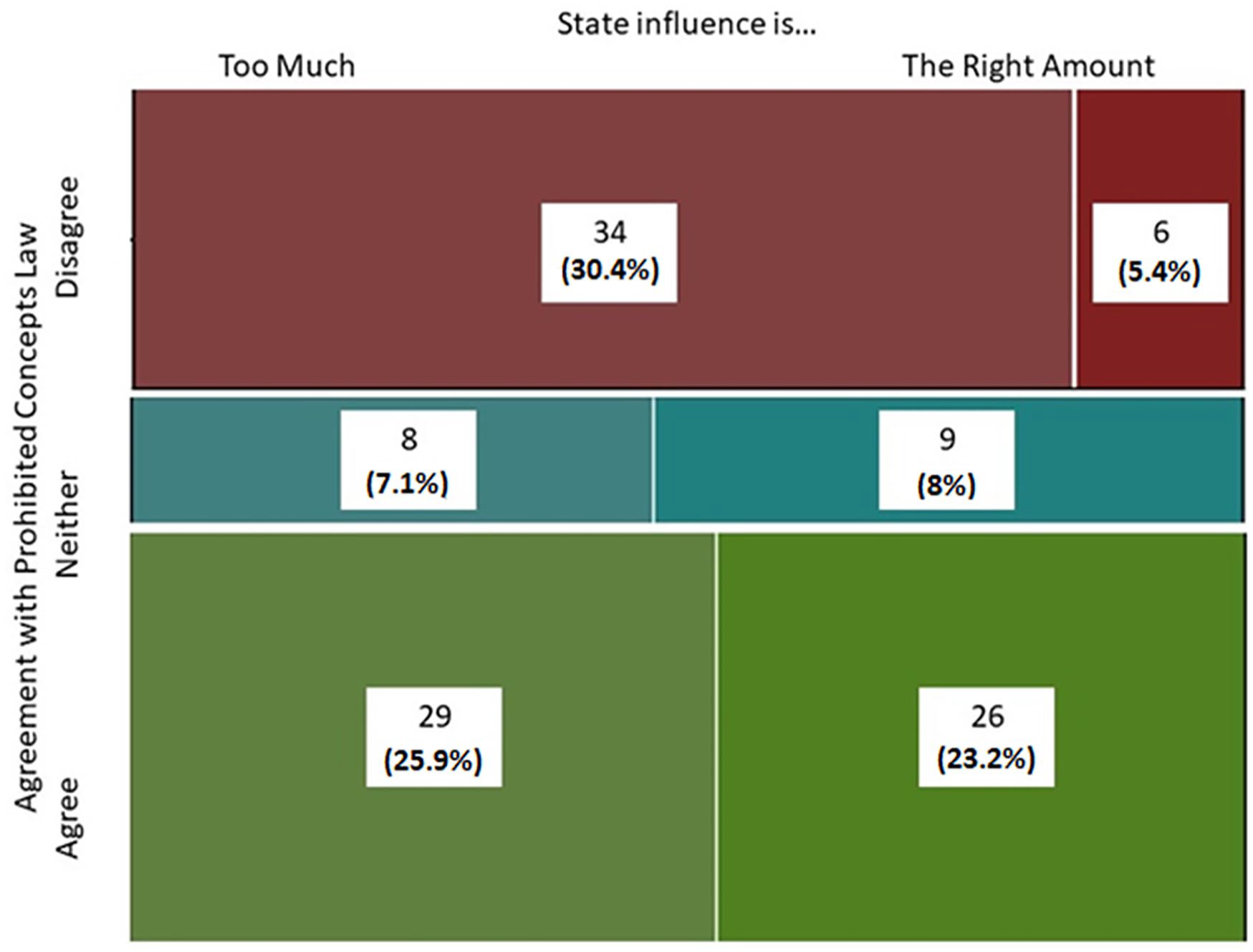
Responses on Prohibited Concepts Versus Curriculum Control Items*.
Discussion
With the Prohibited Concepts Law, the state influences district actions through threat of financial sanctions, and that very real threat drives behaviors at the district-level. This district-level behavior can result in direct threat to teachers’ jobs, as Tennessee teachers could face legitimate challenges to their employment when broaching issues of social justice in the classroom if faced with a board that has high levels of agreement with the law. This real threat was carried out in the highly publicized case of Matthew Hawn immediately after the law’s passage. However, the manner in which the law influences teacher behavior is more nuanced than operating merely under direct threats.
While the relationship between state-level governance and the localized work of teachers remains loosely-coupled under the Prohibited Concepts Law, the state policy still directly impacts teacher behaviors through a chain of policy messaging, or perceived threats, carried out at the district-level (Figure 1). Through this shift, state policies that do not carry direct consequences for teachers influence behavior (in this case, a chilling effect) by using district administrators as the means to enforce state-desired policy outcomes. Special interest groups such as Moms for Liberty have capitalized on this potential impact, becoming involved in school board elections and seeking to change the behavior of teachers and what is taught through district pressures (Gensterblum et al., 2024). As more school board members are elected who display strong stances on nationalized politics, their policy messages will influence the climate in which educators are operating and lead to further changes in behavior. District-level perspectives are important to understand because whether a threat to employment is actually real or perceived is a moot point. Teachers respond to policy messages from the district and change their behavior in response. In the case of the Prohibited Concepts Law, the exclusion of teaching topics related to social justice carry negative impacts for students.
This paper begins to determine the extent to which district-level administration support prohibited concepts laws by examining the perspectives of school board members and superintendents in the state of Tennessee. Overall, the majority of respondents in this sample expressed support for Tennessee’s Prohibited Concepts Law. However, there were differences in perceptions by positions. Given that superintendents often expressed neutrality toward the law, policy messages from school board member perspectives may be more likely to influence teacher behavior. The differences between school board members and superintendent perspectives should not be surprising as the roles are inherently different. Superintendents are professionally trained education experts who are hired into their position based on credentials and who can be dismissed by the school board (whether due to their displeasure or public pressure) and as such they may attempt to walk a more neutral and apolitical line in terms of controversy. Conversely, school board members, as elected officials, become more public facing individuals who have set terms and average less than four years of service (Kirst & Wirt, 2009). Board membership is not a career, and school board elections largely go under the radar of the public, so the consequences of upsetting the public are limited (Ford & Ihrke, 2020; Maeroff, 2010). Furthermore, in Tennessee, school board elections are now partisan, and the role of the school board more broadly has trended toward increasing politicization and partisanship as national issues become entrenched in local politics (Gensterblum et al., 2024; Henig, 2013; Henig et al., 2019; Reckhow et al., 2017; Shah et al., 2024). Taken together, much like teacher behavior, superintendent behavior is likely to be influenced due to both the state law and political pressures from their board. As such, the responses of school board members are more dynamic than their superintendent counterparts because the expectations and stakes attached to each role are different.
Furthermore, three findings in this study supports other scholarship suggesting that school boards have become more partisan and nationalized: (1) the lack of differences between location, (2) differences in perspectives on the Prohibited Concepts Law across party lines, and (3) unified perspectives on issues of curriculum control. First, there were no differences in responses based on location by Congressional District, nor were differences found when proximity to a national headlining event were examined. On one hand, the lack of differences using location measures may be influenced by the characteristics of politics in Tennessee, which has trended heavily Republican for the last several decades. For example, Tennessee’s recent January 2023 redistricting has left the state with only the 9th District trending toward Democrat. Even within districts, there is a great deal of variability due to the way districts have been constructed. For instance, the “Metro-Nashville” area is gerrymandered across four districts, the 4th, 5th, 6th, and 7th. Notably, the 5th District flipped to Republican after the most recent redistricting process. Additionally, the make-up of Congressional Districts does not allow for comparisons across regional demographic characteristics such as rural versus urban (which will be discussed further in the implications for future research). However, this lack of variation across locations could also reflect the national attention prohibited concepts legislation and issues of censorship have received in the media. Given the media frenzy and national attention given to cases like that of Matthew Hawn, it seems unlikely that survey respondents were not familiar with the law or a highly publicized case of censorship occurring within their state, regardless of their physical proximity to the event. It is also possible that one reason the chilling effect is so prominent in Tennessee is because of a combination of national politics and single-party state control, as political power is nearly wholly centralized with the Republican party which supports such legislation at the national level.
Second, there were differences in perspectives on the Prohibited Concepts Law down political party lines. These differences were not maintained when respondents were asked about control of the curriculum, demonstrating the shift school boards are experiencing from focusing on issue of local concern to those of national politics (Henig, 2013; Henig et al., 2019). Further, Republican respondents did not frame the Prohibited Concepts Law as a violation of local control, indicating an alignment with the national party platform. Due to a small sample size, these differences may be understated.
Finally, matching the trend of differences between political parties, there was overall a range of responses on the Prohibited Concepts Law item while respondents were more unified when asked about the issue of local control. While the Prohibited Concepts Law does allow the state to have increased control over curriculum, asking broadly about views of local control of curriculum was much less contentious. This suggests that respondents who agree with the Prohibited Concepts Law may be not be framing it as the state intruding on local decisions about curriculum, perhaps because it aligns with another aspect of their beliefs (such as religion) or due to a partisan platform.
Overall, examining the perspectives of superintendent and school board members illustrates the nuanced way in which threats to teachers’ work at the district-level can be both real and perceived under prohibited concepts legislation, leading to a chilling effect. Teacher responses may include actions reported in other studies, including self-censorship or outright avoiding of certain topics and aspects of the standards and/or curriculums (Anderson, 2023; Gallagher et al., 2021; Kaka & Hollstein, 2023; Misco & Patterson, 2007). These actions, in turn can result in negative consequences to students which could include disruption in educational experiences (Jochim et al., 2023; White, 2022), the perpetuation of systems of oppression and educational disparity (De Marrais & LeCompte, 1999; Trouillot, 2015), and the propagation of a negative climate for students who are members of vulnerable populations and or their allies (Gorse, 2022; Mustanski & Espelage, 2020). Given that Tennessee’s law does not have direct consequences for teachers, district-level administrators should consider the benefits and costs of their policy implementation and policy messaging. The results of this study also support a larger trend of district-level school politics becoming more partisan and nationalized. Future research can better examine how this plays out in local contexts.
Implications for Future Research
While these results are specific to the context of Tennessee, similar legislation is being passed or proposed across the nation and the topic of what should and should not be taught in schools remained salient going into the 2024 election cycle. Despite the limitations and need for further research, this study offers a first step in understanding the role district-level actors play in the chilling effect of Prohibited Concept Laws. An increased understanding of district-level administration as policy intermediaries is necessary for a better understanding of the contextual realities of contemporary teaching under the Prohibited Concepts Law.
Although there were no significant differences between responses when Congressional Districts were used as the unit of measure, it is possible that differences between regions could be captured using another more fine-grained geographic measure, such as school district or zip code. Perceptions of the law could still be influenced by whether or not a respondent’s district has witnessed challenges or their proximity to someone who is very outspoken for or against the policy (e.g., the presence or absence of an outspoken school board member with a strong stance) when a smaller unit of analysis is employed for location. However, given the importance political elites attach to anonymity in survey research (Kertzer & Renshon, 2022), there is the potential that using a finer grain unit of analysis may reduce the number of respondents who identify their location; but, the willingness of respondents to report location generally in this study is promising.
The use of a more fine-grained measure of location would also allow for an analysis of the characteristics of locations rather than the locations themselves. For instance, differences were found between locations grouped by different characteristics in the Jochim et al. (2023) study, and capturing such characteristics could yield more useful results by location. Additionally, other work is ongoing looking at the presence of special interest groups at the district-level (see Gensterblum et al., 2024) as well as the rising costs of mitigating conflict in districts (see Rogers et al., 2024). More precise measures of location would also allow for the inclusion of other data sources. For example, policy preferences could also be compared to local voting results. Other possible metrics of consideration could include rural/suburban/urban status, socioeconomic status, student racial make-up, or achievement data of respective areas. Finally, using a different measure of agreement, such as a feeling thermometer rather than a Likert Scale, would also allow for the use of other statistical tests using analysis of mean, which is limited here due to the ordinal nature of the variables.
Another consideration for future research is that with the exception of the few respondents who chose to write explanations about their answers, the data do not offer any explanation as to why respondents selected a response. For instance, nuanced individuals’ agreement or disagreement with Tennessee’s Prohibited Concepts Law could be dependent on individual interpretation of the law, previous experiences, personal beliefs, and/or background. A written text of the law was given, which, as explained previously, defines the prohibited concepts in very vague terms. Respondents could find agreement with the text if they were unaware of the controversies and the implementation of the law, though unawareness seems unlikely given the topic’s prevalence in national media outlets. Opinions on policy could also be based on individual sensemaking reliant on past experiences in education, their own identities and privileges, and belief systems (Coburn, 2005). For instance, two respondents included religion in their explanations of support for the law, suggesting that religious beliefs could also influence perspectives, regardless of political party. Given the increased partisanship of school board elections, and that results here show a split along party lines, it is also possible that respondents are merely repeating their party platform. Questions that gauge respondents’ reasonings for their perspectives could be helpful for better understanding policy positions.
Finally, potential reasons for non-response should also be considered, as there were cases where respondents chose not to state a policy preference at all. Overall, 27 respondents chose not to answer the question on the Prohibited Concepts Law and 24 chose not to respond to the question on curriculum control. There are many challenges in researching political elite populations such as school board members and superintendents (Kertzer & Renshon, 2022; Vis & Stolwijk, 2021) and an analysis of response patterns across multiple policy issues is ongoing and will offer descriptive insight into response trends (Frasier, 2024). However, the data do not allow for explanation of why respondents chose to respond to or opt out of questions aside from the few respondents who elaborated in the optional written comment section.
Non-response also differed based on respondent position. The superintendent response rate for the survey as a whole was threefold that of school board members (35.9% versus 12%), yet superintendents were more likely to opt out of the question and board members were more likely to take stronger stances on the Prohibited Concepts Law. These differences underscore the complex working relationship these two district stakeholders maintain, particularly in the context of dealing with controversy (e.g., Jochim et al., 2023; Rogers et al., 2024). More work on understanding why individuals chose a particular response (or chose not to respond at all) is needed to better understand how boards and superintendents may respond to the policy in real world contexts.
Conclusion
While other studies demonstrate that prohibited concepts legislation has led to a chilling effect in the work of teachers, the extent to which the threats teachers feel are real or perceived is unclear. This paper examined the perspectives of school board members and superintendents to broach this question. The results suggest that the majority of respondents supported the law, with school board members more likely to take strong stances. Through this loosely coupled system, state government is able to influence local actions. Conversely, there was strong agreement between both stakeholder groups and political parties regarding state control of curriculum, demonstrating that contention about Tennessee’s Prohibited Concepts Law was not merely a matter of concern about local control. Given the potentially negative impact of censoring social justice topics in schools, more work should be conducted to better understand the role district-level stakeholders play in this chilling effect in education.
Footnotes
Appendix A
Acknowledgements
The author would like to acknowledge and express gratitude for the assistance of graduate assistants Jewel B. K. Thomas, Nathan Hargis, Jackson McCloud, and Corey Wolfe, as well as undergraduate student Terry Mann, for their work in facilitating the administration of the survey.
Human Subjects
This research was approved by the Institutional Research Board of East Tennessee State University as an exempt study, c1122.10e-ETSU.

Author
AMANDA S. FRASIER is an assistant professor in Curriculum and Instruction at East Tennessee State University; email: