




Abstract
Research and practice that builds on family strengths is uniquely positioned to support children’s math learning in ecologically valid and culturally meaningful ways. Yet, there is little specificity as to what it means to take a strengths-based approach in early math research. We propose a conceptual framework for studying early math from a strengths perspective, as an extension of sociocultural theory and family funds of knowledge. We propose four construct domains critical to the study of strengths (family knowledge/skills, family routines, family interests, community knowledge) and two methodological considerations (participatory design, adaptability of resources). To demonstrate the framework as a tool for organizing cumulative knowledge, we classify exemplar strengths-based studies of early math (n = 11) according to the construct domains and methodology considerations. Our aims are to improve the specificity with which strengths-based perspectives in early math are operationalized and to provide a framework for evaluating literature and guiding future studies.
Keywords
The family and home environment play critical roles in supporting children’s early math learning. Studies that examine the role of the home environment in children’s math learning have been informed by multiple theoretical perspectives, including sociocultural and bioecological theories on the importance of caregivers as proximal sources of learning stimulation, support, and scaffolding for children (Daucourt et al., 2021; Eason et al., 2022). Increasingly, work in this area has also been influenced by neo-sociocultural theory that rejects deficit perspectives of families and communities, favoring empirical strategies that center the diverse array of resources and strengths that communities and families bring to children’s learning (Caspe et al., 2023; Gennetian et al., 2021; Grazi et al., 2020; Montoya-Ávila et al., 2018; Sonnenschein et al., 2018).
Contemporary strengths-based perspectives in early math have been largely inspired by the funds of knowledge work of González et al. (e.g., González & Moll, 2002), and by scholars who have highlighted the critical roles of informal education within families and communities (e.g., teaching children through their participation in daily routines, creating crafts together, and/or trade apprenticeship) as both cultural mediators and key learning contexts (e.g., Civil, 2002, 2007; Greenfield et al., 2000; Ladson-Billings, 1995; Lave, 1988; Rogoff, 2016; Rogoff et al., 1993). Current strengths-based perspectives in early math have also been influenced by strengths-based perspectives in literacy (e.g., Flores et al., 1991; Gadsden, 2004; K. Gutiérrez, 2008; K. D. Gutiérrez et al., 1999). Together, these lines of work have challenged researchers and educators to more fully consider the assets that all families—across race, ethnicity, cultural heritage, social class, and language background—bring to their children’s learning, including cultural assets, knowledge, talents, interests, and experiences. Family math research and practice that is aligned with, uncovers, helps build, and capitalizes on family strengths appears uniquely positioned to support early math learning in ecologically valid, culturally meaningful, and powerful ways.
Yet, there is little specificity or consistency in the field as to what it means to take a strengths-based approach in early math research, or how strengths-based approaches should be operationalized (i.e., what the primary dimensions or constructs of family strengths are) when studying early math learning. Empirical approaches to studying early math that are positioned as strengths-based vary considerably, including variation in how strengths are conceptualized, operationalized, and incorporated into research designs. Our goal is to help organize this burgeoning work and offer a conceptual framework for studying early math from a strengths-based perspective.
We identify four construct domains of sociocultural strengths that are critical to early math learning: (1) family knowledge, knowhow, and skills; (2) family routines; (3) family interests; and (4) community knowledge, networks, and resources. We also identify two critical methodology and design considerations of strengths-based approaches to studying early math, including (1) participatory design with families and communities and (2) the adaptability of intervention materials, activities, and resources to align with diverse family strengths. Next, we highlight a small set of empirical studies (n = 11) that take a strengths-based approach to early math, and we code and classify each study’s approach along each of our six proposed dimensions of family strengths. Findings from the coding demonstrate both qualitative and quantitative variability in the use of family strengths in early math research, with implications for researchers and strengths-based work in the field of early math.
The Role of the Family in Early Math Development
Multiple theoretical perspectives support the importance of the family and the home environment in early math development. Sociocultural theory, for example, indicates that children learn and develop through their engagement in social and cultural interactions with adults, including parents and caregivers. Specifically, caregivers can provide guidance to directly support children’s learning and understanding (Rogoff, 1990; Vygotsky, 1978). Taking this into account when considering informal activities and contexts, playful learning theories also indicate that adult-child engagement in adult-initiated, child-directed activities—such as guided play and games—offer a particularly powerful chance to support children’s learning and development (Zosh et al., 2018). In the context of early math development, these perspectives suggest that caregiver-child interactions, such as using math talk and math language or engaging in math-related family activities, play, and games, are optimal contexts for supporting children’s math learning as they provide guided math interactions in contexts that are meaningful and engaging for children and families.
In addition, Bronfenbrenner’s (1979) ecological systems theory describes development as being influenced by environmental systems, ranging from proximal processes in contexts that directly contain the child (e.g., the home) to distal systems (e.g., social policy) that indirectly affect development. Within ecological systems theory, the family is viewed as a microsystem, with caregiver-child interactions expected to have direct influences on children’s development. Importantly, contemporary revisions of this theory situate culture as a key proximal influence within the family (and other) microsystems (Vélez-Agosto et al., 2017). For early math development, family beliefs and attitudes towards math and family interactions that engage children with math concepts have been highlighted as key potential influences on math learning in the family microsystem (Daucourt et al., 2021; Eason et al., 2022). Further, mesosystems, which are connecting interactions and processes that operate across microsystems (e.g., social connections across home, school, and community)—including pathways through which cultural practices flow across microsystems (Vélez-Agosto et al., 2017)—also influence children’s development. In early math learning, the mesosystem may include home-school collaborations around math (e.g., school-sponsored family math nights) and opportunities for shared family math interactions in community settings, such as outdoor play spaces, libraries, grocery stores, and bus stops (Bustamante et al., 2019; Leyva et al., 2022).
Consistent with these theories, many empirical studies provide evidence for the importance of families in early math. Systematic reviews and meta-analyses indicate that the home math environment positively relates to children’s math outcomes (Daucourt et al., 2021; Eason et al., 2022; Mutaf Yildez et al., 2020). Studies have found positive relations between children’s math abilities and the frequency of family engagement in formal learning activities (e.g., practicing sums or math facts, writing numbers; Skwarchuk et al., 2014), informal learning activities (e.g., singing counting songs, reading number or counting books; LeFevre et al., 2009), and play and games (Niklas & Schneider, 2014; Zhang et al., 2020). However, from a strengths-based perspective, it is important to consider limitations to the extant literature, including how math enrichment in the home and children’s math knowledge were measured (e.g., narrow definitions of what counts as math, measures administered only in English) and how the home environment was operationalized (e.g., overly exclusive focus on resident parents, mostly mothers, as primary caregivers).
Within the home math environment, many studies have also examined the role of caregiver-child (primarily mother-child) interactions and the use of math talk and math language for children’s math development. Findings indicate that parent-child talk about numbers and math concepts during activities and play relates to children’s math abilities and math learning (Gunderson & Levine, 2011; Ramani & Scalise, 2020; Ramani et al., 2015) and can mediate the relations between socioeconomic status and children’s math performance (Lombardi & Dearing, 2021). Further, evidence suggests that both the amount and type of talk can influence children’s math development. For example, studies show that talk about advanced math concepts (e.g., cardinality) relates to children’s math learning, in contrast to talk about foundational math concepts (e.g., counting; Ramani et al., 2015). Studies have also shown that when parents use prompts (versus statements) about number, children talk about higher numbers and parent-child conversations about number continue longer (Eason et al., 2021). As with the findings described above, results should be considered in the context of limits to conventional methods and conceptualizations used (e.g., focus on parents/mothers rather than other caregivers, including extended family and community members; narrow, school-based, and/or decontextualized operationalizations of math talk and math knowledge).
However, across studies, there is wide variability in family math engagement, including the frequency of engaging in math activities and the quality and quantity of math talk that families use when engaging in activities together (e.g., Douglas et al., 2021; Levine et al., 2010; Lukie et al., 2014; Ramani et al., 2015; Zippert & Rittle-Johnson, 2020). Family math talk and interactions relate to children’s math achievement at school entry (Dearing et al., 2022; Eason et al., 2021), and there is considerable interest among researchers and practitioners in supporting opportunities for early math learning and engagement in historically marginalized communities. For children who may appear to have fewer opportunities, it is increasingly clear that focusing on family strengths, rather than deficits, is key. Strengths-based perspectives redefine the ways we consider opportunities for math engagement and push the field toward a better understanding of opportunities that already exist in families and communities—particularly opportunities that exist in spite of, and in response to, disadvantage and marginalization (Iruka et al., 2022). Precisely what it means to be strengths-based in the early math field, however, has yet to be fully defined. Here, our primary goal is to help build clarity around key dimensions in the operationalization of family strengths in early math and to help set priorities for early math study design that reflect a strengths-based epistemology.
Strengths-Based Approaches in Early Math
There is a long history in the study of child development of taking deficit-based approaches to the study of minoritized and disadvantaged families (Iruka et al., 2022; Miller-Cotto et al., 2022). Evidence of a deficit orientation is seen in the discipline’s centering of white middle-class families as a standard for healthy development, and in the overgeneralization of white middle-class norms to intervention work with families of other races, ethnicities, economic opportunities and constraints, and languages (Bruno & Iruka, 2022; Cunningham, 2021; Gardner-Neblett et al., 2021; Melzi et al., 2018). Strengths-based approaches contrast this deficit orientation, taking various perspectives into account to center and build on families’ strengths, which can also serve as a source of resilience for families (Amatea et al., 2006; N. Cabrera et al., 2022; Gennetian et al., 2021; Montoya-Ávila et al., 2018; Sonnenschein et al., 2018). As described above, one of the foundational areas of work that supports this contrast to deficit-based work is the funds of knowledge perspective, originally developed in the anthropology of education literature (Moll, 1990, Moll et al., 1992).
Based on years of ethnographic work with families of school-age children, the funds of knowledge perspective calls attention to the rich collection of intellectual, social, and cultural assets that families and communities draw on and use strategically to help their children thrive, whether under conditions of opportunity and privilege or under conditions of systemic oppression and underinvestment. This collection of accumulated strengths includes kin and fictive kin networks, community and cultural experiences, and cultural, work-related, household, and religious knowledge, skills, and practices (Gonzalez, 2004; Gonzalez et al., 2005; Moll et al., 1992; Vélez-Ibáñez & Greenberg, 1992). When considering children’s learning and cognitive development, recognizing families’ funds of knowledge takes into account caregiver, child, and family areas of expertise and the cultural and social contexts of children’s development, which allows for a more holistic perspective and more meaningful engagement (Gonzalez et al., 1995; Moll et al., 1992). In considering the role of funds of knowledge in teaching and learning, researchers collaborated with teachers to engage in household visits and ethnographic interviews with their students’ families. Teachers learned about caregivers’ and children’s skills and interests and, in turn, incorporated these into their classroom lessons, connecting experiences across families and subject areas, including math, science, and culture (Moll et al., 1992).
Many studies that build from early funds of knowledge work similarly focus on family-school partnerships and how teachers can use family funds of knowledge in the classroom. For example, pre-service teachers are taught to learn about families’ knowledge, including adults’ expertise, children’s hobbies, and family interests to take a strengths-based approach (Knight-McKenna & Hollingsworth, 2016; Knight-McKenna et al., 2019). In early education settings, teachers are encouraged to learn about family knowledge, work, values and traditions, caregiving and household responsibilities, language background, community engagement, what they enjoy, “know a lot about,” and their interests and routines (Allen et al., 2002; National Center on Cultural and Linguistic Responsiveness, 2022). These can include activities that families regularly engage in such as gardening, literacy and storytelling practices, religious practices, food routines, play, exercise, and engaging with other families in their community (Allen et al., 2002; Cun, 2021; Denton & Borrego, 2021; Green et al., 2004; Knight-McKenna et al., 2019; Leyva et al., 2022; McWayne et al., 2013, 2022; Melzi et al., 2018). Importantly, these activities and practices focus on families’ areas of knowledge and aspects of their daily lives, considering that families each have their own funds of knowledge and certain areas may be more culturally-relevant or meaningful to some families than others (Melzi et al., 2018).
Although much of the work on funds of knowledge is centered on teachers and formal education settings, its relevance to the study of learning at home, in the community, and other informal settings is critical. If we are to understand children’s learning from ecological systems and sociocultural perspectives, then we must understand the ecological and sociocultural assets that families and communities have available to invest in their children and the strategies they use to do so. As Fuller and García Coll (2010, p. 559) eloquently explain, for example, key advances born out of developmental science with Latine children and communities have been “seeing children’s learning and motivation as situated within communities that exercise cognitive demands and social expectations, advancing particular forms of cognitive growth that are embedded within social participation and the motivated desire to become a competent member.” Similar points have been repeatedly underscored by researchers in clinical and counseling psychology (e.g., Whaley & Davis, 2007) and medicine (e.g., Betancourt et al., 2003; Fox, 2005); these scholars argue that effective interventions must be ecologically meaningful and build from family and community strengths.
In the context of math learning, funds of knowledge work by Civil et al. has uncovered many opportunities for math practices and engagement within families’ regular life experiences. These include family activities such as cooking, shopping, sewing, managing money, gardening, engaging in sports and music, and doing household chores (Civil et al., 2008; Gonzalez et al., 2001; Williams et al., 2020). Further, additional research that has drawn directly from Civil et al.’s work also highlights that these opportunities for math practices include interactions and activities that build on families’ social capital and community and cultural experiences (e.g., families’ multilingualism, lived experiences, histories, and the racial, ethnic, and cultural contexts of caregivers’ and children’s math development (Cunningham, 2021; Ishimaru et al., 2015; Karsli-Calamak et al., 2022; Lewis et al., 2020). Importantly, these types of opportunities for math engagement may also build on children’s natural interests in math, such as math that occurs through routines, interests, and families’ funds of knowledge (Ginsburg et al., 2012). Moreover, findings indicate that children naturally draw connections between family funds of knowledge and their mathematical play and engagement. For example, when children engage in free play at school, their play draws from their experiences of household activities, parents’ occupation, family activities, and other life experiences (Papandreou & Tsiouli, 2022).
It is critical to note, however, that funds of knowledge work on early math has raised the issue of differing conceptions of “what counts as math” (Civil, 2006; Gonzalez et al., 2001). While families may regularly engage in math learning chances with their children in real-life contexts (e.g., assisting with managing a family business; engaging in family members’ work that involves sewing, mechanics, carpentry, construction, agriculture, etc.; Civil, 2007, 2016), they may not consider these to be math experiences or connect these daily experiences to more formal math experiences in school settings (Beltrán-Grimm, 2024; Civil, 2007; Gonzalez et al., 2001; Williams et al., 2020). Further, in some cases, these math experiences may not be valued by researchers or educators in the same way that other school-related math experiences are (Civil, 2006, 2007). As early math researchers, this point should resonate and underscore a challenge: how can our discipline draw attention to, help uncover, and help children benefit from the broad range of ways that families regularly engage in math and math-related tasks? This paper was driven, in large part, by a desire to deepen the field’s understanding in this area. We also see too little specificity in the field about what it means to take a strengths-based approach in early math and a lack of clarity around the key components of family strengths that are relevant for early math learning. In particular, as there begin to be increasing empirical studies in early math that are positioned as strengths-based, it is critical to organize and operationalize what it means to take a strengths-based approach in these types of research designs, methodologies, and contexts to strive towards rigor and avoid tokenism or perfunctory application (e.g., adopting “strengths-based” terminology without critical, anti-deficit interrogations of and strengths-oriented improvements in research methods, extant evidence, and theoretical framings used to study children, families, and communities). Accordingly, our goal was to draw from existing literature in family math to help identify key dimensions and components of family strengths in early math and develop a conceptual framework for strengths-based approaches to the study of family math and early math development. In doing so, we provide a framework for organizing some of the key constructs and methods that are well-suited for studying these constructs from a strengths-based perspective.
Conceptual Framework for the Study of Family Strengths in Early Math
In proposing a conceptual framework for the study of family strengths in early math, we first define four construct domains that are central to the study of family strengths in early math. Next, we highlight two methods that have exceptional value in taking strengths-based approaches to studying early math in family and community contexts. Figure 1 provides a summary of the framework, including the four distinct, but overlapping construct domains.

Conceptual Framework for the Study of Family Strengths in Early Math.
Key Construct Domains in the Study of Family Strengths in Early Math
For the study of early math, we divide family strengths into four key construct domains: (1) family knowledge/skills, (2) family routines, (3) family interests, and (4) community knowledge. These domains bring together funds of knowledge with the growing body of empirical work on family math engagement. These domains are also informed by developmental theory and research, more broadly, on aspects of family life that are central to children’s socialization and learning.
Family Knowledge, Knowhow, and Skills
Through lived experiences, social networks, and formal and informal education, families build knowledge, knowhow, and skills that are critical resources for supporting their children’s learning (National Academies of Sciences, Engineering, and Medicine, 2016). This includes, but is not limited to, knowledge of facts and information, practical knowhow and expertise, cultural wealth and traditions, and a range of skills. Understanding and building from accumulated knowledge and skills within families is a critical component of strengths-based research. The value of incorporating the knowledge/skills of families, particularly those whose knowledge has been marginalized in developmental science, builds directly from funds of knowledge and sociocultural perspectives on learning. In early math specifically, building on family knowledge that is built through culture and lived experiences for adaptive, thriving purposes can help make math interactions more meaningful for children and families (Lewis et al., 2020; McWayne et al., 2013; Melzi et al., 2018). Math interactions that draw on family knowledge also hold unique promise for positively impacting children’s math identity development (Ishimaru et al., 2015). Additionally, incorporating family knowledge and knowhow may make early math intervention efforts more accessible and relevant to families (McWayne et al., 2022; Melzi et al., 2018), increasing the chances of enriching interactions. For example, this could include building directly on family knowledge and practices, such as cooking or oral storytelling (McWayne et al., 2022; Melzi et al., 2018), which are more meaningful and accessible to families than practices that are less common or outside of their areas of expertise.
While much child development research focuses exclusively on mother-child interactions, strengths-based perspectives call attention to the ways that children’s development is critically supported by many other caregivers and community members including (but not limited to) fathers, grandparents, extended family, fictive kin, and elders in the community (N. J. Cabrera et al., 2018; Civil, 2002, 2007; Coard, 2022; Dunifon, 2013; Jarrett et al., 2015; Gonzalez et al., 2001; Green et al., 2004; McWayne et al., 2013; Mollborn et al., 2011; Tyrell & Masten, 2022). A small number of studies have focused on fathers’ roles in early math learning, or the joint contributions of fathers and mothers to early math learning (e.g., Huang et al., 2022; Ren et al., 2022; Thomson et al., 2020). Although the evidence is mixed (Ren et al., 2022), one study indicates synergistic associations between maternal and paternal support of math learning and child outcomes. Specifically, Huang and colleagues found that mothers’ and fathers’ scaffolding of mathematics was more positively associated with children’s math learning when combined with high levels of scaffolding by the other parent (Huang et al., 2022).
We are not aware of studies directly examining grandparent or extended family engagement in early math learning. We suspect this is for some of the same reasons that fathers have often been excluded from developmental science (e.g., assumptions about who is a primary caregiver and involved in caregiving, N. J. Cabrera et al., 2018). The lack of work on extended family is also a function of euro-centric biases in developmental science, which have ignored the importance of caregivers beyond parents, despite their presence and central roles in the home environment (Coard, 2022). Critically, this bias increasingly distances our research from the reality of children’s lives.
Dramatic changes in household composition in the United States have been unfolding for decades, driven by trends in immigration, economy, and marriage and family policy. Over the last 50 years, the proportion of children living in co-resident parent-only households has declined while the proportion living in other household compositions has increased, including more children living in households with grandparents, other relatives, and multiple, unrelated families under the same roof (Fomby & Johnson, 2022; Millán, 2022). Demographers have referred to this contemporary home life of young children as “stable complexity” (Fomby & Johnson, 2022). A strengths-based science of early math requires greater attention to the current reality of caregiving and the promise that knowledge and skills embedded in these relationships hold for supporting children’s math learning (e.g., Dunifon, 2013).
Studies that focus on family knowledge/skills can range from directly incorporating families’ individual knowledge/skills (i.e., identifying and building from knowledge at the level of the individual) to relating to knowledge/skills more generally (e.g., building from general cultural practices, areas of knowledge/skills more broadly). This may include opportunities for families to share information about their children’s or families’ areas of knowledge, or other information about their context, perspectives, or routines (Fenton et al., 2016; Lewis et al., 2020; Leyva et al., 2018; Quintos et al., 2019).
Finally, it is important to acknowledge that building on family knowledge/skills is distinct from providing families with information in an attempt to increase their knowledge, especially if this is done without taking into account what families already know, what they are interested in knowing, or how their knowledge is culturally-situated. Without this information, making assumptions about what children’s home environments or family contexts lack is another way of taking a deficit-based approach (E. R. Auerbach, 1989; E. Auerbach, 1995). Studies that provide families with new and culturally meaningful knowledge can be critical for promoting children’s learning and development, but we must consider family knowledge/skills as the starting point.
Family Routines
Early math concepts are prevalent in daily family life, with typical family routines and activities offering many opportunities for math engagement. Within developmental science, household routines have long been considered powerful contexts for the scaffolding and socialization of early learning. This power comes through routines’ frequency and consistency, the ways routines are enriched with and informed by family knowledge and skills, and the messages they convey to children about family priorities, values, and goals (Grusec & Davidov, 2010; Miller & Goodnow, 1995). Routines often serve as a conduit through which funds of knowledge are shared with children in a culturally meaningful, familiar context (Caspe et al., 2023; Leyva, 2019; McWayne et al., 2022; Melzi et al., 2018). For example, routines provide families with many chances for sharing funds of knowledge that are highly mathematical, such as when shopping for and preparing family recipes that call for precise measurement, arithmetic, patterning, or spatial language, visualization, and reasoning skills (Moll et al., 1992; Spagnola & Fiese, 2007).
Family routines also offer opportunities for caregiver-child engagement with attention to household efficiency, a concept that has been a defining principle of economic perspectives of family investments in children (e.g., Becker, 1974). Routines, by definition, are fully integrated into families’ daily lives, and learning interactions that occur within routines can thereby minimize time or energy demands on families (e.g., interactions around measurement while preparing a meal). In this way, routines provide math learning chances that neither interrupt nor add stress to daily life, which may be increasingly valuable for families facing stressors such as systemic racism, discrimination, language barriers, migration and documentation stressors, or poverty (Evans & Wachs, 2010; Iruka et al., 2022).
There is a large literature documenting the ways marginalization, oppression, and disadvantage can challenge caregiving and family life (Jones et al., 2020; Masarik & Conger, 2017). When facing these stressors, however, families use routines as sources of stability, consistency, and predictability (Weisner, 2010) and efficient opportunities for their children’s social and academic skill building (Crespo et al., 2013; Gennetian et al., 2019; Kuchirko et al., 2021; Mayberry et al., 2014; Serpell et al., 2002; Spagnola & Fiese, 2007). Given the combined value of routines as conduits for mathematically rich funds of knowledge, sources of stability, and efficient means of socialization, we believe more research into the ways families can be supported in their efforts to uplift children’s math learning from their daily routines holds exceptional promise for helping families initiate and sustain engagement in early math.
As one signal of the promise routines hold for strengths-based early math learning, it is useful to consider the role of routines in early literacy. Literacy researchers have highlighted that better understandings of families’ routines (e.g., dinner, bedtime, and morning/wake up routines) as literacy learning contexts have helped improve children’s literacy learning chances (Carter et al., 2009). Critical to these lines of work were efforts by literacy researchers to work together with families to discuss, identify, and consider areas within routines that individual families might bring in more learning opportunities and ways to build from areas where their family was already successful in creating learning chances (e.g., identifying through discussions with families that they feel strong in their evening routines but would like to add more learning opportunities to their after school routines; Carter et al., 2009).
In early math, routines similarly have the potential to be central to promoting math development from a family strengths approach, as many math learning opportunities exist within these family routines as well (Davis & Kelly, 2019; LeFevre et al., 2009). These opportunities could include talk or other interactions (e.g., gestures, modeling) related to mathematical concepts during regular routines and household tasks. For example, studies have shown that parents and children engage in math talk during household activities and routines, including mealtimes (e.g., “well, eat four pieces;” Susperreguy, 2016) and cooking and food routines (e.g., “we’re gonna double the recipe”; Leyva et al., 2018; Nelson, 2021). Studies have also examined math interactions during grocery shopping (Hanner et al., 2019; Leyva, 2019) and food pantry visits (Shivaram et al., 2021) and have used grocery shopping, bedtime routines, and morning routines as contexts for engagement in math and computational thinking (Grover et al., 2022). Qualitative findings from a study of Latine caregivers indicate that caregivers identify household routines as times when they and their child use math in their daily lives, including routines like shopping, managing finances, planning family scheduling and transportation, and doing household tasks (Caspe et al., 2023).
Studies that focus on family routines can range from directly incorporating families’ individual routines (e.g., their personal family morning routine), to incorporating routines in a more general way that is not specific to individual families (e.g., general morning routines), to relating to routines more generally (e.g., highlighting that math can be a part of everyday life, including daily routines). By encouraging families to incorporate or build on math concepts present in their routines, these studies allow families to engage in math in a meaningful, relevant way, that aligns with and does not disrupt the structure of their daily lives (Grover et al., 2022; McWayne et al., 2022; Melzi et al., 2018).
Family Interests
Beyond routines, early math concepts are also ubiquitous within a diverse array of families’ joys, hobbies, and interests including reading, games, music, dance, art, doing puzzles, storytelling, athletics, playing outdoors, and gardening, among others. And, these meaningful aspects of family life are, like routines, not only rich with math learning chances, but also informed by and conduits for funds of knowledge (Moll et al., 1992). Some activities may already be specifically focused on early math (e.g., counting books, math and number games, numerical puzzles; Zippert et al., 2017) while others may not; however, it is difficult to identify any family interest that does not open up opportunities for early math engagement.
In addition to building from funds of knowledge, studies that examine family interests in the context of math learning also build from theories and research on the home math environment and strengths approaches in early education. In considering research on the home math environment, many activities that are considered to be part of the home math environment build from children’s or family interests (e.g., playing, reading storybooks, playing board and card games, making collections, singing counting or rhyming songs; LeFevre et al., 2009; Skwarchuk et al., 2014). Strengths-based approaches similarly examine aspects of children’s engagement in activities at home. For example, Fenton et al. (2016) discuss teacher-family interactions where parents identified activities that their children were interested in at home (e.g., dinosaurs, constructing with Legos). Teachers then provided ideas for learning activities related to these interests and a description of math concepts that could be considered within these activities (e.g., sorting dinosaurs by height and size order, making patterns and estimating number of Legos used; Fenton et al., 2016). Similarly, Grover et al. (2022) co-designed activities with families that involved math and computational thinking. Their set of activities included activities that were familiar to families and related to children’s interests (e.g., creating art, building with playdough, playing digital games).
Research on children’s interest in early STEM also indicates that incorporating engineering activities into regular activities and existing family interests can promote the development of interest in STEM (Pattison et al., 2018). Based on these findings, and theoretical perspectives that emphasize the importance of meaningful learning interactions (Rogoff, 1990; Vygotsky, 1978), we expect that building on family interests could similarly promote interest and engagement in early math. Consistent with family routines and family knowledge, studies that focus on family interests can range from directly incorporating families’ individual interests (i.e., at the level of the individual) to building on family interests more broadly, in a way that is not specific to individual families (e.g., broad areas of interest, such as music, sports, cooking), to relating to family interests more generically (e.g., highlight that math can be a part of the family’s everyday life, including what they are interested in).
In considering family interests, it is also important to acknowledge that there may be potential overlap between family interests and family routines. For example, some interests, such as cooking or gardening, could also be part of regular daily routines. However, we chose to retain each of these as their own subcomponents of math use in everyday life, because whether an activity is an interest or a routine may lead to differences in the type and quality of family engagement. Further, because of these potential differences, engaging in math within interests and routines may have different implications. For example, prior research on math anxiety suggests that the influence of parent math anxiety on children’s learning can vary based on the context of parent-child interactions. Specifically, studies have found that parent math anxiety relates to children’s math learning in the context of parent-child interactions during math homework (Maloney et al., 2015), but not in the context of interactions using a math iPad app (Schaeffer et al., 2018). Similarly, it is possible that engaging in routines (e.g., chores, household tasks, grocery shopping) may yield different emotional contexts (e.g., stress, anxiety), and therefore outcomes, than engaging in interests (e.g., reading, play, games).
Community Knowledge, Networks, and Resources
Beyond family, communities can hold many strengths for young children’s math learning. Early math researchers have drawn attention to opportunities for families to engage in math during community events (e.g., family math nights; Bottoms et al., 2017) and in community settings (e.g., outdoor play, playgrounds, community gardens, libraries; Davis & Kelly, 2019; Zippert et al., 2017). It is worth noting, however, that situating math learning in the community does not necessarily make math engagement strengths-based (i.e., a family math night at school, for example, based entirely around unidirectional knowledge sharing from teachers, as the experts, to families, as the learners, is not strengths-based). Analogous to strengths-based math in the home environment, strengths-based math in the community can be defined as learning chances that have been grown out of, aligned with, uncovered within, or designed to complement community (a) cultural and social assets; (b) knowledge, skills, and expertise; and (c) routines, priorities, and interests. As Gonzalez et al. (2001) describe, communities are “repositories of resources” that can be used to support young children’s math learning. This remains true for families living in hyper-segregated and underinvested communities in which social capital and cultural wealth are key developmental assets for children (Yosso, 2005, 2014); in the face of structural racism and concentrated poverty, larger family systems and the community are critical resources, whether by being directly involved in children’s learning or indirectly affecting children’s opportunities for learning through social and cultural capital (e.g., providing wisdom on how to navigate institutions that would otherwise be marginalizing for families).
According to Gonzalez et al. (2001), one key aspect of building on community strengths is reciprocal social networks of trusted community members; these networks become “contexts . . . where children have ample opportunities to participate in activities with people they trust” (Moll et al., 1992). From this perspective, practitioners and scholars have worked to build on opportunities for families to engage with each other around math learning (e.g., family math nights, parent groups and meetings; Bottoms et al., 2017; Lopez & Donovan, 2009; Quintos et al., 2019), and emphasize the importance of community resources and relationships with other families (Green et al., 2004; McWayne et al., 2013). These opportunities to engage in math in community settings also provide contexts for math engagement that connect to cultural practices and racial, ethnic, and cultural identities, and for children to identify themselves and others in their family and community as “knowers and doers of mathematics” (Cunningham, 2021; Ishimaru et al., 2015; McWayne et al., 2013).
Strengths-Based Approaches to Studying Early Math: Methodology and Design Considerations
Our second primary aim is to help identify research methods that are of critical importance when studying early math from a strengths-based perspective. While our ideas have been informed by seminal qualitative works, we focus here on methods that can contribute to strengths-based quantitative research designs, including those testing intervention efficacy and effectiveness. We uplift two design considerations we see as crucial to strengths-based empirical studies: (1) the extent to which study designs have been informed, designed, and implemented in partnership with family, family-facing practitioner, and/or community perspectives and knowledge and (2) the extent to which early math resources and materials are adaptable to diverse and dynamic family contexts.
For this second aim, we take as a given that researchers will situate our recommendations within best-practice conventions and concerns for any quantitative research study (e.g., internal validity). In addition, we start with the hope that researchers recognize the design implications of our review of sociocultural strengths, both implicit (e.g., are researchers starting with a deficit vs. strengths-based mindset?) and explicit (e.g., who is included as a “family” when sampling?; how are concepts such as “math” and “math engagement” defined?; how is math knowledge measured and scored—for example, considering average scores versus the distribution of responses, recognizing children’s understanding of concepts beyond school-based math, having assessments and accepting responses in multiple languages). Developmental theory and our cumulative empirical knowledge are the bedrock for new investigations of children’s learning, including early math learning. We also know, however, that contemporary developmental theory is increasingly skeptical of the generalizability of much of our cumulative knowledge, because that empirical work has disproportionately addressed the development of children growing up in high-income countries and within most of those contexts disproportionately focused on the White middle-class, empirical work in the US (Greenfield et al., 2003; Iruka et al., 2022; Nielsen et al., 2017).
Participatory Design with Families, Family-Facing Practitioners, and Communities
To organize methodological approaches by which researchers can identify, better understand, and build from family and community strengths, we draw heavily on Druin and colleagues’ model of participatory research with children, through which they have co-designed learning technologies (e.g., Druin, 2002; Muller & Druin, 2012). Muller and Druin describe the goal of research situated in this model as an effort to build an: “in-between” region, or “third space,” is a fertile environment in which participants can combine diverse knowledges into new insights . . . third space experiences include challenging assumptions, learning reciprocally, and creating new ideas, which emerge through negotiation and co-creation of identities, working languages, understandings, and relationships, and polyvocal (many-voiced) dialogues across and through differences.” (Muller & Druin, 2012, p. xx)
Creating “in-between” regions with families, family-facing practitioners, and communities is a key method for strengths-based research in early math (for work on this topic in the fields of literacy and STEM, see K. Gutiérrez, 2008; McWayne et al., 2020). Specifically, participatory design provides a mechanism for family and community knowledge, skills, routines, and interests to cross-fertilize with scientific knowledge and early math researcher expertise to make culturally-situated and usable programs (Chew et al., 2021; DiSalvo et al., 2012). From a participatory perspective, families and communities may take on four roles in the early math research process: users, testers, informants, and/or design partners (Figure 2). These roles are arranged in a nested fashion, from user to design partner, given that research using methods in the outer levels generally involves methods in the inner levels, but the reverse is not necessarily true (e.g., a study might only include families as users of an intervention, never moving to the tester, informant, or design partner level).

Participatory Design for Strengths-Based Early Math Research (adapted From Druin, 2002).
Importantly, each level of this model offers additional affordances and constraints. While moving towards the outer ring and operating in full partnership with families and community members will likely result in designs that more thoroughly center community strengths and assets, these approaches require considerable time, resources, and trusting relationships. Therefore, researchers and communities should consider project needs as well as their capacity and resources to decide what level of engagement is best. In this way, researchers, families, family-facing practitioners, and communities can work together within the constraints of their specific partnership, with opportunities to consider, build on, and incorporate family and community strengths at each level. More detailed explanations of each level are provided in the Supplemental Materials.
Adaptability/Malleability of Resources
Finally, when families are provided with resources and suggestions about early math, another component of family strengths in early math is whether and how families are able to adapt and generalize those resources for use in their lives. A key question for evaluating resources, materials, and/or programs from a strengths-based perspective should be: to what extent do these resources and materials support family agency and innovation while maintaining the integrity of core early math learning principles? The suitability of resources for families’ contexts and lives is important for whether or not families are able to use them successfully and meaningfully (Grazi et al., 2020). While this can be informed by input or collaboration with families, it is also important to consider how resources and materials that are provided to families may range from being static, inflexible, or ungeneralizable beyond a narrowly-defined learning opportunity to being adaptable, malleable, or generalizable across a wide range of learning opportunities, contexts, and repeated uses by families. In contrast to resources that are more static, adaptable resources allow families to continuously engage in math in a way that is suitable for their family. In this way, malleable resources might be adapted to connect with families’ own knowledge, interests, and routines as well as child developmental level, which has the potential to facilitate continued engagement and interest.
Studies that highlight the potential adaptability of resources build from multiple theoretical and empirical perspectives, including funds of knowledge, the home math environment, and behavioral economics. Many of these studies have aimed to provide materials that include suggestions for engagement that families can directly incorporate and extend in their own lives. For example, Leyva et al. (2018) provided families with strategies for engaging in math with their children through existing family food routines, and provided families with individualized practice and feedback on their engagement in these strategies during their Food For Thought program meetings. By design, strategies are inherently flexible and malleable to different contexts, however, the researchers also ensured adaptability by providing a range of strategies for different food routine contexts (e.g., grocery shopping, cooking, eating out, eating in; Leyva et al., 2018). Accordingly, resources could be easily adapted by individual families to their own context of food routines and the time that they spend with their children.
Other studies have similarly provided ideas, prompts, and talk suggestions to families individually through text messages (Doss et al., 2022; Kuchirko et al., 2021) or broadly on signage in areas that are part of families’ regular routines such as food pantries (Shivaram et al., 2021) and grocery stores (Hanner et al., 2019). Specifically, Doss et al. (2022) and Kuchirko et al. (2021) sent families weekly text messages as part of larger intervention programs. Texts included broad suggestions for engaging children in math, with the aim of building on families’ typical activities, like shopping, outdoor activities, and meal times (Doss et al., 2022) and typical objects and items that families may have in their homes (e.g., plates, coins; Kuchirko et al., 2021). These types of suggestions are also adaptable to families’ individual contexts, as families can choose how to adapt the suggestions to the activities and routines they engage in and the objects in their own home and neighborhood environments.
Classifying Approaches Along Dimensions of Family Strengths
To further illustrate and examine each component of the strength construct domains and methodology considerations we have outlined above, we identified a small set (n = 11) of exemplar strengths-based empirical studies of early math. We coded and classified these studies according to the strength construct domains and methodology considerations. We hope doing so provides models for future work as well as a preliminary landscape scan of areas of work with more and less coverage in the field.
Coding Approach
For each strength construct domain (i.e., family knowledge/skills, family routines, family interests, and community knowledge,) and both of the methodological considerations (i.e., participatory design and adaptability/malleability of resources), our coding ranged from 0 to 3, with higher values indicating more thorough or direct use of strengths. Specific definitions of each coding level are shown in Table 1, and a further example of the operationalization of the coding definitions is provided in online Supplemental Table S1. Coding was completed by one researcher and checked by a second researcher.
Coding Definitions for Classifying Approaches Along Dimensions of Family Strengths in Early Math

Studies Coded
We coded 11 early math studies that were identified through literature searches across multiple databases and platforms (e.g., PsycInfo, ERIC, Google Scholar) using combinations of search terms related to family strengths, strengths-based approaches, early math, and early learning. 1 Note, however, that our goal in this regard was not to conduct a formal systematic review of all early math studies, strengths-based or otherwise. Rather, our goal was to identify and classify exemplar strengths-based empirical work in early math for the purposes of illustrating and validating the constructs and dimensions in our framework.
Specifically, the 11 studies included early math interventions, which were implemented in home, school, and community settings with families of preschool and elementary school children (see online Supplemental Table S2). Studies built from a range of theoretical frameworks and backgrounds, including cultural/strengths approaches, the home math environment, and behavioral economics. We selected these studies particularly to highlight the range of methods and approaches for engaging in early math research from a strengths-based perspective. The following figures provide a visual summary of the use of family strengths in each article.
Figure 3 shows plots of the use of the key construct domains of family strengths in early math (i.e., family knowledge/skills, family routines, family interests, and community knowledge) in relation to the use of strengths in approaches to studying early math (i.e., participatory design with families, adaptability/malleability of resources). Specifically, Figure 3a shows strengths in relation to participatory design with families, and Figure 3b shows strengths in relation to adaptability/malleability of resources.
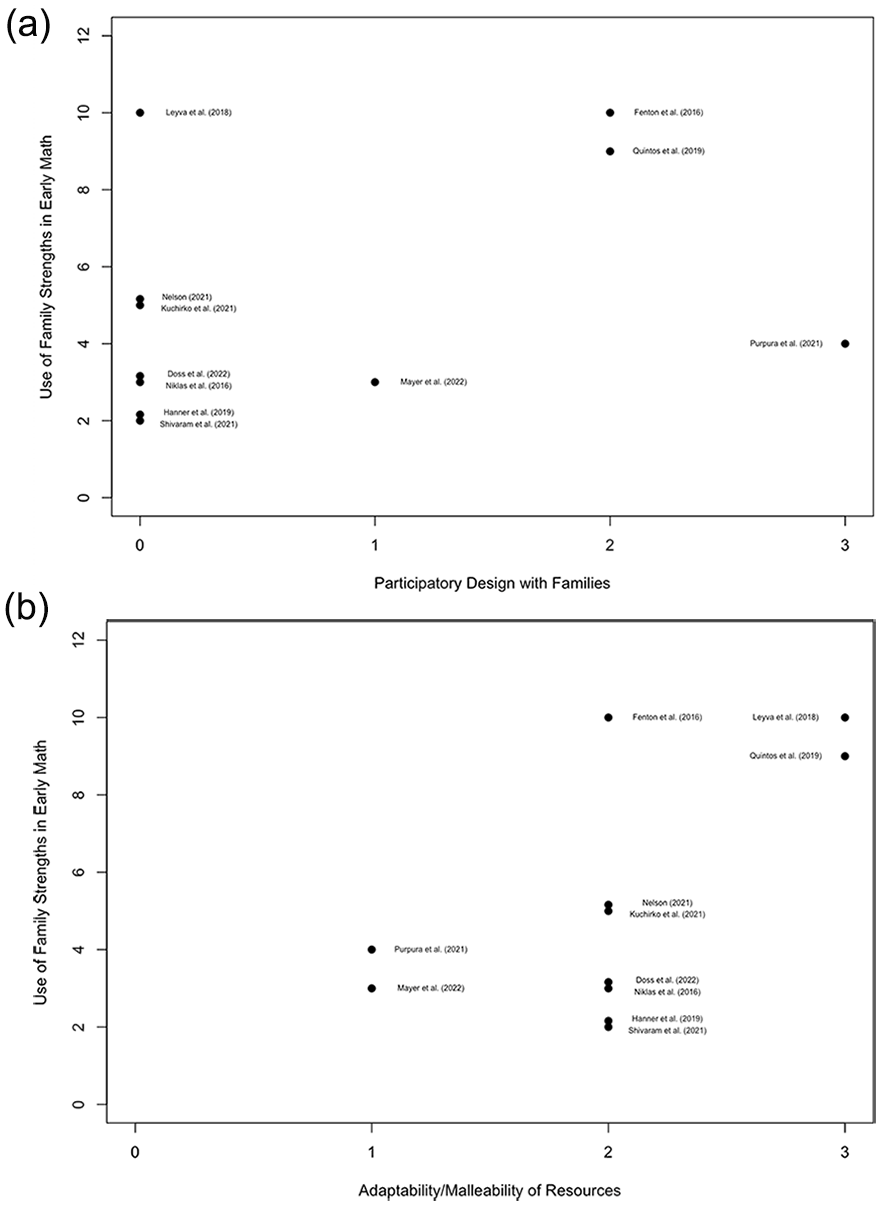
Plots of Use of Family Strengths in Early Math.
These figures highlight the range of variability in studies’ approaches to using family strengths in early math interventions and demonstrate that there are different ways to incorporate family strengths. Studies coded higher included more direct uses of strengths, such as individual or group meetings with and for families (Fenton et al., 2016; Leyva et al., 2018; Quintos et al., 2019), materials for use in real-life contexts such as cooking, mealtimes, bath times, and grocery shopping (Hanner et al., 2019; Leyva et al., 2018; Linder & Emerson, 2019; Nelson, 2021), and specifically engaging families in activities related to their interests, such as book reading and play (Fenton et al., 2016; Mayer et al., 2022; Purpura et al., 2021).
Notably, none of these studies included thorough/direct use of strengths in all six of the coded categories. This is important, because studies can engage with family strengths in different ways, and certain areas may be more feasible for certain studies and contexts of conducting research. In addition, there was more variability in adaptability/malleability of resources than there was in input from families, which we further describe below.
Figure 4 shows a heatmap of each of the dimensions of family strengths used in each article. Darker colors indicate more thorough/direct use of strengths, and lighter colors indicate lower/no use of strengths. This further highlights the variability of use of strengths within strengths-based intervention work in early math. As shown in Figure 4, the majority of studies had lower use of strengths in the context of family and community knowledge and receiving input from families, and the majority of studies had higher use of strengths in the context of family routines, family interests, and resources that are adaptable/malleable. This indicates that more research is needed to build on family and community knowledge, including input from families, in early math development. In particular, when designing intervention studies, researchers can further consider family and community funds of knowledge and include opportunities to receive information and input from families and community members.

Heatmap of Use of Family Strengths.
It is important to note that the studies we coded and classified were all intervention studies focused on early math, and that studies using different methodologies or focusing on other domains (e.g., early STEM, literacy) also include the constructs we identify as key dimensions of strengths-based research in early math. Here we provide limited examples to further illustrate the use of strengths.
First, early math studies have used interview and survey methods to consider families’ perceptions of math and math in their children’s lives. For example, Eason et al. (2023) conducted a study with parents of preschool children in rural communities to consider how families engage in activities and what activities they recognize as math opportunities, and Caspe et al. (2023) conducted interviews with Latine parents, focused on their ideas about math, how parents use math in their own lives, and parents’ perspectives on how their children engage with math in their lives. These studies build on ideas about family routines and family interests, and by using survey and interview methods, receive information directly from families about their experiences and conceptualizations of math.
Strengths-based studies in early math have also included and used families’ funds of knowledge. For example, Leyva (2019) conducted a study with Chilean families, to examine parental support of early math and writing skills. In the study, parents and children played a grocery game, which involved working together to create a grocery list and shop for pretend foods. In another example, Beltran-Grimm (2022) conducted a qualitative, phenomenological study, which included co-design workshops with Latine families in California to design a math activity for their children. Both of these studies highlight the use of family funds of knowledge and skills, while also building on family routines and interests. In particular, Leyva (2019) built on family knowledge and cultural practices with grocery routines, and Beltran-Grimm (2022) built on family knowledge by designing the family workshops based on interviews with families about their family context and funds of knowledge.
Overall, both our coding of early math intervention studies and the examples included in these non-intervention studies indicate that there is variability in the dimensions of family strengths that studies engage with and the way in which they engage in them. In continuing to develop strengths-based research methods, it is important to consider different aspects of engaging with family strengths and to create opportunities in study designs and implementation to build from families’ strengths, including these areas as well as contexts, experiences, and conceptualizations of math.
Discussion
Strengths-based perspectives are critical for examining and promoting early math and opportunities for math engagement in home, family, and community contexts. However, there is little specificity in the field as to what it means to take a strengths-based approach or what the primary dimensions of family strengths in early math are. We bring together sociocultural, ecological systems, and funds of knowledge perspectives, as well as empirical work on the home math environment, family math engagement, and strengths-based approaches in early learning to begin organizing this growing area of work with a conceptual framework.
The framework defines four construct domains of strengths in early math and two considerations for strengths-based methodological approaches to studying early math. Each of these dimensions is theoretically and empirically grounded and includes a range of approaches to building on family strengths to engage in strengths-based work in early math. We also highlight examples of strengths-based work to demonstrate qualitatively and quantitatively different ways of engaging with strengths in early math research. This framework and classification system can be useful for researchers and practitioners to operationalize strengths-based approaches in early math and to consider how study designs and materials vary along these dimensions of family strengths when developing materials for children and families to use and engage with.
Limitations and Future Directions
While growing, the cumulative knowledge on the effectiveness of strengths-based approaches for promoting early math skills remains limited. Work on funds of knowledge in the context of math is strongly rooted in ethnographic research with teacher-family partnerships (Civil, 2007, 2016; Moll, 1990, Moll et al., 1992); however, strengths-based approaches are still relatively new in empirical studies of early math in family and community contexts, particularly when considering quantitative studies in the field. Despite the well-established theoretical and conceptual origins of our framework, empirical applications of a strengths-based perspective are relatively novel in studies of early math learning. Thus, this is a nascent line of work, with many additions to the cumulative knowledge ahead of us.
Moreover, as reflected in some of the reviewed literature (not to mention our training as scholars), the lack of work with minoritized and marginalized populations should evoke caution. In addition, it is important to note that we have, to some extent, relied on an evidence base that may be contaminated by the very types of problems our framework is intended to help address. Thus, we expect that the implications of this limitation and, in turn, opportunities to improve upon our framework will become increasingly clear as the strengths-based early math literature becomes more robust. With regard to our proposed domains of family and community strengths, for example, we expect that as the field grows so too will the need to modify and expand our framework. Nonetheless, we believe it is critical to begin organizing and defining the key constructs and dimensions at this stage.
Operationalizing and defining ideas and terminology is important for maintaining and enhancing rigor as this approach to scholarship proliferates (e.g., see Hornburg et al., 2021 for an example for the home math environment). Without clear operational definitions and methodological specificity, there is a risk that “strengths-based” becomes a buzzword that scholars use in a perfunctory manner. We hope precision around these issues could help prevent this methodological form of tokenism. For example, in order for an intervention to build on domains of family strengths (i.e., family routines, knowhow, interests, community knowledge) in strengths-based manners, it requires building from and aligning practices with family beliefs, goals, perspectives, and cultural orientations. Adding mathematics into routines (or other domains) without attention to these factors is likely to be no more consistent with a strengths-based perspective than interventions that were approached from a deficit-based perspective.
In addition to helping operationalize strengths-based methods in future studies, we highlight conceptual directions for future research, organized around our framework.
Future Research on Knowledge, Routines, and Interests
Additional research is needed to improve our understanding of family knowledge, routines, and interests as strengths for math learning. This should include more descriptive and qualitative studies that document early math learning chances in the diverse realities of family life, updating our understanding of the “stable complexity” in which children increasingly live and thrive. Similarly, more descriptive and qualitative work is needed that is directly informed by families’ views of their strengths—we need a fuller understanding of diverse family perspectives on (a) what constitutes family knowledge, routines, and interests, (b) their vision of successful early math learning and achievement; (c) how they engage knowledge, routines, and interests to promote their children’s math learning; and (d) what opportunities they view as strategies for using their strengths to improve math learning.
We encourage work on these questions because the answers are critical for ensuring intervention work complements family life and because strengths-based family math interventions require a deep understanding of why, how, and when families engage in math. Answering these questions will provide insight into how to align early math resources with the cultural and socialization values that drive family life. Family beliefs around why math learning is important (e.g., for school, personal growth, improved life chances, cultural relevance) likely influence how and when families will best engage in math. As one concrete example, variation in beliefs about why math is important may affect the use and outcomes of learning opportunities that are more or less structured/direct. Beyond this specific example, understanding belief systems is critical to developing early math resources that children and families will want to use, enjoy using, and continue using beyond direct researcher involvement.
Future Participatory Design Research
Participatory design is a powerful method for advancing strengths-based work. However, future work needs to begin addressing potential tensions between evidence built within a participatory design process, generalizability, and scalability. Researchers will need to consider, for example, how practices and partnerships can be developed to simultaneously build on family and community strengths while maximizing adaptability and generalizability across families and communities. Relatedly, an open question in the field is how researcher and community partnerships can develop processes to empower families and community members to adapt and iterate programs to meet their individual strengths and needs, in ways that continue to align with developmental theory and scientific evidence. In line with this, empirical attention to trade-offs that occur during co-design processes would also benefit the field. 2 When researchers and families collaborate to develop early math learning strategies, tradeoffs are often involved with both partners in the co-design needing to be flexible. Researchers, for example, may abandon some elements of design that were informed by their theoretical or empirical knowledge and families may abandon some concerns for ecological validity (Anderson-Coto et al., 2024; Garcia et al., 2022). Careful documentation of tradeoffs is needed as well as comparative studies that can empirically juxtapose the results of varying tradeoff decisions.
Future Research on Adaptable and Malleable Resources
When considering the design of resources that are adaptable and malleable to families’ lives, research could further consider how different features of the resources allow for engagement that aligns with family strengths. Prior research on math games, toys, and books has demonstrated that different features of these materials can differentially impact children’s learning and engagement (e.g., Ward et al., 2017; Zippert et al., 2019; Zosh et al., 2015). Future studies could further examine how features that align with families’ strengths or are more/less able to be adapted (e.g., generalized and continuously used, as described above) by families to meet their needs influence children’s learning and engagement as well.
Conclusions
Across multiple theoretical perspectives and a large body of empirical work, it is clear that the family is a critical context of development and a key source of strength and support in early childhood. Despite this, it has not been uncommon for research to take deficit-based approaches when considering families from disadvantaged or historically marginalized backgrounds. Recently, there has been increasing work that rejects these deficit-based perspectives, centering instead family strengths and the role that building on families’ strengths across race, ethnicity, cultural heritage, social class, and language can have for promoting family engagement and children’s learning. Our conceptual framework organizes this work and defines dimensions of strengths in early math.
Our framework contributes to the field by identifying and defining dimensions of family strengths in early math and strengths-based methodological approaches for studying these dimensions. Our aims with this framework are to add specificity to operational definitions of strengths and strengths-based methods, to help guide research design, and to provide an organizing tool for summary evaluations of the literature. Researchers, educators, and practitioners might also use the framework to classify and conceptualize where and how their work falls along the dimensions of family strengths, including in helping guide the design and evaluation of strengths-based early math activities, materials, and resources. In doing so, this work supports early math development by providing clarity around what it means to take a strengths-based approach in early math. Applications of this framework have the potential to increase opportunities for family math engagement in home and community contexts, which in turn has the potential to support children’s math development. This is particularly important for supporting children and families from low-income and racially and ethnically minoritized backgrounds.
Building on strengths and what families are already engaging in (e.g., areas of family knowledge, interest, routines) can allow families to engage in opportunities in a way that is efficient and meaningful to them, rather than adding additional stressors or burdens on families’ limited time and energy. Further, our framework is intended to promote research on early math development that is ecologically valid and culturally meaningful for children and families. It also values family input and agency of families in the design of research studies and evidence-based materials by building on families’ individual strengths and contexts and being adaptable to their knowledge, skills, routines, and interests. Incorporating family and community strengths throughout the process of designing, disseminating, and studying early math materials, resources, and supports has the potential to provide serious advances in our empirical work, ultimately creating more equitable opportunities for math learning and development.
Supplemental Material
sj-docx-1-ero-10.1177_23328584241302059 – Supplemental material for Strengths-Based Approaches to Investigating Early Math Development in Family and Community Context: A Conceptual Framework
Supplemental material, sj-docx-1-ero-10.1177_23328584241302059 for Strengths-Based Approaches to Investigating Early Math Development in Family and Community Context: A Conceptual Framework by Mary DePascale, Andres S. Bustamante and Eric Dearing in AERA Open
Footnotes
Declaration of Conflicting Interests
The author(s) declared no potential conflicts of interest with respect to the research, authorship, and/or publication of this article.
Funding
The author(s) disclosed receipt of the following financial support for the research, authorship, and/or publication of this article: This research was supported by the National Science Foundation (grant number: 2222218).
Open Practices
The data for this article can be found at http://doi.org/10.3886/E209711V1.

Notes
Authors
MARY DEPASCALE is an assistant professor at the University at Albany, SUNY, 1400 Washington Avenue, Albany, NY 12222;
ANDRES S. BUSTAMANTE is associate professor in the School of Education at the University of California, Irvine; 3200 Education Building, Irvine CA 92697;
ERIC DEARING is professor of applied developmental psychology in the Lynch School of Education and Human Development at Boston College, 140 Commonwealth Ave, Chestnut Hill, MA 02467;
References
Supplementary Material
Please find the following supplemental material available below.
For Open Access articles published under a Creative Commons License, all supplemental material carries the same license as the article it is associated with.
For non-Open Access articles published, all supplemental material carries a non-exclusive license, and permission requests for re-use of supplemental material or any part of supplemental material shall be sent directly to the copyright owner as specified in the copyright notice associated with the article.
