




Abstract
The debate over race-conscious admissions has gained prominence, notably in cases such as Students for Fair Admissions v. Harvard. In debates on race-conscious admissions, the question is often not whether a student will go to college, but which college the student will attend. Using data from the High School Longitudinal Study of 2009, we examined racial and socioeconomic disparities in the probability of acceptance to a student’s first-choice college based on institutional selectivity. Race was a significant predictor of acceptance to a first-choice college, with Black and Asian students facing odds of acceptance that were 46% to 59% lower than those of White peers. However, at highly competitive or most selective colleges, race was no longer a significant predictor, and racial disparities in acceptance rates diminished. Socioeconomic status had no significant association with the probability of acceptance to a first-choice college.
Keywords
The role of admissions decisions in shaping students’ ultimate college choice is a relatively recent phenomenon. Prior to the 1980s, most college applicants secured admission to their first-choice institution, with admissions decisions exerting minimal impact on their final college destination (Jackson, 1988). For example, among the cohort of high school graduates in 1972, nearly 90% of those who applied to 4-year institutions of average or lower selectivity were accepted to their first-choice college, even if they did not receive admission to every institution they applied to (Manski & Wise, 1983). However, the rate of attendance at first-choice colleges declined steadily during the 1990s and 2000s. By 2006, ~67% of freshmen reported matriculating at their first-choice institution, a trend primarily attributable to escalating institutional selectivity, rising college costs, and the growing sizes of the college-aged population (Bound et al., 2009).
This general trend may have obscured important variations in college admissions outcomes based on race and social class. Empirical research indicates a consistent racial gap in enrollment at selective institutions (Baker et al., 2018; Posselt et al., 2012), raising critical questions about whether students from different demographic backgrounds are admitted to first-choice colleges of comparable quality and selectivity. McDonough and Antonio (1996) articulated these concerns: “Do students of color get into their first-choice college as often as White students? Why are students of color clustered at low-prestige, low-resource, low-selectivity institutions?” (p. 3). Previous studies have demonstrated substantial disparities in access to first-choice colleges between students of color and White students (Carter, 1999; Hurtado et al., 1997; Kim, 2004; Maxey et al., 1995; McDonough & Antonio, 1996). Given the persistent lack of progress in achieving racial and socioeconomic equity (Black et al., 2015), these questions retain their significance today, just as they did in the 1990s.
The intersection of college admissions and race has lately garnered considerable attention, especially in light of recent Supreme Court cases, such as Students for Fair Admissions (SFFA) v. Harvard and SFFA v. University of North Carolina at Chapel Hill. Central to public discourse is the inquiry into which individuals secure admission to their preferred first-choice college and which do not. How often are students admitted to their first-choice schools, and does this discrepancy vary by race?
Addressing the factors contributing to the racial and socioeconomic gap in access to first-choice college presents a challenge due to the intricacies of the admissions process, which is a multifaceted interplay of student behaviors and institutional admissions practices. The complexity is compounded by the diverse preferences among students. For instance, the college undermatch literature highlights affordability and proximity to home as key factors in the decision-making processes of low-income students, despite their qualifications to attend highly selective institutions (Ovink & Kalogrides, 2015; Ovink et al., 2018). Even when admission is guaranteed, disparities persist. Black students, for example, exhibit a lower likelihood of applying to flagship institutions compared with their White counterparts with similar standardized test scores and college readiness (Black et al., 2015).
The difficulty of addressing factors contributing to gaps in access to first-choice colleges is exacerbated by the variability in priorities and strategies employed by institutions in shaping their incoming classes. Particularly at selective institutions, the holistic review process involves a nexus of multiple factors, such as academic credentials, test scores, extracurricular activities, recommendation letters, essays, and demographic characteristics, with these criteria constantly evolving (Bastedo, 2021). One of the salient controversies in SFFA v. Harvard also was the use of personal ratings in admissions process, with Asian American students receiving lower ratings than their White peers despite their top academic performance and extracurricular records (Park & Kim, 2020).
In this study, we use data from the High School Longitudinal Study of 2009 (HSLS:09), which focuses on students’ transition from secondary to postsecondary education (Cohen et al., 2024). By leveraging its student-level records, including college applications, indications of first-choice colleges, and admissions outcomes, our objective was to deepen our understanding of how race and socioeconomic status (SES) factor into first-choice college admissions outcomes. The HSLS:09 comprises a nationally representative sample of >23,000 ninth graders in 2009, and we studied students who enrolled in college in 2013, immediately after high school graduation. Notably, this cohort navigated the college admissions process prior to the Supreme Court’s ruling against race-conscious admissions in 2023, as well as before its support of the same policies in Fisher v. University of Texas at Austin (2016). Thus, the HSLS:09 cohort represents students who underwent the college admissions process when affirmative action policies were still in effect for many colleges and universities, at least in states where public institutions were unaffected by statewide bans.
We examined three primary research questions: (1) Do acceptance rates to students’ first-choice colleges vary by race and SES? (2) When controlling for other factors considered in the admissions process, are race and SES still significant predictors of the probability of acceptance at a student’s first-choice college? (3) As the selectivity of students’ first-choice colleges increases, what happens to racial gaps in the probability of acceptance? By addressing these questions, we focused on providing an overview of the differences in college applications by race and SES, the varying odds of acceptance at first-choice institutions by race and SES, and moreover, whether disparities in access to first-choice colleges vary by institutional selectivity.
We aim to contribute to the existing literature by using more recent, nationally representative data on high school graduates, supplemented with detailed information on college applications and admissions outcomes. An important advantage of the HSLS:09 dataset is its ability to identify students’ top-choice set of colleges and their most preferred institution at the time of application. By mapping students’ college applications and admissions outcomes across various demographic and institutional factors, our research provides a valuable snapshot of the college choice and admissions processes. The findings highlight the state of college admissions before recent legal decisions, serving as a reference for future studies examining changes after the rulings.
Furthermore, we highlight the crucial role of institutional practices and goals in shaping a class, alongside students’ college-choice behaviors. We achieve this by estimating a model that includes predictors mirroring factors considered in the admissions process. While earlier literature has primarily focused on students’ choice behaviors, our findings offer a more comprehensive understanding of the mechanisms driving disparities in acceptance to first-choice colleges. Additionally, we broadened the scope of our research to include a wider range of institutions of varying selectivity. This contrasts with the predominant focus of prior research on race and class stratification in admissions, which has largely concentrated on the most selective institutions (kehal et al., 2021).
The key findings reveal that among students who applied to at least one 4-year institution, slightly >80% were admitted to their first-choice college, although the odds of acceptance declined gradually for more selective first-choice institutions. In terms of race and SES, Asian students and those from higher SES backgrounds tended to apply to more selective institutions as their first choice. Notably, the association between race and acceptance odds at first-choice colleges varied depending on institutional selectivity. Overall, controlling for other factors, race emerged as a significant predictor of acceptance odds at students’ first-choice colleges. On average, Black and Asian students had a 46% to 59% lower likelihood of acceptance compared with their White peers. However, among students with the most competitive first-choice colleges, no racial disparities were observed among White, Asian, Black, and Latino/a students. Additionally, SES did not significantly predict students’ odds of acceptance to their first-choice colleges.
Literature Review
This study conceptually drew on prior literature in three main areas. First, we examined the conceptualizations of first-choice college and enrollment at first-choice college in previous research, along with their associated findings. Then, we reviewed studies that investigated the consideration of race or SES in college admissions and their impact on students’ college access.
Access to First-Choice College
Scholars have highlighted the importance of understanding the factors influencing students’ admission and enrollment at their first-choice colleges, particularly from the perspectives of college access and success. In terms of college access, researchers emphasize its significance as a reflection of students’ ability to secure desired educational opportunities (Kim, 2004), identifying various circumstantial and structural barriers that can hinder individual choices and preferences. Regarding college success, enrollment at a first-choice college is thought to exert a considerable impact on diverse student outcomes, including college persistence. Often used as a proxy for students’ institutional commitment (Braxton et al., 1995), attending a first-choice college is considered crucial for enhancing students’ certainty of choice, sense of belonging, and intention to persist in college (Nora & Cabrera, 1993). Students at their first-choice colleges also tend to show higher levels of satisfaction, academic performance, emotional well-being, and self-confidence (Kim, 2002).
Earlier empirical evidence has shown that the likelihood of attending one’s first-choice college varies by race, suggesting that students from different racial backgrounds are differentially impacted throughout the college choice process (e.g., degree aspiration, information, and financial aid) (Hossler & Gallagher, 1987). In particular, Black students have been found to have lower rates of acceptance at their first-choice colleges compared with the national average (McDonough et al., 1995, as cited in Freeman & Thomas, 2002), facing acceptance rates about 10% lower than White students (Carter, 1999; Kim, 2004; Maxey et al., 1995). Hurtado et al. (1997) also reported lower odds of attendance at first-choice colleges among Black students compared with their White counterparts, despite Black students expressing high college aspirations (Portes & Wilson, 1976; St. John, 1991) and submitting more college applications than White students (McDonough & Antonio, 1996).
Moreover, Schneider and Saw (2016) revealed that Black students maintained higher college aspirations than White students among high school seniors in 2012, at a similar rate as in the 1960s. However, they were less likely to plan on taking advanced math courses, which they did now view as helpful for college admissions, and were the least likely to earn credits in Advanced Placement (AP) courses. Financial aid concerns also emerged as major factors influencing college choice for Black students compared with White or Asian students (Hossler & Gallagher, 1987; Maxey et al., 1995; McDonough & Antonio, 1996). However, Kim (2004) later suggested that financial aid had no impact on Black students’ attendance at their first-choice colleges, in contrast to Asian American students, who exhibited a stronger willingness to borrow money to attend their preferred first-choice institutions.
Asian students have also shown lower rates of enrollment at their first-choice colleges compared with White and Latino/a peers (McDonough & Antonio, 1996) and the lowest rates when compared with White, Latino/a, and Black students (Kim, 2004), despite having similarly high levels of degree aspirations and academic capital as White students, and higher expectations than Black and Latino/a students (Hurtado et al., 1997). They also had greater knowledge about and experience with college (e.g., meeting with college officials, taking college entrance exam courses) compared with Black and Latino/a students (Schneider & Saw, 2016). Even though Asian students had lower apprehension about financial aid (McDonough & Antonio, 1996), they enrolled at their first-choice colleges at lower rates, even among those willing to borrow money to do so (Kim, 2004).
In contrast, White and Latino/a students have demonstrated higher rates of attendance at their first-choice colleges despite applying to fewer institutions than Black and Asian students (Hurtado et al., 1997; Kim, 2004; McDonough & Antonio, 1996) and having lower college aspirations than Black students (Schneider & Saw, 2016). For White students, socioeconomic characteristics, particularly family income, have played a pivotal role in college choice, directly influencing their college selection (Kim, 2004) and their propensity to attend more selective institutions (McDonough & Antonio, 1996). In comparison, first-choice college attendance has been considered less critical for Latino/a students, who prioritize peer opinion over other factors, such as financial aid, in their college choices (Kim, 2004).
Considering Race in Admissions
A substantial body of research on race-conscious admissions has illuminated the interplay between race, social class, and college selectivity within the broader context of college admissions. Race-conscious admissions policies have notably increased the representation of racially minoritized students, particularly Black and Latino/a students, at selective institutions (Bowen & Bok, 1998; Espenshade et al., 2004; Grodsky, 2007; M. C. Long, 2004). In a recent study, kehal et al. (2021) examined 975 selective institutions without affirmative action bans from 1990 to 2016 and found that considering race in admissions was associated with higher enrollment rates for Black and Latino/a students, even at the most selective institutions.
Eliminating race-conscious admissions, however, has been linked to decreased odds of acceptance and enrollment for Black and Latino/a students at competitive institutions (Backes, 2012; Hinrichs, 2012; M. C. Long & Tienda, 2008). For instance, Bowen and Bok (1998) found that the odds of admission for Black students hypothetically decreased from 42% to 13% at selective colleges. Similarly, Espenshade and Chung (2005) reported a drop of 21.5% and 13.9% in acceptance probabilities for Black and Latino/a students, respectively. Without racial preferences, underrepresented students might be redirected toward less selective institutions, and alternative admissions policies, such as top X% programs (e.g., Florida’s Talented 20 plan), may not maintain their representation at selective institutions (M. C. Long, 2004). Grodsky and Kurlaender’s (2006) study on Proposition 209 supported this claim, finding that restrictions on race-conscious admissions led to a decline in the selectivity of 4-year public institutions that Black and Latino/a students attended.
Recent research suggests a heterogeneous relationship between race-conscious admissions and enrollment demographics by institutional selectivity. Although kehal et al. (2021) found a positive association between race-conscious admissions and Black student enrollment at the most selective institutions across years from 1990 to 2016, this association appeared to be negative at less selective institutions, where enrollments of White, Asian, Pacific Islander, and non-U.S.-resident students increased. Similarly, the simulation study of Reardon et al. (2017) using the Educational Longitudinal Study (ELS) of 2002 found marginally greater racial diversity at the most selective institutions compared with those one level lower in Barron’s selectivity index.
The impact of race-conscious admissions, especially on Asian students’ representation in higher education, remains a subject of debate across scholarly, political, and legal domains (Poon et al., 2019). Although Asian Americans with strong academic records historically have applied to elite institutions at high rates (Takagi, 1992), their acceptance rates have remained stagnant or even declined from 68% in 1974 to 51.8% in 2005, possibly due to heightened competition in admissions (Chang et al., 2007). Nonetheless, some studies suggest that race-conscious admission benefits students of all races, including Asian students, by reducing racial prejudice, fostering diverse skills (e.g., critical thinking and teamwork), and enhancing college satisfaction (Carnevale & Quinn, 2021; Park, 2013). Additionally, Asian students generally benefit from attending college, irrespective of whether it is their first-choice institution (Nguyen et al., 2020).
The competitive academic qualifications of Asian students and their relatively low acceptance rates at elite institutions have led to speculation that these institutions may intentionally limit the number of Asian American students admitted (Inkelas, 2003). Some institutions, such as Brown University and the University of California, Berkeley, have acknowledged racial biases in their admissions processes (U.S. Commission on Civil Rights, 1992, as cited in Inkelas, 2003; Wang, 1995), and this issue was central to the SFFA v. Harvard case (Garces & Poon, 2018). White critics of affirmative action often argue that Asian students face discrimination due to racial preferences in admissions (Carnevale & Quinn, 2021). Poon and Segoshi (2018) contend that White opponents of race-conscious admissions instrumentalize Asian students as a racial mascot to perpetuate myths of meritocracy and White supremacy, ultimately reinforcing the subjugation of other people of color (Poon et al., 2019).
Considering Class in Admissions
Since the late 1990s, scholars have increasingly turned their attention to the consideration of class and wealth in college admissions (Carnevale & Rose, 2004; Gaertner & Hart, 2013). A class-based preference would potentially favor lower-income students in admissions based on SES rather than race or ethnicity (Reardon et al., 2017), given the structural disadvantages that low-income students face in terms of the credentials needed to prepare for admission to selective institutions (Bastedo & Jaquette, 2011). Prior literature has primarily explored whether class-based preferences could serve as a replacement for race-conscious admissions and enhance racial diversity more effectively (Bowen & Bok, 1998; Kane, 1998; Reardon et al., 2017), or whether considering both class and race simultaneously could improve both racial and socioeconomic diversity on college campuses and maximize educational benefits (Gaertner & Hart, 2013; Park et al., 2019).
However, concrete empirical evidence on the impact of class-based admissions is limited, primarily because this policy has not been widely implemented (Reardon et al., 2017), and institutions have adopted varying approaches to considering class in admissions. Some institutions evaluate SES as part of holistic admissions or use an institution-developed index (Gaertner & Hart, 2013), while others rely on nationally normed data on high schools and neighborhoods (Bastedo et al., 2022). Nevertheless, considering class in admissions is viewed as a “poor substitute for race-conscious admissions” (Gaertner & Hart, 2013, p. 377) for effectively enhancing or sustaining racial diversity, because SES is not considered an adequate proxy for race (Reardon et al., 2017).
Methods
Data
We used the HSLS:09 data produced by the National Center for Education Statistics (NCES). The HSLS:09 is a nationally representative longitudinal survey that began with >23,000 ninth graders in the fall of 2009 from 944 high schools across the United States. High school graduates who entered college immediately following graduation started their college education in the fall of 2013. Additionally, we utilized two subsequent survey datasets: the 2012 follow-up survey, which asked now 11th graders about their high school experiences and future plans after graduation, and the 2013 update (restricted-use data), which included high school transcript, high school completion status, college applications, admission outcomes, and college choices (Ingels et al., 2015).
For the HSLS:09 data, NCES employed a complex sampling design known as a two-stage random-sample design for the base-year survey. In the first stage, schools were selected as primary sampling units, and in the second stage, students were randomly sampled within each selected school. The follow-up surveys targeted the same population as the base-year survey, with later rounds excluding individuals who were deceased or had withdrawn from the study (Ingels et al., 2013). For this study, we used data from the 2013 survey, which retained a total of 25,206 eligible students.
To account for the complex survey design, we applied the balanced repeated replication survey weights in our analysis, as strongly recommended by NCES for accurate variance estimation and results that are representative of the target population (Duprey et al., 2018). These weights, provided by NCES, account for all possible combinations of survey datasets and adjust for nonresponses within those datasets (Ingels et al., 2015). Specifically, we used the analytic weight W3W1W2STUTR, which corresponds to the surveys used in our study (see the online Supplemental HSLS:09 Data File Documentation for details).
Additionally, we incorporated the NCES–Barron’s Admissions Competitiveness Index data for 2014, obtained from NCES. Although the HSLS:09 dataset includes Integrated Postsecondary Education Data System (IPEDS) college selectivity codes, the NCES–Barron’s Index provides a more detailed breakdown of competitiveness ratings, subdividing them into 10 categories compared with the six categories in IPEDS. This expanded classification offers a more comprehensive representation of institutional selectivity for our study.
Analytic Sample
Among the 25,206 students in the HSLS:09 dataset, we first restricted our analysis to those whose first-choice college was a domestic institution in the United States, excluding 30 students from the original sample. We further refined the sample by removing 10 students whose second- or third-choice institutions were not domestic, as well as an additional 10 students who ultimately enrolled at foreign institutions. This refinement ensured that the college choice sets, preferences, and decisions of the included students were comparable, as the application components and requirements for domestic institutions may differ significantly from those for foreign institutions. Also, students who chose to attend foreign institutions might have distinct predispositions and decision-making processes compared to those who enrolled in domestic institutions.
Our analysis also excluded students who applied to any special institutions (e.g., art or music). This was done because applications to these special institutions may not be directly comparable with those to typical colleges and universities. We further excluded 20 students whose number of applications was considered an outlier, exceeding 20, which is the maximum number of applications that can be submitted through the Common App.
The final analytic sample consisted of 4,040 students (population size = 957,432) who applied to at least one 4-year institution. From this sample, we constructed three additional subgroups using the NCES–Barron’s Index for further comparisons in college applications. Subgroup A comprised 3,790 students (population size = 896,424) who applied to at least one very, highly, or most competitive institution. Subgroup B was further limited to 2,470 students (population size = 575,843) who applied to a very, highly, or most competitive first-choice institution. Finally, subgroup C consisted of 1,380 students whose first-choice college was classified as most selective (highly or most competitive; population size = 311,465). Throughout our analysis, we applied survey weights, which enabled us to make meaningful inferences that are representative of the HSLS:09 target population.
It is important to note that all unweighted sample sizes are rounded up to the nearest 10, in accordance with NCES Integrated Environmental Solutions restricted-use guidelines. Population sizes are also rounded up to the nearest integer.
Measures
We analyzed a binary admissions outcome of whether students were accepted or not accepted to their first-choice college among the institutions they applied to. Unlike previous studies (Kim, 2004; Maxey et al., 1995; Otero et al., 2007), we differentiated between a student’s first-choice college at the application stage and their first-choice college among those they were actually admitted to. This distinction is crucial because the former reflects the student’s initial preference at the application stage (Allen et al., 2003), while the latter accounts for admissions and financial aid decisions, which can limit the inferences researchers can make about students’ decision-making processes (Nguyen et al., 2020).
Specifically, we used college application, admissions results, and registration information to create the outcome measure. The dataset includes college application information for three colleges: (1) the student’s currently enrolled institution, (2) the first other college applied to and most seriously considered, and (3) the second other college applied to and most seriously considered. Importantly, the dataset includes a first-choice indicator, which specifies the student’s first-choice institution prior to receiving any admissions results. Students were asked whether their current enrollment was at their first-choice institution. If not, the data indicated whether the first or the second other college (applied to and most seriously considered) was their first-choice institution (Ingels et al., 2015). Additionally, the dataset includes admissions results for these three institutions, indicating whether the student was accepted, wait-listed, or rejected.
In summary, we identified each student’s first-choice college among their current institution and the two other most preferred colleges they applied to, and we had admission results data for all three institutions. As illustrated in Figure 1, we classified three scenarios as “accepted at first-choice college.” The outcome was coded as 1 = “accepted” if (a) the student’s current institution was their first choice, (b) the first other college was their first choice and they were admitted to that institution, or (c) the second other college was their first choice and they were admitted to that institution. Conversely, the outcome was coded as 0 = “not accepted” if the student was wait-listed or rejected by their indicated first-choice college.
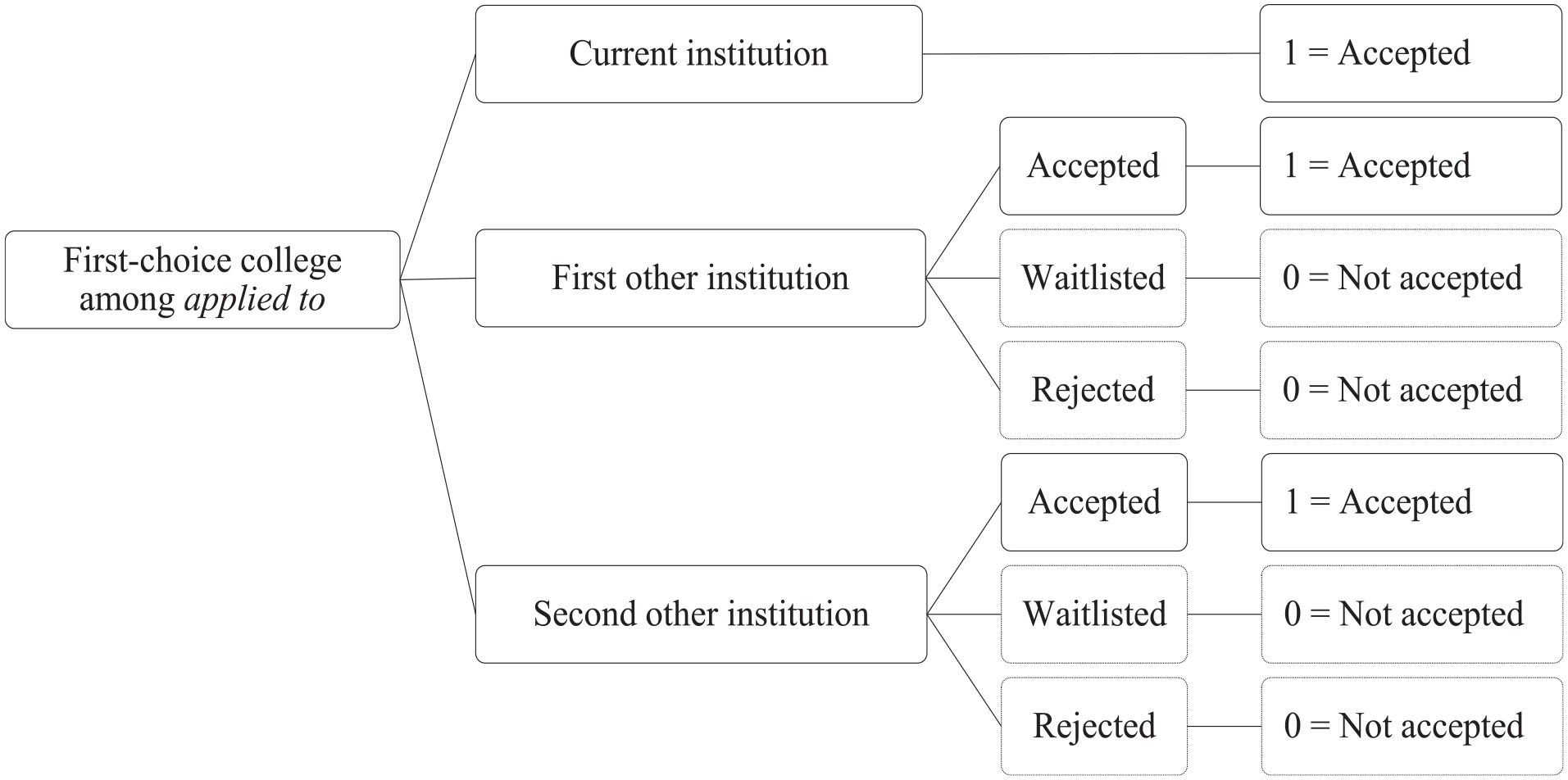
Admissions Outcome Coding Process.
Our key covariates of interest were students’ race and SES. The dataset initially included eight race categories, which we consolidated into five categories due to small cell sizes for multiracial and Indigenous students (i.e., American Indian, Alaska Native, Native Hawaiian, and Pacific Islander). As a result, we categorized students as White, Asian, Black, Latino/a, or other, with “other” encompassing Indigenous and multiracial students. SES was a composite measure developed by NCES using parents’ or guardians’ education level, occupation, and family income (Ingels et al., 2013). We used the SES quintile (first quintile = lowest; fifth quintile = highest). Since the SES composite already includes parental education, we did not include students’ first-generation status as a separate covariate.
We also included additional covariates commonly associated with college admissions. For instance, Bielby et al. (2014) identified a gender enrollment gap at elite institutions, with a male advantage on standardized tests. Admissions officers also place significant weight on academic credentials earned in high school (Bastedo et al., 2016), particularly at selective colleges (Clinedinst & Koranteng, 2018). Academic achievements are often considered alongside other aspects such as character, leadership experience, athletic talent, community involvement, and the school and family context (Bastedo et al., 2018). The academic credentials often include standardized test scores, high school grade-point average (GPA), academic rigor of courses taken (e.g., AP or international baccalaureate [IB] courses), and the level of subject courses taken (Bastedo et al., 2016, 2018; Hossler et al., 2019). In the dataset, math courses were categorized into 14 levels: no math, basic math, other math, prealgebra, algebra I, geometry, algebra II, trigonometry, other advanced math, probability and statistics, other AP/IB math, precalculus, calculus, and AP/IB calculus. Science courses were categorized into six levels: no science, general science, specialty science, advanced studies, advanced studies plus specialty science, and AP/IB science.
Extracurricular activities have also become increasingly important in admissions at highly selective colleges (Posselt et al., 2012). Therefore, we include a measure of number of hours spent on extracurricular activities on a typical schoolday. To capture variations in school climate and the quality of college counseling, we included high school characteristics (Park & Kim, 2020) in our analysis. High school climate was a continuous variable created by NCES (Cronbach’s alpha = 0.88) (Ingels et al., 2013), with higher values indicating a more positive school climate. Additional descriptive statistics for high-school-level variables can be found in Table 1.
Descriptive Statistics—High School

Notes. The Balanced Repeated Replication survey weights are applied to estimate proportions, means, and standard errors. All the total proportions may not equal to 100% due to rounding. From U.S. Department of Education, National Center for Education Statistics, High School Longitudinal Study of 2009 (HSLS:09), Base-year, First Follow-up, and 2013 Update Restricted-Use Data Files. https://nces.ed.gov/surveys/hsls09/hsls09_data.asp
We also considered the number of college applications because research indicates that higher levels of students’ SES and ability are associated with submitting more applications (Hurtado et al., 1997; Smith, 2014). A greater number of applications allows students more flexibility in selecting their desired colleges and improves their overall chances of admission. However, the number of applications is generally not a factor considered by institutions when making admissions decisions.
Additionally, we included students’ residency status in our analysis. Nonresident students are increasingly attractive to institutions because they can contribute more revenue through out-of-state tuition and often possess higher academic credentials. This trend can enhance an institution’s financial stability, particularly for public institutions, and improves its reputation (Jaquette et al., 2016).
Empirical Strategy
We fitted a logistic regression model to examine the relationship between the binary admissions outcome (1 = accepted to first-choice college among applied to; 0 = not accepted to first-choice college among applied to) and a set of predictors. We estimated this model separately for each of the four analytic samples. Although students were nested within high schools, we did not use robust standard errors or cluster standard errors to adjust for potential school-level heteroskedasticity. As noted by Rodriguez et al. (2018), the logit model uses the maximum likelihood estimation (MLE), and MLE becomes an inappropriate estimator with the use of robust standard errors (J. S. Long & Freese, 2014).
The logistic regression model we estimated is as follows. We hypothesized that the predicted probability of being admitted to a first-choice college (Admiti) could be explained by demographics (Demoi), high school characteristics (HSi), academic achievements (Acadi) and extracurricular activities in high school including paid employment (Extrai), number of college applications, and in-state residence at first-choice college (Collegei). Thus:

For a goodness-of-fit test, we used the F-adjusted mean residual test (Archer & Lemeshow, 2006; Rodriguez et al., 2018). This test employs pseudo maximum likelihood estimation (PMLE) to appropriately account for the complex sampling design and survey weights. A small p-value (i.e., <0.05) indicates that the model may not be a good fit, whereas a large p-value (i.e., >0.05) suggests no evidence of a lack of fit. In discussing the results, we use odds ratios rather than logit coefficients due to their practical interpretability (Rodriguez et al., 2018).
Limitations
This study has several limitations. First, while we aimed to comprehensively model the college admissions process by considering both student choices and institutional behaviors, we were unable to fully capture the holistic review process commonly used by colleges. This limitation stems from the absence of data on various institutional practices, such as personal ratings and recommendation letters. Nonetheless, we included a broad range of factors deemed important in students’ college choice behaviors and admissions, leveraging available data on demographics, high school academic credentials, and extracurricular activities.
Second, the study is limited in its ability to establish causal relationships between the odds of acceptance to a first-choice college and the covariates. Our estimates identify meaningful statistical associations rather than causal effects. While we acknowledge this limitation, by applying appropriate analytic weights, we made efforts to provide unbiased estimates that accurately reflect the target population of nationally representative students of the HSLS:09 dataset.
Findings
Descriptive Findings
Table 2 provides a descriptive summary of college applicants for the main sample and each subgroup. White students generally represented the largest proportion (63%–64%) of college applicants by race, followed by Latino/a students (13%). Asian students constituted the smallest proportion (5%) of applicants who applied to at least one 4-year college, but their proportion increased from 5% to 9% when the sample was limited to those whose first choice was highly or most competitive. In contrast, the proportion of Black students decreased from 10% to 8%.
Descriptive Statistics—Demographics

Notes. The Balanced Repeated Replication survey weights are applied to estimate proportions, means, and standard errors. All the total proportions may not equal to 100% due to rounding. From U.S. Department of Education, National Center for Education Statistics, High School Longitudinal Study of 2009 (HSLS:09), Base-year, First Follow-up, and 2013 Update Restricted-Use Data Files. https://nces.ed.gov/surveys/hsls09/hsls09_data.asp
The percentages of students in the highest SES quintile consistently represented the majority of college applicants (33%–38%) across all samples. In contrast, students in the lowest quintile consistently constituted the smallest proportion (8%–10%) across all samples. The proportions of students in highest quintiles increased with the selectivity of the college, whereas the proportions in the second and third quintiles decreased. The gap between the lowest and highest SES quintiles widened as the sample was restricted to those with a more competitive first-choice college. The difference was about 24% in the sample of students who applied to at least one 4-year institution, increasing to between 28% and 30% in the sample of students whose first choice was very, highly, or most competitive.
Table 3 indicates that the average number of college applications increased as we narrowed the sample to students whose first choice was a more selective college. Regarding residency status, a large majority of students (67%–71%) applied to in-state colleges as their first choice across all samples. However, the proportion of students whose first-choice college was an out-of-state school increased as the sample was restricted to those with a more competitive first-choice college. Notably, a significant proportion of students was accepted to their first-choice college, although the acceptance rate decreased from 83% to 75% when the sample was limited to students whose first-choice college was highly or most competitive. Among students accepted to their first-choice institution, ~80% enrolled, with a slightly higher proportion (82%) enrolling when their first-choice college was highly or most competitive.
Descriptive Statistics—College Applications and Admissions

Notes. The Balanced Repeated Replication survey weights are applied to estimate proportions, means, and standard errors. All the total proportions may not equal to 100% due to rounding. The estimates for “First-choice: enrollment” only include students who are accepted at their first-choice institution. From the U.S. Department of Education, National Center for Education Statistics, High School Longitudinal Study of 2009 (HSLS:09), Base-year, First Follow-up, and 2013 Update Restricted-Use Data Files. https://nces.ed.gov/surveys/hsls09/hsls09_data.asp
Race and Acceptance at First-Choice College
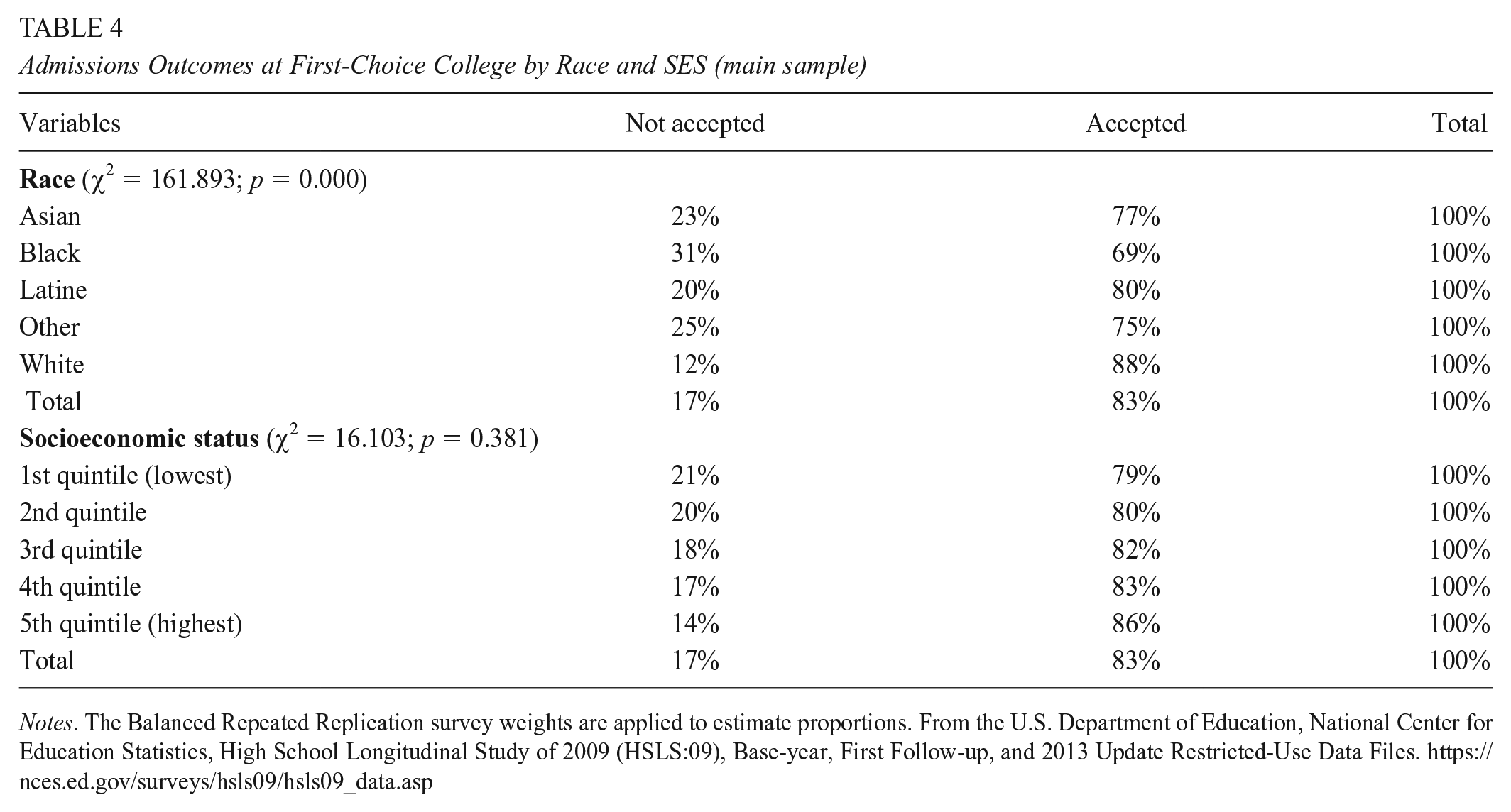
Using the full sample of students who applied to at least one 4-year institution, we descriptively examined students’ admissions outcomes by race and SES. Table 4 shows that acceptance rates to students’ first-choice colleges varied significantly across racial groups. White students had the highest acceptance rate at 88%, followed by Latino/a students at 80%. In contrast, Black and Asian students had the lowest acceptance rates, at 69% and 68%, respectively.
Admissions Outcomes at First-Choice College by Race and SES (main sample)
Notes. The Balanced Repeated Replication survey weights are applied to estimate proportions. From the U.S. Department of Education, National Center for Education Statistics, High School Longitudinal Study of 2009 (HSLS:09), Base-year, First Follow-up, and 2013 Update Restricted-Use Data Files. https://nces.ed.gov/surveys/hsls09/hsls09_data.asp
Table 5 presents an investigation into whether the selectivity of a student’s first-choice college differed significantly by race, revealing a statistically significant association. Asian students applied to more selective institutions as their first choice at the highest rate, with the largest percentage (28%) applying to most competitive institutions. Although >50% of Asian students chose highly or most competitive institutions as their first choice, only ~14% of Black students, 20% of Latino/a students, and 24% of White students did so.
Institutional Selectivity of First-Choice College by Race and Socioeconomic Status (Main Sample)

Notes. The Balanced Repeated Replication survey weights are applied to estimate proportions. All the total proportions may not equal to 100% due to rounding. The total sample size is smaller (n = 3,660; population size = 846,890) than the original main sample (n = 4,040) due to additional missing cases for the institutional selectivity variable. From the U.S. Department of Education, National Center for Education Statistics, High School Longitudinal Study of 2009 (HSLS:09), Base-year, First Follow-up, and 2013 Update Restricted-Use Data Files. https://nces.ed.gov/surveys/hsls09/hsls09_data.asp
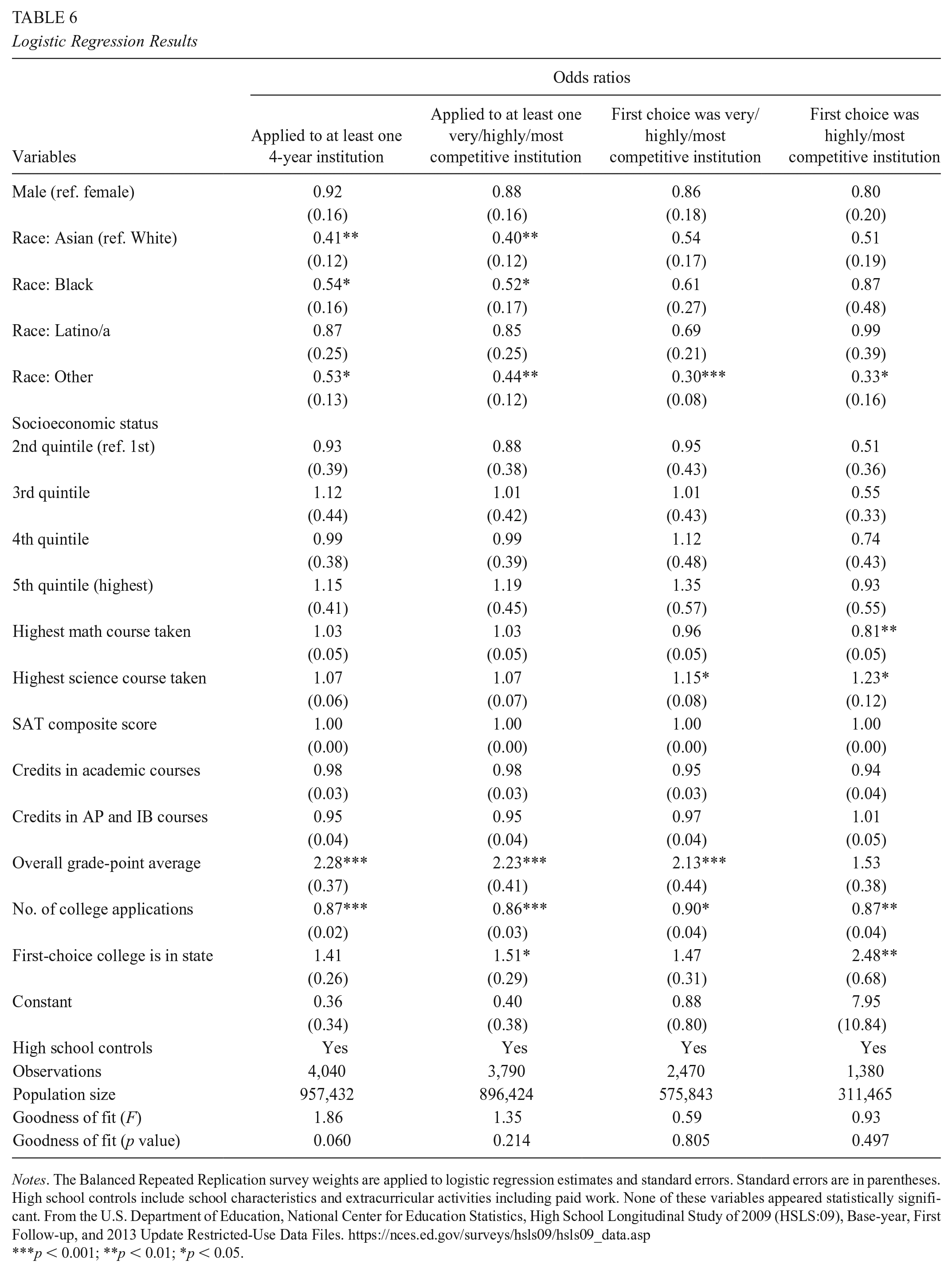
Table 6 displays the logistic regression results. First, the adjusted Wald test indicated that race was a statistically significant predictor of the odds of acceptance at a first-choice college in the main sample of students who applied to at least one 4-year institution (F = 4.22; p = 0.003) as well as in subgroup A, who applied to at least one very, highly, or most competitive school (F = 4.76; p = 0.001), and for subgroup B, whose first choice was a very, highly, or most competitive institution (F = 5.80; p = 0.000). However, for subgroup C, whose first choice was a highly or most competitive institution (F = 1.91; p = 0.110), race was not a statistically significant predictor of the probability of acceptance to their first-choice college.
Logistic Regression Results
Notes. The Balanced Repeated Replication survey weights are applied to logistic regression estimates and standard errors. Standard errors are in parentheses. High school controls include school characteristics and extracurricular activities including paid work. None of these variables appeared statistically significant. From the U.S. Department of Education, National Center for Education Statistics, High School Longitudinal Study of 2009 (HSLS:09), Base-year, First Follow-up, and 2013 Update Restricted-Use Data Files. https://nces.ed.gov/surveys/hsls09/hsls09_data.asp
p < 0.001; **p < 0.01; *p < 0.05.
In the main sample of students, we observed statistically significant and lower odds of acceptance to the first-choice college for Asian and Black students compared to their White peers, all else being equal. On average, Asian students had 59% lower odds and Black students had 46% lower odds, relative to White students. There was no statistically significant difference in the odds of acceptance between Latino/a and White students, ceteris paribus. These findings were consistent for students in subgroup A.
For students in subgroup B, whose first-choice institution was very, highly, or most competitive, significant differences in the average odds of acceptance were found only between White students and those in the “other” category (multiracial or Indigenous), who had ~70% lower odds, controlling for other predictors. A similar pattern emerged for subgroup C, where, holding all else constant, students in the “other” category had ~67% lower odds of acceptance to their first-choice college than White students. In both subgroups B and C, there were no longer statistically significant differences in the average odds of acceptance to the first-choice college between White and Asian, Black, or Latino/a students.
SES and Acceptance at First-Choice College
Table 4 indicates that students in the highest SES quintile had the highest proportion accepted to their first-choice college, whereas those in the lowest SES quintile had the lowest acceptance rate. The difference in acceptance rates was ~7%. However, SES did not show a statistically significant association with acceptance to the first-choice college.
Table 5 reveals a statistically significant relationship between SES and the selectivity of students’ first-choice colleges. About 16% of students in the highest SES quintile chose the most competitive institutions as their first choice, compared to <10% of students in the lower four SES quintiles. Additionally, students in the lower four quintiles primarily applied to competitive institutions, whereas the majority of students in the highest quintile applied to very competitive institutions.
Logistic regression estimates further showed that, after accounting for other covariates, there were no statistically significant differences in the average odds of acceptance to the first-choice college between students in the highest SES quintile and those in the lower four quintiles (see Table 6). Furthermore, the adjusted Wald test results indicated that SES was not a statistically significant predictor of the odds of acceptance at the first-choice college across all analytic samples: main (F = 0.36; p = 0.838), subgroup A (F = 0.45; p = 0.771), subgroup B (F = 0.53; p = 0.714), and subgroup C (F = 0.69; p = 0.603).
Discussion and Conclusion
Both students’ college choices and the college admissions process play pivotal roles in shaping educational opportunities and outcomes, yet disparities persist, particularly regarding race, SES, and institutional selectivity. This study aimed to explore the nuanced relationship between these factors and students’ acceptance at their first-choice college. Using HSLS:09, we identified students’ most preferred first-choice college at the time of application, whereas previous studies mostly relied on first-choice institution among accepted students. Our goal was to illuminate the complex dynamics underlying college admissions and highlight potential avenues for promoting equity and inclusivity in higher education.
Our findings reveal that a significant majority of college applicants (83%) secure admission to their first-choice colleges, albeit at a slightly reduced rate than in earlier analyses from the 1970s (Manski & Wise, 1983). The likelihood of acceptance then drops by ~8% when focusing on students with more selective first-choice colleges (acceptance rate of 75%). Although many students are accepted, ~20% opt not to enroll, potentially influenced by factors such as financial aid offers. Our findings, moreover, indicate that race had a pronounced relationship with admissions outcomes at a first-choice college. White students experienced the highest acceptance rate at 88%, followed by Latino/a (80%), Asian (77%), and Black (69%) students. In contrast, SES was not significantly associated with acceptance rates at first-choice colleges.
Further analysis of students’ first-choice college selectivity revealed notable patterns based on both race and SES. Asian students and those from higher SES backgrounds demonstrated a propensity to select highly competitive institutions as their first choice. Nearly 30% of Asian students chose the most competitive institutions (Barron’s selectivity ranking 1 or 2) as first choice compared with <10% of Black, Latino/a, and White students, who predominantly selected very competitive or competitive institutions (Barron’s selectivity ranking 3 or 4) as their first choice. Similarly, 16% of the students in the highest SES quintile applied to the most selective institutions as their first choice, whereas <10% of students in the lower SES quintiles did so.
Our findings echo previous research on college choice behaviors, particularly among Asian students, where institutional selectivity has been a focal point (Nguyen et al., 2020). Past studies suggest that Asian students often prefer “to be the small frog in a big pond over being the big frog in a small pond” (Wu et al., 2018, p. 103), reflecting their inclination toward selective institutions. This preference is attributed to their focus on the instrumental value of education, pursuing credentials from prestigious institutions to enhance their social and economic opportunities in a competitive market (An, 2010; Mullen & Goyette, 2019; Xie & Goyette, 2003). Empirical evidence supports this, showing that Asian students are more likely than White students to apply to “reach” schools (An, 2010; Mullen & Goyette, 2019) regardless of test scores (Carnevale & Quinn, 2021). Consequently, their higher rejection rates can be associated with their greater frequency of applications to selective institutions (Carnevale & Quinn, 2021). Our results also indicate that even after accounting for various academic and nonacademic traits, Asian students had significantly lower odds of acceptance at their first-choice colleges compared with White students.
Regarding SES, our descriptive findings revealed a notable trend wherein students from the highest SES quintile showed a preference for more selective institutions as their first choice compared with those from lower SES quintiles. This observation aligns with existing literature suggesting that individual socioeconomic backgrounds influence students’ educational aspirations and college selection behaviors (McDonough & Antonio, 1996). Hoxby and Avery (2012) found that high-SES students in particular have a strong preference for reach schools and a marked aversion to nonselective institutions. It is also suggested that parental education level impacts not only students’ choice of institutional selectivity at the application stage but also the number of applications they submit (Mullen & Goyette, 2019).
However, our analysis did not find SES to be a significant predictor of acceptance rates at first-choice colleges, after controlling for other variables. This lack of significance may be due to the fact that both the highest SES students and those from lower SES backgrounds primarily selected either very competitive or competitive institutions (Barron’s selectivity ranking 3 or 4) as their first-choice colleges. Overall, this indicates that the variation in the selectivity of first-choice colleges exhibited greater disparities by race than by SES. From the standpoint of college admissions practices, these findings suggest that class-based preferences may not be as extensively or actively considered in college admissions (Reardon et al., 2017) despite enrollment management practices aimed at maximizing revenue from each incoming class (Jaquette et al., 2016).
Interestingly, our analysis revealed that when controlling for other predictors, racial disparities in acceptance rates for first-choice colleges varied depending on the selectivity of the college choice. When controlling for other predictors, we observed that although students of color faced significantly lower odds of acceptance than White students, in broader samples that included a range of college selectivity, this disparity diminished and eventually disappeared in subgroups with highly selective first-choice institutions.
To understand why race may no longer play a significant role in predicting acceptance rates at selective institutions—and why the racial gap in acceptance rates fades—recent studies using historical data collectively suggest that elite institutions, prior to Students for Fair Admissions (SFFA) v. Harvard, had been more proactive in implementing race-conscious admissions practices, resulting in greater racial diversity compared with less selective institutions (Reardon et al., 2017). Similarly, Hirschman and Berrey (2017), who examined nearly 1,000 selective institutions between 1988 and 2014, noted that middle- and low-status institutions were increasingly moving away from race-conscious admissions. kehal et al. (2021) provided additional insights, suggesting that lower-status institutions may be disinclined to actively improve the representation of Black, Latino/a, or Indigenous students due to concerns about perceived institutional prestige.
It is important to acknowledge, however, that pinpointing how any single factor influences admissions decisions or explains racial disparities in acceptance rates is challenging. At highly selective institutions, the observed reduction in racial disparities in acceptance rates, particularly when controlling for other admissions predictors, may be attributed to the widespread adoption of holistic review practices. Holistic review, which emphasizes a comprehensive evaluation of both academic and nonacademic factors, has become standard among these institutions (Espinosa et al., 2015). This approach involves varying weights on different elements based on institutional priorities (Bastedo et al., 2018). Consequently, this complexity makes it difficult to draw clear conclusions about the role of race in admissions. Although holistic review complicates the isolation of race’s impact, the findings suggest that attributing admissions results primarily to race-conscious policies may be misguided. This insight is particularly relevant to legal discussions and underscores the need for nuanced interpretations of race in admissions processes, particularly in a post-SFFA era. Future research should explicitly address these implications, especially as admissions practices continue to evolve and confront direct legal scrutiny.
Understanding these dynamics is crucial for comprehending the reduced racial disparities in acceptance rates and addressing equity issues in higher education admissions. Our findings underscore the importance of admissions practices that promote diversity and inclusion in higher education, particularly among elite institutions. Continued support for and adherence to such admissions policies are crucial to addressing systemic inequalities in higher education. To add, although SES was not found to be a significant predictor of acceptance rates, its influence on college choice behaviors underscores the need to address socioeconomic barriers to higher education access. Policy interventions aimed at supporting students from low-income backgrounds in navigating the college application process and accessing financial aid could help mitigate these barriers and promote greater socioeconomic diversity in higher education.
Footnotes
Declaration of Conflicting Interests
The authors declare no potential conflicts of interest with respect to the research, authorship, and/or publication of this article.
Funding
The authors received no financial support for the research, authorship, and/or publication of this article.

Authors
SOOJI KIM is an assistant professor of higher education in the Department of Education Leadership, Management, and Policy at Seton Hall University. Her research explores institutional practices related to enrollment management, including admissions and financial aid, and their impact on access and equity in higher education.
MICHAEL N. BASTEDO is the associate dean of research and graduate studies and a professor at the Center for the Study of Higher and Postsecondary Education at the University of Michigan. He has scholarly interests in the governance, politics, and organization of public higher education, with particular interests in stratification, college admissions, rankings, and low-income students.