




Abstract
This study uses experimental and nationally representative Head Start Impact Study data to document the high incidence of multidomain household instability experienced by children eligible for the federal two-generation Head Start early childhood education program for low-income households. The study finds that household instability experienced during the preschool year is associated with higher levels of children’s classroom inattentive/hyperactive, aggressive, and oppositional externalizing behavior problems at the end of kindergarten. This relationship is reduced and even eliminated by access to Head Start. Exploratory evidence suggests that Head Start’s buffering effect may operate by reducing exposure to household instability—including the incidence of high levels of multidomain household instability and the use of parental care—as well as parent–child relationship conflict.
Keywords
Instability, such as a parent unexpectedly losing a job and earnings income, residential relocation due to eviction or foreclosure, or the end of a marriage, is prevalent among households with young children, particularly those with low levels of income (McCoy & Raver, 2014). Over and above income poverty, household instability has negative effects on children’s socioemotional development and behavior—particularly externalizing behavior problems—compared with more limited evidence of effects on cognition (Cavanaugh & Huston, 2006; Fomby & Cherlin, 2007; Lee & McLanahan, 2015; Schmitt & Lipscomb, 2016). Although the literature emphasizes the risks associated with cumulative instability characterized by multiple markers of transition, change, and chaos in the household, far less attention has been paid to multidomain instability that affects multiple aspects of the child’s home life (Adams & Rohacek, 2010; Fomby & Mollborn, 2017). Incidences of household instability tend to co-occur in part because instability begets instability (Cavanaugh & Huston, 2008; Hill et al., 2013; Sandstrom & Huerta, 2013b). At the same time, it is possible that stability begets stability: as one facet of family life steadies, other facets also may stabilize.
The federal Head Start public preschool program for 3- to 5-year-olds—most from low-income families—takes a two-generation approach in its effort to boost school readiness among vulnerable children by offering a comprehensive set of services for children and parents in the same family. Supportive early childhood education (ECE) programs such as Head Start could buffer children against the harms associated with household instability if access to safe and secure ECE allows families to experience decreased household instability and settle into positive patterns and practices (Berry et al., 2016). In contrast, if Head Start is itself unstable, or if it is ineffective for children from unstable households, program access instead could exacerbate the negative consequences of household instability.
This study explores these potential benefits or limitations of Head Start with regression analysis using experimental data on Head Start–eligible children from the national Head Start Impact Study. The study finds that household instability experienced during the Head Start preschool year is associated with higher levels of children’s classroom externalizing behavior problems at the end of kindergarten. Encouragingly, this relationship is reduced and even eliminated by access to Head Start. Exploratory evidence suggests that Head Start’s buffering effect may operate by reducing exposure to household instability—including the incidence of high levels of multidomain household instability and the use of parental care—as well as parent–child relationship conflict.
Background
Income Poverty, Household Instability, and Children’s Behavior
Household instability is an umbrella term describing disruption or discontinuity in experiences and support structures. All households experience some changes, and transitions can be positive if they are voluntary, anticipated, and move the family toward improved circumstances. However, if they are involuntary, abrupt, and/or move the family toward worsened circumstances, they can be harmful to children’s development (Sandstrom & Huerta, 2013b).
Household instability can be divided into four domains of family life: (1) economic, (2) family structure, (3) residential, and (4) chaos instability. Economic (e.g., change in a parent’s employment status), family structure (e.g., change in a parent’s relationship status), and residential instability (e.g., moving) represent episodic household transitions, although they may occur with enough frequency to be considered chronic (Matheny et al., 1995). Household chaos refers to daily disorder and disorganization with unpredictable routines (e.g., changing bedtimes and mealtimes) and such negative characteristics of the physical environment as crowding, clutter, and high levels of stimulation from ambient noise (Brooks-Gunn, Johnson, & Levanthal, 2010; Brown, Ackerman, & Moore, 2013; Evans & Wachs, 2010; Garrett-Peters et al., 2016; Vernon-Feagans et al., 2012, 2016).
Household instability can influence children’s development over and above its relationship with income poverty or even in the absence of poverty. However, instability is most common and often most harmful among low-income households (Evans, 2004; Evans & English, 2002; Graetz et al., 2023; Vernon-Feagans et al., 2012). In fact, household instability may be one mechanism that explains the relationship between income poverty and children’s problem behaviors. For example, material hardship can cause household instability through its effects on household organization and the predictability of daily life (Ackerman et al., 1999; Adam & Chase-Lansdale, 2002).
In turn, times of transition can lead to behavior problems (Brown, Ackerman, & Moore, 2013; Hill et al., 2013; Sandstrom & Huerta, 2013a, 2013b). Children thrive in environments that feel safe, with stable routines and predictable physical, social, and emotional environments, as they learn to use trusted caregivers as secure bases from which to explore and develop (Merrick et al., 2018; Shonkoff & Phillips, 2000; Thompson, 2000). Household instability can prevent or disrupt enriching interactions between the child and their home and childcare environments, in turn limiting socioemotional skill development and causing problem behavior (Bronfenbrenner & Evans, 2000; Vernon-Feagans et al., 2016).
Instability also can affect children indirectly through its effects on parents (Vernon-Feagans et al., 2016). Family stress models explain that when parents face economic hardship, they display emotions and behaviors associated with inconsistent and harsh parenting, which relates to children’s socioemotional skills and behavior (Anderson, Leventhal, & Dupéré, 2014; Conger & Donnellan, 2007). Transitions may be just as consequential—if not more so—as disadvantaged status because change is associated with stress and disruption that affects emotional resources and relational processes (Cavanaugh & Huston, 2006, 2008; Fomby & Cherlin, 2007; Lee & McLanahan, 2015). For example, a chaotic home environment may cause fatigue and negative mood among parents and make it more difficult for them to identify and respond to children’s needs with sensitivity, reducing caregiver–child closeness and increasing conflict (Garrett-Peters et al., 2016; Vernon-Feagans et al., 2012).
Instability Begets Instability
Children who experience one family transition are at increased risk of experiencing additional transitions. For example, the decision to move often happens in response to other life events such as a parent obtaining a higher-paying job or undergoing a divorce (Gaydosh & Harris, 2018; Hill et al., 2013; McCoy, & Raver, 2014). This domino effect is starkest in low-income households, which often lack savings, assets, or other safety nets that serve as supportive financial and psychological buffers during times of transition. As a result, low-income households generally experience the largest increases in material hardship and family disfunction associated with instability (McKernan, Ratcliffe, & Vinopal, 2009; Mills & Amick, 2010; Sandstrom & Huerta, 2013b). Moreover, even if the stresses of a single transition are temporary, a household that experiences multiple transitions over time may never return to normal and may remain characterized by uncertainty (Cavanaugh & Huston, 2008). Just as exposure to multiple risk factors, including poverty and low parental education, may be more detrimental to children’s well-being than a single risk factor (Rutter, 1979; Sameroff, 1998), high levels of household instability hold particular significance for children’s development (Amato, 2010; Cavanaugh & Huston, 2006, 2008; Evans, Li, & Whipple, 2013; Fomby & Cherlin, 2007; Osborne & McLanahan, 2007).
Moreover, children from disadvantaged backgrounds may experience instability in multiple contexts. Different domains of family life are interconnected, but the literature generally does not explicitly account for instability in multiple domains, with concurrent transitions of different types, even when it uses indices that account for cumulative instability (Sandstrom & Huerta, 2013b). An exception is the work of Fomby and Mollborn (2017), who found that children who experience high or chronic ecological change in multiple contexts during early childhood have behavior that is about 0.2 standard deviations worse than those who experience little or no change.
Head Start Preschool: Can Stability Beget Stability?
Head Start Program
Head Start is the largest federal ECE program in the United States. In 2022, Congress funded nearly 600,000 children and their families through Head Start’s preschool program, which serves children aged 3 to 5 years old and is the focus of this study (U.S. Department of Health and Human Services [HHS], 2023). Most Head Start slots (90%) are reserved for families with incomes below the federal poverty line. The program takes a whole-child and whole-family approach with a broad range of services, including early learning and development, health and wellness, and family well-being. Its two-generation design explicitly promotes positive parenting practices, including close and low-conflict parent–child relationships.
Data from the experimental Head Start Impact Study (HSIS) demonstrate that Head Start supports children’s positive socioemotional development in the short term, although early skill gains generally do not persist beyond 1 or 2 years after participation. At the end of kindergarten—the time frame considered for this study—the HSIS found evidence of decreased hyperactive behaviors among a cohort of 3-year-old program applicants but no evidence of program effects on externalizing behavior problems among a 4-year-old cohort. HSIS data also provide evidence of short-term benefits to parenting, but longer-term follow-up at the end of third grade showed little evidence of sustained improvements in parenting practices (Gelber & Isen, 2013; HHS, 2010a, 2012).
Potential Mechanisms
If Head Start is an additional unstable environment in children’s daily lives with higher-than-average caregiver turnover and child–caregiver relationships characterized by inconsistency, it could exacerbate the harms associated with household instability and have no benefit for child development. However, as a relatively high-quality family systems intervention, the two-generation Head Start program is likely instead to be a protective factor that promotes resilience in the face of instability (Chase-Lansdale & Votruba-Drzal, 2004; Masten, 2001; Masten & Gewirtz, 2008).
Head Start’s buffering effect could operate by affecting children’s exposure to household instability during the preschool year. Instability often accumulates across domains and contexts. The reverse is also possible: that stability begets stability. Childcare stability may elicit a domino effect for low-income families, with cascading benefits to children’s developmental outcomes, particularly their externalizing behavior. For example, obtaining stable childcare arrangements can facilitate consistent parental employment and therefore economic stability, also preventing the need for residential relocation and other types of transitions. Notably, although reduced household instability is not an explicit target of the program, many individual markers of instability are, such as housing and family routines (i.e., residential and chaos instability). It is unclear how Head Start might affect economic or family structure instability and whether those effects would benefit or harm children. For example, Head Start aims to promote parental employment, which means disruption and transition, even if it is positive. Alternatively, or in addition, Head Start could reduce children’s exposure to existing household instability during the day by moving them out of parental care.
Finally, Head Start could be particularly effective for families in unstable households. For Head Start to demonstrate a buffering effect, it must boost socioemotional skill development by a greater amount among more unstable households compared with more stable ones. Family stress models indicate that unstable households experience stress and disruption, affecting parent–child interactions and, in turn, child development. Increased effectiveness at promoting positive parent–child relationships, including increased closeness and reduced conflict, among unstable households by virtue of a ceiling effect could help explain a pattern of differential Head Start effectiveness for behavioral development.
This Study
This study investigates the extent to which transitions across multiple domains of the home context (i.e., multidomain household instability) relate to children’s externalizing behavior problems and considers how policy can intervene through public ECE programs by answering the following research questions and testing associated hypotheses with experimental HSIS data:
Methods
Data
This study draws on data from the HSIS (HHS, 2002–2006). A multistage sampling procedure was used to create a nationally representative sample of first-time Head Start applicant children in two age cohorts (3 and 4 years of age) from sites that were overenrolled, with 84 Head Start agencies randomly selected first and then 383 centers operated by these agencies randomly selected. Among the 383 selected centers, evaluators randomly assigned 4,442 children to a treatment group that would have access to Head Start services (n = 2,646) or a control group that would not but could enroll in alternative early childhood programs (n = 1,796).
This study uses data from primary caregiver (largely parent and called parent hereafter) surveys conducted at baseline (fall 2002), with follow-up at the end of the Head Start year (spring 2003) and the end of the kindergarten year (spring 2004 for the 4-year-old cohort and spring 2005 for the 3-year-old cohort) as well as teacher survey data collected at the end of kindergarten. Fifty datasets were imputed to address data missingness using Stata’s MI package (StataCorp, 2017), which assumes missingness at random (Rubin, 1976; StataCorp, 2023; White, Royston, & Wood, 2011), adhering to the Institute for Education Sciences’ What Works Clearinghouse Procedures and Standards Handbook (What Works Clearinghouse, 2022). Values were imputed on covariates but not on key independent or dependent measures. Missingness ranged from 162 (child age in spring 2003) to 1,141 (baseline household income) observations. Among outcome measures, the sample with nonmissing data ranged from 1,779 (teacher-reported aggressive behavior) to 2,575 (parent–child closeness).
Participants
This study’s analytic sample consists of all children in the HSIS with a kindergarten teacher survey available (n = 2,873; Table 1). These children represent 64.7% of the full HSIS sample, although the HSIS reports response rates ranging between 65% and 90% because eligibility was conditional on response to the child assessment and parent interview in that year. Overall attrition from the HSIS sample was higher for the control group than for the treatment group and varied by location (HHS, 2010b). However, this study applied HSIS sample weights that adjust for nonresponse to reduce bias in impact estimates and ensure a nationally representative sample of Head Start applicants. Attrition from this study’s analytic sample was not predicted by the study’s most important measures: treatment status or household instability (Appendix Table A1). Although some individual characteristics predicted study attrition overall, maternal education was the only characteristic that displayed evidence of differential attrition (i.e., the greater threat to validity, in which covariates predict attrition differently between the treatment and control groups).
Full-Sample Descriptive Statistics at Baseline (n = 2,873)

IEP, individualized educational plan; K-FAST, Kaufman Functional Academic Skills Test; GED, General Educational Development Text
Note. Presents descriptive statistics using both imputed and unimputed data employing nonresponse weights. Measures of child behavior and parent–child relationships were not imputed. Not all imputed measures had missing values in the sample, in which case means are identical in the imputed and unimputed data. Child behavior measures represent t-scores, with normed means of 50 and standard deviations of 10.
Sample children were evenly split along gender (49.8% female) and cohort (44.8% from the 4-year-old cohort). The sample was diverse racially, with approximately one third (30.6%) of children White, one quarter (27.6%) Black, one quarter (23.7%) Hispanic, and about two in five (18.1%) of another race. Most mothers (68.8%) had a high school diploma, GED, or less at baseline. Half (54.0%) of sample children lived with both biological parents at baseline. Children resided in households with average monthly incomes of $1,604, nearly half of which (43.3%) received food stamps. After applying nonresponse weights, the experimental treatment and control groups were balanced at baseline (Appendix Table A2), with no statistically significant differences observed on average across a broad range of child, maternal, and household characteristics, indicating that the integrity of randomization was preserved.
Measures
Household Instability
This study’s indicators of household instability represent what the child experienced during the Head Start preschool year. Four domains of household instability were considered: (1) economic, (2) family structure, (3) residential, and (4) chaos. The study used two markers for each of the four domains, for a total of eight markers of household instability, each constructed as indicator variables with a value of 1 representing that the child experienced a type of instability and 0 representing that the child did not. For each domain of household instability, an indicator was constructed representing whether the household had experienced either of the two markers within the domain. In addition, the total number of domains of instability experienced was summed (ranging from 0 to 4), representing multidomain instability.
The markers of economic instability were whether (1) the household experienced a substantial decrease in income of 25% or more between the reported fall 2002 and spring 2003 household incomes and (2) either parent experienced a change in employment (into or out of work, comparing the fall 2002 and spring 2003 employment status, or to a new employer within the past 12 months, as of spring 2003). The markers of family structure instability were whether there was a change in (1) the number of people living in the household between the fall 2002 and spring 2003 household rosters or (2) the mother’s relationship status (because a substantial proportion of the sample came from single-mother households, comparing mother’s relationship status in fall 2002 and spring 2003). Markers of residential instability were whether (1) the child moved in the previous 12 months or (2) the family lived in a home they shared with another family, homeless shelter, or somewhere else, as opposed to a home with the family only, as reported in spring 2003. Markers of chaos instability (reported in the fall of 2002) included (1) having neither bedtime nor mealtime routines and (2) the home being rated as chaotic with such characteristics over the previous 3 months as not having working electricity, plumbing, cooking appliances; heat or air conditioning; or enough basic necessities (e.g., chairs, tables, and beds) or having broken windows or doors, exposed electrical wiring, a lot of peeling paint, overcrowding, or being located in an unsafe building with illegal activities going on.
Children’s Externalizing Behavior Problems
This study’s primary outcomes were teacher reports of children’s classroom externalizing behavior problems at the end of kindergarten. The study did not consider internalizing behavior problems or academic skills to minimize the number of outcome measures examined (i.e., the number of hypotheses tested) because externalizing behavior problems have been most closely linked to household instability (Fomby & Mollborn, 2017). Teacher reports were used rather than parent reports because they were expected to be more objective measures of children’s behavior given the strong connection between parents’ experiences of household instability and their relationships with their children and because they represent classroom behavior, which is most likely to portend future school success (compared with behavior at home). Outcome data from the end of kindergarten were used for this study rather than more proximal teacher reports from the end of the Head Start year because many children—particularly those experiencing high levels of household instability and in the control group—were in parental care at the end of the Head Start year and did not have a teacher report. Sensitivity analyses investigated the consequences of using measures based on teacher reports (rather than parent reports) at the end of kindergarten (rather than the end of the Head Start year).
Teacher surveys included items from the Adjustment Scales for Preschool Intervention, a measure of emotional and behavioral adjustment problems for preschool programs serving children from low-income families. Teachers identified a child’s inattentive/hyperactive, aggressive, and oppositional behaviors in response to common classroom situations during the previous 2 months (HHS, 2010b; Lutz, Fantuzzo, & McDermott, 2002). For all measures of children’s behavior, a lower score on the scale indicates more positive socioemotional development with a lower level of problem behaviors.
For this study, Adjustment Scales for Preschool Intervention t-scores were standardized to effect sizes by subtracting the mean among the HSIS control group and dividing by the control group’s standard deviation. This adjustment makes outcome variables more comparable with each other and those used in related studies; demonstrates not just the statistical but also the practical significance of estimated relationships; and is common practice when using experimental data (Gelber & Isen, 2013; Kling et al., 2007). Coefficients represent changes within a population of Head Start–eligible children in standard deviation units, although they may represent a different magnitude within a broader population across income levels.
Potential Mechanisms
Children were identified as being in parental care at the end of the Head Start year if the spring 2003 parent survey indicated that the person responsible for the child where they spent most of the time Monday through Friday, 9:00 a.m. to 3:00 p.m., was the child’s parent. Measures of overall or parenting stress were not available in the HSIS data, so this study focused on the levels of closeness and conflict in parent–child relationships because, compared with other aspects of parenting considered in the HSIS, such as engagement in enrichment activities, they were expected to be most directly related to household instability and externalizing behavior problems. The spring 2003 parent survey included the Child–Parent Relationship Scale (Pianta, 1992), which asks parents to rate how applicable a series of statements is in terms of relationships between parents and children, with a higher value of closeness representing more positive parent–child relationships and a higher value of conflict representing less positive relationships. Parent–child closeness and conflict were each standardized by subtracting the mean among the control group and dividing by the control group’s standard deviation such that coefficients represent effect sizes within a Head Start–eligible population in standard deviation units.
Descriptive Characteristics
Measures from the baseline (fall 2002) parent survey were used to describe Head Start families and were used as control variables for regression models. Child characteristics included the child’s cohort (3- or 4-year-old cohort), gender (1 = female), race (White, Black, Hispanic, or another non-White race), and IEP status (yes/no). Maternal characteristics included immigrant status (yes/no), age at first birth in years, education (less than a high school diploma or GED, high school diploma or GED, some postsecondary education experience, or bachelor’s degree or higher), and literacy skills (score on the Kaufman Functional Academic Skills Test). Household characteristics included whether both biological parents resided in the household, monthly household income, and food stamp receipt (yes/no).
Analytic Strategy
This study began with a descriptive analysis of the levels and types of household instability experienced among Head Start–eligible households. It then investigated the study’s primary research questions using regression analysis. The analysis considered three time periods. Time period 0, or baseline, represents the time of random assignment to the Head Start treatment or control group. Time period 1 represents the Head Start preschool year, the period between fall 2002 and spring 2003. Dependent variables were measured in a subsequent time period 2, either at the end of the Head Start year (use of parental care, parent–child relationship quality) or at the end of kindergarten (children’s classroom externalizing behavior problems). Across analyses, standard errors were clustered at the program level to account for program-level heterogeneity in the error term (Gelber & Isen, 2013). Unadjusted p-values are presented throughout, whereas p-values calculated after performing the Holm–Bonferroni sequential adjustment for multiple hypothesis testing (Gaetano, 2013; Holm, 1979) are also discussed and referenced in tables.
Random assignment was used to separate children into a treatment group that had access to a slot in a Head Start program and a control group that could not enroll in the Head Start program to which it originally applied. Among the full HSIS sample, 19.0% of the treatment group did not participate in Head Start, whereas 12.1% of the control group were able to enroll in an alternative Head Start program. This study relied on children’s original, randomized treatment status in an intent-to-treat analysis measuring the effect of access to Head Start, which is also the focus of official HSIS reports (HHS 2010a, 2012). This type of analysis likely understates the effect of Head Start participation but may be more policy-relevant because it better replicates real-world scenarios in which take-up of programs and services is voluntary and does not always follow the aims of policymakers and program administrators.
Research Question 1: Household Instability and Children’s Externalizing Behavior Problems
This study answered research question 1 by measuring the association between a child’s experience of household instability during the Head Start year and their levels of externalizing behavior problems at the end of kindergarten (Table 2) using model 1:

Association Between the Number of Domains of Household Instability Experienced During the Head Start Year and Children’s Teacher-Reported Externalizing Behavior Problems at the End of Kindergarten by Head Start Access, Coeff(SE) (n = 2,873)

Note. This table presents coefficients and standard errors from model 1, used to measure the differential association between multidomain household instability and a measure of child behavior problems at the end of kindergarten by Head Start access by regressing a child behavior outcome on the number of domains of household instability experienced during the Head Start year, treatment status, and their interaction using multiply imputed data. All models controlled for child’s cohort, gender, race, and IEP status; mother’s immigrant status, age at first birth, education, and literacy skills; household’s structure, income, and food stamp receipt; and child age at the time of follow-up data collection. Child behavior was measured in standard deviation units. Standard errors were clustered at the program level, and nonresponse weights were applied. The sum of β and δ is −0.016 (SE = 0.038; p = 0.667) for inattentive/hyperactive behavior, −0.030 (SE = 0.040; p = 0.445) for aggressive behavior; and −0.014 (SE = 0.036; p = 0.701) for oppositional behavior, representing the association between household instability and child behavior among treatment group children.
p < 0.10; ** p < 0.05; *** p < 0.01.
p < 0.10; ++ p < 0.05; +++ p < 0.01 after Holm–Bonferroni adjustment across dependent variables.
A behavioral outcome Y at the end of kindergarten (time period 2) is given as a function of the number of domains of household instability experienced during the Head Start year (Instability, during time period 1); an indicator for being randomly assigned to the Head Start treatment group at baseline or time period 0 (R); the interaction between the two; a vector of covariates X measured at baseline representing child, maternal, and household demographic characteristics (see “Descriptive Characteristics”) as well as child age at the time of follow-up data collection and baseline parent-reported total child behavior problems; and a constant term (denoted by
The parameter
Potential Mechanism 1: Effect of Head Start Access on Children’s Experiences of Household Instability During the Head Start Year, Coeff(SE) (n = 2,873)

Note. This table presents coefficients and standard errors from separate regressions using model 2 in which a measure of multidomain household instability was regressed on treatment status using multiply imputed data. Models controlled for child’s cohort, gender, race, and IEP status; mother’s immigrant status, age at first birth, education, and literacy skills; and household’s structure, income, and food stamp receipt. Standard errors were clustered at the program level, and nonresponse weights were applied.
p < 0.10; ** p < 0.05; *** p < 0.01.
p < 0.10; ++ p < 0.05; +++ p < 0.01 after Holm–Bonferroni adjustment across dependent variables.
Research Question 2: Head Start’s Buffering Effect
Estimated model 1 also answered research question 2. The sum
Research Question 3: Potential Mechanisms
Next, the study investigated potential mechanisms by which Head Start access might affect the relationship between household instability and behavior to answer research question 3. These features of home life occurred simultaneously and could affect each other. For example, the use of parental care may be associated with either improved or reduced parent–child relationship quality depending in part on experiences of household instability. Moreover, they are all related to family stress, which is a key determinant of children’s externalizing behavior problems. These complex and bidirectional relationships complicate the investigation of potential mechanisms explaining Head Start’s buffering effect. This study did not use formal mediation analysis given the challenges associated with causal inference in this context, with multiple, simultaneous, and interacting mediators and the lack of repeated measures on the variables of interest during the Head Start year (VanderWeele & Vansteelandt, 2014; VanderWeele & Tchetgen Tchetgen, 2017). The analyses are exploratory and cannot definitively identify causal pathways of influence.
Potential Mechanism 1: Exposure to household instability—Head Start’s effect on household instability
The study investigated whether Head Start access affects children’s exposure to instability at home, that is, whether stability begets stability (Table 4). The estimating equation for this relation is given by model 2, with

The level of household instability experienced during the Head Start year (dependent variable Instability during time period 1) was modeled as a function of random assignment to the Head Start treatment group at baseline or time period 0 (R); a vector of child, maternal, and household demographic characteristics X measured at baseline (see “Descriptive Characteristics”); and a constant term (denoted by
Potential Mechanism 2: Exposure to household instability—Use of parental care
Model 1 was used to predict the use of parental care (yes/no) at the end of the Head Start year (dependent variable Y) as a function of household instability during the Head Start year, an indicator for being randomly assigned to the Head Start treatment group at baseline, and the interaction between the two, controlling for the primary covariates as well as child age at the end of the Head Start year (Table 4). This analysis sought to determine whether Head Start access reduced the use of parental care among children experiencing household instability during the Head Start year (i.e., among those with a nonzero value on the Instability variable).
Potential Mechanism 2: Association Between the Number of Domains of Household Instability Experienced During the Head Start Year and the Use of Parental Care During the Head Start Year by Head Start Access, Coeff(SE) (n = 2,873)

Note. This table presents coefficients and standard errors from model 1, used to measure the differential association between multidomain household instability and the use of parental care during the Head Start year by Head Start access by regressing an indicator variable for the use of parental care during the Head Start year (1 = yes; 0 = no) on the number of domains of household instability experienced during the Head Start year, treatment status, and their interaction using multiply imputed data. Model controlled for child’s cohort, gender, race, and IEP status; mother’s immigrant status, age at first birth, education, and literacy skills; household’s structure, income, and food stamp receipt; and child age at the time of follow-up data collection. Standard errors were clustered at the program level, and nonresponse weights were applied. Holm–Bonferroni adjustment was not conducted for the single dependent variable.
p < 0.10p; ** p < 0.05; *** p < 0.01.
Potential Mechanism 3: Parent–child relationship quality
Model 1 was used to predict parent–child relationship quality at the end of the Head Start year (closeness or conflict, dependent variable Y) as a function of experiences of household instability during the Head Start year, an indicator for being randomly assigned to the Head Start treatment group at baseline, the interaction between the two, and covariates (including child age) to determine whether Head Start access improved parent–child relationship quality (with increased closeness and decreased conflict) by more among children experiencing higher levels of household instability during the Head Start year compared with those experiencing lower levels of (or no) instability (Table 5).
Potential Mechanism 3: Association Between the Number of Domains of Household Instability Experienced During the Head Start Year and Parent–Child Relationship Quality at the End of the Head Start Year by Head Start Access, Coeff(SE) (n = 2,873)

Note. This table presents coefficients and standard errors from model 1, used to measure the differential association between household instability and parent–child relationship quality (i.e., closeness, conflict at the end of the Head Start year) by Head Start access by regressing a relationship quality outcome (in separate regressions) on household instability, treatment status, and their interaction using multiply imputed data. All models controlled for child’s cohort, gender, race, and IEP status; mother’s immigrant status, age at first birth, education, and literacy skills; household’s structure, income, and food stamp receipt; and child age at the time of follow-up data collection. Parent–child relationship quality was measured in standard deviation units. Standard errors were clustered at the program level, and nonresponse weights were applied.
p < 0.10; ** p < 0.05; *** p < 0.01
p < 0.10; ++ p < 0.05; +++ p < 0.01 after Holm–Bonferroni adjustment across dependent variables.
Results
Children’s Experiences of Household Instability During the Head Start Year
Head Start–eligible children experienced substantial levels of household instability during the Head Start preschool year (Table 6), with 82.2% of children experiencing at least one marker of household instability. On average, children experienced a total of 1.64 markers of instability (SD = 1.25), ranging up to a maximum of 7 of 8 markers experienced. The modal child (more than half the sample) experienced one or two markers of instability. The average child experienced 1.44 domains of household instability (i.e., economic, family structure, residential, and chaos; SD = 1.00), ranging from none to all 4 of 4.
Children’s Experiences of Household Instability During the Head Start Year (n = 2,873)

Note. This table presents descriptive statistics using unimputed data with nonresponse weights. Measures of household instability were not imputed, so means are identical in the imputed and unimputed data.
Among the four domains, economic and family structure instability were the most common experiences during the Head Start year. More than two in five households (41.6%) experienced economic instability, and nearly half (47.8%) experienced a family structure transition. Among markers of economic instability, one in five households (19.9%) experienced a substantial decrease in income of 25% or more. More than one third of children (36.5%) had at least one parent change in employment status. Among family structure transitions, about one third (32.7%) experienced a change in the number of people living in the household, and about one in three (29.1%) experienced a change in the mother’s relationship status.
Experiences of residential and chaos instability also were observed frequently among sample children. One in three children (30.3%) experienced residential instability, and chaos instability affected 32.2% of households. Among markers of residential instability, one quarter of children (25.5%) experienced a residential relocation. The average child experienced 0.34 moves in the previous year (SD = 0.70), ranging up to six. One in ten children (9.4%) was homeless or doubled up with another family during the Head Start year. Among markers of chaos instability, one quarter of children (25.7%) lived in unsafe and/or low-quality housing, and one in ten (9.9%) had neither bedtime nor mealtime routines.
Research Question 1: Household Instability and Children’s Externalizing Behavior Problems
Multidomain household instability was predictive of increases in children’s classroom externalizing behavior problems at the end of kindergarten among control-group children without access to Head Start (Table 3). One additional domain of household instability experienced during the Head Start year was associated with increases of about one tenth of a standard deviation in teacher reports of inattentive/hyperactive (β = 0.092; p = 0.030), aggressive (β = 0.106; p = 0.005), and oppositional (β = 0.100; p = 0.031) behaviors at the end of kindergarten among the control group. The relationships between instability and the three measures of externalizing behavior problems were all at least statistically significant at the 5% level prior to adjustment and at least marginally significant at the 10% level after performing the Holm–Bonferroni p-value adjustment.
Research Question 2: Head Start’s Buffering Effect
In the data, Head Start had a statistically significant buffering effect at the 5% level on children’s teacher-reported classroom externalizing behavior at the end of kindergarten even after performing the Holm–Bonferroni p-value adjustment (Table 3). The association between the number of domains of instability experienced and each of the three measures of externalizing behavior problems was roughly 0.1 SD smaller among treatment-group children than among control-group children (inattentive/hyperactive,
Research Question 3: Potential Mechanisms
Potential Mechanism 1: Exposure to household instability—Head Start’s effect on household instability
There was not a statistically significant relationship between Head Start access and the number of domains of household instability experienced during the Head Start year on average, based on the linear measure. However, Head Start access reduced children’s exposure to high levels of multidomain instability by 6.7 percentage points (p = 0.007) from a rate of 47.8% among the control group (Table 4). This finding supports the hypothesis that stability begets stability and potentially explains—at least in part—Head Start’s buffering effect against household instability. Appendix Table A3 shows that Head Start access reduced the incidence of two domains of household instability (i.e., family structure and residential) and two individual markers of instability (i.e., residential relocation and lack of bedtime or mealtime routines). Reduced residential instability and increased family routines were expected as potential program effects, but the effect on family structure instability was more surprising. However, none of the effects on individual markers or domains of instability were statistically significant after performing the Holm–Bonferroni p-value adjustment, so these results should be interpreted with caution.
Potential Mechanism 2: Exposure to household instability—Use of parental care
Among families that did not experience household instability, Head Start access reduced the use of parental care by a statistically significant 34.4 percentage points (
Potential Mechanism 3: Parent–child relationship quality
Household instability was not predictive of the closeness of parent–child relationships at the end of the Head Start year among either treatment-group children with access to Head Start or control-group children without Head Start access (treatment
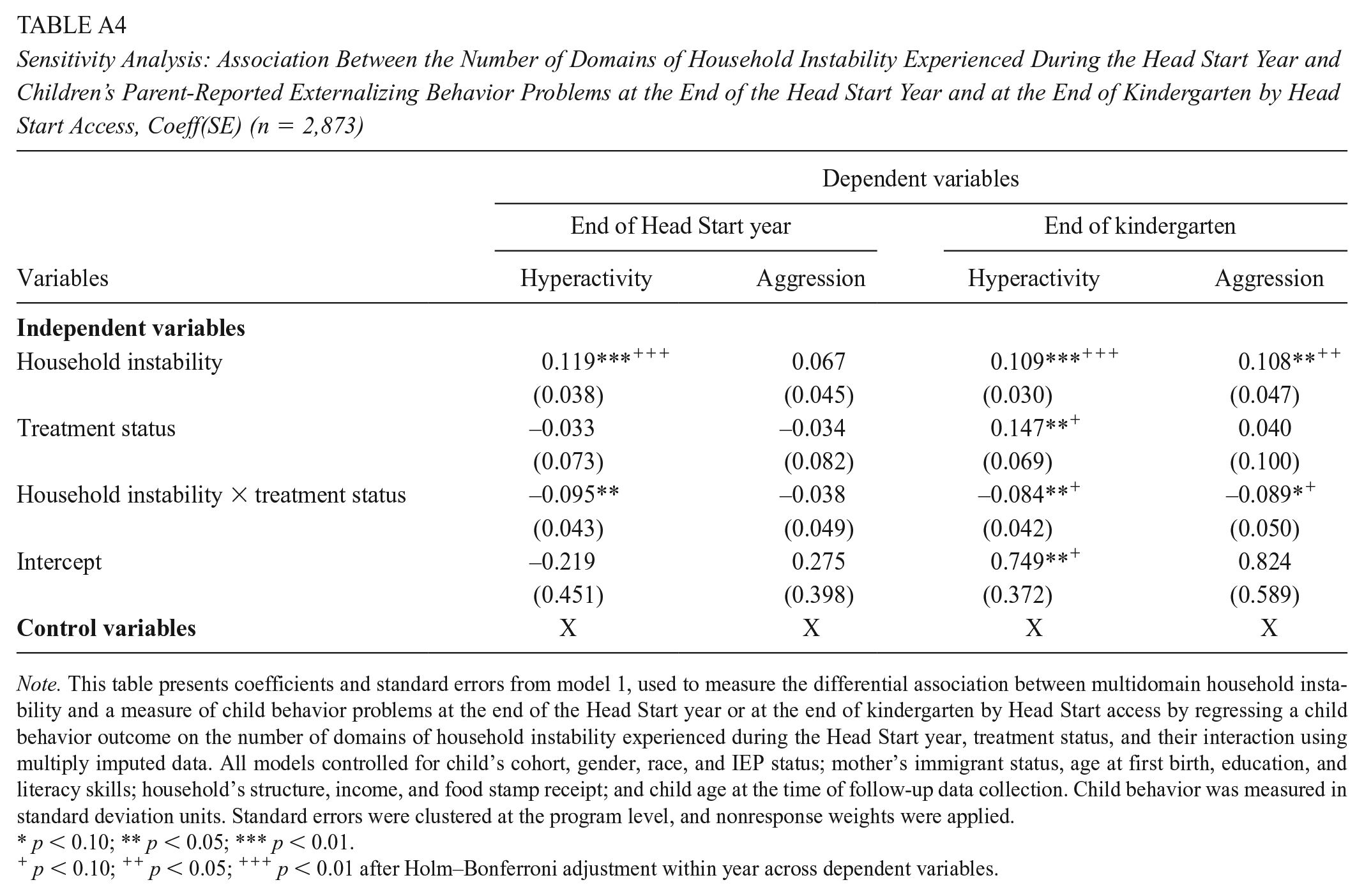
Sensitivity
This study included supplementary exploratory analyses that investigated the extent to which the main findings were affected by using teacher-reported classroom externalizing behavior problems at the end of kindergarten rather than (1) parent-reported measures and (2) more proximal measures from the end of the Head Start year (Appendix Table A4). Model 1 was used to estimate the association between children’s experiences of household instability during the Head Start year and the levels of their parent-reported externalizing behavior problems at the end of the Head Start year and at the end of kindergarten. HSIS surveys asked parents to report on children’s levels of hyperactivity and aggression over the past month using an instrument that draws on the Achenbach Classroom Behavior Checklist (Achenbach, Edelbrock, & Howell, 1987). A lower score on the scale indicates a lower level of problem behaviors, that is, more positive socioemotional development. Levels of behavior problems were standardized to standard deviation units by subtracting the mean among the control group and dividing by the control group’s standard deviation.
Findings were similar using teacher- and parent-reported measures of children’s externalizing behavior problems. At the end of kindergarten, household instability was predictive of parent-reported externalizing behavior problems among the control group, and estimates based on teacher- and parent-reported measures were not statistically significantly different for either hyperactivity (difference, 0.017; p = 0.716) or aggression (difference, 0.001; p = 0.984). In addition, the magnitude of Head Start’s buffering effect was similar for parent- and teacher-reported behavior, with nonsignificant differences in magnitudes of 0.024 SD for hyperactivity (p = 0.693) and 0.048 SD for aggression (p = 0.509).
The use of more distal measures of children’s behavior at the end of kindergarten may have weakened the effect of Head Start access compared with behavior at the end of the Head Start year given the fadeout of Head Start effects observed in the literature. At the same time, given that household instability during the Head Start year is likely correlated with later instability in the home-during the kindergarten year as well as nonrandom kindergarten school experiences, the use of more distal measures may overstate the relationship between household instability during the Head Start year and behavior problems. As such, this study’s estimates of the association between household instability and behavior should not be considered causal. Encouragingly, though, findings were similar using more proximal measures of children’s parent-reported externalizing behavior problems at the end of the Head Start-year compared with the more distal measures from the end of kindergarten. The estimates based on end-of-Head-Start year and end-of-kindergarten measures were not statistically significantly different for either hyperactivity (difference, 0.010; p = 0.819) or aggression (difference, −0.041; p = 0.423). Moreover, the magnitude of Head Start’s buffering effect was similar at the two time points, with nonsignificant differences in magnitudes of 0.01 SD for hyperactivity (p = 0.849) and 0.05 SD for aggression (p = 0.415).
Discussion
This study investigated experiences of household instability among a nationally representative sample of low-income children and families eligible for Head Start in the HSIS. The study is unique in its comprehensive documentation of multidomain family instability in low-income contexts as well as its investigation of the causal buffering effect of access to supportive early childhood education and family services on household stability, family processes, and child development. Encouragingly, Head Start was found to reduce both the incidence and consequences of household instability for family functioning and children’s socioemotional development.
HSIS data document that young children in low-income households experience substantial levels of household instability of many types and across multiple domains of family life. In response to research question 1, this study found that household instability is related to children’s externalizing behavior problems at the end of kindergarten over and above financial resources among this low-income sample. An additional domain of household instability experienced during the Head Start year is associated with increases of about 0.1 SD in each of the three types of teacher-reported kindergarten classroom externalizing behavior problems considered: (1) inattentive/hyperactive, (2) aggressive, and (3) oppositional. The average control-group child experienced 1.5 domains of instability during the Head Start year, indicating that the average child exhibits an increase of about 0.15 SD in each of inattentive/hyperactive, aggressive, and oppositional behaviors related to their experiences of household instability in the absence of Head Start. In answer to research question 2, this study found that Head Start may be a powerful policy lever to mitigate the negative consequences of household instability among low-income households, reducing and even eliminating the association between household instability and each of the three types of externalizing behavior problems, with near-zero and nonsignificant associations among the treatment group.
Exploratory analyses investigated potential mechanisms driving Head Start’s buffering effect to answer the study’s final research question 3. Head Start was found to lessen the dosage or amount of exposure children have to household instability by reducing (1) the incidence of the highest levels of multidomain instability by 6.7 percentage points, or about 15%, and (2) the use of parental care among unstable households. In addition, Head Start access eliminates a 0.12 SD increase in parent–child conflict associated with household instability.
This study, of course, has limitations. Head Start access was randomly assigned within the sample, allowing for causal interpretation of the program’s effects, including its buffering effect. In contrast, levels and types of household instability were not randomly assigned, so estimated associations between instability and children’s externalizing behavior should be interpreted with more caution. The use of teacher reports of children’s behavior at the end of kindergarten rather than at the end of the Head Start year is of particular significance because (1) Head Start effects are found to fade over time in the literature and (2) kindergarten experiences were not randomly assigned. Sensitivity analyses showed that the magnitudes of associations between household instability and behavior remained stable over time using parent reports and were similar between parent- and teacher-reported measures at the end of kindergarten.
In addition, the study’s key variables—household instability, Head Start access, use of parental care, and parent–child relationship quality—occurred simultaneously, with bidirectional influences. Formal mediation analysis can yield biased estimates when there are interactions between multiple mediators and exposure and mediation vary over time. Even more recent advances in these methods require multiple observations of key variables during the Head Start year, which are not available in the HSIS (VanderWeele & Vansteelandt, 2014; VanderWeele & Tchetgen Tchetgen, 2017). Although the exploratory findings related to potential mechanisms are in line with theory and empirical evidence from other studies, they are not definitive.
Furthermore, the generalizability of the study’s findings is unclear. The estimated relationship between household instability and children’s externalizing behavior problems in this study’s low-income sample of children eligible for Head Start—but randomized not to have access—is of a similar magnitude as identified among a national sample (Fomby & Mollborn, 2017). Yet, even if the association between household instability and behavior is similar across income levels, Head Start’s buffering effect may not be as strong among more advantaged families.
Despite these limitations, this study produced important findings with implications about the importance of family systems approaches that account for dynamic relationships within households and across families’ ecosystems. Practitioners, policymakers, and researchers should move away from a singular focus on static indicators and direct more attention toward stabilizing household finances, relationships, and residences, among other markers of family well-being. Encouraged by policymakers, Head Start practitioners should move beyond the point-in-time measures of disadvantage it uses as indicators of family well-being in its annual Program Information Report such as educational attainment, employment, public assistance receipt, and single-parent status. In addition to the level of household income, a dramatic decrease in household income is an important indicator of risk. In addition to whether the family receives housing assistance, residential relocation should be flagged.
Importantly, it is not always clear whether such transitions as newly obtained maternal employment and parental relationship dissolution are positive or negative. A holistic approach to family services can help understand these nuances to effectively support the child and household. This study’s findings imply that well-trained Head Start family support staff with family systems perspectives may be key to the program’s success. Head Start already focuses on such indicators of instability as homelessness and lack of family routines. Family support staff can and should focus more broadly on family stability and be trained to consider characteristics and transitions across multiple domains of family life in recognition of the risks associated with multidomain household instability. Some transitions may not be avoidable, but Head Start can address how transitions will affect the child and family. For example, when parents secure new employment or enroll in school or job training, Head Start staff can ensure that childcare needs are met, offset new work-related expenses such as transportation, and prepare the child for disruption. This type of coordination would require a holistic approach to data-sharing among families, family support staff, and classroom staff to track and address household transitions.
With respect to research, this study’s focus on multidomain instability across multiple facets of home life should be replicated and extended in future studies. The program evaluation literature needs to consider whole-family outcomes and focus on transition and change in addition to point-in-time levels of well-being. These dynamic measures provide important information about family functioning and may help explain null or even negative findings from public programs, which can be disruptive even when they promote some positive outcomes. Future research also should consider whether other subgroups of children and families might benefit even more from the study’s identified buffering effect, such as those most vulnerable to household instability such as males (e.g., males; Lee & McLanahan, 2015).
Head Start was conceived as a two-generation program for children and their parents and families. This study’s findings imply that Head Start may indeed have two-generation impacts and benefit children’s development not only directly but also indirectly through its influence on parents and families. Although the literature has documented that instability begets instability, this study found evidence to support the hypothesis that stability begets stability with a reverse domino effect, that is, that access to Head Start has a stabilizing effect on the household. As such, this study has identified a new mechanism by which Head Start and ECE may promote equity. These multigenerational effects need to be considered as part of the true value of Head Start (Chor, 2018). Moreover, they should be fostered by policymakers and practitioners, who can leverage ECE to address the incidence and consequences of household instability by designing, funding, and implementing intentional and aligned two-generation program components that promote household stability (Chase-Lansdale & Brooks-Gunn, 2014; Chase-Lansdale et al., 2019; Chor et al, 2023).
Footnotes
Appendix
Sensitivity Analysis: Association Between the Number of Domains of Household Instability Experienced During the Head Start Year and Children’s Parent-Reported Externalizing Behavior Problems at the End of the Head Start Year and at the End of Kindergarten by Head Start Access, Coeff(SE) (n = 2,873)
| Variables | Dependent variables | |||
|---|---|---|---|---|
| End of Head Start year | End of kindergarten | |||
| Hyperactivity | Aggression | Hyperactivity | Aggression | |
|
|
||||
| Household instability | 0.119*** +++ | 0.067 | 0.109*** +++ | 0.108** ++ |
| (0.038) | (0.045) | (0.030) | (0.047) | |
| Treatment status | −0.033 | −0.034 | 0.147** + | 0.040 |
| (0.073) | (0.082) | (0.069) | (0.100) | |
| Household instability × treatment status | −0.095** | −0.038 | −0.084** + | −0.089* + |
| (0.043) | (0.049) | (0.042) | (0.050) | |
| Intercept | −0.219 | 0.275 | 0.749** + | 0.824 |
| (0.451) | (0.398) | (0.372) | (0.589) | |
|
|
X | X | X | X |
Note. This table presents coefficients and standard errors from model 1, used to measure the differential association between multidomain household instability and a measure of child behavior problems at the end of the Head Start year or at the end of kindergarten by Head Start access by regressing a child behavior outcome on the number of domains of household instability experienced during the Head Start year, treatment status, and their interaction using multiply imputed data. All models controlled for child’s cohort, gender, race, and IEP status; mother’s immigrant status, age at first birth, education, and literacy skills; household’s structure, income, and food stamp receipt; and child age at the time of follow-up data collection. Child behavior was measured in standard deviation units. Standard errors were clustered at the program level, and nonresponse weights were applied.
p < 0.10; ** p < 0.05; *** p < 0.01.
p < 0.10; ++ p < 0.05; +++ p < 0.01 after Holm–Bonferroni adjustment within year across dependent variables.
Acknowledgements
This study greatly benefited from input and support from Lindsay Chase-Lansdale, Terri Sabol, William Schneider, Judith Levine, and the Temple University Public Policy Laboratory.
Declaration of Conflicting Interests
The author declares no potential conflicts of interest with respect to the research, authorship, and/or publication of this article.
Funding
The author received no financial support for the research, authorship, and/or publication of this article.

Authors
ELISE CHOR is an assistant professor at Temple University. Her research focuses on the multigenerational effects of early childhood education and other policies and programs that support young children from low-income families.