




Abstract
This study explores how observed emotion-focused teaching in preschool classrooms differs across classroom activity settings. Forty-three teachers were observed across several mornings. A total of 1,604 video cycles were coded for levels of emotion-focused teaching (e.g., total, modeling, responding, and instructing) and their activity settings (e.g., mealtimes and transition). Activity settings seemed to afford—to varying degrees for different teachers—the opportunity to interact with children around their emotional learning. Small-group activity settings had the highest levels of emotion-focused teaching, and mealtimes had the lowest. Emotion instructing occurred most often during whole-group interactions, and emotion modeling occurred most often during children’s independent work. Findings can inform the creation and implementation of professional development to promote these emotion-focused teaching practices. While research is increasingly demonstrating the value of emotion-focused teaching, understanding the variability of such practice over the various activity settings may identify opportunities to enhance the intentional support of children’s emotional learning.
Keywords
Recently, studies have demonstrated how one aspect of teacher–child interactions, emotion-focused teaching, is associated with an array of positive outcomes (e.g., Curby et al., 2022; Denham & Bassett, 2019; Fatahi et al., 2023; Garner et al., 2019). Emotion-focused teaching includes practices such as teachers’ modeling of their own emotions, responding to children’s emotions, and explicitly instructing about emotions. Although evidence of the associations between these practices and children’s social competence, emotional competence, and learning behaviors is growing, we know little about how specific classroom activity settings may facilitate the use of emotion-focused teaching practices. While emotion-focused teaching may be employed in any classroom activity, some activities may be particularly rich with emotion-focused teaching, whereas others may have little. The purpose of this study is to explore the extent to which emotion-focused teaching practices differ across common preschool activity settings. Doing so may help identify opportunities for enhancing the provision of emotion-focused teaching during regularly occurring activity settings.
What Is Emotion-Focused Teaching?
Emotion-focused teaching constitutes the specific teaching practices that help promote emotional competencies in children. Mirroring similar behaviors in the parenting emotion socialization literature (Denham, 2023; Eisenberg et al., 1998; Zinsser, Gordon, & Jiang, 2021), these teaching practices encompass teachers’ modeling of, responding to, and instructing about emotions (Denham et al., 2012; Zinsser, Curby, & Gordon, 2021).
In a classroom, teachers may, intentionally or not, express emotions. In doing so, they are modeling different emotions from which students learn. Teachers might, for example, express excitement about a child’s work or laugh along with children during a book reading. According to social learning theory (Bandura, 1995), these adult emotion expressions may, over time, serve as models for children’s own emotion expressions. Thus, through observations of the teacher, children can learn appropriate expressions and the regulation of emotion in the classroom (Garner et al., 2019). Relatedly, as suggested by emotion contagion theory, the adult expression of emotion may evoke a similar emotion in children (Parkinson, 2011), thereby helping children learn about emotion expression and its contexts. Generally, children are considered to learn more emotional skills when they have teachers who express more positive emotions, model how to regulate the expression of negative emotions, and provide labels for the emotions they express (Morris et al., 2013).
Adult responses to children’s emotions provide information to the children about their own emotion expressions (Eisenberg et al., 1998). Generally, responses that validate and affirm a child’s emotion, even just by labeling it, are considered to encourage children’s emotion expression (e.g., “You seem upset. What’s wrong?”) (Fatahi et al., in press). Contrarily, responses that communicate to the child that the child or their emotion is not welcome are considered invalidating responses (e.g., “If you can’t stop crying, I can’t help you.”) (Morris et al., 2013). Notably, affirming a child’s emotion does not mean that the teacher condones any perceived misbehavior (e.g., “I see you’re angry, but you cannot knock your chair on the ground.”).
While modeling and responding to emotions may indirectly provide children with information about emotion norms and expectations, instructing refers to instances in which teachers explicitly provide information to children about emotions, including what causes emotions and how they can be expressed or regulated (Denham et al., 2012). Instructing can include lessons, such as those from social–emotional learning curricula. For example, Al’s Pals (http://wingspanworks.com/) has lessons on calming down, which can be seen as providing children with emotion-regulation strategies. A given lesson might be considered a planned instance of instructing about emotions. Likewise, a teacher who is reading a storybook and points out a facial expression of emotion can be seen to be engaging in instructing about emotions, even though it may have been unplanned (Jackson et al., 2024).
These domains of emotion-focused teaching are conceptually distinct, so it can be helpful to examine them separately (Curby et al., 2022). However, recent research also has supported the view that these three domains can be examined together as part of one overall construct of emotion-focused teaching (Zinsser et al., 2023). This view is also consistent with the idea that any given set of interactions with a child may have any or all three domains present. For example, if a child is upset at drop-off, a teacher may mirror the child’s sadness (modeling), comfort the child by giving them a hug (responding), and describe the physiologic sensations associated with feeling sad (e.g., tightness in the stomach; instructing). This study uses both the overall approach and the domain-specific approach to describe the emotion-focused teaching that takes place in the various preschool activity settings.
Emotion-Focused Teaching Supports Children’s Learning
Although teachers’ engagement in emotion-focused teaching resembles parents’ emotion socialization practices, teachers are in a position to uniquely contribute to children’s emotional competence development (Denham, 2023; Denham et al., 2020). This study descriptively examines emotion-focused teaching during normal interactions as they occur throughout the day (in addition to any planned lessons) during different preschool activity settings. In this section we summarize these associations using the same measure used in this study before discussing how emotion-focused teaching may vary in different activity settings.
A number of studies have focused on the social–emotional domain and the positive effects that the accompanying curricula have on children’s development (Luo et al., 2022). However, work that focuses on emotion-focused aspects of teaching is still just emerging (e.g., Denham & Bassett, 2019). Recent studies have demonstrated that emotion-focused teaching can be reliably observed (Gordon et al., 2021) and that such teaching practices are positively associated with children’s social–emotional advancement and learning within and across time (Curby et al., 2022; Fatahi et al., 2023). Specifically, teachers’ emotion-focused teaching showed several small to moderate effects on children’s observed classroom engagement, peer conflict, self-reliance, and self-conflict in the spring, controlling for fall scores (Curby et al., 2022).
Likewise, using an overall emotion-focused teaching score, Fatahi et al. (2023) found that children in classrooms with higher levels of observed emotion-focused teaching were reported to have better in-class learning behaviors and emotion regulation and fewer angry-aggressive and anxious-withdrawn responses, and they displayed less negative emotionality.
Variation Exists in Emotion-Focused Teaching
Teacher–child interactions vary across classroom activity settings due to the affordances and goals of the activities (e.g., Curby et al., 2011; Dickinson et al., 2008; Pianta et al., 2008; Thorpe et al., 2020). For example, prior studies have shown that instructional support—as measured by the Classroom Assessment Scoring System (CLASS; Pianta et al., 2008)—is greater during science activities and book reading than during other activity settings, such as mealtimes and transitions (Cabell et al., 2013; Kook & Greenfield, 2020).
As with other forms of teacher–child interactions, emotion-focused teaching can happen throughout the day. Although emotion instructing tends to happen least frequently and modeling happens most frequently (Zinsser et al., 2023), any given aspect of the preschool day has the potential of incorporating aspects of emotion-focused teaching. Different activity settings may promote or constrain the emotion-focused teaching that takes place. For example, a teacher may be less likely to do emotion instructing during a transition but more likely during a whole-group activity. It is therefore important to explore how various preschool activity settings might differ in their levels of emotion-focused teaching. This study looks at opportunities for emotion-focused teaching during common activity settings in preschool classrooms, including the times children and teachers spend in learning centers, working in different-sized group activities, meal and snack times, and transition periods between classroom activities.
Centers and Free Choice
Center time is a common component of preschool pedagogy and describes a period (or periods) during the school day in which children are allowed to choose and rotate through various activities simultaneously (e.g., blocks, dramatic play/home living, sensory play with water or sand, and puzzles). These activities can be stations for individuals (e.g., puzzles) or small groups (e.g., sand table). Teachers “open” different centers and vary the content of specific activities in line with a broader curriculum (e.g., adding cars to the block corner during a transportation lesson). Teachers typically move between centers to provide support and scaffolding, but children’s activities are usually not teacher directed. Centers are often considered “free choice” activities but can be implemented with a set rotation or with limited choice. Centers are sometimes run in conjunction with small-group activities. For example, while some of the class does a small-group literacy activity with the teacher, the remaining students have centers. Thorpe et al. (2020) found that such free-choice periods were associated with higher-quality teacher–child interactions using the CLASS (Pianta et al., 2008). Working in centers also entails a fair amount of peer-to-peer interaction. For example, two children in the computer center may have to take turns or work cooperatively, both of which can tax children’s emotion-regulation skills and, thus, are prime opportunities for teachers to respond to children’s emotions.
Large and Small Groups
Throughout the school day, teachers set up a variety of contexts, including small and large groups. Teachers commonly work with children in large groups near the start of the school day (e.g., morning meeting) and again around the transition to or from lunch, when children gather on a rug to listen to stories, sing songs, or engage in a group discussion. Small-group instruction describes teacher-directed activities with subsets of students (typically five or fewer). For example, a teacher may sit at a table with three children to provide a structured phoneme recognition activity or guide a game or craft activity. Small groups are frequently used in early childhood to provide curricular lessons. Because multiple teachers (e.g., leads, co-leads, assistants, and interns) are in early-childhood classrooms, occasionally multiple small groups will be run at the same time.
Small-group work is positively associated with greater instructional support, as measured by the CLASS, in elementary classrooms (Curby et al., 2011). Thorpe et al., (2020) observed preschool classrooms with the CLASS and found that during large-group activities, instructional support was high, but scores on the emotional support and classroom organization domains were lower compared with other activity settings. Given that teachers and children are expressing and experiencing emotions throughout the day, emotion-focused teaching can happen during nearly any interaction, including during group instruction. One opportunity that may be particularly fruitful during large or small groups is the use of social–emotional curricular lessons. Such curricula have become nearly ubiquitous in early-childhood programs and are mandated under Head Start standards (U.S. Department of Health & Human Services, 2016) given their growing evidence base (for a review, see Murano et al., 2020). These types of lessons are often teacher directed and include many of the practices encompassed by the instructing component of emotion-focused teaching (e.g., role playing and discussions of antecedents and consequences) that have been found to be salient for children’s learning behaviors and social outcomes (Fatahi et al., 2023; Jackson et al., 2024).
Meals and Snacks
At preschool, children commonly participate in either a breakfast meal or a lunch meal as part of their normal day; these meals are usually served in the classroom and are facilitated by the teaching staff (Sigman-Grant et al., 2008). Children typically eat meals as a whole group, whereas teachers often serve snacks to small groups on a rotating basis throughout the morning or afternoon (U.S. Department of Agriculture, 2022). Family-style meals, wherein children help to serve themselves, promote children’s self-regulation, healthy eating habits, and sense of community (Dev et al., 2014). In addition to completing mealtime duties, teachers may eat with the children or use meals to complete administrative tasks, prepare for upcoming activities (e.g., nap), or socialize with other teachers (Casey, 2022).
The limited research on the role of meals in early-childhood education generally finds that the quality of teacher–child interactions during meal and snack times is low to moderate (Casey, 2022; Malek-Lasater, 2021), even when compared with other activity settings (Cabell et al., 2013; Thorpe et al., 2020). The teachers’ verbal communication to children during mealtimes (inclusive of snack times) is low in terms of both amount (Gest et al., 2006; Hallam et al., 2016) and sensitivity (Gest et al., 2006; Klette et al., 2018). However, because mealtimes provide an opportunity for social conversation (Gest et al., 2006) and to respond sensitively to food-related issues (e.g., spills and refusing food; Casey, 2022), mealtimes may present unique opportunities for teachers to connect with and respond to the children.
Transitions
Over the course of a day, children experience several different activity settings. As children switch from one activity (e.g., circle time) to another (e.g., centers), they experience transitions. These transitions tend to be numerous, with children experiencing 15–20 transitions during a typical preschool day (Banerjee & Horn, 2013). There are differences in how efficiently these changes are guided by the teacher (Pianta et al., 2008), and, on average, these interactions tend to demonstrate lower levels of teacher–child interaction quality (Curby et al., 2011). More effective transitions can allow for more instructional time while reducing disruptive behaviors (Ostrosky et al., 2003). For some children, transitions from favored to less enjoyable activities can be upsetting (e.g., leaving the playground to get ready for naptime). Better transition practices may include warning children ahead of time about an upcoming transition or providing one-on-one support during the transition to help manage children’s behaviors and emotions (Olive, 2004). At present, however, no study has directly captured the extent to which teachers use emotion-focused teaching practices during transitions.
This Study
Teachers engage in emotion-focused teaching intentionally and unintentionally in the ways they model the expression of emotions, respond to children’s emotions, and instruct about emotions. While evidence of the impact of emotion-focused teaching is growing, little is known about how teachers’ engagement in these practices differs across various typical classroom activities. This study presents the secondary analysis of data previously collected for the development and validation of a measure of emotion-focused teaching. With these new analyses, we examine the variance components and means of emotion-focused teaching practices as they naturally occur during various activity settings in preschool classrooms.
Method
Participants
Eighteen 3- and 4-year-old classrooms from four centers located in two cities participated. Two centers, with three classrooms each, were located in a large midwestern metropolitan area with several million residents. Two centers with six classrooms each were located in a large mid-Atlantic metropolitan area, also with several million residents. The centers were diverse. Of the midwestern centers, one was a Head Start program serving primarily Latinx and eastern European immigrant families; the other served predominantly white and Asian American families on a sliding-scale fee. Of the mid-Atlantic centers, one was a faith-based preschool serving primarily middle- and upper-income families; the other primarily served lower-income Latinx families.
Participating teachers (n = 47) came from these classrooms. Teachers could be in different roles in the classroom depending on who consented and the structure of the center. Some centers had a lead and assistant structure, whereas others had co-leads. The group with the most teachers identified as co-leads (45%), assistant/floater teachers were the next highest group (36%), and the remainder were lead teachers (19%). Among the teachers, all but two identified as female and most identified as white or Latinx.
Procedure
This study was not preregistered. The study protocol was approved by the institutional review boards of the two collaborating universities. Participating classrooms were recorded during three waves across the 2018–2019 school year using the Swivl recording system. To capture normal teaching practices, a teacher wore a microphone that was tracked by a Swivl device that rotated to keep an iPad, which was collecting the video, pointed at the teacher. On average, 10 mornings of video were collected from each classroom across the fall, winter, and spring waves. All but two classrooms contributed data across all seasons (one classroom left the study after the fall; another only participated in winter and spring; together these two classrooms contributed 11 dates of video). When multiple teachers in a single classroom participated, the teacher leading the primary activity was asked to wear the microphone and was the focus of coding. Thus, multiple participating teachers from the same classroom might be a part of a video, but only the one wearing the microphone would be coded.
Videos were segmented into 10-minute cycles and screened by research assistants for codability. Codable cycles (n = 1,606) met the following criteria: (a) students were in the room, and (b) the teacher who was wearing the Swivl microphone was on screen for 8 minutes or more. Additionally, research assistants recorded which activity settings were taking place in the video frame(s) using a multiple select question in the Qualtrics-based inventory form. Two cycles coded as occurring during drop-off were excluded because of the few available cycles for coding (resulting in n = 1,604 for analyses).
Measures
Emotion-Focused Teaching
Cycles were coded using the Emotion Teaching Rating Scale (EMOTERS; Zinsser, Curby, & Gordon, 2021). Full instrument items and scoring instructions for the EMOTERS are publicly available through a creative commons license (www.emoters.org). The EMOTERS captures the provision of emotion-focused teaching behaviors across three domains: modeling, responding, and instructing. Modeling captures the verbal and nonverbal emotion and regulatory expressions of the teacher. Modeling items are scored by valence and amount of information conveyed to children. For example, modeling was scored higher when a positive emotion was expressed across multiple channels (e.g., verbal and nonverbal, with labels) or a negative emotion was displayed with an explicit regulation strategy. Responding captures the validating and invalidating responses teachers give in response to children’s emotions. Generally, whether in response to a child’s negative or positive emotions, validating responses received higher scores than invalidating responses. Instructing captures planned and unplanned instances in which the teacher provides explicit information about emotions, such as during a social–emotional lesson or when working with two children who are upset with one another. Instructing scored higher when teachers provided more information about emotions, such as when connecting an emotion with something that happened previously.
EMOTERS items are mostly dichotomous and indicate the presence or absence of practices in a given video cycle (e.g., “Teacher expresses positive emotion nonverbally (smiling, dancing, etc.)”). Notably, when more than one response option was applicable for a given observation cycle, raters were told to code for the higher-level practice. Thus, EMOTERS scores indicate the highest emotion-focused practice of the teacher across a 10-minute cycle rather than the frequency with which the teacher exhibited the behavior. Prior studies with these data have demonstrated the predictive validity of the EMOTERS. Classroom-level EMOTERS scores are associated with children’s observed and teacher-reported social, emotional, and preacademic skills in spring, controlling for fall scores (Curby et al., 2022; Fatahi et al., 2023).
The EMOTERS was developed using a many-facet Rasch model (MFRM; Linacre, 1994) modeling framework that adjusts for item, occasion, and rater facets (for a full description, see Gordon et al., 2021). Resulting MFRM scores fall along a single continuum of practice (ranging from −4.0 to 4.0 on a logit scale). These scores are described thoroughly in a Rasch analysis from these same data (Gordon et al., 2021) off of which this study builds. Higher scores are assigned to teachers who were observed to engage in better emotion-focused teaching practices. Prior analyses have indicated that based on how often items were observed, overall, modeling items tend to be most frequent and instructing items tend to be least frequent, with responding items spread across the middle (Zinsser et al., 2023). Scores can be analyzed separately for modeling, responding, and instructing or in combination as a total score. The total score reveals emotion-focused teaching practices that are, in general, associated with activity settings, whereas domain scores reveal what particular activity settings are related to particular emotion-focused teaching practices.
EMOTERS coding was completed by trained research assistants at two large public universities. Prior to coding classroom videos, each rater completed 4 hours of training and practice on the EMOTERS measure. All raters then completed a reliability assessment in which they independently rated five reliability video cycles and achieved an average exact agreement above 75% with the master code, as determined by the instrument developers. Nearly all videos (85%) were coded by at least two coders. A subset of 89 videos (nearly 30 per wave) was coded by all 23 research assistants to assess consensus throughout the project. When videos included either teachers or children speaking in Spanish, a fluent coder was assigned to code that video. This level of dual and fully crossed coding allowed for sufficient connectedness needed for the MFRM estimation (Linacre, 1994; Wind & Jones, 2019).
Activity Settings
Primary settings activities (see Table 1) included large group, small group, free-choice/centers, meals/snacks, and transitions. Large-group settings were those in which a teacher was working directly with at least six children (and as many as the whole class, e.g., reading a story to them, facilitating a lesson, or leading a creative activity). The small-group code was applied when a teacher directed five or fewer children in an activity (e.g., phonetic awareness, craft, etc.). The centers code described times when children were working in a variety of student-directed activities throughout the classroom (e.g., independent or small groups of children playing with blocks, doing puzzles, or pretending in the home-living area), even if one of those centers was a teacher-directed activity with a subgroup of students. The meals code was applied whenever children were visibly eating either in a small group at a snack table or as a whole class during lunchtime. Transitions were coded whenever a teacher facilitated the class transitioning from one activity to another (e.g., from whole-group circle time to lunchtime or outdoor recess).
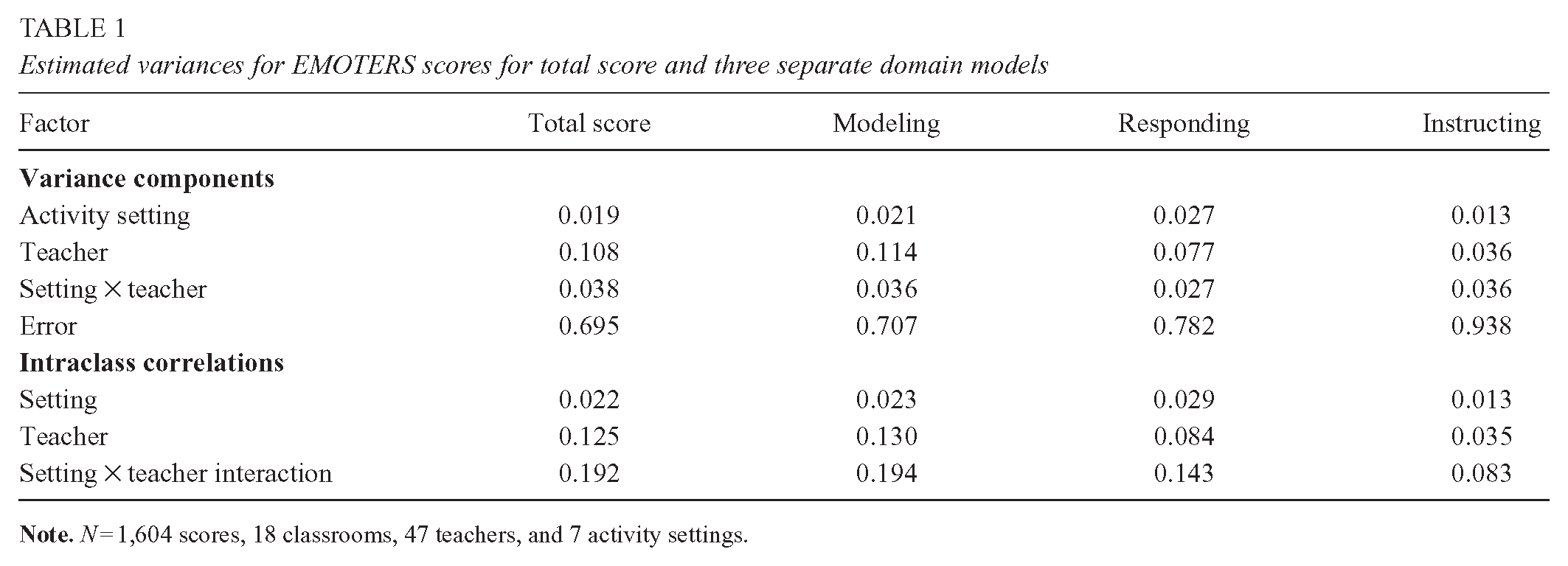
Estimated variances for EMOTERS scores for total score and three separate domain models
Collapsing of Activity-Setting Codes
Initially, activity-setting codes were not mutually exclusive, and therefore, multiple activity settings could be coded when they occurred during a single 10-minute cycle. For example, a cycle that started with a whole-class circle time and ended with a transition to another activity would receive both the large group and transition codes. To facilitate planned analyses, we created mutually exclusive categories that reduced most multiactivity cycles to single codes. First, any cycle with a transition was coded as a transition, even if another activity occurred before or after the transition. Transitions were given priority because our experience in classrooms suggested that emotions are often expressed during transitions, and teachers’ responses to those emotions might take primacy in our coding scheme over the emotion-focused teaching happening during other activities in the cycle. Second, cycles that included both centers and meals/snacks were coded as centers because when both activities were selected, it was because a snack was provided in the context of centers (e.g., one center being set up as a snack). In contrast, for cycles coded as both large group and meals/snacks, we retained the meals/snacks code because we discovered that some study staff had not consistently coded large group when the entire class of children was eating together. Two co-occurring activity settings in a cycle were retained: centers and small-group and centers and large-group activities. Although similar, these code combinations suggested that some of the children were doing centers while others were working with the teacher, just differing in relation to the group size (five or fewer children was a small group; six or more was a large group).
Analysis Plan
Stata version 17 was used for the analyses. To understand our data descriptively, we calculated the means and standard deviations of emotion-focused teaching in various classroom activity settings as well as the frequency of cycles that had a given activity setting. We took a twofold approach to modeling differences in activity settings. One approach used multilevel mixed-effects models to estimate variance components for settings, teachings, and settings × teachers (with fixed effects for classrooms). This allowed us to quantify the extent to which settings differed (net teachers), teachers differed (net settings), and settings and teachers in combination. Put differently, this interaction allows us to know the extent to which teachers in particular settings were particularly effective.
Another approach used regression models with indicators of the activity settings while adjusting standard errors for clustering of multiple cycles within teachers. Teacher role was not accounted for in the model because prior analyses (Gordon et al., 2021) suggested that EMOTERS scores did not systematically vary by role. Pairwise contrasts tested significance between activity settings. Stata correctly calculates the standard error of the difference, including the covariance when computing the significance of the mean differences. Identical analyses were run with EMOTERS total score, modeling, responding, and instructing as outcomes.
Results
Children in observed classrooms were most frequently experiencing either centers (34.85%) or transitions (28.74%) among activities. The remaining cycles were fairly evenly divided across large group (11.97%), meals (9.29%), and center and small-group settings (8.29%). Very few cycles captured small-group activities only (2.56%) or centers and large-group activities (4.30%). The EMOTERS total score was most highly correlated with the modeling domain (r = .93), followed by responding (r = .65) and instructing (r = .25).
Table 1 presents results from the random-effects approach to quantifying variance components. The EMOTERS total scores and three domain scores are listed in columns. The rows show the estimated (raw) variance components as well as calculated intraclass correlations. Generally, the models showed that the variance attributable to the teacher (alone) was larger than setting variance (alone), although this pattern was greatest for modeling, less so for responding, and least so for instructing. Intraclass correlations, which indicate the proportion of variance attributable to a given source, were small for the setting random effects, ranging .013 to .029. Teacher random effects were larger, ranging from .035 to .130. The setting × teacher interactions were the largest random effects, ranging from .083 to .194. The random effects from the setting × teacher interaction were generally the largest source of variance. This indicates that certain teachers were particularly effective (or ineffective) in providing emotion-focused teaching in certain settings.
Overall, these results reveal considerable variability in emotion-focused teaching scores beyond the variance captured by the teacher and setting. Yet, these detailed results also reveal meaningful variation of emotion-focused teaching scores across activity settings.
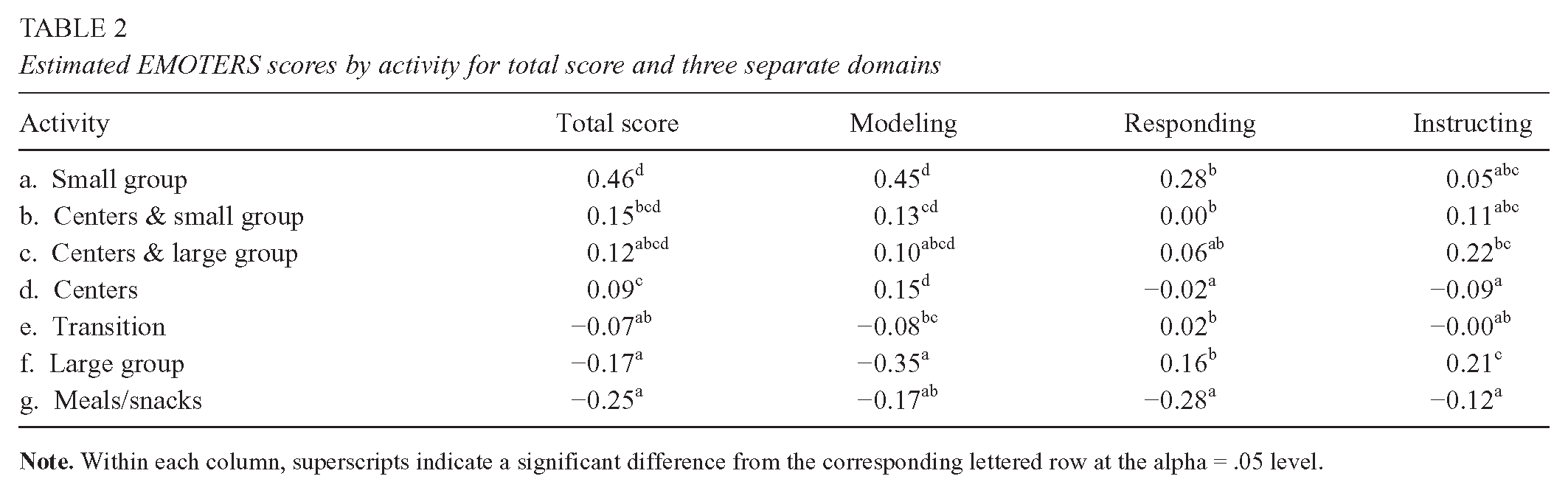
Table 2 presents results from the fixed-effects models. Cells sharing capital letters have marginal means that are not significantly different from one another. Average EMOTERS total scores were lowest for meals/snacks (−0.25 logits). Large groups (−0.17 logits) and transitions (0.07 logits) were not separable from meals/snacks at the low end. Small-group activities were, on average, the highest-scoring activity (0.46 logits) but were not separable from centers and small groups (0.15 logits) or centers and large groups (0.12 logits). This is apparent in Figure 1, which shows the estimated marginal means for each activity setting by outcome.
Estimated EMOTERS scores by activity for total score and three separate domains
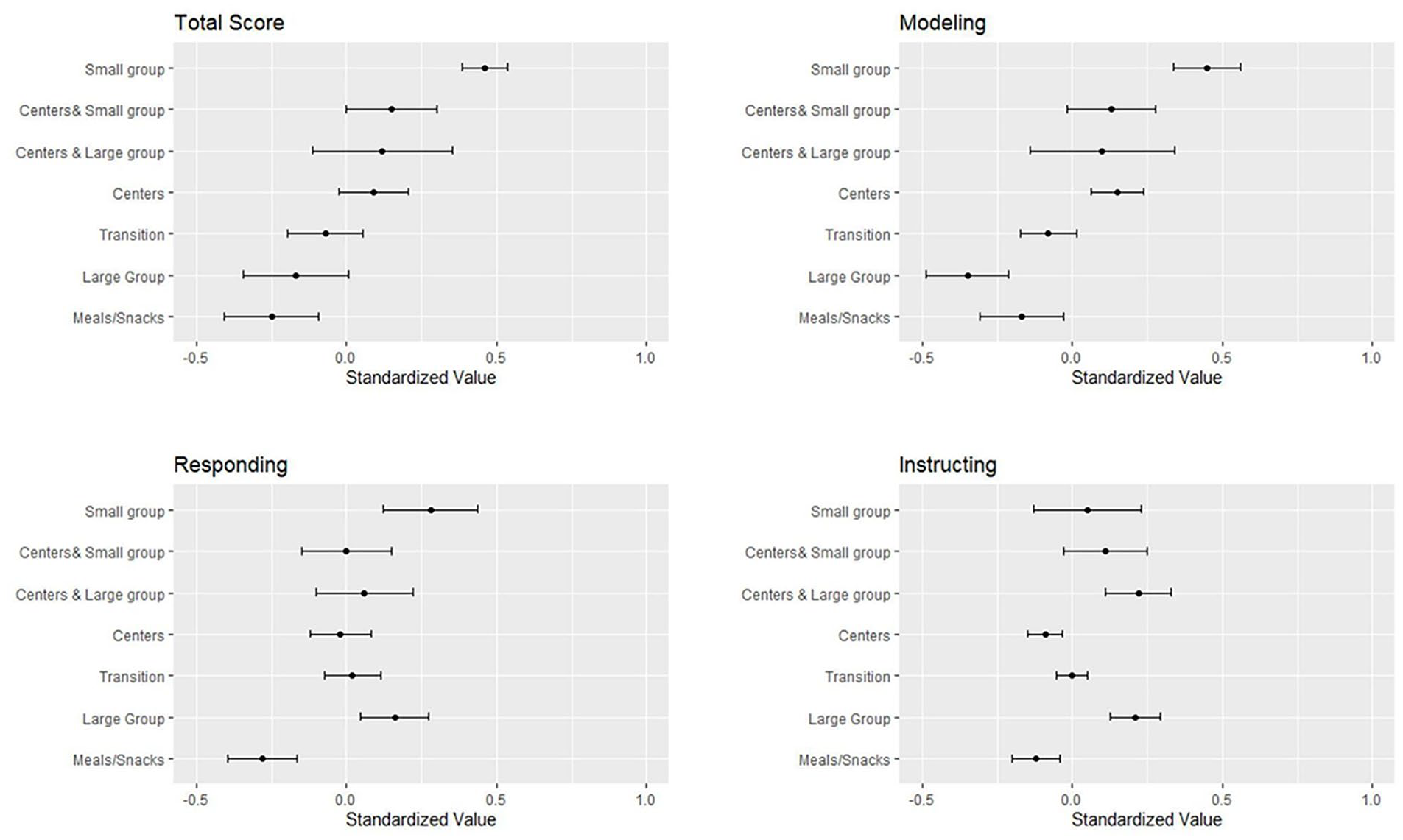
EMOTERS total and domain scores by activity type.
Not all mean differences were significant because the variability around a point estimate reflected both the spread of scores in an activity setting and the number of cycles. As a result, the averages of some pairs of activities were harder to differentiate than others. Broadly speaking, EMOTERS total scores indicated that activities during which teachers were working more intimately with children in small groups (e.g., teacher-directed activities during centers) were associated with higher EMOTERS scores. Conversely, those that required teachers to manage larger groups or facilitate meals averaged lower EMOTERS scores. Transitions tended to score at the lower end of the continuum.
When looking across domains, as was the case for total scores, the small group code was the activity setting averaging the highest scores for both modeling and responding (Figure 1). Conversely, modeling and especially responding scores averaged low levels during meals/snacks. Teachers tended to react to children’s expressed emotions in invalidating ways (e.g., dismissing, punishing, or ignoring) when facilitating mealtimes. Large-group interactions also averaged little modeling but ample instructing and moderate responding scores. Likewise, although middling in EMOTERS total score, average scores for the three activity categories involving centers varied considerably by domain.
Discussion
This study examined variations in emotion-focused teaching across commonly occurring activity settings in preschool classrooms. Observed settings and activities were largely in line with prior studies of time use in early education (e.g., Early et al., 2010). Findings indicated that emotion-focused teaching occurred most often in small-group and large-group activities, although domain-specific patterns of emotion-focused teaching varied across different group sizes. Additionally, during some activities, especially mealtimes, teachers engaged in little emotion-focused teaching. However, these results are tempered by the fact that settings alone did not account for a large portion of variance. Rather, some teachers were particularly effective in particular settings. Here we discuss these results by activity setting before further articulating the implications and limitations of this work.
Sources of Variance in Emotion-Focused Teaching
Preschool classrooms are multifaceted and dynamic, and as such, capturing variance in practices is a consistent challenge. In addition, our models do not fully account for all sources of variance, such as time of day. Nevertheless, results indicate that settings and teachers are important sources of variance in emotion-focused teaching, particularly in combination. This finding aligns with prior studies of emotion-focused teaching. For example, having teachers “read” emotionally laden wordless storybooks with a group of children did not elicit significantly higher EMOTERS scores than their normally observed practices (Jackson et al., 2024), but some individual teachers offered much more emotion-focused teaching during this time. In this way, different teachers may or may not take advantage of the opportunities presented by different activity settings, such as book readings. These results suggest that instructional coaches working with teachers should consider individual teachers’ practices across various activities when developing improvement plans for specific teachers. Although substantial variance was attributed to the teacher alone (suggesting that some teachers offered, on average, more emotion-focused teaching than others), professional development that does not account for teachers’ individual strengths and needs in particular settings likely will be less effective.
Small Groups
Overall, emotion-focused teaching was highest during small-group activities when the teacher was working specifically with only a handful of children. In particular, these small-group settings were associated with greater modeling and responding to children’s emotions. Teachers use small groups as a way to work with a manageable number of children, which enables better attention and differentiation to children as individuals (Farley et al., 2017). Although prior work has shown that teachers’ interactions with children during small-group activities are less cognitively demanding (Durden & Dangel, 2008), small-group activities may position teachers well to identify individual children’s emotional expressions. For teachers seeking to increase their emotion-focused teaching, therefore, setting goals around their engagement in small-group activities may be a good place to start.
Centers
Free-choice or center time is a hallmark of Western early-childhood education. Prior research has shown that having the opportunity to self-select or self-direct their learning during center times is beneficial to children’s inhibitory control skills (Goble & Pianta, 2017). Further, when teachers are effectively engaged with children during free-choice times, these interactions are significantly related to children’s language development (Goble & Pianta, 2017). Our findings highlight the potential for these activity settings to benefit children. Teachers in this study were observed to be engaged in moderate levels of emotion-focused teaching during center times, with some variability across the three domains of the EMOTERS. There are great differences in what teachers might be doing during center times, but nonetheless center times afforded teachers the opportunity to engage in moderate to high levels of emotion-focused teaching. This is tempered by the fact that we were following teachers in our coding, not children. Thus, teachers may have offered high levels of emotion-focused teaching, but it may have been spread across individuals in the room. This suggests that when a teacher is working with a subset of children in a small group during the larger center time, the teacher likely has the ability to focus individually on students and respond in more validating ways. In these group settings, the teacher and students are often all facing one another (often around a table), which could be a structural support for more validating responses to children’s expressions of emotion.
Transitions
Nearly a third of all observed cycles included children transitioning from one activity to another. As stated earlier, based on prior studies (e.g., Curby et al., 2011; Ostrosky et al., 2003; Pianta et al., 2008), we anticipated cycles that included transitions to be among the lowest scoring for emotion-focused teaching practices. Ineffective and/or inefficient transitions are associated with children’s decreased behavioral and cognitive self-control (Rimm-Kaufman et al., 2009), and teachers’ management of transitions is an indicator of higher classroom quality (Pianta et al., 2008). Specific to emotion-focused teaching, transitions present an opportunity for teachers and children to experience and respond to emotions. Teachers may feel anticipation or anxiety about successfully managing a transition. Children may be disappointed or excited about ending one activity and starting another (e.g., getting ready for recess). In this study, cycles that included a transition, on average, received lower total EMOTERS scores, but subtle variations were evident across the three domains. These data show that in addition to managing transitions effectively, teachers can, but often do not, use transitions as opportunities to display, respond to, and teach about emotions.
These findings, however, should be considered in light of the method used for coding cycles as transitions. For a cycle to be coded as a transition, the video cycle had to include children and teachers changing from one activity setting to another. Thus, inherently, transitions capture multiple activity settings. These other activities may very well have scored higher on their own but were averaged with parts of the cycle that was the actual transition in which little emotion-focused teaching was happening. Thus, transitions scored a little higher than expected, but this may just reflect our methodology of coding any cycle with a transition under the singular transition label.
Large Groups
When looking at overall emotion-focused teaching, large-group activities scored near the low end of emotion-focused teaching. At the same time, these activities were scored comparatively higher in the instructing and responding domains. Activities that occur during large groups have the potential to be more instructive but also have to potential to be less developmentally appropriate for young children in U.S. preschools (Burchinal, 2018). This disparity may be due to the fact that instructing about emotions is quite rare (Zinsser et al., 2023), despite contributing more to children’s observed social–emotional and learning behavior gains (Curby et al., 2022).
Although somewhat rare, when present, instructing practices tended to happen during large-group activities, likely representing teachers’ planned curricular moments (e.g., a social–emotional learning lesson or emotionally salient storybook). Morning meetings or circle-time songs or routines such as checking in on a mood meter or feelings chart also would score more highly on this domain of the EMOTERS. Such large-group interactions and routines also can provide teachers with ample opportunities to respond to children’s emotions by validating their feelings. Because responding items are contingent on children’s emotional expressions, it follows that the larger the group of children gathered, the more likely it is that a teacher will have multiple chances to respond to expressions. Further, EMOTERS codes are assigned based on the highest observed practice. That is, if teachers use a mix of validating and invalidating responses to children’s emotions, their score reflects the capacity to use validating responses. It’s possible that during large-group activities, teachers may be less likely to ignore children’s emotion expressions (particularly when coupled with an unwanted behavior) because the children are in close proximity to the teacher and other children.
Means for modeling, by contrast, were lower during large-group activities than during all other activity settings. Teachers’ lower average modeling scores during large-group activities suggest that they were perhaps expressing unregulated negative emotions. Modeling scores are also drawn down by frequent use of prohibitions and commands and by negative outbursts such as yelling. If teachers were to proactively structure large-group activities to promote children’s attentional and behavioral regulation (e.g., setting clear behavioral expectations around whether and how children should sit to listen to a story) and increase their own enjoyment of the activity, we would expect this domain score to increase.
Meals and Snacks
Meals and snacks consistently averaged at the bottom of the emotion-focused teaching continuum. From a certain perspective, this is surprising because the unstructured time may present an opportunity for children and teachers to have social conversations. However, the reality of an early-childhood mealtime is that it can be a stressful time for teachers. Teachers may be simultaneously managing the logistics of mealtimes (e.g., serving food), preparing for future activities (e.g., naptime), and ensuring that children eat their food. In such a situation, teachers may be more directive—displaying fewer positive emotions—and pay less attention to responding and teaching about children’s emotions. Previous research has shown that teachers are fearful of having to give parents a negative report on their child’s eating during pickup (Dev et al., 2016), suggesting that teachers may be focused on encouraging children’s food consumption rather than on other social elements of meals. This may lead teachers to resort to prohibitions and commands to get children to eat (e.g., “Sit down. Eat your food.”), expressing frustration with seemingly off-task behavior (e.g., “If you don’t stop playing with your food, I’m taking it away!”) or missing emotional cues from children entirely. These kinds of responses may be reflected in low responding scores for meals. Akin to prior findings related to lower-quality teacher–child interactions during mealtimes using the CLASS (Cabell et al., 2013; Thorpe et al., 2020), little instruction about emotions occurred during mealtimes in this study. Notably, teachers’ reports of excessive and simultaneous job demands, such as during mealtimes, have been shown to contribute to the workforce turnover rates (Schaack et al., 2020).
Even so, the same situations that may be challenging teachers also may be opportunities for high-quality emotion-focused teaching. During mealtimes, teachers are uniquely positioned to scaffold social interaction and behavior, especially if they are seated at the table with the children. For example, teachers may lead personal conversations with children and expand on emotional content, explain how expressing an emotion affects others at the table, support self-regulation (e.g., helping a child regulate their emotions to stay seated at the table), and respond in validating ways during common mealtime events (e.g., spills or refusing food). Although not commonly conceptualized as an instructional time in the preschool day, mealtimes nonetheless may present valuable opportunities for greater emotion-focused teaching (Casey, 2022). Helping teachers take advantage of such opportunities likely will require reducing simultaneous job demands by marshaling additional resources and staffing support to handle administrative activities during mealtimes (e.g., serving and cleanup).
Limitations and Future Directions
Emotion-focused teaching can be present in almost any preschool interaction. Teachers can nearly always express an emotion, respond to a child’s emotion, or instruct about an emotional aspect of a classroom experience. This study measured the extent to which this emotion-focused teaching was happening in various settings, with some activity settings being quite high (e.g., small groups) and others being quite low (e.g., mealtimes).
This study had several notable limitations. The study focuses only on teachers’ practices and not on children’s behavior or learning within and across different activity settings. Future studies may investigate how activity settings facilitate different bidirectional interactions as opposed to different provisions of emotion-focused teaching practices by the teacher. Additionally, this study does not account for other factors that may influence emotion-focused teaching practices such as teacher role or classroom structure (lead vs co-lead), program type (e.g., Head Start vs private preschool). For our coding, we only coded one teacher in a given cycle. Teachers were asked to give the microphone to the main teacher leading any given activity. By doing so, activity settings that have more teacher-directed instruction (e.g., small or large groups) are more likely to have the scoring that reflects the teacher working with the group. In contrast, when multiple activities are happening, another teacher (not the focus of the coding) also may be working with children in centers. In these activity settings, we may be underestimating what children are receiving from teachers because we are only coding one teacher.
The small- and large-group activity codes were potentially insufficiently distinct, and it is unclear what proportion of large-group activities was actually whole-class activities and what proportion just captured a teacher working with a group of six children instead of five. Because of camera placement in some videos and classrooms, it was often not possible to determine whether a large group constituted all children in the classroom. It is possible that having an activity code dedicated to circle time could have been more ecologically valid and yielded more specific information about teacher-led and preplanned curricular moments.
Finally, a natural question to ask is whether providing more time in a given activity setting would increase emotion-focused teaching levels and thereby benefit children. This is a causal claim that this study is unable to address, but future research can explore the extent to which changing-altering activity settings may affect children’s emotional competence.
Conclusion
Increasingly, research suggests that the emphasis on preacademic skills in early education is potentially misguided and that instead the benefits of preschool are most likely to happen in domains that are “foundational to subsequent development and are typically not a major focus of instruction in later grades” (Burchinal et al., 2022, p. 2), such as children’s emotional competence. While research is increasingly demonstrating the value of emotion-focused teaching, understanding the variability of such practice over the various activity settings has helped identify opportunities to enhance the intentional support of children’s emotional learning. This study indicates that there are ample untapped opportunities to increase emotion-focused teaching broadly and instructing practices in particular throughout the school day. Activity settings afford—to varying degrees for different teachers—the opportunity to interact with children around their emotional learning. Going forward, research and programming are needed to understand how to best support teachers’ consistent engagement in these practices.
Footnotes
Acknowledgements
We are grateful to the teachers and children who welcomed us and our video equipment into their classrooms. We also acknowledge Sarah Moberg, whose early data wrangling and analyses helped inform the conceptualization of this paper. We are grateful to an anonymous reviewer for suggesting that we report the variance components associated with teachers and activity settings. Finally, we could not have done the work without the tireless help of dozens of undergraduate and graduate research assistants at the University of Illinois at Chicago and George Mason University: Vanessa Adan, Xiaozhu An, Jack Belkin, Jyotsna Bitra, Rebbeka Carmona, Iyana Cones, Duy Dang, Jasmina Ejupovic, Monica Estrada, Negar Fatahi, Rachel Fellinger-Stephenson, Danalyn Garcia, Jennifer Hernandez, Velisha Jackson, Mary Jacobson, Xue Jiang, Christina Kelly, Elizabeth Lam, Caroline Lee, Mary Ellen Lily, Elpi Marchesini, Astri McNeish, Christina Nguyen, Christen Park, Dominique Ramos, Julia Ross, Alexa Roth, Nadine Rozell, Emily Shi, Callie Silver, Amber Singh, Devante Sloan, Laura Stokes, Gullnar Syed, Elana Thomas, Ruby Toledo, Luz Torres, Reba Troxler, Qingyuan Xie, Janette Zaragoza-Estrada, Aneesa Zarzis, Courtney Zuluaf, and Uliana Soloviev.
Declaration of Conflicting Interests
The authors declare no potential conflicts of interest with respect to the research, authorship, and/or publication of this article.
Funding
This study was supported by the U.S. Department of Education Institute for Education Science (R305A160010). The opinions are those of the authors and do not represent those of the U.S. Department of Education.

Authors
TIMOTHY W. CURBY is professor and chair of the Psychology Department at George Mason University. His research centers on emotion-focused teaching as well as other teacher–student interactions in early childhood.
KATHERINE M. ZINSSER is a professor of psychology at the University of Illinois, Chicago. Her research focuses on the emotional development and well-being of children and caregivers in early-childhood-education settings.
EMMA G. CASEY is a doctoral student at George Mason University. Her research focuses on emotion-focused teaching in early-childhood-education settings as well as interoceptive awareness and its role in emotional and eating development in young children.
RACHEL GORDON is associate dean for research and administration at the College of Health and Human Sciences of Northern Illinois University. Drawing on multiple disciplines and methods, her research broadly examines contextual, social, and policy factors that nurture and constrain human development.