




Abstract
We present a model of capital that expands existing models to introduce two new forms of capital (time and body capital) as sources of inequity in education. The aim is to (a) make visible core resources that are relevant to educational outcomes and also (often hidden) sources of inequity, (b) identify commonalities across diverse empirical and theoretical research strands, and (c) reconceptualize existing research from an asset rather than deficit framework. We explain how time and physiological resources can be conceptualized as forms of capital and link this to extant empirical and theoretical research across fields. Then, we describe how students may have different amounts and types of time and body capital, as well as different drains on capital, and how this may lead to educational inequities. We close by describing the affordances of using this theory as a lens for analyzing existing educational structures, policies and practices.
We present a theoretical model of capital that expands existing models to introduce two new forms (time and body capital) as sources of inequity in education. Our focus is on higher education, yet this theory is relevant to other contexts. The motivation for this model is to make visible certain resources that are relevant to educational outcomes and also hidden sources of inequity. This theoretical model identifies commonalities across diverse research strands and reconceptualizes existing research from an asset framework. Research in education has often taken a deficit perspective, where the explanation for differences in outcomes between the dominant and some other group (or between individuals) is some characteristic that the dominant group has and others lack. 1 Instead, our approach focuses on the ways in which universal resources are unevenly distributed or depleted, and how this creates different sets of experiences that may maintain or widen preexisting inequities. Borrowing language from related theories, we call these resources capital, and our thinking is similar to that of Bourdieu (1979, 1980, 1983, 1986) in that we conceptualize capital as a tool for explaining social structures, not just economic ones. However, the model presented here goes beyond the categories of capital introduced by Bourdieu and others.
Our model evolved from several decades of teaching, advising, and researching students that have traditionally been marginalized in higher education (e.g., Black/Hispanic students, women, student parents). Throughout the years, students have shared many aspects of their lives with us that impacted their access to education yet were neither typically accounted for by their college nor well represented in existing higher education research and theories. We developed the model presented here to better describe the lived experiences of these students, as well as to illustrate how existing higher education norms can be incompatible with students’ experiences in ways that impede educational success. Inequitable distribution of resources, such as economic ones, contributes to educational gaps (e.g., Calahan et al., 2018; Jury et al., 2017), yet higher education research rarely addresses differential student time (quantity and quality of discretionary time) and body/energy capital (physical, mental, and psychological resources) and their impact on academic outcomes (Wladis et al., 2018, 2023, 2024a). Further, when underresourced students succeed despite time and body resource inequities, they often do so at high personal cost (Wladis et al., 2020, 2024a, 2024c). Our hope is that articulating an explicit framework naming these resource inequities and describing how they relate to other resources in education could be a productive first step toward addressing the marginalization of these students.
We describe how we define capital, and how this relates to extant literature in sociology, economics, and education. Then, we introduce two new forms of capital: time capital and body/energy capital and discuss how these constructs can be viewed as unifying existing theories and empirical research across disciplines. Finally, we describe some affordances of our model in analyzing existing educational structures. Our goal is that this new Holistic Capital Model will allow scholars and practitioners to develop ways to better recognize, acknowledge, and measure currently overlooked sources of inequities, so that they may be addressed.
Definitions
We define capital as a resource or collection of resources that can be
accumulated or depleted;
exchanged for (or gained in exchange for) other forms of capital; 2 and
unequally distributed in society, and this unequal distribution can lead to unequal outcomes.
While other scholars have imposed other qualifications on their definitions of capital, the three criteria above constitute our definition of capital, without further constraints. Thus, our definition is not exactly like others in sociology (e.g., Bourdieu, 1980), economics (e.g., Becker, 1964), or education (e.g., DiMaggio, 1982; Lareau, 2015). Our definition is related to traditional conceptions of capital as something that is exchangeable for other forms of capital (e.g., Bourdieu, 1983, 1986), such as economic capital. Similar to Bourdieu and many education scholars, we are interested in capital only insofar as it explains unequal societal outcomes. However, we conceptualize outcomes as any outcome of value, not just economic ones (or means to economic outcomes such as academic credentials); therefore, unequal outcomes could include, for example, learning, educational achievement, social status/power, quality of life, or health/well-being. We propose a model with five interconnected capital types (time, body/energy, social, cultural, and economic), where different types are viewed as components that constitute someone’s total capital (which describes the distribution of amounts and types of capital for a given person) (Figure 1).
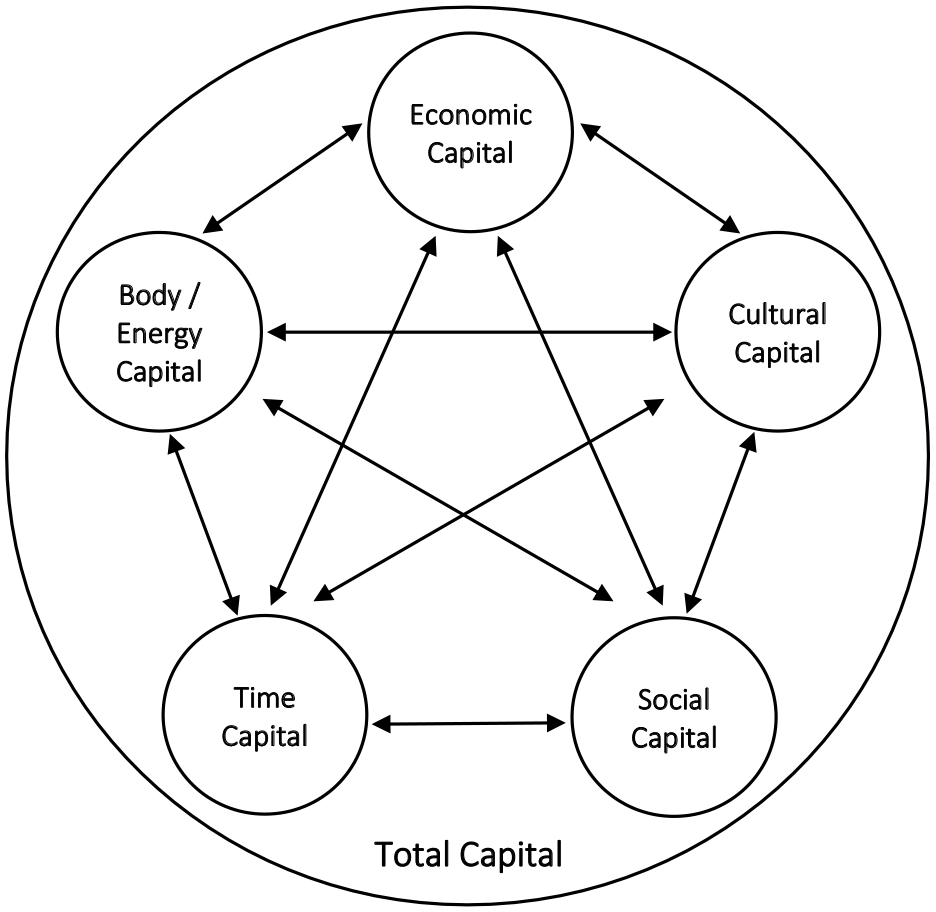
The Holistic Capital Model: Exchangeability of types of capital is represented by arrows, and total capital represents a way of conceptualizing inequity
Our primary outcome of interest in the Holistic Capital Model depicted in Figure 1 is an individual’s distribution of total capital, including both amounts and types of capital. For example, two people may have the same financial assets, but one may have more discretionary time, better mental/physical health, better social connections, or higher knowledge/skills. This puts our model more in line with sociological conceptualizations of capital like those of Bourdieu (1986) than models of human capital in economics (e.g., Becker, 1964). Human capital theories (e.g., Becker, 1964) focus on an individual’s potential economic productivity and have been adapted to educational contexts to measure an individual’s potential academic productivity (e.g., Quarles et al., 2020). Yet human capital theories do not account for how reserves of time and body capital may influence a person’s ability to build human capital through education. In contrast, our Holistic Capital Model accounts for an individual’s distribution of total capital to measure the extent to which (and what kinds of) resources are inequitably distributed, and by extension, the extent to which individuals have choices about when, how much, and what kinds of capital to invest in education.
For Bourdieu (1986), time, energy, and the body play critical roles in the accrual of capital and its conversion into other forms. However, Bourdieu did not conceive of time or body/energy resources themselves as capital (see Figure 2); here, we discuss the benefits of reconceptualizing them as capital. Next, we discuss Bourdieu’s conceptualization of cultural and social capital (including how it has been applied in education research) and delve into the roles of time, energy, and the body.
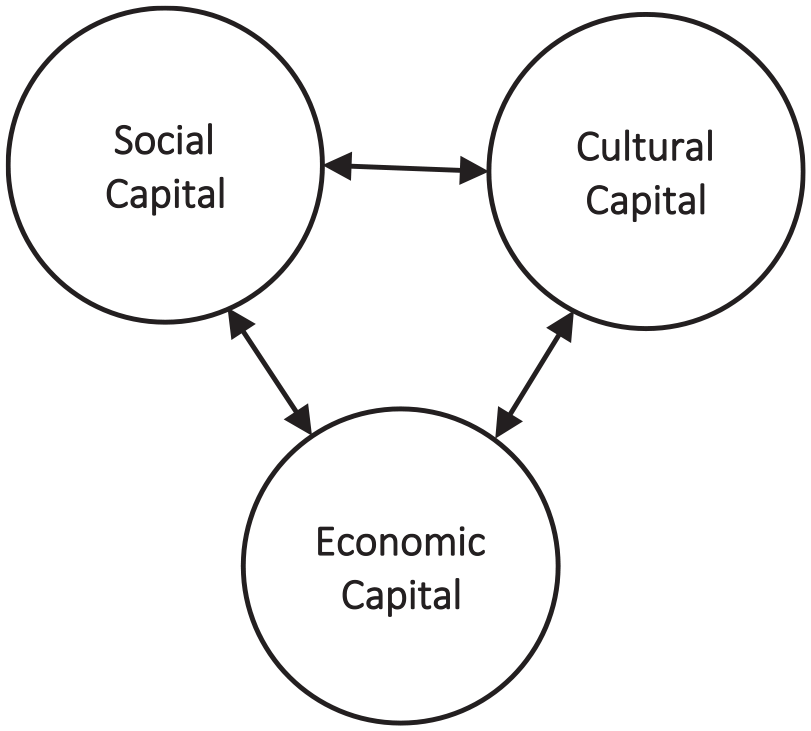
Depiction of Bourdieu’s (1986) conceptualization of capital
Literature Review
Bourdieu’s Conceptualization of Capital
In his essay The Forms of Capital, Bourdieu (1986) articulated the need to recognize capital in multiple forms, not just the one form recognized by economic and human capital theories, which failed to account for the role of culture or social relationships in processes of social stratification. Including cultural and social capital in a conception of capital accumulation afforded a more realistic model of how individuals accrue scarce resources in the contest for economic and social mobility. Bourdieu (1986) defined cultural capital as both embodied skills, knowledge, and abilities (e.g., formal education, language, coding, or dancing), as well as cultural products or goods such as books, instruments, or computers. He referred to certain types of cultural capital, primarily skills or knowledge, as embodied because they are tied to the body, or the individual who possesses them. Bourdieu defined social capital as resources linked to a social network. The amount of benefit resulting from social capital depends upon the size of one’s network, the ability to mobilize social connections, and the amount of capital (cultural and economic) possessed by those in the network. Bourdieu thus conceived of capital as a store of resources that individuals could deploy in a variety of ways that would affect their chances for social and economic mobility (Lamont & Lareau, 1988).
Bourdieu (1986) conceived of these new kinds of capital as a “theoretical hypothesis” that allowed us to explain how social origins affected educational attainment, or why students from different social classes experienced different rates of educational attainment and returns from educational credentials. Thus, Bourdieu saw cultural and social capital as mechanisms through which social origin impacted educational and economic outcomes. Importantly, Bourdieu sought to critique the human capital model described by Becker (1964) that conceived of educational outcomes as resulting from individual ability and investments in education. In contrast, Bourdieu argued that what the human capital model saw as individual ability was in fact the result of previous investments of economic capital, cultural capital, and time. Thus, the education system disproportionately rewarded certain types of capital (i.e., those possessed by the upper classes) and consequently played a role in reproducing patterns of social and economic stratification.
Forms of Capital in Education Research
Many scholars have applied the concepts of cultural and social capital to understand educational outcomes (Brooms & Davis, 2017; Coleman, 1988; Dika & Singh, 2002; DiMaggio, 1982; Farkas et al., 1990; Fitzpatrick, 2020; Klevan et al., 2016; Laanan et al., 2010; Lamont & Lareau, 1988; Lareau, 2015; Lareau & Weininger, 2003; Yosso, 2005). Lareau and Weininger (2003) contend that an interpretation of cultural capital that pervades much early research can be traced back to DiMaggio’s (1982) study that conceptualized cultural capital as knowledge of “prestigious” or “highbrow” culture. Lamont and Lareau (1988) and Lareau and Weininger (2003) criticized this as inconsistent with Bourdieu’s conceptualization and argued for a definition that captured both institutional standards and individuals’ efforts to comply with them (Lareau, 2015). Farkas et al. (1990) also departed from the highbrow definition of cultural capital, exploring how middle school teachers rewarded aspects of student skills and work habits, and how this played a role in course grade gaps by gender, race, and economic status. Laanan et al. (2010) suggested that a subtype of cultural capital, transfer student capital (the knowledge needed to successfully navigate from 2- to 4-year colleges) was important for educational attainment. Critiquing the assumptions of student/family deficit that often accompanied the application of cultural capital in education research, scholars (Brooms & Davis, 2017; Gonzalez et al., 2005; Yosso, 2005), have argued for a model of community cultural wealth that acknowledges the valuable types of cultural capital minoritized students and their families bring to education. Scholars have also explored how leveraging concepts of cultural capital and wealth can support the high school to college transition and college retention for underrepresented students (Lareau, 2015; Matos, 2023).
Research on social capital has been equally prolific, though it has held more closely to Coleman’s (1988) conceptualization of social capital than Bourdieu’s (Dika & Singh, 2002). In contrast to Bourdieu, who conceived of social capital as symbolic power that facilitated reproduction of social structures, Coleman (1988) described social capital in terms of structural conditions that facilitated trust that benefits the whole community, and social capital in families that hinged upon the time parents had to transmit stores of capital to their children. Recent studies have explored the impact of relationships outside the family, such as peers and institutional agents, finding that these have an educational impact (Dingyloudi & Strijbos, 2018; Fitzpatrick, 2020; Klevan et al., 2016; Lareau, 2015; Mishra, 2020; Mishra & Müller, 2021).
Recently, Quarles et al. (2020) discussed the idea of student capital, defined as “the cumulative amount of resources a student can bring to bear to be successful in a particular school context”, and which they operationalized as the number of credits that a student could earn. Like the Holistic Capital Model, this takes a more holistic view of student resources; however, it does not discuss time or body capital explicitly. It also implies that everyone has the same ability to develop human capital through education, which is incompatible with research on the lived experiences of marginalized populations (Goldrick-Rab, 2016; Institute for Women’s Policy Research, 2017; Wladis et al., 2018, 2020, 2023, 2024a, 2024b, 2024c). Further, the focus of student capital on maximizing academic productivity is inconsistent with our conception of capital as a holistic measure of the different types and amounts of resources that students have available to invest in college (but which they may legitimately choose to invest in education in different ways).
Time, the Body, and Capital Accumulation and Conversion
While there is substantial research on cultural and social capital and education outcomes, few studies have focused on how time or body/energy resources may impact accrual and conversion of capital. In Coleman’s (1988) conceptualization, children’s access to family capital depends upon the time available for parents to transmit it. Thus, Coleman acknowledges that time is important, but only insofar as it impacts transmission of cultural capital, and not as a form of capital that itself directly impacts educational outcomes. Bourdieu (1979, 1980, 1983, 1986) also recognized that time, energy/effort, and embodiment are important. Bourdieu (1986) emphasized time’s mediating role in converting economic into cultural capital: “The transformation of economic capital into cultural capital presupposes an expenditure of time that is made possible by possession of economic capital” (p. 253). Bourdieu (1986) also described “investments made (in time and effort)” in capital (p. 248), and social capital as “the product of an endless effort” and resulting from “expenditure of time and energy” (pp. 249–250).
However, Bourdieu did not address the fact that time and energy/effort are inequitably distributed resources that can directly impact educational attainment outside their relationship to social/cultural capital. For example, no amount of social connections or prior knowledge will lead to an educational credential if a student has insufficient time to complete coursework. Just as Bourdieu argued that individual ability and economic capital alone were insufficient to explain differential educational outcomes (and leveraged this to justify social and cultural capital as distinct constructs), we aver that time and body capital contribute to differential educational and economic outcomes distinct from their role in the generation and conversion of social and cultural capital. Other scholars have also discussed how Bourdieu’s theories of time are underspecified, particularly in the context of “time binds” and in complex contexts in which people are subject to multiple “field positionings” (where people are subject to the norms, values, and demands of multiple different roles or social/cultural contexts) (Atkinson, 2019). This is particularly problematic given the prevalence of role strain among current college students (especially those from traditionally marginalized groups) who often have multiple competing roles (e.g., student, employee, caretaker) (Denning et al., 2018; Hensley et al., 2015; McGraw, 2018).
Time Capital
We define time capital as the quantity and quality of time that a student has available for their studies (or other life tasks). Students have less time capital not only if they have fewer available hours for their studies, but also if that time is of lower quality, (e.g., occurring at less useful hours, like late at night) (Fagan, 2001); “restricted” 3 by other activities that interfere with concentration (e.g., childcare, eldercare) (Chatzitheochari & Arber, 2012); fragmented, interfering with tackling complex academic tasks (e.g., available only 1 hour at a time) (Mattingly & Blanchi, 2003); or inflexible, that is, rigid or unpredictable and therefore interferes with scheduling and/or meeting particular deadlines (e.g., inflexible or unpredictable job or family responsibilities) (Schneider & Harknett, 2019; Wanger, 2017). Many features of “lower-quality” time are related to a lack of control over one’s time, which is also correlated with lower socioeconomic status (Schneider & Harknett, 2019).
Some research uses the term “time poverty” to describe having insufficient time for college, which subsequently explains differential educational outcomes (Wladis et al., 2018, 2023, 2024a, 2024b). Other scholars have discussed related ideas, such as “time bind” (Hochschild & Arlie, 1997), “time squeeze” (Forbus et al., 2011; Southerton, 2003; Southerton & Tomlinson, 2005) and “time crunch” (Knulst & van den Broek, 1998; van den Scott, 2014). These concepts are useful for describing the negative experience of having insufficient time for education, but they all could also be seen as applying a deficit lens by framing time as something that some students “lack.” This obscures features of time that are highlighted by conceptualizing it as capital: (a) It is a malleable resource that all students have, in varying types and amounts; (b) it can be exchanged for, and obtained in exchange for, other forms of capital; and (c) the impacts of varying amounts of time capital relate to a student’s total distribution of capital, of which time capital is one interconnected part. Conceptualizing time as a form of capital shifts focus to the ways in which it is interdependent with other forms of capital, which is important for addressing inequities holistically.
Time is a form of capital because it is exchangeable for other forms of capital (e.g., we “spend” time to acquire education, or cultural capital), and because it can be accumulated and depleted, like social and cultural capital. One measure of time as a resource is discretionary time (or the time left over after essential life activities such as working for pay, unpaid work, and critical activities such as healthcare [Ås, 1978; Kalenkoski et al., 2011; Wladis et al., 2018]). Discretionary time depends on how many paid work hours are needed to cover essential living costs (e.g., the wealthy can afford to work less and thus exchange economic for time capital). Similarly, discretionary time also depends on unpaid work (e.g., childcare/eldercare, housework); outsourcing these tasks can “buy” additional time. Higher levels of social or cultural capital can be used to generate more or higher-quality discretionary time: For example, higher-status workers tend to have both more predictable schedules and control over their time (Schneider & Harknett, 2019; Wladis et al., 2020), thus providing better control over both quantity and quality of time. Just like cultural and social capital, time cannot be entirely divorced from the body. Sometimes it can be provided by another (e.g., a friend or family member could provide economic capital to reduce paid/unpaid work hours, or donate their time to reduce hours spent on childcare), but like cultural and social capital, there is a limit on how much can be acquired.
Time is an unequally distributed resource (with some groups having less discretionary time, lower quality time, and/or less control over their time [Schneider & Harknett, 2019; Wladis et al., 2018, 2020, 2023, 2024]). Student parents and working students have on average less time capital than childless and nonworking students (Kalenkoski et al., 2011; Parker & Wang, 2013; Wladis et al., 2018). Black, Hispanic, and women students have on average significantly less time capital than their peers (Conway et al., 2021; Wladis et al., 2018, 2024a, 2024b). These differences in time capital explain significant portions of gaps in college outcomes for parents versus nonparents, and by race/ethnicity and gender (Wladis et al., 2018, 2024a), and thus time as a resource helps to explain inequitable academic outcomes.
Body Capital
We define body capital (or energy capital) as the amount of energy or effort that someone has available to spend on education (or other life tasks); this encompasses all the resources that “live in the body”: physical, mental, and psychological. These are interconnected because they are all linked to physiological processes that can be impacted by physical stimuli. For example, most physical, mental, or psychological fatigue improve with rest and/or sugar intake (Bischoff & Barshi, 2007; Durmer & Dinges, 2005; Gailliot et al., 2007), and physical and mental fatigue influence one another (van Cutsem et al., 2017; Xu et al., 2018). 4 Thus, these physiological resources can be depleted and accumulated.
As with other forms of embodied capital, there is a limit to how much body capital can be acquired; however, it can be exchanged for other forms of capital. Earning wages depends on good mental/physical health (e.g., Meyer & Wallace, 2013), and accumulating cultural capital through education is impacted by the physiological resources of students and their families. Students with disabilities are at higher risk of dropping out (Hartley, 2010; Wilkins & Huckabee, 2014); students’ exposure to stressors is highly correlated with dropout (Dupéré et al., 2015; Pascoe et al., 2020); and student health issues can correlate significantly with college progress (Hachey et al., 2022). Thus, accumulation of cultural capital depends on the availability of body capital.
Our conceptualization of body capital draws from existing theories across disciplines that provide evidence of physical, psychological, and mental resources that (a) can be depleted or accumulated, (b) are to some extent exchangeable for other forms of capital, and (c) can explain unequal societal outcomes. However, existing theories alone are insufficient to describe a unified construct that includes the totality of physiological resources that students possess and that can be invested in their education. We describe how existing research and theories form the basis for generating body capital as a unified construct.
Spoon Theory in the Disability Community
Spoon theory is an emic term in the disability community related to our conceptualization of body capital. Spoon theory (Miserandino, 2013) has been used by those living with disabilities to describe the experience of having limited physical, mental, and psychological resources, represented by “spoons” that have to be “budgeted” daily. Someone living with disability or chronic illness may have fewer “spoons” to spend each day, and activities may cost them more “spoons” than a non-disabled person. Like body capital, this theory unifies physical, psychological, mental, and cognitive resources; however, it has not been developed in formal research literature, it has a somewhat deficit framing (only those with disabilities are depicted as having limited “spoons”), and it has only been applied to disability even though this is not the only factor that could drain body capital. One asset reframing of this idea positions body capital as a resource that all humans must budget, with conditions of illness or disability as one critical factor that reduces body capital. Then, disability or illness describes not a lack of health, but a relatively lower store of (and/or higher drains on) body capital.
Ego Depletion Literature in Psychology
Another existing construct that we conceptualize as a subtype of body capital is ego depletion: In psychology, “ego” is someone’s ability to exert self-control or make choices (“volitional acts”) and is a limited resource that can be accumulated or depleted (Baumeister et al., 1998). This includes “willpower” and decision-making ability (i.e., decision fatigue, e.g., Hagger et al., 2010; Pignatiello et al., 2020), both of which can be restored through rest or glucose intake (Allan et al., 2019; Gailliot & Baumeister, 2007). Decision fatigue, one type of body capital depletion, has been shown to be inequitably distributed, because societal structures may require more numerous, complex, or high-stakes decisions from some individuals than others (such as those living in poverty [Adamkovič & Martončik, 2017]).
One criticism of ego depletion literature is that it includes tasks that measure the accumulation/depletion of a broad range of physical, mental, and psychological resources, beyond the intended construct of self-control (Lurquin & Miyake, 2017). We see this as evidence of the existence of the broader construct of body capital: The construct of body capital could be used to reconceptualize existing empirical studies intended to measure “ego depletion” as measuring the depletion of various types of body capital, even though ego depletion research did not provide theoretical underpinnings for this broader construct, and measuring a broader resource like body capital was not its original intent.
Factors That Deplete Body Capital in the Literature
While both spoon theory and ego depletion theories explicitly describe a resource that is being accumulated or depleted, there is also a range of research across disciplines that describes factors that could be conceptualized as depleting body capital. These theories tend to imply the existence of some resource that is being depleted, without explicitly naming or describing it.
Emotional Labor in Sociology and Education Research
Sociology research describes emotional labor, or “management of feeling to create a publicly observable facial and bodily display” (Hochschild, 2012). This has been shown to be required more extensively by women, students of color, and persons with disabilities, within and outside educational contexts (Acker, 1990; Battey et al., 2022; McKenzie, 2015; Moore, 2008, O’Brien, 2020), and to be systemically invisible and undervalued (e.g., Acker, 1990). Marginalized groups may also be subject to other increased forms of labor, such as cognitive or behavioral labor as a consequence of engaging with educational systems that include deep-rooted bias and oppression (e.g., Leyva, 2021; Leyva et al., 2021). These forms of emotional/cognitive labor could be conceptualized as depleting body capital that could otherwise be invested in education. This relates to a large body of research that documents differential psychological (body capital) costs to marginalized groups who are exposed to forms of stigma, “othering” and implicit or overt bias within society or educational systems (Koo, 2021; Ogunyemi et al., 2020; Spencer et al., 1999; Steele & Aronson, 1995; Trujillo, 2022; Wilkerson, 2019; Wilkins-Yel et al., 2022).
Allostatic Load in Medical and Psychological Research
Allostatic load is another construct that could be conceptualized as depleting body capital because it implies the existence of some unnamed resource that is reduced by cumulative stressor exposure. Allostatic load, which appears in medical/psychology literature, refers to “the cost of chronic exposure to fluctuating or heightened neural or neuroendocrine response resulting from repeated or chronic environmental challenge that an individual reacts to as being particularly stressful” (McEwen & Stellar, 1993). Allostatic load is linked to short- and long-term depletion of body and cultural capital: decreases in executive function and cognition (D’Amico et al., 2020), as well as long-term health and academic impacts (Harris, 2018). Certain groups, such as those living in poverty, or minoritized groups that are often subject to discrimination and oppression, have been shown to suffer from higher levels of allostatic load (e.g., Schulz et al., 2012). Allostatic load is typically approached from a deficit perspective (e.g., high allostatic load is bad, and hard to reverse), but we can use the construct of body capital to reconceptualize this from an asset perspective: All humans have physiological reserves that are depleted by allostatic load, but some have higher baseline stores of body capital, or other forms of capital that can be used to reduce allostatic load or to replenish body capital that is depleted by it (e.g., relying on social support networks [social capital], paying to avoid or outsource stressful or demeaning tasks [economic capital]).
Conceptualizing These Theories as Manifestations of Different Types of Body Capital
We see these different theories across disciplines as focusing on different aspects of the overarching concept of body capital, and as providing evidence of a unifying resource that can be accumulated or depleted, exchanged for other forms of capital, and inequitably distributed (and thus can reproduce social inequality). While many of these theories frame body resources from an individual perspective (using a deficit lens where the “problem” is seen as residing in the individual), we do not limit our conception of body capital to the individual. Similar to the social model of disability (Oliver, 2013), 5 we view an individual’s stores of and ability to deploy body capital as inextricably enmeshed with societal structures. Some groups are subject to greater drains on body capital (e.g., illness/disability, increased demands on decision-making/self-control, greater mental/emotional workload, increased psychological/environmental stressors), and the extent to which different types of body capital are recognized and rendered usable within society is shaped by societal structures (e.g., the body capital of someone who cannot climb stairs is constrained in inaccessible buildings but not in accessible ones). Students’ ability to invest their particular body/time capital stores is dependent upon social structures, suggesting that there are many ways that higher education institutions can enable or disable students from investing their time and body capital in education.
Implications: Affordances of Using the Holistic Capital Model to Analyze Existing Educational Practices
How Time/Body Capital Can Drive Inequity
There are many ways that time/body capital can drive educational inequity: (a) Students can enter college with lower baseline levels or higher drains on their time/body capital; (b) students can enter college with non-dominant-culture or stigmatized types of time/body capital; (c) students can require different amounts of time/body capital to achieve the same educational outcomes; and (d) institutions can directly drain students of body capital through structures, policies, and practices. We explore each of these mechanisms below.
Students Have Different Amounts of Time/Body Capital to Invest in Education
The most obvious mechanism through which time/body capital may drive inequity is that some students have more time/body capital and others have less, and this can explain differences in outcomes. This is related to how time itself tends to be conceptualized in education: as an individual commodity free from constraint, while simultaneously ignoring structural and environmental factors that impact students’ access to time as a resource for college (e.g., Bennett & Burke, 2018). Since these structural and environmental factors are themselves inequitably distributed (e.g., Assari, 2017; Michener & Brower, 2020), overlooking unequal stores of time that students bring to college can widen existing inequities. While some students may choose to prioritize other things over college, for most students, low stores of time capital for college are not a choice but a financial necessity (Goldrick-Rab, 2016; Mathuews, 2018; Robotham, 2013). Thus, policies that tie resources or special programs to full-time enrollment (e.g., federal financial aid; childcare and development fund programs [Pingel et al., 2018]), or “academic momentum” initiatives that push students to enroll in more credits without first providing supports that increase the time that students have to spend on college (e.g., Isserles, 2021; “Keep on Moving On,” 2018) disproportionately benefit those with more time capital, and may send stigmatized messages to students with lower time capital that they are not a “good fit” for college. 6
Similarly, higher education culture tends to assume that all students have the same physiological resources, despite the fact that physical and mental health, and environmental drains on physiological resources, are not distributed equally (e.g., Streed et al., 2017). Ableism is prevalent in educational institutions (Abes & Darkow, 2020), one consequence of which is that the amount of “effort” that a student puts into college, like time, is seen as an individual good free from constraint. This goes beyond theories of ablism and disability, since students who may not identify as disabled may nevertheless experience high allostatic load (e.g., physical danger/abuse, environmental pollutants, crowded living conditions, family illness/disability, substantial work/family commitments, food/housing insecurity, acculturative stress, oppression/discrimination), thus facing significant environmental drains on body capital before they set foot in class (e.g., Blair et al., 2011; Leung & Zhou, 2020; H. N. Miller et al., 2021; Rai et al., 2021; Robinette et al., 2016; Thomson, 2019). For example, there is mounting evidence of negative educational outcomes related to the physiological impact of students’ food and housing insecurity (Broton, 2021; Diamond et al., 2020; Karlin & Martin, 2020; Wilcox et al., 2022; Wolfson et al., 2022).
There are several ways that inequities in the time/body capital that students have to invest in education could be addressed. Various research has experimented with providing students on-campus supports such as free childcare, food, and mental health services; or financial supports (e.g., allowing reduced work hours or financial stress), and these programs have demonstrated success (e.g., Carr & London, 2020; Goldrick-Rab et al., 2012; J. Karp et al., 2016; Kirsch et al., 2014; Kolenovic et al., 2013). However, so far these programs are small in scope and do not meet the needs of many students. Currently, federal financial aid only meets the financial need 7 of 37.5% of undergraduates in the U.S. (U.S. Department of Education, National Center for Education Statistics [NCES], 2020); further, the living expenses of a student’s dependents are not included in federal need calculations for college (Goldrick-Rab, 2016; Wladis et al., 2018) even though this is a major driver for many students to work (Wladis et al., 2020). In addition, on-campus childcare only meets approximately 5% of student need (K. Miller et al., 2011). Student mental health issues have risen significantly for decades (Asher et al., 2023), and the recent COVID-19 pandemic highlighted how these issues can generate barriers to engaging in college coursework (Huckins et al., 2020). Yet access to and utilization of mental health care by college students varies by race/ethnicity, and thus, more large-scale, widespread culturally-informed mental health supports are needed (Chen et al., 2019). If inequities in time and body capital are to be addressed, financial aid, childcare, mental health, and other resources need to be substantially expanded. But in addition to this, existing educational norms around time, energy and the body need to be reconceptualized to be more inclusive; we discuss this in more detail in the next section.
Students Have Different Types of Time/Body Capital to Invest in Education
Just as prior research often defined cultural capital narrowly to reflect dominant culture values and excluded or stigmatized important forms of cultural capital possessed by marginalized communities (e.g., Yosso, 2005), the extent to which students are able to deploy stocks of time and body capital depends on whether societal and educational structures recognize different types of time and body capital as legitimate. For example, having an unpredictable schedule may take a toll on its own (e.g., Schneider & Harknett, 2019), but the extent to which this is a manifestation of lower time capital is bound inextricably to the ways in which educational institutions operationalize time. When courses offer little meeting-time or deadline flexibility, then unpredictable schedules can be a significant handicap; however, in an institution where flexible options are available (e.g., asynchronous or self-paced competency-based courses; flexible forms of course participation and/or deadlines) the same unpredictable schedule may allow more time capital to be deployed. For instance, the Flexible Options program at the University of Wisconsin (where learners must master articulated competencies but the time to achieve that mastery is variable based on learners’ individual experiences and schedule) better accommodates students whose time capital is restricted, fragmented, or unpredictable (Specht-Boardman et al., 2021).
As another example, students with physical disabilities may be less able to employ their stocks of body capital if there is a negative institutional stigma toward remote learning (e.g., B. R. Collins, 2018). But when college services are offered during flexible hours or remotely (thus eliminating physical commutes), students can conserve both time and body capital. For instance, the implementation of wraparound, 24/7 online support at Lone Star College had significant positive impacts on student communication with advisors and professors (Britto & Rush, 2013).
As another example, structures that privilege spoken over written communication may mean that students who are introverted, have speech/hearing differences, or who are English language learners, may be less able to deploy stocks of body capital, as the emotional/mental labor required to communicate orally may be higher than in writing because of their non-dominant-culture or stigmatized types of body capital. However, institutional structures can address this. For instance, at the Rochester Institute of Technology, online components were added to in-person courses using universal design principles, and as a result deaf/hard of hearing students (and to a lesser extent English-as-second-language learners) felt this increased the quality/quantity of their communication with professors and peers (Long et al., 2007).
Students Have Different Time/Body Capital Costs for Education
Students may not only have different amounts or types of time/body capital, but they may also have different time/body capital costs to obtaining a degree, mastering learning outcomes, or attaining other educational goals. This is often the direct consequence of other structural inequities. For example, because of prior restricted access to educational resources (lower cultural capital), certain students may need more time to learn something in college (time capital) because they have to invest extra time addressing gaps or alternate conceptions resulting from poorer-quality prior instruction. This is particularly relevant to students in developmental courses, who need extra terms to complete math requirements; or STEM (science, technology, engineering, and mathematics) majors, who have intense prerequisite course sequences (Bailey et al., 2009; Park & Ngo, 2021). Yet current financial aid policies (e.g., federal financial aid, veterans’ benefits) only pay for students to complete a certain number of hours or terms (Consolidated Appropriations Act, 2012, 2055 H.R., 2011; Post-9/11 Educational Assistance, 2011), ignoring variation in time costs. Just as more economically disadvantaged students may require more money to complete a college degree, students with lower cultural capital (e.g., lower-quality K–12 education) or economic capital (e.g., delayed enrollment due to insufficient funds for college) may require more time to complete a degree (both in terms of the number of terms needed, as well as the number of hours needed per term). This is important to acknowledge, both for practical reasons (providing insufficient time for college sets up students to fail), but also to address marginalization within education culture. For instance, messages about how much time certain educational milestones “should” take stigmatizes students who need more time; this may happen to students such as those in developmental courses, who are most vulnerable in the first place (Jaggars & Stacey, 2014; Mesa, 2012). One approach to address this is to modify federal, state, and institutional financial aid to reflect the diverse time demands of different degree or prerequisite requirements by providing funding for additional enrollment hours (both tuition and additional terms in which living expenses are covered) needed to complete developmental coursework or STEM majors.
Institutional Drains on Time/Body Capital
In addition to students bringing diverse amounts and types of time and body capital to college, and having different time/body capital educational costs, educational institutions may also directly drain students’ time/body capital through structures, policies, or practices. We describe two brief illustrative examples.
Administrative burden
While not yet extensively studied in education research, public administration scholarship recognizes administrative burden, or burdens associated with obtaining services, as a significant driver of structural inequity that most negatively impacts those who are already the most disadvantaged (Heinrich, 2016; Heinrich & Brill, 2015; Herd et al., 2013; Jilke et al., 2018; Moynihan & Herd, 2010; Moynihan et al., 2015; Nisar, 2017). The impacts of administrative burden include the time and energy necessary to understand and comply with requirements, and psychological costs related to stigma, stress, and loss of agency (e.g., Bell & Smith, 2022). Students, particularly marginalized ones (e.g., those at lower-status and less-well-funded institutions like community colleges, or those with disabilities who have to apply for formal accommodations), are often subject to administrative burden that depletes their time/body capital. They may have to wait in long lines, shuffle between multiple offices, or struggle to get correct information from advisors or university offices (e.g., M. Karp et al., 2008; McKenzie, 2015; Nodine et al., 2012). To mitigate this, some universities have pursued integrated student services (or “one stop”) models, which show some promising results (Daugherty et al., 2016; Jenkins et al., 2018; Peterson & Otto, 2011). 8
Existing research has also identified costs associated with submitting the U.S. Free Application for Federal Student Aid (FAFSA): Information costs (cultural capital), time costs (time capital), and psychological costs (body capital) have been identified, particularly for low-income and first-generation students (Deming & Dynarski, 2009; Dynarski & Scott-Clayton, 2006). Personalized attention from financial aid personnel at colleges has been found to reduce some of these costs (Bettinger et al., 2012; Dynarski & Scott-Clayton, 2006). Others have argued for significant simplification of the financial aid process to address these time, energy, and information costs and the differential impact these costs have on vulnerable groups (Dynarski & Scott-Clayton, 2006; Dynarski & Wiederspan, 2012; Dynarski et al., 2013). For example, “free college” movements, which aim to provide public higher education tuition-free (Douglas-Gabriel, 2022), address not only issues of financial capital, but also the time, body, and information capital necessary to obtain financial aid.
Accessibility
Students who live with disabilities face many obstacles—here we focus on some ways that current definitions of “accessible” physical spaces do not completely provide equity of access if we account for time and body capital. Under state guidelines, “accessible” might mean only that there is an elevator that takes people who cannot use stairs to each floor (U.S. Department of Justice, 2010). However, the location of accessible doors, elevators, and ramps may be limited or located so that people with disabilities are required to go much longer distances to enter or change floors; thus, the person with a disability may need to budget extra time to complete the route compared to an non-disabled person (extra time capital) and expend significantly more physical energy (not only because of longer distance but because, depending on the nature of their disability, the extra distance may disproportionately cost them more body capital). Including time/body capital in our definitions of accessibility provides a more complete measure of the extent to which accommodations provide equal access. This has relevance for the construction of educational buildings and campuses, but also for disability law more generally. If colleges took the time and body capital costs of navigating physical spaces into account, they might revise internal accessibility standards (e.g., to better equalize distance/time costs), rearrange physical spaces (e.g., putting “one-stop” services and other offices on the ground floor of a single central building), and offer more alternatives to physical access (e.g., accessible online courses and college services). Additionally, institutions can implement frameworks for universal design (UD) in student affairs units and other programs and offices that focus on student development outside the classroom (see Higbee, 2008).
Shifting Educational Culture Around Time/Body Capital
We have discussed examples of structural changes that could improve accessibility to higher education and educational credentials for students with diverse time/body capital amounts, types, and costs. However, practical changes are only one part of the solution; making colleges inclusive for the diverse group of students who currently attend higher education also requires cultural shifts (Gilardi & Guglielmetti, 2011). Institutions may need to carefully consider how communication, campus culture, policies, and practices can send unintended stigmatized messages that make students feel stressed or shamed for having lower stores or different types of time/body capital. Students with significant work or family commitments, chronic health conditions/disabilities, or other “nontraditional” needs related to time or body capital may require critical information that is hidden, requires significant time or effort to acquire, or is framed as nonnormative (e.g., Bell & Smith, 2022). For example, many college websites have no information about how to include childcare costs in financial aid, and even if students are aware that it can be included, they must petition on a case-by-case basis (U.S. Government Accountability Office, 2019). Many students who legally qualify for disability accommodations do not seek them, because they are unaware that they qualify or because of associated stigma (M. E. Collins & Mowbray, 2005; Newman & Madaus, 2015). Or instructors may not “count” work or caretaking emergencies as legitimate reasons for missing class or course deadlines (Keith et al., 2005). In addition to the direct time/body capital costs, stigma related to these barriers, and the emotional/cognitive labor required of students to overcome it, further drains body capital. One approach to counteract these issues is for institutions to adopt macro-level UD (Opitz & Block, 2008); while UD has traditionally been utilized primarily to assess the accessibility of physical spaces or instructional materials in education, UD principles can be generalized to larger college culture and structures (e.g., Higbee, 2008) to consider how these can be made accessible to students with diverse distributions of time/body capital.
The Importance of Considering Time/Body Capital Holistically
Conceptualizing time and body capital as unified constructs provides a lens through which institutions can more holistically assess their existing policies, practices, and structures, and design new ones that better maximize equity. The impacts of time-and-body-capital drains on students are often cumulative (Manly et al., 2024; Wladis et al., 2024c), and thus their impact on educational access and outcomes can also be cumulative. Without a holistic model, programs may address some aspects of time and body capital while overlooking others, which can have the unintended consequence of marginalizing some students with the least time/body capital. For example, after noticing issues of administrative burden on their campuses, many colleges have adopted “one stop” services (e.g., Daugherty et al., 2016; Peterson & Otto, 2011). While this has helped to address time and body capital expended coordinating services across offices, the same institution with a “one stop” office may still have other policies that penalize, stigmatize, or deny access to students with nondominant time/body capital resources or needs (i.e., the college might only offer some academic programs, services, or resources to full-time students, in-person, or during limited daytime hours; or they may have policies about extensions/incomplete grades that exclude certain types of time/body-capital-related challenges [e.g., childcare cancellations, work conflicts]).
Evaluating even highly successful programs through the holistic capital lens reveals opportunities for reaching students who are not currently well-served. For example, the Accelerated Study in Associate Programs (ASAP) program at the City University of New York has been very successful at significantly increasing rates of credit accumulation among participating community college students by providing financial support (covering/waiving tuition, textbook and transit costs) that may allow some students to reduce time spent on paid work (Kolenovic et al., 2013)—thus addressing some critical time capital needs. However, ASAP is only available to full-time students who can enroll in specific block-scheduled courses, and does not provide financial assistance for other costs that often drive students to work (e.g., dependents’ living expenses [e.g., Institute for Women’s Policy Research, 2017]). Thus, while ASAP has been very successful for a subset of students with somewhat flexible/predictable schedules who are able to enroll full time, it has not addressed the needs of students with lower or less flexible time/body capital. Other program designs are needed to address the needs of these students, but this is not readily apparent before considering time and body capital holistically.
As another example, corequisite courses have reduced the number of terms needed to complete a degree (e.g., Logue et al., 2016, 2019; Mejia et al., 2019; T. Miller et al., 2021; Park-Gaghan et al., 2022), addressing one important time-capital-related challenge. However, this is typically done by combining a two-term sequence into one intensive course. Students with lower time capital (in terms of hours per week available for study) or higher academic time costs (i.e., increased study hours needed to overcome restricted access to high-quality K–12 education) may struggle to complete these intensive courses (Fay, 2020), because structural changes to the course do not simultaneously include resources that provide students more hours per week for academic work. Like ASAP, such programs may work best for students who already have enough time capital to cover the intensive time demands of the program; using a Holistic Capital Model lens allows us to see that other options or supports are needed for students with low time capital or high time costs related to these courses.
One limitation of many existing successful programs is that metrics used to measure success tend to focus on academic productivity (i.e., credits earned per term, years to degree), which reflects narrow conceptualizations of capital. For example, ASAP, corequisite models, and guided pathways (which focuses on time capital in terms of minimizing unneeded credit accumulation, Jenkins et al., 2018) all focus on academic productivity as the goal. While this is one important measure, using it in isolation can have the unintended consequence of driving resources towards students who are able to enroll at higher enrollment intensities, or pressuring all students to enroll full-time (even when existing supports do not provide them with the necessary time/body capital for the workload, or when students can enroll full-time only at high personal cost [Wladis et al., 2020, 2024a, 2024c]). Using enrollment intensity and credit accumulation rates as metrics does not address structural factors that impact students’ time/body capital, and it simultaneously reinforces societal norms that all students should value academic productivity above all else. However, utilizing a holistic model of time and body capital better highlights which resources need to be provided to students if intensive academic programs are to be truly accessible to them (e.g., childcare, financial support that allows them to work less even when they have to pay living expenses for dependents). It also highlights the critical need for other metrics that account for students’ individual time and body capital resources, costs, and educational goals.
A Word of Caution
We want to be cautious about our holistic theory of capital becoming yet another tool for describing deficit views of students. It is a careful balancing act between pointing out inequities that should be corrected (e.g., one group has access to more time for college than another) versus honoring the diversity of resources that students bring to their education (i.e., recognizing that not all time or body capital looks the same when designing educational structures and policies). It is inequitable if some students have access to more time for college than others, and specific supports (e.g., childcare, financial aid) can rectify this inequity of access to resources—but giving all students the opportunity to spend less time on paid work or caretaking should not be conflated with forcing all students to conform to one single model of a “good student” (i.e., one who prioritizes studying above all else, including work, community, and family commitments). For example, some students may be unable or unwilling to outsource familial responsibilities, yet succeed in college with structures that better honor their values. Structures that better enable students to mix college with caretaking (e.g., increased financial aid for part-time attendance, flexible policies/modalities [e.g., online courses, allowing children on campus, etc.]) would recognize that these students have capital that could be “spent” on college if institutional structures were more in line their needs.
Conclusion
We have presented a new model of capital (the Holistic Capital Model) that identifies time and body/energy capital as unified constructs. There are many ways that time and body capital can be used to identify inequities in education: We can consider whether students have the same amounts of time/body capital, we can consider how the different types of time/body capital that students bring to college may vary and how the design of educational institutions (or other societal structures) may privilege certain types of time/body capital above others, and we can consider how inequitable distribution of other types of capital (e.g., economic, cultural, social) may mean that different students require different amounts of time/body capital to obtain particular educational goals. To the extent that educational structures and practices do not acknowledge and address this variation, institutions may reproduce inequities in society, and worse, may legitimize deficit arguments that blame marginalized students for poorer outcomes because they put in less “effort.” Educational institutions may also have policies and practices that directly drain students’ time/body capital, and thus magnify existing inequities or introduce new ones. Our hope is that, as educational institutions more deliberately take time/body capital into account, they will develop policies and practices that better reflect the diverse needs of students who attend them, and better fulfill their critical role as engines of socioeconomic mobility.
Footnotes
Declaration of Conflicting Interests
The author(s) declared no potential conflicts of interest with respect to the research, authorship, and/or publication of this article.
Funding
The author(s) disclosed receipt of the following financial support for the research, authorship, and/or publication of this article: This research was supported by grants from the National Science Foundation (Grant Nos. 1431649 and 1920599). Opinions reflect those of the authors and do not necessarily reflect those of the granting agency.

Notes
Authors
CLAIRE WLADIS is the director of the CUNY Equity Through Education Research Group, Professor of Mathematics at BMCC/CUNY and Urban Education at the CUNY Graduate Center, 199 Chambers St., New York, NY 10007;
MAGGIE P. FAY is a senior research associate at the Community College Research Center at Teachers College at Columbia University, 525 West 125th St. New York, NY 10027;
ALYSE C. HACHEY is chair of the Teacher Education Department, director of the Division of Bilingual Education, Early Childhood Education, Literacy and Sociocultural Studies, and Professor-Lead Early Childhood Faculty in the College of Education at The University of Texas at El Paso, 500 W. University Way, EDUC 601, El Paso, TX 79968;