




Abstract
Using social network analysis, we sought to characterize the professional collaboration and advice networks among rural science teachers. Furthermore, we explored how the characteristics of individual teachers and distance between teachers affected the likelihood of forming connections. Science teachers in publicly funded rural schools were asked whom they collaborate with and seek advice from and the mode and frequency of their communications. Results were analyzed using UCINET to calculate statistical significance of tie formation. Ties among rural teachers were sparse, with a quarter of teachers having no connections within the bounded network. In contrast to other social network studies, characteristics of individual teachers were not a significant predictor of tie formation in our population, but geographic proximity was a strong predictor. Our findings suggest that districts can support teachers in forming supportive ties by providing time, funding, and/or technology tools and training.
Despite the abundant research that describes the physical, professional, and social isolation of rural teachers (Anttila & Väänänen, 2013; Berry & Gravelle, 2013; Biddle & Azano, 2016; Burton et al., 2013), there is very little research that addresses the professional social networks of rural teachers (Woodland & Mazur, 2019). Interactions among teachers can have profound impacts on student success, teacher self-efficacy, and the implementation of effective pedagogical strategies (Darling-Hammond & Richardson, 2009; Jackson & Bruegmann, 2009; Lysberg, 2023). Despite the benefits of frequent teacher-teacher interactions, rural teachers frequently remain disconnected and isolated from other practitioners (Woodland & Mazur, 2019). Because rural teachers tend to place more value on relationships with their students and coworkers (Trentham & Schaer, 1985), understanding the supportive interactions between rural teachers may provide insight into their needs and effective methods to support rural teachers.
Opportunities for increased collaboration among teachers may alleviate some of the struggles of working in rural schools. In addition to the aforementioned isolation, rural teachers often have larger loads, teaching more out-of-subject courses and taking on additional roles within the school such as coaching athletics, instructional coaching, or administrative positions (Berry & Gravelle, 2013; Biddle & Azano, 2016). These factors may contribute to the difficulty rural schools and districts have finding qualified teachers, especially in math, science, and special education (Burton et al., 2013).
Rural teachers themselves are aware of these issues, and the majority “agree that greater collaboration among teachers and school leaders would have a major impact on student achievement” (MetLife & Harris Intereactive, 2013, p. 1); however, opportunities for meaningful collaboration are hindered due to vast geographic distances between teachers in rural areas and lack of access to technology that can bridge that gap (Durr et al., 2020; Maher & Prescott, 2017). Remedies to these issues have been attempted, such as the Northwest Rural Innovation and Student Engagement Network (Jones, 2023) and the Rural Schools Collaborative (RSC; 2023), but more research needs to be done regarding the impact social and professional connections might have on increasing support for rural educators.
One way to assess the presence or absence of these connections is through social network analysis (SNA) (Daly, 2012). SNA can be used to describe, predict, and impact the transfer of knowledge and skills within a group (Borgatti et al., 2018). Research in social networks suggests that the informal connections among educators often play the biggest role in producing and sustaining change in education (Daly, 2010), beyond what is possible through formal networks and official roles alone by providing much-needed support to educators.
Using social network analysis of rural areas in a western state in the United States, we sought to assess the social structure and potential for collaboration among rural high school chemistry and biology teachers by addressing the following questions.
What characterizes the professional network of rural science teachers?
How do individual characteristics of teachers (such as subjects taught and gender) and distance between schools affect the likelihood of teachers forming connections with each other?
By developing further understanding regarding the professional networks among rural science teachers, leaders and policy makers can better plan how to facilitate collaboration and the transfer of science content knowledge and science teaching knowledge to support rural science instruction.
Background
Extensive research reports on the impact of teacher professional development on student achievement (Desimone, 2009; Kennedy, 2016; Penuel et al., 2007). While most professional development opportunities are short-term conferences and workshops (Wei et al., 2009), learning that is intensive, ongoing, and connected to practice is more effective (Hammer et al., 2005). Even though high-quality professional learning is important for all teachers, rural teachers report spending less time than their urban and suburban counterparts visiting classrooms and a lack of professional collaboration focused on curriculum design or strengthening teaching and learning (Desimone, 2009; Kennedy, 2016; Penuel et al., 2007).
Some organizations have made efforts to address the unique challenges of professional learning for rural teachers (Durr et al., 2020; Parsley, 2018), but opportunities of this kind are rare. Most of the research on teacher professional development and collaboration is based in urban or suburban schools. Rural schools tend to have fewer resources for professional development and increased geographic barriers to collaboration (Hammer et al., 2005). More research is needed to understand how professional development and collaboration opportunities are utilized in rural settings.
The lack of opportunities for professional development for rural science teachers became more relevant when many states approved new science standards based on the three-dimensional (3D) framework of the Next Generation Science Standards (NGSS). These standards not only articulate different content requirements, but also different methods of teaching and assessing science. The Framework for K-12 Science Education states that teachers need science-specific pedagogical content knowledge (National Research Council, 2012). Although there is some research on the collaboration of rural science teachers (Woodland & Mazur, 2019), few studies specifically examined the implications of professional networks for transfer or development of pedagogical content knowledge (PCK) through social network analysis (Fentie, 2021; Middleton et al., 2018).
Research suggests that rural teachers have less formal education that supports high quality science teaching (Carlsen & Monk, 1992). For example, they are more likely to have assignments outside of the subject area of their degree, and to be on alternate routes to licensure (Hammer et al., 2005). When teachers do not enter the teaching profession already possessing the appropriate PCK, they gain access to PCK through their professional networks (Woodland & Mazur, 2019). This creates a more pronounced need for rural teachers to develop PCK via in-service professional learning. It is unclear whether rural teachers have access to the needed PCK through their professional networks, and little is known about the social interactions between rural teachers that allow for the exchange of resources and information. Characterizing the professional networks of rural science teachers is one of the aims of this study. When implementing change policies or professional development for sustained improvement in teaching, we need to draw on social network theory and analysis to support our understanding of the connections that may inhibit or support such change.
Social Network Theory and Analysis
Social network theory, as described by Borgatti and Ofem (2010), posits that relationships between people and/or organizations, called actors or nodes, are central to the transfer of resources and information within a network. These relationship structures, or the lack thereof, may support or inhibit this transfer. Networks can be viewed at multiple levels, including the node level (attributes of individual actors), dyad level (properties of and ties between two actors), and the network as a whole (e.g., size, density, and fragmentation) (Borgatti & Ofem, 2010).
While traditional social science methods attribute differences in the performance of actors to their unique characteristics, social network theory suggests that relationships among actors both constrain and provide opportunities that affect individual behavior and performance. Therefore, an actor’s attributes must be examined in the context of their social network, which includes actors, ties among actors, and an overall network structure.
There are a wide variety of possible ties among actors within a network including expressive, instrumental, formal, and informal ties. Expressive ties indicate social support and tend to be more affective or emotional in nature, such as friendship or advice-seeking. Instrumental ties indicate sharing of information and resources and tend to be more business or results oriented, such as collaboration or dissemination (Borgatti & Ofem, 2010). Formal ties may exist because of official organizational roles such as department chair and mentor teacher. Informal ties are formed by choice rather than prescribed organizational roles and can affect the ways teachers communicate with each other and the complexity of the knowledge shared (Baker-Doyle & Yoon, 2011). Ultimately, ties among actors provide paths through which they may affect each other directly and indirectly. A fundamental tenet of social network theory is that an actor’s position within the network influences the actor’s access to support, information, and resources, and thus also their capacity to perform their work effectively.
Node-level, dyad-level, and global network features have an effect on the quality of the transfer of information. Teachers who have ties to others with high levels of expertise are more likely to enact reform-related instruction, such as those expressed in the NGSS 3D Framework, and sustain these changes over time (Coburn et al., 2012). The strength of a tie can be characterized based on the frequency of interactions (Rivera et al., 2010) or based on the presence of expressive and instrumental ties, both of which suggest deeper connections and more opportunities for information flow among the network (Diehl, 2019). In addition to characterizing individual actors and dyadic ties within the network, larger-scale examination of the whole network can be illuminating. For example, teacher networks that support meaningful professional relationships tend to improve teaching and learning and make change efforts more effective (Daly, 2010). In contrast, networks that are disconnected or that include many isolated actors are ineffective at transferring and sharing information (Woodland & Mazur, 2019). Networks that are more densely connected support the success of all individual actors and the organization as a whole.
Social network theory and analysis offers a useful conceptual framework and accompanying methods for describing and analyzing the structure of a social system to understand how social relationships support and constrain the interpretation and use of data in educational improvement (Daly, 2012). SNA characterizes social systems by defining individual actors and the ties among them. Actors select or indicate other actors within the network, referred to as alter-egos, with whom they have a tie. An actor’s out-degree quantifies the number of alter-egos identified by that actor. For example, if an actor identifies three alter-egos with whom they collaborate, their out-degree would be three. In contrast, the in-degree describes the number of alter-egos that identified each actor. Ties within the network are directional and not always reciprocated. For example, if an actor seeks advice from an alter-ego, it does not mean the alter-ego also seeks advice from that actor. The sum of out-degree and in-degree can be used to describe an actor’s overall connectedness in the network and is called degree centrality. Actors with high degree centrality typically have access to more resources and have a greater ability to influence those with whom they are connected (Coburn et al., 2012).
Dyad-level measurements describe the connections and similarities between two actors. A primary concern of dyad-level analysis is the presence, absence, or strength of a given tie between two actors. Two attributes that tend to be strongly predictive of tie formation within a network are homophily and propinquity. Homophily means that actors with similar attributes are more likely to form ties and share information (McPherson et al., 2001). For example, actors tend to form ties with alter-egos of the same race, same gender, or with the same interests. Propinquity means that actors that are physically closer together are more likely to form ties and share information (Monge et al., 1985). Within the same school building, this may be observed as teachers in neighboring classrooms are more likely to collaborate with each other (Mania et al., 2022) or teachers in the same stage of life being more likely to develop friendship or advice ties (Karnopp & Bjorklund, 2022). When describing ties between teachers in different schools, a more appropriate description of propinquity may be the geographic distances between school locations. Additionally, the distance between two actors may be described with the geodesic distance, or the shortest network path between each set of nodes.
Several measures are used to describe the health or strength of the whole network, such as density, centrality (in- or out-centrality), and fragmentation (Borgatti et al., 2018). Networks with a greater density have a higher proportion of ties compared to all possible ties among actors in the network. Conversely, fragmentation describes the proportion of actors that cannot reach each other through any set of ties present in the network. Centrality is a measure of how many alter-egos are connected to a given actor. Some actors, called isolates, have no in or out ties. In very fragmented and low-density networks, there tend to be more isolates. Arc reciprocity, the proportion of outgoing ties which are reciprocated, can also be used to provide insight about the overall health of the network, such as the opportunity to build trust. These trusting relationships can improve the collaborative relationships, focus on student learning, and reflective dialogues that occur among teachers (Zheng et al., 2016).
By understanding the professional networks of rural science teachers, we will be better able to design, implement, and evaluate professional development that leads to increased PCK and improved science teaching.
Methods
The current study investigates the professional networks of rural science teachers to identify the potential for transfer of 3D science teaching practices among teachers. Using electronic data collection (Borgatti et al., 2018), we investigated the collaboration and advice networks of rural science teachers in a western U.S. state, divided into four rural areas. The roster technique, recommended for social network analysis educational settings (de Lima, 2010), was used in this study. Some studies have indicated that teachers may maintain friendships without having meaningful conversations about teaching and learning (Burton et al., 2013). Therefore, we chose to ask about three separate networks: collaboration, advice, and friendship. The survey questions also examined the strength and frequency of teachers’ interactions about 3D science teaching.
The study’s bounded population included all high school chemistry and biology teachers in publicly funded K–12 schools within the four rural regions of the state. Rural districts are organized into four regional service areas which are defined geographically. Of the 28 districts and charter schools included in this boundary, one district was excluded due to its higher population density (U.S. Census Bureau, 2023), and one chose not to participate in the study, resulting in the inclusion of 26 districts and public charter schools, with 46 total schools. All chemistry and biology teachers at these schools were invited to participate in the survey. Given a census list of all the other teachers in the population, each teacher was asked to indicate others with whom they interacted regarding 3D science instruction. In the survey we defined 3D science teaching as teaching that intentionally integrates science and engineering practices, crosscutting concepts, and disciplinary core ideas (National Research Council, 2012). They were asked to select the people with whom they collaborated during the past three years on 3D science instruction and to indicate the frequency (e.g., yearly, monthly, weekly, or almost daily) of their collaboration (Daly, 2012; de Lima, 2010). Given the same list of names, participants were also asked to identify those whom they ask for advice regarding 3D science teaching, in addition to the frequency and mode of their advice seeking.
In addition to questions about their professional networks, respondents were asked about demographic information, current teaching assignments, and additional positions held within the school. Driving distance between each pair of teachers was collected using school addresses and Google Maps.
Data Analysis
Of the 118 teachers identified in the population, 90 teachers (76%) completed the survey. In three cases, participants had started the survey more than once. For this data, the data was merged; and, in the case of any inconsistencies, the more inclusive interpretation of the data was used. The networks were compiled into adjacency matrices, in which rows and columns each represent a teacher (actor) and the entries in the cells represent ties between specific actors. For each row (assigned to one teacher or actor), nonzero values represented out-going ties to the teachers in each column. A value of zero indicated no tie. Additionally, we assumed no ties with self, resulting in the diagonal values of the adjacency matrices being set to zero. Because each of the actors in our network is a teacher, we will use the terms teacher, node, and actor synonymously in our analysis.
Attribute data for each teacher was listed in a separate matrix in which each teacher was assigned a separate row. Each column represented a different attribute, such as years of experience teaching, gender, teacher of biology, and so forth. SPSS (version 20.0.0.0) was used to analyze the frequency data for attributes, including mean, median, and mode for demographic information.
UCINET software (Borgatti et al., 2002) was used to analyze the data for node level, dyad level, and whole network measures. Node-level attributes that were calculated included in-degree, out-degree, and degree centrality. Dyad-level calculations included geodesic distance, driving distance between schools, and similarities in attributes of teachers. Geodesic distances to isolates were set to equal the greatest geodesic distance between nodes plus one. Using the driving distance between schools based on Google Maps, we constructed a dyad-matrix of the driving distance between each pair of teachers in our population. UCINET was also used to calculate dyad-level matrices for homophily tests of attribute data. For example, using the attribute data, an additional adjacency matrix was constructed so that if two nodes identified as biology teachers, the new matrix would put a one in the cell for that row (actor) and column (alter ego) and a zero if they did not both identify as teaching biology.
Our hypothesis testing within UCINET involved two basic methods. Quadratic Assignment Procedure (QAP) was used to test the relationship between continuous outcome matrices and predictor matrices. Logistic Regression Quadratic Assignment Procedure (LR-QAP) was used to regress binary outcome matrices on predictor matrices.
The data was visualized using NetDraw (Borgatti et al., 2002) producing sociograms, representations of the ties between actors. Several of these are given in the Results section of this article. In the diagrams, each teacher (node) is represented by a separate circle or square. Teachers who completed the survey are represented by squares and those who did not are represented by circles. Although we do not have out-ties for those who did not complete the survey, in-degree for these teachers can still be calculated. To reflect this more complete data, the size of each node is proportional to the in-degree of the node. Additionally, nodes are sorted into which of the four rural regional centers each belongs, distinguished by color and location within the sociogram. Isolates are those nodes that have no ties, in or out.
Unlike classical statistics, SNA uses random permutation tests to determine significance levels. In classical statistics, a random sample from a population is analyzed, and it is assumed that the data are independent of one another. The resulting p-values of the statistical tests show the probability that the result obtained was due to random sampling error. In contrast, permutation tests provide a way to approximate a network if the data were truly independent by creating permutations of the actual data as the comparison. The observed QAP correlations are compared to thousands of permutations of the original data that are independent of each other. The resulting p-value is the proportion of the permutations (independent matrices) that had results as large as or greater than the original matrix (Borgatti et al., 2018). For binary outcome variables, LR-QAP was used instead of QAP. Our study used 20,000 permutations for QAP and LR-QAP analyses.
Results
Of the 118 teachers identified in our population, 90 teachers (76.3%) completed the survey. Of the respondents, 45.5% were female and 53.4% were male. Of the respondents, 98% reported that they were Caucasian (White). Additionally, 22.8% of teachers had other roles within the school, such as administrator, athletic coach, or instructional coach.
Most of these teachers teach multiple science subjects, with 85.5% teaching two or more subjects and 43.3% teaching three or more subjects, as shown in Table 1. Multiple levels of the same subject, such as general, honors, and Advanced Placement (AP) courses, were not distinguished in this study, so these results may underrepresent the teaching demands of this population of teachers. Years of teaching experience varied greatly among respondents, with the distribution markedly skewed toward fewer years of experience.
Distribution of Teaching Experience of Rural Science Teachers

Research Question 1: The Professional Network of Rural Science Teachers
Our first research objective was to describe the overall structure of the professional networks of collaboration and advice of rural science teachers. By distinguishing between the collaboration and advice ties, we sought to describe both the formal and informal professional connections among rural science teachers. Many schools and districts have adopted various models of professional learning communities (PLCs) (Thompson et al., 2004). However, the existence of a PLC does not guarantee the effective development of science teaching knowledge (Daly, 2010). Collaboration ties are likely identified in most PLCs. There are differing opinions regarding what collaboration is (Vangrieken et al., 2015). Important features of collaboration that have been identified include teachers working and reflecting together with a task-related focus regarding teaching (James et al., 2007; Kelchtermans, 2006). Therefore, we defined collaboration by the types of tasks in which teachers are engaged, rather than their assignment to a PLC. Collaboration was defined here as working together to create or adapt lesson materials, analyze student data, plan instruction, and/or observe and provide feedback on teaching. By these descriptors, collaboration tends to indicate more formal roles and interactions, utilizing instrumental ties.
Asking teachers to consider whom they go to for advice addresses more informal and expressive connections among teachers. Advice networks combine the instrumental role of transferring knowledge with the expressive role of trust and vulnerability (Moolenaar & Sleegers, 2012). Thus, information about advice networks could provide insight into the ways PCK can move through the network via informal interactions rather than formalized structures or roles (Daly, 2010). Because effective collaboration is frequent and ongoing (Penuel et al., 2007), and increased frequency is associated with stronger ties (Marsden & Campbell, 2012), we chose to focus on connections that were reported as occurring once a month or more frequently.
Despite many similarities between the global measures of the two networks, as shown in Table 2, there are some interesting differences. Both networks show a sparsity of ties between teachers. On average, teachers had fewer than one tie when accounting for both in- and out-ties. Of all of the possible ties among those in our defined population, fewer than 1% of those ties were observed to exist. The collaboration and advice networks are moderately correlated (r = .709, p < .005); a teacher was about 70% more likely to have a tie in which they seek advice from someone with whom they also had a collaboration tie.
Collaboration and Advice Global Network Descriptors
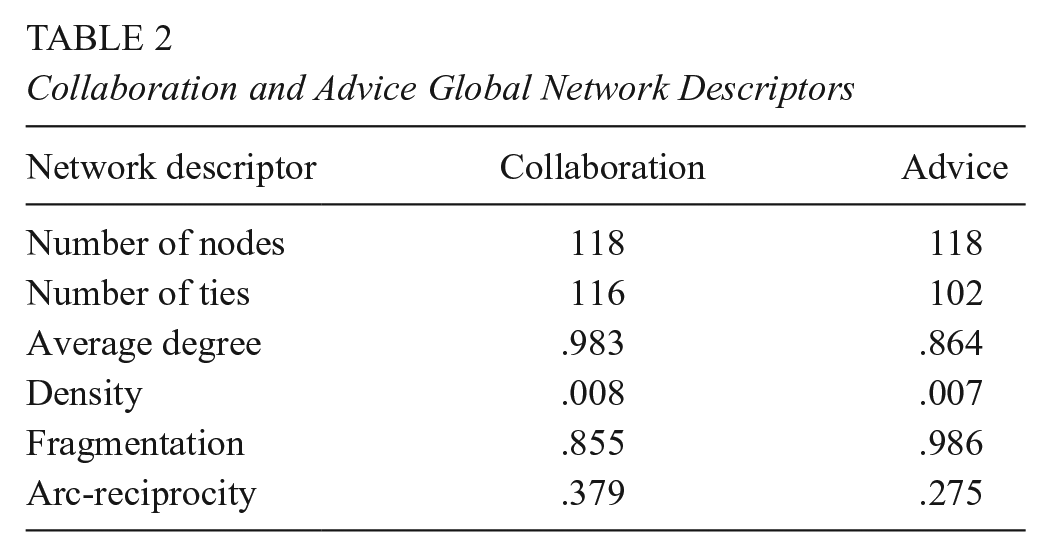
Note that the total number of advice ties is less than the ties in the collaboration network. Also note that arc-reciprocity is greater in the collaboration network than in the advice network. We cannot associate the mode (in-person, phone/text, email, social media, or video conferencing) of communication with the frequency of interactions. However, for the collaboration network including all frequencies of ties, 97% of ties had an in-person component; and for the advice network, 95% of ties had an in-person component. In contrast, only 62% of collaboration ties, and only 67% of advice ties used any form of technology.
There are many similarities between the collaboration and advice networks, as shown in Figure 1 (collaboration network) and Figure 2 (advice network). Both show a high number of isolates, which are located on the outer edges of the sociogram. For most regions, ties are found in very small, fragmented groups. The exception (Region 4, shown on the bottom left) is a denser network of teachers, but still contains a large proportion of isolates. Additionally, Region 3 (shown on the bottom right) contains several cohesive fragments. Of the 118 nodes shown, 28% are isolates in the collaboration network and 30% in the advice network. When looking at the distribution of ties, 92% of collaboration ties and 95% of advice ties are between teachers within the same rural regions.

Collaboration network.

Advice network.
Although the advice network has a similar structure to that of the collaboration network, there are some notable differences. This network is even more fragmented, with more separate subgroups of teachers. In comparing the node-size (proportional to the in-degree in each network), there is greater variation in the size of nodes in the advice network than in the collaboration network. This means that there are some teachers more likely to be asked for advice compared to their peers. Additionally, there are differences in the specific ties between the two networks; some connections that are present in the collaboration network are not present in the advice network, and some of the ties present in the advice network are not in the collaboration network.
Research Question 2: Role of Homophily and Propinquity
To understand the roles of homophily and propinquity in these networks, we used analyses at the dyad level to determine which attributes were related to the formation of a tie. Two common predictors of tie formation include homophily and propinquity. For both networks, we tested whether teachers of the same gender, who both teach biology, and who both teach chemistry were more likely to form ties. Results are reported in Table 3. In many social networks, race and ethnicity are predictors of tie formation. However, there was not enough variation in our population to test this. The LR-QAP analyses regressing collaboration and advice ties on three same-attribute matrices found that no factors tested for homophily were statistically significant.
Regressions Between Homophily Matrices

Note. LR-QAP regressions; 20,000 permutations.
Propinquity is the tendency of an actor to form ties with alter-egos that are physically close. In this very rural and widespread network, we chose to model distance in two different ways. First, we constructed a matrix of the driving distance between schools using Google Maps. The distances were dichotomized so that distances of greater than 50 miles were recoded as zero (indicating “far), and distances less than or equal to 50 miles were recoded as one. Second, a rough estimate of propinquity could be described as teaching within the same district, as districts have geographically defined borders. This is only a rough estimate, though, as many rural districts serve a large geographic area. The LR-QAP analyses regressing collaboration and advice ties on both driving distance and same district found that distance measures were strong predictors of tie formation in the collaboration and advice networks, as shown in Table 4. Working in the same district was a significant predictor of tie formation. Additionally, teachers that worked in schools less than 50 miles apart were much more likely to identify a collaboration or advice tie. A QAP analysis regressing geodesic distance on driving distance found that increased driving distances significantly predicted greater geodesic distances within the network (β = .178, p < .001). As driving distance increased, geodesic distance also increased, and the probability of a tie formation decreased.
Regression Coefficients between Distance and Formation of Ties
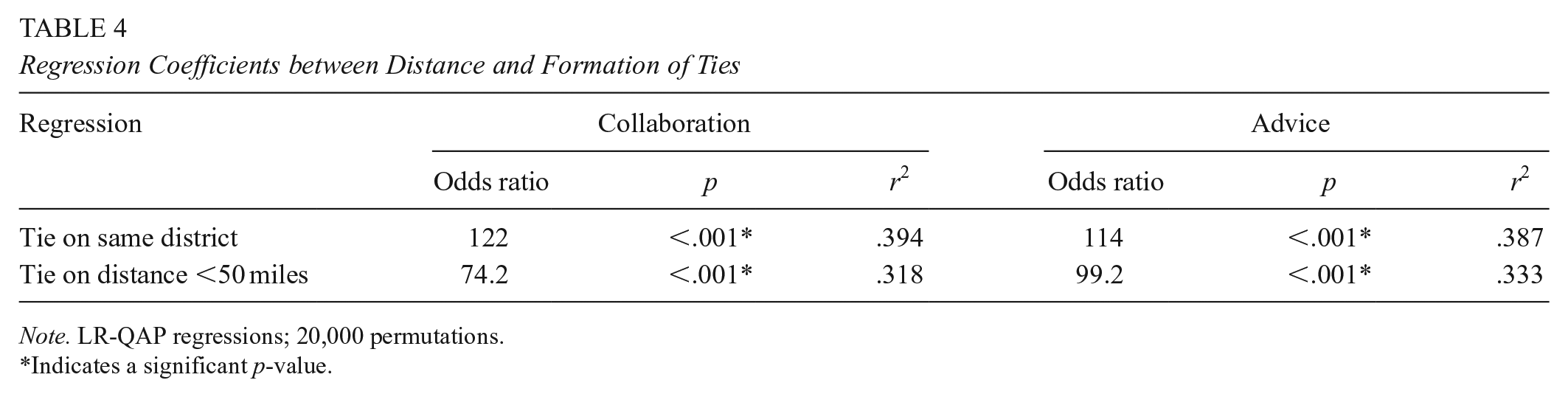
Note. LR-QAP regressions; 20,000 permutations.
Indicates a significant p-value.
Discussion
The teachers in this population have characteristics that are similar to teachers in other rural regions. The vast majority of the teachers were Caucasian, similar to other rural teacher populations across the United States (Schaeffer, 2021). Many teach multiple subjects and take on additional roles within their schools (Berry & Gravelle, 2013; Biddle & Azano, 2016; Hammer et al., 2005). The high turnover rates and staffing challenges among rural science teachers that have been reported previously (Goldhaber et al., 2020; Nguyen, 2020) were also seen in this population that has a mode of 3 years of teaching and skews heavily toward less experienced teachers. While rural communities are quite diverse, with each community having a unique history, culture, and social makeup (Brown et al., 2000; Lichter & Brown, 2011), these similarities between the population in this study and other rural teacher groups may indicate that the results are generalizable to other rural contexts.
Prior reports have characterized the extreme professional isolation that rural teachers experience (Anttila & Väänänen, 2013; Burton et al., 2013). This study explores the extent of rural science teachers’ professional isolation by investigating formal and informal, instrumental and expressive networks in the form of collaboration and advice. One in every four of the teachers in this study are isolates, those who identified zero other rural science teachers to collaborate with or seek advice from. On average teachers had less than one tie to another science teacher. While these teachers may have access to other forms of professional support, if the goal is to build capacity for 3D science teaching, collaboration with colleagues around science instruction has been demonstrated as an effective strategy (Allensworth et al., 2022). The absence of opportunities for collaboration with teachers of the same subject creates a professional environment where rural science teachers are asked to teach 3D science without access to material or social supports that would enable their success.
Of particular concern is the number of isolates among our population. There are many reasons why teachers may experience the level of professional isolation observed in this study. Because effective collaboration is frequent and ongoing (Darling-Hammond & Richardson, 2009), we focused on connections that were monthly or more frequent. Less frequent collaboration and advice ties identified by teachers may partially fill some of the gaps in teachers’ professional isolation. Additionally, rural teachers may form supportive connections with nonrural science teachers who were not included in our defined population. Additional research, such as ego-network studies, may better address these other potential connections. The sparsity of connections may also be due to geographic barriers and the nature of teaching in small schools. This isolation is exacerbated by the lack of access to organized structures to support collaboration and other ties (Woodland & Mazur, 2019). Because geographic distances hinder in-person collaboration and communication, districts should also consider ways to use technology to bridge geographically isolated areas in addition to the benefits of in-person communication and collaboration. Other means of communication remain an underutilized resource given the extreme sparsity of professional connections.
The structures of the collaboration and advice networks are easily accommodated within the organizational structures that exist in this state. There are very few ties that cross regional service center administrative boundaries, and the vast majority of ties are among teachers within the same school district. This suggests that the actions of the regional service centers and individual districts to encourage collaboration among teachers are crucial to creating a healthy professional support system for rural science teachers. However, the network structures of individual districts varied dramatically within this population. In some districts, all teachers were isolates; while in other districts, the density of connections was close to unity. This further suggests that district policies can impact the professional experiences of teachers, and understanding the relationships between formal district or administrative structures and tie formation is an area for further research. Additionally, given the low density of connections in the networks generally, it is likely that there are additional roles for the regional service centers to create community among the teachers in districts and schools that they serve. Such partnerships may support greater equity among larger, well-resourced districts and smaller, underresourced districts within the rural regions of the state (Bridwell-Mitchell, 2017).
Collaboration is commonly organized on a district or school level where teachers are grouped based on the subjects they teach and required to collaborate in some form. In contrast, whom to seek advice from is a decision made by the individual teacher and based on perceived expertise and trust. The collaboration and advice networks were moderately correlated, indicating that formal opportunities to collaborate likely result in teachers identifying others from whom they can seek advice (Horn et al., 2020), although the causality of this relationship was not studied here. The difference in arc-reciprocities and in-degree between the collaboration and advice networks highlights an additional aspect of professional isolation. Higher in-degree and lower arc-reciprocity in the advice sociogram indicate that some teachers are perceived as having more knowledge or resources to share than others, and these individuals may bear the professional burden of always being the advisor and not having anyone to turn to for advice themselves.
Although most social network analysis studies find evidence that both homophily and propinquity predict tie formation, our results indicate that homophily was not a predictor of ties, while propinquity was a significant predictor of ties. In the collaboration network, which represents more formal district and school structures such as professional learning communities, it is perhaps not surprising that there were no significant homophily-related predictors of tie formation. However, it is notable that teaching the same subject was not a significant predictor of collaboration ties. This suggests that even when formal structures are in place, teachers may not have access to others who teach the same subject, although it is known that teachers benefit from collaboration that is content-specific (Birman et al., 2000; Desimone, 2011). This may be a consequence of other features of the population such as teaching multiple subjects, making it likely that there are no other teachers of the same subject within the school.
Similar findings were observed in the advice network. Although formal collaboration may provide opportunities for teachers to identify like-minded others as potential advice ties, there were no significant homophily predictors in the advice network. This indicates that the existing formal collaborations are insufficient to allow teachers to locate trusted others with expertise within the network. This represents an opportunity for regional service centers, universities (Cornelissen et al., 2015), and other stakeholders to support professional connections among teachers and leaders in different districts (Edwards, 2019; Forfang, 2021; National Association of State Directors of Special Education & Office of Special Education and Rehabilitative Services, 1990).
Although our networks did not show evidence of homophily as a predictor of ties, propinquity played a significant role in tie formation. The vast majority of ties in both the collaboration and advice networks were through in-person interactions. This gives some context to the strong influence of geography on tie formation. In-person collaboration among teachers in schools that are geographically distant may be prohibitively expensive both in terms of time and money resources required. In other words, the geographic distances between schools are the most important barrier to be overcome if we hope to encourage effective collaboration among same-subject teachers about 3D science teaching. This suggests that there may be an opportunity to creatively bridge the geographic divide using technology to bring teachers together. Indeed, there may be no other way to accomplish this type of collaboration. Technology has been used to facilitate meaningful collaboration work among teachers (Durr et al., 2020; Huang et al., 2013), and the use of technology to connect rural science teachers is an area for future study.
It is important to consider how social network theory might apply differently in rural spaces, given the significant influence of geographic closeness on tie formation in this network, and the concomitant geographic and organizational dispersion of rural science teachers. Rather than conceptualizing the conflict between the importance of propinquity and the lack of propinquity in rural networks as an insurmountable challenge, we can recognize the opportunity for creative and novel solutions to the professional isolation of rural science teachers, such as using technology to connect teachers separated by organizational boundaries and large geographic distances. In interventions designed to increase the flow of information and skill within the network, attention must be paid to superorganizational opportunities for connection (Kezar, 2014), such as among teachers from several different schools and districts (Woodland & Mazur, 2019). Additionally, given the strong influence of propinquity on tie formation (Godley, 2008), even when connections take place online (Huang et al., 2013), efforts to strengthen rural science teachers’ professional networks using technology should consider the impact of in-person interactions, where possible, and the frequency and depth of collaboration opportunities (Horn et al., 2020) when in-person meetings are not possible.
Conclusion
This study describes the extreme professional isolation encountered by rural science teachers in a western U.S. state, indicating that there are immense barriers to the sharing of 3D science teaching pedagogical content knowledge in this population. As our understanding of collegial interactions among rural science teachers grows, we will be better positioned to support increased collaboration in ways that build capacity for 3D science teaching for individual teachers and the whole network (Borgatti et al., 2018).
There are important implications of this work for the policies and practices of rural educational leaders. The extreme professional isolation of rural science teachers should compel rural leaders to leverage the existing organizational and administrative structures to facilitate collaboration among teachers in novel ways. In larger districts, more frequent, structured district collaborations may be appropriate. However, for teachers from smaller districts and charter schools to receive the same benefits, cross-district collaboration opportunities must be considered. One promising method districts could adopt for increasing collaboration among rural teachers is Technology-Mediated Lesson Study (Hudson et al., 2024). Similarly, the Expanding Capacity in Environmental Education Project (Li & Krasny, 2019) incorporated opportunities for rural teachers to network. Regional educational service centers, universities, the state offices and boards of education, and informal educational institutions all have a role to play in supporting cross-district collaboration. In these new relationships, it is likely that technology will be required to connect teachers across vast geographical distances by uniting them through professional collaboration with teachers of the same subject.
Footnotes
Declaration of Conflicting Interests
The author(s) declared no potential conflicts of interest with respect to the research, authorship, and/or publication of this article.
Funding
The author(s) disclosed receipt of the following financial support for the research, authorship, and/or publication of this article: This material is based on work supported by the U.S. National Science Foundation under Grant No. DRL-2101383. Any opinions, findings, and conclusions or recommendations expressed in this material are those of the author(s) and do not necessarily reflect the views of the National Science Foundation.
Ethical Approval
This study was reviewed and approved by the Institutional Review Board at Brigham Young University under protocol IRB2021-141.
Open Practices

Authors
TRACY POULSEN is a PhD candidate in the Educational Inquiry, Measurement, and Evaluation Program at Brigham Young University, 150 MCKB, 701 E University Pkwy, Provo, UT 84602;
HEATHER LEARY is an associate professor in the Department of Instructional Psychology & technology at Brigham Young University, 150 MCKB, 701 E University Pkwy, Provo, UT 84602;
ALAN DALY is a professor and chair of the Department of Educational Leadership at the University of California, 9500 Gilman Drive, Mail Code 0070, La Jolla, CA 92093-0070, San Diego;
REBECCA SANSOM is an associate professor of chemistry and biochemistry at Brigham Young University, C161 BNSN, 701 E University Pkwy, Provo, UT 84602;